

Sample Category Title
Mid-US Update: Sterling shines of Brexit optimism, Yen dives as stocks and yield rally
Sterling is so far, and will stay as, the biggest winner today on EU chief Brexit negotiator Michel Barnier's positive comments. Even though the conclusion of the Brexit could still be delayed from October, there is very positive sign that there will eventually be a deal. On the other hand, Swiss Franc is notably much stronger than Euro today as Turkish Lira crisis re-emerges. USD/TRY hits as high at 6.479 today and is currently up 2.45% at 6.42. There are deeps concerns on funding problem of Turkish banks. Even though Euro isn't that strong, it's still much better than others.
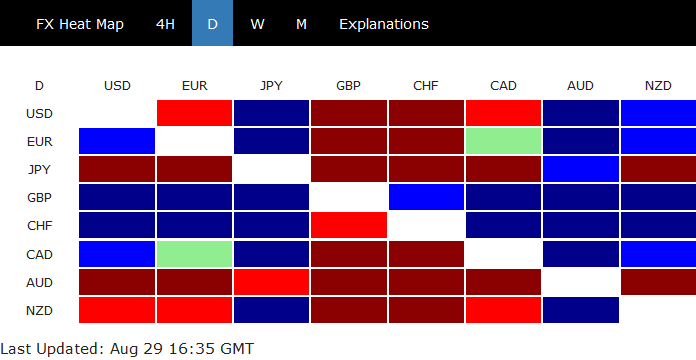
Yen is sold off deeply, and is justly performing marginally better than Australian Dollar. Risk appetite picks up again in US session with NASDAQ and S&P 500 extending record run, with strong momentum. NASDAQ is currently up 0.85%, S&P 500 is up 0.56% and DOW is up 0.34%. Also, if should be noted that German 10 year bund yields surged 0.0246 to 0.406 today, back above 0.4 handle. US 10 year yield is also up slightly. Both are reasons that give Yen heavy pressure. Canadian Dollar also trades with undertone as we're only hearing positive words on trade negotiation with US, but not concrete results yet.
In other markets, FTSE closed down -0.71% thanks to the rally in Sterling. DAX closed up 0.27% while CAC up 0.30%. Gold continues to consolidate in tight range above 1200.
Gold Gains Ground Despite Strong Preliminary GDP
Gold has posted slight gains in the Wednesday session. In the North American trade, the spot price for one ounce of gold is $1204.39, up 0.26% on the day. On the release front, Preliminary GDP jumped 4.2%, beating the estimate of 4.1%. Pending Home Sales disappointed with a reading of -0.7%, well off the estimate of 0.3%. On Thursday, the U.S publishes personal spending and unemployment claims.
It’s full speed ahead for the U.S economy, which posted excellent growth in the second quarter. Preliminary GDP for Q2 was revised upwards to 4.2%, edging above the estimate of 4.0%. This reading was above the initial GDP release of 4.1% back in July. Growth in the second quarter was much stronger than in Q1, which posted a gain of 2.2%. Will the strong data continue in the third quarter? Consumer spending has been strong early in the quarter, but housing data has disappointed, with recent key indicators missing expectations. Although the GDP release beat the estimate, investors the US dollar failed to gain ground, and gold has held its own on Wednesday.
It has been a rough road for gold, which has shed 8.6% of its value since April 1. Months of escalating trade tensions and tit-for-tat tariffs between the U.S and China rocked risk appetite, as the U.S dollar has made strong gains at the expense of other major currencies. Even though gold is a safe-haven asset, it failed to benefit from nervous investors, who flocked to the U.S dollar. A booming U.S economy has also contributed to a strong greenback and weighted on gold prices.
US: Strength in Q2 GDP Shows Up in Corporate Profits
The second estimate of Q2 GDP revised growth up to 4.2 percent. Corporate profits reached a historic high in the second quarter, supported by strength in real final sales and consumer spending.
Revisions to Trade and Software Spending Bump Up Q2 GDP Growing at a slightly faster pace than initially reported, real GDP rose at an annualized rate of 4.2 percent in Q2. As initially reported, consumer spending, business fixed investment and government spending each rose at a solid pace.
Business fixed investment, revised up 1.2 percentage points, led much of the upward revision, with intellectual property products growing 11.0 percent over the quarter. Similarly, a significant downward revision to import growth caused net exports to add a bit more to overall GDP growth.
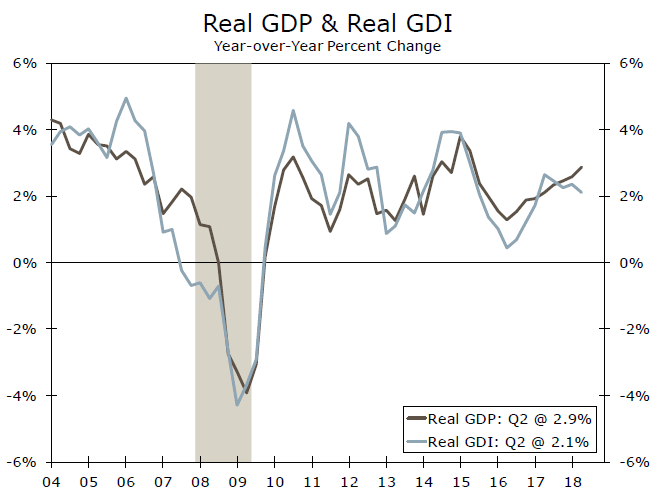
Real gross domestic income (GDI) increased 1.8 percent in the second quarter, and is up 2.1 percent over the past year (top chart). In line with a tight labor market and rising incomes, the average of GDP and GDI is in line with expectations of about 3.0 percent growth this year.
Corporate Profits Reach a Historic High in the Second Quarter
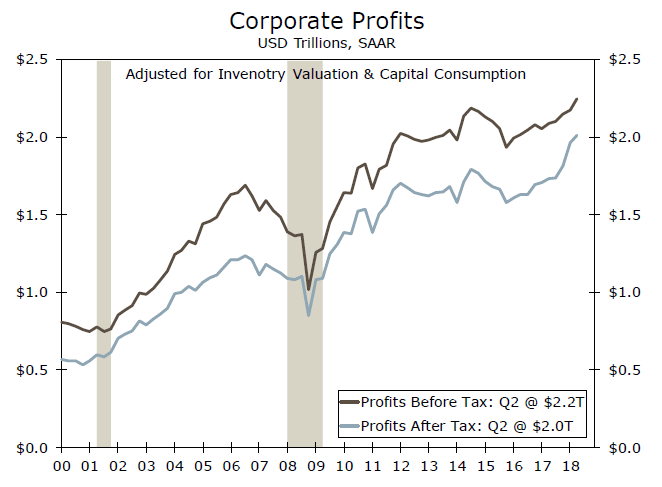
With the second estimate of GDP we received our first look at corporate profit growth in the second quarter. Pre-tax profits grew $72.4 billion over the quarter, nudging the overall pre-tax profit level up to $2.2 trillion, a record high for the series (middle chart). However, after-tax profits rose only $47.3 billion, compared to the near $150 billion surge in the first quarter. This more modest increase was partially due to a rise of nearly one percentage point in the effective corporate tax rate. The deceleration in after-tax profits corroborates our forecast that the effect of the 2017 Tax Cuts and Jobs Act will only act as a temporary boost to corporate profit growth.
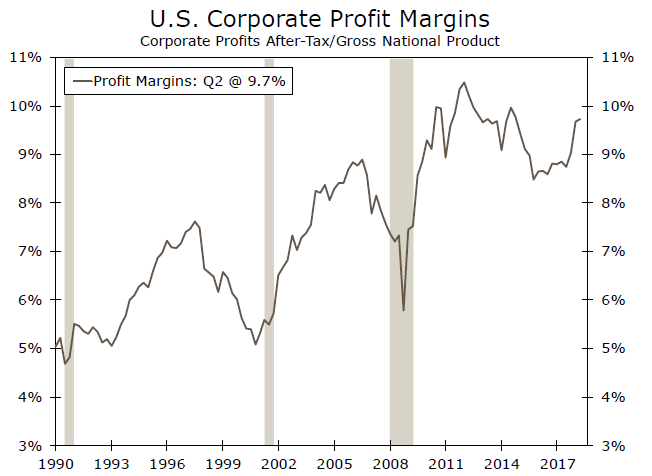
We look for corporate profits to continue to rise in the medium term, due to elevated levels of real final sales and business fixed investment. However, if the strength in equipment spending and intellectual property continues to only translate to modest improvements in productivity, it will likely exert a headwind to corporate profit growth in the future. Similarly, as the economic cycle continues to mature, increasing labor costs will squeeze corporate profit margins (bottom chart). Rising inflation also has the potential to limit real income gains, while higher interest rates may weigh on consumer spending–which would dampen real final sales, all else equal.
While this release was our first look at second quarter profit growth, the initial Q2 GDP release included a benchmark revision, which caused a downshift in the overall profit series throughout this expansion. The benchmark revisions, as well as the larger-than-expected gain in before-tax profits, will likely cause us to bump up our corporate profits forecast.
We have found that pre-tax profits traditionally peak about five-to-eight quarters prior to a recession. While we are not expecting a recession in our forecast horizon, we will continue to monitor signs of a peak in the profits series, and adjust our forecast accordingly.
British Pound Hits 1.30 as EU’s Barnier Offers UK Strong Ties
GBP/USD has posted strong gains in the Wednesday session. In North American trade, the pair is trading at 1.2986, up 0.89% on the day. On the release front, British shop price inflation posted a gain of 0.1%, the first gain since April 2013. U.S Preliminary GDP jumped 4.2%, beating the estimate of 4.1%. Pending Home Sales disappointed with a reading of -0.7%, well off the estimate of 0.3%. There are no British events on the schedule. On Thursday, the UK releases Net Lending to Individuals and GfK consumer confidence. The U.S publishes personal spending and unemployment claims.
With the Brexit negotiations stalled, investors becoming increasingly jittery about the prospects of the UK economy in the post-Brexit era. On Wednesday, Prime Minister May said that a ‘no deal’ Brexit would “not be the end of the world”, but it’s doubtful that the business sector would second her sentiment. Given the uncertainty over Brexit, the markets pounced on some good news on Wednesday, which came in the form of comments from Michel Barnier, chief Brexit negotiator for the EU. Barnier said that the bloc was prepared to offer Britain a special relationship, which could include foreign and security ties. At the same time, Barnier warned that “there is no single market a la carte”.
The U.S economy continues to sparkle. Preliminary GDP for Q2 was revised upwards to 4.2%, edging above the estimate of 4.0%. This reading was above the initial GDP release of 4.1% back in July. Growth in the second quarter was much stronger than in Q1, which posted a gain of 2.2%. Will the strong data continue in the third quarter? Consumer spending has been strong early in the quarter, but housing data has disappointed, with recent key indicators missing expectations. The strong GDP has not affected the likelihood of rate hikes in the second half of 2018. The Fed has already raised rates twice this year, and a September hike is practically a given, with the CME Group estimating the odds of a hike at 96%. The odds of a December hike currently stand at 70%.
NZDUSD Bounces Back from 2½-Year Low But Remains Bearish Below Ichimoku Cloud
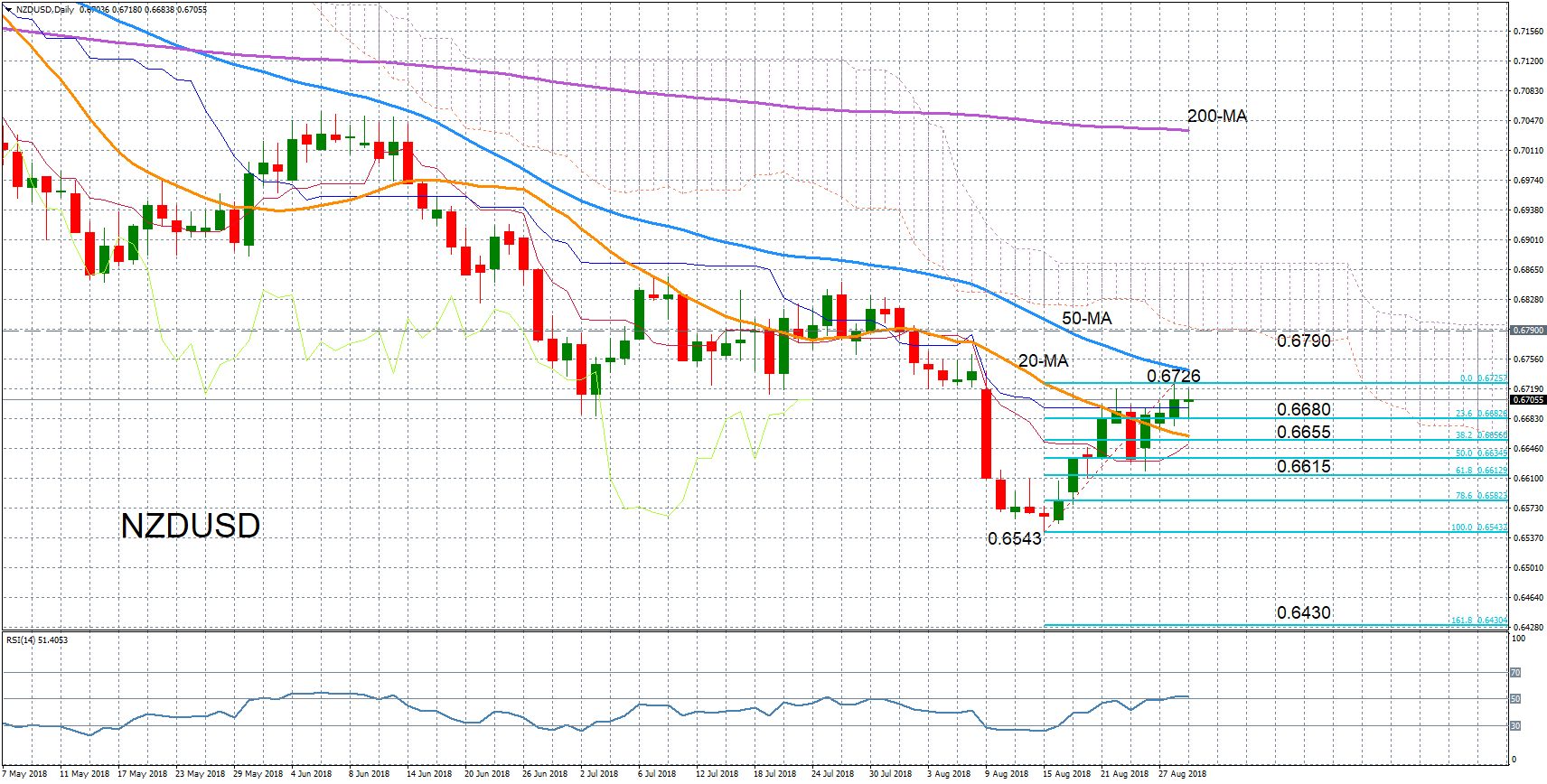
NSDUSD has rebounded by almost 3% from the 2½-year low of 0.6543 touched on August 15. The downside pressure has eased for now, at least in the short term, with price action moving above the 20-day moving average (MA). However, additional gains look doubtful as the RSI appears to have peaked around the 50-neutral level, indicating lack of momentum in either direction in the near term.
To extend the rebound, prices would need to overcome nearby resistance at Tuesday’s near 3-week top of 0.6726. A climb beyond this level would help strengthen the upside momentum and drive the pair towards the 50-day MA, which currently stands at 0.6743. A successful challenge of the 50-day MA would open the way towards the bottom of the Ichimoku cloud, which would likely provide strong resistance around 0.6790.
A break inside the cloud would help shift the bearish medium-term picture to a neutral one.
However, if NZDUSD was unable to sustain its short-term uptrend and reversed lower again, immediate support should come from the 23.6% Fibonacci retracement level of the upleg from 0.6543 to 0.6726 at 0.6680, near today’s intra-day low. Not too far below, another potential barrier is the 38.2% Fibonacci level around 0.6655, which happens to lie between the 20-day MA and the Tenkan-sen line of the Ichimoku cloud. A drop below this support area could accelerate the declines, bringing prices back within range of the more than 2-year low of 0.6543, though the 61.8% Fibonacci at 0.6615 could attempt the halt the slide before that.
A breach of the August trough would reinforce the medium-term downtrend and the next major support to watch below that is the 161.8% Fibonacci extension at 0.6430.
Eurozone Economic Sentiment to Ease Further; CPI to Show No Change
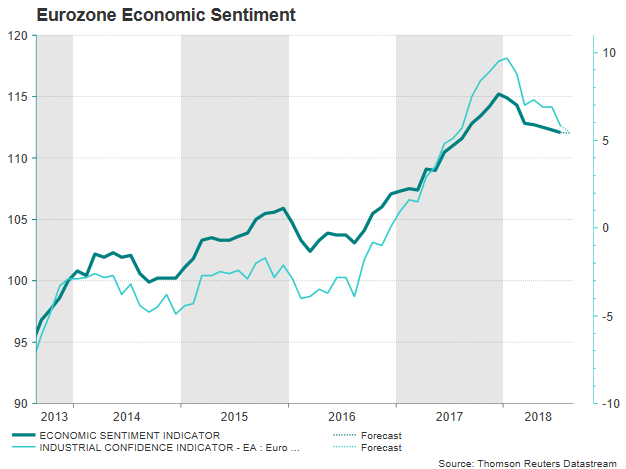
The European Commission is delivering its monthly consumer and business survey results on Thursday at 0900 GMT and forecasts signal that economic sentiment in the 19 countries sharing the euro currency has deteriorated even further in August. While an upside surprise could move the euro higher, traders may stay cautious on their positioning until Eurozone’s August preliminary inflation numbers come out on Friday at 0900 GMT, as those could generate larger volatility to the market given their direct impact on the European Central Bank’s appetite for future rate hikes. Note that price stability is the primary objective of the ECB.
In July, the Eurozone Economic Sentiment index (ESI) pulled back by 0.2 points to 112.1, touching a one-year low, and extending its downtrend from December’s peak of 115.3. The weakness in the index appeared to worsen as managers expectations on future production levels, current order books and stocks of finished goods turned more pessimistic on the back of US steel and aluminum import tariffs as well as on Washington’s warnings of more tariffs on EU cars, pushing the industrial sentiment index lower to 5.8.
New ESI data on Thursday though are not expected to show any improvement yet as analysts believe that in August the measure inched down to 112.0. Meanwhile, its industrial component is anticipated to drop to 5.5, probably reflecting the additional pressure businesses felt on the face of the ongoing US-Chinese tit-for-tat trade game and the inability of these trading powers to find a common ground.
However, Trump’s agreement with the President of the European Commission, Jean Claude Junker, to refrain from imposing tariffs on EU automobiles and continue negotiations could have calmed worries. As much is evident from the latest German Ifo business sentiment data, which surprisingly indicated a stronger recovery than analysts had forecasted, posting the first increase since November. First estimates on the Eurozone’s composite Markit PMI for the month of August also indicated an improvement but disappointingly only a marginal one, while the manufacturing PMI retreated further to the lowest since November 2016. As regards the sentiment in the services sector, the corresponding index is projected to come at 15.1, losing part of last month’s positive momentum which drove the measure to 15.3, the highest since March.
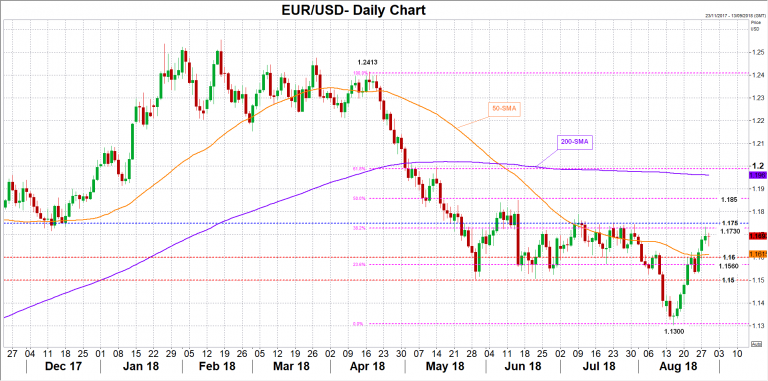
In FX markets, euro/dollar has fully recovered losses made earlier this month, spiking slightly above the 1.1700 key level on Tuesday after touching the more-than-a-year low of 1.1300. Upbeat ESI numbers on Thursday may add hopes that GDP growth in the eurozone could do better in the third quarter, helping the pair to surpass the 1.1700 round level again to hit 1.1750, which the market found difficult to pierce in July. Beforehand, however, bulls would need to overcome 1.1730, which is the 38.2% Fibonacci of the downleg from 1.2413 to 1.1300. A bigger positive surprise in the data could also bring the 50% Fibonacci of 1.1850 on the radar.
On the other hand, a data miss could send the price down to the 1.1600 round level, near the 50-day simple moving average, while slightly lower, the area between the 23.6% Fibonacci of 1.1560 and the 1.1500 mark may attract attention as well ahead of the 1.1300 low.
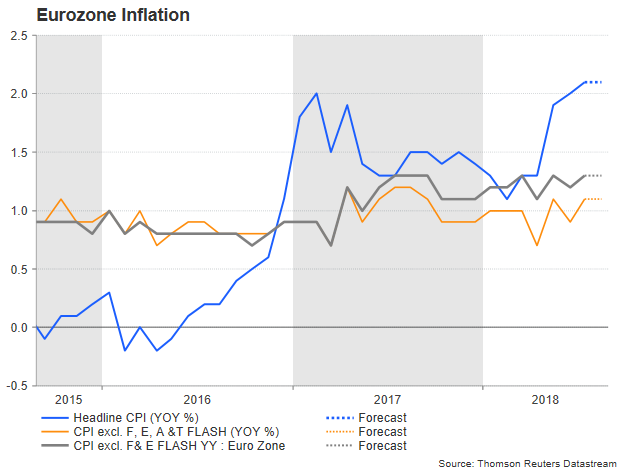
It should be pointed out, however, that investors might react less than usual in the wake of the data, showing patience ahead of the flash harmonized CPI figures out of the bloc on Friday. Initial estimates are anticipated to message that consumer prices overall have grown at a pace of 2.1% y/y in August, the same as in July, expanding at the highest pace since January 2013 and marginally above the ECB’s 2.0% inflation target. Excluding food and energy products, the core measure is also expected to show no change, holding at 1.3% y/y, while the gauge deducting alcohol and tobacco too is seen steady, at 1.1% y/y.
As the termination of the quantitative easing program (QE) by the end of this year is already a well-known story, the focus has switched back into interest rates. Minutes of the latest ECB meeting in July clarified that the central bank won’t do anything about rates until the end of summer 2019, with markets estimating the first hike to come only in October or December next year.
The unpredictable and risky US trade policy, as well as the recent slowdown in the Eurozone’s GDP growth, are among factors that refrain policymakers from raising borrowing costs and should inflation numbers unexpectedly pull back on Friday, the odds for an after-summer rate hike next year could weaken, driving the euro to the aforementioned support levels. Alternatively, if consumer prices advance by more than analysts predicted, taking another step above the ECB’s price target, that could boost the common currency towards resistance levels underlined above as investors would probably turn more confident that a rate hike is on the way.
Loonie Awaits Canadian GDP Data as Trade Talks Commence
Canada’s GDP data for Q2 are slated for release on Thursday, at 1230 GMT. Forecasts point to a material rebound in economic growth, which is likely to be pleasant news for BoC policymakers, and could support the loonie somewhat. That said, the most crucial determinant of the currency’s forthcoming direction may be how the US-Canada trade negotiations play out over the coming days.
The Canadian economy experienced a soft patch in the first quarter of the year, recording a mere 1.3% annualized GDP growth rate during that period amid a slowdown in the housing market and weakness in exports. That said, the Bank of Canada (BoC) has repeatedly stated that it anticipates this softness to have been temporary and economic growth to rebound in the second quarter. Indeed, the nation’s upcoming GDP data are forecast to confirm that, by showing growth clocking in at a robust 3.0% annualized rate in Q2.
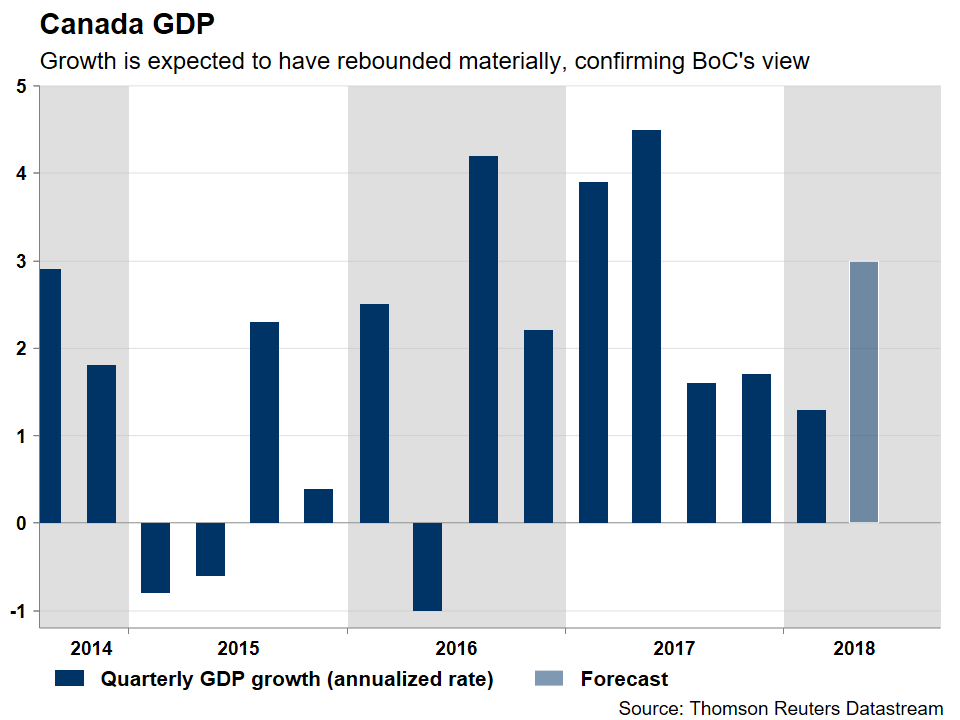
Looking at market pricing, investors have fully priced in one more quarter-point rate increase by the BoC before year-end, while they also assign a 25% probability for a second one, according to Canada’s overnight index swaps. In the more immediate term, the next BoC policy decision is on September 5, and markets currently assign a 43% likelihood for a hike as early as then. With the nation’s unemployment rate hovering at four-decade lows and inflation steadily creeping higher, a strong GDP print for Q2 could well amplify speculation that the Bank may act as early as at the September meeting, and thereby bring the loonie under renewed buying interest.
That said, a far larger determinant of the currency’s forthcoming direction – at least in the short run – may be how, and at what speed, the NAFTA negotiations progress from here. The US and Mexico reached a preliminary accord earlier this week, allowing Canada to now re-engage in the talks to flesh out a trilateral deal. Should there be clear signs that a “full-blown” agreement is close to being completed, that would likely cause the NAFTA risk premium on the loonie to fade, triggering a relief rally. Not to mention such an outcome could also make the BoC more confident in raising rates, as one of the biggest risks to the economy would disappear. The opposite holds true as well, of course. To specify, any hints that the negotiations are likely to drag on for a prolonged period amid disagreements could come as a disappointment for investors anticipating a near-term deal, and may trigger a negative reaction in the loonie.
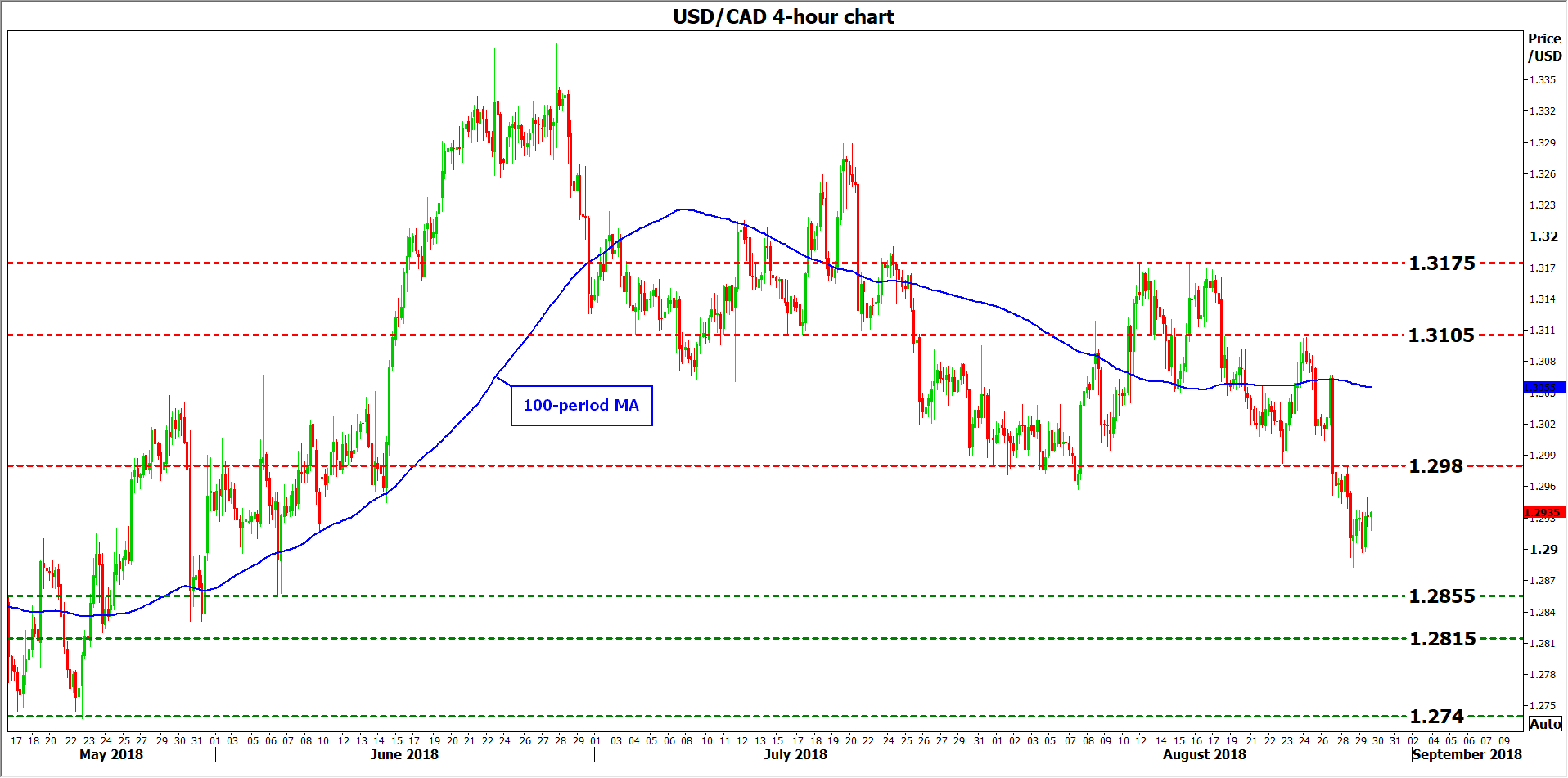
Technically, looking at dollar/loonie, support to declines may come around the 1.2855 zone, marked by the pair’s June 6 low. A downside break could open the door for the 1.2815 hurdle, this being the May 31 trough, before the May 22 low of 1.2740 comes into view.
On the other hand, in case of advances, initial resistance may be found near 1.2980, defined by the inside swing low on August 22. If the bulls pierce above it, the attention would increasingly shift to the 1.3105 mark, identified by the August 24 peak. Even higher, advances may stall near the 1.3175 territory, which halted the pair’s surge twice in mid-August.
Sunset Market Commentary
Markets
Global core bonds traded mixed today with stable US Treasuries outperforming declining German Bunds. We think that the move is mainly technically inspired following the engulfing signal in German yields earlier this week. The eco calendar only contained second tier US eco data. German supply might have played a minor role. The German yield curve bear steepens again at the time of writing with yields 0.7 bps (2-yr) to 2.7 bps (30-yr) higher. The 10-yr yield moved above the 0.4% mark. US yield changes vary between + 0.2 bps and +0.5 bps. As the US trading session gets going, they show tentative signs of gaining some more upward traction as well. 10-yr yield spread changes vs Germany are almost unchanged with Italy outperforming (-4 bps). 5SM leader Di Maio denied a La Stampa report this morning suggesting that the Italian government is pushing the ECB to start a new round of QE in order to protect Italy from financial speculation and to avoid rating downgrades. Fitch reviews the Italian BBB rating this weekend. We don’t expect a downgrade yet, but the outlook will likely become negative.
There was little hard news to guide USD trading today. The risk rally that fueled the USD decline of late slowed. The US currency regained a few ticks against the euro in technical trade. EUR/USD returned to the mid-1.16 area, but the pair is holding well within the 1.15/1.1850 trading range. US Q2 GDP was revised slightly higher to 4.2% Q/Qa (4.0% was expected), but the revision was too small to have an impact on USD trading. In the absence of other (eco) news, USD traders are looking for guidance from the equity markets/global risk sentiment. For now, global sentiment (especially on US equity markets) is not too bad, preventing a return of safe haven flows to the dollar. EUR/USD trades currently in the 1.1675/80 area. USD/JPY gains slightly ground in a daily perspective (111.35 area) but the broader picture remains indecisive.
Sterling succeeded a modest comeback today after recent losses. We didn’t see a specific trigger. Sterling initially held near recent lows against the euro this morning as markets pondered the significance of a rumored delay to November for the EU and the UK to strike a Brexit divorce deal (instead of the October EU summit). Brexit headlines this time didn’t cause additional damage for sterling, contrary to what was the case recently. The UK currency even staged a technical rebound, especially against the euro. EUR/GBP is currently trading in the 0.9060 area. Cable even regained a few ticks even as the dollar was better bid across the board. The technical picture for sterling remains fragile, despite today’s ‘rebound’. We don’t anticipate a sustained comeback.
News Headlines
The central bank of Turkey has announced it will reintroduce borrowing limits for banks’ overnight transactions. It will double the limits from levels which applied before August 13, when the central bank offered unrestricted funding. It then removed the borrowing limits in response to stress in the market.
Nafta trade talks will continue tonight with Canada’s Foreign Minister Chrystia Freeland expected to visit Washington to negotiate with US Trade Representative Robert Lighthizer. The duo is said to discuss possible Canadian concessions on the import of US dairy products, which is a key request of the Trump administration.
Argentine President Mauricio Macri said today that he asked the IMF to accelerate disbursements from the $50 billion credit line that was granted after the country was immersing in a financial crisis in June. Argentina then received the first $15 billion of the program and was expected to receive another $3 billion in September.
GBP Spikes on Barnier Brexit Comments
Michel Barnier triggered a rally in the pound on Wednesday, offering hope to the UK that a bespoke deal can be agreed on the divorce ahead of the upcoming deadline.
The news earlier in the day had been less positive, with reports suggesting that high level officials are not optimistic of an agreement ahead of the EU summit in the middle of October. This acknowledgement from Barnier that they are prepared to offer a partnership that has never existed with another third country – a significant shift from the previous position that the UK must choose a pre-existing model in any future relationship – suggests the EU is ready to soften its opposition on certain issues in order to speed up negotiations.
While this doesn’t mean the EU’s red lines have changed – in fact he explicitly confirmed that they must be respected, along with the UK’s – it does suggest that more constructive conversations can happen to find a workable solution that suits both sides, should one exist. That’s a big change from the focus on punishing the UK for voting to leave which appears to have been the case for the last two years.
Traders have responded very positively to these comments, with the pound rising close to 1% and back towards 1.30 against the dollar, from below 1.29 before the comments, and a similar amount against the euro. Traders have become very concerned about negotiations in recent months, particularly the increased talk of no deal Brexit and these comments will at least start to alleviate those concerns. There’s still a long way to go but it would appear Theresa May and her teams charm offensive across Europe over the summer may be working.
Yen Steady as US GDP Within Expectations, Japanese Retail Sales Next
The Japanese yen is steady in the Wednesday session. In North American trade, the pair is trading at 111.45, up 0.23% on the day. On the release front, Japanese consumer confidence edged lower to 43.3, just below the estimate of 43.4 points. In the U.S, Preliminary GDP jumped 4.2%, beating the estimate of 4.1%. Pending Home Sales disappointed with a reading of -0.7%, well off the estimate of 0.3%. Later in the day, Japan releases retail sales, which is expected to drop to 1.3%. On Thursday, the U.S publishes personal spending and unemployment claims. Japan will release Tokyo Core CPI.
The U.S economy continues to sparkle. Preliminary GDP for Q2 was revised upwards to 4.2%, edging above the estimate of 4.0%. This reading was above the initial GDP release of 4.1% back in July. Growth in the second quarter was much stronger than in Q1, which posted a gain of 2.2%. Will the strong data continue in the third quarter? Consumer spending has been strong early in the quarter, but housing data has disappointed, with recent key indicators missing expectations.
Japanese inflation numbers have been a mix this week. BoJ Core CPI, the Bank of Japan’s preferred inflation indicator, improved to 0.5%. Earlier in the week, National Core CPI remained pegged at 0.8%, shy of the estimate of 0.9%. The Services Producer Price Index edged lower to 1.1%, missing the estimate of 1.2%. Despite an ultra-accommodative monetary policy, inflation remains well below the BoJ target of just below 2 percent. Rather than reduce the inflation target, the Bank will likely postpone yet again the timeline for its 2% target to fiscal year 2020 or beyond. Massive quantitative and qualitative easing have failed to coax inflation higher, so policymakers may have to consider other means of fiscal easing in order to encourage more spending and push inflation higher. The markets will get another look at inflation on Thursday, with the release of Tokyo Core CPI. The indicator is expected to remain unchanged at 0.8%.