

Sample Category Title
Sterling Surged on Brexit Deal Optimism, New Zealand Dollar Tumbles on Business Confidence
Sterling surged overnight as boosted by comments from EU indicating that they're committed to a deal Brexit deal with the UK. The Pound remains firm in Asian session and is now the strongest one for the week. Swiss Franc is mixed in Asia but remains the second strongest one. Reemergence of Turkish Lira crisis is a factor that pressures the Euro and lifts the Franc. USD/TRY is now back at 6.47, comparing to 5.69 just two weeks ago, with risk of heading back to 7.00 handle. Canadian Dollar is steady today but it's the third strongest one for the week. Negotiation between Canada and US appears to be progressing well, and it's hopeful for a deal by Friday. On the other hand, Australian and New Zealand Dollar are staying as the weakest, with fresh selling seen in Kiwi after terrible business confidence data.
In other markets, S&P 500 and NASDAQ extended recent record runs overnight. And more importantly, both picked up momentum again. S&P 500 closed up 0.57% at 2914.04, a record. NASDAQ gained 0.99% to 8109.69, also a record. DOW also rose 0.23% to 26124.57. Treasury yields were mixed with five year yield up 0.006 at 2.780, 10 year yield flat at 2.884 and 30 year yield down -0.013 at 3.021. Positive sentiments didn't carry through to Asia though. Nikkei pared back initial gain and is just up 0.17% at the time of writing. Hong Kong HSI is down -0.61%, China Shanghai SSE is down -0.81%, Singapore Strait Times is down -0.71%. Gold stays in tight range as consolidation continues, but holds above 1200.
Technically, GBP/USD's rebound should have confirmed medium term bottoming at 1.2661 and we'd see more upside 1.3316 fibonacci level. EUR/USD is already close to equivalent level at 1.1779. EUR/USD could feel some "heaviness" ahead of 1.1779. Meanwhile, EUR/CHF's break of 1.1363 suggested that rebound from 1.1242 might have completed earlier than expected at 1.1452 and deeper fall is in favor. On the other hand, it looks like GBP/CHF has bottomed out just ahead of 1.2500 handle. All factors combined could give EUR/GBP extra selling pressure. That is, while EUR/GBP is still trading inside rising channel, such bullishness could be challenged. The interactions between these pairs would be a joy to watch, even if you're not trading them.
EU Barnier to offer unparalleled partnership to UK after Brexit
EU chief negotiator Michel Barnier said that the EU is prepared to offer a partnership with UK unlike with another other country. That's seen as a gesture that EU is committed to a deal. Barnier said in Berlin that "we are prepared to offer Britain a partnership such as there never has been with any other third country." And, "we respect Britain's red lines scrupulously. In return, they must respect what we are," he said. "Single market means single market … There is no single market a la carte."
Brexit Minister Dominic Raab also told the parliament that a Brexit deal with EU was "within our sights" and the negotiation would intensifies as the divorce date approaches. Raab also added that UK's Brexit plan received positive reactions from EU. He said the plan "had a reasonably positive landing" And "we're getting a lot of constructive engagement, and … a lot of talk about the practical considerations rather than 'in principle' dismissal, and I think that's valuable from our point of view".
Canada-US trade deal (NAFTA?) on track for conclusion by Friday
Canadian Dollar softens mildly in Asian session but remains the third strongest for the week, just behind Sterling and Swiss Franc. Progress in Canada-US trade talks appears to be positive. Comments from Trump and Canadian Prime Minister Justin Trudeau suggested that the negotiations are on track to complete by the end of the week.
Trump told reporters that "they (Canada) want to be part of the deal, and we gave until Friday and I think we're probably on track. We'll see what happens, but in any event, things are working out very well." That's an about turn from his recent hostile comments on Canada.
Trudeau also said "there is a possibility of getting there by Friday". But he also emphasized that it is only a possibility, because it will hinge on whether or not there is ultimately a good deal for Canada." He reiterated that "no NAFTA deal is better than a bad NAFTA deal."
Canadian Foreign Minister Chrystia Freeland, staying in Washington, said "our officials are meeting now and will be meeting until very late tonight. Possibly they'll be meeting all night long". And, "this is a very intense moment in the negotiations and we're trying to get a lot of things done very quickly."
Mexico's President Enrique Pena Nieto also said in a local radio interview that "I am optimistic that a trilateral deal can be reached... we have from now until Friday for a deal in principle to be announced."
New Zealand business confidence plummets, AUD/NZD rebounds on Kiwi selloff
New Zealand ANZ business confidence tumbled by a further -5 pts in August to -50. Meanwhile, Activity Outlook was unchanged at 3.8. ANZ noted that "manufacturing is now the least confident sector – likely a lagged impact from construction sector woes". On the other hand, The services sector is the most optimistic. Also "activity sub-indicators remain weak" and "threat to near-term activity is real."
It's a "particularly sharp turnaround" in the manufacturing sector from being the most optimistic in April, to the most pessimistic in August. Manufacturers' export expectations are holding up. Thus, "this weakness is an echo of construction sector pessimism". Employment intentions "continue to ease" and are weakest in "agriculture and construction sectors". And, "it seems increasingly inevitable that wariness amongst firms will have real impacts, in the near term at least, as investment and employment decisions are deferred."
Also released in Asian session, New Zealand building permits dropped -10.3% mom in July. Australian building approvals dropped -5.2% mom in July, private capital expenditure dropped -2.5% qoq in Q2. Japan retail sales rose 1.5% yoy in July.
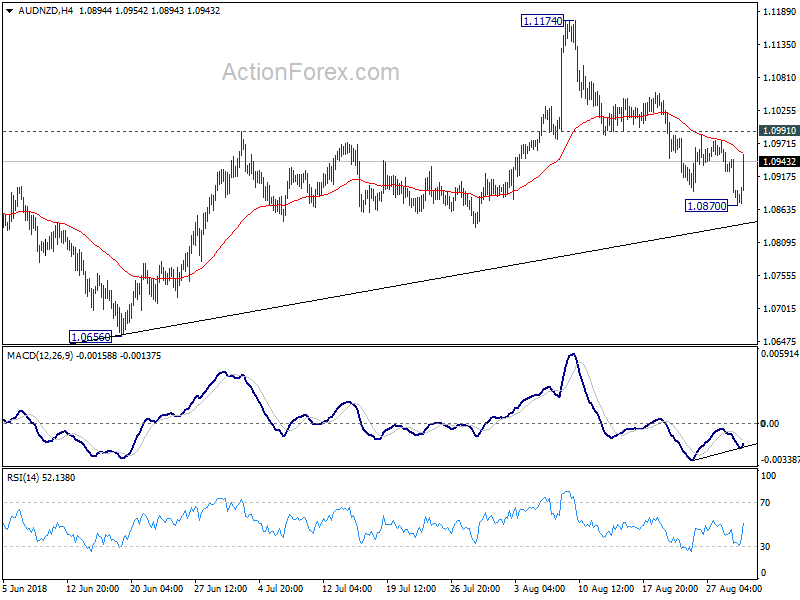
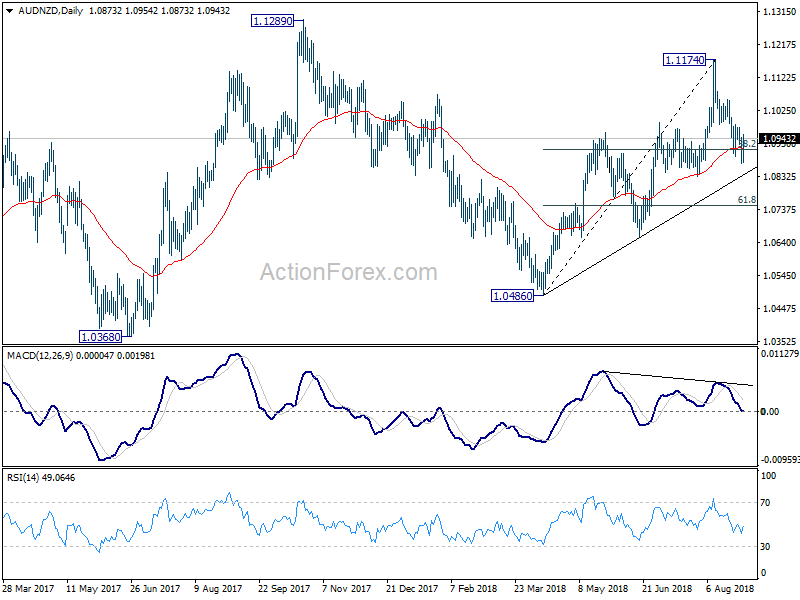
The Australia Dollar isn't a good performer this week, but the New Zealand Dollar is even worse. The strong rebound today suggests temporary bottoming at 1.0870 in AUD/NZD. Given that it was close to medium term trend line support, and there is bullish convergence condition in 4 hour MACD, the decline from 1.1174 is likely finished. Focus is back on 1.0991 minor resistance. Break will at least bring a test on 1.1174 high.
Looking ahead
The economic calendar is rather busy today. Swiss will release KOF economic barometer in European session. Germany will release unemployment and CPI. Eurozone will release confidence indicators. UK will release mortgage approvals and M4.
Later in the day, Canada GDP will be featured which might be important for BoC to decide whether hike in September or October. US will release personal income and spending, with focus on PCE core inflation.
GBP/USD Daily Outlook
Daily Pivots: (S1) 1.2904; (P) 1.2969; (R1) 1.3092; More...
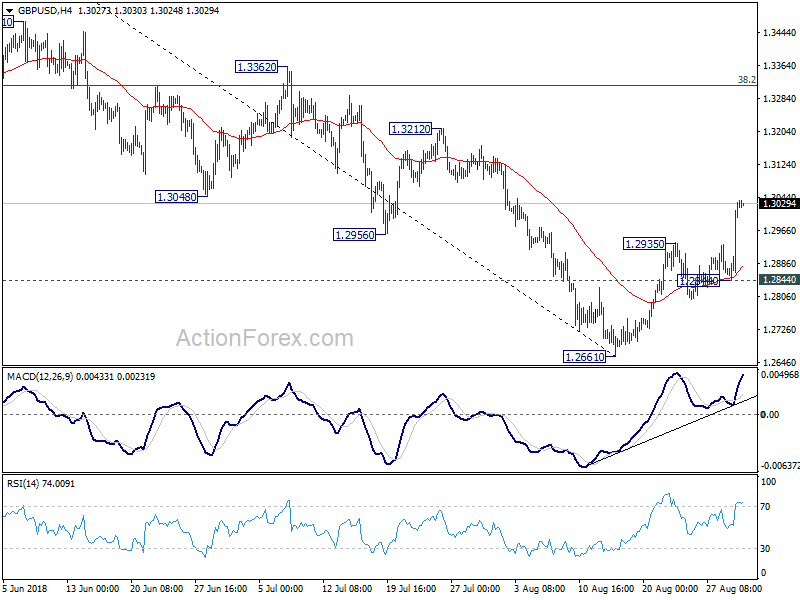
GBP/USD's rebound from 1.2661 extended to as high as 1.3038 so far and intraday bias stays on the upside. Current development suggests medium term bottoming at 1.2661, on bullish convergence condition in daily MACD. Further rise should be seen to 55 day EMA (now at 1.3058) and then 1.3212 resistance. For now, we'd expect strong resistance from 1.3316 fibonacci level to limit upside, at least on first attempt. On the downside, break of 1.2844 support will argue that the rebound is completed and bring retest of 1.2661 low.
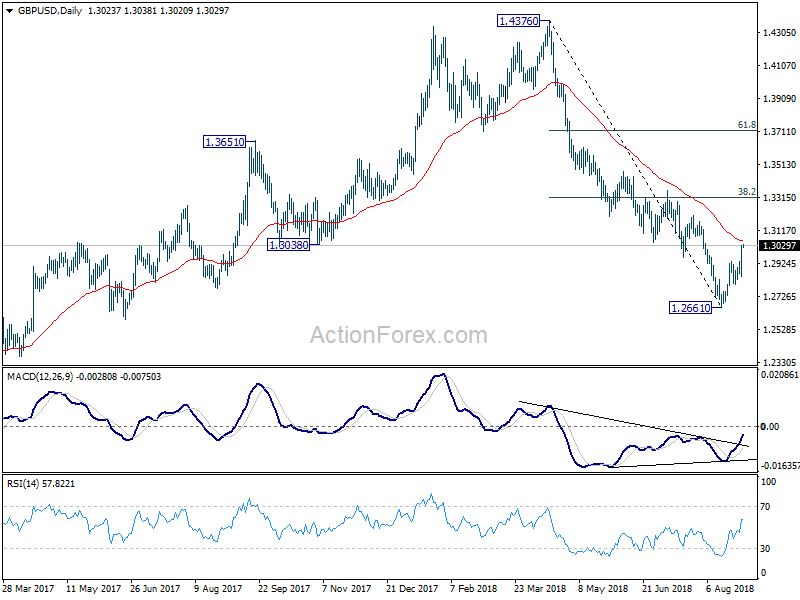
In the bigger picture, whole medium term rebound from 1.1946 (2016 low) should have completed at 1.4376 already, after rejection from 55 month EMA (now at 1.4091). The structure and momentum of the fall from 1.4376 argues that it's resuming long term down trend. And this will be the preferred case as long as 38.2% retracement of 1.4376 to 1.2661 at 1.3316 holds. However, firm break of 1.3316 would bring stronger rebound to 61.8% retracement at 1.3721. And, the eventual depth of the fall from 1.4376, and the chance of hitting 1.1946 low, will depend on the strength of the interim corrective rebound from 1.2661.
Economic Indicators Update
| GMT | Ccy | Events | Actual | Forecast | Previous | Revised |
|---|---|---|---|---|---|---|
| 22:45 | NZD | Building Permits M/M Jul | -10.30% | -7.60% | -8.20% | |
| 23:50 | JPY | Retail Trade Y/Y Jul | 1.50% | 1.30% | 1.80% | 1.70% |
| 1:00 | NZD | ANZ Business Confidence Aug | -50.3 | -44.9 | ||
| 1:30 | AUD | Building Approvals M/M Jul | -5.20% | -1.90% | 6.40% | |
| 7:00 | CHF | KOF Leading Indicator Aug | 101.2 | 101.1 | ||
| 7:55 | EUR | German Unemployment Change (000's) Aug | -8K | -6k | ||
| 7:55 | EUR | German Unemployment Claims Rate Aug | 5.20% | 5.20% | ||
| 8:30 | GBP | Mortgage Approvals Jul | 65K | |||
| 8:30 | GBP | Money Supply M4 M/M Jul | 0.20% | |||
| 9:00 | EUR | Eurozone Business Climate Indicator Aug | 1.25 | 1.29 | ||
| 9:00 | EUR | Eurozone Economic Confidence Aug | 112.2 | 112.1 | ||
| 9:00 | EUR | Eurozone Industrial Confidence Aug | 5.9 | 5.8 | ||
| 9:00 | EUR | Eurozone Services Confidence Aug | 15.2 | 15.3 | ||
| 9:00 | EUR | Eurozone Consumer Confidence Aug F | -0.6 | -1.9 | ||
| 12:00 | EUR | German CPI M/M Aug P | 0.10% | 0.30% | ||
| 12:00 | EUR | German CPI Y/Y Aug P | 2.00% | 2.00% | ||
| 12:30 | CAD | Quarterly GDP Annualized Q2 | 1.30% | |||
| 12:30 | CAD | GDP M/M Jun | 0.20% | 0.50% | ||
| 12:30 | USD | Initial Jobless Claims (AUG 25) | ||||
| 12:30 | USD | Personal Income Jul | 0.30% | 0.40% | ||
| 12:30 | USD | Personal Spending Jul | 0.40% | 0.40% | ||
| 12:30 | USD | PCE Deflator M/M Jul | 0.10% | 0.10% | ||
| 12:30 | USD | PCE Deflator Y/Y Jul | 2.20% | 2.20% | ||
| 12:30 | USD | PCE Core M/M Jul | 0.20% | 0.10% | ||
| 12:30 | USD | PCE Core Y/Y Jul | 2.00% | 1.90% | ||
| 14:30 | USD | Natural Gas Storage | 48B |
Crude Oil Prices Soared on US Inventory Decline and Expectations of Tighter Market
Crude oil prices extended recent rally, as US inventory dropped more than expected and the International Energy Agency (IEA) forecast oil market to tighten towards year end. The front-month WTI crude oil contract gained +1.43% while the Brent contract rose +1.57%. Both benchmarks rebounded, by +4.26% and 5.56% respectively, in the prior week, recovering after selloff in the first three weeks in August.
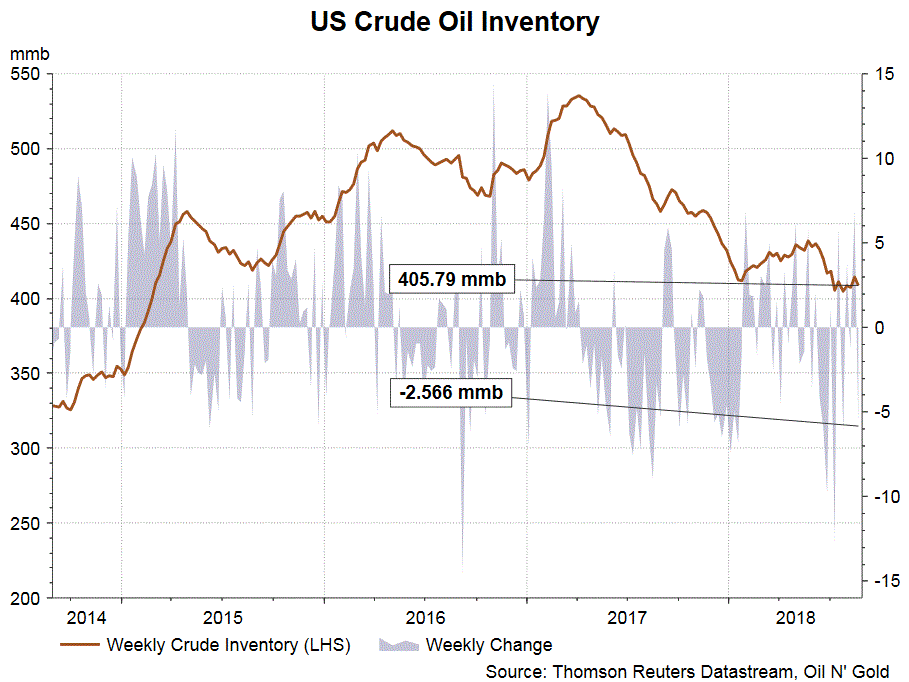
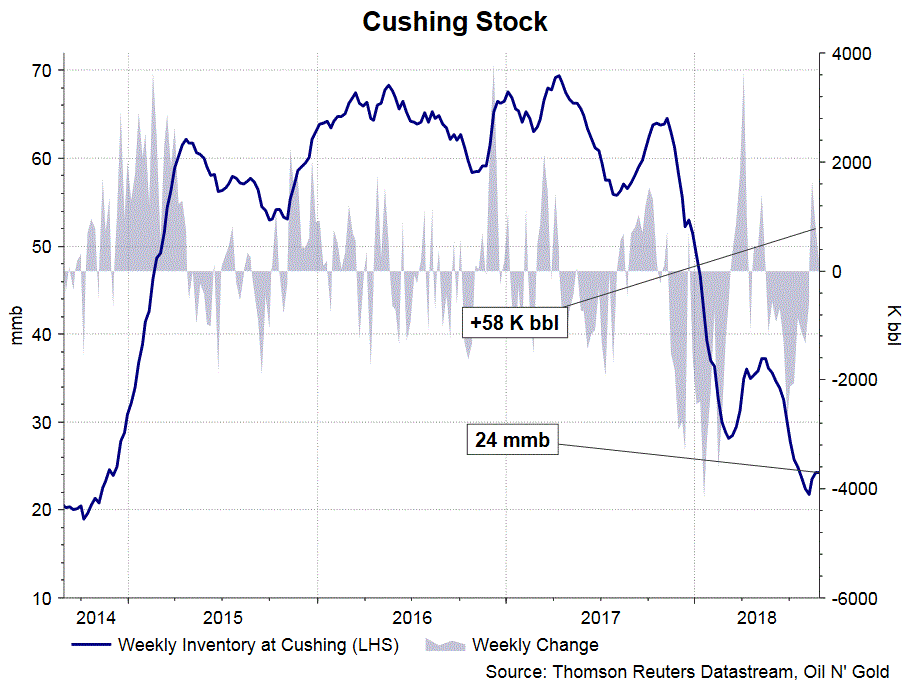
The report from the US Energy Information Administration (EIA) shows that total crude oil and petroleum products stocks fell -1.71 mmb to 1223.06 mmb in the week ended August 25. Crude oil inventory declined -2.57 mmb (consensus: -0.69 mmb) to 405.79 mmb. Inventories decreased -2.84 mmb in PADD I and -1.06 mmb in PADD V. Cushing stock added +0.06 mmb to 24.28 mmb. Utilization rate slipped -1.8% to 96.3%. Meanwhile, crude production steadied at 11M bpd for the week.
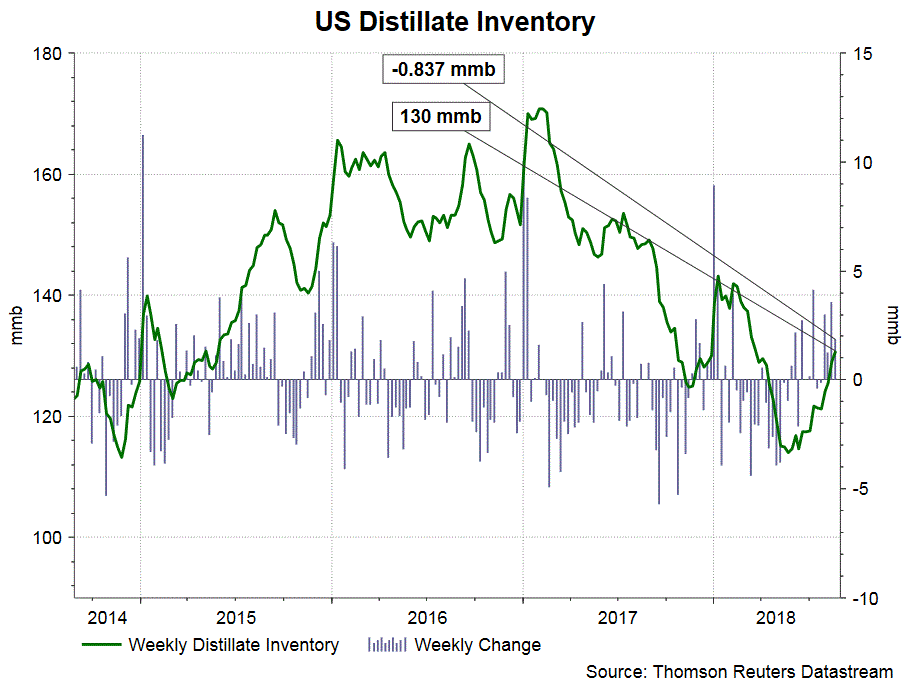
Concerning refined oil product inventories, gasoline inventory dropped -1.55 mmb to 232.77 mmb as demand jumped +4.72% to 9.9M bpd. The market had anticipated a +0.37 mmb decrease in stockpile. Production gained +0.85% to 10.24M bpd while imports soared +6.24% to 0.87M bpd during the week. Distillate inventory slid -0.84 mmb to 130 mmb as demand jumped +9.15% to 4.44M bpd. The market had anticipated a +1.59 mmb gain in inventory. Production declined -4.55% to 5.18M bpd while imports rose +88.97% to 0.27M bpd during the week.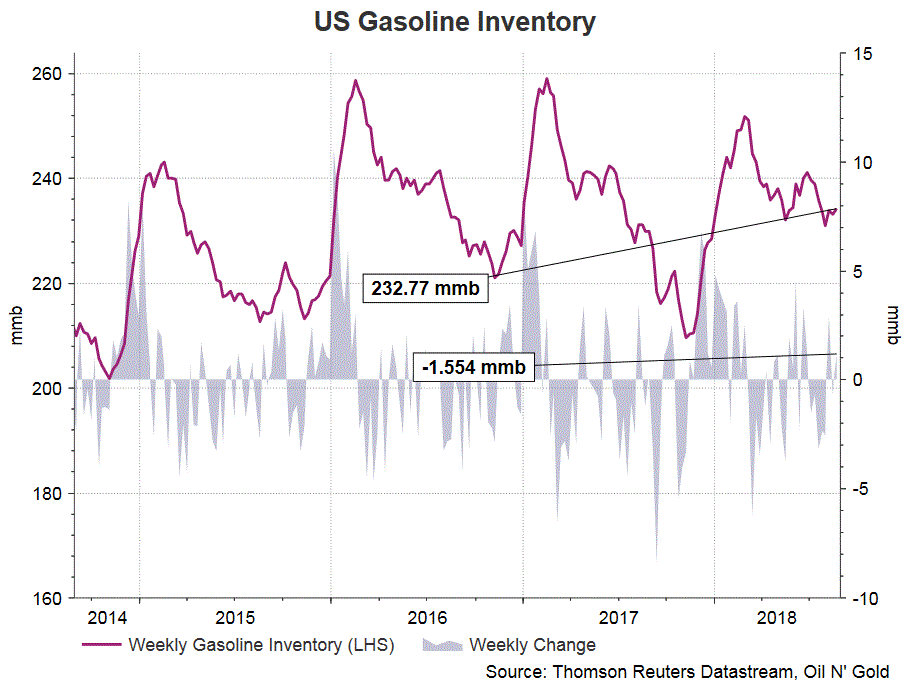
 Released after market close on Wednesday, the industry- sponsored API estimated that crude oil inventory rose +0.04 mmb during the week. For refined oil products, gasoline stockpile added +0.02 mmb while distillate was up +0.98 mmb.
Separately, the IEA's head Fatih Birol noted that oil markets might tighten towards the end of this year, as major oil importing countries, such as India would raise imports. The agency forecast that oil demand growth will remain very strong. This is accompanied with the “fragility of production” in some countries including Venezuela and others in the Middle East.
New Zealand business confidence plummets, AUD/NZD rebounds on Kiwi selloff
New Zealand ANZ business confidence tumbled by a further -5 pts in August to -50. Meanwhile, Activity Outlook was unchanged at 3.8. ANZ noted that "manufacturing is now the least confident sector – likely a lagged impact from construction sector woes". On the other hand, The services sector is the most optimistic. Also "activity sub-indicators remain weak" and "threat to near-term activity is real."
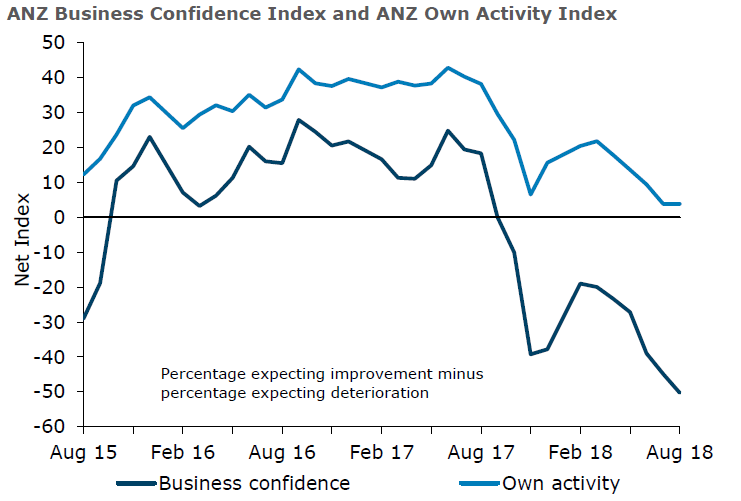
It's a "particularly sharp turnaround" in the manufacturing sector from being the most optimistic in April, to the most pessimistic in August. Manufacturers' export expectations are holding up. Thus, "this weakness is an echo of construction sector pessimism". Employment intentions "continue to ease" and are weakest in "agriculture and construction sectors". And, "it seems increasingly inevitable that wariness amongst firms will have real impacts, in the near term at least, as investment and employment decisions are deferred."
Also released in Asian session, New Zealand building permits dropped -10.3% mom in July. Australian building approvals dropped -5.2% mom in July, private capital expenditure dropped -2.5% qoq in Q2. Japan retail sales rose 1.5% yoy in July.
The Australia Dollar isn't a good performer this week, but the New Zealand Dollar is even worse. The strong rebound today suggests temporary bottoming at 1.0870 in AUD/NZD. Given that it was close to medium term trend line support, and there is bullish convergence condition in 4 hour MACD, the decline from 1.1174 is likely finished. Focus is back on 1.0991 minor resistance. Break will at least bring a test on 1.1174 high.
Canada-US trade deal (NAFTA?) on track for conclusion by Friday
Canadian Dollar softens mildly in Asian session but remains the third strongest for the week, just behind Sterling and Swiss Franc.
Progress in Canada-US trade talks appears to be positive. Comments from Trump and Canadian Prime Minister Justin Trudeau suggested that the negotiations are on track to complete by the end of the week.
Trump told reporters that "they (Canada) want to be part of the deal, and we gave until Friday and I think we're probably on track. We'll see what happens, but in any event, things are working out very well." That's an about turn from his recent hostile comments on Canada.
Trudeau also said "there is a possibility of getting there by Friday". But he also emphasized that it is only a possibility, because it will hinge on whether or not there is ultimately a good deal for Canada." He reiterated that "no NAFTA deal is better than a bad NAFTA deal."
Canadian Foreign Minister Chrystia Freeland, staying in Washington, said "our officials are meeting now and will be meeting until very late tonight. Possibly they'll be meeting all night long". And, "this is a very intense moment in the negotiations and we're trying to get a lot of things done very quickly."
Mexico's President Enrique Pena Nieto also said in a local radio interview that "I am optimistic that a trilateral deal can be reached... we have from now until Friday for a deal in principle to be announced,"
Market Morning Briefing: Euro Could Not Break Below Support Near 1.165
STOCKS
There could be some corrective dips in the stock indices globally. Nifty, Dow, Dax and Shanghai could see some corrective dip while Nikkei looks stable just now.
Important resistances above current levels on the 3-day and weekly candles show that the immediate upside could be limited in Dow (26124.57, +0.23%) with a corrective dip soon on the cards. While the resistances hold, the index could come off again towards 26000-25500 levels in the near term.
Dax (12561.68, +0.27%) could fall to 12400 on the downside while the medium term remains to be bullish targeting levels above 12700. While immediate resistance on the daily candle at 12700 holds, a small corrective dip is possible in the near term.
Nikkei (22893.93, +0.20%) dipped back after rising sharply in the initial hour of trading today. While above 22850, if Nikkei struggles to move up in the near term, our expectation of a sharp rise in the medium term could be negated. We would wait for a confirmation as the index could well remain stable this week and start moving up beyond 23000 next week. For now bullish possibilities remain intact.
Shanghai (2759.62, -0.35%) could be stable just now but would find it difficult to move above 2800 in the near term. While below 2800, chances of a fall towards 2700 remains on the cards. A sustained breach above 2800 would be needed to trigger medium term bullishness.
Nifty (11691.90, -0.40%) could have possibly seen a high of 11760 this week. A slight dip in the near term would be more likely towards 11600-11550 levels.
COMMODITIES
Crude prices have risen on news of some indication that the Iran sanctions may limit supply globally without possibly hurting the demand from China. But the prices could face some rejection from resistance levels in a couple of sessions. With the EIA report yesterday stating a decline in the domestic supply by 2.6 mln barrels (for week ended 24th Aug) and earlier report of API stating a rise of 38000 barrels, some analysts feel that the data could tilt the crude prices towards bullishness in the near term.
Brent (77.39) and Nymex WTI (69.67) have both risen as expected and could move towards our mentioned levels of 78 and 70-71 levels in the near term. Note that both 78 and 70-71 levels are immediate resistances and if hold could again push prices down next week.
Gold (1212.90) and Copper (2.73085) are almost stable and could see some ranged movement with a slight downward bias in the next 1-2 sessions. Gold could trade in the 1210-1225 region while copper could be stuck in the 2.70-2.76 region.
FOREX
Some positive sentiment around Brexit talks helped the Pound rally yesterday. Euro also respected an important support, thereby suggesting that it could rise some more in the near term. The Rupee plunged to record lows against USD and might search for a new low in today's session as well.
Euro (1.1701) Euro could not break below support near 1.165 on daily candles yesterday. Chances of an upmove to 1.175 seems to have increased now. Above 1.175, there could be an important resistance near 1.178, and then near 1.1825-1.185.
Dollar Index (94.57) : Contrary to expectation, Dollar Index has broken support near 94.7 on daily candles and now has lower supports near 94.3 and then near 94. Next few sessions could see a further downmove towards these levels.
Dollar Yen (111.64): Dollar Yen might now be starting to turn bullish towards 113 as it saw a high near 111.8 yesterday and looks set to break above 112.2 this week / by early next week.
Euro Yen (130.63): Chances of a break above 131 have again emerged for Euro Yen as Dollar Yen has finally gone above 111.5 and Euro Dollar was unable to break below 1.165. It might target 131.5 this week and then, levels near 132 next week.
Pound (1.3031): Pound has broken above resistance near 1.287 on daily line chart to see a high near 1.3038 already. The 1.303-1.305 zone is a crucial resistance zone, which if breached, would be bullish for Pound. Currently, the preference is for this resistance to hold.
Dollar Rupee (70.5950) : We might see Resistance at 70.70 in Dollar-Rupee today and then at 70.90 over the next few days. Supports seen at 70.40-20 for now.
INTEREST RATES
US GDP growth in Apr-Jun was revised higher from its earlier 4% estimate to 4.2%. This, along with new Treasury note auctions of approx $31 bn helped in raising the US 10 year yield slightly. Earlier, progress on a trade deal between US-Mexico had also helped in the US 10 year yield rising from the crucial 2.81% support . Earlier last week, the US Fed Chairman's comments in the Jackson Hole Conference led some analysts to interpret that a December rate hike by the US Fed might get delayed to 2019. As we have been saying, we need to watch out for whether this belief grows stronger in the markets – if it does, then the May high of 3.125% for the US 10 year yield would be confirmed as the year's top.
US 10 Year Yield (2.88%) : As mentioned yesterday, we would wait for a breach above 2.9% before we abandon the possibility of a downmove below 2.82% in this move. Current preference still remains bearish for the near term. A breach above 2.9% could however lead to another upmove to 3% and then, a dip from there.
Japan 30 year yield (0.84%) is again dipping from crucial resistance @ 0.85%.
Indian 10 Year GOI Yield (7.9176%) is nearing crucial resistance level. A dip from here towards 7.7% could take place. Alternatively, a rise beyond 7.95% is also possible. Preference between both alternatives is currently divided equally.
AUD/USD Facing Significant Resistance Near 0.7350
Key Highlights
- The Australian Dollar was recently rejected near the 0.7350-60 resistance against the US Dollar.
- There is a crucial bearish trend line formed with resistance at 0.7335 on the 4-hour chart of AUD/USD.
- The US GDP in Q2 2018 (Prelim) grew 4.2%, more than the forecast of 4.0%.
- Today, the US Personal Income for July 2018 will be released, which is forecasted to rise 0.3% (MoM).
AUDUSD Technical Analysis
There was a decent recovery from the 0.7235 support by the Australian Dollar against the US Dollar. The AUD/USD pair traded above 0.7300, but it faced a strong resistance near the 0.7350 and 0.7360 levels.
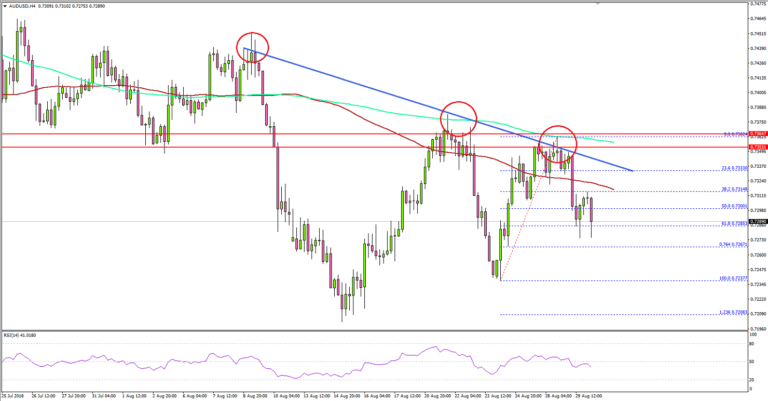
Looking at the 4-hours chart, the pair traded above the 0.7320 resistance and the 100 simple moving average (red). However, the upside move was capped by a significant resistance near 0.7360, which was a support earlier.
Additionally, the 200 simple moving average (green, 4-hours) also acted as a resistance near 0.7362. More importantly, there is a crucial bearish trend line formed with resistance at 0.7335 on same chart.
The pair declined and broke the 50% fib retracement level of the last wave from the 0.7237 low to 0.7362 high. There was also a close below the 0.7320 level and the 100 SMA.
These all are negative signs and indicates that the pair may continue to decline towards 0.7250 and 0.7230 in the near term. To move into a bullish zone, AUD/USD must break the trend line, 200 SMA, and the 0.7360 resistance zone.
Fundamentally, the US Gross Domestic Product report for Q2 2018 (Prelim) was released by the US Bureau of Economic Analysis. The market was looking for a growth of around 4% in Q2 2018.
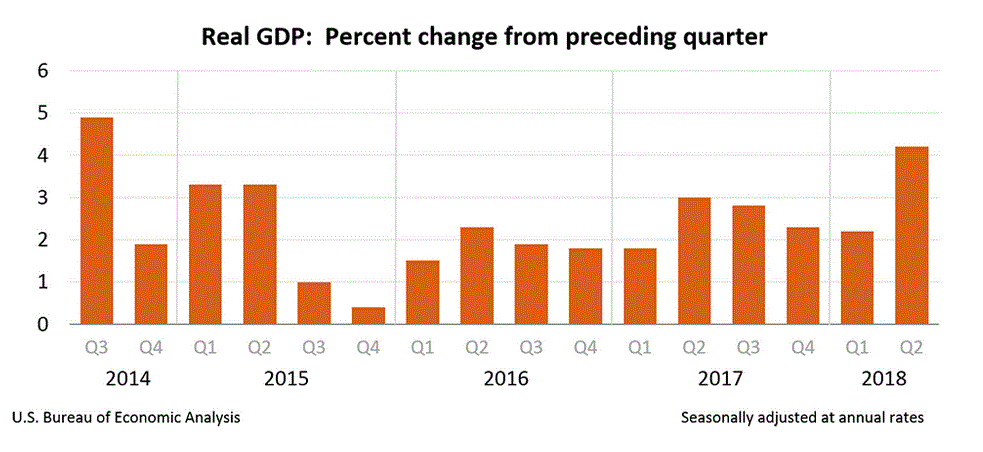
The actual result was better than the forecast as the US GDP grew 4.2% in Q2 2018 as per the “second” estimate. Moreover, the real gross domestic income (GDI) rose 1.8% in Q2 2018. The report added that:
The increase in real GDP in the second quarter reflected positive contributions from PCE, nonresidential fixed investment, exports, federal government spending, and state and local government spending that were partly offset by negative contributions from private inventory investment and residential fixed investment. Imports decreased.
The greenback got traction after the release and there was a pullback noted in GBP/USD and EUR/USD, but both pairs later recovered.
Economic Releases to Watch Today
- German Consumer Price Index for August 2018 (YoY) (Prelim) – Forecast +2%, versus +2% previous.
- German Consumer Price Index for August 2018 (MoM) (Prelim) – Forecast +0.1%, versus +0.3% previous.
- Germany’s Unemployment Change for August 2018 – Forecast -8K, versus -6K previous.
- Germany’s Unemployment Rate for August 2018 – Forecast 5.2%, versus 5.2% previous.
- Euro Zone Consumer Confidence August 2018 – Forecast -1.9, versus -1.9 previous.
- Euro Zone Economic Sentiment Indicator August 2018 – Forecast 112.0, versus 112.1 previous.
- US Personal Income for July 2018 (MoM) – Forecast +0.3%, versus +0.4% previous.
- US Initial Jobless Claims – Forecast 214K, versus 210K previous.
USDCHF – Bearish, Risk Continues To Point Lower
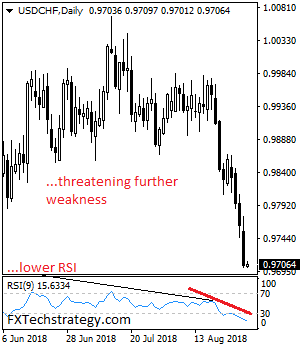
USDCHF - The pair continues to face downside pressure closing further lower on Wednesday. On the downside, support lies at the 0.9650 level. A turn below here will open the door for more weakness towards the 0.9600 level and then the 0.9550 level. Its daily RSI is bearish and pointing lower suggesting further weakness. On the upside, resistance resides at the 0.9800 level where a break will clear the way for more strength to occur towards the 0.9850 level. Further out, resistance comes in at the 0.9900 level. Above here if seen will turn attention to 0.9950. All in all, USDCHF faces further downside threats.
Cause And Effects
Equity Markets
Equity markets continue marching higher with the S&P 500 and the Nasdaq yet again trading in record territory. Indeed, investors confidence is soaring as optimism builds over the likelihood of the inevitable US trade deal with a crucial trade partner, Canada. Undeniably, the prospects of a revised trilateral trade agreement between the US -Canada and Mexico have put investors on cloud nine! Undoubtedly this effervescent “risk on ” environment should prove to be very constructive for investors across the global spectrum.
Oil Markets
The weekly Energy Information Administration inventory report came in bullish for oil prices. Total crude oil inventories showed a bigger than expected draw at -2.566million vs -0.967million consensus. Not surprisingly reversing out all the negativity from Tuesday’s API survey. Besides, there was also an excellent inventory draw in the oil by-products, both gasoline and distillate. But given the headline report was less contracted than the prior week’s draw, further gains could be a grind in today’s session.
While WTI is holding onto earlier gains after the DoE inspired move, but the primary bullish factor remains rooted in Iran sanctions
Gold Markets
Gold initially came under pressure overnight as real yields moved north and the USD showed signs of making a revival, but the gains didn’t hold in New York despite a revision higher in 2nd Quarter GDP. But with both the PCE and GDP prices remaining static, it offered little encouragement for dollar bulls but provided a glimmer of hope for Gold investors. However, in the absence of any significant catalysts and with the Feds committed to status quo normalisation, real yields moving higher and equities continue to soar, who wants gold?? Very few !! Which suggests topside moves will continue to be faded.
Currency Markets
The dollars gains in Asian and early London sessions didn’t stick in NY, below are a few reasons why.
British Pound
Currency markets were wholly focused on the goings on in Sterling as positive Brexit headlines were the primary trigger.
” EU chief Brexit negotiator Barnier says the EU is prepared to offer Britain a bespoke partnership, unlike any other third country.”
The domino effect set in after the short end of the STIRT curve sold off on expectations of a more Hawkish BoE with Brexit tensions easing, which then catapulted GBPUSD above 1.3000 where its holding firm above that fundamental psychological level in early Asia.
Of course, we could expect a period of consolidation but if these green shoot positive developments bloom, we should see the “Cable” ramp extend much higher in the weeks to come.
The Euro
The break back above 1.1670 sparked waves of topside interest on the positive Brexit headlines. Despite the positives, 1.1750 should be a tough nut to crack given that if anyone who is bearish Euro will be looking to sell on upticks. Italy is still in play, despite some EU friendly overtones coming from the technocratic faction which should temper upside momentum.
Australian Dollar
The Australian dollar is treading water despite effervescent risk markets. But Westpac adjusting their variable mortgage rates higher due to funding costs abrading margins does raise the spectre of mortgage defaults, and one would assume the RBA is not amused.
We’re certainly on the edge of a slippery slope amid this bearish Aussie backdrop with a brewing political hotpot threatening a cherished AAA sovereign rating. But the RBA will ultimately struggle to hold their neutral tilt should any signs of housing meltdown materialise.
Canadian Dollar
Canadian foreign minister Freeland is set to meet with the US trade representative Lighthizer are attending, and Dairy is reportedly the first focus topic. Lots of positives in the Loonie space but tomorrows GDP will be the key for a broader move to 1.2800.
Japanese Yen
The happy risk on the environment has traders testing the top of the range once again, but the lack of excitement is telling as I suspect there are far more exciting trades to be had at this juncture
The Yuan
Still on the highlight reels but trader appears are waiting for something to break on the trade front. As a result, they remain caught between two opposing forces, position positively for the future US-China Trade deal or negatively over waning China growth prospects but ultimately interest rates and economic fundamentals will carry the day short-term and dips still look attractive.
ASEAN Currencies
It feels like economic risk recovery is slowing given the apparent lack of urgency from Trump administration to get this US-China trade agreement inked. But local exchanges are still chugging along riding the US equity market coattails. The pessimist in me says to expect a long and winding road when it comes to the ratification of a China agreement after all in the eyes of the US administration; China is a currency manipulator.
Singapore Dollar
Attention shifts to the Singapore Dollar today with the vital CPI report on the docket. As with increasing volumes on the offshore Yuan, there has been significant interest in the local unit so there will be a great deal of attention where support 1.3600 support will be a primary focus for intraday trade.
The Malaysian Ringgit
Bond markets are trading sideways which is likely a function of the upcoming MPC on September 5 and tomorrows National Day holiday. As a result, the USDMYR is trading as equally sideways. If anything higher energy prices may provide a fillip heading into the long weekend but the markets are unlikely to make a meal out of this bounce if at all
Brexit EU Remarks Ease Global Trade Tensions
The US dollar finished mixed on Wednesday against major currencies. The EU’s Chief Brexit Negotiator for the EU announced that they are prepared to offer Britain a unique partnership. The news boosted the pound and the euro versus the greenback. The Canadian dollar continues to advance as talks continue for Canada to join the US-Mexico trade deal that is meant to replace NAFTA.
Growth concerns borne out of the rise of trade disputes has been a major factor in market pricing. The softening of some trade turmoils with a willingness to negotiate is sure to impress on central banks that will have a busy month of September.
Canadian Dollar Boosted by Trump-Trudeau Comments
The USD/CAD lost 0.18 percent in the last 24 hours. The currency pair is trading 1.2908 after the optimism on Canada joining the US-Mexico trade agreement. Friday has been set as an arbitrary deadline but comments from US President Trump and Canadian Prime Minister Justin Trudeau have been supportive of reaching an agreement.
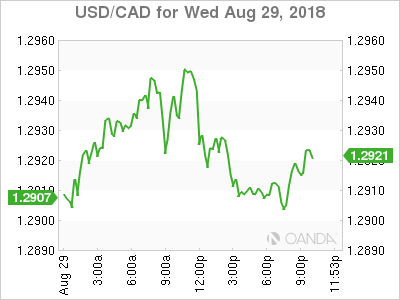
The loonie is higher ahead of the monthly release of Canadian GDP data on Thursday. Canadian growth is expected to come in at 0.1 percent which could put some question marks around a possible interest rate hike in September.
The Bank of Canada (BoC) has lifted rates twice in 2018 and the market is pricing in at least another one before the end of the year. The U.S. Federal Reserve is heavily anticipated to hike in September, but the Canadian central bank has an earlier date in the month, and the October meeting could offer better timing.
Pound Higher on Brexit EU Comments and Lower Possibility of Hard Divorce
The GBP/USD rose 1.23 percent on Wednesday. The currency pair is trading at 1.3027 after comments from the EU’s chief negotiator Michel Barnier said the UK could get a unique partnership. The possibility of a hard Brexit has been hanging over the pound and the news of a softer divorce was a breath of fresh air for the currency.
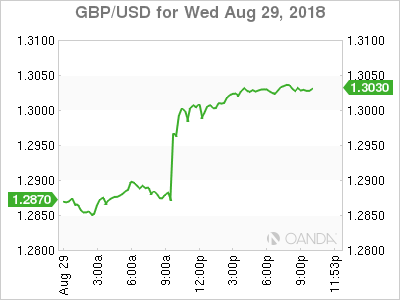
There are a lot of details that remain unknown, and Barnier made it clear that the single market its not negotiable. The GBP rose to above the 1.30 price level where it was last in early August.
US Dollar Fails to Rise on Higher GDP data
Gold prices showed signs of life toward the end of the North American session and its close to levels last seen at the beginning of the trading week. The upward revision in the second estimate of the US GDP to 4.2 percent gave the greenback a boost earlier on Wednesday. Easing of trade tensions with progress on the NAFTA renegotiation and softer Brexit news can be supportive of metals.
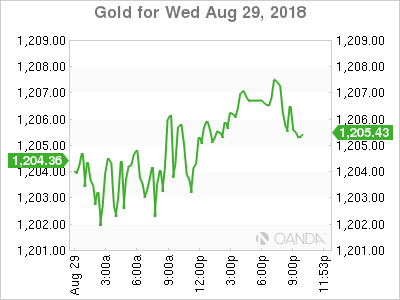
The stronger dollar has put downward pressure on the yellow metal, but the surprisingly fast US-Mexico trade agreement is giving hope that American negotiators employ similar tactics with the EU and China.
Crude Prices Higher on Trade Tension Easing and Iran Supply Disruption
The Brexit news boosted the pound and the euro against the greenback. The softness of the dollar is aiding the rise of oil prices after the Energy Information Administration (EIA) published its weekly inventories. Crude stocks fell more than expected on Wednesday by 2.6 million barrels versus the forecasted 1 million barrels.
The API data released yesterday showed a slight increase of 38,000 barrels versus an anticipated drawdown of 1 million barrels.
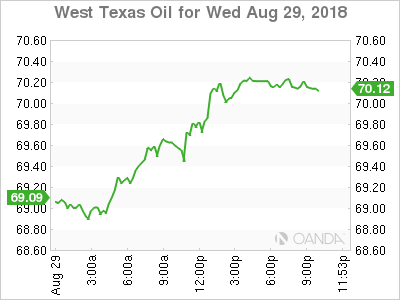
Oil prices have been under pressure from global growth concerns resulting form trade disputes. The trade agreement between the US and Mexico earlier this week has eased those fears somewhat and the looming sanctions against Iran are beginning to impact oil supply lifting crude prices.
The dollar got a small lift from a higher than expected second GDP estimate, but steady economic growth and more interest rate hikes from the U.S. Federal Reserve are already priced into the currency.
Eco Data 8/30/18
[php_everywhere instance="1"]