

Sample Category Title
EUR/USD Dips Remain Supported Near 1.1620
Key Highlights
- The Euro corrected lower this past week and tested the 1.1610 support against the US Dollar.
- There is a key bullish trend line formed with support at 1.1620 on the 4-hours chart of EUR/USD.
- On the upside, resistances are seen near 1.1720, 1.1740 and 1.1750.
- Today in the US, the Retail Sales figure for June 2018 will be released, which is forecasted to increase 0.6% (MoM).
EURUSD Technical Analysis
The Euro started a downward correction after trading as high as 1.1790 against the US Dollar. The EUR/USD pair declined and tested the 1.1610-20 support area where buyers appeared.
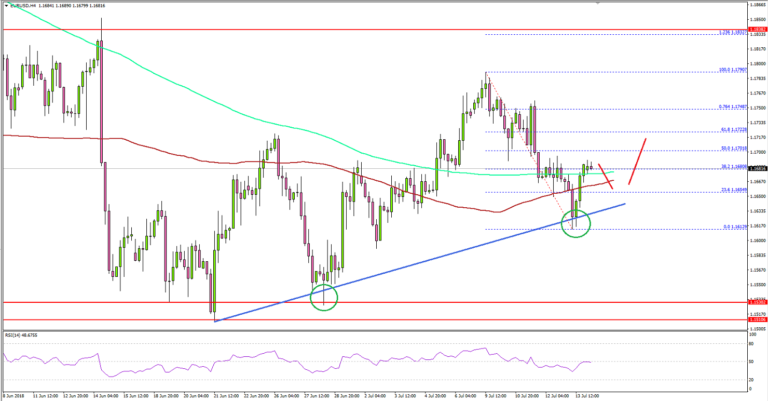
Looking at the 4-hours chart, the pair remains in a decent uptrend from the 1.1510 swing low. The recent dip from the 1.1790 high can be seen as a correction. The pair traded above the 23.6% Fib retracement level of the last decline from the 1.1790 high to 1.1610 low.
On the downside, there is a key bullish trend line formed with support at 1.1620 on the same chart. Therefore, as long as the pair is above the 1.1610-20 support area, it could continue to move higher.
On the upside, there is a key resistance near 1.1720, which coincides with the 61.8% Fib retracement level of the last decline from the 1.1790 high to 1.1610 low. A push above the 1.1720 resistance may perhaps clear the path for more gains towards the 1.1750 level.
Should the pair gain momentum above the 1.1790 high, the next resistance could be the target near the 1.236 Fib extension level of the last decline from the 1.1790 high to 1.1610 low at 1.1830.
On the flip side, if the pair breaks the trend line and the 1.1610 support, there may well be extended declines towards the 1.1560 support.
Economic Releases to Watch Today
- US Retail Sales June 2018 (MoM) – Forecast +0.6%, versus +0.8% previous.
- US Retail Sales ex Autos June 2018 (MoM) – Forecast +0.4%, versus +0.9% previous.
- US Retail Sales Control Group June 2018 – Forecast +0.4%, versus +0.5% previous.
EU Tusk and Juncker in China for talk on trade, investment and climate change
European Council President Donald Tusk and European Commission President Jean-Claude Juncker will meet with Chines Premier Li Keqiang in Beijing today for discussions on some practical topics. Ahead of the meeting European Commission spokesman Margaritis Schinas said the meeting will focus on "trade and investment, on the commitment to combating climate change and investing in clean energy and on foreign and security issues, including the situation on the Korean peninsula". And, the two sides will also talk on the joint commitment to the Iran nuclear deal.
Chinese Ambassador to the EU Zhang Ming wrote in an article in the official People's Daily, urging to deepen cooperation to address global challenges. In particular, he said both sides should "send out a positive message to safeguard multilateralism, liberalize and facilitate trade and investment." Zhang added that "Both of them recognize the necessity to firmly resist unilateralism and trade protectionism, guard the rule-based multilateral trading system with the WTO at its core, push economic globalization in the direction of becoming more open, inclusive, balanced and beneficial to all, reform multilateral trading system with the times, and perfect global economic governance system.
Italy agrees to take some Libya migrants as some EU countries offer help
Italy's far right Interior Minister Matteo Salvini said on Sunday that the country is allowing some of the asylum seekers from Libya to disembark in Sicily. Prime Minister Giuseppe Conte set letters to head of state of other EU nations asking to share responsibility on the Libya migrants. In response, Germany, France, Spain, Portugal and Malta have agreed to take 50 people each.
"Spain will take in 50 of the people rescued yesterday in the Mediterranean. This shows our commitment to offer solutions to migration flows and solidarity with the humanitarian drama," Spanish Prime Minister Pedro Sanchez confirmed and tweeted.
EURUSD – Faces Further Downside Pressure But With Caution
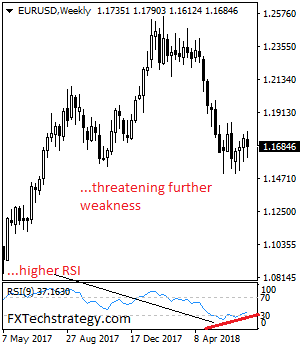
EURUSD - The pair looks to extend its weakness after selling off on Wednesday. On the upside, resistance comes in at 1.1700 level with a cut through here opening the door for more upside towards the 1.1750 level. Further up, resistance lies at the 1.1800 level where a break will expose the 1.1850 level. Conversely, support lies at the 1.1600 level where a violation will aim at the 1.1550 level. A break of here will aim at the 1.1500 level. Below here will open the door for more weakness towards the 1.1450. All in all, EURUSD faces further upside pressure but with caution of a recovery.
Eco Data 7/16/18
[php_everywhere instance="1"]
Forex Trading Crash Course
The 'Forex Trading Crash Course' is a complete step-by-step course that will take you by the hand and show you exactly how to make money trading forex. You will get nearly 5 hours of detailed video training and forex training eBooks that are easy to understand, seriously, we've left no rock unturned!

This course covers everything there is to know about forex trading. In fact, some people have described it as "the best forex trading course" for new traders. It's like having your very own forex expert that you can ask questions anytime you need to!
If you really want to be successful, you need to know when to trade, what to trade, and how to trade. A good forex education will enable you to trade in forex more effectively and increase your chances of earning a considerable amount of money.
It's true that forex trading can help you earn a lot of money. But there are certain conditions to follow before trading in forex. Firstly, one must have a thorough knowledge about the trends in the stock market, the basics of trading and risk-taking ability.
You also have to take full advantage of FREE Tools that can dramatically increase your profits.
Simply knowing the basics of how to trade forex is not enough to be successful -- even if you have a good idea about major currencies traded, like the US dollar, the Japanese Yen, and others, you still need to learn forex trading strategies that can protect your investments and boost your profits.
The Forex Trading Crash Course will teach you how to trade forex like the pros with no experience. You will discover so many things on how to trade forex with little effort!
On The Forex Trading Crash Course Videos You Will Learn:
- How to start forex trading from scratch!
- Learn how to download and set-up your free Forex Trading Software.
- Learn the biggest mistakes of forex traders and how to avoid the same mistakes yourself.
- Learn what the professionals know about forex correlation and how it can multiply your profits.
- Learn Breakout Trading, Forex Correlation Trading, Risk Control and Live Trading.
- Discover how to create you own Forex Trading System and identify trends using indicators.
- Learn how to create candle stick charts & identify trends.
- Learn about SMA (simple moving average) and trendlines.
- Learn how to make a profit using scalping and position trading techniques.
- Learn how to evaluate currency pairs and monitor activity daily or weekly.
- Discover how to duplicate successful trades shown in our live examples!
- Learn top-down price analysis to see the market's real trends.
- Learn how to trade forex using virtual money.
- Learn much, much more too!
These are only a few of the topics that you are going to learn in this video course, if we list all the details here this page will be too long to read!
Forex Mentor Pro
We've mentored over 9600 trainee traders in the last 10 years
Most people who come to Forex Mentor Pro have tried lots of ways to learn to trade alone. Granted, learning alone is a convenient and cost effective way to learn, but you miss out on the real insight you get when you get guidance from a professional trader who makes his living from trading.
The problem with trader training is that it's glossy, shiny and comes with all sorts of promises. When you sign up, you think you're getting access to professional knowledge, but in fact what you're getting is an array of 'get rich quick' promises that rarely, if ever, come true. The reality is that you never get close to any professional traders. You don't get to share in their personal experience.
So what do you do? You imagine if you pay more, that'll change. Sadly, this is seldom the case.
We've been teaching people to trade since 2008 and have taught and mentored over 9600 people. Many of them now trade for a living.
Learn to trade the Forex Mentor Pro way
At Forex Mentor Pro you get up close and personal with everything the professional traders on the team trade.
No matter your current level, at Forex Mentor Pro, we teach you our proven strategies and supply you with the software you need (included free with your membership). But more than that, we also show you in advance, every trading day what we are going to trade and why. That way you can follow our lead.
At Forex Mentor Pro if you have a problem and you're not sure what to do next you get answers from real working traders, not anonymous, outsourced helpdesk people who don't know any better than you.
In other words, you get everything you need to become the successful, calm and confident trader you know you deserve to be.
JOIN TODAY AND GET IMMEDATE ACCESS TO
3 Powerful Trading Systems
Get immediate, full access to the same powerful trading systems we use every day to pull profits out of the Forex market. Daily, 4 hour & 1 hour strategies.
Daily video analysis and support
Get advance video insight of the trades we're planning and explanations of what we're looking at with each trading system for the days ahead.
Step-by-step guidance
From basics to advanced trading systems. We walk you through everything you need in our step-by-step online video tutorials & weekly live training sessions.
Proprietary Trading Software
Unlimited access to our custom proprietary software, indicators and trading tools designed to make your trading life easy, calm and profitable.
Join our Private Community
Join the FMP family, participate in the weekly live training sessions where you can ask as many questions as you like of mentors Judith, Pierre and Marc. Mentors are also available in the forum along with senior members.
Help & Support
Our #1 goal is to help you succeed. That's why we offer so much support. When you work with us you can ask questions and get advice from real, professional Forex traders.
Infinity Scalper Trading System
The Best Prediction Technology
Infinity Scalper comes with the latest Trend Analysis Mechanism and a Hybrid Prediction formula. These special methods used in Infinity Scalper allow it to bring the best and most accurate signals to you. If you trade without Infinity Scalper, then there is absolutely no way you could achieve even close results to those that you can get when trading with this new powerful indicator tool.

Our team of expert traders and developers has spent countless days and a lot of sleepless nights working on this fantastic M1 and M5 indicator.
We wanted to present you with something that is smart, adaptive, modern and yet super easy to understand and use.
There are a lot of trading systems which use 4+ indicators, several mechanical analysis techniques and other difficult calculations.
Just imagine how long it would take you to learn a system like that and make sure you will make no mistakes while following it.
With Infinity Scalper however, everything is completely different. You are given EASY & SIMPLE signals that hold a very complicated and smart logic behind them. So you are going to get great results with almost no effort. You are going to get great results the same day when you start using Infinity Scalper.
Others choose to go the hard way - study forex and hundreds of it's trading principles and they still end up burning their accounts because there is always a couple of important aspects of the strategy that they missed. Infinity Scalper is going to take care of you, do all the analysis and calculations for you and generate ready-to-follow signals for you right on the trading chart of your choice. Nothing could be better and easier than that.
Ichimoku System: Trading with the Chikou Span Indicator
The Ichimoku trading indicator is well known for its capability of offering a complete trading system. This has been well documented, and trend following traders rely upon the Ichimoku’s indicators. However, various strategies can be developed using the Ichimoku’s different components as well.
One might argue on the merits of picking apart the Ichimoku trading system when it offers a complete strategy in the first place. While this might be true, the fact remains that the trader has to assess different variables when trading with the Ichimoku system.
This might lead to the trader either being left on the sidelines while a strong trend is formed subsequently. The result of this being that traders tend to ignore the rules and this is where mistakes start to prove costly.
By using just one component of the Ichimoku system, traders can keep their trading system simple and rely on just a few signals to validate their bias.
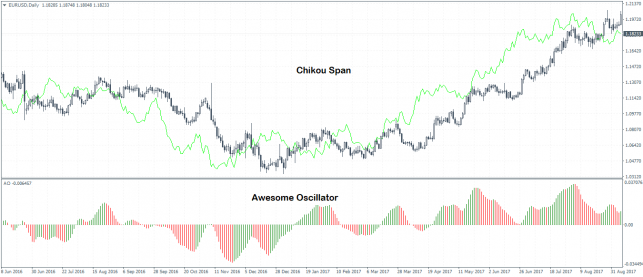
In this Ichimoku trading system, we rely on the Chikou span or the lagging indicator. Anyone who has traded using the Ichimoku system will know that the lagging indicator is basically the closing prices, shifted 26 periods behind price.
One of the Ichimoku trading rules also dictates that one of the scenarios to ascertain a bullish or a bearish trend is to compare the current price against price 26 periods ago.
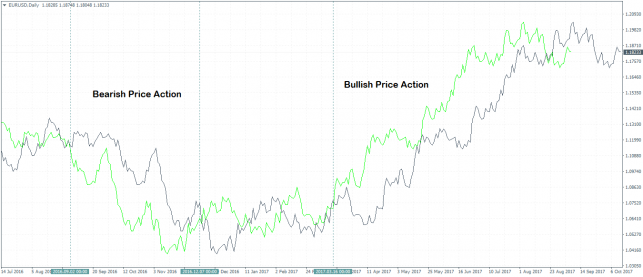
Thus, when the Chikou span is above price, the market is said to be bearish, and when the Chikou span is below price, the market is said to be bullish. The logic is quite simple. A bullish trend emerges when the current price is above the price 26 periods ago and vice versa. We can, however, look at the Chikou span differently by comparing it to the price line itself.
In the first chart below, this concept is shown. The green line shows the Chikou span and the black line shows the price.
Trading with Chikou span and Awesome Oscillator
Combining the information with the Chikou span and the awesome oscillator creates a unique trading strategy. This method is not just simple but also allows traders quick reaction times to enter into a trend. The trading system is open-ended, meaning that traders can either continue to hold on to their positions until the trend starts to change, or traders can look towards booking profits at regular intervals.
The next chart below shows the set up that is quite simple. On the price chart, the Chikou span is overlaid while the Awesome oscillator sits in the sub-window.
The trading rules are quite simple.
- A bearish market is when the Chikou span cuts below the price line
- A bullish market is when the Chikou span cuts above the price line
- The AO also signals bullish market when it crosses above the zero-line
- The AO signals bearish market when it crosses below the zero-line
When you combine both these indicators and they are in-sync suggesting a bullish or a bearish market, traders can comfortably take long or short positions respectively.
Trading examples using the Chikou span and AO indicator
In the first example, we can see a bearish market signal in price. In the next chart, you can see that the Chikou span signaled a bearish market by crossing below the price line. The price candle marked by the arrow, signals when this occurs.
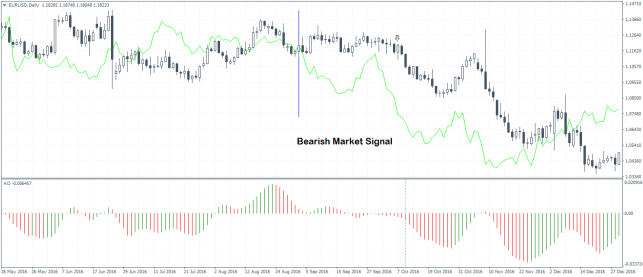
At the same time, we can also see that the AO is below the zero-line. Thus, both the indicators point to the decline in prices. Traders can set their stops at the recent swing high positions and based on this set the rewards of 1:2 and so on.
In the next example, we can see the bullish market signal in action.
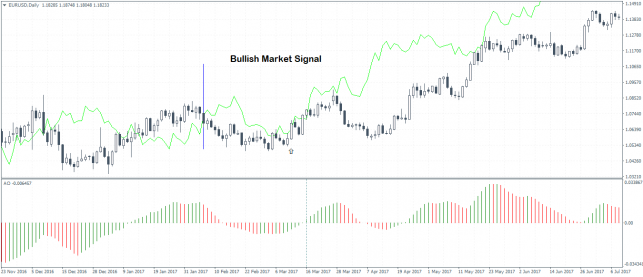
In this example, we can see that the Chikou span crosses above the price line. The AO also signals the same information with the crossover above the zero-line. Thus, long positions are taken here with stops set to the recent pivot lows.
The above-mentioned strategy works best on the daily time frame but could be applied to the H4 chart as well. This trend following method requires some patience, meaning that traders will have to stay on the sidelines for a few days at a stretch.
However, since all other variables are cut off, the simplicity of this trading strategy will enable you to enter early into a trend. The risks are relatively small compared to the rewards that come out of this trading system.
Why Do Central Banks Target Inflation?
When it comes to determining monetary policy, among a number of economic indicators that policymakers look at, one particular indicator stands out. Inflation or consumer price index has been one of the key factors when it comes to central bank policy responses.
If one looks back to the time since the 2008 global financial crisis, central banks have pumped trillions of dollars into the economy. This monetary policy response, dubbed Quantitative Easing initially evoked a lot of doubt among skeptics. Some even went as far as to question how long such a policy response would go.
However, the central bank’s QE policies have managed to revive the economy to a certain extent. Among the factors that the central bank considers, inflation ranks high. Interestingly though, inflation is not a standalone indicator and is in fact influenced by other components.
For example, the unemployment rate or the labor market plays a key role. If wages do not rise, how can consumers spend more? And when consumers do not spend more, how can inflation rise?
As you can see from the above, inflation although looks like a standalone indicator or a metric for the central bank takes into account the broader market.
What is the inflation targeting mandate?
Inflation targeting mandate is also known as a monetary policy regime. Here, the central bank sets an explicit target for the inflation rate in the short to medium term. It is widely publicized as well. A quick look at various central bank monetary policy statements will show the various inflation targets set by the respective central banks.
In the advanced economies, central banks follow a 2% inflation target rate. Examples include the United States Federal Reserve, the European Central bank and the Bank of England to name a few.
Other central banks set a target band to allow for more policy flexibility. For example, the Reserve Bank of Australia follows an inflation target band of 2% – 3%, while the Reserve Bank of New Zealand follows an inflation band of 1% – 3%.
Inflation or price stability is of importance to the central banks as they believe that maintaining the stability of prices is essential to the growth of an economy.
Based on how inflation fluctuates, central banks use this to respond to monetary policy. Raising interest rates is said to contain rising inflation and cools down the economy from overheating. Conversely, cutting interest rates is said to support an increase in inflation in an effort to kick-start the economy.
These cycles of policy tightening and easing are all based on inflation.
The inflation targeting regime was proposed by John Maynard Keynes.
Keynes recommended that exchange rate flexibility was needed as a response to inflation.
Prior to inflation targeting, central banks used to directly set the currency peg. However, it is public knowledge how especially in recent times central banks have failed to maintain the peg.
Examples include the Central Bank of Russia which eventually gave up defending the currency during the height of the Ukraine crisis. We also know about the Swiss National Bank eventually giving up the peg that it defended for years.
The RBNZ was among the first central banks in the world to shift to an inflation targeting regime in 1989.
Can the central banks manage to reach the inflation target?
After the 2008 financial crisis, central banks lowered interest rates and also started to pump money into the economy. This came at a time when inflation remained subdued across the globe. However, in recent times, inflation has started to pick up, most notably in the Eurozone.
For central banks, inflation targeting doesn’t mean raising rates when inflation reaches 2%, but rather monitoring the trends in inflation. Thus, when inflation starts to show a steady uptrend and edges closer to the inflation target rate, central bankers start to hike rates gradually as well.
For traders, inflation is often seen as a binary event for trading. While this might be true in the short term, understanding the inflation targeting regime can help traders to better speculate the potential central bank policy responses.
The currency markets revolve around interest rates, and the interest rates are set as a result of inflation.