

Sample Category Title
US: Manufacturing Activity Strengthens in February to a New Cycle High
The Institute for Supply Management (ISM) index of manufacturing for February rose 1.7 points to 60.8 - a new cycle high - beating market expectations of a slight decline to 58.7. This marks the 18th consecutive month that the index has been in expansionary territory.
The underlying details of the report were mixed, with the headline index driven by a strong advance in employment (+5.5 to 59.7), inventories (+4.4 to 56.7 - a cycle high), and supplier deliveries (+2.0 to 61.1). Although both production and new orders declined, they still remain near cycle highs that were reached at the end of last year.
Prices paid rose 1.5 points to 74.2, also a new cycle high.
The spread between new orders and inventories - a good leading indicator of activity - narrowed to 7.5 (-5.6 points) in February. Overall this indicator remains consistent with manufacturing activity continuing to expand through the first quarter of 2018.
Key Implications
The U.S. manufacturing sector continues to surprise to the upside, as demand for U.S. manufactured goods remains robust. Moreover, comments by survey participants were optimistic, suggesting that demand is being supported by tax cuts, and that capacity pressures, exchange rate volatility, and component shortages are pushing up input prices.
Alongside strong domestic demand come encouraging signs of robust foreign demand. New export orders surged to a cycle-high, and PMI manufacturing surveys reported this morning suggest that global demand for manufactured goods remains strong in many parts of the world. This bodes well for first quarter global trade volumes and economic activity more broadly.
Gold Resumes Slide ahead of Speeches from Powell, May
Gold has posted sharp losses in the Thursday session, after a brief pause on Wednesday. In North American trade, the spot price for an ounce of gold is $1308.40 down 0.76% on the day. In economic news, Thursday is quite busy. Personal Spending slowed to 0.2%, matching the forecast. Unemployment claims dropped to an impressive 210 thousand, well below the estimate of 222 thousand. Next up, Fed chair Jerome Powell testifies before the Senate Banking Committee. On Friday, the US publishes UoM Consumer Sentiment. Brexit will also be in focus, as Prime Minister May speaks about Britain's departure from the EU.
Jerome Powell will be on center stage on Thursday, as he testifies before the Senate Banking Committee. Powell addressed the House Finance Committee on Tuesday, and his remarks were decidedly hawkish. Fed chair said that the current policy of gradual rate increases would continue. He added that the economy was strong and that he expected inflation to move up to the Fed target of 2 percent. Importantly, Powell did not address the question of an acceleration of rate hikes, but his hawkish stance has increased the likelihood that the Fed will increase it projection from three to four rate hikes this year. Any hints that Fed will quicken its pace of rate hikes would be bullish for the US dollar.
Gold tends to rise in times of uncertainty, and a crisis is brewing up between London and Brussels, after the EU published a draft of the legal framework of the Brexit agreement. The May government responded by saying it could not accept the draft. Two items in particular have raised the ire of London. First, the proposal that EU would keep Northern Ireland in the bloc's customs union, which could mean a border between Northern Ireland and the UK. Second, that the European Court of Justice (ECJ) would have the final say in any disputes over the Brexit agreement. May wasted no time responding to the EU proposal, saying that any type of border between the UK and Northern Ireland would threaten the constitutional integrity of the United Kingdom. May is unlikely to accept a role for the ECJ after Brexit, as this would be seen as undermining British sovereignty. Meanwhile, the Europeans dismissed May's proposal that a final trade deal would allow some divergence with EU regulations in certain industries, but the Europeans have dismissed this as 'cherry picking', which they say is a non-starter. May will lay out her post-Brexit vision of relations with the EU in a speech on Friday and if the Europeans pour cold water on her plan, nervous investors could snap up gold, a traditional safe-haven asset.
British Pound Under Pressure over Brexit Spat
The British pound has inched lower in the Thursday session. In North American trade, GBP/USD is trading at 1.3745, down 0.11% on the day. In economic news, British Manufacturing PMI ticked lower to 55.2, just above the estimate of 55.1 points. In the US, Personal Spending slowed to 0.2%, matching the forecast. Unemployment claims dropped to an impressive 210 thousand, well below the estimate of 222 thousand. Next up, Fed chair Jerome Powell testifies before the Senate Banking Committee. On Friday, the US publishes UoM Consumer Sentiment. In the UK, Brexit will be in focus, as Prime Minister May speaks about Britain's departure from the EU. As well, Britain releases Construction PMI and Mark Carney will address a conference in Edinburgh.
Are the Brexit talks about to hit the rocks? The pound took a dip on Wednesday, after the EU published a draft of the legal framework of the Brexit agreement. The May government responded by saying it could not accept the draft. Two items in particular have raised the ire of London. First, the proposal that EU would keep Northern Ireland in the bloc's customs union, which could mean a border between Northern Ireland and the UK. Second, that the European Court of Justice (ECJ) would have the final say in any disputes over the Brexit agreement. May wasted no time responding to the EU proposal, saying that any type of border between the UK and Northern Ireland would threaten the constitutional integrity of the United Kingdom. May is unlikely to accept a role for the ECJ after Brexit, as this would be seen as undermining British sovereignty. Meanwhile, the Europeans dismissed May's proposal that a final trade deal would allow some divergence with EU regulations in certain industries, but the Europeans have dismissed this as 'cherry picking', which they say is a non-starter. May will lay out her post-Brexit vision of relations with the EU in a speech on Friday and if the Europeans pour cold water on her plan, the pound could continue to lose ground.
Jerome Powell will be on center stage on Thursday, as he testifies before the Senate Banking Committee. Powell addressed the House Finance Committee on Tuesday, and his remarks were decidedly hawkish. Fed chair said that the current policy of gradual rate increases would continue. He added that the economy was strong and that he expected inflation to move up to the Fed target of 2 percent. Importantly, Powell did not address the question of an acceleration of rate hikes, but his hawkish stance has increased the likelihood that the Fed will increase it projection from three to four rate hikes this year. Any hints that Fed will quicken its pace of rate hikes would be bullish for the US dollar.
Dollar Trying to Extend Rally as Jobless Claims Dropped to Near Five Decade Low
Quick update: Dollar tries to rise further after ISM manufacturing beat expectation. But momentum remains indecisive.
Dollar is trying to ride on strong job data to extend recent rally. Initial jobless claims dropped 10k to 210k, lower than expectation of 226k. That's the lowest level in nearly five decades since December 1969. Four week moving average dropped to 220.5k, also the lowest since 1969. Continuing claims rose 57k to 1.93m in the week ended February 17. Personal income rose 0.4% in January, above expectation of 0.3%. Personal spending rose 0.2%, in line with expectation. Headline PCE was unchanged at 1.7% yoy, core PCE unchanged at 1.5% yoy. Both met expectation. Also released, Canada current account deficit narrowed to CAD -16.4b in Q4. Focus will turn to round two of Fed Chair Jerome Powell's testimony.
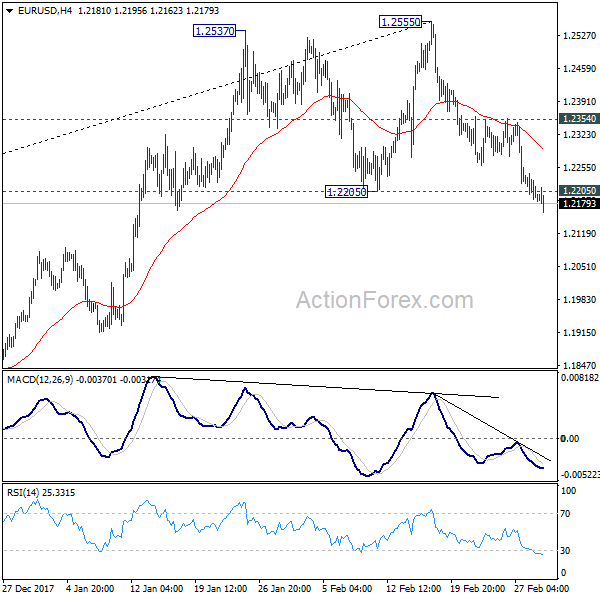
Technically, EUR/USD is trying to dip further away from 1.2205 key support, which indicates trend reversal. USD/CHF is also pressing equivalent level at 0.9469. For today, New Zealand Dollar is the strongest into US session, followed by Dollar. Aussie and Loonie are the weakest. For the week. Yen remains the strongest one, followed by Dollar. Canadian is the weakest, followed by Sterling and than Aussie.
EC Tusk warned friction inevitable for Brexit
European Council President Donald Tusk is meeting UK Prime Minister Theresa May in London today. May expressed her intention to make post Brexit trade "as frictionless as possible. Tusk responded by warning that "friction is an inevitable side-effect of Brexit." And ultimately, the post Brexit relationship between UK and EU would be determined by respective "red lines". Tusk added that "we acknowledge these red lines without enthusiasm and without satisfaction, but we must treat them seriously, with all the possible consequences."
EU published the draft Brexit treaty yesterday and the border of Irelands have sudden become the sticky point. Tusk said that he was "absolutely sure that all the essential elements of the draft" would be accepted by the 27 remaining EU members. And he added that that "until now, no one has come up with anything wiser than that" referring to the proposal of keeping Northern Ireland in EU's customs union. But May has already warned that such proposal would "threaten the constitutional integrity of the UK" by creating a border down the Irish Sea." May will deliver her highly anticipated speech on Brexit tomorrow.
Released in European session, Eurozone unemployment rate was unchanged at 8.6% in January. PMI manufacturing was revised up by 0.1 to 58.6 in February. UK PMI manufacturing dropped to 55.2 in February, down from 55.3 but beat expectation of 55.0. M4 money supply rose 1.5% mom in January. Mortgage approvals rose to 67k in January. Swiss PMI manufacturing rose 0.2 to 65.5 in February. Retail sales dropped -1.4% yoy in January GDP grew 0.6% qoq in Q4.
BoJ Kataoka warned on premature stimulus exit
BoJ board member Goushi Kataoka urged that "to influence inflation expectations, it is essential that policy coordination between the government and the BOJ ... is firmly ensured through action by both entities." And he noted that " there is still a long way to go before considering a change in monetary policy stance." He warned against premature stimulus exit as that could drag Japan back into deflation. Kataoka is the persistent sole dissenter in BoJ since joining last year, pushing for more aggressive easing.
Released from Japan, capital spending rose 4.3% in Q4, above expectation of 3.0%. PMI manufacturing was revised up by 0.1 to 54.1 in February. Consumer confidence dropped 0.4 to 44.3 in February.
Caixin China PMI manufacturing hit six-month high
The Caixin China PMI manufacturing rose 0.1 to 51.6 in February, above expectation of 51.3. The index focuses on small to mid-size manufacturers hit a six-month high. Zhengsheng Zhong, director of macroeconomic analysis at CEBM Group, a subsidiary of Caixin noted that "for now, the durability of the Chinese economy will persist. Looking ahead, whether demand generated from the beginning of work in March will gain strength will be key in determining China's economic direction for 2018."
Australia private capital expenditure unexpectedly dropped -0.2% in Q4, comparing to expectation of 1.0% rise. However, that's probably due to the large upward revision in the prior quarter, from 1.0% to 1.9%. New Zealand terms of trade dropped -0.2% qoq in Q4, below expectation of 0.5% qoq.
EUR/USD Mid-Day Outlook
Daily Pivots: (S1) 1.2173; (P) 1.2207 (R1) 1.2227; More....
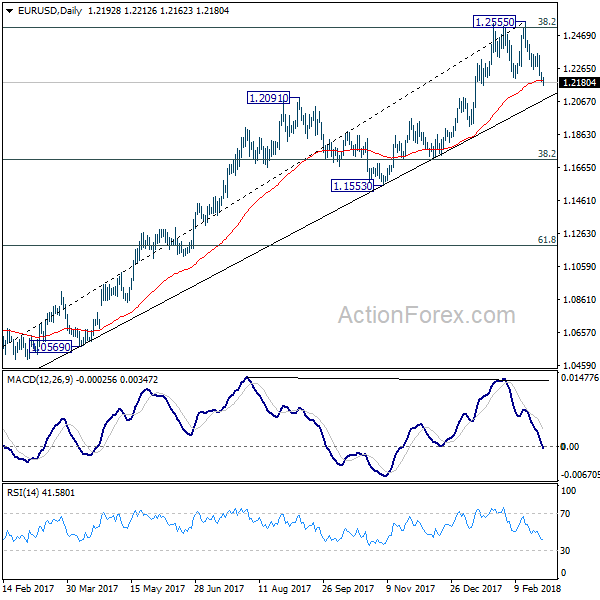
As noted before, the break of 1.2205 key support is taken as a tentative sign of trend reversal, after being rejected by 1.2516 key fibonacci level. Intraday bias remains on the downside for deeper fall. Sustained trading below 1.2205 will confirm and target 38.2% retracement of 1.0339 to 1.2555 at 1.1708. On the upside, above 1.2354 minor resistance will dampen this bearish case and bring retest of 1.2555 high instead.
In the bigger picture, key fibonacci level at 38.2% retracement of 1.6039 (2008 high) to 1.0339 (2017 low) at 1.2516 remains intact despite attempts to break. Hence, rise from 1.0339 medium term bottom is still seen as a corrective move for the moment. Rejection from 1.2516 will maintain long term bearish outlook and keep the case for retesting 1.0039 alive. Firm break of 1.5553 support will add more medium term bearishness. However, sustained break of 1.2516 will carry larger bullish implication and target 61.8% retracement of 1.6039 to 1.0339 at 1.3862.
Economic Indicators Update
| GMT | Ccy | Events | Actual | Forecast | Previous | Revised |
|---|---|---|---|---|---|---|
| 21:45 | NZD | Terms of Trade Index Q/Q Q4 | -0.20% | 0.50% | 0.70% | 1.30% |
| 23:50 | JPY | Capital Spending Q4 | 4.30% | 3.00% | 4.20% | |
| 00:30 | AUD | Private Capital Expenditure Q4 | -0.20% | 1.00% | 1.00% | 1.90% |
| 01:30 | JPY | PMI Manufacturing Feb F | 54.1 | 54 | 54 | |
| 01:45 | CNY | Caixin PMI Manufacturing Feb | 51.6 | 51.3 | 51.5 | |
| 05:00 | JPY | Consumer Confidence Index Feb | 44.3 | 44.8 | 44.7 | |
| 06:45 | CHF | GDP Q/Q Q4 | 0.60% | 0.50% | 0.60% | 0.70% |
| 06:45 | CHF | GDP Y/Y Q4 | 1.90% | 1.70% | 1.20% | |
| 08:15 | CHF | Retail Sales Y/Y Jan | -1.40% | 1.10% | 0.60% | 0.70% |
| 08:30 | CHF | PMI Manufacturing Feb | 65.5 | 64.1 | 65.3 | |
| 08:45 | EUR | Italy Manufacturing PMI Feb | 56.8 | 58 | 59 | |
| 08:50 | EUR | France Manufacturing PMI Feb F | 55.9 | 56.1 | 56.1 | |
| 08:55 | EUR | Germany Manufacturing PMI Feb F | 60.6 | 60.3 | 60.3 | |
| 09:00 | EUR | Eurozone Manufacturing PMI Feb F | 58.6 | 58.5 | 58.5 | |
| 09:30 | GBP | Mortgage Approvals Jan | 67K | 62K | 61K | 62K |
| 09:30 | GBP | M4 Money Supply M/M Jan | 1.50% | 0.40% | -0.60% | |
| 09:30 | GBP | PMI Manufacturing Feb | 55.2 | 55 | 55.3 | |
| 10:00 | EUR | Eurozone Unemployment Rate Jan | 8.60% | 8.60% | 8.70% | 8.60% |
| 13:30 | CAD | Current Account Balance (CAD) Q4 | -16.4B | -17.8B | -19.3B | -18.6B |
| 13:30 | USD | Personal Income Jan | 0.40% | 0.30% | 0.40% | |
| 13:30 | USD | Personal Spending Jan | 0.20% | 0.20% | 0.40% | |
| 13:30 | USD | PCE Deflator M/M Jan | 0.40% | 0.40% | 0.10% | |
| 13:30 | USD | PCE Deflator Y/Y Jan | 1.70% | 1.70% | 1.70% | |
| 13:30 | USD | PCE Core M/M Jan | 0.30% | 0.30% | 0.20% | |
| 13:30 | USD | PCE Core Y/Y Jan | 1.50% | 1.50% | 1.50% | |
| 13:30 | USD | Initial Jobless Claims (24 FEB) | 210K | 226K | 222K | 220K |
| 14:30 | CAD | RBC Canadian Manufacturing PMI Feb | 55.6 | 55.9 | ||
| 14:45 | USD | US Manufacturing PMI Feb F | 55.3 | 55.8 | 55.9 | |
| 15:00 | USD | Construction Spending M/M Jan | 0.00% | 0.20% | 0.70% | 0.80% |
| 15:00 | USD | ISM Manufacturing Feb | 60.8 | 58.7 | 59.1 | |
| 15:00 | USD | ISM Prices Paid Feb | 74.2 | 70 | 72.7 | |
| 15:30 | USD | Natural Gas Storage | -71B | -124B |
GOLD: Tumbles Lower, Extends Weakness
GOLD: The commodity retains its downside short term as it sold off on Thurs leaving risk of more upside pressure. On the downside, support comes in at the 1,300.00 level where a break will turn attention to the 1,290.00 level. Further down, a cut through here will open the door for a move lower towards the 1,280.00 level. Below here if seen could trigger further downside pressure towards the 1,270.00 level. Conversely, resistance resides at the 1,310.00 level where a break will aim at the 1,320.00 level. A turn above there will expose the 1,330.00 level. Further out, resistance stands at the 1,340.00 level. All in all, GOLD looks to strengthen further.
Sunset Market Commentary
Markets:
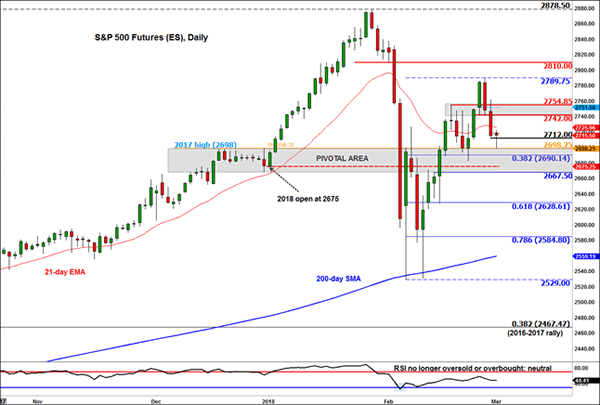
Global core bonds profited from safe haven flows during European trading as losses on stock markets amounted to 1.5%. Today's expected announcement of tariffs on steel and aluminum by US President Trump probably played a role. The German Bund briefly crossed 159.75 with the German 10-yr yield testing 0.62%. A break didn't occur, triggering return action. The intraday topping off pattern in core bonds was further enhanced by stronger than expected US eco data. PCE deflators printed in line with forecasts, but at high levels. Jobless claims dropped to historically low levels, confirming tight conditions on the US labour market. Markets are now counting down to round 2 of Fed chair Powell's testimony for US Congress. At the time of writing, changes on the US yield curve range between -1.2 bps (5-yr) and +0.7 bps (30-yr). German yields shift around 1.5 bps lower across the curve. 10-yr yield spread changes versus Germany are almost unchanged with Greece underperforming (+10 bps).
The dollar succeeded some incremental further gains today; a cautious continuation of the post-Powell rebound. The Fed-president indicating that US rates could be raised four times this year reinstalled some kind of renewed 'divergence trade'. EMU data were OK, but in line. US jobless claims dropped to a multi-decade low. The PCE deflator printed as expected at 0.4% M/M and 1.7% Y/Y. US yields tried to reverse a cautious intraday decline after the release of the data, but it didn't help any further USD gains, at least not of the dollar against the euro. Even so, the 2-yr interest rate differential between the US and Germany reached a new cycle top of 280 bps, the highest level since 1997! Interest rate differentials are not the only factor guiding currencies, but at some point this kind of premium should finally give the dollar downside protection. EUR/USD already tested the key 1.2165 area earlier today. A real break didn't occur yet, but the pressure is building. USD/JPY tries to regain the 107 barrier, but it remains an uphill battle. The focus now turns to the manufacturing ISM and even more to the Q&A of Powell's hearing before the US Senate.
Sterling showed no clear directional trading pattern (against the euro). Brexit tensions are dominating the headlines. Yesterday, EU negotiator Barnier warned that there was no guaranty on a transition deal. He also made a proposal on the Irish boarder that was inacceptable for the UK. Today, EU president Tusk said that one can't expect frictionless trade outside the bloc's single market. The political bickering continues, one day before the key Brexit speech of UK PM May. Sterling didn't decline further against the euro. EUR/GBP hovered in the 0.8840/75 area. The UK manufacturing PMI was little changed at 55.2. This remains quite a healthy level. However, it didn't change the markets' assessment on the BoE's rate intentions. The report had little impact on sterling trading on EUR/GBP.
News Headlines:
US consumer prices increased in January, with PCE core inflation (0.3% M/M & 1.5% Y/Y) posting its largest gain in 12 months, bolstering views that price pressures will accelerate this year. The PCE deflator was in line with expectations (0.4% M/M 1.7% Y/Y). January personal income (tax bump?) and spending rose by 0.4% M/M and 0.2% M/M respectively while weekly jobless claims dropped to the lowest level since 1969 (210k)! The February manufacturing ISM rose from 59.1 to 60.8 (vs 58.7 expected) with the prices paid component surging to 74.2!
The February EMU manufacturing PMI was slightly upwardly revised from 58.5 to 58.6 while the UK manufacturing PMI stabilized around 55.2. The January EMU unemployment rate declined from 8.7% to 8.6%, the lowest level since December 2008.
Japanese Yen Slightly Lower, Japanese Consumer Reports Next
The Japanese yen has posted slight gains in the Thursday session. In North American trade, USD/JPY is trading at 106.90, up 0.21% on the day. On the release front, it's a busy day. In Japan, Capital Spending gained 4.3%, beating the estimate of 3.1%. Final Manufacturing PMI dropped to 54.1, within expectations. Consumer confidence slowed to 44.3, shy of the estimate of 44.9 points. Later in the day, Japan releases Household Spending and Tokyo Core CPI. In the US, Personal Spending slowed to 0.2%, matching the forecast. Unemployment claims dropped to an impressive 210 thousand, well below the estimate of 222 thousand. Next up, Fed chair Jerome Powell testifies before the Senate Banking Committee. On Friday, the US publishes UoM Consumer Sentiment.
Jerome Powell will be on center stage on Thursday, as he testifies before the Senate Banking Committee. Powell addressed the House Finance Committee on Tuesday, and his remarks were decidedly hawkish. Fed chair said that the current policy of gradual rate increases would continue. He added that the economy was strong and that he expected inflation to move up to the Fed target of 2 percent. Importantly, Powell did not address the question of an acceleration of rate hikes, but his hawkish stance has increased the likelihood that the Fed will increase it projection from three to four rate hikes this year. Any hints that Fed will quicken its pace of rate hikes would be bullish for the US dollar.
US revised GDP came in at 2.5% in the fourth quarter, down from the initial estimate of 2.6% in January. This is considerably lower than the 3.2% expansion in the third quarter. The downward revision was attributed to lower inventory than expected. Importantly, consumer spending, a key driver of economic growth, remained unchanged at 3.8% percent in the fourth quarter. Despite the lower revision to GDP, sentiment remains positive on the US economy, and Jerome Powell's hawkish testimony earlier this week marks an important vote of confidence in the US economy.
US: Tax Cuts Boost Incomes, But Household Spending is Soft to Start 2018
Personal income rose 0.4% in January, beating the consensus expectation for a 0.3% gain. A reduction in current personal taxes led to an even more sizable gain in disposable income, which rose 0.9% on the month. Controlling for inflation, real disposable income was up a robust 0.6%.
Personal spending came in on expectations, rising 0.2% in nominal terms. In real (inflation-adjusted) terms however, spending fell 0.1%. By component, real spending on durable goods declined 1.6%, pulling back after a strong 0.6% (but downwardly revised) gain in December. Non-durable goods spending was flat, while services spending edged up 0.1%.
Prices rose 0.4% month-on-month in January, as energy prices rebounded (+3.0%). Headline inflation was unchanged at 1.7% year-on-year. Core prices firmed, rising 0.3% (m/m) in January, but core inflation remained unchanged at 1.5% year-on-year.
The personal saving rate jumped to 3.2% from an upwardly revised reading of 2.5% in December, as households held on to some of their windfall gains from lower taxes.
Key Implications
Just as it did at the beginning of 2016 and 2017, consumer spending started the year on a soft note. This despite the boost to disposable income from a smaller tax take. Some of the spending weakness is simply give back following hurricane-induced buying late in 2017. Nonetheless, it is difficult not to notice the apparent seasonal pattern even in the "seasonally adjusted data," whereby relatively strong gains in December are followed by a pullback in January.
The weakness to start the year is likely to imply a relatively slow first quarter in terms of real GDP growth. Even with relatively strong growth in February and March, both real consumption and GDP appear likely to have a one-handle in front of them. Still, we are not concerned with the apparent setback, which is likely to prove short lived. With both tax cuts and a tightening labor market likely to push up income, household demand is expected to accelerate enough to pull growth to an above-trend rate over the remainder of 2018.
While inflation remained unchanged on a year-on-year basis, the momentum has picked up in recent months. The annualized three-month moving average inflation rate currently sits at the Fed's 2.0% target. Still, there is cause to fade some of this strength – the residual seasonality in the real spending data is the flip side of seasonality on the inflation front, where price growth appears understated at the end of the calendar year and overstated in January.
US Dollar Index is Ready for Bullish Retracement; Creates 7-Week High
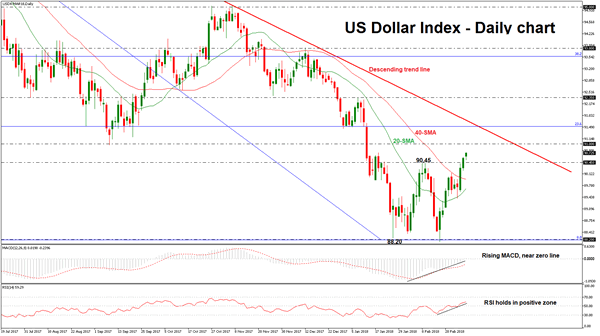
The US dollar index created a double bottom on February 16 near 88.20, posting a new more than 3-year low. The double bottom reversal is a bullish pattern indicating further gains on the price action as the index jumped above the significant area of 90.45. Currently, the price is recording a 7-week high near 90.75.
In the daily chart, short-term momentum indicators are also pointing to a continuation of the bullish bias. The Relative Strength Index is well above the 50 level, suggesting that the latest upswing may be running towards the overbought zone. The MACD oscillator is rising above the trigger line and has just entered the positive territory. In addition, the 20 simple moving averages is sloping to the upside, endorsing the upside scenario.
Further gains should see the 91.00 handle acting as a major resistance taken from the low on September 8. A run above this area could reinforce the bullish structure in the short-term as it could take the price towards the descending trend line near 91.50, which has been holding over the last year. Also, the 23.6% Fibonacci retracement level of the downleg from 102.23 to 88.20 is standing near the aforementioned level.
In the event of a continuation of the downside movement, the price could re-challenge the 88.20 support barrier, but the price would first need to go through the 20 and 40 SMAs.
Will Powell Deliver Another Blow to US Markets?
Hawkish Powell Weighing on Stocks
US equity markets are expected to open in the red on Thursday, as traders await the second appearance of the week from new Federal Reserve Chair Jerome Powell and a selection of economic data.
Powell's testimony in front of the House Financial Services Committee on Tuesday was very bullish on the economy and led many to believe that a fourth rate hike is on the table this year. While this isn't a million miles from what markets are pricing in, it did trigger another negative response from markets with US indices falling around two and a half percent since and positioned for further losses today.
It would appear markets are bracing for more hawkish commentary from Powell today when he appears before the Senate Banking Committee, once again discussing the semi-annual monetary policy report. Given everything that he said on Tuesday, it seems pretty clear that economic forecasts will be revised higher this month and the pace of tightening will likely therefore pick up, which may make today's less eventful as he reiterates many of the views already expressed. That said, should he wish to back pedal on anything or clarify points that have been misinterpreted, it may attract some attention.
US Inflation Data Eyed
What may be of more interest today is the US economic data that's being released. Yesterday's GDP data showed the economy growing at a decent pace in the fourth quarter and with momentum very much building and tax reform providing additional stimulus, this will likely pick up in the quarters ahead. This makes the inflation data all the more interesting, especially as the labour market slack has already been largely diminished which should put more upward pressure on prices.
The core PCE price index is the Fed's preferred measure of inflation and has been gradually ticking up again in the last few months. At 1.5%, it is still below the Fed's 2% target but close enough that any surprise beat will likely trigger a reaction in the markets, particularly following such a hawkish testimony from the new Fed Chairman. Personal income and spending figures will also be of interest, along with the two manufacturing PMI surveys.
Sterling at Six Week Low as Transition Talks Frustrate
We've already had a large number of PMI readings from across Europe this morning but, despite the numbers being broadly positive, they have failed to lift the mood in markets. The UK manufacturing PMI ticked slightly lower from a month ago, although this was largely shrugged as it remains quite elevated, with the sector having been boosted by a weaker pound over the last 18 months.
The pound is trading at six week lows against the dollar this morning, having come off its highs as Brexit discussions come back into focus, with both sides in talks over the transition period. A deal on the transition was initially intended to be completed this month, allowing for other discussions to take place over the course of the rest of the year but with both sides seemingly far apart on their expectations – to the surprise of no one – this could run over which is making traders uneasy and weighing on the pound.