

Sample Category Title
USD/CHF Mid-Day Outlook
Daily Pivots: (S1) 0.9401; (P) 0.9429; (R1) 0.9474; More...
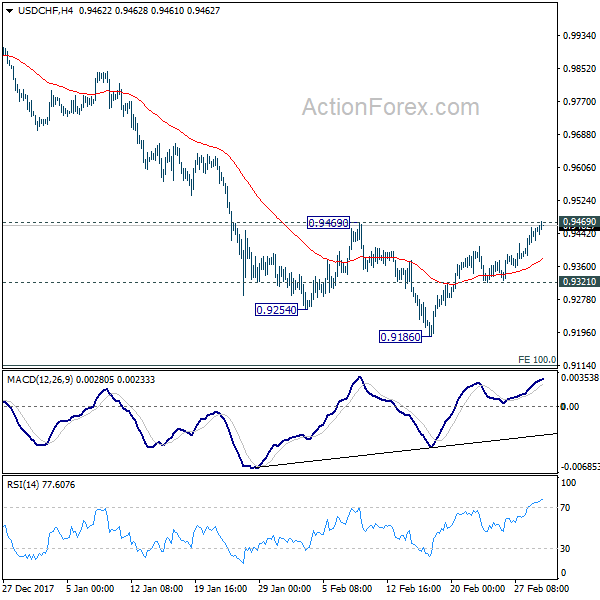
USD/CHF's rally continues today and is now pressing 0.9469 key near term resistance. Considering bullish convergence condition in 4 hour MACD, firm break of 0.9469 will indicate near term reversal and turn outlook bullish for 55 day EMA (now at 0.9511) and above. On the downside, below 0.9321 minor support will bring retest of 0.9186. Break there will extend the larger down trend to 0.9115 medium term projection level next.
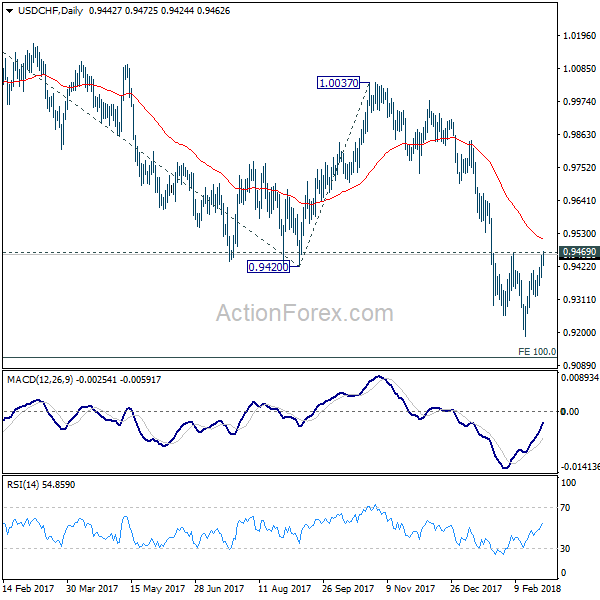
In the bigger picture, fall from 1.0342 is seen as a medium term down trend. Deeper decline should be seen to 100% projection of 1.0342 to 0.9420 from 1.0037 at 0.9115. Break will target 161.8% projection at 0.8545. In any case, sustained trading above 55 day EMA is needed to be the first sign of medium term reversal. Otherwise, outlook will stay bearish even in case of strong rebound.
USD/JPY Mid-Day Outlook
Daily Pivots: (S1) 106.31; (P) 106.92; (R1) 107.27; More...
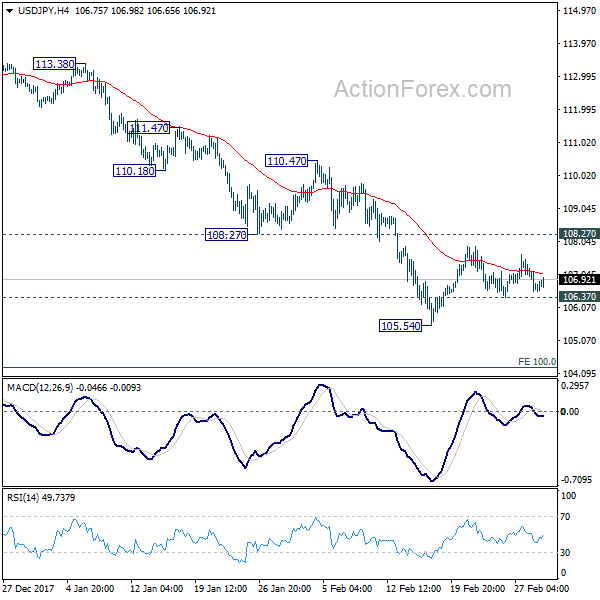
USD/JPY continues to stay in tight range and intraday bias remains neutral. On the upside, break of 108.27 will be the first sign of near term reversal and will target 110.47 resistance for confirmation. On the downside, below 106.37 minor support will bring retest of 105.54 low. Break of 105.54 will extend the larger decline from 118.65 and target 100% projection of 118.65 to 108.12 from 114.73 at 104.20 next.
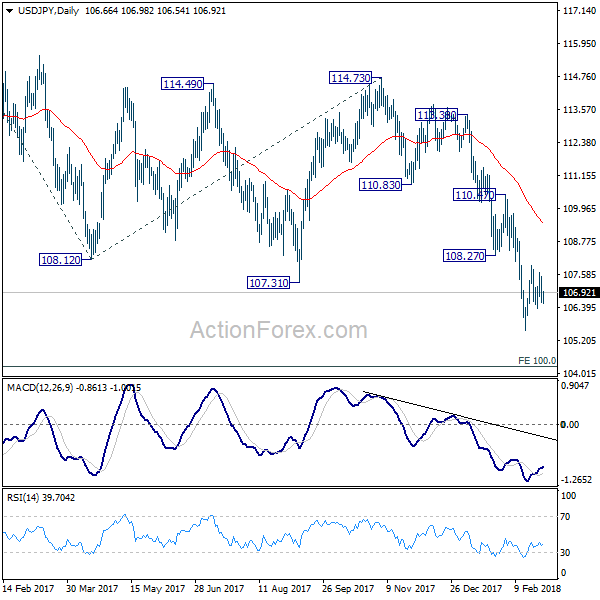
In the bigger picture, current development argues that the corrective pattern from 118.65 is extending. The solid break of 61.8% retracement of 98.97 to 118.65 at 106.48 now suggests that the pattern from 125.85 high is possibly extending. Deeper fall could be seen through 98.97 key support (2016 low). This bearish case will now be favored as long as 110.47 resistance holds.
GBP/USD Mid-Day Outlook
Daily Pivots: (S1) 1.3704; (P) 1.3810; (R1) 1.3864; More....
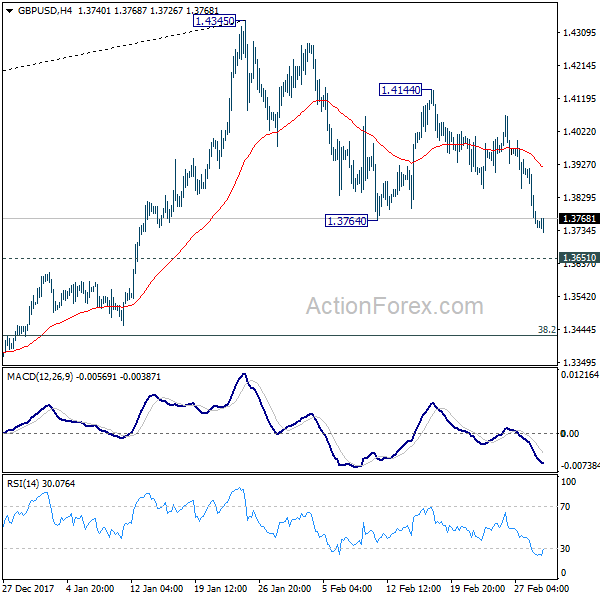
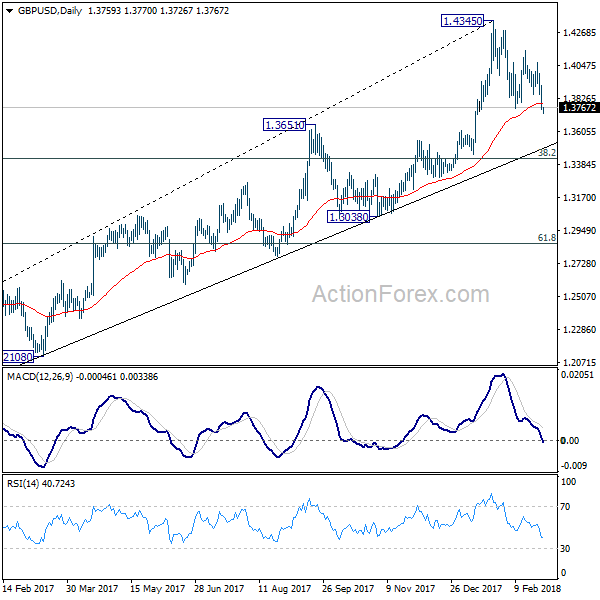
As noted before, fall from 1.4345 has just resumed. Intraday bias stays on the downside for 1.3651 resistance turned support and below. At this point, such fall is viewed as a corrective move. Hence, we'll look for strong support from 38.2% retracement of 1.1946 to 1.4345 at 1.3429 to contain downside and bring rebound. Nonetheless, break of 1.4144 resistance is needed to confirm completion of the decline. Otherwise, near term outlook will remain mildly bearish even in case of recovery.
In the bigger picture, as long as 1.3038 support holds, medium term outlook in GBP/USD will remains bullish. Rise from 1.1946 is at least correcting the long term down from 2007 high at 2.1161. Further rally would be seen back to 38.2% retracement of 2.1161 (2007 high) to 1.1946 (2016 low) at 1.5466. However, GBP/USD fails to sustain above 55 month EMA (now at 1.4279) so far. Break of 1.3038 support, will suggests that rise from 1.1946 has completed and will turn outlook bearish for retesting this low.
EUR/USD Mid-Day Outlook
Daily Pivots: (S1) 1.2173; (P) 1.2207 (R1) 1.2227; More....
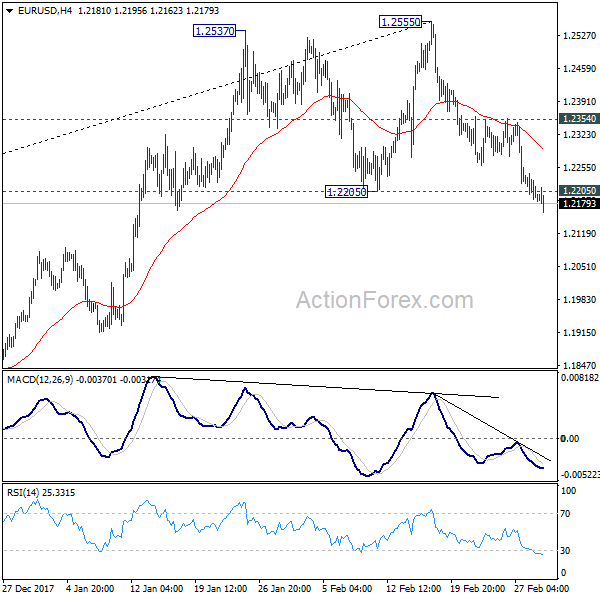
As noted before, the break of 1.2205 key support is taken as a tentative sign of trend reversal, after being rejected by 1.2516 key fibonacci level. Intraday bias remains on the downside for deeper fall. Sustained trading below 1.2205 will confirm and target 38.2% retracement of 1.0339 to 1.2555 at 1.1708. On the upside, above 1.2354 minor resistance will dampen this bearish case and bring retest of 1.2555 high instead.
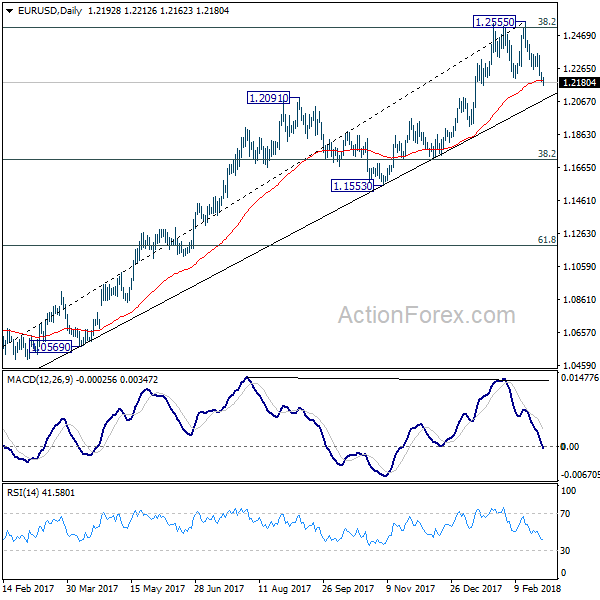
In the bigger picture, key fibonacci level at 38.2% retracement of 1.6039 (2008 high) to 1.0339 (2017 low) at 1.2516 remains intact despite attempts to break. Hence, rise from 1.0339 medium term bottom is still seen as a corrective move for the moment. Rejection from 1.2516 will maintain long term bearish outlook and keep the case for retesting 1.0039 alive. Firm break of 1.5553 support will add more medium term bearishness. However, sustained break of 1.2516 will carry larger bullish implication and target 61.8% retracement of 1.6039 to 1.0339 at 1.3862.
Spot Gold at New 2-Mth Low as Dollar Rises on Fed’s Hawkish Stance
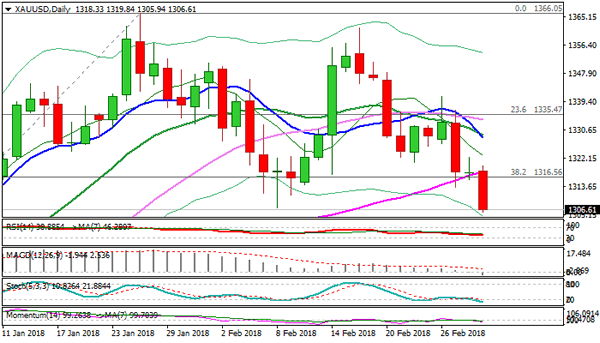
Spot Gold hit two-month low at $1306, on fresh bearish acceleration which cracked key near-term support at $1307 (08 Feb low). The yellow metal, sensitive on changes of US interest rates, came under increased pressure after Fed's new chief Jerome Powell, in his debut testimony, pointed at strong US economic outlook, indicating that the Fed could increase the pace of rate hikes this year and sending the greenback higher. Violation of $13707 pivot is negative signal which requires confirmation on close blow support to complete failure swing pattern on daily chart and confirm double-top ($1366/61) for further weakness. Bears now eye strong supports at $1301/00 (100SMA/daily cloud base/Fibo 50% of $1236/$1366 ascend), loss of which would expose next key supports at $1286 (200SMA/Fibo 61.8% retracement). Today's break below 55SMA and formation of double bear-cross (10/30 and 10/20SMA's), along with fresh bearish momentum, increase bearish pressure and maintain negative sentiment. Broken 55SMA now marks solid resistance at $1318, which is expected to keep the upside protected.
Res: 1307; 1313; 1318; 1324
Sup: 1300; 1294; 1286; 1279
Dollar Holds Strong ahead of Powell’s Senate Speech; European Equities in the Red
Here are the latest developments in global markets:
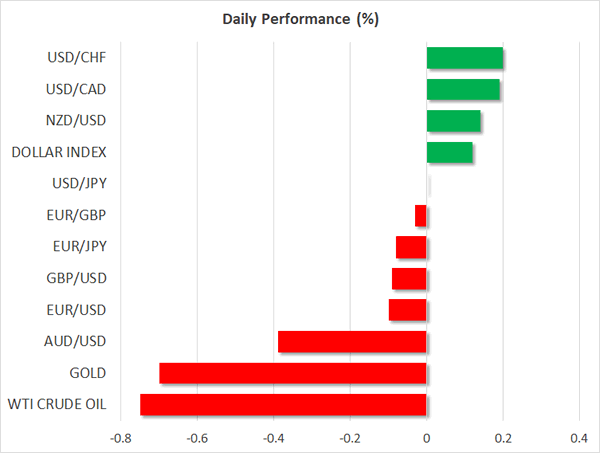
FOREX: Investors were in a sell mode against the pound during early European afternoon as the cloud around the Brexit story was getting larger following May's unexpected rejection of the legal draft Brexit treaty published yesterday. Pound/dollar crawled further down to touch a fresh six-week low at 1.3726 (-0.16%). Euro/dollar also weakened towards six-week lows, inching down to 1.2185 (-0.07%) as hawkish monetary prospects in the US increased the gap between the US-EU short-term government bond yields to the widest in 20 years. Meanwhile, the Eurozone's unemployment rate stood at 8.6% as expected in January (December's unemployment rate was revised slightly downwards to 8.6%) while the bloc's final IHS Markit manufacturing PMI for the month of February retreated by less than expected and remained above the threshold that separates growth from contraction. Euro/pound was flat at 0.8862 (+0.02%) after yesterday's steep rally. The dollar index was in the green for the third consecutive day, trading at 90.72 (+0.12%) near six-week highs, with investors sentiment on the currency remaining positive ahead of the Fed Chair's speech before the US Senate. Dollar/yen was moving sideways at 106.67 (+0.01%) while dollar/loonie was higher at 1.2848 (+0.12%). In antipodean currencies, aussie/dollar was struggling to pare earlier losses following a disappointing CAPEX print in the final quarter of 2017.
STOCKS: European stocks opened sharply lower on Thursday as prospects that the Fed could raise interest rates faster than expected continued to loom in the background, while disappointing earnings releases added further losses to the European equities. The pan-European STOXX 600 and the blue-chip Euro STOXX 50 were down by 1.0% and 0.86% accordingly at 1100 GMT. The German DAX 30 dived by 1.47% with all sectors being in the red and consumer cyclicals losing the most. The French CAC 40 fell by 1.12% after the French supermarket Carrefour cut group's dividends and painted a cautious outlook for its 2018 profits. The Italian FTSE MIB dropped by 0.89% ahead of Sunday's general elections, the Spanish IBEX 35 and the UK's FTSE 100 fell by 1.14% and 0.56% respectively. US stock futures were pointing to a negative open.
COMMODITIES: Oil prices extended losses towards fresh weekly lows as concerns over a rising US production heightened after the EIA oil report showed that US crude oil inventories increased well above expectations in the week ending February 23. In other news, sources stated that Saudi Arabia is likely to cut crude prices for its Asian partners in April after demand for April's cargoes from Asia declined last month. WTI crude and Brent were trading lower at 61.29 (.-0.58%) and 64.32 (-0.63%) per barrel respectively. In precious metals, gold stretched to fresh three-week lows, last seen at $1310.30 per ounce.
Day ahead: Theresa May meets the European Council President Donald Tusk; Powell testifies in front of the Senate
The British Prime Minister, Theresa May is meeting the President of the European Council Donald Tusk today at 1230 GMT according to the Council, a day before she delivers a keynote speech regarding the UK's relations with the bloc. Yesterday, May surprisingly rejected a legal draft of the Brexit treaty handed out by the European Commission, opposing the EU's border proposals on the Irish problem which stated that Northern Ireland would stay a member of the EU customs union if the sides fail to reach an alternative agreement. May is now under severe pressure as she has theoretically dismissed solutions discussed in Brussels and any retaliation from her side could tear down progress in the Brexit story, sending the pound even lower.
In the US, the focus will turn to Jerome Powell once again. Following his hawkish speech before the House Financial Committee on Tuesday, the new Fed Chair is now preparing to testify in front of the Senate Banking Committee today at 1500 GMT. Powell will probably reiterate his optimism on the country's economic conditions, supporting that gradual rate hikes are needed in the future to avoid the economy from overheating. While this is not something new to the markets, any change in his tone perceived as more hawkish or bearish could shake the dollar.
Meanwhile, the US President, Donald Trump, is expected to announce tariffs on steel and aluminum imports later today, risking the country's trade relations and increasing tensions with China, the world's biggest aluminum and steel producer. Canada and Mexico are also exporting metals to the US and any restriction to their activities could deteriorate efforts to negotiate the NAFTA treaty which has been so far hanging in the air.
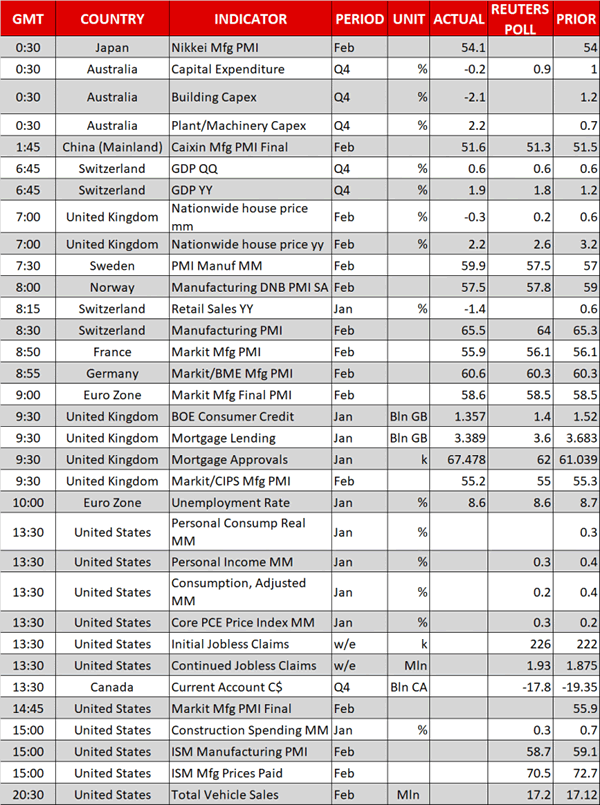
In terms of data, economic releases will keep investors busy today, with the US releasing a bunch of figures. At 1330 GMT, the Fed's preferred inflation measure, the core personal consumption expenditures index (PCE) will come into view. For the month of January, the index is expected to stand flat at 1.5% y/y and inch up by 0.1 percentage points to 0.3% m/m. Readings on personal consumption and personal spending will also attract attention at the same time, with both indicators seen lower in the aforementioned month.
Initial jobless claims (1330 GMT), ISM manufacturing PMI (1500 GMT) and the Fed's Beige Book which reports on current economic conditions in 12 Federal districts will also attract attention later in the day.
In Canada, current account data for the final quarter of 2017 are due out at 1330 GMT, while the Markit manufacturing PMI for February will be released at 1430 GMT.
As for the speakers, besides Fed Chair Jerome Powell, New York Fed President William Dudley (permanent voter) will also step up to the rostrum, at 1600 GMT. He is considered one of the most influential Fed officials and thus investors will look for any signals as to whether he would entertain the prospect of four rate hikes this year.
USDJPY Currently Holding Key Support
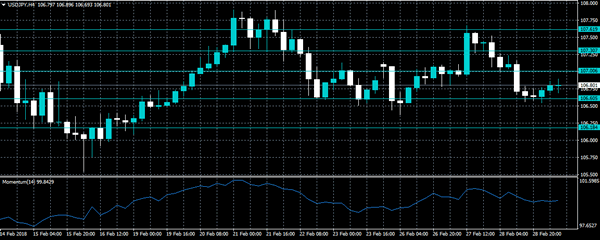
Moving into Thursday's U.S trading session, USDJPY traders will likely look to U.S stock markets and the ISM Manufacturing report for the month of February.
The USDJPY pair is likely to fall sharply below the 106.60 level, key technical support is found at the 106.18 and 105.50 levels.
Should price-action on the USDJPY pair hold above the 106.60 level, traders may test the 107.00 and 107.30 resistance levels.
GBPUSD Sellers Now Targeting 1.3657 Level
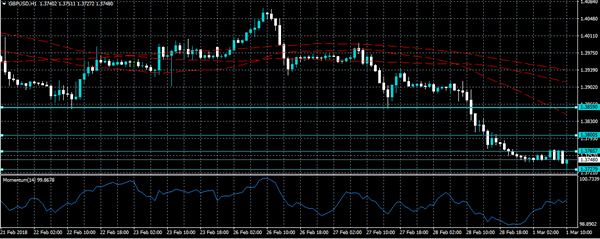
The British pound has continued to extend heavy intraday losses against the greenback on Thursday, with price-action trading as low as 1.3727, during the European trading session. A much stronger U.S dollar and concerns over Brexit negotiations are weighing on the GBPUSD pair, alongside bearish RSI and MACD indicators. Technical sellers also firmly in control of the pair, following a breach of the key 1.3765 earlier today, the next major downside remains the 2017 trading high, located at 1.3657.
The GBPUSD pair is strongly bearish below the 1.3765 level, traders may now test towards the 1.3710 and 1.3657 support levels.
Should GBPUSD price-action move above the 1.3765 level for a sustained period, buyers may test back towards the 1.3800 resistance level.
CAC Slides as US, Asian Markets Lose Ground After Powell Remarks
The CAC index has posted sharp losses in the Thursday session. Currently, the index is at 5,261.50, down 1.12% on the day. On the release front, manufacturing reports were in focus. French and eurozone PMIs continue to point to steady expansion, as stronger global growth has boosted the manufacturing sectors. However, both indicators slowed in February. Eurozone PMI dipped to 58.6, just above the estimate of 58.5 points. French PMI dropped to 55.9, shy of the forecast of 56.1 points. This marked a 6-month low. As well, the eurozone unemployment rate dipped lower to 8.6%, matching the forecast. In the US, Fed chair Jerome Powell testifies before the Senate Banking Committee.
Inflation in eurozone edged lower to 1.2% in February, down from 1.3% in January. This reading met expectations, but underscores that inflation levels remain well below the ECB target of around 2 percent. Economic growth has rebounded, led by a robust German economy. Still, there is plenty of slack in the eurozone economy and the ECB is not under pressure to tighten policy. The Bank will meet on March 8, and no major changes are expected. Policymakers could deliberate the possibility of removing the Bank's easing bias towards increasing bond purchases if needed. A removal of the easing bias would likely be interpreted as a plan to tighten policy and would be bullish for the euro.
It's been a brutal start to 2018 for stock markets, and the CAC has plunged 7.4% so far this year. Global stock markets remain under pressure this week, after a hawkish performance from Federal Reserve Chair Jerome Powell, who testified before a congressional committee on Tuesday. Powell affirmed that the Fed planned to raise rates gradually. Powell sounded optimistic about economic conditions, noting that the US economy was benefiting from the global recovery as well as changes in fiscal policy. Importantly, Powell did not address the question of an acceleration of rate hikes. Currently, the Fed has projected three rate hikes in 2018, with increases widely expected at the March and May meetings. However, with inflation moving higher and the economy continuing to perform well, many analysts expect the Fed to raise rates four or more times this year. Any hints at an increased pace of rate hikes could send the US dollar higher and send European stock markets downwards.
Canadian GDP Figures On The Horizon As Loonie Falls To Multi-Week Low
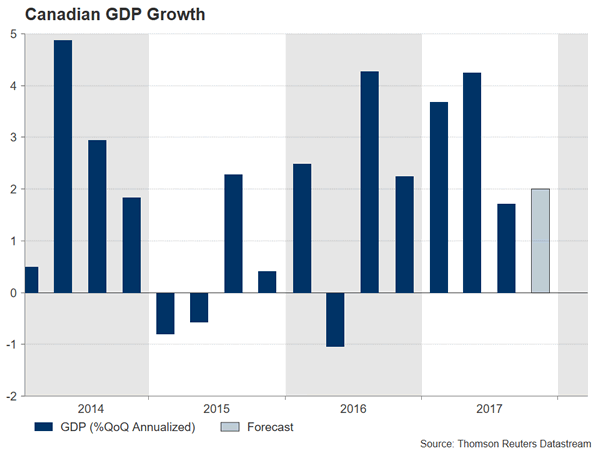
Canada will see the release of Q4 2017 as well as December GDP figures on Friday at 1330 GMT. Quarterly annualized growth figures are projected to show an improvement after Q3's slump in economic activity, while monthly figures are anticipated to show that expansion eased during the last month of the year. Market participants may assign greater weight on the numbers that would otherwise have been the case, given that they will be released a few days before the Bank of Canada next meets to set its monetary policy moving forward.
The annualized pace of quarterly growth during the last quarter of 2017 is expected to stand at 2.0%. This compares to Q3's respective figure of 1.7% that followed Q2's 4.3% – this being the strongest rate of growth since Q2 2014. The slowdown in Q3 came on the back of a considerable decline in exports, as well as due to businesses holding back on investments. The latter was likely attributed to uncertainty over the future of the North American Free Trade Agreement (NAFTA). December's monthly growth figure is projected to stand at 0.1%, down from November's 0.4%
The BoC, the first major central bank to deliver a rate hike so far this year, will be concluding its two-day meeting on monetary policy on March 7. Given that Friday's release will constitute the last growth input before the Bank's meeting, this might increase the significance of the release in investors' minds, with a deviation from forecasts leading to sharper movements than would otherwise have been the case; of course, the extent of the deviation is also a factor that is under consideration.
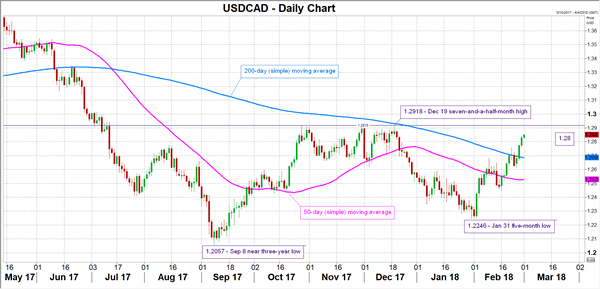
A data beat is anticipated to be met with long loonie positions and focusing on the Canadian dollar versus its US counterpart, lead to a buildup of short dollar/loonie positions. Market participants could potentially revise their expectations for additional rate hikes by the BoC in sight of strong readings, bringing them sooner in time than previously thought. In this case, dollar/loonie might find support around the 1.28 handle which was congested in the past. Steeper declines would shift the focus to the area around the current level of the 200-day moving average at 1.2686. The range around this point also encapsulates the 1.27 handle that may carry psychological importance and was also congested in the past.
Dollar/loonie has advanced considerably after hitting a five-month low of 1.2246 on January 31, recording a more than two-month high of 1.2854 during Thursday's trading. If growth numbers surprise to the downside, the pair is likely to build on positive momentum, targeting the area around the seven-and-a-half-month high of 1.2918 that was recorded on December 19.
For the record, no change in the BoC's policy rate is expected next Wednesday, with Canadian overnight index swaps currently assigning only a 10% probability for a quarter percentage point interest rate increase, something which would see the policy rate rising to 1.5%.
A major driver for the loonie moving forward is the future of NAFTA negotiations. Those are currently on their seventh round, with no meaningful progress so far recorded. Rising uncertainty on this front has in the past hurt the Canadian currency. Oil prices could also give direction to the currency as Canada is a major exporter of the precious commodity. Those have eased somewhat in February after hitting a three-year high in January. It is noteworthy that the International Energy Agency said on Tuesday that US shale production is set to rapidly increase, with the US overtaking Russia as the world's biggest oil producer by 2019 the latest. Such an outcome does not paint a bullish picture for oil prices moving forward, which in turn could lead to losses for the loonie.