Sample Category Title
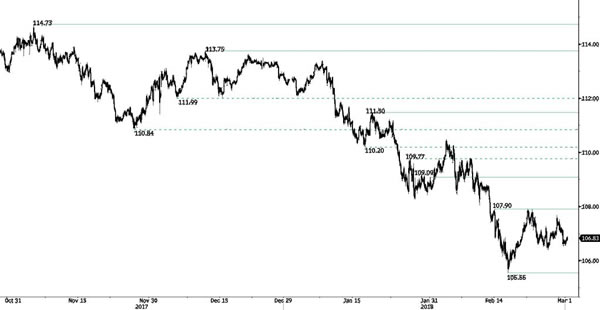
USD/JPY Decline
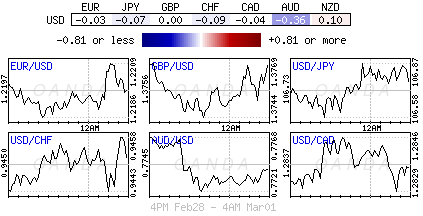
USD/JPY decreases, trading below 107. USD/ JPY downward pattern is maintained. Hourly support and resistance are given at 105.55 (16/02/2018 low) and 107.90 (14/02/2018 high). The technical structure suggests short-term declining moves.
We favor a long-term bearish bias. Support at 105.55 (03/05/2016 low) is almost reached. A gradual rise toward the major resistance at 125.86 (05/06/2015 high) seems unlikely. Expected to decline further support at 101.20 (09/11/2016 low).
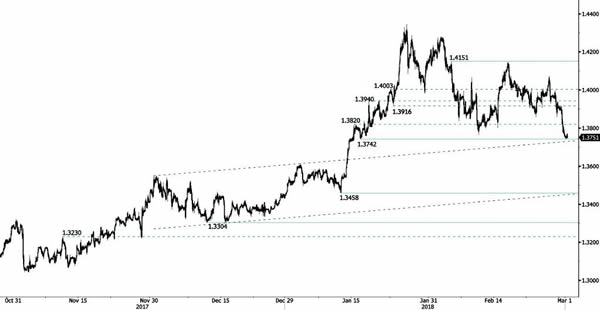
GBP/USD Monitoring Support At 1.3742
GBP/USD trades below 1.38, approaching hourly support at 1.3742 (16/01/2018 low). The upward trend of November 2017 remains however intact. Hourly resistance is given at 1.4151 (05/02/2018 high). The technical structure suggests further short-term downside moves.
The long-term technical pattern is reversing. The Brexit vote had paved the way for further decline but the pair is moving to 2016 highs. Long-term support and resistance are given at 1.1841 (07/10/2017 low) and 1.5018 (24/06/2016 high).
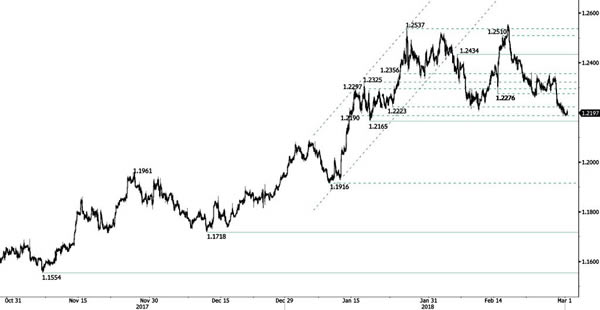
EUR/USD Consolidating
EUR/USD is approaching hourly support at 1.2165 (17/01/2018 low), currently trading sideways. Hourly resistance remains at 1.2434 (06/02/2018 high). The technical structure suggests sideways moves.
In the longer term, the momentum is turning largely positive. We favor a continued bullish bias. Key resistance is holding at 1.2886 (15/10/2014 high) while strong support lies at 1.1554 (08/11/2017 low).
Round Two With Fed Chair Powell
Thursday Mar 1: Five things the markets are talking about
U.S equities suffered their worst monthly decline in two years last month as investors continued to digest new Fed Chair, Jerome Powell’s, Tuesday’s comments. The S&P 500 Index slumped more than -1% yesterday, ending February with a decline of -4%.
U.S Treasuries and the dollar trade somewhat steady as the market awaits his second appearance this morning (10 am EST). Powell is due to testify on the Semi-annual Monetary Policy Report before the Senate Banking Committee, in Washington.
His comments this week has kept the door ajar to speculation that the Fed may want to quicken the pace of monetary tightening.
1. Stocks trade under pressure
In Japan, the Nikkei share average closed atop of its two-week low overnight as market sentiment was hit by the rout stateside on Wednesday. The Nikkei closed out -1.6% lower, while the broader Topix declined -1.7%.
Down-under, the Aussie ASX 200 declined -0.7%, weighed down mostly by mining heavyweights as commodity prices weakened, while the broader market retreated on fears of rising U.S interest rates. In S. Korea, the Kospi was closed for a holiday.
In Hong Kong, stocks fell to a two-week low. The Hang Seng index ended down -1.4%, while the China Enterprises index declined -2.1%.
In China, stocks recouped earlier losses to climb as consumer and banking firms rose, after a private survey showed the country’s factory growth rose to a six-month high in February. At the close, the Shanghai Composite index was up +0.6%, while China’s blue-chip CSI300 index was up +0.9%.
In Europe, regionalIndices trade lower across the board following yesterday’s weaker close on Wall street , and mostly weaker markets in the Far East.
U.S stocks are set to open in the ‘red’ (-0.2%).
Indices: Stoxx600 -0.9% at 376.1, FTSE -0.5% at 7195, DAX -1.4% at 12259, CAC-40 -1.1% at 5264, IBEX-35 -1.0% at 9745, FTSE MIB -0.8% at 22421 , SMI -0.9% at 8828, S&P 500 Futures -0.2%
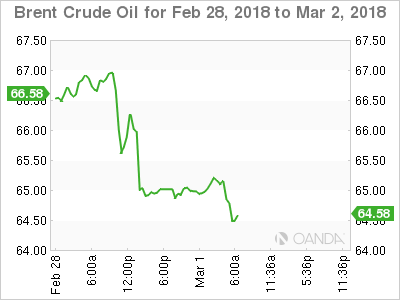
2. Oil prices capped, gold lower
Oil prices remain capped after U.S federal data yesterday showed that oil and gas are building up in storage even as U.S oil production continues to climb.
In the U.S, crude inventories grew by +3m barrels last week, and gas increased by +2.5m barrels, according to yesterday’s U.S EIA report. The market had correctly anticipated an increase, but a smaller one.
Note: On Tuesday the API group, an industry group said that its data for the week showed a +933k barrel increase in crude supplies, a +1.9m barrel rise in gas stocks and a -1.4m barrel decrease in distillate inventories.
Brent crude for May delivery is up +17c, or +0.3% at +$64.90, while the U.S West Texas Intermediate (WTI) for April delivery is up +13c, or +0.2% at +$61.77 a barrel.
Note: Both benchmark contracts fell nearly -5% in February, the first monthly declines in six-months.
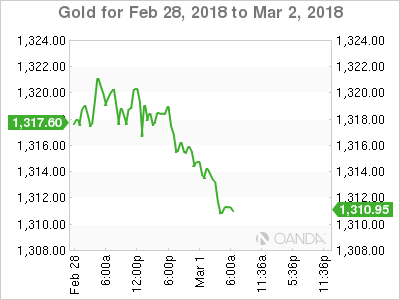
Ahead of the U.S open, gold prices have dipped, pulled down, as the dollar remains better bid following Fed Chairman Powell’s comments that fanned concerns of faster-than-expected rate hikes in the U.S. Spot gold is -0.2% lower at +$1,315.36 an ounce. Prices have fallen about -1% so far this week.
3. Sovereign yields remain elevated
With central banks beginning to reduce their balance sheets should start to have a bigger effect on currencies. Policy normalization should lead to increased market volatility and also continue to impact the cost of hedging FX transactions.
Stateside, Treasury yields have notched another monthly advance in February. The yield on the U.S 10-year note has now risen for five of the past six-months as investors worry that inflation could be accelerating and that there may not be enough demand to meet additional Treasury’s issuance.
The yield on U.S 10’s has gained less than +1 bps to +2.86%. In Germany, the 10-year Bund yield has fallen less than -1 bps to +0.65%, the lowest in almost five weeks. In the U.K, the 10-year Gilt yield has declined -6 bps to +1.501%, the lowest yield in a month and the largest intraday fall in almost two-weeks.
4. Sterling selling back in vogue on Brexit fears
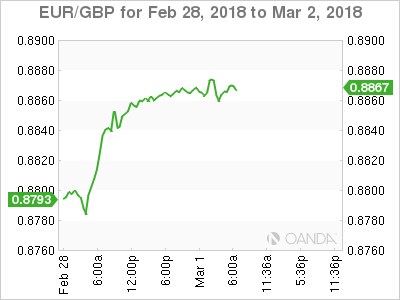
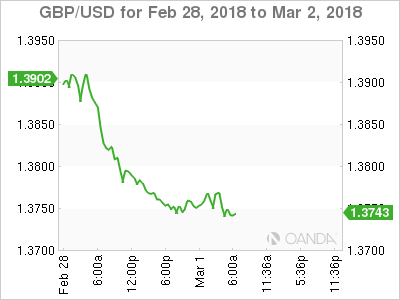
Selling sterling on concerns about the lack of progress in Brexit negotiations is back in fashion. The pound was driven to a two-week low outright overnight after the E.U published a draft Brexit withdrawal agreement. However, Prime Minister May has said she cannot accept the E.U’s proposals on the Northern Ireland border. GBP/USD last traded flat at £1.3759, up from around £1.3747 before this morning’s PMI data (see below). EUR/GBP trades roughly flat at €0.8858, having traded at around €0.8867.
Note: PM May’s will deliver a speech in Sunderland tomorrow (Mar 2) on the ” U.K’s relationship with E.U.” There is no specific time or location that has been announced yet. She has picked a strong pro-Brexit area and one that has not voted Tory in generations.
Elsewhere, the EUR has gained less than +0.05% to €1.2197.The Japanese yen dipped -0.2% to ¥106.86, while the South African rand sank -0.4% to $11.8485, the weakest in more than two-weeks.
5. German manufacturing revised higher, U.K manufacturing lower
Data this morning showed that Germany’s manufacturing PMI for February was revised up a tad to 60.6 from its flash estimate of 60.3. Digging deeper, rising input costs led many German manufacturers to increase prices – capacity issues have allowed vendors to negotiate higher prices as demand outstrips supply.
In the U.K, purchasing managers’ survey on manufacturing for February came in at 55.2, down just slightly from January’s 55.3 and in line with market expectations.
DAX Slides, As Global Stock Markets See Red
The DAX index has posted sharp losses in the Thursday session. Currently, the index is trading at 12,271.50, down 1.32% since the Wednesday close. European markets have followed the lead of the Asian and North American stock markets, which posted losses in the most recent session. On the release front, Germany and eurozone PMIs continue to point to strong expansion. German Manufacturing PMI dipped to 60.6, above the estimate of 60.3 points. It was a similar trend for the eurozone indicator, which dropped to 58.6, just above the estimate of 58.5 points. As well, the eurozone unemployment rate dipped lower to 8.6%, matching the forecast. In the US, Fed chair Jerome Powell testifies before the Senate Banking Committee. On Friday, Germany releases Retail Sales.
The eurozone continues to post steady economic growth, and the bloc’s unemployment rate has dropped to 8.6%. Still, inflation levels remain well below the ECB target of around 2 percent. In February, Eurozone CP edged lower to 1.2%, down from 1.3% in January. With plenty of slack in the eurozone economy, the ECB is not under pressure to tighten policy. The Bank will meet on March 8, and no major changes are expected. Policymakers could deliberate the possibility of removing the Bank’s easing bias towards increasing bond purchases if needed. A removal of the easing bias would likely be interpreted as a plan to tighten policy, which would be a vote of confidence in the economy and could rally European stock markets.
Jerome Powell is just settling into his new job, but it’s been an eventful few weeks for the new Federal Reserve chair. Powell was greeted by a sharp correction in US stock markets, as investors headed for the hills on fears that the Fed might accelerate its pace of rate hikes if inflation moves higher. On Tuesday, Powell testified before a congressional committee, and will speak before the Senate Banking Committee on Thursday. Powell’s message to Congress was decidedly hawkish, as the Fed chair said that the current policy of gradual rate increases would continue. He added that the economy was strong and that he expected inflation to move up to the Fed target of 2 percent. Importantly, Powell did not address the question of an acceleration of rate hikes, but his hawkish stance has increased the likelihood that the Fed will increase it projection from three to four rate hikes this year.
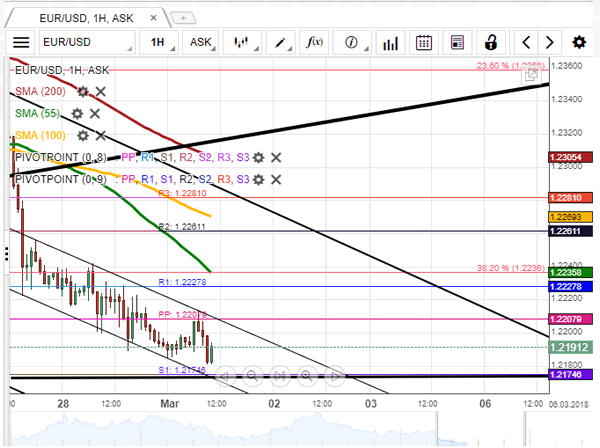
EUR/USD Analysis Continues Lower
During the early hours of Thursday's trading session the common European currency continued to lose ground against the US Dollar. Meanwhile, Dukascopy analysts spotted two notable facts about the pair's charts.
The decline, which followed the first testimony of the head of the Federal Reserve, has confirmed that it is occurring in a narrow descending channel pattern.
Meanwhile, analysts looked for a possible level of support, which might force a reversal of the direction. As a result of the efforts, a possible support line of a long term almost horizontal pattern has been set near the 1.2170 mark.
The zone around this line should be watched carefully.
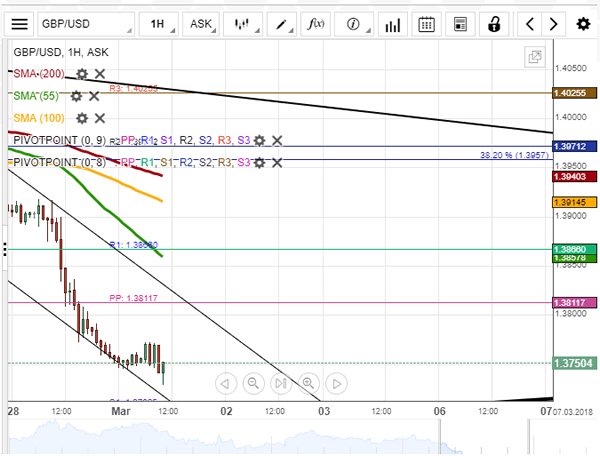
GBP/USD Analysis Continues In Discovered Pattern
The patterns drawn on Wednesday have held their ground, as the Pound continues to trade against the Greenback in a narrow channel down pattern. However, the decline on Thursday morning turned sideways.
If one looks at the hourly chart, it can be observed that the rate made a few attempts to rebound after meeting the lower trend line of the channel down pattern. Although, the resistance of the weekly S2 has stopped the efforts of the Pound.
Meanwhile, it was noticed that the supposed sideways fluctuations were booking lower and lower rebound points. That indicates that the decline will continue.
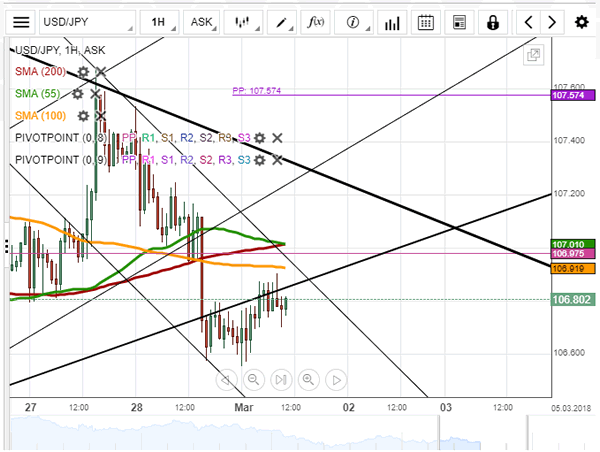
USD/JPY Analysis Breaks Support Levels
The support level described on Wednesday did not manage to hold its ground. As a result one can spot a large, red hourly candle on the USD/JPY currency pairs charts. Although, the sudden drop was stopped by a medium scale pattern's lower trend line, which on Thursday was acting as a resistance.
Meanwhile, the large scale descending channel was once more adjusted, as its exact borders have been mysterious during this week.
However, most attention should be given to the newly spotted channel down pattern, which might guide the pair lower. That would occur after a resistance cluster is met just below the 107.00 mark.
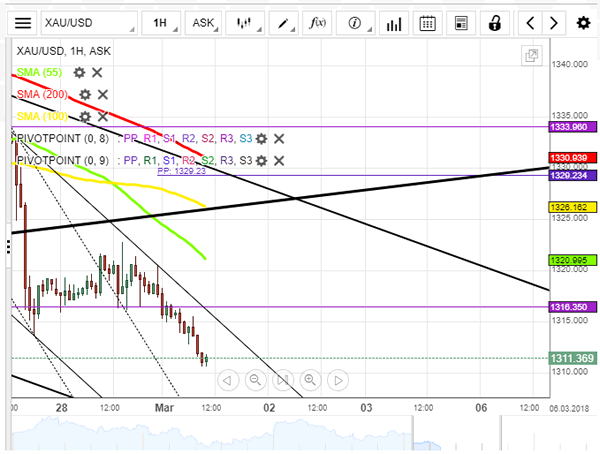
Gold Analysis Declines As Expected
The expected decline of the yellow metal has occurred. However, it did not come into reality exactly as it was expected.
The bullion broke the narrow ranged channel down pattern. The narrow pattern turned out to represent the junior decline in the borders of a wider descending pattern.
The newly discovered pattern was the one, whose upper trend line provided the resistance needed for the speculated decline.
In regards to the near future, on Thursday morning the range down to the levels near the 1,300.00 mark was free from support.
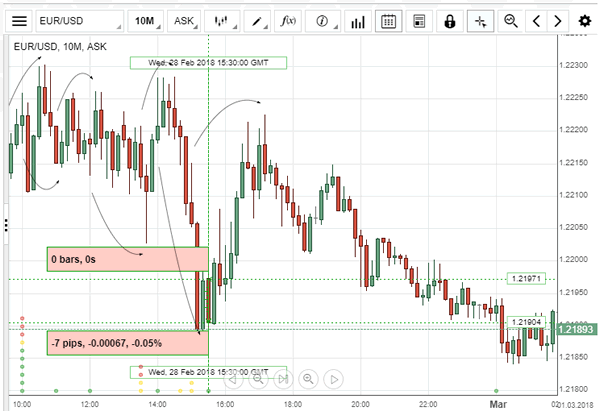
EUR/USD: US Crude Oil Inventories
The Greenback strengthened against its European counterpart following the release of the US crude oil inventories report for the week ended 23 February. The EUR/USD exchange rate fell just seven base points, or 0.05%, to the 1.2190 level and continued to fluctuate in the 1.2200 area.
The Energy Information Administration stated that crude oil inventories rose three million barrels, which is 0.6 million barrels more than expected in the reported week, following a drop in domestic crude oil inventories as of the week before. The US Dollar keeps gaining strength after various generally positive reports including Powell's testimony that will most probably play its role for a few more weeks.