Sample Category Title
Technical Outlook: GBPUSD – Weaker Than Expected UK Q$ GDP Could Further Boost Bears
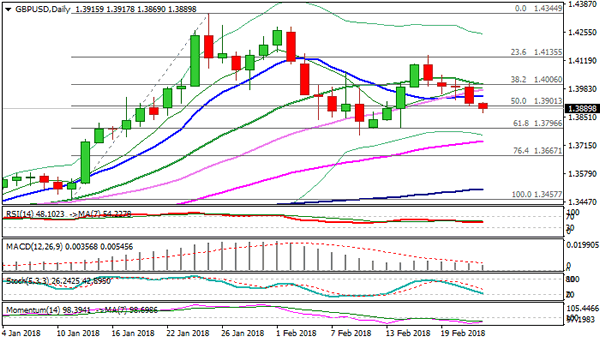
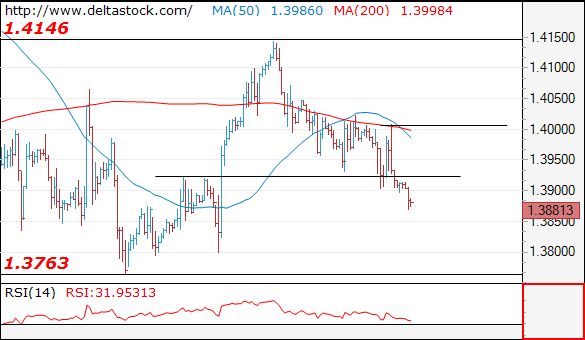
Cable continues to trend lower and hit new low at 1.3869 in early European trading on Thursday (the lowest since 16 Feb), pressured by stronger dollar.
Bearish setup on daily techs adds to negative near-term outlook which could drive pound further down for test of next significant support at 1.3800 zone (Fibo 61.8% of 1.3457/1.4344 upleg).
Further negative impact on sterling could be expected from UK GDP data which showed that Britain’s economy grew at slower pace in the last quarter of 2017 than initially estimated.
UK GDP q/q rose by 0.4% in Q4, missing forecast at 0.5%, which was the figure of Q3.
Annualized GDP also slowed, showing growth by 1.4% in Q3 vs forecasted / Q3 release at 1.5%.
Weaker than expected GDP data could affect strong expectations for BoE’s attempts in normalizing monetary policy.
Cable stays in red for the fifth straight day and bears eye 1.3854 (Fibo 76.4% of 1.3764/1.4144 upleg) break which would open way towards 1.3800 and 1.3764 (09 Feb low).
Broken 10SMA marks solid resistance at 1.3946 which should ideally keep the upside protected and guard next pivot at 1.4000 (psychological barrier / 20SMA).
Res: 1.3917, 1.3946, 1.4000, 1.4049
Sup: 1.3869, 1.3854, 1.3800, 1.3764
Forex Technical Analysis: EUR/USD, USD/JPY, GBP/USD
EUR/USD
Current level - 1.2269
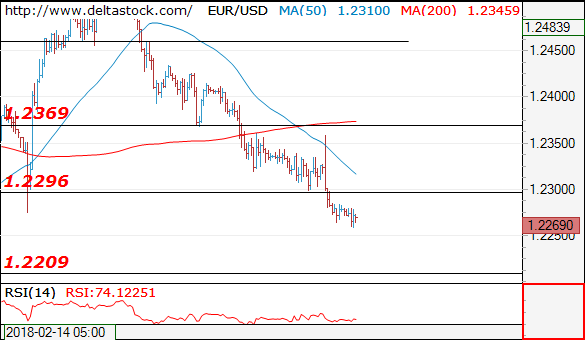
The brief rebound above 1.2290 was capped below 1.2370 and the downtrend is renewed, towards 1.2210 area. Initial intraday resistance lies at 1.2300.
| Resistance | Support | ||
| intraday | intraweek | intraday | intraweek |
| 1.2300 | 1.2460 | 1.2250 | 1.2210 |
| 1.2370 | 1.2560 | 1.2210 | 1.2090 |
USD/JPY
Current level - 107.37
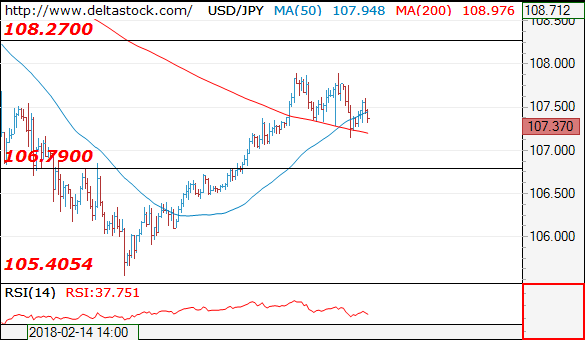
The second test of 108.00 failed as well and the intraday bias is bearish, for a slide towards 106.80 area.
| Resistance | Support | ||
| intraday | intraweek | intraday | intraweek |
| 108.00 | 108.30 | 107.15 | 105.40 |
| 108.30 | 110.40 | 106.80 | 102.40 |
GBP/USD
Current level - 1.3881
The break through 1.3920 shows, that the downtrend is intact, heading towards 1.3760 lows. Crucial on the upside is 1.4010.
| Resistance | Support | ||
| intraday | intraweek | intraday | intraweek |
| 1.3920 | 1.4280 | 1.3800 | 1.3760 |
| 1.4010 | 1.4340 | 1.3760 | 1.3620 |
Technical Outlook: USDJPY – Reversal Signal Is Developing On Daily Chart, 107 Is Key
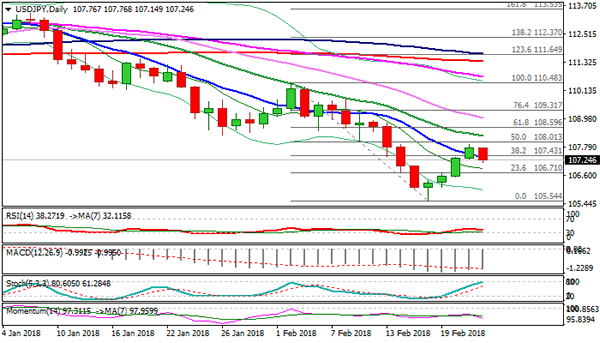
The pair holds in red on Thursday and showing initial signal of reversal after strong rally of past four days stalled on approach at 108 barrier.
Pullback from recovery high at 107.90, posted on Wednesday, returned below falling 10SMA (currently at 107.36) and dipped near pivotal support at 107.00 (Fibo 38.2% of 105.54/107.90 upleg), looking for firmer bearish signal on break lower.
Overall bearish structure favors fresh weakness after correction, with close below 107 handle today needed to form bearish outside day pattern and signal further easing towards next pivotal support at 106.44 (Fibo 61.8% of 105.54/107.90).
Daily MA’s turned to full bearish setup, while 14-d momentum heads south in deep negative territory, supporting further weakness.
Alternative scenario requires sustained break above 108 and extension through falling 20SMA (108.26) to bring near-term bulls back to play.
Res: 107.36, 107.76, 107.90, 108.26
Sup: 107.00, 106.72, 106.44, 106.10
Technical Outlook: EURUSD – Extended Weakness After Hawkish Fed Minutes Exposes Key Supports At 1.2205/1.2173
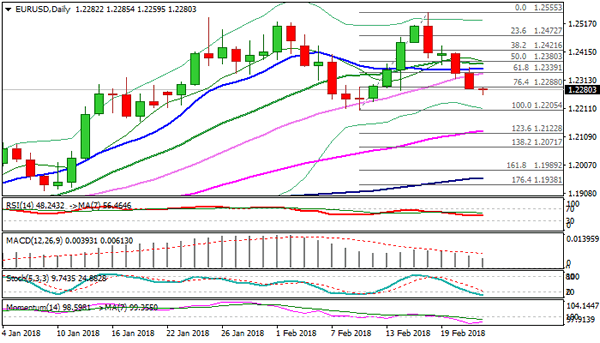
The Euro remains in red on Thursday and hit 1 ½ week low at 1.2259 after Fed minutes further inflated the dollar.
Minutes of Fed’s 30/31 Jan policy meeting showed the US policymakers upgraded their forecasts for economic outlook since December and showed more confidence regarding interest rates hikes this year on improved view on inflation.
Rising hopes for more rate hikes than initially planned keep the single currency under pressure, as extension below 1.2288 (broken Fibo 76.4% of 1.2205/1.2553 upleg) opens way towards key supports at 1.2205 (09 Feb higher low) and 1.2173 (Fibo 38.2% of Nov/Feb 1.1553/1.2555 ascend).
Violation of these support would generate stronger bearish signal for extension of descend from daily double-top (1.2537/55) towards 1.2132 (rising 55SMA) and 1.2092 (former top of 08 Sep).
Daily techs are maintaining strong bearish momentum and backing further weakness, but oversold slow stochastic warns that bears may take a breather ahead of 1.2205 pivot.
Falling thick hourly cloud (spanned between 1.2330 and 1.2367) weighs on near-term action and is expected to cap upticks, as resistance is reinforced by a cluster of daily MA’s (10/20/30 SMA, laying between 1.2336 and 1.2369).
Release of German Ifo business climate index is the key event in the European session (Feb f/c 117.1 vs Jan 117.6) with softer than expected numbers to further weaken the Euro.
Res: 1.2288, 1.2330, 1.2369, 1.2412
Sup: 1.2259, 1.2235, 1.2205, 1.2172
Dollar Recovery Gains Momentum After Fed Minutes, UK GDP And ECB Minutes Due
Here are the latest developments in global markets:
FOREX: The dollar index was 0.2% higher on Thursday, adding to the notable gains it posted yesterday on the back of the Fed minutes from the January meeting, which were quite upbeat. The greenback moved in tandem with US Treasury yields that surged across the board in the aftermath of the minutes, to reach fresh multi-year highs.
STOCKS: US markets took a hit from the Fed minutes, as speculation for faster rate hikes and higher Treasury yields weighed on risk appetite. The Dow Jones fell 0.7%, while the S&P 500 followed in its tracks, declining 0.6%. The Nasdaq Composite pulled back only by 0.2%. Moreover, futures tracking the Dow, S&P, and Nasdaq 100 are all flashing red at the time of writing, suggesting that volatility will probably remain the dominant theme in equity markets for a while more. The negative sentiment spilled over to Asia as well, with Japan's Nikkei 225 and Topix falling by 1.1% and 0.9% respectively, while Hong Kong's Hang Seng index declined 1.3%. The exception to this pattern were Chinese markets, which posted significant gains on their first day back from holidays. In Europe, futures tracking the major equity indices were a sea of red.
COMMODITIES: Oil prices plunged as the dollar strengthened. WTI is down by almost 1.1% while Brent crude is trading lower by 0.9%, even despite the private API inventory data overnight surprisingly reporting a drawdown in US stockpiles. Today, the oil market will turn its sights to the official EIA inventory data, for a fresh indication of whether US production continues to soar higher. In precious metals, gold is 0.2% lower as well, last trading near $1321/ounce as the firmer greenback made the dollar-denominated metal less appealing.

Major movers: Dollar gains as dust settles after Fed minutes; BoE expects wages to surge
Yesterday, the Fed released the minutes from the latest FOMC meeting. The tone of the minutes was rather upbeat on practically every front. On economic growth, 'most' policymakers judged that recent data suggested a stronger near-term outlook than they had anticipated previously. On inflation, 'most' members noted it would likely move up in 2018 and stabilize around its 2% target over the medium-term, with only 'a couple' of officials expressing concerns on that prospect.
Overall, the minutes painted a picture of a Fed that is becoming increasingly more confident on the economy, even though this meeting took place prior to the surprising acceleration in wages and the stronger-than-anticipated inflation prints for January. Without saying so clearly, the minutes kept the door open for the prospect of four quarter-point rate hikes this year, something that could be signaled as early as at the March meeting provided the economy remains on a strong path. While the knee-jerk reaction in the dollar was lower at the release, the currency quickly recouped all of its losses to trade much higher in the following hours.
Despite this rebound in the greenback though, one must sound a note of caution and reiterate that the broader narrative remains one of USD weakness, amid concerns regarding widening US deficits and longer-term debt sustainability. For this narrative to change and the dollar's downtrend to reverse, it may take something bigger than simply a more upbeat tone in the Fed minutes. In this respect, markets will pay very close attention to Jerome Powell's testimony before Congress next week. The remarks of the new Fed Chair could be the biggest determinant of expectations over what the Fed is likely to deliver this year and thus, the dollar's overall direction.
Sterling/dollar experienced a very busy session yesterday, amid data releases and some remarks from BoE policymakers. The pound fell initially after the UK unemployment rate surprisingly rose, though wages did pick up some speed. Meanwhile, BoE Governor Mark Carney and three other policymakers testified before Parliament. While most comments were a reiteration of what was said at the latest BoE meeting, the officials did deliver a few fresh points, such as the fact that they expect wages to firm and reach 3% soon.
Day ahead: UK GDP, ECB minutes, US jobless claims and Canadian retail sales among Thursday's releases
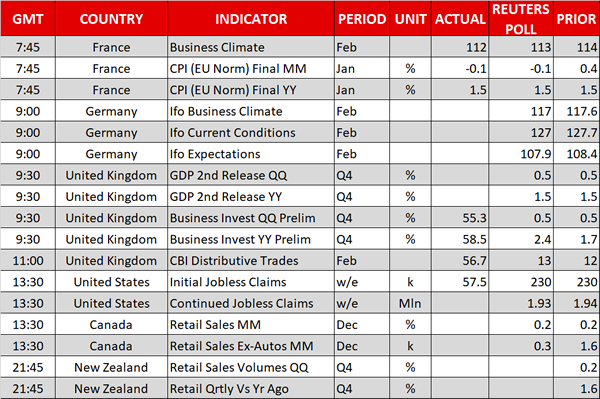
Thursday's calendar features numerous releases that could spur positioning in the markets.
At 0900 GMT, the Ifo Institute for Economic Research will release numerous surveys gauging business sentiment in Germany, Europe's largest economy. All relevant indices - Business Climate, Current Conditions and Expectations - are projected to decline in February relative to January's respective readings, though not by much.
The UK will see the second release of Q4 2017 GDP growth at 0930 GMT. The pace of growth is forecast to remain unchanged at 0.5% and 1.5% on a quarterly and annual basis respectively. Beyond GDP numbers, data on investments by businesses in Q4 2017 will also be made public at the same time, while the Confederation of British Industry's Distributive Trades figure for the month of February is due at 1100 GMT. The latter attempts to measure the change in the volume of orders placed on suppliers during a given month - in this case February - versus the same month a year ago.
The European Central Bank will release its account of the monetary policy meeting that took place in January at 1230 GMT. The minutes from the December meeting took markets by surprise by being more on the hawkish side of the spectrum than markets expected, leading to a rally in the euro. It would be interesting to see if today's release builds on the 'hawkish momentum', propelling the single currency higher.
US initial and continued jobless claims data for the week ending February 17 are scheduled for release at 1330 GMT. Individuals applying for unemployment benefits for the first time are yet again expected to remain below the 300k threshold that's associated to a healthy labor market. Specifically, projections are for the number to stand at 230k, the same as in the week that preceded.
Of importance out of Canada will be retail sales figures for the month of December due at 1330 GMT. New Zealand will also see the release of retail sales numbers for Q4 2017 at 2145 GMT; kiwi pairs would be eyed.
Policymakers making appearances include ECB board member Yves Mersch who is scheduled to give a speech at 0930 at the European Banking Federation's executive committee meeting in Frankfurt. New York Fed President William Dudley - a permanent FOMC voting member - will be participating in an economic briefing on the impact of hurricanes Irma and Maria in Puerto Rico and the Virgin Islands at 1500 GMT. Atlanta Fed President Raphael Bostic - a voting FOMC member in 2018 - will be speaking on Banking at 1710 GMT, with Dallas Fed President Robert Kaplan - a non-voting FOMC member in 2018 - participating in a Q&A session on NAFTA at 2030 GMT.
The Energy Information Administration's (EIA) report including information on US crude and gasoline stocks for the week ending February 16 is scheduled for release at 1600 GMT. Crude inventories are anticipated to increase by around 1.8 million barrels in the period of coverage - around the same as in the previously tracked week - recording their fourth straight weekly rise.
Technical Analysis: WTI oil futures hit one-week low; RSI halts decline
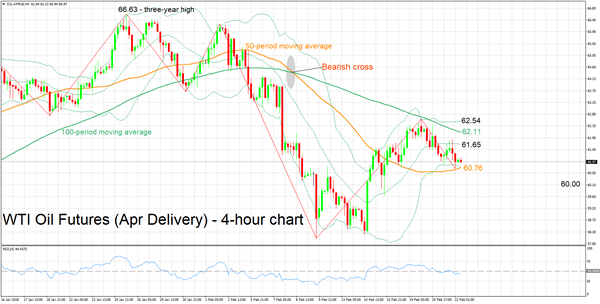
WTI oil futures for April delivery are currently trading not far above 60.72, this being a one-week low recorded earlier in the day. Despite this, the RSI seems to have halted its decline, moving sideways for the most part and projecting a mostly neutral short-term picture.
If the Energy Information Administration's weekly report shows a smaller-than-anticipated increase in US crude oil inventories, prices could advance. In this scenario, resistance could come around the middle Bollinger line - a 20-period moving average line - at 61.65. Further above, and given stronger bullish movement, the attention would shift to the area around the current level of the 100-period MA at 62.11.
On the other hand, should crude inventories rise by more than projected, then prices could post losses. In this case, the area around the current level of the 50-period MA at 60.76 might provide support. Notice that the lower Bollinger band coincides with the 50-period MA. A downside violation would turn the attention to the 60 handle, this being a level of potential psychological significance.
USDJPY Faces Weaker Movement After Four Green Days, Remains Below Symmetrical Triangle
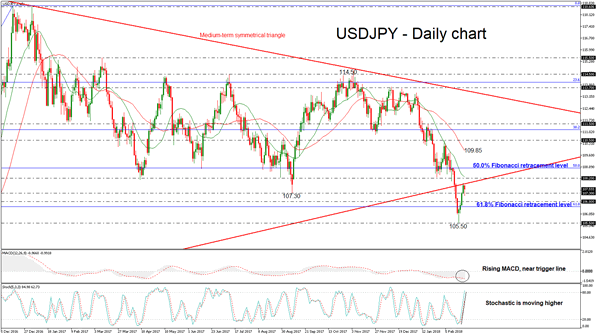
USDJPY recorded four bullish trading days in a row following the rebound on the 15-month low near the 105.50 support level. The aggressive bearish rally in the previous week started after the fall below the 50.0% Fibonacci retracement level near 108.80 of the up-leg with the low of 98.96 and the high of 118.60 and drove the price below the medium-term symmetrical triangle, which has been holding since May 2015.
Currently, the price is developing near the lower band of the triangle with weaker momentum than the previous days but there is a possible scenario of a jump above the 108.00 handle. The upside bias is also confirmed by the technical indicators in the daily timeframe.
From the technical point of view, the MACD oscillator is moving slightly higher in the negative territory and posted a bullish cross with its trigger line, suggesting further gains. Moreover, the stochastic oscillator is extending its upside movement and has entered the overbought zone.
If prices continue the buying interest, immediate resistance could come at 108.20, which is near the 20-day simple moving average. The next significant resistance to have in mind is the 50.0% Fibonacci mark at 108.80. In addition, a jump above the latter level could open the way towards the 40-day SMA around 109.85 at the time of writing.
However, the price has found a strong obstacle on the lower band of the symmetrical triangle and in case of a deeper move down, the focus could shift again to the downside until the 61.8% Fibonacci level near 106.50. Falling below this area could see prices re-testing the 105.50 barrier.
EURO Strongly Bearish Below 1.2292 Level
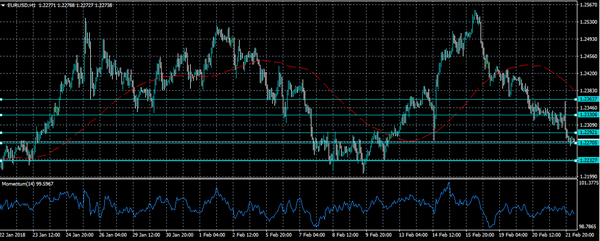
The euro has continued to move lower against the greenback, with price-action hitting 1.2268 overnight, as traders bought U.S dollar following the release of the FOMC Meeting Minutes. Price-action currently trades around the 1.2270 region, with intraday sellers firmly in control of the EURUSD whilst the pair trades below the 1.2292 technical level. Moving into today’s European session, traders look to the release of the ECB Meeting Minutes from the Governing Councils January 24th to January 25th policy meeting.
The EURUSD pair is strongly intraday bearish whilst trading below the 1.2292 level, further losses towards the 1.2232 and 1.2210 levels remain possible.
Should EURUSD price-action move back above the 1.2292 level, we may see a relief rally towards the 1.2330 and 1.2363 resistance level.
GBPUSD Further Bearish Below 1.3901 Level
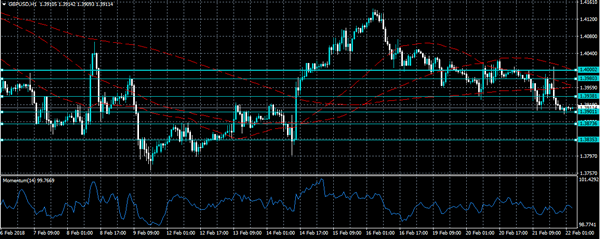
The British pound continues to hold around the price-lows of the week against the U.S dollar, as traders remain cautious ahead of the release of key economic data from the United Kingdom. The GBPUSD pair currently trades just above the 1.3900 handle, ahead of the release of the second estimate of fourth fiscal quarter UK Gross Domestic Product. Moving into Thursday’s European trading session, a clear break of the 1.3901 to 1.3938 price-range is likely to define the pairs intraday directional bias.
The GBPUSD pair is likely to experience further losses below the 1.3901 level, key downside support is then found at the 1.3873 and 1.3835 levels.
Should GBPUSD price-action move above the 1.3938 resistance level, buyers may attack the 1.3980 and 1.4000 resistance areas.
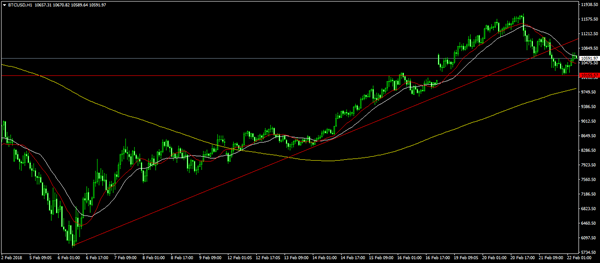
The Path Of Least Resistance For Bitcoin
Yesterday, bitcoin fell more than 1000 points. It found its support at the $10,155 level. This drop was purely technical since there was no major negative market-moving data. Potentially, this drop came as traders took profits following a more than 50% gain.
Today, bitcoin has recovered from some of the losses after reports emerged that Bitfinex and Coinbase were introducing a new software to reduce transaction costs by more than 20%. As you possibly know, one of the reasons why cryptocurrencies exist is to make transactions cheaper but this has not been the case. With reduced costs, there is a likelihood that more people and companies will adopt bitcoin.
The adoption of Segwit by these exchanges will ultimately increase the transaction speed, reduce costs, and help create a more vibrant community.
Therefore, with positive news coming internally from exchanges and externally from regulators, in the short term, bitcoin is likely to continue moving up.
Dollar Firms As FOMC Minutes Sound Hawkish
The dollar firmed against the major currencies in early trading today. This followed the release of Fed minutes which showed that officials sounded more upbeat about the US economy. These sentiments bolstered analysts’ estimates that more rate hikes were coming. After the release, the dollar index which tracks the dollar against major currencies rose to the highest level since February 13. Traders now expect the Fed to raise rates in their March meeting.
This week, the euro index which tracks the euro against major currencies fell by 0.52%. Part of the reason for this fall was the stronger dollar. Today, traders will watch for key economic data from key European countries. In France, we will receive inflation data while in Italy, we will get industrial and inflation data. In Germany, business sentiment about the economy is also due out. The Euro index is now trading at a weekly low of 108.19.
The Canadian dollar has been in free fall this week, dropping by more than 1.66% against the dollar. Like in most currency pairs this week, the fall of the pair is associated with a stronger dollar. Today, with insignificant data coming from the United States, traders will focus on retail sales from Canada. They expect core retail sales to grow by 0.1% compared to December’s 1.6%. They also expect retail sales growth to drop from 0.6% to 0.05.
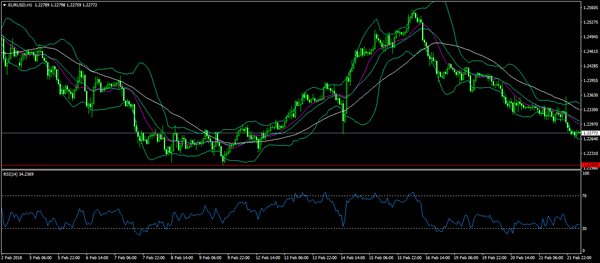
EUR/USD
The EUR/USD is trading at the 1.2276 level, which is near a two-week low. Still, the downward trend seems not to be over. As shown below, the RSI of the pair is currently near the oversold level while the Bollinger bands show that more downside could happen. The next price target for the pair is possibly at 1.2205.
USD/CAD
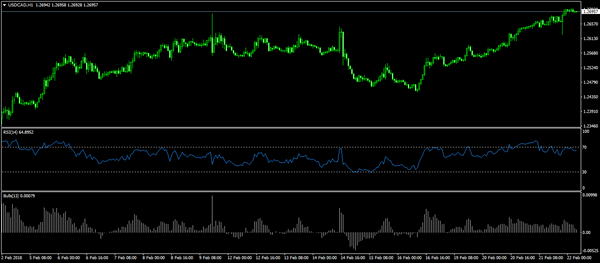
The USD/CAD is trading at 1.2695, which is the highest level since January 27. The pair’s upward trend is more about a stronger dollar and the doubts about the future of NAFTA. As shown below, possibly, the end of this rally could be close since the RSI is near the overbought territory while the Bulls power is diminishing.
EUR/GBP
The EUR/GBP pair has traded sideways in the last few days. As a result, the pair is currently trading at its 25-day and 14-day moving average level of 0.8825. This shows that the pair could break out in either direction. Today’s data from the EU, and the GDP data from the UK coupled with Brexit talks could determine how the pair moves.