

Sample Category Title
UK’s BBA Mortgage Approvals Hit A Nearly 5-Year Low In December
For the 24 hours to 23:00 GMT, the GBP declined 0.78% against the USD and closed at 1.4125, after UK's mortgage approvals registered an unexpected drop in December.
Data showed that Britain's BBA mortgage approvals declined to its lowest level since April 2013, after it fell to a level of 36.12K in December, intensifying concerns about the health of the nation's housing market. In the prior month, mortgage approvals had registered a revised level of 39.01K, while markets were expecting for a rise to a level of 39.80K.
In the Asian session, at GMT0400, the pair is trading at 1.4190, with the GBP trading 0.46% higher against the USD from yesterday's close.
The pair is expected to find support at 1.4067, and a fall through could take it to the next support level of 1.3944. The pair is expected to find its first resistance at 1.4329, and a rise through could take it to the next resistance level of 1.4468.
Trading trend in the Pound today is expected to be determined by UK's crucial 4Q GDP data and BoE Governor Mark Carney's speech, set to release in a few hours.
The currency pair is trading below its 20 Hr moving average and showing convergence with its 50 Hr moving average.

Few Officials Saw Future Need To Raise Rates, Slow Asset Buying: BoJ Minutes
For the 24 hours to 23:00 GMT, the USD rose 0.37% against the JPY and closed at 109.60.
In the Asian session, at GMT0400, the pair is trading at 109.38, with the USD trading 0.2% lower against the JPY from yesterday's close.
Minutes of the Bank of Japan's (BoJ) December monetary policy meeting showed that majority of board members believed that it was appropriate to stick to the central bank's current monetary policy stance as inflation remains far from its 2.0% target. However, some officials expressed a need to consider raising interest rates or reducing purchases of risky assets if the economic recovery continued.
Data released overnight showed that Japan's national consumer price index (CPI) advanced less-than-anticipated by 1.0% on an annual basis in December, adding to the complication for the central bank as it struggles to boost inflation in the nation. The CPI had registered a gain of 0.6% in the prior month, while markets were expecting for a rise of 1.1%.
The pair is expected to find support at 108.66, and a fall through could take it to the next support level of 107.95. The pair is expected to find its first resistance at 109.93, and a rise through could take it to the next resistance level of 110.49.
Going ahead, traders would await the release of Japan's jobless rate, flash industrial production and retail trade data, all due to release next week.
The currency pair is trading above its 20 Hr moving average and showing convergence with its 50 Hr moving average.

Swiss Franc Trading On A Stronger Footing This Morning
For the 24 hours to 23:00 GMT, the USD declined 0.36% against the CHF and closed at 0.9423.
In the Asian session, at GMT0400, the pair is trading at 0.9391, with the USD trading 0.34% lower against the CHF from yesterday’s close.
The pair is expected to find support at 0.9304, and a fall through could take it to the next support level of 0.9218. The pair is expected to find its first resistance at 0.9463, and a rise through could take it to the next resistance level of 0.9536.
Moving ahead, traders would focus on Switzerland’s ZEW expectations survey, real retail sales, the manufacturing PMI and SECO consumer confidence data, all scheduled to be released next week.
The currency pair is showing convergence with its 20 Hr moving average and trading below its 50 Hr moving average.

Canadian Retail Sales Grew Less-Than-Expected In November
For the 24 hours to 23:00 GMT, the USD rose 0.36% against the CAD and closed at 1.2388.
In economic news, Canada's retail sales climbed 0.2% on a monthly basis in November, falling short of market expectations for a gain of 0.8%. Retail sales had advanced by a revised 1.6% in the previous month.
In the Asian session, at GMT0400, the pair is trading at 1.2351, with the USD trading 0.3% lower against the CAD from yesterday's close.
The pair is expected to find support at 1.2292, and a fall through could take it to the next support level of 1.2232. The pair is expected to find its first resistance at 1.2401, and a rise through could take it to the next resistance level of 1.2450.
Going forward, Canada's crucial inflation figures for December, slated to release later in the day, would pique significant amount of market attention.
The currency pair is showing convergence with its 20 Hr and 50 Hr moving averages.

ECB To Prepare First Steps Towards Tightening?
- Slightly less dovish tone from Draghi
- Subtle changes suggest ECB beginning to think about exit strategy
- No early tightening in prospect but 'noisy' period could be beginning
- Buoyant economy and expected inflation pick-up to alter policy stance
- Draghi suggests data pointing towards mid-2019 rate rise
The ECB's January meeting is rarely an occasion for fireworks and ECB president, Mario Draghi suggested that 'very little has changed' since the ECB provided its previous update and its latest economic projection in mid-December. However, the substance of his comments appears to contradict that verdict and also hint that a change in thinking may be underway in Frankfurt.
The ECB did seek to limit the rise in the exchange rate of the euro by emphasising in the opening press statement that 'the recent volatility in the exchange rate represents a source of uncertainty which requires monitoring'. However, the more important message from Mr Draghi was one of increasing confidence in the economic upswing and the start of considerations as to what this will mean for ECB monetary policy.
While Mr Draghi strongly indicated that any notable policy change is still some distance away, the tone of his remarks suggested the ECB is beginning to contemplate what is likely to be quite an extended process of phasing back the degree of monetary support for the Euro area economy.
Important but not entirely surprising was Mr Draghi suggestion that discussions are beginning as to exactly how and when to phase out the ECB's Asset Purchase
Programme. It was more surprising that he gave a fairly unambiguous response to a question on the possible timing of a first ECB rate rise when he indicated that on the basis of current trends in economic data, an initial rate rise might be seen in mid-2019.
A not so dry January for Mr Draghi
In one sense Mr Draghi's encouraging tone merely reflects an acknowledgement of a sustained period of very strong growth in the Euro area economy through the past year. With momentum in activity and employment continuing to building forcefully, markets increasingly judge that the degree of monetary policy accommodation provided by the ECB's current stance is no longer required. However, when and exactly how an exit process might be negotiated remains unclear. Mr Draghi's remarks suggest that a discussion of that exit path is now starting to appear on the Governing council's agenda.
Mr Draghi described how despite their judgement that little had changed of late, the ECB had observed that the expected path of short term interest rates had moved up and exchange rate volatility had increased. He then suggested three factors might be at play: an improvement in the economy, a heightened market sensitivity to perceived changes in ECB communications and finally, in the case of the exchange rate, what Mr Draghi effectively described albeit in slightly more diplomatic language as inappropriate comments on the dollar by US policymakers.
The opening press statement hints that the ECB's assessment of current economic conditions is being progressively upgraded. The statement acknowledges that the upswing in the Euro area economy 'accelerated more than expected in the second half of 2017' and adds 'increasing capacity utilisation' to a list of factors that 'strengthen further our confidence that inflation will converge towards our inflation aim..' . Such remarks imply that the ECB now has a notably stronger conviction that Euro area economic conditions have moved onto a notably firmer trajectory of late.
Stronger economy has implications for policy
Mr Draghi went on to say that changing economic conditions would be reflected in monetary policy: 'Naturally as the economy improves, this will accompany quite neatly our monetary policy.' He said this would occur in a clear sequence with the emphasis initially falling onto reinvestment of maturing securities when the current phase of net asset purchases ends and eventually onto forward guidance on interest rates which he highlighted now emphasised that rates would remain at current levels 'well past' the ending of net asset purchases.
Mr Draghi acknowledged that markets would favour some explicit guidance in terms of timelines but argued that 'discipline' was required in ECB communications at this point in time. He then indicated a discussion at the Governing council would determine whether September would see another extension of the Asset purchase Programme, an abrupt end to the programme at that point or a further tapering. As this seemed to represent at least the possibility of a climb-down from his December press conference comment that 'it's never been our view that things should stop suddenly', it seems consistent with the view that the balance of thinking is shifting, even if modestly, within the ECB.
Although Mr Draghi was circumspect in relation to many aspects of the policy outlook he was more forthright when asked if he would endorse Bundesbank president's Jens Weidmann's view that mid-2019 was a likely time for an initial rise in ECB policy rates. Mr Draghi answered that the ECB is effectively data dependent in relation to its policy decisions and that 'basically that's what the data tell us'.
Implicit in this response is a reasonably clear timeline for the start of the initial phase in the ECB's exit strategy which suggests that, in the absence of a marked change in the expected trajectory of activity and inflation, the Asset
Purchase Programme will effectively finish in the autumn and the groundwork will be laid for a first rate rise in the summer of 2019. As Mr Draghi again pointed out the ECB's monetary policy stance will remain accommodative well after the first rate hike. Markets are firmly of the view that the path to 'normalisation' will take even longer on this side of the Atlantic than it has in the US.
Draghi subtly starts to prepare markets
The second factor that Mr Draghi referenced in terms of recent market movements was a 'heightened sensitivity' to the possibility of a change in ECB thinking. We think this has come about because markets increasingly take the view that the present stance of ECB policy looks increasingly illsuited to current economic conditions.
In such circumstances, there is an understandable fervour to be positioned properly ahead of any alteration in ECB policy. We think the general tenor of Mr Draghi's remarks confirms at very least a shift in focus towards the need to prepare markets for the process of scaling back the degree of monetary support being provided to the Euro area. By extension, this would tend to validate the markets recent reaction to the comments of various ECB officials.
Mr Draghi outlined three elements that we think might be important considerations in framing the ECB's exit strategy. The first element he mentioned was confidence. Clearly, there is now much greater confidence in the persistence of strong economic conditions in the Euro area and this is encouraging greater confidence that inflation will gradually move towards the ECB target. However, a second element, patience, will also be crucial as a pick-up in inflation is not yet evident and may take some time to materialise. Finally, Mr Draghi noted the importance of persistence in that ECB policy is likely to remain notably supportive well after what is expected to be an extended normalisation process has begun.
Significantly, for markets, Mr Draghi's emphasis on patience and persistence is likely intended to signal the ECB's concern to avoid a premature or excessive uptick in market interest rates or the exchange rate of the Euro.
Mr Mnuchin's comments are a problem but the Euro presents a greater dilemma
Mr Draghi's clearest expression of concern related to exchange rate movements that stemmed from what he called 'the use of language… agreed at the IMF'. While he didn't specifically refer to comments made by US Treasury Secretary Steve Mnuchin who was quoted on Wednesday as saying that a weaker dollar was "good for us as it relates to trade and opportunities", it is clear that such rhetoric is raising some concerns within the ECB.
While Mr Draghi may feel that he needs to protest strongly against any US actions to talk down the dollar, we think the broader tone of the press conference suggests the ECB is more focused on the ongoing strengthening in the trajectory of the Euro area economy. This momentum in activity would make it very difficult to prevent some degree of appreciation of the Euro. Indeed, Mr Draghi acknowledged this by indicating that exchange rate gains in response to favourable economic developments were 'part of nature'. A key uncertainty for markets and for the ECB itself is how much of an appreciation might be said to reflect improved Euro area fundamentals.
Less dovish Draghi prepares to guide in March?
The fact that term interest rates are firmer and the Euro has risen yesterday in the wake of the ECB press conference suggests that Mr Draghi was less dovish than had been expected. This may reflect a recognition by the ECB that to avoid an excessive future tightening in financial conditions in the Euro area it needs to progressively modify its message and prepare markets for what it likely hopes to be an orderly and extended path towards policy normalisation. Alternatively, the slightly altered message may simply reflect the increasing influence of longstanding hawkish voices.
The likelihood is that markets will expect a clearer indication of the intended policy path at the March policy meeting and some pointers in this regard in the interim. Mr Draghi has already sketched out some important parameters by suggesting that mid 2019 might be represent a plausible timing for a first rate rise. However, as he also suggested that the exact nature of the wind-down of asset purchases has yet to be decided, there may be scope for further significant volatility in interest rate and currency markets in the weeks ahead.
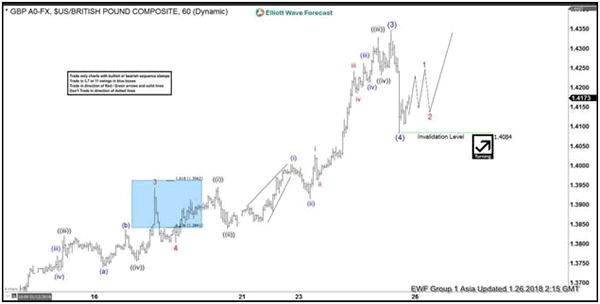
Elliott Wave View: GBPUSD Ended Wave (4) Correction
GBPUSD Short Term Elliott Wave view suggests that pair ended Intermediate wave (2) at 1.33 on 16 December 2017. Up from there, Intermediate wave (3) rally is unfolding as 5 waves impulse Elliott Wave structure where Minor wave 1 ended at 1.3613, Minor wave 2 ended at 1.3456, Minor wave 3 ended at 1.3943, Minor wave 4 ended at 1.3797, and Minor wave 5 of (3) ended at 1.434.
Pullback to 1.4084 today is proposed to have ended Intermediate wave (4) at 1.4084, but pair still needs to break above Intermediate wave (3) at 1.434 to confirm this view. Until then, a double correction in Intermediate wave (4) still can’t be ruled out. Near term, while pullbacks stay above 1.4084, but more importantly as far as pivot at 16 December 2017 low (1.33) stays intact, expect pair to extend higher. We don’t like selling the pair.
GBPUSD 1 Hour Elliott Wave Chart
USD/JPY Nosedives, Breaks Key Support Ahead Of US GDP
Key Highlights
- The US Dollar was under a lot of pressure recently and it declined below the 110.00 support against the Japanese Yen.
- There is a major bearish trend line forming with current resistance at 110.60 on the 4-hours chart of USD/JPY.
- On the downside, the next supports are at 108.50 and 108.00.
- The US Initial Jobless Claims for the week ending Jan 20th 2017 increased from the last revised reading of 216K to 233K.
USD/JPY Technical Analysis
The US Dollar was under a lot of pressure this week as it tumbled below 110.00 against the Japanese Yen. The USD/JPY pair is in declining mode with the next support at 108.00
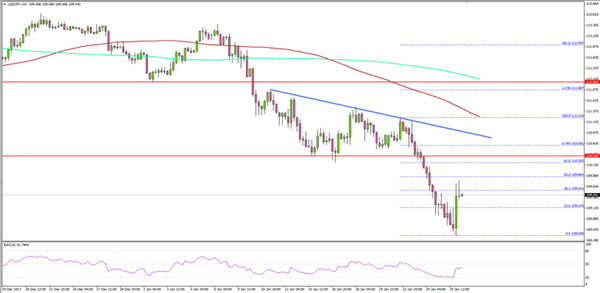
Clearly, the pair is in a strong downtrend from the 113.00 swing high. Looking at the 4-hours chart of USD/JPY, there was a break below the 112.00 and 110.40 support levels. The downside move was such that the pair even broke the 109.00 level.
The recent low as 108.50 and it seems like the current downtrend is far from over. An initial resistance on the upside is around the 50% Fib retracement level of the last decline from the 111.22 high to 108.50 low.
However, the most important resistance is near 110.00, which acted as a support earlier. Moreover, there is a major bearish trend line forming with current resistance at 110.60 on the 4-hours chart.
If the pair continues to move down, the next key support on the downside is at 108.00. Below 108.00, the 107.50 support could act as a decent buy zone.
Fundamentally, the US Gross Domestic Product Annualized for Q4 2017 (preliminary reading) will be released by the US Bureau of Economic Analysis today. The market is looking for a 3.0% growth in Q4 2017, down from the last reading of 3.2%.
If the outcome fails to meet the forecast, the greenback could decline further versus all other major currencies. Both EUR/USD and GBP/USD are in the green zone and looks set for more upsides in the near term.
Euro Rallied Further Despite Draught’s Attempt To Downplay Forward Guidance Adjustment
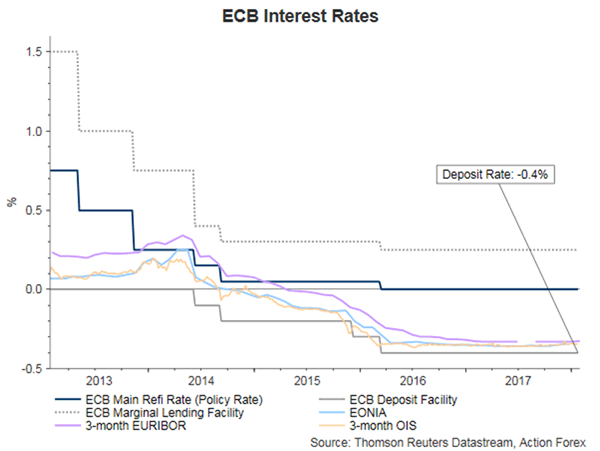
ECB left the policy rates unchanged, with the main refinancing rate, the marginal lending rate and the deposit rate staying at 0%, 0.25% and -0.40% respectively. The pace of asset purchases also stayed unchanged at 30B euro per month until September, or beyond, if necessary. President Mario Draghi attempted to downplay speculations that the central bank would soon adjust the forward guidance, as interpreted by many following the December meeting minutes. Meanwhile, he stressed that any rate hike would be 'well past' the end of asset purchases. Draghi also warned of the impacts of the strong euro on growth and complained about the US for talking down the greenback at the World Economic Forum.
Policymakers remained concerned about the inflation outlook. As suggested in the accompanying statement, inflation 'yet to show more convincing signs of a sustained upward trend'. As such 'an ample degree of monetary stimulus remains necessary for underlying inflation pressures to continue to build up'. Regarding the language on headline inflation, ECB expected it to 'hover' in the coming months, compared with 'moderate. It continued to expect underlying inflation to 'rise gradually over the medium term, supported by our monetary policy measures, the continuing economic expansion, the corresponding absorption of economic slack and rising wage growth'.
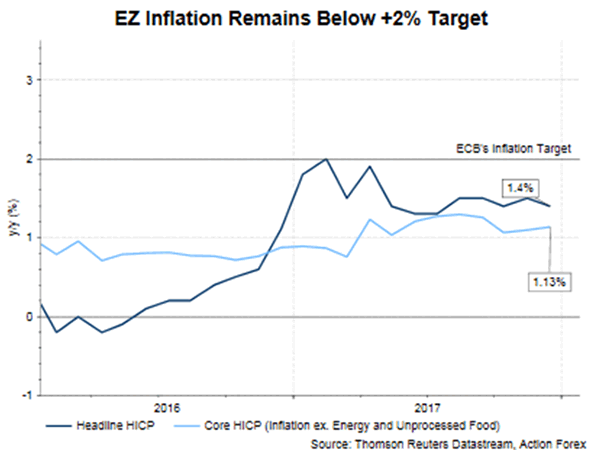
Perhaps the most closely aspect of the meeting was the forward guidance. There was no change in January. At the press conference, Draghi emphasized that such discussion 'has not really started' and clarified that the wording in the December minutes suggested that the discussion on forward guidance would start soon, rather than the forward guidance would be adjusted soon. Meanwhile, Draghi reiterated several times that the following criteria are needed for the removal of monetary easing: inflation should be on a path that reaches the target in the medium term, ECB should be confident on the degree of convergence towards the target and convergence has to be self-sustainable.
Regarding the accelerated strength in the single currency recently, the central bank warned that 'the recent volatility in the exchange rate represents a source of uncertainty which requires monitoring with regard to its possible implications for the medium-term outlook for price stability'. Meanwhile, Draghi was clearly discontent with US Treasury Secretary Mnuchin's comments about a weak US dollar in recent days. He noted that 'the use of language' by some other parties 'doesn't reflect the terms of reference we have agreed', pointing to the international agreement made last October on the commitment to not talk down a country's currency. At the press conference Draghi added that 'several members expressed concern, which was 'broader than simply the exchange rate' but was 'about the overall status of international relations right now'. Recall that Mnuchin suggested at the annual World Economic Forum at Davos, Switzerland that 'obviously a weaker USD is good for us as it relates to trade and opportunities' and the currency's short term value is 'not a concern of ours at all'. Yet, he affirmed that in 'longer term, the strength of the dollar is a reflection of the strength of the US economy and the fact that it is and will continue to be the primary currency in terms of the reserve currency'
ECB Review: Language To Be Revisited In March
- Overall, President Draghi struck a dismissive tone on changes to language indicating that monetary policy normalisation is only in the very early stage with changes to forward guidance yet to be discussed. Sequencing is set in stone.
- Growth is still strong and inflation still subdued.
- The exchange rate was mentioned twice in the introductory statement as a source of uncertainty that requires monitoring, a sentence that has not been used since September 2017. In particular, external drivers were used as concerns.
In line with our expectation, the ECB left its policy measures and forward guidance unchanged, keeping the QE programme open-ended (see also Preview). The ECB reiterated that policy rates would remain at current levels for an extended period and well past the horizon of asset purchases. Today's press conference confirmed our view that a change to the asymmetric communication on the purchase programme will come at the 8 March meeting.
The big joker in today's meeting was the exchange rate. The exchange rate made it back into the introductory statement as a source of uncertainty that requires monitoring, a sentence that hasn't been used since September 2017 when the trade-weighted 38 had risen about 5% in the months leading to the press conference. The current trade-weighted 38 is only up 1% since mid-November.
Draghi was asked about the apparent discord between the December meeting and the accounts, and while he said that there was no misalignment and GC members were surprised about the market reaction, we view the accounts and the hawkish messages from early January from e.g. Weidmann and Hansson, as a result of an increasingly split GC. Going forward, that will be a balancing act between a gradual change in the forward guidance and catering for the hawks.
Further, to this end, Draghi confirmed that there is only a very small chance of a hike this year, which confirms our view of a very gradual normalisation and sequencing being set in stone. We still expect a rate hike in Q2 19.
During the introductory statement and the Q&A session Draghi/ECB acknowledged that market inflation expectations have risen and there are some signs that wage growth is picking up. That said, Draghi is still very dovish on the inflation outlook and stresses that the ECB has yet to grow confident that it's self-sustaining.
Towards the end of the press conference, Draghi again stressed that rising headline inflation due to i.e. higher oil prices alone is not enough to make them confident on the inflation outlook. ECB wants to see rising underlying inflation pressures which are self-sustained
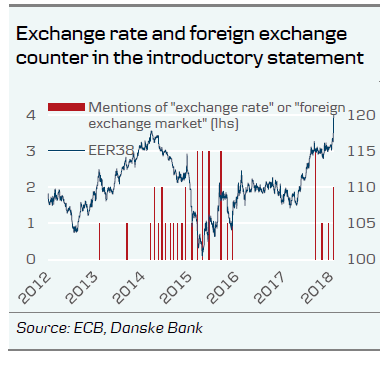
Exchange rate:
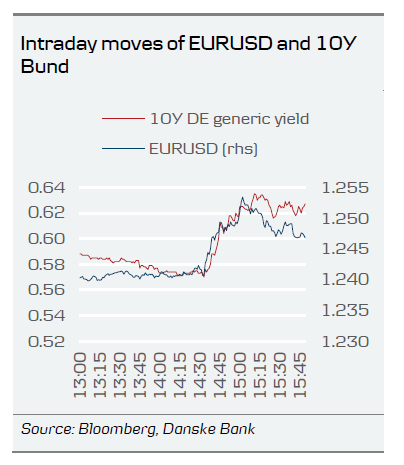
The exchange rate was mentioned twice in the introductory statement as a source of uncertainty that requires monitoring, a sentence that has not been used since September 2017. Draghi also sent a very clear critique towards the US regarding its weak US dollar (USD) policy. However, the euro (EUR) still rose sharply during the press conference particularly versus the USD and the Japanese yen. This illustrates that the apparent shift in the US Treasury's dollar stance is dominating any Draghi worries. In our view, the US's weak USD policy together with broad basic balance of payment (BBoP) support for the EUR will continue to push EUR/USD higher. (For more details see Strategy – Push for a weaker USD supported by flows, 25 January 2018).
Fixed income:
The impact on the fixed income markets from the press conference was initially modestly bullish with the long end performing as the ECB is no hurry to taper. However, given the strong focus on the positive growth outlook as well as inflation “hovering” around current levels bond yields went higher. So ECB/Draghi are sending a positive signal on growth for the Eurozone economy, but also that they are in no hurry to change the forward guidance. Hence, they are trying to move slowly, which is sending yields higher, with the 5Y and 10Y segment on the yield curve bearing the brunt of the rise in rates combined with a stronger EUR versus the USD. Hence, we see room for more flattening between 10Y and 30Y.
The spread between the peripheral markets and core EU tightened initially, but later during the press conference the sentiment changed, sending spreads modestly wider perhaps driven by the comments that the ECB does not favour any country in the QE, and the market should not focus on monthly deviations, but more on the gross amounts relative to the capital key. Hence, he is downplaying the QE deviations we have seen so far. We think the market is overacting to the comments. Hence, we keep our longs in Portugal and Ireland and add a long position in Spain given the growth outlook and that the ECB is no hurry to tighten monetary policy. In all three markets we buy the new 10Y benchmarks versus core EU.
A Triple Dose Of Verbal Intervention
Currency Market Overview
A triple dose of verbal intervention was enough to stem the dollar bloodletting for the time being.
During his, Q&A Draghi was doing his best to deflect questions on the Euro then just as 1.2500 broke; Draghi said EUR’s gains were due to comments from 'someone else.'
In what is becoming all too predictable from the ECB, who now apparently have a preference to express currency policy through 'sources familiar with the matter', suggested a division in the ECB ranks was forming over removing the ECB easing bias in March due to the strong Euro.
But the real short-term game changer was Trump suggesting that he 'ultimately wants to see a strong USD' and proving far more adept than Mnuchin, Draghi or ' sources familiar with the matter', of swaying the market that Mnuchin’s 'weak USD' were taken out of context.
Given the extend oversold US dollar positioning on the Euro the market back peddled in convincing fashion legging down some 125 pips tumbling below 1.24 with fast money speculators and weaker intraday longs bearing the brunt of the move.
However, it’s obvious to anyone that the US administration trade policy would benefit from the weaker dollar policy, but I suspect Trumps latest support for the dollar comments are more about optics and little more than a case of temporarily taming the dollar bear ahead of his Davos speech. Ultimately, the market will decide the dollar fate and perhaps a bit early to bring out the eulogies this morning, the weaker USD dollar narrative remains intact for 2018.
But heading for the weekend with US GDP and Durable goods on tap later tonight, the dollar short may be more sensitive to US economic data than they may have before Trump’s comments so we could more short USD position squaring ahead of tonight’s US data.
Oil prices
Oil prices have moved lower following Presidents Trumps strong dollar comments. WTI remains tentatively supported above 65 per barrel in early Asia trade but with the likely hood of more short USD position squaring ahead of the weekend, commodities in general, should come off the boil and could struggle to push higher in today’s APAC session.
However, the continuous fall in US oil inventories and the anticipated return of USD weakness should keep the dips supported.
Gold prices
The USD dollar is not out of the weeds by any means, and of course, a position whipsaw unfolded overnight on the Topsy Turvy dollar movements, but the unwinding of Mnuchin comments does not change the long-term views regarding the US dollar. And while catching short-term speculators off guard, the Gold price retracement will not threaten long-term positions who’s view are cemented around a probable equity market correction and an extension of the US dollar downtrend
Frankly, Gold markest we already taking a breather prior to Trump’s comments suggesting short-term positions were prone to any dollar correction.
Malaysian Ringgit
The Market had more significant exposure in the Ringgit than market projections, so when BNM delivered the consensus rate hike, we did not get the follow through as expected. It was likely a case moving too far too quickly and market players were ready to book profits on the initial move lower.
Nevertheless, MYR immediate gains were likely held back by a somewhat laissez-faire view towards domestic inflation projections when the statement suggested that CPI is expected to average lower in 2018 implying this is a one and done rate hike for 2018 and more dovish than expected on the inflation front.
Bank Negara Malaysia is suggesting inflation pressures are not that strong meaning this policy decision was little more than removing emergency accommodation delivered as a buffer for the potentially destabilising effect from Brexit.
The suspicion is the market is going to become more data depended and extremely focused on inflation readings for any possible shift in rate hike expectations. For example, if inflation starts moving towards the upper-end of the Central Banks 3-4 % inflation band, it will increase the odds of an addition rate hike for 2018.
However, moving forward the Ringgit should remain well supported by robust macro foundation and higher energy prices.
If we consider that we could be entering an extended cyclical downtrend on the USD dollar, the MYR could still rally below 3.80 near term with a possible move to 3.70 if another rate hike in 2018 becomes a reality.