

Sample Category Title
The Weekly Bottom Line: Upbeat Data Bolster Case For March Hike
U.S. Highlights
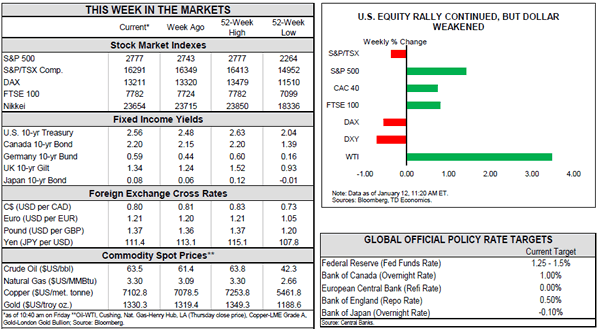
- The second week of 2018 marked another strong performance in equity markets. While the advance did take a breather midweek, the main American stock indices resumed their upward trajectory, rising to new highs. The rally received an added fillip from oil prices, which gained additional ground, thanks in part to a bullish inventory report.
- Economic reports drove in the point that the U.S. economy ended the year on solid footing. Retail sales rose 0.4% m/m in December, while November sales received a healthy upward revision. Fourth quarter consumption growth is now expected to come in at around 3.3% (ann.), which should help propel growth forward by a robust 2.6% at year-end.
- On the inflation front, data out this morning suggests that price pressures appear to be building. Core CPI saw a stronger-than-expected 0.3% m/m increase, which lifted the y/y pace to 1.8%. Altogether, this week's data helps bolster support for a March rate hike, with two more expected later this year.
Canadian Highlights
- The West Texas Intermediate oil price hit a 3-year high of US$64 per barrel this week, as the market focused on falling U.S. inventories and tensions in Iran.
- Housing starts totaled a healthy 217k units in December, bringing the trend rate to a solid 227k units.
- The Bank of Canada's Business Outlook Survey revealed that sentiment among firms remained positive in the final quarter of 2017, with healthy hiring and investment intentions pointing to economic strength.
U.S. - Upbeat Data Bolster Case For March Hike
The second week of 2018 marked another strong performance in equity markets. Tax reform and upbeat economic data helped support investor sentiment. Markets hiccupped temporarily mid-week on renewed concerns about NAFTA, and an unsubstantiated report that senior Chinese officials have recommended slowing or halting the purchase of U.S. Treasuries. The main American stock indices shrugged off these concerns, and resumed their upward trajectory to new highs. The rally received an added fillip from higher oil prices, thanks in part to a bullish inventory report.
Economic reports reinforced the view that the U.S. economy ended the year on solid footing, setting the stage for robust momentum heading into 2018. Retail sales rose 0.4% m/m in December, while November received a healthy upward revision to 0.9% from 0.8% previously. Gains were broad based, with strength seen in categories such as building material, food & beverage, and non-store retailers. Considering these data, fourth quarter consumption growth is expected to come in at around 3.3% (annualized), which should help real GDP growth advance by a solid 2.6% at year-end.
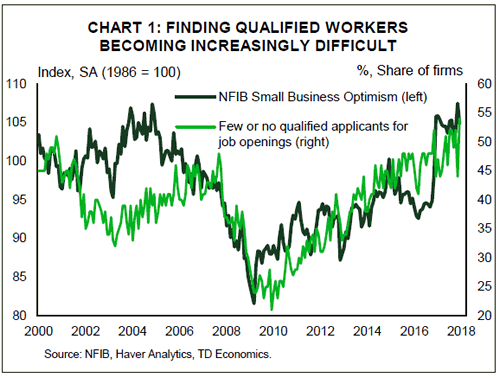
Complementing strong consumer spending, small business owners remained upbeat. Although confidence pulled back slightly in December, the reading remained at historically high levels. Moreover, the recent upbeat trend in optimism has been accompanied by the increased difficulty in finding qualified workers (Chart 1). Given the tightness in the labor market, businesses will need to boost worker compensation in order to attract and retain talent. They will have an improved ability to do so thanks to tax reform which will lower some of the tax burden. This narrative, corroborated by an upward trend in the share of small businesses planning to raise compensation, provides additional comfort with regards to our inflation outlook.
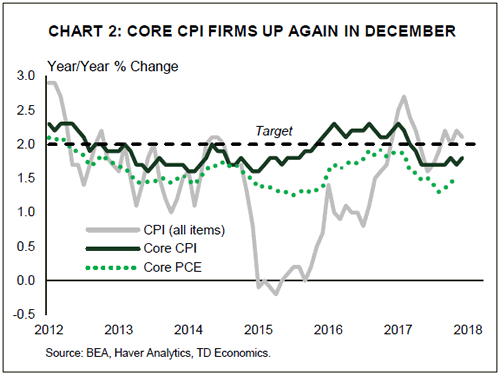
On that note, inflation data out this morning suggests that price pressures appear to be falling into place. While headline inflation was held back by declining energy prices, recording only a modest uptick, the more important aspect of the report was that core CPI saw a stronger-than-expected 0.3% m/m increase, buoyed by gains in shelter costs, healthcare-related costs and vehicle prices. This nudged up the y/y pace of core inflation to 1.8% in December (Chart 2). The lack of price pressures has long puzzled the Fed, holding back the pace of interest rate normalization. But, this week's data is consistent with a Fed that is likely to hike this March and twice more in 2018.
The potential for overheating, given the combined impact of fiscal stimulus and a tight labor market, may necessitate a slightly faster pace of hikes. But for now, we views risks for three hikes in 2018 as roughly balanced. For instance, the fact that core inflation has remained in the 1.7 to 1.8% range for the past eight months makes one month of strong data not very reassuring. Strength was also concentrated in a few key categories, which may not prove sufficient to buoy inflation on a sustained basis. A radical makeover of the Fed, which has a number of vacancies, along with the possibility of a government shutdown as early as next week, pose additional downside risks.
Canada - Slowly But Surely, Higher Interest Rates On The Way
It was a quiet week on the Canadian data front, but oil was shining bright, with the WTI benchmark reaching a 3-year high of nearly US$64 per barrel and the Canadian WCS benchmark reaching US$38 per barrel after hitting a low of US$29 per barrel in December.
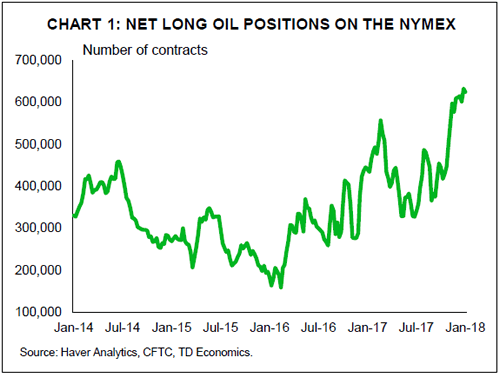
While inventories have come down somewhat, global supply is still abundant, suggesting that global prices have run too high too fast. Speculative activity has played a role in the run-up in prices in recent weeks, with WTI net long positions on the NYMEX sitting at a record high. Improving prospects for global growth, uncertainty and tensions in the Middle East and a decline in U.S. inventories have contributed to the optimism in the market. However, prices over US$60 per barrel will lead to more U.S. shale production, prolonging the rebalancing period. The U.S. Energy Information Administration (EIA) revised up its 2018 forecast for U.S. production by nearly 200k barrels per day this week, with output now expected to hit a record in the first quarter, three quarters earlier than previously thought. With production on the rise in the U.S. – in addition to increases in Canada, Brazil and the North Sea – it is unlikely that prices will stay above that threshold on a sustained basis. What's more, with such a high level of speculation in the market, the risks for prices are heavily skewed to the downside.
The Canadian dollar did not benefit from higher oil prices, as it fell back below the 80 US cent level this week. Much of the weakness came following news that Canadian government officials said that there is an increasing likelihood that President Trump will pull out of NAFTA. The next set of negotiations are scheduled to take place in Montreal on January 23-28, with another round scheduled to happen in Mexico in February. A U.S. withdrawal from NAFTA would have significant ramifications for the Canadian economy, but the recent concerns are unlikely to prevent the Bank of Canada from hiking the overnight rate next Wednesday, particularly given recent suggestions that negotiations could in fact be prolonged further, stretching into the Summer to account for upcoming Mexican elections.
Governor Poloz has indicated that interest rate decisions will be data dependent and most recent data releases point to higher interest rates. In addition to the stellar jobs report released last Friday, this week's housing starts data showed that builders broke ground on a solid 217k new homes in December. Moreover, the Bank of Canada's Business Outlook Survey – a key forward-looking indicator – revealed that sentiment among Canadian businesses remained positive during the final quarter of 2017. Healthy hiring and investment intentions indicate underlying strength in the economy and less need for emergency level interest rates.
That said, a rate hike next week does not necessarily mean that the Bank will embark on a rapid tightening cycle. Given high household debt levels, uncertainty surrounding the impact of the B20 mortgage measures and risk associated with the NAFTA renegotiations, the Bank must be careful in how quickly it raises rates so as to not derail the economy. As such, we expect a gradual pace of tightening over the next two years, of about 25 bps every six months.
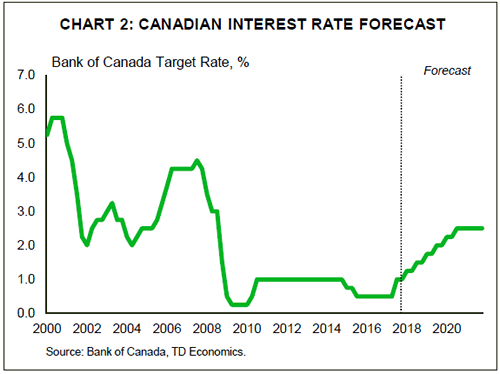
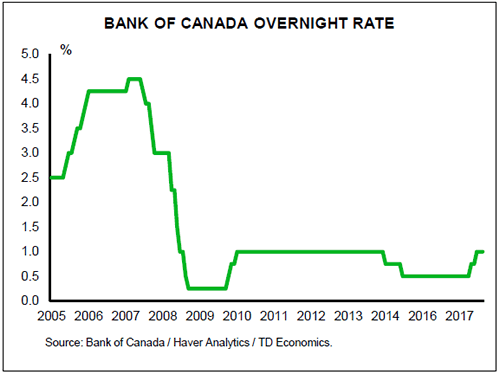
Canada: Upcoming Key Economic Releases
Bank of Canada Rate Decision
Date: January 17, 2018
Previous Result: 1.00%
TD Forecast: 1.25%
Consensus: 1.25%
NAFTA rumours have injected a dose of uncertainty into next week's meeting but we do not think they will be enough to derail a rate hike that's 80% priced by the market and almost universally expected by economists. We look for Poloz's data dependence to outweigh his risk management framework. The evolution of data since the December FAD has been undeniably upbeat, as evidenced by further gains in CPI and the labour market, while the one GDP report that disappointed was weighed down by transitory factor. With a January rate hike well priced, the larger question for markets will be whether Poloz tries to talk down an OIS curve which is pricing in over three hikes for 2018. Given Poloz's aversion to forward guidance, we think it is unlikely he tries to steer market expectations with a "dovish hike" but watch out for a speech in the near future to reprice markets.
Canadian Manufacturing Sales – November
Release Date: January 19, 2018
Previous Result: -0.4% m/m
TD Forecast: 2.1% m/m
Consensus: 1.5% m/m
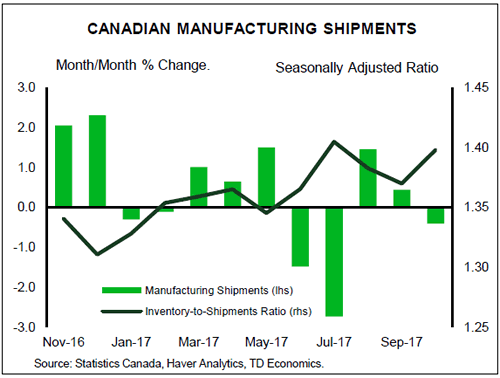
We expect manufacturing sales to post a firm 2.1% m/m rebound in November led by a partial normalization of motor vehicle production. Imports of motor vehicle parts surged in November, pointing to a rebound in assemblies after retooling shutdowns constrained output in the prior month. Energy products will be another source of nominal upside owing to a surge in gasoline prices, while volumes could see marginal benefit from pipeline shutdowns that restricted the flow of crude oil to US refineries. Outside of these two industries, the combination of a broad increase in factory prices and a pickup in hours worked favours a strong rebound from October. We expect real manufacturing sales to underperform the nominal print with a gain of roughly 1%, but nonetheless contribute positively to industry-level growth.
Chart: Canadian Manufacturing Shipments
Australia & New Zealand Weekly
Week beginning 15 January 2018
- 'The week that was', data previews, calendar and forecasts.
- Australia: Westpac-MI Consumer Sentiment, employment, housing finance.
- NZ: house sales & prices, retail card spending, Survey of Business Opinion.
- China: Q4 GDP, fixed asset investment, retail sales, industrial production.
- US: housing starts & permits, Beige Book, University of Michigan consumer sentiment.
- Central banks: BoC policy decision.
- Key economic & financial forecasts.
Information contained in this report was current as at 12 January 2018.
The week that was
Data releases for Australia at the beginning of 2018 have delivered a number of surprises. Most notable amongst these have been surging dwelling approvals and retail sales.
Starting with dwelling approvals, against October's flat outcome and the market's November expectation of a 1% fall, the near 12% gain was certainly eye catching. Interestingly, it was in large part due to a jump in Victorian approvals, a 38% surge following October's 21% jump. Both of these outcomes came as a result of strength in the highly-volatile high-rise apartment category. In stark contrast to the goings on in Victoria, approvals were little changed elsewhere, falling 2% in the month following an 8% decline in October. The trend for detached dwellings remains far more muted: they fell 2% in the month to be only 2% higher than a year ago. Overall, the November report points to the housing construction cycle having more enduring strength than anticipated. However, we still believe that we are past the peak in activity. Hence, GDP growth is unlikely to receive lasting support from the sector. Given the very volatile nature of this data, a large downside 'surprise' in coming months seems highly likely.
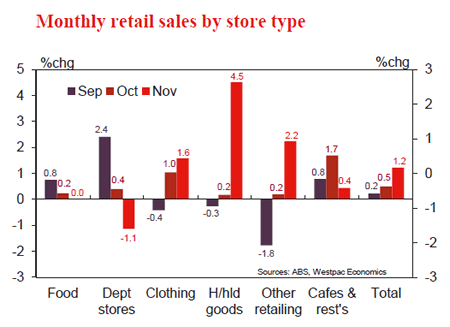
Moving then to retail sales, a 1.2% surge was reported in November - three times the gain the market had expected. For further detail, see chart of the week below.
While a week old, it is also worth mentioning that the Australian trade deficit was larger than anticipated in November (-$0.6bn) and that the October result was also revised down (from +$0.1bn to -$0.3bn). For the most part, this downside surprise looks to have been driven by the commodity sector, particularly gold in November. Consumption good imports did rise, but not in scale consistent with the above retail sales surge. One suspects therefore that November's retail sales outcome will be followed by stronger consumer imports come the December trade report. Needless to say, direct imports of consumer goods from offshore merchants are of no benefit to our own economy, as the income spent flows straight out of the country.
Moving offshore, to date in 2018 it has been financial markets that have been the focus rather than economic data. The one 'economic event' of note is the minutes of the ECB's last policy meeting. These carried a very positive tone as growth remained strong and confidence at record highs. Yet their optimism remained conditional on a policy stance in "crisis configuration" (that is, extraordinarily easy monetary policy). In time, an increasingly self-sustaining growth cycle will see the ECB Governing Council bring asset purchases to an end, and plans to raise rates come to light. We see the first event as occurring at the end of the year (or, if conditions improve further, potentially at the current program's September end date), but the latter not until well into 2019. In the interim, from as early as the next policy meeting, a gradual firming of the language used to describe the economy will be seen to slowly 'make known' to the market the ECB's intent. It has to be said though, given the Euro's gains against the US dollar during the past month, the market looks to have already pre-empted this shift in forward guidance.
Finally on the US, little has changed since late-2017. Debate on the effectiveness of the now-passed tax bill continues to rage on. On the one hand are comments such as those of Atlanta Fed President Bostic: "among businesses surveyed after the House of Representatives' version of the tax overhaul had been approved, two-thirds or more of larger firms said the changes would not prompt them to expand investment or hiring". But on the other are individual company decisions such as that made by Walmart to increase the hourly wage paid to their lowest-paid workers from February, from $9-10 to $11. Suffice to say that the US economy is very large and the tax package very complex; ergo, the net aggregate effect will take considerable time to digest. Regarding the FOMC, the positive tone of financial markets generally in early 2018 has rubbed off on market expectations for the next Fed hike. The market's view on the timing is that it is now most likely to come in March, and definitely by June (on economic fundamentals, June remains our current expectation). Interestingly, the best guess of the market on the total number of hikes in 2018 is still that there will only be two (also our view). However, it is evident that financial conditions are becoming the swing variable for policy, both in terms of the timing of each decision and whether the cumulative number of hikes will be two (as we and the market expect), three (the FOMC's central forecast) or more.
Chart of the week: November Australian retail sales
Retail sales surged 1.2% in November, well in excess of expectations for a 0.4% rise. Annual growth is at 2.9%yr.
The result reflects a strong consumer response to emerging sales events, namely the Black Friday sales, with a boost in spending across household goods - in particular electronics - as well as the 'other retailing' category. These relatively new events in Australia may be causing a behavioural change in the way consumers shop, postponing purchases in the run up to expected discount periods. That effect appears to not yet be fully captured in seasonal adjustments to the sales data. This dynamic is likely to be behind the increased volatility in the retail sales series of late with Q4 bouncing back from a soft Q3.
Nevertheless, underlying fundamentals for the consumer are still subdued with weak household income growth a constraint on spending. But with the unveiling of Amazon's expanded catalogue a factor in the next December release, there will likely continue to be higher volatility in upcoming retail sales data.
Data Previews
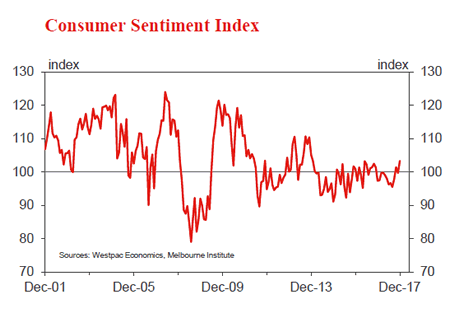
Aus Jan Westpac-MI Consumer Sentiment
Jan 17 Last: 103.3
The Westpac-Melbourne Institute Consumer Sentiment Index rose 3.6% to 103.3 in December from 99.7 in November. The average reading for the Index in the December quarter was 5% above the average for the September quarter when we saw a disturbing slump in consumer spending.
The Jan survey is in the field over the week ended Jan 13. Note that the headline is adjusted to remove a regular 'holiday' sentiment bump worth about 4pts. Other factors that may influence confidence this month include: another strong gain in jobs; but more signs of cooling across Australia's housing markets. Australia's dominance in the Ashes may also add to the Christmas mood.
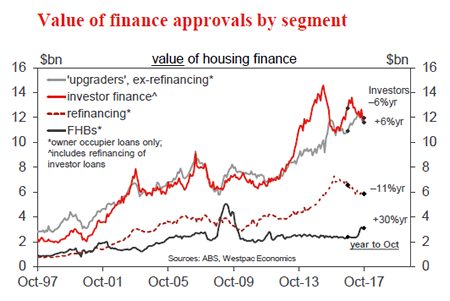
Aus Nov housing finance (no.)
Jan 17, Last: 0.6%, WBC f/c: -1.0%
Mkt f/c: 0.0%, Range: -1.0% to 1.5%
- Housing finance approvals have held up much better than expected given the material housing market slowdown evident in auction clearance rates, prices and turnover. The total number of owner occupier finance approvals dipped 0.6% in Oct, down 0.8% ex refi. The value of investor housing finance posted a 1.6% rise despite multiple downward pressures.
- The Nov update should show a decline. Markets have yet to level out and although the initial adjustment to APRA's macroprudential restrictions have largely passed, we expect some restraint to still be evident. Approvals are expected to decline 1%.
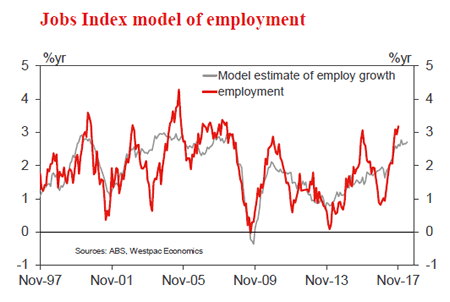
Aus Dec Labour Force - employment '000
Jan 18, Last: 61.6k, WBC f/c: -10k
Mkt f/c: 15k, Range: -10k to 40k
- Total employment rose 61.6k compared the market's 19k forecast and Westpac's +25k. It was the 14th consecutive gain monthly gain in employment matching the historical second longest period of monthly gains which started Aug 1979. The longest period of consecutive employment gains is 15 months starting May 1993.
- The Australian labour market gathered momentum through 2017 with annual employment growth accelerating from 0.9%yr in February to the November peak of 3.2%yr. In the year to Nov total employment has grown 383.3k.
- The pace of employment growth overshot Westpac Jobs Index which is suggesting growth of around 2¾%yr. The Jobs Index is not pointing to a downturn, however, growth is likely to ease back from the +3%yr pace. Westpac's -10k forecast will see it ease to a 2.9%yr pace.
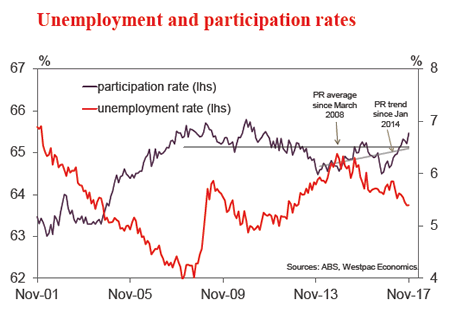
Aus Dec Labour Force - unemployment %
Jan 18, Last: 5.4%, WBC f/c: 5.5%
Mkt f/c: 5.4%, Range: 5.3% to 5.5%
- In November the unemployment was flat at 5.4% (5.40% at two decimal places vs. 5.39% in October) with a 0.3ppt gain participation driving 65.7k surge in the labour force.
- In the November survey the ABS noted that the incoming rotation group had a higher employment to population ratio than both the group it replaced and the entire sample. As such, sample volatility would explain a fair proportion of both the rise in employment and participation in November and thus the flat unemployment rate.
- For December we are expecting a more average sample to roll in which should result in both a lower employment to population ratio and participation rate. This should limit the rise in the unemployment rate to 5.5% despite the 10k dip in employment.
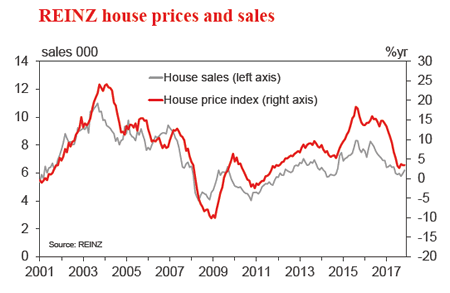
NZ Dec house sales and prices
Jan 15, Sales last: +4.1%, Prices last; +3.5%yr
- The housing market picked up in late 2017, with lower borrowing rates boosting both prices and sales. This reversed some of the softening we saw earlier in the year.
- We expect the positive trend in the housing market to continue for a few more months as buyers rush to beat looming regulatory and tax changes, as mortgage rates fall, and as banks loosen lending requirements following the RBNZ's LVR changes.
- However, over the course of 2018 we expect that changes in Government policy will see the market slow again.
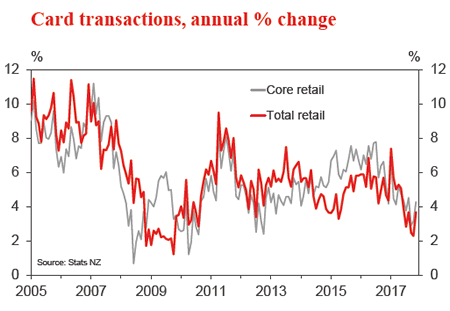
NZ Dec retail card spending
Jan 16, Last: +1.2%, WBC f/c: +0.5%
- Retail card spending rose strongly in November, increasing 1.2%. In part, this was due to increases in fuel prices. However, there were also solid gains in core spending categories, supported by the lift in the housing market and growing prevalence of 'Black Friday' sales.
- Some of the strength that we saw in November reflects that spending was brought forward to take advantage of price discounting, particularly in the case of durable goods. As a result, some payback is expected in December. Balanced against this, late-2017 has seen a second wind in the house housing market, which will provide some boost to spending. Weighing these factors up, we expect a modest 0.5% gain in retail spending in December.
- Heading in 2018, the strength of spending will be challenged by policies aimed at dampening housing market pressures and the gradual slowing in population growth.
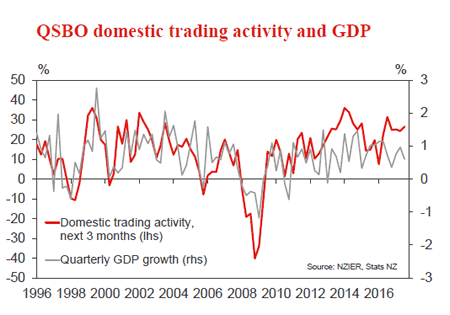
NZ Quarterly Survey of Business Opinion
Jan 16, Domestic trading activity - last: +27
- The previous survey of business opinion was conducted ahead of September's election. It showed that businesses had become increasingly nervous about the broader economic environment. However, they were still fairly upbeat about the prospects for activity in their own firms.
- Three months on, and with a change in Government, it's likely that confidence has taken a further hit. We'll be watching to see how this is affecting businesses' hiring and investment intentions, with other recent surveys pointing to softening activity.
- We'll also be keeping a close eye on the survey's key activity gauges. In particular, we'll be watching how activity in the construction sector is shaping up, and any headwinds that the industry is highlighting. We'll also be watching for signs that capacity or inflation pressures are increasing.
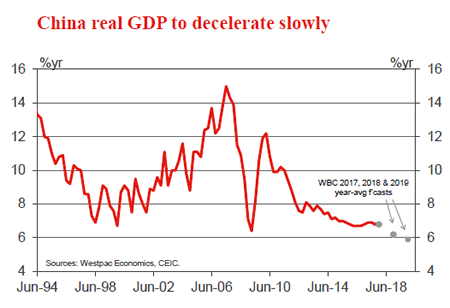
China Q4 GDP
Jan 18, last 6.8%, WBC 6.7%
- China GDP has consistently beaten expectations through 2017, spurred on by external demand as well as a robust pipeline of investment projects that are proceeding to completion.
- It may again be the case that growth surprises to the upside; however, we and the market believe the more likely outcome is that momentum slows a tick from 6.8%yr to 6.7%yr.
- The basis of this view is partly attributable to the slowdown in investment currently being seen across the economy, in both residential and nonresidential construction as well as other investment spending being undertaken by the government and corporates.
- Also key to the growth story is the consumer. Here we see robust demand, but not enough of an acceleration to more than offset the softening investment pulse.
Week Ahead – Bank of Canada Ponders Raising Rates Again; Aussie Eyes Jobs Data and China GDP
The Canadian and Australian dollars will be in focus next week as the Bank of Canada holds its first monetary policy meeting of the year, while Australian employment and Chinese growth figures will test the aussie's recent bull run. Other highlights will include inflation data out of the UK and the Eurozone. But the US will see a quieter week in terms of economic releases.
China's economy likely slowed in Q4
China will be the first major economy to report fourth quarter growth data when it publishes its GDP numbers on Thursday. After growing by 6.9% year-on-year in the first half of 2017 and 6.8% in the third quarter, China's growth rate is expected to moderate slightly to 6.7% in the final three months of the year, giving a full year figure of 6.8%. China's Premier, Li Keqiang, said this week it expects growth of 6.9%. But a weaker growth is possible too given that authorities have been intensifying their efforts to cut excess capacity and pollution. Also to watch out of China next week are December figures for industrial output, retail sales and fixed asset investment.
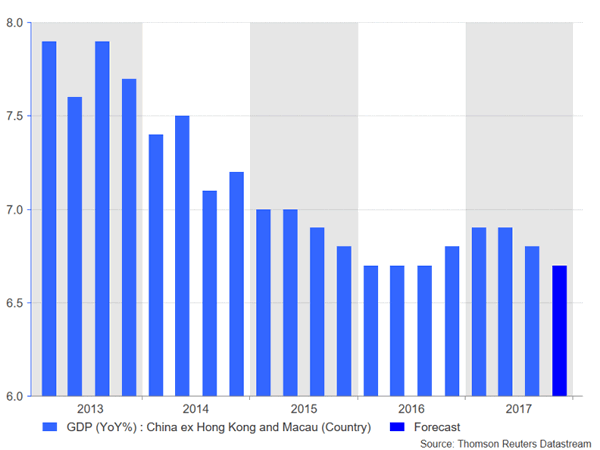
Positive numbers from China could spur the Australian dollar higher to back above $0.79, after testing the level on Friday for the first time since September 2017. However, data out of Australia should also attract bets in the aussie/dollar pair as December employment figures are released on Thursday. Recent data out of Australia have been on the strong side, helping the aussie rebound sharply from its December 6-month low. Another strong jobs report next week could strengthen the currency's upside momentum, putting the $0.80 handle within reach.
Japan reports producer prices and machinery orders
The yen soared against its major peers this week after a small reduction in long-dated government bond purchases by the Bank of Japan in a regular market operation on Tuesday prompted speculation that the BoJ may soon announce a scaling back of its stimulus program. Data out of Japan next week are unlikely to trigger similar moves but will nevertheless be watched to gauge the strength of the Japanese economy. Starting with corporate goods prices on Tuesday, Japan's equivalent of producer prices is forecast to rise a solid 0.4% month-on-month in December, though the year-on-year rate is expected to ease from 3.5% to 3.2%. Machinery orders will follow on Wednesday. Core machinery orders - a good indication of business expenditure - is forecast to decline by 1.4% m/m in November after a 5% jump in October.
Is UK inflation peaking?
Inflation (Tuesday) and retail sales (Friday) numbers will be the focus for pound traders next week as they could give clues as to whether the Bank of England is likely to raise interest rates this year. The 12-month CPI rate hit a near 6-year high of 3.1% in November. It is expected to edge down to 3.0% in December - perhaps a sign that the upside price pressures generated by sterling's sharp devaluation following the Brexit referendum are starting to subside. Core inflation is also forecast to ease slightly, from 2.7% to 2.6% y/y. Retail sales meanwhile will likely take the shine away from the optimistic picture painted by the November industrial output figures which surged on the back of the weaker pound and rising global demand. Retail sales are forecast to drop 0.6% m/m in December after an unexpectedly strong November.
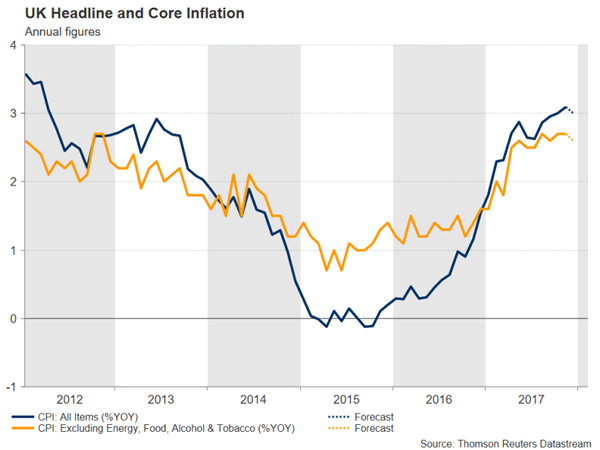
The Eurozone will also publish inflation figures. The final readings for December are expected to show CPI unrevised at 1.4%, but core CPI being revised lower from 1.1% to 0.9% y/y. A downward revision in the core rate could provide investors with an excuse to take profit on the euro's impressive gains this week when it broke above the key $1.21 level for the first time since January 2015.
Few attractions out of the US
US releases will be scarce next week with Wednesday's industrial production figures for the month of December, Thursday's data on housing starts for the same month and Friday's preliminary survey on January consumer sentiment by the University of Michigan expected to draw the most attention.
Industrial output is expected to exhibit positive growth for the fourth straight month, expanding by 0.5% m/m, a faster pace relative to November's 0.2%. Manufacturing output figures - a subset of industrial output ones - will also be watched. Moving to housing starts, it would be interesting to see if they continue coming in solidly after reaching a more than a decade high in November. Lastly, the University of Michigan's survey is expected to reflect an improvement in consumer sentiment, following the previous month's decline. Other notable releases in the coming seven days are the Empire State Manufacturing index (Tuesday) and the Philly Fed Business index (Thursday).
Bank of Canada headed for third rate hike in six months
Canada's economy continues to confound expectations with recent data on employment and retail sales suggesting the output gap is fast closing. This fuelled expectations that the Bank of Canada will raise rates for a third time since July when it meets on Wednesday. Futures markets are currently implying a more than 90% probability that the overnight rate target will rise from 1.0% to 1.25%. However, some analysts are warning that the BoC may decide to wait a little longer before hiking rates again so soon. Concerns about the possible termination of NAFTA and flat growth in monthly GDP in October may dissuade the BoC from taking early action.
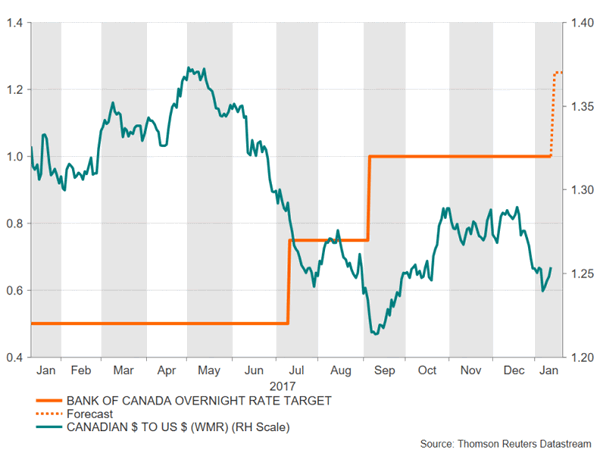
A surprise no change in policy would be negative for the Canadian dollar, which rallied to a 3-month high of C$1.2354 to the US dollar in early January on the expectations of a rate rise this month, before retreating to around C$1.25 on renewed NAFTA worries.
Weekly Focus: Strong Start to 2018 Amid Increasing US-China Tensions
Market movers ahead
- Overall, it looks like a fairly quiet week on the news front. In the US, industrial production and more Fed speeches should not give a big change to the outlook.
- China GDP for Q4 is set to show growth of 6.7% y/y. This would leave overall growth for 2017 at 6.8% or 6.9%.
- In the euro area, we are set to get more details on December inflation with the final release. We estimate UK inflation fell back below 3% in December.
- In Scandinavia, we expect the most interesting data to be Swedish house prices (HOX), where we look for a further decline in Stockholm flats of 2.6% m/m, taking the cumulated decline to 12% since August 2017.
Global macro and market themes
- We are still positive on equities, as global growth remains solid, although the acceleration phase is likely to be over soon.
- Inflation remains one of the most important topics this year. Despite higher oil prices, we expect core inflation to remain subdued.
- In our view, markets have priced the ECB too aggressively, as we see the first ECB hike in Q2 19.
- Increasing tension between the US and China is a cause for concern.
GBPJPY Rallies; Corrective Move or Shift in Trend?
GBPJPY shifted out of its neutral phase and has turned more bullish in the short term to regain the 151 handle. Looking at the 4-hour chart, the pair appears to have put in a base after falling to its lowest level in around 3 weeks.
The pair is strengthening after making an aggressive move higher to breach what was a firm resistance level at 151 and the rally may have legs to move higher towards the next key level at 152. RSI is rising and has reached the 50 level, although it hasn't broken it yet.
Minor support is expected at 150.50 and below this, the focus turns to 150 ahead of a re-test of the mid-December low of 149.40, with additional weakness seen from here.
Unless GBPJPY reaches into the 152 handle soon, then upside momentum may fade fast and the recent recovery would be seen as merely a corrective move of the downtrend from January 8 and not a shift in trend. A breach of 153 resistance is needed to bring GBPJPY back to a bullish market structure.

Still Not Much Heat in US Inflation – But is that a Barrier to Further Rate Hikes?
Highlights:
- All items CPI met market expectations with a 0.1% month-over-month increase in December. Lower energy prices limited the gain, unlike November when they contributed to a 0.4% headline increase.
- All items inflation edged down to 2.1% year-over-year from 2.2% in November.
- Excluding food and energy, prices were up 0.3% in December—the largest monthly increase since last January. December's gain was helped by a 0.4% increase in the sizeable shelter component.
- Core inflation edged up to 1.8% year-over-year in December but has been stuck in a tight 1.7-1.8% range over the last eight months.
The December CPI report caps off a year that saw little evidence of tight economic conditions fueling higher consumer prices. The headline rate of 2.1% is exactly where it was a year earlier, while core inflation remains stuck below the Fed's 2% objective after having been on the opposite side throughout 2016. That is despite the unemployment rate falling to 4.1%—below most estimates of what the economy can sustain without driving inflation higher. It remains the case that without the impact of one-off factors like a sizeable dip in wireless telephone service prices, core inflation would be right around the 2% mark. But still there is limited evidence that underlying inflation is actually heating up. That continues to be a sticking point for some members of the FOMC who are reluctant to raise interest rates further in the absence of greater inflationary pressure.
However, those on the other side who are concerned about upside risks to the inflation outlook now have a bit more ammunition thanks to the tax cuts passed in December. With the economy already running near full capacity, this fiscal boost arguably will need to be offset by tighter monetary policy. A pickup in inflation would certainly help make the case, but even if current price trends hold we think policymakers have to be concerned about falling behind the curve. So while core inflation is likely to remain stuck below 2% early this year, we continue to expect the Fed will raise rates again in March.
U.S Core CPI Posts Largest Increase in 11-Months
U.S headline inflation was muted as expected last month (+0.1% vs. +0.1%e m/m), but there was movement in the closely watched underlying measure.
Core-CPI prices, ex-food and energy, increased a seasonally adjusted +0.3% in December from a month earlier, the largest increase since January 2017.
Digging deeper, the gain in core-prices can be attributed largely to shelter inflation, which had been slowing over the past year but rose +0.4% in December. Besides shelter, the indexes for medical care, used cars and trucks, and new vehicles all contributed to the rise in core prices. The index for prescription drugs, which had weakened earlier this year, rose 1% in December on the back of a 0.6% increase in November.
Note: Shelter accounts for about a third of the overall consumer price index.
U.S Retail sales ends last year on solid footing
U.S retail stores, restaurants and online-shopping platforms closed out December on a strong note.
Data this morning showed that U.S retail and food services sales rose a seasonally adjusted +0.4% in December from the prior month, the fourth straight increase. Ex-autos and gas, sales also rose +0.4% in November.
Total sales in Q4 were up +5.5% from the same period a year earlier. For 2017 as a whole, overall sales rose +4.2% from the prior year, the strongest annual growth in three years.
USD/CAD – Subdued as US Inflation, Retail Sales Within Expectations
USD/CAD is subdued in the Friday session. Currently, the pair is trading at 1.2535, up 0.08% on the day. On the release front, there are no Canadian events. In the US, Retail Sales and CPI reports were within expectations.
There was unexpected news out of China on Wednesday. A report that China was considering slowing the purchase of US government bonds shook up the currency markets and sent the Canadian dollar lower. China boasts the largest currency reserves, estimated at $3 trillion. It is also the biggest holder of US government bonds, in the amount of $1.19 trillion. China is unlikely to halt all purchases, but its vast holdings of US bonds could serve as leverage in a trade war with the US. President Trump has railed against the US trade imbalance with trade with China, and by serving notice that it might reduce its US Treasury purchases, China appears to be flexing some muscle. If China does indeed make any moves regarding these bond purchases, traders can expect sharp market movement.
After strong gains in December, the Canadian dollar has held its own against the greenback in January. There are two important factors for this positive trend. First, Canada has recorded outstanding employment numbers in the past two months. In December, the economy added 78.6 thousand jobs, defying experts who predicted a minuscule gain of 1.8 thousand. This release comes on the heels of a superb November release, when the economy added 79.5 thousand news jobs. The unemployment rate dropped to 5.7% in December, down from 5.9% a month earlier. Second, the recent rise in oil prices, which are up 6.8% since mid-December, has boosted the commodity-based Canadian currency. The BoC is expected to raise rates later this month, which could boost the Canadian dollar.
EUR/USD Mid-Day Outlook
Daily Pivots: (S1) 1.1953; (P) 1.2006 (R1) 1.2084; More....
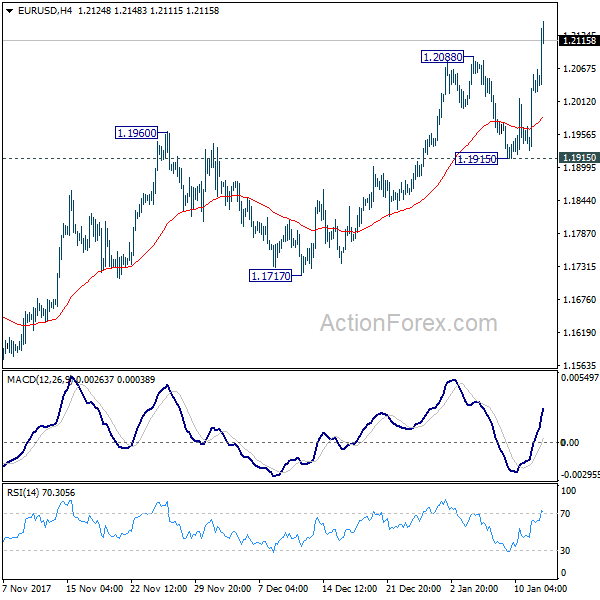
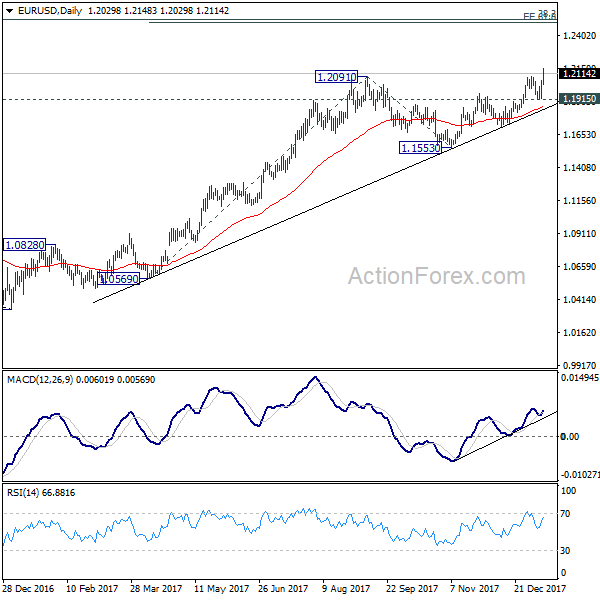
EUR/USD's firm break of 1.2091 resistance today indicates resumption of medium term rise from 1.0339. Intraday bias is back on the upside. Current rise should target 1.2494/2516 key resistance zone next. On the downside, break of 1.1915 support is needed to confirm short term topping. Otherwise, outlook will remain bullish in case of retreat.
In the bigger picture, rise from 1.0339 medium term bottom is still seen as a corrective move for the moment. Therefore, in case of another rally, we'd be expect 38.2% retracement of 1.6039 (2008 high) to 1.0339 (2017 low) at 1.2516 to limit upside and bring reversal. That is also close to 61.8% projection of 1.0569 to 1.2091 from 1.1553 at 1.2494.
Euro Extends Rally on Breakthrough in German Coalition Talks, Dollar Gets No Support from CPI
EUR/USD powers through 1.21 handle today on new that German Chancellor Angela Merkel has achieved some breakthrough in forming the new coalition government. It's reported that Merkel has struck a deal with the Social Democrat to formally open talks for reforming the grand coalition. The marathon talks were closed with a 28-page blue print between the CDU/CSU and SPD. Close cooperation with France to strengthen the Eurozone is one of the key point of the blue print.
Merkel said after the talks that "we have felt since the elections that the world will not wait for us, and in particular regarding Europe we are convinced we need a new call for Europe". She also noted that "there will be difficult tasks to come" and, "the coalition negotiations probably won't be easier than the exploratory talks."
SPD leader Martin Schulz said in the joint press conference that there were "turbulent moments" during the talks but negotiators "never faced the risk of failure".He pledged that 'we want to ensure economic and political power for Germany is put towards creating a stronger Europe."
Released from US, headline CPI rose 0.1% mom, 2.1% yoy in December, slowed from 2.2% yoy but met expectations. Core CPI, on the other hand, beat expectation of rose 0.3% mom, 1.8% yoy. Headline retail sales rose 0.4% mom in December, while ex-auto sales also rose 0.4%. But the data provides little support to the greenback.
EUR/USD Mid-Day Outlook
Daily Pivots: (S1) 1.1953; (P) 1.2006 (R1) 1.2084; More....
EUR/USD's firm break of 1.2091 resistance today indicates resumption of medium term rise from 1.0339. Intraday bias is back on the upside. Current rise should target 1.2494/2516 key resistance zone next. On the downside, break of 1.1915 support is needed to confirm short term topping. Otherwise, outlook will remain bullish in case of retreat.
In the bigger picture, rise from 1.0339 medium term bottom is still seen as a corrective move for the moment. Therefore, in case of another rally, we'd be expect 38.2% retracement of 1.6039 (2008 high) to 1.0339 (2017 low) at 1.2516 to limit upside and bring reversal. That is also close to 61.8% projection of 1.0569 to 1.2091 from 1.1553 at 1.2494.