Sample Category Title
GBPUSD Expected To Continue Consolidation Phase In Short-Term After September’s Decline
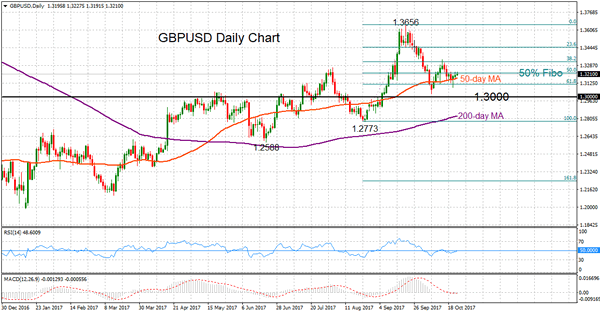
GBPUSD has been maintaining a soft bias since peaking at 1.3656. The pair has managed to trade above the key 1.3000 level since declining from the September 20 high and this looks like a strong support level, which if broken would increase downside pressure.
The market has mainly been pivoting around the 50% Fibonacci retracement level (1.3215) of the upleg from 1.2773 to 1.3656 over the last three weeks.
The neutral bias of the RSI and MACD indicators suggest more sideways trading at least in the near-term. There are few signs for a real push higher due to the lack of momentum in the market. A break below the 50-day moving average at 1.3167 could trigger a drop back towards the 1.3000 area. A deeper decline would strengthen downside momentum and shift the focus back to the 1.2773 low.
Looking at the bigger picture, GBPUSD has been slowly shifting higher since April. The market is trading above the positively aligned 50- and 200-day moving averages which keeps the odds for a bullish trend to remain in play. The consolidative phase is expected to remain in the short-term and only a move above 1.3318 (38.2% Fibonacci) would help trigger a rally back towards 1.3656.
Majors Stay In Recent Ranges, Kiwi Hit By New Zealand’s Coalition Government Program
Most foreign exchange majors stayed within narrow ranges during today's Asian session as traders were awaiting key business survey data out of the Eurozone and the United States later in the day.
The only big mover was the New Zealand dollar, which continued to post heavy losses as the country was seen getting a coalition government whose policies could have a negative impact on the currency. In particular, the new Labor-led government could push for the Reserve Bank to include unemployment as well as inflation in its mandate. According to analysts, this could lead to a delay of higher interest rates from the RBNZ. The new government would also raise the minimum wage, curb immigration and put limits on foreign buyers of housing. This led the kiwi dollar to a fresh 5-month low against the greenback at 0.6918; well below the psychological 70 cent mark which had acted as support before news of the outcome of the coalition talks broke. The kiwi's daily losses were about 0.6%.
The aussie also sold off sharply against the US dollar to trade at 0.7780; losing around 0.3% on the day.
Concerning the US dollar, there was little news flow as the market was awaiting President Trump's choice for the nomination of Federal Reserve Chair. The three leading candidates were the current Chair Janet Yellen, Stanford Professor John Taylor and Fed Governor Jerome Powell. A decision would be taken 'very soon' according to Trump. The current Fed Chair will step down in February of 2018.
Traders were hesitant of pushing the euro too much in one direction ahead of the European Central Bank meeting on Thursday when the ECB is expected to announce its plans for a further reduction in monthly asset purchases in 2018. There were important developments ahead for Catalonia, where the crisis seems to be escalating after Madrid decided to sack the regional government and call for regional elections during the weekend. Spain's national parliament was set to vote on revoking the region's autonomy on Friday. In return, Catalan independence leaders called for disobedience to Madrid's rule in that event. Political uncertainty was seen as weighing on the euro, although at 1.1748 the single currency did not appear too worried about the repercussions from the crisis.
Although US stock indices closed in the negative the previous day, Japan's Nikkei extended its record run to 16 consecutive days of gains. The victory by Prime Minister Abe during the weekend's elections seems to have boosted sentiment and optimism that stimulus policies will continue. The dollar rebounded versus the yen to come back to around 113.69 from a session low of 113.29.
Gold gained to around $1280 an ounce as it took advantage of some modest dollar weakness during the Monday's US session.
Looking ahead, after the release of Eurozone PMIs, the US session will feature the Markit PMI, Richmond Fed manufacturing PMI and API crude oil inventories later.
NZD In The Doldrums As The Goverment Outlines Its Plan
NZD's slide is not over
The New Dollar was by far the worst performer among the G10 complex this morning as Prime Minister Jacinda Ardern made her first announcements. The Kiwi rose to $0.7004 before reversing momentum towards $0.6926 after New Zealand's Prime Minister announced the priorities of the newly formed government - NZ First's Winston Peter is now deputy PM. One of the priorities of the coalition government is to review and reform the central bank act by adding another mandate to the central bank. Should this be accepted, the Reserve Bank of New Zealand (RBNZ) will have a dual mandate, just like the Federal Reserve, and will have an employment target as well as the traditional inflation one. However, what sent the Kiwi lower is another comment from PM Ardern regarding the possibility to give the central bank more flexibility to manage the NZD's value against other currencies.
Besides reforming the Central Bank Act, the government also made other commitments including forbidding foreigners to buy real estates, to trim immigration down to 30k people a year, to create a fund for regional development and to plant 100 million trees per year, among other priorities.
The New Zealand dollar has fallen almost 3.50% since the announcement of the Labour coalition government. Last week, we said that the Kiwi has further downside potential as speculators continue to unwind their bullish bets. We maintain our target at $0.6888 (low from May 11th). Another support lies at 0.6676 (low from May 2016).
Japan: Big win for Shinzo Abe at parliamentary election
The Japan election sent the USD/JPY to a three-month high above yen 113.50 for one single dollar note. Shinzo Abe won by a clear majority (312 seats out of 465 possible, more than a two-thirds majority). The prime minister victory is synonym of continuation of the Abenomics. The free money is then likely to continue flooding in Japan for some more time. The Nikkei has by the way reacted very positively by setting an all-time high to 21805 points.
This result may sound as contradictory knowing the failure of the Abenomics so far. The targets set up by Shinzo Abe have not been reached. The Japanese debt has never been so strong and the country struggles against deflation. Wages growth are very low. The truth is that the country needs this very loose monetary policy to keep going.
Abe promised to open up Japan to foreign investments in order to boost Japan's economy. Abe, which political future seemed at staked is now like a phoenix reborn from ashes. Next time, it won't likely work that way!
EURUSD Analysis: Reaches Marked Support
There are three facts that need to be described to update the situation.
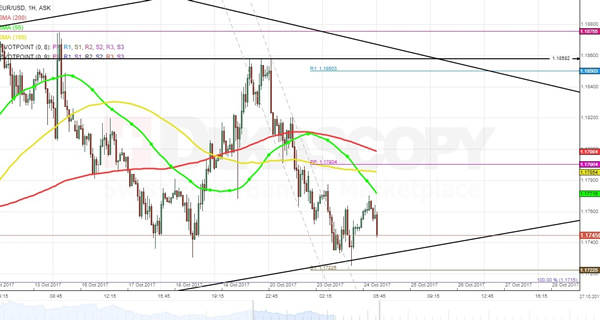
First of all the pair has hit the previously speculated lower trend line of a medium term ascending channel pattern. The rate rebounded against the support after shortly touching it above the 1.1720 mark.
Secondly a rebound followed, which was already stopped on Tuesday morning by the resistance of the 55-hour simple moving average. The SMA is just the first one in a cluster of resistance levels.
Third and last the pair is set to be squeezed in by the medium support and the SMAs.
GBPUSD Analysis: Back Below 1.32 Mark
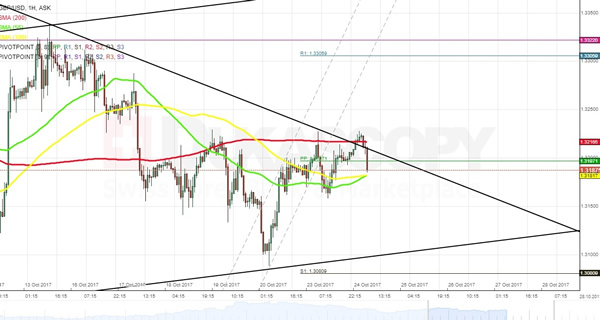
On Tuesday morning the Pound had already lost the previously gained ground against the US Dollar, as the currency exchange rate traded below the 1.32 level.
The reason for that is quite unclear, as the pair had already passed the last resistance level above the 1.3250 mark during the early hours, when the rate suddenly began to fall.
However, after passing various support levels the pair’s decline was stopped by the combined support of the 55 and 100-hour SMAs.
In regards to the future outlook, it seems that the surge is set to continue, as the pair has broken the resistnace of the long term channel down pattern.
USDJPY Analysis: Retreats As Expected
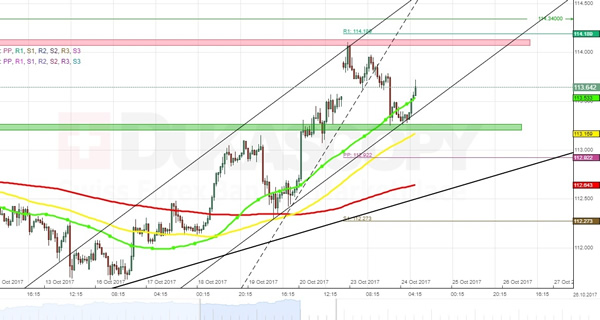
After reaching the high level above the 114.00 mark on Monday in the aftermath of the Japanese election the USD/JPY currency pair retreated back down to the support zone near the 113.20 mark. At that level the rate rebounded and offered a chance to adjust the drawing of the medium scale ascending channel pattern.
In general the rate faced no resistance levels up to the mentioned 114.00 mark, as it was being driven higher by the support of the 55-hour SMA. Moreover, the SMA was supported by the ascending lower trend line of the dominant medium scale channel up pattern.
Due to that reason it is assumed that the 114.00 mark will be reached once more.
Gold Analysis: Rebound Results In Jump
On Tuesday morning initially it looked like the yellow metal has broken the dominant ascending channel. However, the situation is quite different. After examining the chart more one can discover that the ascending channel needs to be adjusted. Meanwhile, the bullish long term outlook still persists.
In regards to the short term outlook, the bullion's price had approached the support of the proven 61.80% Fibonacci retracement level at the 1,279.05 level, where it seemed to have made a rebound.
Although, the metal still faced the 55 and 100-hour SMAs, which needed to be passed until the price surges back higher.

USD/CAD: Canadian Wholesale Sales
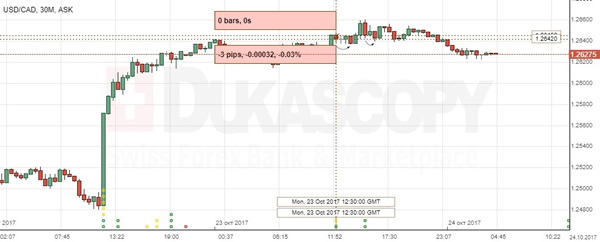
The USD/CAD exchange rate was little changed on the Canadian wholesale sales report, failing to spoil Friday gains. The Greenback lost 0.03% against the Canadian Dollar to remain in the 1.2640 area.
Statistics Canada revealed that the country's wholesale sales grew at a weaker-than-expected pace of 0.5% in August, following an upwardly revised 1.7% gain in the prior month. The main contributors were higher sales of household and private goods, as well as in the motor vehicle subsector. Though, the weak reading provided further signs that the Canadian economy entered the stage of slowdown. In this regard, the Bank of Canada is widely expected to kept interest rates unchanged on its Wednesday meeting, which could cause some volatility in the pair.
Technical Outlook: AUDUSD – Bears Extend To New Two-Week Low, Eye Key Support At 0.7732
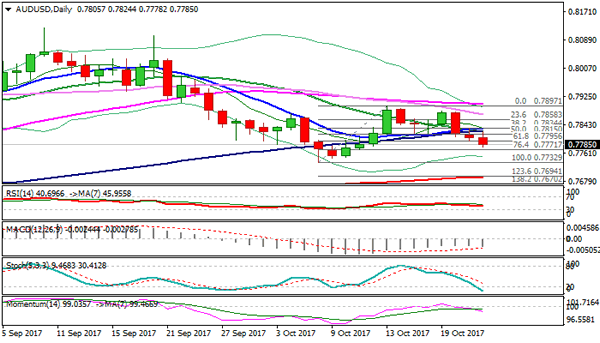
The Aussie dollar accelerated further down on Tuesday and broke below pivotal support at 0.7795 (Fibo 61.8% of 0.7732/0.7897 upleg).
Last Friday’s long red daily candle continues to weigh strongly for bearish extension towards 0.7732 (06 Oct low), to mark full retracement of 0.7732/0.7897 upleg.
Bearish daily techs are supportive, with formation of 20/100SMA bear-cross, additionally weighing on near-term action.
Close below 0.7795 will be bearish signal for further easing through 0.7771 (Fibo 76.4%) towards 0.7732 target.
Meanwhile, bears may take a breather ahead of 0.7732 as strongly oversold slow stochastic warns of correction.
Initial resistance lies at 0.7824 (20/100 bear-cross / session high) while daily cloud base (0.7848) is expected to cap extended upticks.
Res: 0.7824, 0.7848, 0.7883, 0.7897
Sup: 0.7771, 0.7732, 0.7712, 0.7670
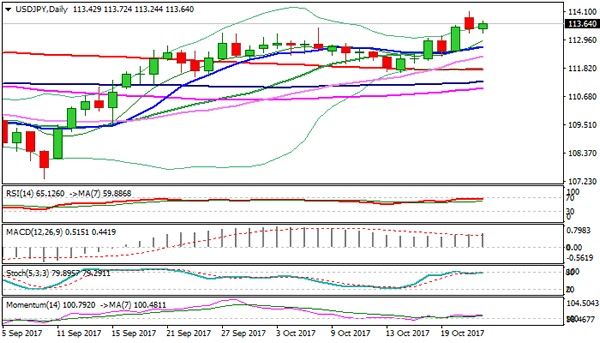
Technical Outlook: USDJPY – Hourly Cloud Top Is Key For Fresh Probe Above 114.00
The pair is in recovery mode in early Tuesday's trading after Monday's post-election rally failed to clearly break above 114.00 barrier at first attempt and pulled back to113.24.
Today's recovery is attacking key near-term barrier at 113.72 (top of thickening hourly cloud), break of which is needed for fresh bullish signal for renewed probe through 114.00 barrier and attack at key resistances at 114.33 (Fibo 61.8% of 118.66/107.31 descend) and 114.36/49 (11 May / 11 July former tops).
Bullish daily studies are supportive for further advance but bulls may hesitate again as slow stochastic is entering overbought territory.
Prolonged consolidation could be expected while the price holds within hourly cloud (spanned between 113.19 and 113.72).
Stronger bearish signal could be expected on sustained break below hourly cloud, which would trigger deeper pullback towards 112.70 (converged 10/20 SMA's).
Res: 113.72, 114.09, 114.33, 114.50
Sup: 113.60, 113.48, 113.19, 112.70