

Sample Category Title
EUR/AUD Daily Outlook
Daily Pivots: (S1) 1.5020; (P) 1.5045; (R1) 1.5075; More....
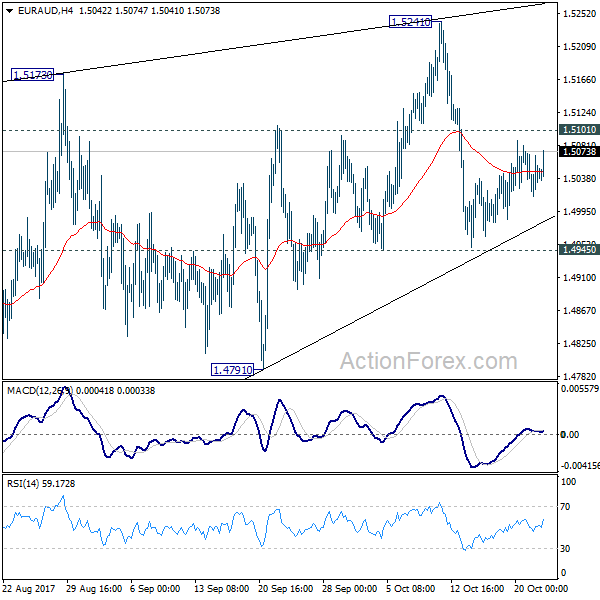
Intraday bias in EUR/AUD remains neutral as range trading continues. With 1.5101 minor resistance intact, deeper decline is in favor. Fall from 1.5241 is seen as the third leg of the consolidation pattern from 1.5226. Break of 1.4945 will target 1.4791 support and possibly further to 1.4421. On the upside, though above 1.5101 will turn focus back to 1.5241 resistance instead.
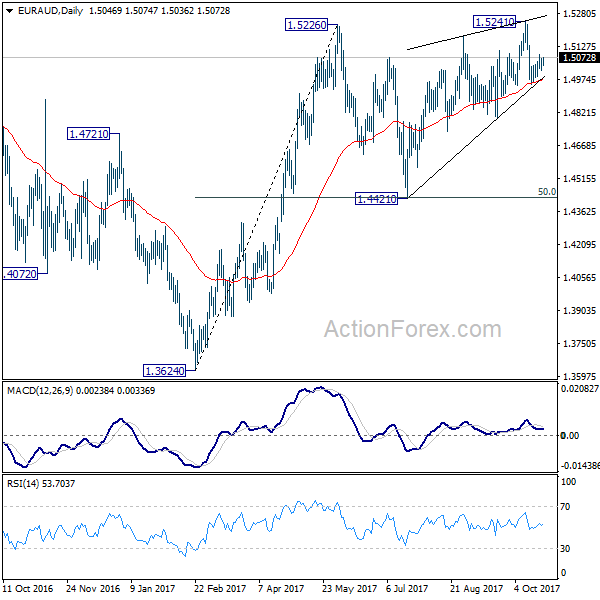
In the bigger picture, we're holding on to the view that corrective decline from 1.6587 medium term top has completed at 1.3624. Rise from 1.3624 is expected to extend to retest 1.6587. The corrective structure of the price actions from 1.5226 is affirming this view. Sustained trading above 1.5226 will target a test on 1.6587 key resistance. However, break of 1.4421 support will dampen our view and would drag EUR/AUD lower to retest key support zone around 1.3624.
EUR/CHF Daily Outlook
Daily Pivots: (S1) 1.1560; (P) 1.1581; (R1) 1.1593; More...
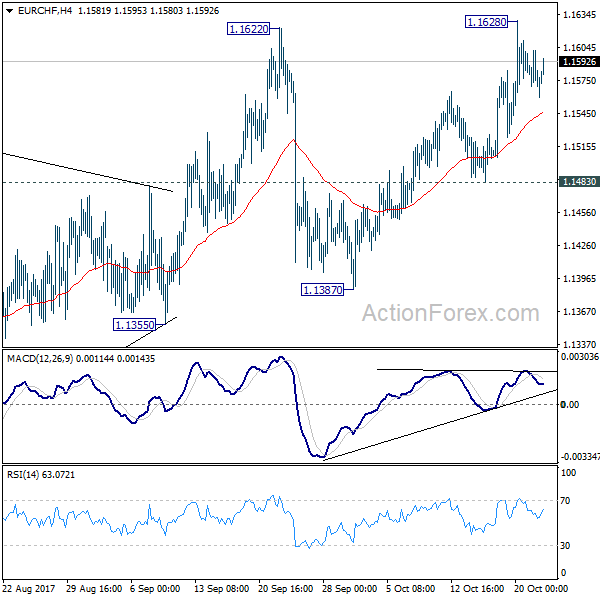
A temporary top is formed at 1.1628 and intraday bias in EUR/CHF is turned neutral first. As long as 1.1483 minor support holds, another rise is mildly in favor. Sustained trading above 1.1622 will confirm resumption of medium term rally and target 1.2 key level. However, firm break of 1.1483 will dampen this bullish case and turn bias to the downside for 1.1387 instead. In that case, consolidation from 1.1622 will extend for a while.
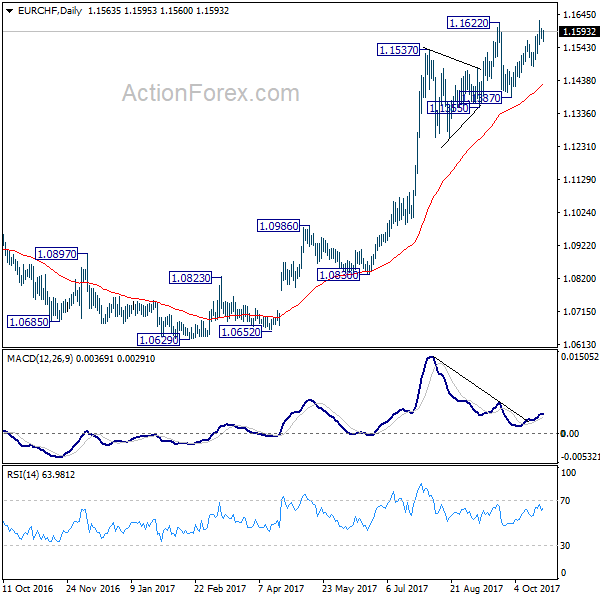
In the bigger picture, long term rise from SNB spike low back in 2015 is still in progress. EUR/CHF should now be heading back to prior SNB imposed floor at 1.2000. For now, this will be the favored case as long as 1.1198 resistance turned support holds.
The US Bond Market Also Closed With Modest Movements
Market movers today
In the euro area, PMIs are released. Manufacturing PMI has been on a rising trend since August 2016, getting close to the post -financial crisis peak of 59.0 in February 2011. In October, we expect manufacturing PMI to remain around the current level of 58.1, as the stronger euro may have started to affect new export orders adversely. After four straight months of decline, services PMI recovered in September to 55.8 and we believe services PMI will increase further in October to 56.2. Overall, the high PMIs support our expectation of robust growth for H2 in the euro area.
In the US, preliminary Markit PMIs for October are due. The service index shows that the service sector remains the main growth driver but we are puzzled about the large gap between ISM manufacturing and Markit PMI manufacturing and expect Markit PMI manufacturing to close the gap a little by increasing this month.
In China, the Congress of the Communist Party ends today with the new Standing Commit tee (SC) of the Politburo being presented Wednesday morning. Early news reports suggest Xi Jinping is choosing a moderate path in setting the new Standing Committee. South China Morning Post reports that there will be members from different factions, which in our view will bode well for political stability in China. It still remains unclear whether Xi Jinping will choose a successor.
Selected market news
The Asian equity markets move modestly higher this morning despite a modest decline in US equities on Monday. The US equity markets are awaiting a string of earnings results as well as more news regarding the process on the US tax reform.
In the currency markets we have seen modest movements in the major crosses this morning while we wait for the ECB meeting on Thursday.
The US bond market also closed with modest movements. Here, the market is also awaiting the announcement from US President Trump about who is going to be the next Fed president as well as several members to the FOMC committee. T he market is looking towards ‘Fed-proof' trades such as a flatter US Treasury curve even though the curve is very flat already.
The Spanish government bond market has been fairly resilient to the recent escalation of the Catalan political crisis. Yesterday, Spanish 10Y government bond yields outperformed the core markets. The Catalan independent movement plans to make a ‘human shield' in order to stop national authorities from taking over regional government buildings.
Elliott Wave View: FTSE Short Term
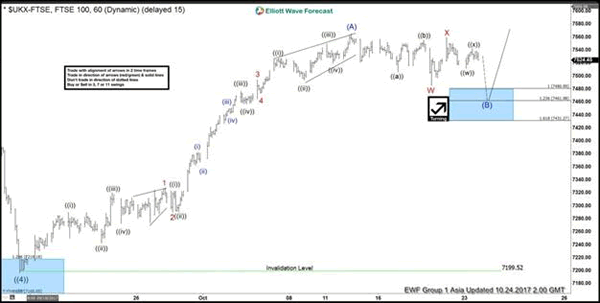
FTSE Short term Elliott Wave view suggests that the decline to 7199.5 ended Primary wave ((4)). Rally from there is unfolding as an impulse Elliott Wave structure where Minor wave 1 ended at 7327.5 and pullback to 7289.75 ended Minor wave 2. Subsequent rally to 7494.34 ended Minor wave 3, Minor wave 4 ended at 7473.12, and Minor wave 5 ended at 7565.11. The last leg to 7565.11 also ended Intermediate wave (A) of a zigzag Elliott Wave structure from 9/15 low (7199.5).
Intermediate wave (B) is currently in progress as a double three Elliott Wave structure. Down from 7565.11, Minor wave W ended at 7485.42 and bounce to 7560.04 ended Minor wave X. Near term, while bounces stay below 7565.11, expect the Index to turn lower towards 7431.27 – 7480.95 area to complete Intermediate wave (B). Afterwards, Index should resume the rally to new high or at least bounce in 3 waves. We don’t like selling the proposed pullback.
FTSE 1 Hour Elliott Wave Analysis
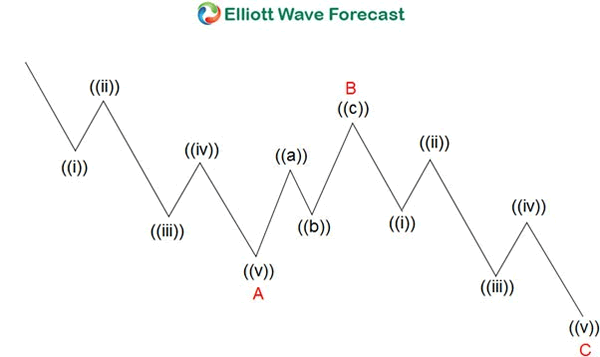
Zigzag is a 3 waves corrective pattern which is labelled as ABC. The subdivision of wave A is in 5 waves, either as impulse or diagonal. The subdivision of wave B can be any corrective structure. Finally, the subdivision of wave C is also in 5 waves, either as impulse or diagonal. Thus, zigzag has a 5-3-5 structure. Wave C typically ends at 100% – 123.6% of wave A.
EUR/USD Daily Outlook
Daily Pivots: (S1) 1.1722; (P) 1.1750 (R1) 1.1775; More...
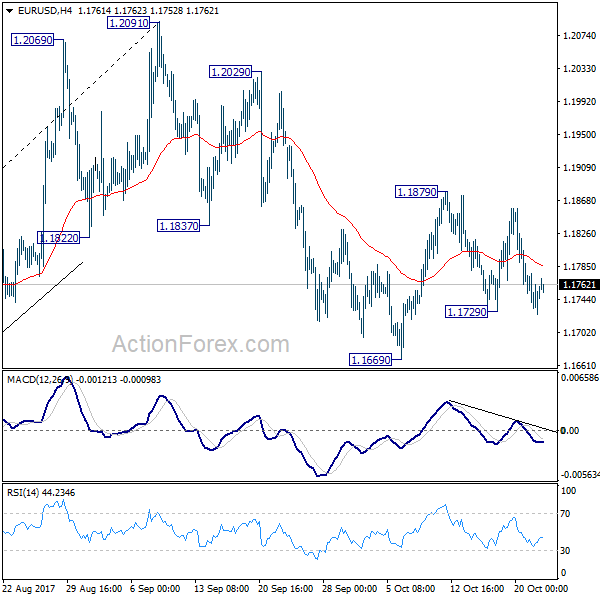
EUR/USD breached 1.1729 but quickly recovered. Intraday bias remains neutral first. On the downside, break of 1.1669 will resume the corrective fall from 1.2091 to 38.2% retracement of 1.0569 to 1.2091 at 1.1510. We'd expect strong support from there to complete the correction. On the upside, break of 1.1879 will revive the case that pull back from 1.2091 has already completed at 1.1669. In such case, intraday bias will be turned back to the upside for retesting 1.2091 high.
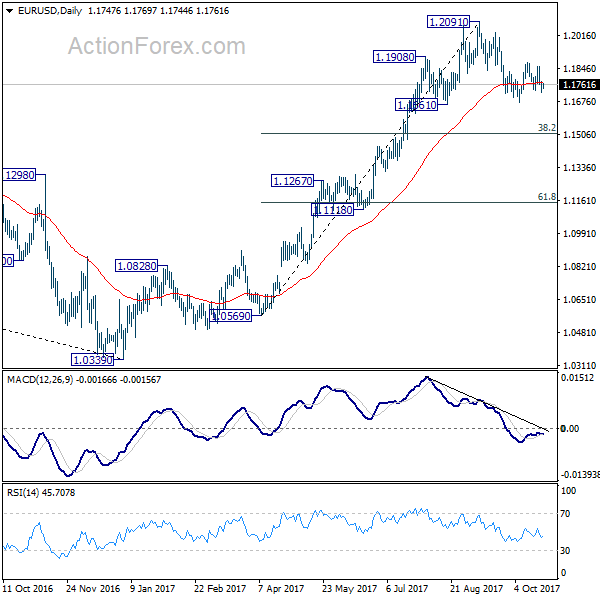
In the bigger picture, rise from medium term bottom at 1.0339 is not finished yet. It's expected to continue after pull back from 1.2091 completes. And, next target will be 38.2% retracement of 1.6039 (2008 high) to 1.0339 (2017 low) at 1.2516. However, it should be noted that there is no confirmation of trend reversal yet. That is, such rebound from 1.0399 could be a correction. And the long term fall from 1.6039 (2008 high) could resume. Hence, we'd be cautious on strong resistance from 1.2516 to limit upside.
GBP/USD Daily Outlook
Daily Pivots: (S1) 1.3160; (P) 1.3193; (R1) 1.3229; More....
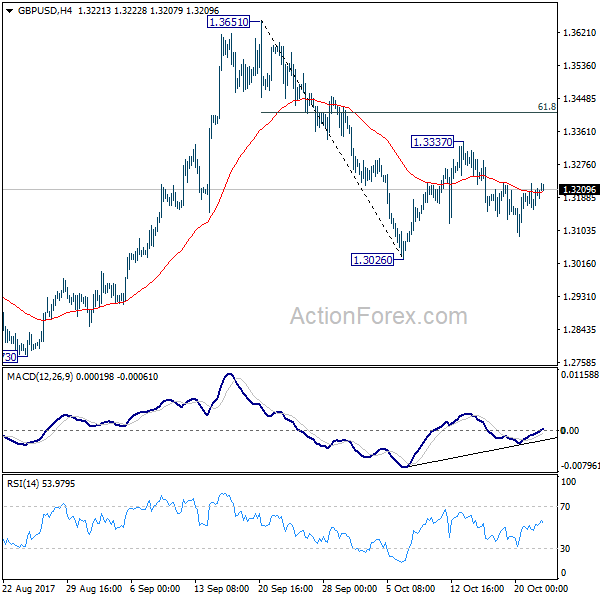
GBP/USD is still bounded in range of 1.3026/3337 and intraday bias remains neutral at this point. On the downside, break of 1.3026 will resume the decline from 1.3651 and target 1.2773 key support level. This will also revive the case of medium term reversal. Meanwhile, on the upside, break of 1.3337 will resume the rebound from 1.3026 to 61.8% retracement of 1.3651 to 1.3026 at 1.3412 and above.
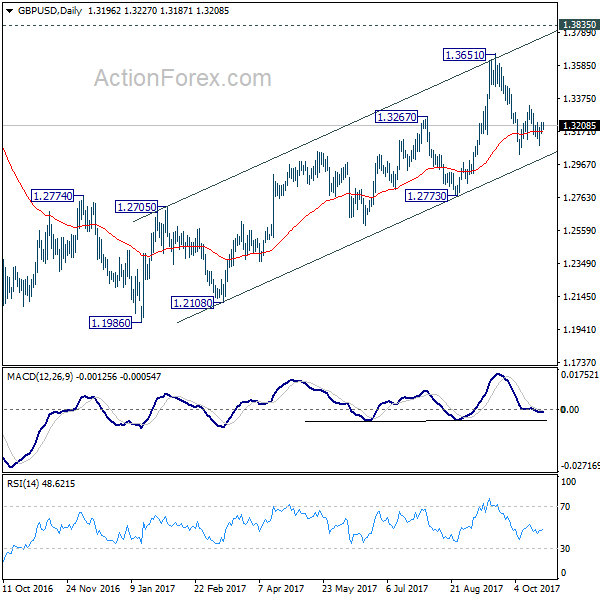
In the bigger picture, while the medium term rebound from 1.1946 was strong, GBP/USD hit strong resistance from the long term falling trend line. Outlook is turned a bit mixed and we'll stay neutral first. On the downside, decisive break of 1.2773 key support will argue that rebound from 1.1946 has completed. The corrective structure of rise from 1.1946 to 1.3651 will in turn suggest that long term down trend is now completed. Break of 1.1946 low should then be seen. On the upside, break of 1.3835 support turned resistance will revive the case of trend reversal and target 38.2% retracement of 2.1161 (2007 high) to 1.1946 (2016 low) at 1.5466.
ECB Ready To Outline Future Of APP
- APP: consensus about 9-month extension at €30 bn/month from January
- Markets too complacent about a more hawkish outcome, such as a shorter lifespan APP?
- Accelerating growth, strengthening jobs market, but tame inflation give ECB room for maneuver
- Curve steepening, but what about EUR/USD?
The ECB indicated that at last month's governing council policy meeting there were ‘very preliminary' discussions on various topics relating to the winding down and eventual exit from QE. These remained mostly confined to asking questions about the pros and cons of various scenarios entailing different extension lengths and purchase amounts that might be considered in the future. This week's ECB policy meeting is expected to deliver significant clarity about the future of the central bank's Asset Purchase Programme with the end-date looming on the horizon. The current forward guidance reads that “net asset purchases, at the current monthly pace of €60 billion, are intended to run until the end of December 2017, or beyond, if necessary, and in any case until the Governing Council sees a sustained adjustment in the path of inflation consistent with its inflation aim.”
APP: Extend and recalibrate
Ahead of the September meeting, we suggested that the ECB could use the playbook they've put together in December 2016. Ten months ago, the central bank was in a more or less similar situation as the APP guidance noted that purchases were intended to run until the end of March 2017, or beyond, if necessary. The ECB then decided to lengthen asset purchases, but also to “recalibrate” the monthly amount (from €80bn/month to €60bn/month) in order to adapt to the changing/improving economic reality
More specifically, we expected the ECB to extend purchases until the end of June 2018 or beyond if necessary with a reduction of asset purchases from €60bn/month to €30bn/month taking effect from the start of 2018.
Over the past week, several “rumours” and comments by ECB governors suggested that consensus has been building around a 9-month extension (until September 2018), while effectively recalibrating the monthly purchases amount to €30 bn. Other sources sounded more concerned about capping the total amount of purchases, around €2.5 tn. At the end of September 2017, total asset holdings amounted to €2.12 tn. Applying the consensus scenario would result in total purchases of €2.57 tn by the end of September 2018, suiting the needs of those worried about the total size of the package. Quite apart from determining what level of QE might be appropriate for the Euro area economy, a slower pace of purchases is becoming necessary for technical reasons as the ECB is running into issue(r) limits for several EMU countries.
The rumoured proposal strikes a balance between doves and hawks. Monetary doves will be pleased as a 9-month extension strengthens the ECB's forward guidance on rates (“we expect rates to remain at their present levels for an extended period of time, and well past the horizon of our net asset purchases”) and buys significant time to prepare for the final element in beginning the normalization process. It would probably prevent any significant rate hike speculation beginning at least until the summer of 2018. Already, the 3-month Euribor forward curve only turns positive by the end of 2019, which is entirely consistent with the rumoured dovish 9-month extension proposal. Another important side-effect of this stance is that it should keep the euro in check, especially in combination with the Fed's gradual rate hike cycle. At the September meeting, the ECB spent an unusually large amount of time discussing the causes and effects of euro strength.
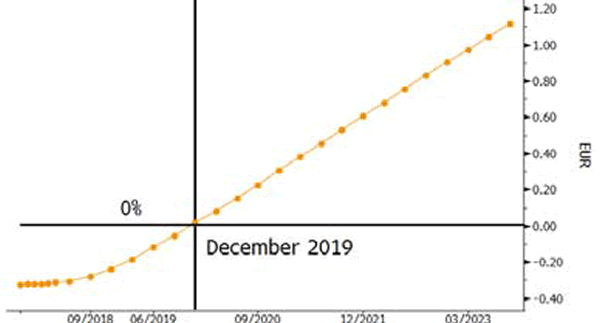
Euribor 3m forward curve only turns positive in 2020, implying very dovish market expectations about ECB policy rates
If the ECB stance is still very dovish, the hawks on the governing council will take some comfort from a significant cut in the monthly purchases which implies that they can be completely ended in a next step and before the end of 2018. German ECB board member Lautenschlaeger for example said “I think it is time next year to gradually but completely roll back net purchases of bonds. For even if we allow our net purchases to come to an end, monetary policy will remain expansive”.
We think that markets are too complacent about the 9- month extension proposal, ignoring the risk of a somewhat less dovish compromise such as a shorter (additional) lifespan for APP. Even a 6-month extension would be a significant commitment from the ECB to keep policy extremely easy in a context of accelerating growth and a strengthening labour market. Extending APP by 9 months while holding on to the sequencing principle (first ending APP, next hiking rates) furthermore increases the risk of the ECB falling behind the curve.
Strong growth, but tame inflation
The mix of a strong EMU growth momentum and tame inflation readings both warrants and allows the ECB room for manoeuvre to implement a gradual and well signalled path for ending APP, rather than having to suddenly hit the brakes. EMU Q2 GDP growth remained above trend (0.6% Q/Q) while the EMU composite PMI has now recorded 55+ readings for nine months running. As a result, in September, the ECB revised up its GDP growth projection for this year from 1.9% to 2.2%, the strongest level since 2007. However, the central bank maintained its previous estimates of 1.8% in 2018 and 1.7% in 2019, implying the Euro area economy is on a glide path to slower but still strong growth in coming years.
There's less confidence on the inflation front. Headline CPI stabilized at 1.5% Y/Y in September, and although it has trended higher over the past year, core inflation remains lacklustre at 1.1% Y/Y. The appreciation of the single currency caused downward revisions of 0.1% in ECB September CPI forecasts for each of the next two years to leave inflation at 1.2% in 2018 and 1.5% in 2019. ECB Praet said recently that “deflationary risks have disappeared and some measures of underlying inflation have ticked up over recent months, but overall inflation developments, despite the solid growth, have remained subdued.” This, the ECB argues means that a very substantial degree of monetary accommodation is still needed.
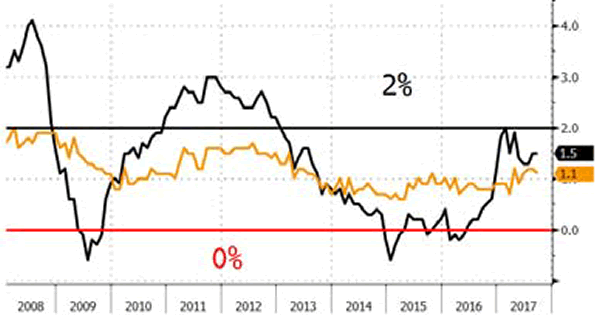
EMU headline (black) and core (orange) inflation: subdued core inflation main reason for ECB's easy monetary stance
Curve steepening, but what about EUR?
The market reaction to this week's ECB decisions will probably be determined by how they relate to the current consensus expectation of a 9-month extension to the APP at a reduced rate of €30 bn/month from January. Current expectations imply the front end of European yield curves should remain cemented near rock-bottom levels. The longer end of the yield curve could decline in a first reaction because of the additional easing, but we hold our upward bias medium-to-long term. As markets contemplate an important buyer gradually leaving the scene next year and turn their attention to the implications of a very positive growth trend for long-term rates, we believe current rate bullishness will fade. We therefore hold our European steepening bias for the coming months. A global rising yield environment is negative for peripheral bonds, but we expect this impact to remain modest at this stage. Instead, country specific developments may be the main driver of volatility in spreads.
A strongly dovish signal from the ECB (such as a 9 month extension to the APP) should cap the euro. The short term yield differential with US will continue to develop in favour of the greenback in coming months. Historically, there's a strong correlation between currency movements and this differential. From this point of view, the euro correction has some way to go, even if we must admit that the single currency shows strong resilience up until now. We expect that any correction in EUR/USD could extend towards the 1.13-1.15 area
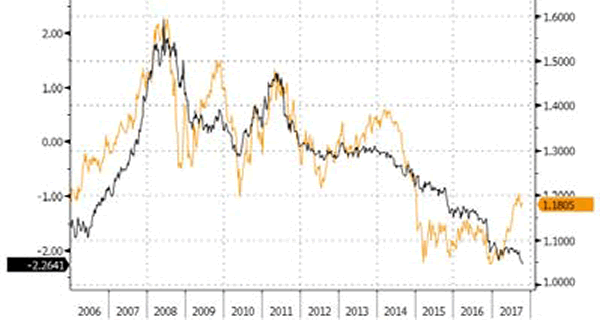
EU/US 2y spread differential (black, LHS) and EUR/USD (orange RHS): Spread will evolve further in favour of US
If the ECB surprises on the hawkish side of expectationssuch as announcing a shorter extension of APP, European yields and EUR/USD will surge higher in a first reaction. However, as long as the interest rate forward guidance remains unchanged, we don't think investors will be lured into strong early rate hike bets suggesting that any repositioning at the front end of the yield curve will remain limited after all. US/EU interest rate differentials will also in the scenario continue to play in favour of the dollar in the next couple of months.
USD/CHF Daily Outlook
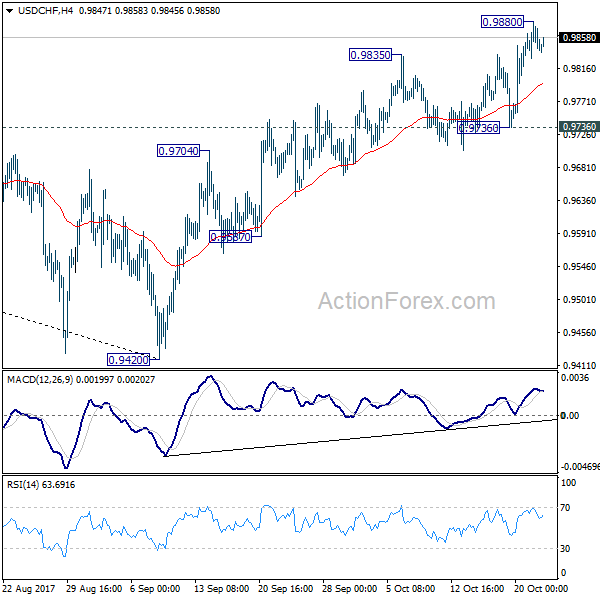
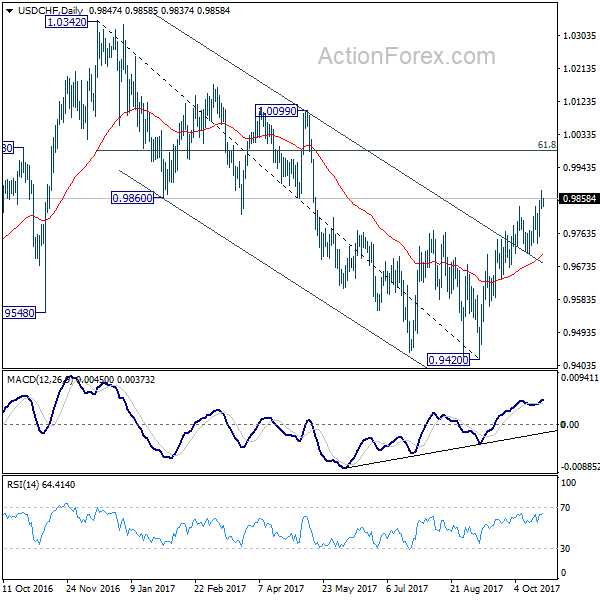
A temporary top is formed at 0.9880 in USD/CHF and intraday bias is turned neutral first. Near term outlook remains bullish as long as 0.9736 support holds. Medium term fall from 1.0342 should have completed at 0.9420 already. Above 0.9880 will target 61.8% retracement of 1.0342 to 0.9420 at 0.9990. Sustained break there will pave the way to retest 1.0342 high. However, break of 0.9736 support will mixed up the near term outlook and turn bias back to the downside for 0.9587 support instead.
Daily Pivots: (S1) 0.9826; (P) 0.9854; (R1) 0.9876; More....
A temporary top is formed at 0.9880 in USD/CHF and intraday bias is turned neutral first. Near term outlook remains bullish as long as 0.9736 support holds. Medium term fall from 1.0342 should have completed at 0.9420 already. Above 0.9880 will target 61.8% retracement of 1.0342 to 0.9420 at 0.9990. Sustained break there will pave the way to retest 1.0342 high. However, break of 0.9736 support will mixed up the near term outlook and turn bias back to the downside for 0.9587 support instead.
In the bigger picture, current development suggests that USD/CHF has defended 0.9443 (2016 low) key support level again. Rise from 0.9420 could develop into a medium term move and target a test on 1.0342 high. This represents the upper end of a long term range that started back in 2015. On the downside, break of 0.9587 support is now needed to indicate completion of the rise from 0.9420. Otherwise, further rally will remain in favor in medium term.
USD/JPY Daily Outlook
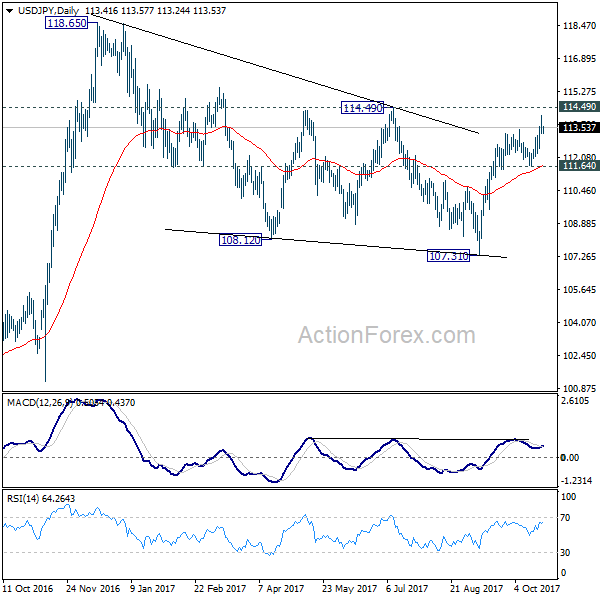
Daily Pivots: (S1) 113.08; (P) 113.59; (R1) 113.93; More...
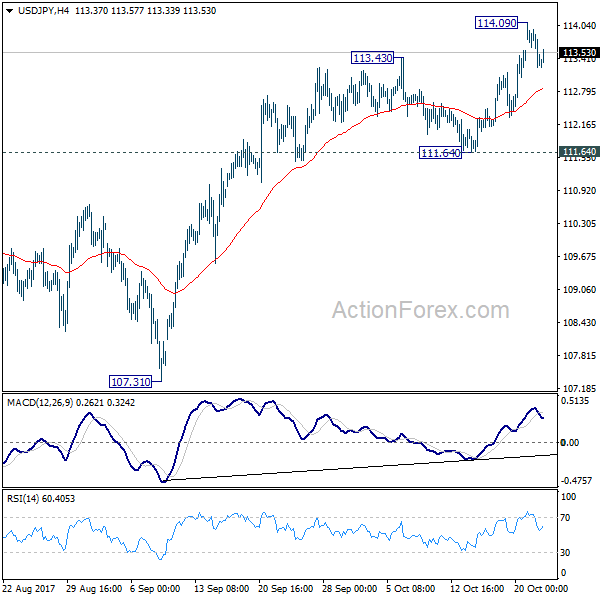
A temporary top is in place at 114.09 and intraday bias is turned neutral first. In any case, outlook will remain mildly bullish as long as 111.64 support holds. Above 114.09 will target 114.49 resistance next. Decisive break there will confirm that correction pattern from 118.65 has completed at 107.31 already. And USD/JPY should then target a test on 118.65.
In the bigger picture, medium term rise from 98.97 (2016 low) is not completed yet. It should resume after corrective fall from 118.65 completed. Break of 114.49 resistance will likely resume the rise to 61.8% projection of 98.97 to 118.65 from 107.31 at 119.47 first. Firm break there will pave the way to 100% projection at 126.99. This will be the key level to decide whether long term up trend is resuming.
Market Update – Asian Session: ECB Ready To Outline Future Of APP
Asia Summary
Following the negative leads out of the US, Asian equity markets opened mostly lower. The Nikkei 225 opened down by 0.1%, amid weakness in shares of Fast Retailing.
However, the index has since pared losses as it attempts to gain for the 16th straight session. Japanese ‘mega-banks’ have added on to their post-elections gains. Strength has also been seen among steel makers and trading companies. Japanese electronic parts makers are trading mostly higher, after it was reported that Q2 orders for the sector may have risen by 17%.
In the tech sector, Rakuten has declined by over 2% following a cautious broker note. South Korean chipmaker Hynix has declined by over 2%, after gaining over 4% in the prior session.
Banks in South Korea have rebounded on today’s session, following the weakness seen yesterday and rise in government bond yields. Korea’s 3-year bond yield has risen over 3bps on the session.
Energy companies in Australia are generally trading lower following yesterday’s decline in oil prices. Shares of Santos have declined by over 0.5%. Japara Healthcare has gained over 7% in Sydney, after Moelis Australia disclosed an ~10% stake.
The Hang Seng opened the session lower, as furniture products firm Man Wah Holdings has lost over 15%, after cutting its forecast, primarily due to the appreciation of the Chinese yuan. The index has since pared losses. The Property and Construction sub-index has risen by over 0.5% on the session.
In currencies, the Kiwi has moved between gains and losses, as the new Labour/NZ First coalition government outlined some of its priorities, which include a higher minimum wage, review of the RBNZ’s mandate and a ban on the purchase of existing homes by foreigners.
Looking, ahead the Aussie has traded slightly higher ahead of tomorrow’s release of Q3 CPI data. Japanese companies expected to report earnings today include Canon and Nidec. Out of China, companies including CNOOC, China CITIC Bank and China Shipbuilding Group may report earnings.
US companies expected to report today include 3M, AT&T, Biogen, Caterpillar, Chipotle, Corning, GM, Lockheed Martin and McDonald’s. Following Monday’s US equity close, Whirlpool declined by over 6%, after reporting weaker than expected quarterly results and reducing its FY outlook.
Key economic data
(JP) JAPAN OCT FLASH PMI MANUFACTURING: 52.5 V 52.9 FINAL
Speakers and Press
Japan
(JP) Japan Econ Min Motegi: To host next round of TPP talks Oct 30-Nov 1st
(JP) Japan Fin Min Aso: Markets support Govt's economic policies; Election results saw stocks go up
(JP) Japan Electronic Parts Makers Q2 Orders +17% y/y to ¥1.57T (quarterly record)- Japanese Press
Korea
(KR) South Korea, US and Japan start joint missile warning exercise
China/Hong Kong
(CN) Singapore SGX official: Seeing less China intervention in yuan market since 2016
(CN) China President Xi ideology to enter the constitution as "Xi Jiping Thought" and elevate him to the same level as Mao and Deng Xiaoping – press
(CN) China President Xi now included in draft version of amended China Communist Party constitution; Adds Xi Jing Ping thought into charter - Chinese press
(CN) The gap between China aggregate financing and M2 money supply rise will narrow - Chinese press
(HK) Hong Kong Monetary Authority (HKMA) said the discount between HKD Hibor and USD Libor is not of concern
Australia/New Zealand
(NZ) New Zealand Labour Leader Ardern signs coalition agreement with NZ First: You will see significant increase in minimum wage
Asian Equity Indices/Futures (00:00ET)
Nikkei +0.04%, Hang Seng +0.03%; Shanghai Composite +0.08%; ASX200 -0.0%, Kospi +0.2%
Equity Futures: S&P500 +0.1%; Nasdaq100 +0.1%, Dax +0.1%; FTSE100 +0.1%
FX ranges/Commodities/Fixed Income (00:00ET)
EUR 1.1770-1.1747; JPY 113.49-113.25; AUD 0.7825-0.7807;NZD 0.7004-0.6935
Dec Gold +0.2% at $1,283/oz; Dec Crude Oil +0.2% at $51.98/brl; Dec Copper +1.3% at $3.22/lb
USD/CNY *(CN) PBOC SETS YUAN REFERENCE RATE AT 6.6268 V 6.6205 PRIOR
(CN) PBoC OMO: Injects CNY250B in 7 and 14-day reverse repos v CNY200B injected prior; injects net CNY140B v CNY140B prior (6th consecutive injections, longest since July)
(TH) Thailand Central bank sells combined THB60B in 3-month and 6-month bonds
Equities notable movers
Australia/New Zealand
ESV.AU Completes ~£15.8M institutional component of entitlement offering; +21%
MML.AU Reports Q1 gold production 24.9K oz v 23.8K q/q at avg head grade of 6.59 g/t; ASIC $973/oz v $1,180 q/q; +15.6%
KGN.AU CEO Ruslan Kogan sells 3M shares at A$4.25/shr; -13%
China/Hong Kong
606.HK Announces intent to sell COFCO Biofuel and COFCO Biochemical for HK$8.58B; declares special dividend; +8.5%
1999.HK Issues profit warning; sees H1 -10% profit y/y – filing; -16.5%
Korea
005930.KR Said to consider plan to spend KRW20T on dividends and buybacks in 2017 - South Korean Press
Japan
2432.JP Strength attributed to Nintendo's announcement on Animal Crossing; +7%
6502.JP CEO: Considering measures if chip unit sale is not completed by the end of March; -0.6%