Sample Category Title
Technical Outlook: Kiwi Dollar Falls Sharply On Political Uncertainty
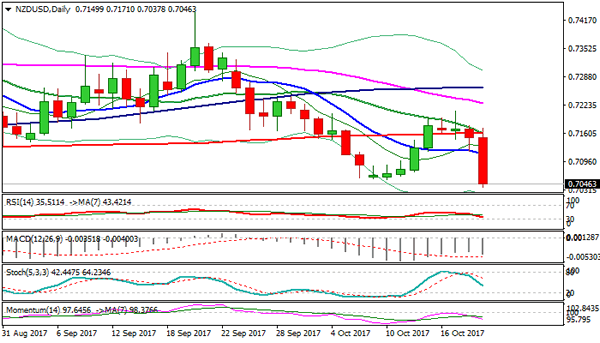
The Kiwi dollar fell sharply on Thursday in reaction on political uncertainty after New Zealand First Party joined a coalition with Labor and Greens to form government.
Traders reacted on such decision with strong selling of New Zealand dollar, which fell over 1.5% against the greenback in late Asian trading.
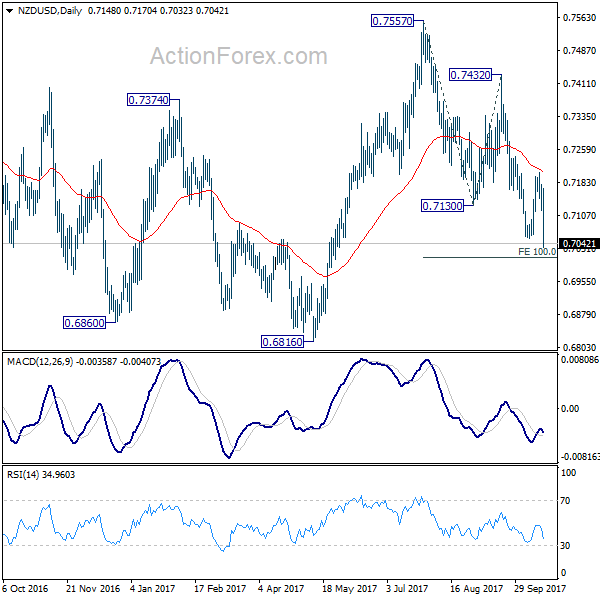
Fresh bearish acceleration broke below previous low of 10 Oct at 0.7055 and left lower top at 0.7146 (17 Oct high), signaling continuation of broader downtrend from 2017 high at 0.7558 (posted on 27 July).
Bears returned below cracked Fibo support at 0.7100 and pressuring psychological support at 0.7000.
Close below 0.7100 (Fibo 61.8% of 0.6817/0.7558, May/July rally) is needed to generate strong bearish signal, with sustained break below 0.7000 handle to open way towards key med-term support at 0.6817 (2017 low, posted on 11 May).
Daily indicators are in full bearish setup (20/200 SMA Death-Cross is forming) and supportive for further weakness.
Broken 10SMA (0.7114) is expected to cap upticks and keep fresh bears intact.
Res: 0.7055, 0.7073, 0.7114, 0.7160
Sup: 0.7037, 0.7000, 0.6950, 0.6910
Technical Outlook: GBPUSD – Recovery Attempts Stalled Ahead Of UK Retail Sales
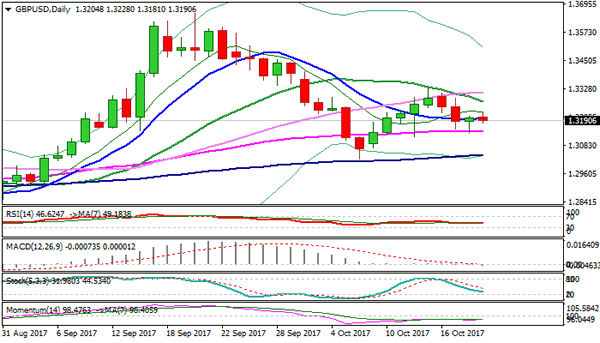
Cable fell back below 1.3200 after recovery attempts from Wednesday's downside rejection at 1.3140 (55SMA) stalled at 1.3228 on Thursday.
Fresh weakness diminishes hopes of stronger recovery after Wednesday's action was shaped in Hammer.
Mixed techs on daily chart show no clear near-term direction, with rising downside risk on recovery stall under top of hourly cloud (1.3232). Thick hourly cloud (spanned between 1.3203/32) so far limited recovery attempts, with sustained break above cloud needed to generate bullish signal.
UK Retail Sales data are in focus today, with forecast for September at -0.1% m/m vs 1.0% in Aug and 2.4% y/y vs 2.8% in Aug, seen as negative signal for Sterling if release comes at/below forecasts.
Bearish scenario could trigger acceleration through 55SMA pivot at 1.3140, towards 1.3100 and possible extension lower on stronger bearish acceleration.
Conversely, upbeat Retail Sales numbers in September would inflate pound and expose barriers at 1.3274 (falling 20SMA) and 1.3313 (30SMA).
Res: 1.3232, 1.3264, 1.3286, 1.3313
Sup: 1.3181, 1.3154, 1.3140, 1.3100
Technical Outlook: EURUSD – Politics Would Be Likely Main Driver For The Euro Today
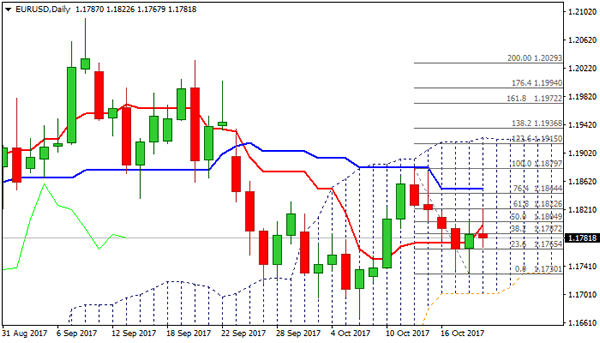
The Euro holds positive near-term tone and extended recovery on Thursday after repeated strong downside rejections at 1.1730 and subsequent bounce added to the upside potential. Recovery extension stalled in early European trading at pivotal 1.1822 barrier (Fibo 61.8% of 1.1879/1.1730 downleg/4-hr cloud top) with rising concerns over Catalonia weighing on single currency. Increased downside risk could be expected on sustained break below 4-hrr cloud base (1.1774) which would attract key n/t support at 1.1730 for retest. Bullish scenario requires sustained break above 1.1822 to signal further recovery and expose barriers at 1.1851 (daily Kijun-sen) and 1.1879 (12 Oct high). With no releases from the EU today, technicals and situation in Catalonia are expected to be Euro's main drivers today.
Res: 1.1800, 1.1822, 1.1851, 1.1879
Sup: 1.1774, 1.1730, 1.1702, 1.1669
USDJPY Neutral Both In The Short- And Medium-Term
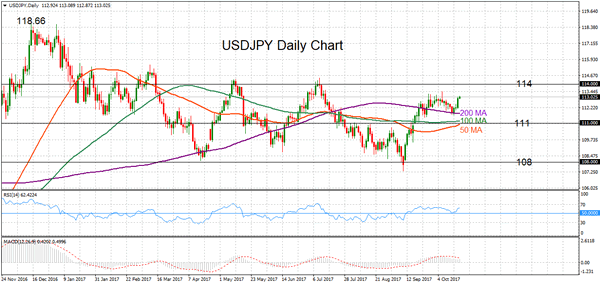
USDJPY is neutral both in the short- and medium-term. A broad range of (roughly) 108 and 114 has been formed since March and this is highlighted by a lack of direction in the major moving averages (50,100 and 200-day). Price action in the near-term since September 20 shows a consolidation range between 111.46 and 113.43.
USDJPY is currently trading in the upper end of the broader range. Short-term downward pressure has weakened and there is a positive undertone in the market as indicated by the RSI and MACD (both in bullish territory).
Support is being provided by the 200-day MA, currently at 111.75. Dropping below this would target the mid-point of the medium-term range at the key 111 level. Further weakness would push prices towards the lower end of the range at 108. Based on price action during the past six months, this area has been rejected, thus making it a strong support level. A drop below it would change the broader trend to bearish from neutral.
USDJPY has been firm in the past couple of sessions with risk clearly tilted to the upside. Breaking out of the 114 level and top of the range area would give scope to target the 118.66 peak from December 2016. Such a move would change the broader trend to bullish.
Despite the current positive tone in USDJPY, the short- and medium-term trend remains neutral
NZDUSD Sees Increased Downside Pressure
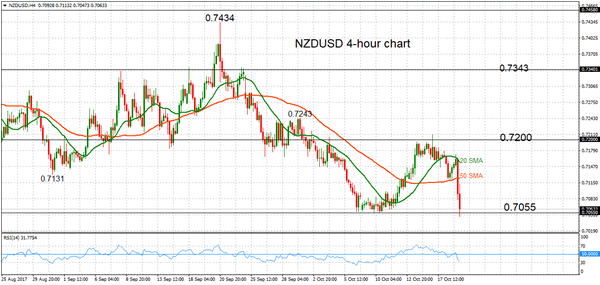
NZDUSD has shifted its near-term bias to bearish after dropping sharply to break key support at 0.7055. The odds are high for a move towards the next major low in the 0.6800 area.
On the 4-hour chart, RSI has fallen into bearish territory below 50, indicating momentum is tilted to the downside. Price action is currently below the 20 and 50-period moving averages, which also highlights increased downside pressure in the market.
The market has been in a downtrend since falling from the July peak of 0.7557. NZDUSD needs to rise back above key resistance at 0.7200. From here, the focus would shift back to the upside to target the next resistance level at 0.7343 and ahead of the 0.7434 high.
NZDUSD is at risk of putting in another lower top at 0.7210 if price action continues to fall below 0.7055.
Kiwi Sinks As Peters Supports Labour Party, Aussie Slips As China’s Growth Softens
A day after China's twice-in-a-decade Communist Party Congress commenced, statistics out of China showed that the economy continued to grow above the government's annual target, giving more confidence on President XiJinping's leadership. However, the expansion was slightly softer relative to the previous quarter, with the Australian dollar falling slightly in the wake of the data. In New Zealand, the Labour Party looks set to govern the country pushed the kiwi to a near five-month low.
According to the National Bureau of Statistics of China, the second-largest economy grew in line with expectations by 6.8% y/y in the third quarter, at a slightly slower pace than in the previous quarter as the government put extra efforts to cool the property market and limit debt-related risks. However, markets remained positive on the country's economic outlook with PBOC Governor Zhou Xiaochuan saying that GDP growth could reach 7.0% in the second semester of 2017.
Other data showed that Chinese industrial production climbed by 0.6 percentage points to 6.6% y/y in September, surpassing the forecast of 6.2%, whereas investments on equipment fell short of expectations, decreasing by 0.3 percentage points to 7.5% y/y, and missing projections of a rise by 7.7%.
The Chinese yuan retreated against the dollar, with dollar/yuan rising to a ten-day high of 6.6417 before it fell back to 6.6234.
In Europe, the focus is on Catalonia, with markets eagerly anticipating whether the Catalan leader, Charles Puigdemont, would step back from his symbolic independence declaration – Madrid set him a deadline for today at 0800GMT. The Spanish Prime Minister, Mariano Rajoy, warned Puigdemont on Wednesday to “act sensibly” in order to avoid the implementation of the direct rule which would give the right to the Spanish government to suspend the region's autonomy.
The euro, though, continued its uptrend during the Asian session, approaching a one-week high of $1.1821 after Reuters polls indicated that the ECB will announce on October 26 its decision to start trimming its asset-buying program in January. Recall that the plan was for the monthly purchases to drop from the current 60 billion euros to 40 billion. However, there is still doubt whether the plan would extend for six or nine months.
The pound was mainly flat around $1.3195 ahead of retail sales figures during the European session. The UK Prime Minister is also expected to attend the EU summit in Brussels later today (which concludes on Friday), where European leaders will discuss the progress in Brexit negotiations.
The dollar index was ranging around 93.32 after posting moderate gains earlier on the back of higher Treasury yields.
Dollar/yen was moving sideways at 112.95.
In New Zealand the leader of the kingmaker First Party, Winston Peters, announced his decision to support the opposition Labour Party to form a government, declaring Jacinda Ardem the next Prime Minister – she will hold the role for the next three years. The kiwi tumbled, reaching a near five-month low of $0.7037, losing 1.41% on the day.
On the other hand, the aussie recorded gains during the session in the wake of better-than-expected employment data that were partially lost after China's GDP growth appeared softer. Note that China is the largest export partner of Australia. Employment in Australia increased by 19,800 people, exceeding the forecast of 15,000 but remaining below the previous mark of 53,000 (downwardly revised from 54,200). The unemployment rate declined to 5.5%, a level seen before in March 2013, while analysts expected the figure to remain at August's rate of 5.6%.
Turning to commodities, oil prices moved lower on Thursday, while gold stood taller. WTI crude was down by 0.35% at $51.86 per barrel and Brent fell by 0.33% to $57.97. Gold was up by 0.13% at $1,2820 per ounce.
XAUUSD Analysis: Tries To Cross 61.8% Fibo
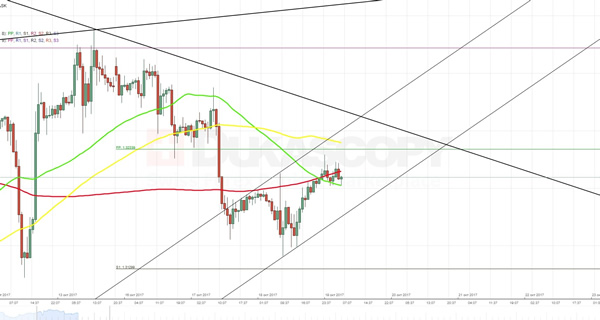
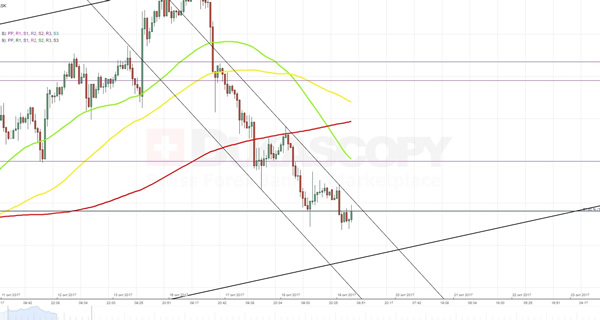
Despite release of negative data about the American housing market growth, the exchange rate continued to move to the bottom, in the process crossing a combination of the weekly S1 and the lower support line of senior ascending channel. At the moment, the pair is testing the 61.8% Fibonacci retracement level at 1,278.98. It seems that pressure from the slipping 55-, 100- and 200-hour SMAs should eventually push the pair through that barrier. Afterwards, the pair would face no obstacles on its way up until the weekly S2 at 1,265.92. On the other hand, daily chart clearly indicates that an area near 1,276.34 represents location of the 100-day SMA. From this perspective, it seems that the pair is going to make a temporary rebound.
Euro Tumbles as Spain Going to Suspend Catalonia Autonomy, Kiwi Dives as Labour Forms Coalition
This is a quick update.
Euro tumbles sharply while Yen jumps on as political risks come back to markets. Passing the deadline imposed to Catalan leader Carles Puigdemont, Spanish government said they will "continue with the procedures set out in Article 155 of the Constitution to restore the legality of self-rule in Catalonia." That is, the Spanish Government is going to suspend autonomy of Catalonia.
On the other hand, Puigdemont refused to withdraw the declaration of independence. And Puigdemont said that he will still go on with the declaration unless Madrid agrees to talk. Puigdemont said that "if the central government persists in blocking dialogue and continues its repression, the Catalan Parliament may proceed, if it considers it appropriate, to approve a formal declaration of independence."
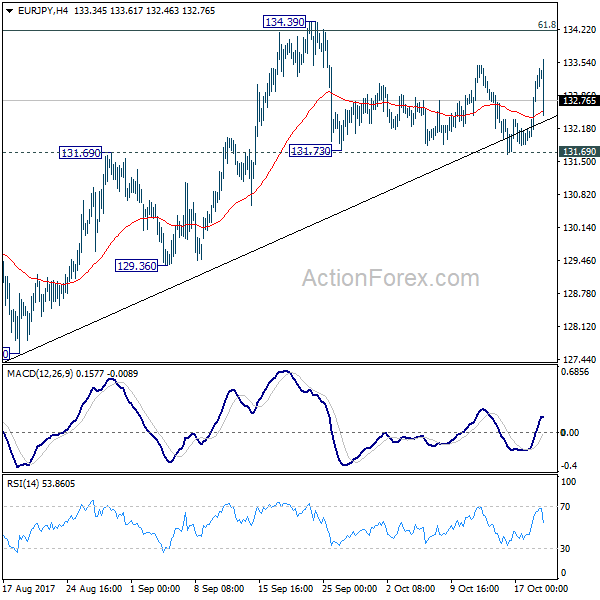
Euro reverses much gains against Yen and Dollar. But still, EUR/JPY is staying in range and keeping intraday bias neutral.
New Zealand Dollar plunges today on news that New Zealand First would be forming a coalition with the Labour Party. And Jacinda Ardern will become the next Prime Minister. An important to note is that both Labour and NZ First propose reduction in net immigrations and reform on the RBNZ. Cutting immigration is seen as a factor that will drag on economic growth. Also, Labour-led government would likely boost social spending and push to add full employment to RBNZ's mandate. And the overall effect is prolonging RBNZ's accommodative policy.
NZD/USD dives to as low as 0.7032 so far today. The break of 0.7055 support confirms resumption of whole decline from 0.7557. NZD/USD should now target 100% projection of 0.7557 to 0.7130 from 0.7432 at 0.7005 first. And, sustained break there will pave the way to retest 2017 low at 0.6816.
USDJPY Analysis: Rushes To The Top
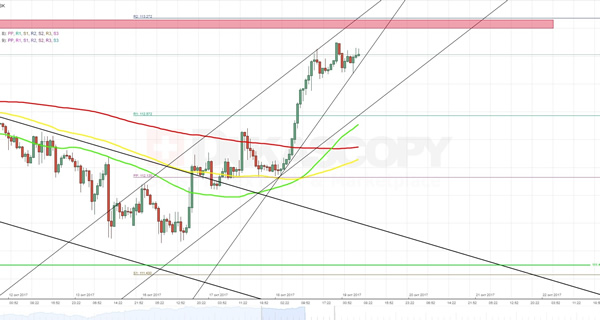
In result of the previous trading session, the Dollar appreciated against the Yen by 0.82%. In result of such advance the pair has practically returned to the 113.20 level, which represented significant resistance barrier three weeks ago. As now this area is additionally protected by the weekly R2, it seems that the currency rate is going to make a rebound. This assumption is also supported by the fact that in result of the sharp surge the pair formed a short-term rising wedge. Accordingly, it is expected to make a breakout in the southern direction. Finally, there is a need to take into account that on daily chart the pair is about to reach the upper trend-line of a long-term, dominant pattern, which additionally points out on an upcoming rebound.
GBPUSD Analysis: Prepares For Another Data Release
Due to release of mixed British employment data, the pair did not get a impulse to make significant moves yesterday. In particular, this relates to three unsuccessful attempts made by bears to push the rate through the 38.2% Fibonacci retracement level at 1.3145. As a result, the new trading session cable started at the intersection of the 55- and 200-hour SMAs. At the moment, the further recovery of the Pound against the Dollar seems complicated, as northern direction is blocked not only by a combination of the weekly PP and the 100-hour SMA but also by the upper trend-line of a senior descending channel. However, a release of better than expected information about the retail sales might create a momentum that would help traders to push the pair either through these barriers or in the opposite direction.