Sample Category Title
Trade Idea : USD/CHF – Target met and buy at 0.9480
USD/CHF - 0.9548
Most recent candlesticks pattern : N/A
Trend : Down
Tenkan-Sen level : 0.9561
Kijun-Sen level : 0.9530
Ichimoku cloud top : 0.9496
Ichimoku cloud bottom : 0.9473
Original strategy :
Bought at 0.9450, met target at 0.9550
Position : - Long at 0.9450
Target : - 0.9550
Stop : -
New strategy :
Buy at 0.9480, Target: 0.9580, Stop: 0.9445
Position : -
Target : -
Stop : -
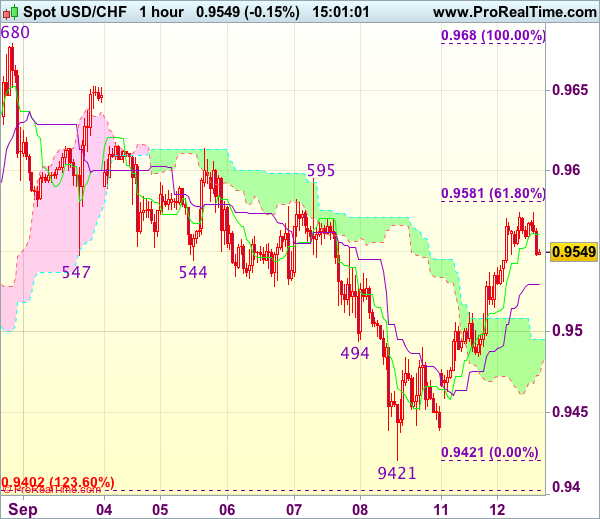
The greenback extended the rebound from 0.9421 (last week’s low) in line with our bullish expectations, our long position entered at 0.9450 met target at 0.9550 with 100 points profit, this anticipated rise adds credence to our view that low has been formed at 0.9421 and consolidation with upside bias remains for another rebound to 0.9580-81 (61.8% Fibonacci retracement of 0.9680-0.9421), then test of resistance at 0.9595, however, near term overbought condition should limit upside to 0.9640-45.
In view of this, we are looking to reinstate long on dips as the lower Kumo (now at 0.9473) should limit downside and bring another rebound. Below 0.9450 would abort and suggest the rebound from 0.9421 has ended, bring retest of this level later.
Softened Sanctions On North Korea & Fading Irma Concerns Sends S&P 500 To Record High
Investors returned from the weekend with a high appetite for risk assets, sending the S&P 500 to a new record high on Monday, with global equities edging higher across the board. Risk-on trading was driven by two factors; the absence of provocative actions from North Korea, and the fact that less damage was recorded by Hurricane Irma than previously estimated.
Although the United Nations Security Council stepped up sanctions against North Korea over its missile and nuclear programs, the UN's actions do not seem to be leading to war. The less severe measures and comments from U.S. Ambassador Nikki Haley that Pyongyang had 'not yet passed the point of no return', are pointing towards negotiations, rather than military confrontation. Eliminating North Korea's risk factor will be a positive development for financial markets, but as we have yet to find out the response from Kim Jong-un's regime, we cannot assume negotiations are going to be successful.
The damage cost of Hurricane Irma has been dialed down significantly, as it was downgraded to a tropical storm on Monday morning. Over the weekend, total damage cost estimates had exceeded 200 billion dollars, or approximately 1% of U.S. GDP; current estimates have revised this figure down to $50 billion. Insurance stocks were the prime beneficiaries yesterday, with the sector rising 1.8%.
Another factor helping equity markets is the belief that the Fed will refrain from raising rates again this year, due to the loss in economic activity caused by hurricanes Harvey and Irma. Investors are likely to continue buying stocks with overstretched valuations, because when compared to treasuries, they still look much more attractive.
Safe haven assets were sold off heavily, with gold declining 2.3%, or $32, from Friday's peak. Although the appetite for equities may further affect gold prices, investors are likely to remain cautious and hedge against many unknowns. That's why we didn't see any significant outflows from gold-backed exchange traded funds. The yellow metal is still up 10% from June's low, and we expect the $1,300 will prove to be a strong support level.
Currency markets were steady early Tuesday, with the greenback holding on to most of yesterday's gains. However, U.K. data might lead to some big swings in Sterling if it diverges from expectations. The risk of the August CPI shooting higher and leading to a more hawkish tone from BoE on Thursday, is keeping GBPUSD well supported. With no other tier one economic data on the calendar, currencies are likely to remain range-bound for the rest of the day, unless we see significant moves in U.S. treasury yields
Technical Outlook: EURUSD – 10SMA So Far Contains Pullback But Deeper Correction Cannot Be Ruled Out
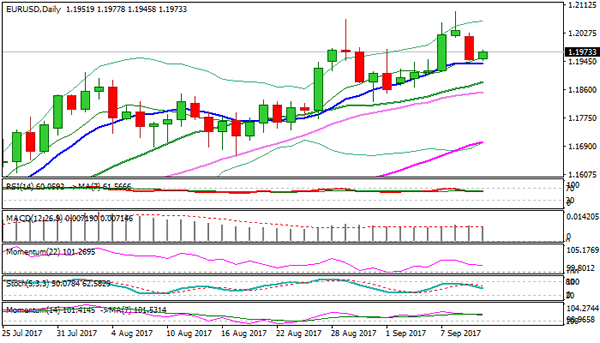
The Euro was higher in early Tuesday's trading after pullback from fresh multi-month high at 1.2092 was contained above initial support at 1.1935 (10SMA) that hardly impacted larger bullish picture. Fresh attempts above psychological 1.2000 barrier could be expected while 10SMA, with close above 1.2000 (also Fibo 38.2% of 1.2092/1.1945 pullback needed to signal higher low at 1.1945 and trigger further recovery. Daily studies in full bullish setup support the notion. Alternative scenario sees rising downside risk on break below 10SMA, which could extend pullback towards next strong support at 1.1883 (rising 20SMA).
Res: 1.2000, 1.2036, 1.2070, 1.2092
Sup: 1.1935, 1.1883, 1.1826, 1.1773
Trade Idea : GBP/USD – Buy at 1.3125
GBP/USD - 1.3200
Most recent candlesticks pattern : N/A
Trend : Near term up
Tenkan-Sen level : 1.3186
Kijun-Sen level : 1.3195
Ichimoku cloud top : 1.3178
Ichimoku cloud bottom : 1.3129
Original strategy :
Buy at 1.3125, Target: 1.3225, Stop: 1.3090
Position : -
Target : -
Stop : -
New strategy :
Buy at 1.3125, Target: 1.3225, Stop: 1.3090
Position : -
Target : -
Stop : -
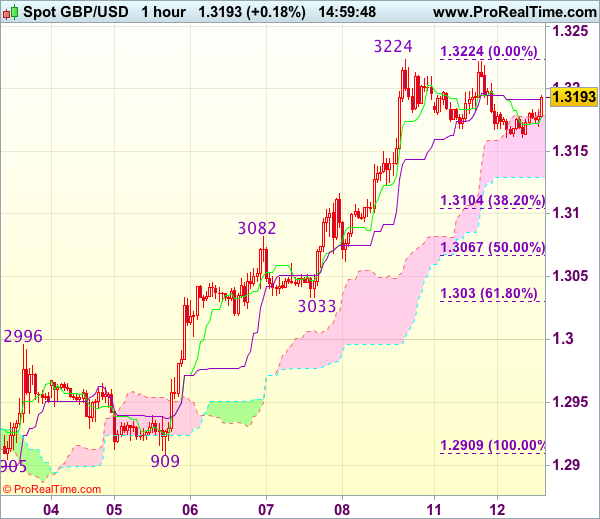
As cable has continued trading with a firm undertone, suggesting bullishness remains for recent upmove from 1.2774 to resume after consolidation, above last week’s high at 1.3224 would extend gain to 1.3250, however, loss of near term upward momentum should prevent sharp move beyond recent high at 1.3269, risk from there has increased for a retreat to take place later.
In view of this, would not chase this rise at current level and would be prudent to buy cable on subsequent pullback as 1.3120-25 should limit downside. Only below 1.3082 (previous resistance turned support) would abort ad suggest top is possibly formed, risk test of 1.3062 but reckon support at 1.3033 would hold.
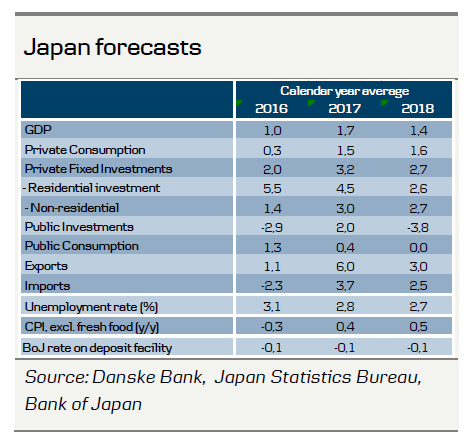
Japan: Running On All Engines
- Japan is showing itself to be in good shape as the economic upswing is the longeststanding since the crisis.
- We expect growth to continue through fiscal 2017, supported by a very strong labour market, the global economic recovery and extremely accommodative economic policies.
- As fiscal stimulus wanes next year, we are likely to see growth rates return to lower levels around potential.
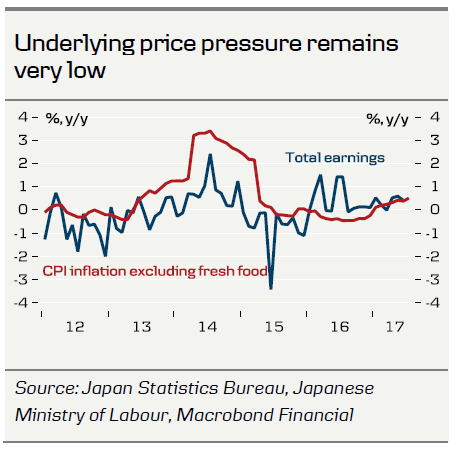
- Underlying price pressure remains very low. Higher inflation does not seem impending.
Strong momentum
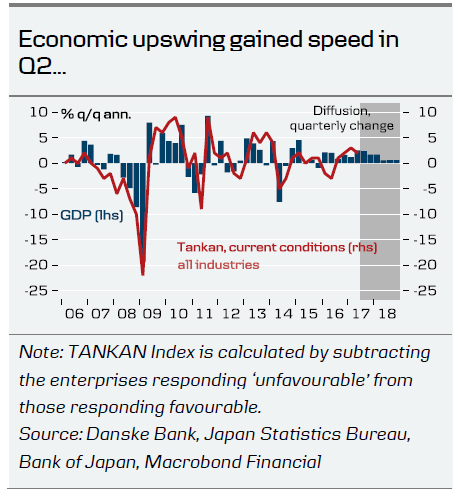
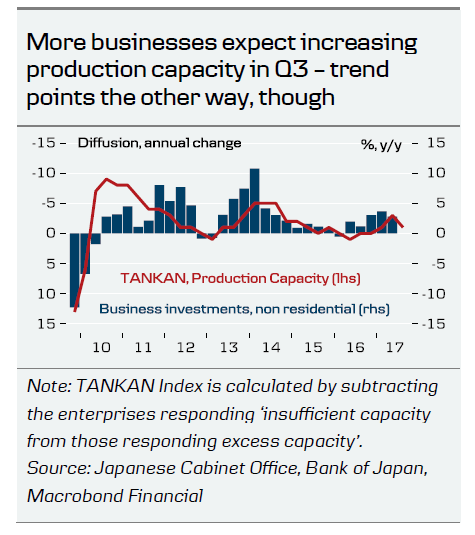
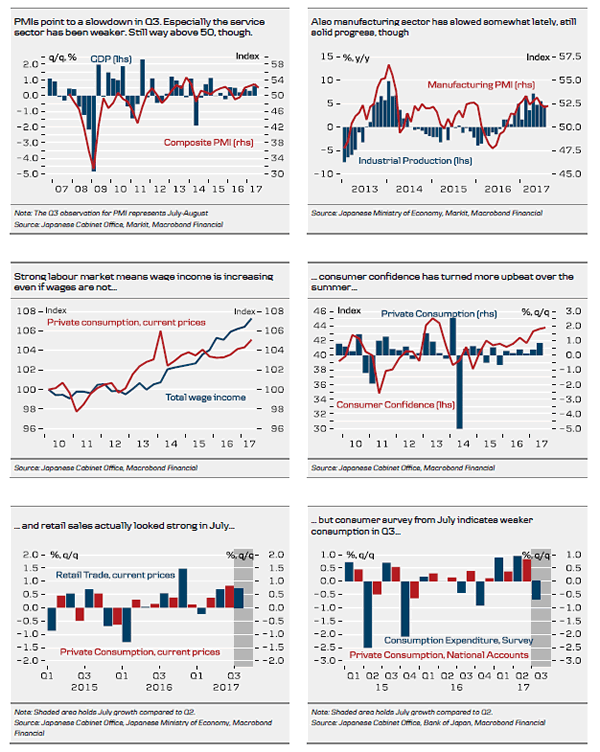
The Japanese economy picked up speed in Q2 and grew at an annualised growth of 2.5% q/q. Thus, the economic upswing continued and the last six quarters now constitute the longest period of positive growth in Japan since before the crisis. According to Bank of Japan's TANKAN survey, businesses are turning increasingly upbeat, more companies have reported favourable conditions since Q2 16 and more companies are looking for favourable conditions in Q3. On the other hand, PMIs have decreased in July and August, particularly driven by the service sector, which could signal some slowdown in domestic demand. Manufacturing PMIs have also shown some signs of slowdown, which is also what we see in industrial production over the summer. Composite PMI now stands about one index point lower than Q2, which indicates a decrease in Q3 for the first time in 2017. PMIs thus point to some slowdown in GDP growth.
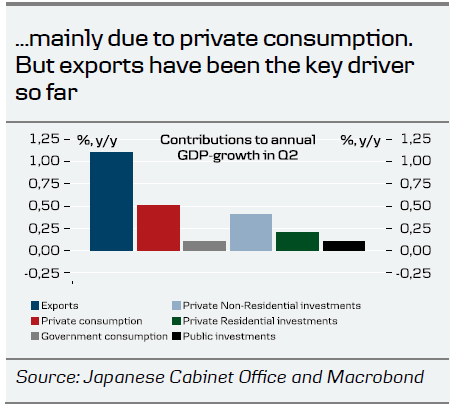
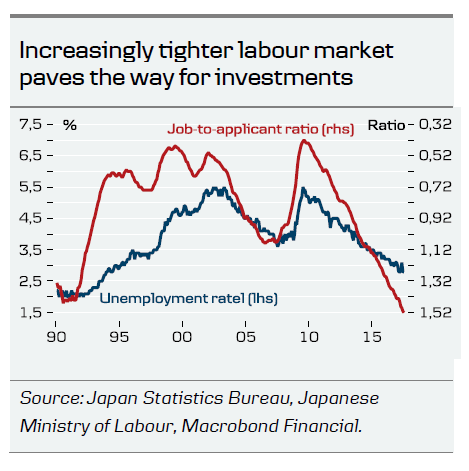
Growth was primarily driven by private consumption and investments in Q2. Looking back on the recent year, exports have been the key driver, though. We do expect more from private consumption going forward. Wage inflation remains stubbornly low but with a labour market that is turning increasingly hotter and unemployment that has fallen to even lower levels, total wage income is increasing, even if wages are not. We believe there is room for private consumption to continue contributing to growth. Consumer confidence has also remained upbeat over the summer, although it does look like some slowdown in private consumption in Q3. Both consumer surveys and auto sales have looked weak in August. Retail sales, on the other hand, was strong. We expect private consumption to stay on a positive trend but as long as wage increases remain depressed, it will probably be at a moderate pace.
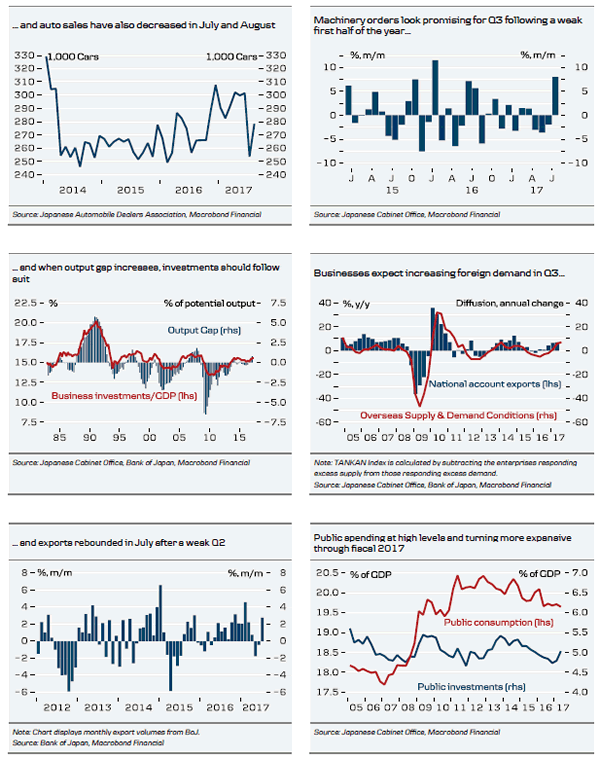
On the private demand side, we have also seen a decent pick-up in investments recently. Both business and residential investments have been increasing since the current economic upturn began in Q1 16. Indicators are mixed, as housing starts decreased in July and businesses signal a slight increase in production capacity in Q3. Machinery orders, on the other hand, rebounded in July after a weak first half of the year. Looking beyond Q3, we expect the positive trend in business investments to keep up, as the output gap increases and labour becomes an increasingly scarce resource. At the same time, the Tokyo Olympics 2020 remains supportive for investments. Bank of Japan (BoJ) has estimated that investments in infrastructure, hotels, commercial properties, etc., amount to 1.3% of annual GDP spread out over the years 2014-2021.
Overall, exports have still been the main driver of the upturn, especially over the past year. Japan is particularly dependent on the US and China, which account for close to 40% of total exports. Particularly exports to China have been key, standing at close to 20% y/y in nominal terms, but also US demand has been strong. Whereas private demand could be slowing somewhat in Q3, exports have been strong and rebounded in July. An increasing share of companies are reporting excess demand in Q2 and expectations of the same in Q3. Japanese exporters strongly benefit from the global economic upturn and the relatively weak yen.
Stimulus in place but inflation remains stubbornly low
We expect monetary policy to remain extremely accommodative throughout the forecast period, which will also be supportive for demand, both domestically and abroad. BoJ has pledged to hold measures in place until the 2% inflation target is reached. Inflation has been increasing through 2017, but mainly due to rising energy prices. Underlying price pressure in Japan remains very low and BoJ's inflation target is currently nowhere within reach. Almost three decades of very low inflation mean companies are reluctant to raise prices and try to cut back on services and streamline their operations instead of raising wages. Low worker mobility and a preference for job security over wage increases are big obstacles for wage inflation.
Public spending is also set to remain supportive for the economy through the fiscal year 2017, which runs from Q2 17-Q1 18. We expect to see GDP-growth around 2% q/q annualised through the rest of fiscal 2017 and a significant slowdown in fiscal 2018 when stimulus starts to wear off.
Trade Idea : EUR/USD – Stand aside
EUR/USD - 1.1977
Most recent candlesticks pattern : N/A
Trend : Up
Tenkan-Sen level : 1.1962
Kijun-Sen level : 1.1988
Ichimoku cloud top : 1.2031
Ichimoku cloud bottom : 1.2004
Original strategy :
Bought at 1.1985, stopped at 1.1950
Position : - Long at 1.1985
Target : -
Stop : - 1.1950
New strategy :
Stand aside
Position : -
Target : -
Stop : -
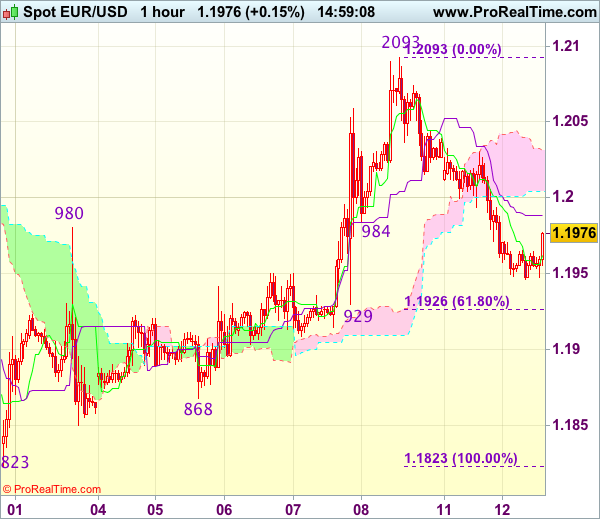
Although the single currency recovered after falling to 1.1947 and test of the Kijun-Sen (now at 1.1988) cannot be ruled out, reckon upside would be limited to the lower Kumo (now at 1.2004) and bring another decline later, below said support at 1.1947 would extend the fall from 1.2093 top to 1.1926-29 (61.8% Fibonacci retracement of 1.1823-1.2093 and previous support) but reckon 1.1900 would hold on first testing.
In view of this, would be prudent to stand aside for now. Above the lower Kumo (now at 1.2004) would bring test of the upper Kumo (now at 1.2031) but a sustained breach above there is needed to signal the fall from 1.2093 has ended and bring a stronger rebound to 1.2050-55 first.
Technical Outlook: GBPUSD – Strong Inflation Numbers Today Could Drive The Price Above 2017 High At 1.3268
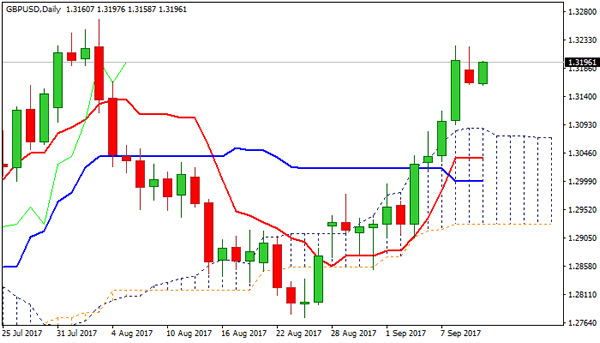
Cable regains traction and emerges above thick hourly cloud, in renewed attempt again at1.3200 barrier, following yesterday's repeated rejection at 1.3222 and daily close in red, the first after four consecutive strong bullish days.
Overall structure remains firmly bullish while the price holds above daily cloud top (1.3075) and sees scope for final push towards key barrier at 1.3268 (03 Aug peak).
UK CPI data are in focus today and may boost pound further if release comes at/above forecast at 2.8% for August (vs 2.6% in July).
Sustained break above 1.3268 (also 2017 high) would open way towards 1.3473 (weekly cloud top/50% retracement of larger 1.5016/1.1930 descend).
Conversely, weaker than expected inflation numbers could spark fresh weakness through 1.3159 (lows of today/Monday) and risk retest of daily cloud top.
Res: 1.3203, 1.3224, 1.3268, 1.3300
Sup: 1.3159, 1.3093, 1.3075, 1.3046
Trade Idea : USD/JPY – Hold short entered at 109.35
USD/JPY - 109.55
Most recent candlesticks pattern : N/A
Trend : Down
Tenkan-Sen level : 109.44
Kijun-Sen level : 108.96
Ichimoku cloud top : 108.22
Ichimoku cloud bottom : 108.15
Original strategy :
Sold at 109.35, Target: 108.35, Stop: 109.70
Position : - Short at 109.35
Target : - 108.35
Stop : - 109.70
New strategy :
Hold short entered at 109.35, Target: 108.35, Stop: 109.70
Position : - Short at 109.35
Target : - 108.35
Stop : - 109.70
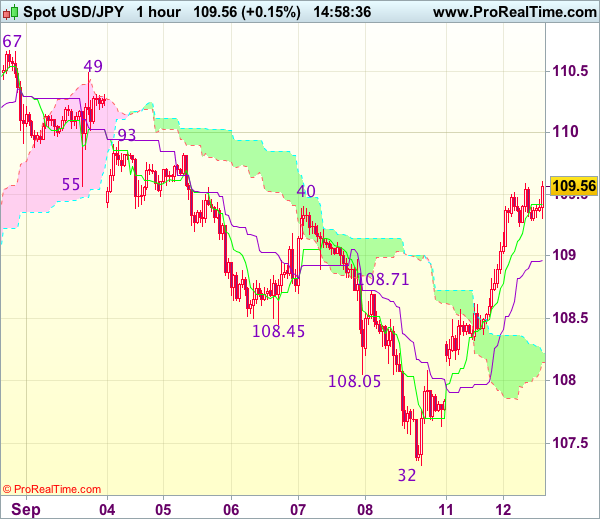
Although the greenback has continued edging higher today and marginal gain from here cannot be ruled out, loss of near term upward momentum should prevent sharp move beyond 109.70 and bring retreat later, below the Kijun-Sen (now at 108.96) would suggest an intra-day top is formed, bring weakness to 108.60-65, break there would add credence to this view, then test of the Ichimoku cloud (now at 108.15-22) would follow but downside should be limited to 107.85, bring rebound later.
In view of this, we are holding on to our short position entered at 109.55. Above 109.70 would defer and signal low has been formed, bring a stronger rebound towards resistance at 109.93 but reckon 110.20 would hold from here due to near term overbought condition.
USDJPY Intraday Analysis
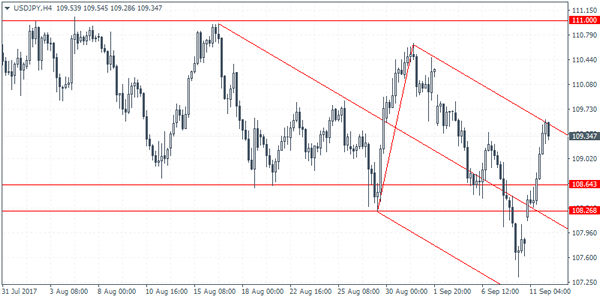
USDJPY (109.34): The USDJPY recovered sharply off the support level at 109.15 - 108.26, rising to post a 4-day high. In the near term, USDJPY could be seen falling back to retest the support level at 108.64 - 108.26. Establishing support here could shift the bias to the upside with price action likely to push towards 111.00. Alternately, to the downside in the event that the support fails, we could expect USDJPY falling back to the previous lows formed near 107.60.
GBPUSD Intraday Analysis
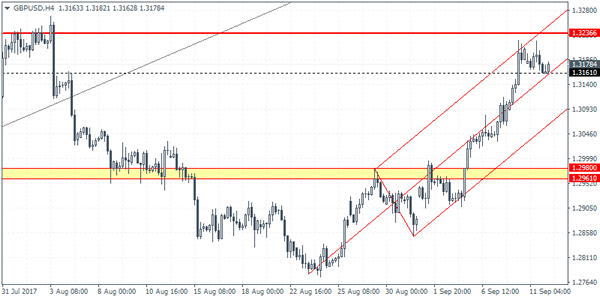
GBPUSD (1.3178): The British pound remains bullish as price action remains flat above 1.3150 level. The currency pair gave up some of the gains yesterday. The rally to 1.3200 marks a test of the trend line break out following establishing support at 1.2847. Further gains could be seen coming as GBPUSD could potentially be testing 1.3236 resistance level. To the downside, minor support has been formed at 1.3161. Therefore, a breakdown below this support level could signal near-term declines. The correction could potentially push the cable down to the pending support level at 1.2980.