

Sample Category Title
EUR/GBP Mid-Day Outlook
Daily Pivots: (S1) 0.9157; (P) 0.9167; (R1) 0.9180; More
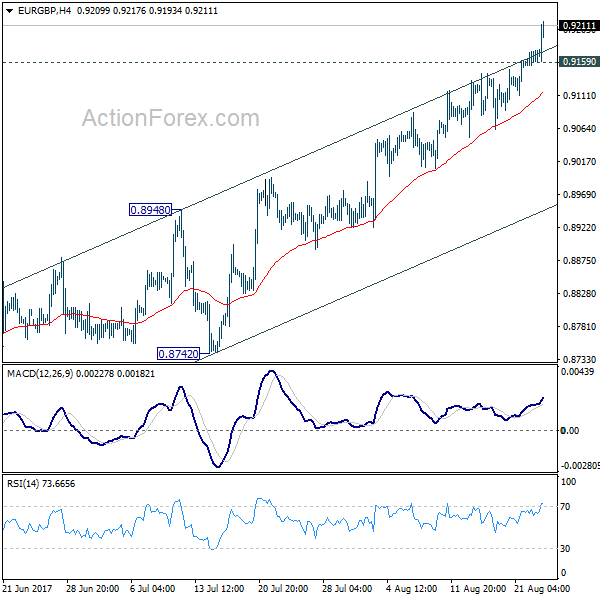
EUR/GBP's rally continues today and reaches as high as 0.9217 so far. Break of channel resistance suggests upside acceleration. Intraday bias remains on the upside for 0.9304 key resistance next. At this point, there is no clear sign of up trend resumption yet. Hence, we'll be cautious on strong resistance from 0.9304 to limit upside and bring another fall. But firm break of 0.9304 will confirm up trend resumption and pave the way to 0.9799. On the downside, below 0.9159 minor support will turn intraday bias neutral first.
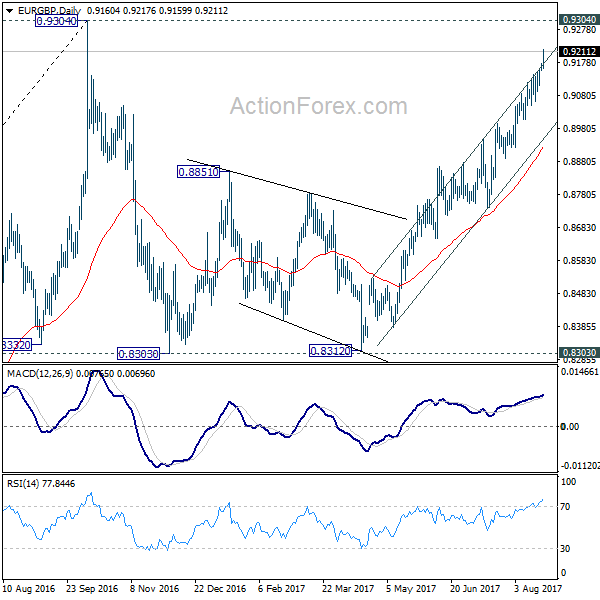
In the bigger picture, price actions from 0.9304 are viewed as a medium term corrective pattern. It's uncertain whether it is finished yet. But in case of another fall, we'd expect strong support from 0.8116 cluster support (50% retracement of 0.6935 to 0.9304 at 0.8120) to contain downside and bring rebound. Whole up trend from 0.6935 is expected to resume after consolidation from 0.9304 completes. In that case, 2008 high at 0.9799 will be the next target.
Euro Surges as PMIs Suggest Strong Growth Spell, Yen Jumps on Trump Comments
The Japanese stages a strong rally today, possibly in response to US President Donald Trump's comments about shutting the the government. Strength in Yen is particularly apparent against New Zealand as NZD/JPY dives through recent support at 79.07. USD/JPY is being rejected from 4 hour 55 EMA and is possibly now heading back to 108.59. But at same time, Euro also surges broadly after solid PMI data that suggests growth momentum to continue. EUR/GBP extends recent rally through 0.92 handle. EUR/USD is at this point, staying is recently established range but looks set to retest 1.1846 minor resistance again. It looks like the forex traders are getting a bit impatient waiting for Jackson Hole symposium.
Trump threatens government shutdown over US-Mexican wall
While there were revived hope of tax reform by US President Donald Trump's administration, Dollar seemed to have struggle to gain momentum due to Trump's comments. To be more particular, Trump said yesterday that "if we have to close down our government, we're building that wall." If the Congress does not reach a funding deal by September 30, the US government will shut down. At the same time, even if Republicans and Democrats could agree on a deal that exclude the US-Mexico border wall, Trump can, in theory, veto it. And the government will still shut down. Secondly, Trump said that he didn't think there would be a deal in the renegotiation of the North American Free Trade Agreement with Mexico and Canada. And Trump said that "we'll end up probably terminating NAFTA at some point:.
Eurozone PMI: Best growth spell for a number of years
Eurozone PMI manufacturing rose to 57.4 in August, up from 56.6 and above expectation of 56.3. Eurozone PMI services, however, dropped to 54.9, down from 55.4 and below expectation of 55.4. Germany PMI manufacturing rose to 59.4, up from 58.1, beat expectation of 57.7. Germany PMI services rose to 53.4, up from 53.1 and beat expectation of 53.3. France PMI manufacturing rose to 55.0, up from 54.9 and beat expectation of 54.5. France PMI services dropped to 55.5, down from 56.0, below expectation of 55.8.
Markit noted that "this is another positive set of numbers for the euro area, which continues to enjoy its best growth spell for a number of years." And strength in factory orders "bodes well for the labor market as firms will likely look to hire extra staff to deal with outstanding work."
ECB Draghi: QE supported the economy and inflation
Ahead of Jackson hole symposium in US, ECB President Mario Draghi delivered a speech in Lindau, Germany. Draghi defended quantitative easing program. He noted that "a large body of empirical research has substantiated the success of these policies in supporting the economy and inflation, both in the euro area and in the United States." And, "policy actions undertaken in the last 10 years in monetary policy and in regulation and supervision have made the world more resilient."
UK May softens stance on European Court of Justice
In UK, it's reported that Prime Minister Theresa May is softening her stance on EU Court in Brexit negotiation in hope of speeding up the process to trade agreements. May was clear with her stance that UK could "take back control of our laws and bring an end to the jurisdiction". But now, May said that UK will avoid European Court of Justice's "direct jurisdiction". That is seen as a compromise for ECJ to have some say in governing and any post Brexit dispute. And of course, there could still be some influence from ECJ on UK laws.
Japan economy supported by a mixed of strengthened demand
Japan PMI manufacturing rose to 52.8 in August, up from 52.1 and beat expectation of 52.3. That's also the highest level in six months. Markit noted that expansion in the Japanese economy "continues to be supported by a mix of strengthened demand from both domestic and external sources: public work projects and stronger sales to South East Asia were both reported by panellists as areas of growth in August."
NZD/JPY heading to 75.65
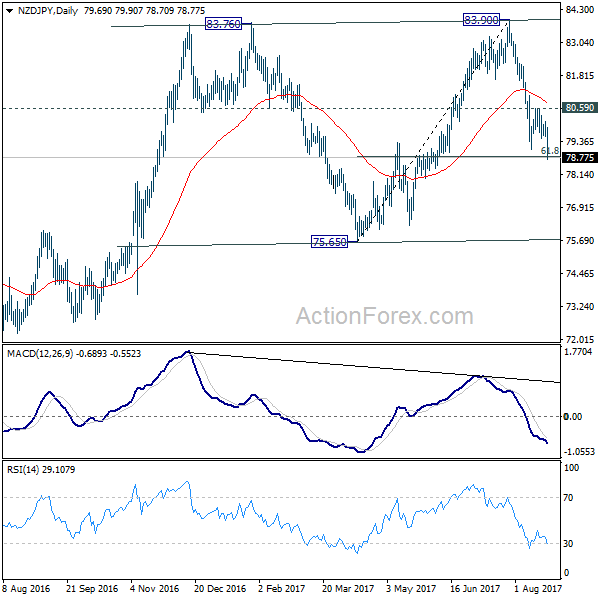
NZD/JPY's break of 79.07 support confirms resumption of decline from 83.90. 61.8% retracement of 75.65 to 83.90 is taken out already. Intraday bias is now on the downside for 75.65 key support level next. As this point, it's slightly more likely that price actions fro 83.767 are forming a sideway pattern. Hence, we'll start to look for bottoming signal above 75.65. But break of 80.59 resistance is needed to indicate short term reversal. Otherwise, near term outlook will stay mildly bearish in case of recovery.
EUR/GBP Mid-Day Outlook
Daily Pivots: (S1) 0.9157; (P) 0.9167; (R1) 0.9180; More
EUR/GBP's rally continues today and reaches as high as 0.9217 so far. Break of channel resistance suggests upside acceleration. Intraday bias remains on the upside for 0.9304 key resistance next. At this point, there is no clear sign of up trend resumption yet. Hence, we'll be cautious on strong resistance from 0.9304 to limit upside and bring another fall. But firm break of 0.9304 will confirm up trend resumption and pave the way to 0.9799. On the downside, below 0.9159 minor support will turn intraday bias neutral first.
In the bigger picture, price actions from 0.9304 are viewed as a medium term corrective pattern. It's uncertain whether it is finished yet. But in case of another fall, we'd expect strong support from 0.8116 cluster support (50% retracement of 0.6935 to 0.9304 at 0.8120) to contain downside and bring rebound. Whole up trend from 0.6935 is expected to resume after consolidation from 0.9304 completes. In that case, 2008 high at 0.9799 will be the next target.
Economic Indicators Update
| GMT | Ccy | Events | Actual | Forecast | Previous | Revised |
|---|---|---|---|---|---|---|
| 0:30 | JPY | PMI Manufacturing Aug P | 52.8 | 52.3 | 52.1 | |
| 7:00 | EUR | France Manufacturing PMI Aug P | 55 | 54.5 | 54.9 | |
| 7:00 | EUR | France Services PMI Aug P | 55.5 | 55.8 | 56 | |
| 7:30 | EUR | Germany Manufacturing PMI Aug P | 59.4 | 57.7 | 58.1 | |
| 7:30 | EUR | Germany Services PMI Aug P | 53.4 | 53.3 | 53.1 | |
| 8:00 | EUR | Eurozone Manufacturing PMI Aug P | 57.4 | 56.3 | 56.6 | |
| 8:00 | EUR | Eurozone Services PMI Aug P | 54.9 | 55.4 | 55.4 | |
| 13:45 | USD | US Manufacturing PMI Aug P | 53.4 | 53.3 | ||
| 13:45 | USD | US Services PMI Aug P | 54.9 | 54.7 | ||
| 14:00 | USD | New Home Sales Jul | 610K | 610K | ||
| 14:00 | EUR | Eurozone Consumer Confidence Aug A | -2 | -2 | ||
| 14:30 | USD | Crude Oil Inventories | -8.9M |
GBPUSD: Remains Vulnerable To The Downside
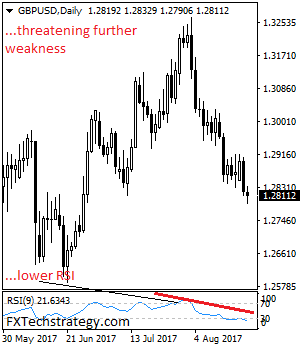
GBPUSD: The pair continues to retain its downside pressure as it reversed its Monday gains to close on Tuesday. Support lies at the 1.2800 level where a break will turn attention to the 1.2750 level. Further down, support lies at the 1.2700 level. Below here will set the stage for more weakness towards the 1.2650 level. Conversely, resistance stands at the 1.2900 levels with a turn above here allowing more strength to build up towards the 1.2950 level. Further out, resistance resides at the 1.3000 level followed by the 1.3050 level. On the whole, GBPUSD continues to face downside risk.
Euro Hits Higher as Eurozone PMI Readings Surprise to the Upside and Draghi Gives No Clues on Policy
During early European hours, the euro pared almost half of yesterday's losses against its US counterpart after preliminary Markit composite PMI readings out of the Eurozone indicated that business activity in the block continued strengthening in August, despite a pullback in the previous month. Before the data release, ECB president, Mario Draghi, did not comment on future monetary policy plans during his public appearance in Germany.
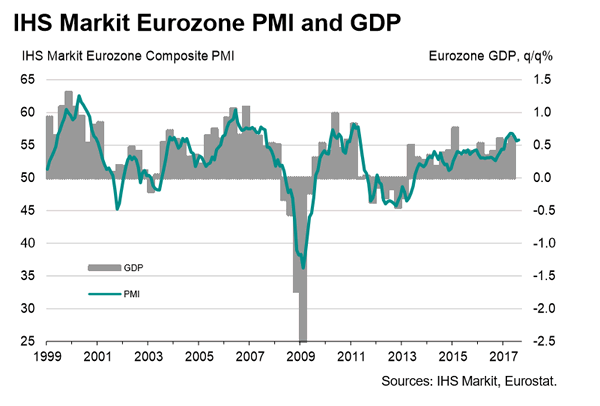
Following a disappointing performance in July, flash IHS Markit PMI figures out of Eurozone came in better than expected in August, after higher activity in the manufacturing sector offset weaker activity in the services industry. Manufacturing PMI rose unexpectedly by 0.8 points to 57.4 instead of declining by 0.3 points to 56.3 as analysts had projected. On the other hand, services PMI dropped to 54.9, while analysts expected the index to remain steady at July's mark of 55.4. Overall, the IHS Markit composite PMI which summarizes surveys given to over 300 private manufacturing companies and 300 services companies, ticked up by 0.1 points to 55.8, exceeding the forecast of 55.5 and remaining close a multi-year high level of 56.8 reached during April-May.
Positive German and French PMI readings were also published along with the Eurozone data. Regarding the manufacturing sector, the German PMI jumped surprisingly to 59.4, while expectations were for the index to retreat to 57.7. The French one also came in above expectations at 55.8. Concerning the services PMI, the German index improved to 53.4 while the French index declined to 55.5 with projections being at 53.3 and 55.8 respectively.
Meanwhile, in Germany, ECB President Mario Draghi, avoided commenting on whether the ECB will tighten its monetary policy amid strengthening economic conditions across the Eurozone. Instead, Draghi made reference on how lower interest rates accompanied by quantitative easing has helped the block to recover from the global financial and Eurozone debt crises.
However, investors will closely watch Draghi's comments at the Jackson Hole symposium on Friday in Wyoming for any clues on monetary policy tightening in the future, as it is widely expected that improving economic data in the Eurozone will prompt the ECB to withdraw stimulus soon. Note that, flash GDP growth in the area remained steady at a one-year high of 0.6% q/q in the second quarter of the year.
Looking at the reaction in the forex markets, the euro climbed immediately by 0.30% versus the greenback to $1.1791 before sliding to 1.1781. Euro/yen also increased by 0.30% to 129.02 and then eased back to 128.90, while euro/pound touched a 10 ½ -month high of 0.9213 (eight-year high, excluding pound's short-lived flash crash in October 2016), supported by heightened uncertainties around Brexit.
Technical Outlook: WTI Oil Trades In Near-Term Directionless Mode
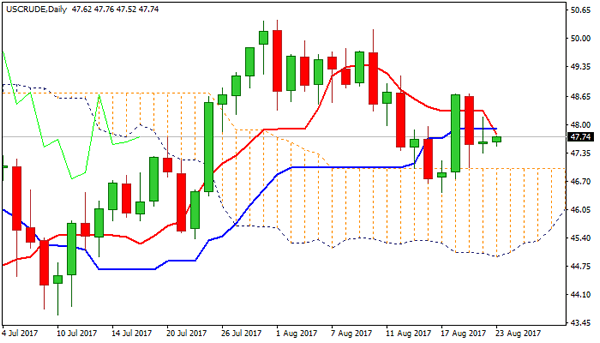
WTI oil price is holding within tight range on Wednesday, showing a sign of indecision after Tuesday's trading ended in long-legged Doji candle.
Mixed signal from daily studies shows no clear near-term direction. Daily Tenkan-sen / Kijun-sen bear cross weighs along with yesterday's strong upside rejection at $48.19 and daily MA's in bearish setup.
Negative momentum studies add to bearish signals.
On the other side, thick daily cloud continues to underpin (cloud top lies at $47.01) and marks significant support.
From the fundamental side, concerns of oil oversupply increase after gasoline inventories rose despite being at the peak of summer driving season (API report showed rise of 1.4 million barrels in gasoline stocks on Tuesday) and improved Libyan oil output continue to weigh on oil price, while trend in reduction of US crude stocks is likely to extend and supports oil prices (API report on
Tuesday showed draw of 3.6 million barrels while forecast for EIA report today shows forecast for 3.45 million barrels draw).
Break out of Tuesday's range ($47.35/$48.19) would generate initial direction signal and expose key near-term points at $48.72 (Mon/Tue double upside rejection) or $47.01 (daily cloud top).
Res: 47.76, 47.90, 48.57, 48.72
Sup: 47.35, 47.01, 46.44, 46.22
Market Update – European Session: Draghi Speech Largely Academic
Notes/Observations
Major European Aug Preliminary PMI Manufacturing data better-than-expected (Beats: France, Germany and Euro Zone)
Draghi speech in Germany mostly centered on academic observations but noted to be prepared for new challenges
President Trump raised the specter of a government shutdown to fulfil a campaign pledge of building the Mexican border wall
Overnight
Asia:
Japan Aug Preliminary PMI Manufacturing: 52.8 v 52.1 prior
Europe:
PM May said to drop pledge to cut ties with European Court of Justice (ECJ) after Brexit and sought only to ensure that the ECJ did not have direct jurisdiction over the UK
Americas:
President Trump commented on NAFTA during his from Arizona rally and personally believed that the US could not make a deal, will probably end up terminating it at some point
Mexico Foreign Min Videgaray: Mexico will continue with NAFTA talks
Energy:
Weekly API Oil Inventories: Crude: -3.6M v -9.2M prior
Economic data
(FR) France Aug Preliminary Manufacturing PMI: 55.8 v 54.5e (10th month of expansion), Services PMI: 55.5 v 55.8e, Composite PMI: 55.6 v 55.4e
(DK) Denmark Aug Consumer Confidence Index: 7.6 v 9.5e
(TR) Turkey Aug Consumer Confidence : 71.1 v 71.3 prior
(DE) Germany Aug Preliminary Manufacturing PMI: 59.4 v 57.6e (33rd month of expansion), Services PMI: 53.4 v 53.3e, Composite PMI: 55.7 v 54.7e
(EU) Euro Zone Aug Preliminary Manufacturing PMI: 57.4 v 56.3e (49th month of expansion), Services PMI: 54.9 v 55.4e, Composite PMI: 55.8 v 55.5e
(ZA) South Africa July CPI M/M: 0.3% v 0.3%e; Y/Y: 4.6% v 4.6%e (4th straight reading within the SARB target range of 3.0-6.0%)
(ZA) South Africa July CPI Core M/M: 0.5% v 0.5%e; Y/Y: 4.7% v 4.7%e
(TW) Taiwan July Industrial Production Y/Y: 2.4% v 3.3%e
(IS) Iceland Central Bank (Sedabanki) left its 7-Day Term Deposit Rate currently stands at 4.50% for its 1st pause in three meetings since removing capital controls
Fixed Income Issuance:
(IN) India sold total INR170B vs. INR170B indicated in 3-month and 6-month Bills (INR100B and 70B respectively)
(DK) Denmark sold total DKK1.45B in 2020 and 2027 Bonds
(EU) ECB allotted $35M in 7-day USD Liquidity Tender at fixed 1.64% vs $35M prior
(SE) Sweden sold total SEK2.5B vs. SEK2.5B indicated in 2023 and 2026 bonds
SPEAKERS/FIXED INCOME/FX/COMMODITIES/ERRATUM
Equities
Indices [Stoxx600 -0.3% at 374.8, FTSE +0.1% at 7388, DAX -0.1% at 12219, CAC-40 flat at 5133, IBEX-35 -0.1% at 10397, FTSE MIB -0.1% at 21698, SMI -0.3% at 8941, S&P 500 Futures -0.2%]
Market Focal Points/Key Themes:
European Indices trade lower across the board tracking US futures lower, despite stronger than expected Manufacturing PMI readings out of Europe. Advertising giant WPP set the tone following its results trading lower by over 10% after cutting its full year outlook following pressure on client spending particularly in the fast moving consumer goods sector. Elsewhere K+S shares trade higher after vague rumours regarding a potential stake acquisition by Elliot. Elsewhere Bayer shares trade little changed after the EU initiates a phase II probe on competition concerns.
Looking ahead to the US morning, retailers continue to dominate earnings with notable names including Express and American Eagle set to report alongside earnings from Lowes.
Equities
Consumer discretionary [WPP [WPP.UK] -11% (Earnings, cuts outlook), Publicis [PUB.FR] -2.9% (In sympathy with WPP], Emmi [EMMN.CH] -9.5% (Earnings) , Rockwool [ROCKB.DK] +4.9% (Earnings)]
Materials: [K+S [SDF.DE] +3.6% (Reportedly Elliot looking to take stake) ]
Industrials: [Vedanta [VED.UK] +1.9% (Earnings) , Costain [COST.UK] +2.1% (Earnings)]
Healthcare: [Ambu [AMBUB.DK] +6.7% (Earnings), NMC Health [NMC.UK] +4.9% (Earnings)]
Speakers
ECB's Draghi noted that research helped us decide whether a change in facts deserves a policy response or look through it. Research showed that QE and forward guidance are a success> Monetary policy must always prepare for new challenges
German Fin Min Schaeuble said to want more influence on region's budgets and working on a proposal that would allow southern euro zone countries to tap into the single currency bloc's bailout fund to boost investments during recessions (**Insight: Plan would mark a major change of policy for Schaeuble)
Norway PM Solberg: Growth is improving and employment is gaining
Currencies
EUR/USD reverse earlier loses following better Manufacturing PMI. Also Draghi’s speech ahead of his Jackson Hole conference focused only on academic observations and did not address any concern on the recent EUR currency appreciation or hints on QE exit.
GBP/USD tested 2-month lows below the 1.28 level despite talk that the UK was softening its stance on Brexit. PM May said to drop pledge to cut ties with European Court of Justice (ECJ) after BrexiT viewed as a sign of a new willingness to compromise
Fixed Income
Bund futures trades at 164.24 down 12 ticks following strong German PMI readings, with IHS Markit noting input inflation continued to rise, with manufacturing posting a steeper rate of price increases. Downside targets 163.50 followed by 162.56. To the upside the 164.50 to 165.20 remains key resistance.
Gilt futures trades at 127.55 down 10 ticks little changed along with Bunds. A resumption to the upside could eye 128.25 then 128.75. A move back below 126.51 targets 125.97
Wednesday's liquidity report showed Tuesday’s excess liquidity rose to €1.715T from €1.711T and use of the marginal lending facility rose to €202M from €171M prior
Corporateissuance saw no deals priced in high-grade primary
Looking Ahead
05:30 (DE) Germany to sell €3.0B in 0.5% Aug 2027 Bunds
05:30 (UK) DMO to sell £2.7B in 0.75% 2023 Gilts
06:30 (DE) Chancellor Merkel discusses the West's Future at Event in Berlin
06:45 (US) Daily Libor Fixing
07:00 (RU) Russia to sell combined RUB40B in 2024 and 2033 OFZ Bonds
07:00 (US) MBA Mortgage Applications w/e Aug 8th: No est v +0.1% prior
07:30 (CL) Chile Central Bank's Traders Survey
08:00 (BR) Brazil Aug IBGE Inflation IPCA-15 M/M: +0.4%e v -0.2% prior; Y/Y: 2.7%e v 2.8% prior
08:00 (PL) Poland July M3 Money Supply M/M: +0.3%e v -0.2% prior; Y/Y: 5.0%e v 5.0% prior
08:05 (UK) Baltic Dry Bulk Index
09:00 (MX) Mexico Jun Retail Sales M/M: +0.2%e v -0.1% prior; Y/Y: 2.8%e v 4.1% prior
09:05 (US) Fed's Kaplan speaks to Oil Group in Midland, Texas
09:30 (BR) Brazil July Current Account: -$3.4Be v +$1.3B prior; Foreign Direct Investment (FDI): $5.0Be v 4.0B prior
09:45 (US) Aug Markit Preliminary Manufacturing PMI: 53.5e v 53.3 prior, Services PMI: 55.0e v 54.7 prior, Composite PMI: No est v 54.6 prior
10:00 (US) July New Home Sales: 610Ke v 610K prior
10:00 (EU) Euro Zone Aug Advance Consumer Confidence: -1.8e v -1.7 prior
10:30 (US) Weekly DOE Crude Oil Inventories
11:00 (IT) Italy Debt Agency (Tesoro) announces upcoming CTZ auction for Aug 28th
11:30 (US) Treasury to sell $13B in 2-Year Floating Rate Notes Reopening
12:00 (CA) Canada to sell 5-Year Bonds
Dollar Flounders On Trump Comments
Wednesday August 23: Five things the markets are talking about
The EUR (€1.1781) is the standout currency in another low volume trading session, supported by better than expected flash manufacturing and service PMI's (see below) that continues to encourage investor confidence in the region's growth.
Elsewhere, comments from President Trump at a rally in Arizona yesterday evening again have provoked another bout of investor caution with gold and yen benefitting.
The President said he 'might terminate' the NAFTA trade treaty with Mexico and Canada after three-way talks failed to bridge deep differences and he would build a border wall with Mexico even if he has to shut down the U.S government to secure enough funding.
Geopolitical events continue to hover in the background. Investors are also keeping an eye on tensions between the U.S and North Korea, after the U.S and South Korea began joint military exercises on Monday.
Oil prices are under pressure after U.S gasoline inventories rose.
1. Global stocks mixed results
In Japan, the Nikkei share average posted modest gains overnight (+0.3%), snapping a five session losing that marked its longest losing streak in 12-months. Presidents Trumps overnight comments pared some of those gains. The broader Topix rallied +0.3%, but turnover remains subdued, with more than -10% below the recent average.
In South Korea, the Kospi index added +0.1%, while down-under, Australia's S&P/ASX 200 Index declined -0.2%.
In Hong Kong, trading was halted on Wednesday as a strong typhoon bared down on the financial centre and other parts of southern China.
In China, the main stock indexes ended little changed overnight, with profit taking in steel firms offsetting a rise in financials ahead of earnings reports. The CSI300 index rose +0.1%, while the Shanghai Composite Index fell -0.1%.
In Europe, Indices trade lower across the board tracking U.S futures, despite stronger than expected Manufacturing PMI readings out of Europe.
U.S stocks are set to open in the red (-0.2%).
Indices: Stoxx600 -0.3% at 374.8, FTSE +0.1% at 7388, DAX -0.1% at 12219, CAC-40 flat at 5133, IBEX-35 -0.1% at 10397, FTSE MIB -0.1% at 21698, SMI -0.3% at 8941, S&P 500 Futures -0.2%
2. Oil prices fall on concerns of oversupply, gold higher
Ahead of the U.S open, oil prices trade under pressure, weighed down by concerns of oversupply as Libyan output improves and as U.S gasoline inventories rise.
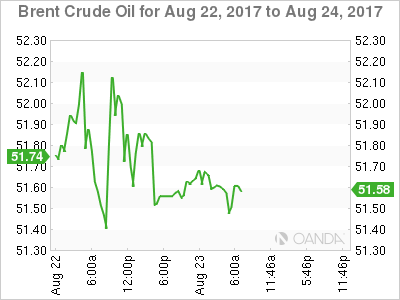
Brent crude futures are at +$51.64 per barrel at 0721 GMT, down -23c, or -0.4% from Tuesday's close. U.S West Texas Intermediate (WTI) crude futures are at +$47.59 a barrel, down -24c, or -0.5%.
Libya's Sharara oil field was back on line Tuesday, although regional instability suggests that output could be volatile.
Note: Sharara recently reached output of +280k bpd, but closed earlier this week due to a pipeline blockade.
Libya's rising output is a headache for the OPEC, which together with non-OPEC producers have pledged to hold back around -1.8m bpd of supplies between January 2017 and March 2018 to tighten supplies.
The next meeting of OPEC and non-OPEC states to discuss their production pact has been proposed for Sept. 22.
Stateside yesterday, API crude inventories fell by -3.6m barrels in the week to Aug. 18 to +465.6m. However, gasoline stocks rose by +1.4m barrels, compared with expectations for a -643k decline.
Investors will take their cue from today's EIA report (10:30 am EDT).
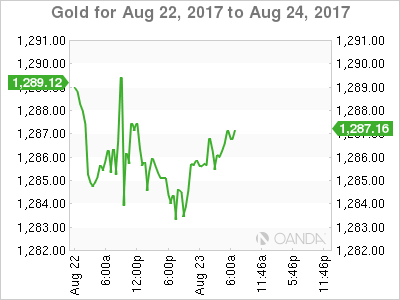
Gold prices inched up on Wednesday (+0.1% to +$1,285.30) as the dollar slipped after remarks by President Trump raised fears of a government shutdown. Expect investors to wait for further direction from this week's Jackson Hole symposium.
3. Yields back up a tad
In the absence of major economic data, bonds have been strongly influenced by market sentiment in recent sessions, a pattern that is expected to hold for much of this week until the Jackson Hole conference on Friday, which kicks off with a speech from Fed Chairwoman Janet Yellen on financial stability. A key question is whether Yellen will suggest the need for tighter monetary policy to address high asset prices.
While a trimming of expectations for a tighter ECB policy have helped push down yields across the eurozone, investors now seem reluctant to go any further without fresh policy cues.
With market speculation mounting about when the ECB will signal an exit from its ultra-loose monetary policy, Draghi's speech Friday remains a key focus for markets.
This morning, Eurozone government bond yields have backed up a tad ahead of the U.S open after a plethora of surveys showed the bloc's manufacturing businesses reported their best month of growth in nearly seven-years.
Germany's 10-year Bund yield gained +1 bps to +0.41%, while Britain's 10-year Gilt yield advanced +1 bps to +1.097%.
The yield on 10-year Treasuries increased less than +1 bps to +2.22%.
4. Pound struggles on Brexit investment woes
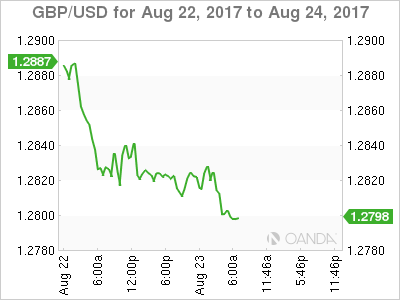
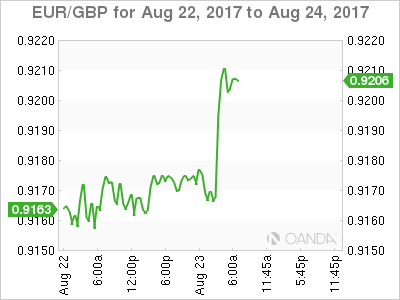
Sterling has fallen further, reaching its lowest reading in two months outright while the EUR/GBP breaks above the psychological €0.92 handle, as investors continue to shun the pound due to Brexit uncertainty.
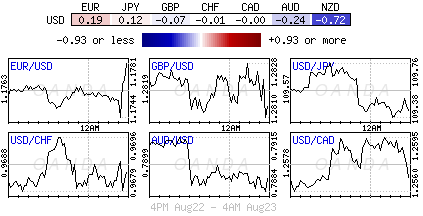
GBP/USD falls -0.2% to a low of £1.2792, while EUR/GBP rises +0.4% to a high of €0.9215, as the U.K.'s release of policy papers on Brexit this week fails to reassure investors.
Above-forecast Eurozone manufacturing PMI's have benefitted the 'single unit' – the EUR/USD up +0.2% at €1.1787.
USD/JPY (¥109.35) is little changed.
5. Eurozone maintains solid growth in August
Data in Europe this morning showed that eurozone economy maintained its solid growth momentum this month, supported by a rise in manufacturing activity and strong exports, according to the regions PMI reports.
The composite PMI for the eurozone increased marginally to 55.8 from 55.7 in July, which marks a two-month high. The market had been expecting a decline to 55.4.
According to IHS Markit, the outcome signals 'strong growth' in the private sector, and the rate of expansion remained broadly 'the best seen over the past six years.'
Manufacturing activity picked up in July, boosted by 'the fastest rise in exports,' but services-sector activity hit a seven-month low, according to the survey.
Trump Warns Of Government Shutdown Over Wall
Speaking at a rally in Arizona overnight, US President Trump said that: 'if we have to close down our government, we are building that wall'. Even though this may be just rhetoric aimed at his supporters, given that building a border wall was a core theme of his campaign, his comments still suggest that the government may continue to seek funding for a wall in the upcoming budget. The deadline for Congress to reach a deal on the budget is September 30th, which is when the fiscal year ends.
This is a key issue because in case the new budget does not include funds for a wall, the President could veto it. At the same time, if it does include such funding, Congress is highly unlikely to vote for it. The Democrats have been very vocal in their opposition for such a project, and the Republicans have shown little willingness to fight for this issue. Therefore, if the President insists about keeping wall funds in the budget, then the prospect of a government shutdown could quickly become realistic.
In our view, a potential shutdown could dampen expectations for tax reform even further. It could highlight once again the division between the White House and Congress and send the signal that if the two sides cannot agree on a budget, then a complex tax overhaul is far less likely to materialize. As such, once Jackson Hole is out of the way and investors begin to focus more on this subject, speculation for a potential shutdown could begin to weigh on the assets that rallied after the election, namely the dollar and US equities.
USD/JPY traded higher yesterday after it hit the key support barrier of 108.70 (S1) on Monday. Nevertheless, the rate found resistance at 109.75 (R1) and retreated following Trump’s comments over a government shutdown. The pair has been oscillating between 108.70 (S1) and 111.00 (R3) since the 28th of July and therefore, we consider the short-term path to be sideways for now. Having said that, given that the latest recovery started after testing the lower bound of the aforementioned range, we would expect the bulls to take advantage of the overnight Trump pullback, or any extensions of it, and perhaps drive the rate above 109.75 (R1). If they manage to do so, we believe that they may target our next resistance of 110.35 (R2).
As for the bigger picture, on the daily chart we see that USD/JPY is trading within a broader range between 108.70 (S1) and 114.40 since mid-March. This keeps the medium-term outlook flat as well and enhances the case for a further recovery within the range. Nevertheless, if speculation over a potential government shutdown begins to heighten over the next weeks, this could bring the pair under renewed selling interest. In our view, a clear close below the key support zone of 108.70 (S1) is needed to turn the medium-term picture back negative.
Kiwi tumbles as government trims growth forecasts
NZD came under renewed selling interest overnight, after New Zealand’s government trimmed its GDP forecasts for the current year and the next. It also noted that it will not consider any tax cuts until 2020, unless economic conditions turn out better than currently expected. These reinforce our view that the outlook for NZD remains cautiously negative, amid lackluster economic data and an RBNZ worried about the high exchange rate.
NZD/USD tumbled on the news, fell below the support (now turned into resistance) of 0.7275 (R1), and now appears ready to challenge the 0.7225 (S1) barrier. Given that the rate is trading below the prior uptrend line drawn from the low of the 11th of May, and also below the short-term downtrend line taken from the peak of the 27th of July, we consider the near-term outlook to be negative. A break below 0.7225 (S1) would confirm a forthcoming lower low on the 4-hour chart and is possible to initially aim for our next support of 0.7200 (S2). Nonetheless, bearing in mind that the latest tumble appears overextended, we would stay mindful of a minor corrective rebound before the bears decide to take the reins again.
Today’s highlights:
During the European morning, Eurozone’s preliminary manufacturing and services PMIs for August will take center stage. The forecast is for the manufacturing index to slip somewhat, while the services print is expected to hold steady. Even though a decline in the manufacturing print could weigh on the euro somewhat, as long as these figures remain at healthy levels, we do not expect them to derail the ECB’s policy plans. We get preliminary Markit manufacturing and services PMI data for the month from the US as well.
We have two speakers on the schedule: ECB President Mario Draghi and Dallas Fed President Robert Kaplan. Considering all the recent speculation regarding some fresh policy signals on ECB policy, we expect market focus to be primarily on Draghi. Should he reiterate the risk of exchange rate overshooting, as the latest ECB minutes highlighted, then the common currency could correct lower.
USD/JPY
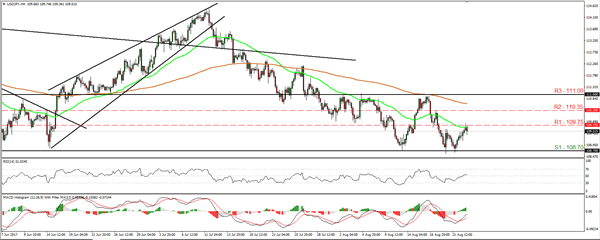
Support: 108.70 (S1), 108.00 (S2), 107.40 (S3)
Resistance: 109.75 (R1), 110.35 (R2), 111.00 (R3)
NZD/USD
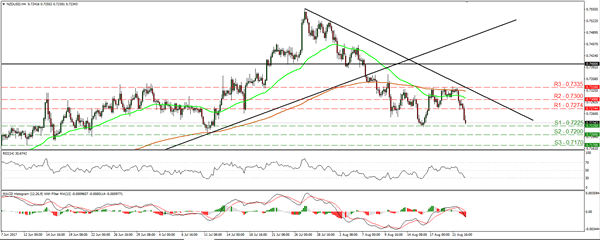
Support: 0.7225 (S1), 0.7200 (S2), 0.7170 (S3)
Resistance: 0.7275 (R1), 0.7300 (R2), 0.7335 (R3
Euro Climbs After PMIs And Draghi Jackson Hole Warm Up Speech
- Draghi steers clear of monetary policy decisions ahead of Jackson Hole;
- EUR pops higher on strong manufacturing data;
- EIA seen reporting eighth consecutive drawdown in oil inventories.
It's been a slow start to trading on Wednesday, much in keeping with the rest of the week so far, as traders wait in anticipation of the Jackson Hole Symposium which takes place over the next few days.
The event will see both Federal Reserve Chair Janet Yellen and ECB President Mario Draghi speak on Friday, which will be of keen interest to traders. Both central banks are expected to be very active between now and year-end and Jackson Hole is the perfect platform to lay the foundation for upcoming policy moves. Whether they will or not remains to be seen.
If Draghi's comments today are anything to go by we should not get our hopes up. Draghi steered well clear of upcoming monetary policy decisions and if reports last week are to be believed, he may well do so again on Friday. The ECB is clearly very concerned about the recent appreciation in the euro – despite an insistence that it does not concern itself with such matters – and recent “misinterpretations” by traders to Draghi's comments will likely mean he steers clear once again.
The euro is trading a little higher this morning after some more strong survey data from the region. Manufacturing and services PMIs from the eurozone, Germany and France were all very strong and well above the level that separates growth from contraction, suggesting that the recovery is continuing to gain traction. Manufacturing was a particular strong point in all three cases, despite the fact that the currency moves this year represent a potential headwind for exporters.
Oil is coming under a little pressure this morning after API on Tuesday reports another drawdown in inventories last week. Should EIA confirm a decline of around 3.59 million today, it would fall in line with expectations and be the eighth consecutive weekly drop which suggests the output cut is taking its toll. The fact that oil rigs in the US have stabilised and last week actually fell slightly would also suggest the worst of the glut may be behind us.
Other US data being released throughout the session today includes manufacturing and services PMIs for August and new home sales data. We'll also get consumer confidence data from the eurozone, which is expected to remain below 0 – indicating pessimism – but it has improved dramatically over the last year and looks on the cusp of moving into positive territory for the first time since 2001. We'll also hear from Robert Kaplan today who is one of the policy makers that has become increasingly concerned about a lack of inflation and recently suggested he may be willing to wait before raising interest rates again.
Currencies: Dollar Rebound Remains Unconvincing
Sunrise Market Commentary
- Rates: Sentiment-driven trading, but Draghi's speech wildcard
Today's eco calendar contains EMU PMI's and consumer confidence. We don't expect large deviations from consensus. A speech by ECB President Draghi is the wildcard. Will he revive speculation on an APP tapering announcement or keep his cards close to his chest? We forecast trading to remain sentiment-driven ahead of speeches in Jackson Hole on Friday. - Currencies: Dollar rebound remains unconvincing
Yesterday, the dollar was in better shape supported by higher US yields and a positive risk sentiment. Overnight, Trump comments on NAFTA broke the positive USD momentum. Today's US eco data might be ok, but USD traders remain in waitand- see modus ahead of the CB speeches at Jackson Hole.
The Sunrise Headlines
- US equities put last week's political troubles behind and rallied to a 1% gain. Asian equity markets are less enthused this morning, trading mixed. Hong Kong is closed, bracing for Typhoon Hato. Iron ore takes a hit, weighing on AUD.
- US trade officials are putting together a proposal to let the US withdraw from a corporate arbitration system at the heart of NAFTA, upsetting big American companies that say the system protects their investments overseas.
- EU law will influence the UK long after Brexit, Theresa May conceded. It's a marked change of tone from seven months ago when she vowed to end the ECJ's jurisdiction. The compromise is an attempt to speed up divorce talks.
- German FM Schaeuble is working on a proposal that would allow southern euro zone countries to tap into the single currency bloc's bailout fund (ESM) to boost investments during recessions, according to Bild.
- The Nikkei-Markit Japan flash manufacturing PMI came in at 52.8 in August, up from 52.1 in July. Growth in output, new orders and employment all accelerated in the first three weeks of the month. NZD/USD loses some ground.
- New Zealand's government trimmed economic growth and budget surplus forecasts a month before a general election, limiting the ability of political parties to ramp up spending promises. NZD/USD loses some ground.
- Today's EMU eco calendar heats up with August Manufacturing & Services PMI's, consumer confidence and a speech by ECB president Draghi. Germany holds this week's only scheduled bond auction (2027).
Currencies: Dollar Rebound Remains Unconvincing
Dollar rebound remains unconvincing
Yesterday, the dollar profited from a modest rise in US yields and a positive equity sentiment. Still, EUR/USD and USD/JPY held within the established ranges. Currency investors are looking forward to the CB speeches at Jackson Hole later this week. EUR/USD finished the session at 1.1762 (from 1.1815). USD/JPY was propelled by a nice US equity rebound end finished the day at 109.57 (from 108.98)
Overnight, Asian equities opened strong after the WS rally. USD/JPY filled offers in the 109.83 area but risk sentiment deteriorated after Donald Trump said he may end NAFTA at some point. He also threatened to shut down the US government if he wouldn't get the funding to build a wall along the Mexican border. Equities ceded part of the early gains. USD/JPY (currently 109.45) is off the intraday top (109.83). The Kiwi dollar (USD/NZD 0.7235) declined after the government cut its growth forecasts. A setback in Iron ore weighed on the Aussie dollar. AUD/USD dropped below 0.79. EUR/USD was little affected by the Trump comments.
This morning ECB-s Draghi will give a speech in Germany before leaving for Jackson Hole. Will he give any hints/details on the exit of the APP bond buying programme or will he abstain from doing so due to fear about a further strengthening of the euro. Most likely he won't dwell on these questions today but it's a wildcard. Regarding the data, ,the focus is on the EMU PMI's. The indices are slightly off the May highs, but stay on levels that suggest ongoing strong growth. Similarly, August consumer confidence is expected marginally lower(-1.8 from -1.7). US August PMI confidence is expected to have risen marginally to 53.5 (manufacturing) and 54.9 (services). We see a risk for an above consensus outcome, based on weaker dollar and signs retail sales are improving. The EMU data should be neutral for the euro. US data might in theory be USD supportive. However, this positive impact might be counterbalanced by the fall-out of the Trump comments on ending NAFTA. So, we expect yesterday's USD rebound to halt. A modest USD setback going into the Jackson Hole speeches is possible. However, we expect the established ranges to remain in place.
Broader context and technical picture. Late June, EUR/USD started a new upleg as investors anticipated a reduction of ECB bond buying to be announced in autumn. The Fed was expected to remove policy stimulation only in a very gradual way as US inflation remained soft. Uncertainty on the policy of the Trump administration was an secondary negative factor for the dollar. EUR/USD set a new correction top north of 1.19 before consolidating in a narrow 1.1662/1.1910 trading range. We expect this range will hold going into the Jackson Hole symposium. If US data remain ok (as most were this month) and if Draghi gives little information on next ECB steps, there might be room for a modest USD comeback. A return of EUR/USD to the 1.15/16 area is possible. Pockets of US political risk are a (negative) wildcard for the dollar. A downward correction in core (US and European) yields supported the yen in August. USD/JPY declined from the mid 114 area mid-July to 108.60. The April correction low (108.13) remains the line in the sand. For now, this level won't be easy to break as quite some USD bad news is discounted after the recent protracted setback. A cautious buy-on-dips approach (with stop-loss protection below 108) may be considered.
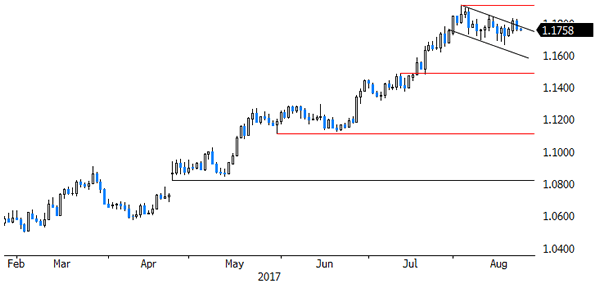
EUR/US: awaiting clearer CB guidance
EUR/GBP
EUR/GBP sets new highs
Sterling continued trading with a negative bias yesterday. Cable drifted from the high 1.28 area early in Europe to close the session at 1.2824. Most of this move was due to a rebound of the dollar, but sterling also set a minor new low against the euro. The UK data were not to blame. The UK August public budget showed an unexpected surplus and the CBI orders were better than expected. However, good eco/activity data don't help sterling these days as long as inflation remain modest and as there is little progress in the EU-UK Brexit talks. EUR/GBP closed the session at 0.9172.
Today, without UK eco data, the global risk sentiment and the headlines on the Brexit negotiations will set the tone for sterling trading. A cautious sentiment on risk is sterling negative. We also don't expect high profile positive Brexit news. So, despite the extensive sterling correction (especially against the euro) and the overbought EUR/GBP conditions, we don't see a trigger for a change in sentiment
From a technical point of view, EUR/GBP cleared the 0.8854/80 resistance (top end June), opening the way for further gains The move was the result of euro strength (ongoing strong EMU growth and expectations of the ECB reducing policy stimulus later this year). At the same time, UK price data remain soft enough for the BoE to keep a wait-and-see modus as the Brexit negotiations continue. MT, we maintain a buy EUR/GBP on dips approach as we expect the constellation of relative euro strength and sterling softness to continue. The 0.9415 flash-crash spike is the next MT target on the charts. However, we don't jump on the trend anymore after recent protracted EUR/GBP rally and wait for a correction, e.g to the technical support in the 0.88/89 area.
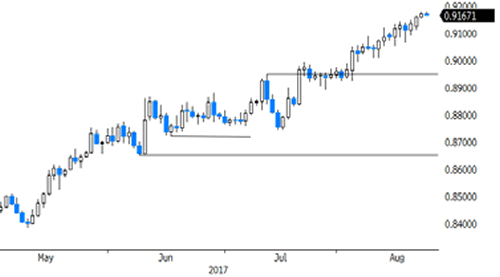
EUR/GBP: uptrend continues unabatedly