Sample Category Title
EUR/USD Analysis: Finds Support At 1.1754
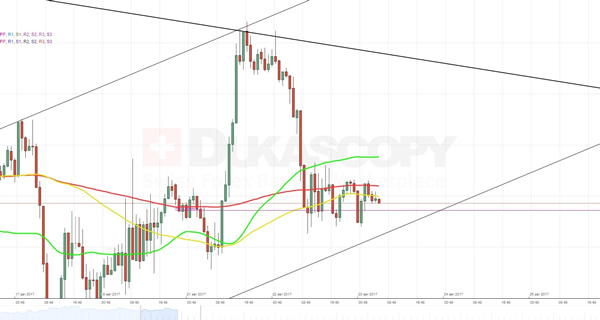
As it was expected, a release of information on the German Economic Sentiment, which appeared to be even less than analysts anticipated, notably affected valuation of the Euro. Namely, it dragged the currency pair down by 0.34%. And the only obstacle that stopped the fall was the weekly PP located at the 1.1754 level. Given that this barrier practically coincides with the bottom edge of a junior ascending channel, the exchange rate should not plunge any further. From technical perspective it is expected to make a rebound and start to move towards the 1.1800 mark. However, this scenario might not materialize due to the ECB President Mario Draghi speech that will be delivered at 7:00 GMT and that most likely will cause significant volatility in the markets.
Technical Outlook: AUDUSD – Negative Near-Term Outlook After Repeated Upside Rejections
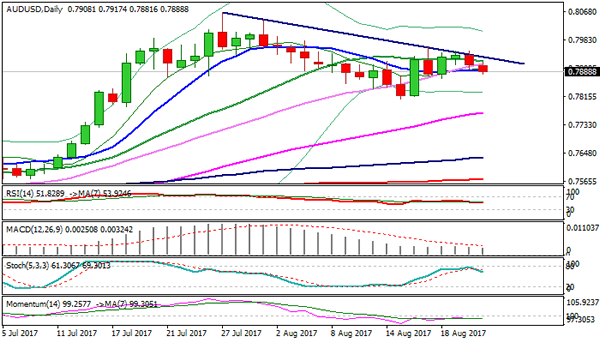
The Aussie dollar holds in red for the second day and extends pullback from 0.7950 zone where multiple upside rejections occurred in recent sessions.
This could be seen as a signal further weakness and lower top formation.
The price returned below 10/20SMA's with persisting bearish momentum that could put the pair under stronger pressure.
Key near-term support lies at 0.7867 (last Friday's low/Fibo 61.8% of 0.7807/0.7962 recovery leg) and sustained break here would give stronger signal of lower top and open key support at 0.7807(15 Aug low) for retest.
Broken 20SMA caps today's action and marks initial resistance at 0.7918, guarding key barriers at 0.7950/62 (recent upside rejections) break of which will be bullish.
Res: 0.7918, 0.7950, 0.7967, 0.8000
Sup: 0.7867, 0.7844, 0.7807, 0.7786
Technical Outlook: EURUSD Jumps From Dangerous Zone, Boosted By PMI Data
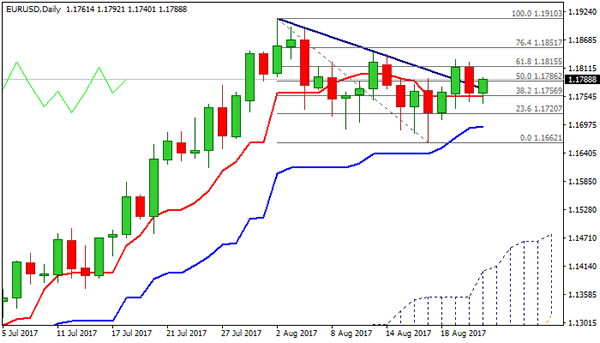
The Euro regains momentum and bounces from dangerous zone (1.1730/40) where downside attempts failed for the third time.
Fresh acceleration higher was fuelled by better than expected PMI data from Germany and EU (German Manufacturing PMI was 59.4 in Aug vs 57.7 f/c, while EU manufacturing PMI was at 57.4 in Aug vs 56.3 f/c).
ECB's chief Mario Draghi did not offer something substantially new in his today's speech today, reiterating that unconventional monetary policy in past decade has been a success, however, rigorous research in gaining further knowledge about this toll is required. Draghi said that the world became more resilient after applying unconventional methods in policy and regulation.
More signals from top central bankers are expected on Jackson Hole symposium which starts on Thursday, when Draghi is due to speak.
The Euro hit new session high at 1.1789 and may extend fresh recovery action higher after triple downside rejection and failure to close below daily Tenkan-sen which acts as strong support at 1.1754.
Key near-term barriers lay at 1.1815/28 (Fibo 61.8% of 1.1910/1.1662 pullback / Mon/Tue double upside rejection) and sustained break here is needed to confirm reversal.
Overall bullish structure and political crisis in the US work in favor of Euro bulls.
Res: 1.1800; 1.1815; 1.1828; 1.1846
Sup: 1.1754; 1.1731; 1.1708; 1.1662
Foreign Exchange Market Commentary: EUR/USD, USD/JPY, GBP/USD, GOLD, WTI CRUDE, DJIA, FTSE100, DAX
EUR/USD
The American dollar recovered the ground lost on Monday against most of its major rivals, and even entered positive territory against some of them, but gains remain shallow ahead of first-tier macroeconomic events coming during the second half of the week. Most action took place right after London's opening, when a strong opening of European equities interrupted the reigning risk aversion seen on the previous session. The EUR/USD pair fell down to 1.1744, from where it bounced to stabilize around 1.1760, level that the pair maintained all through the US session. Weighing on the common currency was the only piece of macroeconomic news released in the EU, German's ZEW survey showed that sentiment fell beyond expected. Business sentiment in the country for August fell to 10 from 17.5 in July, while for the whole EU it retreated from 35.6 to 29.3. The assessment of the current situation, however, remained strong up to 86.7 from previous 86.4. In the US, the Richmond Fed manufacturing index remained flat at 14 in August, beating expectations of 11.
Things will heat up this Wednesday, with August preliminary PMIs for the EU and the US, and new home sales for this last, although investors may wait for the upcoming speeches from Yellen and Draghi within the Jackson Hole Symposium that will start on Thursday, and extend into the weekend.
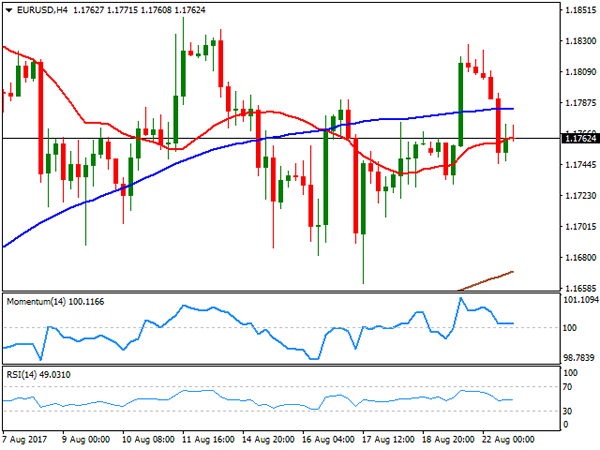
The recovery above 1.1800 was once again reversed, and with the pair having reached a lower high so far this week for a third consecutive time, somehow indicating decreasing buying interest around the common currency, although the greenback is nowhere near on demand. The short term technical outlook is neutral according to the 4 hours chart, with the price right below directionless 20 and 100 SMAs, whilst technical indicators head nowhere around their mid-lines. The immediate support is the weekly low, at 1.1730, with a more relevant one in the 1.1680/90 region. Below this last, the pair can gain bearish momentum and extend its monthly decline beyond the current low of 1.1661. Strong selling interest is capping advances in the 1.1820/30 price zone, so it will take a break beyond 1.1860 to see the pair gaining bullish traction.
Support levels: 1.1730 1.1685 1.1650
Resistance levels: 1.1825 1.1860 1.1910
USD/JPY
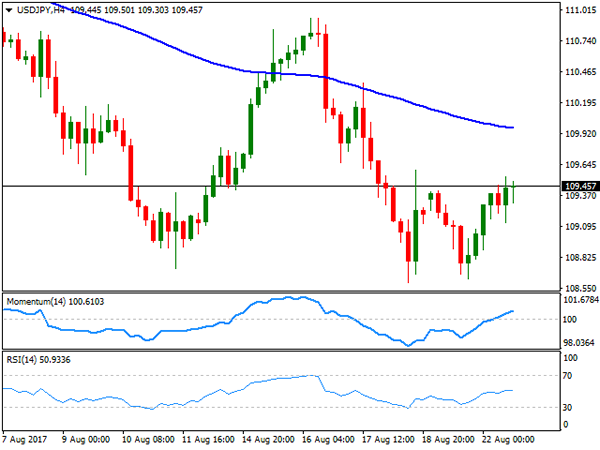
The USD/JPY pair recovered slowly but steadily this Tuesday, ending the day not far from a daily high of 109.54, amid a recovery in worldwide equities and a modest uptick in US Treasury yields after Monday's decline to fresh 2-month lows. US data was generally positive, as US home prices rose 1.6% in the second quarter of 2017, despite June's monthly advance was shy of expectations, up by just 0.1%, whilst the Richmond Fed survey showed manufacturing activity in the region was better-than-expected, with the index at 14 for August, against market's forecast of 11. Ahead of key speeches from Fed' Yellen and ECB's Draghi, Japan will release the August preliminary Nikkei Manufacturing PMI during the upcoming Asian session, expected at 52.3 from a downwardly revised 52.1 in July. In the 4 hours chart, the upward potential remains limited, as the price is well below bearish 100 and 200 SMAs, while Friday's high of 109.59 comes as an immediate resistance. Technical indicators in the mentioned time frame have entered positive territory, but the RSI has lost upward strength and turned neutral, reflecting the cautious stance towards the greenback that prevailed these last few weeks.
Support levels: 109.10 108.80 108.45
Resistance levels: 109.60 110.00 110.45
GBP/USD
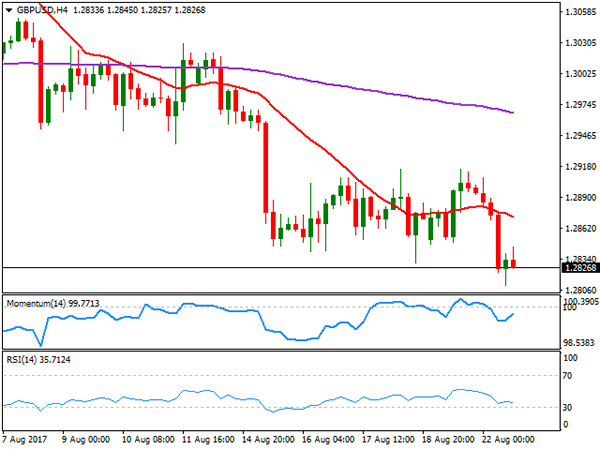
The GBP/USD pair fell down to 1.2810, its lowest in nearly two months, as dollar's short-term demand affected more the weakened Pound. There were a couple of minor releases in the UK that came in above expected, with the CBI industrial trend survey showing that manufacturing grew in August, as the index came in at 13 from July's 10, also beating expectations of 8, while public sector net borrowing, excluding the nationalized banks, was in surplus by £184m in July, the first surplus since 2002, while excluding public sector banks, it increased by £1.9 billion to £22.8 billion in the current financial year-to-date, compared with the same period in 2016. The Pound, however, is unable to attract buyers ahead of the next round of Brexit negotiations, taking place in Brussels next week. From a technical point of view, the downside remains favored, given that in the 4 hours chart, the 20 SMA began gaining downward momentum above the current level, whilst technical indicators hold within bearish territory, with the RSI indicator already gyrating south around 35. A bearish extension through 1.2810 should favor an approach to the 1.2700/20 region, where the pair presents multiple relevant daily highs and lows from earlier this year.
Support levels: 1.2810 1.2755 1.2710
Resistance levels: 1.2845 1.2885 1.2920
GOLD
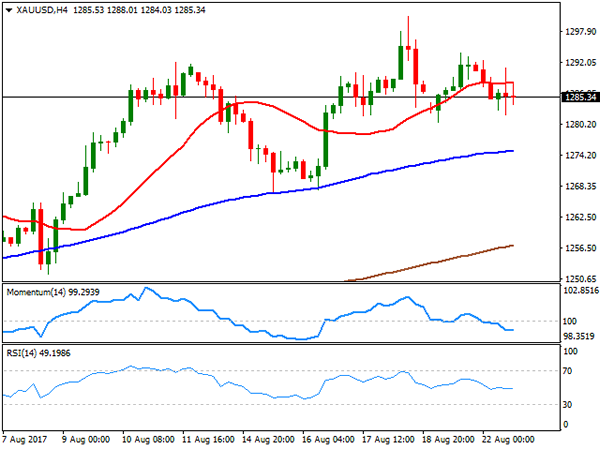
Gold prices eased this Tuesday, with spot settling at $1,285.44 a troy ounce, and trimming most of its weekly gains as the dollar rallied on better markets' mood. Still marginally higher for the week, a clearer picture for gold may come on Thursday, when Fed's Yellen will offer a speech within the Jackson Hole Symposium. The head of the Federal Reserve is not expected to talk specifically about the ongoing monetary policy, but investors will be trying to read in-between lines, looking for clues on what's next, particularly on rate hikes. In the meantime, the daily chart indicates that the upward momentum eased, but also that the commodity is far from bearish territory, as technical indicators eased modestly, but remain well above their mid-lines, whilst the price is far above all of its moving averages. In the shorter term, and according to the 4 hours chart, gold maintains a neutral stance, trading slightly below a horizontal 20 SMA and with technical indicators hovering around their mid-lines.
Support levels: 1,281.65 1,273.95 1,261.20
Resistance levels: 1,292.10 1,300.90 1,309.25
WTI CRUDE OIL
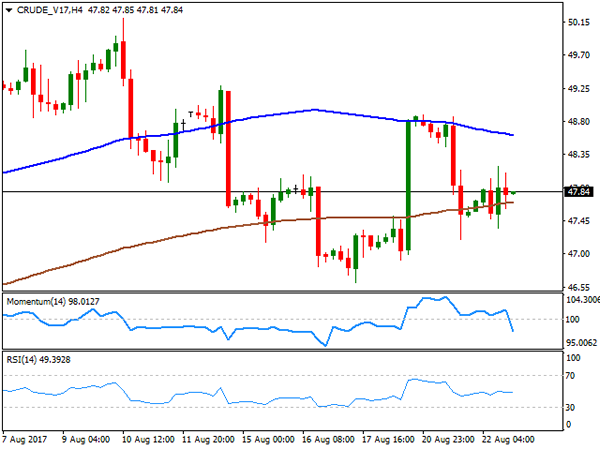
Crude oil prices posted a modest advance this Tuesday, with WTI ending the day at $47.84 a barrel, helped by expectations of another crude stockpile draw-down in the US last week. According to a Reuters' poll, inventories are expected to have fallen by around 3.4 million barrels in the week ended August 18th. The advance, however, was limited by news that Libya's Sharara oil field was reopening after its latest shutdown. The API report, to be released late Tuesday, could give a first glance of what the EIA report will bring. The shallow daily bounce hasn't been enough to revert the negative tone seen on previous updates, as in the daily chart, the commodity has barely bounced from its 100 DMA, while technical indicators remain within bearish territory, but lacking directional strength. In the 4 hours chart, the 100 SMA is gaining downward traction above the current level, the RSI remains flat around its 50 level, whilst the Momentum indicator presents a strong downward slope within negative territory, all of which maintains the risk towards the downside.
Support levels: 47.20 46.60 45.90
Resistance levels: 48.20 48.80 49.50
DJIA
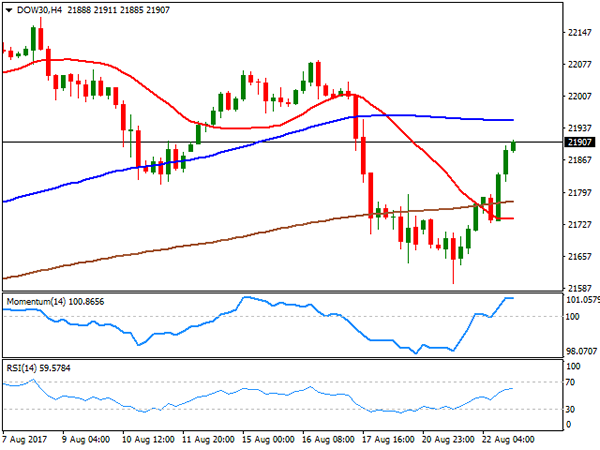
Wall Street edged sharply higher this Tuesday, with the DJIA adding 196 points, its largest daily rally in four months, to end at 21,899,89. The Nasdaq Composite gained 1.36%, to close at 6,297.48, while the S&P settled at 2,452.51, up by 24 points. Speculation that the US administration will focus now on the long promised tax reform, woke up investor's appetite for equities, also getting support from a recovery in their overseas counterparts that rallied on the back or rising base metals. Only three members were down within the Dow, with Intel Corp. being the worst performer, down by 0.72%. Cisco Systems, on the other hand, led advancers, up 2.0%, followed by Caterpillar that added 1.95%. In the daily chart, the index pared its recovery a few points below a flat 20 DMA at 21,936, the immediate resistance, whilst technical indicators bounced from oversold levels, with the RSI indicator already entering positive territory, now at 54 and anticipating some further gains for this Wednesday. In the 4 hours chart, technical indicators lost upward strength near overbought territory, whilst the index ended well above its 20 and 200 SMAs, but below the 100 SMA, currently at 21.954.
Support levels: 21,880 21,836 21,790
Resistance levels: 21,936 21,970 22,011
FTSE100
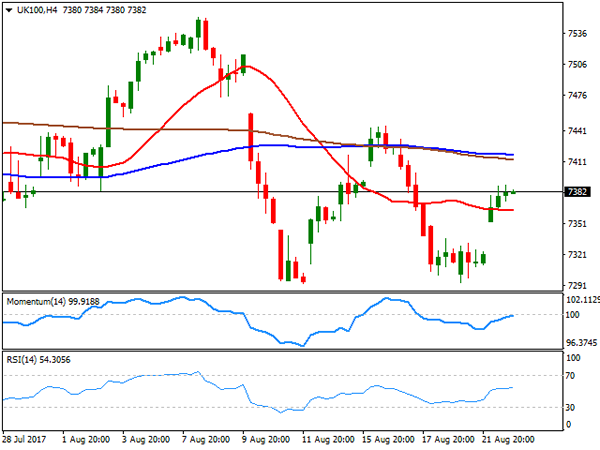
The FTSE 100 closed the day at 7,381.74, up by 63 points, as an advance in mining-related equities offset large losses from insurance related equities. Provident Financial plunged 66.22% after issuing its second profit warning in three months, losing two thirds of its value. Tesco led the advance, adding 4.10%, while Rio Tinto, Glencore and BHP Billiton added over 2.0% each, also making it to the top ten list. The positive tone persists in after-hours trading on Wall Street's recovery, but the daily chart for the Footsie shows that technical indicators remain within bearish territory, with limited upward strength, whilst the 20 and 100 DMAs remain above the current level, not enough to confirm a bullish extension for this Wednesday. In the 4 hours chart, the index presents a modestly positive tone, as it settled above a horizontal 20 SMA while the Momentum indicator aims higher around its mid-line, and the RSI at 55.
Support levels: 7,353 7,309 7,271
Resistance levels: 7,401 7,444 7,482
DAX
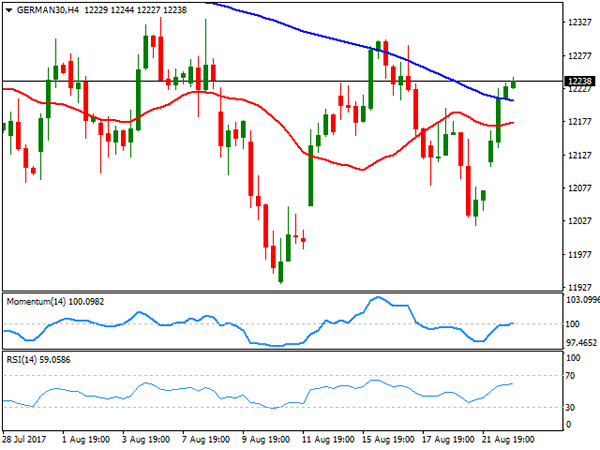
European equities edged higher this Tuesday, reversing a three-day losing streak, with the German DAX adding 165 points to end at 12,229.34, amid a recovery in the mining and automotive sectors. Within the DAX, only Commerzbank closed in the red, shedding 0.29%, while Fresenius led advancers, adding 3.36%, followed by Linde which gained 2.96%. The daily chart for the index shows that it settled above its 20 DMA, while technical indicators have turned north, but still hovering around their mid-lines and barely above this month highs, not enough to indicate a bullish continuation for this Wednesday. In the 4 hours chart, the index recovered above its 20 and 100 SMAs, while technical indicators entered positive territory but lost upward strength, in line with the longer term perspective. Further gains beyond the 12,300 region where the index topped last week, will likely encourage bulls, resulting in a firmer upward movement this Wednesday.
Support levels: 12,212 12,176 12,131
Resistance levels: 12,263 12,301 12,343
APAC FX Roundup Draghi And PMI’s Eyed
A quiet session with Hong Kong closed with the only notable movers being NZD and MXN.
Hong Kong was closed today as it weathered a T10 typhoon. But it seemed to matter not as Asia was content to sit and wait for ECB Governor Mario Draghi to speak at 08:25 London time in Germany followed by a swath of Eurozone PMI's. In the case of the former, the street will be hanging on to every word for a signal to the timing of the ECB's unconventional monetary policy. In the latter, the markets will be looking for a stronger performance to offset yesterdays surprisingly downbeat ZEW survey.
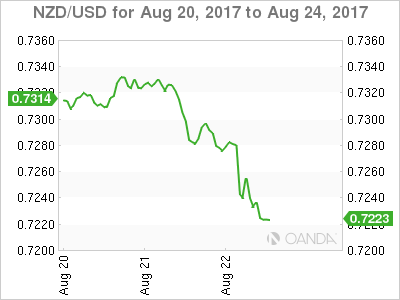
The two primary movers today were NZD and MXN which weakened, but for very different reasons. In the NZ Dollars case, the treasury released downgraded growth forecasts and budget surplus' for the years ahead with saw the Kiwi topple 50 points to a low of 7230 in Asia trading. This trend appears to be continuing into early London as pre-election jitters, and a dovish central bank weighs on the flightless bird.
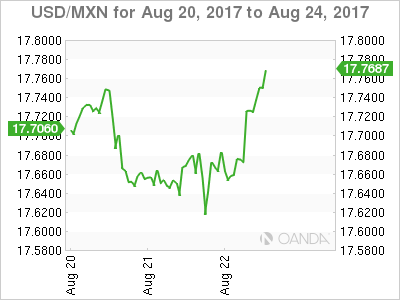
President Trump's Twitter account weighed on the Mexican Peso. Mr. Trump said that he was willing to shut down the government to get funding to build the wall, and is likely to scrap NAFTA at some stage in an underwhelming vote of confidence in North/South relations. USD/MXN rallied from 17.6500 to 17.7450 as the market digested the news from two issues that have been quiet of late.
Later on this evening, we will get U.S> PMI's as well as the official DOE Crude Inventories data which should bring some volatility (as if we didn't need more) to WTI and Brent. The market is forecasting a drawdown of -3.6 million barrels of crude and a drawdown of 1 million bpd of gasolene.
AUDUSD In Neutral Phase, Key 0.80 Level Acts As Strong Resistance
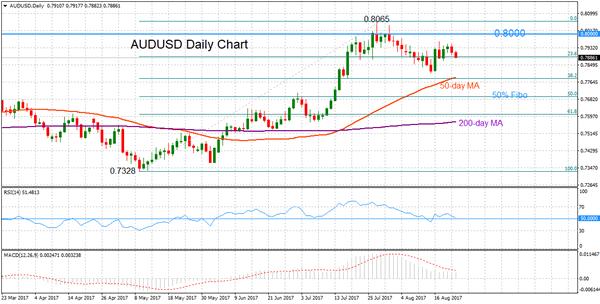
AUDUSD shifted to neutral after failing to make a sustained move above the key psychological level at 0.8000. After a brief spike to a more than two-year high of 0.8065 on July 27 the market reached extreme conditions as the RSI reached overbought levels.
Momentum signals are weak and consequently AUDUSD is now consolidating around the 23.6% Fibonacci retracement level of the rise from 0.7328 to 0.8065, at 0.7888. Both MACD and RSI are pointing down, giving room for more weakness in the market.
Support is expected at 0.7785, which is the July 18 low and the 38.2% Fibonacci retracement level. A breakdown at this point would bring AUDUSD under more pressure to drop to the 50% Fibonacci at 0.7695. From here the market would turn increasingly more bearish and reverse the uptrend that took place from 0.7328 to 0.8065.
The short-term bias is expected to remain neutral with the odds of downside risk increasing on a break below current support. Only a bounce back up to break the key 0.8000 resistance level would indicate the current neutral phase has ended and there would be a resumption of the uptrend. In the bigger picture, the medium-term bullish market structure remains intact and there has not been any clear indication of a change in the underlying trend.
Trump Yet Again Induces Dollar Weakness Against Yen, Other Majors Edge Down
President Trump has yet again induced weakness in the US currency with his remarks about a possible government shutdown to fulfill his campaign promises. The greenback weakened against the yen, but gained against other majors making the dollar index flat on the day. The release of flash PMI data out of the eurozone will attract some traction during early hours of European trading.
Speaking at a rally in Phoenix, President Trump said “If we have to close down the government, we are building that wall”, sparking concerns among the investor community and sending the dollar lower against the yen. The President went further to signal a possible end of the NAFTA treaty with Mexico and Canada, just as the first round of interviews finished on Sunday. While there is still time before a situation of a possible government shutdown becomes serious, the forex market did take note of Trump’s remarks. Dollar/yen was trading lower at 109.37 ahead of the European open, though still above the four-month low it touched last week.
Other majors weakened during Asian trading, though most were trading in tight ranges in the wake of no economic data releases and many traders awaiting signals from the central bankers’ symposium in Jackson Hole. The aussie was down at $0.7887, while the pound edged lower at $1.2818, but traded in a very tight range against the dollar for most of the Asian session.
The kiwi plunged against its US counterpart (down 0.73% at $0.72224) due to the government cutting its growth outlook for this and the next fiscal year. The New Zealand Treasury reduced its forecast for the year to June to 2.6% versus the previously estimated 3.2%, and cut its growth projection of 3.5% in the year to June 2018 from 3.7% in the May budget update.
The only economic data release that could have a significant impact on forex markets during the European session is the release of flash PMIs for France, Germany and the eurozone. The euro traded in a very narrow range ahead of the first data publication and was standing at $1.1754. The common currency didn’t react much following the release of the French PMI, and was trading at $1.1752. France’s manufacturing PMI came in better than expected (a preliminary reading of 55.8 for August versus expectations of 54.5). The country’s services PMI disappointed slightly with a figure of 55.5, just below the expected figure of 55.8.
Later in the session, traders could be busy monitoring preliminary PMIs from the US, July figures for new home sales out of the States and crude oil inventories. More so, Federal Reserve Bank of Dallas President Robert Kaplan is due to speak today.
Oil prices fell during the first session of the day despite the API report showing a drawdown in crude inventories. The American Petroleum Institute released a report last night pointing to a drawdown of 3.6 million barrels last week, more than the expected 3.5 million barrels. Initially, oil prices rose but later gave up on those gains following news that the production at Libya’s Sharara field restarted after several disruptions. WTI was last trading at $47.67 a barrel and Brent was at $51.70.
Following dollar weakness against the yen, gold prices rose modestly. The precious metal was last trading at $1,286.09 an ounce.
Technical Outlook: USDJPY – Daily Tenkan-Sen Limits Recovery Action For Now
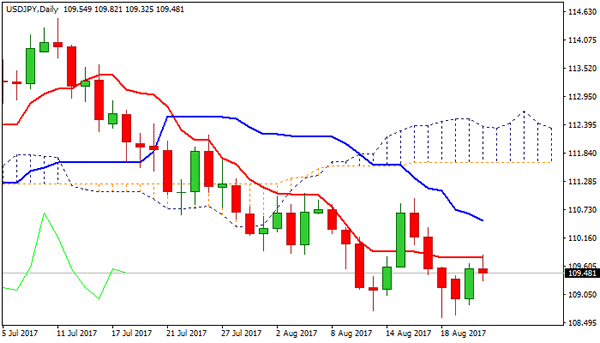
The pair extended Tuesday’s strong recovery rally in early Wednesday’s trading but gains were so far short-lived and capped by daily Tenkan-sen at 109.77 which was briefly pierced on extension to session high at 109.82.
Subsequent easing suggests that recovery might be over, as the move was seen as correction of larger bear-trend from 114.49 which eyes target at 108.11 (17 Apr low).
However, the pair may remain in extended consolidation which should stay capped by daily Tenkan-sen and psychological 110.00 barrier (also Fibo 61.8% of 110.94/108.60 downleg / falling 20SMA) before bears resume).
Conversely, extension above 110.00 barrier would ease immediate bearish pressure, while extension above daily Kijun-sen (110.50) is needed to neutralize.
Res: 109.82, 110.00, 110.36, 110.50
Sup: 109.32, 108.85, 108.60, 108.11
Technical Outlook: GBPUSD – Bearish Signal On Break Below Daily Cloud
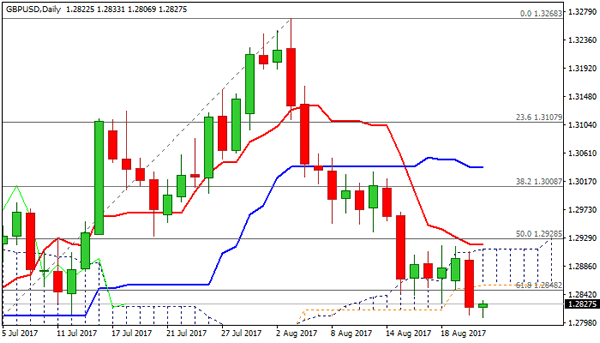
Cable traded within narrow range in Asia and pressuring 1.2800 support zone after strong fall on Tuesday closed well below key supports at 1.2857/48 (daily cloud base / Fibo 61.8% of 1.2588/1.3268 rally). Strong signal for bearish continuation of the downtrend from 1.3268 has been generated on eventual break below near-term 1.2831/1.2917 congestion and extension below daily cloud.
Fresh weakness also dented another important support at 1.2811 (12 July trough), firm break of which is needed to confirm bearish resumption towards 1.2749 (Fibo 76.4%).
Strong bearish setup of daily studies favors further downside, with consolidation above 1.2800 handle to precede fresh weakness.
Daily cloud base now acts as solid resistance at 1.2857, along with broken 100SMA (1.2880) and expected to keep corrective upticks capped.
Alternative scenario requires acceleration above daily cloud to sideline immediate bearish threats.
Res: 1.2848, 1.2857, 1.2880, 1.2912
Sup: 1.2806, 1.2749, 1.2715, 1.2647
EUR/CHF Elliott Wave Analysis
EUR/CHF : 1.1327
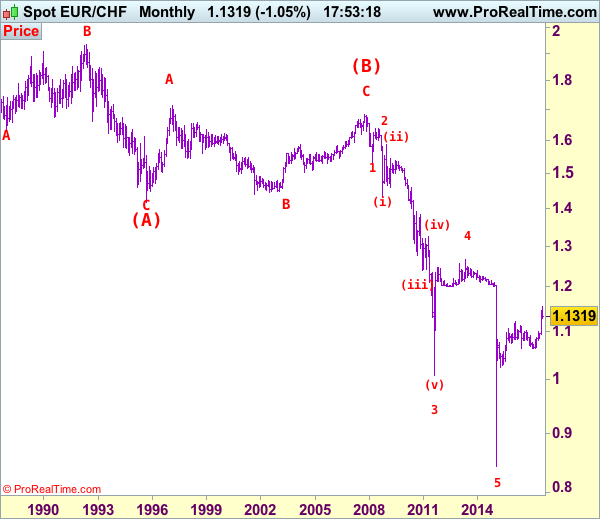
EUR/CHF: Major wave 5 trough ended at 0.8426 and correction has commenced from there for subsequent gain towards 1.1400-1.1500.
Although the single currency met renewed selling interest at 1.1479 and slipped again week, lack of follow through selling on break of support at 1.1261 and the subsequent rebound from 1.1259 suggest the correction from 1.1538 (i.e. wave iv) has possibly ended there, hence consolidation with upside bias is seen for another test of said resistance at 1.1479 but a daily close above there is needed to add credence to this view, bring retest of this recent high. Looking ahead, a break of this resistance at 1.1538 (wave iii top) is needed to confirm upmove has resumed in wave v to 1.1600, then towards 1.1700-10.
To recap our preferred count, the decline from 1.6828 (end wave (B)) is labeled as the beginning of wave (C) which should unfold as an impulsive move with 1: 1.5326, 2: 1.6377 and wave 3 is sub-divided into (i): 1.4300, (ii): 1.5880 and wave (iii) is still unfolding with (1): 1.4577, (2): 1.5448 and wave (3) is an extended 3rd with i: 1.5006, ii: 1.5383, wave iii: 1.3073, then wave iv ended at 1.3925 and wave v at 1.3073, wave (4) ended at 1.3925 and wave (5) has ended at 1.2765 which also marked the low of wave (iii) and wave (iv) has ended at 1.3835 and wave (v) as well as larger degree wave 3 has ended at 1.0075. The selloff from 1.2650 signals wave 4 has ended there and we are taking a view that the wave 5 could also have ended 0.8426, hence consolidation is seen with mild upside bias for rebound to 1.1400 (already met), then towards 1.1600.
On the downside, whilst initial pullback to 1.1370-80 is likely, reckon 1.1325-30 would limit downside and bring another rise later. Below said support at 1.1259 would defer and signal the wave iv correction is still in progress (probably a complex one), bring retracement of recent upmove to 1.1185-90 (50% Fibonacci retracement of 1.0833-1.1538), however, reckon downside would be limited to 1.1100-05 (61.8% Fibonacci retracement of 1.0833-1.1538), bring upmove in wave v later (probably in late Q3). Only a drop below previous resistance at 1.0988 (wave i top) would abort and signal recent upmove has ended, bring correction to 1.0950, then 1.0900 but support at 1.0833 should remain intact.
Recommendation: Buy again at 1.1330 for 1.1530 with stop below 1.1230.
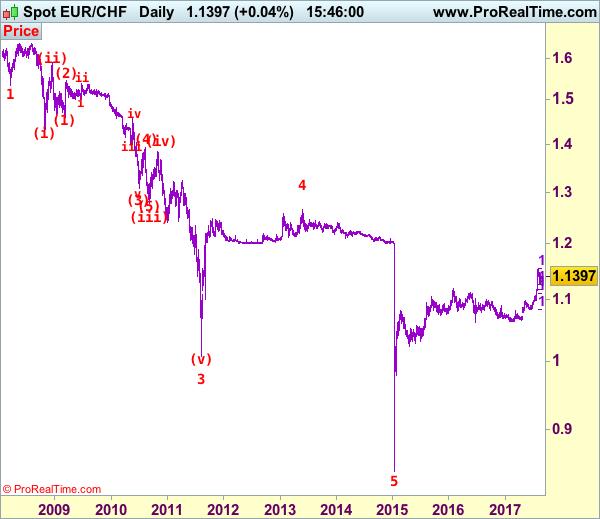
The long-term downtrend started from 1.9626 (Apr 1985) to 1.4166 (Sep 1995) is treated as wave (A) with A:1.6285 (Dec 1987), B: 1.9342 (May 1992) and C: 1.4166, then wave (B) ended at 1.6828 with A: 1.7147 (Feb 1997), B: 1.4398 (Sep 2001), C: 1.6828 (Nov 2007), therefore, wave (C) is now in progress with the breakdown indicated as above. This wave (C) already met indicated downside target at 1.1455/60 and 1.1300, it could have ended at 0.8426, consolidation with mild upside bias is seen for gain to 1.1000 and later towards 1.2000.