

Sample Category Title
USD/CHF Mid-Day Outlook
Daily Pivots: (S1) 0.9635; (P) 0.9666; (R1) 0.9703; More.....
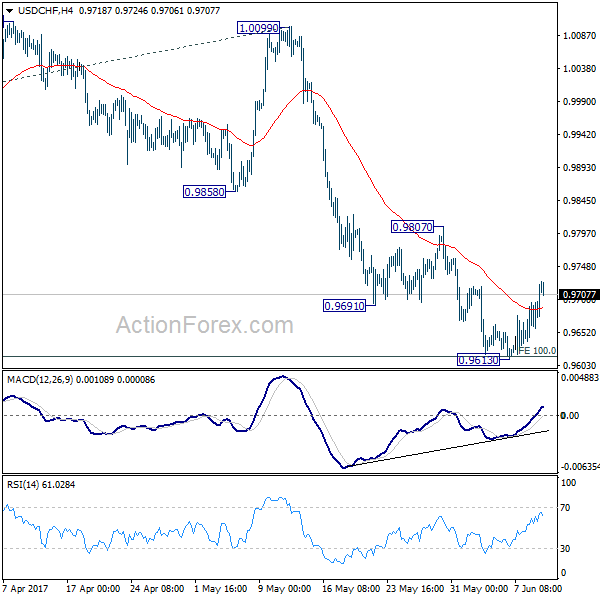
USD/CHF's rebound from 0.9613 extends higher. But still, it's limited well below 0.9807 resistance. Near term outlook stays bearish and deeper fall is expected. When decline from 1.0342 resumes, we'd start to look for bottoming signal again as it approaches 0.9443 key support level. However, considering bullish convergence condition in 4 hour MACD, break of 0.9807 will indicate near term reversal and turn outlook bullish for 1.0099 resistance next.
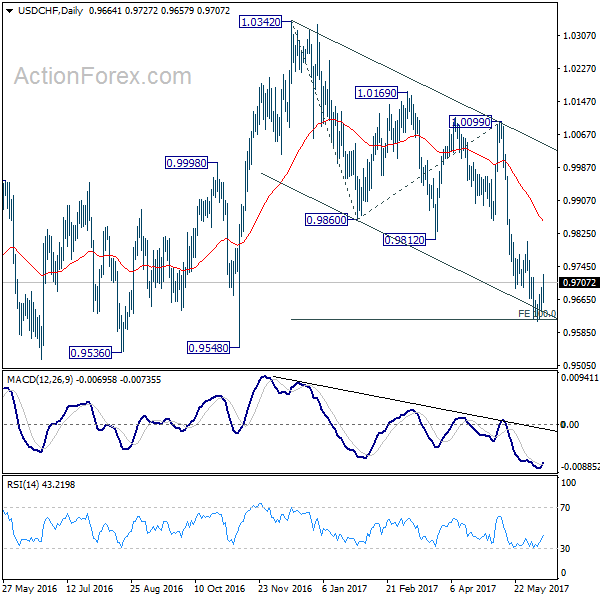
In the bigger picture, USD/CHF is still bounded in medium term range of 0.9443/1.0342 for the moment. Consolidative trading would likely continue and medium term outlook remains neutral. Break of 1.0342 key resistance is needed to confirm underlying bullish momentum in the pair. Meanwhile, downside attempts should be contained by 0.9443 key support level. However, sustained break of 0.9443 will carry larger bearish implication and target 0.9 handle.
USD/JPY Mid-Day Outlook
Daily Pivots: (S1) 109.47; (P) 109.92; (R1) 110.48; More...
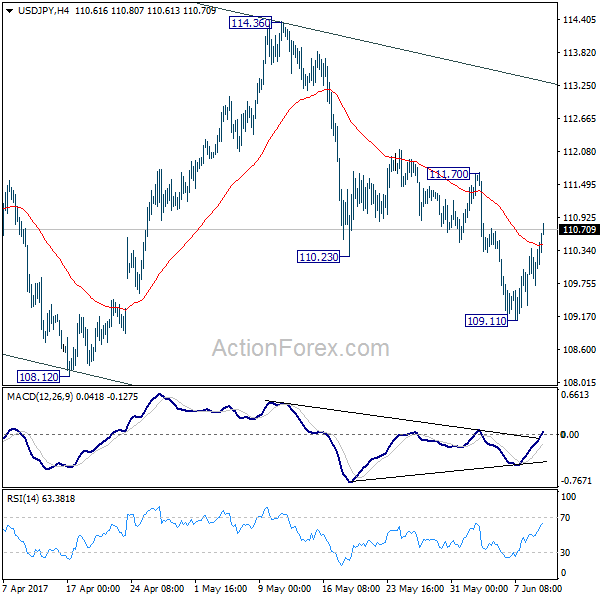
USD/JPY's rebound from 109.11 extends higher today. But still it's limited well below 111.70 resistance. Thus, near term outlook stays bearish and deeper decline is expected. Below 109.11 will target 108.12 low first. Break will extend whole decline from 118.65 to 61.8% retracement of 98.97 to 118.65 at 106.48. As such decline is seen as a correction, we'll looking for bottoming signal around 106.48. Meanwhile, break of 110.70 will suggest near term reversal and turn bias back to the upside for 114.36 resistance instead.
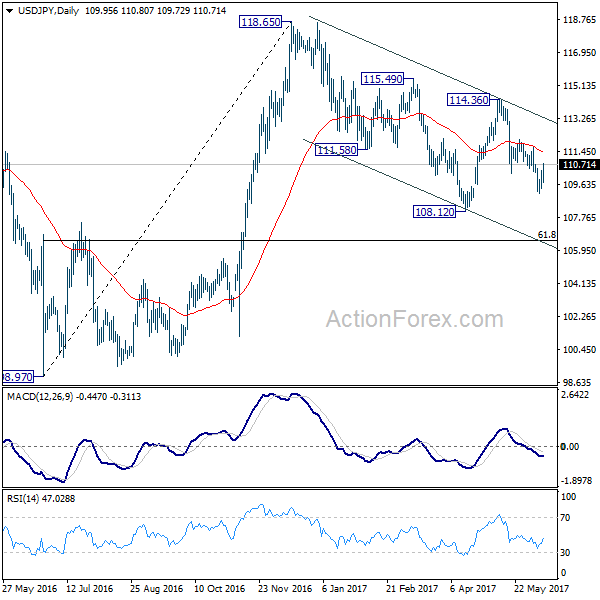
In the bigger picture, price actions from 125.85 high are seen as a corrective pattern. It's uncertain whether it's completed yet. But in case of another fall, downside should be contained by 61.8% retracement of 75.56 to 125.85 at 94.77 to bring rebound. Overall, rise from 75.56 is still expected to resume later after the correction from 125.85 completes.
GBP/USD Mid-Day Outlook
Daily Pivots: (S1) 1.2912; (P) 1.2944; (R1) 1.2982; More...
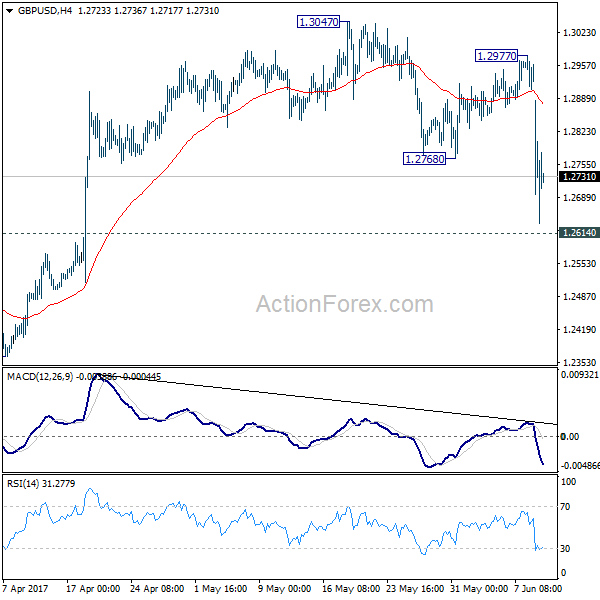
Intraday bias in GBP/USD remains on the downside as the decline from 1.3047 is still in progress for 1.2614 key support level. We're favoring the case that whole consolidation pattern from 1.1946 has completed at 1.3047 already. Decisive break of 1.2614 should confirm this bearish view. In such case, larger down trend should be resuming for a new low below 1.1946. On the upside, break of 1.2977 resistance is now needed to indicate completion of the fall from 1.3047. Otherwise, outlook will remain bearish in case of recovery.
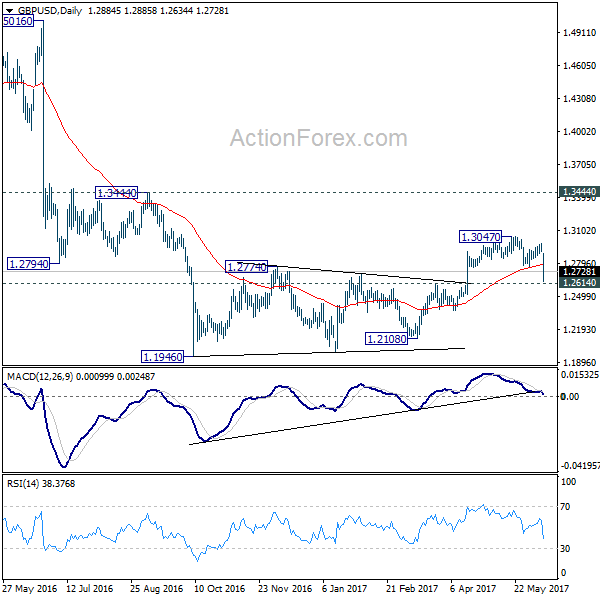
In the bigger picture, fall from 1.7190 is seen as part of the down trend from 2.1161. The rejection from 55 week EMA is maintaining bearishness in the pair. Also, at this point, as long as 1.3444 resistance holds, fall from 1.7190 is still expected to continue. Break of above mentioned 1.2614 support will affirm this bearish case.
Sterling Stabilized as Conservatives Form Coalition with Democratic Unionist Party, CAD Jumps on Employment
Sterling stabilized a bit after the post UK election sharp fall. After suffering the election backslash and losing majority in the parliament, Prime Minister Theresa May visited the Queen at Buckingham Palace to get permission to form a new government. May emphasized that "what the country needs more than ever is certainty" and "now, let's get to work". The Conservatives is now expected to form coalition with Northern Ireland's Democratic Unionist Party. And both parties reached consensus to keep May in the position for now. But overall, May's political survival remains in question. And, there are five candidates identified who could fill the role of Prime Minister, including Boris Johnson, Philip Hammond and David Davis.
Released from UK today, trade deficit narrowed to GBP -10.4b in April. construction output dropped -1.6% mom in April. Industrial production rose 0.2% mom, dropped -0.8% yoy in April. Manufacturing production rose 0.2% mom, 0.0% yoy in April. NIESR GDP estimate rose 0.2% in May.
EU officials showed impatience regarding Brexit negotiation
EU official showed some impatience on the situation of Brexit negotiation after UK election. European Commission President Jean-Claude Juncker said that the can "open negotiations tomorrow morning at half-past nine." Therefore, they are "waiting for visitors coming from London". Juncker hoped that "we will not experience a further delay in the conclusion of this negotiation." EU President Donald Tusk said that "we don't know when Brexit talks start" but "we know when they must end". Hence "do your best to avoid a no as a result of no negotiation". Meanwhile, EU's Brexit negotiator Michel Barnier said that "Brexit negotiations should start when UK is ready; timetable and EU positions are clear."
Released from Eurozone, German trade surplus widened slightly to EUR 19.8b in April.
CAD lifted by job data
Some strength is seen in Canadian dollar in early US session on solid job data. The employment market grew 54.5k in May, well above expectation of 17.0k. Unemployment rate rose 0.1% to 6.6% in May. Nonetheless, the Loonie is standing on shaky ground as weakness in oil price persists. WTI dipped to as low as 45.27 earlier today before recovering to 45.70. Near term support at 43.76 is still what the WTI is targeting at. Also from Canada, capacity utilization rate rose to 83.3% in Q1.
Elsewhere, Japan M2 rose 3.9% yoy in May. China CPI accelerated to 1.5% yoy in May, PPI slowed to 5.5% yoy. Australia home loans dropped -1.9% in April.
GBP/USD Mid-Day Outlook
Daily Pivots: (S1) 1.2912; (P) 1.2944; (R1) 1.2982; More...
Intraday bias in GBP/USD remains on the downside as the decline from 1.3047 is still in progress for 1.2614 key support level. We're favoring the case that whole consolidation pattern from 1.1946 has completed at 1.3047 already. Decisive break of 1.2614 should confirm this bearish view. In such case, larger down trend should be resuming for a new low below 1.1946. On the upside, break of 1.2977 resistance is now needed to indicate completion of the fall from 1.3047. Otherwise, outlook will remain bearish in case of recovery.
In the bigger picture, fall from 1.7190 is seen as part of the down trend from 2.1161. The rejection from 55 week EMA is maintaining bearishness in the pair. Also, at this point, as long as 1.3444 resistance holds, fall from 1.7190 is still expected to continue. Break of above mentioned 1.2614 support will affirm this bearish case.
Economic Indicators Update
| GMT | Ccy | Events | Actual | Forecast | Previous | Revised |
|---|---|---|---|---|---|---|
| 23:50 | JPY | Japan Money Stock M2+CD Y/Y May | 3.90% | 4.30% | 4.30% | 4.00% |
| 01:30 | CNY | CPI Y/Y May | 1.50% | 1.50% | 1.20% | |
| 01:30 | CNY | PPI Y/Y May | 5.50% | 5.70% | 6.40% | |
| 01:30 | AUD | Home Loans Apr | -1.90% | -1.00% | -0.50% | |
| 04:30 | JPY | Tertiary Industry Index M/M Apr | 1.20% | 0.50% | -0.20% | -0.30% |
| 06:00 | EUR | German Trade Balance (EUR) Apr | 19.8B | 20.3B | 19.6B | |
| 08:30 | GBP | Industrial Production M/M Apr | 0.20% | 0.70% | -0.50% | |
| 08:30 | GBP | Industrial Production Y/Y Apr | -0.80% | -0.30% | 1.40% | |
| 08:30 | GBP | Manufacturing Production M/M Apr | 0.20% | 0.80% | -0.60% | |
| 08:30 | GBP | Manufacturing Production Y/Y Apr | 0.00% | 0.70% | 2.30% | |
| 08:30 | GBP | Construction Output M/M Apr | -1.60% | 0.40% | -0.70% | |
| 08:30 | GBP | Visible Trade Balance (GBP) Apr | -10.4B | -12.0B | -13.4B | |
| 12:00 | GBP | NIESR GDP Estimate May | 0.20% | 0.20% | ||
| 12:30 | CAD | Capacity Utilization Rate Q1 | 83.30% | 82.40% | 82.20% | |
| 12:30 | CAD | Net Change in Employment May | 54.5K | 17.0k | 3.2k | |
| 12:30 | CAD | Unemployment Rate May | 6.60% | 6.60% | 6.50% | |
| 14:00 | USD | Wholesale Inventories Apr F | -0.30% | -0.30% |
USD/JPY Important Resistance Could Reject the Price
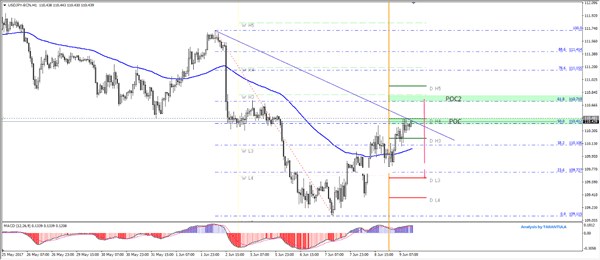
The USD/JPY has spiked due to excessive USD buying negating the yen strength during risk off as seen yesterday. The pair is at important POC zone (D H4, order block, 50.0, trend line) 110.50-55. However if momentum persists the pair could spike further to the upside towards 110.70-85 POC2 (61.8, W H3, historical sellers). Watch for possible rejection within the POC zones although I personally favour the POC2 rejection due to possible Friday profit taking. The pair should drop to 109.65 if rejected.
PM May’s Gamble to Enlarge the Conservatives Majority Fails
Notes/Observations
- UK election results in a hung Parliament; PM May's gamble to enlarge the Conservatives majority fails
- Coalition with Northern Ireland's Democratic Unionist Party (DUP) could deliver the Conservatives the votes they need to pass legislation; DUP said to back PM May (no formal agreement in place)
Overnight
Asia:
- China May CPI in-line with expectations and at a 4-month high (Y/Y: 1.5% v 1.5%e)
- BOJ's Kuroda: Japan is no longer experiencing deflation; long way to go until Japan price stability target is achieved UK Results (646 seats of 650)
- Conservatives (Tories): 315 seats (-12)
- Labour: 261 seats (+29)
- SNP: 35 seats (-21)
- Liberal Democrats: 12 seats (+4)
- DUP: 10 seats (+2)
Election commentary
- PM May: will not step down as PM; in talks with senior party colleagues about how to form a new government; to visit Buckingham Palace later today - financial press
- Labour Party leader Corbyn (opposition): PM May has lost her mandate; I think that's enough for her to go
- Liberal Democrat spokesperson Campbell: It's very difficult to see how the Party could join a coalition
- Democratic Unionist Part (DUP) Donaldson: Would negotiate with the conservatives if they fail to achieve a majority adding that they have a lot of ground
- Democratic Unionist Part (DUP) member Foster: no-one wants to see a hard Brexit; we want a workable plan
- Democratic Unionist Part (DUP) said to consider a 'confidence and supply' arrangement to ensure Theresa May has support to keep her in government
- Labour Party Finance spokesperson McDonnell: Will not do a coalition deal; will put ourselves forward to form a minority govt
- Labour Shadow Chancellor John McDonnell: Labour will seek to form a minority government because the Conservative party is not "stable, If they do seek to do a coalition with the DUP... well, pardon the expression but someone used it during the campaign, it is a coalition of chaos
- Germany's DIW institute: UK election result has turned PM May into a "lame duck" and signals voters' rejection of her tough stance in the Brexit negotiations.
Americas:
- Former FBI Dir Comey testimony: Trump administration did not ask him to stop Russia election probe; Trump did not specifically order him to let Flynn probe go; took Trump's comment as a direction, but didn't obey it My common sense was that Trump was looking to get something in exchange for granting request to stay on the job
- President Trump's attorney: Comey hearing established that Trump was not being investigated for colluding or attempting to obstruct FBI investigation
Economic Data
- (NO) Norway May CPI M/M: 0.2% v 0.2%e; Y/Y: 2.1% v 2.1%e
- (NO) Norway May CPI Underlying M/M: 0.3% v 0.3%e; Y/Y: 1.6% v 1.6%e
- (DE) Germany Apr Current Account Balance: €15.1B v €24.5Be; Trade Balance: €18.1B v €23.0Be; Exports M/M: +0.9% v +0.3%e; Imports M/M: +1.2% v -0.5%e
- (DE) Germany Q1 Labor Costs Q/Q: No est v 1.5% prior; Y/Y: 2.5% v 2.9% prior
- - (FR) France Apr Industrial Production M/M: -0.5% v +0.2%e; Y/Y: 0.6% v 1.2%e
- (FR) France Apr Manufacturing Production M/M: -1.2% v -0.5%e; Y/Y: 1.1% v 1.8%e
- (CZ) Czech May CPI M/M: +0.2% v -0.1%e; Y/Y: 2.4% v 2.2%e
- (IT) Italy Q1 Unemployment Rate Q/Q: 11.6% v 11.6%e
- (UK) Apr Industrial Production M/M: 0.2% v 0.7%e; Y/Y: -0.8% v -0.3%e
- (UK) Apr Manufacturing Production M/M: 0.2% v 0.8%e; Y/Y: 0.0% v 0.7%
- (UK) Visible Trade Balance: -£10.8B v -£12.0Be; Total Trade Balance: -£2.1B v -£3.5Be; Trade Balance Non EU: -£2.1B v -£3.9B prior
- (UK) BoE/TNS May Inflation Next 12 Month: 2.8% v 2.9% prior
**Fixed Income Issuance:
- (IN) India sold INR150B vs. INR150B indicated in 2024, 2027, 2034 and 2046 bonds
SPEAKERS/FIXED INCOME/FX/COMMODITIES/ERRATUM
**Equities**
Indices [Stoxx50 +0.5% at 3580, FTSE +0.7% at 7499, DAX +0.5% at 12775, CAC-40 +0.6% at 5294 IBEX-35 +0.2% at 10975, FTSE MIB +0.6% at 21165, SMI +0.3% at 8839, S&P 500 Futures +0.2%]
Market Focal Points/Key Themes European Indices trade higher across the board but off the earlier session highs with outperformance in the FTSE benefiting from a 200 pip plus fall in Sterling after a Hung Parliament in the UK Elections. In corporate news L'Oreal announced it was in seclusive talks with Natura in regards to BodyShop, whilst shares of Centrica trade higher after selling Canadian Business in which it will receive £240M. Air France maintains the positive news flow in Airlines after solid May metrics and RealDolmen trades sharply higher following strong Earnings.
Equities
- Consumer discretionary [Air France [AF.FR] +1.2% (May Metrics), John Menzies [MNZS] -1.8% (DX Group Investigation by the City of London Police), L'Oreal [OR.FR] +0.9% (Enters into exclusive discussions with Natura regarding sale of The Body Shop valued at €1.0B)]
- Industrials: [Airbus [AIR.FR] +1.6% (Media Day)]
- Financials: [Stanley Gibbons [SGI.UK] +15.6% (Confirms takeover approach)]
- Technology: [Realdomen [REA.BE] +5.9% (Earnings)
- Energy: [Centrica [CNA.UK] +1.7%(Partnership to sell Canadian E&P business to a consortium for C$722M in cash)]
Speakers
- PM May to go to Buckingham Palace with backing from Democratic Unionist Part (DUP) party to form govt. Conservatives and DUP will not have a formal coalition
- German Bundesbank raised its 2017 thru 2019 GDP growth forecasts. Raised 2017 GDP growth from 1.8% to 1.9%; 2018 GDP growth from 1.6% to 1.7% and 2019 GDP growth from 1.5% to 1.6%. It did cut its 2018 and 2019 inflation outlook. To just below the ECB target of around 2%.
- ECB's Weidmann (Germany) noted that a very healthy labor market situation, private consumption, together with general government demand and investment in housing in Germany would ensure an ongoing solid underlying pace
- Bank of France raised its 2017 thru 2019 GDP growth outlook. Raises 2017 GDP growth forecast from 1.3% to 1.4%; 2018 GDP from 1.4% to 1.6% and 2019 GDP from 1.4% to 1.6%
- ECB's Villeroy (France): noted that the French growth was lagging the Euro Zone. ECB remained active and was becoming more confident. ECB to remain predictable and saw no urgent need to change policy
- ECB's Nowotny (Austria) noted that ECB inflation forecasts had downside risks. Low inflation despite growth was a global issue. Did not rule out a fall in inflation in 2017 and 2018 if the Euro currency appreciated
- Labour Party leader Corbyn reiterated his call that PM May should resign. Brexit negotiations would have to go ahead without delay. Clear who won the election and was prepared to serve
- Moody's official Muehlbronner noted that was monitoring UK's process of forming new government
- Spain Catalan leader Puigdemont: To hold independence vote on Oct 1st with question will be "Do you want Catalonia to be an independent State within a Republican regime?"
- South Korea National Security Advisor: Do not look to change the agreement with US on the THAAD missile defense
Currencies
- FX market focus was on the GBP following the UK election results. GBP/USD began the session testing 7-week lows at 1.2635 before recovering and moving back above the 1.27 handle. The UK election results saw PM May lose her gamble with a hung Parliament and this increased uncertainty about the upcoming Brexit negotiations. Only one month ago the expectation was that the Conservatives would win big, and secure a landslide victory - The USD was slightly firmer against other major pairs in relatively quiet trading with focus on the Fed rate decision next week. The big question if the Fed does hike in June whether it would leave the door open for further monetary tightening in the months to come
- EUR/USD remained on soft footing after Thursday's ECB meeting and quarterly staff projections. The main focus was on inflation and the trimming of CPI during the ECB forecast horizon.
- The yen did not respond to any safe-have role despite the uncertainty of the UK election. USD/JPY higher by 0.4% and firmly above the 110 level for the time being.
Fixed Income
- Bund futures trade at 164.98 down 10 ticks after the ECB kept its monetary policy unchanged, but changed its forward guidance by removing its easing bias regarding policy rates. Resistance lies near the 165.70 level followed by 167.79. A break of the 162.65 support level could see lows target 159.96 followed by 157.50.
- Gilt futures trade at 129.08 higher by 25 ticks after the early general election resulted in a hung parliament. Gilts are in the middle of this week's trading range and continue to gravitate towards both the 129.00 handle and the 129.14 April 18th high. Price finds key support at the 128.48 support level. An acceleration lower could test the 127.43 region. Resistance remains the noted 129.00/129.14 region, then 129.75 followed by 130.28.
- Friday's liquidity report showed Thursday's deposits dropped rose to €614.9B from €608.4B prior. Use of the marginal lending facility fell to €143M from €257M prior.
- Corporate issuance saw $0.5B come to market via 1 issues headlined by Maxim Integrated Products senior unsecured note offering. This week's issuance is at $17.05B, lower than the analysts' issuance target to come in around $25B. For the week ending Jun 7th Lipper US fund flows reported IG funds net inflows $3.73B bringing YTD inflows to $61.69B, High yield funds reported outflows of $0.52B bringing YTD outflows to $4.90B.
Looking Ahead
- PM May post-election speech
- (MX) Mexico May Nominal Wages Y/Y: No est v 3.9% prior
- (PT) Portugal Debt Agency (IGCP) announces upcoming PGB auction for Jun 14th
- 05:30 (PL) Poland to sell Bonds
- 06:00 (UK) DMO to sell combined £3.0B in 1-month, 3-month and 6-month bills (£1.5B, £0.5B and £1.0B respectively)
- 06:00 (PT) Portugal Apr Trade Balance: No est v -€0.8B prior
- 06:45 (US) Daily Libor Fixing
- 07:00 (BR) Brazil Jun IGP-M Inflation (1st Preview): -0.4%e v -0.9% prior
- 07:00 (LT) ECB's Rimsevics
- 07:00 (CZ) Czech Central Bank comments on CPI data
- 07:30 (IN) India Weekly Forex Reserves
- 07:30 (UK) PM May at Buckingham palace
- 08:00 (UK) May NIESR GDP Estimate: No est v 0.2% prior
- 08:00 (BR) Brazil May IBGE Inflation IPCA M/M: 0.5%e v 0.1% prior; Y/Y: 3.8%e v 4.1% prior
- 08:15 (UK) Baltic Dry Bulk Index
- 08:30 CA) Canada May Net Change in Employment: +15.0Ke v +3.2K prior; Unemployment Rate: 6.6%e v 6.5% prior; Full Time Employment Change: No est v -31.2K; Part Time Employment Change: No est v +34.3K prior; Participation Rate: No est v 65.6% prior
- 08:30 (CA) Canada Q1 Capacity Utilization Rate: 83.5%e v 82.2% prior
- 09:00 (RU) Russia Apr Trade Balance: $8.7Be v $12.6B prior; Exports: $27.4Be v $31.3B prior; Imports: $18.7Be v $18.7B prior
- 09:00 (MX) Mexico Apr Industrial Production M/M: 0.3%e v 0.0% prior; Y/Y: -2.1%e v +3.4% prior; Manufacturing Production Y/Y: -1.0%e v +8.5 prior
- 10:00 (US) Apr Final Wholesale Inventories M/M: -0.3%e v -0.3% prelim; Wholesale Trade Sales M/M: 0.2%e v 0.0% prior
- 11:00 (EU) Potential sovereign rating after European close
- (CZ) Czech Sovereign Debt to be rated by Moody's - (IT) Italy Sovereign Debt to be rated by Moody's
- (PL) Poland Sovereign Debt to be rated by DBRS
- 12:00 (US) USDA World Agricultural Supply and Demand Estimates (WASDE) Crop Report
- 13:00 (US) Weekly Baker Hughes Rig Count data
- 13:30 (DE) German Fin Min Schaeuble at CDU party event
- 14:00 (CO) Colombia Central Bank May Minutes
Pound: “We Did Not Mean to Vote for Brexit”
Friday June 9: Five things the markets are talking about
It's little surprise to see sterling tumble, as much as -2.4%, after a disastrous night for the PM Theresa May's Conservatives party, who with an electoral swing, lost her parliament majority with a hung House of Commons.
The key concern driving U.K asset prices, aside from market liquidity issues, is how this election will impact Britain's ongoing divorce with the European Union, which Prime Minister Theresa May had already begun three-months ago.
The Conservatives, as the party with most seats (316), will have first shot at trying to form a new government either as a formal coalition with another party or by relying on other parties to help vote through its policies.
If they can't build a majority large enough to govern, the Labour Party (261) would get a chance to form a government.
What's left is that the market again faces more political uncertainty and with Comey's testimony in Washington yesterday, it's on both sides of the Atlantic.
Note: This morning's press conference - PM May said she will not step down as PM and is in talks with senior party colleagues about how to form a new government.
For more political intrigue it's now onto French where voters go to the polls this weekend as part of a two-step process for parliamentary elections. The outcome will decide how much control President Macron will have to enact his legislative agenda.
1. Global stocks mixed results
In Japan, the Nikkei 225 stock average rallied +0.5%, supported by the index heavyweight SoftBank who rallied +7.4% to the highest in 17-years after agreeing to buy Boston Dynamics from Google parent Alphabet Inc. The broader Topix index rose +0.1%.
In Hong Kong, the Hang Seng fell -0.2%, the Hang Seng China Enterprises Index lost -0.6% and the Shanghai Composite added +0.3% - data overnight showed China's producer price gains moderated following further easing in commodity prices.
Elsewhere, South Korea's Kospi index climbed +0.8% and Singapore's Straits Times Index added +0.5%.
In Europe, indices are trading higher across the board, but off the earlier session highs with outperformance in the FTSE 100 benefiting from -2% slide in the pound (£1.2720).
In the U.S, stocks are set to open in the 'black.'
Indices: Stoxx50 +0.5% at 3580, FTSE +0.7% at 7499, DAX +0.5% at 12775, CAC-40 +0.6% at 5294 IBEX-35 +0.2% at 10975, FTSE MIB +0.6% at 21165, SMI +0.3% at 8839, S&P 500 Futures +0.2%
2. Oil prices resume slide as supply glut prevails
Global oil prices have resumed their downtrend ahead of the U.S open following steep falls this week, pressured by widespread evidence of a fuel glut despite efforts led by OPEC to tighten the market.
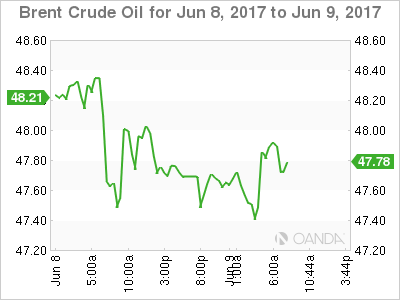
Brent crude is down -20c at +$47.66 a barrel, around -12% below its opening level on May 25, when an OPEC promise to restrict production was extended into 2018. U.S. light crude (WTI) is down -20c at +$45.44.
Not helping the supply glut is U.S supplies and production rates. U.S data this week showed a surprise +3.3m barrel build in commercial crude oil stocks to +513.2m. Inventories of refined products were also up, despite the start of the peak-demand summer driving season.
Note: U.S. refined oil product inventories are now back above 2016 levels and well above their five-year range.
Technically, the world is awash with crude and more production is coming. Libya's 270k-bpd Sharara oilfield has reopened after a workers' protest and should return to normal production by next week.
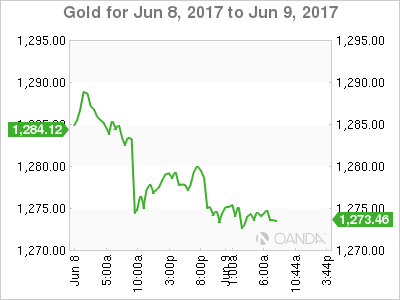
In early trade, gold (-0.4% to +$1,274.95) has fallen for a third day as the USD firmed after the U.K national election results left no single party with a majority.
3. Yields back up
Yesterday, the ECB kept its monetary policy unchanged, but changed its forward guidance by removing its easing bias regarding policy rates. German 10-year Bund yields are flat at +0.25%.
French 10-year yields have fallen -1bps ahead of this weekend's parliamentary election.
In the U.K, despite the political uncertainty, asset prices moves remain very well contained. U.K 10-years Gilts U.K. gilt yields rose +2 bps to +1.06%, after climbing +3 bps yesterday. The inconclusive U.K general election results will make it almost certain that the Bank of England (BoE) will keep monetary policy ultra-loose to support growth.
The focus now switches to next week's Fed decision (June13-14). For many, the big question is if the Fed does hike next week is whether it would leave the door ajar for further monetary tightening in the months to come. The yield on 10-year Treasury notes has rallied +1 bps to +2.20%.
4. Pound plummets on political woes
It's little surprise that the focus in FX overnight was the pound and the U.K election results.
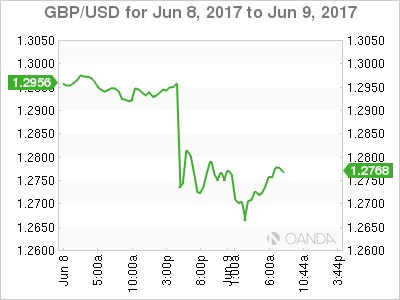
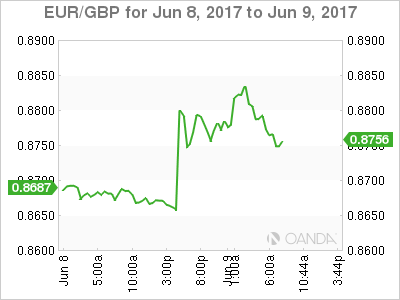
Sterling began the European session testing its two-month lows atop or £1.2635 on the possibility that PM May would not be able to acquire a solid majority. It has since recovered to trade back above £1.2741 on fundamental support - U.K showed industrial production weaker than forecast in April, but the trade deficit narrower more than expected.
Sterling remains down close to -2% compared with just before exit polls were released late Thursday.
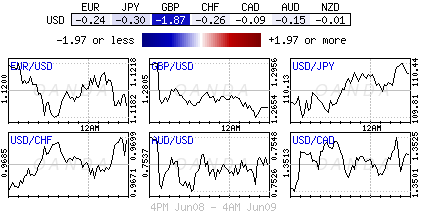
The 'big' dollar remains slightly firmer against other major pairs in relatively quiet trading with focus on the Fed rate decision next week. The EUR (€1.1179) is a tad softer after yesterday's ECB meeting and quarterly staff projections.
The yen (¥110.38) has not responded to any safe-haven demand after the PM May's disastrous election.
5. Germany's trade surplus steadies in April
Data this morning showed that Germany's adjusted trade surplus was unchanged in April, after exports and imports picked up further compared with the previous month.
Total exports of goods increased for the fourth consecutive month to a record of €106.3B in April. Goods imports rose by +1.2% to €86.6B (record).
This resulted in a stable trade surplus of €19.8B - the market was expecting €20B.
Note: German exports have picked up notably since the start of the year, led by stronger demand from China and India.
Elliott Wave Analysis: USD Index Undergoing A Recovery
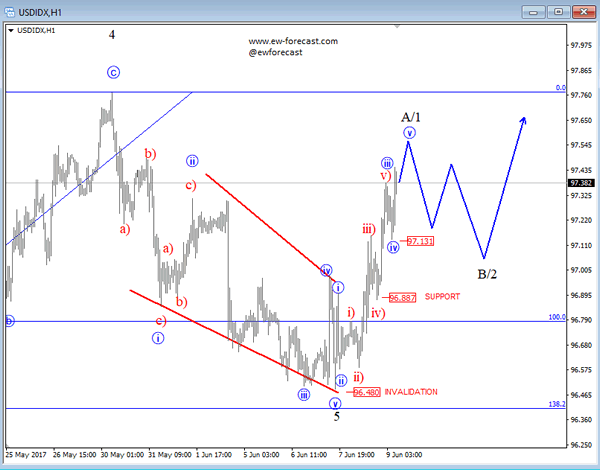
USD Index is making a rally from the lows, specifically from the 96.48 level where we labeled end of wave 5. Current impulsive sequnce can be the first sign of a low in place and a suggestion that more gains may follow. At the moment we see first wave A/1 in motion, which can be trading in final stages. Once wave A or 1 unfolds, a new three wave correction into wave B or 2 may follow. Support for the upcoming correction can be around 96.88/97.12 region.
USD Index, 1H
UK Election Results In Further Questions Than Answers
The eyes of the world are on the United Kingdom once again following another unexpected outcome to an election vote.
Has recent history repeated itself once again? It certainly feels that way after it appears that market expectations were once again left on the wrong side of the trade when it comes to a UK vote, with the UK election concluding in a hung parliament. This wasn’t what anyone really wanted or expected as traders themselves watch the Pound slip 300 points against the Dollar, with losses in the British Sterling now seeing the currency diving all the way from 1.2950 to marginally below 1.2635 at the time of writing.
Before we dissect into the nitty gritty details around the behavior of the Pound there are a couple of other market-related questions on spectator’s minds, for example why has the FTSE 100 climbed higher at European open despite all of this uncertainty? This is most likely due to the Pound weakness and the inverse correlation that has seen Pound losses encourage FTSE gains over the past year. Another question that has left some puzzled is why has the financial market fluctuations been so restricted towards the Pound, and not seen in other asset classes like demand for safe-havens? It appears that investors are treating the UK election as an independent Brexit/Britain issue, which is something that will lead to more concern for the UK and its economy than impacts elsewhere on the financial markets.
Moving back to the Pound, another question on the mind of traders is why is the currency not moving further south? With all the uncertainty in mind, the next direction for the Pound should be lower and I personally still think that 1.25 is the possible eventual target for sellers should the selling momentum continue. The outcome to the UK election has been the opposite to what traders priced into the markets with the expectation of a landslide victory for Theresa May not occurring, which is why the Pound is looking at risk to retracing all gains made since the announcement of the snap election.
Some even expected the Pound to plunge all the way towards 1.20 against the Dollar in the event of a hung parliament and while the market might not have moved as much as expected with the door of uncertainty for the UK open even wider following this result, what this means away from any valuations in the financial markets is that the worst potential outcome has been realized with official Brexit negotiations scheduled to begin in less than a fortnight. It was widely perceived that the major motive for Theresa May to announce a snap election was to have a stronger hand in the Brexit negotiations, but her playing card has not turned out as she had hoped and now the UK is embracing even more uncertainty just days away from a collision course with the European Union.
Where does the market head from here? The risks look heavily tilted towards further downside pressure. What investors could be waiting for is some clues on what could possibly be happening next, before determining what direction the Pound should really be heading in next.
Although this outcome has come as an unexpected surprise for most, what we can confidently say at this stage is that the UK is going to encounter further political instability and this represents a wide contrast from the United Kingdom of the past, something that has clearly changed since the EU referendum and looks set to continue.
DAX Posts Gains As ECB Drops Rate Guidance, Upgrades Growth Forecast
The DAX index has posted modest gains in the Friday session. The index is up 0.49% and is currently at 12,770.50 points. On the release front, there is just one event on the schedule. Germany's trade surplus improved to EUR 19.8 billion, but this fell short of the forecast of EUR 20.3 billion.
The ECB played it cautious at the June policy meeting. The central bank maintained the benchmark rate at 0.00%, and made no changes to its quantitative easing scheme (QE) of EUR 60 billion/month. However, there was an unexpected development, as the ECB removed its guidance on rate cuts, saying that rates could remain at current levels for an extended period. Effectively, the ECB has closed the door on lowering rates into negative territory, although the bank could change its stance if economic conditions in the euro-area deteriorate. On a brighter note, the ECB revised upwards its growth forecasts for the eurozone – from 1.8% to 1.9% in 2017, and from 1.7% to 1.8% in 2018. Analysts also noted a shift in language, as Draghi characterized risks to the economy as “broadly balanced”, compared to previous warnings that risks were “tilted to the downside”. However, low inflation levels remain a serious concern, and the ECB acknowledged this, lowering its inflation forecast. The ECB is now predicting inflation in 2017 at 1.5% in 2017 and 1.3% in 2018. Back in March, the forecast stood at 1.7% in 2017 and 1.6% in 2018. The ECB is not expected to revisit its monetary policy until the September meeting. Drahgi and his colleagues appear in no rush to tighten monetary policy, but at the same time, policymakers carefully chose less dovish language in the rate statement, in order to relieve pressure from Germany, which has been outspoken in demanding tighter monetary policy.
There was plenty of excitement in Washington on Thursday, as former FBI director James Comey testified before the Senate Intelligence Committee on Thursday, The TV ratings were high, but Comey did not deliver any bombshells while on the stand. Comey stated that he was not specifically asked by President Trump to close an investigation into Trump's alleged ties with Moscow, so it is unlikely that his testimony will be the “smoking gun” that leads to charges of obstruction of justice against Trump. Still, Comey's testimony raised troubling questions about Trump's conduct, and will only complicate matters for the beleaguered Trump administration. Investors are growing more skeptical that Trump, who seems to be spending most of his time in damage control mode, will be able to deliver on key promises, and may come to view the president as a lame duck, just months into his presidency.