

Sample Category Title
Technical Outlook: EURUSD – Range Trading Ahead Of ECB
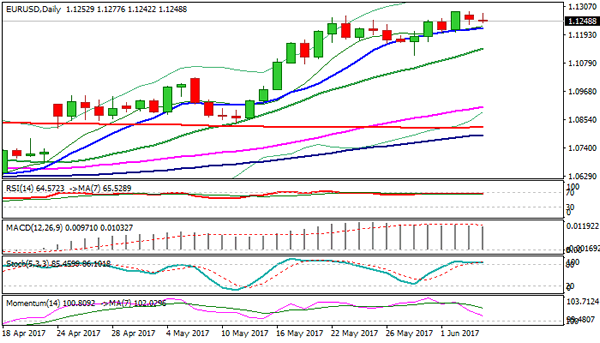
The Euro is holding within narrow consolidation under fresh high at 1.1285, as traders are awaiting signals from ECB on Thursday.
Overall bullish structure remains intact, underpinned by rising 10SMA (1.1219) and eyes immediate targets at 1.1299 (09 Nov post-US election high) and 1.1313 (Fibo 76.4% of 1.1614/1.0340 descend).
Extended directionless trading is expected ahead of ECB, with shallow dips to be contained above 10SMA/daily Tenkan-sen (1.1219/1.1197), as the pair so far ignores overbought conditions.
Near-term direction will depend from the ECB's decisions on Thursday's meeting. Markets are expecting more hawkish tone to further boost the single currency for 1.1300+ gains.
On the other side, softer tone from the central bank would disappoint traders and likely spark fresh weakness.
Loss of 1.1200 handle would generate initial bearish signal and risk extension towards key 1.1109 support (30 May trough).
Res: 1.1277, 1.1285, 1.1313, 1.1366
Sup: 1.1236, 1.1219, 1.1197, 1.1164
GBP/USD Elliott Wave Analysis
GBP/USD – 1.2919
GBP/USD – Wave 4 is unfolding as an (A)-(B)-(C) and could have ended at 1.7192
The British pound found support at 1.2769 and has rebounded, however, reckon upside would be limited to 1.2960-70 and resistance at 1.3015 should hold, bring further consolidation below recent high at 1.3048. Only a daily close above 1.3015 would signal pullback from 1.3048 has ended, bring retest of this level, break there would extend recent upmove from 1.1986 low to 1.3140-50 (38.2% Fibonacci retracement of 1.5018-1.1986) and possibly 1.3200, however risk from there has increased for a retreat later.
Our preferred count on the daily chart is that cable's rebound from 1.3500 (wave (A) trough) is unfolding as a wave (B) with A ended at 1.7043, followed by triangle wave B and wave C as well as wave (B) has possibly ended at 1.7192, below support at 1.4232 would add credence to this count, then further fall to 1.4000 level would follow but reckon downside would be limited to 1.3655 support and price should stay above previous support at 1.3500.
On the downside, expect pullback to be limited to 1.2830 and bring another recovery. Below 1.2830 would bring test of 1.2757-69 support area, break there would signal a temporary top has been formed, bring retracement of recent rise to previous resistance at 1.2706 (now support), then towards 1.2650-60 but previous resistance at 1.2616 (tentatively wave i top) should remain intact.
Recommendation: Stand aside for this week.

Longer term - Cable's rise from 1.0520 (Feb 1985) to 2.0100 (September 1992) is seen as [A], the decline to 1.3682 is labeled as (B) and (C) wave rally has ended at 2.1162 (9 Nov, 2007) which is also the top of larger degree wave B with circle. The selloff from there is a 5-waver with wave (A) ended at 1.3500 (23 Jan 2009), wave (B) itself is labeled as A: 1.6733, triangle wave B: 1.4813 and wave C as well as top of wave (B) ended at 1.7192 (2014), hence the selloff from there is an impulsive wave (C) with wave I : 1.4566, wave II 1.5930, an extended wave III is unfolding and already exceeded our downside target at 1.3500 and 1.3000, hence weakness to 1.2500 and possibly 1.2000 cannot be ruled out, however, price should stay well above psychological level at 1.0000.

GBP/CHF Elliott Wave Analysis
GBP/CHF – 1.2470
GBP/CHF – Circle wave v ended at 0.9106 and major correction has commenced for subsequent gain to 1.5547.
Sterling continued heading south after last month’s selloff fro1.3069, adding credence to our view that top has been formed there and bearishness remains for this decline to extend weakness to 1.2340-50, then towards support at 1.2285, however, oversold condition should prevent sharp fall below previous chart support at 1.2215, risk from there has increased for a rebound to take place later this month.
To recap the larger degree count, the selloff from 2.4965 (July 2007) is the beginning of wave V with circle and is labeled as 1: 2.3760, 2: 2.4425, wave 3 extension ended at 1.1470, followed by wave 4 at 1.5547, the quick rebound from 0.9106 suggests wave 5 as well as entire circle wave V could have ended there, hence consolidation with mild upside bias is seen for major correction to take place, bring initial test of 1.5547 (previous 4th of a lesser degree).
On the upside, whilst initial recovery to 1.2535-40 cannot be ruled out, reckon upside would be limited to 1.2595-00 and bring another decline later. Only a daily close above resistance at 1.2690-95 would abort and suggest first leg of decline from 1.3069 has ended, bring a stronger rebound to 1.2740-50, however, as top has been formed at 1.3069, still reckon upside would be limited to 1.2785-90 and price should falter below 1.2850-60, bring another decline later.
Recommendation: Sell at 1.2700 for 1.2500 with stop below 1.2800.

On the Monthly chart, the longer-term count is that major downtrend is under way with circle wave I at 2.8645 (Sep 1.978), then wave II with circle at 4.6175 (Feb 1981), the wave III with circle ended at 1.7425 (Nov 1995) and followed by wave IV with circle at 2.4965 (July 2007 with a short wave C) and wave V with circle has possibly ended at 0.9106. A monthly close above 1.5547 would add credence to this view, bring major correction to 1.7000, then towards psychological level at 2.0000.

Trade Idea: GBP/USD – Stand aside
GBP/USD – 1.2925
Recent wave: Wave V of larger degree wave (III) has ended at 1.1986 and major correction has commenced from there for gain to 1.3000 and 1.3140-50
Trend: Near term up
Original strategy :
Sold at 1.2920, stopped at break-even
Position: - Short at 1.2920
Target: -
Stop: - 1.2920
New strategy :
Stand aside
Position: -
Target: -
Stop:-
The British pound has risen again in part due to cross-buying in sterling and the breach of resistance at 1.2921 signals the rebound from 1.2769 low is still in progress, hence upside risk remains for further gain to 1.2955-60 and then 1.2975-80, however, reckon resistance at 1.3015 would limit upside, bring further choppy trading later. Only a break of said resistance at 1.3015 would signal the correction from 1.3048 top has ended, bring resumption of upmove for retest of this level first.
Our preferred count on the daily chart is that cable's rebound from 1.3500 (wave (A) trough) is unfolding as a wave (B) with A ended at 1.7043, followed by triangle wave B and wave C as well as wave (B) has ended at 1.7192, the subsequent selloff is the larger degree wave (C) which is still unfolding with minor wave (III) of larger degree wave 3 ended at 1.1986, hence wave (IV) correction is in progress which could either be a triangle wave (IV) of a complex formation but upside should be limited to 1.3500 and price should falter well below 1.4000, bring another decline in wave (V) of 3 for weakness to 1.1500, then 1.1200.
On the downside, aspect pullback to be limited to 1.2890-95 and 1.2845-50 should hold, bring further consolidation. Only below support at 1.2830 would revive bearishness and signal the rebound from 1.2769 low has ended, bring further fall to 1.2800 first.

Arab Gulf’s Banning over Qatar Might Help Australia’s LNG Exports
Geopolitical uncertainty in the Middle East lifted Australian dollar. A boycott over Qatar is expected to disrupt the country's exports, benefitting its rival, Australia, over LNG exports. Aussie, however, retreated on 'Tuesday, using RBA announcement as an excuse. The central bank reiterated that the global economy continued the "broad-based pick-up", suggested that the domestic economic transition from mining investment has "almost complete" and maintained a neutral tone on the monetary policy. Yet, it remained concerned that low household income growth would constrain consumption. We are skeptical over RBA's forecast that Australia's economy growth would reach+3% p.a. and cast doubt over how long it can refrain from cutting the policy rate further so as to prevent the property bubble.
Australia and Qatar: Rivals in Natural Gas Exports
Aussie's rebound accelerated on Monday amidst news that Arab Gulf countries cut diplomatic ties with Qatar and suspended Doha-bound flights. A statement issued by the Saudi government accused Qatar of collaborating with "Iranian-backed terrorist groups" in the eastern region of Qatif and in Bahrain, while Qatar called the accusation "unjustified" and with "no basis in fact".
Australia and Qatar are trading partners. Australia's exports to Qatar amounted to AU$ 0.55B, and its imports from Qatar amounted to AU$ 0.45B, in 2015-16. Total merchandise trade was approximately at AU$ 1B during that period. Exports are dominated by meat, motor vehicles and live animals. Imports from Qatar are almost entirely fertilisers and LNG products. Yet, these figures were insignificant when compared with the trade relations between Australia and China. Australia's exports to China amounted to AU$75B, and imports from China amounted to AU$61.5B, in 2015-16. Merchandise trade totaled at AU$ 136.7B during the period.
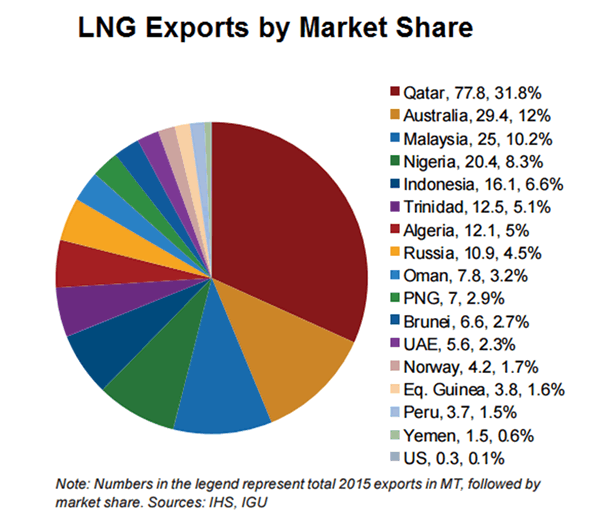
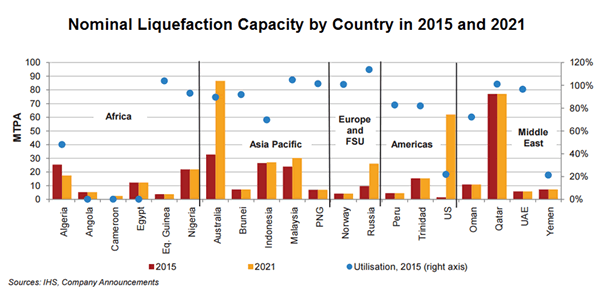
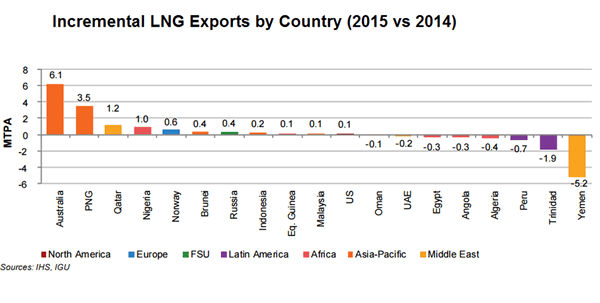
Indeed, Australia and Qatar are rivals in natural gas exports. Natural gas is Australia's third largest exports in value terms, after iron ore and concentrates, and coal. It takes up 5.4% of the country's total exports in 2014. Qatar is the largest exporter of LNG, producing around one-third of the LNG traded. Yet, the rapid ramp-up in LNG investments has raised expectations that Australia would become the world biggest exports by 2020. This hope, was, however, dampened two months ago, as Qatar announced plans to lift the moratorium on further development of its huge North gas field. It was expected that such development could convert to 15.3M tonnes of natural gas per year, in addition to the Middle East country's existing 77M tonnes annual capacity. The market now expects that the boycott would disruption Qatar's exports, benefiting Australia.
RBA Struggled to Keep Rates Unchanged.
As widely anticipated, RBA left the cash rate unchanged at 1.5% in June. Policymakers indicated that, "transition to lower levels of mining investment following the mining investment boom is almost complete". Meanwhile, "business conditions have improved and capacity utilization has increased. Business investment has picked up in those parts of the country not directly affected by the decline in mining investment". While acknowledging growth moderation in the first quarter, the central bank maintained the view that GDP growth would "increase gradually over the next couple of years to a little above +3%". On the job market, policymakers acknowledged the payroll growth but remained concerned over the subdued growth in total hours worked as well as wage growth remains. Policymakers warned that persistently low growth in wage would restrain household consumption.
We believe the RBA has been over-optimistic over the economic growth outlook. The huge volatility of commodity prices and concerns over Chinese economy slowdown are the major headwinds to Australian economy. Meanwhile, as the RBA suggested, consumption growth remains challenging on subdued wage growth. Although government spending might provide a boost, the recent budget signals that fiscal stimuli are not under consideration.
We retain the view that RBA is refraining from reducing interest rates so as not to exacerbate the acceleration in housing prices. Policymakers acknowledged that housing prices have been "rising briskly in some markets, although there are some signs that these conditions are starting to ease". They remained concerned that the growth in housing loan has outpaced that of household income. However, the central bank would be forced ease the monetary policy if the economic developments come in worse than what it has anticipated
Trade Idea: GBP/JPY – Target met and look to sell higher
GBP/JPY - 141.65
Recent wave: Medium term low formed at 120.50 and (A)-(B)-(C) major correction has commenced with (A) leg ended at 148.45, hence wave (B) is unfolding for retreat to 131.00-10.
Trend: Near term up
Original strategy:
Sold at 143.65, met target at 141.65
Position: - Short at 143.65
Target: - 141.65
Stop: -
New strategy :
Look to sell again higher
Position: -
Target: -
Stop:-
Sterling met renewed selling interest at 143.10 yesterday and has fallen again in line with our bearish expectation, our short position entered at 143.65 met downside target at 141.65 (with 200 points profit) and a sustained breach below indicated previous support at 141.50 would extend the selloff from 148.10 top to 141.00 but loss of momentum should limit downside to 140.50-55 and price should stay above psychological support at 140.00, bring rebound later.
As we have taken profit on our short position entered at 143.65, would not chase this fall here and would be prudent to stand aside for now. Above 142.10-15 would bring recovery to 142.55-60 but said resistance at 143.10 should remain intact and bring another decline later. Only a break above 143.10 would suggest low is formed instead, risk a stronger rebound to 143.40-50 but resistance at 143.95-00 should remain intact.
Our preferred count is that larger degree wave V with circle is unfolding from 251.12 with wave (I) 219.34, (II): 241.38 and wave (III) is subdivided into 1: 192.60, 2: 215.89 (23 Jul 2008) and wave 3 ended at 118.87 earlier in 2009. The correction from there to 162.60 is wave 4 which itself is a double three and is labeled as first a-b-c ended at 151.53, followed by wave x at 139.03, 2nd a ended at 162.60, 2nd b at 146.75 and 2nd c leg of wave 4 ended at 163.00. Therefore, the decline from 163.00 to 116.85 is now treated as wave 5 which also marked the end of larger degree wave (III), hence wave (IV) major correction has commenced for retracement of the wave (III) from 241.38 and upside target at 183.95-00 (50% Fibonacci retracement of the wave (II) from 241.38) had been met, a drop below 160.00 would suggest wave (IV) has ended at 195.85, bring decline in wave (V) for initial weakness to 130 (already met) and 120.

Gold Resumes Bullish Momentum
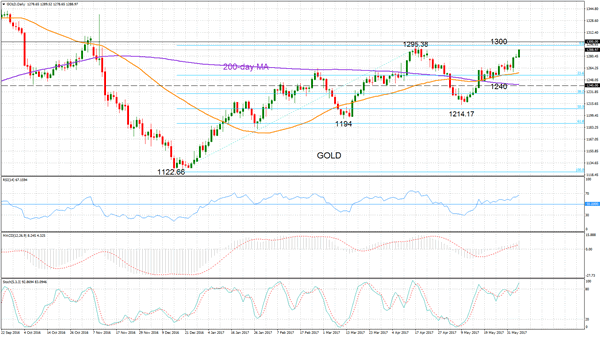
Gold maintains its bullish outlook as it resumes its upside momentum following a pause in the rally for a few weeks in May after rebounding from a low of 1214.17. There is scope to target the key level at 1300. Prices would have to pass the April 17 high of 1295.38 in order to confirm that a lower low is in place at 1214.17 (May 9 low) and to strengthen the bullish bias. A successful break above 1300 would open the way to the next resistance level at the November high of 1337.12.
The medium-term uptrend remains in progress as gold has been carving out higher highs and higher lows since rising from the mid-December low of 1122.66.
The RSI has picked up momentum and is rising after pausing in the month of May. Being above 50 in bullish territory suggests that there is room for further upside in gold prices. MACD has recently crossed above zero, giving a bullish signal.
Meanwhile, the bullish crossover of the 50-day moving average with the 200-day MA on May 17 supports the overall bullish outlook.
If prices fail to rise and instead decline from current levels, important support comes into view at 1240 and 1214.17. Below this, the market is at risk of changing the medium-term bullish trend to a more bearish one.
Dollar Extends Decline; Aussie Rallies after RBA; Oil Under Pressure
The dollar was broadly weaker and the yen gained on safe haven demand. The aussie rallied after the RBA meeting. Oil remained under pressure.
The Reserve Bank of Australia announced its decision to hold its benchmark interest rate steady at 1.5% and said that its unchanged policy was consistent with sustainable growth and hitting its inflation target. The markets took comfort from the RBA statement and this helped the aussie erase earlier losses to reach a session high of $0.7495. Prior to the RBA announcement the currency had fallen to a session low of $0.7456 after a big miss in Australia's current account balance.
The euro and sterling rose ahead of the ECB meeting and the UK election. Both key events will take place on Thursday.
The euro edged up against the dollar to reach $1.1276, close to a six-month high reached yesterday.
The pound has been quite resilient despite uncertainty regarding the general elections in the UK this week. Recent polls have been mixed. Some polls indicated a narrowing lead for the Conservatives over the Labour Party while British bookmaker William Hill showed increased odds for a majority win by Prime Minister Theresa May. This news combined with a broadly weaker dollar helped cable rise to a session high of $1.2949.
Data out of Japan today showed nominal wages rose last month. Average cash earnings rose 0.5% year-on-year in May versus 0.3% expected.
The dollar / yen pair extended losses after the Japanese data to fall below the key 110-yen level. The greenback was already weighed down by disappointing US data out yesterday on ISM non-manufacturing PMI. The weaker numbers raised concerns that the Federal Reserve would slow down the pace of rate hikes after June. The dollar index touched its lowest level since November, reaching 96.46.
Oil prices extended declines on escalating tensions in the Middle East, after four Arab nations, including Saudi Arabia, cut ties with Qatar. Markets fear the diplomatic spat could hamper a global deal to reduce oil production levels, sending WTI crude prices below $48 a barrel since the news broke yesterday. Prices have been fluctuating around the $47.25 area in the past two trading sessions.
Gold extended gains to reach $1289.38 an ounce, helped by a broadly weaker dollar and safe haven demand.
Trade Idea: EUR/JPY – Hold long entered at 123.75
EUR/JPY - 123.31
Recent wave: wave v of (C) ended at 94.12 and major correction in wave A has ended at 149.79
Trend: Near term up
Original strategy:
Bought at 123.75, Target: 125.75, Stop: 123.15
Position: - Long at 123.75
Target: - 125.75
Stop: - 123.15
New strategy :
Hold long entered at 123.75, Target: 125.75, Stop: 123.15
Position: - Long at 123.75
Target: - 125.75
Stop:- 123.15
Current selloff dampened our near term bullishness and support at 123.16 needs to hold to retain prospect of another rebound later, above 124.15-20 would suggest the retreat from 125.31 has ended, bring test of 124.71 resistance but break there is needed to confirm and bring another test of said resistance at 125.31. Looking ahead, above 125.31 would extend gain towards strong resistance at 125.82 but break there is needed to confirm recent upmove has resumed and extend headway to 126.20-30 and possibly 126.60-70.
In view of this, we are holding on to our long position entered at 123.75. Below support at 123.16 would abort and shift risk back to downside for test of previous support at 122.56 which is likely to hold from here due to broad consolidative outlook.
Our latest preferred count is that wave (ii) is ABC-X-ABC which ended at 123.33 and wave (iii) is unfolding with wave iii ended at 100.77, followed by wave iv at 111.57 and wave v as well as the wave (iii) has ended at 97.04, followed by wave (iv) at 111.43 and wave (v) has ended at 94.12 which is also the end of the larger degree v, this also implied the major wave (C) has also ended there, hence major correction has commenced from there with (A) leg unfolding in its lower degree wave c which has possibly ended at 145.69. Under this count, A-B-C wave (B) has commenced with A leg ended at 136.23, wave B at 143.79 and wave C has possibly ended at 149.79.
Our larger degree count is that the decline from 139.26 is wave (C) and is sub-divided into a diagonal triangle i-ii-iii-iv-v with wave i - 105.44, wave ii- 123.33, wave iii - 97.03, wave iv - 111.43, followed by the final wave v as well as the end of wave (C) at 94.12, this also mark the bottom of larger degree wave B. Under this count, major rise in wave C has commenced as an impulsive wave with minor wave III ended at 145.69, wave V is still in progress for further gain to 150.00. Having said that, this so-called wave V could well be the first leg of larger degree 5-waver wave C and this wave C should bring at least a retest of wave A top at 169.97 (July 2008).

Trade Idea: AUD/USD – Buy at 0.7420
AUD/USD – 0.7477
Recent wave: Wave 5 ended at 1.1081 and major correction has commenced for fall to 0.7000 and then towards 0.6500-10
Trend: Near term down
Original strategy :
Buy at 0.7420, Target: 0.7570, Stop: 0.7360
Position: -
Target: -
Stop: -
New strategy :
Buy at 0.7420, Target: 0.7570, Stop: 0.7360
Position: -
Target: -
Stop:-
As aussie found good support at 0.7372 late last week and has staged a strong rebound above resistance at 0.7476, suggesting the retreat from 0.7518 has ended there and another test of this resistance would be seen, however, break there is needed to signal another leg of rise from 0.7329 low is underway and extend headway towards 0.7592 but resistance at 0.7611 should hold from here due to near term overbought condition.
In view of this, we are looking to buy aussie on dips as 0.7415-20 should limit downside and bring another rise. Below said support at 0.7372 would abort and revive our bearish view that the rebound from 0.7329 has ended at 0.7518 last month, bring further fall towards this level. Only a drop below there would confirm recent decline has resumed and extend weakness to 0.7295-00 (76.4% retracement of 0.7158-0.7750).
On the 4-hour chart, the move from 0.8066 is the wave 5 with i: 0.8860, ii: 0.8315, wave iii is an extended move ended at 1.0183, iv: 0.9706 and wave v has ended at 1.1081 (also the top of entire wave 5). The subsequent selloff is the major correction which is unfolding as ABC-X-ABC and 2nd A leg has ended at 0.8848, followed by a-b-c wave B which ended at 0.9758, hence, 2nd C wave is now in progress and indicated downside target at 0.7000 and 0.6950 had been met, so further fall to 0.6710-20 cannot be ruled out.
