Mon, Apr 13, 2026 06:15 GMT
More

    Sample Category Title

    Euro Steady as ECB Sees Recovery Becoming Increasing Solid, But Discourage Talks of Stimulus Exit

    Euro is staying in tight range against Dollar and Yen, and weakens against Sterling. ECB kept monetary policies unchanged today as widely expected. The key interest rate is held at 0.00%, marginal lending facility rate at 0.25% and the deposit facility rate at -0.40%. Asset purchase at was also kept unchanged at EUR 60b per month. ECB President Mario Draghi said in the post meeting press conference that "downside risks have further diminished" as data confirmed "cyclical recovery of euro area economy is becoming increasingly solid". And he also described the improving growth and recovery as "solid and broad".

    However, he also sounded cautious that there are still many "fragilities" to worry about. And the central bank reiterated that it "stands ready to increase" stimulus if the outlook for growth and inflation worsens. Such language is seen as a sign to discourage talk of stimulus exit. Regarding the result of French election, Draghi emphasized that "we actually don't do monetary policy based on likely election outcomes." And, "we have not seen sufficient evidence to alter our inflation outlook."

    From Eurozone, German CPI accelerated to 2.0% yoy in April, up from 1.6% yoy and beat expectation of 1.9% yoy. German Gfk consumer sentiment improved to 10.2 in May, up from 9.8. Eurozone business climate rose to 1.09 in April, up from 0.83 beat expectation of 0.82. Economic confidence rose to 109.6, industrial confidence rose to 2.6, services confidence rose to 14.2. Consumer confidence was finalized at -3.6. Also from Europe, UK CBI realized sales rose to 38 in April. Swiss trade surplus came in at CHF 3.1b in March.

    Markets yawned Trump's Tax Plan

    Markets had basically no reaction to US President Donald Trump's tax reform plan. Trump revealed that there would be vigorous change to the tax system, for both individuals and businesses. For individuals, the new tax structure would reduce the number of tax brackets from seven to three (10%, 25% and 35%) and cut the top marginal rate from 39.6% to 35%. Meanwhile, several taxes, including the Alternative Minimum Tax, the estate tax, and the Obamacare tax on investment income, are repealed. For businesses, the corporate tax rate is reduced to 15%, from 35%. Tax rate for smaller pass-through businesses (such as partnerships) would also be 15%. Meanwhile, the reform plan proposes a switch to the territorial tax system under which US companies would only pay US tax on what they earn in the US. This is compared with the current system that US companies must pay tax on all their profits, regardless of where the profits are earned. The controversial border adjustment tax (BAT) does not appear in the announcement. Treasury Secretary Steve Mnuchin suggested that the current form of BAT might not work and there will be discussions on the revisions.

    While the headlines look rosy, details on execution are not yet available. For instance, there is no information on how much of one's income would apply to each of the three rates. Therefore, it is impossible to understand who the beneficiaries of the new system are. The huge cut in corporate tax rate might cost the government a -USD 2T loss in revenue. Alternative revenue sources for the government remained uncertain. Congress' response to the proposal is the most critical as only it can make major tax law changes. The instant response of Democrats is condemnation of the plan as "fiscally irresponsible".

    Released from US, initial jobless claims rose 14k to 257k in the week ended April 22, above expectation of 241k. Four week moving average dropped 0.5k to 242.25k. Continuing claims rose 10k to 1.99m in the week ended April 15. Also from US, trade deficit widened slightly to USD -64.8b in March. Wholesale inventories dropped -0.1% in March. Durable goods orders rose 0.7% in March, below expectation of 1.3%. Ex-auto sales dropped -0.2% in March, below expectation of 0.5%.

    BoJ sounded most positive in 9 years

    BoJ left monetary policies unchanged today as widely expected. Short-term interest rate target was held at -0.10%. And under the Yield Curve Control framework to guide 10 year bond yield to zero, the central bank will keep the annual asset purchase size at JPY 80T. BoJ sounded upbeat as it noted that "Japan's economy has been turning toward a moderate expansion." It should be noted it's the first time since 2008 that BoJ used the word "expansion" to describe the state of the economy. BoJ Governor Haruhiko Kuroda said in the press conference that inflation is expected to "accelerate towards 2%" even though it's currently at around 0%. Meanwhile, Kuroda still sounded a bit cautious that "talking about a specific exit strategy now would cause undue confusion in markets."

    In the quarterly report of Outlook for Economic Activity and Prices, the central bank lowered inflation forecast for the current fiscal year to 1.4%, down from January's projection of 1.5%. Inflation forecast for fiscal 2018 was held unchanged at 1.7%. On the other hand, growth forecast for fiscal 2017 was revised up to 1.6%, from 1.5%. For fiscal 2018, growth is projected to be at 1.3%, up from prior estimation of 1.1%.

    EUR/USD Mid-Day Outlook

    Daily Pivots: (S1) 1.0855; (P) 1.0903 (R1) 1.0950; More....

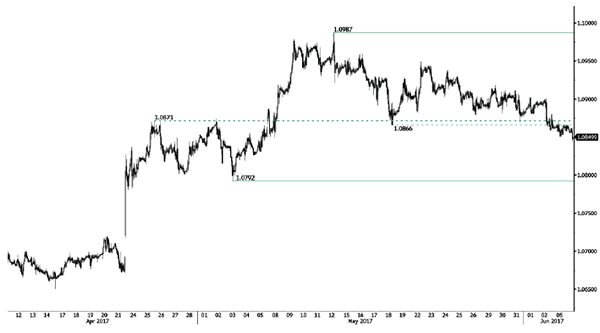
    EUR/USD is staying in tight range below 1.0949 temporary top and intraday bias remains neutral for consolidations. At this point, another rise could be seen as long as 1.0777 support holds. But still, rise form 1.0339 is seen as a corrective move. Hence we'd pay attention to topping signal even if EUR/USD rises through 1.0949. On the downside, below 1.0777 minor support will turn bias to the downside for 1.0569 support first.

    In the bigger picture, as long as 1.1298 key resistance holds, whole down trend from 1.6039 (2008 high) is still expected to continue. Break of 1.0339 low will send EUR/USD through parity to 61.8% projection of 1.3993 to 1.0461 from 1.1298 at 0.9115. However, considering bullish convergence condition in weekly MACD, break of 1.1298 will indicate term reversal. this would also be supported by sustained trading above 55 week EMA.

    EUR/USD 4 Hours Chart

    EUR/USD Daily Chart

    Economic Indicators Update

    GMT Ccy Events Actual Forecast Previous Revised
    JPY Monetary Policy Statement
    01:30 AUD Import Price Index Q/Q Q1 1.20% -0.50% 0.20%
    06:00 CHF Trade Balance (CHF) Mar 3.10B 3.01B 3.12B
    06:00 EUR German GfK Consumer Confidence May 10.2 9.9 9.8
    09:00 EUR Eurozone Economic Confidence Apr 109.6 108.1 107.9
    09:00 EUR Eurozone Business Climate Indicator Apr 1.09 0.82 0.82 0.83
    09:00 EUR Eurozone Industrial Confidence Apr 2.6 1.3 1.2 1.3
    09:00 EUR Eurozone Services Confidence Apr 14.2 12.9 12.7 12.8
    09:00 EUR Eurozone Consumer Confidence Apr F -3.6 -3.6 -3.6
    10:00 GBP CBI Realized Sales Apr 38 6 9
    11:45 EUR ECB Rate Decision 0.00% 0.00% 0.00%
    11:45 EUR ECB Marginal Lending Facility 0.25% 0.25% 0.25%
    11:45 EUR ECB Deposit Facility Rate -0.40% -0.40% -0.40%
    11:45 EUR ECB Asset Purchase Target (EUR) Apr 60B 60B 80B
    12:00 EUR German CPI M/M Apr P 0.00% -0.10% 0.20%
    12:00 EUR German CPI Y/Y Apr P 2.00% 1.90% 1.60%
    12:30 USD Advance Goods Trade Balance Mar -64.8B -65.2B -63.9B -63.9B
    12:30 USD Wholesale Inventories Mar P -0.10% 0.30% 0.40% 0.20%
    12:30 USD Durable Goods Orders Mar P 0.70% 1.30% 1.80%
    12:30 USD Durables Ex Transportation Mar P -0.20% 0.50% 0.50%
    12:30 USD Initial Jobless Claims (22 APR) 257K 241K 244K 243K
    14:00 USD Pending Home Sales M/M Mar -1.00% 5.50%
    14:30 USD Natural Gas Storage 54B


    (ECB) Introductory Statement to the Press Conference

    Mario Draghi, President of the ECB,
    Vítor Constâncio, Vice-President of the ECB,
    Frankfurt am Main, 27 April 2017

    INTRODUCTORY STATEMENT

    Ladies and gentlemen, the Vice-President and I are very pleased to welcome you to our press conference. We will now report on the outcome of today's meeting of the Governing Council, which was also attended by the Commission Vice-President, Mr Dombrovskis.

    Based on our regular economic and monetary analyses, we decided to keep the key ECB interest rates unchanged. We continue to expect them to remain at present or lower levels for an extended period of time, and well past the horizon of our net asset purchases. Regarding non-standard monetary policy measures, we confirm that our net asset purchases, at the new monthly pace of €60 billion, are intended to run until the end of December 2017, or beyond, if necessary, and in any case until the Governing Council sees a sustained adjustment in the path of inflation consistent with its inflation aim. The net purchases will be made alongside reinvestments of the principal payments from maturing securities purchased under the asset purchase programme.

    Our monetary policy measures have continued to preserve the very favourable financing conditions that are necessary to secure a sustained convergence of inflation rates towards levels below, but close to, 2% over the medium term. Incoming data since our meeting in early March confirm that the cyclical recovery of the euro area economy is becoming increasingly solid and that downside risks have further diminished. At the same time, underlying inflation pressures continue to remain subdued and have yet to show a convincing upward trend. Moreover, the ongoing volatility in headline inflation underlines the need to look through transient developments in HICP inflation, which have no implication for the medium-term outlook for price stability.

    A very substantial degree of monetary accommodation is still needed for underlying inflation pressures to build up and support headline inflation in the medium term. If the outlook becomes less favourable, or if financial conditions become inconsistent with further progress towards a sustained adjustment in the path of inflation, we stand ready to increase our asset purchase programme in terms of size and/or duration.

    Let me now explain our assessment in greater detail, starting with the economic analysis. Euro area real GDP increased by 0.5%, quarter on quarter, in the fourth quarter of 2016, following a growth rate of 0.4% in the third quarter. Incoming data, notably survey results, bolster our confidence that the ongoing economic expansion will continue to firm and broaden. The pass-through of our monetary policy measures is supporting domestic demand and facilitates the ongoing deleveraging process. The recovery in investment continues to benefit from very favourable financing conditions and improvements in corporate profitability. Employment gains, which are also benefiting from past labour market reforms, are supporting real disposable income and private consumption. Moreover, the signs of a stronger global recovery and increasing global trade suggest that foreign demand should increasingly add to the overall resilience of the economic expansion in the euro area. However, economic growth continues to be dampened by a sluggish pace of implementation of structural reforms, in particular in product markets, and by remaining balance sheet adjustment needs in a number of sectors. The risks surrounding the euro area growth outlook, while moving towards a more balanced configuration, are still tilted to the downside and relate predominantly to global factors.

    Headline inflation has been recovering from the very low levels seen in 2016, largely owing to higher energy price increases. After reaching 2.0% in February 2017, euro area annual HICP inflation stood at 1.5% in March. This reflected mainly lower energy and unprocessed food price inflation, but also a decline in services price inflation. Looking ahead, on the basis of current futures prices for oil, headline inflation is likely to increase in April and thereafter to hover around current levels until the end of this year. However, as unutilised resources are still weighing on domestic wage and price formation, measures of underlying inflation remain low and are expected to rise only gradually over the medium term, supported by our monetary policy measures, the expected continuing economic recovery and the corresponding gradual absorption of slack.

    Turning to the monetary analysis, broad money (M3) continues to expand at a robust pace, with an annual rate of growth of 4.7% in February 2017, after 4.8% in January. As in previous months, annual growth in M3 was mainly supported by its most liquid components, with the narrow monetary aggregate M1 expanding at an annual rate of 8.4% in February 2017, unchanged from the previous month.

    The recovery in loan growth to the private sector observed since the beginning of 2014 is proceeding. The annual growth rate of loans to non-financial corporations declined to 2.0% in February 2017, from 2.3% in the previous month, while the annual growth rate of loans to households remained broadly stable at 2.3% in February. At the same time, the euro area bank lending survey for the first quarter of 2017 indicates that net loan demand has increased and bank lending conditions have further eased across all loan categories. The pass-through of the monetary policy measures put in place since June 2014 continues to significantly support borrowing conditions for firms and households and credit flows across the euro area.

    To sum up, a cross-check of the outcome of the economic analysis with the signals coming from the monetary analysis confirmed the need for a continued very substantial degree of monetary accommodation to secure a sustained return of inflation rates towards levels that are below, but close to, 2% without undue delay.

    In order to reap the full benefits from our monetary policy measures, other policy areas must contribute much more decisively to strengthening economic growth. The implementation of structural reforms needs to be substantially stepped up to increase resilience, reduce structural unemployment and boost productivity and potential output growth. Regarding fiscal policies, all countries should intensify efforts towards achieving a more growth-friendly composition of public finances. A full and consistent implementation of the Stability and Growth Pact and of the macroeconomic imbalances procedure over time and across countries remains crucial to enhance the resilience of the euro area economy.

    We are now at your disposal for questions.

    CAC Subdued as ECB Leaves Interest Rate at 0.00%

    The CAC is unchanged in the Thursday session. Currently, the index is trading at 5,267.50. After a quiet week so far, the markets finally have some key releases to digest. The ECB kept the benchmark rate at a flat 0.00%. Later in the day, Germany releases Preliminary CPI, with an estimate of -0.1%. On Friday, the Eurozone releases CPI Flash Estimate. Over in the US, we'll get a look at Advance GDP.

    There were no surprises from the ECB on Thursday, as the central bank made no changes to the benchmark interest rate. The rate has been pegged at 0.00% since March 2o16, as the ECB implemented an ultra-loose monetary policy in order to kick-start the weak eurozone economy. The economy has improved in recent months, with inflation and growth numbers moving higher. The brighter economic picture had led to some pressure on the ECB to taper or shorten its asset-purchase program, which is scheduled to wind up in December. However, the ECB appears content to hold course, barring any significant change in growth or inflation numbers. There is also the political card to keep in mind, as the ECB does not want to be seen as intervening in the current French election, or when Germany holds elections in September.

    Another Sunday, another Election Day in France. Voters will have their say in the second round of the presidential election on May 7, with centrist Emmanuel Macron and National Front leader Marie Le Pen vying for the office of president. The stock markets have steady over the past few days, having priced in a victory by Macron. Although Macron currently has a comfortable margin of 60-40 in opinion polls, the second round of the campaign has not gone well for the front-runner. Macron was jeered by workers at a factory in his hometown of Amiens, only to have Le Pen show up unexpectedly, to the delight of the workers. A BFM TV poll showed that more voters feel that Le Pen has run a better campaign in round than Macron. This may not change the expected outcome of a Macron win, but a strong showing by Le Pen on Sunday would show that her strident anti-EU stance has wide popularity, and this could sour investor sentiment and send the stock markets to lower ground.

    One of President Trump's most important campaign platforms was overhauling the US tax code. Trump finally announced his long-awaited tax plan on Wednesday. The proposal calls for sharp reductions for both individuals and corporations. The plan calls for three tax brackets for individuals – 10%, 25% and 35%. The corporate sector would also see significant tax relief, with the corporate tax rate dropping from 35% to 15%, and the tax on multinationals' overseas profits lowered from 35% to 10%. However, any tax reform proposals from the White House will require a stamp of approval from Congress, so Trump's proposal should be viewed as a blueprint that is a long way off from becoming law. Trump's proposal was short on details, although government officials are praising it as one of the largest tax cuts and broadest overhauls of the tax system in history. There hasn't been much reaction from the CAC or other European stock markets, which have been subdued in Thursday trading.

    Euro Steady ahead of ECB Meeting

    The EURUSD remained static during Thursday's trading session, as investors remained on the fence ahead of the forthcoming European Central Bank meeting. With markets widely expecting the ECB to leave monetary policy unchanged in April, much attention may be directed towards Draghi's tone. Although receding political risks in France and improving economic data across Europe have somewhat boosted sentiment towards the European economy, the ECB may remain on standby.

    With Draghi potentially reiterating his dovish mantra on how the Eurozone still needs the ECB's support in an effort to quell taper tantrum speculations, the Euro could find itself exposed to downside risks. Although the Central Bank may recognize that consumer and business confidence have followed a positive trajectory, emphasis could be placed on weak inflation and muted wage growth, which should support the ECB doves. While there is a possibility of Draghi playing it safe today to limit volatility, a hawkish surprise would still have the ability to elevate the EURUSD towards 1.1000.

    From a technical standpoint, price stability above 1.0900 may open a path higher towards the next relevant level at 1.1000. In an alternative scenario, weakness below 1.0800 may trigger a decline towards 1.0750.

    Trump's tax reveal disappoints

    A familiar feeling of disappointment lingered across the financial markets during late trading on Wednesday, after Trump's heavily anticipated big tax announcement failed to provide the clarity investors sought. Although U.S Treasury Secretary Steven Mnuchin offered some detail by confirming that the reform plan would cut corporate tax from 35% to 15%, nothing new was brought to the table. With investors clearly disappointed and some even questioning if the "phenomenal" tax cuts will be passed through Congress, the risk-on rally decelerated.

    Many queries over the tax reveal still remain unanswered, with the potential increase in the budget deficit compounding uncertainties. The possibility that Trump's suggested tax reforms will suffer a similar fate as that of his failed healthcare reform proposal may put an end to the Trump rally, with Dollar finding itself under renewed selling pressure.

    Commodity spotlight - WTI Crude

    WTI Crude was under pressure on Thursday, as bears exploited the persistent oversupply concerns to install rounds of selling. Recent reports of U.S gasoline stockpiles surging by 3.4 million barrels have compounded with the downside risks, with further declines expected. Investors have started to come to the realization that there is still a global oil market glut, despite the efforts led by OPEC and Russia to stabilize the saturated markets. The growing threat of U.S Shale's rapid resurgence destabilizing the OPEC production cut deal and potentially resulting in more oil in the already bloated market may leave WTI vulnerable to further losses. From a technical standpoint, a breakdown below $49 on WTI could open a path lower towards $47.50.

    (ECB) Monetary Policy Decisions

    At today's meeting the Governing Council of the ECB decided that the interest rate on the main refinancing operations and the interest rates on the marginal lending facility and the deposit facility will remain unchanged at 0.00%, 0.25% and -0.40% respectively. The Governing Council continues to expect the key ECB interest rates to remain at present or lower levels for an extended period of time, and well past the horizon of the net asset purchases.

    Regarding non-standard monetary policy measures, the Governing Council confirms that the net asset purchases, at the new monthly pace of €60 billion, are intended to run until the end of December 2017, or beyond, if necessary, and in any case until the Governing Council sees a sustained adjustment in the path of inflation consistent with its inflation aim. The net purchases will be made alongside reinvestments of the principal payments from maturing securities purchased under the asset purchase programme. If the outlook becomes less favourable, or if financial conditions become inconsistent with further progress towards a sustained adjustment in the path of inflation, the Governing Council stands ready to increase the programme in terms of size and/or duration.

    The President of the ECB will comment on the considerations underlying these decisions at a press conference starting at 14:30 CET today.

    Trade Idea: GBP/USD – Buy at 1.2850

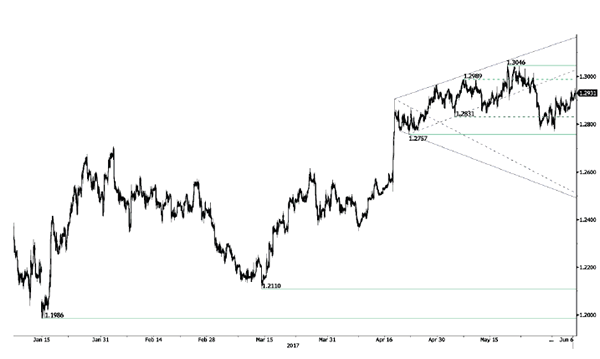
    GBP/USD – 1.2897

    Recent wave: Wave V of larger degree wave (III) has ended at 1.1986 and major correction has commenced from there for gain to 1.3000 and 1.3140-50

    Trend: Near term up

    Original strategy :

    Buy at 1.2710, Target: 1.2910, Stop: 1.2650

    Position: -
    Target:  -
    Stop: -

    New strategy :

    Buy at 1.2850, Target: 1.3000, Stop: 1.2790

    Position: -
    Target:  -
    Stop:-

    As cable has risen again and broke above indicated previous resistance at 1.2906, adding credence to our bullish view that recent upmove is still in progress and upside bias remains for further gain to 1.2950, then towards psychological resistance at 1.3000 but near term overbought condition should limit upside and 1.3050 and price should falter below 1.3100. We are keeping our view that the wave c as well as larger degree wave B has ended at 1.2109, hence impulsive wave C has commenced from there with wave i of C ended at 1.2616, follow by a correction to 1.2365 (end of wave ii) and wave iii rally is unfolding, hence further gain to indicated upside targets would be seen. 

    Our preferred count on the daily chart is that cable's rebound from 1.3500 (wave (A) trough) is unfolding as a wave (B) with A ended at 1.7043, followed by triangle wave B and wave C as well as wave (B) has ended at 1.7192, the subsequent selloff is the larger degree wave (C) which is still unfolding with minor wave (III) of larger degree wave 3 ended at 1.1986, hence wave (IV) correction is in progress which could either be a triangle wave (IV) of a complex formation but upside should be limited to 1.3500 and price should falter well below 1.4000, bring another decline in wave (V) of 3 for weakness to 1.1500, then 1.1200.

    On the downside, whilst initial pullback to 1.2845-55 is likely, as long as support at 1.2805 holds, bullishness remains for another upmove. A drop below this level would defer and suggest top is possibly formed but only break of support at 1.2757 would add credence to this view, bring retracement of recent upmove to 1.2700-10 later. 

    PRE-ECB Analysis: EUR/USD Breakouts Possible

    The European Central Bank is set to keep its ultra-easy policy stance firmly in place this Thursday afternoon (11:30 AM GMT) but may acknowledge better growth prospects, setting the stage for a small signal as early as June about an eventual reduction of stimulus. Volatility on EUR/USD could be expected.

    Technically the EUR/USD 4h chart shows bullish momentum but anything can happen during the ECB conference. Yesterday we had a successful live EUR/USD entry on Wednesday's Live webinar that made more than 40 pips as of now. The break of 1.0950 should retest 1.0965 and possibly 1.0990-1.1020. However, the break of 1.0820 could close the retail gap around 1.0777 level. Be careful with risk allocation and using of VPS tool is advised

    Trade Idea: GBP/JPY – Buy at 142.30

    GBP/JPY - 143.68

    Recent wave: Medium term low formed at 120.50 and (A)-(B)-(C) major correction has commenced with (A) leg ended at 148.45, hence wave (B) is unfolding for retreat to 131.00-10.

    Trend: Near term up

    Original strategy:

    Buy at 141.70, Target: 143.70, Stop: 141.00

    Position: -
    Target: -
    Stop: -

    New strategy :

    Buy at 142.30, Target: 144.30, Stop: 141.70

    Position: -
    Target:  -
    Stop:-

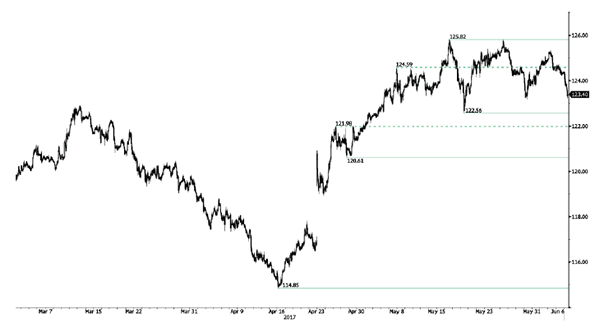
    As sterling has surged again after brief pullback, adding credence to our view that recent upmove from 135.60 has resumed and upside bias remains for this move to extend further gain to 144.00-10, however, near term overbought condition should prevent sharp move beyond 144.40-50 and reckon previous chart resistance at 144.75 would remain intact, bring retreat later.

    In view of this, would not chase this rise here and would be prudent to buy sterling on pullback as 142.30-40 should limit downside. Below 141.60-65 would defer and suggest top is possibly formed instead, risk correction to 141.00-10 but downside should be limited to 140.55-60 and price should stay well above support at 140.10, bring another rally.

    Our preferred count is that larger degree wave V with circle is unfolding from 251.12 with wave (I) 219.34, (II): 241.38 and wave (III) is subdivided into 1: 192.60, 2: 215.89 (23 Jul 2008) and wave 3 ended at 118.87 earlier in 2009. The correction from there to 162.60 is wave 4 which itself is a double three and is labeled as first a-b-c ended at 151.53, followed by wave x at 139.03, 2nd a ended at 162.60, 2nd b at 146.75 and 2nd c leg of wave 4 ended at 163.00. Therefore, the decline from 163.00 to 116.85 is now treated as wave 5 which also marked the end of larger degree wave (III), hence wave (IV) major correction has commenced for retracement of the wave (III) from 241.38 and upside target at 183.95-00 (50% Fibonacci retracement of the wave (II) from 241.38) had been met, a drop below 160.00 would suggest wave (IV) has ended at 195.85, bring decline in wave (V) for initial weakness to 130 (already met) and 120.


    U.S Dollar Deflated on Trump U-turn

    April 27: Five things the markets are talking about

    The not so 'mighty' U.S dollar has pared gains overnight as investors digest details of the Trump administration's tax-reform plan and deal with the Presidents U-turn on NAFTA.

    The Presidents tax plan includes deep reductions in business taxes and major changes to the individual tax system. The administration also said it would introduce a one-time tax break meant to encourage U.S corporations to repatriate earnings stashed overseas. However, the market has largely brushed off the plan, weighed by uncertainties over the timeline.

    Sticking with uncertainties, Trump, for now, has done a U-turn on pulling out of NAFTA after talking with leaders from Mexico and Canada. Both currencies were able to take back much of yesterday's intraday losses - +1.1% and +0.5% respectively.

    On the central bank front, the ECB will set monetary policy later this morning (07:45 am EST rate announcement, 08:30 am press conference). With officials of late indicating little chance of a policy change, the focus will be on any signals from President Draghi that the central bank is debating an exit from its extraordinary stimulus. Overnight, The Bank of Japan (BoJ) remained on hold as expected.

    Tomorrow, U.S. GDP is due and it's projected to show the economy expanded at a +1.0% annualized rate in Q1, the weakest pace in a year.

    1. Global equities mixed reaction

    In Japan, stocks fell for the first time in six days, tracking the retreat on Wall Street's disappointment over the U.S tax plan. The Nikkei fell -0.2%, while the broader Topix dipped -0.05%. The BoJ kept its policies unchanged while lowering its inflation forecast and emphasizing that any exit from its monetary easing remains "far away."

    In Hong Kong, financials helped lift the Hang Seng (+0.5%) to its highest close in 20-months, but the China Enterprises Index lost -0.6%.

    In China, stocks ended higher with small caps bolstering sentiment. The blue-chip CSI300 index rose +0.1%, while the Shanghai Composite Index added +0.4%.

    In Europe, equity indices are trading lower as market participants await the ECB's monetary policy decision. Banking and financial stocks trading notably lower in the Eurostoxx, while energy stocks in the FTSE 100 are trading lower on oil price pull backs.

    U.S stocks are set to open relatively flat.

    Indices: Stoxx50 -0.5% at 3,560, FTSE -0.5% at 7,250, DAX -0.4% at 12,428, CAC-40 -0.4% at 5,264, IBEX-35 -0.9% at 10,668, FTSE MIB -0.6% at 20,703, SMI -0.2% at 8,815, S&P 500 Futures flat

    2. Oil prices fall on oversupply, gold steady

    Oil prices again are on the back foot, weighed down by oversupply issues, but the losses remain somewhat contained on hopes that OPEC and non-OPEC members will agree to extend production cuts to try to rebalance the market.

    Ahead of the U.S open, Brent crude futures are down -60c at +$51.22 a barrel, while U.S light crude (WTI) is down -55c at +$49.07 - both benchmarks are down -10% from this month's peak.

    Inventory reports this week stated ample supplies in all key markets despite efforts led by OPEC and Russia to cut output by -1.8m bpd in H1.

    OPEC is discussing extending its cuts into H2, but crude "bulls" are getting concerned as producers face an uphill battle with oil inventories atop of record levels in many parts of the world.

    Yesterday's EIA report showed a drop in crude oil stocks, but gasoline inventories surged as refiners produced more fuel than the market could consume.

    Gold prices have edged down overnight as global risk sentiment diminishes, but scepticism over Trump's tax reform plan has limited the losses. Spot gold is down -0.3% at +$1,264.60 per ounce.

    3. Few surprises from Central Banks rate announcements

    The ECB is expected to hold off any 'hawkish' tendencies ahead of France's second round Presidential elections (May 7). Sweden's Riksbank has extended QE for another six-months, while the BoJ did was expected and stood pat.

    Sweden Central Bank (Riksbank) has surprised the market with its "dovish" stance - repo rate unchanged (+0.5%), however, it has extended its government bond buying for another six months citing global uncertainties. The policy statement noted that it would take longer before inflation stabilized around +2% and indicated that to support the upturn in inflation, monetary policy "needed to be somewhat more expansionary." The program was set to expire next month.

    In Governor Kuroda's post BoJ rate decision press conference he noted that the economic cycle was strengthening and that BoJ would continue with QQE until prices hit its inflation target. He reiterated the view that they would achieve the +2% inflation target during the financial year 2018/19 and that they need to achieve this target before discussing 'exit' strategy.

    Next up is the ECB.

    4. U.S dollar deflated on Trump U-turn

    Ahead of the ECB rate announcement, the EUR is steady trading atop of €1.0900. The focus of the ECB meeting is likely be on the recent run of stronger growth and inflation data out of the Eurozone and possibility that the taper argument could be revisited as the fundamental picture is improving. The consensus doesn't believe that Draghi and co. will alter its policy language.

    Note: The market is speculating that the ECB could discuss removing some of its easing biases in the June statement.

    EUR/SEK (€9.6400) is trading +1% higher after the Riksbank surprised with an extension of its QE bond buying. The market was betting that monetary policy did not need to be more expansionary at this time.

    Elsewhere, USD/JPY (¥113.35) is a tad higher after the BoJ announcement while the CAD (C$1.3576) and MXN ($19.00) are firmer after President Trump noted that he would "not" scrap NAFTA, but renegotiate the trade agreement.

    5. Eurozone confidence hits post crisis high

    Euro data this morning shows eurozone confidence was stronger than expected in this month, with the European Commission's ESI measure jumping to 109.6 from 108.0 in March. It's the highest level in a decade.

    The market was expecting a modest rise to 108.1. The pickup suggests that the eurozone's economic recovery is gaining momentum this year, and will reinforce the ECB's view that the outlook has improved.

    The survey also showed household inflation expectations have fallen back this month, reaching their lowest level in five-months - This will likely support the ECB's caution over winding down its stimulus programs.

    EUR/GBP Elliott Wave Analysis

    EUR/GBP         –  0.8452

    EUR/GBP – The major (A)(B)(C)-(X)-(A)(B)(C) correction from 0.9805 is unfolding and 2nd (A) has possibly ended at 0.6936.

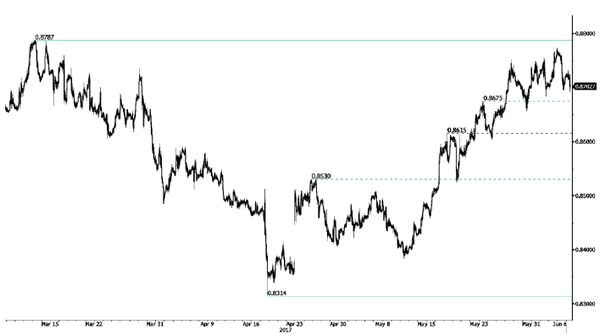
    Although the single currency fell to as low as 0.8312 last week, failure to penetrate indicated previous support at 0.87304 and the subsequent gap-up opening this week suggest further consolidation above 0.9304 would be seen and above this week’s high at 0.8531 would bring a stronger rebound to 0.8592 but break of latter level is needed to signal the fall from 0.8857 has ended instead, bring further subsequent gain to 0.8650-60 and possibly towards resistance at 0.8735 but price should falter well below resistance at 0.8788.

    Our latest preferred count is that the wave V of a 5-wave series from 0.5682 ended at 0.9805 earlier and major from there has possibly ended at 0.8067 as A-B-C-X-A-B-C. We are keeping our view that the entire correction from 0.9805 has possibly ended at 0.7756 and as labeled as the attached daily chart and impulsive move from 0.9084 has ended at 0.7756 as a 5-waver which marked either the (C) wave or the A leg of (C), a daily close above resistance at 0.8831 would suggest (C) leg has ended and headway towards 0.9084.

    On the downside, whilst the pullback from 0.8531 may bring initial weakness to 0.8410-20, reckon downside would be limited and support at 0.8351 should hold, bring another rebound later. A drop below 0.8351 support would signal the rebound from 0.8312 has ended but only break of said support at 0.8304 would revive bearishness and signal early decline from 0.9576 top (2016 high) has resumed for weakness to 0.8251 support, then 0.8200.
     
    Recommendation: Stand aside for this week.

    Euro's long term uptrend started in Feb 1981 at 0.5039 and is unfolding as a (A)-(B)-(C) move with (A): 0.8433 (Feb 1993), (B): 0.5682 (May 2000) and impulsive wave (C) should have ended at 0.9805 with wave III ended at 0.7254 (May 2003), triangle wave IV at 0.6536 (23 Jan 2007) and wave V as well as wave (C) has ended at 0.9805.

    We are keeping an alternate count that only wave III ended at 0.9805 and the correction from there is the wave IV and may extend weakness to 0.7700, however, it is necessary to see a daily close above resistance at 0.9143 would change this to be the preferred count.