Sample Category Title
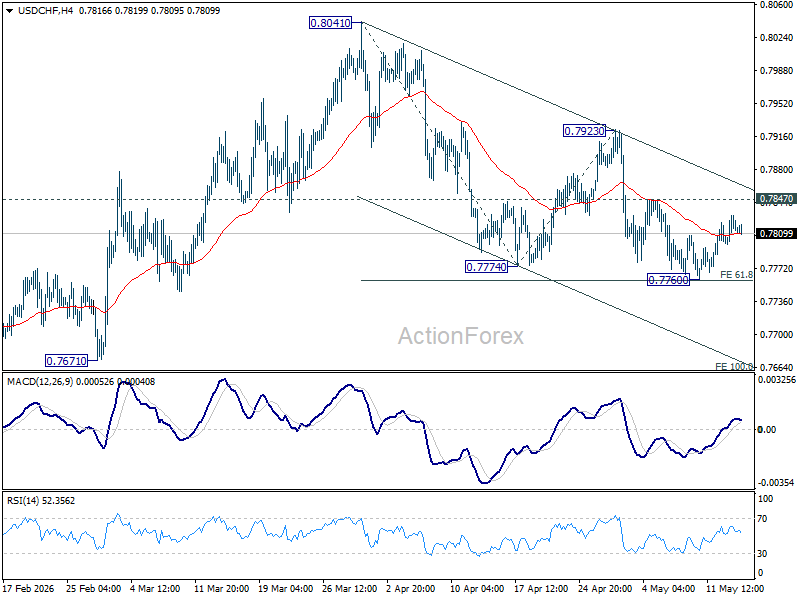
USD/CHF Daily Outlook
Daily Pivots: (S1) 0.7798; (P) 0.7814; (R1) 0.7831; More….
Intraday bias in USD/CHF stays neutral for the moment. With 0.7847 resistance intact, further decline is expected. On the downside, decisive break of 0.7760 will resume the whole decline form 0.8041, and target 100% projection of 0.8041 to 0.7774 from 0.7923 at 0.7656. However, firm break of 0.7847 resistance will indicate short term bottoming, and bring stronger rebound back to 0.7923 resistance.
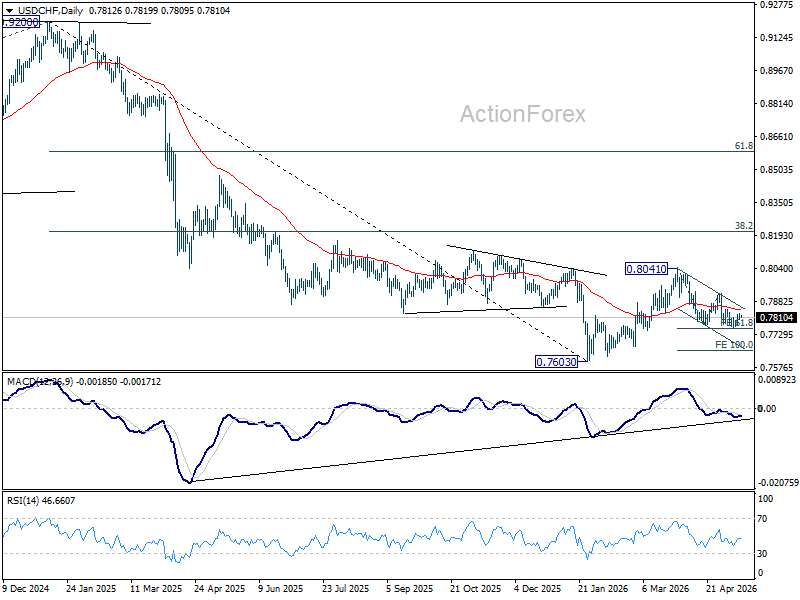
In the bigger picture, as long as 55 W EMA (now at 0.8051) holds, fall from 0.9200 is expected to continue, as part of the larger down trend. Firm break of 0.7603 will target 100% projection of 1.0146 (2022 high) to 0.8332 from 0.9200 at 0.7382.
AUD/USD Daily Report
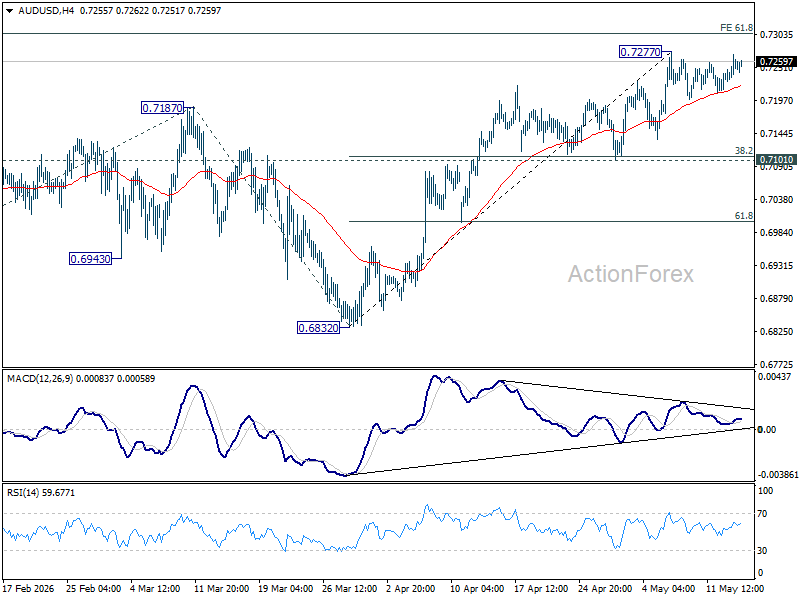
Daily Pivots: (S1) 0.7233; (P) 0.7252; (R1) 0.7274; More...
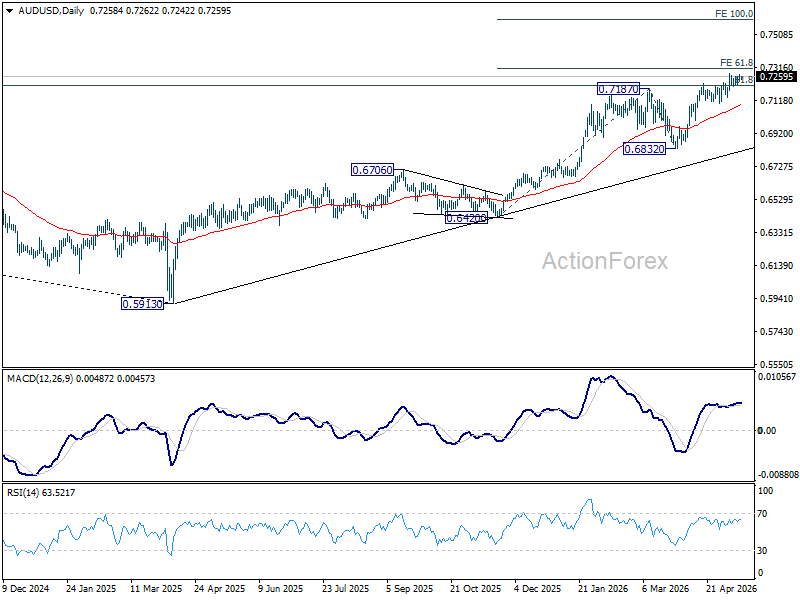
Intraday bias remains neutral for the moment. On the upside, firm break of 0.7277 will resume larger up trend and target 61.8% projection of 0.6420 to 0.7187 from 0.6832 at 0.7306. Outlook will stay bullish as long as 0.7101 support holds, in case of another dip.
In the bigger picture, rise from 0.5913 (2024 low) is still in progress. Decisive break of 61.8% retracement of 0.8006 to 0.5913 at 0.7206 will solidify the case that it's already reversing the down trend from 0.8006 (2021 high). Further rally should then be seen to retest 0.8006. For now, outlook will remain bullish as long as 0.6832 support holds, in case of pullback.
USD/CAD Daily Outlook
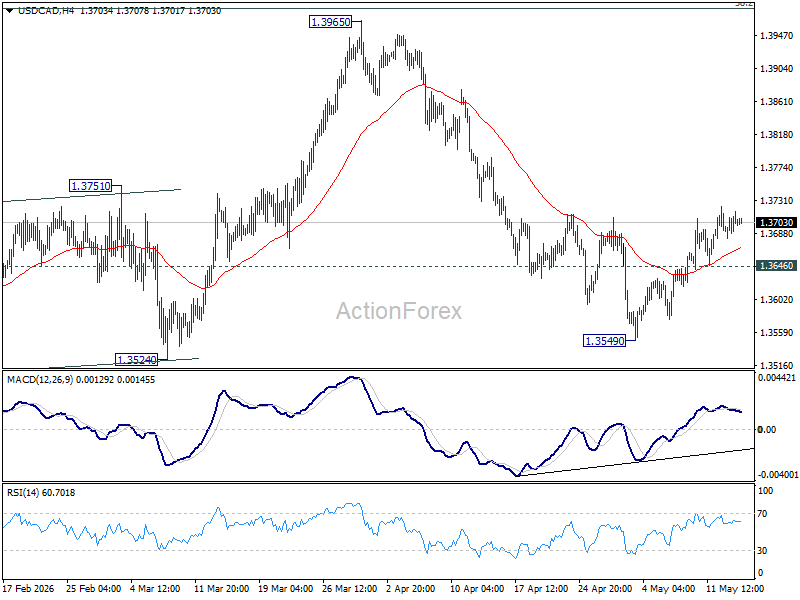
Daily Pivots: (S1) 1.3686; (P) 1.3702; (R1) 1.3721; More...
Intraday bias in USD/CAD remains mildly on the upside at this point. Rebound from 1.3549 is seen as the third leg of the corrective pattern from 1.3480. Further rise would be seen towards 1.3965 resistance. On the downside, though, break of 1.3646 minor support will bring retest of 1.3549 instead.
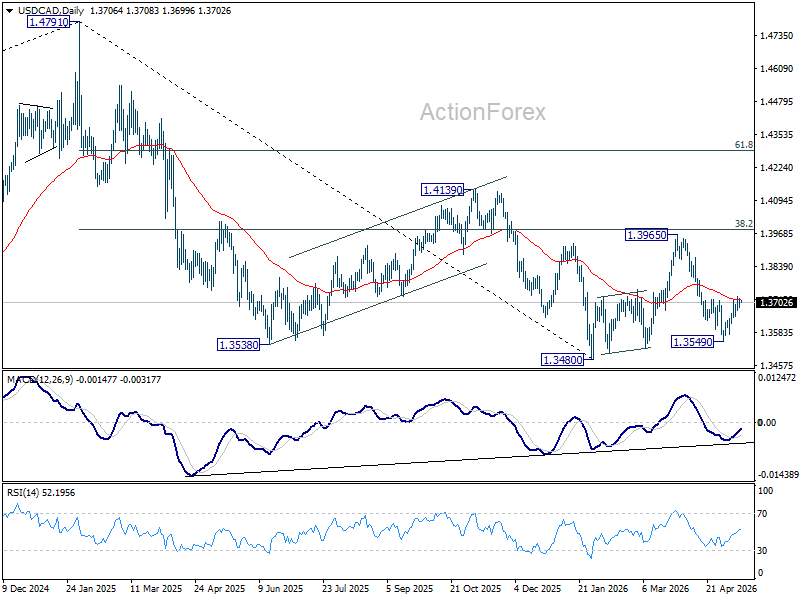
In the bigger picture, price actions from 1.4791 are seen as a corrective pattern to the whole up trend from 1.2005 (2021 low). Deeper fall could be seen, as the pattern extends, to 61.8% retracement of 1.2005 to 1.4791 at 1.3069. However, decisive break of 38.2% retracement of 1.4791 to 1.3480 at 1.3981 will argue that the correction has completed with three waves down to 1.3480 already.
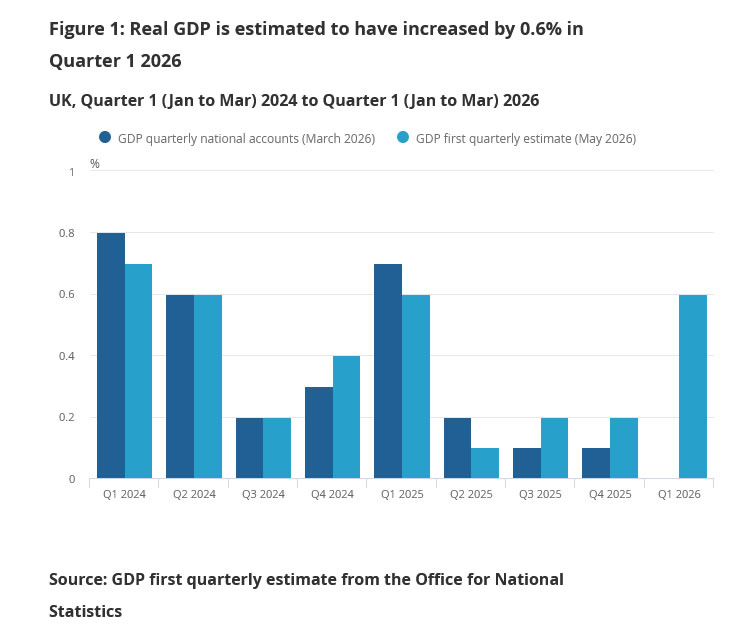
UK GDP Expands 0.6% in Q1, up 0.3% in March
UK economic growth held up better than expected in the first quarter of 2026, with GDP expanding 0.6% qoq in line with forecasts as stronger services activity helped offset softer industrial momentum. The figures suggest the economy entered the second quarter with more resilience than many investors had feared, despite elevated energy costs and rising political uncertainty surrounding Prime Minister Keir Starmer’s government.
Services remained the main engine of growth. Output in the sector increased 0.8% qoq following a 0.2% rise in the previous quarter and stood 1.4% higher than a year earlier. Production output also expanded by 0.2% qoq after a strong 1.3% gain in Quarter 4 2025, though annual production growth remained flat. Construction activity rose 0.4% qoq but was still -1.3% lower than the same period last year. Meanwhile, real GDP per head increased 0.6% qoq during the quarter and was up 0.9% yoy.
Monthly data for March surprised to the upside. UK GDP grew 0.3% mom versus expectations for a -0.1% mom contraction, following February’s 0.4% expansion. Services output rose 0.3% while construction surged 1.5%, offsetting a modest -0.2% decline in production activity.
The stronger-than-expected figures may provide some reassurance to policymakers that the UK economy retains underlying resilience even as higher energy prices, rising gilt yields, and domestic political instability continue clouding the broader outlook.
| Indicator | Previous | Latest | Expectation |
|---|---|---|---|
| UK GDP (Q1 QoQ) | 0.2% | 0.6% | 0.6% |
| Services Output | 0.8% | ||
| Production Output | 0.2% | ||
| Construction Output | 0.4% | ||
| Real GDP Per Head | 0.6% | ||
| UK GDP (March MoM) | 0.4% | 0.3% | -0.1% |
| Services Output | 0.3% | ||
| Construction Output | 1.5% | ||
| Production Output | -0.2% |
GBP/JPY Daily Outlook
Daily Pivots: (S1) 212.97; (P) 213.33; (R1) 213.79; More...
Intraday bias in GBP/JPY stays neutral and outlook is unchanged. On the downside, break of 212.35 minor support will bring deeper fall back to 210.43 support. On the upside, firm break of 214.40 will bring stronger rebound to retest 216.58 high.
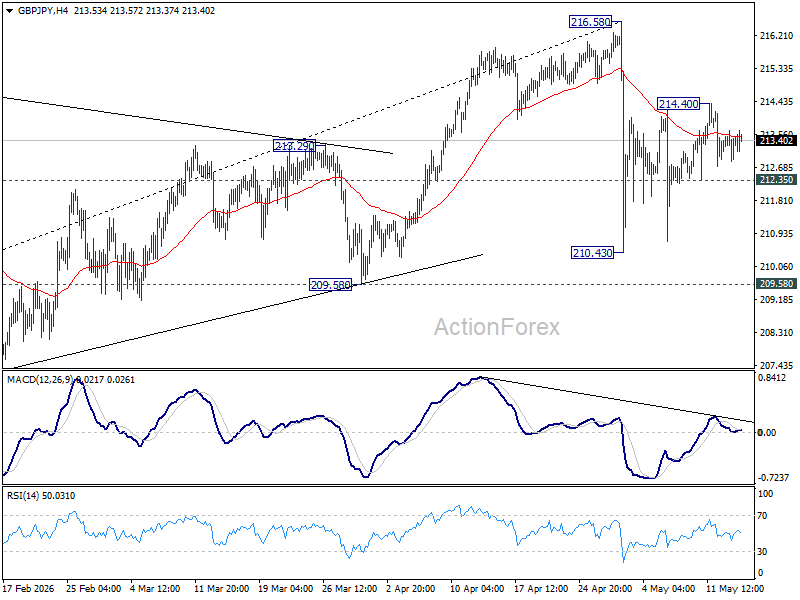
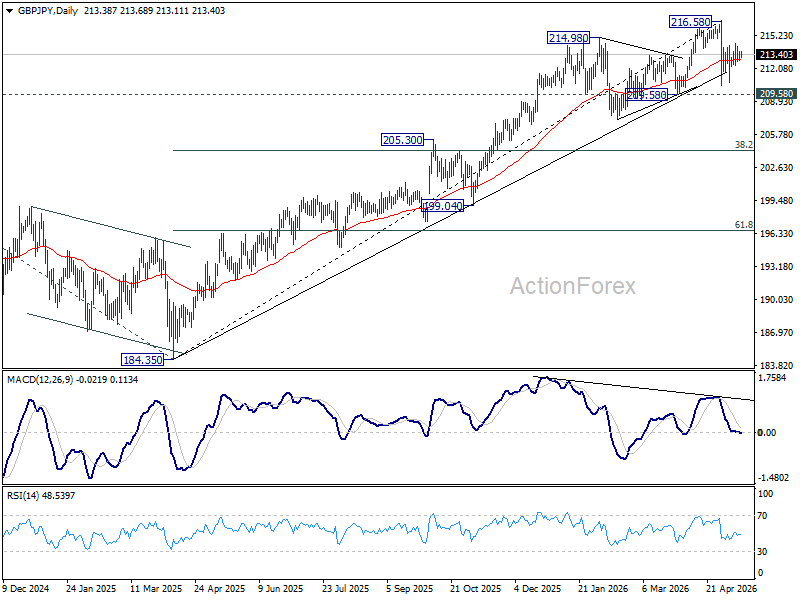
In the bigger picture, while the fall from 216.58 is steep, there is no clear sign of trend reversal yet. The long term up trend could still extend to 61.8% projection of 148.93 (2022 low) to 208.09 (2024 high) from 184.35 at 220.90 on resumption. However, sustained break of 55 W EMA (now at 205.75) will argue that it's already in medium term down trend for 184.35 support.
EUR/JPY Daily Outlook
Daily Pivots: (S1) 184.57; (P) 184.86; (R1) 185.10; More...
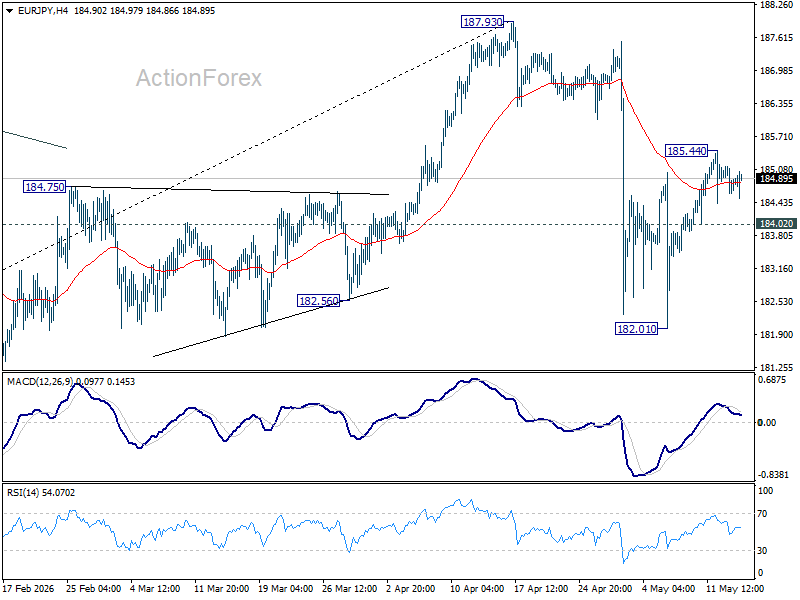
Intraday bias in EUR/JPY is turned neutral with current retreat. As noted before, pullback from 187.93 could have completed at 182.01 already. Further rise is in favor as long as 184.02 minor support holds. Above 185.44 will target a retest on 187.93 high. Nevertheless, break of 184.02 minor support will turn bias back to the downside towards 182.01 again.
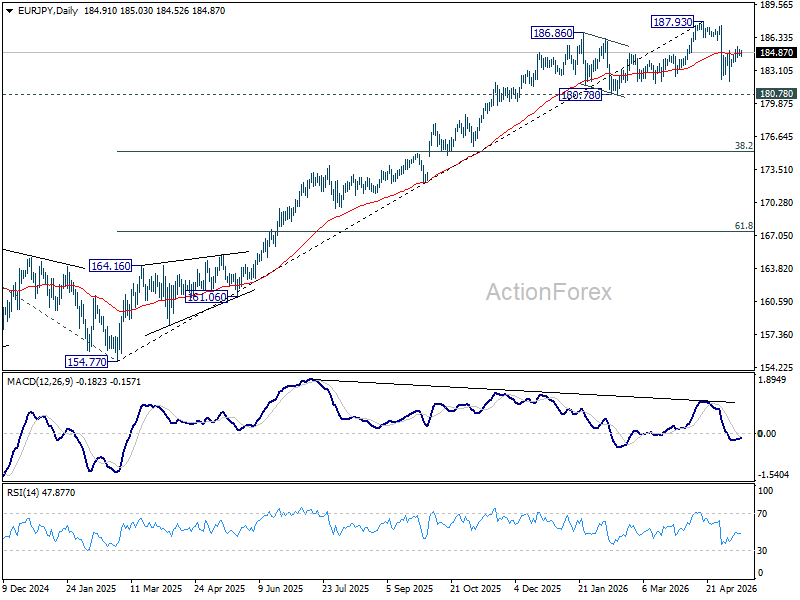
In the bigger picture, the pullback from 187.93 is steep, there is no sign of reversal yet. Uptrend from 114.42 is still expected to resume at a later stage to 78.6% projection of 124.37 (2022 low) to 175.41 (2025 high) from 154.77 at 194.88. However, sustained break of 55 W EMA (now at 178.04) will argue that it's already in a medium term down trend to 175.41 resistance turned support and below.
EUR/CHF Daily Outlook
Daily Pivots: (S1) 0.9148; (P) 0.9157; (R1) 0.9165; More....
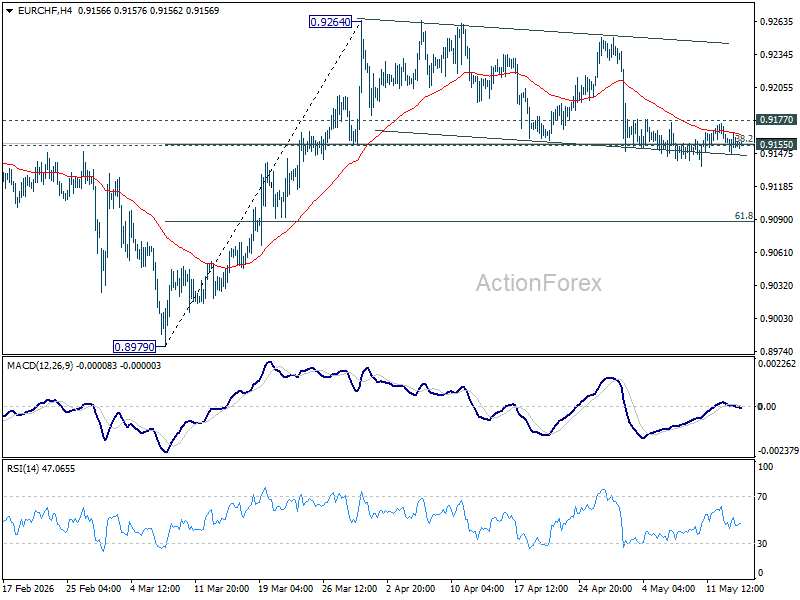
Intraday bias in EUR/CHF stays neutral for the moment. On the upside, break of 0.9177 minor resistance will turn bias back to the upside for 0.9264 resistance. However, sustained trading below 0.9155 cluster support (38.2% retracement of 0.8979 to 0.9264 at 0.9155) will turn bias back to the downside for deeper pullback to 61.8% retracement at 0.9088 and possibly below.
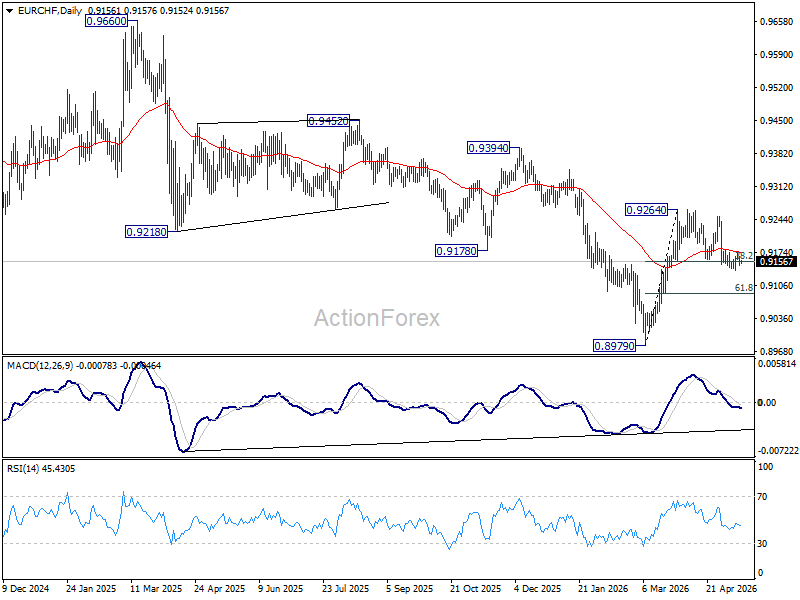
In the bigger picture, considering bullish convergence condition in W MACD, a medium term bottom should be in place at 0.8979. Sustained trading above 55 W EMA (now at 0.9241) will add more credence to this case. Further break of 0.9394 resistance will pave the way to 0.9660 resistance next. However rejection by the 55 W EMA will set up another fall through 0.8979 low at a later stage.
EUR/GBP Daily Outlook
Daily Pivots: (S1) 0.8641; (P) 0.8669; (R1) 0.8695; More…
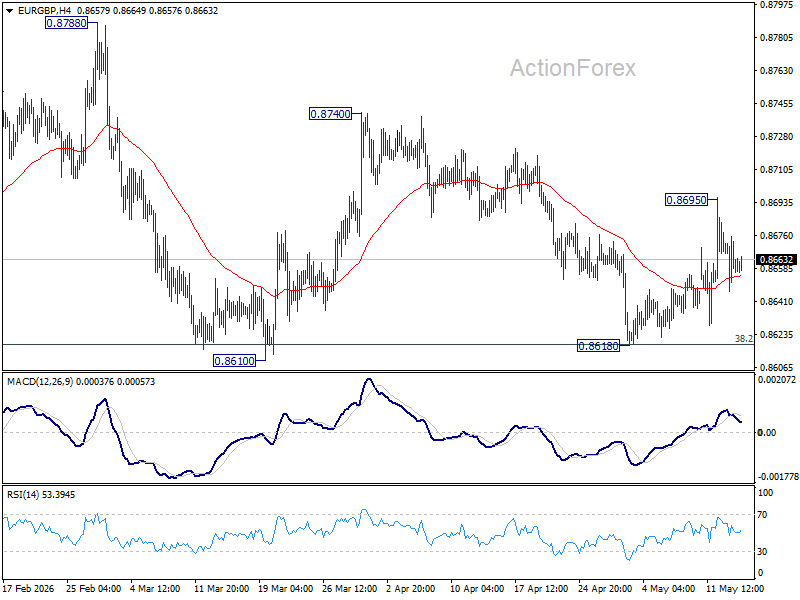
Intraday bias in EUR/GBP remains neutral for the moment. Risk will stay on the upside as long as 0.8618 support holds. Break of 0.8695 will resume the rebound from 0.8618 to 0.8740 resistance. Decisive break there should pave the way through 0.8788 to retest 0.8863 high.
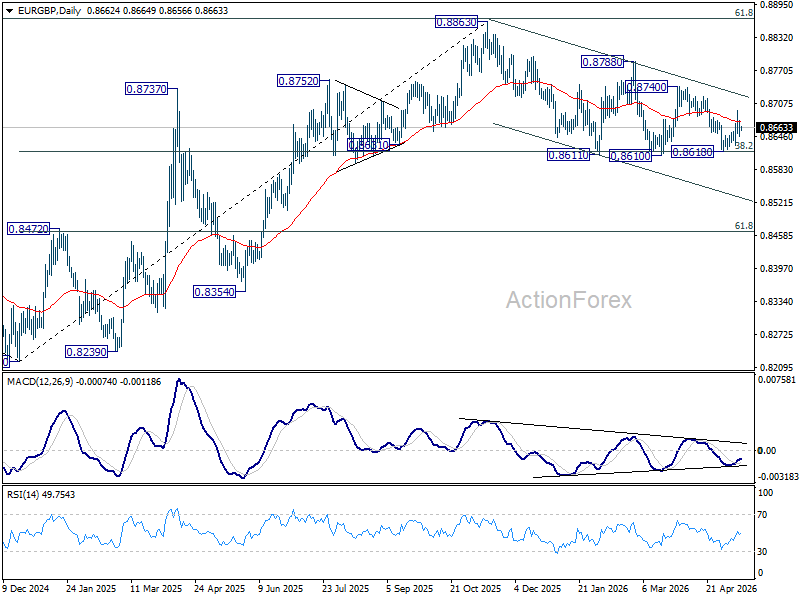
In the bigger picture, focus is back on 38.2% retracement of 0.8821 to 0.8863 at 0.8618. Strong rebound from there will retain medium term bullishness. Rise from 0.8221 should resume through 0.8863 at a later stage. Nevertheless, sustained break of 0.8618 will confirm that whole rise from 0.8221 has completed at 0.8863. Deeper decline should then be seen to 61.8% retracement at 0.8466 at least.
Trump-Xi Summit 2026: Key Expectations and What Markets Are Watching
Key Takeaways
- The 2026 Trump-Xi summit is viewed as a critical geopolitical event for financial markets, with investors primarily seeking signs of stabilisation in US-China trade relations, technology restrictions, and broader geopolitical tensions.
- Markets are focused on potential progress in semiconductor export controls, AI technology access, Taiwan-related communication channels, and currency stability, as even modest diplomatic improvements could support risk assets and Asian equities.
- The most likely market outcome remains a limited “managed competition” framework rather than a comprehensive trade deal, which could trigger only a temporary relief rally before markets refocus on inflation, oil prices, and Federal Reserve policy risks.
Today’s two-day meeting between Donald Trump and Xi Jinping in Beijing is shaping up to be one of the most consequential geopolitical events for global markets in 2026.
The summit comes at a time of heightened tensions driven by trade frictions, technology restrictions, Taiwan-related security concerns, and the inflation shock stemming from the Iran conflict.
Key Expectations from the Trump-Xi Summit
Temporary Trade Stabilisation Rather Than a Full Deal
Markets are likely expecting a de-escalation framework instead of a comprehensive trade agreement. Possible outcomes include:
- Partial tariff rollbacks or suspension of new tariffs.
- Agreements to resume high-level economic dialogue.
- China pledges increased purchases of US agricultural, energy, or industrial goods.
- Reduced rhetoric on export controls and sanctions.
A broad structural trade deal remains unlikely due to strategic rivalry between the two powers.
Supply Chain and Technology Negotiations
Technology remains the core battleground. Investors will focus on:
- Potential easing or delay of US semiconductor export restrictions, including possible easing of controls on Nvidia's H200 AI chips to China.
- Negotiations surrounding AI chips, rare earths, EV batteries, and critical minerals.
- Whether China receives any concessions on access to advanced technology.
Any softening stance could trigger strong rallies in Asian tech equities and semiconductor-linked stocks.
Taiwan and Security Communication Channels
A key objective may simply be reducing geopolitical tail risks:
- Re-establishment of military communication hotlines.
- Commitments to avoid escalation around the Taiwan Strait.
- Diplomatic language aimed at reducing accidental military confrontation.
Even symbolic cooperation would likely be viewed positively by risk assets.
Currency and Financial Market Stability
Given recent USD volatility and concerns over inflation:
- China may resist sharp yuan depreciation, with the offshore CNH continuing to strengthen in the past week and approaching a 3-year high of 6.7740 per USD.
- The US may seek commitments against competitive devaluation.
- Both sides could emphasize financial stability to calm bond and FX markets.
This would matter significantly for Asian FX, emerging markets, and global risk sentiment.
Possible Market Reactions
- Positive scenario, most market-friendly: Limited trade truce with improved diplomatic tone may trigger a rally in equities, Asian exporters, semiconductors, and cyclical assets.
- Neutral scenario, most likely: Constructive dialogue, but few concrete deliverables may lead to a short-term relief rally followed by renewed focus on inflation and rates.
- Negative scenario, least likely: Breakdown in talks or aggressive rhetoric on tariffs/Taiwan sees a risk-off move into USD, gold, Treasuries, and defensive sectors.
Markets Await Concrete Signals as Trump-Xi Summit Begins in Beijing
Markets are still waiting for the real signals. As US President Donald Trump’s two-day summit with Chinese President Xi Jinping began in Beijing today, investors largely avoided making aggressive bets, preferring instead to wait for the kinds of concrete announcements and joint language that typically emerge near the end of high-level diplomatic visits. Beneath the surface calm, however, the summit could shape the direction of everything from oil prices and AI stocks to inflation expectations and global trade stability.
The biggest issue remains the Strait of Hormuz crisis.
Washington is reportedly asking Beijing to use its enormous economic leverage over Iran to help reopen the vital shipping corridor. China is currently the largest buyer of Iranian oil, giving it influence over Tehran that no other governments possess. Trump may be willing to offer selective sanctions relief for Chinese firms tied to Iranian shipments if Beijing pressures Iran toward de-escalation and maritime reopening.
Markets are watching closely for any joint language mentioning “maritime stability” or “de-escalation in the Gulf.” Such wording would likely be interpreted as a major diplomatic breakthrough and could trigger a sharp fall in oil prices from current elevated levels near $106 Brent. Airline and logistics shares, which have suffered under rising fuel costs, would likely rally strongly, while Dollar could weaken as safe-haven demand fades.
But the summit is about far more than oil alone.
One of the biggest surprises of the visit was Nvidia CEO Jensen Huang joining the delegation alongside Elon Musk and Apple CEO Tim Cook. Their presence intensified speculation that AI chip restrictions may be part of a broader geopolitical negotiation framework involving rare earth exports, technology access, and cooperation over Iran. There is possibility of selective carve-outs on advanced semiconductor exports if China helps stabilize the Hormuz situation or loosens restrictions on critical minerals.
Such a development would likely provide another major boost to US technology shares, particularly as NASDAQ continues extending its record-setting rally on AI optimism despite elevated geopolitical tensions.
Another important area of discussion is the proposed US-China “Board of Trade” framework — a permanent institutional mechanism designed to manage disputes and reduce the risk of repeated tariff escalations. While probably less immediately market-moving than oil or semiconductor announcements, institutional investors would likely welcome any framework that increases long-term trade predictability between Washington and Beijing.
Meanwhile, Kevin Warsh was officially confirmed by the Senate as the next Chair of the Federal Reserve in a historically partisan 54–45 vote. Warsh is expected to formally assume the role on May 14 ahead of his first policy meeting in June. Markets continue monitoring the leadership transition carefully following this week’s hotter-than-expected CPI and PPI data, which further strengthened expectations that the Fed may need to maintain restrictive policy for longer.
In currency markets, the overall picture remains unusually mixed rather than purely risk-on or risk-off. Aussie is now the strongest major currency this week thanks to resilient risk appetite and AI-driven optimism. Dollar stayed supported by rising Fed expectations after hot inflation data. Loonie benefited from elevated crude prices. On the other hand, Sterling remained pressured by Britain’s political instability, and Yen continued struggling as intervention effects faded.
In Asia, at the time of writing, Nikkei is down -0.69%. Hong Kong HSI is up 0.36%. China Shanghai SSE is down -0.76%. Singapore Strait Times is down -0.38%. Japan 10-year JGB yield is up 0.037 at 2.630. Overnight, DOW fell -0.14%. S&P 500 rose 0.58%. NASDAQ rose 1.20%. 10-year yield rose 0.02 to 4.48.
Fed’s Kashkari Reinforces Hawkish Stance Amid Iran-Driven Inflation
Fed’s Neel Kashkari said the labor market is looking stronger while inflation pressures tied to the Iran war are worsening, reinforcing the case for keeping the door open to additional rate hikes. His remarks add to growing evidence that the Fed is shifting away from rate-cut discussions and back toward inflation control. Read More.
Collins: Fed Should Hold for Now but Hike Risk Has Increased
Boston Fed President Susan Collins signaled that while holding rates remains the Fed’s base case, policymakers are becoming far less willing to ignore supply-driven inflation shocks. Persistent energy pressures tied to the Middle East conflict are increasing the risk that another hike may eventually be needed. Read More.
ECB's Lane Lays Out Case for June Hike Amid Global Energy Shock
ECB Chief Economist Philip Lane warned that the Iran war’s oil shock is a global inflation problem rather than a regional one, laying out the case for a June ECB rate hike to prevent higher energy costs from spreading into wages and broader prices. Read More.
BoE’s Mann Warns Bond Market Fragility Matters for Future Rate Hikes
BoE policymaker Catherine Mann warned that fragile UK bond markets could amplify the impact of future rate hikes, especially as political instability and foreign investor flows increase volatility risks. Even one of the MPC’s most hawkish members now appears increasingly cautious about financial market fragility. Read More.
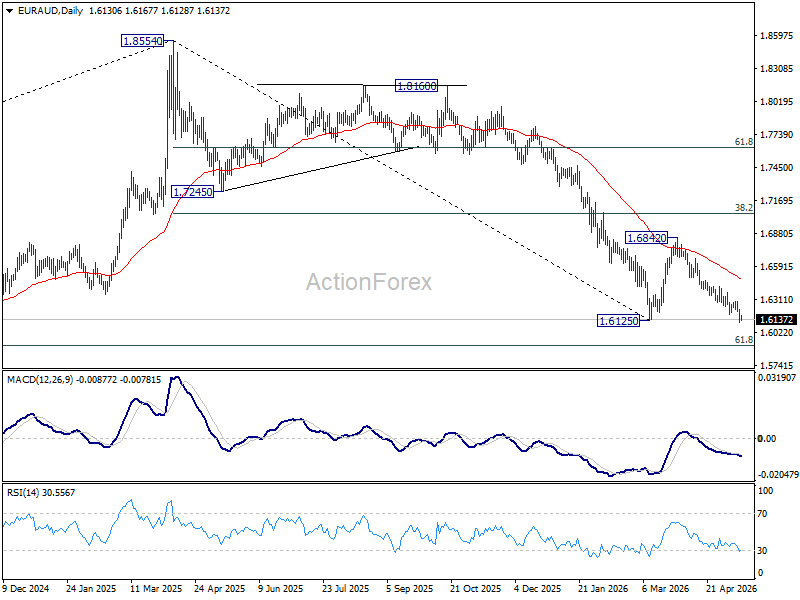
EUR/AUD Daily Outlook
Daily Pivots: (S1) 1.6082; (P) 1.6153; (R1) 1.6196; More...
Intraday bias in EUR/AUD stays on the downside at this point. Decisive break of 1.6125 will resume larger fall from 1.8554. Next target is 1.5913 fibonacci level. Nevertheless, break of 1.6293 resistance will indicate short term bottoming, and turn bias back to the upside for stronger rebound to 55 D EMA (now at 1.6491).
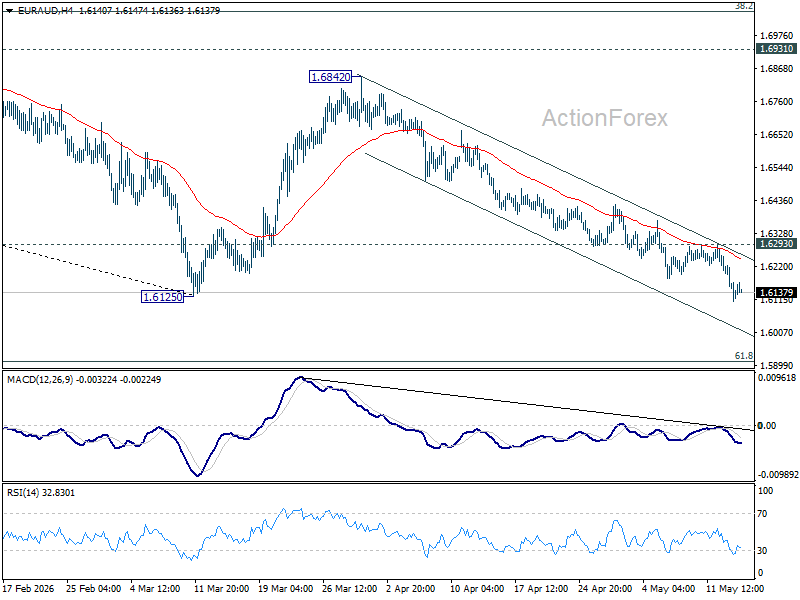
In the bigger picture, fall from 1.8554 (2025 high) is in progress and deeper decline should be seen to 61.8% retracement of 1.4281 to 1.8554 at 1.5913, which is slightly below 1.5963 structural support. Decisive break there will pave the way back to 1.4281 (2022 low). For now, risk will stay on the downside as long as 55 W EMA (now at 1.7039) holds, even in case of strong rebound.