

Sample Category Title
USD/JPY Daily Outlook
Daily Pivots: (S1) 130.79; (P) 131.27; (R1) 132.06; More...
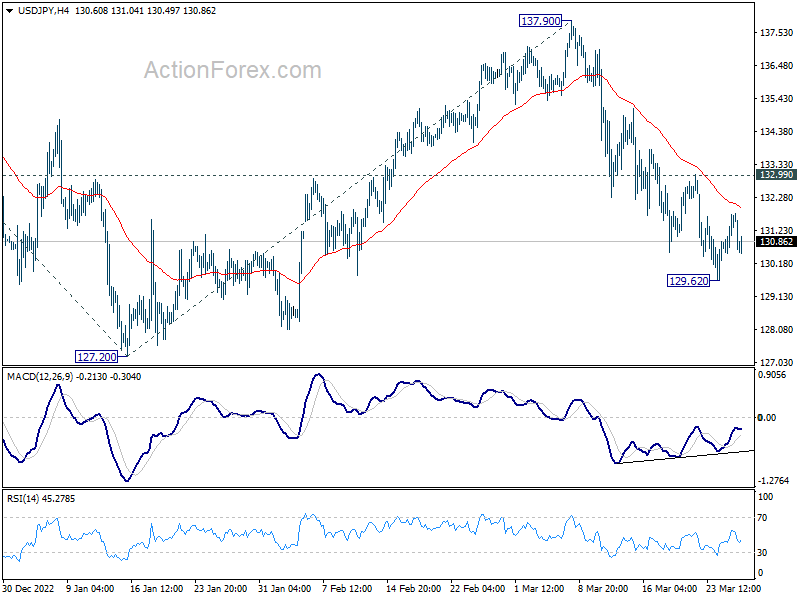
USD/JPY is staying in consolidation above 129.62 temporary low and intraday bias remains neutral. Outlook remains bearish as long as 132.99 resistance holds. Break of 129.62 will target a test on 127.20 low. Decisive break there will resume larger decline from 151.93 to 61.8% projection of 151.93 to 127.20 from 137.90 at 122.61.
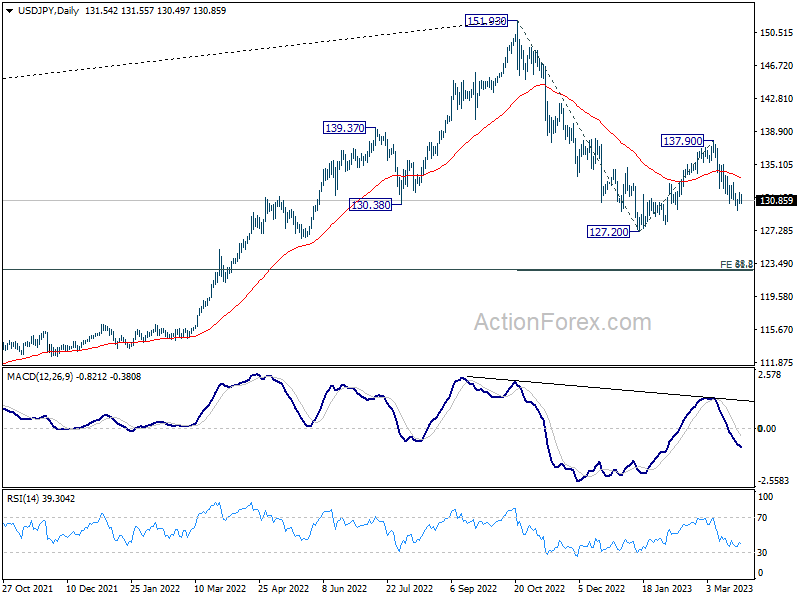
In the bigger picture, rebound from 127.20 should have completed at 137.90 as a corrective move. The down trend from 151.93 (2022 high) is still in progress. Break of 127.20 will resume this down trend and target 61.8% projection of 151.93 to 127.20 from 137.90 at 122.61. This will now be the favored case as long as 137.90 resistance holds.
AUD/USD Daily Report
Daily Pivots: (S1) 0.6635; (P) 0.6650; (R1) 0.6667; More...
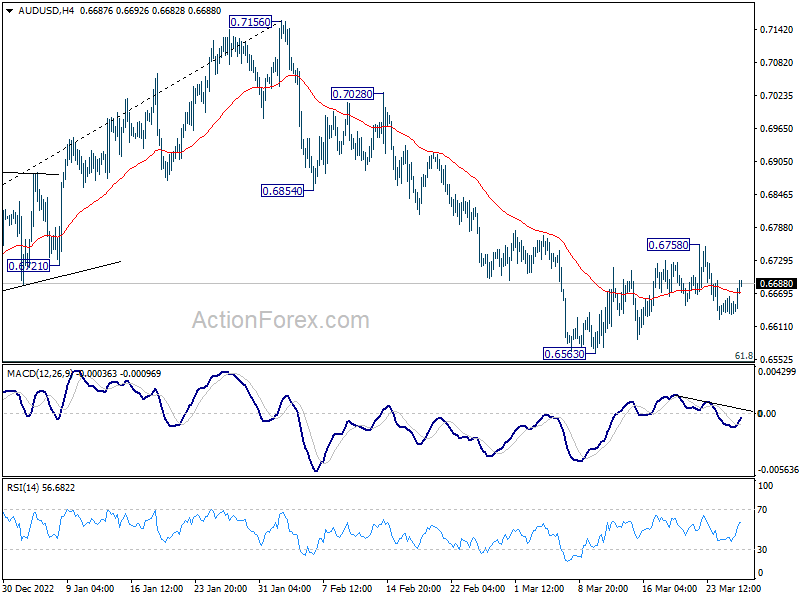
Intraday bias in AUD/USD turned neutral again with current recovery. Corrective pattern from 0.6563 could extend further. But deeper decline is in favor as long as 0.6758 resistance holds. Decisive break of 0.6546 fibonacci level will carry larger bearish implication. On the upside, however, break of 0.6758 resistance will now be a strong signal of bullish reversal and turn bias back to the upside.
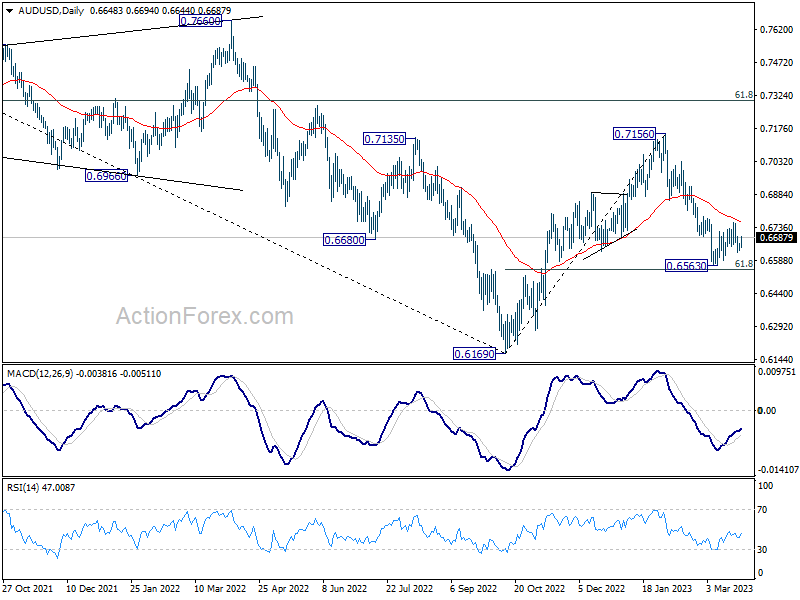
In the bigger picture, as long as 61.8% retracement of 0.6169 to 0.7156 at 0.6546 holds, the decline from 0.7156 is seen as a correction to rally from 0.6169 (2022 low) only. Another rise should still be seen through 0.7156 at a later stage. However, sustained break of 0.6546 will raise the chance of long term down trend resumption through 0.6169 low.
USD Consolidates Gains
EUR/USD finds support
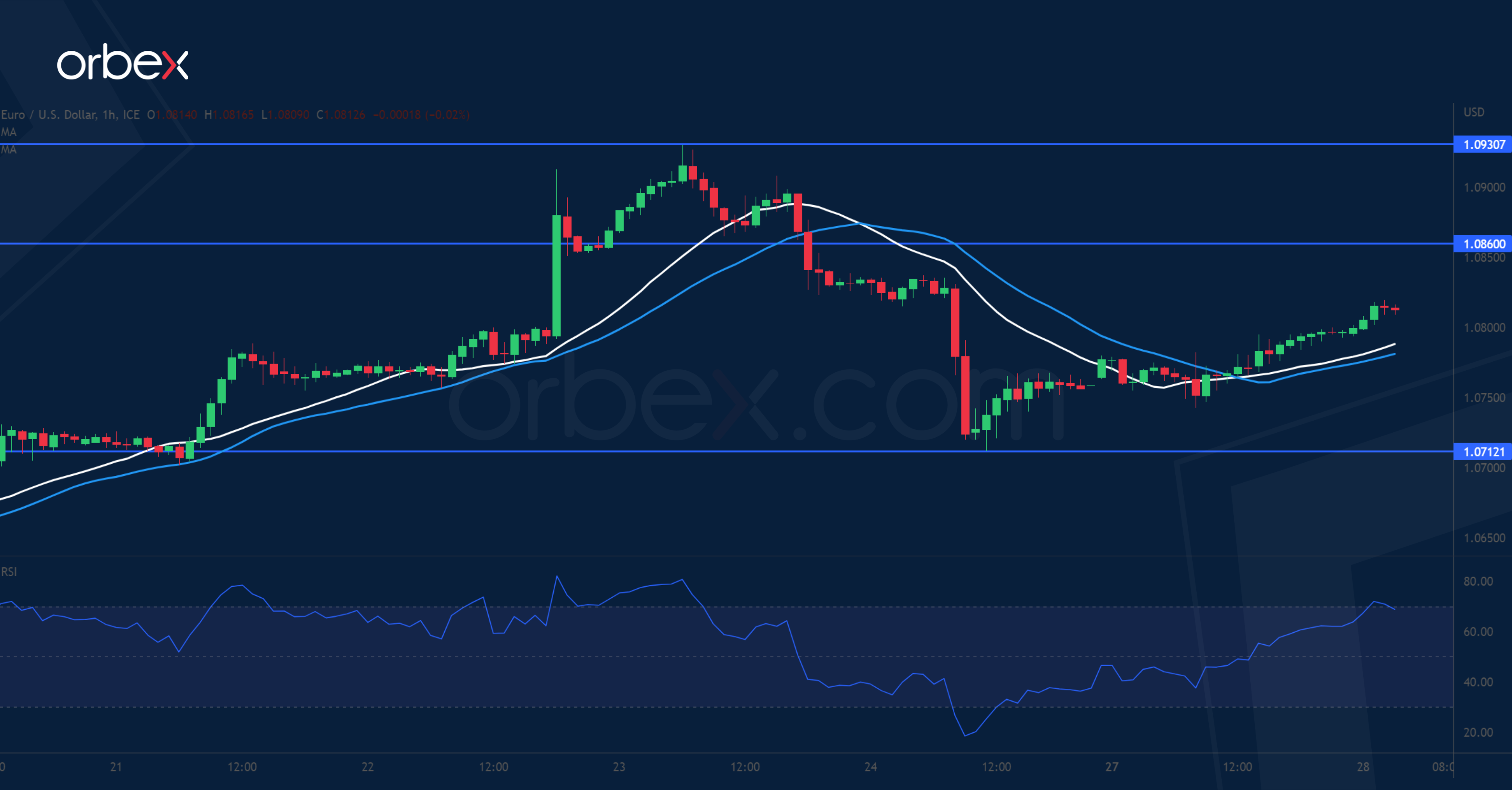
The US dollar pulls back as market sentiment stabilises. Coming off the start of the February sell-off at 1.0930, the pair is looking to keep the correction in check. The base of the bullish breakout at 1.0710 is an important level to retain the momentum. Its breach would dent the short-term optimism and trigger a deeper retracement towards 1.0600. The RSI’s oversold condition attracted some buying interests in the demand zone, but the bulls will need to reclaim 1.0860 before a higher high could materialise.
AUD/USD tests resistance
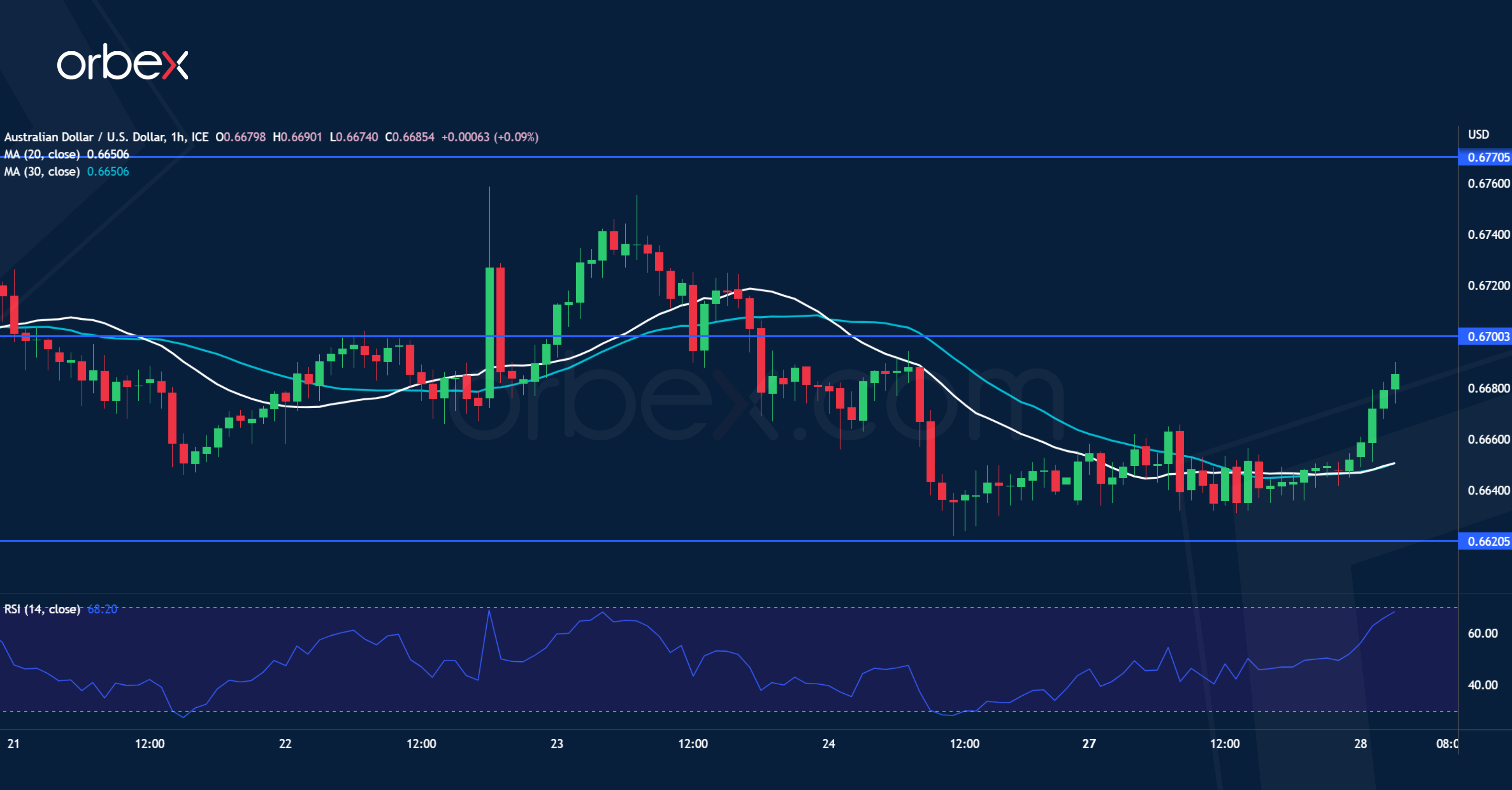
The Australian dollar may struggle over lacklustre retail figures in February. A drop below the swing low of 0.6650 has put the bulls on the defensive and proved that the supply zone around 0.6750 and on the 30- day SMA to be a tough level to crack for now. Sentiment remains cautious and 0.6620 might be buyers’ last chance to turn the tide with 0.6700 as the first hurdle to clear. A bearish breakout would cause a retest of this month’s low at 0.6570 where the aussie could be vulnerable to another leg of sell-off.
US 30 attempts to rebound
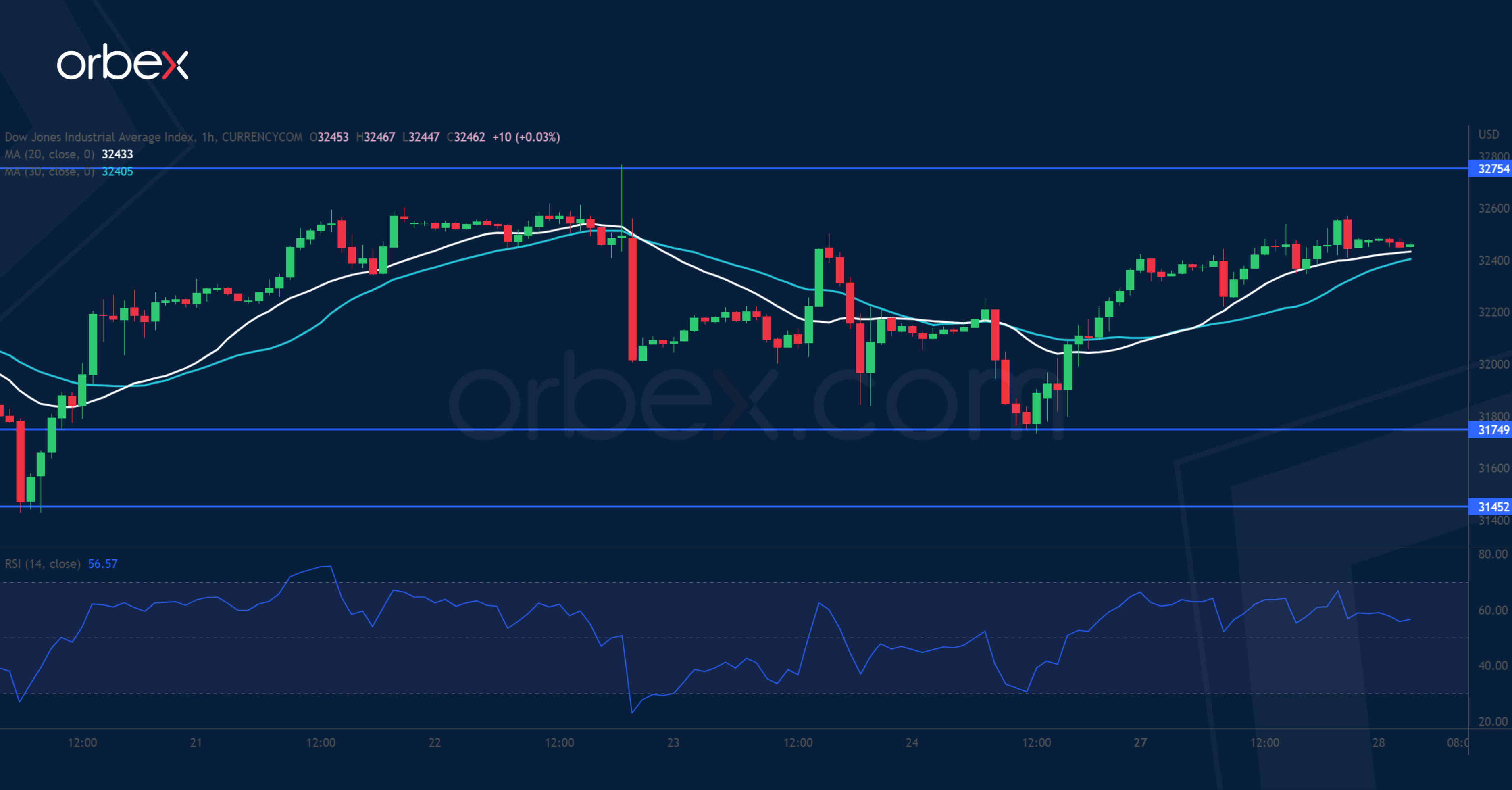
The Dow Jones 30 rallies as news of more emergency lending ease concerns about bank failures. A long spike at the support-turned-resistance of 32750 suggests strong resistance at last week’s breakout attempt. However, solid buying seems to have emerged in the demand zone 31450-31750. A convincing break above 32750 would prompt sellers to cover their positions and help buyers regain control of the direction in the short-term. Then 33500 would be the next target. Failing that, a fall below 31450 would expose 31000.
Dollar Remains in Defensive, Even Against Yen
Markets
Yesterday, financial stress that dominated investor positioning going into the weekend, gradually subsided. Markets apparently err to the view that issues at some US regional banks still should be considered as idiosyncratic and that authorities have enough tools to prevent those individual cases to affect the global system in profound way. Such a scenario allows central bankers to continue to give inflation the focus it needs in their policy mix. Eco data were few, with the German Ifo business confidence the exception to the rule. The headline index improved more than expected (93.3 from 91.1) supported by better than expected readings for both the current assessment and expectations. The direct impact on trading was modest. Even so, it confirmed the message from the PMI’s that the European/German recovery remains on track. In a brother risk-on repositioning, US yields rebounded between 22.9 bps (2-y) and 11.7 bps (10-y). Despite intra-day cheapening, the $42 bln 2-y Treasury auction only received mediocre investor interest. The rise in yields was mainly driven by higher real yields (10-y +11 bps). Markets now again see about a 50/50 chance for one additional Fed rate hike in May and have reduced Fed rate cut expectations by about 25 bps for early next year. German yields showed a similar move, albeit more modest, with yields rising between 12.8 bps (2-y) and 9 bps (30-y). The Euro Stoxx 50 closed 0.82% higher. In the US the Dow gained 0.60% but the Nasdaq ceded 0.47%. Higher real yields apparently complicate the rebound of growth stocks. The dollar also didn’t profit from higher real yields as broader risk sentiment also dominated FX trading. DXY dropped back below the 103 handle. In a protracted intraday uptrend EUR/USD closed near 1.08. The yen underperformed with USD/JPY closing at 131.57. Sterling also held up well, with EUR/GBP still attacking 0.88 big figure (close 0.8788).
This morning, Asian equity markets mostly show modest gains. US yields ease about 1-2 bps. The dollar remains in the defensive, even against the yen (DXY 102.65, USD/JPY 130.7). Later today, the eco calendar contains country confidence data in Europe and consumer confidence (Conf. Board) in the US. A modest decline from 102.9 to 101 is expected. We don’t expect a profound impact on trading. Markets might be slightly more sensitive to a negative than a positive surprise. ECB’s Muller and Vasle are scheduled to speak. In a day-to-day perspective, we expect yesterday’s trends to continue, albeit at a much more modest pace. The US 2-y yield is nearing the 4.0% handle. EUR/USD managed to hold above the 1.0735 support area, suggesting some further gains within the 1.0760/1.0913 short term barriers. Sterling also remains well bid this morning (EUR/GBP 0.878). Overnight, UK BRC shop prices were reported at 8.9%, a record since the start of the series in 2005.
News and views
Hungary ratified Finland’s Nato membership yesterday. The country together with Turkey have long opposed Finland’s bid (and still do in case of Sweden), with some calling it a game of blackmail over the EU blocking funds. But after Turkey dropped resistance about two weeks ago, Hungary followed soon thereafter. PM Orban’s U-turn is seen as a latest sign of pivoting to the west, away from Russia. Economic benefits of that relationship are fading with many companies contemplating an exit out of the country.
The European Commission delayed the payout of €19bn pandemic recovery funds to Italy by at least one month. There is skepticism about Italy reaching preset targets that are required to unlock the aid. The Commission will double-check in particular progress on the licensing of port activities, on district heating and on two urban renewal projects. Of the €192bn Italy is to receive, some €67bn has already been distributed. But red tape is slowing down authorization processes, leaving Italy struggling to allocate and spend the money as quickly as originally planned.
New research by the World Bank showed that the global economy risks suffering a lost decade of growth. The pandemic and the Russian invasion were said to create lasting damage to economic performance and reduce growth rates for the rest of this decade by a third, from 2.6% between 2011 and 2021 to 2.2%. In the first 10 years of this century, growth was 3.5%. The World Bank cited huge uncertainties and reduced investments (about half compared to the previous two decades). The slowdown in global prospects could be much sharper in case another financial crisis would cause a global recession, it added referring to the turmoil in financial markets over the past weeks.
Bank Stocks Rebound, Gold and Bitcoin Fall
Recovery in bank stocks improved market sentiment on Monday.
In Germany, Deutsche Bank shares gained more than 6%.
In the US, First Citizens BancShares jumped more than 50% after agreement to absorb the remains of the Silicon Valley Bank (SVB). Meanwhile, the First Republic Bank recovered nearly 12% yesterday.
Calm, and rally in bank stocks yesterday stabilized the market mood. Gold tipped a toe below $1950 per ounce, while the US 2-year yield flirted with the 4% mark – on bet that if the bank crisis is over, we could go back to our lives and worrying about inflation, again.
The S&P500 closed 0.17% up, while the rate-sensitive Nasdaq fell 0.74%.
Of course, if the banking stress further eases, we should see sovereign yields recover a part of the recent retreat.
Yet, the pricing of recession is now in play, and should keep the upside limited at below the pre-SVB levels, when the Federal Reserve (Fed) was expected to hike the rates all the way up to around 5.5%.
This is no longer the expectation.
That’s why the equity markets, which have been relatively resilient to the bank stress – partly due to higher liquidity injected in the market to deal with it, remain vulnerable as earnings estimates will more likely than not revised lower in the foreseeable future.
Bitcoin narrative shifts from safe-haven on bank stress to shaky on Binance stress
Bitcoin fell sharply to below $27K per coin on news that Binance and its CEO were sued by CFTC for allegedly failing to properly register. The firm is said to have allowed its clients to trade derivates since at least 2021, and these derivatives are not subject to American jurisdiction, and that Binance should’ve registered with the agency years ago, and that they continue to violate CFTC’s rules.
The news doesn’t call for the end of Binance, the world’s biggest crypto exchange, but it could well cool appetite for safe haven flows to Bitcoin – which came along with the bank crisis, reminding crypto investors that cryptocurrency exchanges are not necessarily safer than a bank.
FX and energy
The US dollar index remains under the pressure of softer US yields as mounting recession worries keep the hawkish Fed expectations at bay.
The EURUSD has so far managed to rebound from a critical 50-DMA, near 1.0725, even though Mario Centeno, a member of the European Central Bank’s (ECB) Governing Council said that the bank must consider recent financial-market stress when taking decisions on interest rates - an idea that Lagarde simply rejected at her latest press conference saying that the ECB has other tools in hand to deal with a potential stress concerning the banks and liquidity. The door for a further rise to $1.10 remains open for the euro bulls.
In energy, improved sentiment in banks and a legal dispute that halted around 400,000 barrels a day of oil exports from the Ceyhan port in Turkey pushed the barrel of US crude past the $70pb yesterday. The price of a barrel flirted with the $73 level.
Yet, the mounting recession odds and the resilient Russian supply, which partly absorbs the rising oil demand from China, are expected to keep the topside limited into the $75/77 area, where stand the 50 and the 100-DMA respectively.
Yields Rebound
Market movers today
It is a quiet day on the macro data front although the US Conference Board's Consumer Confidence index will be released for March. Consensus is looking for a modest decline in line with the University of Michigan survey released earlier.
ECB's Lagarde and BoE's Bailey will give speeches today, while the Fed's Barr testifies before the US Senate on bank oversight.
The National Bank of Hungary has a monetary policy meeting, consensus expects unchanged policy rate. In Sweden, FSA publishes its yearly Mortgage report (08:00 CET).
In Sweden, FSA publishes its yearly Mortgage report (08:00 CET).
The 60 second overview
Market recap: The beginning of the week has been characterised by relief in equity markets and a rebound in both nominal and real yields as markets have priced back in a higher likelihood of more global rate hikes to come. "No news is good news" remains the mantra for the European bank sector but general risk appetite was also aided by positive bank news on the other side of the Atlantic. Also the start to the week has been characterised by a weaker USD, a rise oil prices and a setback to indicators on global USD funding pressures.
First Citizens Bank. Yesterday, it was announced that First Citizens BankcShares has agreed to buy the majority of Silicon Valley Bank (SVB) assets which brings the acquirer to the top 15 list of the biggest US banks - up from a 30th spot by the end of 2022. The US Federal Deposit Insurance Corporation will still maintain a portion of SVB-assets. First Citizen stocks rose by more than 50% upon announcement. Adding to positive US banking news, Bloomberg reported over the weekend that the US authorities are contemplating expanding an emergency lending facility to struggling banks.
Central bank pricing. Following the improved risk appetite global yields moved higher yesterday with markets notably pricing in a higher likelihood of additional rate hikes from the Fed and the ECB. Markets are now pricing around 10bp worth of hikes from the Fed at the May meeting - yet the USD rate curve still embeds an accumulative 70bp worth of cuts by year-end. We still expect the Fed to hike policy rates by an additional 25bp in May and thereafter to keep policy rates unchanged until at least early 2024.
In terms of the ECB markets are now pricing around 45bp worth of additional hikes until summer and roughly 7bp worth of cuts by December. This remains more than 50bp worth of hikes short of our house call on the ECB although we humbly acknowledge that much will come down to credit growth indicators in the coming months as these will shed light on the full impact of recent bank jitters.
Israeli demonstrations. Following heavy demonstrations Israeli Prime Minister Benjamin Netanyahu has decided to delay a bill on political dominance in the appointment of judges. The bill has received heavy opposition which has brought Israel to a virtual standstill.
Hungary. Yesterday a majority of the Hungarian Parliament voted in favour of Finland joining NATO. The decision follows Turkey's decision to approve Finland's bid. Among political commentators Hungary's previous opposition to a Finish membership was seen as an attempt to pressure the EU but also that this ratification is yet another sign that Prime Minister Victor Orbán is gradually turning his back to Moscow.
Equities: Global equities rose yesterday as the weekend had passed without any bank closure and just as importantly, it was a very quiet Monday from a bank news perspective. First Citiczens bought part of SVB, but that kind of news is in the positive camp as it strengthens the confidence around SVB being an idiosyncratic event. On top of this we got looser financial conditions, higher short-term yields, lover bond vol and banks together with value outperforming. In other words, Monday looked a bit like how we expect the coming months to be. In US Dow +0.6%, S&P 500 +0.2%, Nasdaq -0.5% and Russell 2000 +1.1%. Asian markets are mixed this morning while US and European futures are higher.
Credit: Yesterday, credit markets were relatively calm and traded slightly tighter with both CDS indices closing lower with iTraxx Main (-1.1bp) at 96.1bp, and iTraxx Crossover (-5.9bp) at 489.8bp. The primary Eurobond market is coming off to a busy start with 4 borrowers raising debt where Engie SA, Renault SA, Wolters Kluwer NV, and Canadian Imperial Bank of Commerce (Covered bond) were among the largest announced deals. Including the primary US market, 14 issuers were active, making the day the busiest since the SVB collapse. Bloomberg reports that borrowers are seeking funding based on declining volatility, lower rates, and are active in advance of first-quarter earnings blackouts.
FI: Global rates sold-off significantly in the absence of market moving news, which in light of the turmoil in recent weeks also means focus is turning back to the macro narrative. The sell-off was yet again driven by the front end, with 2y Germany 13bp higher on the day. German ASW spreads tightening from the start to 74bp, which is in the lower end in recent turmoil.
FX: It has been a fairly quiet start to the week for FX markets. Despite the relief risk-on sentiment in yesterday's session it was still very limited to what extent the traditional risk-on currencies gained - some of which, like NOK, even ended the session among the underperformers. EUR/USD crept slightly higher to the 1.08 level but remains below the spot levels prior to Friday's sell-off. Both EUR/SEK and EUR/GBP edged marginally lower while USD/JPY has moved back above the 131 mark on the rebound in yields.
USD/CAD Daily Outlook
Daily Pivots: (S1) 1.3625; (P) 1.3685; (R1) 1.3720; More....
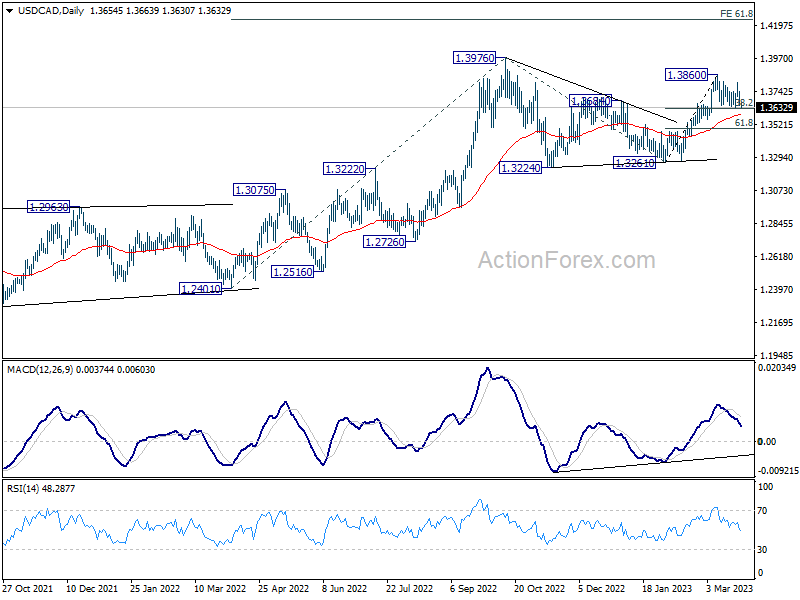
Intraday bias in USD/CAD stays neutral at this point. Further rally is expected as long as 1.3629 support holds. Firm break of 1.3860 will target 1.3976 high. However, break of 1.3629 will mix up the near term outlook. Intraday bias will be back on the downside for 55 day EMA (now at 1.3586), or even further to 61.8% retracement of 1.3261 to 1.3860 at 1.3490.
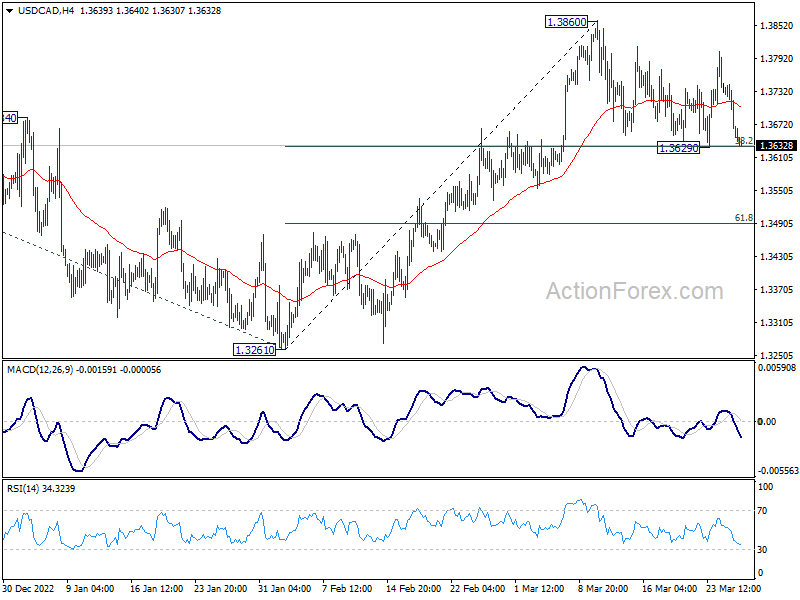
In the bigger picture, the up trend from 1.2005 (2021 low) is still in progress. Break of 1.3976 will confirm resumption and target 61.8% projection of 1.2401 to 1.3976 from 1.3261 at 1.4234. Firm break there will pave the way to long term resistance zone at 1.4667/89 (2016, 2020 highs). On the downside, break of 1.3261 support is needed to confirm medium term topping. Otherwise, outlook will remain bullish even in case of deep pull back.
Forex Markets Grapple with Uncertainty and Ambiguity, Sterling Ready for Breakout?
Forex markets are currently navigating a landscape of uncertainty, as mixed currency performance contributes to a lack of clear direction. Dollar has experienced a decline in Asian session, but still hovers within familiar boundaries against other major currencies. Meanwhile, Euro has managed to strengthen against the greenback but appears less robust in other pairs.
Yen, on the other hand, has emerged as a strong contender for the day, recouping some of its yesterday's pullback. In addition, Sterling has found firmer footing after BoE Governor Andrew Bailey's remarks indicated that the Monetary Policy Committee can concentrate on inflation while the Financial Policy Committee maintains financial stability. Interestingly, Australian Dollar has managed to hold its ground despite disappointing retail sales data.
Looking ahead, the market may experience subdued trading due to a relatively light economic calendar. However, the upcoming release of US consumer confidence data could introduce an element of volatility, as traders and investors alike look for potential opportunities in the midst of uncertainty.
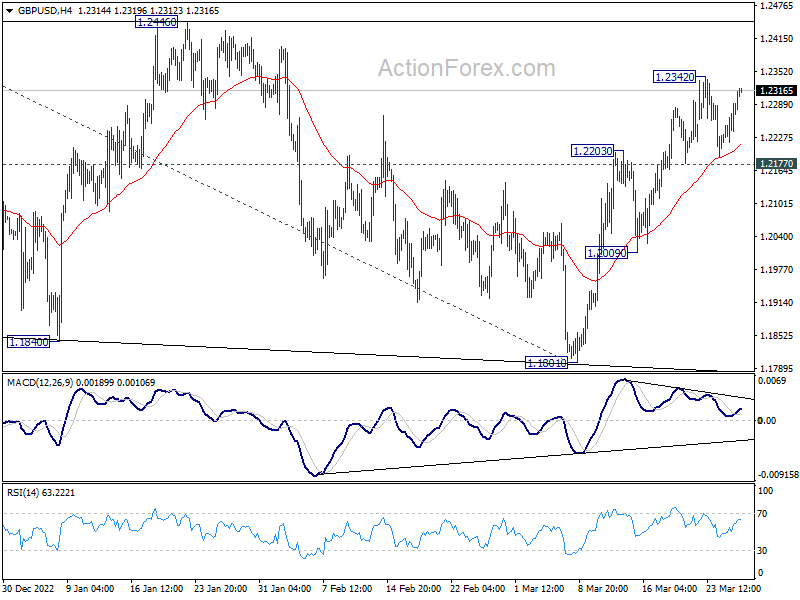
Technically, GBP/USD could now be eyeing 1.2342 temporary top with this week's rebound. Break there will resume the near term rally to 1.2445/6 resistance zone. Decisive break there will resume larger up trend from 1.0351 (2022 low) to 1.2759 fibonacci level. Let's see if the Pound has enough buying to back the breakout.
In Asia, at the time of writing, Nikkei is up 0.15%. Hong Kong HSI is up 1.37%. China Shanghai SSE is up 0.18%. Singapore Strait Times is up 0.73%. Japan 10-year JGB yield is up 0.0220 at 0.317. Overnight DOW rose 0.60%. S&P 500 rose 0.16%. NASDAQ dropped -0.47%. 10-year yield rose 0.148 to 3.528.
Fed Jefferson on balancing inflation and economic stability
Fed Philip Jefferson stated yesterday that the current inflation rate is too high, emphasizing the FOMC's goal to reduce it to 2% as quickly as possible. Speaking at Washington and Lee University in Lexington, Virginia, he acknowledged that the process may take some time due to persistent inflation components such as services excluding housing.
Jefferson said, "I would like to say that inflation will return to 2% soon, but we have to do it in a way that does not damage the economy any more than is necessary. That's what we are trying to do." Fed is grappling with the challenge of ensuring price stability amid high inflation while also maintaining financial stability in the wake of the second-largest bank failure in US history.
In his speech, Jefferson also noted that although inflation has begun to decline, it remains unclear whether this decrease is due to higher interest rates, easing pandemic-induced supply strains, or falling energy prices.
He highlighted the uncertainty surrounding the full impact of the Fed's tightening measures, saying, "Monetary policy affects the economy and inflation with long, variable, and highly uncertain lags, and we are still learning about the full effect of our tightening thus far."
Australia retail sales turnover up 0.2% mom in Feb, appeared to have levelled out
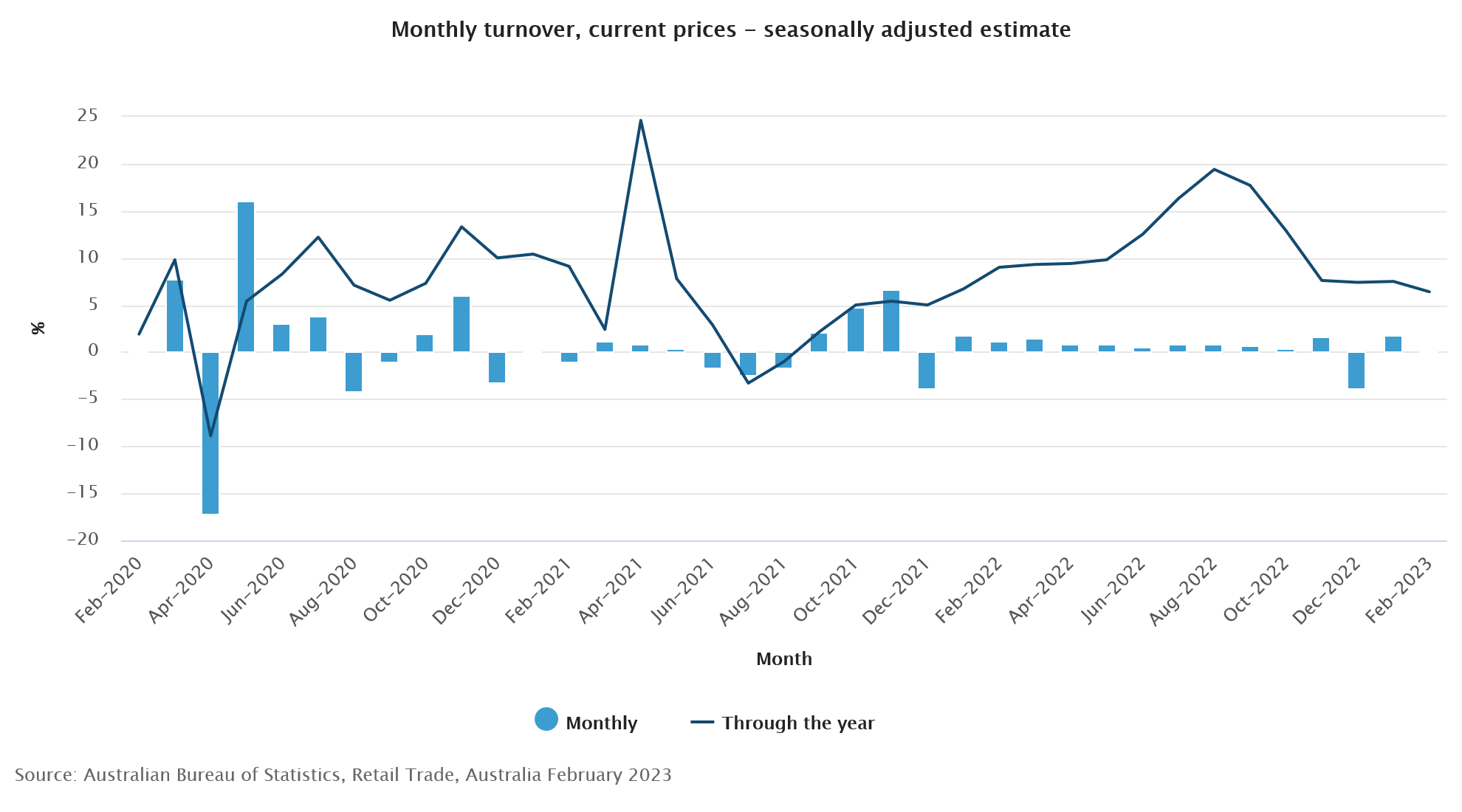
Australia retail sales turnover rose 0.2% mom to AUD 35.14B in February, matched expectations. Through the year, retail sales rose 6.4% yoy.
Ben Dorber, ABS head of retail statistics, said retail sales rose modestly in February and appear to have levelled out after a period of increased volatility over November, December and January.
"On average, retail spending has been flat through the end of 2022 and to begin the new year."
Retail turnover rose modestly across most of the states and territories, with rises at 1.0% or less. Queensland recorded the only fall in turnover, down -0.4%.
Looking ahead
BOE will release quarterly bulletin. Later in the day, US will publish goods trade balance, housing index and consumer confidence.
USD/CAD Daily Outlook
Daily Pivots: (S1) 1.3625; (P) 1.3685; (R1) 1.3720; More....
Intraday bias in USD/CAD stays neutral at this point. Further rally is expected as long as 1.3629 support holds. Firm break of 1.3860 will target 1.3976 high. However, break of 1.3629 will mix up the near term outlook. Intraday bias will be back on the downside for 55 day EMA (now at 1.3586), or even further to 61.8% retracement of 1.3261 to 1.3860 at 1.3490.
In the bigger picture, the up trend from 1.2005 (2021 low) is still in progress. Break of 1.3976 will confirm resumption and target 61.8% projection of 1.2401 to 1.3976 from 1.3261 at 1.4234. Firm break there will pave the way to long term resistance zone at 1.4667/89 (2016, 2020 highs). On the downside, break of 1.3261 support is needed to confirm medium term topping. Otherwise, outlook will remain bullish even in case of deep pull back.
Economic Indicators Update
| GMT | Ccy | Events | Actual | Forecast | Previous | Revised |
|---|---|---|---|---|---|---|
| 00:30 | AUD | Retail Sales M/M Feb | 0.20% | 0.40% | 1.90% | 1.80% |
| 11:00 | GBP | BoE Quarterly Bulletin | ||||
| 12:30 | USD | Goods Trade Balance (USD) Feb P | -89.9B | -91.5B | ||
| 12:30 | USD | Wholesale Inventories Feb P | 0.20% | -0.40% | ||
| 13:00 | USD | Housing Price Index M/M Jan | -0.20% | -0.10% | ||
| 13:00 | USD | S&P/CS Composite-20 HPI Y/Y Jan | 4.50% | 4.60% | ||
| 14:00 | USD | Consumer Confidence Mar | 101.7 | 102.9 |
Australia retail sales turnover up 0.2% mom in Feb, appeared to have levelled out
Australia retail sales turnover rose 0.2% mom to AUD 35.14B in February, matched expectations. Through the year, retail sales rose 6.4% yoy.
Ben Dorber, ABS head of retail statistics, said retail sales rose modestly in February and appear to have levelled out after a period of increased volatility over November, December and January.
"On average, retail spending has been flat through the end of 2022 and to begin the new year."
Retail turnover rose modestly across most of the states and territories, with rises at 1.0% or less. Queensland recorded the only fall in turnover, down -0.4%.
Bearish Elliott Wave Sequence in AUDJPY Suggests Further Downside
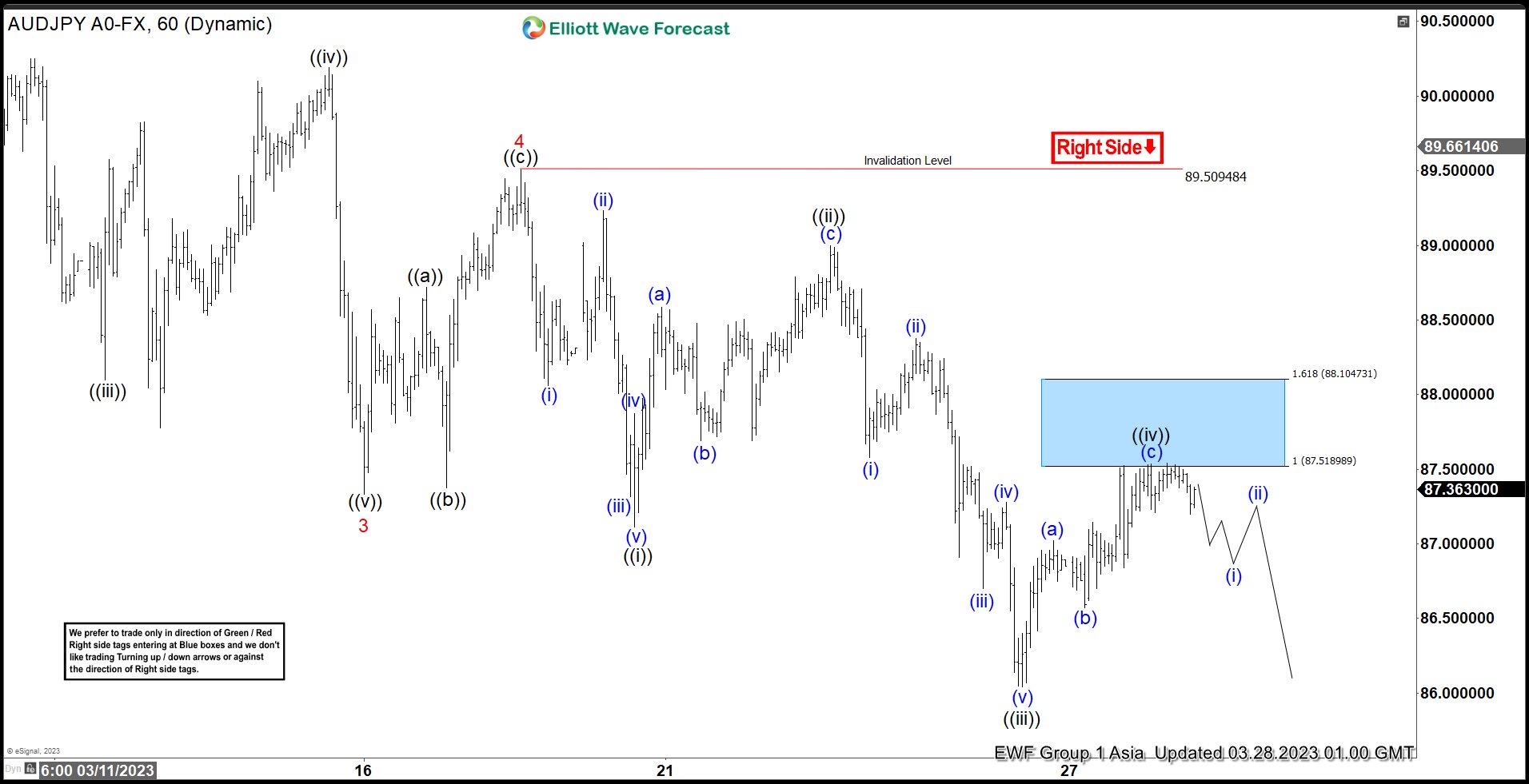
AUDJPY shows a 5 swing bearish sequence from September 2022 peak favoring further downside. Cycle from 2.15.2023 high is currently in progress as a 5 waves impulse Elliott Wave structure. This cycle is mature and expected to end soon. Down from 2.15.2023 high, wave 1 ended at 91.91 and rally in wave 2 ended at 93. Pair then resumes lower again in wave 3 towards 87.33 as the 1 hour chart below shows. Rally in wave 4 ended at 89.509 with internal subdivision as a zigzag structure. Up from wave 3, wave ((a)) ended at 88.719 and wave ((b)) ended at 87.37. Final leg wave ((c)) ended at 89.509 which completed wave 4.
Wave 5 lower is now in progress with subdivision as another 5 waves impulse in lesser degree. Down from wave 4, wave ((i)) ended at 87.115 and rally in wave ((ii)) ended at 89. Pair resumes lower in wave ((iii)) towards 86.04, and wave ((iv)) is proposed complete at 87.53. Near term, as far as pivot at 89.509 high stays intact, pair has scope to extend lower before ending wave ((v)) of 5. This should also complete cycle from 2.15.2023 high and then pair should see larger degree correction higher in 3, 7, 11 swing.
AUDJPY 1 Hour Elliott Wave Chart
AUDJPY Elliott Wave Video
https://www.youtube.com/watch?v=pLhZDAtueyg