

Sample Category Title
ECB press conference live stream
https://www.youtube.com/watch?v=GTMCvGVU8aE
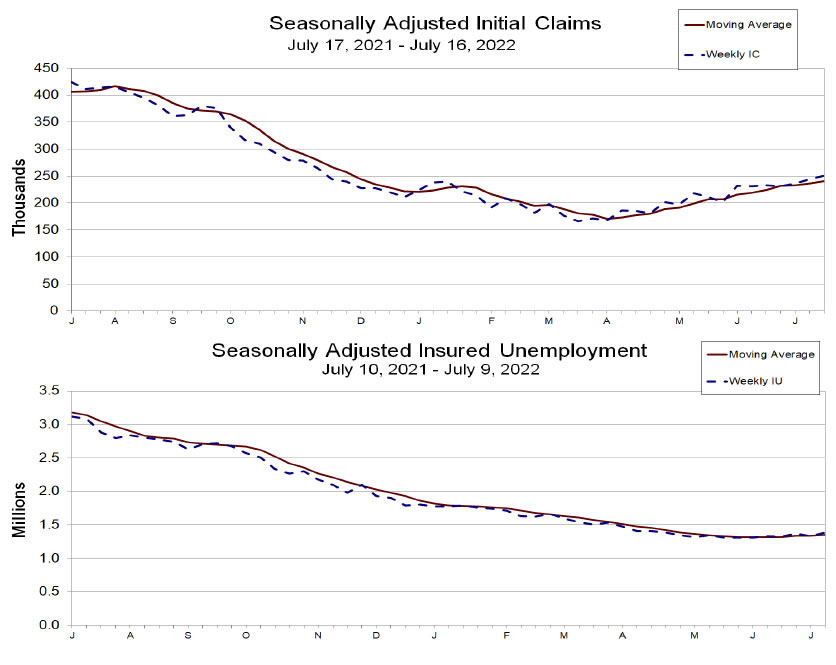
US initial jobless claims rose to 251k, continuing claims rose to 1.384m
US initial jobless claims rose 7k to 251k in the week ending July 16, above expectation of 240k. Four-week moving average of initial claims rose 4.5k to 240.5k.
Continuing claims rose 51k to 1384k in the week ending July 9. Four-week moving average of continuing claims rose 13k to 1353k.
ECB hikes 50bps, frontloading exit from negative deposit rate
ECB announced to raise the three key interest rates by 50bps today. The main refinancing operations and the interest rates on the marginal lending facility and the deposit facility will be increased to 0.50%, 0.75% and 0.00% respectively, with effect from 27 July 2022.
The "larger first step" in policy normalization was based on the "updated assessment of inflation risks and the reinforced support provided by the TPI for the effective transmission of monetary policy." The "frontloading" of exit from negative deposit rate " allows the Governing Council to make a transition to a meeting-by-meeting approach to interest rate decisions." Future policy path will continue to be "data-dependent".
Also, the Governing Council approved the Transmission Protection Instrument (TPI), to "ensure that the monetary policy stance is transmitted smoothly across all euro area countries".
(ECB) Monetary policy decisions
Today, in line with the Governing Council's strong commitment to its price stability mandate, the Governing Council took further key steps to make sure inflation returns to its 2% target over the medium term. The Governing Council decided to raise the three key ECB interest rates by 50 basis points and approved the Transmission Protection Instrument (TPI).
The Governing Council judged that it is appropriate to take a larger first step on its policy rate normalisation path than signalled at its previous meeting. This decision is based on the Governing Council's updated assessment of inflation risks and the reinforced support provided by the TPI for the effective transmission of monetary policy. It will support the return of inflation to the Governing Council's medium-term target by strengthening the anchoring of inflation expectations and by ensuring that demand conditions adjust to deliver its inflation target in the medium term.
At the Governing Council's upcoming meetings, further normalisation of interest rates will be appropriate. The frontloading today of the exit from negative interest rates allows the Governing Council to make a transition to a meeting-by-meeting approach to interest rate decisions. The Governing Council's future policy rate path will continue to be data-dependent and will help to deliver on its 2% inflation target over the medium term. In the context of its policy normalisation, the Governing Council will evaluate options for remunerating excess liquidity holdings.
The Governing Council assessed that the establishment of the TPI is necessary to support the effective transmission of monetary policy. In particular, as the Governing Council continues normalising monetary policy, the TPI will ensure that the monetary policy stance is transmitted smoothly across all euro area countries. The singleness of the Governing Council's monetary policy is a precondition for the ECB to be able to deliver on its price stability mandate.
The TPI will be an addition to the Governing Council's toolkit and can be activated to counter unwarranted, disorderly market dynamics that pose a serious threat to the transmission of monetary policy across the euro area. The scale of TPI purchases depends on the severity of the risks facing policy transmission. Purchases are not restricted ex ante. By safeguarding the transmission mechanism, the TPI will allow the Governing Council to more effectively deliver on its price stability mandate.
In any event, the flexibility in reinvestments of redemptions coming due in the pandemic emergency purchase programme (PEPP) portfolio remains the first line of defence to counter risks to the transmission mechanism related to the pandemic.
The details of the TPI are described in a separate press release to be published at 15:45 CET.
Key ECB interest rates
The Governing Council decided to raise the three key ECB interest rates by 50 basis points. Accordingly, the interest rate on the main refinancing operations and the interest rates on the marginal lending facility and the deposit facility will be increased to 0.50%, 0.75% and 0.00% respectively, with effect from 27 July 2022.
At the Governing Council's upcoming meetings, further normalisation of interest rates will be appropriate. The frontloading today of the exit from negative interest rates allows the Governing Council to make a transition to a meeting-by-meeting approach to interest rate decisions. The Governing Council's future policy rate path will continue to be data-dependent and will help to deliver on its 2% inflation target over the medium term.
Asset purchase programme (APP) and pandemic emergency purchase programme (PEPP)
The Governing Council intends to continue reinvesting, in full, the principal payments from maturing securities purchased under the APP for an extended period of time past the date when it starts raising the key ECB interest rates and, in any case, for as long as necessary to maintain ample liquidity conditions and an appropriate monetary policy stance.
As concerns the PEPP, the Governing Council intends to reinvest the principal payments from maturing securities purchased under the programme until at least the end of 2024. In any case, the future roll-off of the PEPP portfolio will be managed to avoid interference with the appropriate monetary policy stance.
Redemptions coming due in the PEPP portfolio are being reinvested flexibly, with a view to countering risks to the transmission mechanism related to the pandemic.
Refinancing operations
The Governing Council will continue to monitor bank funding conditions and ensure that the maturing of operations under the third series of targeted longer-term refinancing operations (TLTRO III) does not hamper the smooth transmission of its monetary policy. The Governing Council will also regularly assess how targeted lending operations are contributing to its monetary policy stance.
***
The Governing Council stands ready to adjust all of its instruments within its mandate to ensure that inflation stabilises at its 2% target over the medium term. The Governing Council's new TPI will safeguard the smooth transmission of its monetary policy stance throughout the euro area.
The President of the ECB will comment on the considerations underlying these decisions at a press conference starting at 14:45 CET today.
Only US Policymakers Can Stop the Dollar’s Growth
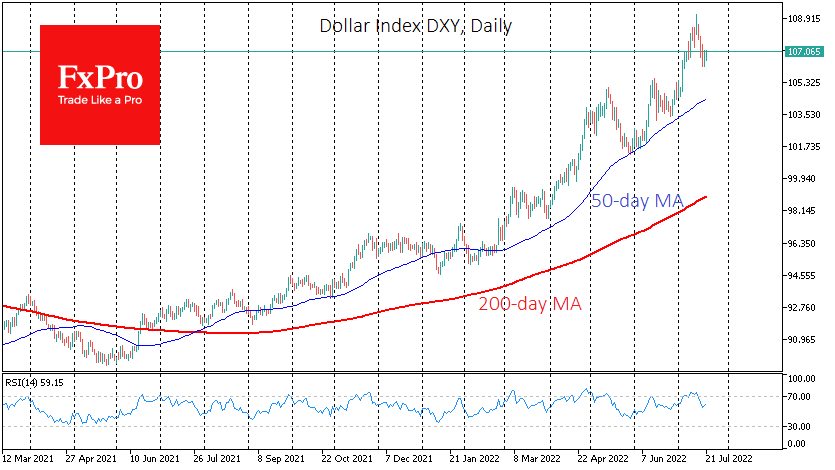
The differences between the actions of monetary authorities in various developed countries are becoming increasingly apparent. Until we see real work by the governments and central banks of the USA, Japan, or the Eurozone to change the trend, it is hardly prudent to bet on a peak in the USD.
In our view, governments’ ability to service their debts is an unspoken and indirect reason for this divergence. In the first instance, this depends on the level of the debt burden, and a more comprehensive set of measures also includes international investor confidence and the ability to raise money from the markets at an acceptable interest rate for the government.
From that point of view, the procrastination by the ECB, which is not expected to raise its rate until later Thursday, is understandable. Probably by as much as 50 points at once. For the ECB, it may look like a decisive move, but it is desperately lagging behind market conditions and the actions of its colleagues. Much of this has to do with questions about whether debt-ridden Italy and Greece can hold their own.
In Japan today, the central bank left Thursday’s rate unchanged at -0.1% and promised to increase QE if necessary. The debt-ridden Rising Sun Country cannot raise rates to protect against rising import prices., which has direct and obvious consequences for the currency. Since the start of 2021, the yen has lost 35% against the Dollar, about double the loss of the euro.
To investors and traders, the current euro and yen exchange rates may seem low after updating 20-year lows, but that is a dangerous approach. Rebalancing global monetary or currency policy is necessary to reverse the Dollar’s rising trend.
The ECB and the Bank of Japan allow a market devaluation of their currencies, ostentatiously delaying their policy tightening. Since they are significant reserve currencies, devaluation is proceeding smoothly despite economic problems and gloomy prospects due to dependence on energy imports.
Japan’s authorities appear to be only concerned about the pace of the yen’s decline, not its direction. The euro region’s monetary and financial authorities have made no discernible comments to defend the euro. Only the US authorities can stop the Dollar’s rise in such circumstances.
Right now, the appreciation against peers is working to lower inflation and cool the economy, as is the policy of the Fed. Furthermore, the current situation is working on the Dollar’s credibility, which has been shaken in 2020.
In our view, in the coming months, the Dollar’s rise will only be interrupted by occasional technical pullbacks. Only the US authorities can stop this trend. The Treasury could suddenly become alarmed by the appreciation of the Dollar. The Fed could also quickly reduce the rate hikes or talk about easing plans once it is convinced that inflation has turned around. But so far, we are not at that point.
Euro Flat Ahead of ECB Rate Move
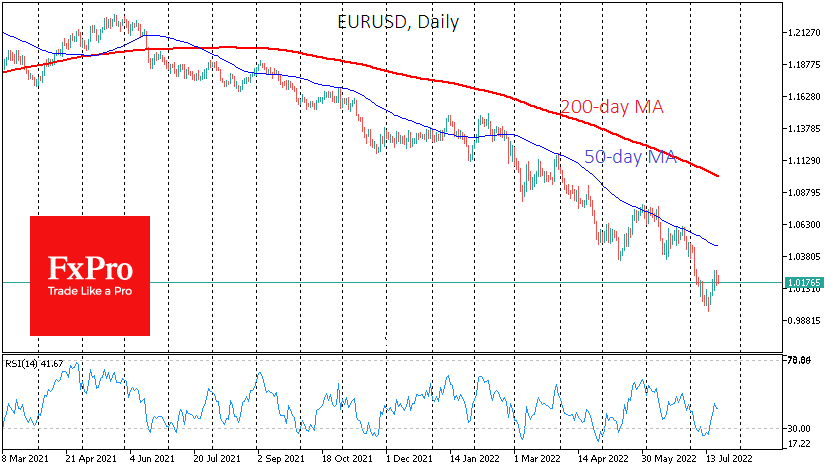
The euro is unchanged today, as EUR/USD is trading at 1.0180 in the European session.
Today’s economic calendar is very light, but there are a slew of developments today which could have an impact on the movement of the euro. The ECB will commence its rate-tightening cycle, the Nord Stream 1 pipeline has been reactivated, and Italian Prime Minister Draghi has just tendered his resignation. With so much happening, it seems fitting that the markets have no idea which way to turn and this has left the euro directionless, for now. This could be the calm before the storm as we may see some sharp volatility from the euro before today’s session is over.
How high will ECB lift off?
Today’s ECB meeting will be a milestone, as the central bank is expected to raise interest rates for the first time since 2011. Adding to the anticipation, the size of the rate hike is going down to the wire – will the ECB opt for a modest 25bp move, or come out with guns ablaze and deliver a sizeable 50bp increase? The ECB could go either way and how the markets react to the decision will be interesting. A 25bp move could be met with a shrug from the euro, while a 50bp hike would likely boost the ailing currency, which broke below parity last week.
The ECB also plans to wrap up its QE programme on July 1st, but at the same time, the ECB is introducing a new bond-buying scheme which it is calling an anti-fragmentation tool, which is meant to maintain government bond spreads between eurozone members and protect Italy and other weak members from speculators. This points to the ECB still retaining a somewhat accommodative monetary stance, even as it reluctantly raises interest rates due to soaring inflation.
Speaking of Italy, the political turmoil has deepened in the eurozone’s third largest economy as Prime Minister Draghi announced his resignation earlier today. A snap election will likely take place in September, and the political instability in the meantime will only add to investors’ concerns about the eurozone, which could spell trouble for the euro.
Finally, it’s Nord Stream Day, as gas is again flowing through the pipeline from Russia to Germany. According to a report from Russian gas giant Gazprom, the pipeline is running at 30% capacity. That’s obviously on the low side, but should be enough to stave off panic about an energy shortage this winter. The European Commission announced on Wednesday that it was urging EU members to reduce their gas needs by some 15% by March 31st in response to Moscow’s hints that it might not reopen the pipeline. I strongly doubt that we have heard the last concerning the crisis over Nord Stream, whose company motto is ironically, “secure gas supply for Europe”.
EUR/USD Technical
- EUR/USD tested support at 1.0197 in the European session. The next support level is 1.0075
- There is resistance at 1.0307 and 1.0429
WTI Oil Outlook: Oil Prices Slump on Renewed Demand Worries
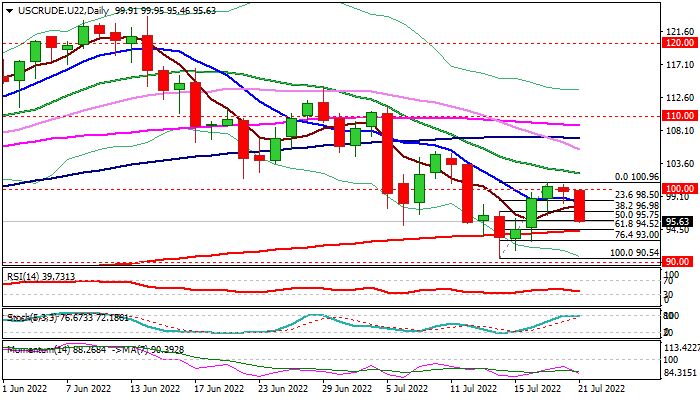
WTI oil price accelerates lower in European trading on Thursday (down 3.3% since Asian opening last night), after three-day recovery failed to sustain break above psychological $100 barrier.
Oil prices came under pressure from renewed demand worries on rising US gasoline stocks, gas flow through Nord Stream 1 pipeline resumed after a maintenance and Libya resumed production from several oilfields.
Traders are also concerned about the ECB joining other major central banks in raising interest rates to fight soaring inflation, as higher borrowing cost is likely to significantly hurt economic growth and consequently affect demand.
Fresh weakness already retraced 50% of $90.54/$100.96 recovery leg and signal that corrective phase is likely over.
Bears need extension through key supports at $94.52/$94.31 (Fibo 61.8% / 200DMA) confirm reversal and open way for another probe through key supports at $92.92/$92.64 (Mar/Apr higher base) after last week’s break lower failed to register close below these levels and generate fresh bearish signal.
Bearish daily studies add to weak fundamentals and support near-term action.
Res: 96.50; 96.98; 97.83; 98.50.
Sup: 95.00; 94.52; 94.31; 93.00.
XAU/USD Outlook: Gold Cracks Key Support, Pressured by Signals of More Aggressive Major Central Banks
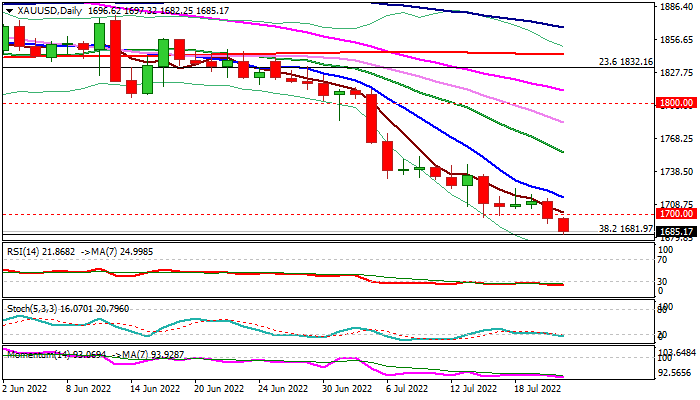
Spot gold extends weakness into second day as larger downtrend resumed after three-day consolidation and hit the lowest in one year on Thursday.
The metal came under increased pressure on signals that major central banks are likely to start more aggressive approach to tightening their monetary policies that would further hurt demand for the yellow metal.
Fresh bears crack important supports at $1690 zone (Fibo 38.2% of larger $1046/$2074 ascend / Mar-Aug 2021 higher base), break of which is expected to generate strong bearish signal on confirmation of a double-top ($2074/$2070).
Rising negative momentum and MA’s in full bearish setup on daily chart, strongly support the action, with little impact seen so far from oversold conditions, but bears may face headwinds at this zone.
Broken psychological $1700 support reverted to resistance, followed by falling 10DMA ($1715) which should ideally limit upticks and offer better selling opportunities.
Final break of $1680 zone pivot would risk acceleration towards $1655 (200WMA), $1600/$1594 (round-figure / 55MMA) and $1560 (50% retracement of $1046/$2074) in extension.
Res: 1700; 1715; 1723; 1736.
Sup: 1676; 1655; 1608; 1594.
USD/JPY Outlook: Dollar Bulls Retake Control for Final Attack at 140 Target
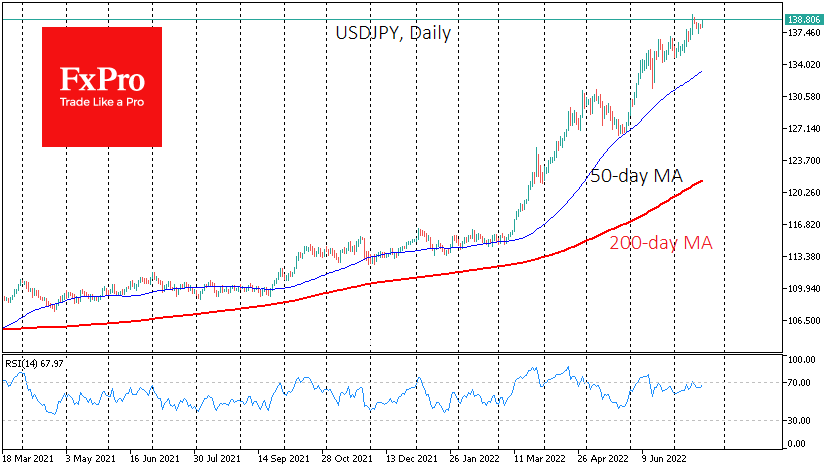
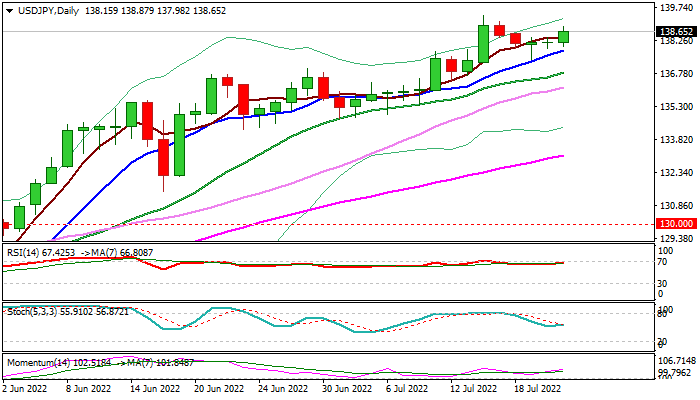
The USDJPY rises on Thursday, confirming reversal signaled by a hammer candle on Tuesday, after Wednesday’s Doji questioned fresh bulls.
Bounce from correction low at 137.38 so far retraced over 61.8% of a shallow 139.39/137.38 pullback, signaling that bulls regained control and will look for a continuation of larger uptrend.
The action remains tracked by a rising 10DMA (137.83), adding to bullish daily studies (rising bullish momentum / MA’s in positive setup), preparing ground for stronger acceleration and test of targets at 139.92/140.00 (Sep 1998 high/psychological) violation of which would open way for further advance.
Res: 138.91; 139.39; 139.92; 140.00.
Sup: 138.38; 137.83; 137.38; 136.79.
Musk Has Clipped the Wings of Bitcoin
How long does forever last? Just over a year, if you’re Elon Musk. Tesla has indicated in its quarterly report that it has sold three-quarters of its Bitcoins, citing uncertainty. The past selling does not change the market disposition, as all transactions have already been made. However, investor sentiment is perhaps the main driver in this market, where a mathematical algorithm governs issuance.
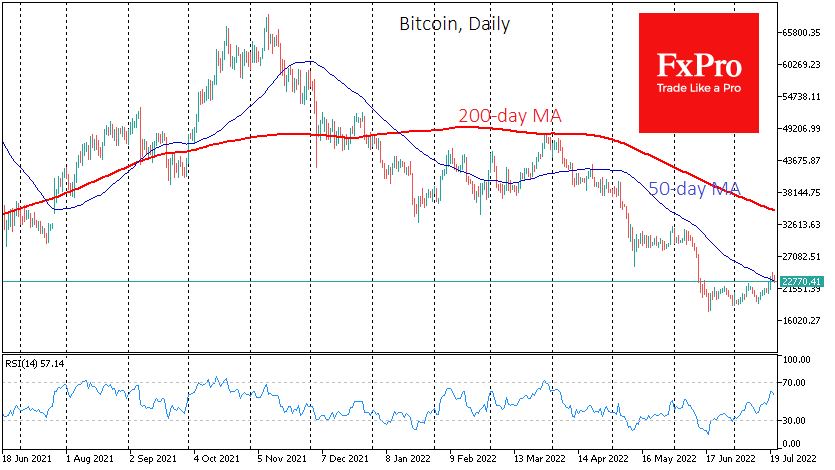
And this sentiment has been hit at a rather crucial moment. As a result of short-term investors’ frustration, BTCUSD failed to break away from its 50-day moving average. The price stabilised at 23000 at the time of writing, hovering around this trendline. Failure to cross this line in a sharp move is a bearish signal. The closest development would be Bitcoin’s return to the local support area at 19000.
Ethereum has lost 5.7% in the past 24 hours, to $1480. Leading altcoins have fallen even further, from -4% (Dogecoin) to 11% (Solana). Total crypto market capitalisation fell 3.6% to $1.03 trillion, according to CoinMarketCap.
According to CoinShares, capital inflows into crypto funds last week were $12.2m, with $14.8m coming into the funds on bitcoin shorts. Regular bitcoin products saw a net outflow of $2.6m.
The fall of the crypto market was caused by “greed, ignorance and misguided risk management”, Galaxy Digital CEO Mike Novogratz said. He noted the collapse of the Terra ecosystem, which was the trigger for the subsequent problems of Celsius Network, Voyager Digital and Three Arrows Capital.
A bipartisan bill to regulate the crypto industry in the US could pass as a full-fledged document in 2023, Wyoming Senator Cynthia Lummis said. She said that some lawmakers would need more time to handle the topic.
SEC chief Gary Gensler said the crisis in the crypto market would require a reworking of investor protection laws.