Sample Category Title
Eurozone Rate Hike: A Big Step for ECB, But a Small Help for Euro
The European Central Bank increased its key rate by 50 points to 0.50%. This is more than average analyst forecasts, based mainly on old comments from Bank members. However, rumours of a more decisive move surfaced in the last few days when a period of silence was already in effect. This situation repeated what we saw before the last Fed meeting. The new “expectation management” techniques seem to be spreading fast.
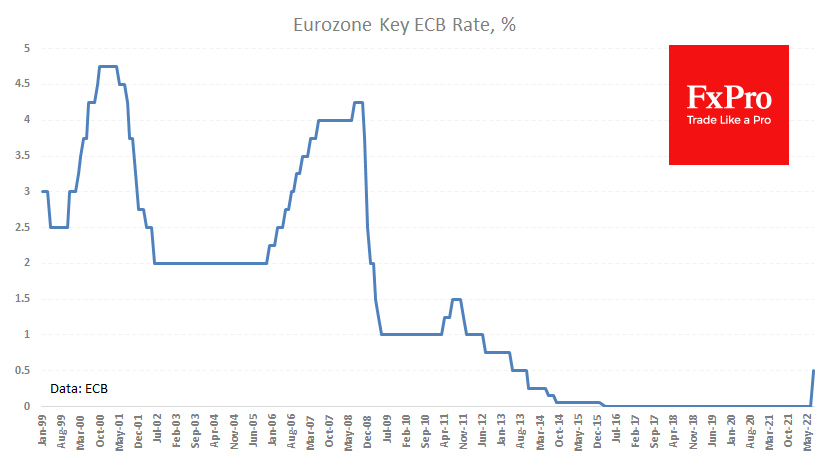
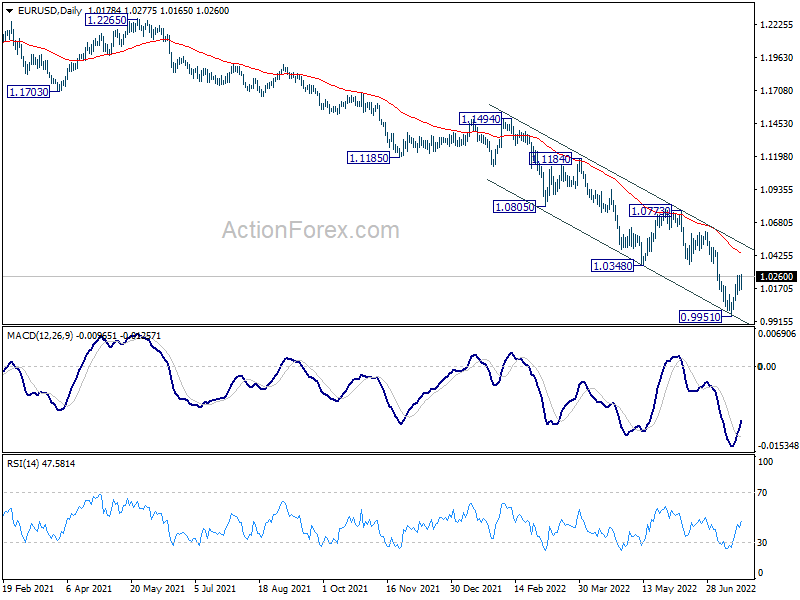
Nevertheless, the euro’s reaction to the rate hike shows that the market has not fully priced in the 50-point hike step. EURUSD is adding 0.65% after the announcement, rising to 1.0260.
The EURUSD pair is testing 2-week highs, returning to the upper boundary of this week’s trading range and rejecting the negative vibe caused by the Italian political crisis and Prime Minister Draghi’s resignation.
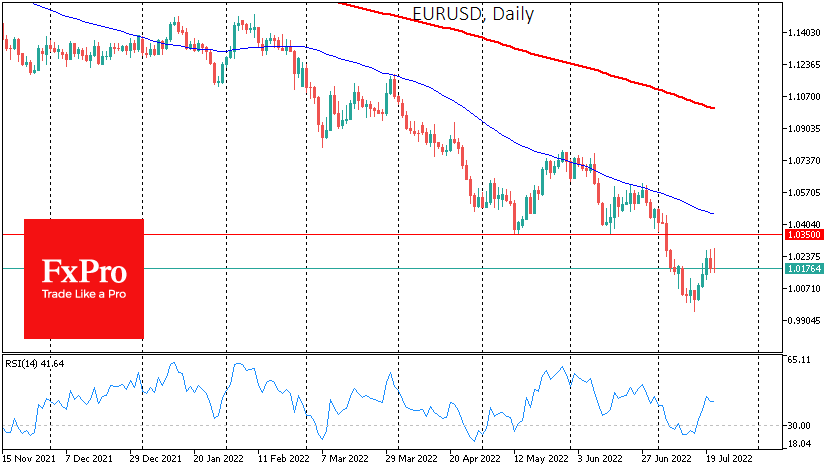
However, the current rebound in the euro is still far from the beginning of a recovery. The bulls will have to endure more diverse tests to confirm a full-fledged reversal in the pair.
Right now, the EURUSD growth looks like just a technical rebound after a long decline. It can be considered more significant after a substantial consolidation above 1.0350 (previous global and local lows). A pullback above the 50 SMA, which is near 1.0450, may seal the break-up of the bearish trend.
Amongst the significant fundamental obstacles to the appreciation of the single currency are the European economy, which is deeply mired in an energy crisis, and the extremely high debt/GDP ratios of some of the larger economies, which reduce the scope for fiscal stimulus. Thus, there are many questions about the sustainability of EURO growth in the near term despite a seemingly decisive ECB rate hike.
European Central Bank Exits Negative Interest Rates
Summary
- The European Central Bank (ECB) joined the global rate hike cycle at today's announcement, delivering a larger-than-expected 50 bps Deposit Rate increase, to 0.00%. The ECB said a further normalization of interest rates would be appropriate at upcoming meetings.
- The ECB also approved the Transmission Protection Instrument (TPI), a tool aimed at supporting orderly conditions across Eurozone government bond markets, in particular the region's peripheral markets such as Italy and Spain. While full details are yet to be released, the ECB said purchases using the tool are not restricted ex ante, and that the scale of TPI purchases depends on the severity of the risks facing policy transmission.
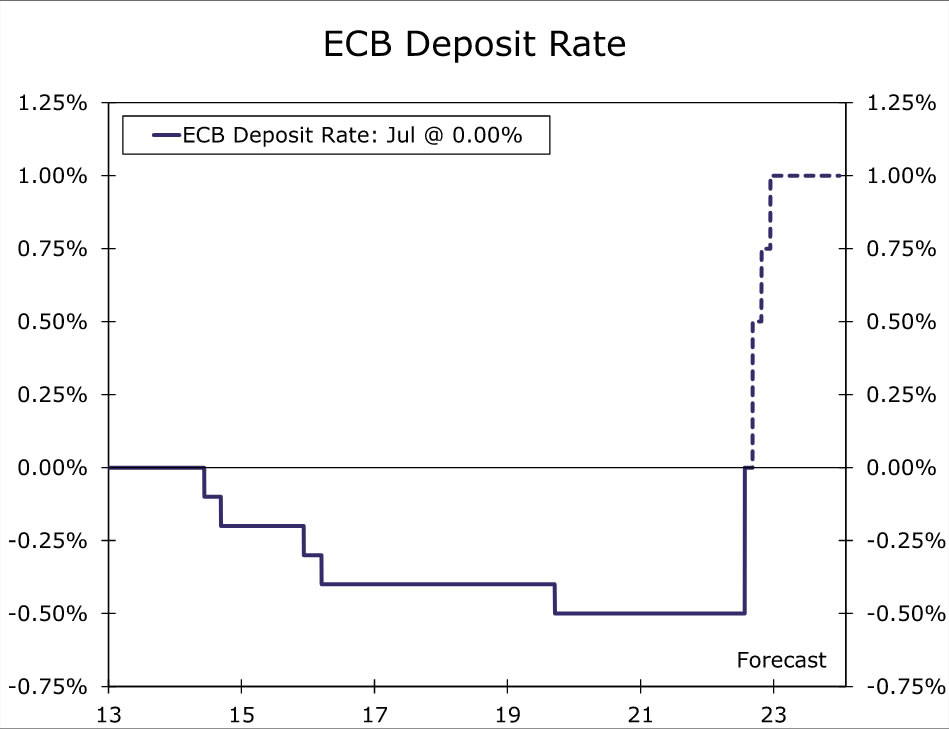
- We believe inflation remains elevated enough, and inflation risks worrisome enough, to continue with a more forceful pace of rate hikes for the time being. Our view remains that today's hike will be followed up by another 50 bps Deposit Rate increase at the September meeting. In addition, while inflation remains elevated and until Eurozone economic growth slows in a much more meaningful manner, we also see a steady series of rate increases as more likely than not. In that context, we also forecast a 25 bps rate increase at the October and December meetings, which would bring the Deposit Rate to 1.00% by the end of 2022.
European Central Banks Joins Global Rate Hike Cycle
The European Central Bank (ECB), as widely expected, joined the global rate hike cycle at today's monetary policy announcement, but in doing so also managed to spring a couple of mild surprises. The ECB delivered a larger than expected 50 bps Deposit Rate increase, thereby exiting its negative interest rate policy and taking the Deposit rate to 0.00%. The other key policy interest rates were also lifted by 50 bps, taking the refinancing rate to 0.50% and the marginal lending rate to 0.75%.
In announcing the larger interest rate increase, the ECB said "further normalization of interest rates will be appropriate. The front-loading today of the exit from negative interest rates allows the Governing Council to make a transition to a meeting-by-meeting approach to interest rate decisions. The Governing Council’s future policy rate path will continue to be data-dependent and will help to deliver on its 2% inflation target over the medium term."
Separately and importantly, the ECB also approved the Transmission Protection Instrument (TPI), aimed at supporting orderly conditions across Eurozone government bond markets, in particular the region's peripheral markets such as Italy and Spain. While full details are yet to be released, the ECB said purchases using the tool are not restricted ex ante, and that the scale of TPI purchases depends on the severity of the risks facing policy transmission. While the announcement of such a tool today was viewed as more likely than not, it was certainly not seen as a "done deal" and, indeed, some reports ahead of today's meeting hinted at a possible quid-pro-quo among ECB policymakers in that a larger 50 bps increase could shore up support for the anti-fragmentation tool. Whether such a quid-pro-quo was explicitly part of discussions, there certainly appears to be some trade-off between the larger rate increase and the approval of the Transmission Protection Instrument. The ECB said that in addition to an updated assessment of inflation risks, the larger first step towards policy normalization was also reinforced by the support provided by the TPI for the effective transmission of monetary policy.
Of course, after today's large rate increase the focus now turns to what happens next from the European Central Bank, particularly since they had previously hinted at a 50 bps hike in September. The comments in today's decision about "front-loading" the exit from negative interest rates and transitioning to a "meeting-by-meeting" approach to interest rate decisions offers hints of at least some potential to shift to smaller 25 bps increments going forward. Indeed, ECB President Lagarde also said prior guidance on the September interest rate move no longer applies. However, as the lead into the July meeting made clear, even forward guidance on interest rates does not guarantee a particular policy rate outcome. Moreover, we believe inflation remains elevated and inflation risks worrisome enough—Lagarde cited inflation risks were to the upside and have intensified in the short-term—to continue with a more forceful pace of rate hikes for the time being.
As a result, our view remains that today's hike will be followed up by another 50 bps Deposit Rate increase at the September meeting. In addition, while inflation remains elevated and until Eurozone economic growth slows in a much more meaningful manner, we also see a steady series of rate increases as more likely than not. In that context, we also forecast a 25 bps rate increase at the October and December meetings, which would bring the Deposit Rate to 1.00% by the end of 2022. We anticipate that will be the peak during the current cycle—as inflation begins to recede by 2023 and growth slows sharply, we see the ECB keeping interest rates steady through most, if not all, of next year. In essence, after today's announcement, we anticipate a shorter, sharper rate hike cycle from the European Central Bank than previously.
Euro Rises after ECB’s 50bps Hike, But Momentum Not Too Convincing Yet
Euro rises broadly after ECB raising interest rate by 50bps, and front-loads the exit from negative deposit rate. The central bank also maintains tightening bias. Swiss Franc is taken up by Euro too. Meanwhile, New Zealand Dollar is the worst performing one for today, together with Canadian and Yen. Dollar is mixed for now, and would need more guidance from overall risk sentiments, or even FOMC rate decision next week.
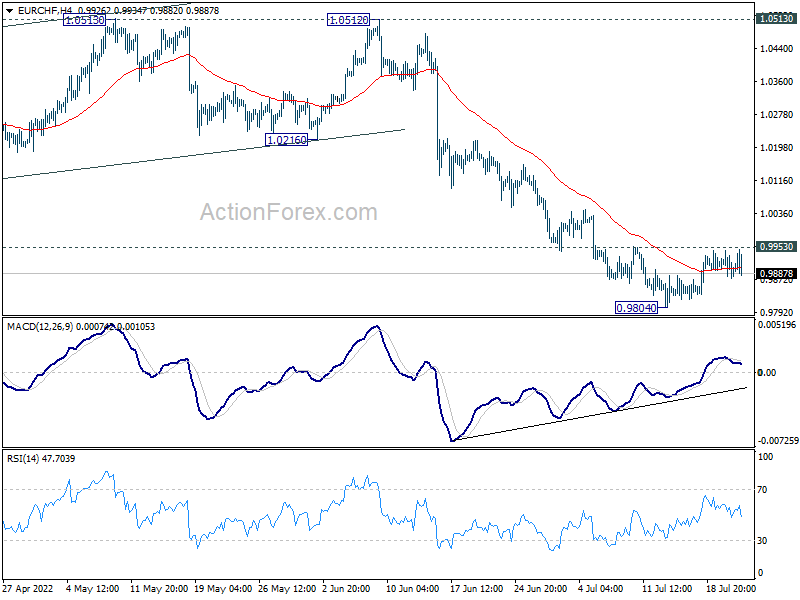
Technically, the sluggishness in EUR/CHF is putting some doubts over underlying strength in Euro. Firm break of 0.9953 minor resistance will confirm short term bottoming at 0.9083 and target 55 day EMA (now at 1.0108). However, rejection by 0.9953 will maintain near term bearishness. Break of 0.9804 will resume larger up trend. The next move in EUR/CHF is most important in confirming Euro's direction.
In Europe, at the time of writing, FTSE is down -0.22%. DAX is down -0.34%. CAC is up 0.54%. Germany 10-year yield is up 0.019 at 1.278. Earlier in Asia, Nikkei rose 0.44%. Hong Kong HSI dropped -1.51%. China Shanghai SSE dropped -0.99%. Singapore Strait Times dropped -0.57%. Japan 10-year JGB yield dropped -0.0036 to 0.241.
ECB hikes 50bps, frontloading exit from negative deposit rate
ECB announced to raise the three key interest rates by 50bps today. The main refinancing operations and the interest rates on the marginal lending facility and the deposit facility will be increased to 0.50%, 0.75% and 0.00% respectively, with effect from 27 July 2022.
The "larger first step" in policy normalization was based on the "updated assessment of inflation risks and the reinforced support provided by the TPI for the effective transmission of monetary policy." The "frontloading" of exit from negative deposit rate " allows the Governing Council to make a transition to a meeting-by-meeting approach to interest rate decisions." Future policy path will continue to be "data-dependent".
Also, the Governing Council approved the Transmission Protection Instrument (TPI), to "ensure that the monetary policy stance is transmitted smoothly across all euro area countries".
At the post meeting press conference, President Christine Lagarde said that inflation continues to be "undesirably high" and is expected to remain above target for some time. While latest data indicate a slowdown in growth, this slowdown is "being cushioned by a number of supportive factors".
"At our upcoming meetings, further normalization of interest rates will be appropriate," she said. "Our future policy rate path will continue to be data-dependent and will help us deliver on our two per cent inflation target over the medium term."
US initial jobless claims rose to 251k, continuing claims rose to 1.384m
US initial jobless claims rose 7k to 251k in the week ending July 16, above expectation of 240k. Four-week moving average of initial claims rose 4.5k to 240.5k.
Continuing claims rose 51k to 1384k in the week ending July 9. Four-week moving average of continuing claims rose 13k to 1353k.
BoJ stands part, downgrades 2022 growth forecasts, upgrades inflation
BoJ left monetary policy unchanged today as widely expected. Under the yield curve control frame work, short-term policy rate is held at -0.10%. BoJ will also will continue to purchase JGBs, without setting upper limit, to keep 10-year yield at around 0%. It will continue to offer to purchase 10-year JGBs at 0.25% yield every business day through fixed rate operations. Goushi Kataoka dissented again, pushing for further strengthening monetary easing.
In the new economic projections, BoJ downgraded fiscal 2022 GDP forecasts, but upgraded both fiscal 2023 and 2024. CPI forecasts was upgraded across the horizon. Here are the new projections.
- Fiscal 2022 GDP growth at 2.4% (downgraded from April's 2.9%).
- Fiscal 2023 GDP growth at 2.0% (up from 1.9%).
- Fiscal 2024 GDP growth at 1.3% (up from 1.1%).
- Fiscal 2022 CPI at 2.3% (up from 1.9%).
- Fiscal 2023 CPI at 1.4% (up from 1.1%).
- Fiscal 2024 CPI at 1.3% (up from 1.1%).
- Fiscal 2022 CPI core-core (ex-fresh food and energy) at 1.3% (up from 0.9%).
- Fiscal 2023 CPI core-core at 1.4% (up from 1.2%).
- Fiscal 2024 CPI core core at 1.5% (unchanged).
New Zealand good imports jumped 25% yoy on petroleum, imports rose 7.7% yoy
New Zealand goods exports rose 7.7% yoy to NZD 6.4B in June. Goods imports rose 25.0% yoy to NZD 7.1B. Trade balance came in at NZD -701m deficit, versus expectation of NZD 204m surplus.
"Petroleum and products imports rose $795 million to reach a new high of $1.2 billion," Stats NZ. "This rise lead the sharp increase in total imports for the month compared with June 2021."
US leads monthly export rise, up 22%. Exports to EU were up 28% and Japan up 24%. Exports to China were down -6% and to Australia down -12%.
Import form all top partners rose, with China up 12%, EU up 11%, Australia up 6%, US up 30%, and Japan up 4.1%.
Australia NAB business condition rose to 20 in Q2, but confidence dropped to 5
Australia NAB quarterly business confidence dropped from 15 to 5 in Q2. Current business conditions rose from 11 to 20. Next 3 months business conditions was unchanged at 26. next 12 months business conditions dropped from 34 to 29. Capex plan for next 12 months dropped from 33 to 31.
Alan Oster, NAB Group Chief Economist, "Conditions strengthened in Q2 as the disruptions related to the virus receded. Trading, profitability, and employment were all higher with conditions approaching the high levels seen in early 2021."
"Confidence eased in Q2, down to around long-run average levels," said Oster. "That likely reflects the waning of some of the pandemic-recovery optimism, as well as the mounting challenges of rising inflation and also rising interest rates that businesses are confronting."
EUR/GBP Mid-Day Outlook
Daily Pivots: (S1) 0.8481; (P) 0.8510; (R1) 0.8528; More...
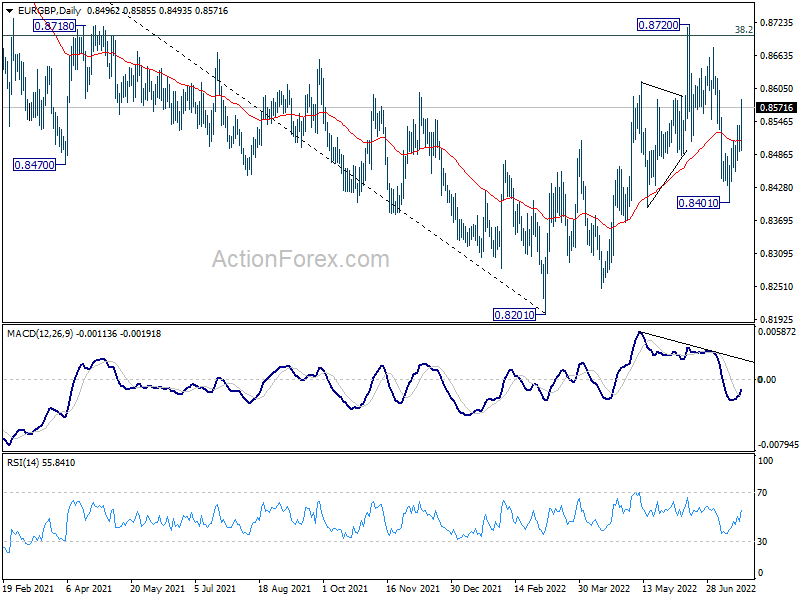
EUR/GBP's break of 0.8552 minor resistance argues that corrective fall from 0.8720 has completed at 0.8401. The development also revived near term bullishness. Intraday bias is back on the upside for retesting 0.8720 resistance first. Firm break there will resume larger rally from 0.8201. On the downside, below 0.8491 minor support will bring retest of 0.8401 support instead.
In the bigger picture, attention remains on 38.2% retracement of 0.9499 to 0.8201 at 0.8697. Sustained break there will affirm the case that rise from 0.8201 is a medium term up trend itself. Further rally would then be seen to 61.8% retracement at 0.9003. However, rejection by 0.8697 will confirm medium term bearishness for another fall through 0.8201.
Economic Indicators Update
| GMT | Ccy | Events | Actual | Forecast | Previous | Revised |
|---|---|---|---|---|---|---|
| 22:45 | NZD | Trade Balance (NZD) Jun | -701M | 240M | 263M | 195M |
| 23:50 | JPY | Trade Balance (JPY) Jun | -1.93T | -2.01T | -1.93T | -1.89T |
| 01:30 | AUD | NAB Business Confidence Q2 | 5 | 14 | 15 | |
| 03:00 | JPY | BoJ Interest Rate Decision | -0.10% | -0.10% | -0.10% | |
| 06:00 | GBP | Public Sector Net Borrowing (GBP) Jun | 22.1B | 21.3B | 13.2B | 11.8B |
| 12:15 | EUR | ECB Interest Rate Decision | 0.50% | 0.25% | 0.00% | |
| 12:30 | CAD | New Housing Price Index M/M Jun | 0.20% | 0.40% | 0.50% | |
| 12:30 | USD | Initial Jobless Claims (Jul 15) | 251K | 240K | 244K | |
| 12:30 | USD | Philadelphia Fed Manufacturing Survey Jul | -12.3 | -0.5 | -3.3 | |
| 12:45 | EUR | ECB Press Conference | ||||
| 14:30 | USD | Natural Gas Storage | 45B | 58B |
(ECB) Introductory Statement to the Press Conference
Christine Lagarde, President of the ECB,
Luis de Guindos, Vice-President of the ECB
Frankfurt am Main, 21 July 2022
Good afternoon, the Vice-President and I welcome you to our press conference.
Today, in line with our strong commitment to our price stability mandate, the Governing Council took further key steps to make sure inflation returns to our two per cent target over the medium term.We decided to raise the three key ECB interest rates by 50 basis points and approved the Transmission Protection Instrument (TPI).
The Governing Council judged that it is appropriate to take a larger first step on its policy rate normalisation path than signalled at its previous meeting. This decision is based on our updated assessment of inflation risks and the reinforced support provided by the TPI for the effective transmission of monetary policy. It will support the return of inflation to our medium-term target by strengthening the anchoring of inflation expectations and by ensuring that demand conditions adjust to deliver our inflation target in the medium term.
At our upcoming meetings, further normalisation of interest rates will be appropriate. The frontloading today of the exit from negative interest rates allows us to make a transition to a meeting-by-meeting approach to our interest rate decisions. Our future policy rate path will continue to be data-dependent and will help us deliver on our two per cent inflation target over the medium term. In the context of our policy normalisation, we will evaluate options for remunerating excess liquidity holdings.
We assessed that the establishment of the TPI is necessary to support the effective transmission of monetary policy. In particular, as we continue normalising monetary policy, the TPI will ensure that our monetary policy stance is transmitted smoothly across all euro area countries. The singleness of our monetary policy is a precondition for the ECB to be able to deliver on its price stability mandate.
The TPI will be an addition to our toolkit and can be activated to counter unwarranted, disorderly market dynamics that pose a serious threat to the transmission of monetary policy across the euro area. The scale of TPI purchases depends on the severity of the risks facing policy transmission. Purchases are not restricted ex ante. By safeguarding the transmission mechanism, the TPI will allow the Governing Council to more effectively deliver on its price stability mandate.
In any event, the flexibility in reinvestments of redemptions coming due in the pandemic emergency purchase programme (PEPP) portfolio remains the first line of defence to counter risks to the transmission mechanism related to the pandemic.
The decisions taken today are set out in a press release available on our website. The details of the TPI are described in a separate press release to be published at 15:45 CET.
I will now outline in more detail how we see the economy and inflation developing and will then explain our assessment of financial and monetary conditions.
Economic activity
Economic activity is slowing. Russia's unjustified aggression towards Ukraine is an ongoing drag on growth. The impact of high inflation on purchasing power, continuous supply constraints and higher uncertainty are having a dampening effect on the economy. Firms continue to face higher costs and disruptions in their supply chains, although there are tentative signs that some of the supply bottlenecks are easing. Taken together, these factors are significantly clouding the outlook for the second half of 2022 and beyond.
At the same time, economic activity continues to benefit from the reopening of the economy, a strong labour market and fiscal policy support. In particular, the full reopening of the economy is supporting spending in the services sector. As people start to travel again, tourism is expected to help the economy in the third quarter of this year. Consumption is being supported by the savings that households built up during the pandemic and by a strong labour market.
Fiscal policy is helping to cushion the impact of the war in Ukraine for those bearing the brunt of higher energy prices. Temporary and targeted measures should be tailored so as to limit the risk of fuelling inflationary pressures. Fiscal policies in all countries should aim at preserving debt sustainability, as well as raising the growth potential in a sustainable manner to enhance the recovery.
Inflation
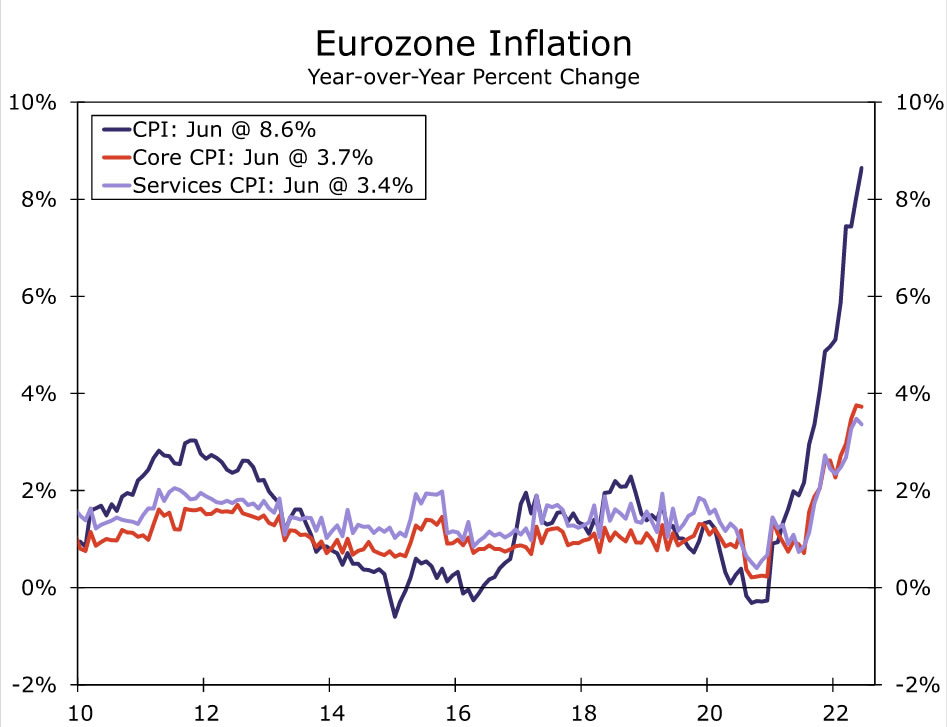
Inflation increased further to 8.6 per cent in June. Surging energy prices were again the most important component of overall inflation. Market-based indicators suggest that global energy prices will stay high in the near term. Food inflation also rose further, standing at 8.9 per cent in June, in part reflecting the importance of Ukraine and Russia as producers of agricultural goods.
Persistent supply bottlenecks for industrial goods and recovering demand, especially in the services sector, are also contributing to the current high rates of inflation. Price pressures are spreading across more and more sectors, in part owing to the indirect impact of high energy costs across the whole economy. Accordingly, most measures of underlying inflation have risen further.
We expect inflation to remain undesirably high for some time, owing to continued pressures from energy and food prices and pipeline pressures in the pricing chain. Higher inflationary pressures are also stemming from the depreciation of the euro exchange rate. But looking further ahead, in the absence of new disruptions, energy costs should stabilise and supply bottlenecks should ease, which, together with the ongoing policy normalisation, should support the return of inflation to our target.
The labour market remains strong. Unemployment fell to a historical low of 6.6 per cent in May. Job vacancies across many sectors show that there is robust demand for labour. Wage growth, also according to forward-looking indicators, has continued to increase gradually over the last few months, but still remains contained overall. Over time, the strengthening of the economy and some catch-up effects should support faster growth in wages. Most measures of longer-term inflation expectations currently stand at around two per cent, although recent above-target revisions to some indicators warrant continued monitoring.
Risk assessment
A prolongation of the war in Ukraine remains a source of significant downside risk to growth, especially if energy supplies from Russia were to be disrupted to such an extent that it led to rationing for firms and households. The war may also further dampen confidence and aggravate supply-side constraints, while energy and food costs could remain persistently higher than expected. A faster deceleration in global growth would also pose a risk to the euro area outlook.
The risks to the inflation outlook continue to be on the upside and have intensified, particularly in the short term. The risks to the medium-term inflation outlook include a durable worsening of the production capacity of our economy, persistently high energy and food prices, inflation expectations rising above our target and higher than anticipated wage rises. However, if demand were to weaken over the medium term, it would lower pressures on prices.
Financial and monetary conditions
Market interest rates have been volatile as a result of the pronounced economic and geopolitical uncertainty. Bank funding costs have risen in recent months, which has increasingly fed into higher bank lending rates, in particular for households. While the volume of bank lending to households remains strong, it is expected to decline in view of lower demand. Lending to firms has also been robust as high production costs, inventory building and lower reliance on market funding have created a continued need for credit from banks. At the same time, demand for loans to finance investment has declined. Money growth has continued to moderate owing to lower liquid savings and lower Eurosystem asset purchases.
Our most recent bank lending survey reports that credit standards tightened for all loan categories in the second quarter of the year, as banks are becoming more concerned about the risks faced by their customers in the current uncertain environment. Banks expect to continue tightening their credit standards in the third quarter.
Conclusion
Summing up, inflation continues to be undesirably high and is expected to remain above our target for some time. The latest data indicate a slowdown in growth, clouding the outlook for the second half of 2022 and beyond. At the same time, this slowdown is being cushioned by a number of supportive factors.
The Governing Council has today decided to raise the key ECB interest rates and approved the TPI. At our upcoming meetings, further normalisation of interest rates will be appropriate. Our future policy rate path will continue to be data-dependent and will help us deliver on our two per cent inflation target over the medium term.
We stand ready to adjust all of our instruments within our mandate to ensure that inflation stabilises at our two per cent target over the medium term. Our new TPI will safeguard the smooth transmission of our monetary policy stance throughout the euro area as we keep adjusting the stance to address high inflation.
We are now ready to take your questions.
EUR/USD Mid-Day Outlook
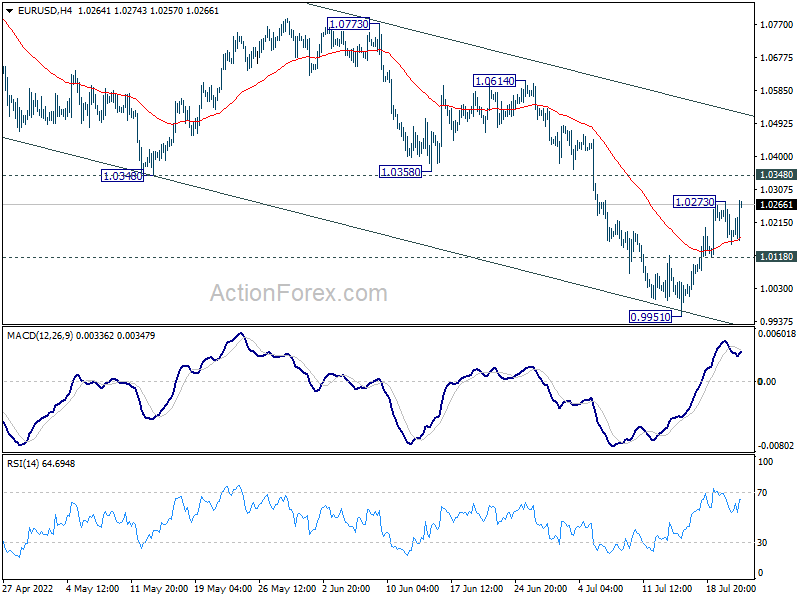
Daily Pivots: (S1) 1.0135; (P) 1.0204; (R1) 1.0252; More...
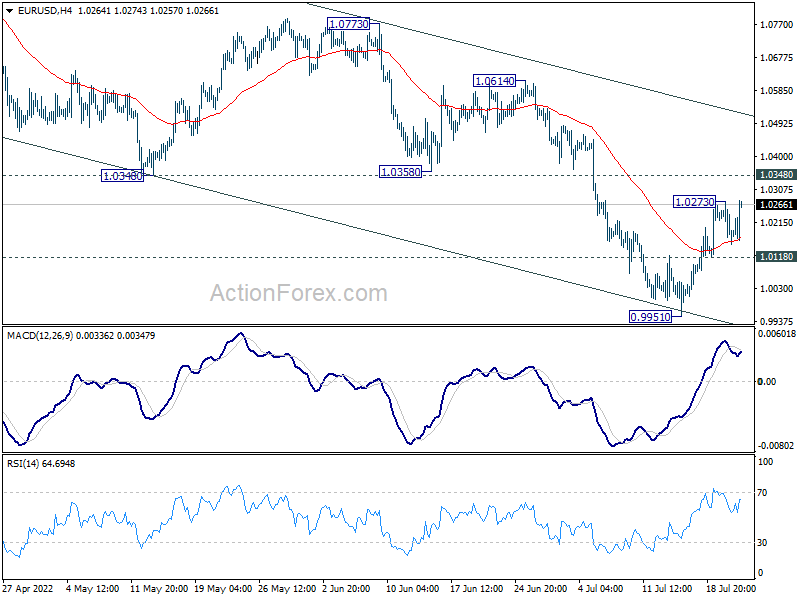
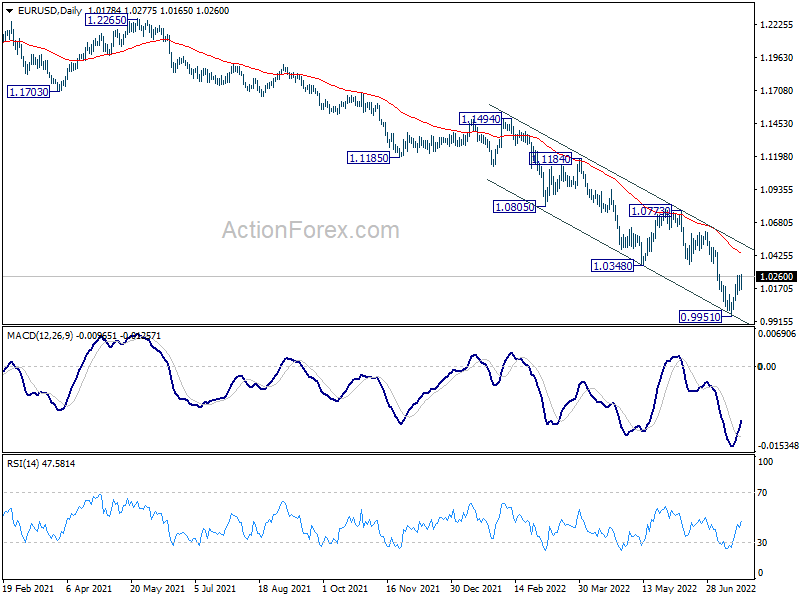
EUR/USD's rebound from 0.9951 resumes after brief retreat. Intraday bias is back on the upside for 1.0348 1.0348 support turned resistance, and then channel resistance at 1.0514. Nevertheless, break of 1.0118 minor support will argue that larger down trend is ready to resume, and should bring retest of 0.9951 low first.
In the bigger picture, down trend from 1.6039 (2008 high) is still in progress. Next target is 100% projection of 1.3993 to 1.0339 from 1.2348 at 0.8694. In any case, outlook will stay bearish as long as 1.0773 resistance holds, in case of rebound.
USD/CHF Mid-Day Outlook
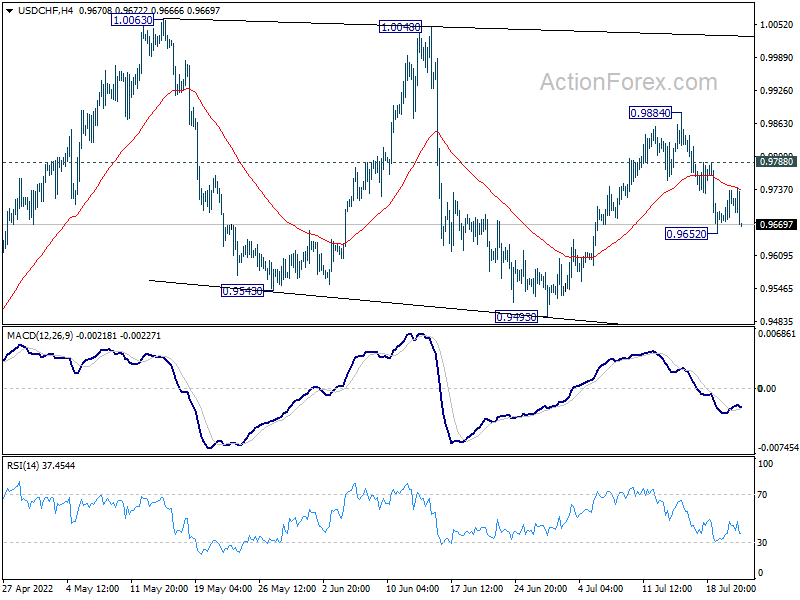
Daily Pivots: (S1) 0.9679; (P) 0.9708; (R1) 0.9739; More...
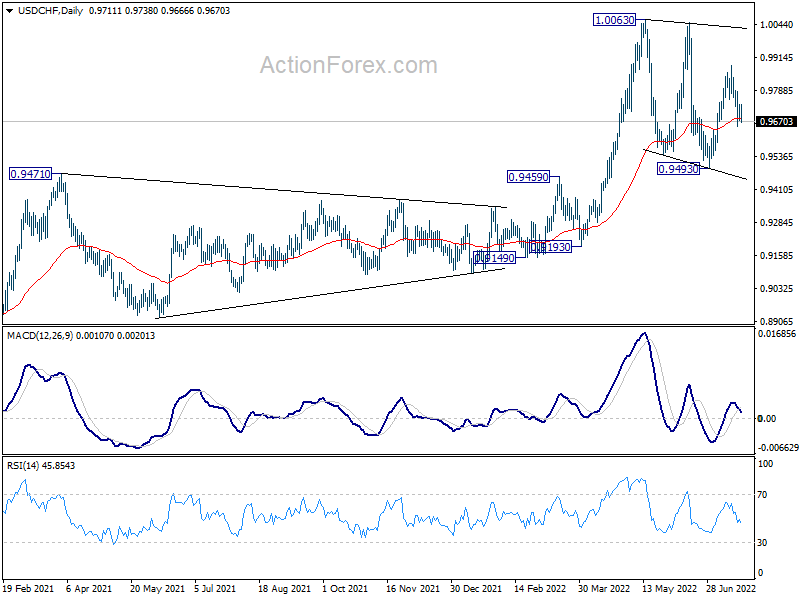
Intraday bias in USD/CHF remains neutral for the moment. Fall from 0.9884 is seen as a falling leg of the consolidation from 1.0063. Below 0.9652 will target 0.9493 support. On the upside, though, above 0.9788 minor resistance will turn bias back to the upside for 0.9884 resistance.
In the bigger picture, medium term up trend from 0.8756 (2021 low) is still in progress. Next target is 1.0342 (2016 high). Sustained break there will resume long term up trend from 0.7065 (2011 low). This will remain the favored case as long as 0.9471 resistance turned support holds.
GBP/USD Mid-Day Outlook
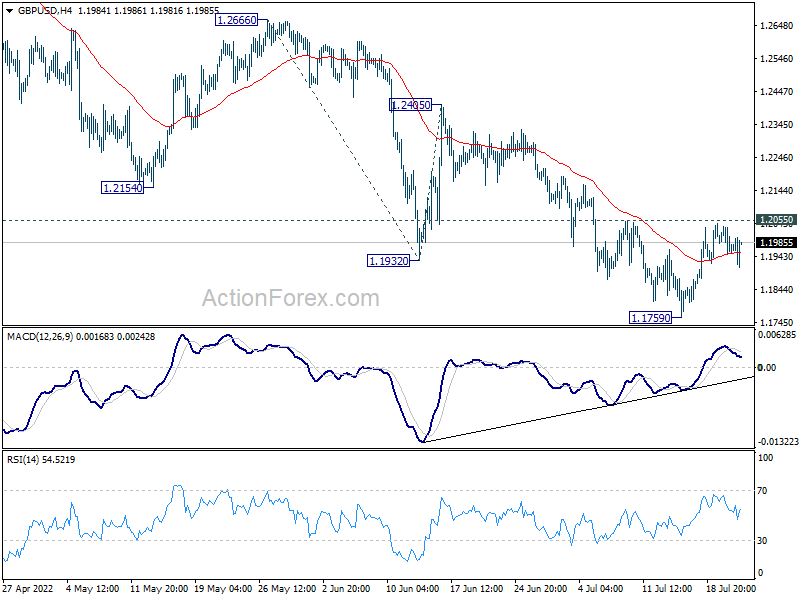
Daily Pivots: (S1) 1.1942; (P) 1.1990; (R1) 1.2027; More...
Range trading continues in GBP/USD and intraday bias remains neutral first. Focus remains on 1.2055 minor resistance. Firm break there will confirm short term bottoming at 1.1759. Bias will be turned back to the upside for 1.2405 resistance next. On the downside, below 1.1759 will resume larger down trend to 100% projection of 1.2666 to 1.1932 from 1.2405 at 1.1671.
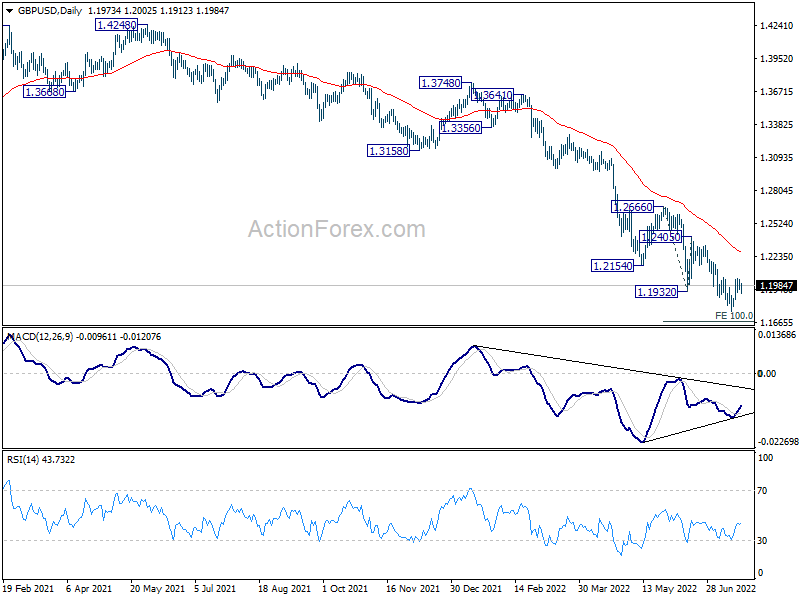
In the bigger picture, fall from 1.4248 (2018 high) could be a leg inside the pattern from 1.1409 (2020 low), or resuming the longer term down trend. Deeper decline is expected as long as 1.2666 resistance holds. Next target is 1.1409 low. However, firm break of 1.2666 will bring stronger rise back to 55 week EMA (now at 1.3065).
EUR/JPY Mid-Day Outlook
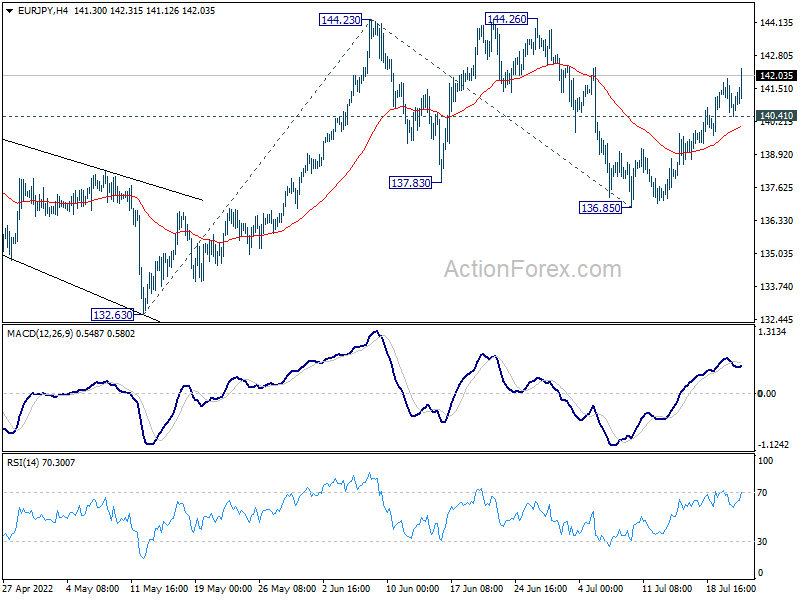
Daily Pivots: (S1) 140.15; (P) 141.04; (R1) 141.65; More....
EUR/JPY's rally resumes after brief retreat and intraday bias stays on the upside. As noted before, consolidation pattern from 144.23 should have completed with three waves to 136.85. Further rally should be seen to retest 144.26 resistance first. Firm break there will resume larger up trend. Next target is 100% projection of 132.63 to 144.34 from 136.85 at 148.45. On the downside, below 140.41 minor support will dampen the bullish case and turn bias neutral first.
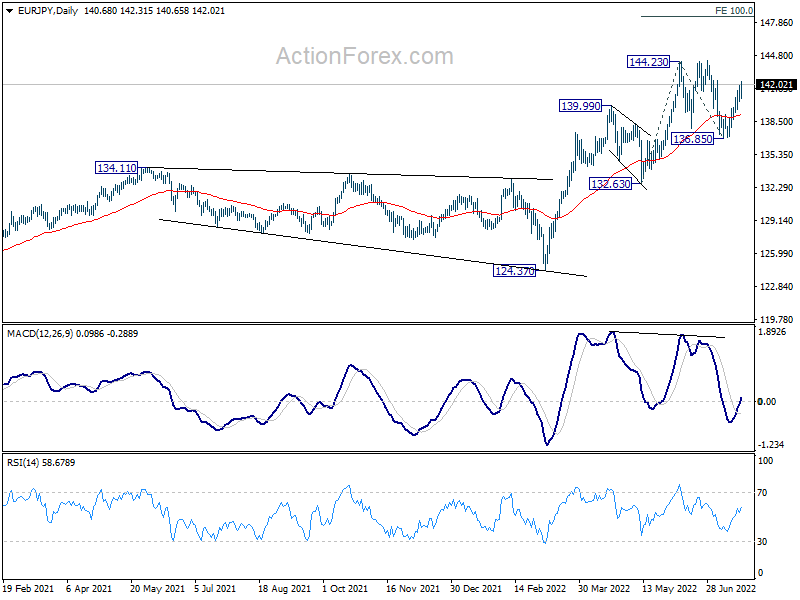
In the bigger picture, up trend from 114.42 (2020 low) is seen as the third leg of the pattern from 109.30 (2016 low). Further rally is in favor as long as 134.11 resistance turned support holds, even in case of deep pull back. Firm break of 139.78 will target 149.76 (2015 high). However, sustained break of 134.11 will be a sign of medium term bearish reversal and turn focus to 124.37 support for confirmation.
USD/JPY Mid-Day Outlook
Daily Pivots: (S1) 138.00; (P) 138.18; (R1) 138.47; More...
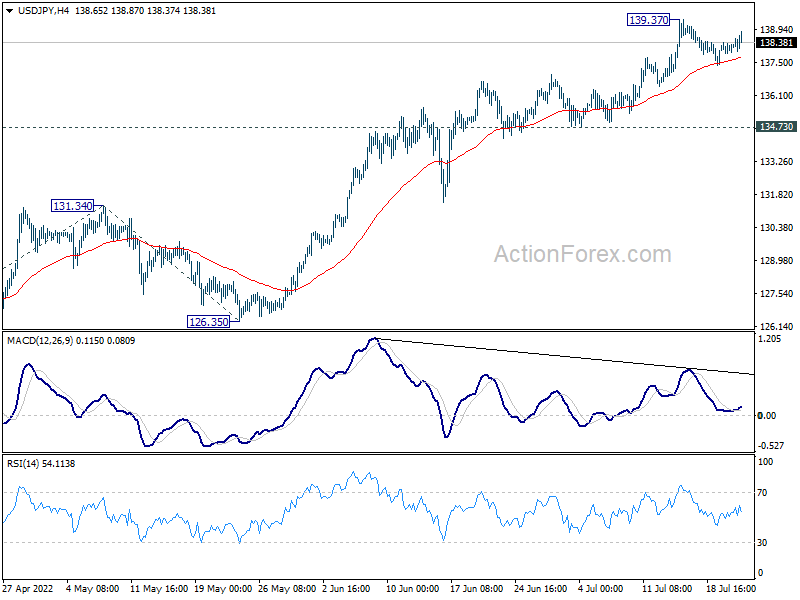
Intraday bias in USD/JPY remains neutral as consolidation from 139.37 is extending. Downside of retreat should be contained by 134.73 support. On the upside, break of 139.37 will resume larger up trend to 100% projection of 114.40 to 131.34 from 126.35 at 143.29.
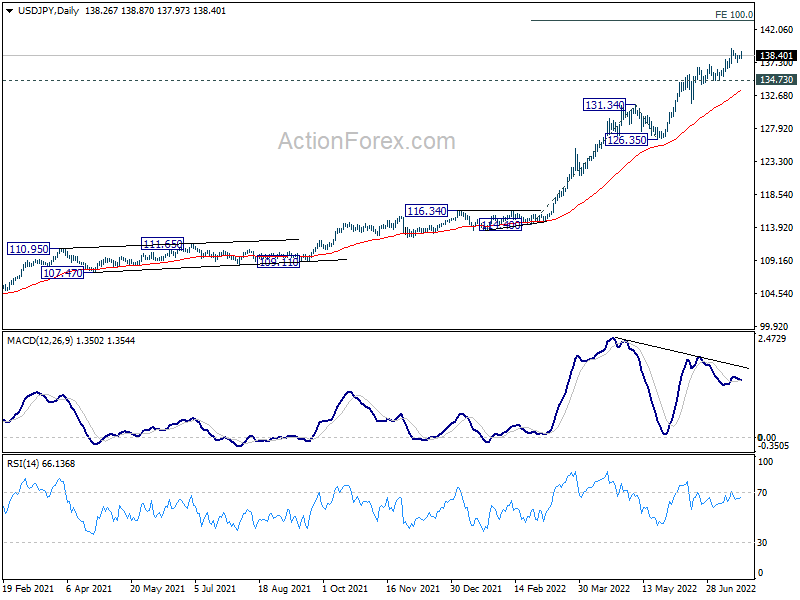
In the bigger picture, current rally is seen as part of the long term up trend from 75.56 (2011 low). Next target is 100% projection of 75.56 (2011 low) to 125.85 (2015 high) from 98.97 at 149.26, which is close to 147.68 (1998 high). This will remain the favored case as long as 126.35 support holds.
EUR/GBP Mid-Day Outlook
Daily Pivots: (S1) 0.8481; (P) 0.8510; (R1) 0.8528; More...
EUR/GBP's break of 0.8552 minor resistance argues that corrective fall from 0.8720 has completed at 0.8401. The development also revived near term bullishness. Intraday bias is back on the upside for retesting 0.8720 resistance first. Firm break there will resume larger rally from 0.8201. On the downside, below 0.8491 minor support will bring retest of 0.8401 support instead.
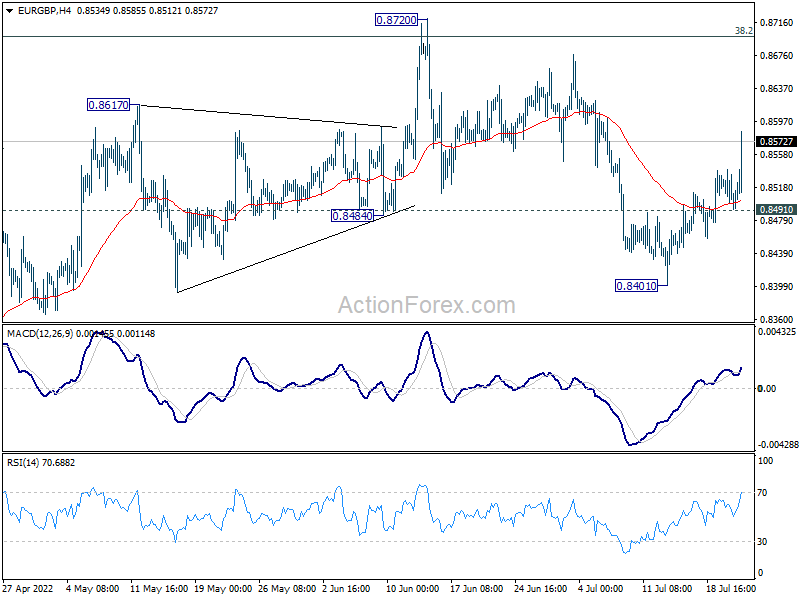
In the bigger picture, attention remains on 38.2% retracement of 0.9499 to 0.8201 at 0.8697. Sustained break there will affirm the case that rise from 0.8201 is a medium term up trend itself. Further rally would then be seen to 61.8% retracement at 0.9003. However, rejection by 0.8697 will confirm medium term bearishness for another fall through 0.8201.