

Sample Category Title
GBP/JPY Daily Outlook
Daily Pivots: (S1) 165.10; (P) 165.68; (R1) 166.21; More...
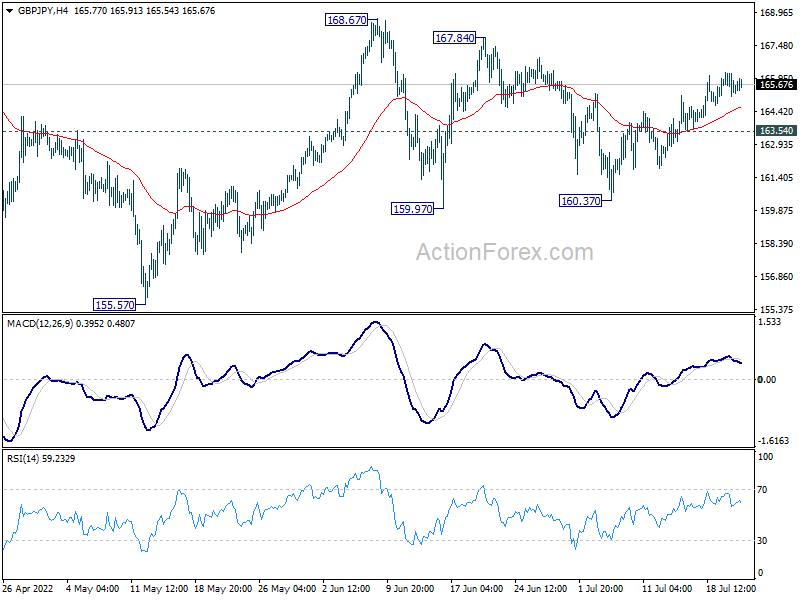
Further rise is mildly in favor in GBP/JPY with 163.54 minor support intact. Consolidation from 168.67 should have completed with three waves to 160.37. Further rally should be seen to retest 168.67 high. Firm break there will resume larger up trend. On the downside, below 163.54 minor support will dampen this bullish view and turn bias back to the downside for 160.37 support instead.
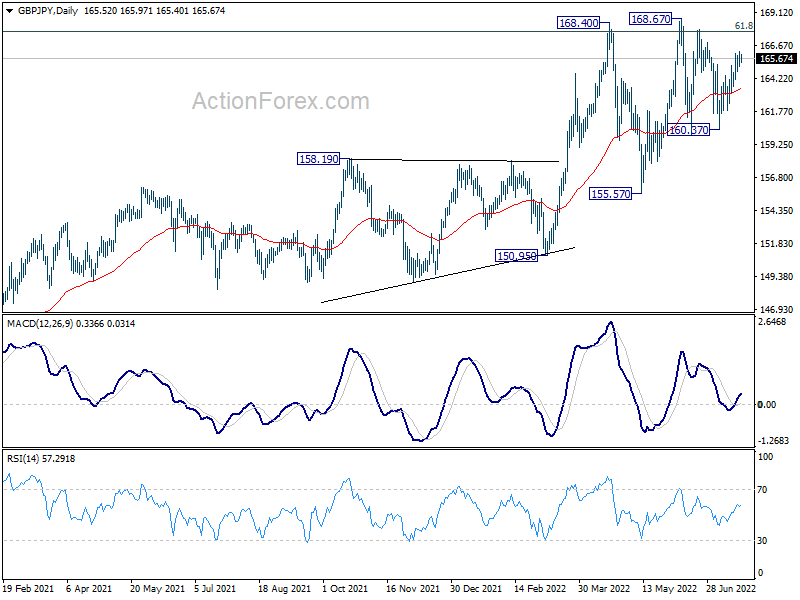
In the bigger picture, up trend from 123.94 (2020 low) is still in progress. Sustained break of 61.8% retracement of 195.86 (2015 high) to 122.75 (2016 low) at 167.93 will be a long term bullish signal, and could pave the way back to 195.86 high. This will now remain the favored case as long as 155.57 support holds, even in case of deep pull back.
EUR/JPY Daily Outlook
Daily Pivots: (S1) 140.15; (P) 141.04; (R1) 141.65; More....
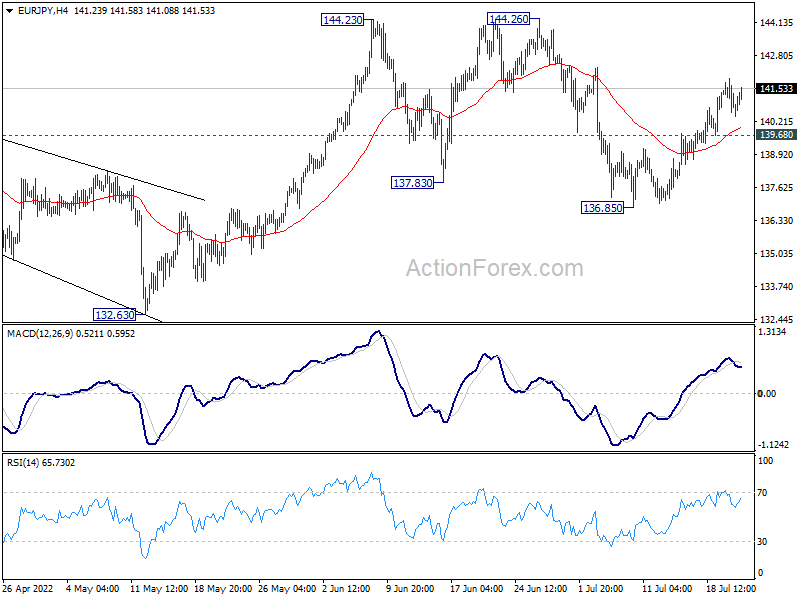
Further rise is still in favor in EUR/JPY with 139.68 minor support intact. Consolidation pattern from 144.23 should have completed with three waves to 136.85. Further rally should be seen to retest 144.26 resistance first. Firm break there will resume larger up trend. On the downside, below 139.68 minor support will dampen this bullish view and bring retest of 136.85 instead.
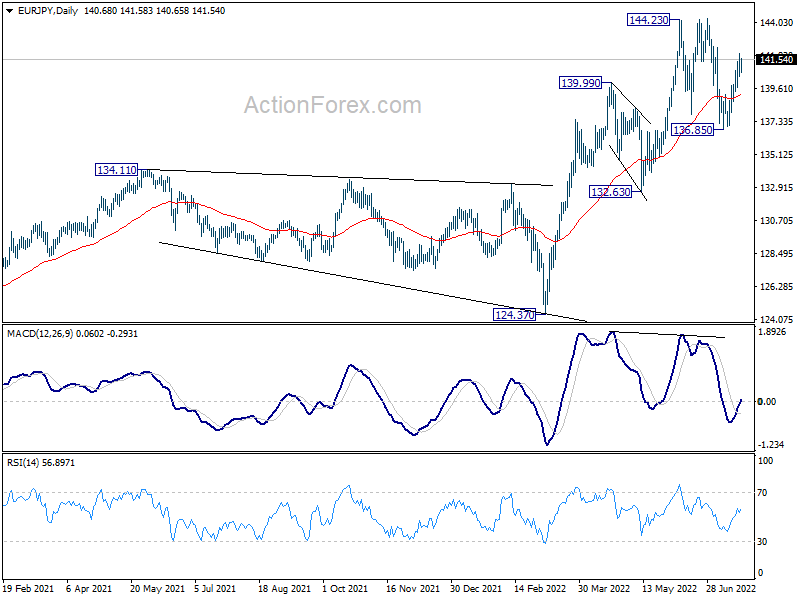
In the bigger picture, up trend from 114.42 (2020 low) is seen as the third leg of the pattern from 109.30 (2016 low). Further rally is in favor as long as 134.11 resistance turned support holds, even in case of deep pull back. Firm break of 139.78 will target 149.76 (2015 high. However, sustained break of 134.11 will be a sign of medium term bearish reversal and turn focus to 124.37 support for confirmation.
EUR/GBP Daily Outlook
Daily Pivots: (S1) 0.8481; (P) 0.8510; (R1) 0.8528; More...
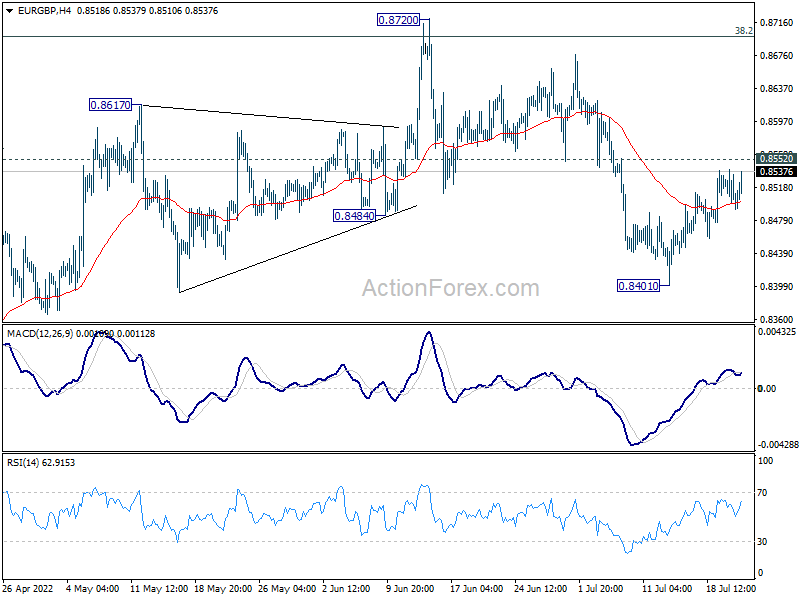
Intraday bias in EUR/GBP remains neutral first. On the upside break of 0.8552 resistance will suggest that pull back from 0.8720 has completed. That will also also revive near term bullishness. Further rise should be seen to retest 0.8720 high. On the downside, break of 0.8401 will reaffirm rejection by 0.8697 medium term fibonacci level and target 0.8201/48 support zone next.
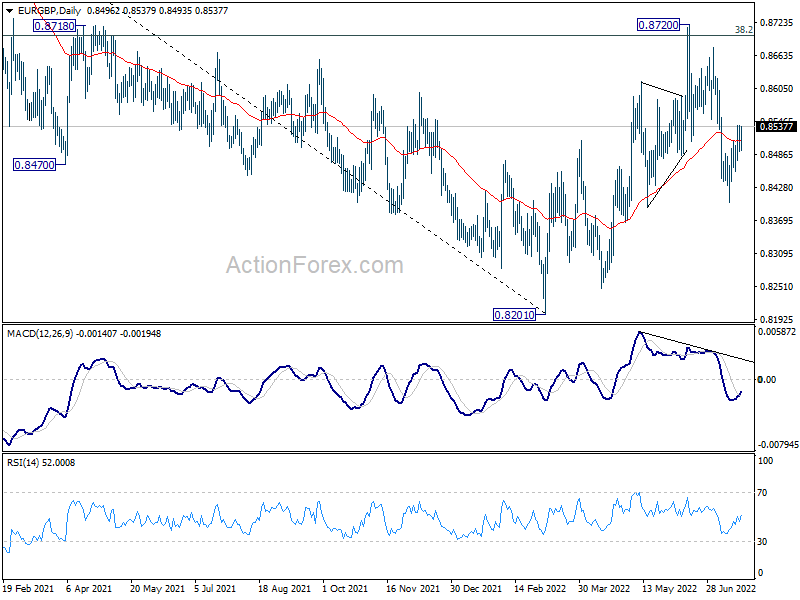
In the bigger picture, rejection by 38.2% retracement of 0.9499 to 0.8201 at 0.8697 argues that rebound from 0.8201 is merely a corrective move. That is, down trend from 0.9499 (2020 high) is now over. Sustained break of 0.8201 will resume such decline and target 61.8% retracement of 0.6935 to 0.9499 at 0.7917. This will now remain the favored case as long as 0.8720 resistance holds.
EUR/AUD Daily Outlook
Daily Pivots: (S1) 1.4737; (P) 1.4794; (R1) 1.4836; More...
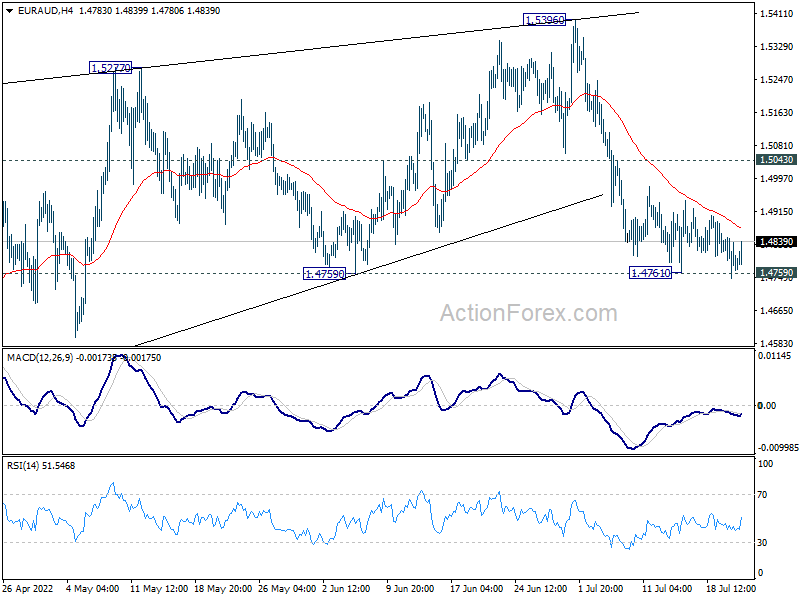
Intraday bias in EUR/AUD stays neutral at this point. On the downside, decisive break of 1.4759 support should confirm that corrective rise from 1.4318 has completed at 1.5396 after rejection by 1.5354 support turned resistance. Deeper fall should then be seen back to retest 1.4318 low. On the upside, however, break of 1.5043 will bring stronger rebound back towards 1.5396.
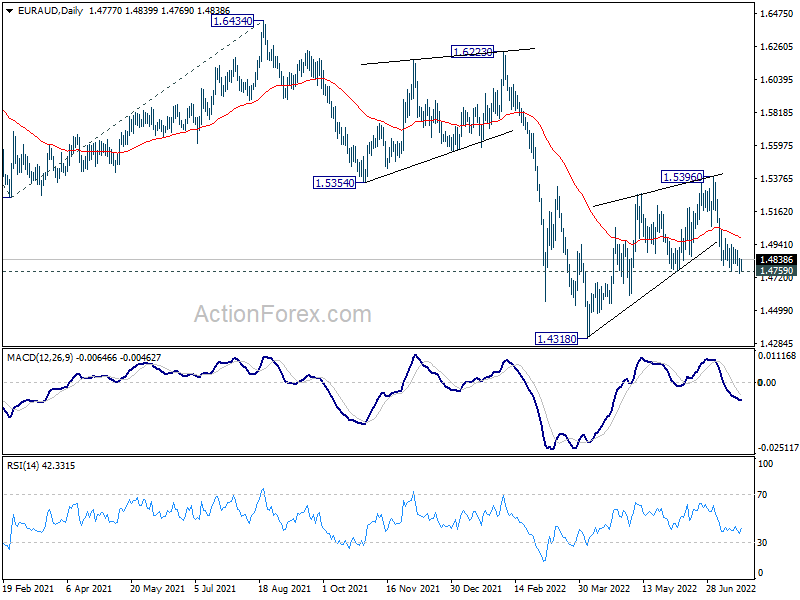
In the bigger picture, rejection by 1.5354 support turned resistance, as well as 55 week EMA (now at 1.5378), maintain medium term bearishness. That is, larger down trend from 1.9799 is not completed yet. Break of 1.4318 low will target 61.8% projection of 1.9799 to 1.5250 from 1.6434 at 1.3623, which is close to 1.3624 long term support (2017 low). This will remain the favored case now as long as 1.5396 resistance holds.
EUR/CHF Daily Outlook
Daily Pivots: (S1) 0.9863; (P) 0.9904; (R1) 0.9931; More....
EUR/CHF is still staying in range below 0.9953 minor resistance. Intraday bias remains neutral first. On the upside, break of 0.9953 minor resistance will suggest short term bottoming at 0.9804, on bullish convergence condition in 4 hour MACD. Intraday bias will be back on the upside for 55 day EMA (now at 1.0110). On the downside, break of 0.9804 will resume larger down trend to 0.9650 long term projection level.
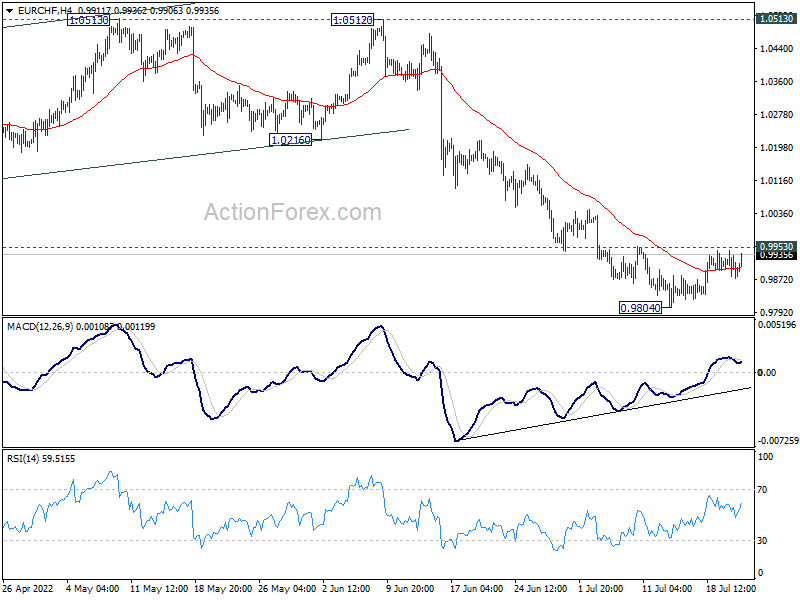
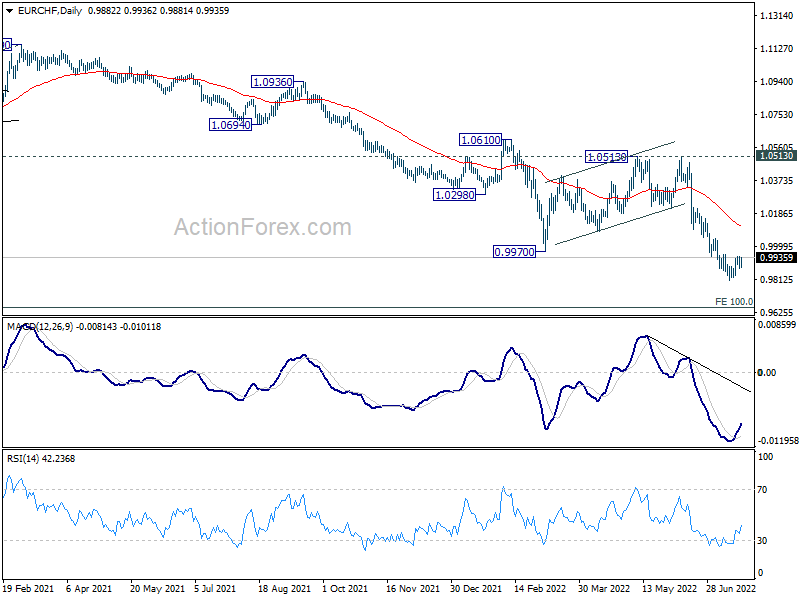
In the bigger picture,long term down trend from 1.2004 (2018 high) is expected to target 100% projection of 1.2004 to 1.0505 to 1.1149 at 0.9650. On the upside, break of 1.0513 resistance is needed to indicate medium term bottoming. Otherwise, outlook will stay bearish in case of strong rebound.
EURCHF Flags Bullish Trend Reversal ahead of ECB
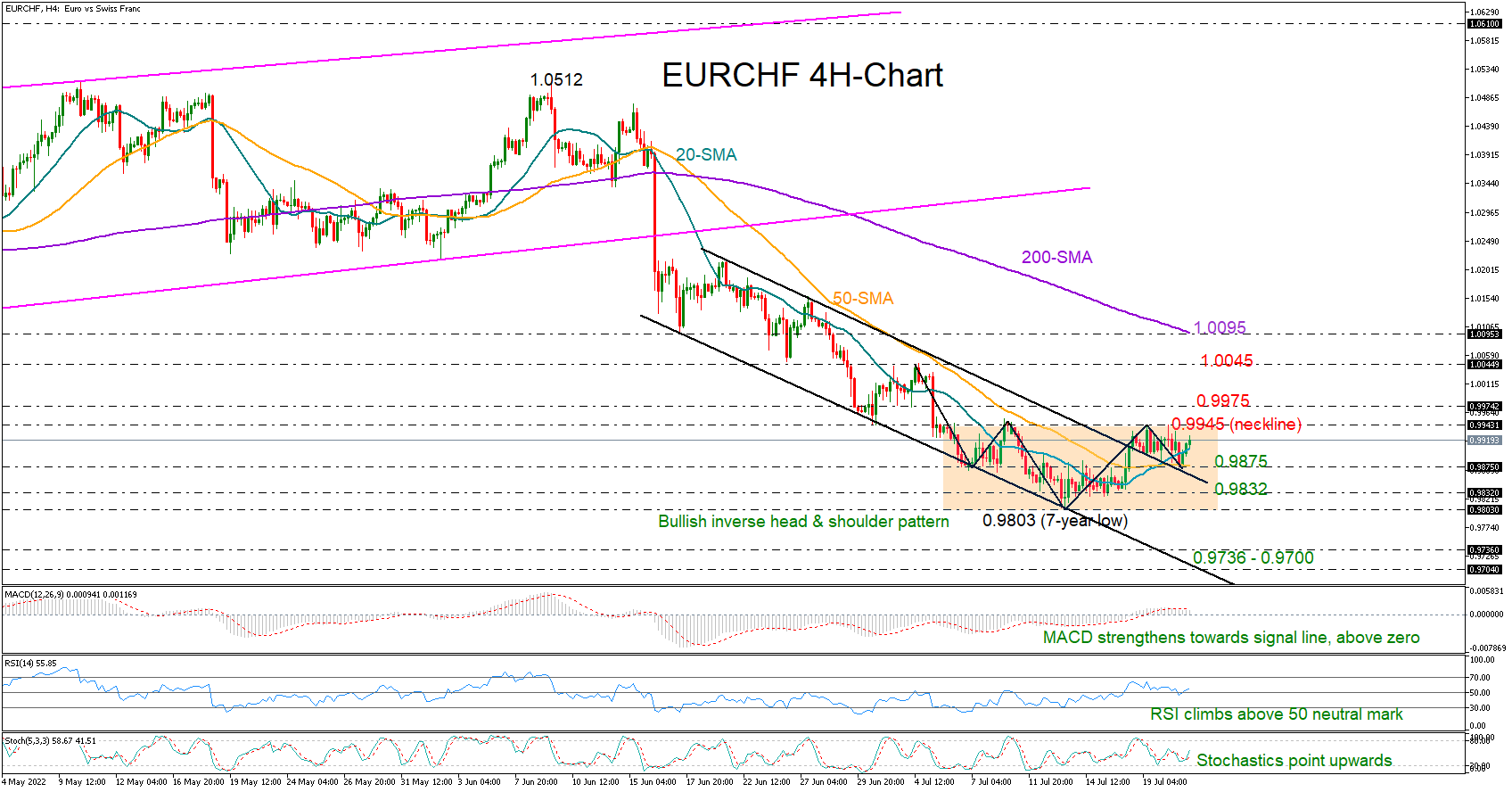
EURCHF pivoted northwards to re-enter the 0.9900 territory after its latest pullback in the four-hour chart ceased near the 50-period simple moving average (SMA) at 0.9870.
There are a couple of bullish signs, which feed optimism that the current recovery mood could persist in the coming sessions. The RSI has bounced back above its 50 neutral mark, the stochastics have resumed their upward slope, while the MACD, although beneath its red signal line, seems to be gaining positive momentum.
Trend signals are also rosy. Besides the bullish cross between the 20- and 50-period simple moving averages (SMAs) and the rebound on the penetrated bearish channel, investors will closely monitor the formation of a bullish inverse head and shoulder pattern set around the seven-year low of 0.9803. To confirm the bullish pattern, the pair will need to successfully violate the neckline at 0.9945. If that turns out to be the case, the price could initially test the limits around 0.9975 before speeding up to July’s high of 1.0045. Beyond that, the next target will be the 200-period SMA at 1.0093.
Should the bears retake control, they will first attempt to breach the 50-period SMA at 0.9875 with scope to access the 0.9832 – 0.9803 support zone. A durable move below the latter would open the door for the key 0.9736 – 0.9700 area, where the channel's lower boundary and the 2015 base are placed. Lower, all attention will turn to the 2015 bottom of 0.9649.
In brief, EURCHF is surrounded by positive vibes in the short-term picture. A sustainable rally above the threshold of 0.9945 is expected to attract new buying interest in the market.
AUDUSD Tests 0.6900, Remaining in Descending Cchannel
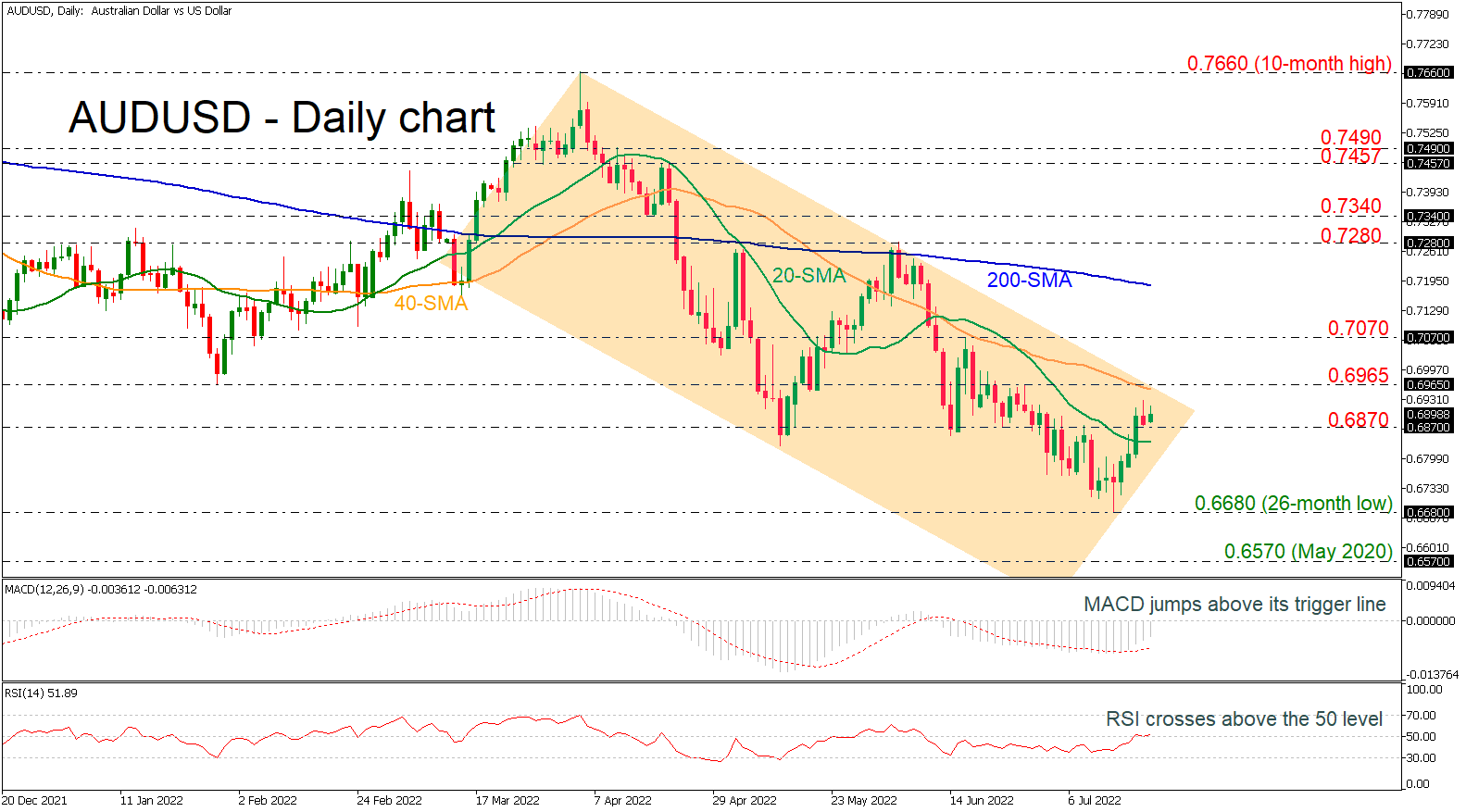
AUDUSD is carrying on with its rebound from the previous week with better impetus than it had before, within its extending pattern of decline. The price is currently approaching the 0.6900 mark and then the next key level to have in mind is the 0.7000 that may switch the bias to neutral.
The short-term bias appears to be bullish as the MACD keeps gaining ground above its red signal line, and the RSI is looking to be working its way up over its 50-neutral threshold, but there is still room for improvement.
If the pair is able to push higher, the 40-day simple moving average (SMA), which is located around 0.6950, may serve as a crucial point for more aggressive bullish movement. This is also just below the resistance at 0.6965 and the 0.7070 barrier. Moreover, the 200-day SMA at 0.7190 may garner some attention. If prices continue to rise, the resistance could approach the limiting range between 0.7280 and 0.7340.
In the event that the pair reverts back to a downward trend, investors may turn their trading first at the low point that occurred at 0.6680, which is the 26-month low, and then at the 0.6570 support, registered in May 2020. If the price continues to fall, the next potential support might occur somewhere close to the 0.6250 support level, which was taken from the bottoms in April 2020.
In the medium-term outlook, AUDUSD may remain increasingly pessimistic as long as it maintains its move within a descending channel and, more crucially, remains below the 200-day SMA.
Daily Technical Analysis
EUR/USD
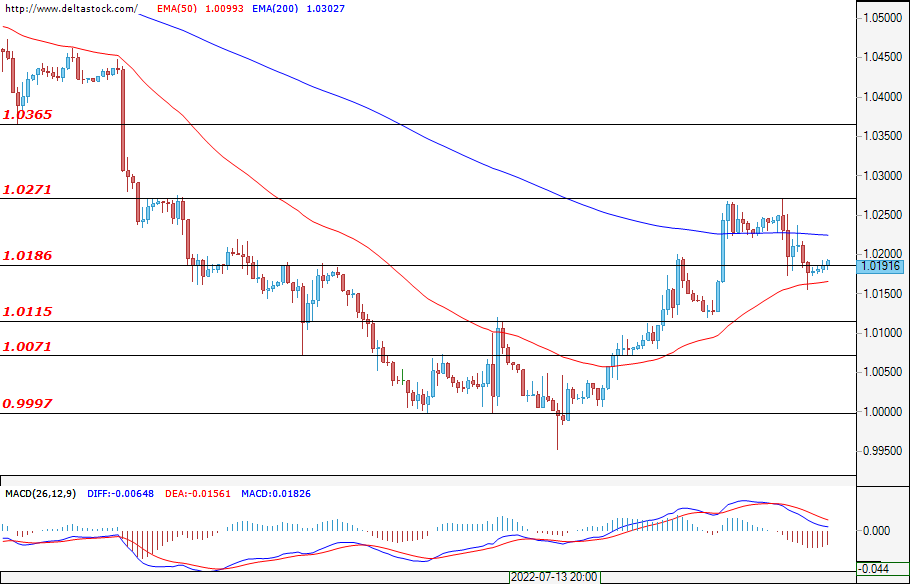
The Euro ended its streak of winning days and finished yesterday's session in the red. The market is in a pullback phase after bottoming around parity. Given the record lows, a deeper correction can be expected towards the resistance at around 1.0350 – 1.0365. After this test, the expectations are for the general downtrend to continue and for prices to retest the area at around 1.0000. In the early hours of today, the rate of the euro against the greenback is gravitating around the 1.0186 support and the first resistance for the bulls is 1.0270. If it is overtaken, then the chances for a test of 1.0350 would increase significantly. The ECB interest rate decision is due today (12:15 GMT) and a rate hike could support the euro. Investors will also look forward to the subsequent press conference (12:45 GMT) on the bank's future monetary policy.
USD/JPY
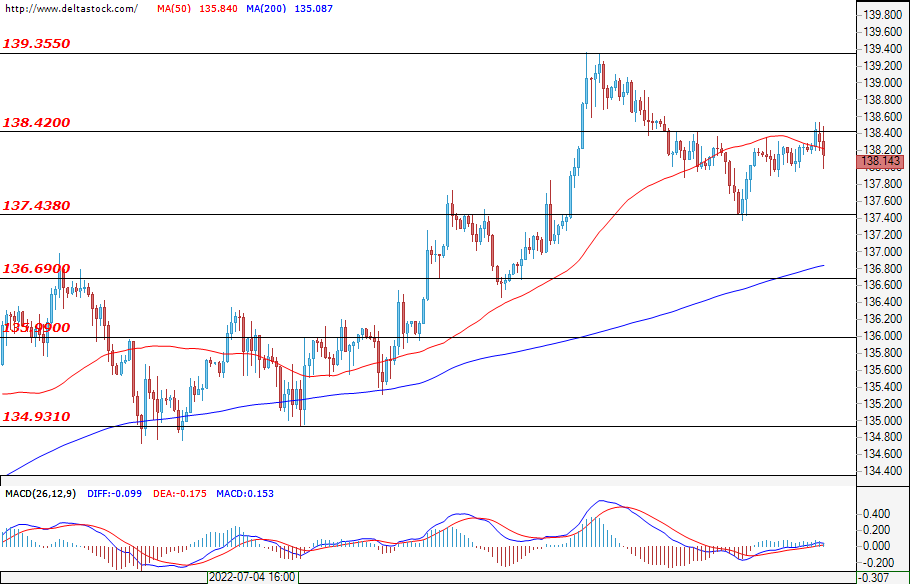
This morning's decision by the Bank of Japan to leave the key interest rates unchanged did not surprise the markets. The expectations are for a new rally and more stress for the yen. The first resistance is 138.42, which is about to be breached while a main and confirmed support for the day is 137.43. The first target for the bulls is the peak at 139.35, and the breach can be expected to lead them towards 140.00.
GBP/USD
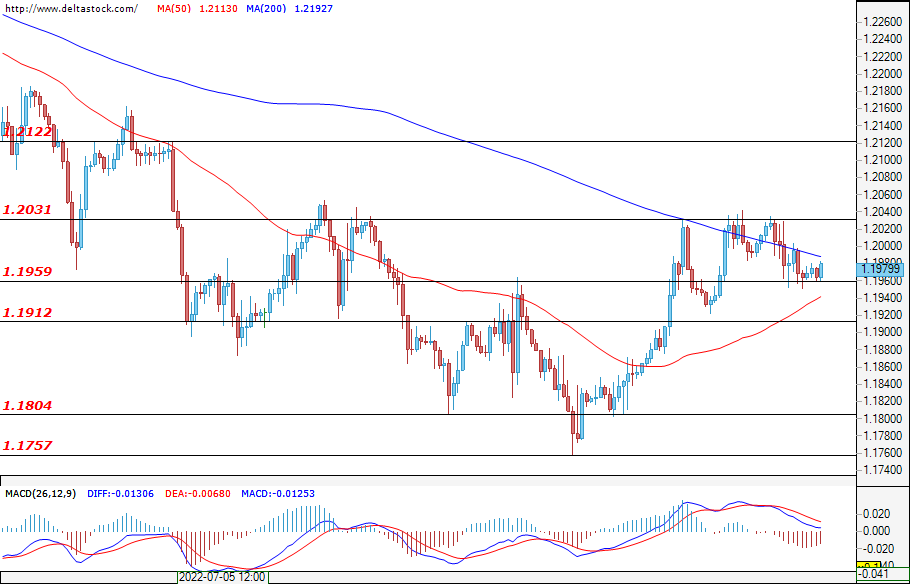
The Cable has broken the short-term downtrend and the market is entering a deeper retracement phase. For now, the bulls remain limited by the resistance at 1.2030, but if it is breached, then a test of the zone at 1.2120 is expected. First supports for the buyers are 1.1960 and 1.1910. With more serious bullish pressure in place, a test of the key resistance at 1.2170 is also possible, with expectations for a new wave of sell-offs flooding the market once this zone is reached.
EUGERMANY40
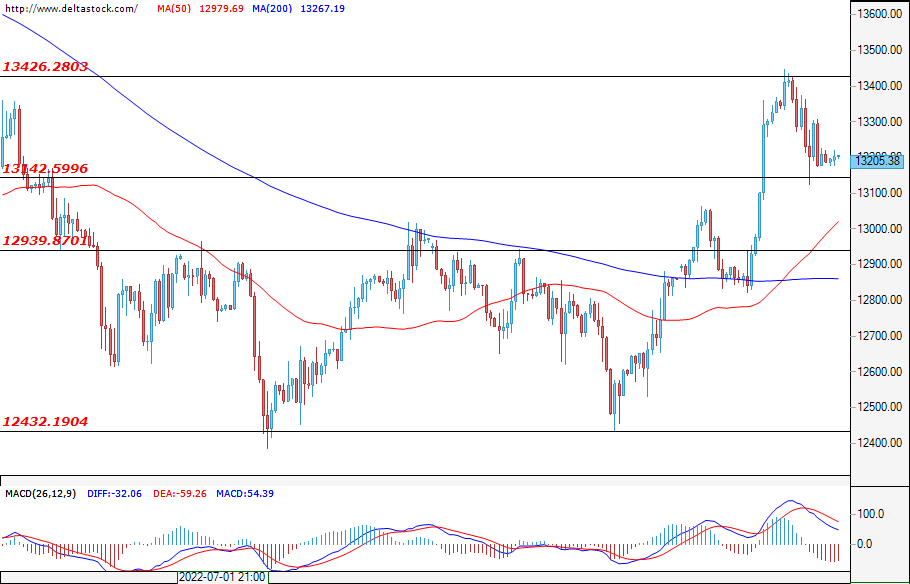
The German index is giving up some of its weekly gains, with prices managing to hold above the 13140 support for the time being. The 13430 area comes from the higher time frames and a potential breakout would require a market catalyst. The expectations are for this level to be tested today as well, and if the bulls don't succeed, then the bears might grow even mightier. Today, increased activity can be expected around the ECB interest rate announcement at 12:15 GMT. The first support for the bulls remains at 13140, followed by the more substantial zone at 12940.
US30
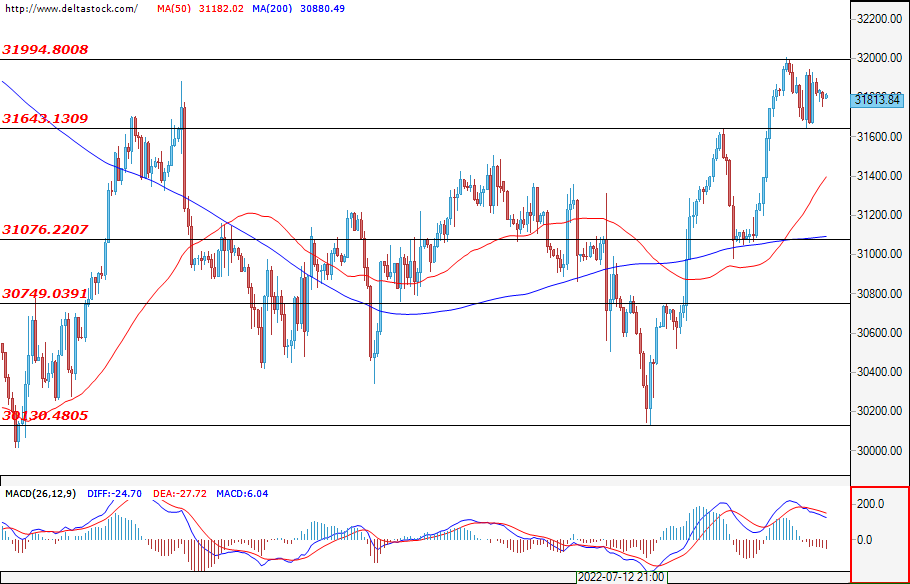
The US30 ended the session almost unchanged, holding onto its weekly gains. Yesterday, the support at 31640 was tested and withstood the bearish pressure. If the market manages to hold above 31500, then the bulls have a chance to rally towards 32620. The main weekly support remains 31080, but a test of the zone is not ruled out. A failure for the bulls to charge past 32000 may encourage the bears for a new push, with their first target being 30750.
Goodbye Draghi
Three parties in Mario Draghi’s coalition turned their back against him at yesterday’s confidence vote, meaning that Mario Draghi will resign again, today. Draghi’s resignation means early election in fall in Italy, and political chaos at least until then.
And unfortunately, Mario Draghi’s resignation will have a broader impact than just in Italy. Italy is the Eurozone’s third biggest economy, and the fact that the country will sink into political chaos comes as an additional layer of stress for the European Central Babk (ECB), which is already having hard time to contain the divergence between the Eurozone yields.
That divergence should be contained, however, if the ECB wants to increase its interest rate to address the rising inflation. If it doesn’t, and if some European yields rise significantly more than the others as a result of higher interest rates, it would trigger another debt crisis in Europe.
The spread between the Italian and German 10-year yield has been widening since the start of the year. So, all eyes are on what Christine Lagarde thinks about the latest developments in Italy, and what she proposes against antifragmentation.
The ECB meets today, and not only it is expected to announce the first rate hike in Europe since 2014, but it will also reveal an antifragmentation tool, that should, in theory prevent the spread between the core and peripheral yields to go much wider.
Europe needs a solid tool to deal with the mess.
Nord Stream 1 should be back
Good news is that the Russian President Vladimir Putin said that the gas flow to Europe will be restored via the Nord Stream 1 pipeline today, but took the opportunity to warn the Europeans that the gas flow will be tightly curbed until the problems with the sanctioned turbine parts are resolved.
The European gas futures eased, and the EURUSD advanced past the 1.0270 yesterday on the back of a broadly softer US dollar, encouraging news from the Nord Stream 1, and the rising expectation that the ECB could opt for a 50bp hike today, rather than a 25bp hike.
It’s a no brainer that the ECB must go bigger than a 25bp hike today, if it wants to have an impact on the rising inflation. But will it be capable of doing so on a continent ravaged by pandemic, a war and now political chaos, is another question.
A 25bp hike will certainly send the EURUSD back below parity, while a 50bp hike could keep the single currency’s head above water for some more time. But the euro will likely remain under pressure, as long as the threat of a renewed euro zone debt crisis, and further energy crisis remain.
Gold sinks below $1700 per ounce
Gold slipped below the $1700 per ounce on the back of waning geopolitical tensions. In the absence of news that would trigger massive safe haven flows, the yellow metal should continue its journey to the south.
It is also said that if Janet Yellen is successful in forcing Russian oil exporters to accept $40-$60/bbl to sell the Russian oil, gold could tumble to the $1400-$1300 support zone. But don’t get too scared yet, there is more chance for the oil price cap to backfire than to be accepted.
In the US
Oil bulls are much less ambitious about buying oil above the $100 per barrel. The barrel of American crude is back to $101 this morning, and the limited upside seems to be giving an energy boost to equity markets, along with some good earnings announcements.
The S&P500 posted its first back-to-back gains in almost two weeks and Nasdaq gained the most with a 1.58% advance as Netflix jumped 7.35% on the back of less disappointing quarterly results.
Tesla, on the other hand, announced better than expected earnings after the bell. As Netflix, the Tesla results were worse than the previous quarter. The company announced the first sequential decline in profit since the end of 2020, but revealed that it nailed the highest vehicle production in its history despite the shutdown of the Shanghai mega factory due to the Covid restrictions and maintained its annual production growth target unchanged at 50%.
What was less encouraging in the Tesla report is the update regarding its Bitcoin holdings. Tesla apparently sold a big chunk of Bitcoin to add near a billion dollar to the company’s balance sheet. No wonder the news reversed the positive momentum and sent Bitcoin back below the $23K mark yesterday.
6. A.M. Berlin
Thursday is shaping up to be a frisky day for financial markets, but probably nothing today will be more important than when the bell tolls 6. A.M. in Berlin. The official Nord Stream 1 maintenance period finishes, and the natural gas from Russia is supposed to resume. President Putin has already signalled that flows will remain below capacity, and if they resume at 40%, the rate before the shutdown, that is probably the best Europe can expect. The European Union has already told member states that they will need to cut gas usage by 15% until March next year, and if flows are even lighter than 40%, the economic picture for Europe, and the UK, darken considerably.
European markets have piggybacked the bear market US equity rally this week. However, they ran into a brick wall yesterday as Euro-reality set in. Notably, EUR/USD failed ahead of 1.0300 and has fallen back to 1.0200. It isn’t just natural gas that is capping Eurozone risk; Italy’s government looks to be in imminent danger of collapsing after Mario Draghi won a non-confidence vote yesterday. It was a trojan horse, though, as the three largest members of the coalition boycotted the vote. Mr Draghi is expected to resign again, triggering new elections. It also imperils disbursement of further multi-billion tranches of the covid-recovery fund and threatens Italy’s reform path, and by extension, will probably push BTP yields higher.
I wouldn’t want to be the European Central Bank today, which is scheduled to announce its latest monetary policy decision this afternoon. It will be a damned if you do, damned if you don’t sort of meeting as they look across Europe’s wartime stagflationary economy and the ability of the Italians to shoot themselves in the foot so regularly since 1945. We can expect a token 0.25% hike to an inflation-slaying 0.25%, with the deposit rising to an equally frightening um, -0.25%. I have always said that something has been rotten in the state of Denmark with the EU since the GFC. While the rest of the world has many to squeeze in two or three economic cycles, Europe has basically sat at zero to negative interest rates since 2008 and has been quantitatively easing in some shape or form since then.
While the rate hike is a Hobson’s Choice for the ECB this afternoon, more attention is likely to be focused on the ECB’s anti-fragmentation tool to maintain government bond spreads between member states. Just don’t call it targeted quantitative easing, ok? With Rome pulling an Italian Job on the Eurozone at the worst possible time, it may be needed sooner rather than later. If markets are underwhelmed with the toolbox and Ms Lagarde’s press conference and rate outlook, European equities and the Euro may also be underwhelmed, and that’s before we see whether Russian gas returns this morning.
The US equity rally continued overnight, thanks to the zero-sum game in the Netflix results and even large American airlines reporting profits; who would have thought? Tesla’s results were also ok, although they’ve taken a bath selling their Bitcoin, but who hasn’t? Interestingly, Existing Home Sales slumped by -5.40% MoM for June as rate hikes bite. Equity markets ignored this as they are want to do, but it speaks volumes that although US yields were nearly unchanged, the US Dollar rallied quite impressively. And not just versus a running-on-empty Euro either. Sterling was Trussed-up and beaten down, as was AUD and NZD etc, and Asian currencies also retreated. More on that below.
News that both Alphabet and Microsoft are “assessing hiring requirements” has sent US futures lower in Asia. All I can say as I watch diverging asset class prices is that one should beware of stock market’s bearing “gifts.” I’ve been saying that for decades about investment banks, but it seems appropriate for the FOMO gnomes of Wall Street as well today.
In Asia today, the Asian Development Bank downgraded its Asia growth forecasts yet again while raising its inflation outlooks. We also have two central bank meetings of note. Firstly, the Bank of Japan announces its policy decision this morning. The BOJ is expected to temper its growth and inflation forecasts into 2023, and we can rightly assume there will be no change to its current ultra-easy settings. With US yields having settled down this week, the long USD/JPY trade has lost some momentum for now as well, likely easing some internal bureaucratic pressures.
Bank Indonesia is harder to call. BI has been a very reluctant rate hiker as its inflation environment remains benign, with a well-publicised priority to support Indonesia’s post-covid recovery. Unscheduled tightening last week by Singapore and Manila highlights the pressure central banks across the region are coming under as their currencies wilt under King Dollar. Notably, the rally by major currency heavyweights versus the greenback this past week did not flow meaningfully into the Asia FX space. In fact, looking at them this morning, all are at or near their recent lows, including USD/IDR, which continues nibbling at 15,000.00. That may force BI’s hand to enact a 0.25% hike, as with commodity prices falling, the help BI gets from a beefy current account surplus will dimmish.
The Turkish central bank will also announce its latest policy decision this afternoon. That’s always worth buying some popcorn and taking a comfortable seat as we watch Erdogan-omics Part 10. More fun than a John Wick sequel and with a higher economic body count. Expect no change. South Africa also announces, and there I expect a far-more-sensible 0.50% hike to 5.25% to occur, with upside risk. That probably won’t be enough to relieve the pressure on the Rand, and I expect this story to play out more in H2 across the EM and Asia FX space as the Fed keeps on hiking.
ADB and China nerves cause a mixed picture with Asian equities today
Wall Street’s rally continued overnight, boosted by the Netflix results apparently. In Asia, US futures are flirting with negative territory as Alphabet and Microsoft announce hiring assessments. Meanwhile, another China property developer is defaulting on offshore debt, Covid cases remain elevated in Mainland China, and the Asian Development Bank has downgraded regional growth while raising inflation assessments once again. Taken in totality, Asian markets are very mixed today as China nerves temper the urge to follow Wall Street in several markets.
Overnight, the S&P 500 rise by 0.59%, while the tech-heavy Nasdaq outperformed, rallying by 1.58%. The Dow Jones managed just a 0.15% gain. In Asia, US futures have run out of steam, with S&P 500, Nasdaq and Dow futures easing by 0.10%.
In Asia, Japan’s Nikkei 225 is up just 0.23% after the BOJ left policy unchanged. Meanwhile, South Korea’s Kospi has eked out a 0.40% gain after the sharp rise once again by the Nasdaq overnight. China markets are in negative territory, with the Shanghai Composite and CSI 300 losing 0.45% and Hong Kong falling by 1.25%.
In regional markets, Singapore has fallen by 0.65%, but Taipei, also highly correlated to the Nasdaq, has managed to rise by 0.70%. Jakarta is lower by 0.85% ahead of the BI decision, while Kuala Lumpur has gained 0.65%. Bangkok is 0.30% lower, while Manila has risen by 0.75%. Australian markets are also mixed, the All Ordinaries have risen by just 0.05%, but the ASX 200 has fallen by 0.30%.
European markets ran out of steam yesterday, having coat-tailed Wall Street higher this week. A combination of Italian political instability, the resumption-or not- of gas flows through Nord Stream 1 today, and the ECB policy meeting, combined to bring a dose of reality back to European markets. I expect European markets to also struggle today with so many irons in the fire. Although if gas flows resume this morning, that may give European stocks an initial boost, even if the flows are slight.
US Dollar rebounds overnight
The US Dollar rebounded overnight as a multitude of risk factors in Europe saw the Euro fall heavily, lifting the dollar index. The US Dollar strength was not confined to just them, though, with the greenback booking decent gains versus both the DM and EM space. The weak US housing data provided the catalyst for the rebound on a day when US yields remained almost unchanged.
The dollar index rose by 0.33% to 107.05 before edging 0.19% lower to 106.85 in Asia. The technical picture still suggests the correction lower has more to run, however, and the dollar index has now traced a triple bottom at 106.40. Failure of 106.40 now signals a deeper move towards 1.0500, and 1.0350 is possible. Resistance is at 108.00 and 109.30.
EUR/USD fell by 0.44% to 1.0180 overnight before rising by 0.27% to 1.0210 in Asia. The single currency faces a multitude of risks today, but markets seem poised to by Euros if gas flows resume through Nord Stream 1 this afternoon, even at reduced flows still. EUR/USD has traced out a triple top at 1.0175, which is initial resistance. That is followed closely by 1.0200. Only a sustained break above 1.0360 would suggest a longer-term low is in place. EUR/USD has support at 1.0100, 1.0000 and 0.9900/25.
GBP/USD closed slightly lower at 1.1980 overnight, where it remains in Asia. Higher than expected UK inflation and the emergence of the final two new prime ministerial candidates having little impact. It has support at 1.1930, 1.1800 and 1.1760, with resistance at 1.2060 and 1.2200. A rise above 1.2060 suggests a larger rally to the 1.2400 regions, but it would take a sustained break above 1.2400 to call for a longer-term low by sterling.
USD/JPY is sharply unchanged at 138.10 today, for the third day in a row. The BOJ policy decision and revised forecasts had zero impact on the currency. US bond yields have been steady this week, which likely explains the tight ranges in USD/JPY. 139.40 is initial resistance, followed by 140.00. Support is at 137.40 and 136.00.
AUD/USD and NZD/USD are also steady at 0.6895 and 0.6230 this morning, consolidating their respective topside wedge breakouts. Only a move below either 0.6800 or 0.6150 changes the short-term bullish technical outlook.
Asian currencies are slightly weaker versus the US Dollar today, in contrast with the moves by major currencies during the Asian session. A weaker CNY fixing by the PBOC this morning is playing its part, as are China's economic and virus concerns. In the bigger picture, the US yield differential is still weighing on Asian currencies, in addition to global slowdown fears. That has kept the pressure up on regional currencies, with USD/KRW, USD/PHP, USD/IDR, USD/MYR, and USD/INR all pushing against recent highs and in some cases, record highs. This afternoon, a dovish BI could see USD/IDR break above 15,000.00, adding more pressure to Asia FX.
Oil prices are steady
Brent crude and WTI were steady once again overnight, with US official crude inventory data having little impact on prices, although the rise in gasoline inventories by 3.5 million barrels may have capped prices intraday. European gas concerns look to be supporting the downside for now. Another factor behind the lack of volatility could be that volatility in July has bordered on the absurd at times, and that may have prompted traders to move to the sidelines.
Brent crude has edged 0.40% lower to $106.05 a barrel in Asia, with WTI moving 0.90% lower to $98.90 a barrel on futures markets. Brent crude has well-denoted resistance at $108.00 a barrel on the charts and then 111.00. It has support at $104.00 and $101.00 a barrel, and then 97.50, the 200-DMA. WTI has support at $98.25 and $96.00 a barrel, followed by $94.30, its 200 DMA. Resistance is at $100.00, followed by 104.00 a barrel.
Gold’s moment of truth draws near
If any asset class yells that the risk sentiment rally could be a very false dawn, it is gold. Having completely failed to rally on material US Dollar weakness this week, it has edged even lower to longer-term support overnight and this morning. To say that gold’s price action is underwhelming is an understatement, and it appears to be facing imminent material downside risks if the technical picture is to be believed.
Gold fell by 0.86% to $1697.00 overnight, easing by another 0.30% to $1691.00 an ounce in Asia this morning. It is now just above longer-term support around the $1675.00 an ounce zone. A sustained failure of $1675.00 will signal a much deeper move, targeting the $1450.00 to $1500.00 an ounce regions. Gold has resistance nearby at $1720.00, then $1745.00, now a triple top.