Sample Category Title
Oil Rallies, Equities Set for Positive Start
The week starts on a positive note after the rally we saw in the US stocks before last week’s closing bell. European futures hint at a positive open.
The US 10-year yield stabilized around the 2.75% mark, and the US dollar index is now back to its 50-DMA level, giving some sigh of relief to the FX markets overall.
One interesting thing is that we observe that the equities and bonds stopped moving together since the 10-year yield hit 3% threshold, suggesting that investors started moving capital to less risky bonds if they quit equities, instead of selling everything and sitting on cash. That’s one positive sign in terms of broader risk appetite and should help assessing a bottom near the actual levels.
Data, data, data
But the end of the equity selloff depends on economic data. Released on Friday, the US PCE index fell from 6.6 to 6.3% in April. The personal income rose slightly lower than the previous month, while spending remained stronger than expected. The thing is, if we start seeing a softer income growth, spending won’t – can’t – remain robust. And a softer spending will, finally, have the cooling effect on consumer prices. If that’s the case, the Federal Reserve (Fed) could finally relax into September – following two highly likely 50bp hikes in June and July, and the only expectation of a more relax Fed is enough to give investors a smile after such a sharp downside correction in equity valuations.
Due this week, the NFP number per se is not very important, as the Fed thinks that the US labour market is still too tight. But more importantly, they think that the US inflation is too high. Therefore, the wages growth will again be in focus. Analysts predict a decline from 5.5 to 5.2% in May. If that’s the case, it may be taken as good news for inflation, though lower income means less spending, and less revenue for companies. So, we will certainly see a cool down in the stock selloff, but we are not yet done with the recession talk.
EUR/USD drills above the 1.0750
Weak US dollar, combined with the recent hawkish comments from the European Central Bank (ECB) head Christine Lagarde hinting at the end of the negative rate era in Europe, is now forcing the EURUSD higher. The pair kicks off the week working on the 1.0750 resistance, to extend gains to 1.08, which is the 23.6% minor Fibonacci retracement on the past year selloff, then to 100-DMA, which stands just a touch below the 1.10 mark, to the 1.10 psychological level and to the 1.1084, which is the major 38.2% retracement, and which will, in theory distinguish between the actual yearly negative trend and a bearish reversal. So even with a rise to the 1.10 mark, the EURUSD will still remain in the bearish trend, which makes the 1.10 a fairly reasonable bullish aim.
All this is great, but
There is one thing that preoccupies investors this Monday: rising oil prices. The barrel of US crude trades above the $117 mark as the US driving season is about to kick off, and UK oil giants review their production plans in the North Sea following the announcement of a 25% windfall tax in the UK.
The windfall tax is fundamentally bad news: if oil companies reduce investment due to higher tax, the tighter global supply would keep oil prices upbeat. Thanks, Rishi!
On the geopolitical front, the Europeans meet and meet again to discuss about the sanctions about Russia, but they can’t agree on a Russian energy ban as Hungary continues refusing to walk away from the Russian oil.
On the supply front, OPEC will meet this week, but there is little hope to see OPEC countries announcing anything that would give a relief to the market.
So all in all, it looks like oil prices will remain under a decent positive pressure this week. On the upside, we should see a solid resistance into the $120pb mark, as the high oil prices weigh on sentiment about the economic activity, lower the demand and could slow down the rally. But whether it will keep the upside contained near the $120pb is the million-dollar question.
Warming Up to June Central Bank Meetings
Market movers today
The most important data releases today will be the Euro Area Sentiment indicators for May, as well as the German and Spanish flash CPIs. They will both give an early sense of tomorrow's Euro Area Flash HICP, where we look for a pick-up in both headline and core inflation.
Later in the week, we will get the official May PMIs for China as well as the ISM PMIs for the US. Finally, we expect another strong US jobs report on Friday with 400 thousand new jobs in May. We will also have a range of central bank speeches throughout the week, including Fed's Waller this evening. This round of data is the last 'batch' of data before the important central bank meetings.
The 60 second overview
Inflation: The yoy US PCE deflator was lower than the previous monthly reading for the first time since November 2020, albeit slightly better than market consensus (PCE deflator came in at 6.3% for April compared to March at 6.6%). While one should naturally always be cautious about calling a peak to the inflation, in particular as the monthly change was still 0.2% (but well below the previous 0.9%) in this environment with elevated uncertainties, the inflationary pressures are still significantly too high for the Fed to change course on its tightening path.
FOMC minutes: The FOMC minutes released on Wednesday did not contain new signals. 75bp was not mentioned at all at the meeting and the market had no significant reaction to it. We still see risks skewed towards faster tightening, as underlying inflation pressure remains too high despite markets pricing in a lot of rate hikes this year.
Oil: Overnight media reported that EU failed to reach a package revising its current sanctions, including a ban on Russian oil, as Hungary is refusing to back the proposal. Negotiations are set to continue today ahead of the special EU council starting tonight.
COVID in China: Shanghai announced new policies to support the economy to cope with the economic fall´-out from COVID restrictions. Most important is that companies do no longer need to be on the 'whitelist' to resume its production from 1 June. Furthermore, an acceleration of approvals in the construction sector is planned. Shanghai plans to loosen the test requirements in June. Beijing seems to have recorded the worst of the COVID outbreaks.
FI: Towards the end of last week, the volatility in rates markets settled down amid early indications that inflation may have peaked in annual terms as the US PCE deflator was lower than the previous monthly reading for the first time since November 2020 (in April at 6.3% compared to March at 6.6%). One should naturally always be cautious about calling a peak to the inflation (mom was still 0.2%), especially in this environment with elevated uncertainties. Focus early this week is on the inflation prints from the euro area (some country releases today and Euro Area release tomorrow), and later in the week focus turns to the US labour market report as both the ECB and Fed enters its silent periods this week.
FX: With credit starting to price in levels similar to other peak events (absent a major blow-out like 2008 or the COVID shock), the potential for a mild volatility compression might very well drive a push towards Scandies and high beta EM carry.
Credit: iTraxx Main was 2bp tighter to 87bp on Friday, closing the week 13bp tighter on the back of improving risk sentiment. Meanwhile, iTraxx Crossover tightened 8bp to 431bp, ending the week 57bp tighter.
China COVID-19 Hopes Boost Asia
Asian markets are mostly positive this morning as Shanghai announced a raft of stimulus measures and both Shanghai and Beijing eased Covid-19 restrictions. The devil is in the detail of course, and corkers in both cities still face challenges either going to work, or even being allowed to leave the house. Nor has the reality that the virus only has to get lucky once, prompting the reimposition of tightened covid-zero restrictions, in the minds of investors. Such minutiae are usually ignored by markets when it doesn’t suit the preferred narrative, and so it is today. Asia is pricing in peak virus in China and a recovery in growth.
Another tailwind was the strong performance by Wall Street on Friday, which closed out a banner week prompting the usual “maybe this is the bottom” response from the financial press and FOMO investors. That was assisted by US data on Friday. Personal Income and Expenditure for April were still robust, but eased from March’s numbers, and Michigan Consumer Sentiment retreated from 65.2 in April to a still-healthy 58.4 for May. Lower data equalling reduced need for Fed tightening equals buy everything. Simple really. Although I must say, I’m struggling to see how a slowing US economy is good for equities, I don’t want to spoil the party though.
Another negative headwind being completely ignored by markets is oil prices. Brent crude has edged above $120.00 a barrel this morning as the European Union continues its efforts to get Hungary on board for a proposed EU ban on Russian crude imports. The underlying driver though is the massive squeeze on refined products we are seeing around the world, which is lifting the base ingredient for all that diesel and petrol that has got very expensive. The world would have been flapping and wringing its hands about the end of days if we had said Brent crude above $120.00 a barrel a month or two or three or four ago, now it is being ignored. By the way, if China recovers, oil prices will as well; just saying.
Also being ignored by markets completely in Non-Farm Payroll week is that the Federal Reserve also starts quantitative tightening this week. The Fed will start to sell $47.50 billion of bonds and MBS’ per month, scaling up to $95 billion per month by September. Meanwhile, the ECB, is still quantitatively easing while talking about hiking rates to errrr, zero per cent. And there is a war in Eastern Europe. Long EUR/USD above 1.0800 anybody?
Despite being less than impressed with either the Fed’s guidance or overall performance over the past year or so, at least they’re not the Reserve Bank of New Zealand. I find it highly unlikely they will abruptly swing to less a hawkish stance between now and September, meaning three more 0.50% hikes into September and fewer jokes being made about their credibility. Additionally, the $8.5 trillion balance sheet needs to reduce is carb and saturated fat intake, so quantitative tightening it is. From my position as a pilot fish cleaning the teeth of the capital markets sharp on the periphery, none of this is being priced in, although I acknowledge that markets can remain irrational, longer than you can stay solvent.
Now that I have fulfilled my role as the voice of reason on a Monday, it is time to have a look at what the week ahead brings. Asia’s calendar is dead today with the week’s highlights being China’s Official and Caixin PMIs coming out tomorrow and Wednesday. Wednesday and Thursday also see a swath of manufacturing and services PMIs from the rest of Asia, while Australia releases its April Trade Balance on Thursday. China’s data will have a very binary impact this week if peak-covid is here. Soft data will likely ramp up fears of a slowdown, with a decent showing likely to see hot money flowing in looking for the bottom. Soft data from the rest of Asia ill raise fears of spreading China contagion. Watch also for Indonesian Inflation on Wednesday. A high print will increase the pressure on Bank Indonesia to finally hike this month.
Holidays will play their part this week. US markets are closed for Memorial Day today, although electronic trading is open in Asia. Indonesia is closed Wednesday while Mainland China and Hong Kong and Taiwan are closed on Friday for the International Dragon Boat Festival. Thursday and Friday see United Kingdom markets closed for a bank holiday and Her Majesty’s Platinum Jubilee. Activity in Asia will likely be muted from Thursday.
Today features German May Inflation with Eurozone, French and Italian Inflation tomorrow. High prints will likely increase the hiking noise around the ECB and could extend the Euro's recent gains. The ECB should probably stop quantitatively easing first though. Eurozone and US Manufacturing PMIs are released on Wednesday, along with US ADPO Employment that forecasters will pointlessly use to extrapolate Friday’s data. We also have a Bank of Canada policy decision which should feature a 0.50% hike.
Finally, on Friday, we will see May’s US Non-Farm Payrolls data. Market expectations are a moving target this week, but as of today, markets are expecting a fall from 428,000 in April to a still robust 320,000 for May. Trading the data in the hour after its release has always been a sure-fire way to lose money. But if pushed, I would say a lower number will have the market pricing in less Fed tightening, while a higher number might dish out a cold dose of reality to the bottom-fishers in equity, bond, and currency markets ahead of the mid-month FOMC meeting.
Asian markets rally on positive Wall Street and China hopes
US markets closed out the week on another positive note after US data alleviated inflation fears and thus, future Fed tightening, and showed strength among US consumers still. Realistically, after such a positive week, it would have taken a lot to knock the FOMO gnomes of Wall Street off their path of bottom-picking nirvana. The S&P 500 rallied by 2.48%, while the Nasdaq leapt by an impressive 3.33%, with the Dow Jones climbed by 1.76%. The rally has continued in Asia, with Nasdaq futures 0.90% higher, with S&P 500 futures up 0.40%, and Dow futures edging 0.10% higher. US OTC markets are closed for Memorial Day.
Asia is also turning in a positive performance, following the impressive New York close, and boosted by hopes that China’s Beijing and Shanghai hubs are reopening from virus restrictions and a package of stimulus measures released by the Shanghai local government.
Japan’s Nikkei 225 has coat-tailed the Nasdaq 2.10% higher today, with South Korea’s Kospi gaining 1.25%, and Taipei rallying by 1.60%. In Mainland China, the Shanghai Composite is a more cautious 0.30% higher, with the CSI 300 rising by just 0.40%. The ever-optimistic Hong Kong, however, had leapt 2.50% higher, boosted by hopes of an Evergrande bond deal.
In regional markets, Singapore is up just 0.20%, while Kuala Lumpur has fallen 0.25%, and Jakarta is 0.60% lower. A Goldman Sachs report suggesting metals prices have peaked is likely weighing on all three markets, as risk sentiment swings back to more growth-stock orientated markets. Bangkok has gained 0.65%, while Manila has rallied by 1.25%. Australian markets have also liked what they have seen with Wall Street and China, the ASX 200 and All Ordinaries climbing by 1.25% today.
Friday’s New York close and Asia’s rally today should be enough to lift European equity markets this afternoon, although the still simmering EU import ban on Russian oil and Brent crude above $120.00 a barrel will temper bullish animal spirits.
Sill improving risk sentiment sends US Dollar lower
The US Dollar declined once again on Friday as improving risk sentiment continues to unwind the 2022 US Dollar rally. That has spilt over into Asian markets today, with regional currencies booking some decent gains versus the greenback this morning. On Friday, the dollar index edged 0.12% lower to 101.64, losing another 0.13% to 101.50 in Asia. Support remains at 101.00, with resistance at 102.50.
EUR/USD held steady on Friday, closing almost unchanged at 1.0735, with US Dollar weakness being reflected in EMFX and the commonwealth currencies. It has gained 0.20% to 1.0755 in Asia, but overall, seems locked in a 1.0700 to 1.0800 range. Oil’s rally may temper single currency gains, with the multi-decade breakout line, today at 1.0830, still a formidable barrier.
GBP/USD closed 0.20% higher at 1.2630 on Friday, adding another 0.14% to 1.2640 in Asia. GBP/USD looks set to trade in a noisy 1.2600 to 1.2700 range as the week gets underway. The government's cost of living package may prompt faster BOE tightening, supporting the downside, while the economic slowdown continues to slow upside progress.
USD/JPY is trading sideways, ranging each side of 127.00 as US yields trade in narrow ranges. That is likely to continue with US bond markets closed today. The chart suggests USD/JPY has further downside potential that could target 125.00. Only a move through trendline resistance at 127.80 changes the picture.
AUD/USD and NZD/USD continue to be driven entirely by swings in global risk sentiment. Another strong performance by Wall Street on Friday maintained that upward momentum and both AUD and NZD were prime beneficiaries. AUD/USD rallied by 0.85% to 0.7160, adding another 0.20% to 0.7175 today. It has resistance at 0.7260, and support at 0.7100. NZD/USD rose by 0.86% to 0.6536 on Friday, rising another 0.17% to 0.6547 today. Resistance nearby at 0.6570 opens a larger rally to 0.6650, with support at 0.6475.
Asian FX rode improving investor risk sentiment higher on Friday, moves reflected throughout the EM space. Gains were led by the Chinese Yuan, Korean Won, and New Taiwan Dollar, all gaining around 0.70%, while even the beleaguered Malaysian Ringgit out in a good show, USD/MYR falling to 4.3770. Both the Indonesian Rupiah and the Malaysian Ringgit should find further strength on higher oil prices, even though it increases their domestic subsidy bills. Oil’s strength is likely the reason the Indian Rupee has remained unchanged from Friday through today. CNY, KRW and NTD are rallying strongly today, likely boosted by China's reopening hopes. USD/CNY, USD/KRW, and USD/NTD have fallen by around 0.80% today. However, if oil prices continue to rise this week, the rally in energy-importing Asian currencies may run out of steam.
Brent crude rises above $120.00
The disconnect between energy prices and optimism in equity markets continues today in Asia. On Friday, oil prices surged once again, driven by an unrelenting squeeze on refined products, notably diesel and gasoline, globally, with the US driving season about to begin in earnest. Brent crude rose by 1.63% to $119.20 a barrel on Friday, rallying another 0.70% to $120.05 this morning. WTI rose by 0.85% to $115.10 a barrel on Friday, rallying another 0.83% higher to $116.05 in Asia today.
Markets pricing in peak virus in Beijing and Shanghai are behind the rally in oil prices today, with a China reopening likely leading to increased oil consumption. Unlike recent times, markets seem unconcerned about oil moving back to March highs, emphasising how much pent-up risk-sentiment demand there appears to be out there.
We can expect no solace from OPEC+ on production increases on Thursday. The grouping cannot pump to meet its present quotas as it is, and a 430,000 bpd increase is all we can expect. Additionally, the EU Russian oil import ban is still a work in progress and if it gets over the line this week, expect supplies to tighten again. As such, the risks are now increasing of a move towards the post-Ukraine highs we saw in February.
Both Brent crude and WTI are at the top of my expected medium-term ranges at $120.00 and $115.00 respectively. A weekly close above these levels would be a major signal indicating more gains ahead. Brent crude’s next technical resistance is at $124.00 a barrel, and then $$132.00, with support at $116.00. WTI has resistance nearby at $116.70 a barrel, with nothing afterwards until $127.00 a barrel. Support is at $115.00 and $113.00 a barrel.
Gold trades sideways
Gold seems determined to bore traders to death after another inconclusive overnight range-trading session. It finished Friday 0.13% lower at $1853.00 an ounce, before gaining 0.44% to $186.75 an ounce in Asia today. Gold’s price action continues to suggest caution, with the US Dollar sell-off not translating to any meaningful gold strength. If global risk sentiment turns lower, gold could quickly follow.
Gold has nearby support at $1840.00, followed by $1836.00 an ounce. Failure sees the possibility of a mini-capitulation by longs that could reach as far as $1780.00 an ounce. Gold has resistance here at $1862.00, then $1870.00, followed by $1886.00 an ounce, its 100-day moving average.
GBP/JPY Daily Outlook
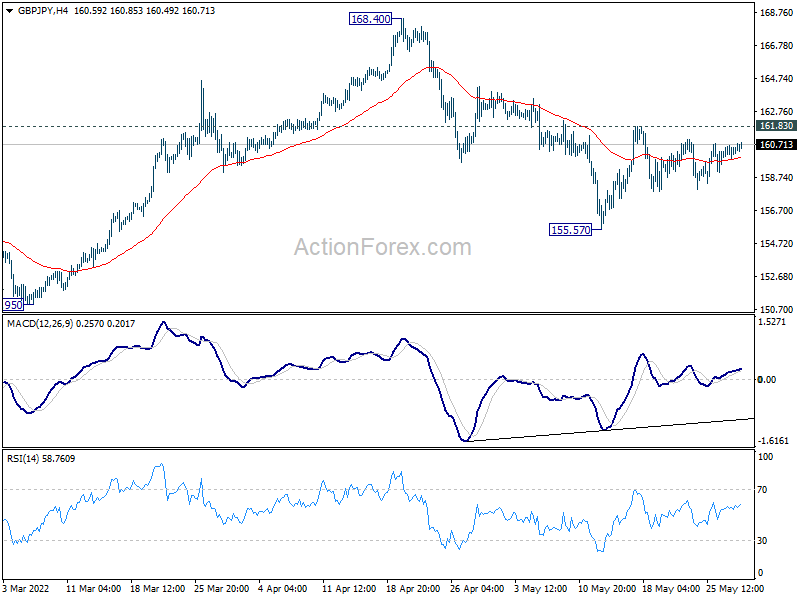
Daily Pivots: (S1) 160.04; (P) 160.35; (R1) 160.87; More...
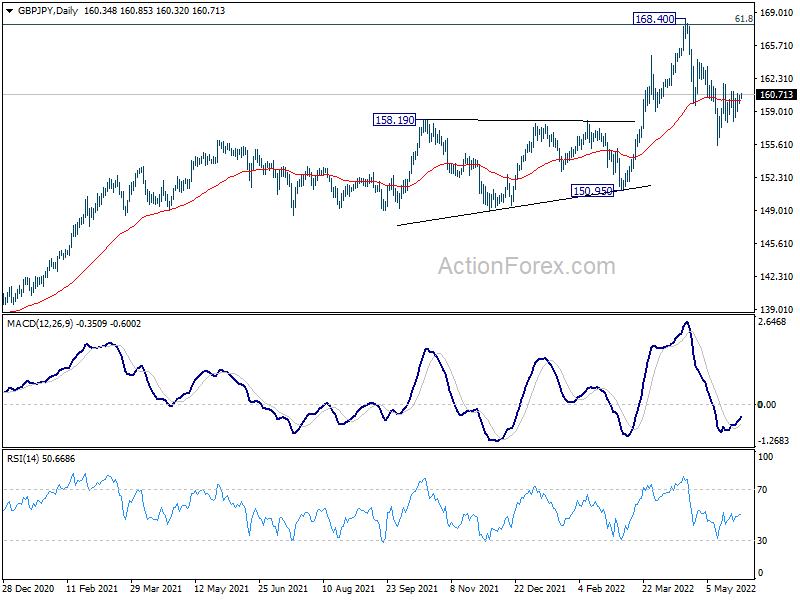
Intraday bias in GBP/JPY remains neutral for the moment. On the downside, break of 155.57 will extend the correction towards 150.96 key structural support. Nevertheless, on the upside, firm break of 162.16 will indicate that the correction has completed, and bring retest of 168.40 high next.
In the bigger picture, up trend from 123.94 (2020 low) is still in progress. Sustained break of 61.8% retracement of 195.86 (2015 high) to 122.75 (2016 low) at 167.93 will be a long term bullish signal, and could pave the way back to 195.86 high. This will now remain the favored case as long as 150.95 support holds, even in case of deep pull back. However, firm break of 150.95 will indicate rejection by 167.93, and bearish trend reversal.
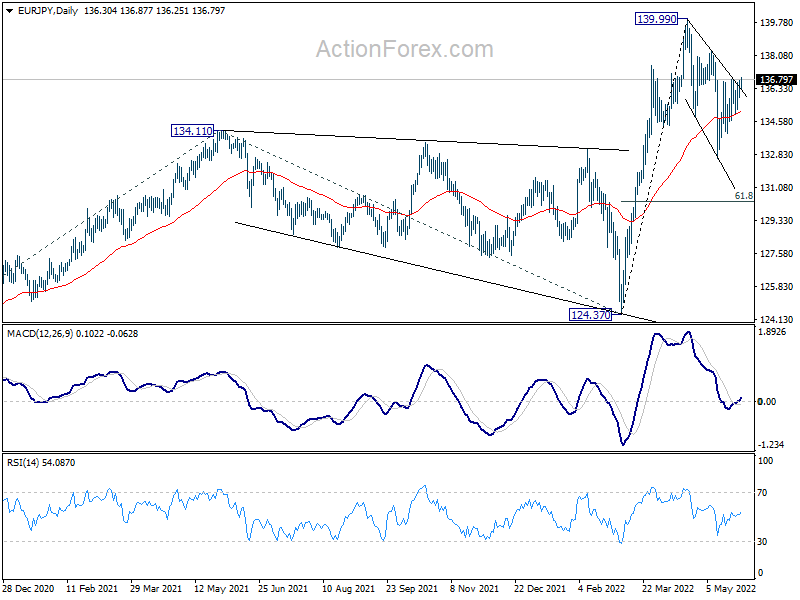
EUR/JPY Daily Outlook
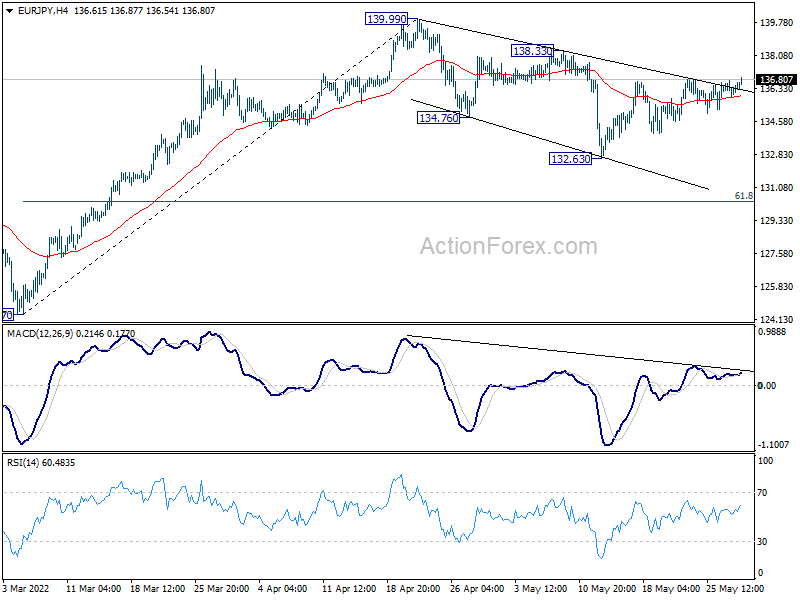
Daily Pivots: (S1) 135.94; (P) 136.33; (R1) 136.82; More....
Intraday bias in EUR/JPY stays neutral at this point. Corrective pattern from 139.99 could still extend. On the downside, break of 132.63 will target 61.8% retracement of 124.37 to 139.99 at 130.33. On the upside, break of 138.33 will indicate that the correction has completed, and bring retest of 139.99 high next.
In the bigger picture, up trend from 114.42 (2020 low) is in progress. Such rise is seen as the third leg of the pattern from 109.30 (2016 low). Next target will be 100% projection of 114.42 to 134.11 from 124.37 at 144.06. In any case, outlook will now remain bullish as long as 124.37 support holds, in case of deep pull back.
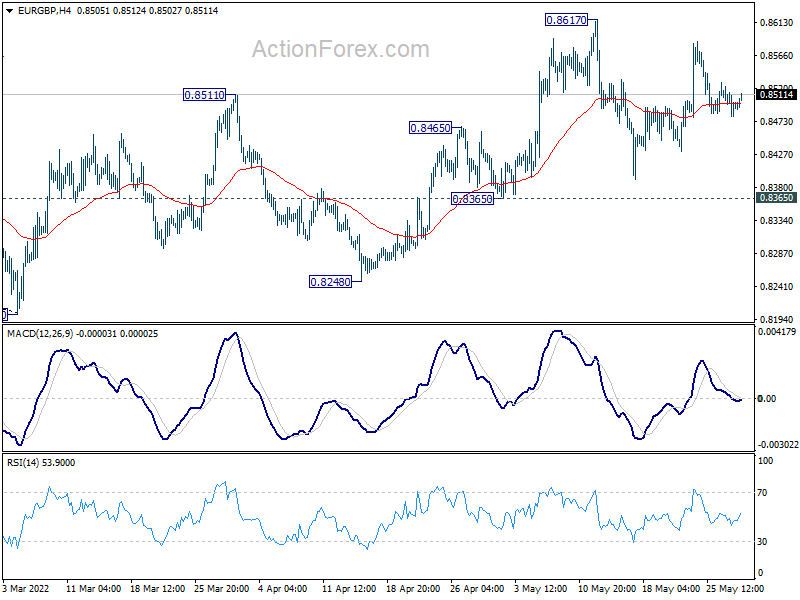
EUR/GBP Daily Outlook
Daily Pivots: (S1) 0.8477; (P) 0.8500; (R1) 0.8519; More...
Intraday bias in EUR/GBP stays neutral and outlook is unchanged. Further rally is in favor with 0.8365 support intact. On the upside, break of 0.8617 will resume rise from 0.8201 medium term bottom to 0.8697 medium term fibonacci level. However, break of 0.8365 will dampen this bullish view, and turn bias back to the downside instead.
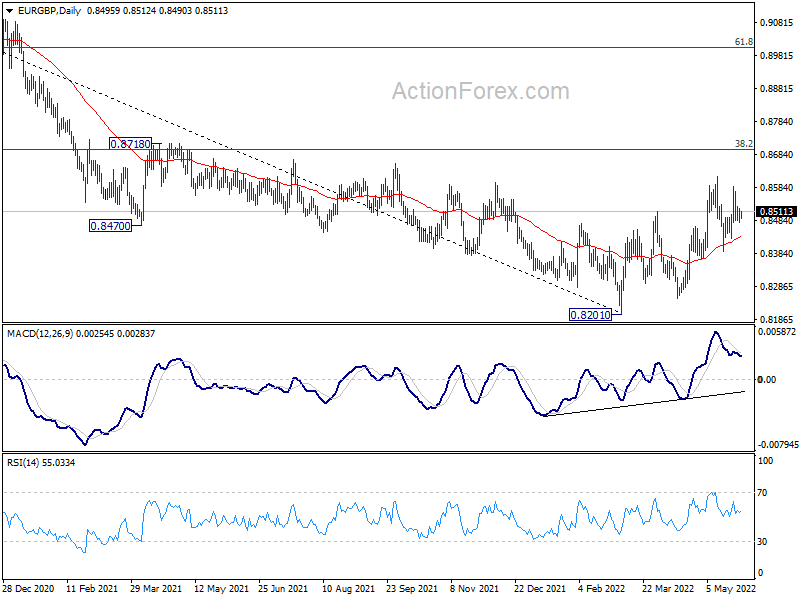
In the bigger picture, a medium term bottom could be in place at 0.8201, on bullish convergence condition in daily and weekly MACD. Rise from there could either be a correction to the down trend from 0.9499 (2020 high), or a medium term up trend itself. In either case, further rise should be seen to 38.2% retracement of 0.9499 to 0.8201 at 0.8697. Sustained break there will target 61.8% retracement at 0.9003.
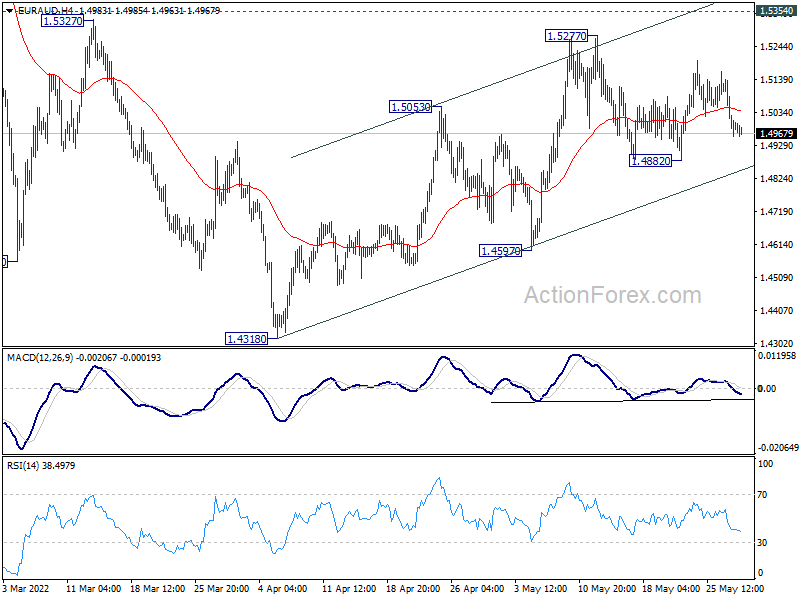
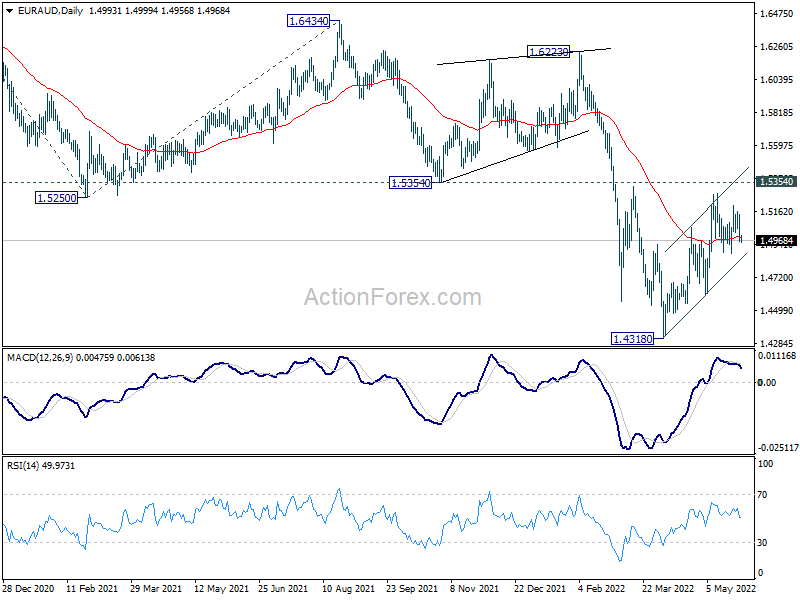
EUR/AUD Daily Outlook
Daily Pivots: (S1) 1.4921; (P) 1.5031; (R1) 1.5100; More...
Intraday bias in EUR/AUD remains neutral and outlook is unchanged. Break of 1.4882 support will reaffirm that case that corrective rebound from 1.4318 has completed at 1.5277, ahead of 1.5354 resistance. Deeper fall would be seen to 1.4597 support, and then 1.4318 low. Also, risk will stay on the downside as long as 1.5277 resistance holds.
In the bigger picture, as long as 1.5354 support turned resistance holds, larger down trend from 1.9799 (2020 high) is still expected to continue. On resumption, next target is 61.8% projection of 1.9799 to 1.5250 from 1.6434 at 1.3623, which is close to 1.3624 long term support (2017 low). However, firm break of 1.5354 will indicate medium term bottoming and bring stronger rally back to 1.6434 key resistance.
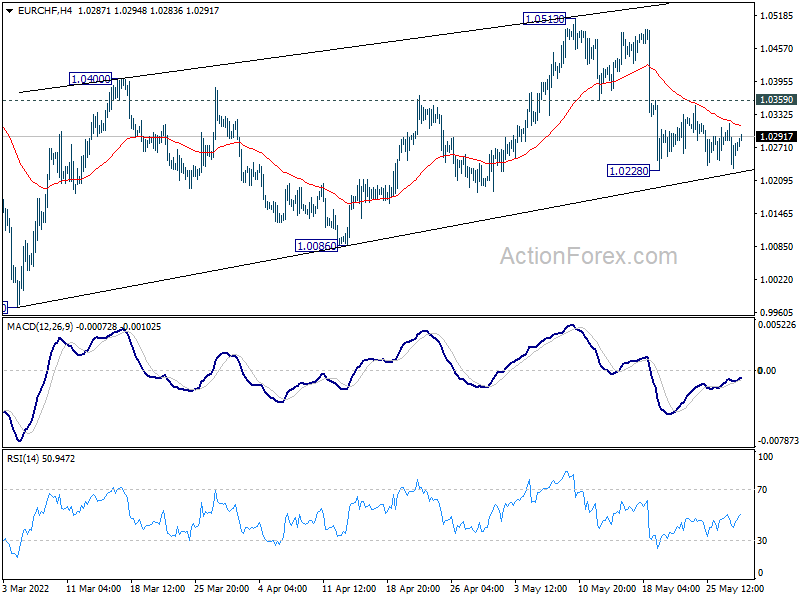
EUR/CHF Daily Outlook
Daily Pivots: (S1) 1.0232; (P) 1.0275; (R1) 1.0317; More....
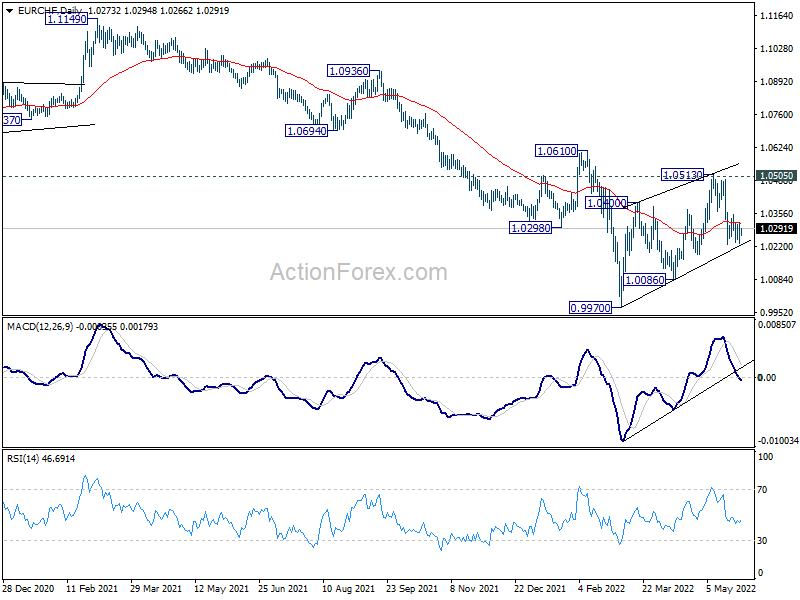
Intraday bias in EUR/CHF remains neutral and outlook is unchanged. Further fall is expected with 1.0359 resistance intact. On the downside, below 1.0228 will reaffirm the case that corrective rebound from 0.9970 has completed at 1.0513. Deeper fall would be seen to 1.0086 support next. However, above 1.0359 will dampen this bearish view and bring stronger recovery back towards 1.0513 resistance.
In the bigger picture, as long as 1.0505 support turned resistance (2020 low) holds, long term down trend from 1.2004 (2018 high) is expected to continue. Next target is 100% projection of 1.2004 to 1.0505 to 1.1149 at 0.9650. However, firm break of 1.0505 will suggest medium term bottoming, and bring stronger rebound towards 1.1149 structural resistance.
EUR/USD Daily Outlook
Daily Pivots: (S1) 1.0699; (P) 1.0732 (R1) 1.0767; More...
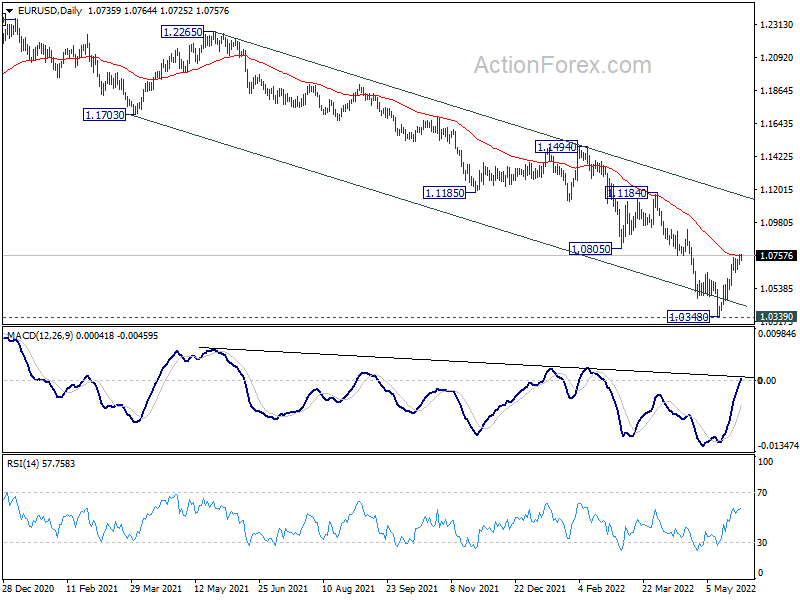
EUR/USD's rebound from 1.0348 is still in progress and intraday bias stays on the upside. Sustained trading above 55 day EMA (now at 1.0757) will target 1.0935 resistance next. On the downside, however, break of 1.641 minor support will turn bias back to the downside for retesting 1.0348 low instead.
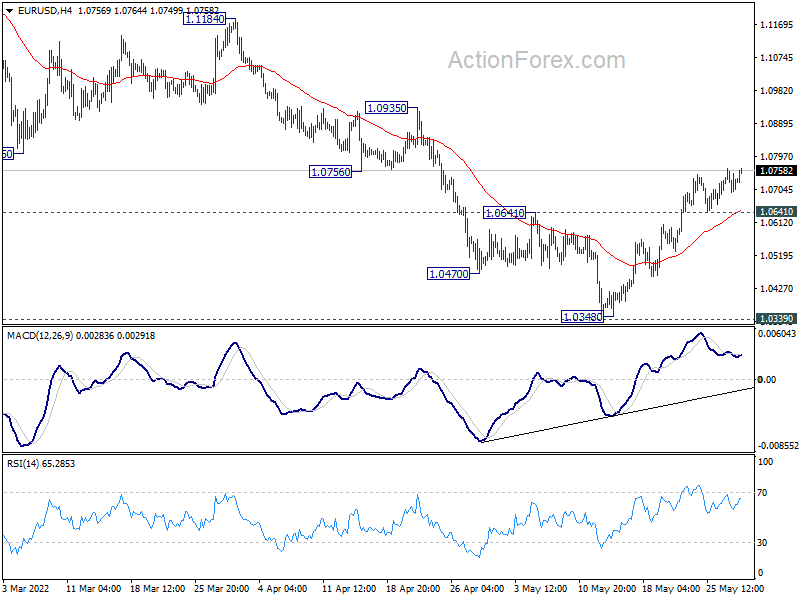
In the bigger picture, focus stays on 1.0339 long term support (2017 low). Decisive break there will resume whole down trend from 1.6039 (2008 high). Next target is 61.8% projection of 1.3993 to 1.0339 from 1.2348 at 1.0090. However, firm break of 1.0805 support turned resistance will delay this bearish case and bring medium term corrective rebound first.
USD/JPY Daily Outlook
Daily Pivots: (S1) 126.78; (P) 127.01; (R1) 127.35; More...
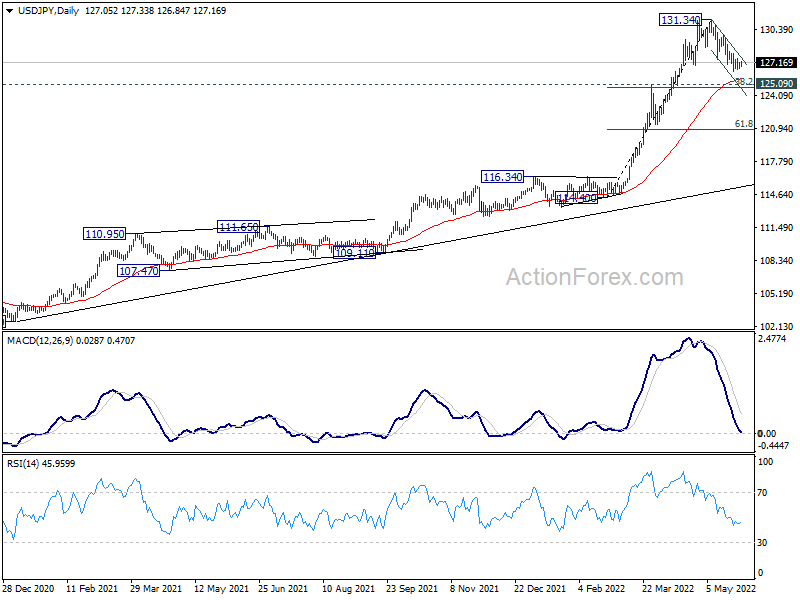
No change in USD/JPY's outlook as correction from 131.34 is extending. Deeper decline could be seen but downside should be contained by 125.09 cluster support (38.2% retracement of 114.40 to 131.34 at 124.86) to bring rebound. On the upside, break of 129.77 minor resistance will suggest that the correction is finished and bring retest of 131.34.
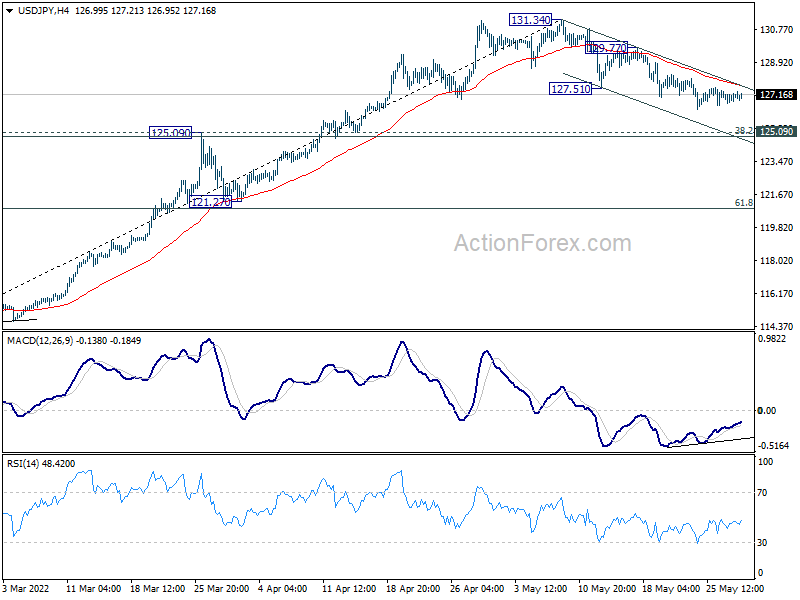
In the bigger picture, current rally is seen as part of the long term up trend form 75.56 (2011 low). Sustained trading above 61.8% projection of 75.56 (2011 low) to 125.85 (2015 high) from 98.97 at 130.04 will pave the way to 100% projection at 149.26, which is close to 147.68 (1998 high). For now, this will remain the favored case as long as 121.27 support holds.