Sample Category Title
Japanese Yen Drifting, Fed Minutes Next
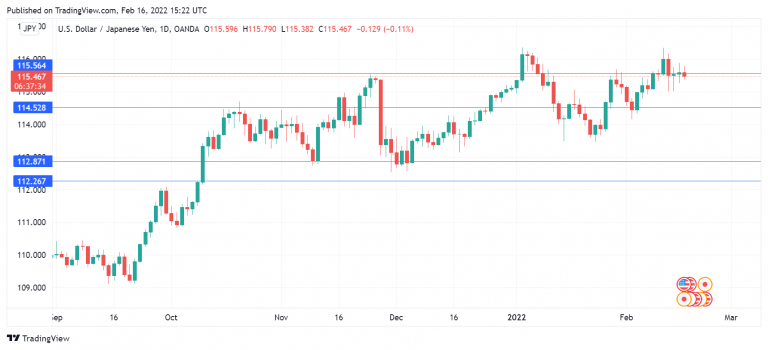
The Japanese yen continues to have a quiet week and is trading at 115.46 in the North American session, down 0.12% on the day.
What next for Ukraine?
The US dollar enjoyed a boost earlier in the week as tensions between Russia and the West reached a fever pitch. Now that the situation has stabilized somewhat, investors are breathing easier and the dollar has lost ground. Still, there is apprehension in the air and a lack of clarity as to what happens next. Russia says that it has moved some troops away from attack positions, but the US says there is no proof of this. President Biden took to the airwaves on Tuesday and warned the Russians of severe consequences if it attacked Ukraine while saying it was not too late to reach a diplomatic solution.
US retail reports sparkle
In the US, a strong retail sales report for January provided something for investors to digest other than news from Ukraine. Retail Sales jumped 3.8% m/m, crushing the estimate of 2.0% and rebounding from the 2.5% decline in December. High inflation helped boost the retail sales numbers, but consumers are buying more goods and services as well.
Investors will now shift their attention to the Fed minutes, which will be released later today. We’ve been hearing a hawkish message from some FOMC members of late, and the minutes could well reflect the hawkish pivot that the Fed has reluctantly embraced due to red-hot inflation. Fed Chair Jerome Powell recently abandoned his stance that inflation was transitory and a March liftoff for hikes is essentially a done deal. The markets have priced in six hikes, although some FOMC members have suggested that three or four hikes will suffice to rein in inflation close to the Fed’s target of 2 per cent.
USD/JPY Technical
- There is weak resistance at 115.56. Above, there is resistance at 114.52
- There is support at 112.87 and 112.26
US: Retail Sales Bounce Back, With Autos and E-commerce Doing Most of the Heavy Lifting
Retail sales jumped up 3.8% month-on-month (m/m), well above the consensus estimate for an increase of 2.0%. December's reading had a marginal downward revision to -2.0% m/m from -1.9% m/m reported earlier.
Autos & parts dealers had a strong month, rising 5.7% m/m despite December's downward revision to -1.6% vs. (-0.4% reported earlier).
Excluding autos, retail sales were up 3.3% m/m. Sales at gasoline stations declined by 1.3%m/m, while building materials retailers saw a gain of 4.1% m/m in January.
Sales in the "control group", which exclude the most volatile categories and are used in calculating personal consumption expenditures (and GDP), were up by 4.8% m/m. However, December sales were revised weaker, -4.0% m/m from the advance reading of -3.1% m/m.
- Within the group, the biggest contributors to growth were non-store retailers (+14.5% m/m), department stores (+3.6% m/m) and furniture & electronics/appliance stores (+5.2% m/m),
- Several categories were in the red, including food services & drinking places (-0.9% m/m), sporting goods, hobby, book & music stores (-3.0% m/m), health & personal care (-0.7% m/m) and miscellaneous stores retailers (-0.1% m/m).
Key Implications
What a strong start to the year! One third of the strength came from auto sales, with consumers snapping up cars as they roll off the assembly line despite increasingly higher vehicle prices. Non-store retailers returned with vengeance, recovering all of their December losses and more. Other categories also delivered a strong performance as consumer demand is proving resilient to Omicron and post-holiday spending fatigue typical of the winter months. One disappointment is the decline in sales in food establishments and bars, which may point to a momentum loss in services growth, a more detailed reading of which will come out at the end of the month.
Looking to the year ahead, retail trade growth should remain steady. Consumers haven't made a sizeable dent in their pandemic nest egg, which should support a healthy level of spending, especially as job and income growth remains healthy. One risk is that consumers become more and more pessimistic about their spending prospects as concerns over inflation continue to mount. Still, we expect that goods inflation will ease as consumer demand shifts towards services consumption, which should help balance out spending without tempering growth.
Canada: Inflation Rises Above 5%, Highest Levels Since 1991
Consumer price inflation accelerated to 5.1% year-on-year (y/y) in January, from 4.8% in December and well ahead of market expectations for an unchanged print. Energy price growth accelerated to 23.1% (from 21.2% in December), even as gasoline price growth slowed year-on-year (to 31.7% from 33.3% in December). Excluding energy, prices picked up noticeably, hitting 4.0% y/y (from 3.7 in December).
Seasonally adjusted, month-on-month prices were up a robust 0.6%. Price growth was broad and swift across categories in January. Every category saw monthly gains well in advance of their recent historic norms, with especially strong growth in recreation, reading and education (+2.2%), tobacco and alcohol (+1.1%), transportation (+0.7%), food (+0.6%), and shelter (+0.5%).
All three of the Bank of Canada's core inflation metrics rose 0.2 percentage points in January. CPI-trim hit 4.0% (from 3.8%), CPI-median to 3.3% (from 3.1%), and CPI-common measure to 2.3% (from 2.1%).
Key Implications
It is no longer possible to point to idiosyncratic factors as driving prices higher in Canada. Inflation is broad based and elevated across categories. Headlines are likely to get worse before they get better, with year-on-year comparisons boosted by softer price growth in the spring of last year.
Higher interest rate hikes won't immediately quell inflation, but they are essential to slowing it over the medium term. Inflation expectations still appear to be well moored and anticipation that the Bank of Canada will raise interest rates has lifted interest rates to their highest level since before the pandemic.
Still, it will be important to watch the evolution of supply constraints as well as geopolitical risks. Unless these ease, inflation will continue to surprise on the upside, making the job of achieving a smooth landing that much harder.
Euro Steady as Ukraine Takes a Breath
The euro is flat on Wednesday, as investors keep a close eye on developments on the Ukraine/Russia border.
The euro has been acting as a barometer of the crisis, and the currency’s lack of movement today reflects a lack of clarity on the part of the markets as to what will happen next. Russia says that it has moved some troops away from attack positions, but the US says there is no proof of this. President Biden took to the airwaves on Tuesday and warned the Russians of severe consequences if it attacked Ukraine while saying it was not too late to reach a diplomatic solution.
In the eurozone, a tight labor market and rising inflation are putting pressure on the ECB to respond by raising interest rates. We have seen Christine Lagarde bend slightly and sound less dovish, although she has not indicated that the ECB is planning any rate hikes prior to 2023. The markets remain more hawkish and expect the ECB to raise rates by 40 basis points by the end of the year.
US retail reports shine
In the US, a strong retail sales report for January provided something for investors to digest other than news from Ukraine. Retail Sales jumped 3.8% m/m, crushing the estimate of 2.0% and rebounding from the 2.5% decline in December. High inflation helped boost the retail sales numbers, but consumers are buying more goods and services as well.
Investors will now shift their attention to the Fed minutes, which will be released later today. With various FOMC members sounding hawkish lately, there’s a strong chance that the minutes will reflect the hawkish pivot that includes Jerome Powell, who recently abandoned his stance that inflation was transitory. The markets have priced in six hikes and expect an aggressive Fed that has its work cut out for it on the inflation front.
EUR/USD Technical
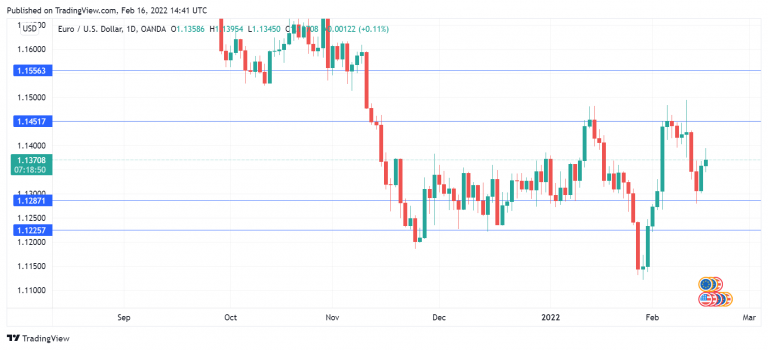
- EUR/USD faces resistance at 1.1452 and 1.1556
- There is support at 1.1287 and 1.1226
FOMC Minutes Next on the Radar; Canada CPI Surprises
US retail sales beat estimates; FOMC minutes next on the agenda
The minutes of the Federal Reserve's last meeting are on investor’s radar today and will be looking for details on its plans to reduce its enormous balance sheet and raise interest rates in 2022, as well as its evolving outlook on inflation. At the meeting on January 25-26, policymakers agreed that raising the Fed's benchmark overnight interest rate from near-zero would be "soon appropriate" and discussed the future of the $9 trillion in securities owned by the central bank.
The Fed's aggressiveness in tightening monetary policy, and in particular the likelihood of starting a new round of rate hikes in March with a half-percentage-point increase in its target rate, may be revealed in the debate over these themes. Investors presently expect the Fed to go down that route rather than the more cautious quarter-percentage-point rise.
The US dollar index is easing below 96.00 with weak momentum, while dollar/yen is posting some minor losses after two positive days. US futures stocks are suggesting a negative open today, after a strong bullish day on Tuesday.
As omicron infections decline and inflation continues to increase, retail sales in the United States rebounded in January, increasing by 3.8% m/m.
Russia returns some troops to base
Russian forces encircling Ukraine stated they were reducing their numbers on Wednesday; however, NATO demanded proof that they were reducing their numbers, claiming there were indications that more troops were on their way to the region.
The Ukrainian defense ministry has claimed that a cyber-attack has entered its second day. Russia denied any involvement in the incident. Following exercises in the southern and western military districts near Ukraine, Russia's defense ministry said its forces were withdrawing.
Canadian CPI surprises the market
Canada's headline inflation rate increased to 5.1% in January from 4.8% in December, greatly exceeding market predictions of 4.8%. It was the highest rate of inflation since September 1991, owing to persistent supply interruptions.
The commodity currencies are showing some positive signs as the kiwi and the aussie are returning to the upside, both testing the short-term moving averages (MAs). Dollar/loonie is heading south, holding near 1.2680.
Oil prices are rising today by 1.4% approaching the latest almost seven-and-a-half-year high of 95.78. On the other hand, gold prices are moving near their opening levels, holding above the long-term symmetrical triangle.
UK CPI jumps to 5.5%
British consumer prices grew at their fastest annual rate in over 30 years, putting pressure on consumers and increasing the likelihood of a third consecutive Bank of England rate hike. As Britain emerged from a protracted period of high wage accords, annual inflation climbed to 5.5% in January, the most since March 1992. The Bank of England estimated earlier this month that inflation will peak around 7.25 percent in April, when energy expenses will more than double. Sterling is showing some positive vibes but is still developing around $1.3555, remaining in a neutral range in the short-term.
Sunset Market Commentary
Markets
Today’s trading session revolved around US retail sales. They came in much stronger than expected, even accounting for the 0.5-0.9% (depending on the gauge) downward revision of December. Headline sales rose 3.8% m/m vs 2% expected. The control group – a proxy for private consumption in GDP – soared 4.8%, crushing the 1.3% consensus bar. While Omicron probably damped spending, it clearly did so less than feared. 8 out of the 13 categories rose with motor vehicles, furniture and non-store sales surging the most. Eating and drinking is the only service-oriented bracket in the retail sales series and showed a 0.9% m/m decline. US bond yields hesitated for a few minutes before shedding a few bps shortly after. It was the easiest way to go after showing some fatigue earlier on the day and as a still-mild risk-off intensifies (EuroStoxx50 loses about 0.5%, WS opens up to 1% lower in the Nasdaq) going into US dealings on lingering geopolitical uncertainty. US yields decline 2.3-3.5 bps across the curve with the 10y trying to retain the 2% ahead of tonight’s Fed meeting minutes. German yields decline in sympathy with changes varying from -2.5 bps (2y) to 4.3 bps (10y). ECB heavyweight Villeroy this morning said APP net buying could end in Q3 but hinted at altering forward guidance to allow for more time for a first rate hike. ECB hawk Kazaks later said a rate hike is “quite likely” this year but framed markets positioning for two 25 bps hikes as “somewhat too harsh”. Interestingly though, markets refuse to rule out such a scenario. European swaps yields slightly outpace the decline of Bund yields, easing 2.6 to 4.6 bps in a bull flattening move. UK yields tank up to 13 bps even as CPI in January accelerated unexpectedly to 5.5% headline and 4.4% core. It suggests money markets currently expect more than enough action by the Bank of England. UK retail sales on Friday thus face an asymmetric market risk.
There are no stand-out currencies in FX space today. The Canadian loonie takes first place with small gains vs all G10 peers following higher-than-expected inflation (see below). The USD and euro is a balance of weakness with the pair briefly touching minor resistance at 1.1386 before returning to opening levels around 1.136. The trade-weighted DXY is testing the 96 barrier. Sterling headed for the strongest levels vs the euro for the day while US dealings get going. EUR/GBP went from 0.839 to 0.837 at the time of writing.
News Headlines
The European court of Justice today ruled that the rule of law conditionality mechanism was legally solid and is in accordance with the treaties of the Union. The court dismissed challenges of Poland and Hungary against rules that would allow the Union to retain funding from members states that are breaking European laws. There is no appeal possible against this ruling of the ECJ. The ECJ found that the new law ‘respects in particular the limits of the powers conferred on the European Union and the principle of legal certainty’. The EU has disputes with multiple countries on compliance with its founding principles but it is expected that the mechanism might be used against Hungary and Poland in the near future. The loss of the zloty after the announcement of the ruling was modest (EUR/PLN 4.50). Forint losses were bigger with EUR/HUF rebounding from the sub 354 area to currently trade near 356.25.
Headline inflation in Canada in January accelerated 0.9% M/M (non-seasonally adjusted) to 5.1% Y/Y, the fastest pace since September 1991 (was -0.1% M/M and 4.8% Y/Y in December). The outcome was also above market expectations. Price rises were broad-based with M/M gains of 1.4% for food, 0.5% for shelter, 1.3% transportation and recreation/education (1.3%) catching the eye. All of the BoC preferred core inflation measures also printed higher than expected. Markets were already positioned for the BoC to start hiking its policy rate at the March 2 meeting. Today’s data only confirm this lift-off scenario. The loonie gained modestly after the CPI release with USD/CAD currently trading in the 1.2690 area.
EUR/USD Mid-Day Outlook
Daily Pivots: (S1) 1.1318; (P) 1.1343; (R1) 1.1384; More...
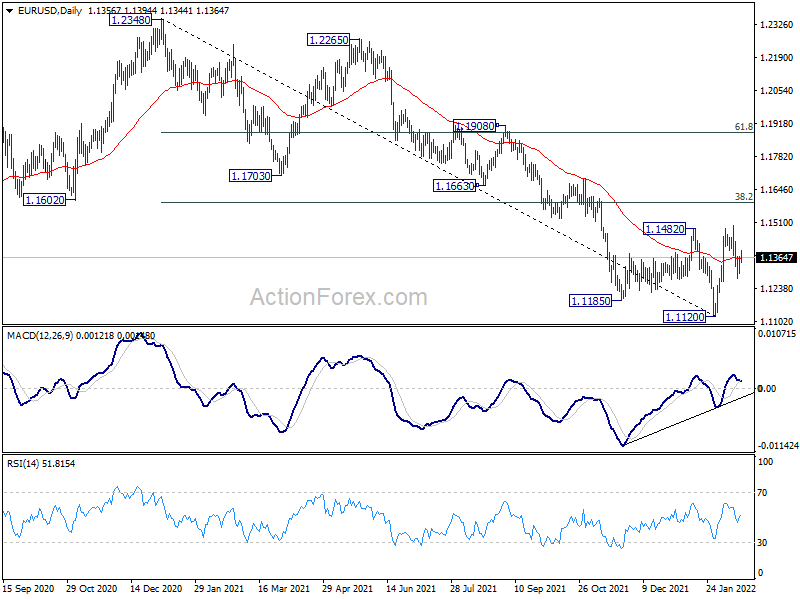
Intraday bias in EUR/USD remains neutral for the moment. With 1.1265 minor support intact, further rally will remain mildly in favor. On the upside break of 1.1482 will target 38.2% retracement of 1.2348 to 1.1120 at 1.1589 next. Sustained break there will argue that whole fall from 1.2348 has completed too and target 61.8% retracement at 1.1879. On the downside, however, break of 1.1265 support will dampen this bullish view and bring retest of 1.1120 low instead.
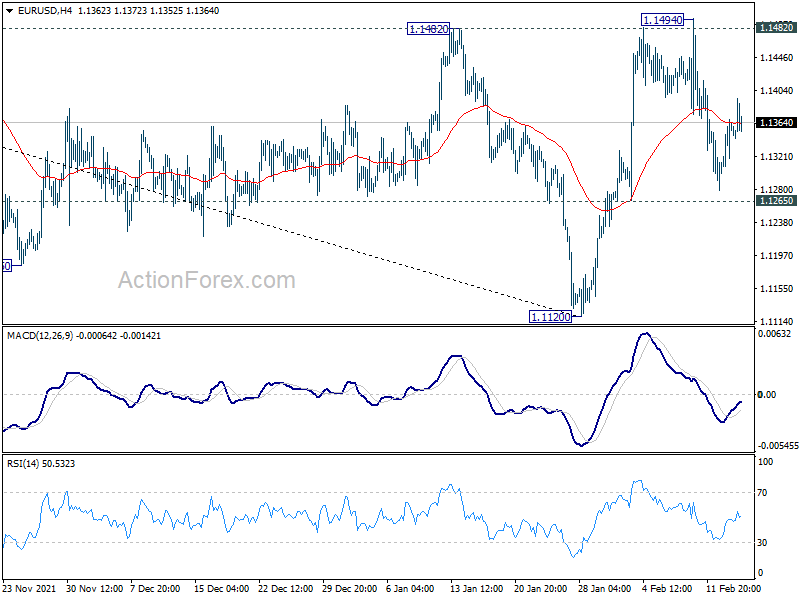
In the bigger picture, the decline from 1.2348 (2021 high) is seen as a leg inside the range pattern from 1.2555 (2018 high). Sustained trading above 55 week EMA (now at 1.1613) will argue that it has completed and stronger rise would be seen back towards top of the range between 1.2348 and 1.2555. However, firm break of 1.0635 (2020 low) will raise the chance of long term down trend resumption and target a retest on 1.0339 (2017 low) next.
GBP/USD Mid-Day Outlook
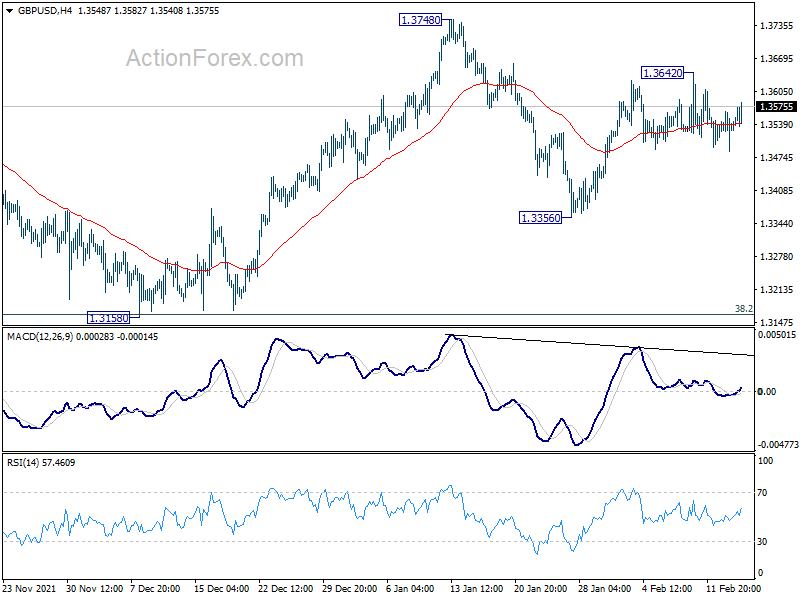
Daily Pivots: (S1) 1.3498; (P) 1.3532; (R1) 1.3578; More...
Intraday bias in GBP/USD remains neutral at this point. On the upside, break of 1.3642 will resume the rebound from 1.3356 to 1.3748 resistance. Firm break there will revive the bullish case that correction from 1.4248 has completed with three waves down to 1.3158. Further rally should then be seen to retest 1.4248 high. On the downside, however, break of 1.3356 will bring retest of 1.3158 low.
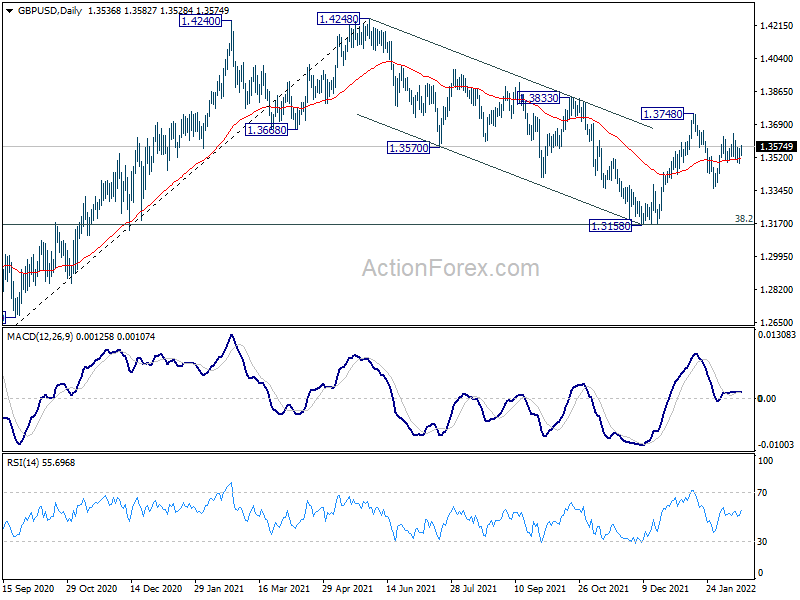
In the bigger picture, as long as 38.2% retracement of 1.1409 to 1.4248 at 1.3164 holds, up trend from 1.1409 (2020 low) is still in progress. On resumption, next target will be 38.2% retracement of 2.1161 to 1.1409 at 1.5134. Nevertheless sustained break of 1.3164 will argue that whole rise from 1.1409 has completed and bring deeper fall to 61.8% retracement at 1.2493.
USD/CHF Mid-Day Outlook
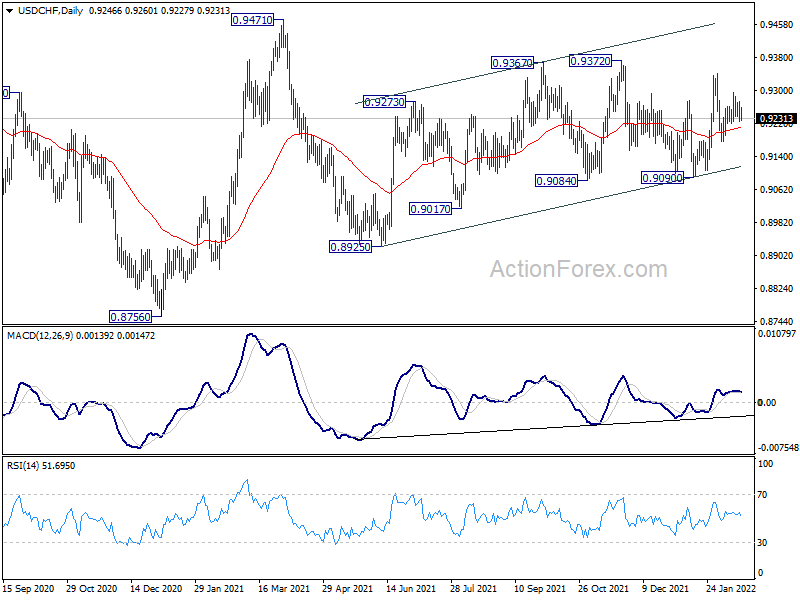
Daily Pivots: (S1) 0.9228; (P) 0.9251; (R1) 0.9275; More....
Intraday bias in USD/CHF remains neutral first and outlook is unchanged. Overall, further rally is mildly in favor as long as 0.9090 support holds. On the upside, break of 0.9372 will resume the choppy rally from 0.8925 to 0.9471 high. However, break of 0.9090 will turn bias back to the downside for 0.8925 support instead.
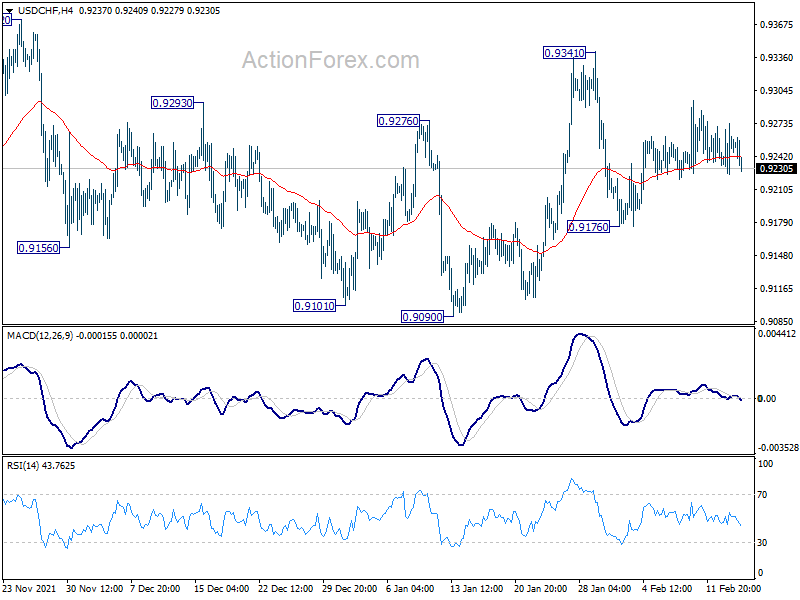
In the bigger picture, medium term outlook will be neutral at best as long as 0.9471 resistance holds. Larger down trend could still extend through 0.8756 (2021 low). However, firm break of 0.9471 will argue that the trend has already reversed and rebound the rally from 0.8756 with another impulsive move.
USD/JPY Mid-Day Outlook
Daily Pivots: (S1) 115.29; (P) 115.58; (R1) 115.89; More...
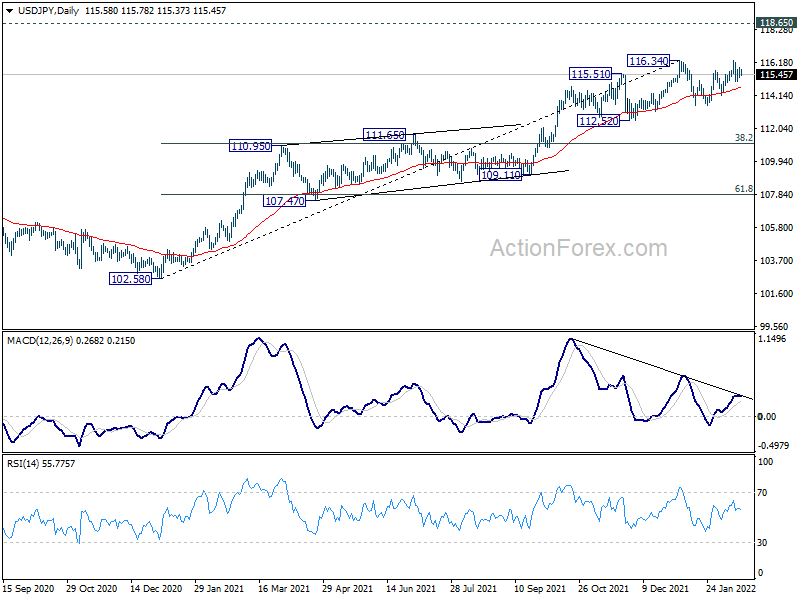
Range trading continues in USD/JPY and intraday bias remains neutral first. On the downside, below 115.00 will extend the fall from 116.33, as the third leg of the corrective pattern from 116.34. Deeper fall would be seen to 114.14 support, and then 113.46. On the upside, firm break of 116.34 will resume larger up trend from 102.58. Next target is 118.65 long term resistance.
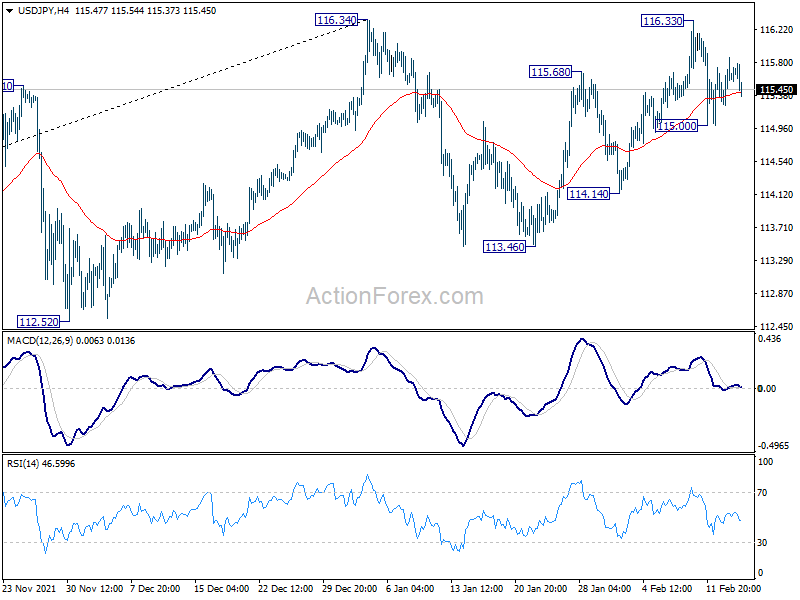
In the bigger picture, no change in the view that rise from 102.58 is the third leg of the up trend from 101.18 (2020 low). Such rally should target a test on 118.65 (2016 high). Sustained break there will pave the way to 120.85 (2015 high) and raise the chance of long term up trend resumption. This will remain the favored case as long as 55 week EMA (now at 111.21) holds.