

Sample Category Title
Gold Could Top $2,000
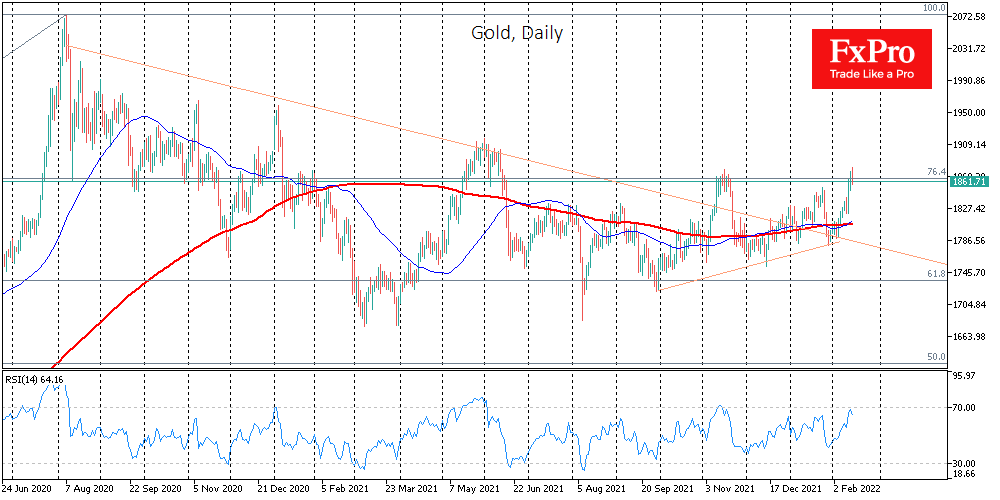
Since the end of last week, the price of gold has risen by more than 3%. With a high of $1879, it was temporarily rose to highs since last June.
Biden’s warning that Russia could invade Ukraine “at any moment” triggered a broad sell-off in Europe and several emerging markets and tangentially affected the US equity market. Recent events have brought back interest in assets that have benefited from decades of tension: gold has risen as insurance against currency destabilisation, and oil has risen on fears of a surge in demand and a shortage of supply.
Geopolitics give a shaky ground behind this growth, so investors should be wary of joining gold’s rise. It is impossible to predict whether the next move will escalate or de-escalate. Now, there are far more signs that the peak of tension is behind us, yet gold continues to gain today.
Likely, the fundamental demand for gold is now driven by a desire to preserve the purchasing value of capital amid inflation and ongoing price shocks across a range of commodities.
Also, tech analysis is now on the side of the bulls. A trend of higher local lows has formed since the end of September, with the last anchor point in late January. In addition, the 50-day moving average is again above the 200-day moving average, giving a bullish “golden cross” signal. This signal coincided with a solid upward momentum on Friday, strengthening the bullish signal. In January, the former retracement resistance line became support, indicating a break in the trend.
If gold stays above $1865 – the area of the November peaks- despite the reduction of the geopolitical premium – we can speak of a bullish momentum development. In this case, the nearest target of this impulse will be the area of $1900-1910.
In general, we can say that the long period of correction and sluggish dynamics of gold is over, and then its price can move from one local top to another, potentially exceeding $2000 by August.
Bitcoin is Behaving Like Gold
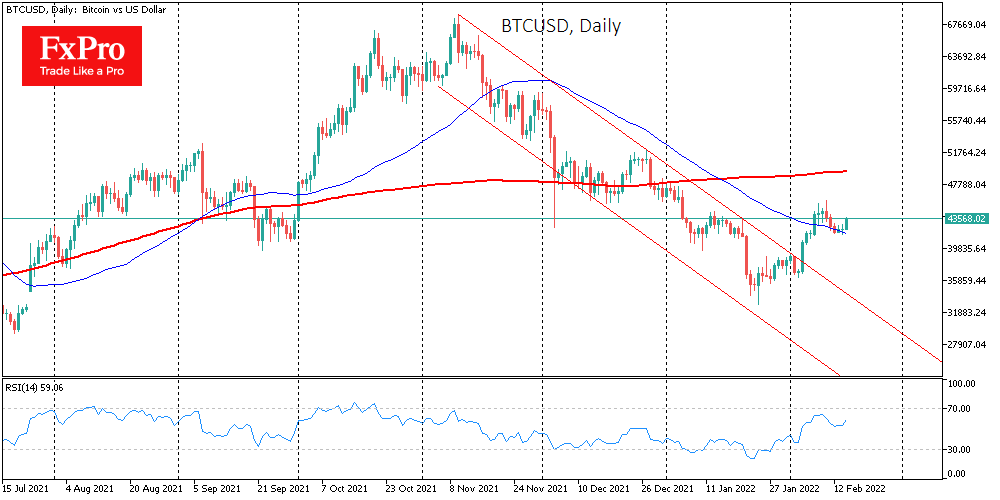
The first cryptocurrency returned to growth on Tuesday morning, adding 3.3% and rising to 43,500. Technically, BTCUSD held above the 50-day moving average and received support from buyers after another touch of this level. At the same time, however, this average is directed downwards, emphasizing the general downward trend.
Cryptocurrencies seem to be once again trying on the role of a safe-haven asset, becoming a little more like gold and a little less like stocks.
Although US stock indices were under pressure on Monday, they decided to stop the sharp decline at the end of last week. However, the high-tech Nasdaq ended the day unchanged. European stock indicators showed a noticeable drop under the influence of tensions around Ukraine. On the same background, gold shot up 3% to highs since June last year. It should be understood that in the event of a massive sale of shares, only short-term government bonds will be the protective asset of last resort.
Institutions invested $75 million in crypto funds last week, according to CoinShares. Over the past four weeks, net inflows to crypto funds amounted to $209 million.
The head of Uber said that the company would definitely start accepting cryptocurrencies in the future. A British crypto investor has announced the creation of a city for crypto investors in the Pacific and expects thousands of supporters from around the world to join soon.
The Ministry of Finance of the Russian Federation proposed to limit the investments of unqualified Russian investors in cryptocurrencies to 50 thousand rubles. The agency estimates tax revenues to the budget from the legalization of the cryptocurrency market at 10-15 billion rubles, and the main amount of payments will fall on the miners.
Overall, Bitcoin was down 0.2% on Monday, ending the day at around $42,200. Ethereum added 0.1%, while other leading altcoins from the top ten showed mixed dynamics: from a decrease of 1.6% (XRP) to a rise of 2 .2% (Terra).
The total capitalization of the crypto market, according to CoinGecko, grew by 0.5% per day, to $1.97 trillion. The BTC dominance index did not change during the day, remaining at the level of 40.7%. The Fear and Greed Index is up 2 points to 46 and is in a state of fear.
USD/JPY Mid-Day Outlook
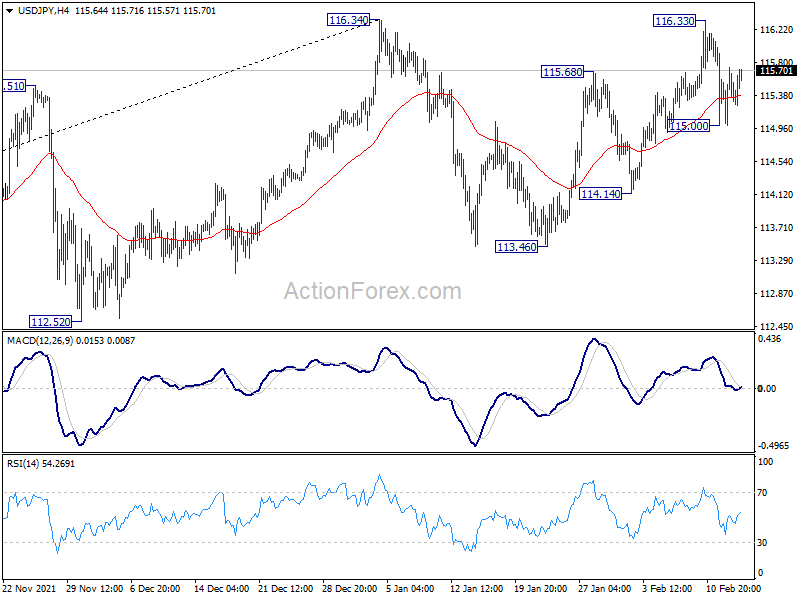
Daily Pivots: (S1) 115.12; (P) 115.43; (R1) 115.86; More...
Intraday bias in USD/JPY is turned neutral with today's recovery. On the downside, below 115.00 will extend the fall from 116.33, as the third leg of the corrective pattern from 116.34. Deeper fall would be seen to 114.14 support, and then 113.46. On the upside, firm break of 116.34 will resume larger up trend from 102.58. Next target is 118.65 long term resistance.
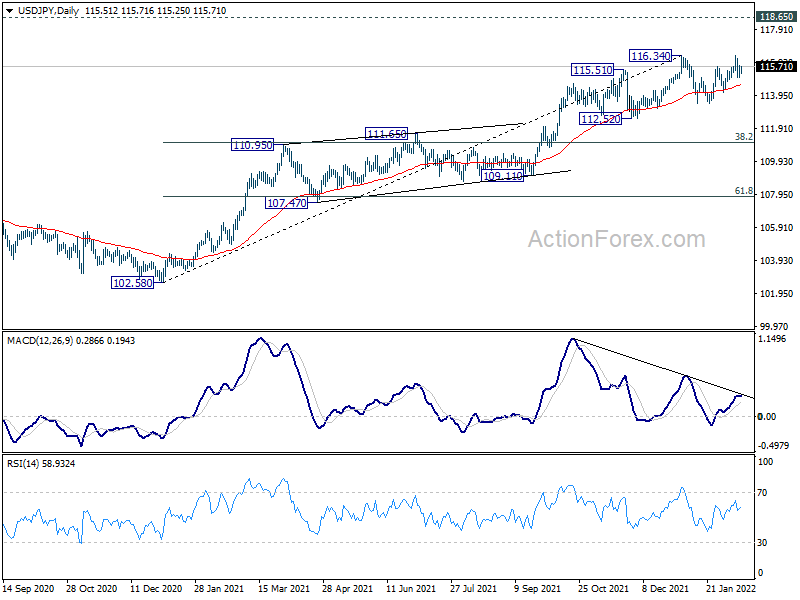
In the bigger picture, no change in the view that rise from 102.58 is the third leg of the up trend from 101.18 (2020 low). Such rally should target a test on 118.65 (2016 high). Sustained break there will pave the way to 120.85 (2015 high) and raise the chance of long term up trend resumption. This will remain the favored case as long as 55 week EMA (now at 111.21) holds.
USD/CHF Mid-Day Outlook
Daily Pivots: (S1) 0.9231; (P) 0.9252; (R1) 0.9265; More....
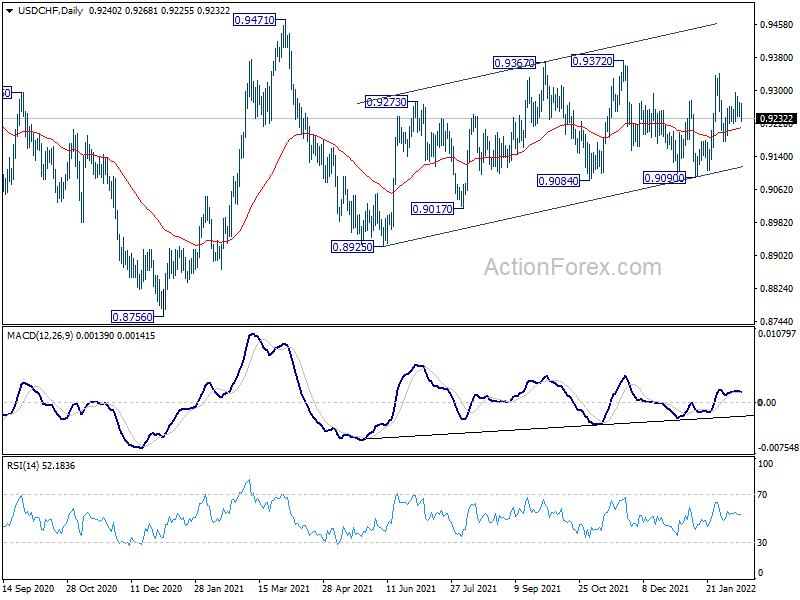
Range trading continues in USD/CHF and intraday bias remains neutral. Overall, further rally is mildly in favor as long as 0.9090 support holds. On the upside, break of 0.9372 will resume the choppy rally from 0.8925 to 0.9471 high. However, break of 0.9090 will turn bias back to the downside for 0.8925 support instead.
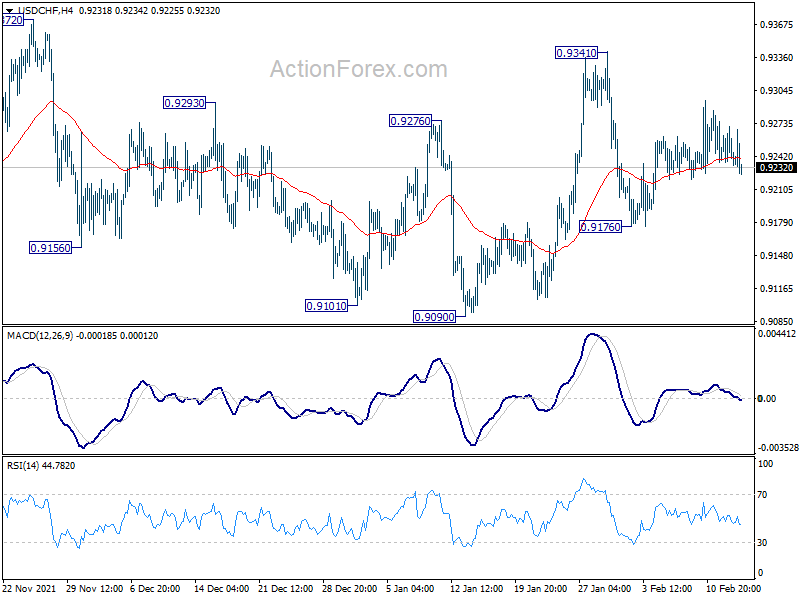
In the bigger picture, medium term outlook will be neutral at best as long as 0.9471 resistance holds. Larger down trend could still extend through 0.8756 (2021 low). However, firm break of 0.9471 will argue that the trend has already reversed and rebound the rally from 0.8756 with another impulsive move.
GBP/USD Mid-Day Outlook
Daily Pivots: (S1) 1.3495; (P) 1.3534; (R1) 1.3572; More...
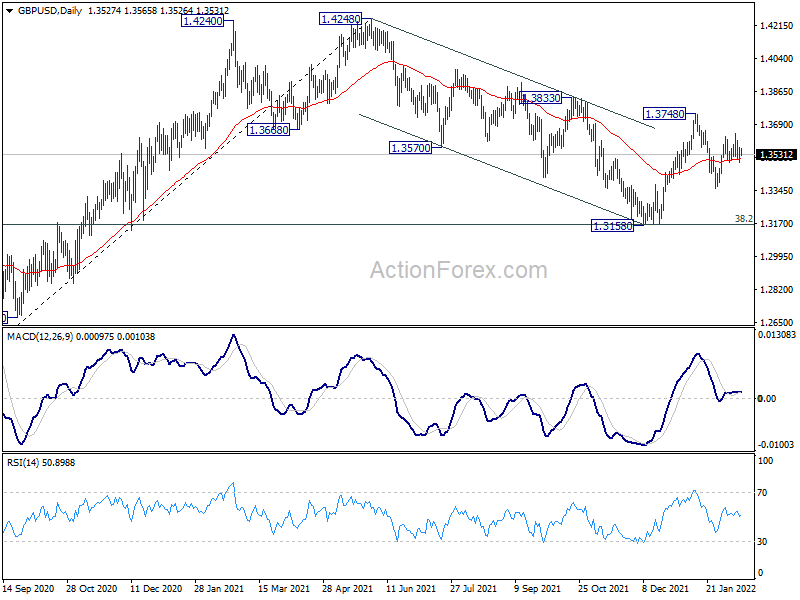
Intraday bias in GBP/USD remains neutral as sideway trading is still extending. On the upside, break of 1.3642 will resume the rebound to 1.3748 resistance. Firm break there will revive the bullish case that correction from 1.4248 has completed with three waves down to 1.3158. Further rally should then be seen to retest 1.4248 high. On the downside, however, break of 1.3356 will bring retest of 1.3158 low.
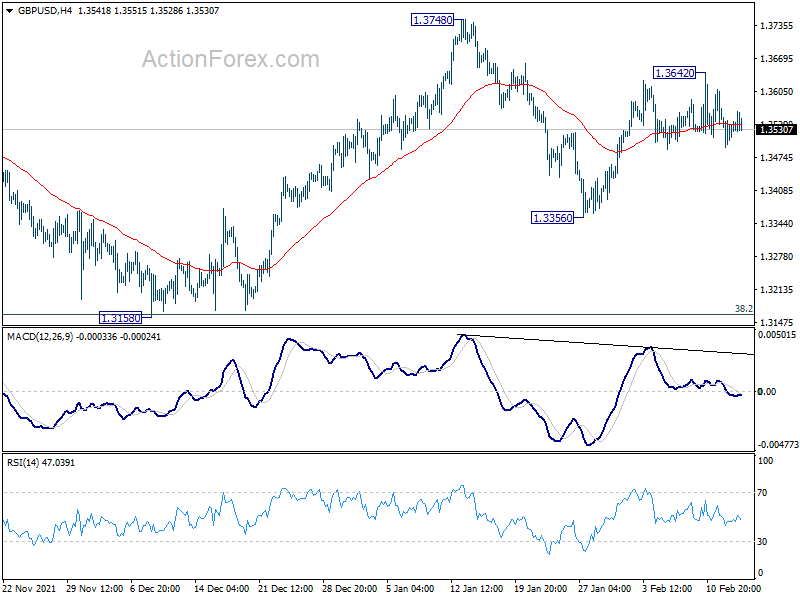
In the bigger picture, as long as 38.2% retracement of 1.1409 to 1.4248 at 1.3164 holds, up trend from 1.1409 (2020 low) is still in progress. On resumption, next target will be 38.2% retracement of 2.1161 to 1.1409 at 1.5134. Nevertheless sustained break of 1.3164 will argue that whole rise from 1.1409 has completed and bring deeper fall to 61.8% retracement at 1.2493.
EUR/USD Mid-Day Outlook
Daily Pivots: (S1) 1.1269; (P) 1.1319; (R1) 1.1358; More...
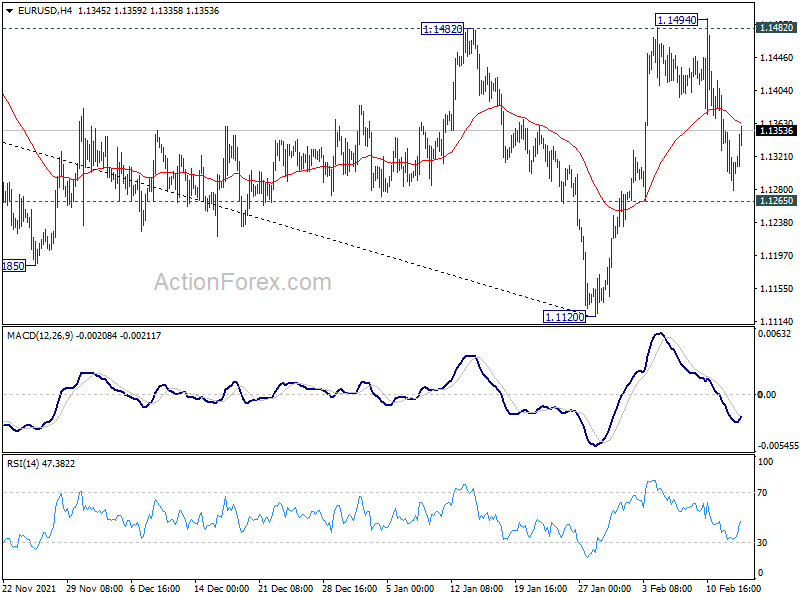
EUR/USD recovered ahead of 1.1265 minor support. Intraday bias remains neutral and further rise is still mildly in favor. On the upside break of 1.1482 will target 38.2% retracement of 1.2348 to 1.1120 at 1.1589 next. Sustained break there will argue that whole fall from 1.2348 has completed too and target 61.8% retracement at 1.1879. On the downside, however, break of 1.1265 support will dampen this bullish view and bring retest of 1.1120 low instead.
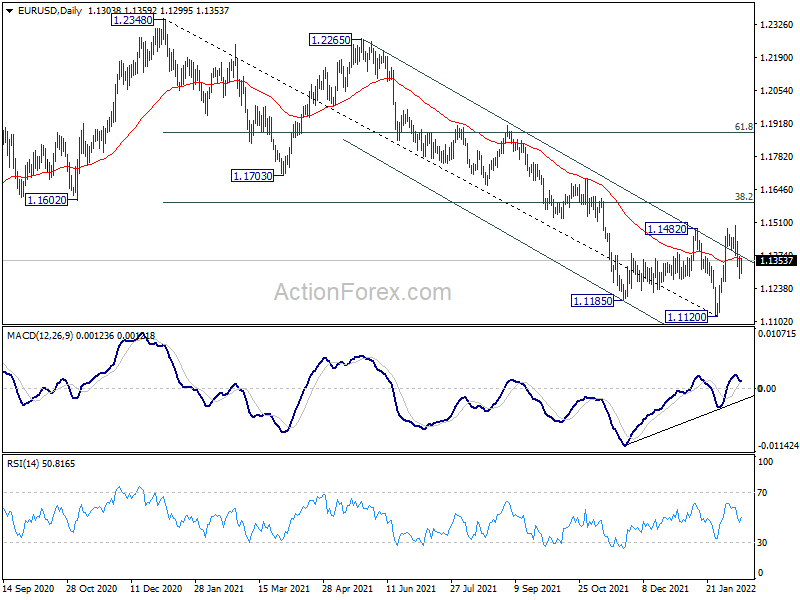
In the bigger picture, the decline from 1.2348 (2021 high) is seen as a leg inside the range pattern from 1.2555 (2018 high). Sustained trading above 55 week EMA (now at 1.1613) will argue that it has completed and stronger rise would be seen back towards top of the range between 1.2348 and 1.2555. However, firm break of 1.0635 (2020 low) will raise the chance of long term down trend resumption and target a retest on 1.0339 (2017 low) next.
Euro Rebounds, Sentiment Improved as Russia-Ukraine Tensions Ease
Overall market sentiment improved a lot after Russia said it pulled back some troops near the border of Ukraine. As worries of imminent war eased, Gold and oil price dip notably, while stocks rebound. Euro is staging a recovery, together with Aussie and Kiwi. On the other hand, Yen and Dollar are turning softer, together with Canadian. Sterling and Swiss Franc are mixed for the moment.
Technically, EUR/USD has somewhat defended 1.1265 minor support for now, maintaining mild near term bullish bias. There is prospect of extending the rebound to retest 1.1483 key near term resistance. Meanwhile, EUR/JPY could also be heading back to 133.13/133.44 resistance zone. But is should be noted level these levels would also be broken if the Russia/Ukraine situation is totally cleared.
In Europe, at the time of writing, FTSE is up 0.79%. DAX is up 1.61%. CAC is up 1.29%. Germany 10-year JGB yield is up 0.040 at 0.322. Earlier in Asia, Nikkei dropped -0.79%. Hong Kong HSI dropped -0.82%. China Shanghai SSE rose 0.50%. Singapore Strait Times rose 0.01%. Japan 10-year JGB yield dropped -0.0019 to 0.216.
US PPI rose 1% mom, 9.7% yoy in Jan
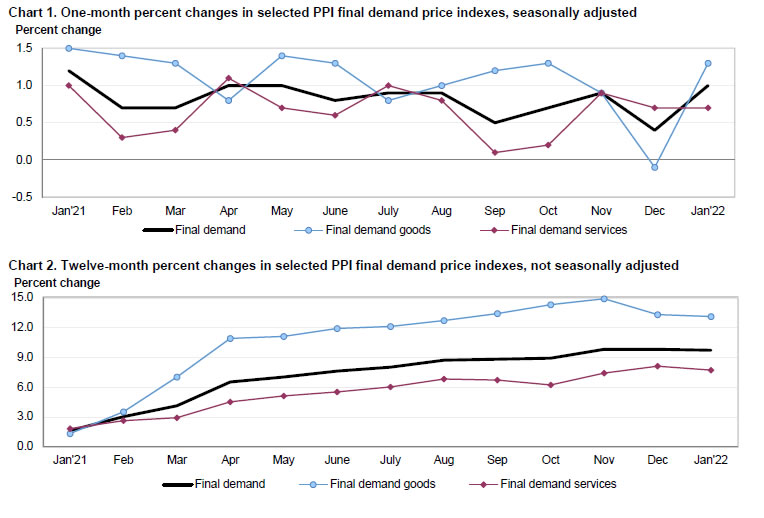
US PPI for final demand rose 1.0% mom in January, above expectation of 0.6% mom. PPI for final demand services rose 0.7% mom. PPI for final demand goods rose 1.3% mom. For the 12-month period, PPI was unchanged at 9.7% yoy, above expectation of 9.2% yoy.
Excluding foods, energy and trade services, PPI rose 0.9% mom, largest since January 2021. For the 12-monht period, PPI less foods, energy, and trade services rose 6.9% yoy.
Empire state manufacturing index rose for m-0.7 to 3.1 in February, below expectation of 10.0.
Germany ZEW rose to 54.3, outlook continues to improve despite growing economic and political uncertainties
Germany ZEW Economic Sentiment rose from 51.7 to 54.3 in February, above expectation of 53.5. Current Situation index rose from -10.2 to -8.1, worse than expectation of -7.0.
Eurozone ZEW Economic Sentiment dropped from 49.4 to 48.6, below expectation of 52.3. Current Situation Index rose 6.8 to 0.6. Inflation expectations for Eurozone rose 3.6 pts to -35.1. 53.2% of expects expect inflation rate to decline in the next six months.
"The economic outlook for Germany continues to improve in February despite growing economic and political uncertainties. Financial market experts expect an easing of pandemic-related restrictions and an economic recovery in the first half of 2022. They still expect inflation to decline, albeit at a slower pace and from a higher level than in previous months. Consequently, more than 50 per cent of the experts now predict that short-term interest rates in the euro area will rise in the next six months," comments ZEW President Professor Achim Wambach on current expectations.
Eurozone exports of goods to the rest of the world grew 14.1% yoy to EUR 218.7B in December. Imports rose 36.7% yoy to EUR 223.3B. Trade deficit came in at EUR -4.6B. Intra-Eurozone trade rose 27.8% yoy to EUR 191.9B.
In seasonally adjusted terms, exports dropped -0.6% mom while imports rose EUR 3.1% mom. Trade deficit was at EUR -9.7B, larger than expectation of EUR -2.5B.
For whole of 2021, exports rose 14.1% to EUR 2434.4B. Imports rose 21.4% to EUR 2305.9B. Trade surplus came in at EUR 128.4B, down from EUR 233.9B in 2020.
Eurozone GDP grew 0.3% qoq, 4.6% yoy in Q4. Annual growth 2021 was at 5.2%. Employment rose 0.5% qoq.
UK payrolled employees rose 108k in Jan, unemployment rate unchanged at 4.1% in Dec
UK payrolled employees rose rose 0.4% mom, or 108k, to 29.5m in January. Over the year, payrolled employees grew 4.8% yoy, or 1.35m. Claimant count dropped -31.9k.
In the three months to December, unemployment rate was unchanged at 4.1%, matched expectations. That's still 0.1% higher than before the pandemic, but down -0.2% from the previous three-month period. Employment rate rose 0.1% to 75.5%, comparing to the previous 3-month period.
Average earnings including bonus rose 4.3% 3moy, much better than expectation of 3.9%. Average earnings excluding bonus rose 3.7% 3moy, above better than expectation of 3.6%.
BoJ Kuroda: Baseline for economy and prices to gradually pick up
BoJ Governor Haruhiko Kuroda reiterated that the baseline forecast is for Japan's economy and prices to gradually pick up as rising real household income underpins consumption. Nevertheless, the "economic and price conditions warrant maintaining our easy monetary policy."
He acknowledged that the market operation of an offer to buy unlimited amount of bonds on Monday successfully pushed 10-year JGB yield from near 0.25% to 0.22%. But he emphasized it's a "last resort" and a "powerful means not used explicitly by other central banks." "We don't expect to conduct such operation frequently. We'll do this as needed," he added.
Japan GDP grew 1.3% qoq in Q4, remains slightly be pre-pandemic level
Japan GDP grew 1.3% qoq in Q4, slightly below expectation of 1.4% qoq. In annualized term, GDP grew 5.4%, below expectation of 5.8%.
Private consumption grew 2.7% qoq, accounting for much of the growth. Capital expenditure rose 0.4% qoq. External demand rose 0.2% qoq.
For 2021 as a whole, GDP grew 1.7%, marking the first expansion in three years. The seasonally-adjusted real GDP size at JPY 541T remains slightly below pre-pandemic level of late 2019.
RBA minutes: Prepared to be patient on interest rate
In the minutes of February 1 meeting, RBA reiterated that it "will not increase the cash rate until actual inflation is sustainably within the 2 to 3 per cent target band." It's "too early to conclude that it was sustainably within the target band". There were uncertainties about "how persistent the pick-up in inflation would be as supply-side problems were resolved" and "wages growth also remained modest". The central bank is "prepared to be patient".
Omicron outbreak "had affected the economy, but had not derailed the recovery". The economy was "resilient" and was expected to "pick up as case numbers trended lower". Job market had "recovered strongly" with central forecasts seeing unemployment to fall to "levels not seen since early 1970s". Wages growth was expected to pick-up, buy only gradually.
Inflation had "picked up more quickly than the Bank had expected", but was still "lower than in many other countries". "Some moderation" in inflation was expected as "supply problems were resolved." Stronger growth in labour costs was expected to become the "more important driver of inflation". The central forecast was for underlying inflation to be within the target band over both 2022 and 2023.
A decision about reinvestment of asset purchases would be made at the May meeting, with the key considerations being the "state of the economy and the outlook for inflation and unemployment."
EUR/USD Mid-Day Outlook
Daily Pivots: (S1) 1.1269; (P) 1.1319; (R1) 1.1358; More...
EUR/USD recovered ahead of 1.1265 minor support. Intraday bias remains neutral and further rise is still mildly in favor. On the upside break of 1.1482 will target 38.2% retracement of 1.2348 to 1.1120 at 1.1589 next. Sustained break there will argue that whole fall from 1.2348 has completed too and target 61.8% retracement at 1.1879. On the downside, however, break of 1.1265 support will dampen this bullish view and bring retest of 1.1120 low instead.
In the bigger picture, the decline from 1.2348 (2021 high) is seen as a leg inside the range pattern from 1.2555 (2018 high). Sustained trading above 55 week EMA (now at 1.1613) will argue that it has completed and stronger rise would be seen back towards top of the range between 1.2348 and 1.2555. However, firm break of 1.0635 (2020 low) will raise the chance of long term down trend resumption and target a retest on 1.0339 (2017 low) next.
Economic Indicators Update
| GMT | Ccy | Events | Actual | Forecast | Previous | Revised |
|---|---|---|---|---|---|---|
| 23:50 | JPY | GDP Q/Q Q4 P | 1.30% | 1.40% | -0.90% | |
| 23:50 | JPY | GDP Deflator Y/Y Q4 P | -1.30% | -1.20% | -1.20% | |
| 00:30 | AUD | RBA Minutes | ||||
| 04:30 | JPY | Industrial Production M/M Dec F | -1.00% | -1.00% | -1.00% | |
| 07:00 | GBP | Claimant Count Change Jan | -31.9K | -43.3K | -51.6K | |
| 07:00 | GBP | ILO Unemployment Rate (3M) Dec | 4.10% | 4.10% | 4.10% | |
| 07:00 | GBP | Average Earnings Excluding Bonus 3M/Y Dec | 3.70% | 3.60% | 3.80% | |
| 07:00 | GBP | Average Earnings Including Bonus 3M/Y Dec | 4.30% | 3.90% | 4.20% | |
| 10:00 | EUR | Eurozone Trade Balance (EUR) Dec | -9.7B | -2.5B | -1.3B | -1.8B |
| 10:00 | EUR | Eurozone GDP Q/Q Q4 P | 0.30% | 0.30% | 0.30% | |
| 10:00 | EUR | Eurozone Employment Change Q/Q Q4 P | 0.50% | 0.40% | 0.90% | |
| 10:00 | EUR | Germany ZEW Economic Sentiment Feb | 54.3 | 53.5 | 51.7 | |
| 10:00 | EUR | Germany ZEW Current Situation Feb | -8.1 | -7 | -10.2 | |
| 10:00 | EUR | Eurozone ZEW Economic Sentiment Feb | 48.6 | 52.3 | 49.4 | |
| 13:15 | CAD | Housing Starts Jan | 230.8K | 270.0K | 236.1K | 238.4K |
| 13:30 | USD | Empire State Manufacturing Index Feb | 3.1 | 10 | -0.7 | |
| 13:30 | USD | PPI M/M Jan | 1.00% | 0.60% | 0.20% | 0.40% |
| 13:30 | USD | PPI Y/Y Jan | 9.70% | 9.20% | 9.70% | 9.80% |
| 13:30 | USD | PPI Core M/M Jan | 0.80% | 0.50% | 0.50% | 0.60% |
| 13:30 | USD | PPI Core Y/Y Jan | 8.30% | 8.10% | 8.30% |
US PPI rose 1% mom, 9.7% yoy in Jan
US PPI for final demand rose 1.0% mom in January, above expectation of 0.6% mom. PPI for final demand services rose 0.7% mom. PPI for final demand goods rose 1.3% mom. For the 12-month period, PPI was unchanged at 9.7% yoy, above expectation of 9.2% yoy.
Excluding foods, energy and trade services, PPI rose 0.9% mom, largest since January 2021. For the 12-monht period, PPI less foods, energy, and trade services rose 6.9% yoy.
A Big Step in the Right Direction
Risk appetite is much improved on Tuesday following reports that Russia is pulling back some troops, a significant de-escalation that makes the prospect of an invasion this week much less likely.
The Kremlin maintains that it never intended to invade Ukraine and the return of some troops to their regular bases following military exercises is proceeding as was always planned. While risks remain elevated, this looks like a big step in the right direction, and investors, like everyone else, are breathing a huge sigh of relief.
European stocks are up more than 1% and US futures are eyeing a similar open, while oil and gold are paring gains from the last couple of sessions. The mood will no doubt continue to lift if troops continue to return to bases and leaders stop talking up the prospect of an imminent invasion, which appears to have brought amusement to some in recent days.
With diplomatic efforts set to continue, starting with German Chancellor Olaf Scholz' visit to the Kremlin today, we could see sentiment continue to improve in the coming days. That could allow stocks to make up more lost ground as Ukraine developments have compounded fears around inflation and interest rates.
Pressure growing on ECB and BoE
Data from across Europe this morning has shown the labour market remained healthy into the new year despite the omicron setback. The euro area has seen employment exceed its pre-pandemic level while the economy grew by 0.3% in the final three months of the year. The resilience displayed through the latest wave highlights how tight the labour market is and will continue to pile pressure on the ECB as it tackles unusually high inflation.
The Bank of England is all too aware of those pressures, having already raised interest rates at each of the last two meetings and a repeat is expected in the coming months as well. Wages are continuing to rise as Christmas bonus' appeared to exceed expectations, which contributed to earnings rising 4.3% in the three months to December, a faster rate than a month earlier and far higher than the 3.8% consensus. The pressure is not easing up on central banks, although inflation is expected to peak over the next couple of months.
$100 oil delayed as Ukraine tensions ease
Oil prices have pulled back from yesterday's highs and are off more than 3% on the day as invasion fears recede. Brent and WTI had been on the march to $100 but the removal of troops has reduced the likelihood of conflict and, in turn, the risk premium. We could quickly see that change over the coming days if the situation deteriorates but if not, we could see a further decline in the price.
There's been so much talk of triple-figure crude and the threat of war in Ukraine clearly accelerated that. We could still see oil hit $100 even without an invasion but it will take a little longer. The market is still extremely tight, which is why we're seeing the prospect of an invasion drive up prices so much. In the absence of some unilateral action from Saudi Arabia, or a nuclear deal between the US and Iran, it may still not be too far away.
Gold appeal wanes on Ukraine de-escalation
Soaring demand for gold in recent days has cooled after Russia confirmed the planned withdrawal of some troops; the first sign of de-escalation on the Ukrainian border amid warnings of an invasion. The yellow metal was boosted by a combination of its safe-haven reputation and its inflation hedge qualities as oil and gas prices spiked.
It peaked earlier today around $1,880 but now finds itself testing $1,850, a level that prior to the invasion warnings on Friday had been a notable level of resistance. Should gold erase its invasion premium, we could see it move back towards $1,830 where it had stabilised around the middle of last week.
Bitcoin looking to build on positive momentum
Bitcoin remained quite stable throughout the uncertainty of recent days. It had already started to pull back from $45,500 as profit-taking kicked in but the downside since Friday has been fairly mild by its own standards. It's certainly benefiting from improved sentiment today though, rallying almost 5% and suddenly last week's highs look quite vulnerable. A break above here would put it back into healthy territory and we could see it gather momentum from there.
Markets Continue to Trade Geopolitics
- Conflicting Ukraine headlines send stocks on a rollercoaster
- Gold and oil push higher amid hedging demand, but cool off
- Dollar takes a step back ahead of US producer price data
Lost in translation
Geopolitics remain in the driver’s seat for global markets, and it’s been a wild ride. A series of conflicting reports around Ukraine sparked all kinds of volatility in stocks yesterday as trading algorithms were apparently overloaded with headlines they couldn’t process.
It all started with the Russian foreign minister, who received Vladimir Putin’s blessing to continue negotiations for a diplomatic solution. That sparked a rally in risk assets but the optimism soon evaporated following reports that Russian troops were moving to attack positions, and after the Ukrainian president warned the attack would start on Wednesday.
This comment was later walked back by Ukrainian authorities as mere sarcasm by the president, who was apparently making fun of foreign officials predicting specific dates for the attack. Once traders realized it was just irony, the risk tone improved once again and shares on Wall Street bounced back to close the session with minor losses.
Market implications
Overall, investors seem to be in a ‘shoot first, ask questions later’ mode. Although war fears generally have a short-lived impact on equity markets, a Ukrainian invasion could be a special case given the spillover effects into energy prices at a time when central banks prepare to wage their own war against inflation.
Hence, an invasion could have far-reaching consequences for the global economy even if it doesn’t lead to a recession. The good news is that if war is ultimately avoided, there could be a powerful relief rally in riskier trades as both the geopolitical and inflationary risk premiums are priced out.
We are already seeing some signs of that today, with equity markets and the euro cheering some reports that Russian troops are returning to their bases after drills. With the fog of war clearing a little, gold and oil prices are on the retreat, surrendering the gains they recorded yesterday as demand for portfolio protection and energy stockpiling went into overdrive.
This crisis has been a perfect storm for gold, boosting the metal directly as a geopolitical hedge and indirectly by halting the relentless rise in yields, as traders piled back into the safety of bonds. The flip side of this argument is that bullion is now highly vulnerable to a de-escalation in tensions.
FX market breathes sigh of relief
A cautious sense of relief is coursing through the FX market on Tuesday, with the currencies that benefited from geopolitical nerves like the dollar and yen coming under pressure, while the battered euro recovers some ground.
Investors are grappling with how aggressively the Fed will raise interest rates to hammer down inflation, and the verdict will likely decide the path for the entire FX arena. Money markets are currently pricing in six and a half rate increases for the year and speculation for a 50 basis points move in March is running rampant.
However, Fed officials seem split on the matter. Some aren’t convinced a 50 basis points move is needed and worry it would spark unnecessary turmoil in the markets. This suggests the decision could ultimately depend on the final pieces of data heading into the March meeting, which elevates the importance of the producer prices numbers coming up today.