Sample Category Title
EUR/USD Outlook: Fresh Advance on Renewed Risk Appetite Needs to Clear Key Obstacles at 1.1350
The steep fall in past two days is pausing as fresh bulls emerged on optimistic news from Ukraine that revived risk sentiment and lifted the Euro in European session on Tuesday.
Today’s economic data from the EU came mainly in line expectations, adding to positive tone.
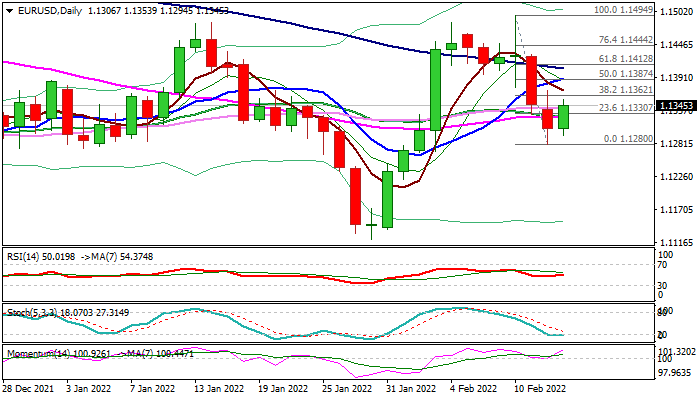
Fresh bulls pressure key double-Fibo barriers at 1.1350 zone (broken 38.2% of 1.1121/1.1494 upleg and 38.2% of 1.1494/1.1280 pullback), with sustained break here needed to generate bullish signal and open way for further advance.
Daily studies are gaining bullish momentum and RSI is heading north, while daily cloud is thinning and next week’s twist also expected to attract.
Clear break of 1.1350 zone would expose next pivotal barriers at 1.1387 and 1.1412 (Fibo 50% and 61.8% of 1.1494/1.1280 respectively), violation of which would confirm a higher low at 1.1280 (Feb 14).
Caution on failure to clear 1.1350 pivot tat would keep the downside vulnerable, but return and close below pivotal 1.1300 zone is needed to bring bears fully in play.
Situation over Ukraine is expected to dominate and remain a key market driver, with further improvement to keep riskier assets supported.
Res: 1.1353; 1.1362; 1.1387; 1.1412.
Sup: 1.1300; 1.1280; 1.1264; 1.1221.
Pound Edges Higher as Wages Jump
Wage growth a warning sign for BoE
The UK employment report showed a slight rise in wage growth, raising fears of a wage-inflation spiral, as the country struggles with inflation at its highest level in 30 years.
Wage growth rose to 4.3% y/y in the three-month period to November, up from 4.2% beforehand. The upshot is that even though wage growth is rising, real wages are actually falling because inflation is running at a much higher clip than wage growth. The uptick, although not large, will put further pressure on the Bank of England to raise rates at the March meeting, which would mark back-to-back hikes.
Will the BOE show an aggressive side in the face of red-hot inflation? ING is projecting six rate hikes from the BoE this year. Similar to the Federal Reserve, the BoE has a credibility problem in as far as its handling of the inflation issue. In the case of the BoE, there is even a bigger disconnect with the market, after the central bank raised and then maintained rates late last year, both times catching the markets by surprise. Investors will be looking for some clarity from the BoE ahead of the March meeting and any comments from BoE members will be closely scrutinized.
The crisis on the Ukraine/Russia border remains a powder keg that could explode at any time. There are still hopes that a diplomatic solution can be reached and there have been reports of some Russian troops withdrawing from the border. The solution to the crisis is firmly in the hands of Russian President Vladimir Putin. The West has no intention of defending Ukraine militarily, so the key question is whether the threat of sanctions is enough to dissuade Putin from starting a war in Europe, which could have severe ramifications.
GBP/USD Technical Analysis
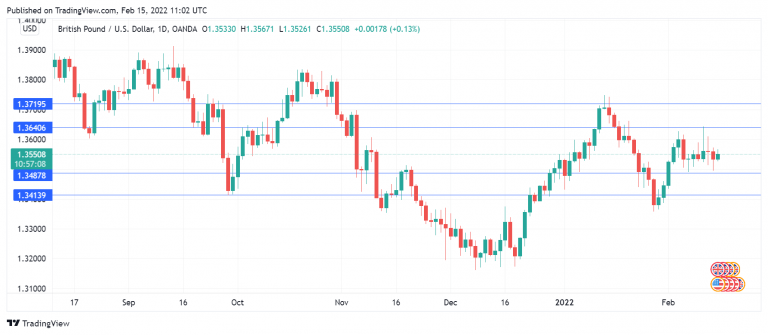
- There is resistance at 1.3640. and 1.3719
- There is support at 1.3487 and 1.3413
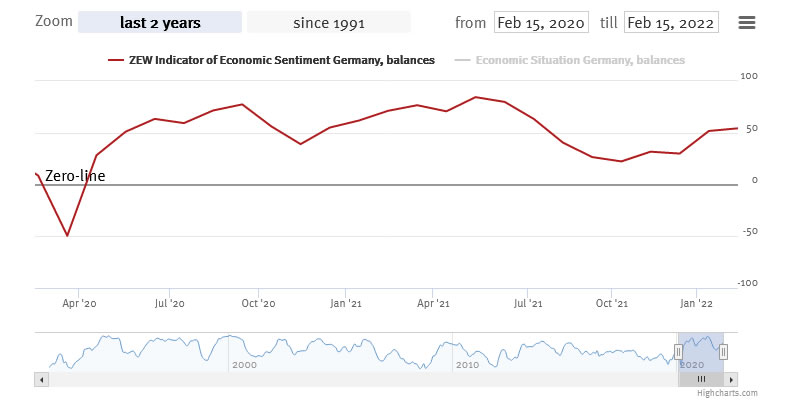
Germany ZEW rose to 54.3, outlook continues to improve despite growing economic and political uncertainties
Germany ZEW Economic Sentiment rose from 51.7 to 54.3 in February, above expectation of 53.5. Current Situation index rose from -10.2 to -8.1, worse than expectation of -7.0.
Eurozone ZEW Economic Sentiment dropped from 49.4 to 48.6, below expectation of 52.3. Current Situation Index rose 6.8 to 0.6. Inflation expectations for Eurozone rose 3.6 pts to -35.1. 53.2% of expects expect inflation rate to decline in the next six months.
"The economic outlook for Germany continues to improve in February despite growing economic and political uncertainties. Financial market experts expect an easing of pandemic-related restrictions and an economic recovery in the first half of 2022. They still expect inflation to decline, albeit at a slower pace and from a higher level than in previous months. Consequently, more than 50 per cent of the experts now predict that short-term interest rates in the euro area will rise in the next six months," comments ZEW President Professor Achim Wambach on current expectations.
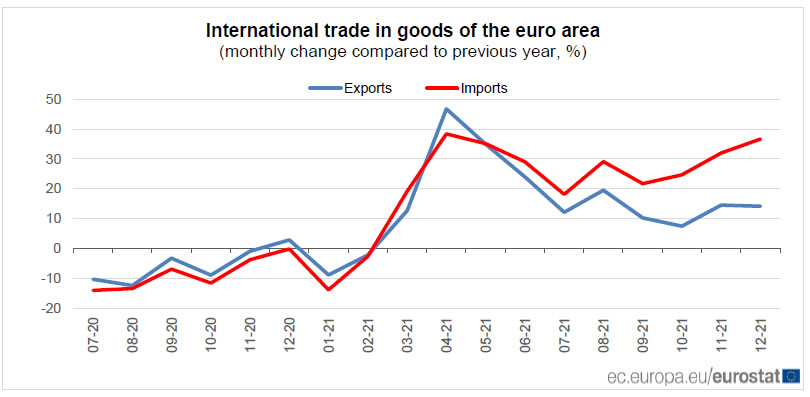
Eurozone exports rose 14.1% yoy in Dec, imports rose 36.7% yoy
Eurozone exports of goods to the rest of the world grew 14.1% yoy to EUR 218.7B in December. Imports rose 36.7% yoy to EUR 223.3B. Trade deficit came in at EUR -4.6B. Intra-Eurozone trade rose 27.8% yoy to EUR 191.9B.
In seasonally adjusted terms, exports dropped -0.6% mom while imports rose EUR 3.1% mom. Trade deficit was at EUR -9.7B, larger than expectation of EUR -2.5B.
For whole of 2021, exports rose 14.1% to EUR 2434.4B. Imports rose 21.4% to EUR 2305.9B. Trade surplus came in at EUR 128.4B, down from EUR 233.9B in 2020.
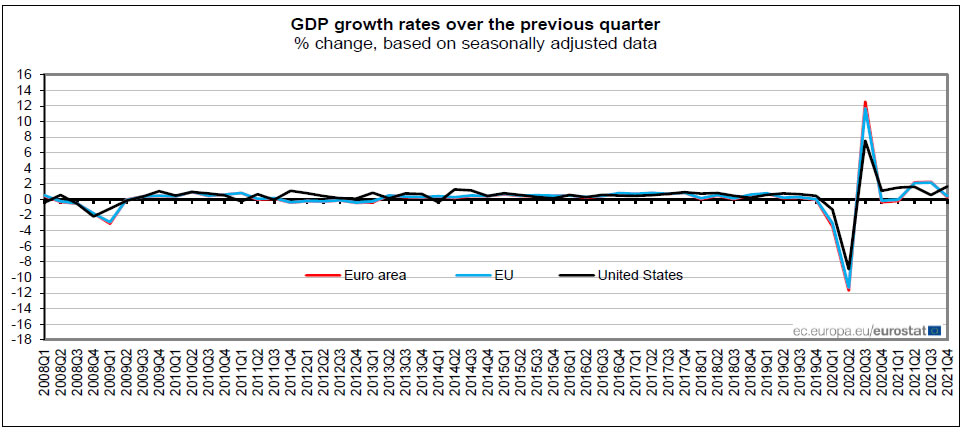
Eurozone GDP grew 0.3% qoq in Q4, EU up 0.4% qoq
Eurozone GDP grew 0.3% qoq, 4.6% yoy in Q4. Annual growth 2021 was at 5.2%. Employment rose 0.5% qoq.
EU GDP grew 0.4% qoq, 4.8% yoy. Annual growth 2021 was at 5.2%. Employment grew 0.5% qoq.
GBPUSD Displays Neutral Tone Tiptoeing on 100-MA
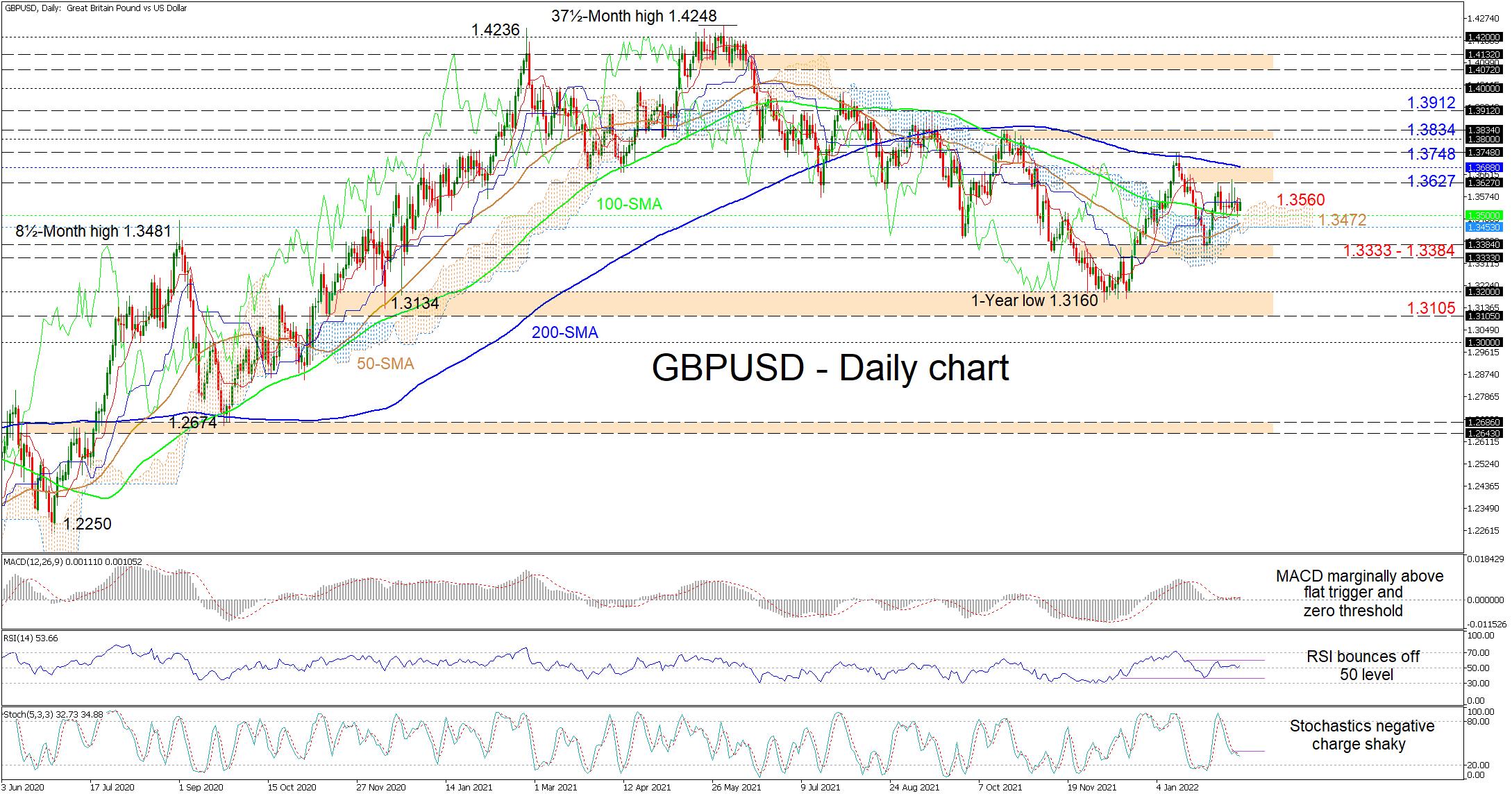
GBPUSD is edging sideways slightly above the 100-day simple moving average (SMA) as directional impetus has disappeared. The SMAs are converging, largely endorsing a more neutral trend, with the gliding 200-day SMA nourishing bearish pressures, while the rising 50-day SMA is championing positive price moves.
Currently, the Ichimoku lines are not reflecting dominant directional forces, while the short-term oscillators are transmitting mixed and weak messages in momentum. The MACD is holding a tad above its zero and trigger lines, while the RSI has marginally improved from its 50 neutral threshold. Furthermore, it is uncertain how long the stochastic oscillator will sustain its minor negative charge.
In the positive scenario, a step over the Ichimoku lines could bring about the test of a resistance zone from the 1.3627 level until the 200-day SMA at 1.3688, before buyers aim for the January 13 peak of 1.3748. Additional progress may then tackle the neighbouring 1.3800-1.3834 barricade, which is linked to the October 2021 highs. Successfully conquering these obstacles could reinforce the bullish outlook with the price turning to its next possible target, the September 2021 high of 1.3912.
Alternatively, a fortified area of support from the 100-day SMA at 1.3500 until the Ichimoku cloud’s floor of 1.3453 may act promptly to deter sellers from resuscitating a negative price mood. However, if the price successfully navigates lower, the 1.3333-1.3384 support border may be challenged. If intensified selling overwhelms this base, it could boost the pair’s bearish tone, magnifying the significance of the 1.3105-1.3200 support foundation that has held since November 2020.
Summarizing, GBPUSD is marginally above the cloud and is exhibiting a neutral bearing squeezed between the SMAs. A dive below the 1.3333-1.3384 support could juice up negative pressures, while a price climb extending beyond the 200-day SMA at 1.3688 and the 1.3748 high may reinstate optimism in the pair.
Equities Stage Relief Bounce on Russia
… but inflation and central bank tightening remain the key risk.
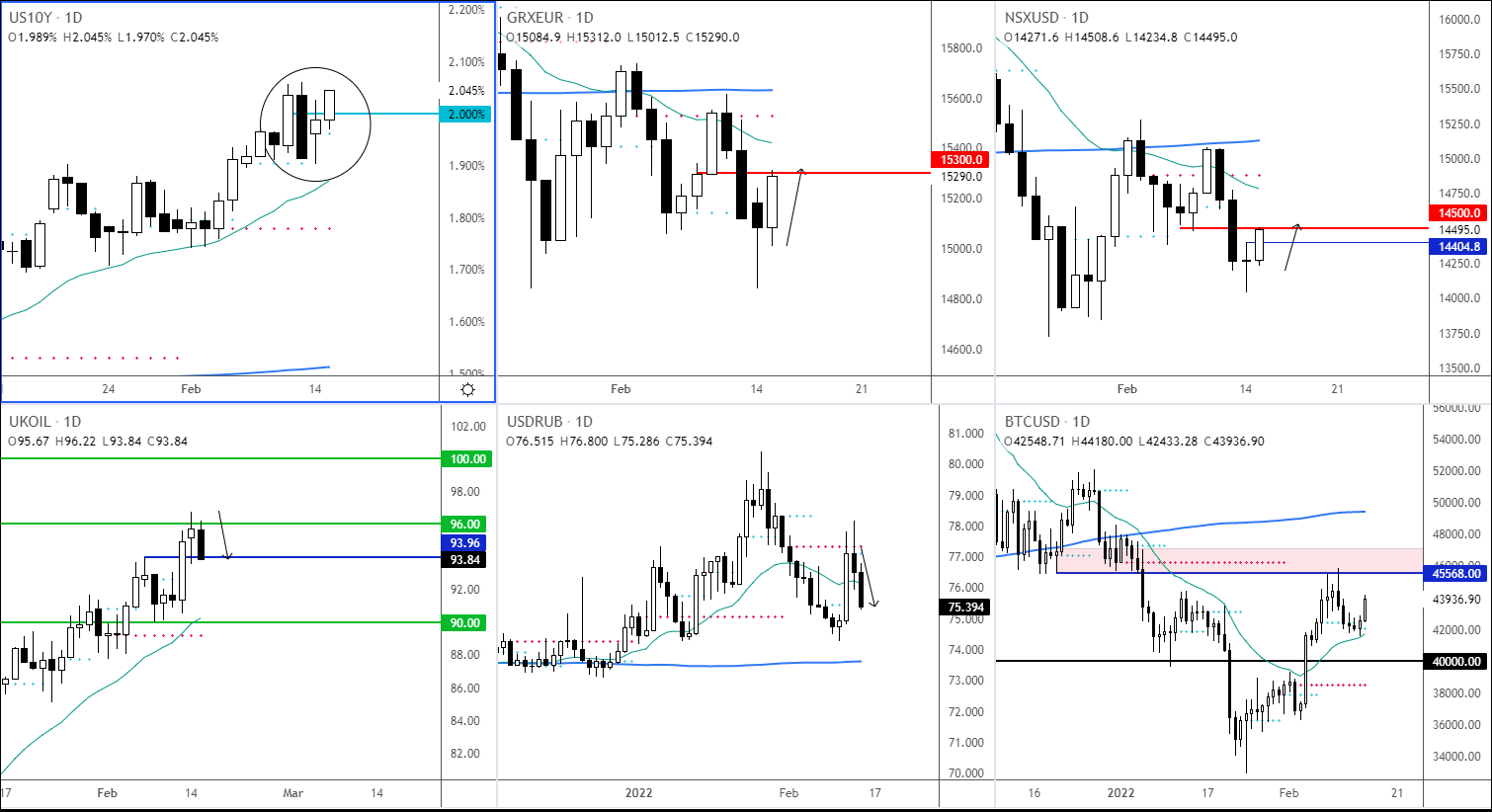
The big news this morning came from Russia, which sent stocks and US futures sharply higher, while Brent crude oil dipped back to $94 after rising to above $96 earlier. The turnaround was triggered by news some Russian troops positioned on the border with Ukraine were returning to their bases after completing drills.
Source: ThinkMarkets and TradingView.com
While this will certainly help reduce tensions in the region, it doesn't necessarily mean Russia won't invade Ukraine. More to the point, it doesn't necessarily mean the end of troubles for technology stocks and other sectors of the market sensitive to interest rate rises. Indeed, inflation and policy tightening remain a bigger threat to stocks.
Government bonds are unlikely to find much love any time soon. The key themes that have dominated market sentiment remains the same: inflation and central bank policy tightening. We might see government bonds stage short-covering bounces here and there, but ultimately, they remain in a bear trend as traders front-run the Fed in anticipating policy tightening. Therefore, bond yields are likely to remain in an uptrend, which, at best, should limit the potential gains for over-valued technology stocks. For the same reason, the US dollar should continue to perform well against currencies where the central banks comparatively less hawkish.
The latest sign that inflation is continuing to accelerate came from the UK as average earnings climbed to 4.3% in the 3 months to January compared to a year earlier, rising from 4.2% previously. This easily beat 3.8% expected.
We will have more US inflation pointers to look forward to this week, in the form of headline and core producer price indices later on today. PPI is expected to have risen by an additional 0.5% month-over-month in January, while core PPI is seen climbing 0.4% m/m. In addition, the FOMC's minutes from its January meeting will be published on Wednesday, which could reveal more hawkish signals from policymakers.
So, the key question is what will happen to yields, which will, of course, have repercussions for other financial markets, not least US tech stocks. It is possible that if we see a stronger-than-expected PPI print that this will lead to further strength for yields. At around 2.0%, the 10-year yield is way lower than the 7.5% inflation rate. This means that real yields are actually -5.5%. This is bizarre, to say the least. The Fed's QE programmes and strong foreign demand for US debt are the main reasons for this mis-match. The question is, why aren't yields higher? Is it because the market is expecting nominal inflation rates to fall back, and quickly? Perhaps. Even if inflation falls back to around 3%, real yields would still be negative. Therefore, it is reasonable to expect yields to catch up with inflation. I reckon we will be heading towards 3.00% on the 10-year in the coming weeks, the speed of which will depend on incoming data and whether more Fed officials will turn as hawkish as Bullard. This should keep tech stocks under pressure, but support financials.
Key economic data coming up this week
Tuesday
- Eurozone quarterly GDP expected to print 0.3% q/q while employment is estimated to have risen by 1.0% q/q.
- German ZEW Economic Sentiment
- US PPI and Empire State Manufacturing Index
Wednesday
- CPI estimates from China, UK and Canada
- US retail sales, industrial productions and FOMC meeting minutes
Thursday
-
- Australian employment data
- FedSpeak: FOMC members Bullard and Mester
Friday
- Retail sales data from UK and Canada
- FedSpeak: FOMC members Waller and Williams
Aussie Rises after Optimistic RBA Minutes
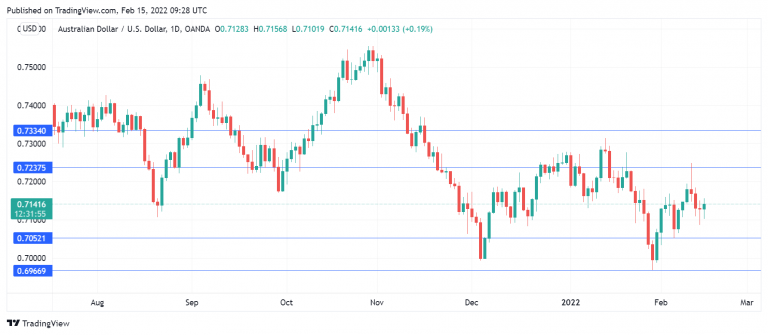
The Australian dollar has reversed directions and is in positive territory on Tuesday. AUD/USD is trading at 0.7154 in the European session, up 0.37% on the day.
RBA preaches patience on rate hikes
The RBA released the minutes of the February meeting earlier today, providing a welcome distraction from the incessant news from the Ukraine. Investors liked what they saw and sent the Aussie higher. The minutes indicated that the RBA would remain patient and was not convinced that inflation was sustainable within its target of 2%-3%. In particular, wage growth was lagging behind inflation. At the same time, it acknowledged that inflation had risen higher than anticipated, which contributed to the decision to end QE this month.
The RBA continues to preach patience before it will hike rates, but how patient is patient? The central bank doesn’t appear ready to hike before 2023, but the markets remain more hawkish, expecting a rate hike later in the year. CommBank, the country’s largest bank, has brought forward its projection of a lift-off date from August to June. The bank’s inflation forecast is much higher than the central bank – CommBank expects inflation to hit 1.2% in Q1, while the RBA is predicting 0.75%.
The crisis on the Ukraine/Russia border remains at a fever pitch, although there are still hopes that a diplomatic solution can be found which would avoid a war in Europe and all its ramifications. German Chancellor Olaf Scholz is in Moscow in last-ditch effort to prevent an invasion. The cards are in the hands of Russian President Vladimir Putin. The West has no intention of defending Ukraine militarily, so the key question is whether the threat of sanctions is enough to dissuade Putin from starting a war in Europe, which could have severe ramifications.
AUD/USD Technical
- AUD/USD continues to rally and is testing resistance at 0.7168. Above, there is resistance at 0.7258
- There is support at 0.6987 and 0.6896
GBP/USD Outlook: Positive News from Russia Lift Pound
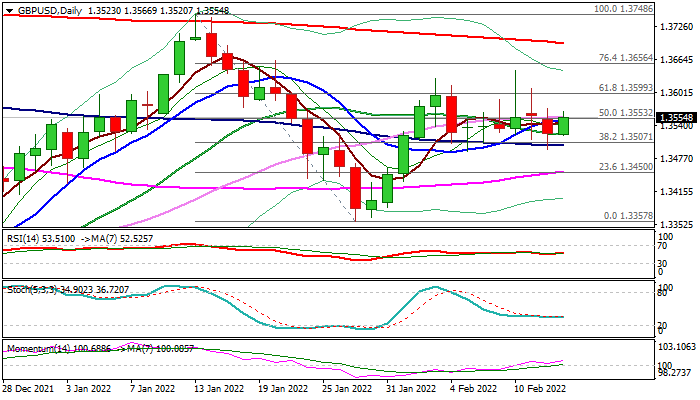
Cable rose in early European trading on Monday after Russian Ministry of Defense announced return of some troops to bases near Ukraine.
Positive news cooled the situation and revived hopes that a war can be avoided, lifting risk-sensitive sterling, adding to positive signals from overall solid UK January labor report.
Fresh advance pushes the price towards the mid-point of nearly two-week range (1.3490/1.3643), following another downside rejection at 1.3500 zones (100DMA / 50% retracement of 1.3357/1.3643 upleg) where the range floor has formed.
Although near-term action remains directionless while holding within the range, rising positive momentum on daily chart and thickening daily cloud after today’s twist, underpin and keep near-term positive bias.
Fresh bulls look for initial signal on today’s close above 1.3566 (daily Tenkan-sen), with extension above pivotal 1.3600 barriers (which repeatedly capped rallies in past two weeks) to help bulls to tighten grip and open way for further gains.
Res: 1.3566; 1.3600; 1.3643; 1.3656.
Sup: 1.3520; 1.3507; 1.3495; 1.3450.
EURJPY Bulls Wake Up Near 200-SMA, But Can They Dominate?
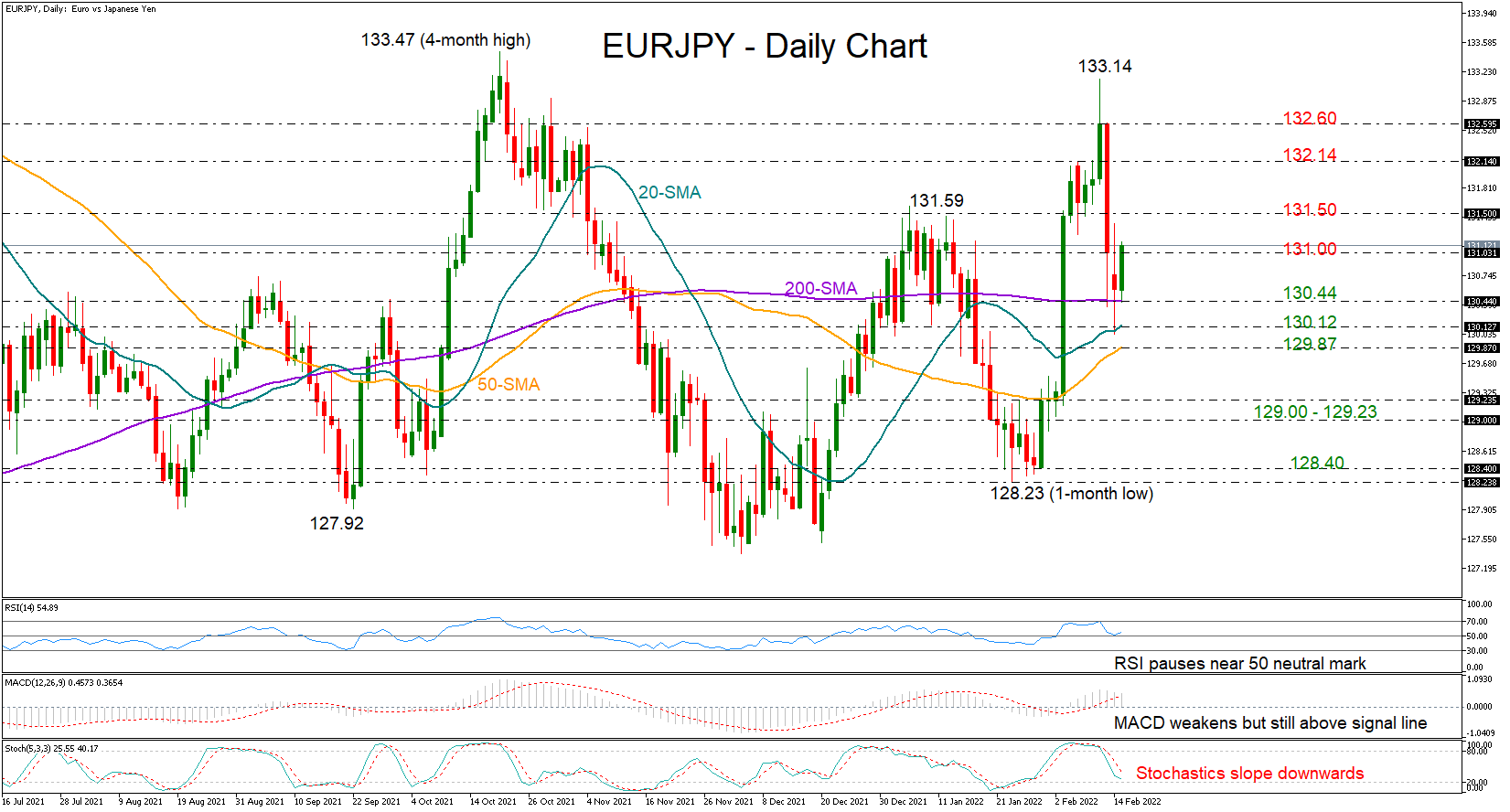
EURJPY found a strong footing around the 200-day simple moving average (SMA) and the 130.50 level despite a flash breakout to 130.00 on Monday, with the price currently looking to re-enter the 131.00 territory.
The pair has retraced more than half of February’s rally and selling tendencies could persist in the short-term as the technical oscillators maintain a negative trajectory. That said, the RSI is currently rejecting any extensions below its 50 neutral mark, while the MACD is still some distance above its red signal line. Hence, any potential declines in the price could be interpreted with some caution.
In the bullish scenario, where the 130.50 floor stands firm and the price crawls above the nearby 131.00 resistance, the rebound could gain extra legs towards the 131.50 barrier. Beyond that, the bulls may attempt to climb above the 132.14 number with scope to test last week’s tough bar of 132.60.
If the 130.50 floor collapses, sellers will push for a close below the 130.00 level, where the 20-day SMA is currently standing. Then, the restrictive 50-day SMA may immediately attract attention around 129.87 before a sharper downfall brings the 129.23 – 129.00 supportive region under examination. If the bears dominate below the latter, the door will open for January’s base of 128.40 - 128.23.
Summarizing, EURJPY is looking cautiously bearish in the short-term picture, with traders probably waiting for a clear close below 130.50 to place their selling orders.