

Sample Category Title
EUR/GBP Daily Outlook
Daily Pivots: (S1) 0.8339; (P) 0.8363; (R1) 0.8379; More...
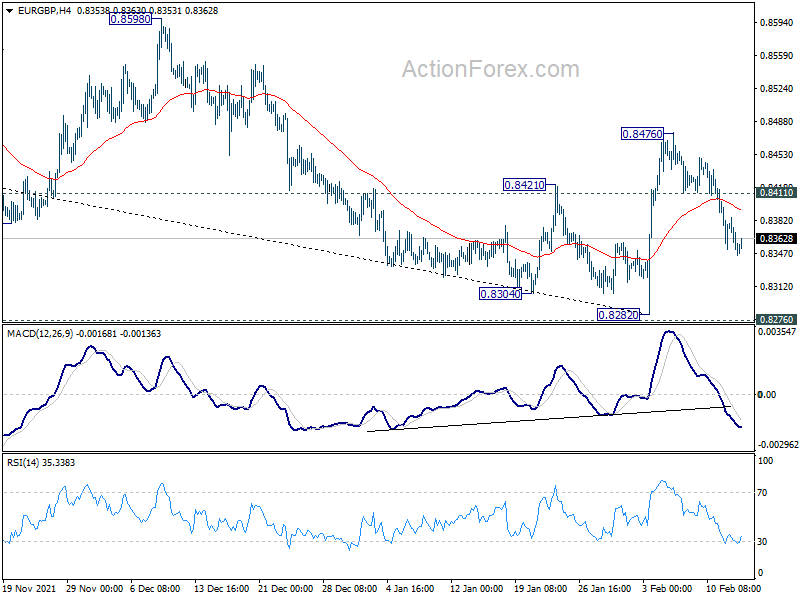
EUR/GBP's fall from 0.8476 is still in progress and intraday bias stays on the downside for retesting 0.8282 low. Sustained break of 0.8276 key long term support will carry larger bearish implication. On the upside, above 0.8411 minor resistance will turn bias back to the upside for 0.8476 resistance. Break there will resume the rebound from 0.8282.
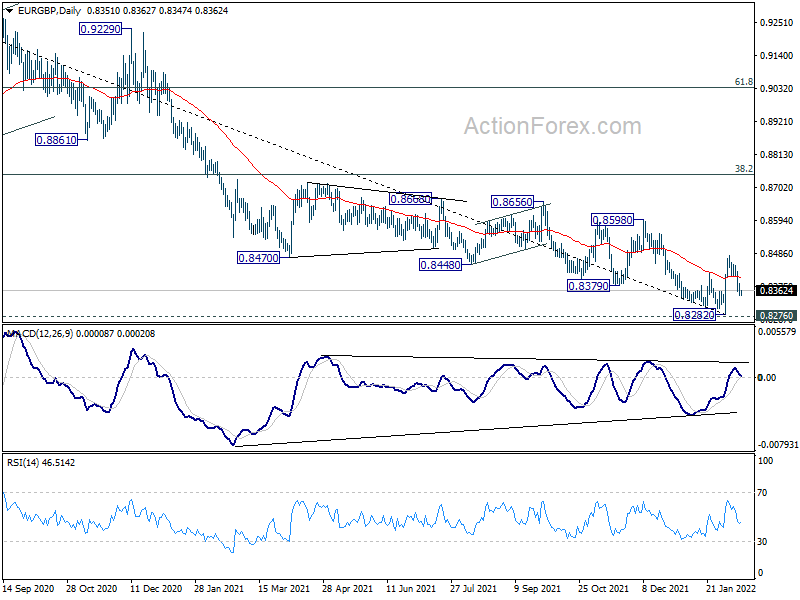
In the bigger picture, price actions from 0.9499 (2020 high) are still seen a corrective pattern that should be contained by 0.8276 long term support (2019 low). Bullish convergence condition in daily MACD and break of 55 day EMA raises the chance that it might be completed. Sustained trading above 38.2% retracement of 0.9499 to 0.8282 at 0.8747 will affirm this bullish case. However, sustained break of 0.8276 will argue that the long term trend has reversed.
EUR/AUD Daily Outlook
Daily Pivots: (S1) 1.5841; (P) 1.5922; (R1) 1.5983; More...
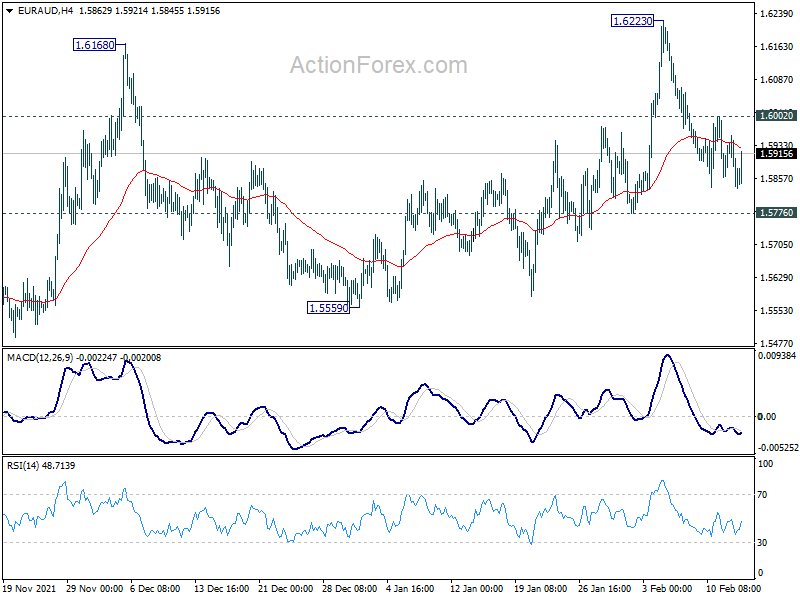
Intraday bias in EUR/AUD stays neutral for the moment. As long as 1.5776 minor support holds, further rise remains mildly in favor. Above 1.6002 will turn bias to the upside for 1.6223 resistance first. However, on the downside, break of 1.5776 will turn bias back to the downside for 1.5559 support instead.
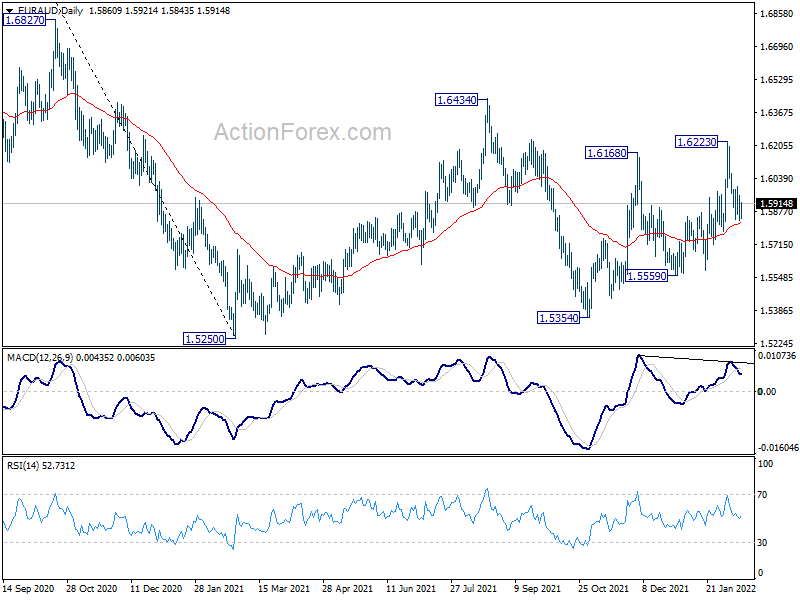
In the bigger picture, rise from 1.5354 is seen as the third leg of the corrective pattern from 1.5250 low. Further rise cannot be ruled out, but even in that case, strong resistance should be seen at 38.2% retracement of 1.9799 to 1.5250 at 1.6988. Larger down trend from 1.9799 is in favor to extend through 1.5250 at a later stage.
Technical Outlook and Review
DXY:
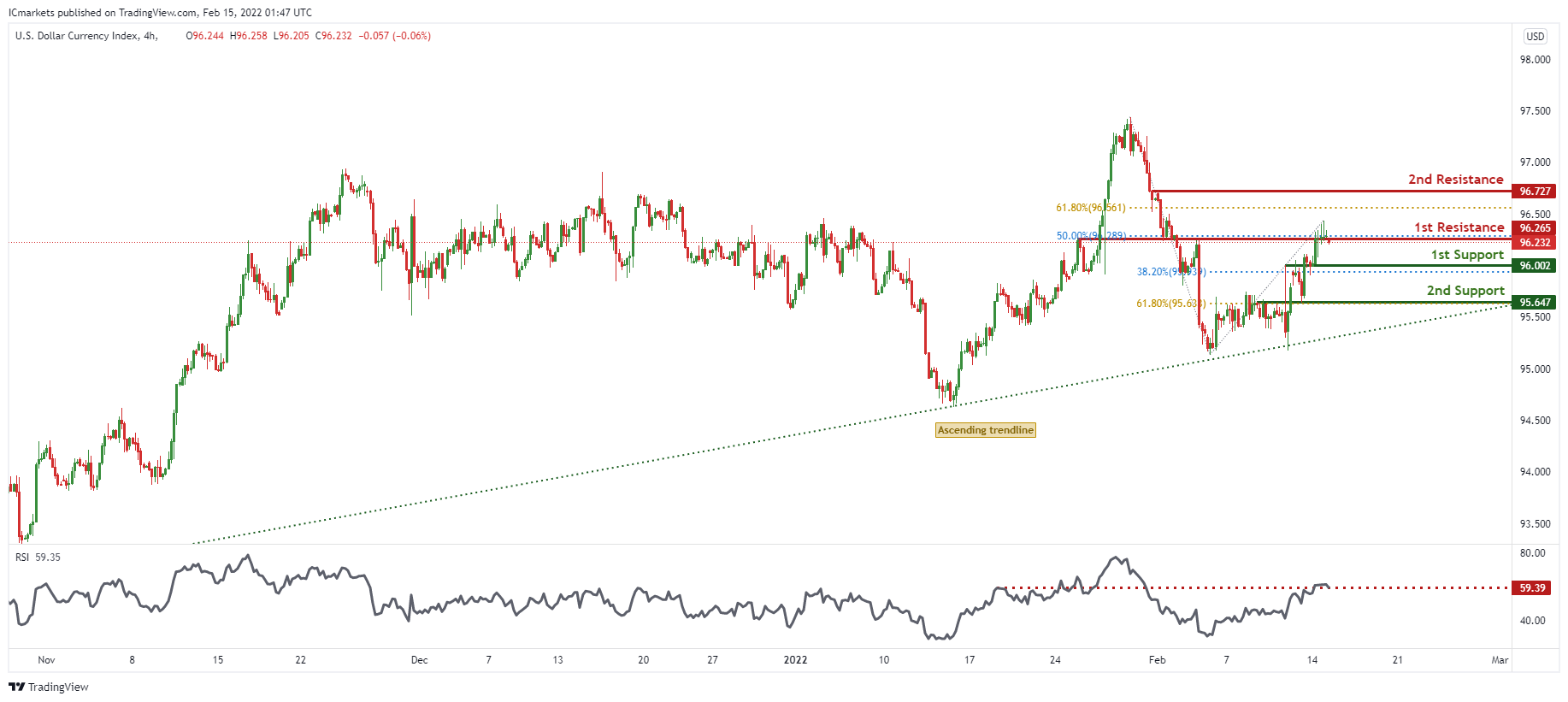
On the H4 timeframe, prices are abiding by a daily ascending trendline and are on bullish momentum. We see the potential for a pullback from our 1st resistance at 96.265 in line with 50% Fibonacci retracement and graphical overlap towards our 1st support at 96.002 in line with 38.2% Fibonacci retracement. Our bearish bias is further supported by our RSI being at levels where dips previously occurred.
Areas of consideration:
- H4 time frame, 1st resistance at 96.265
- H4 time frame, 1st support at 96.002
XAU/USD (GOLD):
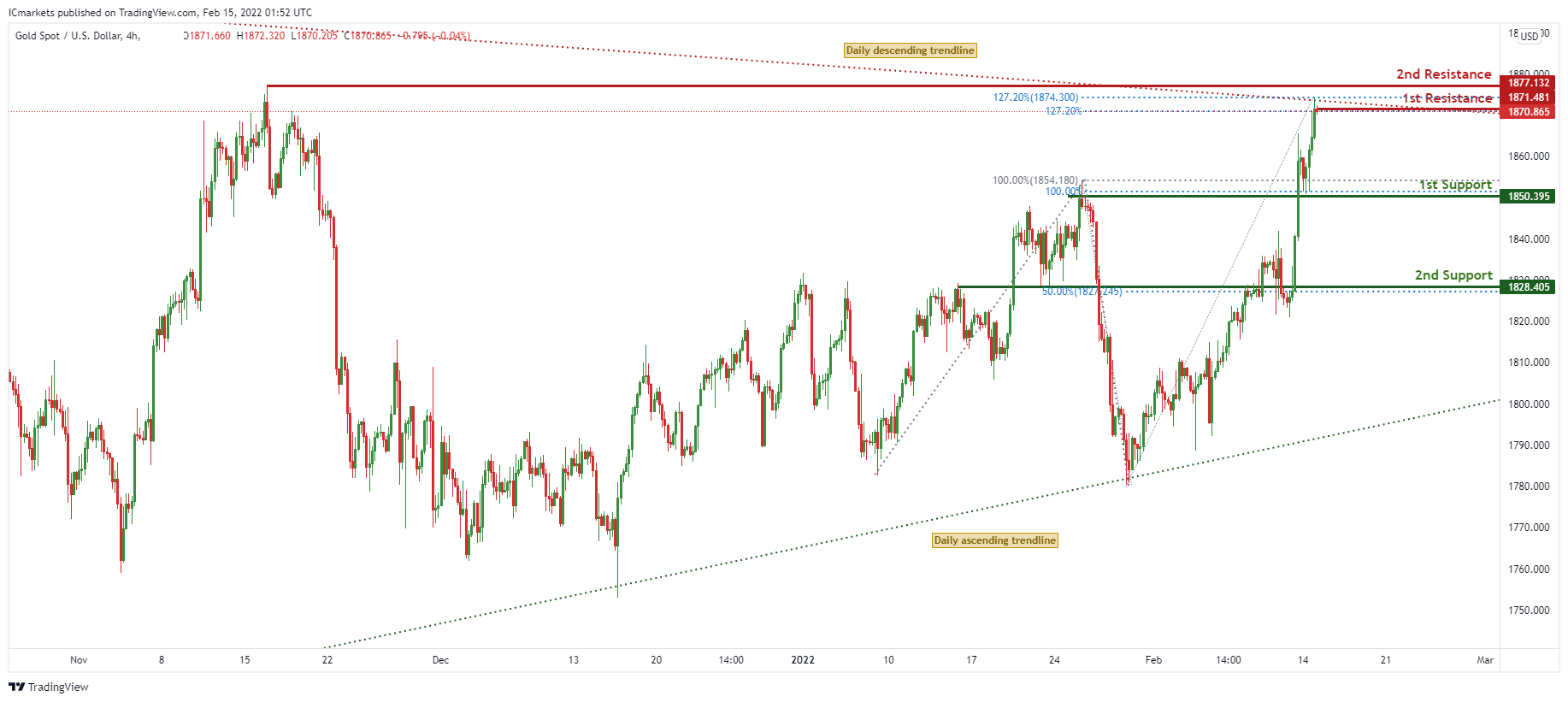
On the H4 chart, prices are on bullish momentum and have approached the edge of our daily descending trendline. We see potential for a pullback from our 1st resistance at 1871.481 in line with 127.2% Fibonacci extension and 127.2% Fibonacci expansion towards our 1st support at 1850.395 in line with 100% Fibonacci retracement and 100% Fibonacci extension.
Areas of consideration:
- 4h 1st support at 1850.395
- 4h 1st resistance at 1870.865
GBP/USD:
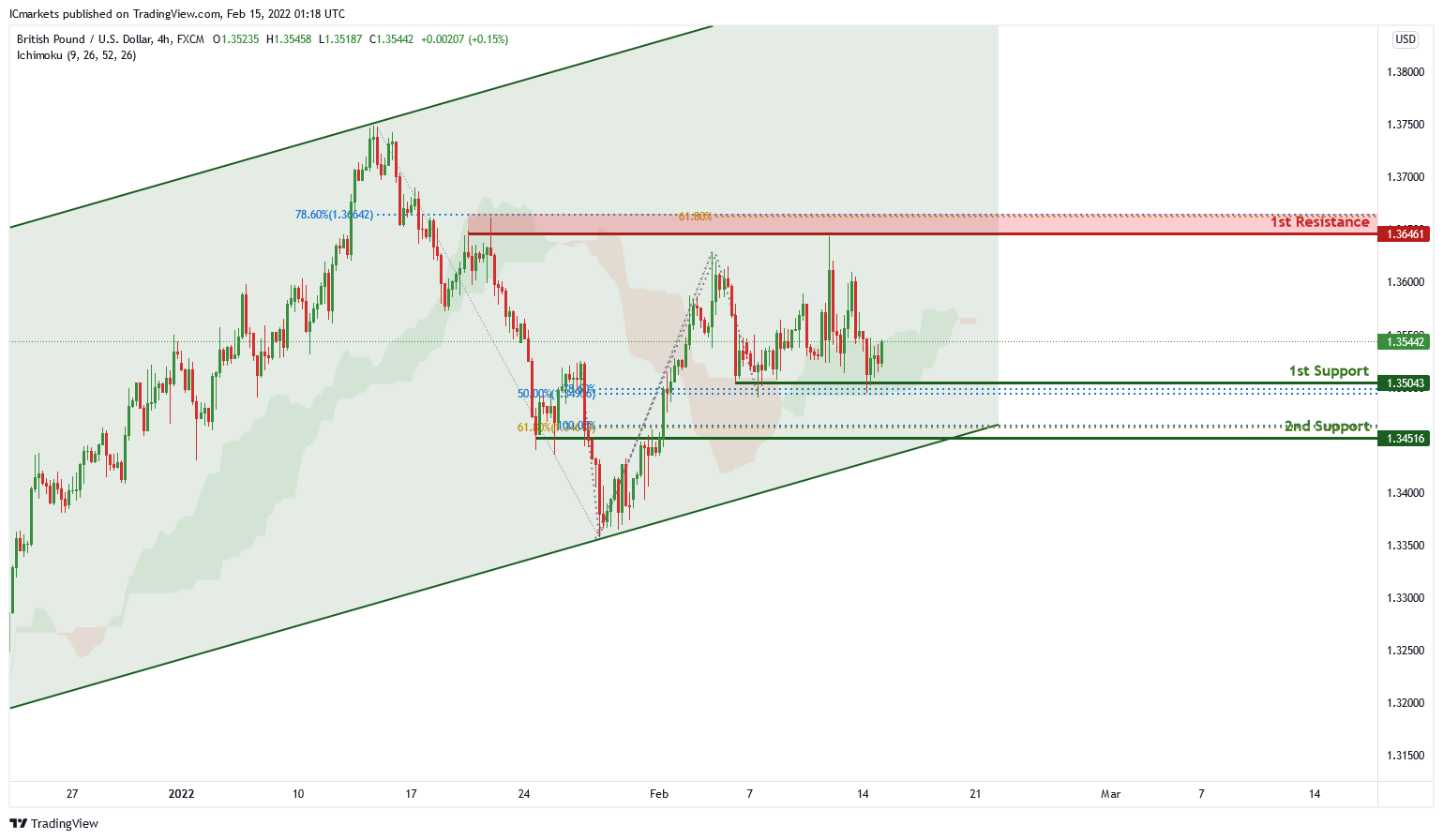
In the H4 chart , price is trading in an ascending channel and near 1st support level of 1.35043 which is also 50% Fibonacci retracement and 78.6% Fibonacci projection. Price can potentially continue its bullish momentum to the 1st resistance level of 1.36461 in line with 61.8% Fibonacci projection and 78.6% Fibonacci retracement. Our bullish bias is supported by the ichimoku cloud indicator as price is trading above it.
Areas of consideration:
- H4 1st resistance 1.36461
- H4 1st support 1.35043
USD/CHF:
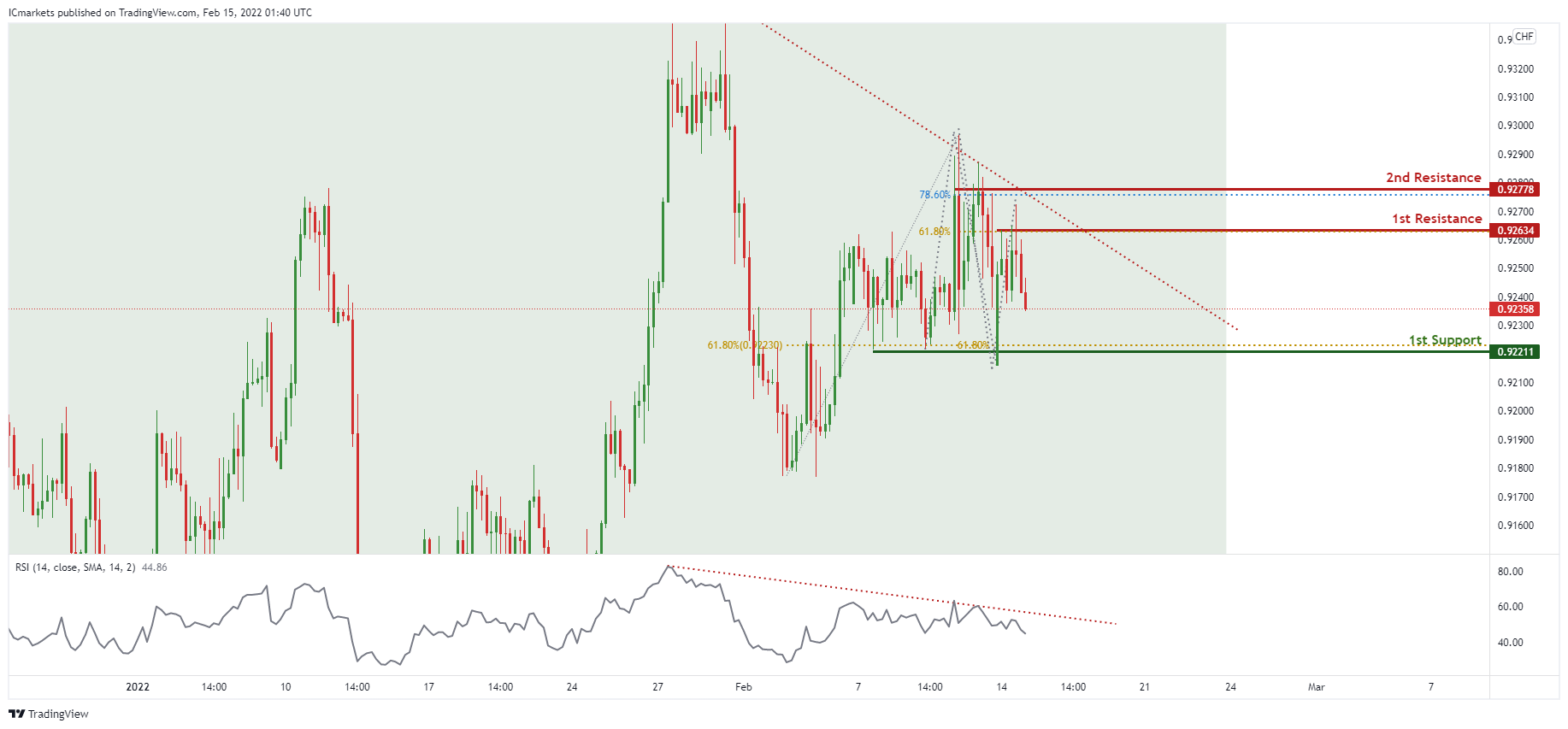
On the H4 timeframe, price is abiding to the daily ascending channel and descending trendline resistance on the H4. We can expect the price to drop from 1st Resistance in line with 61.8% Fibonacci projection towards 1st Support in line with 61.8% Fibonacci projection and 61.8% Fibonacci retracement. Our bearish bias is further supported by the RSI indicator where it is abiding to the descending trendline resistance. Traders should wait for prices to swing higher or lower before entering.
Areas of consideration:
- Watch 1st Support at 0.92211
- Watch 1st Resistance at 0.92634
EUR/USD :
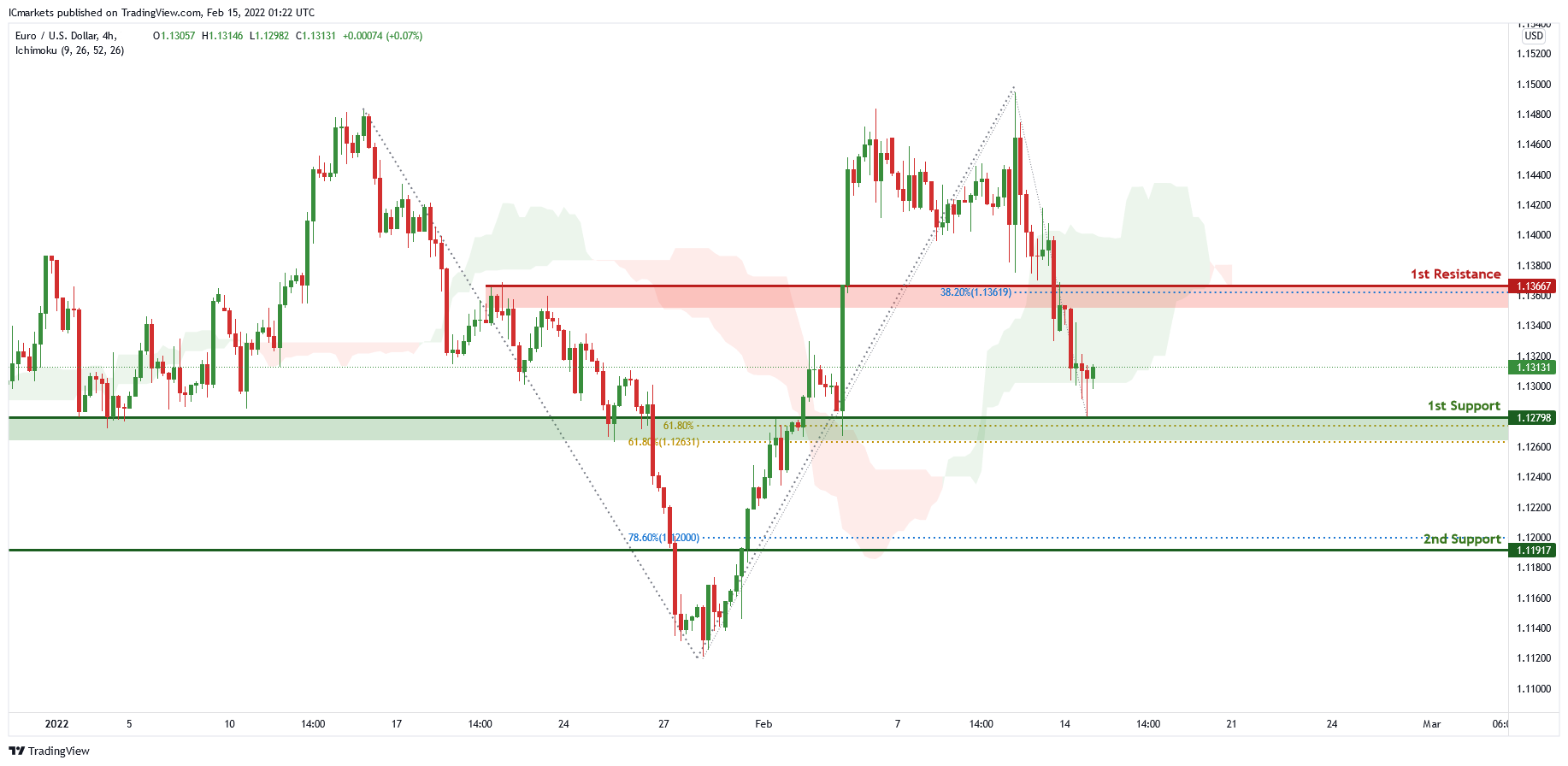
On the H4 chart, price is near 1st support level of 1.12798 in line with 61.8% Fibonacci retracement and 61.8% Fibonacci projection. Price can potentially bounce from this level to the 1st resistance which is also 38.2% Fibonacci retracement and graphical overlap resistance. Our bullish bias is supported by the ichimoku cloud indicator.
Areas of consideration:
- H4 1st resistance at 1.13611
- H4 1st support at 1.12798
USD/JPY:
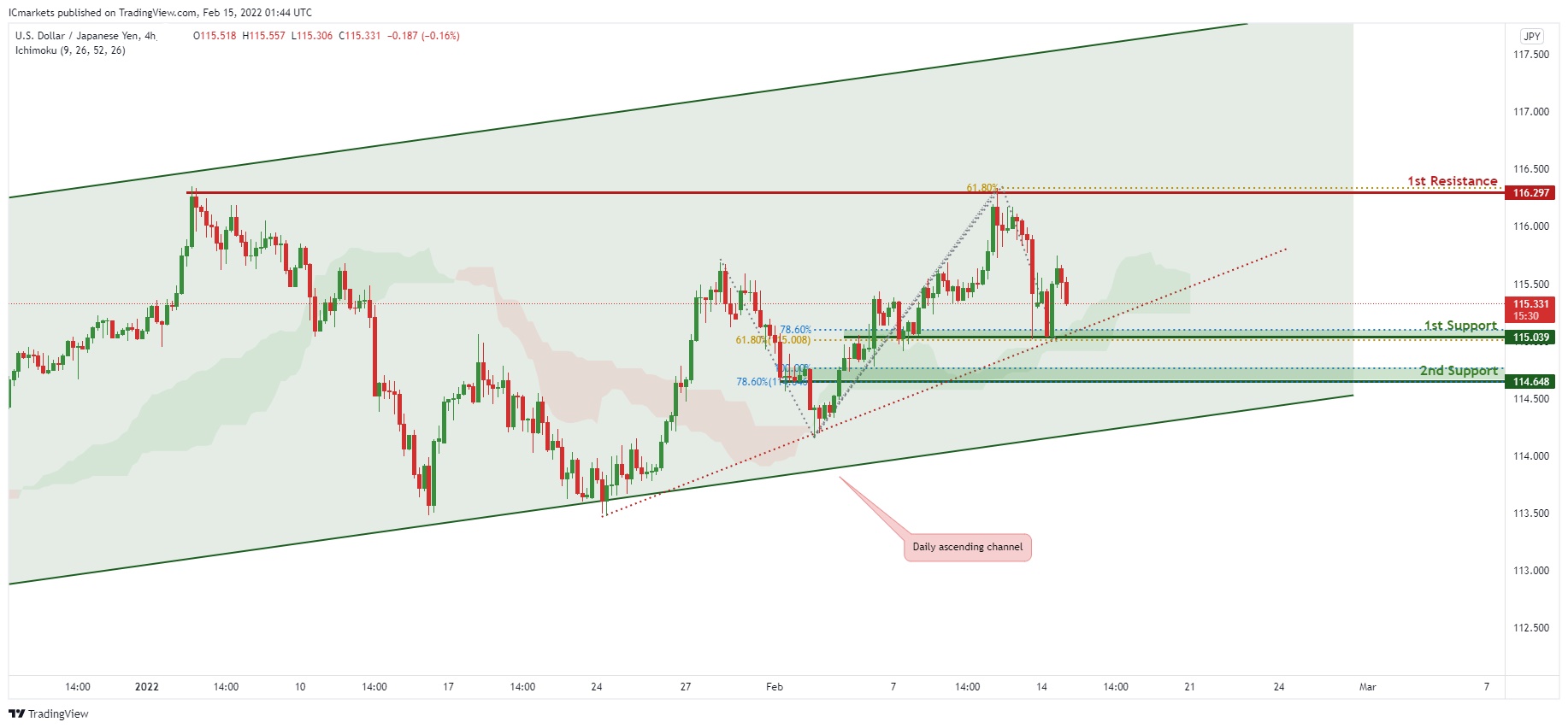
On the H4 chart, price is abiding to the ascending trendline support and the ascending channel on the daily, signifying an overall bullish momentum. We can expect price to bounce at the 1st Support level in line with 78.6% FIbonacci projection ,61.8% Fibonacci retracement and trendline support towards 1st Resistance in line with 61.8% Fibonacci projection and swing high resistance. Our bullish bias is further supported by the Ichimoku cloud acting as a support.
Areas of consideration:
- H4 1st support at 115.039
- H4 1st resistance at 116.297
AUD/USD:
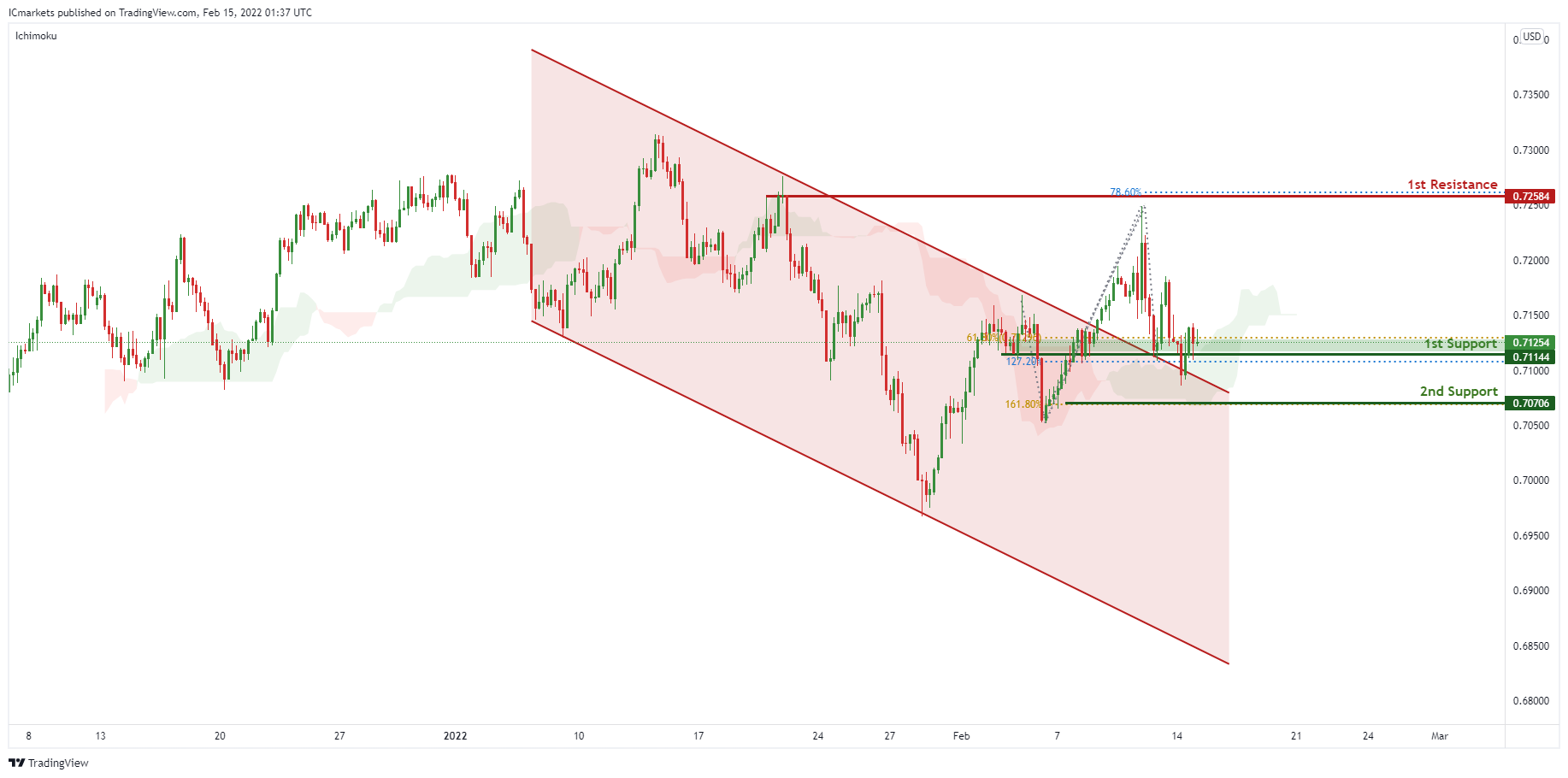
Price broke out of the descending channel, signifying an overall bullish momentum. We can expect price to bounce from 1st Support in line with 61.8% Fibonacci retracement, 127.2% Fibonacci projection and graphical overlap support towards 1st Resistance in line with previous swing high and 78.6% Fibonacci projection. Our bullish bias is further supported by the Ichimoku indicator where the prices are holding above the cloud.
Areas of consideration:
- H4 1st Support level 0.71144
- H4 1st resistance level 0.72584
NZD/USD:
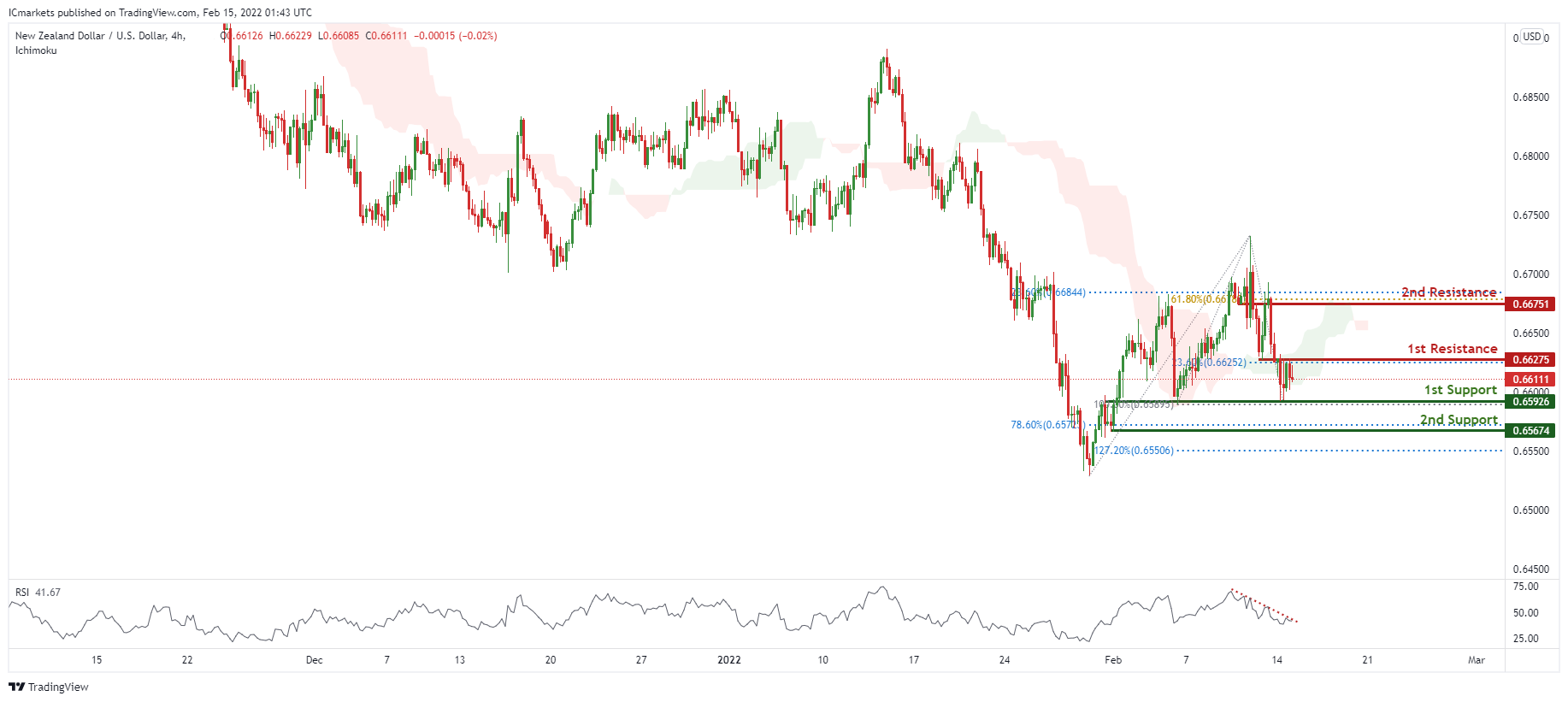
On the H4 timeframe, prices are on bearish momentum. We see potential for bearish continuation from our 1st resistance at 0.66275 in line with 23.6% Fibonacci retracement towards our 1st support at 0.65926 in line with 100% Fibonacci retracement and 78.6% Fibonacci extension. Our bias is further supported by RSI portraying bearish momentum and also ichimoku cloud forecasting bearish momentum . Alternatively, our stop loss will be placed at 2nd resistance at 0.66751 in line with 23.6% Fibonacci retracement and 61.8% Fibonacci extension.
Areas of consideration:
- H4 time frame, 1st resistance at 0.66275
- H4 time frame, 1st support at 0.65926
USD/CAD:
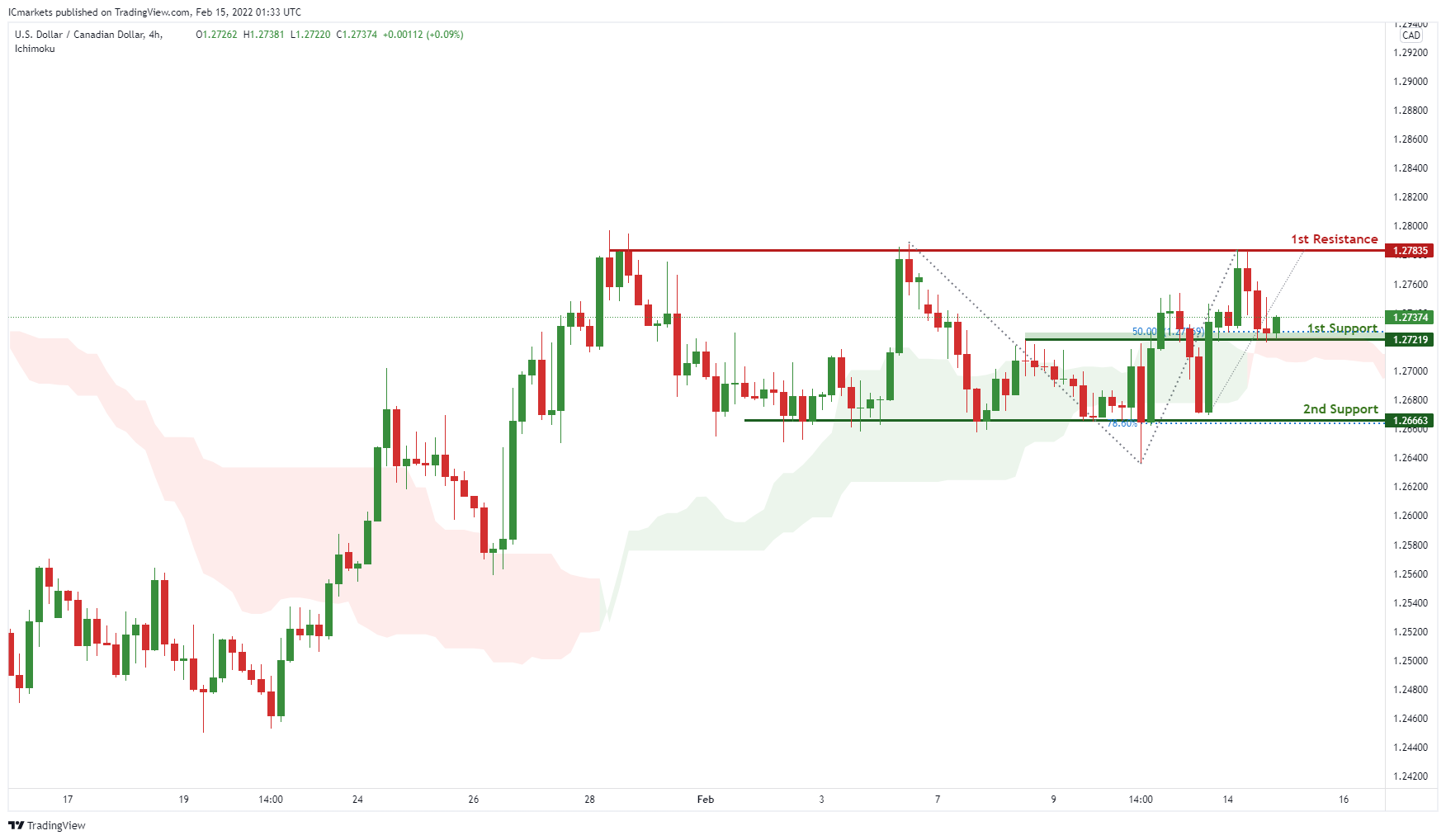
On the H4, with price moving above the ichimoku cloud, signifying an overall bullish momentum. We can expect price to rise to our 1st resistance at 1.27835 in line horizontal graphical swing high resistance from our 1st support in line with horizontal overlap support and 78.6% Fibonacci retracement at 1.27219. Alternatively, price may break 1st support structure and head for 2nd support, which coincides with horizontal swing low support and 161.8% Fibonacci extension at 1.26663.
Areas of consideration:
- H4 time frame, 1st support at 1.27219
- H4 time frame, 1st resistance at 1.27835
OIL:
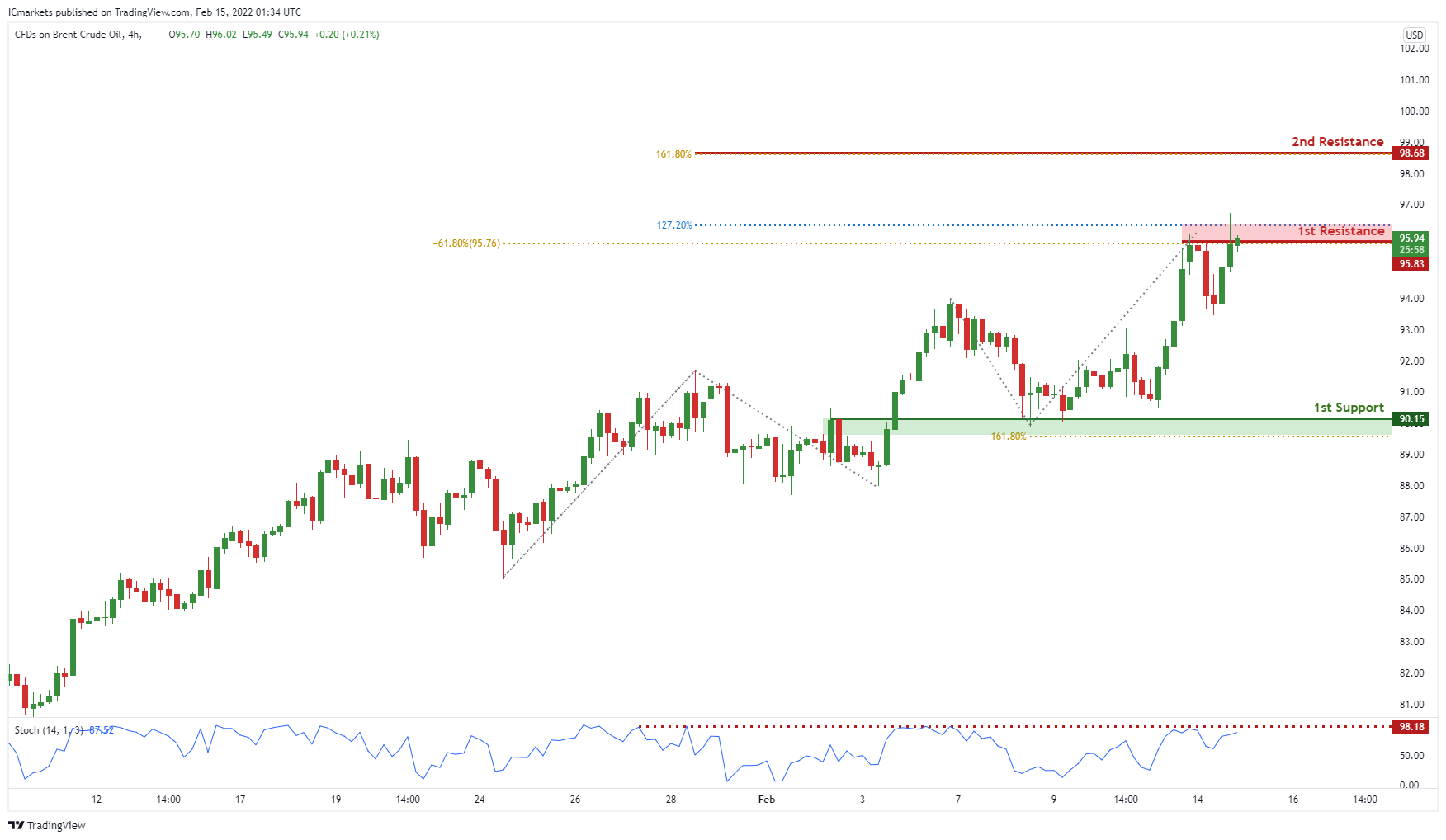
On the H4, with prices expected to reverse off the resistance of the stochastics indicator, we see the potential for a drop to our 1st support at 90.15 in line with horizontal overlap support from our 1st resistance at 95.83 in line with the 127.2% Fibonacci extension and -61.8% Fibonacci expansion. Alternatively, price may break 1st resistance structure and head for 2nd resistance at 98.68, in line with the horizontal swing low support and 161.8% Fibonacci extension.
Areas of consideration:
- H4 time frame, 1st resistance of 95.83
- H4 time frame, 1st support of 90.15
Dow Jones Industrial Average:
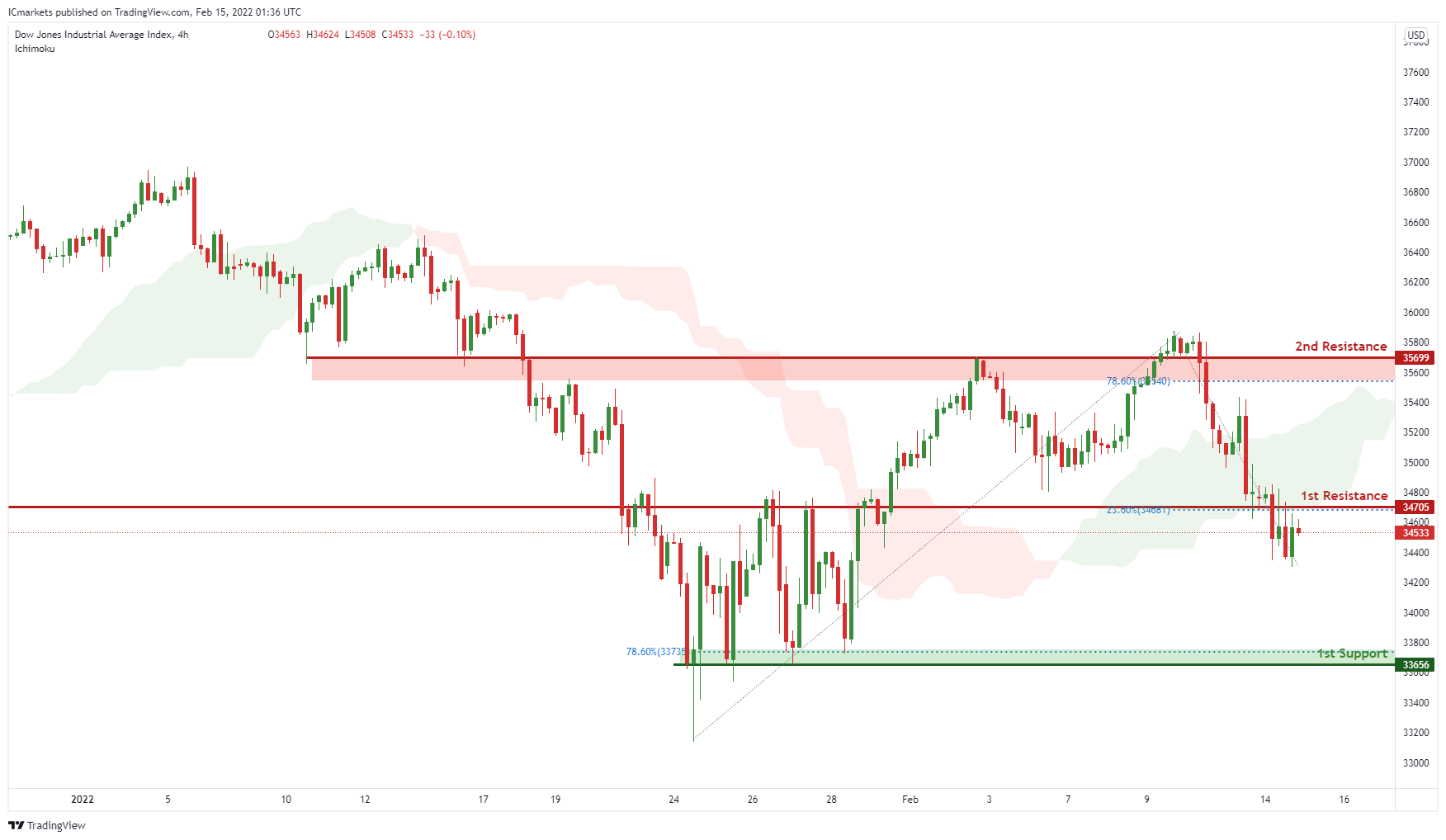
On the H4, with prices moving below the ichimoku cloud, we see the potential for a drop to our 1st support at 33656 in line with horizontal swing low support from our 1st resistance at 34705 in line with the 23.6% Fibonacci retracement. Alternatively, price may break 1st resistance structure and head for 2nd resistance at 35699, in line with the horizontal overlap resistance and 78.6% Fibonacci retracement.
Areas of consideration:
- H4 time frame, 1st resistance of 34705
- H4 time frame, 1st support of 33656
EUR/CHF Daily Outlook
Daily Pivots: (S1) 1.0423; (P) 1.0469; (R1) 1.0499; More....
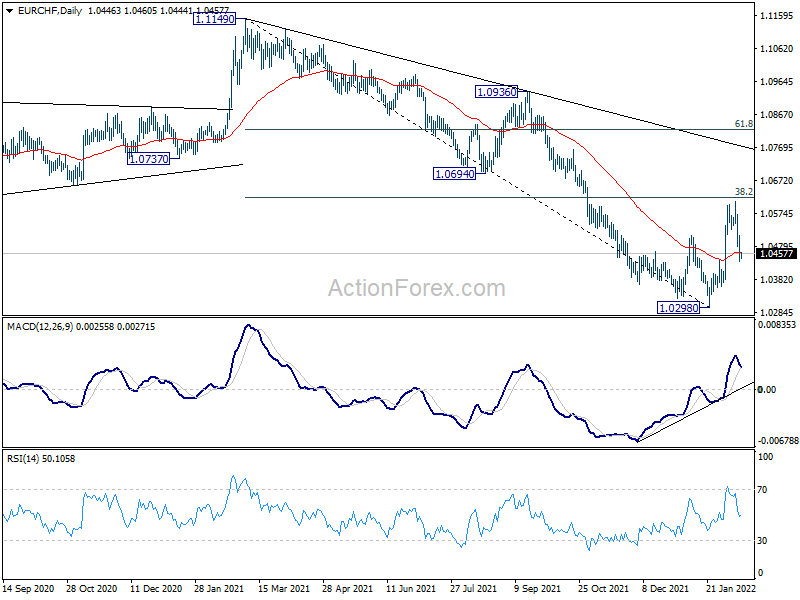
Immediate focus is now on 1.0439 support in EUR/CHF. Firm break there should confirm that rebound from 1.0298 has completed, ahead of 38.2% retracement of 1.1149 to 1.0298 at 1.0623. Deeper fall will then be seen back to retest 1.0298 low. On the upside, break of 1.0527 minor resistance will clear near term downside risk and bring stronger rebound back to 1.0623 fibonacci resistance instead.
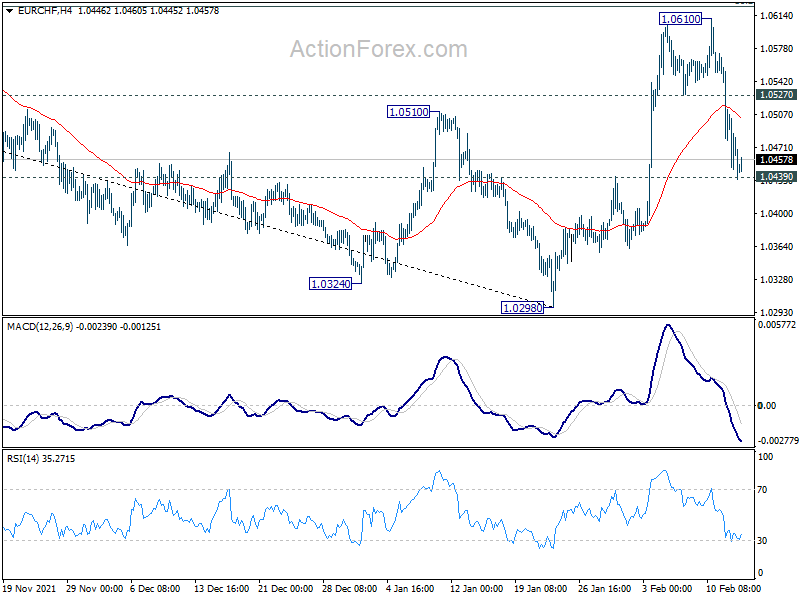
In the bigger picture, a medium term bottom was formed at 1.0298 on bullish convergence condition in daily MACD. Rebound from there is still tentatively viewed part of a corrective pattern. That is, larger down trend from 1.2004 (2018) could still extend through 1.0298 to 61.8% projection of 1.2004 to 1.0505 to 1.1149 at 1.0223. However, sustained trading above 55 week EMA (now at 1.0673) will argue that the down trend is over, and bring stronger rise back to 1.1149 next.
Gold Jumps on Ukraine Risks, Swiss Franc Firm and Euro Weak
The forex markets are pretty steady in Asia session today, with major pairs and crosses bounded inside yesterday's range. Sentiment is mixed as investors are awaiting to see Russia would invade Ukraine on February 16, as media reported. But the rally in Gold suggests that investors are getting nervous on the risks. For now, Swiss Franc and Yen are the stronger ones, while Euro and Sterling are soft together with Kiwi.
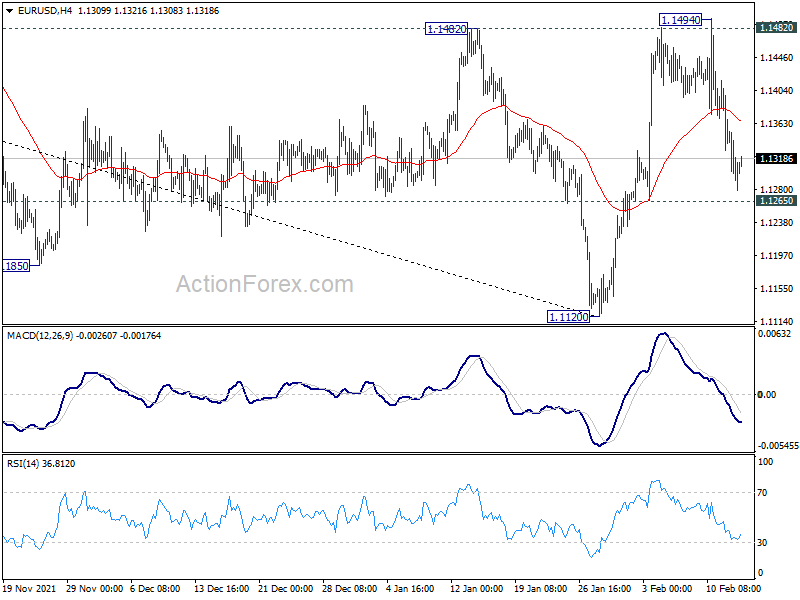
Technically, Euro is starting to look vulnerable as geopolitical risks clearly outweighs prospect of interest rate hike. In particular, we'll pay attention to EUR/CHF's reaction to 1.0439 minor support, as well as EUR/USD's reaction to 1.1265 minor support. Break of these levels will indicate that near term rebound in the two pairs completed. They will then be heading back to 1.0298 and 1.1120 low respectively, with prospects of downside breakout.
In Asia, at the time of writing, Nikkei is down -0.37%. Hong Kong HSI is down -0.67%. China Shanghai SSE is up 0.40%. Singapore Strait Times is down -0.35%. Japan 10-year JGB yield is down -0.0006 at 0.218. Overnight, DOW dropped -0.49%. S&P 500 dropped to 0.38%. NASDAQ dropped -0.00%. 10-year yield rose 0.041 to 1.996, after hitting 2.026.
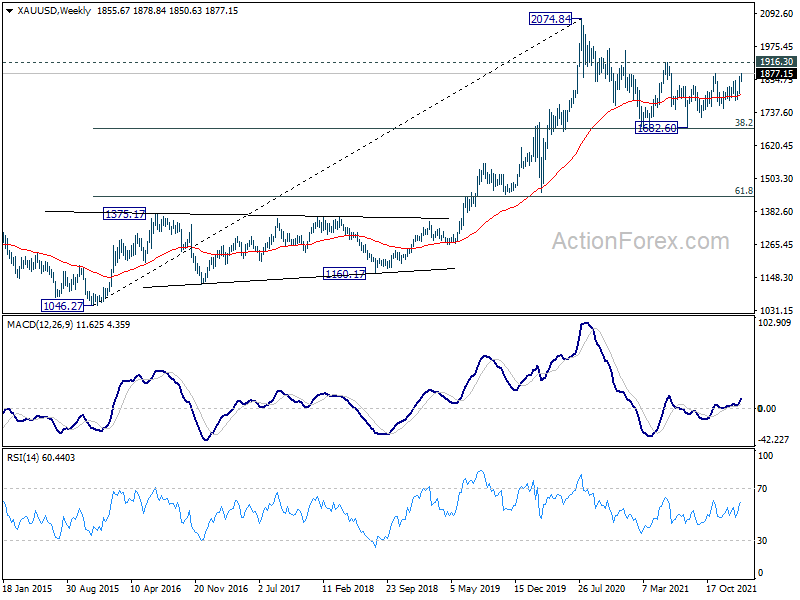
Gold upside breakout, ready for 1916 resistance
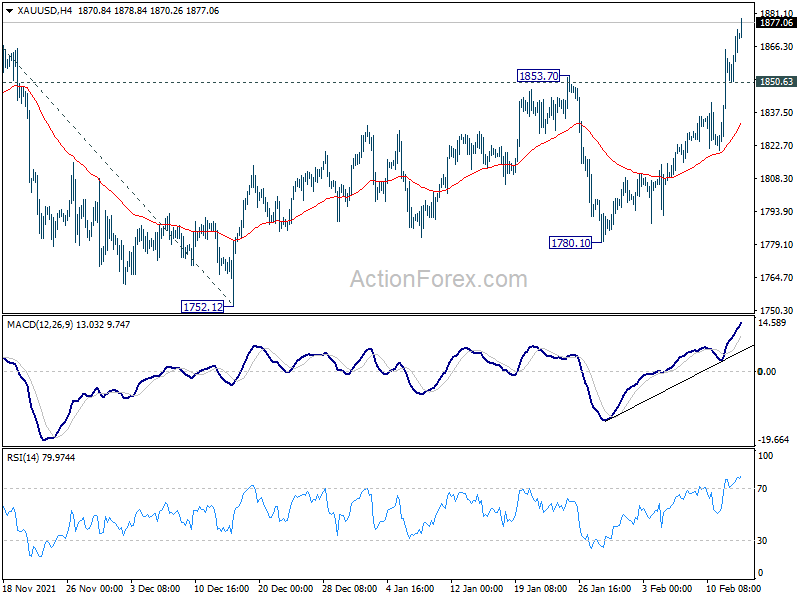
Gold rises further to as high as 1878.84 so far today. The break of 1877.05 resistance indicates resumption of whole rally from 1682.60. Further rally will be expected as long as 1850.63 support holds. 1916.30 resistance is the next target and break there will pave the way to 100% projection of 1682.60 to 1877.05 from 1752.12 at 1946.57.
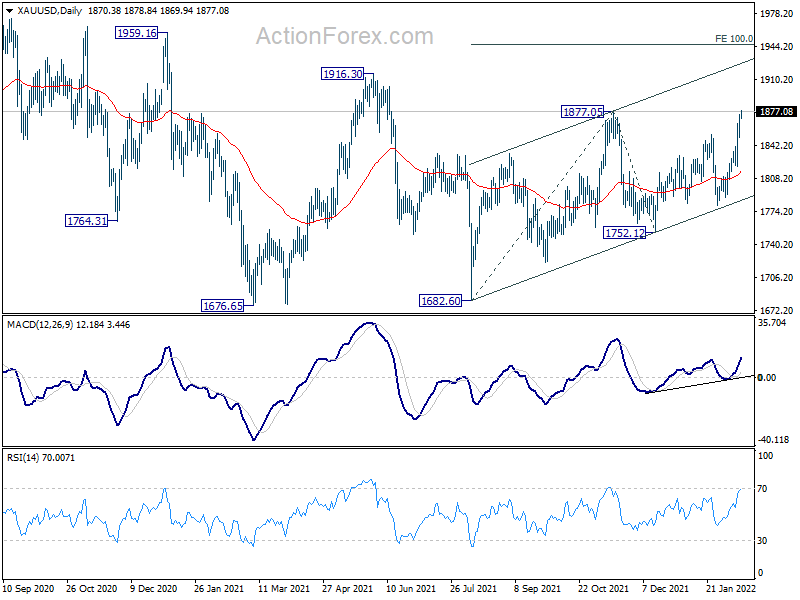
More importantly, sustained break of 1946.57 will affirm the case that whole medium term correction from 2074.84 has completed at 1682.60, after hitting 38.2% retracement of 1046.27 to 2074.84. That is, retest of 2074.84 should be seen next with prospect of resuming the long term up trend at a later stage.
BoJ Kuroda: Baseline for economy and prices to gradually pick up
BoJ Governor Haruhiko Kuroda reiterated that the baseline forecast is for Japan's economy and prices to gradually pick up as rising real household income underpins consumption. Nevertheless, the "economic and price conditions warrant maintaining our easy monetary policy."
He acknowledged that the market operation of an offer to buy unlimited amount of bonds on Monday successfully pushed 10-year JGB yield from near 0.25% to 0.22%. But he emphasized it's a "last resort" and a "powerful means not used explicitly by other central banks." "We don't expect to conduct such operation frequently. We'll do this as needed," he added.
Japan GDP grew 1.3% qoq in Q4, remains slightly be pre-pandemic level
Japan GDP grew 1.3% qoq in Q4, slightly below expectation of 1.4% qoq. In annualized term, GDP grew 5.4%, below expectation of 5.8%.
Private consumption grew 2.7% qoq, accounting for much of the growth. Capital expenditure rose 0.4% qoq. External demand rose 0.2% qoq.
For 2021 as a whole, GDP grew 1.7%, marking the first expansion in three years. The seasonally-adjusted real GDP size at JPY 541T remains slightly below pre-pandemic level of late 2019.
RBA minutes: Prepared to be patient on interest rate
In the minutes of February 1 meeting, RBA reiterated that it "will not increase the cash rate until actual inflation is sustainably within the 2 to 3 per cent target band." It's "too early to conclude that it was sustainably within the target band". There were uncertainties about "how persistent the pick-up in inflation would be as supply-side problems were resolved" and "wages growth also remained modest". The central bank is "prepared to be patient".
Omicron outbreak "had affected the economy, but had not derailed the recovery". The economy was "resilient" and was expected to "pick up as case numbers trended lower". Job market had "recovered strongly" with central forecasts seeing unemployment to fall to "levels not seen since early 1970s". Wages growth was expected to pick-up, buy only gradually.
Inflation had "picked up more quickly than the Bank had expected", but was still "lower than in many other countries". "Some moderation" in inflation was expected as "supply problems were resolved." Stronger growth in labour costs was expected to become the "more important driver of inflation". The central forecast was for underlying inflation to be within the target band over both 2022 and 2023.
A decision about reinvestment of asset purchases would be made at the May meeting, with the key considerations being the "state of the economy and the outlook for inflation and unemployment."
Looking ahead
UK employment data will be a main feature in European session. Eurozone GDP and Germany ZEW economic sentiment will also be closely watched. Later in the day, US will release PPI and Empire state manufacturing index. Canada will release housing starts.
EUR/CHF Daily Outlook
Daily Pivots: (S1) 1.0423; (P) 1.0469; (R1) 1.0499; More....
Immediate focus is now on 1.0439 support in EUR/CHF. Firm break there should confirm that rebound from 1.0298 has completed, ahead of 38.2% retracement of 1.1149 to 1.0298 at 1.0623. Deeper fall will then be seen back to retest 1.0298 low. On the upside, break of 1.0527 minor resistance will clear near term downside risk and bring stronger rebound back to 1.0623 fibonacci resistance instead.
In the bigger picture, a medium term bottom was formed at 1.0298 on bullish convergence condition in daily MACD. Rebound from there is still tentatively viewed part of a corrective pattern. That is, larger down trend from 1.2004 (2018) could still extend through 1.0298 to 61.8% projection of 1.2004 to 1.0505 to 1.1149 at 1.0223. However, sustained trading above 55 week EMA (now at 1.0673) will argue that the down trend is over, and bring stronger rise back to 1.1149 next.
Economic Indicators Update
| GMT | Ccy | Events | Actual | Forecast | Previous | Revised |
|---|---|---|---|---|---|---|
| 23:50 | JPY | GDP Q/Q Q4 P | 1.30% | 1.40% | -0.90% | |
| 23:50 | JPY | GDP Deflator Y/Y Q4 P | -1.30% | -1.20% | -1.20% | |
| 00:30 | AUD | RBA Minutes | ||||
| 04:30 | JPY | Industrial Production M/M Dec F | -1.00% | -1.00% | ||
| 07:00 | GBP | Claimant Count Change Jan | -43.3K | |||
| 07:00 | GBP | ILO Unemployment Rate (3M) Dec | 4.10% | 4.10% | ||
| 07:00 | GBP | Average Earnings Excluding Bonus 3M/Y Dec | 3.60% | 3.80% | ||
| 07:00 | GBP | Average Earnings Including Bonus 3M/Y Dec | 3.90% | 4.20% | ||
| 10:00 | EUR | Eurozone Trade Balance (EUR) Dec | -2.5B | -1.3B | ||
| 10:00 | EUR | Eurozone GDP Q/Q Q4 P | 0.30% | 0.30% | ||
| 10:00 | EUR | Eurozone Employment Change Q/Q Q4 P | 0.40% | 0.90% | ||
| 10:00 | EUR | Germany ZEW Economic Sentiment Feb | 53.5 | 51.7 | ||
| 10:00 | EUR | Germany ZEW Current Situation Feb | -7 | -10.2 | ||
| 10:00 | EUR | Eurozone ZEW Economic Sentiment Feb | 52.3 | 49.4 | ||
| 13:15 | CAD | Housing Starts Jan | 270.0K | 236.1K | ||
| 13:30 | USD | Empire State Manufacturing Index Feb | 10 | -0.7 | ||
| 13:30 | USD | PPI M/M Jan | 0.60% | 0.20% | ||
| 13:30 | USD | PPI Y/Y Jan | 9.20% | 9.70% | ||
| 13:30 | USD | PPI Core M/M Jan | 0.50% | 0.50% | ||
| 13:30 | USD | PPI Core Y/Y Jan | 8.10% | 8.30% |
Gold upside breakout, ready for 1916 resistance
Gold rises further to as high as 1878.84 so far today. The break of 1877.05 resistance indicates resumption of whole rally from 1682.60. Further rally will be expected as long as 1850.63 support holds. 1916.30 resistance is the next target and break there will pave the way to 100% projection of 1682.60 to 1877.05 from 1752.12 at 1946.57.
More importantly, sustained break of 1946.57 will affirm the case that whole medium term correction from 2074.84 has completed at 1682.60, after hitting 38.2% retracement of 1046.27 to 2074.84. That is, retest of 2074.84 should be seen next with prospect of resuming the long term up trend at a later stage.
GBP/USD Could Resume Decline, UK Employment Report Next
Key Highlights
- GBP/USD is still struggling to clear the 1.3600 resistance zone.
- It traded below a crucial bullish trend line with support near 1.3550 on the 4-hours chart.
- EUR/USD is showing a few bearish signs below 1.1350.
- The UK ILO Unemployment rate could remain at 4.1% in Dec 2021 (3M).
GBP/USD Technical Analysis
The British Pound failed to gain strength above 1.3640 against the US Dollar. GBP/USD started a downside correction after trading as high as 1.3643.
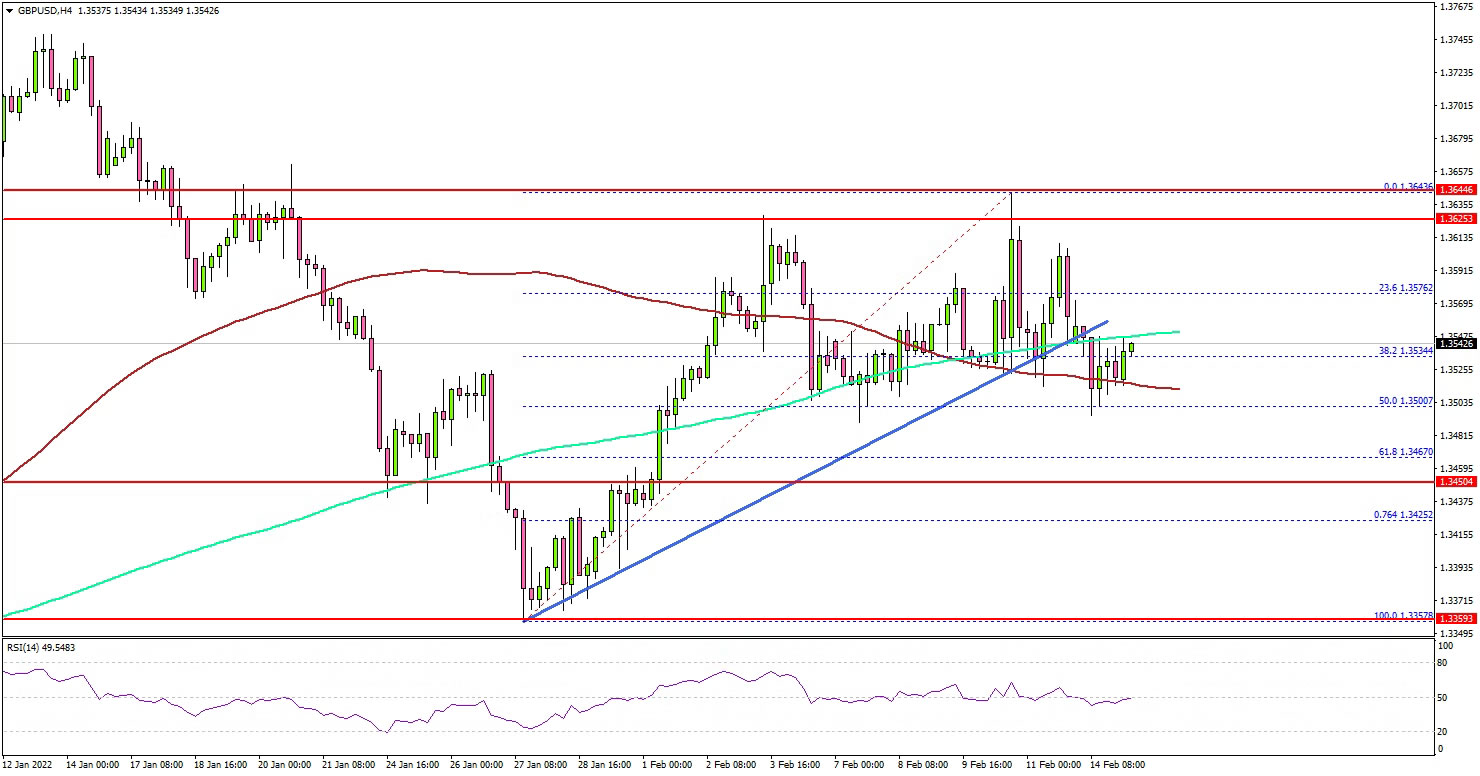
Looking at the 4-hours chart, the pair started a downside correction below the 1.3600 level. The pair moved below the 38.2% Fib retracement level of the upward move from the 1.3357 swing low to 1.3643 high.
Besides, there was a break below a crucial bullish trend line with support near 1.3550 on the same chart. It tested the 50% Fib retracement level of the upward move from the 1.3357 swing low to 1.3643 high.
If the bears remain in action, the pair could decline towards the 1.3450 level. The next major support is near the 1.3400 level. On the upside, the pair might face sellers near the 1.3580 level. The main breakout resistance is still near the 1.3600 and 1.3620 levels.
A clear move above the 1.3620 level could open the doors for more gains. In the stated case, GBP/USD might rise towards the 1.3720 level.
Looking at EUR/USD, the pair is showing a few bearish signs below 1.1350. The next major support sits near the 1.1265 level.
Economic Releases
- UK Claimant Count Change for Jan 2022 – Forecast -10.0K, versus -43.3K previous.
- UK ILO Unemployment Rate for Dec 2021 (3M) – Forecast 4.1%, versus 4.1% previous.
- Euro Zone Gross Domestic Product for Q4 2021 (QoQ) (Prelim) - Forecast 0.3%, versus 0.3% previous.
- Euro Zone Gross Domestic Product for Q4 2021 (YoY) (Prelim) - Forecast 4.6%, versus 4.6% previous.
- German ZEW Business Economic Sentiment Index for Feb 2022 – Forecast 53.5, versus 51.7 previous.
RBA Minutes Support Previous Communication
The minutes of the Reserve Bank’s Board meeting for February support the “patient” rhetoric of earlier communications. There is some new information on the treatment of the balance sheet although balance sheet action does not appear to be part of the expected tightening cycle. Our forecast of 3.5% for annual underlying inflation by June compared to the RBA’s 3.25% should be enough to trigger the expected first hike in August.
The Minutes of the Reserve Bank Board’s February meeting provide limited further insight into the Board’s thinking than we have already seen in previous communications from the Governor since the meeting on February 1.
These communications covered the Governor’s Statement following the February meeting; his speech to the National Press Club; and his appearance before the House of Representatives Standing Committee on Economics.
At that last hearing he somewhat lowered his guard about being “patient “(as concluded in today’s Minutes) by indicating that he would like to see two more CPI prints before he could conclude that the time was right for a rate hike. That fits into our thinking of an August hike with the two CPI reports printing on April 24 and July 24.
Our forecast for annual growth in the underlying CPI in the year to June (printing on July 24) is 3.5% (above the RBA’s forecast of 3.25%) making the case quite clear that inflation will sustainably achieve the Board’s objective of holding within the 2–3% range, even as supply pressures ease.
The theme that gave us some comfort that we did not need to see the Wage Price Index printing 3%+ before a rate hike can be expected was once again discussed in the Minutes where “the outlook for broader measures of employee earnings growth had been upgraded more substantially than base wages… bonus payments… overtime rates… job turnover… with workers more willing to change jobs at higher pay.”
The Board once again emphasises that “the pick-up in wages growth was expected to be only gradual and there was uncertainty about the behaviour of wages as the international border reopens and the unemployment rate declines to historically low levels.”
We did get some new insights into the Board’s thinking on the bond market.
The decision to cease bond purchases was explained in terms of the progress towards inflation and employment targets but also “Members noted the staff’s assessment that although the Australian bond market could accommodate further bond purchases by the Bank, there would be a rising probability of additional strains emerging.”
The Board also discussed the reinvestment program – note that no consideration is being given, at this stage, to shrinking the balance sheet through outright sales. This process of shrinking the balance sheet through not reinvesting maturing bonds is going to be a very slow process indeed.
Consider the Bank’s holdings of bonds that mature in 2022 – around $2 billion of July 2022; $2 billion of November 2022 – so virtually no inroads into the $350 billion bond holdings on the balance sheet through maturing bonds in 2022.
In 2023 it holds around $13 billion of maturing AGS; around $34 billion in 2024; and around $36 billion maturing in 2025.
Shrinking the balance sheet through not investing maturities rather than outright sales is going to be a very slow process.
This is a very different issue than is faced by the FOMC where maturities are regularly flowing while the authorities also appear to be prepared to actually shrink the balance sheet through outright sales.
Of course, the RBA assesses that the stimulatory effect on the economy is through the size of the balance sheet rather than the flow so a very large stagnant balance sheet represents an unknown dimension of stimulus that will need to be offset by traditional rate hikes.
As we move through the tightening cycle which we estimate will extend into the first quarter of 2024 with a peak terminal rate of 1.75% sheer size of the balance sheet will represent an issue for the RBA.
Our call for an August rate hike continues to be challenged by the rhetoric in the Minutes, “it was likely to be some time before aggregate wages growth would be consistent with inflation being sustainably at target” but we take considerable comfort with the consistent reference to more responsive measures of wage pressures than the Wage price Index (overtime; bonuses; turnover; business surveys).
If our forecast that annual underlying inflation reaches 3.5% by June compared with the RBA’s current forecast of 3.25% then that is likely to be sufficient to convince the Board to begin the cycle in August, particularly when prospects for any real contraction in the stimulatory but “bloated” balance sheet appear to be a long way off.
RBA minutes: Prepared to be patient on interest rate
In the minutes of February 1 meeting, RBA reiterated that it "will not increase the cash rate until actual inflation is sustainably within the 2 to 3 per cent target band." It's "too early to conclude that it was sustainably within the target band". There were uncertainties about "how persistent the pick-up in inflation would be as supply-side problems were resolved" and "wages growth also remained modest". The central bank is "prepared to be patient".
Omicron outbreak "had affected the economy, but had not derailed the recovery". The economy was "resilient" and was expected to "pick up as case numbers trended lower". Job market had "recovered strongly" with central forecasts seeing unemployment to fall to "levels not seen since early 1970s". Wages growth was expected to pick-up, buy only gradually.
Inflation had "picked up more quickly than the Bank had expected", but was still "lower than in many other countries". "Some moderation" in inflation was expected as "supply problems were resolved." Stronger growth in labour costs was expected to become the "more important driver of inflation". The central forecast was for underlying inflation to be within the target band over both 2022 and 2023.
A decision about reinvestment of asset purchases would be made at the May meeting, with the key considerations being the "state of the economy and the outlook for inflation and unemployment."
(RBA) Minutes of the Monetary Policy Meeting of the Reserve Bank Board
Videoconference – 1 February 2022
Members present
Philip Lowe (Governor and Chair), Guy Debelle (Deputy Governor), Mark Barnaba AM, Wendy Craik AM, Ian Harper AO, Carolyn Hewson AO, Steven Kennedy PSM, Carol Schwartz AO, Alison Watkins AM
Others participating
Luci Ellis (Assistant Governor, Economic), Christopher Kent (Assistant Governor, Financial Markets)
Anthony Dickman (Secretary), Penelope Smith (Deputy Secretary)
Alexandra Heath (Head, International Department), Bradley Jones (Head, Economic Analysis Department), Marion Kohler (Head, Domestic Markets Department)
International economic developments
Members commenced their discussion of international developments by noting that global economic growth had gathered momentum in the second half of 2021, ahead of the outbreak of the Omicron variant of COVID-19. The global recovery was most progressed in advanced economies, where activity had returned to – or, in some cases, exceeded – its pre-pandemic level. In these economies, household balance sheets and labour market conditions were strong, fiscal and monetary policies remained supportive and vaccination coverage was generally high. Activity across much of Asia had also rebounded in late 2021, following the disruption of the midyear outbreak of the Delta variant. In China, economic activity had already rebounded to its pre-pandemic trajectory in 2020, although output growth had been subdued by historical standards throughout most of 2021. Growth in China had picked up in the December quarter as the drag from earlier policy tightening measures abated.
Members noted that the outlook for global output growth remained favourable, with the economies of Australia's major trading partners expected to grow at an above-average rate in 2022. While the rapid spread of the Omicron variant had disrupted global activity, including supply chains, the effects on demand appeared to be less substantial than in earlier outbreaks. In most advanced economies, GDP was forecast to return to its pre-pandemic path in 2022, and the Chinese economy was expected to continue growing around its pre-pandemic trend through the year. Strong growth was forecast for emerging market economies in 2022, although for many this was unlikely to be sufficient to return GDP to its pre-pandemic path.
Members noted that inflation in many economies had persisted at multi-year highs and broadened in scope in prior months to include the prices of services as well as goods as restrictions had eased. Global supply chains remained under pressure. In addition, outbreaks of COVID-19 had continued to disrupt labour supply and distribution networks at a time of strong household consumption in advanced economies. Energy and non-energy commodity prices had risen further in prior months and, in some economies, inventories remained low across a number of sectors, including retail. Even so, some sources of upstream price pressure, such as shipping costs and semiconductor prices, had stabilised or abated. Central banks had recently raised their inflation forecasts for 2022; however, most expected inflation to moderate over the course of the coming year and had emphasised the considerable uncertainty surrounding the outlook. Members noted that key uncertainties for the global inflation outlook included whether, and how quickly, global consumption patterns normalise, and whether inflationary pressures ease in an environment of low unemployment and negative real interest rates.
Labour markets in advanced economies had continued to recover in prior months and the outlook remained strong. Job vacancies remained high and solid employment growth had driven unemployment rates down to around the low levels prevailing before the onset of the pandemic. Yet outcomes for wages growth had differed across economies. Wages growth had picked up most sharply in the United States and the United Kingdom, where labour demand had been strong but participation rates had still been well below pre-pandemic levels. In addition to paying higher wages, an increasing proportion of firms in these countries had been paying bonuses and offering other incentives to attract and retain employees. By contrast, wages growth had remained subdued in a number of countries where unemployment rates had been low but labour supply had largely recovered, including in the euro area, Canada and Australia.
Members concluded their discussion of international economic conditions by taking stock of upside and downside risks to the global outlook. Much would continue to depend on health-related developments. Favourable health outcomes could result in much stronger private demand, while the emergence of a more severe strain of COVID-19 would be expected to further disrupt supply chains, labour supply and economic activity more generally. Another risk was that the upswing in global inflation turned out to be larger and/or more persistent than currently anticipated by central banks and market participants. This could trigger a significant tightening in monetary policy and global financial conditions. The complexity of medium-term policy challenges in China, together with the possibility of broader and more frequent lockdowns in response to COVID-19 outbreaks, meant that risks remained skewed to the downside there. An increase in geopolitical tensions was also noted as a downside risk to the global outlook.
Domestic economic developments
Turning to domestic economic conditions, members observed that the Australian economy had established solid momentum prior to the Omicron outbreak. Economic activity had bounced back strongly in the December quarter, led by a surge in household spending as restrictions relating to the Delta outbreak in the second half of 2021 were eased. Conditions in the labour market had also rebounded quickly.
Members discussed how the spread of the Omicron variant would slow growth in the March quarter, but agreed that it was likely to have a much smaller impact on economic activity than previous waves of COVID-19. High vaccination rates in Australia and less severe health outcomes associated with the Omicron variant had reduced the need for widespread lockdowns. As of late January, case numbers were starting to trend lower and hospitalisations appeared to have peaked. Timely measures of household spending suggested that consumption had been relatively resilient during the outbreak. This was despite a drop in mobility, which reflected the effects of illness, isolation requirements, some restrictions on activity and people voluntarily reducing their social interaction to reduce the risk of infection. Hours worked, more so than employment, were expected to bear much of the adjustment to the disruption caused by the Omicron outbreak.
GDP growth was forecast to strengthen through the middle of the year, with broad-based growth in domestic demand sustained across the forecast period. GDP was estimated to have grown by 5 per cent over 2021, and it was forecast to grow by around 4¼ per cent over 2022 and 2 per cent over 2023; the resulting level of output was expected to be higher over the forecast period than had been forecast three months earlier. Household consumption was expected to be supported by strong growth in labour income and the large increase in household wealth over prior years. The household saving ratio was expected to decline over the forecast period, but remain higher than its average level in the years prior to the pandemic. Members noted that an important source of uncertainty surrounded households' use of savings accumulated during the pandemic and how consumption would respond to the increase in household wealth.
Members discussed the outlook for private and public investment, which remained strong. A high level of dwelling investment was expected to be sustained during the forecast period, reflecting a large pipeline of work. The recovery in non-mining business investment that had been under way before the Delta outbreak was expected to continue, supported by tax incentives, strong corporate balance sheets and the broader recovery in demand conditions. Federal and state midyear budgets had also pointed to a stronger outlook for public investment and public consumption than previously foreshadowed. However, information from the Bank's liaison program suggested that capacity constraints – including difficulties in sourcing building materials, labour shortages and planning bottlenecks – could slow the roll-out of some investment projects.
Turning to the outlook for the labour market, members noted that employment had recovered more quickly than previously expected. In December, employment was higher and the unemployment rate lower than pre-Delta levels. The unemployment rate had declined by 1 percentage point to 4.2 per cent in the final two months of 2021, and underemployment had declined further to reach its lowest rate in 13 years in December. Labour force participation had also rebounded to around historically high levels.
The Omicron outbreak was expected to have caused average hours worked to decline significantly in January as employees recovered from illness or self-isolated. However, employment was expected to be less affected. Looking beyond the near term, strong demand for labour was forecast to translate into a lower unemployment rate, as well as a declining rate of underemployment as firms boosted the working hours of existing staff to meet demand. The central forecast was for the unemployment rate to fall below 4 per cent later in 2022 and to be around 3¾ per cent at the end of 2023. Members noted that the unemployment rate had not been sustained below 4 per cent in Australia since the early 1970s.
Members noted that wages growth had picked up, but only to the subdued rates prevailing before the pandemic. A further pick-up in wages growth was expected in response to the tightening in the labour market, particularly for employees whose wages are set under individual agreements. However, the increase in overall wages growth was anticipated to be gradual in light of the inertia in institutional wage-setting practices, including in public and private enterprise agreements. The outlook for broader measures of employee earnings growth had been upgraded more substantially than for base wages. This reflected an expected increase in bonus payments, a larger share of hours being worked at overtime rates, and a pick-up in job turnover as workers become more willing to change jobs for higher pay. Members concurred that there was considerable uncertainty about the response of labour costs to historically low levels of unemployment and the reopening of the international border.
Members noted that inflation had picked up more quickly than expected and price pressures had broadened. Headline CPI inflation had increased to 3.5 per cent over the year to the December quarter, largely reflecting higher fuel prices, higher prices for newly constructed homes and disruptions to supply chains (including for imported durable goods). In underlying terms, inflation had picked up to 2.6 per cent. Members noted that this was the first time in more than seven years that underlying inflation had been around the midpoint of the target range. Members observed that, nonetheless, inflation in Australia remained well below that in many other advanced economies and the behaviour of prices and wages in Australia differed in important ways from the experience in other countries. Goods price inflation in Australia was lower than elsewhere (particularly the United States) and Australia had been less affected by increases in wholesale gas and electricity prices. Rents, which comprise a large share of the consumer price index, remained relatively subdued in Australia, which was not the case in other countries. Wages growth in Australia was also substantially lower than in the United States and the United Kingdom, where participation rates had not recovered to a similar extent.
Members discussed the upward revision to the outlook for inflation. The central forecast was for underlying inflation to increase to around 3¼ per cent in mid-2022, before declining to around 2¾ per cent over 2023. Near-term inflation outcomes were forecast to be boosted by the pass-through of upstream cost pressures to consumers, particularly for building materials and retail goods. The underlying drivers of inflation were expected to shift later in 2022, with broader inflationary pressures emerging, including through a pick-up in labour costs. Members observed that there were a number of sources of uncertainty surrounding the outlook for inflation, including the persistence of price changes in response to disruptions to global and domestic supply chains, how quickly consumption patterns might normalise, and how prices would respond as the remaining spare capacity in the economy is absorbed.
Members concluded their discussion of the domestic economy by considering two alternative scenarios that were illustrative of the ongoing uncertainty around health outcomes and household consumption. In the upside scenario, better-than-assumed health outcomes would boost households' confidence and willingness to spend out of accumulated savings; this would also support private investment. Stronger activity would increase the demand for labour, resulting in a decline in the unemployment rate to around 3 per cent by the end of the forecast period. Inflation would be noticeably higher in this scenario as the economy's resources would be fully employed. Alternatively, a weaker trajectory could eventuate, owing to a combination of heightened health-related risk aversion and a major negative health event such as the emergence of a severe new variant of COVID-19. While both demand and supply would be adversely affected by the reintroduction of restrictions on activity and self-imposed restraint by individuals, labour supply could be particularly affected. In this scenario, the unemployment rate would remain above current levels throughout the forecast period. Persistent weakness in labour market conditions would be sufficient to keep inflation in the bottom half of the target range for most of the forecast period, although the impairment to the supply side of the economy would be expected to prevent an even larger decline in inflation.
International financial markets
Many central banks in advanced economies – including the Bank of England, Sveriges Riksbank, the Bank of Canada and the Reserve Bank of New Zealand (RBNZ) – had ceased their pandemic-related asset purchase programs in 2021 in response to economic conditions, including stronger and more persistent inflationary pressures than had been expected. Other central banks, including the US Federal Reserve and the European Central Bank, were expected to follow suit early in 2022. In addition, the Bank of England, Norges Bank and the RBNZ had already started to increase their policy rates in 2021. Members observed that the flow of data over the preceding two months had contributed to financial market participants raising their expectations for the path of policy rates over 2022 for most advanced economy central banks. The Federal Reserve and the Bank of Canada were expected to start raising their policy rates as early as March.
Financial markets expected the Federal Reserve to increase the federal funds rate by at least 100 basis points over 2022. Members noted that the upward revision to the expected path of the federal funds rate had been particularly important for financial market developments since December. The Federal Reserve had indicated in December that it expected to cease its asset purchases by March 2022 – previously the plan had been to stop in June 2022 – given the persistence of high inflation and further improvements in labour market conditions. However, following its meeting in January, the Federal Reserve indicated that it was likely to start running down its asset holdings sooner and faster than in previous episodes. It emphasised that the policy rate is regarded as the main tool for withdrawing policy stimulus and also indicated that the first increase in the federal funds rate could be as early as March.
Government bond yields in most advanced economies had risen notably since December. Most of the increase had occurred in real rates as market participants' expectations for withdrawal of monetary policy stimulus had increased, while longer-term inflation expectations had remained little changed around central banks' targets. Members noted that, despite recent increases, longer-term bond yields remained at historically low levels.
Corporate financing conditions remained accommodative internationally and in Australia, despite some tightening in line with rising government bond yields and declines in equity prices. The declines in equity prices had partly reflected the effect of higher sovereign bond yields – particularly on 'high growth' stocks – as well as rising geopolitical tensions.
In contrast to many advanced and emerging market economies, Chinese authorities had recently eased monetary policy by lowering reserve requirement ratios as well as some key policy rates. The authorities had also expressed a willingness to ease monetary policy further to support the real economy. Despite the broader loosening in financial conditions, some highly leveraged private Chinese property developers continued to face significant financial difficulties. Members noted that the process of resolving defaults would take time and that the authorities had expressed a preference to manage these problems by allowing firms with sound finances to take over the projects of distressed property developers. Spillovers to broader financial markets had remained limited and the authorities were expected to remain focused on alleviating any potential flow-on to wider financial conditions.
Domestic financial markets
In Australia, money market rates had risen slightly over preceding weeks. However, they remained close to historical lows, reflecting the Bank's policy measures. Market participants expected the cash rate to increase to a little over 1 per cent by the end of 2022 and to around 2 per cent by the end of 2023. Members noted that this was similar to market expectations for policy rates in the United States, despite significant differences in wages growth and inflationary pressures between the two countries. Members also observed that market economists had brought forward their expectations for cash rate increases, with most now expecting the first increase towards the latter part of 2022.
Members noted that, following the strong labour force data and CPI releases in January, all market economists surveyed by the Bank had expected the Bank to cease bond purchases in February 2022. The Bank held 42 per cent of outstanding Australian Government Securities in the target purchase range and 24 per cent of outstanding securities issued by the states and territories in the target purchase range.
Overall, the Bank's holdings of Australian Government Securities as a share of the stock outstanding were in the range of international experience. Members noted that after a period of weakness in the latter part of October and early November, some measures of bond market functioning, such as bid-offer spreads, had improved. Members noted that stock lending from the Bank's bond holdings had increased significantly over prior months, especially of bonds in the three-year futures basket (of which the Bank holds a sizeable share); this lending was supporting the functioning of the government bond market. Measures for the bond futures market suggested relatively low levels of liquidity at times, especially for the three-year futures contract.
Government bond yields in Australia had risen alongside US treasury yields in early 2022. As a result, the difference between bond yields in Australia and in the United States had remained broadly unchanged over the preceding two months. The Australian dollar had traded towards the bottom of its recent range against the US dollar and in trade-weighted terms, and had depreciated since the beginning of 2021 despite an increase in commodity prices over the period.
Members noted that banks' funding costs remained at historic lows. Although yields on bank bonds had increased in late 2021, the bulk of banks' funding costs are linked to the three-month bank bill swap rate, which had remained very low. Outstanding lending rates had continued to drift downwards over recent months. While interest rates on new fixed-rate home loans had increased in line with swap rates in prior months, interest rates on new variable-rate basic home loans had decreased over this period.
Credit growth had picked up strongly over 2021, driven by strong demand for finance from households and businesses. In monthly terms, growth in credit to owner-occupiers had increased in late 2021, after easing over the preceding few months, while growth in credit to investors had continued to rise. Business credit had increased at a fast pace, driven by lending to large firms, while lending to small firms had been little changed. It was noted that these data largely predated the outbreak of the Omicron variant.
Considerations for monetary policy
In considering the policy decision, members observed that the recent Omicron outbreak of COVID-19 had affected the economy, but had not derailed the recovery. The Australian economy was resilient and spending was expected to pick up as case numbers trended lower. The economic outlook was being supported by household and business balance sheets that remain in generally good shape, strong business investment, a large pipeline of construction work and accommodative macroeconomic policy settings. The pandemic continued to be the main source of uncertainty surrounding the outlook for economic activity.
The labour market had recovered strongly, with the unemployment rate declining to its lowest level in more than a decade in December. Members noted that forward-looking indicators of labour demand remained strong, and the staff's central forecast would see the unemployment rate fall to levels not seen since the early 1970s. Wages growth had picked up, but only to the low rates prevailing prior to the onset of the pandemic. A further pick-up in wages growth was expected as the labour market continues to tighten. However, the pick-up was expected to be only gradual and there was uncertainty about the behaviour of wages as the international border re-opens and the unemployment rate declines to historically low levels.
Members observed that inflation had picked up more quickly than the Bank had expected, but was still lower than in many other countries. In year-ended terms, underlying inflation was expected to increase further over coming quarters. Members noted that some moderation in inflation was expected as supply problems were resolved. Over time, stronger growth in labour costs was expected to become the more important driver of inflation. The central forecast was for underlying inflation to be within the target band over both 2022 and 2023.
Members noted that financial conditions in Australia remained highly accommodative, and that the Bank's bond purchase program, the funding provided under the Term Funding Facility and the low level of interest rates were providing important support to the Australian economy as it recovers from the effects of the pandemic. Australian Government bond yields had risen in early 2022 alongside US treasury yields. The Australian dollar exchange rate was around its lows of the preceding year. The Australian bond market was continuing to function reasonably well, supported by the Bank's stock lending activities, although there had been some pressure points recently. This was evident around the three-year mark, where a gap had emerged between the price of physical bonds and the futures contract.
Housing prices had risen strongly over the preceding year, although the rate of increase had eased in some cities. Housing credit growth had been strong over 2021. Members continued to emphasise the importance of maintaining lending standards and borrowers having adequate buffers.
The Board had previously announced that it would make a decision about the bond purchase program at this meeting. Three possible options were discussed. The first option was to reduce the pace of purchases from mid-February with an expectation of a likely end point in May 2022. The second option was to reduce the pace of purchases and review it again in May 2022. The third option was to cease purchases altogether in mid-February. These options reflected the expectation that the economy would continue to bounce back. In discussing the options, members noted that the stimulus associated with the stock of bonds already purchased in the program would continue to provide significant support to the economy for some time.
Members reviewed the previously agreed criteria that guided the bond purchase program – namely, the actions of other central banks, the functioning of the Australian bond market, and actual and expected progress towards the Board's goals for employment and inflation. Most other central banks had already completed their bond-buying programs, or would do so soon. Members noted the staff's assessment that although the Australian bond market could accommodate further bond purchases by the Bank, there would be a rising probability of additional strains emerging.
Most importantly, since November 2021 better-than-expected progress towards the Board's goals had been made. Members observed that the achievement of the goals was within sight for the first time in several years. The unemployment rate was at its lowest level since 2008 and underlying inflation was in the middle of the target range for the first time since 2014. In these circumstances, members agreed that it was the right time to draw the bond purchase program to a close.
Members then discussed the reinvestment of the proceeds of maturing bonds. They noted that, in Australia, there are large gaps in the maturity profile of government bonds, which is not the case in many other countries. The next maturity of an Australian Government bond is not until July 2022, which provides the Board with additional time to make a decision. Members agreed that a decision about reinvestment would be made in May 2022, with the key considerations being the state of the economy and the outlook for inflation and unemployment.
Turning to the decision for the cash rate, members remained committed to maintaining highly supportive monetary conditions to achieve the objectives of a return to full employment and inflation consistent with the target. As previously agreed, the Board will not increase the cash rate until actual inflation is sustainably within the 2 to 3 per cent target band. While inflation had picked up, members agreed it was too early to conclude that it was sustainably within the target band. There were uncertainties about how persistent the pick-up in inflation would be as supply-side problems were resolved. Wages growth also remained modest and it was likely to be some time before aggregate wages growth would be at a rate consistent with inflation being sustainably at target. The Board is prepared to be patient as it monitors how the various factors affecting inflation in Australia evolve.
The decision
The Board decided upon the following policy settings:
- maintain the cash rate target at 10 basis points and the interest rate on Exchange Settlement balances at zero per cent
- cease further purchases of government securities under the bond purchase program, with the final purchases to take place on 10 February 2022.