

Sample Category Title
Japan GDP grew 1.3% qoq in Q4, remains slightly be pre-pandemic level
Japan GDP grew 1.3% qoq in Q4, slightly below expectation of 1.4% qoq. In annualized term, GDP grew 5.4%, below expectation of 5.8%.
Private consumption grew 2.7% qoq, accounting for much of the growth. Capital expenditure rose 0.4% qoq. External demand rose 0.2% qoq.
For 2021 as a whole, GDP grew 1.7%, marking the first expansion in three years. The seasonally-adjusted real GDP size at JPY 541T remains slightly below pre-pandemic level of late 2019.
BoJ Kuroda: Baseline for economy and prices to gradually pick up
BoJ Governor Haruhiko Kuroda reiterated that the baseline forecast is for Japan's economy and prices to gradually pick up as rising real household income underpins consumption. Nevertheless, the "economic and price conditions warrant maintaining our easy monetary policy."
He acknowledged that the market operation of an offer to buy unlimited amount of bonds on Monday successfully pushed 10-year JGB yield from near 0.25% to 0.22%. But he emphasized it's a "last resort" and a "powerful means not used explicitly by other central banks." "We don't expect to conduct such operation frequently. We'll do this as needed," he added.
Elliott Wave View: NZDJPY Turns Lower After 3 Waves Rally
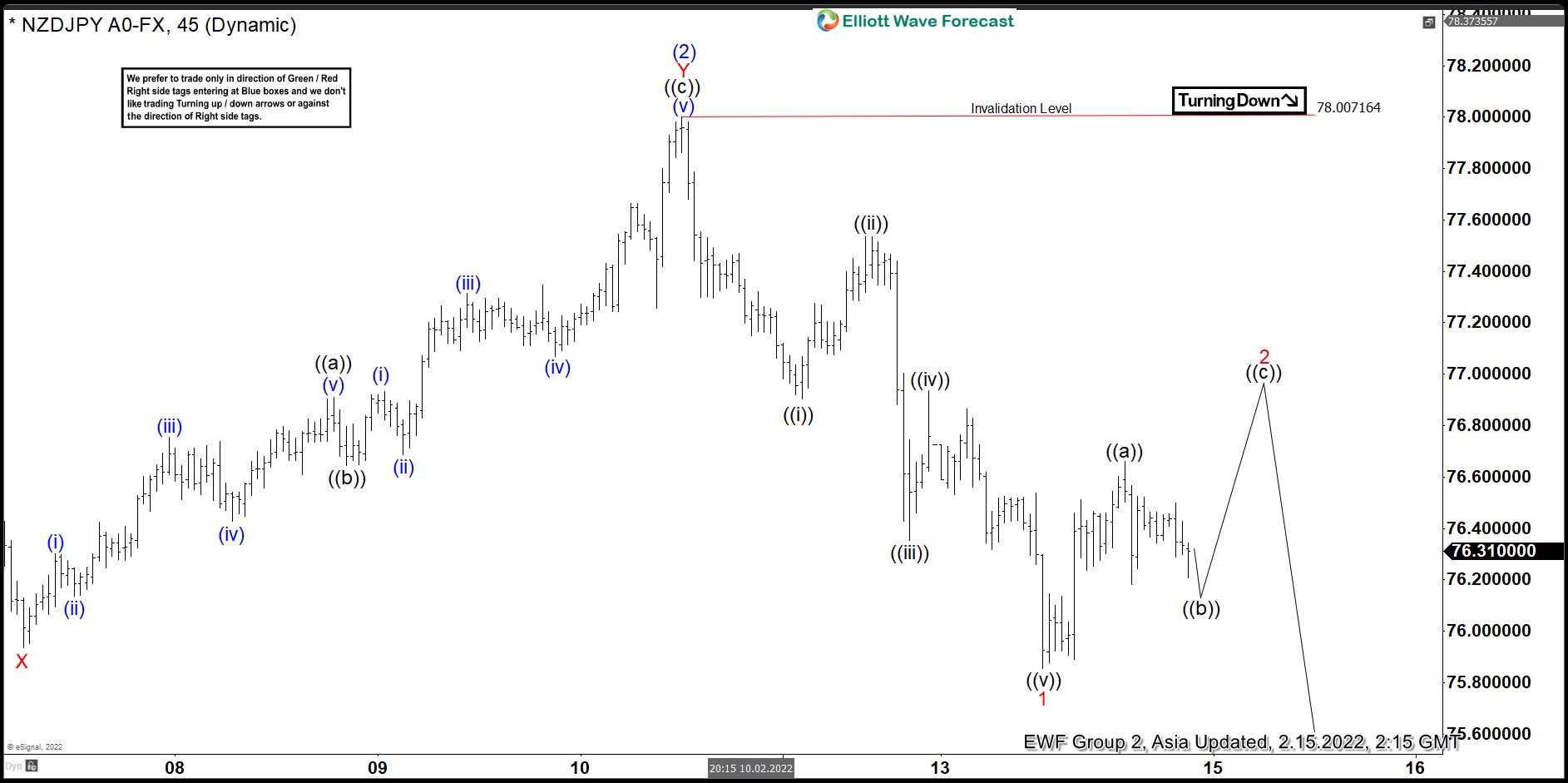
Short term Elliott Wave view in NZDJPY suggests that decline from January 5, 2022 peak is unfolding as a 5 waves impulse structure. Down from January 5 peak, wave (1) ended at 75.24 on January 28 and rally to 78 ended wave (2) on February 10. Internal subdivision of wave (2) unfolded as a double three Elliott Wave structure. Up from wave (1), wave W ended at 76.78, pullback in wave X ended at 75.96, and wave Y ended at 78 which also completed wave (2).
Wave (2) in this case ended at the 100% – 161.8% Fibonacci extension of wave W, suggesting the entire rally from wave (1) low is corrective 3 waves. Pair has turned lower in wave (3) but to rule out a double correction, pair still needs to break below wave (1) at 75.24. Down from wave (2), wave ((i)) ended at 76.9 and wave ((ii)) rally ended at 77.53. Wave ((iii)) ended at 76.35, wave ((iv)) ended at 76.93, and wave ((v)) of 1 ended at 75.85. Wave 2 rally is in progress to correct cycle from February 11 high in 3, 7 or 11 swing before pair resumes lower. Near term, as far as pivot at 78 high remains intact, expect rally to fail in 3, 7, or 11 swing for further downside.
NZDJPY 45 Minutes Elliott Wave Chart
Red Valentine’s for Bonds, Stocks
It might be Valentine’s Day, but government bonds are unlikely to find much love any time soon.
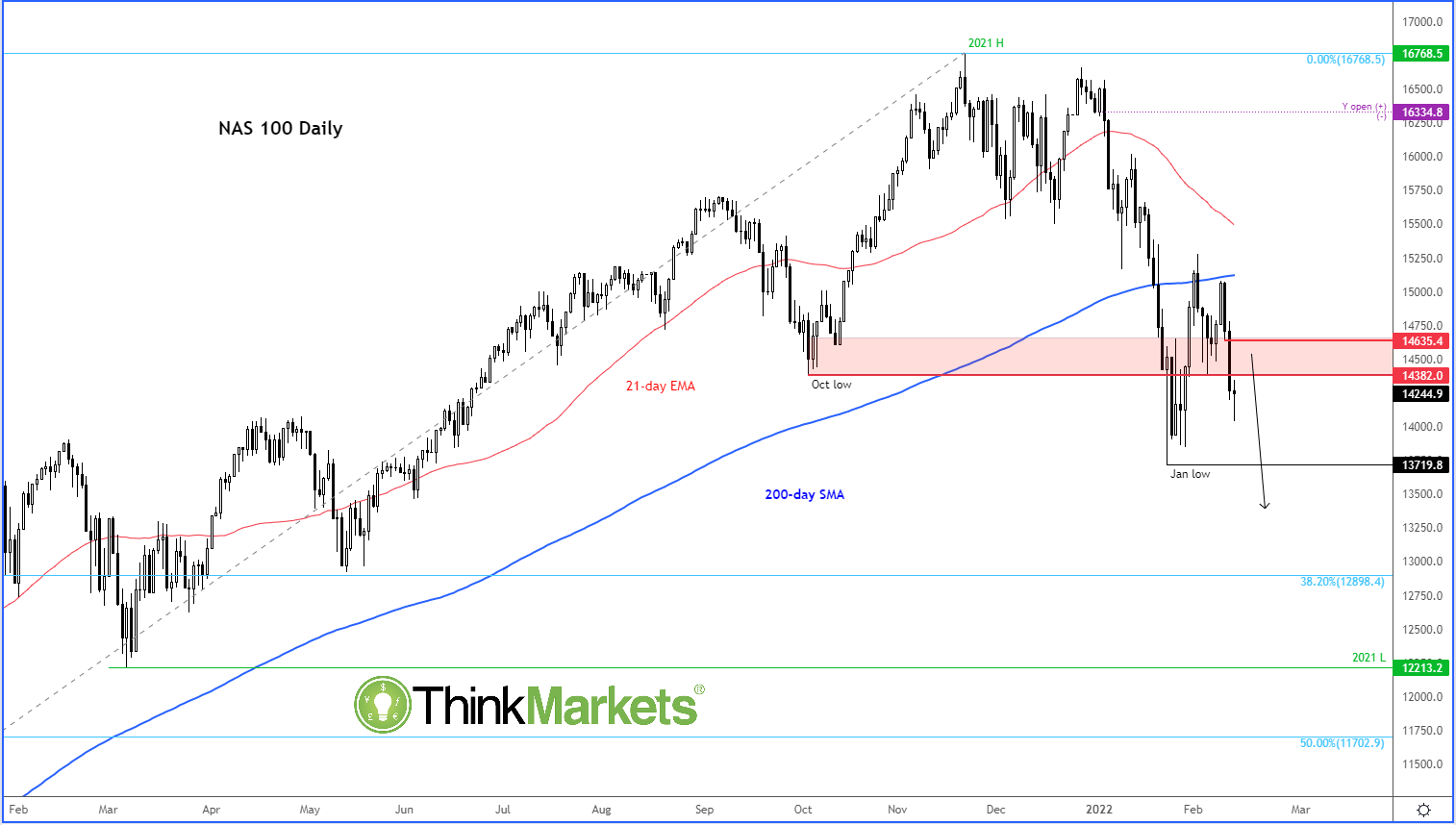
The key themes that have dominated market sentiment remains the same: inflation, central bank policy tightening and the Ukrainian situation. Sentiment remains cagey as fundamentally nothing has changed. We might see government bonds stage short-covering bounces here and there, but ultimately, they remain in a bear trend as traders front-run the Fed in anticipating policy tightening. Therefore, bond yields are likely to remain in an uptrend, which, at best, should limit the potential gains for over-valued technology stocks. For the same reason, the US dollar should continue to perform well against currencies where the central banks comparatively less hawkish.
Russia: We support diplomatic talks
In what has been a relatively quiet day for economic data, the start of the new trading week has been as one would have expected following last week’s selling into the close. European stocks and US futures fell noticeably this morning, although by around mid-day in London they managed to bounce back equally sharply. This was in response to comments from Russia’s foreign minister Sergey Lavrov. Mr Lavrov was addressing the press alongside President Vladmir Putin, and said he supports continuing diplomatic talks with the West in response to a question on whether "there was a chance for agreement" on key issues. He said he can see a way to move forward with talks. This eased investor nerves over an “imminent" invasion of Ukraine by Russia, something which Kremlin has continually denied.
Inflation: Elephant in the room
Beyond Russia and Ukraine, it is all about how central banks are going to address surging inflationary pressures around the world, not least the Federal Reserve. One particular Fed official who has been making headlines was at it again. St. Louis Fed President James Bullard repeated his call for 100 bps in hikes by 1st July. Bullard argues that the Fed needs to push interest rates up quickly because “our credibility is on the line here.”
We will have more inflation pointers to look forward to this week, in the form of headline and core producer price indices on Tuesday. PPI is expected to have risen by an additional 0.5% month-over-month in January, while core PPI is seen climbing 0.4% m/m. In addition, the FOMC’s minutes from its January meeting will be published on Wednesday, which could reveal more hawkish signals from policymakers.
How high will yields go?
So, the key question is what will happen to yields, which will, of course, have repercussions for other financial markets, not least US tech stocks. It is possible that if we see a stronger-than-expected PPI print that this will lead to further strength for yields. At around 2.0%, the 10-year yield is way lower than the 7.5% inflation rate. This means that real yields are actually -5.5%. This is bizarre, to say the least. The Fed’s QE programmes and strong foreign demand for US debt are the main reasons for this mis-match. The question is, why aren’t yields higher? Is it because the market is expecting nominal inflation rates to fall back, and quickly? Perhaps. Even if inflation falls back to around 3%, real yields would still be negative. Therefore, it is reasonable to expect yields to catch up with inflation. I reckon we will be heading towards 3.00% on the 10-year in the coming weeks, the speed of which will depend on incoming data and whether more Fed officials will turn as hawkish as Bullard. This should keep tech stocks under pressure, but support financials.
NZDCAD Wave Analysis
- NZDCAD reversed from resistance zone
- Likely to fall to support level 0.8350
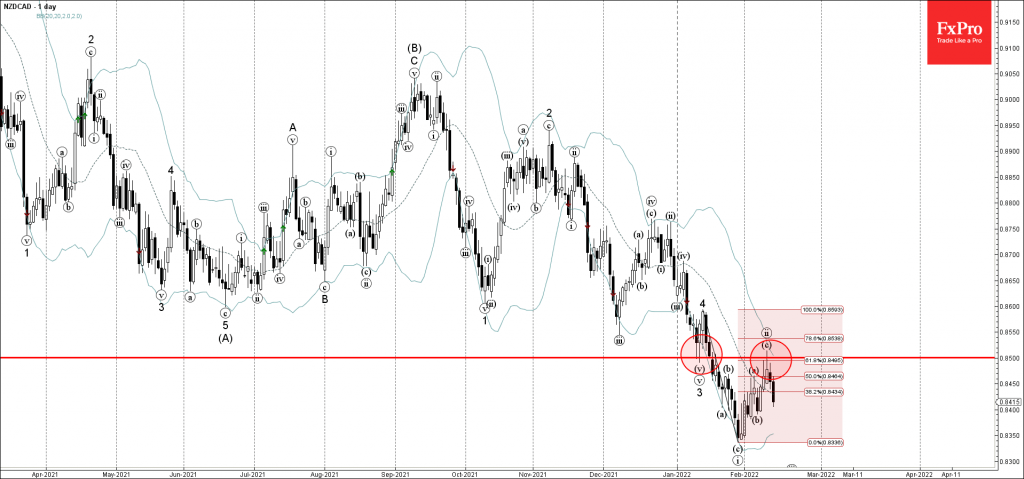
NZDCAD currency pair recently reversed down from the resistance zone located between the resistance level 0.8500 (former support from the start of January), upper daily Bollinger Band and the 61.8% Fibonacci correction of the downward impulse from December.
The downward reversal from this resistance zone stopped the previous short-term ABC correction (ii).
Given the clear daily downtrend- NZDCAD can be expected to fall further toward the next support level 0.8350 (low of the previous impulse wave (i)).
Eco Data 2/15/22
[php_everywhere instance="1"]
Pound Dips as Employment Data Looms
The pound is down at the start of the week, ahead of the January data report on Tuesday. In the European session, GBP/USD is trading at 1.3551, down 0.31% on the day. It’s a busy week in the UK, which will release inflation data on Wednesday and retail sales on Thursday.
The UK labour market remains robust, with many companies reporting difficulties trying to fill positions. Unemployment rolls fell by 43 thousand in December, and the downtrend is expected to continue in January, with an estimate of 28 thousand. There were concerns that unemployment would go through the roof when the furlough plan was removed, but this didn’t happen. Wage growth in December is expected to dip to 3.6%, down from 3.8% beforehand. This is well behind the pace of inflation, which surged to a 30-year high in December.
In the US, St. Louis Federal Reserve President James Bullard argued that the Fed must move more rapidly in raising rates. Bullard admitted that the Fed was “surprised to the upside on inflation”. Bullard, who is one of the most hawkish voting members, said last week that the Fed should raise rates by a full percentage point by July. The markets are leaning towards a 50 basis point hike in March, with a 61% likelihood, according to CME’s FedWatch. Bullard added that he was especially concerned with the surge in inflation since it was broad-based and could still be on the rise.
There are other voices in the Fed, of course, and investors will be looking for guidance from the Fed on the course of rate hikes this year. The Fed minutes, which will be released Wednesday, could provide some insights into the Fed’s plans.
GBP/USD Technical Analysis
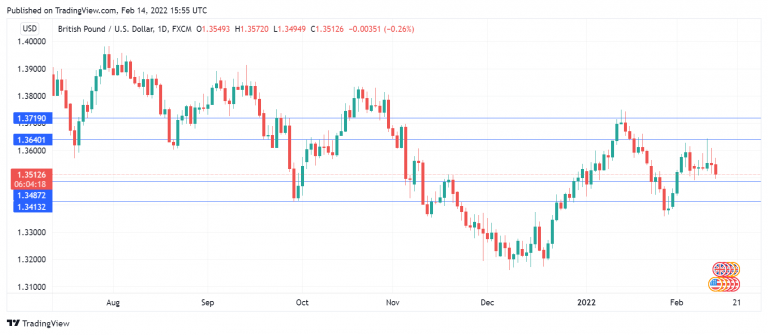
- GBP/USD is putting pressure on resistance at 1.3642. Above, there is resistance at 1.3756
- There is support at 1.3400 and 1.3272
Sunset Market Commentary
Markets
There were no important data in the US or EMU today. Even if this had been the case, they probably only had a secondary role to play. The market focus completely shifted from last week’s ‘inflation hype’ to the geopolitical tensions related to the Ukraine conflict. Rumours on imminent military action on Friday from Russia triggered an old-fashioned risk-off repositioning with equities selling off. It also provided a good excuse for at least some investors to take profit on bond-short positions in the wake of an impressive yield rally reinforced by multi-decade high US inflation published earlier last week. The Ukraine inspired risk-off also hit European stocks hard at the open. The EuroStoxx50 soon lost more than 3% and came close to the psychological barrier of 4000. Selling slightly eased, especially on headlines that Russian President Putin gave its Foreign Minister Lavrov the go ahead to continue talks aiming to reach a ‘diplomatic solution’. Still, most European indices are losing 2%+. US equities are opening little changed. On the interest rate markets, the 10-y Bund yield initially declined more than 10 bps points of Friday’s close. However, the safe haven bid gradually eased. German yields currently decline between 4.5 bps (30-y) up to 6.5 bps (5-y). This illustrates the risk-off side of the story. At the same time, EMU swap yields show quite a different picture, holding within reach of last week’s cycle peak levels. Brent oil touching a new cycle top north of $ 95 p/b over the weekend only illustrates that the inflation narrative stays omni-present and potentially even intensifies as the tensions around Ukraine persist. The EMU 10-y swap currently trades near 0.84% compared to a peak of 0.867% end last week. The US bond curve resumes a bear flattening trend after Friday’s risk-off rally with yields rebounding between 9 bps (2-y) and 5.5 bps (10 & 30-y).
Geopolitical tensions also dominated safe haven related price action on FX markets. The dollar, the yen and the Swiss franc all competed near Friday’s closing levels, with USD/JPY at 115.50, USD/CHF at 0.9252 and CHF/JPY at 124.85. Sterling maintained Friday’s gain against the single currency (EUR/GBP 0.8365) but additional gains were negligible. EUR/USD (1.131) drifted further south and almost touched the 1.13 big figure. In Central Europe, the Czech krone and the zloty due to internal stories (cf infra) decoupled from the broader risk-off. The forint slightly underperformed (EUR/HUF 357.25).
News Headlines
New Polish central bank policy maker Kotecki in his first interview said there is no alternative than to aggressively tighten monetary policy to tackle high inflation. Growth is faster than expected and wage costs are spiraling. Kotecki said that the government is adding fuel to the fire by having introduced tax cuts from fuels to food that could trigger a delayed surge in prices. He cannot set any terminal policy rate right now. His comments came a few days after the central bank raised rates for a fifth time straight to 2.75%. More hikes are imminent. Polish money market rates added 13 bpn, expecting another 125 bps rate increases over the course of the next three months. The Polish zloty’s intraday reversal strengthened after the comments, bringing EUR/PLN from 4.59 to 4.53.
Czech CPI beat both market and CNB estimates in January. Prices rose at an accelerated 9.9% y/y, coming from 6.6% in December. The increase was broad-based and the result of companies’ new price list reflecting the general strong inflationary environment. The reintroduction of VAT on electricity and gas after being suspended in November and December provided an additional boost, most visible in housing (9.6% m/m!). Travel (10.8% m/m), recreation & culture (3.3% m/m) and hotels & restaurants (3% m/m) are some of the biggest other contributors. The figure puts pressure on the CNB after it suggested the latest rate hike may have been the final one. Markets expect one more 25 bps. This would bring the policy rate to 4.75%. The Czech crown initially failed to profit because of the risk-off settings but currently ekes out a gain to EUR/CZK 25.49 (from 25.56 at Friday’s close) after all.
Fed Bullard: We need to front-load more of our planned removal of accommodation
St. Louis Fed President James Bullard told CNBC today, "we need to front-load more of our planned removal of accommodation than we would have previously. We've been surprised to the upside on inflation. This is a lot of inflation."
"Our credibility is on the line here and we do have to react to the data," he added. "However, I do think we can do it in a way that's organized and not disruptive to markets." Bullard added that Fed should raise interest rate by a full percent point by July. "I think my position is a good one, and I'll try to convince my colleagues that it's a good one," he said.
Regarding the 7.5% consumer inflation rate in January, Bullard said, "my interpretation was not so much that report alone, but the last four reports taken in tandem have indicated that inflation is broadening and possibly accelerating in the U.S. economy,"
"The inflation that we're seeing is very bad for low- and moderate-income households," he said. "People are unhappy, consumer confidence is declining. This is not a good situation. We have to reassure people that we're going to defend our inflation target and we're going to get back to 2%."
As Russia-Ukraine Tensions Persist, Dollar Strengthens
Ukraine tensions and FOMC minutes in focus; dollar rises
As the United States fears that an invasion may be approaching, tensions over Russian forces stationed near Ukraine are entering what might be a pivotal week. The United States is warning of an imminent invasion, while President Vladimir Putin has accused America of failing to satisfy his demands. Russia has denied it is preparing to invade Ukraine, and Chancellor Olaf Scholz of Germany is travelling to Kyiv today, a day before visiting Moscow to calm the issue.
This week's focus is on the minutes of the FOMC meeting. As of the time of writing, the markets are pricing in a 50-basis-point rate increase for March. A more aggressive tightening cycle may be discussed in the minutes. The Federal Reserve's remarks on the topic will be keenly monitored as well.
As long as tensions with Russia persist, the dollar is likely to remain strong. The US dollar index is flying around 96.30, surpassing successfully the short-term simple moving averages (SMAs). Dollar/yen is moving slightly higher, while US stock futures are paring losses after a negative trade, suggesting a slight easing in risk aversion.
Euro and pound find support at $1.13 and $1.35
A Russian invasion of Ukraine would have the greatest impact on Europe. The euro is still under pressure and is currently seeking support near $1.1300. The pound is diving to around $1.3500 after finding support near $1.3500.
Commodities retreat after aggressive gains; aussie and kiwi fall
In other markets, the commodity currencies are heading south. Aussie/dollar is declining below the 0.7100 round number, while kiwi/dollar is plunging below 0.6600 after the pullback off the medium-term descending trend line. Dollar/loonie is gaining ground near 1.2780.
Oil prices are on the verge of hitting $100 per barrel, which could lead to increased inflation, stifling the global economy. Many countries' central banks are taking action to rein in increasing prices by implementing stricter monetary policies. WTI crude oil futures are currently falling after the climb to $94.91/per barrel. Moreover, gold prices surpassed the previous high of $1,853/per ounce, shifting the short-term outlook to positive. However, today, the price started in a negative mode.