Sample Category Title
Forex and Cryptocurrency Forecast
EUR/USD: Another Surprise, from the ECB This Time
It's hard to resist when you're attacked from both sides. The dollar received two powerful blows last week: one from the Bank of England, the second from the ECB, and could not resist them. The USD DXY index flew down. While it was at the level of 97.36 on January 28, it dropped to 95.14 on February 04. This is not a knockout of course, but a knockdown from which it will be difficult for the US currency to recover quickly.
So, the Bank of England raised the interest rate by another 25 basis points (bp) to 0.50%, which was expected. But what shocked the markets was a shift in the direction of the ECB's monetary policy. The market was waiting for the regulator to start discussing such changes towards the end of the year. But it turned out that this could happen much earlier. Maybe already in the spring.
The data on unemployment in the Eurozone exceeded all wildest expectations: its level fell to 7.0%. But this is not all either. The growth of consumer prices in January accelerated from 5% to 5.1% and renewed its historical high. This is despite the fact that many expected the opposite. For example, Bloomberg experts predicted a slowdown in inflation to 4.4%.
It is known that unemployment and inflation are the main factors that determine the monetary policy of regulators in the current environment. And if the head of the ECB, Christine Lagarde, stated until recently that her bank would not copy the actions of the Fed, she was forced to admit at a press conference on Thursday, February 03 that "the situation has really changed."
"Inflation is likely to remain high longer than initially expected," said Ms Lagarde. "Compared to our December estimates, current inflation risks are biased upwards. especially in the short term".
The head of the ECB did not repeat the mantra about the "extremely low probability" of a rate hike in 2022. And, although the key rate remained unchanged at 0% at the last meeting, it became known from informed sources that the bank's officials are already discussing the possibility of raising it at the end of this year. According to some experts, it could rise by as much as 40 or even 50 bp.
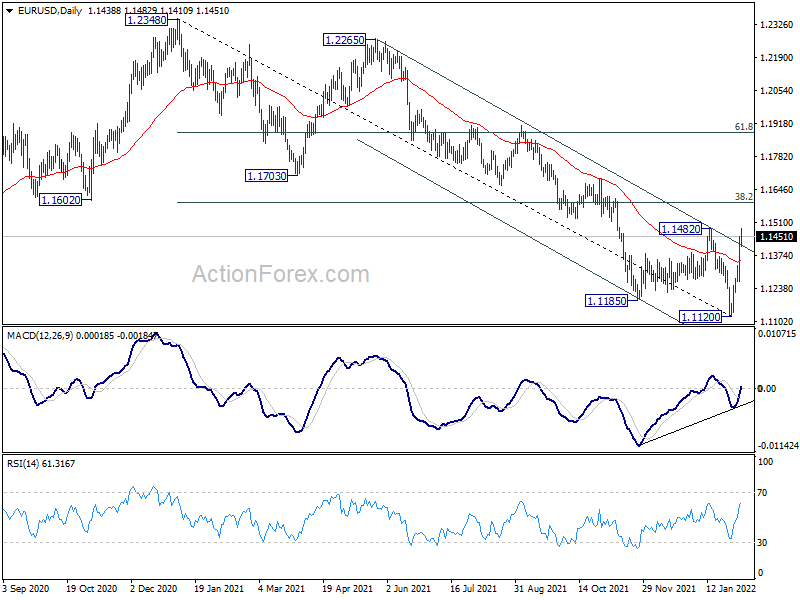
So, apparently, the European regulator is abandoning the policy of patience and, together with the US Federal Reserve and the Bank of England, joins the "hawk" race to tighten monetary policy. It is appropriate to draw an analogy between Christine Lagarde's current statement and what her American colleague Jerome Powell said in June 2021. The head of the Fed said something similar then, after which the dollar began to sharply gain strength and won 1135 points back from the euro, lowering the EUR/USD pair from 1.2255 to 1.1120. Now it seems that it is time for the euro to recoup its losses.
In addition to the frontal blows from the Bank of England and the ECB, the US currency also received backstabs from the "native" Fed. At least six representatives of the US Central bank made comments last week, and none of them mentioned that the FOMC (Federal Open Market Committee) could immediately raise rates by 50 bp at its meeting in March (although the market was waiting for this).
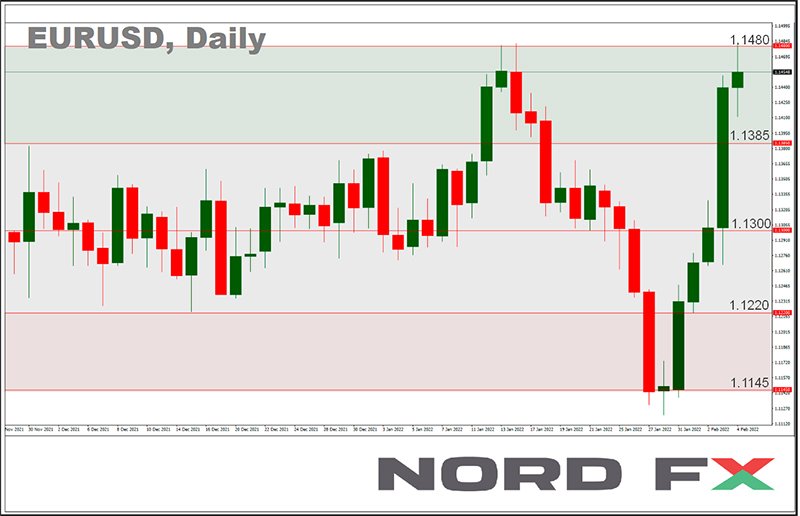
The result of all the events of the week, so painful for the dollar, was an impressive strengthening of the European currency. The EUR/USD pair has shown an active growth, which has not been seen since the beginning of the pandemic: it rose by 343 points in a week, from 1.1140 to 1.1483.
True, the dollar was slightly supported by statistics from the US at the very end of the working week, on Friday, February 04. Such an important indicator as the number of new jobs created outside agriculture (non-farm payrolls) was fixed at 467K, while the market expected it to fall to 150K. As a result, the dollar strengthened slightly, and the pair set the last chord at 1.1453.
Most of the indicators on D1 turned up by the end of the five-day period. Among the trend ones, there were 85% of them (15% are still colored red), among the oscillators - 80%, the remaining 20% took a neutral position. Among the experts, opinions are divided almost evenly, although the bulls have still got a slight advantage: 45% are in favor of continuing the uptrend, 35% are for moving down and 20% are for the sideways trend.
The nearest resistance is the highs of January 13 and February 04 in the zone of 1.1480, followed by 1.1525, 1.1560 and 1.1625. Supports are in zones and at levels 1.1365-1.1385, 1.1275, 1.1220, 1.1185 and Jan 28 low 1.1120.
As for the events of the upcoming week, the most important of them are related to inflation and will concern the consumer market. So, the values of the US Consumer Price Index (excluding food products and energy carriers) will become known on Thursday, February 10, and the values of the Harmonized Consumer Price Index of Germany and the Consumer Confidence Index of the University of Michigan USA will be published on Friday, February 11.
GBP/USD: The Bank of England: Not a Dove Yet, No Longer a Hawk
Of course, the general weakening of the dollar affected the GBP/USD pair as well, which recorded the weekly high at 1.3627. However, as mentioned above, the increase in the interest rate by the Bank of England did not come as a surprise to anyone and had already taken into account by the market in quotations. In contrast to the statement of the head of the ECB, Christine Lagarde, which produced the effect of a bombshell. As a result, the European currency gained a significant advantage over the British one, and the EUR/GBP pair rose by more than 2.2%, from 0.82843 to 0.84650. As for GBP/USD, it finished well below the local high, at 1.3528 for the same reason.
The bulls on the pound were also disappointed by disagreements among members of the Bank of England committee. Only 4 out of 9 voted to raise the rate by 50 bps. The majority, including the head of the bank, Andrew Bailey, decided to raise rates by only 25 basis points, citing a slowdown in economic growth.
This regulator will apparently continue to act in an extremely balanced manner, which was confirmed by the chief economist of the Bank of England, Hugh Pill. He said in an interview with Reuters that the bank expects "further moderate tightening in the coming months if everything goes as planned" and that "you need to be careful in setting the rate level."
Strategists at Japan's MUFG Bank say this sneaky stance limits the prospects for a stronger British currency. MUFG does not expect a steady growth of the pound and believes that if the movement of GBP/USD to 1.4000 continues, the pair will encounter many pits and bumps along the way. And their colleagues from Scotiabank look in the opposite direction at all. In their opinion, due to the inability to gain a foothold above 1.3600, the British currency is now at risk of falling to 1.3400 initially and possibly to 1.3200 in a relatively short term.
The majority of experts (55%) are still set for further growth of the GBP/USD pair at the moment, the remaining 45% have taken the opposite position. The indicators on D1 look like this: 45% of oscillators point north, 10% point south, the remaining 45% remain neutral. Among trend indicators, 40% look up, 60% look down. Supports are located at 1.3500, 1.3425, 1.3365, next strong support is 100 pips lower. Levels and resistance zones: 1.3570-1.3600, 1.3640, 1.3700, 1.3750, 1.3835 and 1.3900.
Highlights of the coming week include a speech by Bank of England Governor Andrew Bailey on Thursday, February 10, and the release of UK GDP and industrial production data on Friday, February 11.
USD/JPY: Calm, and Calm Again
While most G10 Central banks are either raising rates or becoming more aggressive (like the ECB), the BOJ's slogan is still "calm and calm again". Safe haven should remain as quiet as possible with its perpetually negative (minus 0.1%) interest rate.
It is already clear that, since inflation in Japan does not show signs of approaching the target level of 2% set by the Japanese regulator, its actions will lag behind the actions of other Central banks. And this, according to analysts at CIBC Capital Markets, will continue to put pressure on the yen.
At some point, rumors began circulating in the market that the Bank of Japan could move to normalize its monetary policy this year. However, the Bank's statement released after the January meeting made it clear that this is nothing more than speculation. Since central bank Governor Haruhiko Kuroda keeps saying that it is far from reaching the inflation target of 2.0%, his organization is quite comfortable with the weak yen.
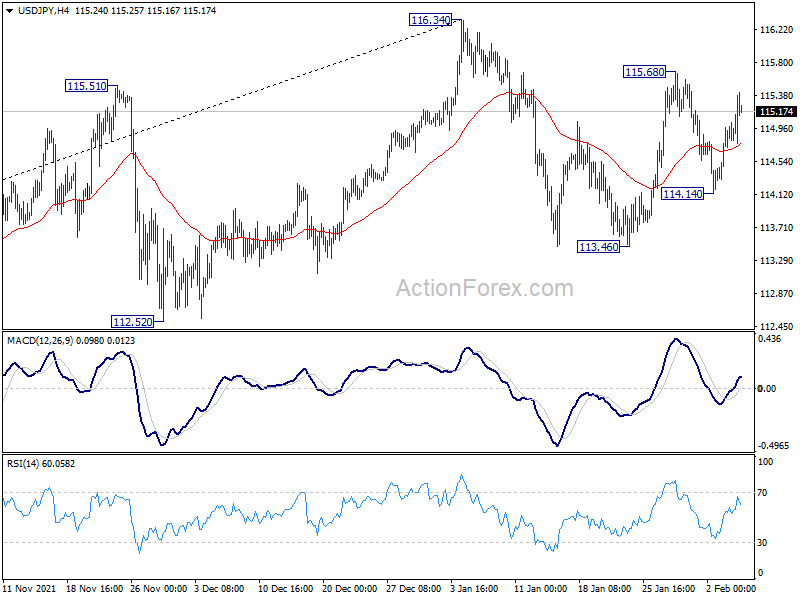
What has been happening to the USD/JPY pair over the past four months can be considered a sideways trend with a predominance of bullish sentiment. So the general weakening of the dollar practically did not help the Japanese currency last week: having fallen on February 02 to the level of 114.14, the pair returned to the same place where it started, to the zone of 115.20, by the end of the week.
At the time of writing, the majority of experts (55%) expect the USD/JPY pair to continue moving towards a multi-year high of 116.35, recorded on January 04. The remaining 45% believe that the weakened dollar will still put downward pressure on it. All 100% of the indicators are green, although 15% of the oscillators give signals of the pair being overbought.
Support levels and zones are 115.00, 114.55-114.80, 114.15, 113.75, 113.45, 113.20, 112.55 and 112.70. The nearest resistance zone is 115.50-115.70, the nearest serious target of the bulls is a new five-year high at 116.35.
No serious macroeconomic statistics from Japan are expected either last or next week. We only note that Friday, February 11 is a day off in Japan. The country celebrates Kenko Kinen No Hi, the National Foundation Day. It is believed that the first emperor of Japan, Jimmu, ascended the throne on this day in 660 BC and founded the Imperial Dynasty of Japan and the State of Japan.
CRYPTOCURRENCIES: Who Is in Charge in the BTC/USD Pair? Answer: US Federal Reserve
Whatever crypto enthusiasts say, bitcoin has long ceased to be an independent asset. And the decisive factor intheBTC/USD pair is the dollar. And the strength or weakness of the US currency depends, in turn, on the policy of the US Federal Reserve (and partly on the actions of other Central banks).
The same crypto enthusiasts crave an inflow of funds from institutional investors like manna from heaven. And the latter are waiting for the regulators to establish clear rules governing the work with digital assets. Therefore, the movement of quotes of leading cryptocurrencies will depend (and already depends) not on the mood of millions of small players, but on the mood of just a few governments and Central banks. Just look at the correlation between the cryptocurrency and stock markets. This link is becoming more and more rigid and is determined by the risk sentiment of large investors.
Of course, short-term fluctuations in BTC/USD can be affected by events such as bad weather that has suspended miners in Texas. But the main trends are set not by them, but by the actions of regulators.
Bitcoin is now perceived as a "money commodity". Analysts of Fidelity Digital Assets came to this conclusion, calling the first cryptocurrency not only a technology, but also a perfect form of money. And what kind of government will allow the flow of "perfect" money to pass it by? And there may be two solutions: either to ban them completely, as in China, or to take them under strict control.
The Central Bank of Russia wanted to follow the Chinese version. But Russia's President Vladimir Putin supported the proposal of the Ministry of Finance not to ban, but to regulate the cryptocurrency market, including their circulation and mining. This is a very serious decision, because, according to Bloomberg, residents of Russia possess a huge number of digital assets worth about $214 billion. In addition, according to the University of Cambridge, Russia became the third country in the world in bitcoin mining (11.23%) in the summer of 2021, after the USA (35.4%) and Kazakhstan (18.1%), where many miners migrated after the ban in China.
MicroStrategy founder Michael Saylor also believes that the current problems in the cryptocurrency market are caused, first of all, by the non-transparent regulation and regulatory uncertainty of the crypto industry. According to Saylor, many institutional investors are now tracking bitcoin, however, they are in no hurry to invest in it.
According to JPMorgan analysts, the persistence of high volatility, which limits the adoption of bitcoin by institutions, is also an obstacle.
Interestingly, analysts at another major investment bank, Goldman Sachs, agree that cryptocurrencies are unlikely to escape the influence of macroeconomic forces, such as the monetary policy of the US Federal Reserve. However, they believe that the mass adoption of cryptocurrency may not improve, but, on the contrary, worsen the chances for its long-term growth. Experts argue that the global popularity of digital assets will further increase their correlation with the traditional ones. This, in turn, will reduce the volatility of cryptocurrencies and reduce both their speculative attractiveness and their advantages as a diversifying asset in investor portfolios.
As for the current situation, despite a solid bounce off its 90-day low of $32,950, the main cryptocurrency has been unable to overcome the strong resistance in the $38,000-39,000 zone for a long time. However, the BTC/USD pair went on a breakthrough and reached $40,880 at the time of writing the review, on the evening of Friday, February 04.
The total market capitalization for the week has grown slightly: $1.85 trillion compared to $1.70 trillion seven days ago, and the Crypto Fear & Greed Index has deepened even more into the zone of Extreme Fear, falling from 24 to 20 points.
The latest JPMorgan report notes that "open interest in futures and the volume of exchange balances indicate less panic or liquidation of positions than in last May, especially in relation to large crypto investors". At the same time, the bank's specialists do not exclude a further decrease in bitcoin quotes, even in the absence of signs of capitulation of buyers. They seriously lowered the fair value of the first cryptocurrency from $150,000 to $38,000.
According to Business Insider, JPMorgan's model assumed that bitcoin's volatility would converge with gold's volatility and equalize their shares in investment portfolios. Now, the bank's analysts have acknowledged that their previous forecast that the bitcoin-to-gold volatility ratio would drop to around 2/1 by the end of 2022 proved to be unrealistic, leading to the downgrade.
Peter Brandt, a well-known Wall Street trader with 45 years of experience, notes that most crypto enthusiasts are now in an extremely bearish mood. Most of the participants in the Laser Eyes flash mob are confident that the price of bitcoin will fall below $30,000 in the near future. According to the expert, this may be a signal to buy the first cryptocurrency. "When the bulls wear laser eyes, it's time to sell. When bulls turn bears, is it time to buy?" Brandt asks.
Recall that the "Laser Eyes" flash mob started on Twitter in February 2021, when bitcoin reached a local high of $58,300. After that, many supporters of the first cryptocurrency, in anticipation of its growth to $100,000, posted photos with "laser eyes" as their profile avatar. Co-founder of Morgan Creek Digital Anthony Pompliano, TV presenter Max Kaiser, CEO of Binance crypto exchange Changpeng Zhao, Tesla CEO Elon Musk and other influencers were among the participants in the flash mob.
However, instead of rising to $100,000, the flagship cryptocurrency collapsed to $29,000 by June. So, Peter Brand's current remark about "laser eyes" in bears clearly deserves attention.
It is also worth paying close attention to the results of the round table organized by the Finder analytical website. The discussion was attended by 33 fintech experts, half of whom do not expect the cryptocurrency price to fall even against the backdrop of the upcoming increase in US interest rates. The average forecast given by the participants of the table says that bitcoin could soar to a high of $93,717 this year and is expected to be worth $76,360 by the end of 2022 and close to $193,000 by the end of 2025.
Vanessa Harris, director of the cryptocurrency startup Permission, was among the most optimistic participants in the discussion. She predicts that BTC will peak at $220,000 this year. A much more modest figure was voiced by the founder of the CoinFlip bitcoin ATM network, Daniel Polotsky. In his opinion, the cryptocurrency is unlikely to exceed $60,000 in 2022 as the bubbles created by the US Federal Reserve during the pandemic are now deflating.
Crypto analyst Jason Pizzino predicts BTC growth as well. According to his forecast, bitcoin will still enter an accumulation period in the medium term, when whales and investors with smart money will begin to invest in cryptocurrency, waiting for its next bullish trend. This may take a whole year, during which the BTC rate will rise. According to Pizzino's forecast, bitcoin is able to reach a new price high in the second half of 2022, but this will not be a sharp upward movement but a series of ascents.
Finally, the most cosmic forecast was given by Circle CEO Jeremy Aller in an interview with Business Insider. In his opinion, the worldwide adoption of bitcoin will certainly contribute to the growth of this coin to $1 million. The businessman admitted that he is not a "bitcoin maximalist", but he still believes in new cryptocurrency highs. At the same time, he prefers not to compare bitcoin with gold, believing that the digital asset is much more efficient than precious metals. According to the head of Circle, gold as money is simply useless in modern society.
EUR/USD Weekly Outlook
EUR/USD's strong rebound last week argues that a medium term bottom could be in place at 1.1120, on bullish convergence condition in daily MACD. Initial bias stays on the upside this week. Break of 1.1482 resistance will target 38.2% retracement of 1.2348 to 1.1120 at 1.1589 next. Sustained break there will argue that whole fall from 1.2348 has completed too and target 61.8% retracement at 1.1879. On the downside, break of 1.1329 minor support will mix up the outlook and turn intraday bias neutral first.
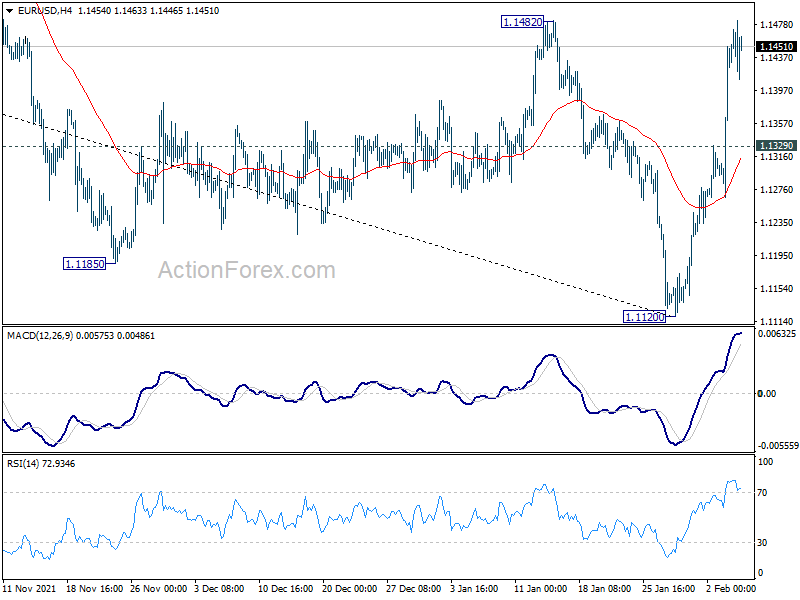
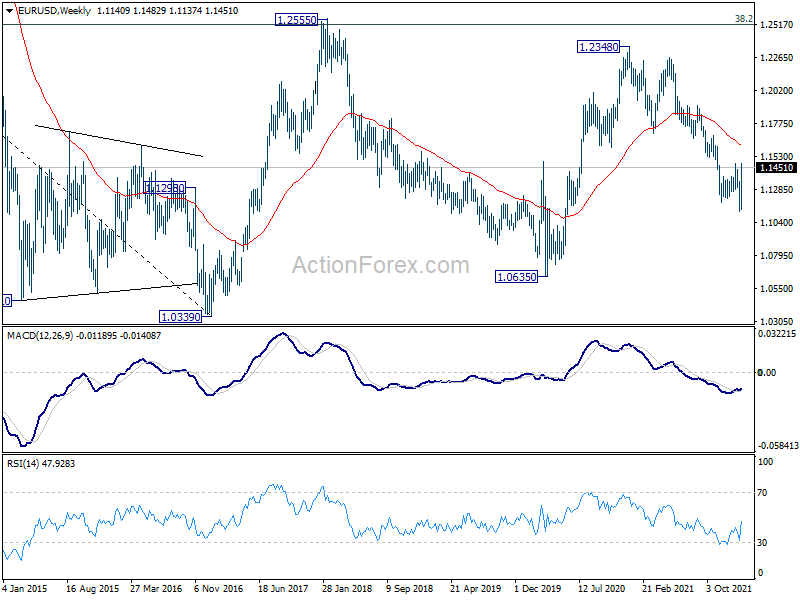
In the bigger picture, the decline from 1.2348 (2021 high) is seen as a leg inside the range pattern from 1.2555 (2018 high). Sustained trading above 55 week EMA (now at 1.1613) will argue that it has completed and stronger rise would be seen back towards top of the range between 1.2348 and 1.2555. However, firm break of 1.0635 (2020 low) will raise the chance of long term down trend resumption and target a retest on 1.0339 (2017 low) next.
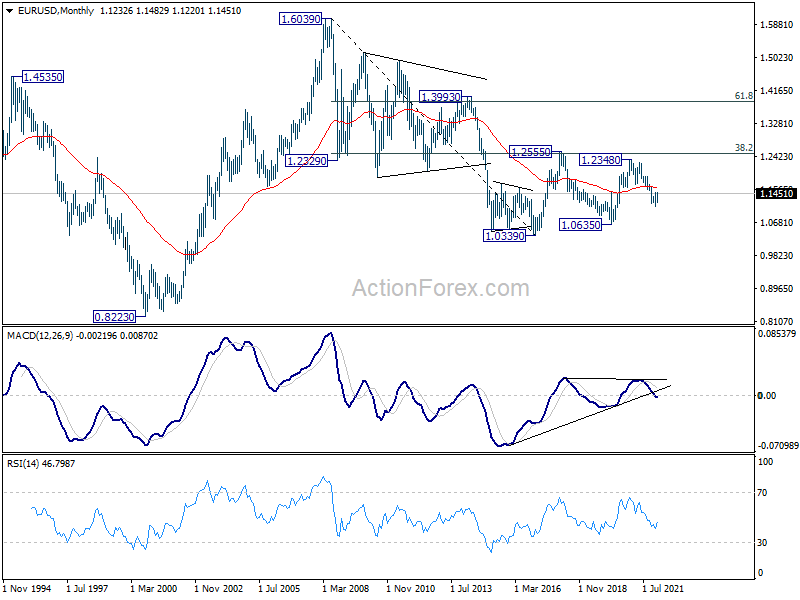
In the long term picture, in another case, as long as (38.2% retracement of 1.6039 (2008 high) to 1.0339 (2017 low) at 1.2516 holds, the down trend from 1.6039 could still resume through 1.0339 low. However, sustained trading above 1.2516 will argue that the long term trend has reversed.
USD/JPY Weekly Outlook
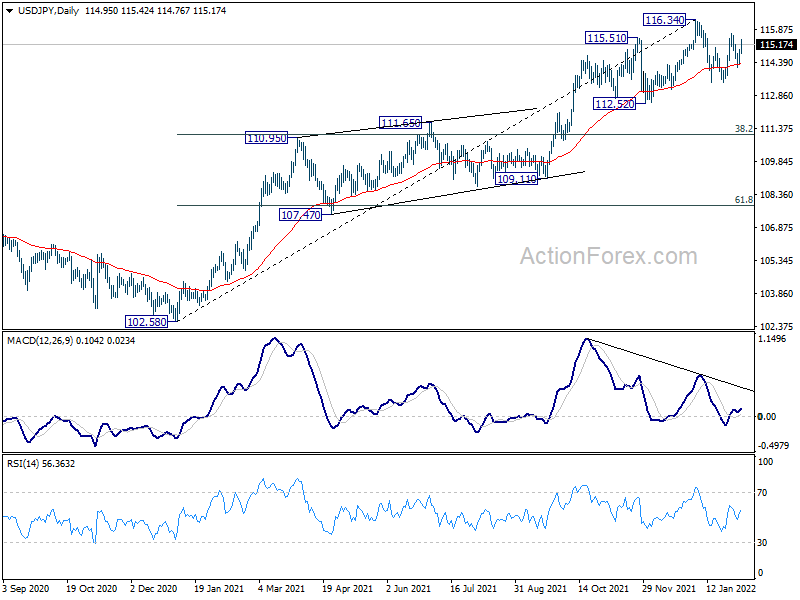
USD/JPY extended the consolidation pattern from 116.34 last week and outlook is unchanged. Initial bias remains neutral this week first. On the upside, break of 115.68 will resume the rebound from 113.46 to retest 116.34 high first. On the downside, break of 114.14 should extend the consolidation with another falling leg through 113.46 support.
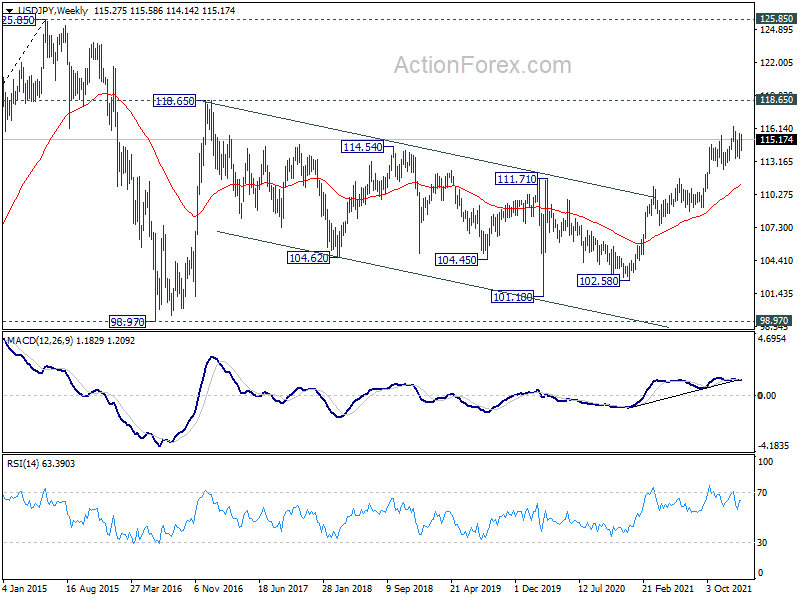
In the bigger picture, no change in the view that rise from 102.58 is the third leg of the up trend from 101.18 (2020 low). Such rally should target a test on 118.65 (2016 high). Sustained break there will pave the way to 120.85 (2015 high) and raise the chance of long term up trend resumption. This will remain the favored case as long as 55 week EMA (now at 111.21) holds.
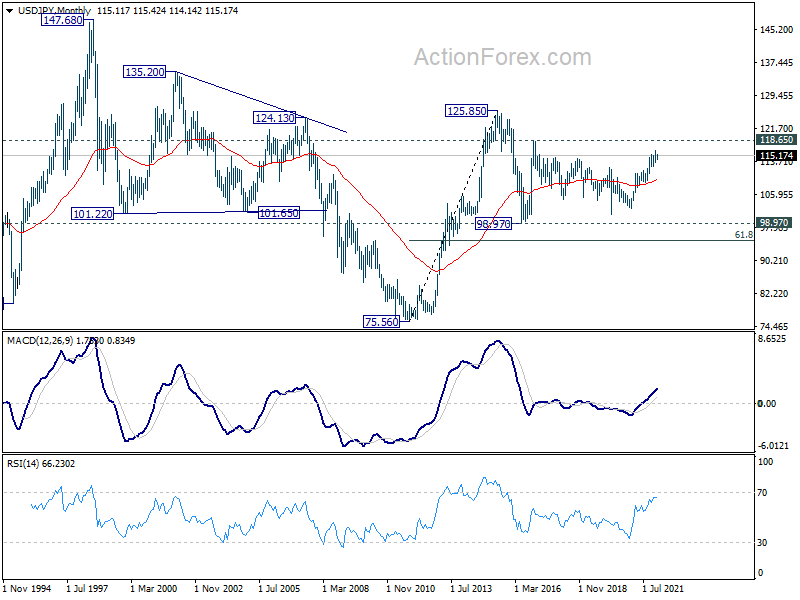
In the long term picture, the rise from 75.56 (2011 low) long term bottom to 125.85 (2015 high) is viewed as an impulsive move, no change in this view. Price actions from 125.85 are seen as a corrective pattern which could still extend. In case of deeper fall, downside should be contained by 61.8% retracement of 75.56 to 125.85 at 94.77. Up trend from 75.56 is expected to resume at a later stage for above 135.20/147.68 resistance zone.
GBP/USD Weekly Outlook
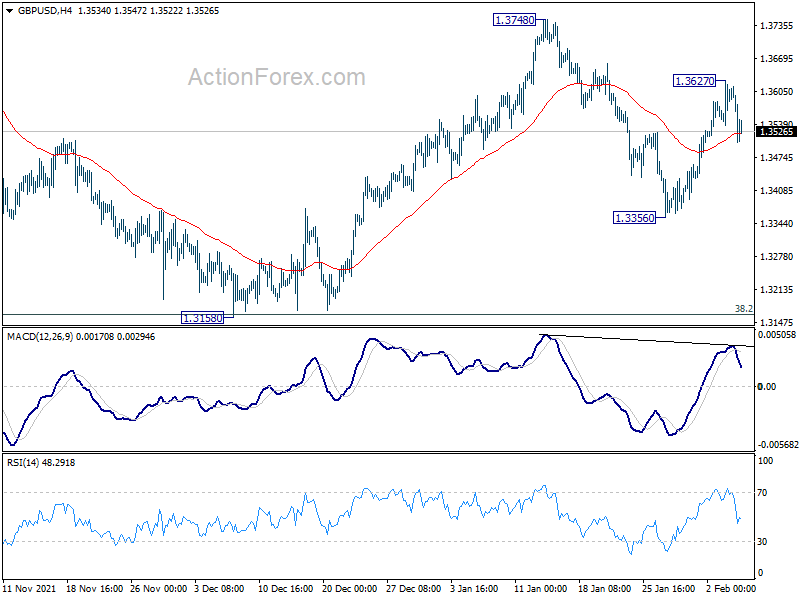
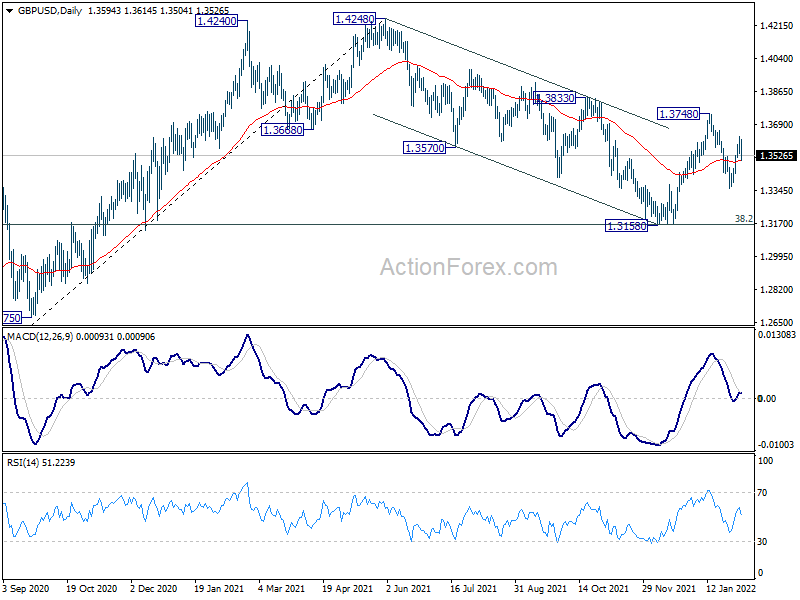
GBP/USD rebounded to 1.3627 last week but retreated since then. Initial bias is neutral this week first. On the upside, break of 1.3627 will resume the rebound to 1.3748 resistance. Firm break there will revive the bullish case that correction from 1.4248 has completed with three waves down to 1.3158. Further rally should then be seen to retest 1.4248 high. On the downside, however, break of 1.3356 will bring retest of 1.3158 low.
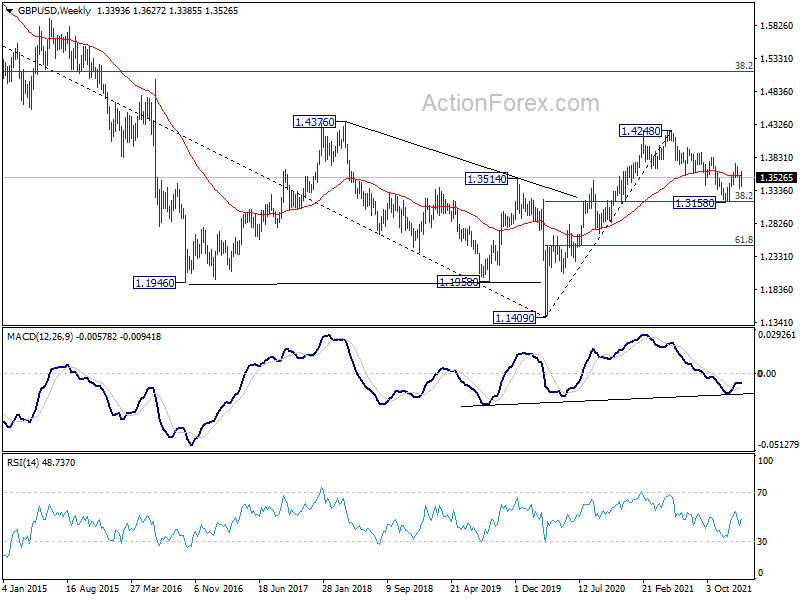
In the bigger picture, as long as 38.2% retracement of 1.1409 to 1.4248 at 1.3164 holds, up trend from 1.1409 (2020 low) is still in progress. On resumption, next target will be 38.2% retracement of 2.1161 to 1.1409 at 1.5134. Nevertheless sustained break of 1.3164 will argue that whole rise from 1.1409 has completed and bring deeper fall to 61.8% retracement at 1.2493.
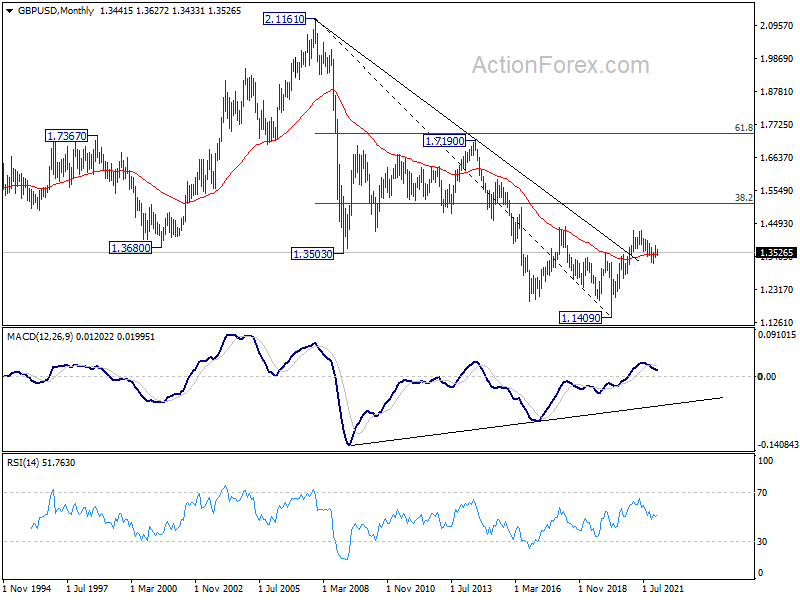
In the longer term picture, a long term bottom should be in place at 1.1409, on bullish convergence condition in monthly MACD. Rise from there would target 38.2% retracement of 2.1161 to 1.1409 at 1.5134. Reaction from there would reveal whether rise from 1.1409 is just a correction, or developing into a long term up trend.
USD/CHF Weekly Outlook
USD/CHF edged higher to 0.9341 last week but retreated since then. It's basically still stuck in range trading below 0.9372 resistance. Initial bias is neutral this week first. For now, further rise will remain mildly in favor as long as 0.9090 support holds. break of 0.9372 will resume the choppy rally from 0.8925 to 0.9471 high. However, break of 0.9090 will turn bias back to the downside for 0.8925 support instead.
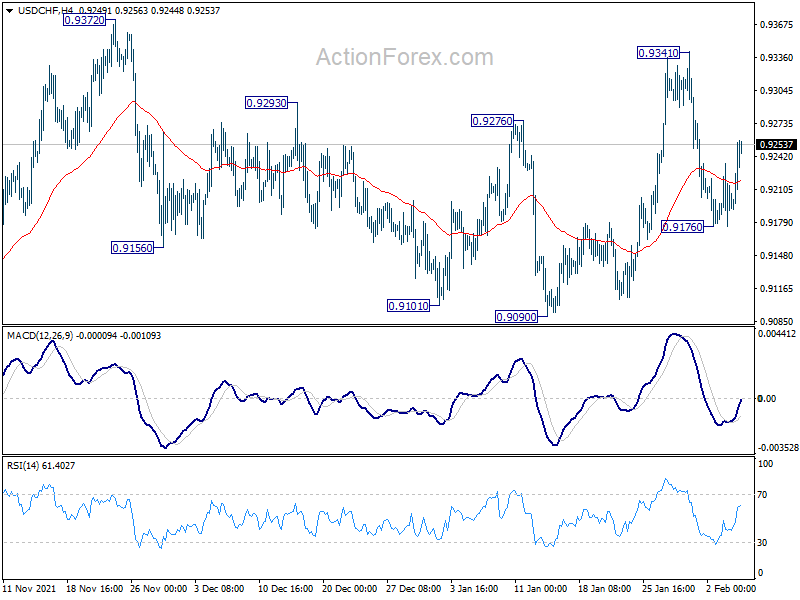
In the bigger picture, medium term outlook will be neutral at best as long as 0.9471 resistance holds. Larger down trend could still extend through 0.8756 (2021 low). However, firm break of 0.9471 will argue that the trend has already reversed and rebound the rally from 0.8756 with another impulsive move.
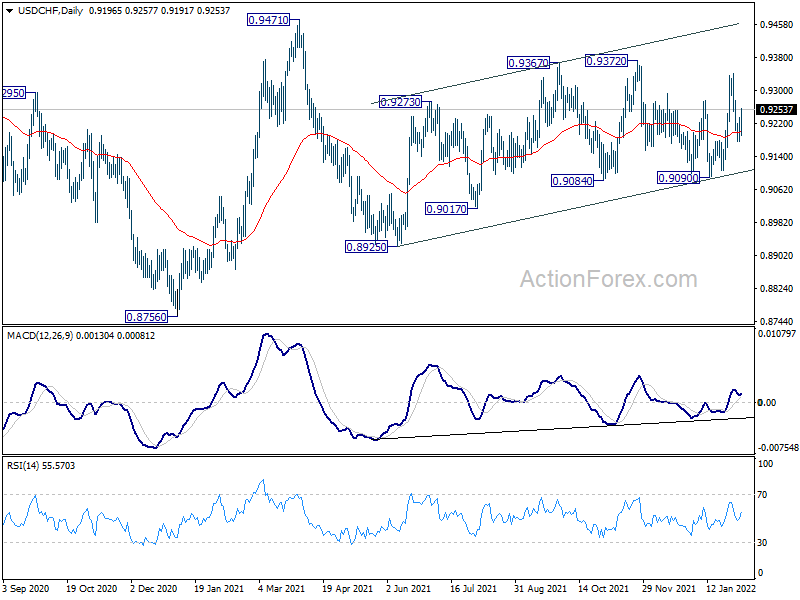
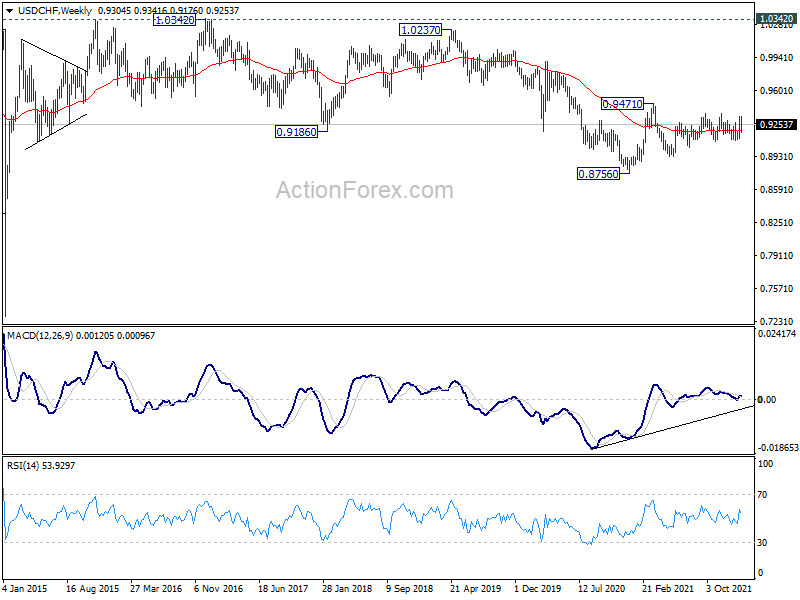
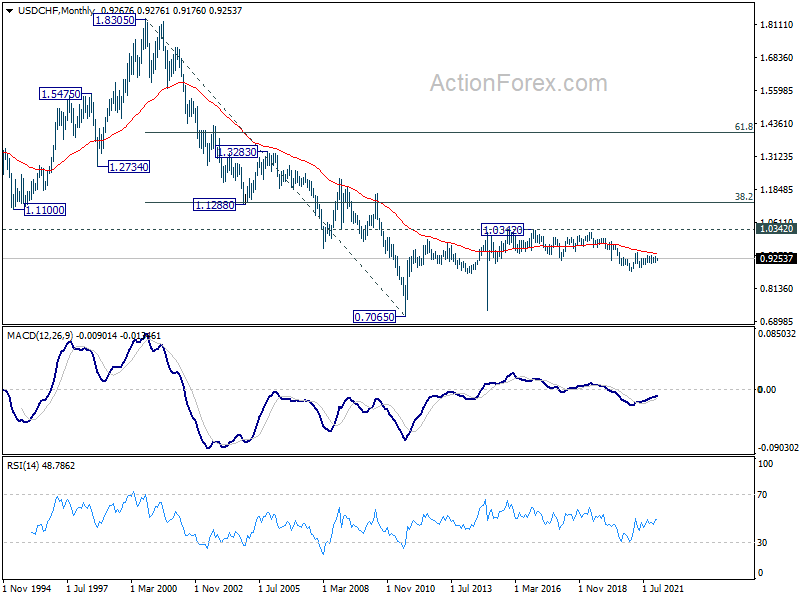
In the long term picture, price actions from 0.7065 (2011 low) are currently seen as developing into a long term corrective pattern, at least until a firm break of 1.0342 resistance.
AUD/USD Weekly Outlook
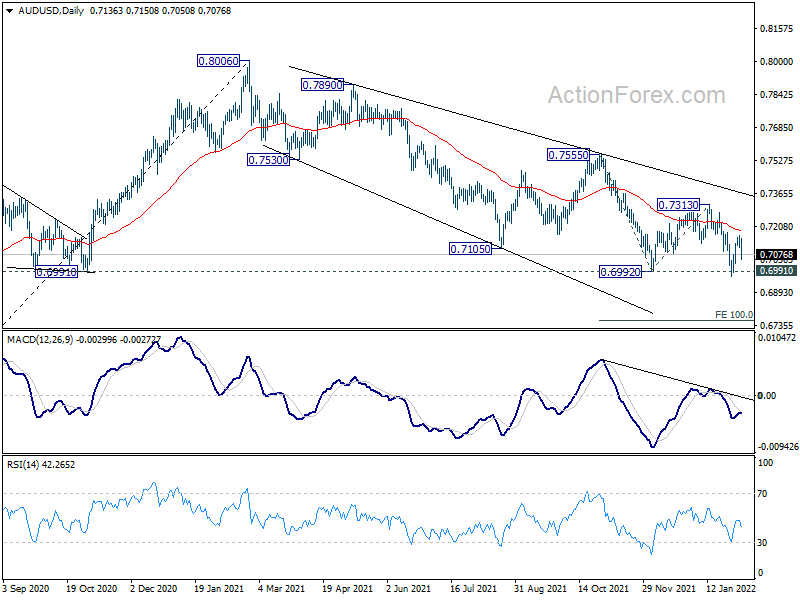
AUD/USD rebounded to 0.7167 last week but reversed from there. Initial bias is mildly on the downside this week for retesting 0.6966. Firm break there and sustained trading below 0.6991 will extend the down trend from 0.8006. Next target is 100% projection of 0.7555 to 0.6992 from 0.7313 at 0.6750. On the upside, above 0.7167 will resume the rebound to 0.7313 resistance.
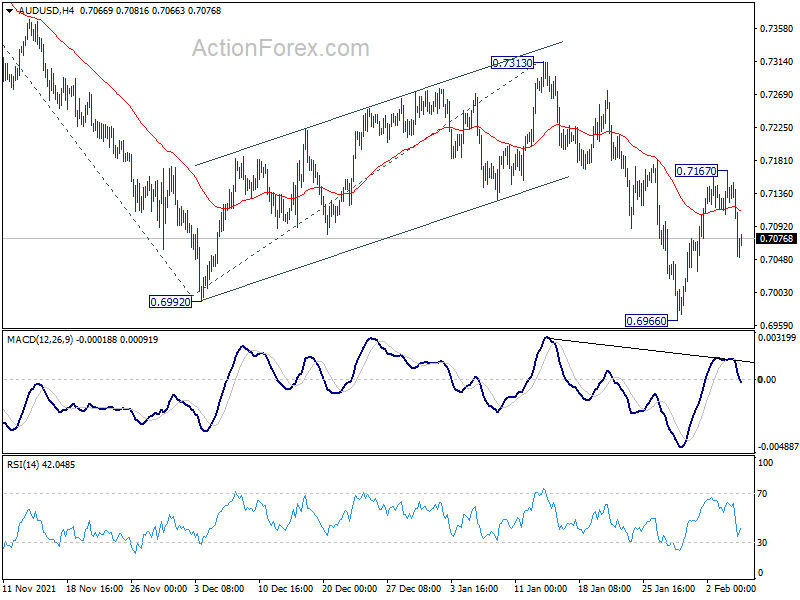
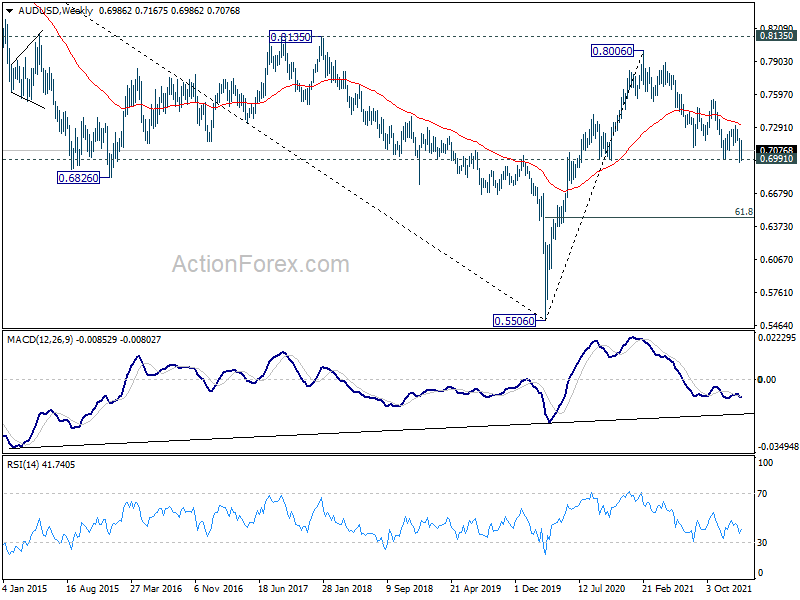
In the bigger picture, focus remains on 0.6991 key structural support. Sustained break there will argue that the whole up trend from 0.5506 might be finished at 0.8006, after rejection by 0.8135 long term resistance. Deeper decline would then be seen back to 61.8% retracement of 0.5506 to 0.8006 at 0.6461. Meanwhile, strong rebound from 0.6991 will retain medium term bullishness. That is, whole up trend from 0.5506 is still in progress.
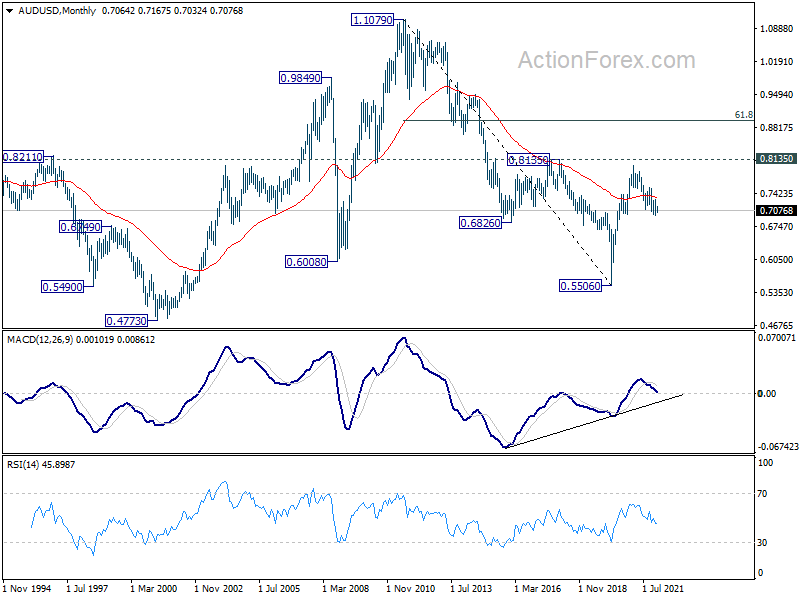
In the longer term picture, focus remains on 0.8135 structural resistance. Decisive break there will argue that rise from 0.5506 is developing into a long term up trend that reverses whole down trend from 1.1079 (2011 high). However, rejection by 0.8135 will keep long term outlook neutral at best.
USD/CAD Weekly Outlook
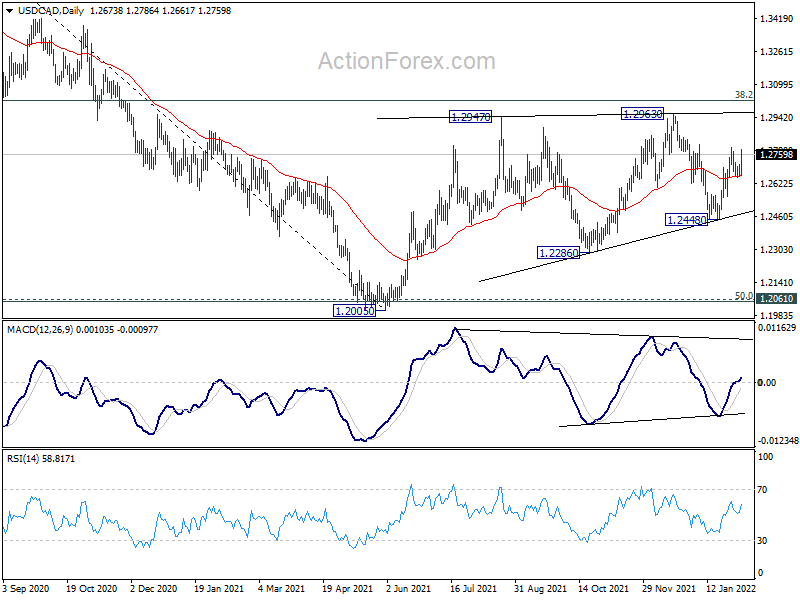
USD/CAD turned into sideway consolidation last week, but retreat was contained well above 4 hour 55 EMA and 55 day EMA. Initial bias remains neutral first and further rise is in favor. Break of 1.2795 will resume the rally from 1.2448 to 1.2963 resistance next. However, break of 1.2648 will turn bias back to the downside for 1.2448 support instead.
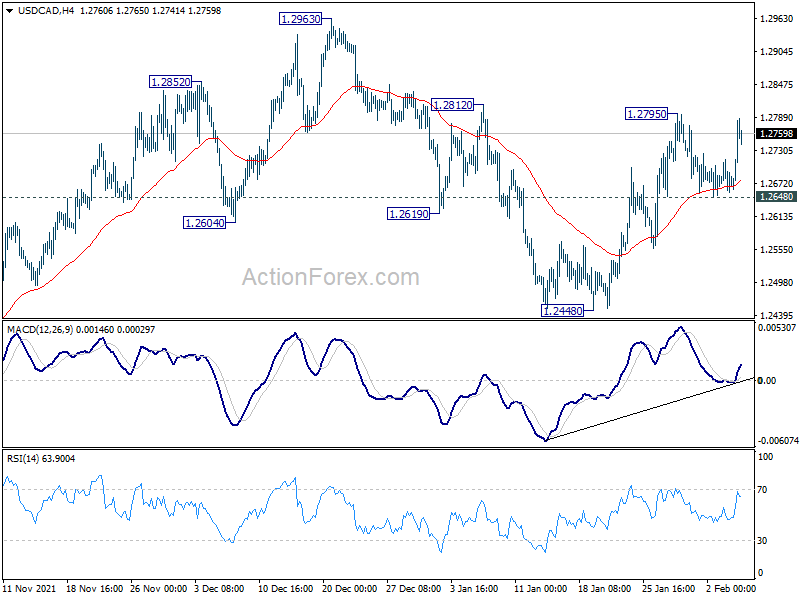
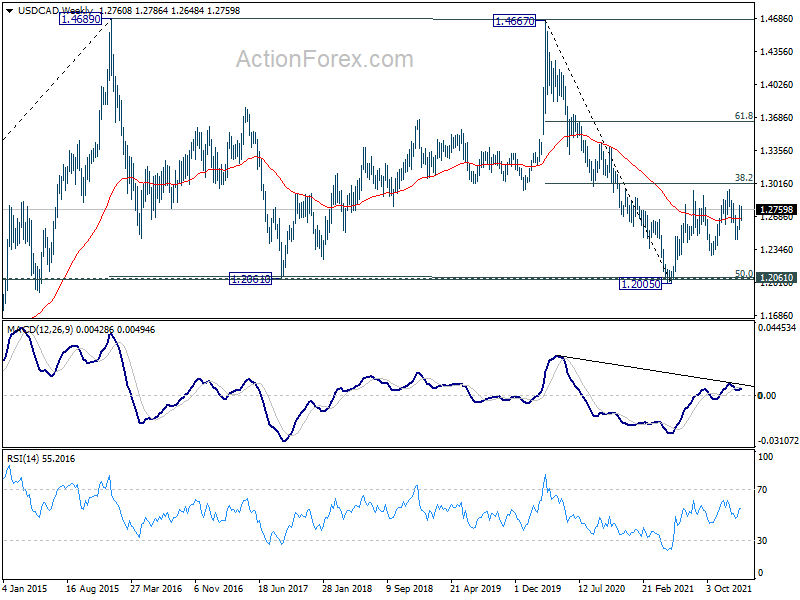
In the bigger picture, focus stays on 38.2% retracement of 1.4667 (2020 high) to 1.2005 (2021 low) at 1.3022. Sustained break there should confirm that the down trend from 1.4667 has completed after defending 1.2061 long term cluster support. Further rise would then be seen towards 61.8% retracement at 1.3650. However, rejection by 1.3022 will maintain medium term bearishness. Break of 1.2005 will resume the down trend from 1.4667 and that carries larger bearish implications too.
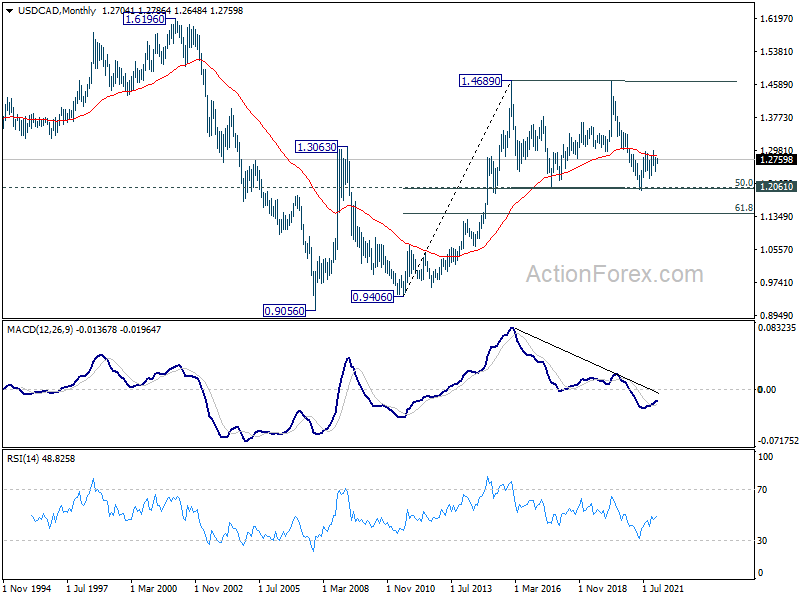
In the longer term picture, we're viewing price actions from 1.4689 as a consolidation pattern. Thus, up trend from 0.9506 (2007 low) is still expected to resume at a later stage. This will remain the favored case as long as 1.2061 support holds, which is close to 50% retracement of 0.9406 to 1.4689 at 1.2048. However, firm break of 1.2061 support will argue that USD/CAD has already started a long term down trend. Next target is 61.8% retracement of 0.9406 to 1.4689 at 1.1424.
EUR/GBP Weekly Outlook
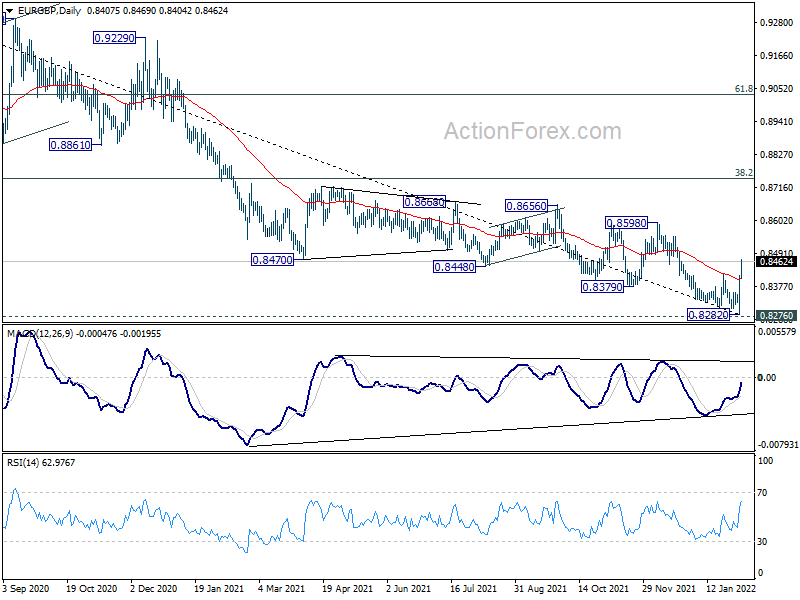
EUR/GBP's strong break of 0.8421 resistance last weeks argues that a medium term bottom was formed at 0.8282, on bullish convergence condition in daily MACD, ahead of 0.8276 key long term support. Initial bias remains on the upside this week for 0.8598 resistance next. Decisive break there will add to the case of trend reversal and target 38.2% retracement of 0.9499 to 0.8282 at 0.8747 next. On the downside, below 0.8398 minor support will turn intraday bias neutral first.
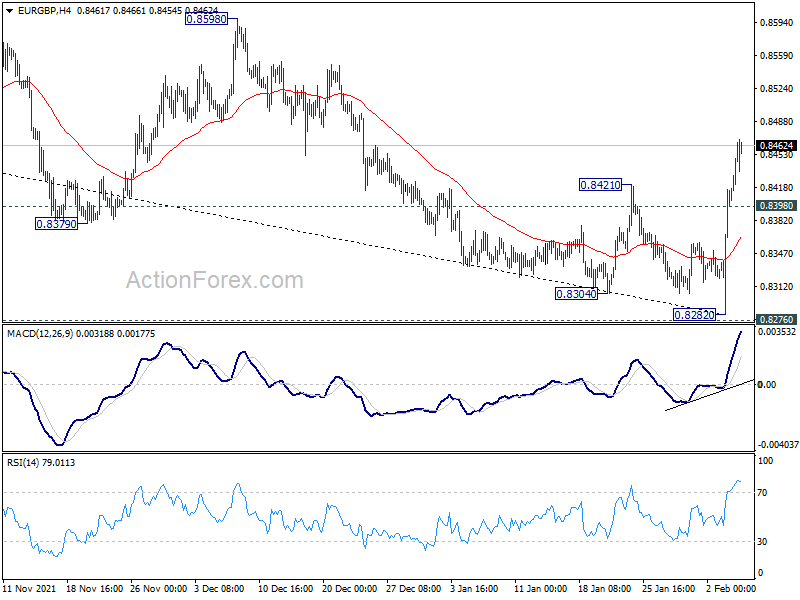
In the bigger picture, price actions from 0.9499 (2020 high) are still see a corrective pattern that should be contained by 0.8276 long term support (2019 low). Bullish convergence condition in daily MACD and break of 55 day EMA raises the chance that it might be completed. Sustained trading above 38.2% retracement of 0.9499 to 0.8282 at 0.8747 will affirm this bullish case and target 61.8% retracement at 0.9034 and above).
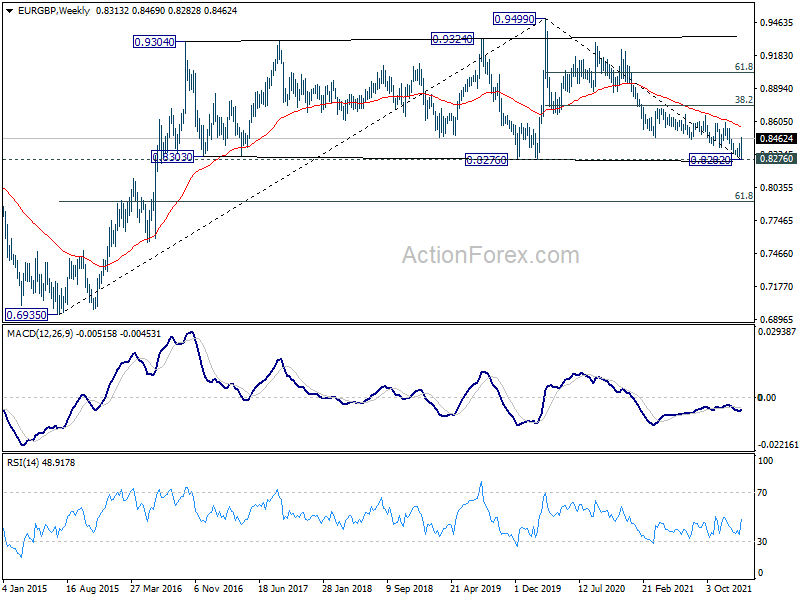
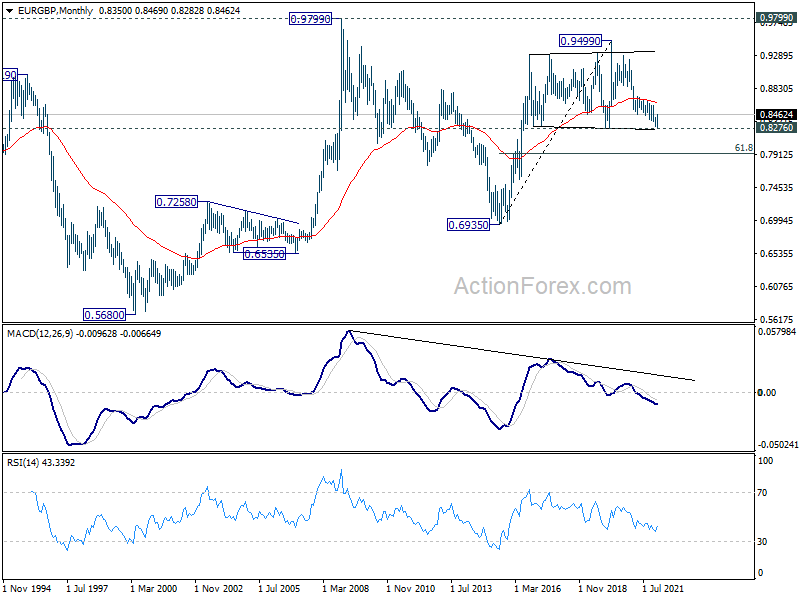
In the long term picture, outlook will stay bullish as long as 0.8276 support holds. Break of 0.9499 is in favor at a later stage, to resume the up trend from 0.6935 (2015 low). However, sustained break of 0.8276 will indicate long term trend reversal, and target 61.8% retracement of 0.6935 to 0.9499 at 0.7917, and possibly below.
EUR/AUD Weekly Outlook
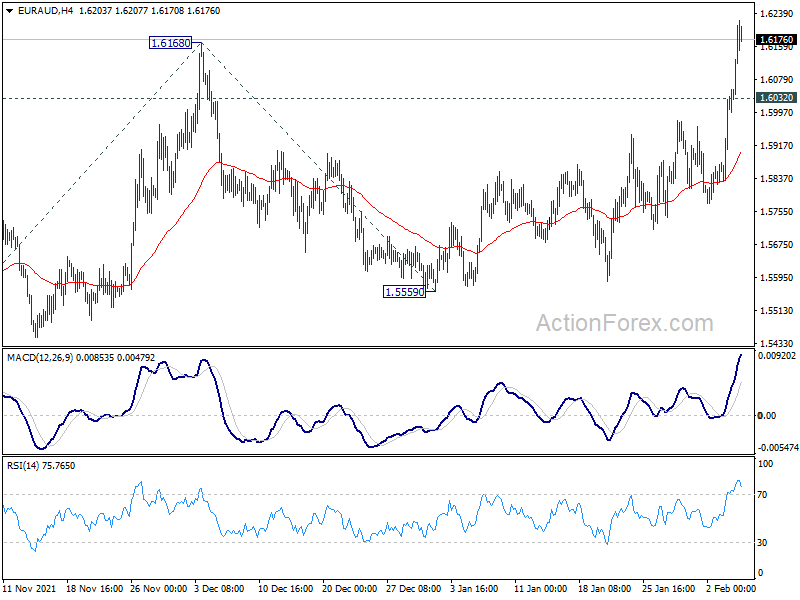
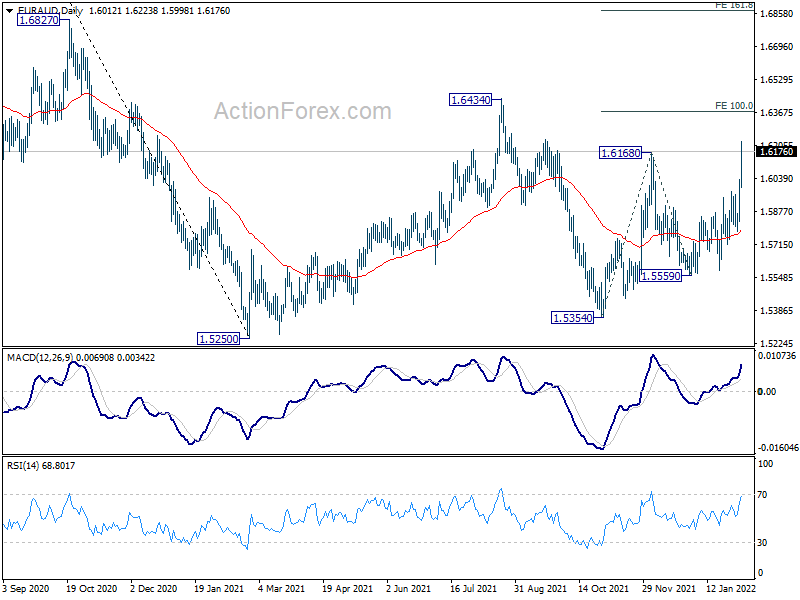
EUR/AUD's rise from 1.5559 accelerated to as high as 1.6223 last week. Break of 1.6168 resistance confirmed resumption of whole rise from 1.5354. Initial bias stays on the upside this week for 100% projection of 1.5354 to 1.6168 from 1.5559 at 1.6373 next. On the downside, below 1.6032 minor support will turn intraday bias neutral and bring consolidations first, before staging another rally.
In the bigger picture, rise from 1.5354 is seen as the third leg of the corrective pattern from 1.5250 low. Further rise cannot be ruled out, but even in that case, strong resistance should be seen at 38.2% retracement of 1.9799 to 1.5250 at 1.6988. Larger down trend from 1.9799 is in favor to extend through 1.5250 at a later stage.
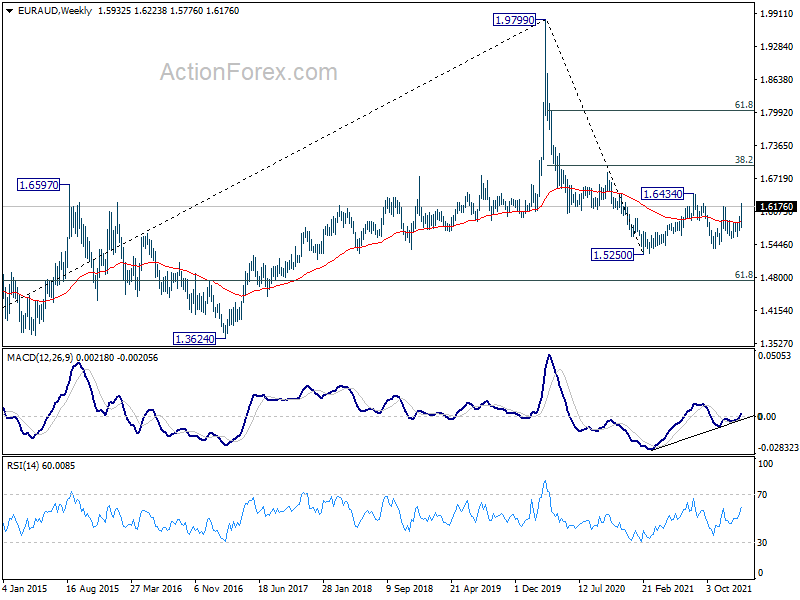
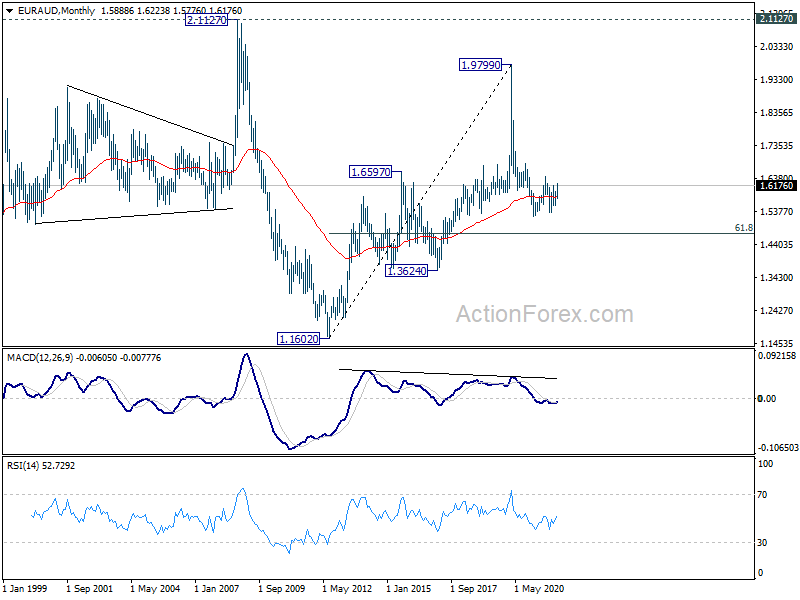
In the longer term picture, fall from 1.9799 (2020 high) is seen as a long term down trend. Further decline will remain in favor as long as 38.2% retracement of 1.9799 to 1.5250 at 1.6988 holds. Break of 1.5250 will target 61.8 retracement of 1.1602 (2012 low) to 1.9799 at 1.4733
EUR/JPY Weekly Outlook
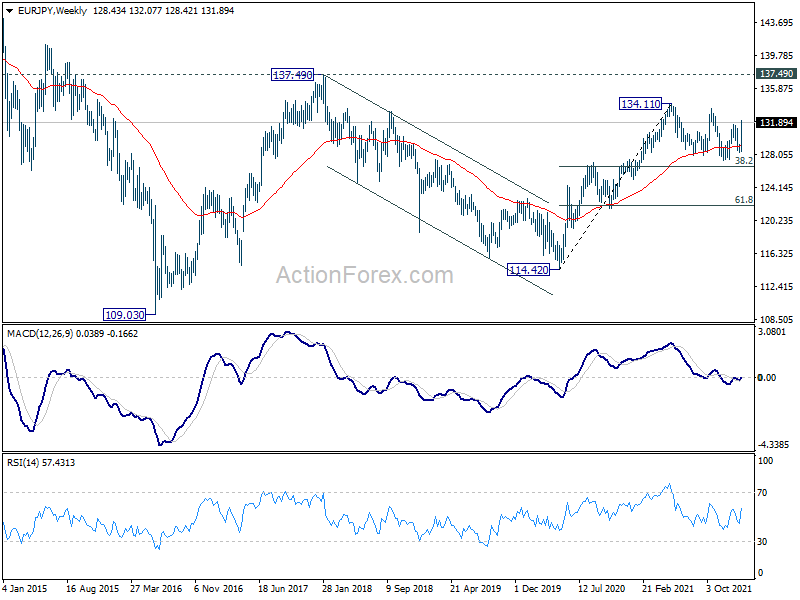
EUR/JPY's strong rally and break of 131.59 resistance last week confirmed resumption of rise from 127.36. Also, it revived the case that corrective pattern from 134.11 has completed with three waves down to 127.36. Initial bias remains on the upside this week for retesting 133.44/134.11 resistance zone. Decisive break there will resume larger up trend from 114.42. On the downside, below 131.20 minor support will turn intraday bias neutral and bring consolidations first, before staging another rally.
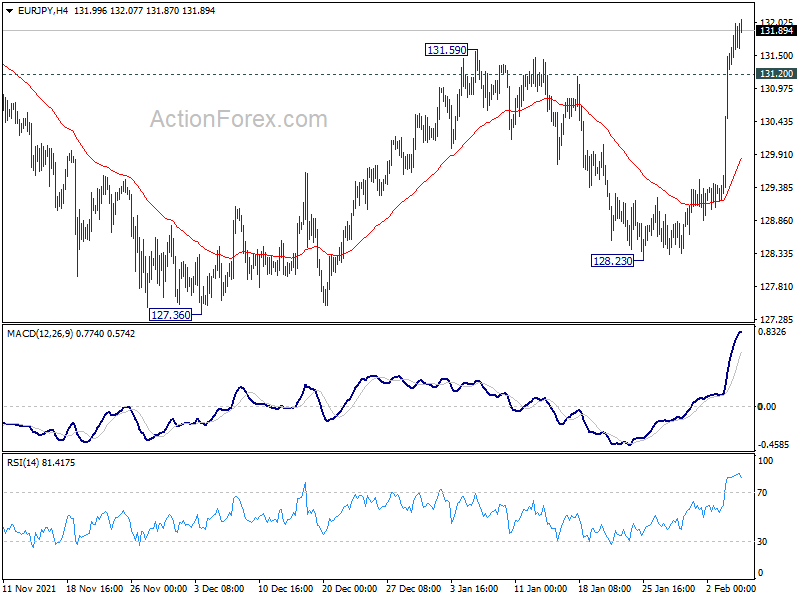
In the bigger picture, price actions from 134.11 are currently seen as a consolidation pattern only. As long as 38.2% retracement of 114.42 (2020 low) to 134.11 at 126.58 holds, up trend from 114.42 is still in favor to continue. Break of 134.11 will target long term resistance at 137.49 (2018 high). However, sustained break of 126.58 will raise the chance of bearish reversal. In this case, deeper decline would be seen to 61.8% retracement at 121.94, and possibly below.
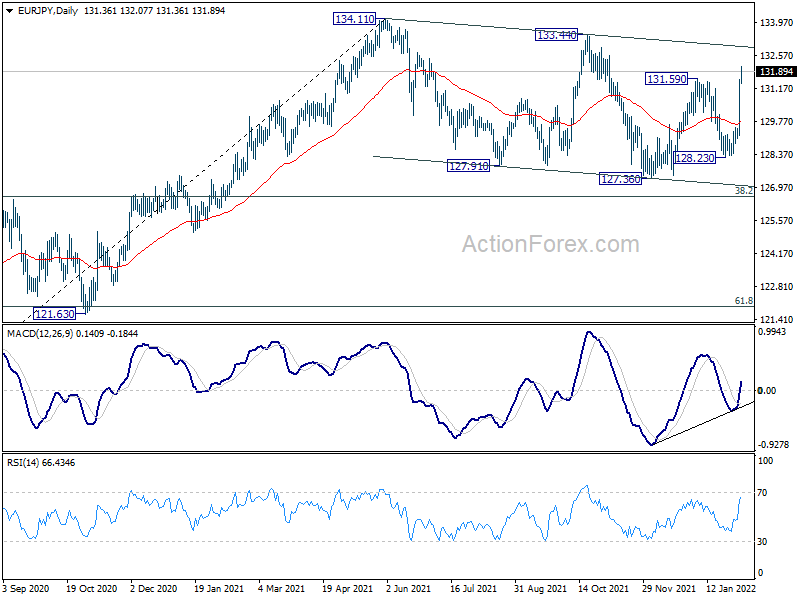
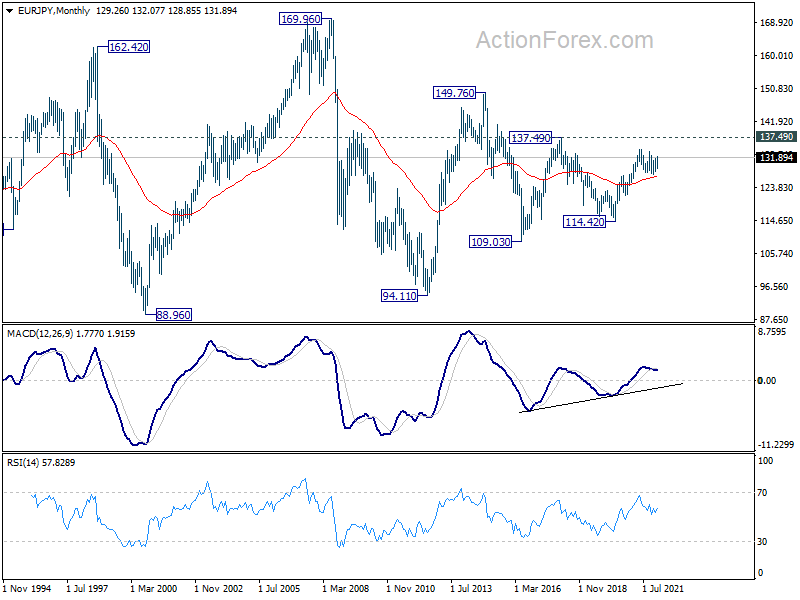
In the long term picture, EUR/JPY is staying in long term sideway pattern, established since 2000. Long term outlook will remain neutral until breakout from the range of 109.03/137.49.