

Sample Category Title
GBP/JPY Weekly Outlook
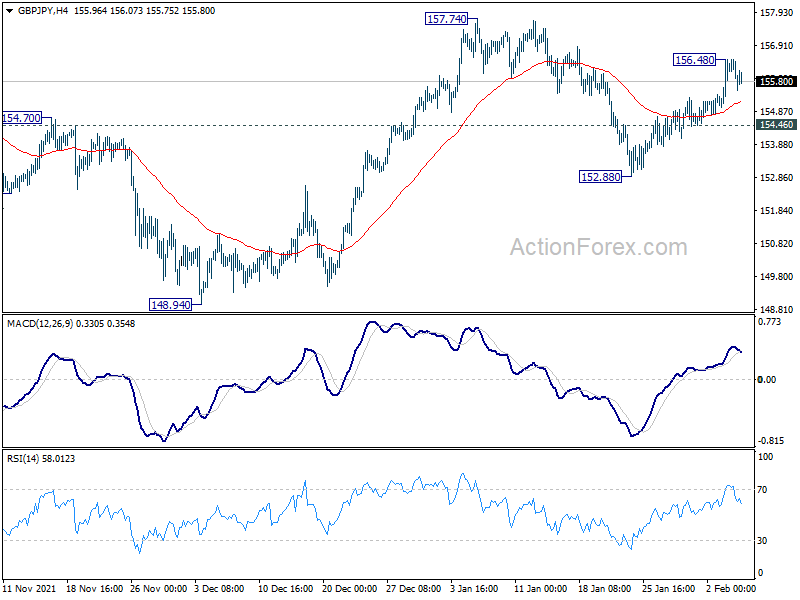
GBP/JPY's rebound from 152.88 extended higher last week, but lost momentum after hitting 156.48. Initial bias is neutral this week first. The consolidation pattern from 158.19 could still extend further. On the downside, below 154.46 minor support will turn bias back to the downside for 152.88 support and below. Nevertheless, above 156.48 will target a test on 157.74/158.19 resistance zone. Decisive break there will resume larger up trend.
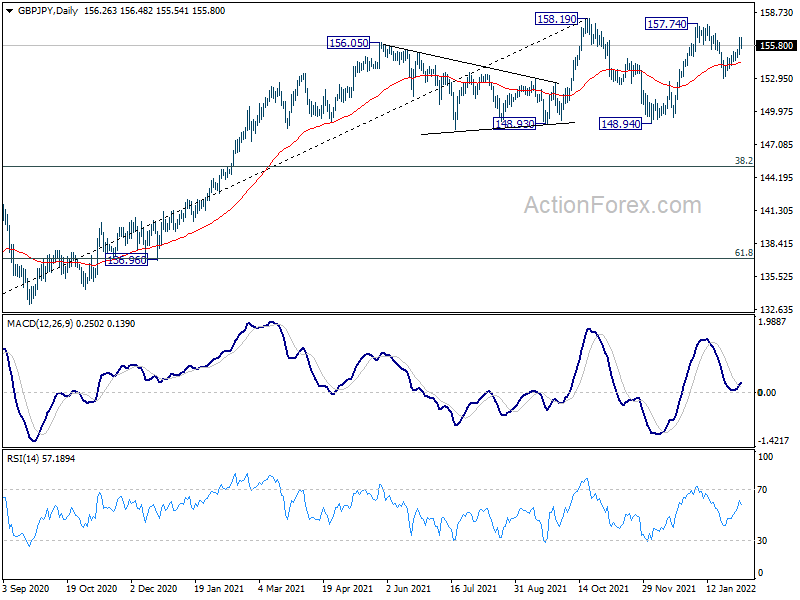
In the bigger picture, price actions from 158.19 are seen as developing into a consolidation pattern to up trend from 123.94 (2020 low). Downside should be contained by 123.94 to 158.19 at 145.10 to bring rebound. Firm break of 158.19 will resume the up trend to long term fibonacci level at 167.93. However, sustained break of 145.10 will raise the chance of trend reversal and target 61.8% retracement at 137.02.
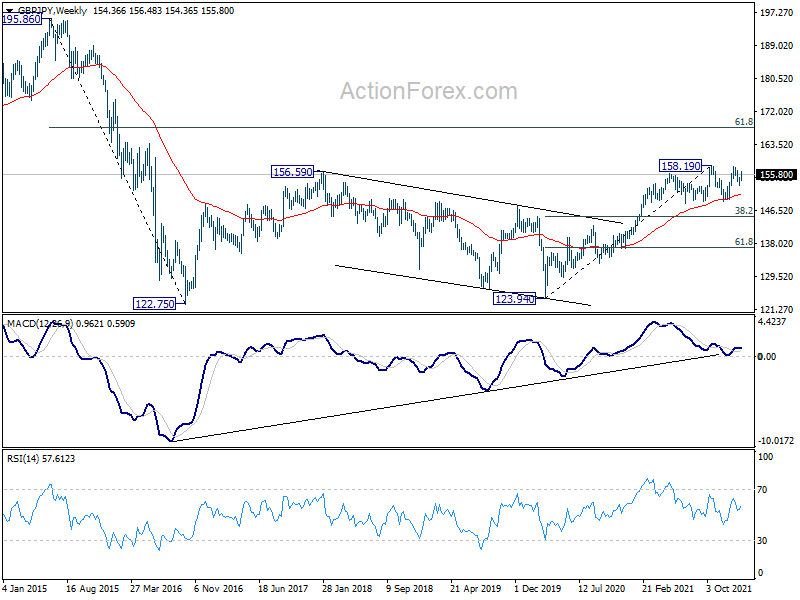
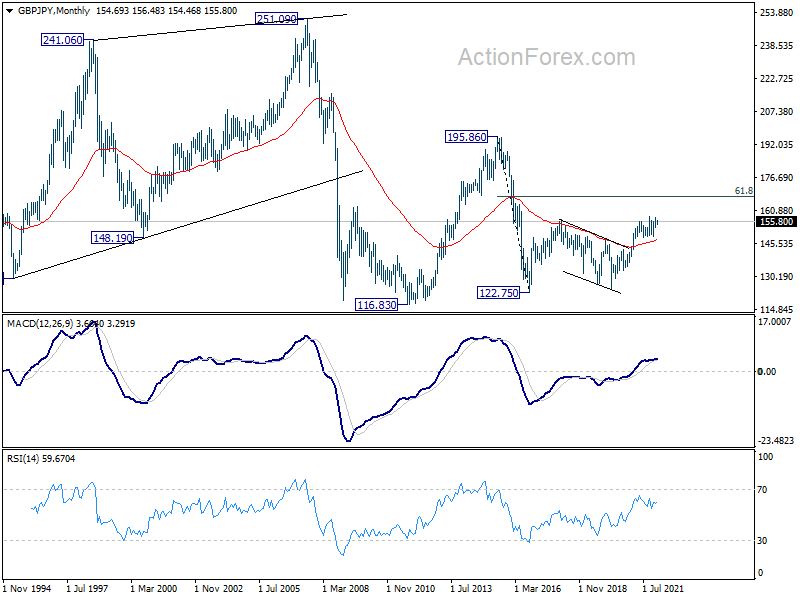
In the longer term picture, as long as 55 month EMA (now at 147.30) holds, we'd still favor more rally to 61.8% retracement of 195.86 to 122.75 at 167.93. But sustained trading below 55 month EMA will at least neutralize medium term bullishness and re-open the chance of revisiting 122.75 low (2016 low).
EUR/CHF Weekly Outlook
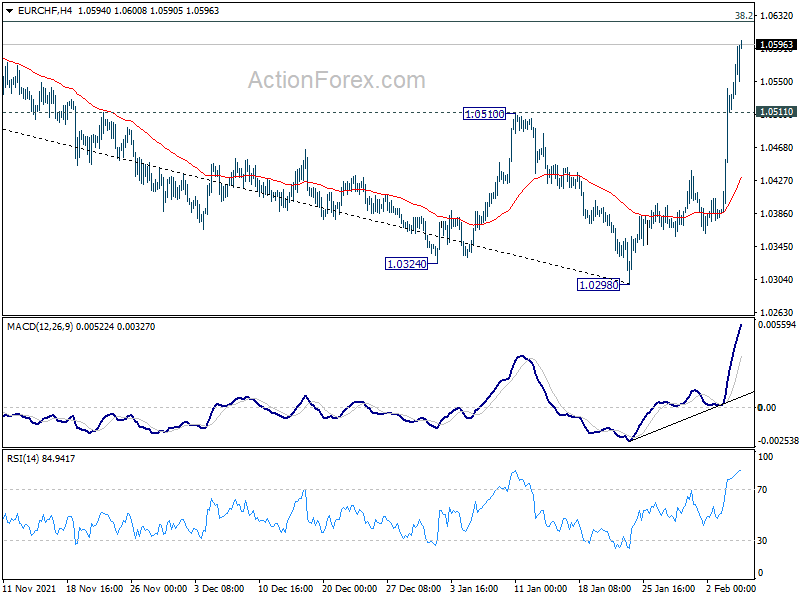
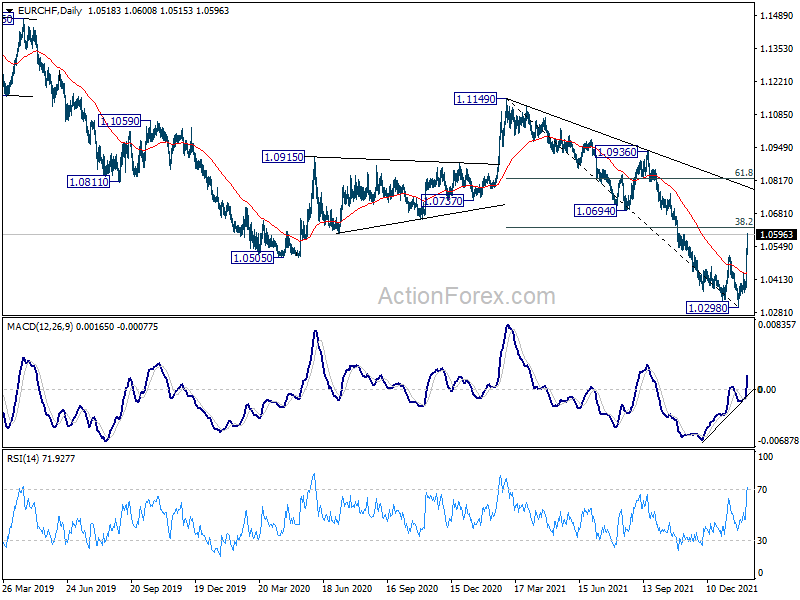
EUR/CHF soared to as high as 1.0515 last week and a medium term bottom should be formed at 1.0298 on bullish convergence condition in daily MACD. Initial bias stays on the upside this week for 38.2% retracement of 1.1149 to 1.0298 at 1.0623 first. Sustained trading above there will raise the chance of trend reversal and target 61.8% retracement at 1.0824 next. On the downside, below 1.0511 minor support will turn bias neutral and bring consolidation first, before staging another rally.
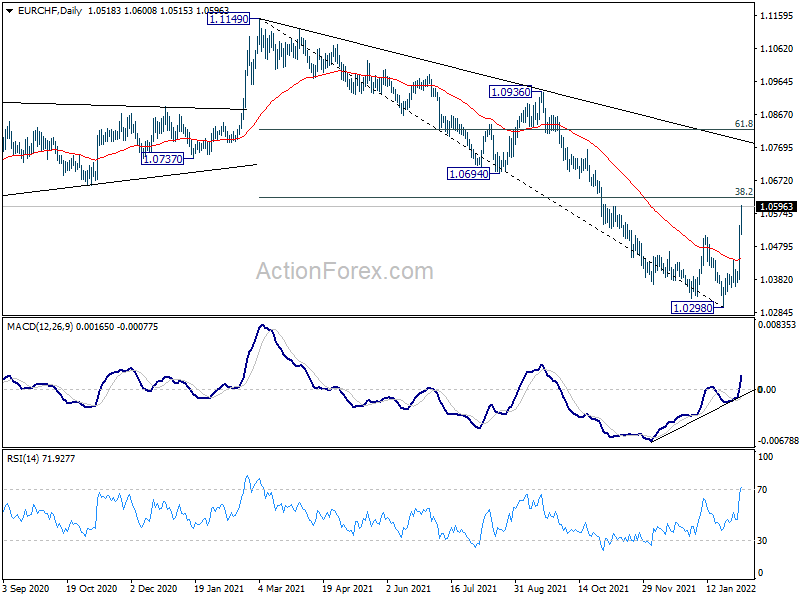
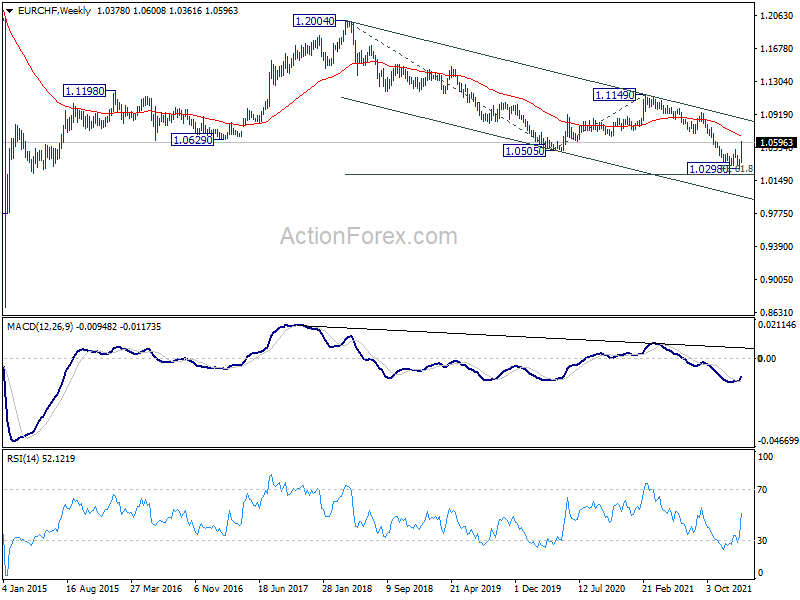
In the bigger picture, current development suggests that a medium term bottom is formed at 1.0298 on bullish convergence condition in daily MACD. Rebound from there is still tentatively viewed part of a corrective pattern. That is, larger down trend from 1.2004 (2018) could still extend through 1.0298 to 61.8% projection of 1.2004 to 1.0505 to 1.1149 at 1.0223. However, sustained trading above 55 week EMA (now at 1.0673) will argue that the down trend is over, and bring stronger rise back to 1.1149 next.
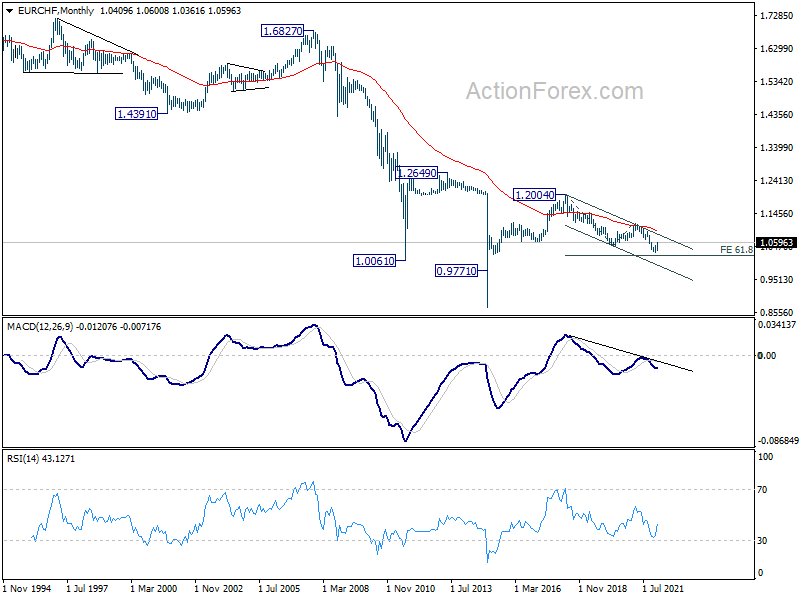
In the long term picture, prior rejection by 55 month EMA (now at 1.0967) maintains long term bearishness. Down trend from 1.2004 could still extend lower as long as 1.1149 resistance holds.
Euro Flexes Muscle after ECB, Staging Broad-Based Bullish Reversal?
It was a week a surprises. While BoE delivered that a 25bps hike, four of the nine MPC members have indeed voted for a 50bps raise. However, there was no follow through buying as BoE indicated only "modest" tightening would follow. Also, the event was overshadowed by ECB's unexpected hawkish turn. Then, after US ADP report set up rather low expectation for non-farm payroll, NFP hit the markets with a bang.
Still, Dollar ended as the worst performing one even though it tried to strike a late come back. Yen was the second worst, followed by Canadian Dollar. Euro was the runaway winner, followed by Australian and then New Zealand Dollar. Sterling just ended mixed with Swiss.
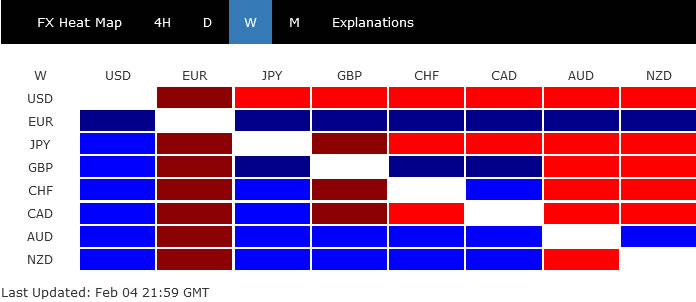
Euro ended as runaway winner after ECB hawkish turn
The biggest surprise last week was ECB's hawkish turned. In the post meeting press conference, President Christine Lagarde declined to repeat her guidance that rate hike was "very unlikely" this year. Then, Governing Council member Olli Rehn was quoted on Friday that "if there are no setbacks in the pandemic or the geopolitical situation, it would logical for the ECB to hike its key interest rate at latest next year." Markets are now expecting the deposit rate to be raised from the current -0.50% to 0.00% by year end, even though the opinions on timing differ.
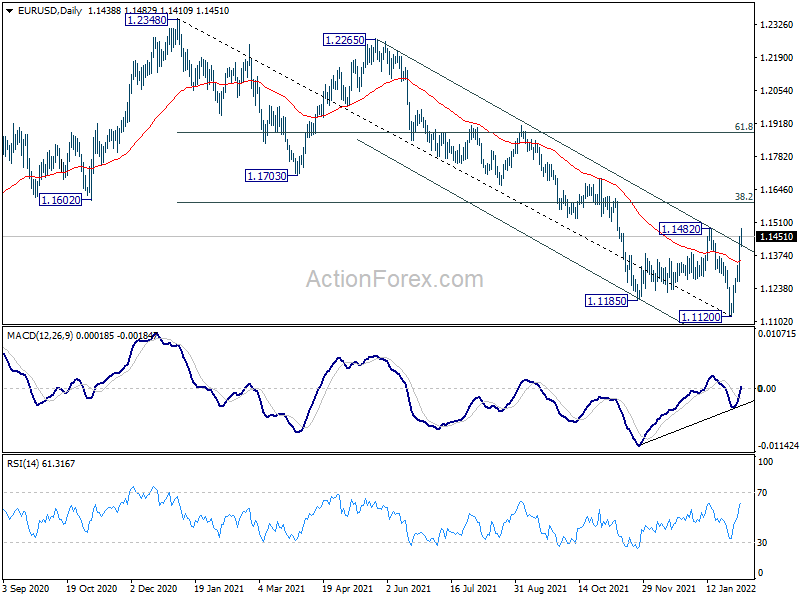
Euro was the runaway leader last week. EUR/USD's break of of the medium term channel resistance is a bullish sign, together with bullish convergence condition in daily MACD. Immediate focus is on 1.1482 resistance this week. Firm break there will confirm medium term bottoming at 1.1120, and raise the chance of trend reversal. Further rise should then be seen to 38.2% retracement of 1.2348 to 1.1120 at 1.1589 next.
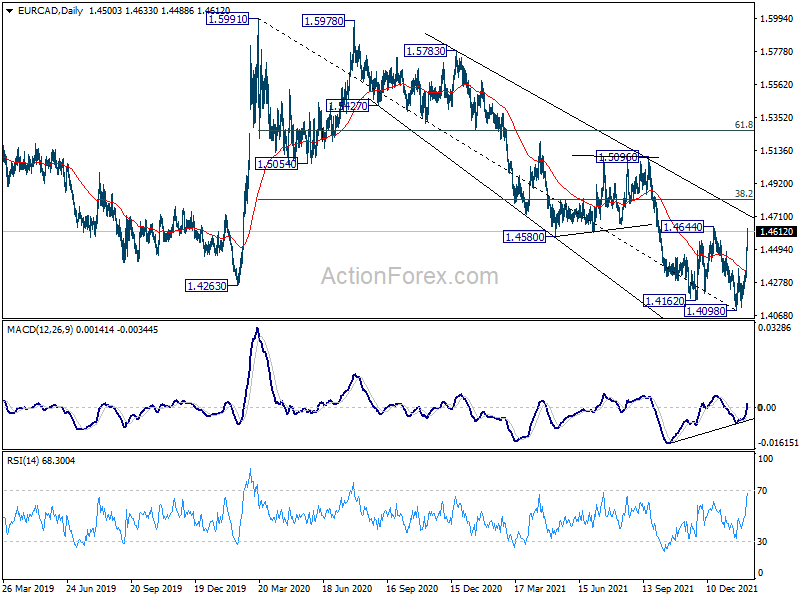
EUR/CAD's rally argue that a medium term bottom was formed at 1.4098, on bullish convergence condition in daily MACD. Firm break of 1.4644 resistance will confirm this case and target 38.2% retracement of 1.5991 to 1.4098 at 1.4821. Sustained break there will raise the chance of trend reversal, that is, whole down trend from 1.5991 (2020 high) was complete. Further rally would be seen to 61.8% retracement at 1.5268.
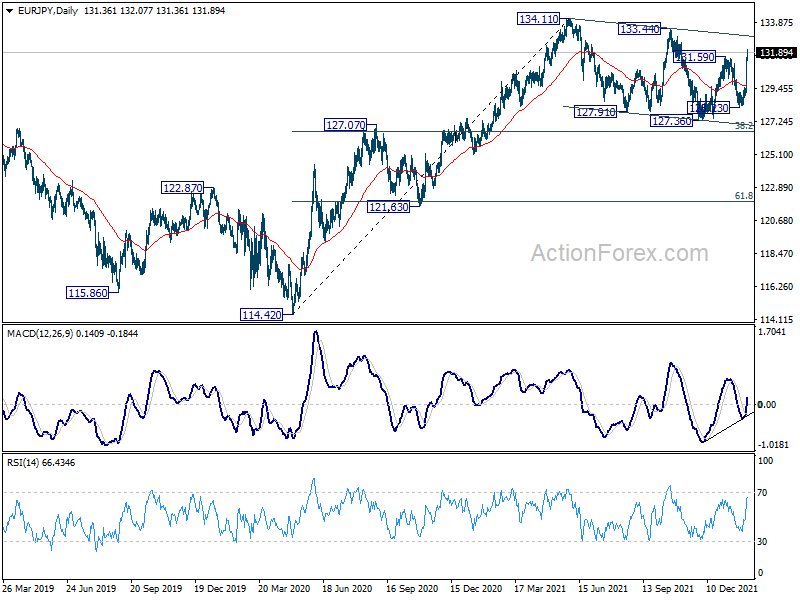
EUR/JPY's break of 131.59 resistance confirmed resumption of the rise from 127.36. More importantly, it revives the case that consolidation from 134.11 has completed with three waves to 127.36. Retest of 133.44/134.11 resistance zone should be seen next. Firm break there will resume larger up trend from 114.42.
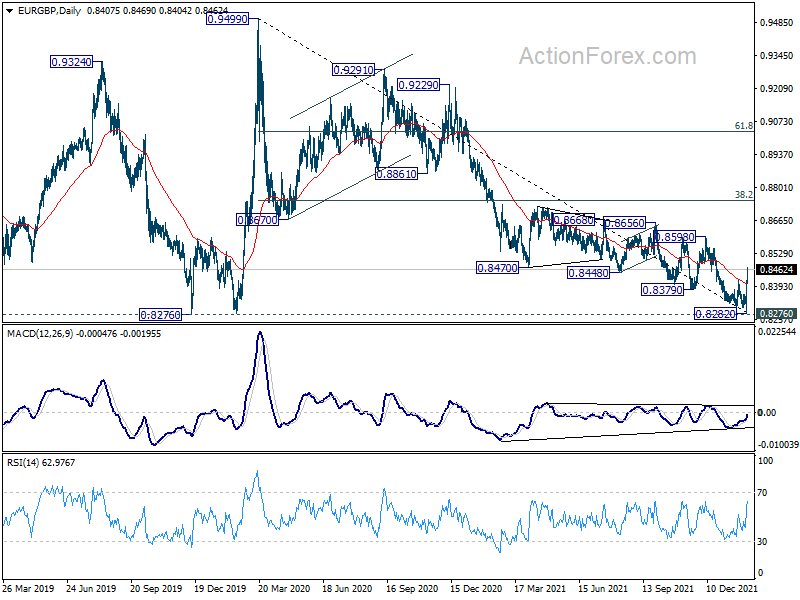
EUR/GBP's strong break of 0.8241 resistance and and 55 day EMA indicates medium term bottoming at 0.8282, on bullish convergence condition in daily MACD, just ahead of 0.8276 key long term support (2019 low). Next focus will be 0.8598 resistance. Sustained break there will argue that whole down trend from 2020 high at 0.9499 is finished too, and turn medium term outlook bullish.
EUR/CHF's strong break of 1.0510 resistance indicates medium term bottoming at 1.0298, on bullish convergence condition in daily MACD. Immediate focus is now on 38.2% retracement of 1.1149 to 1.0298 at 1.0623 first. Sustained trading above there will raise the chance of trend reversal and target 61.8% retracement at 1.0824 next
Fed hike expectations heightened further after NFP, but stocks resilient
Another big surprise last week was the much stronger than expected non-farm payroll report, which saw large job growth and faster wages growth. There are some speculations that Fed would start the tightening cycle in March with a 50bps hike. Yet, for now, the base case is still for Fed to deliver consecutive 25bps hike at the upcoming meetings. That would give policymakers more flexibility to wait-and-see how inflation develops.
Though, the March 15-16 FOMC meeting is more than a month away and many things could happen in between, starting with January CPI data to be featured this week. If inflation outlook does worsen much further, it would be hard for Fed to not acting quick and heavy.
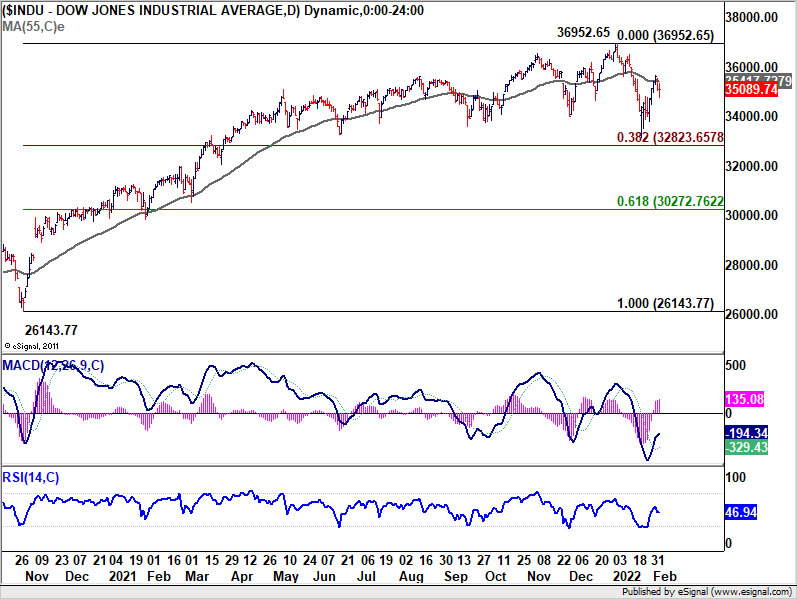
US stocks remained pretty resilient in spite of heightened expectation on Fed's stimulus removal. For now, DOW is seen as in a consolidation pattern to the rise from 26143.77 only, not that from 18213.65. Such consolidations should extend for a while with another falling leg before completion. That is, in case of stronger rebound, break of 36952.65 high is not envisaged. In case of another fall, stronger support should be seen at 38.2% retracement of 26143.77 to 36952.65 at 32823.65 to bring rebound.
US 10-year yield surged, so did others
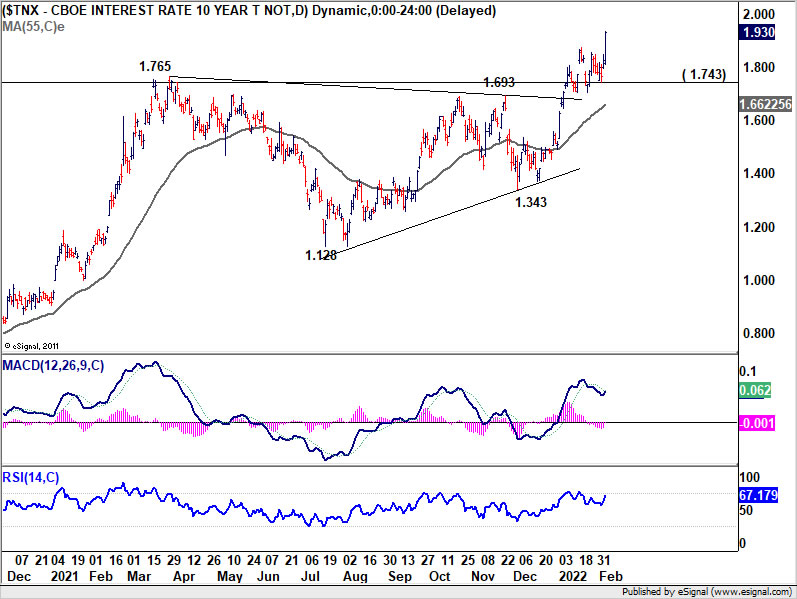
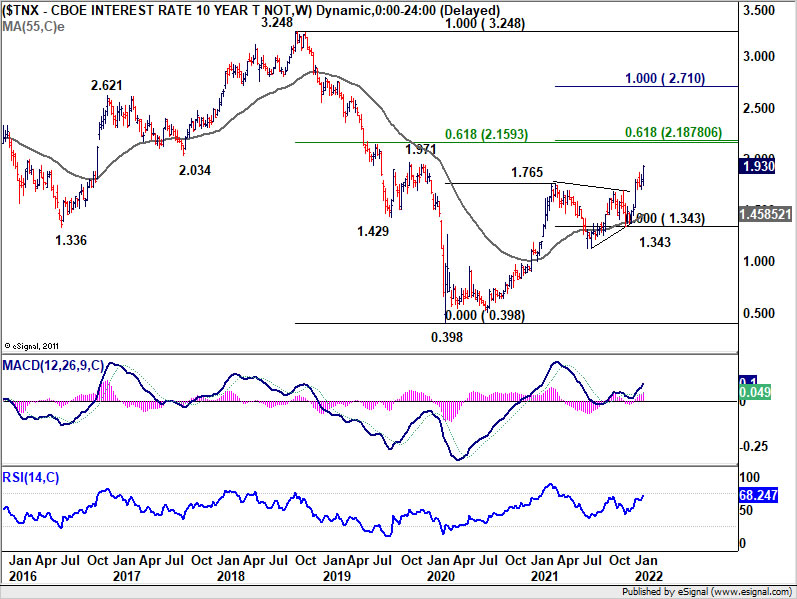
10-year yield broke out from range on Friday to close at 1.930. Near term outlook in TNX will stay bullish as long as 1.743 support holds. Current up trend is expected to continue through 2% handle to 2.159/87 cluster level. This represents 61.8% retracement of 3.248 to 0.398 at 2.159, and 61.8% projection of 0.398 to 1.765 from 1.343 at 2.187. This is where the real test lies, and no break is expected unless there are some dramatic underlying developments.
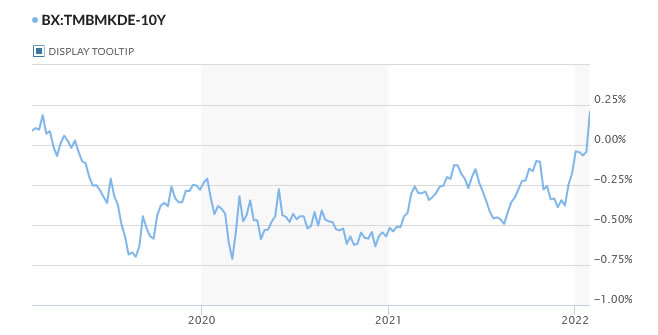
Meanwhile, it should be noted that US benchmark yields could provide little support to the greenback for now. As other major global yields are also on the way up. Germany 10-year bund yield has finally turned positive with some conviction and closed at 0.210, highest since early 2019.
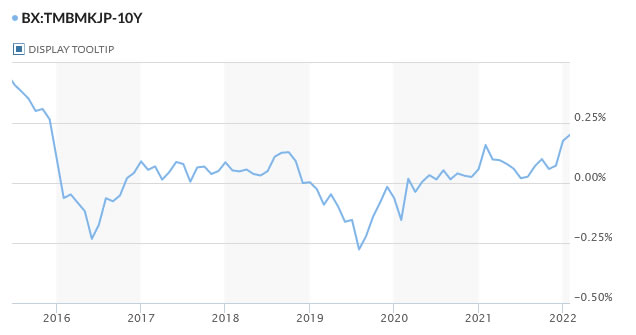
Japan 10-year JGB yield also jumped to close at 0.210, highest since early 2016.
Dollar index dropped following the rebound in Euro
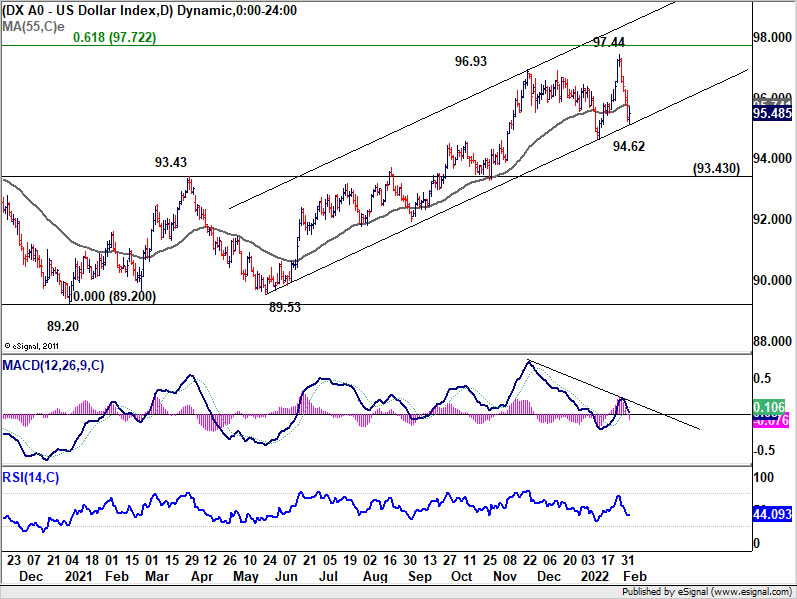
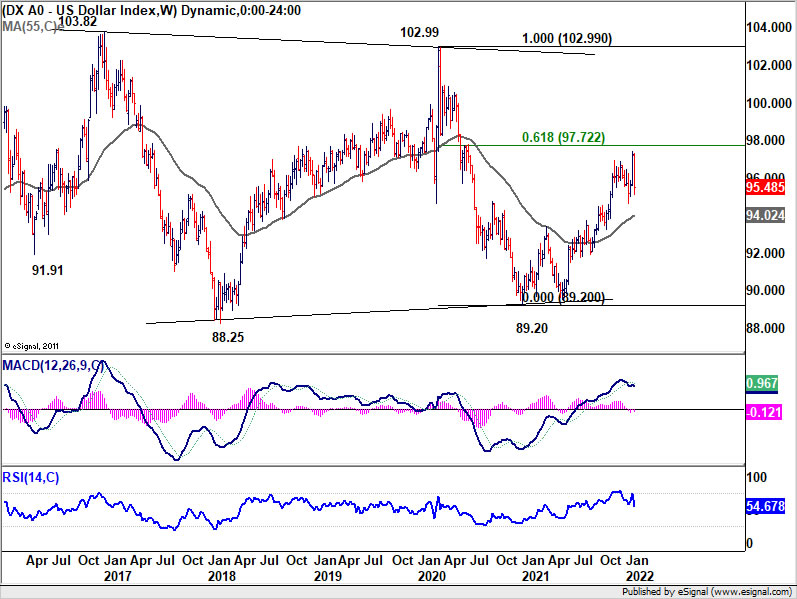
Dollar index basically followed the move in EUR/USD last week. The steep decline indicates that a short term top is at least formed at 97.44. The biggest question is whether it's already rejected by key resistance at 61.8% retracement of 102.99 to 89.20 at 97.72.
On the downside, sustained break of trend line support at around 95.00 will argue that it's at least correcting the whole up trend from 89.20. Deeper decline would be seen through 94.62. Reactions to 55 week EMA (now at 94.02) would reveal whether the medium term trend has reversed.
GBP/JPY Weekly Outlook
GBP/JPY's rebound from 152.88 extended higher last week, but lost momentum after hitting 156.48. Initial bias is neutral this week first. The consolidation pattern from 158.19 could still extend further. On the downside, below 154.46 minor support will turn bias back to the downside for 152.88 support and below. Nevertheless, above 156.48 will target a test on 157.74/158.19 resistance zone. Decisive break there will resume larger up trend.
In the bigger picture, price actions from 158.19 are seen as developing into a consolidation pattern to up trend from 123.94 (2020 low). Downside should be contained by 123.94 to 158.19 at 145.10 to bring rebound. Firm break of 158.19 will resume the up trend to long term fibonacci level at 167.93. However, sustained break of 145.10 will raise the chance of trend reversal and target 61.8% retracement at 137.02.
In the longer term picture, as long as 55 month EMA (now at 147.30) holds, we'd still favor more rally to 61.8% retracement of 195.86 to 122.75 at 167.93. But sustained trading below 55 month EMA will at least neutralize medium term bullishness and re-open the chance of revisiting 122.75 low (2016 low).
Summary 2/7 – 2/11
Monday, Feb 7, 2022
[php_everywhere instance="1"]
Tuesday, Feb 8, 2022
[php_everywhere instance="2"]
Wednesday, Feb 9, 2022
[php_everywhere instance="3"]
Thursday, Feb 10, 2022
[php_everywhere instance="4"]
Friday, Feb 11, 2022
[php_everywhere instance="5"]
Weekly Economic & Financial Commentary: Omicron Not Enough to Crash the Payroll Party
Summary
United States: Omicron Not Enough to Crash the Payroll Party
- This week ushered in a broad range of economic indicators that covered everything from supply chains to the housing market, but needless to say it was the labor market that was top of mind. Nonfarm payrolls rose 467K in January, which was not only nearly four times the consensus estimate but also well ahead of any forecast. JOLTS and nonfarm productivity pointed to a strong and thriving labor force, while January's ISM surveys and construction spending data affirmed that we are not out of the woods yet when it comes to supply chain struggles and higher prices.
- Next week: NFIB Small Business (Tuesday), Trade Balance (Tuesday), CPI (Thursday)
International: Central Banks Take Center Stage
- The Bank of England delivered a hawkish monetary policy announcement, raising its policy rate by 25 bps, but with several policymakers dissenting in favor of a larger move. Given the hawkish announcement, we now expect the Bank of England to raise rates by more and earlier than previously. The European Central Bank held monetary policy steady but said inflation risks were to the upside, signaling it would re-assess its policy outlook in March.
- Next week: Brazil CPI (Wednesday), Mexico Overnight Rate (Thursday), U.K. GDP (Friday)
Interest Rate Watch: Shrinking Budget Deficit Leads Treasury to Issue Less Debt
- The federal budget deficit is narrowing sharply, and as a result, the U.S. Treasury announced this week that it would continue cutting the size of its Treasury security auctions, given the declining financing need.
Topic of the Week: Economic Resiliency and Progress in the Black & African American Community
- The Black and African American community in the United States has faced significant structural obstacles over the past few centuries that have impeded full economic participation. In commemoration of Black History Month, we look at the recent economic progress the Black and African American community has made, despite these obstacles.
The Weekly Bottom Line: The U.S. Economy Endures Omicron
U.S. Highlights
- This week provided the first glance at the economic impact of Omicron, which seems relatively benign compared to previous outbreaks. The poster child of this week is employment, which pulled off an Olympic medal’s worth performance, adding 467k jobs in January.
- On the business side, both the manufacturing and services sector remained in expansionary territory, while auto sales surprised with solid growth, reaching the highest level in seven months.
- Stock prices gyrated in sync with the earnings performance of individual tech companies. The bond market, meanwhile, reacted strongly to the employment data, with yields rising by 13 basis points for the week.
Canadian Highlights
- This week we got a glimpse of the damage to the economy from the Omicron wave. The employment report released earlier today showed the economy shed 200,000 jobs in January, and the unemployment rate rose to 6.5% from 6.0% a month earlier.
- GDP growth held up well in November, advancing by 0.6% on the month. However, activity slowed in December, with the preliminary estimate suggesting that GDP remained flat on the month. January is expected to be worse.
- Unlike other parts of the economy, the housing market remained hot in January. Several regional real estate boards released their data this week, indicating strong price growth and a flurry of activity ahead of Bank of Canada rate hikes.
U.S. - The U.S. Economy Endures Omicron
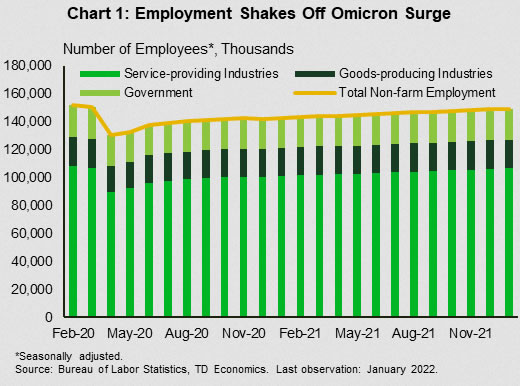
This week provided the first glance at the economic impact of Omicron. As it turns out, the damage wasn’t as bad as feared, at least according to early economic indicators. Hot off the press, the jobs report came in faster, higher and stronger than anticipated by the market consensus. The economy pulled off an Olympic medal’s worth performance, adding 467k jobs in January (Chart 1). December and November data were revised up adding another 709k, bridging the employment gap to less than 2% of its pre-pandemic level. The laggard industry remains leisure and hospitality, where employment rose by 151k, but remains well below its pre-pandemic peak.
This week’s Institute for Supply Management (ISM) reports filled in the narrative from the business perspective. Both the manufacturing and services sector indexes slowed in January, but continued to expand at an above-trend rate, with readings of 57.6% and 59.9%, respectively . As expected, Omicron weighed on demand, with services business activity dropping by 8.4 percentage points (ppts) and manufacturing production softening by 1.6 ppts. Some demand softening is a blessing in disguise as it helped reduce backlogs of orders, which dropped by 6.4 and 4.9 ppts for manufacturing and services sectors, respectively. Notably, demand for services still has room to grow, as it has not yet fully recovered from pandemic-related restrictions. Once the threat of Omicron fades, consumers are likely to direct more of their spending to services, giving the sector some added oomph.
At the same time, supply constraints may take a longer time to attenuate. Supplier delivery times remained relatively flat for manufacturing and increased marginally for the services sector (following a sizeable reduction in December). The tone of respondents’ comments on disruptions hardly lost its zing as the “lack of supplier manpower” continues to push prices up, affecting industries across the economy.
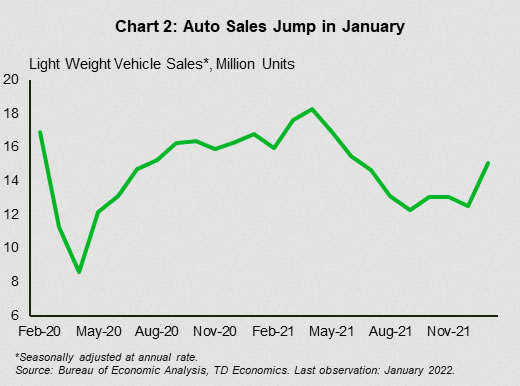
Nowhere is the impact of supply disruptions on prices more apparent than in the auto sector. This week, auto sales surprised with solid growth, reaching the highest level in seven months (Chart 2). The improvement can be attributed to a solid recovery in production, which was able to reduce the pre-pandemic gap from 30% in September to 8% in December. While chip shortages continue to affect the industry, anecdotal evidence suggests that Omicron has so far had a less dire impact on semiconductor supply chains compared to Delta.
All in all, early economic data suggest that the negative impact of the virus continues to diminish with each subsequent wave. Nevertheless, the equity market continued skating on thin ice as stock prices gyrated in sync with the earnings performance of individual tech companies. The bond market, meanwhile, reacted strongly to the employment data with yields rising by almost 10 basis points (bps) to an overall increase of 13 bps for the week (as of writing). This makes sense. With few signs of waning strength in the labor market, a data-dependent Fed is likely to act decisively to raise the federal funds rate starting at its next meeting in March. Balance sheet normalization shouldn’t be too far behind, but its pace is likely to be “gradual and not disruptive”, in the words of San Francisco Fed’s President Mary Daly.
Canada - Looking Past Omicron
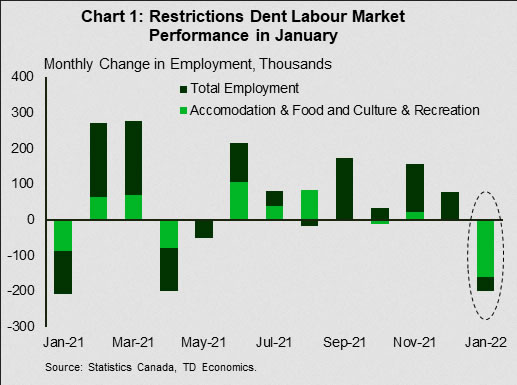
This week we finally got a glimpse of the damage to the economy from the Omicron wave. The employment report released earlier today showed the economy shed 200,000 jobs in January. As a result of these losses, the unemployment rate rose to 6.5% from 6.0% a month earlier. Job losses were heavily concentrated in industries hard-hit by restrictions, such as accommodation & food (-113k) and culture & recreation (-48k) (Chart 1). Younger workers, who tend to work in those industries, were disproportionately affected. Seventy percent of the jobs lost in January were among workers aged 15 to 24.
In addition to the job numbers, earlier this week we also received November's GDP data. While somewhat outdated, the report had a few important takeaways. First, it reaffirmed that the economy was expanding at a healthy clip prior to restrictions. GDP rose by 0.6% (month-on-month) in November, finally recovering to the pre-pandemic level (Chart 2). November's solid increase in activity was broad-based, spanning both the goods-producing sector and the still-recovering services industries.
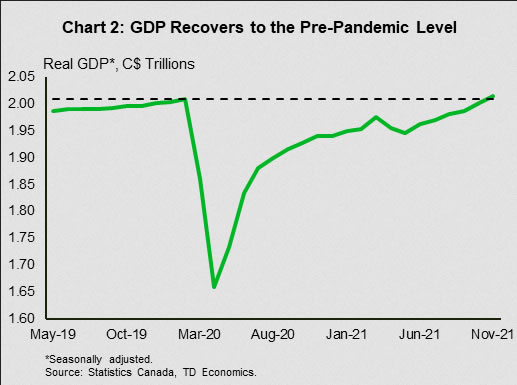
Secondly, on the goods side, there were signs that supply chain bottlenecks were easing prior to the most recent wave of the virus and the manufacturing sector was beginning to hum again. Auto production edged higher for the second consecutive month. With demand and prices for energy soaring, petroleum production also jumped. Lastly, while the severe floods in British Columbia did impact certain industries such as coal mining and wholesale of farm products, the overall impact on growth was small. Still, as expected, the Omicron wave slowed activity in December, with Statistics Canada's preliminary estimate suggesting that the GDP remained flat on the month. As evidenced in the job report, January is likely to be worse, with restrictions and staff absenteeism weighing on growth.
There are good reasons to look past the near term setback. Case loads have been falling, and both Ontario and Quebec eased their restrictions this week, suggesting that the economy and labour market will regain the spring in their step. As the labour market tightens further, stronger wage growth should follow suit.
Unlike other parts of the economy, the housing market could use some cooling. Alas, it remained hot in January. Several regional real estate boards released their data this week, indicating that home price growth was incredibly strong, as were home sales in Calgary and Vancouver. The latest flurry of activity and competition may reflect buyers and investors rushing ahead of the Bank of Canada rate hikes.
With the economy faring better than expected at the end of last year and restrictions looking to be short-lived, there is nothing in this week's data to dissuade the Bank from raising rates in March. Higher rates should cool Canadians' seemingly insatiable appetite for real estate.
Another Elevated US Inflation Reading in the Cards Next Week
Canada should show a pullback in the merchandise trade balance to a smaller surplus, with both exports and imports ticking lower following a November surge. A drop in oil prices on early concerns about the economic impact of Omicron will lower the value of energy exports, although that will reverse in January as prices bounce back. We expect imports of machinery and equipment to rise after surveys showed many businesses bumping up against current production capacity and planning to invest more in operations.
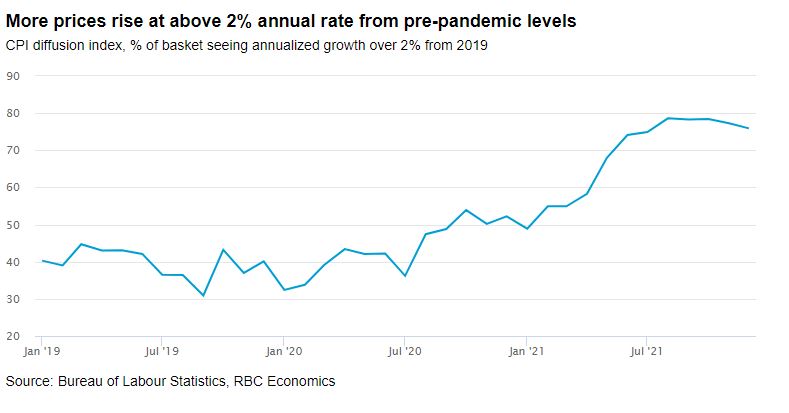
The rapid rebound in the economy—both within Canada and abroad—into late last year has prompted global monetary policymakers to worry that higher inflation rates could last longer than expected. Against that backdrop, the US CPI report will be carefully watched. We look for headline inflation to hold around 7.3% in January, a touch higher than the previous month’s reading—and still running at its highest rate since the early 1980s. Year-over-year price growth is being pushed higher by surging vehicle prices (tied to global supply chain disruptions) and rising shelter costs. A bounce-back in oil prices in January left prices at the pump more than 40% higher than a year ago. But the breadth of price growth has also widened substantially with more than three-quarters of the CPI basket rising at a rate faster than 2% as of December.
Policymakers at the U.S. Fed are unlikely to be surprised by yet another elevated inflation reading. But higher inflation rates alongside increasingly tight labour markets leave little reason to keep interest rates at emergency low levels. The same is true in Canada, even though near-term Omicron disruptions are expected to be more significant. Both the Fed and Bank of Canada are expected to kick off a rate hiking cycles as early as next month.
Week ahead data watch:
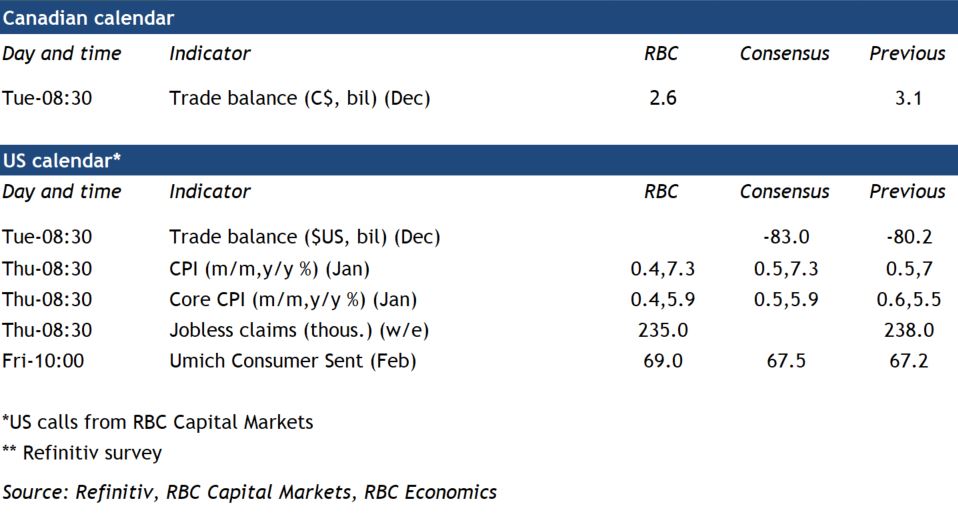
- We look for Canada’s Merchandise Trade surplus to narrow from $3.1 billion to $2.6 billion in December as a drop in oil prices weighs on energy exports and as imports of equipment rise on strong business investment intentions. The services trade balance is expected to edge higher with Omicron disrupting Canadian travel plans abroad.
- United States Headline CPI growth is expected mover higher to 7.3% year-over-year in January with ex-food & energy price growth accelerating to 5.9%.
Week Ahead – Plenty More Action to Come
How aggressively will central banks raise rates?
It’s been an incredible couple of weeks in the markets, one in which we’ve seen another hawkish move from multiple central banks, big swings in stocks on the back of earnings, and tensions around Ukraine intensify. The result has been very volatile markets and while the coming week looks a little lighter on event risk, there’s little reason to expect that the markets will suddenly settle down.
Just because central banks including the Fed, ECB, and BoE have already laid the groundwork for a more aggressive tightening this year, many questions remain unanswered and huge uncertainty around the inflation outlook remains. Traders will be paying very close attention to incoming data and comments from policymakers to better understand whether markets are positioned too aggressively, or still not enough.
Russia has obviously been in the headlines for many weeks now as troops have built up on the Ukrainian border and the West has made accusations of a possible impending invasion. While this will remain at the forefront of investors’ minds next week, the central bank will also be meeting later in the week and is expected to raise interest rates again as inflation continues to rise even after a year of tightening.
US
Traders were stunned after the January nonfarm payroll report showed hiring accelerated. Employers added 467,000 jobs last month, almost doubling the highest economist estimate. The December reading was also massively revised higher, which means the Omicron wave did not deliver a temporary disruption to the labor market recovery. Average hourly earnings continued to surge and that will feed into the inflation theme and drive expectations that the Fed will become even more hawkish.
The upcoming inflation data is all that matters and could lead to markets fully pricing in a half-point rate hike for the Fed at the March policy meeting. The January inflation report is expected to be red hot as the omicron wave intensified supply constraints and consumer demand remained strong. Wall Street expects the January inflation rate to rise between 7.0% and 7.6% from a year earlier.
Fed speak will include speeches from Michelle Bowman and Loretta Mester on Wednesday. Fed’s Bowman has not had any comments on monetary policy since October, so investors will pay close attention to see if she still resides with the hawks. Fed’s Mester has already supported a March liftoff and also a shrinking of the balance sheet as fast as possible without roiling markets.
EU
After this week’s handbrake turn from the ECB, focus next week will be on commentary coming from policymakers in regards to how soon we can expect an end of net asset purchases and, more importantly, what that means for interest rates this year. Markets are pricing in around 40-50 basis points of hikes this year after Christine Lagarde’s appearance following the meeting and there’s plenty of room for more if other central banks are anything to go by. German inflation on Friday will also be closely monitored.
UK
We have to wait until the end of the week for the bulk of the data from the UK, with GDP for Q4 headlining the releases. But this will come second next week to appearances from BoE policymakers, with Huw Pill speaking on Wednesday and Governor Andrew Bailey on Thursday. The Bank is clearly split on the pace of tightening if the vote this week (5-4) is anything to go by. Although their views appear more aligned than the MPCs is with the markets, which are pricing in four more hikes this year, despite Bailey’s comments in the press conference after the decision.
Boris Johnson is hanging on by a thread as key aides continue to abandon him and more backbenchers push for a vote of no confidence. The police investigation could be the final nail in the coffin for the Prime Minister.
Russia
Inflation is expected to have risen to 8.8% in January, up from 8.4% in December, and more than double its 4% target. This has happened even as the CBR has raised rates aggressively over the last year from 4.25% last February to 8.5% in December. And they’re expected to keep going on Friday, raising the key rate by another 100 basis points to 9.5%. Unemployment will also be released on Wednesday.
Tensions with the West remain high and the risk of invasion and sanctions are heightened. Escalations have taken their toll on the ruble, with higher oil prices perhaps easing the pain recently. With the West warning of Russian plans to stage a fake attack on Russian territory or Russian-speaking people in Eastern Ukraine in order to justify an invasion, it seems the situation could boil over at any minute.
South Africa
A couple of notable data points next week including mining and manufacturing production on Thursday.
Turkey
Inflation hit 48.7% in January, as reported by the Turkish Statistical Institute this week, which has been accused of falsifying the data to appease President Erdogan, with some claiming real inflation is much higher. Erdogan sacked the head of the institute days before the release, which has only further fueled claims that the data is unreliable. This begs the question if 48.7% is the falsified number, how high is the actual rate?
New Treasury and Finance Minister Nureddin Nebati claimed this week that he doesn’t think inflation will hit 50% this year and will peak in April, adding he hopes he’s not wrong. When below 50% is the best possible, and potentially unreliable, scenario, you know there’s a problem. He also reiterated that there is no turning back from this policy.
China
Chinese banks are expected to record an upswing in credit lending, after the People’s Bank of China cut its one-year loan prime rate twice in January, to 3.7%. The lending spurt should help reinvigorate the economy, which has slowed down to China’s zero-Covid policy.
Despite the Covid pandemic and the real estate crisis, the future looks bright for the economy. Eurostat reported last week that China’s GDP surpassed the entire EU for the first time in 2021.
India
The Reserve Bank of India holds a rate meeting on Wednesday. The RBI is expected to maintain the key lending rate at 4.0%, while potentially raising the reverse repo rate.
Australia
Australia releases NAB Business Confidence for January on Monday. In December, the index slid 24 points to -12, as the Omicron wave took a toll on business sentiment.
On Tuesday, Westpac Consumer Confidence for February will be released. The index has posted back-to-back declines, indicating pessimism among consumers.
The Melbourne Institute Consumer Inflation Expectations for February will be published on Thursday. The index slowed to 4.4% in January, down from 4.8% prior. Still, this is well above the RBA target band of 2%-3%. The release will be closely watched as inflation expectations can manifest into real inflation.
New Zealand
New Zealand 2-yr Inflation Expectations for Q1 will be released on Tuesday. Inflation continues to rise in New Zealand, and the index rose to 2.96% q/q in 2021 Q4, up from 2.3% previously. A higher reading in Q1 would support expectations of a rate hike when the RBNZ meets on February 23rd.
The manufacturing sector continues to expand but has been hampered by disruptions to supply and production chains. BusinessNZ Manufacturing PMI will be released on Thursday.
Japan
Japan is seeing an upswing in inflationary pressures, although to a lesser extent than in the US and UK. The rise in food and gas prices has dampened consumer spending, a key driver of the economy. In November, Household Spending came in at -1.3%. The consensus for the December release, which will be released on Monday, stands at a flat 0.0%.
Thailand
The Bank of Thailand holds a policy meeting on Wednesday. The central bank highlighted Omicron as a major risk when it held rates at the December meeting and is expected to maintain rates at 0.50%.
Economic Calendar
Saturday, Feb. 5
- EU-US Energy Council: EU foreign policy chief Borrell speak with Secretary of State Blinken
Sunday, Feb. 6
- Queen Elizabeth II celebrates platinum jubilee
Monday, Feb. 7
- Lunar New Year break ends, Mainland Chinese markets reopen
- Germany’s Scholz meets Biden in Washington
- Informal meeting of EU agriculture ministers in Strasbourg
Economic Data/Events
- China Caixin services PMI, forex reserves
- Germany Industrial production
- South Africa gross and net reserves
- Switzerland Foreign currency
- Sweden Budget balance
- Turkey Budget balance
- Russian Official reserves
- Switzerland unemployment, sight deposits
Tuesday, Feb. 8
- Norway Energy ministry update on petroleum activity
- Bank of France Governor Villeroy speaks at French National Assembly’s Finance Committee
Economic Data/Events
- US Trade
- Poland rate decision: Expected to raise Base Rate by 50bps to 2.75%
- Sweden Industrial production
- France Trade
- Japan household spending
- Italy retail sales
Wednesday, Feb. 9
- Fed President Mester speaks at European Economics and Financial Centre event
- BoE Chief Economist Pill speaks at the Society of Professional Economists’ annual conference on “U.K. Monetary Policy Outlook.”
- EU foreign and health ministers meet in Lyon, France with an aim of developing the bloc’s health policy
- Sweden scraps its Covid restrictions, citing a higher vaccination rate and a manageable situation in hospitals
Economic Data/Events
- US wholesale inventories
- India Central Bank (RBI) Interest Rate Decision: Expected to raise Reverse Repo Rate by 40 bps to 3.75%
- Thailand Central Bank (BOT) Interest Rate Decision: Expected to keep interest rate unchanged at 0.50%
- BOC Gov Macklem speaks to Canadian Chamber of Commerce
- Fed’s Mester speaks at European Economics and Financial Centre event
- BoE Chief Economist Pill speaks at the Society of Professional Economists’ annual conference on “U.K. Monetary Policy Outlook.”
- EU foreign and health ministers meet in France to discuss the bloc’s health policy.
- Sweden reopens and scraps its Covid restrictions
- Mexico CPI
- Russia CPI
- Australia consumer confidence
- South Africa business confidence
- Germany Trade
- Italy industrial production
- Japan M2 money stock
- Mexico international reserves
- Russia unemployment, retail sales, real wages
- EIA Crude Oil Inventory Report
Thursday, Feb. 10
Economic Data/Events
- US CPI, initial jobless claims
- Mexico Rate decisions: Expected to raise overnight rate 50bps to 6.00%
- Sweden Rate decisions: Expected to keep interest rates unchanged at 0.00%
- Hungary one-week deposit rate
- European Commission publishes updated economic forecasts.
- BOE Gov Bailey speaks at The CityUK annual dinner
- National Bank of Poland releases minutes of the rate decision
- South Africa’s Ramaphosa delivers state of the nation address
- Japan PPI
- South Africa manufacturing production
- South Africa manufacturing, mining, gold, and platinum production
- Turkey Unemployment
- Russia gold and forex reserves
- UK RICS house price balance
Friday, Feb. 11
Economic Data/Events
- US University of Michigan consumer sentiment
- Germany CPI
- Hungary CPI
- Switzerland CPI
- Russia Rate Decisions: Expected to raise key rate 100bps to 9.50%
- UK GDP, industrial production, trade
- India industrial production
- Mexico industrial production
- Turkey industrial production
- Russia trade
- New Zealand PMI
- Turkey current account, industrial productions, expected inflation
Sovereign Rating Updates
- Turkey(Fitch)
- Hungary (S&P)
- Switzerland (S&P)
- Denmark (Moody’s)
- Germany(Moody’s)
- Belgium (DBRS)
Week Ahead – US Inflation in the Spotlight Again, UK GDP Eyed Too
The skidding US dollar will be looking to the January inflation readings out of the United States to reverse its decline as financial markets enter a somewhat quieter week. UK GDP growth numbers will be the other highlight as the pound’s rally lost steam after the Bank of England sent some mixed signals on the economy. The kiwi might find some love should the RBNZ’s own survey show inflation expectations are creeping higher in New Zealand. However, with earnings releases also slowing down, markets might nevertheless struggle to find fresh direction in the coming days.
Waiting for inflation to peak
It will likely be another grim picture on the inflation front next week as the US consumer price index is expected to edge up to yet another multi-decade high on Thursday. The 12-month rate in CPI is forecast to have risen by 7.2% in January, climbing 0.2 percentage points from the prior month. There might be some relief from the month-on-month rate, which is expected to have risen at the slowest pace in four months, by 0.4%. However, the core rate will likely raise eyebrows as it’s set to jump from 5.5% to 5.9% year-on-year.
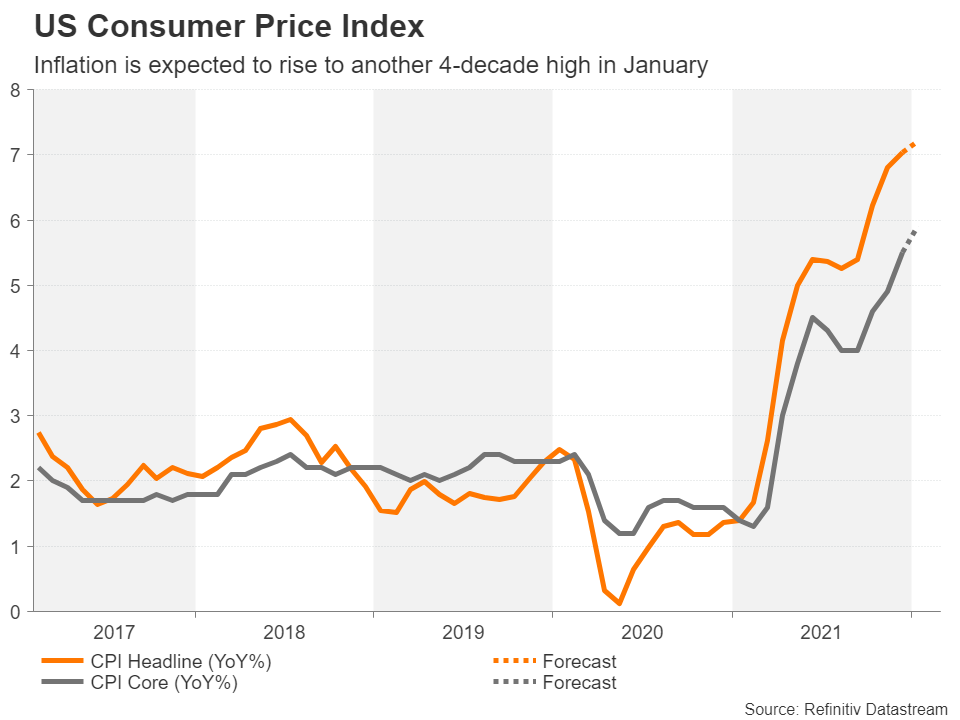
The next few months will be crucial in determining whether inflation has started to peak so investors will be scouring over the details of the report to find any signs that price pressures in the CPI components most affected by the pandemic and the related supply disruptions are starting to ease.
Weaker-than-expected readings in either the headline or core rates would raise hopes that inflation is plateauing. This would be good news for shares on Wall Street but not so much for the dollar as Treasury yields could tumble if investors begin to price out some of the more excessive rate hikes bets for the Fed.
The dollar index slid sharply from the 18-month high it hit only a week ago after Fed policymakers calmed fears that a 50-basis-points rate hike was on the menu in March. However, should the inflation numbers surprise on the upside again, that would add wind to the dollar’s sails.
In other data out of the US, the University of Michigan’s preliminary consumer sentiment gauge will be watched on Friday.
Energised euro might shine even in quiet week
The euro shot higher after the European Central Bank signalled it may have to pull back the pandemic-era stimulus at a much faster pace than currently indicated, opening the door to a rate increase in 2022, amid the worsening threat of higher inflation.
Eurozone government bond yields surged in the aftermath of the meeting as the prospect of a rate hike later this year draws closer. The euro will likely have to rely on this rally enduring in the coming days if it is to stretch its gains as there’s not a lot on the European calendar of interest apart from some German stats.
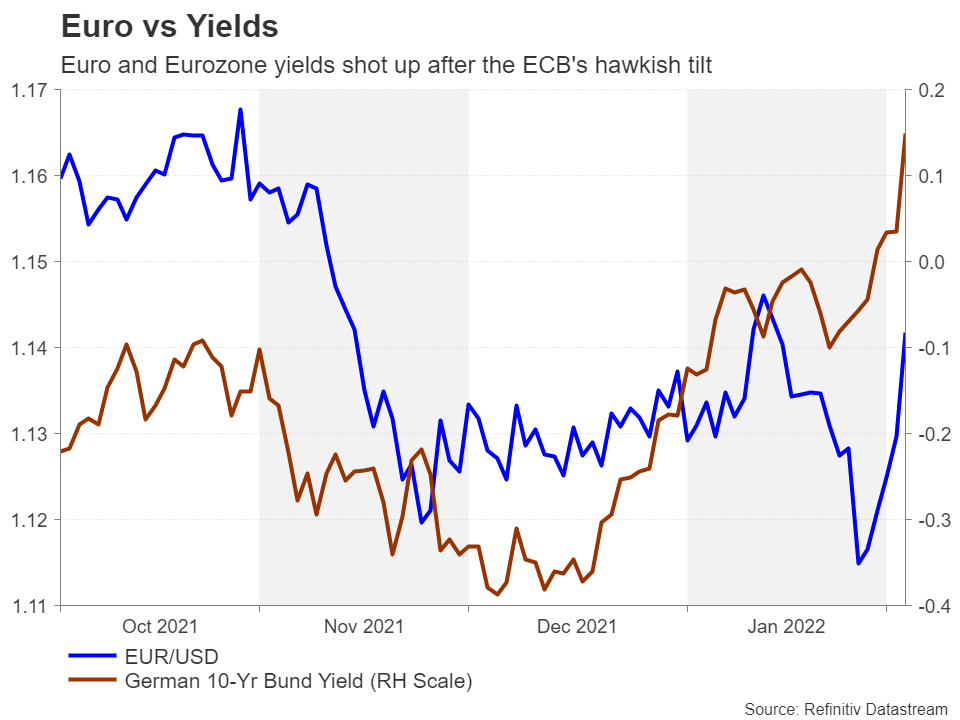
German industrial output for December is out on Monday and will be followed by trade figures on Wednesday and the final January CPI print on Friday. Germany’s recovery has stumbled lately and is now lagging those of some other Eurozone countries, so any positive surprises could assist the euro’s latest upwards march.
Outside of the euro area, Sweden’s Riksbank meets on Thursday and might follow in the ECB’s footsteps in sounding more hawkish.
Pound turns to GDP data after BoE confuses markets
The Bank of England maintained its advantage over other major central banks in being the least behind the curve on inflation by hiking rates for the second meeting in a row in February. However, despite the overall hawkish backdrop of the meeting, Governor Andrew Bailey pointed out some downside risks to their upwardly revised inflation forecasts, casting uncertainty over the rate outlook even as he flagged more rate hikes in upcoming meetings.
So although sterling remains well supported after the BoE meeting, it may need a fresh upside driver to sustain its rebound against the greenback. It’s doubtful if next week’s quarterly GDP publication can act as that driver.
Data on Friday will likely reveal that the UK economy recouped all its lost output from the pandemic in the three months to December. GDP is projected to have expanded by 1.1% quarter-on-quarter, the same pace as in Q3.
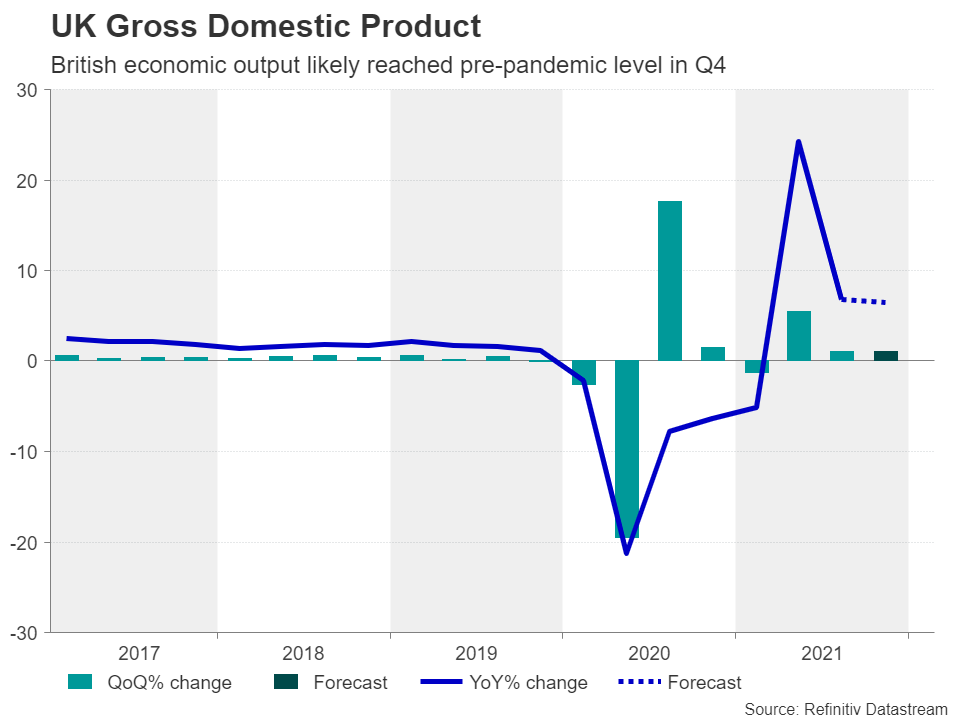
Separate numbers for December will be available too, including for industrial production and the trade balance. These could attract more attention if they show a bigger-than-anticipated impact from the Omicron wave on the economy. With the Bank of England decision out of the way, the degree to which growth faltered in December and January and how quickly it picks up going forward will probably be of more significance for traders.
Hence, reaction to the data might be limited even if there’s an impressive beat in the headline GDP figure.
Kiwi looks to RBNZ survey as bounceback gathers steam
The Reserve Bank of New Zealand doesn’t meet until February 23, but markets might get a clue as to what to expect from its quarterly survey on inflation expectations on Friday. The RBNZ’s measures of price expectations has been a good guide on the central bank’s next move in the past and could be again if expectations for one- and two-year inflation jump sharply like they did in the previous two surveys.
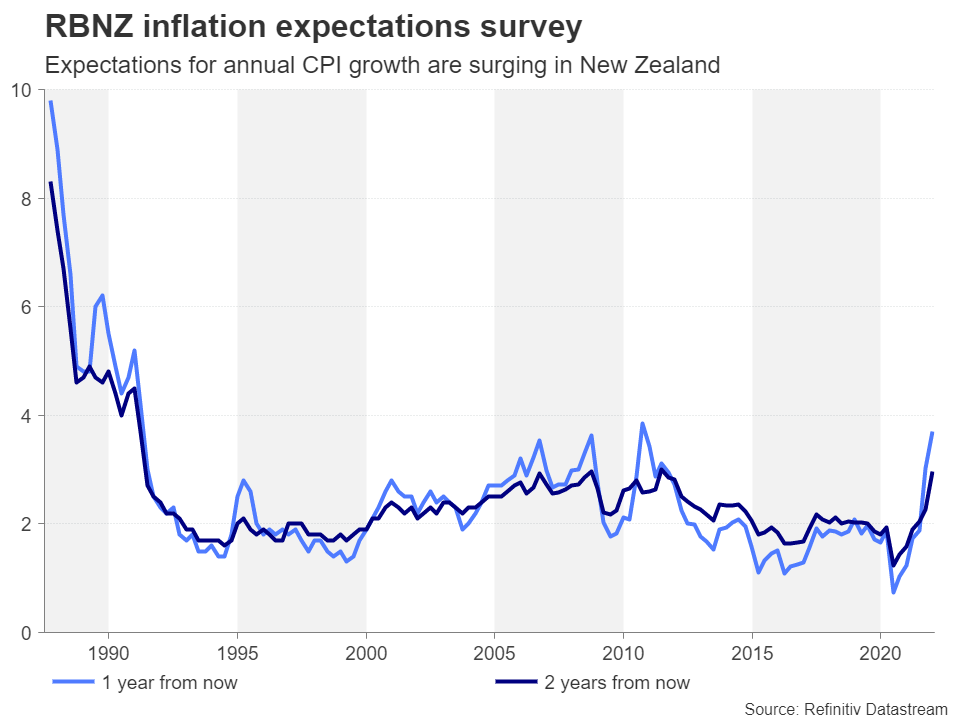
A rate hike is almost certain at the February meeting, but policymakers might have trouble with the very steep rate hike path futures markets have priced in. If inflation expectations climb further, that would create less room for disappointment and support the New Zealand dollar’s grind higher.
In neighbouring Australia, the aussie dollar will likely be taking its cues from the broader market risk tone as the only major release is the final retail sales estimate for December as well as for the whole December quarter.
A further improvement in risk sentiment next week could inflict more damage on the Japanese yen, which is paring some of its January gains. However, household spending numbers for Japan on Tuesday and corporate goods prices on Thursday are unlikely to provide much of a boost.
Weekly Focus – ECB Repricing is the Name of the Game, Expect a Hike in December
German yields rose and EUR gained three figures against the USD this week to 1.14, as markets priced in an increasingly hawkish ECB. After the ECB Governing Council meeting on Thursday, we changed our call and now expect the ECB to hike rates in December 2022, and again in March 2023 (See ECB Review: New call - ECB to hike in Dec22 and Mar23, 3 February). Based on Lagarde's comments on the press conference, the ECB GC is more and more concerned about inflation, while seeing growth risks broadly balanced. In several occasions, Lagarde had the opportunity to close the door for a rate hike in 2022 but she intentionally left it open. Same time, Lagarde confirmed 'sequencing' indicating that the ECB would only hike rates after ending its net asset purchases (APP). Hence, we still see the current market pricing as too aggressive, as the ECB would have to accelerate the pace of taper in order to be able to hike in September, let alone in the summer.
Tighter financial conditions will be a key market driver in 2022. After last week's FOMC meeting, we changed our Fed call and now expect five hikes (a total of 125bp) this year and QT in June. The risks are tilted towards more aggressive tightening, and we think that compared to 2015, the Fed is 'behind the curve' this time around (See Fed Update: - Different economy, different hiking cycle - a comparison with December 2015, 3 February).
Tighter financial conditions will make life harder for indebted sovereigns, businesses and individuals, and may exacerbate regional divergence in growth and recovery. While developed economies have broadly recovered back to pre-pandemic levels, insufficient vaccine rollout, slow recovery in international tourism and limited fiscal space remain a drag on EM growth. Tighter financial conditions through wider credit spreads and stronger USD will make the external financing environment for EM substantially more challenging at a time when overall debt levels are at historical highs and borrowing needs remain elevated. In Europe, the focus remains on Turkey, where another staggering inflation print was recorded this week (48.7% in January). In the context of looming Fed rate hikes, with an extremely low and negative real interest rate and weak buffers, the Turkish economy remains one of the most vulnerable ones in the EM universe.
Repricing of expected ECB action was the name of the game this week. The curve flattened with a 25bp rise in 2y and a 15bp rise in 10y Bund yields. The futures markets are pricing in the first ECB hike as soon as in July, which we see premature. ECB repricing was the key driver for a higher EUR/USD this week but we think next week's US inflation print (Thursday) could again turn the attention back to the US. We continue to see EUR as overvalued vs. fundamentals, and maintain our forecast for EUR/USD at 1.08 in 12M.
Next week's data calendar is pretty light. If the US inflation print surprises on the upside, we think a 50bp hike by the Fed in March is possible. We will also keep a close eye on any comments from FOMC and ECB policymakers, although there are not many speeches in the calendar. China is back from the New Year's celebrations and a key thing to watch will be whether there's a pickup in new COVID-19 cases after increased travelling. Also, any headlines on the Russia-Ukraine standoff will be watched closely.