Sample Category Title
Weekly Focus – ECB Repricing is the Name of the Game, Expect a Hike in December
German yields rose and EUR gained three figures against the USD this week to 1.14, as markets priced in an increasingly hawkish ECB. After the ECB Governing Council meeting on Thursday, we changed our call and now expect the ECB to hike rates in December 2022, and again in March 2023 (See ECB Review: New call - ECB to hike in Dec22 and Mar23, 3 February). Based on Lagarde's comments on the press conference, the ECB GC is more and more concerned about inflation, while seeing growth risks broadly balanced. In several occasions, Lagarde had the opportunity to close the door for a rate hike in 2022 but she intentionally left it open. Same time, Lagarde confirmed 'sequencing' indicating that the ECB would only hike rates after ending its net asset purchases (APP). Hence, we still see the current market pricing as too aggressive, as the ECB would have to accelerate the pace of taper in order to be able to hike in September, let alone in the summer.
Tighter financial conditions will be a key market driver in 2022. After last week's FOMC meeting, we changed our Fed call and now expect five hikes (a total of 125bp) this year and QT in June. The risks are tilted towards more aggressive tightening, and we think that compared to 2015, the Fed is 'behind the curve' this time around (See Fed Update: - Different economy, different hiking cycle - a comparison with December 2015, 3 February).
Tighter financial conditions will make life harder for indebted sovereigns, businesses and individuals, and may exacerbate regional divergence in growth and recovery. While developed economies have broadly recovered back to pre-pandemic levels, insufficient vaccine rollout, slow recovery in international tourism and limited fiscal space remain a drag on EM growth. Tighter financial conditions through wider credit spreads and stronger USD will make the external financing environment for EM substantially more challenging at a time when overall debt levels are at historical highs and borrowing needs remain elevated. In Europe, the focus remains on Turkey, where another staggering inflation print was recorded this week (48.7% in January). In the context of looming Fed rate hikes, with an extremely low and negative real interest rate and weak buffers, the Turkish economy remains one of the most vulnerable ones in the EM universe.
Repricing of expected ECB action was the name of the game this week. The curve flattened with a 25bp rise in 2y and a 15bp rise in 10y Bund yields. The futures markets are pricing in the first ECB hike as soon as in July, which we see premature. ECB repricing was the key driver for a higher EUR/USD this week but we think next week's US inflation print (Thursday) could again turn the attention back to the US. We continue to see EUR as overvalued vs. fundamentals, and maintain our forecast for EUR/USD at 1.08 in 12M.
Next week's data calendar is pretty light. If the US inflation print surprises on the upside, we think a 50bp hike by the Fed in March is possible. We will also keep a close eye on any comments from FOMC and ECB policymakers, although there are not many speeches in the calendar. China is back from the New Year's celebrations and a key thing to watch will be whether there's a pickup in new COVID-19 cases after increased travelling. Also, any headlines on the Russia-Ukraine standoff will be watched closely.
Sunset Market Commentary
Markets
This morning, US and European interest rate markets continued yesterday’s ‘unusual’ disconnect. European markets still reacted to yesterday’s ‘implicit’ U-turn of Chair Lagarde. She backtracked on the ‘temporary inflation’ narrative and didn’t repeat the mantra of no ECB rate hikes in 2022. The era of negative EMU interest rates is coming to an end. Money markets are embracing the idea that the ECB might raise its policy rate out of negative territory by the end of this year. US interest rates initially declined (albeit marginally) on rumours that omicron could cause a blip in the labour market recovery. However, it didn’t. On the contrary. According to the monthly BLS payrolls data, the US economy in January added 467 000 jobs, much more than the 125 000 expected . Any presumed softness at the end of last year was also overthrown by an impressive 709k upward revision. Wage growth (average hourly earnings) accelerated at an impressive 0.7% M/M (5.7% Y/Y). Even the rise in the unemployment rate (calculated from a different source/household survey) to 4.1% from 4.0% should be considered as good news as it was the result a higher participation rate. Admittedly, the interpretation of this data series was difficult due to statistical adjustments. Whatever, the overall picture only confirmed Chair Powell’s upbeat assessment on the labour market at the Fed press conference last week. US yields switched an initial cautious decline for yet another impressive jump higher, the short end still taking the lead. The curve bear flattens with the 2-y/5-y sector rising 10/9 bps and the 30-y +5.5 bps. The 2-y is again setting a new cycle peak (1.30%). The 10-y is testing the 1.90% top! German yields, were 4.5/2.5 bps higher before the payrolls and extended their post-ECB follow-through rise. Yields are rising 6 bps for the 2-y, 7 bps for the 5-y and 5 bps for the 10-y. Curve flattening at the very long end keeps the 30-y little changed. The prospect of higher core EMU yields and the ECB expected to halt net asset purchases (APP) sooner than expected also hurts peripheral EMU bonds. 10-y year yields spreads versus Germany of Greece, Italy and Spain widen a further 12 bps, 5 bps and 3 bps respectively. European equities are losing up to 1-1.5% after yesterday’s WS losses. US indices show remarkable resilience (modest gains of 0.25%/0.50%) given the wild swings on interest rate markets.
The euro extended yesterday’s post-ECB gains this morning, with EUR/USD attacking the 1.1483 top. The payrolls prevented a break at this stage. At 1.1440, however, the euro is holding yesterday’s gain, which should be a promising sign for euro bulls. At the same time, the dollar extends gains against most other majors with DXY rebounding to the 96.60 area. The Swiss franc is ceding further ground (1.0560). Sterling is losing further ground against the euro (EUR/GBP 0.8450) and the dollar (cable 1.3530). In CE the forint and the Czech koruna are holding strong. The zloty underperforms.
News Headlines
Canadian payrolls showed that 200.1k jobs went bust in January. Markets expected a smaller setback (-110k). Details showed both full time (-82.7k) and part time (-117.4) jobs decreasing. The number of people who were employed but worked less than half their usual hours rose by 620k (+66.1%) in January, the largest increase since March 2020. The unemployment rate ticked up from 6% to 6.5% (first increase since April) with the labour force participation rate falling from 65.4% to 65%. Hourly wages rose by 2.4% Y/Y, down from 2.7% Y/Y in December. The Omicron-outbreak is to blame for the weak payrolls report as many jurisdictions implemented stricter public health measures. Accommodation and food services was the hardest-hit industry. USD/CAD gained a big figure from 1.2675 to 1.2775 and approaches the 2022 high (1.2814). The move is both inspired by USD-strength (post US payrolls) and CAD-weakness. The temporary labour market setback won’t interfere with the Bank of Canada’s intentions to start its tightening cycle in March.
Positive Surprise from NFP Supports Dollar, Trouble for Equities
A positive surprise on US employment. The official BLS report showed a jobs increase of 467K, markedly better than the expected 110-165K. Moreover, the previous data was seriously revised upwards and now reports employment growth of 510K in December compared to the initially reported 199K.
Average hourly earnings rose by 0.7% m/m and 5.7% y/y, showing further acceleration and increasing signs that the inflation genie is out of the bottle.
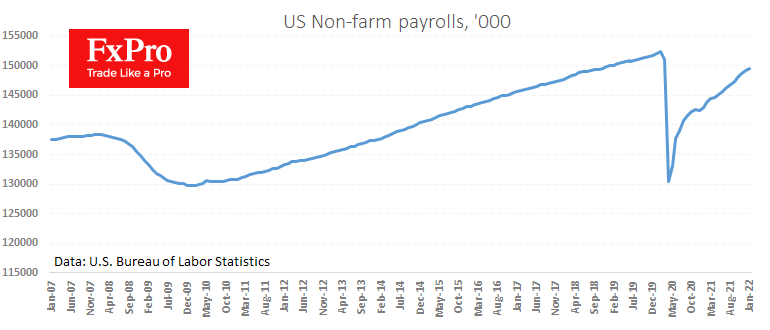
As a result, markets are intensifying their expectations for policy tightening, laying a 34% chance of an immediate 50-point rate hike in March versus 18% before the release.
The strong labour market and the mood for decisive rate hikes also support the dollar, which adds 0.4% after the release. This is likely that the USD growth impulse is far from the end, and dollar growth will continue in the coming days or even weeks.
US: Payrolls Make Strong Gains January, Despite Omicron
The U.S. economy gained an impressive 467k jobs in January, well above market expectations. January's report also included the annual benchmark revisions to the payrolls numbers, and was a result the monthly gains in employment in November and December were revised up materially (+709k). Overall, payrolls remained 1.9% below their pre-pandemic level.
The unemployment rate rose a tick to 4.0% in January. The household survey data reflected updated population estimates. Removing the effects of the population controls, employment fell 272k. The number of people on temporary layoff rose 147k, the largest increase since December 2020, likely reflecting Omicron-related furloughs. The labor force participation rate is now at 62.2%, below the 63.4% pre-pandemic
Looking at shifts by industry, employment rose in leisure and hospitality (+151k), professional and business services (+86k), retail (+61k) and transportation and warehousing (+54k). All of these sectors, except leisure and hospitality, now have employment levels above their pre-pandemic highs.
Average hourly earnings were up 5.7% from a year ago in January, which was likely biased upwards by lower average hours.
The impact of Omicron can be seen in reduced hours worked. The index of aggregate weekly hours was down 0.3% month/month, the first monthly decline since last February.
Key Implications
Payrolls defied expectations in January, posting a solid month of increase. The impact of Omicron on the jobs market was more evident in the household survey, where the unemployment rate edged higher. The survey reference period is shorter for the household survey than for payrolls, so the bar for being counted as unemployed for a short work absence is lower.
That said, we expect the impact of Omicron wave to be nasty, brutish and short. Hospitalizations across many regions are already coming down, and by March, Americans will likely be resuming many of the close contact activities they put on hold. We expect the disruption to output to be greater than employment, but it will also bounce back strongly in the second quarter. Several Fed officials have already indicated they would look through any Omicron related disruptions. There is nothing in today's report to dissuade the FOMC from taking rates higher in March.
Canada’s Economy Sheds Jobs in January
The Canadian labour market lost 200k positions in January, worse than the consensus call for a loss of 120k positions. Full-time (-83k) and part-time (-117k) employment fell on the month.
Even with the labour force participation rate dropping 0.4 percentage points, to 65%, job losses pushed the unemployment rate 0.5 percentage points higher to 6.5% in January.
By industry, services-producing employment fell 223k, with food services leading the way, down 113k. Meanwhile, employment increased in the goods-producing sector (+23k), with the construction industry (+23k) once again driving the gains.
By province, employment was down mostly in Ontario (-146k) and Quebec (-63k), the two provinces most directly impacted by public health restrictions.
Lastly, total hours worked fell 2.2% month-on-month, ending the streak of advances that started in July 2021.
Key Implications
This was sure to be a negative report. The Omicron wave and associated lockdowns forced many businesses to adjust on the fly. They did this by cutting jobs and hours significantly. Notably, all of the increase in unemployment was due to more people on temporary lay-off or scheduled to start a job in the near future, suggesting the setback will be short lived.
With reopening already underway, we expect a big bounce back when the February data are released next month. Canadian businesses and workers have been incredibly resilient through all the stops and starts over the last two years. This wave should be no exception.
The Bank of Canada should be confident that employment will rebound swiftly and will still execute on its first rate hike in March. Market pricing hasn't budged off this and Canadian bond yields are up this morning.
EUR/USD Mid-Day Outlook
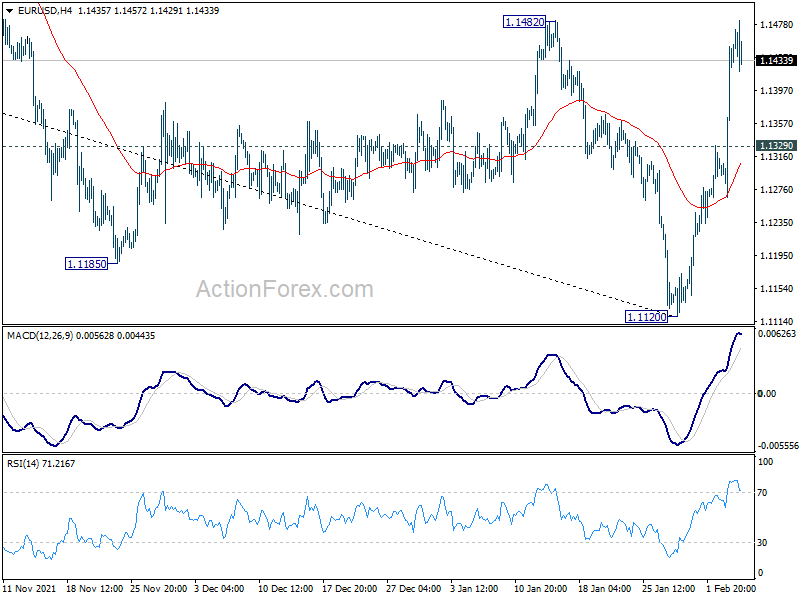
Daily Pivots: (S1) 1.1322; (P) 1.1386; (R1) 1.1505; More...
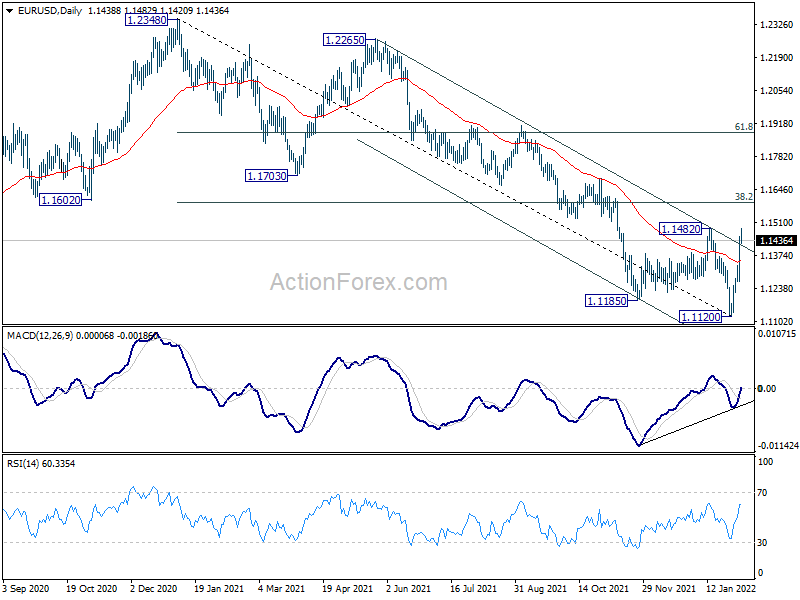
No change in EUR/USD's outlook and intraday bias stays on the upside. Considering bullish convergence condition in daily MACD, a medium term bottom could be in place already. Break of 1.1482 will affirm this case and target 38.2% retracement of 1.2348 to 1.1120 at 1.1589 next. On the downside however, break of 1.1329 minor support will mix up the outlook and turn intraday bias neutral first.
In the bigger picture, the strength of the the decline from 1.2348 (2021 high) suggests that it's not a corrective move. But still, it could be the fourth leg of a sideway pattern from 1.0339 (2017 low), or resuming long term down trend. In any case, outlook will now stay bearish as long as 1.1482 resistance holds. Next target would be 1.0635 low. However, firm break of 1.1482 will raise the chance that whole fall from 1.2348 has completed, and turn focus back to 1.1703 resistance for confirmation.
USD/CHF Mid-Day Outlook
Daily Pivots: (S1) 0.9175; (P) 0.9206; (R1) 0.9234; More....
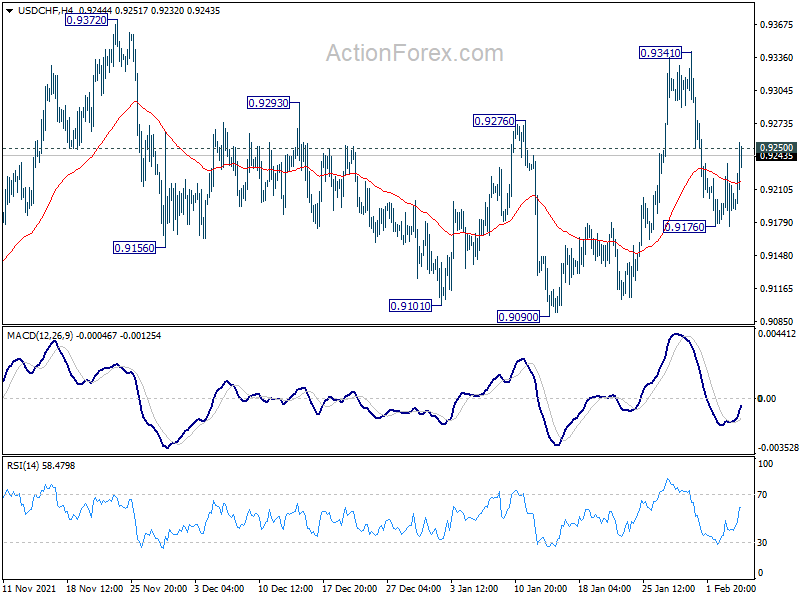
Intraday bias is back on the upside in USD/CHF with break of 0.9250. Further rise would be seen back to 0.9341 resistance first. Break will target 0.9372. On the downside, below 0.9176 will resume the fall form 0.9341 to 0.9090 support. Firm break there will argue that choppy rise from 0.8925 has completed, and turn near term outlook bearish.
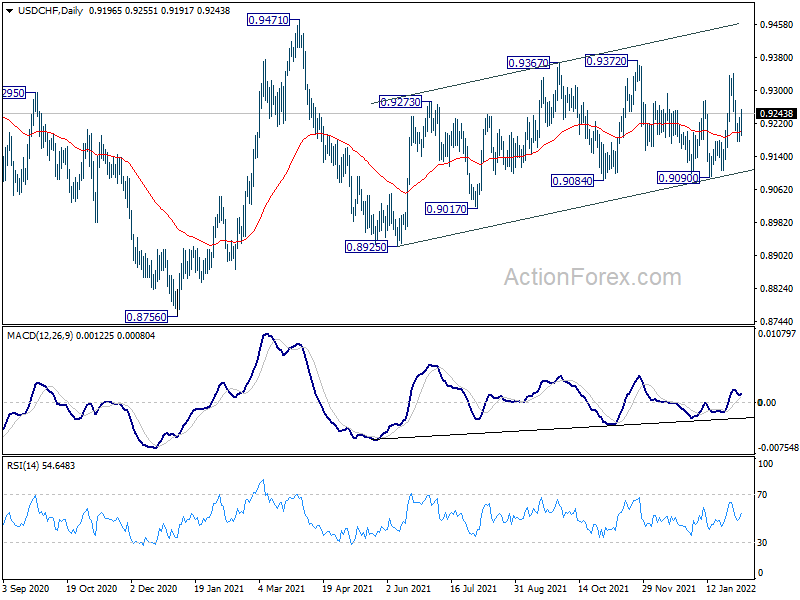
In the bigger picture, medium term outlook will be neutral at best as long as 0.9471 resistance holds. Larger down trend could still extend through 0.8756 (2021 low). However, firm break of 0.9471 will argue that the trend has already reversed and rebound the rally from 0.8756 with another impulsive move.
USD/JPY Mid-Day Outlook
Daily Pivots: (S1) 114.54; (P) 114.77; (R1) 115.20; More...
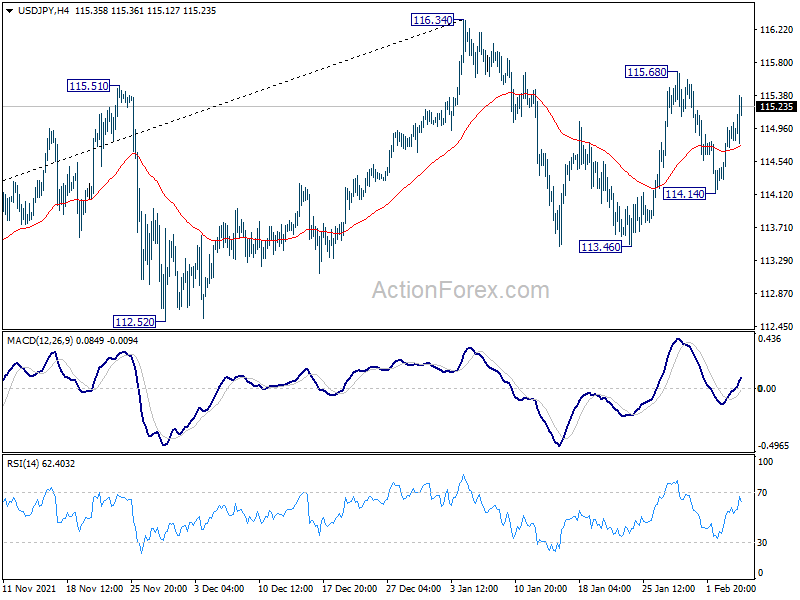
Intraday bias in USD/JPY remains neutral at this point and outlook is unchanged. Overall, corrective pattern from 116.34 is extending. Below 114.14 will target 113.46 and possibly further to 112.52 support. On the upside, above 115.68 will bring retest of 116.34 high.
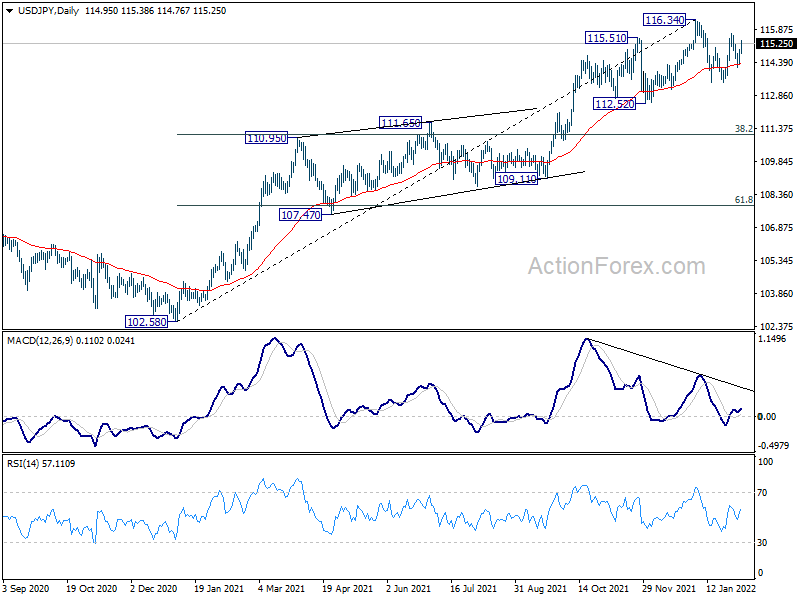
In the bigger picture, no change in the view that rise from 102.58 is the third leg of the up trend from 101.18 (2020 low). Such rally should target a test on 118.65 (2016 high). Sustained break there will pave the way to 120.85 (2015 high) and raise the chance of long term up trend resumption. This will remain the favored case as long as 55 week EMA (now at 111.07) holds.
WTI Oil Rally for the Seventh Straight Week on Geopolitical Tensions and Supply Fears
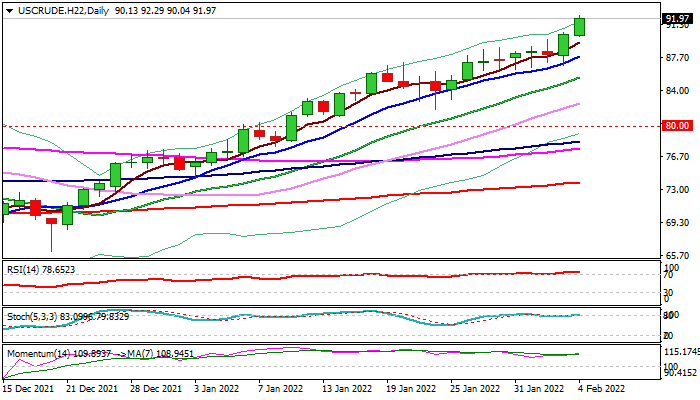
WTI oil price surged through round-figure $90 resistance and hit new seven-year high above $92 per barrel on Friday.
Geopolitical tensions over Ukraine and a winter storm in the United States fueled concerns about supply disruptions and continue to inflate oil prices for the seventh consecutive week, when the price advanced over $20 or nearly 32%.
Analysts see a test of psychological $100 barrier in the short term as likely scenario, with growing fears about potential war in Ukraine being one of the top concerns in 2022.
Bulls so far ignore overbought conditions on daily and weekly chart, but some corrective action should be expected before attack at $100 barrier, with dips expected to offer better buying opportunities.
Res: 92.94; 93.48; 95.89; 98.65.
Sup: 91.00; 90.04; 88.81; 87.76.
GBP/USD Mid-Day Outlook
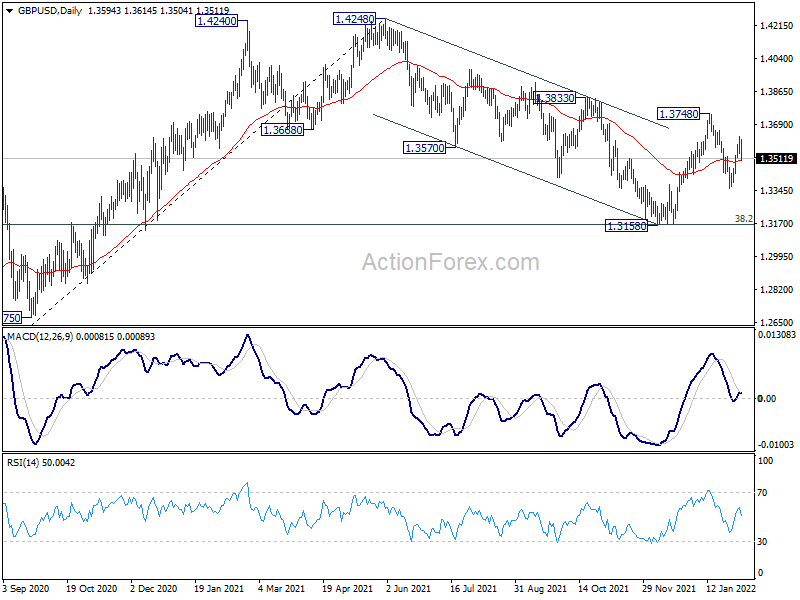
Daily Pivots: (S1) 1.3549; (P) 1.3589; (R1) 1.3639; More...
GBP/USD's sharp fall and break of 1.3515 minor support suggests that rebound from 1.3356 has completed at 1.3627 already. Intraday bias is back on the downside for 1.3356 support first. Break will resume the decline from 1.3748 to retest 1.3158 low. On the upside, however, above 1.3627 will resume the rebound for 1.3748 resistance instead.
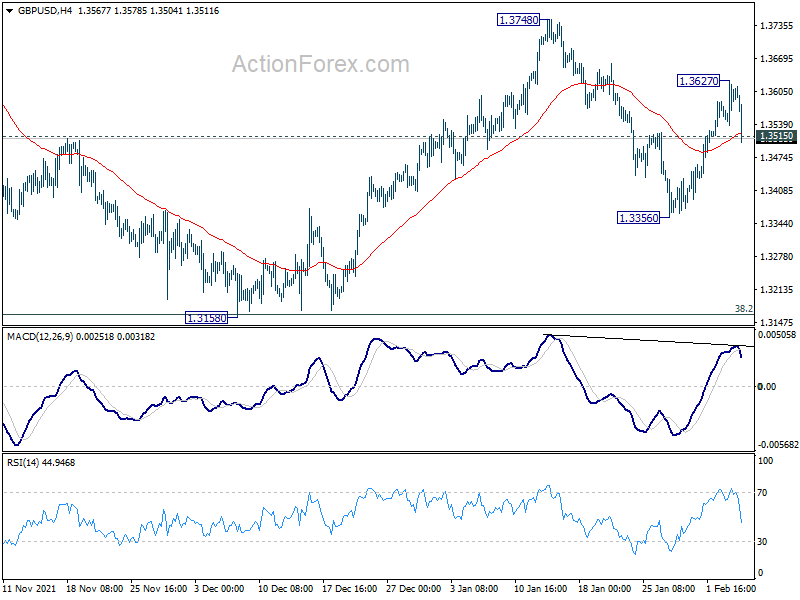
In the bigger picture, as long as 38.2% retracement of 1.1409 to 1.4248 at 1.3164 holds, up trend from 1.1409 (2020 low) is still in progress. On resumption, next target will be 38.2% retracement of 2.1161 to 1.1409 at 1.5134. Nevertheless sustained break of 1.3164 will argue that whole rise from 1.1409 has completed and bring deeper fall to 61.8% retracement at 1.2493.