Sample Category Title
EUR/USD Mid-Day Outlook
Daily Pivots: (S1) 1.1272; (P) 1.1301; (R1) 1.1335; More...
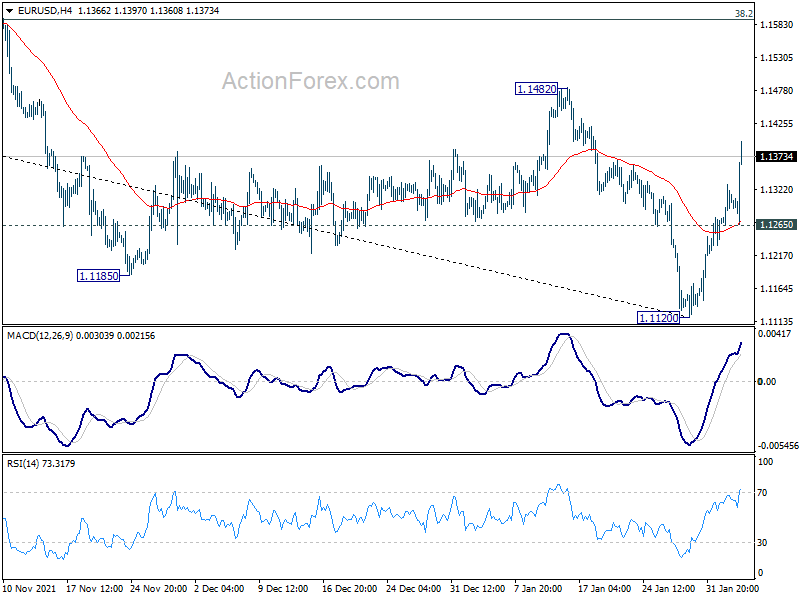
EUR/USD's rebound from 1.1120 accelerates higher today and intraday bias stays on the upside for 1.1482 resistance. Considering bullish convergence condition in daily MACD, a medium term bottom could be in place already. Break of 1.1482 will affirm this case and target 38.2% retracement of 1.2348 to 1.1120 at 1.1639 next. On the downside however, break of 1.1265 minor support will retain near term bearishness, and flip bias back to the downside for retesting 1.1120 low instead.
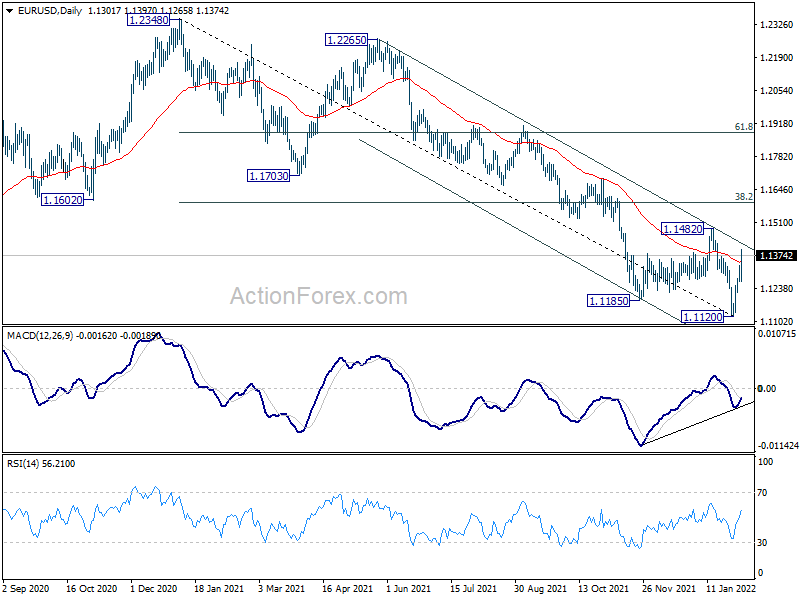
In the bigger picture, the strength of the the decline from 1.2348 (2021 high) suggests that it's not a corrective move. But still, it could be the fourth leg of a sideway pattern from 1.0339 (2017 low), or resuming long term down trend. In any case, outlook will now stay bearish as long as 1.1482 resistance holds. Next target would be 1.0635 low. However, firm break of 1.1482 will raise the chance that whole fall from 1.2348 has completed, and turn focus back to 1.1703 resistance for confirmation.
ECB Winning the Race of Hawkish Surprises, Euro Overpowers Sterling
It looks like ECB is beating BoE in the race of hawkish surprise in a jam-packed day. Sterling spiked higher after four of the nine MPC members have indeed voted for a larger hike of 50bps. However, there was no clear follow through buying as BoE indicated there will only be "some further modest tightening" ahead.
On the other hand, ECB President Christine Lagarde admitted in the post-meeting press conference that inflation surprises caused unanimous concerns in the Governing Council. More importantly, she refused to repeat the talk that a rate hike in 2022 remain highly likely. It seems that Lagarde is leaving the door open to a change in forward guidance in March to reflect the chance of a rate hike within this year.
Elsewhere in the forex markets, Dollar is recovery mildly today but remains the weakest one for the week, followed by Yen. Aussie is still the strongest but it's path would depend on overall risk sentiment.
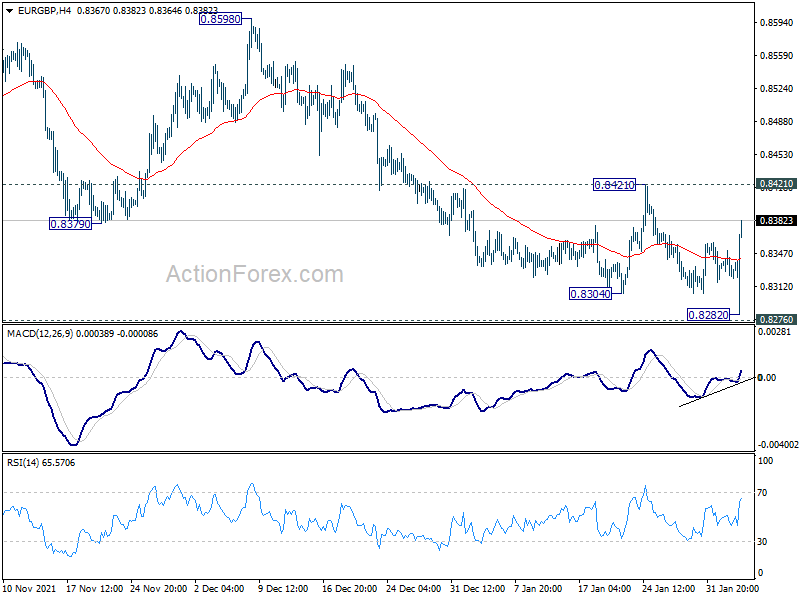
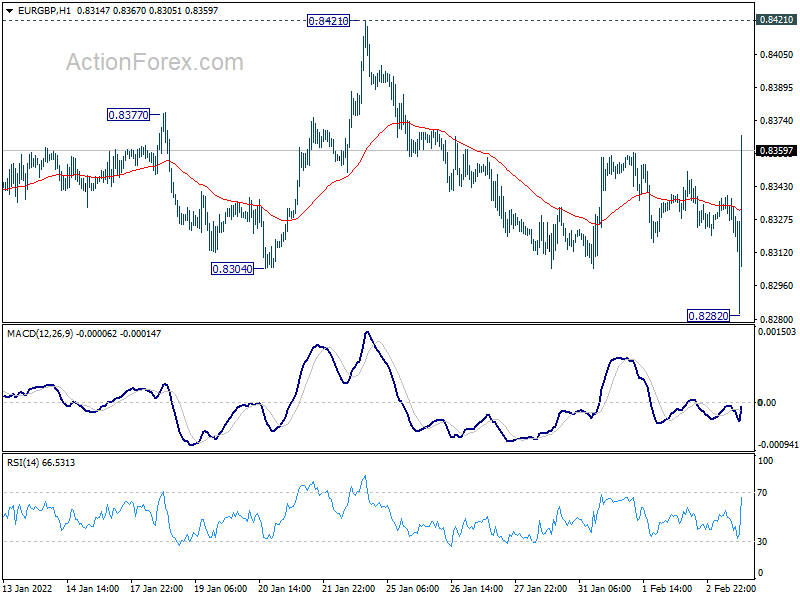
Technically, a major focus now is whether EUR/GBP could ride on the u-turn to power through 0.8421 resistance, to pave the way for bullish trend reversal just ahead of 0.8276 key long term support.
In Europe, at the time of writing, FTSE is down -0.14%. DAX is down -0.28%. CAC is down -0.07%. Germany 10-year yield is up 0.039 at 0.081, marching towards 0.1 handle. Earlier in Asia, Nikkei dropped -1.06%. Japan 10-year JGB yield rose 0.001 to 0.180. Singapore Strait Times rose 2.04%. Hong Kong and China were on holiday.
US initial jobless claims dropped back to 238k
US initial jobless claims dropped -23k to 238k in the week ending January 29, much better than expectation of 264k. Four-week moving average of initial claims rose 8k to 255k.
Continuing claims dropped -44k to 1628k in the week ending January 22. Four-week moving average of continuing claims dropped -31k to 1620k, lowest since August 4, 1973.
BoE hikes 25bps to 0.50%, but four members want 50bps
BoE raises Bank Rate by 0.25% to 0.50% today, by a slight majority of 5-4 vote. Four hawks (Jonathan Haskel, Catherine L Mann, Dave Ramsden, Michael Saunders) voted for a more aggressive 50bps hike to 0.75%. The other five (Andrew Bailey, Ben Broadbent, Jon Cunliffe, Huw Pill, Silvana Tenreyro) won the vote.
Meanwhile, the MPC voted unanimously to begin to reduce stock of government bonds by ceasing to reinvest maturing assets. It also decided to start reducing stock of corporate bonds by ceasing to reinvest maturing assets and complete a bond sales program no earlier than towards the end of 2023.
Going forward, the extent of any further tightening in monetary policy will "depend on the medium-term prospects for inflation". If the economy develops broadly in line with the February Report central projections, "some further modest tightening in monetary policy is likely to be appropriate in the coming months."
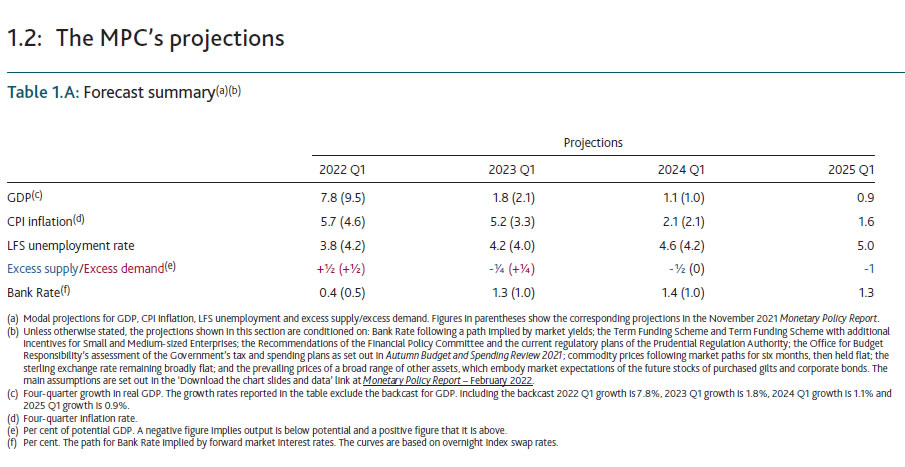
In the new four-quarter GDP projections:
- 2022 Q1 was revised down from 9.5% to 7.8%.
- 2023 Q1 was revised down from 2.1% to 1.8%.
- 2024 Q1 was revised up from 1.0% to 1.1%.
- 2025 Q1 was at 0.9% (new).
CPI inflation projections:
- 2022 Q1 raised from 4.6% to 5.7%.
- 2023 Q1 raised from 3.3% to 5.2%.
- 2024 Q1 unchanged at 2.1%.
- 2025 Q1 to slow to 1.6%.
Unemployment rate projections:
- 2022 Q1 lowered from 4.2% to 3.8%.
- 2023Q1 raised from 4.0% to 4.2%.
- 2024 Q1 raised from 4.2% to 4.6%.
- 2025 Q1 to rise to 5.0%.
Implied path for Bank Rate:
- 2022 Q1 lowered from 0.5% to 0.4%.
- 2023 Q1 raised from 1.0% to 1.3%.
- 2024 Q1 raised from 1.0% to 1.4%.
- 2025 Q1 at 1.3%.
UK PMI services finalized at 54.1, goods news about 2022 prospect
UK PMI Services was finalized at 54.1 in January, up from December's 10-month low of 53.6. PMI Composite was finalized at 54.2, up from prior month's 53.6. Markit said charges had fastest rise on record in more than 25 years. Output and new business picked up at the start of 2022. Growth projections were strongest since May 2021.
ECB stands pat, maintains forward guidance
ECB keeps interest rates unchanged today. The main refinancing rate, marginal lending facility rate and deposit facility rate are held at 0.00%, 0.25%, and -0.50% respectively.
It maintains the forward guidance that interest rates will "remain at their present or lower levels" until ECB sees inflation "reaching 2% well ahead of the end of tis projection horizon and durably for the rest of the projection horizon". Also, ECB will need to judges that realized progress in underlying inflation is "sufficiently advanced to be consistent with inflation stabilizing at 2% over the medium term.".
ECB also reiterated that it will discontinue net PEPP purchases at the end of march 2022, and reinvests until at least the end of 2024. APP net monthly purchases will amount to EUR 40B in Q2, then EUR 30B in Q3, and back to monthly pace of EUR 20B from October onwards, (for as long as necessary".
Eurozone PPI rose 2.9% mom, 26.2% yoy in Dec
Eurozone PPI rose 2.9% mom, 26.2% yoy in December, slightly below expectation of 3.0% mom, 26.6% yoy. For the month, industrial producer prices increased by 7.0% mom in the energy sector, by 0.7% mom for intermediate goods, by 0.6% mom for non-durable consumer goods, by 0.3% mom for capital goods and by 0.2% mom for durable consumer goods. Prices in total industry excluding energy increased by 0.5% mom.
EU PPI rose 2.9% mom, 26.2% yoy. The highest monthly increases in industrial producer prices were recorded in Ireland (+13.3%), Estonia (+12.7%) and Greece (+8.0%), while the only decrease was observed in Czechia (-0.1%).
Eurozone PMI composite finalized at 52.3, economy slowed further
Eurozone PMI Services was finalized at 51.1 in January, down from December's 53.1. PMI Composite was finalized at 52.3, down from prior month's 53.3. Looking at some member states, Ireland PMI Composite was unchanged at 56.5, Germany dropped to 4-month low at 53.8, France dropped to 9-month low at 52.7, Italy dropped to 12-month low at 50.1, and Spain dropped to 11-month low at 47.9.
BoJ Wakatabe: Definitely too early to start tightening
BoJ Deputy Governor Masazumi Wakatabe said in a speech, "given the current situation where Japan's economy has finally started to pick up from the pandemic, it is definitely too early for the Bank to start tightening monetary policy when the target has not yet been achieved as this could hinder the economic recovery."
He reiterated the current policy as to continue with QQE with yield curve control, "as long as it is necessary" to maintain 2% inflation target in a "stable manner". That is, CPI should remain at 2% while medium- to long-term inflation expectations are "anchored".
Australia NAB business confidence rose to 18 in Q4
Australia NAB business confidence jumped from -2 to 18 in Q4. Current business conditions was unchanged at 12. Conditions for the next 3 months rose from 8 to 30. Conditions for the next 12 months also rose from 26 to 34. Capex plans rose from 26 to 34.
"The economy was showing considerable strength prior to the spread of the Omicron variant, and that translated into a positive outlook for the coming months,"Alan Oster, NAB Group Chief Economist. "We now know that Omicron has dampened that recovery somewhat but, fundamentally, we expect that positive trajectory to continue when the current virus outbreak recedes."
Also released, goods and services export rose 1% mom to AUD 45.32B in December. Goods and services imports rose 5% mom to AUD 36.96B. Trade surplus narrowed to AUD 8.36B, below expectation of AUD 9.80B. AiG Performance of Construction index dropped from 57 to 45.9 in December. Building permits rose 8.2% mom in December.
EUR/USD Mid-Day Outlook
Daily Pivots: (S1) 1.1272; (P) 1.1301; (R1) 1.1335; More...
EUR/USD's rebound from 1.1120 accelerates higher today and intraday bias stays on the upside for 1.1482 resistance. Considering bullish convergence condition in daily MACD, a medium term bottom could be in place already. Break of 1.1482 will affirm this case and target 38.2% retracement of 1.2348 to 1.1120 at 1.1639 next. On the downside however, break of 1.1265 minor support will retain near term bearishness, and flip bias back to the downside for retesting 1.1120 low instead.
In the bigger picture, the strength of the the decline from 1.2348 (2021 high) suggests that it's not a corrective move. But still, it could be the fourth leg of a sideway pattern from 1.0339 (2017 low), or resuming long term down trend. In any case, outlook will now stay bearish as long as 1.1482 resistance holds. Next target would be 1.0635 low. However, firm break of 1.1482 will raise the chance that whole fall from 1.2348 has completed, and turn focus back to 1.1703 resistance for confirmation.
Economic Indicators Update
| GMT | Ccy | Events | Actual | Forecast | Previous | Revised |
|---|---|---|---|---|---|---|
| 21:30 | AUD | AiG Performance of Construction Index Dec | 45.9 | 57 | ||
| 00:30 | AUD | Building Permits M/M Dec | 8.20% | -0.90% | 3.60% | 2.60% |
| 00:30 | AUD | Trade Balance (AUD) Dec | 8.36B | 9.80B | 9.42B | 9.76B |
| 08:50 | EUR | France Services PMI Jan F | 53.1 | 53.1 | 53.1 | |
| 08:55 | EUR | Germany Services PMI Jan F | 52.2 | 52.2 | 52.2 | |
| 09:00 | EUR | Eurozone Services PMI Jan F | 51.1 | 51.2 | 51.2 | |
| 09:30 | GBP | Services PMI Jan F | 54.1 | 53.5 | 53.3 | |
| 10:00 | EUR | Eurozone PPI M/M Dec | 2.90% | 3.00% | 1.80% | |
| 10:00 | EUR | Eurozone PPI Y/Y Dec | 26.20% | 26.60% | 23.70% | |
| 12:00 | GBP | BoE Interest Rate Decision | 0.50% | 0.50% | 0.25% | |
| 12:00 | GBP | MPC Official Bank Rate Votes | 9--0--0 | 7--0--2 | 8--0--1 | |
| 12:30 | USD | Challenger Job Cuts Y/Y Jan | -76.00% | -75.30% | ||
| 12:45 | EUR | ECB Interest Rate Decision | 0.00% | 0.00% | 0.00% | |
| 13:30 | EUR | ECB Press Conference | ||||
| 13:30 | USD | Initial Jobless Claims (Jan 28) | 238K | 264K | 260K | 261K |
| 13:30 | USD | Nonfarm Productivity Q4 P | 6.60% | 2.80% | -5.20% | |
| 13:30 | USD | Unit Labor Costs Q4 P | 0.30% | 1.50% | 9.60% | |
| 14:45 | USD | Services PMI Jan F | 50.9 | 50.9 | ||
| 15:00 | USD | ISM Services PMI Jan | 58.7 | 62 | ||
| 15:00 | USD | ISM Services Prices Paid Jan | 83 | 82.5 | ||
| 15:00 | USD | Factory Orders M/M Dec | 0.10% | 1.60% | ||
| 15:30 | USD | Natural Gas Storage | -280B | -219B |
EUR/GBP u-turns on hawkish ECB lagarde
Euro jumps broadly after ECB President Christine Lagarde turns a bit more hawkish in the post meeting press conference. She said that inflation is likely to remain elevated for longer than previously expected. The governing council will remain attentive to the incoming data and carefully assess the implications for the medium-term inflation outlook.
Lagarde also indicated that inflation surprises caused unanimous concerns on not to rush into decisions. When pressed on the question of whether a rate hike remain highly unlikely in 2022, she refused to echo what she said before. But she just said she never make pledges without conditionalities. This is an indication that Lagarde is leaving the door open to a change in forward guidance in March to reflect the chance of a rate hike within this year.
EUR/GBP is staging a u-turn after hitting 0.8282, just ahead of key long term support at 0.8276. The question is whether the rebound is strong enough to push EUR/GBP through 0.8421 resistance to confirm near term bullish reversal.
(ECB) Introductory Statement to the Press Conference
Christine Lagarde, President of the ECB,
Luis de Guindos, Vice-President of the ECB
Frankfurt am Main, 3 February 2022
Good afternoon, the Vice-President and I welcome you to our press conference.
The euro area economy is continuing to recover and the labour market is improving further, helped by ample policy support. But growth is likely to remain subdued in the first quarter, as the current pandemic wave is still weighing on economic activity. Shortages of materials, equipment and labour continue to hold back output in some industries. High energy costs are hurting incomes and are likely to dampen spending. However, the economy is affected less and less by each wave of the pandemic and the factors restraining production and consumption should gradually ease, allowing the economy to pick up again strongly in the course of the year.
Inflation has risen sharply in recent months and it has further surprised to the upside in January. This is primarily driven by higher energy costs that are pushing up prices across many sectors, as well as higher food prices. Inflation is likely to remain elevated for longer than previously expected, but to decline in the course of this year.
The Governing Council therefore confirmed the decisions taken at its monetary policy meeting last December, as detailed in the press release published at 13:45 today. Accordingly, we will continue reducing the pace of our asset purchases step by step over the coming quarters, and will end net purchases under the pandemic emergency purchase programme (PEPP) at the end of March. In view of the current uncertainty, we need more than ever to maintain flexibility and optionality in the conduct of monetary policy. The Governing Council stands ready to adjust all of its instruments, as appropriate, to ensure that inflation stabilises at its two per cent target over the medium term.
I will now outline in more detail how we see the economy and inflation developing, and will then talk about our assessment of financial and monetary conditions.
Economic activity
Economic growth weakened to 0.3 per cent in the final quarter of last year. Nevertheless, output reached its pre-pandemic level at the end of 2021.Economic activity and demand will likely remain muted in the early part of this year for several reasons. First, containment measures are affecting consumer services, especially travel, tourism, hospitality and entertainment. Although infection rates are still very high, the impact of the pandemic on economic life is now proving less damaging. Second, high energy costs are reducing the purchasing power of households and the earnings of businesses, which constrains consumption and investment. And third, shortages of equipment, materials and labour in some sectors continue to hamper the production of manufactured goods, delay construction and hold back the recovery in parts of the services sector. There are signs that these bottlenecks may be starting to ease, but they will still persist for some time.
Looking beyond the near term, growth should rebound strongly over the course of 2022, driven by robust domestic demand. As the labour market is improving further, with more people having jobs and fewer in job retention schemes, households should enjoy higher income and spend more. The global recovery and the ongoing fiscal and monetary policy support also contribute to this positive outlook. Targeted and productivity-enhancing fiscal measures and structural reforms, attuned to the conditions in different euro area countries, remain key to complement our monetary policy effectively.
Inflation
Inflation increased to 5.1 per cent in January, from 5.0 per cent in December 2021.It is likely to remain high in the near term. Energy prices continue to be the main reason for the elevated rate of inflation. Their direct impact accounted for over half of headline inflation in January and energy costs are also pushing up prices across many sectors. Food prices have also increased, owing to seasonal factors, elevated transportation costs and the higher price of fertilisers. In addition, price rises have become more widespread, with the prices of a large number of goods and services having increased markedly. Most measures of underlying inflation have risen over recent months, although the role of temporary pandemic factors means that the persistence of these increases remains uncertain. Market-based indicators suggest a moderation in energy price dynamics in the course of 2022 and price pressures stemming from global supply bottlenecks should also subside.
Labour market conditions are improving further, although wage growth remains muted overall. Over time, the return of the economy to full capacity should support faster growth in wages. Market-based measures of longer-term inflation expectations have remained broadly stable at rates just below two per cent since our last monetary policy meeting. The latest survey-based measures stand at around two per cent. These factors will also contribute further to underlying inflation and will help headline inflation to settle durably at our two per cent target.
Risk assessment
We continue to see the risks to the economic outlook as broadly balanced over the medium term. The economy could perform more strongly than expected if households become more confident and save less than expected. By contrast, although uncertainties related to the pandemic have abated somewhat, geopolitical tensions have increased. Furthermore, persistently high costs of energy could exert a stronger than expected drag on consumption and investment. The pace at which supply bottlenecks are resolved is a further risk to the outlook for growth and inflation. Compared with our expectations in December, risks to the inflation outlook are tilted to the upside, particularly in the near term. If price pressures feed through into higher than anticipated wage rises or the economy returns more quickly to full capacity, inflation could turn out to be higher.
Financial and monetary conditions
Market interest rates have increased since our December meeting. However, bank funding costs have so far remained contained. Bank lending rates for firms and households continue to stand at historically low levels and financing conditions for the economy remain favourable. Lending to firms has picked up, supported by both short and longer-term loans. Robust demand for mortgages is sustaining lending to households. Banks are now as profitable as they were before the pandemic and their balance sheets remain solid.
According to our latest Bank Lending Survey, loan demand by firms increased strongly in the last quarter of 2021. This was driven by both higher working capital needs, stemming from supply bottlenecks, and increased financing of longer-term investment. In addition, banks continue to hold an overall benign view of credit risks, mainly because of their positive assessment of the economic outlook.
Conclusion
Summing up, the euro area economy continues to recover, but growth is expected to remain subdued in the first quarter. While the outlook for inflation is uncertain, inflation is likely to remain elevated for longer than previously expected, but to decline in the course of this year. We will remain attentive to the incoming data and carefully assess the implications for the medium-term inflation outlook. We stand ready to adjust all of our instruments, as appropriate, to ensure that inflation stabilises at its two per cent target over the medium term.
We are now ready to take your questions.
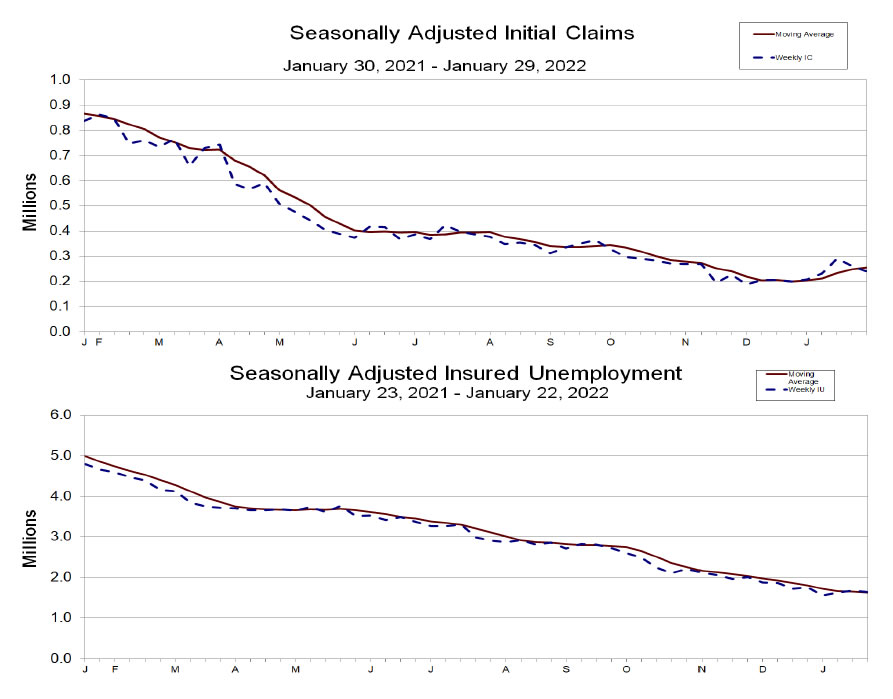
US initial jobless claims dropped back to 238k
US initial jobless claims dropped -23k to 238k in the week ending January 29, much better than expectation of 264k. Four-week moving average of initial claims rose 8k to 255k.
Continuing claims dropped -44k to 1628k in the week ending January 22. Four-week moving average of continuing claims dropped -31k to 1620k, lowest since August 4, 1973.
ECB Lagarde press conference live stream
https://www.youtube.com/watch?v=yXHehAdOYkI
ECB stands pat, maintains forward guidance
ECB keeps interest rates unchanged today. The main refinancing rate, marginal lending facility rate and deposit facility rate are held at 0.00%, 0.25%, and -0.50% respectively.
It maintains the forward guidance that interest rates will "remain at their present or lower levels" until ECB sees inflation "reaching 2% well ahead of the end of tis projection horizon and durably for the rest of the projection horizon". Also, ECB will need to judges that realized progress in underlying inflation is "sufficiently advanced to be consistent with inflation stabilizing at 2% over the medium term.".
ECB also reiterated that it will discontinue net PEPP purchases at the end of march 2022, and reinvests until at least the end of 2024. APP net monthly purchases will amount to EUR 40B in Q2, then EUR 30B in Q3, and back to monthly pace of EUR 20B from October onwards, (for as long as necessary".
(ECB) Monetary policy decisions
The Governing Council confirmed the decisions taken at its monetary policy meeting last December.
Pandemic emergency purchase programme (PEPP)
In the first quarter of 2022, the Governing Council is conducting net asset purchases under the PEPP at a lower pace than in the previous quarter. It will discontinue net asset purchases under the PEPP at the end of March 2022.
The Governing Council intends to reinvest the principal payments from maturing securities purchased under the PEPP until at least the end of 2024. In any case, the future roll-off of the PEPP portfolio will be managed to avoid interference with the appropriate monetary policy stance.
The pandemic has shown that, under stressed conditions, flexibility in the design and conduct of asset purchases has helped to counter the impaired transmission of monetary policy and made the Governing Council's efforts to achieve its goal more effective. Within the Governing Council's mandate, under stressed conditions, flexibility will remain an element of monetary policy whenever threats to monetary policy transmission jeopardise the attainment of price stability. In particular, in the event of renewed market fragmentation related to the pandemic, PEPP reinvestments can be adjusted flexibly across time, asset classes and jurisdictions at any time. This could include purchasing bonds issued by the Hellenic Republic over and above rollovers of redemptions in order to avoid an interruption of purchases in that jurisdiction, which could impair the transmission of monetary policy to the Greek economy while it is still recovering from the fallout from the pandemic. Net purchases under the PEPP could also be resumed, if necessary, to counter negative shocks related to the pandemic.
Asset purchase programme (APP)
In line with the step-by-step reduction in asset purchases decided on in December 2021 and to ensure that the monetary policy stance remains consistent with inflation stabilising at the Governing Council's target over the medium term, monthly net purchases under the APP will amount to €40 billion in the second quarter of 2022 and €30 billion in the third quarter. From October onwards, the Governing Council will maintain net asset purchases under the APP at a monthly pace of €20 billion for as long as necessary to reinforce the accommodative impact of its policy rates. The Governing Council expects net purchases to end shortly before it starts raising the key ECB interest rates.
The Governing Council also intends to continue reinvesting, in full, the principal payments from maturing securities purchased under the APP for an extended period of time past the date when it starts raising the key ECB interest rates and, in any case, for as long as necessary to maintain favourable liquidity conditions and an ample degree of monetary accommodation.
Key ECB interest rates
The interest rate on the main refinancing operations and the interest rates on the marginal lending facility and the deposit facility will remain unchanged at 0.00%, 0.25% and -0.50% respectively.
In support of its symmetric 2% inflation target and in line with its monetary policy strategy, the Governing Council expects the key ECB interest rates to remain at their present or lower levels until it sees inflation reaching 2% well ahead of the end of its projection horizon and durably for the rest of the projection horizon, and it judges that realised progress in underlying inflation is sufficiently advanced to be consistent with inflation stabilising at 2% over the medium term. This may also imply a transitory period in which inflation is moderately above target.
Refinancing operations
The Governing Council will continue to monitor bank funding conditions and ensure that the maturing of operations under the third series of targeted longer-term refinancing operations (TLTRO III) does not hamper the smooth transmission of its monetary policy. The Governing Council will also regularly assess how targeted lending operations are contributing to its monetary policy stance. As announced, it expects the special conditions applicable under TLTRO III to end in June this year. The Governing Council will also assess the appropriate calibration of its two-tier system for reserve remuneration so that the negative interest rate policy does not limit banks' intermediation capacity in an environment of ample excess liquidity.
***
The Governing Council stands ready to adjust all of its instruments, as appropriate, to ensure that inflation stabilises at its 2% target over the medium term.
The President of the ECB will comment on the considerations underlying these decisions at a press conference starting at 14:30 CET today.
BoE Bailey press conference live stream
https://www.youtube.com/watch?v=QwZCbI2zMcs
BoE hikes 25bps to 0.50%, but four members want 50bps
BoE raises Bank Rate by 0.25% to 0.50% today, by a slight majority of 5-4 vote. Four hawks (Jonathan Haskel, Catherine L Mann, Dave Ramsden, Michael Saunders) voted for a more aggressive 50bps hike to 0.75%. The other five (Andrew Bailey, Ben Broadbent, Jon Cunliffe, Huw Pill, Silvana Tenreyro) won the vote.
Meanwhile, the MPC voted unanimously to begin to reduce stock of government bonds by ceasing to reinvest maturing assets. It also decided to start reducing stock of corporate bonds by ceasing to reinvest maturing assets and complete a bond sales program no earlier than towards the end of 2023.
Going forward, the extent of any further tightening in monetary policy will "depend on the medium-term prospects for inflation". If the economy develops broadly in line with the February Report central projections, "some further modest tightening in monetary policy is likely to be appropriate in the coming months."
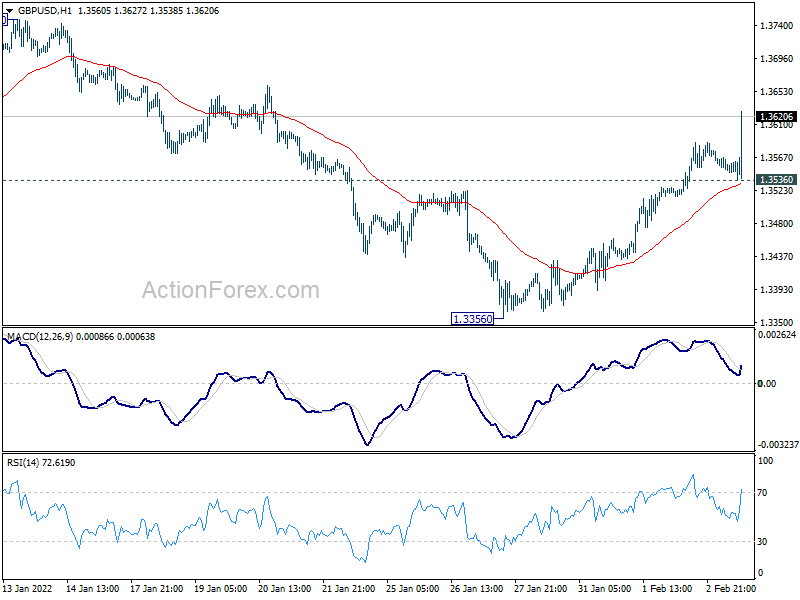
Sterling surges sharply after the release.
In the new four-quarter GDP projections:
- 2022 Q1 was revised down from 9.5% to 7.8%.
- 2023 Q1 was revised down from 2.1% to 1.8%.
- 2024 Q1 was revised up from 1.0% to 1.1%.
- 2025 Q1 was at 0.9% (new).
CPI inflation projections:
- 2022 Q1 raised from 4.6% to 5.7%.
- 2023 Q1 raised from 3.3% to 5.2%.
- 2024 Q1 unchanged at 2.1%.
- 2025 Q1 to slow to 1.6%.
Unemployment rate projections:
- 2022 Q1 lowered from 4.2% to 3.8%.
- 2023Q1 raised from 4.0% to 4.2%.
- 2024 Q1 raised from 4.2% to 4.6%.
- 2025 Q1 to rise to 5.0%.
Implied path for Bank Rate:
- 2022 Q1 lowered from 0.5% to 0.4%.
- 2023 Q1 raised from 1.0% to 1.3%.
- 2024 Q1 raised from 1.0% to 1.4%.
- 2025 Q1 at 1.3%.