

Sample Category Title
ECB Review: New Call – ECB to Hike in Dec22 and Mar23
- After the hawkish ECB meeting today, we change our ECB call and now expect the ECB to hike its deposit facility rate in December this year, and again in March 2023, by 25bp each, which will bring the deposit facility rate to 0%. For now, our call is for a 'two-and-done'. We expect Danmarks Nationalbank (DN) to follow the ECB and hike the deposit rate to -0.10%.
- There is still elevated uncertainty on this call, but given that Lagarde highlighted the uncertainty of the model framework in its staff projections, that inflation will remain elevated for longer than previously expected, and a tight labour market, we change our view to acknowledge the increased risk, which now becomes our baseline.
- Given the highly uncertain inflation outlook, the ECB left out the sentence from December, which said that inflation was projected to settle below 2% – which is a hawkish shift in our view.
- On several occasions during the press conference, Lagarde had to close the door for a rate hike in 2022, but she intentionally left the door open ensuring that she did not want to make pledges without conditionality.
- For the first time since 2014, the ECB added a risk assessment to the inflation outlook in its monetary policy decision, which are on the upside, in particular in the short-term.
- Today's meeting will also be remembered to show the largest difference to date between the ECB's released decision and the press conference. The ECB's decision released at 13:45 CET carried almost no changes, where the 'at present or lower' and sequencing was confirmed.
- Indications of TLTRO to be discussed in March or later.
Growth risk broadly balanced – elevated uncertainty with tight labour market
The growth risk outlook, which was assessed to be broadly balanced, carried the expected small nuances to the December decision. Domestic demand expected to fare well, in particular after the restrictions end, where the impact from Omicron was assessed to be less, while highlighting geopolitical uncertainties.
On the inflation front, Lagarde said that the majority was still energy driven, but food prices were highlighted due to seasonal factors (elevated transportation cost and fertilisers). There was unanimity in the governing council that the high inflation print was of concern. She also highlighted a larger share of price increases and uncertainty for how long the pandemic-related high inflation implications would remain. The most recent inflation figures were unanimously seen with concern.
Previously, we argued that the wage dynamic was the missing piece in the puzzle for us to change call for a rate hike. Lagarde clearly downplayed the importance of this by highlighting its lagged nature of the measure, but also that the participation rate is now at pre-Covid levels and unemployment rate below the start of the pandemic, and expected to tighten further.
Sequencing still holds – rate hike in December
We now expect the ECB to hike in December this year by 25bp for the first time since 2011. While Lagarde emphasised the flexibility and optionality of the calibration of instruments and its data dependency, she reiterated several times that sequencing is still valid. This means that the ECB will end its net asset purchases before hiking policy rates. Given the wording today from Lagarde, we believe the ECB will use this option in December, as we do not expect the ECB to accelerate the taper purchase pace (current guidance until October), sufficient to open for a September hike. However, there is a risk that the ECB will follow the Fed's accelerated taper decisions, which would bring September in play.
As we have seen increased awareness about the negative side effects of the negative interest rate policy, we expect the ECB to go for 'two-and-done', bringing the deposit rate to zero in March 2023.
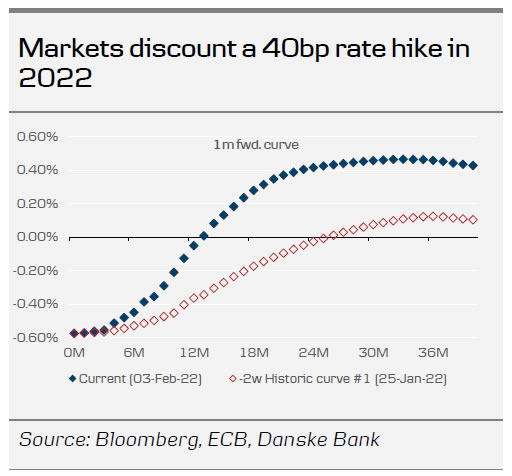
Despite our new ECB call, we still find the 2022 pricing aggressive. At the time of writing, markets are pricing in 42bp for December this year.
EUR rates fuelled EUR/USD move higher
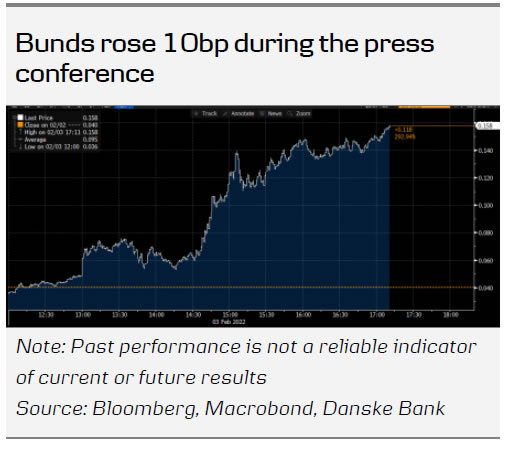
EUR/USD increased around a figure on the ECB meeting, to around 1.14. The dominant driver was a repricing of where European interest rates should be: higher. The reaction itself – that EUR/USD follows yields during the brief time span of the ECB press conference – is quite common. However, spot is generally decoupled from yields over the 1-3m horizon, and we expect this to continue to be the case.
At present, the market's focus is quite short-term. Indeed, as of last week, EUR/USD dropped substantially on the back of the hawkish Fed meeting and this week, we see the exact opposite on the back of the ECB meeting. Looking ahead, the upcoming US CPI print can easily turn market's attention around again. Equally so if the bounce in global equities comes to a halt (USD positive). It is also quite common that the ECB speakers may 'clarify' the message in the following days – in either direction and with equal implications for EUR/USD spot.
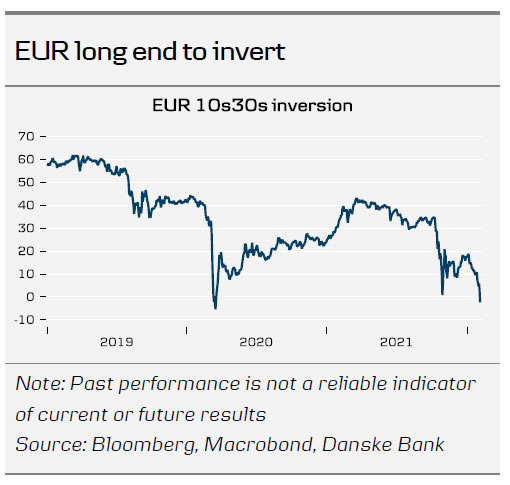
Looking a bit further ahead, we continue to see EUR as overvalued vs. fundamentals, for the investment environment to change in a manner that is a drag on the EUR and for European data to underwhelm. We do not expect, nor see, that relative policy rates are a big driver in EUR/USD spot. In 12 months, we continue to forecast EUR/USD spot at 1.08.
Danmarks Nationalbank to follow the ECB
We expect Danmarks Nationalbank (DN) to follow the ECB and hike 25bp in December and March, respectively. We expect DN to hike both the repo and the deposit rate. After the two hikes, the repo rate would be 0.05% and the deposit rate -0.10%. EUR/DKK trades at the low end of the trading range and last year DN was forced to sell DKK in FX intervention to floor EUR/DKK around the 7.4360 level. We see a possibility that DN could hike 10-15bp less or cut in between ECB hikes if downwards pressure on EUR/DKK spot and need to sell DKK in FX intervention returns in Q4 this year or Q1 next year.
EURUSD Wave Analysis
- EURUSD reversed from support zone
- Likely to rise to resistance level 1.1470
EURUSD currency pair recently reversed up sharply from the support zone lying between the major support level 1.12 (which has been reversing the pair from the middle of 2020) and the lower weekly Bollinger Band.
This support zone was further strengthened by the nearby 61.8% Fibonacci correction of the previous weekly upward impulse from the start of last year.
Given the prevailing euro optimism – EURUSD currency pair can be expected to rise further toward the next resistance level 1.1470 (top of wave 4 from January).
EURAUD Wave Analysis
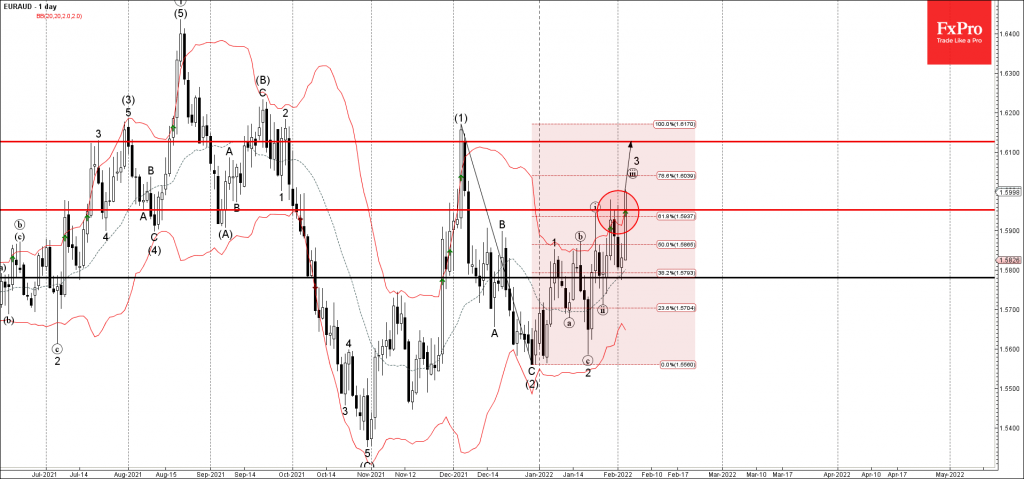
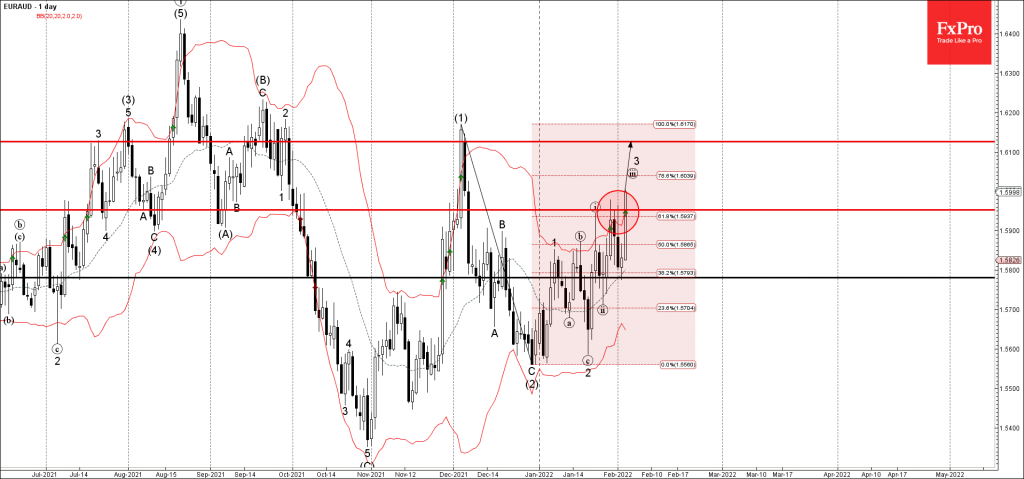
- EURAUD broke resistance zone
- Likely to rise to resistance level 1.6125
EURAUD currency pair recently broke the resistance zone lying between the key resistance level 1.5950 (which has been reversing the pair from January) and the 61.8% Fibonacci correction of the previous ABC correction (2) from December.
The breakout of this resistance zone accelerated the both of the active impulse waves (iii) and 3 of wave (3) from December.
EURAUD currency pair can be expected to rise further toward the next resistance level 1.6125 (target price for the completion of the active impulse wave 3).
Eco Data 2/4/22
[php_everywhere instance="1"]
Bank of England Hawks Take Flight
Summary
- The Bank of England (BoE) delivered a February monetary policy announcement that was towards the hawkish end of market expectations. The BoE raised its policy rate 25 bps to 0.50%, though several policymakers dissented in favor of a larger 50 bps increase. The central bank also said it will stop reinvesting maturing proceeds from its government and corporate bond holdings.
- The BoE raised its inflation forecasts, and now sees inflation peaking at 7.25% in April 2022. Despite an outlook for slower growth, in part as household incomes are squeezed by higher energy prices, the central bank said further modest tightening will be appropriate in the months ahead.
- Given the hawkish announcement, we have adjusted our outlook for Bank of England monetary policy. We expect another 25 bps policy rate increase to 0.75% in May, and also a 25 bps increase to 1.00% in August. However, as higher energy prices weigh on growth and inflation passes its peak, we do expect the pace of Bank of England tightening to slow. We do not envisage any move at the November meeting, while for 2023 we see 25 bps rate increases in February and August of next year, which would see the policy rate end 2023 at 1.50%.
Bank of England Hikes Rates and Signals Further Tightening to Come
The Bank of England (BoE) delivered a February monetary policy announcement that was at the hawkish end of spectrum in terms of market expectations. The BoE increased its policy rate by 25 bps to 0.50%, which was widely expected. However, policymakers were close to delivering an even larger 50 bps rate increase given a 5-4 vote, with the four dissenters voting in favor of a larger rate increase. In addition, having reached the 0.50% policy rate threshold and considering the economic circumstances, the BoE also said it would stop reinvesting maturing proceeds from government bonds and corporate bonds, and in addition signaled some sales of corporate bonds, allowing its balance sheet to reduce in size.
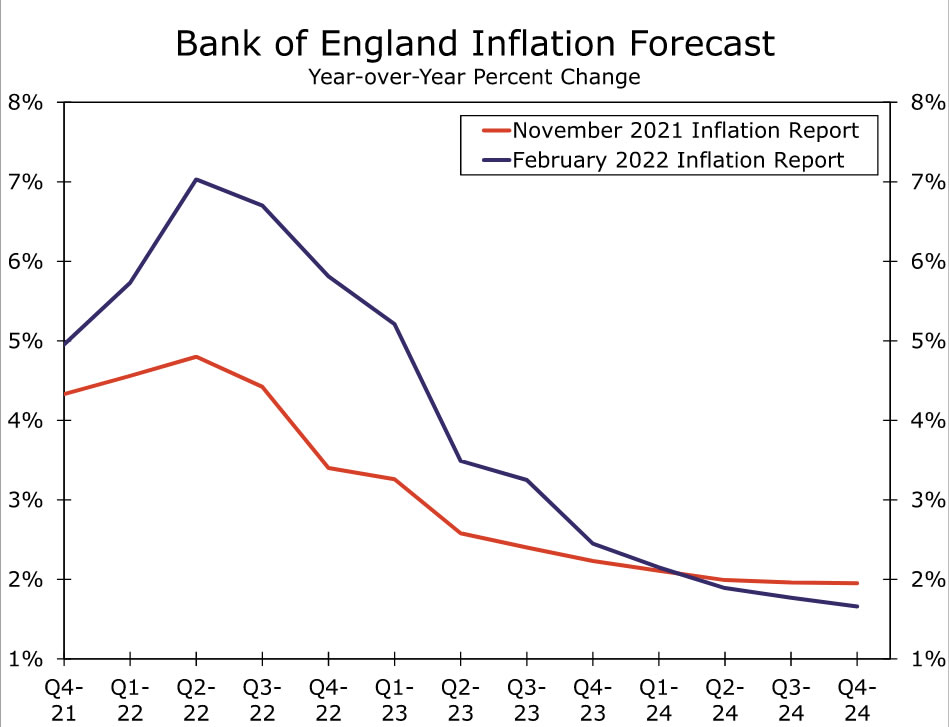
The central bank's statement and accompanying economic projections contained some other hawkish elements as well. The BoE lifted its CPI inflation forecasts, saying it expects inflation to peak at 7.25% in April 2022. The Bank of England sees inflation slowing to 2.15% in two years and to 1.6% in three years. The revisions to the GDP growth outlook were in the other direction, with the forecast for 2022 GDP growth lowered to 3.75%.
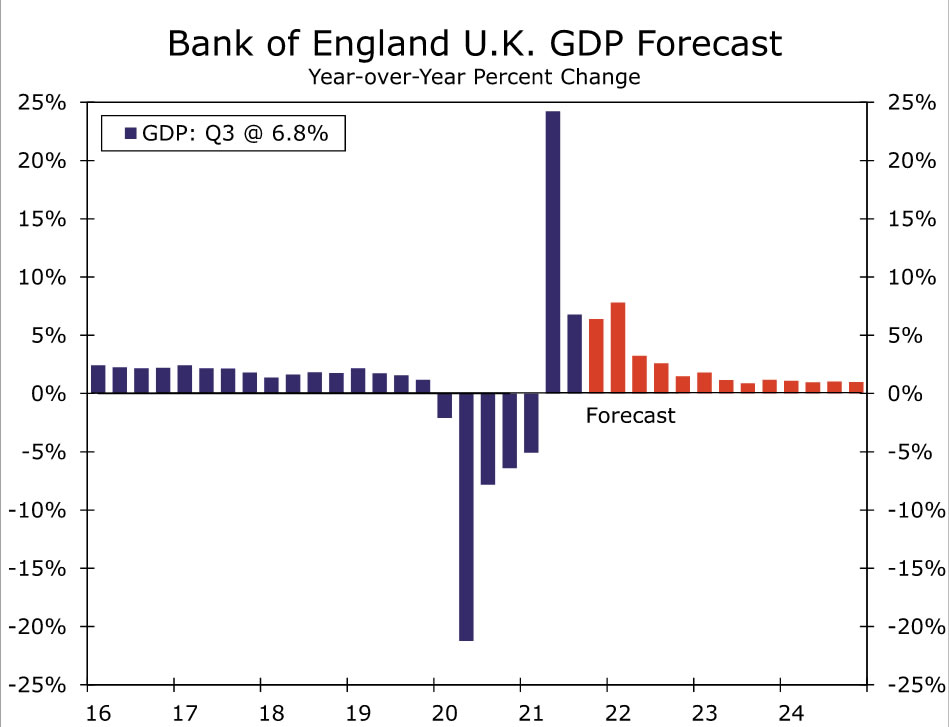
The BoE acknowledged that energy and other price increases would squeeze real household incomes and economic growth, but also said the "MPC’s remit is clear that the inflation target applies at all times, reflecting the primacy of price stability in the UK monetary policy framework" and added that the "MPC judges that, if the economy develops broadly in line with the February Report central projections, some further modest tightening in monetary policy is likely to be appropriate in the coming months." As a result, despite the prospect of slower growth, especially elevated inflation prompted the Bank of England to move at today's meeting, and some further near-term rate hikes appear likely.
Indeed, comments from Governor Bailey tended to suggest that central bank monetary tightening would be front-loaded to some extent. Speaking after the formal policy announcement, Bailey said the BoE had not raised rates because the economy is "roaring away," there is much uncertainty on the outlook, and that it is a mistake to assume interest rates are on an inevitable long march up.
Expect Earlier, And More, Bank of England Rate Hikes
We had been on the dovish end of the spectrum regarding our Bank of England outlook heading into today's meeting—hence today's announcement necessitates a change in our view. With the central bank signaling modest further tightening in the near-term, we expect another 25 bps policy rate increase to 0.75% in May, and also a 25 bps increase to 1.00% in August. However, as higher energy prices weigh on growth and inflation passes its peak, we do expect the pace of Bank of England tightening to slow. We do not envisage any move at the November meeting, while for 2023 we see 25 bps rate increases in February and August of next year, which would see the policy rate end 2023 at 1.50%. For the next 12 months in particular, our forecasted pace of rate hikes is more conservative than what is currently priced in by market participants, and as a result we still anticipate moderate weakness in the pound versus the U.S. dollar in the months and quarters ahead.
Dollar Falls Further on BoE and ECB’s Hawkish Steer
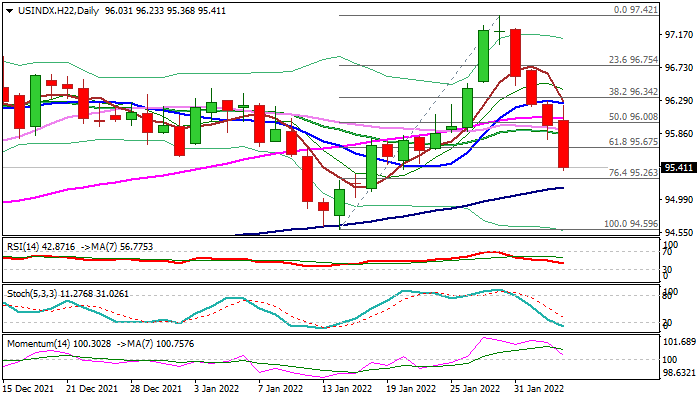
The dollar index accelerated lower and hit the lowest in over two weeks on Thursday, following BoE and ECB’s policy meetings.
Near-term bears extend into fourth straight day, boosted by BoE’s hawkish hike and changed ECB’s narrative in central bank’s tiny shift towards tightening bias and dropping comments that 2022 hikes are unlikely, while narrowing divergence between the Fed and BoE and ECB on expected rate hikes, adds pressure on the US currency.
Weaker structure of daily studies (sharp loss of positive momentum / MA’s 10/20/30 turned to bearish setup) favors further weakness, as bears surged through 95.67 pivot (Fibo 61.8% of 94.59/97.42 upleg) and eye targets at 95.26 (Fibo 76.4%), 95.14 (100DMA) and 95.08 (daily cloud base)
Today’s close below broken 95.67 Fibo support to confirm bearish signal.
Res: 95.67; 95.85; 96.00; 96.25
Sup: 95.26; 95.14; 95.08; 94.59
EURCAD Soars to Monthly Highs; Bullish But Overbought
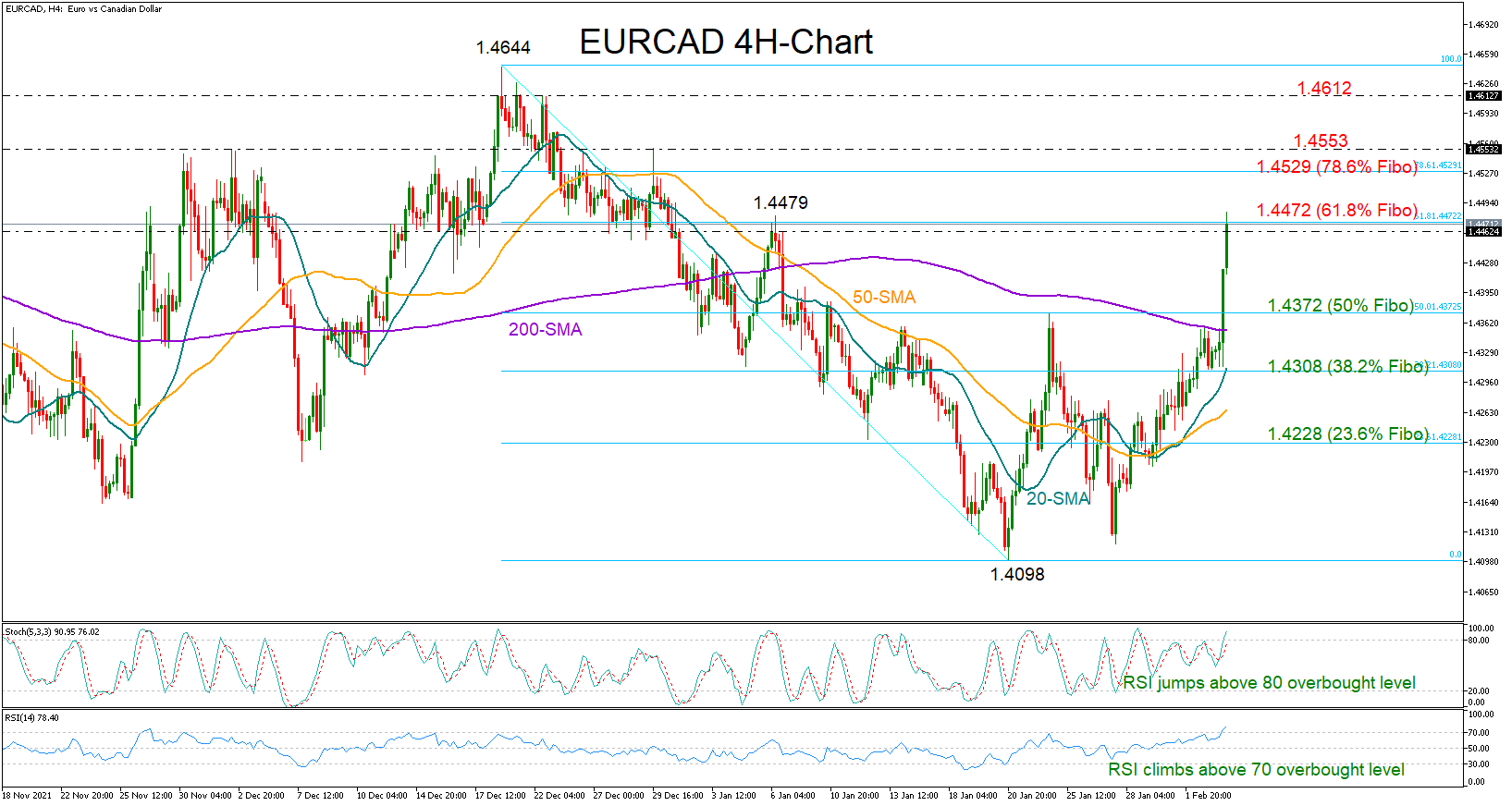
EURCAD surged furiously above the 200-period simple moving average (SMA) on the four-hour chart, which has been blocking upside movements over the past few sessions, to print a one-month high at 1.4484.
The market action, however, has not closed above January’s top of 1.4479 and the 61.8% Fibonacci retracement of the 1.4644 – 1.4098 down leg yet. Hence, a downside correction is still looking increasingly likely as the RSI and the Stochastics sail in the overbought area.
In the event the wall at 1.4479 collapses, the price could immediately jump into the 1.2529 – 1.4553 region formed by the 78.6% Fibonacci and the 2021 limits. Crawling higher, the rally could battle the crucial border of 1.4612 and the 1.4644 top before printing a new peak at 1.4726.
If the 1.4479 bar proves a tough obstacle, the pair may reverse south to seek support around the 50% Fibonacci of 1.4372. The 20-period SMA and the 38.2% Fibonacci of 1.4308 could next show up on the radar ahead of the 23.6% Fibonacci of 1.4228.
In summary, the latest sharp bullish run in EURCAD seems to have entered overbought waters, increasing the likelihood for a downside correction near January’s limits.
US: Services Sector Slowed as Omicron Hit in January, But Growth Continued
The ISM services index eased 2.4 percentage points (ppts) to 59.9 in January (from 62.3 reported in December). This was a slightly better reading than 59.5 expected by the median consensus estimate.
Demand sub-indexes continued to grow, but at a slower pace. The business activity sub-index declined by 8.4 ppts to 59.9 from 68.3, while new orders remained above 60, easing only 0.4 ppts to 61.7 from 62.1 reported in December.
The supply-side indicators saw mixed fortunes. Delivery times worsened, with the supplier deliveries sub-index increasing by 1.8 ppts to 65.7, still the index is 10 points below its recent high of 75.7 in November. Meanwhile, the backlog of orders sub-index eased by 4.9 ppts to 57.4 from 62.3 in December (likely due to slower demand).
Inventories were up by 2.7 points to 49.4, while inventory sentiment increased markedly to 47.5 (+9.2 ppts) – still in the contractionary territory, suggesting that inventories remain too low for the level of demand.
The new export orders sub-index plunged to contraction, collapsing by 15.6 ppts to 45.9. Imports remained in expansion dropping to 51.1 (- 4.4 ppts).
The employment sub-component slowed for the second month, but remained expansionary with a reading of 52.3, down from 54.7 in December.
The prices paid component moved lower to 82.3 from its highest level of 83.9 in December.
Fifteen industries expanded in January. The three industries reporting contraction are Agriculture, Forestry, Fishing & Hunting; Arts, Entertainment & Recreation; and Information.
Key Implications
The services sector started the new year on a weaker footing, largely due to Omicron. Based on the sentiment expressed in today's report, firms' remain cautiously optimistic about demand despite "challenging operating conditions".
Comments on employment paint a colorful picture: "Omicron is keeping between 20 and 25 percent of our workforce out daily". We'll have a better idea about how Omicron affected January employment numbers tomorrow. Stay tuned.
Despite these challenges, the trend path remains upward, suggesting that the sector will bounce back once the threat of Omicron fades. The sector hasn't fully profited from reopening and should continue to benefit from consumers' directing more of their spending to services.
Canada Reports Jobs Data, What’s the FX Outlook?
The latest batch of Canadian employment data will hit the markets at 13:30 GMT Friday. It seems that the Omicron wave hit the labor market in January, with forecasts pointing to a loss in jobs. That said, this is probably a temporary setback. The loonie has been driven mostly by risk sentiment in stock markets lately, but over time, it could realign itself with Canada’s strong fundamentals and soaring oil prices.
Solid economy
The Bank of Canada hesitated to raise interest rates last week, disappointing market expectations. Policymakers highlighted the risks posed by the Omicron variant, which will likely hold back economic activity for a few months because of the restrictions across the country.
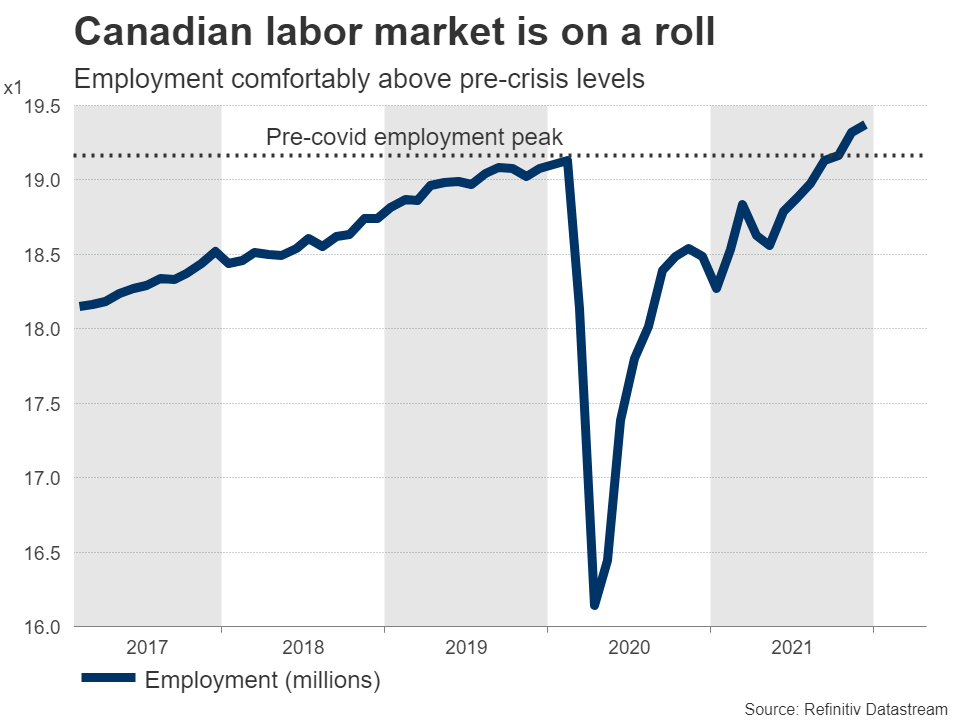
But the commentary around the economy was very cheerful. They noted that inflation is scorching hot, businesses are optimistic, the housing market is booming, oil prices are elevated, and economic growth has been surprisingly strong. Most importantly, the labor market has tightened significantly, pushing wages higher.
In other words, even though the central bank didn’t raise interest rates, it essentially signaled that it will do so several times this year. Money markets are currently pricing in a rate hike at almost every meeting for the rest of the year - a testament to the strength of the economy.
Soft report
Turning to the upcoming data, forecasts suggest that the economy lost 117k jobs in January amid business closures driven by covid restrictions and adverse weather conditions. That would push the unemployment rate higher by three ticks to reach 6.2%.
While this would clearly be bad news, it wouldn’t be a disaster either. Some damage to the jobs market was inevitable with the restrictions in many provinces, but those are already being relaxed. Hence, it may prove to be only a temporary setback for the economy, similar to previous covid waves.
Bear in mind that America’s jobs report will be released at the same time as Canada’s, so the reaction in dollar/loonie will depend on both datasets.
Taking a technical look at the pair, initial support to declines may be found near the 1.2620 zone.
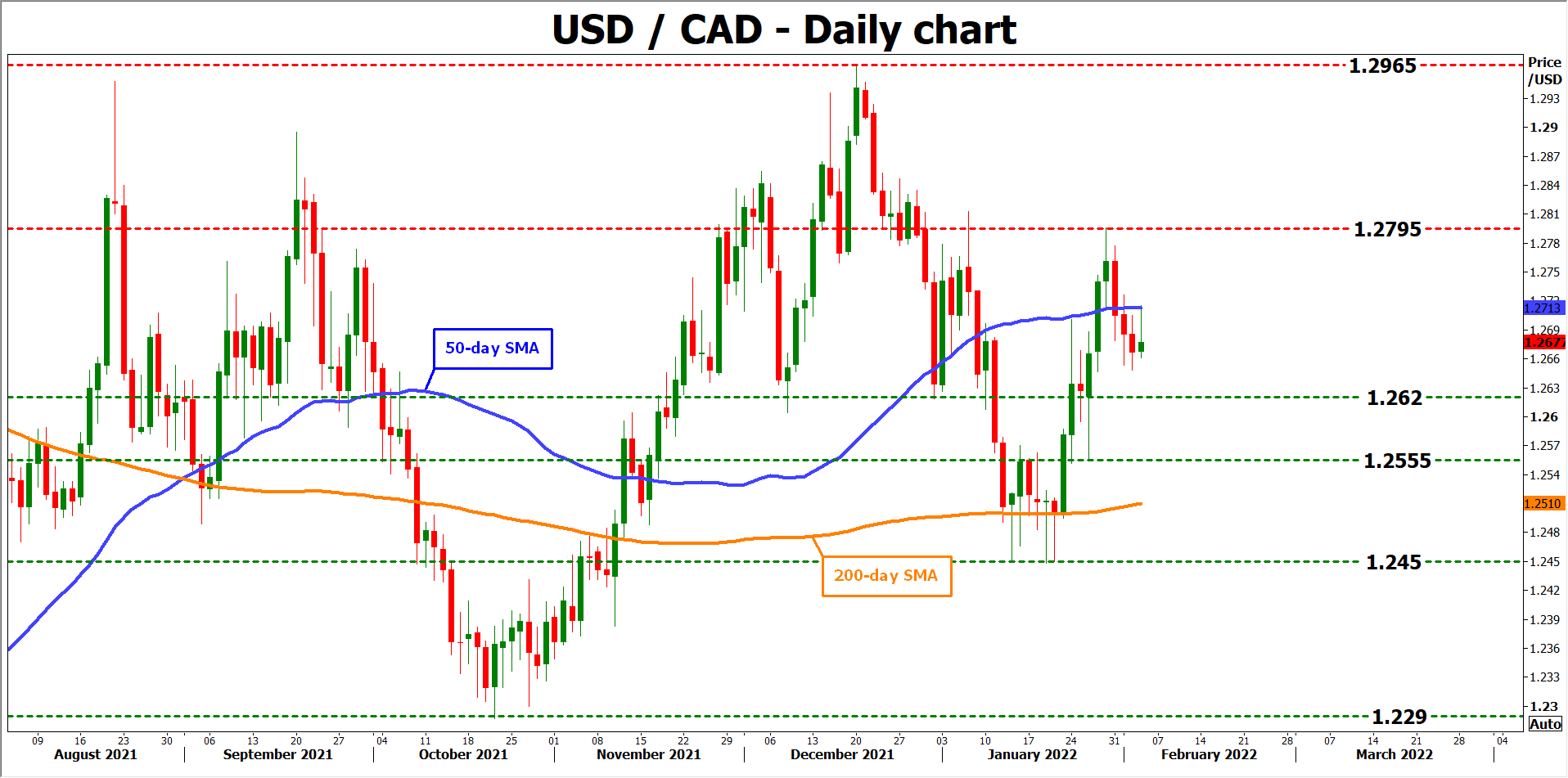
On the upside, the first barrier for the bulls may be the latest high at 1.2795.
Loonie decouples from oil
In the FX market, the Canadian dollar has been trading mostly as a function of risk sentiment in recent weeks, rising and falling with stock markets. This is natural considering that Canada is a major exporting economy and is therefore vulnerable to shifts in the global environment.
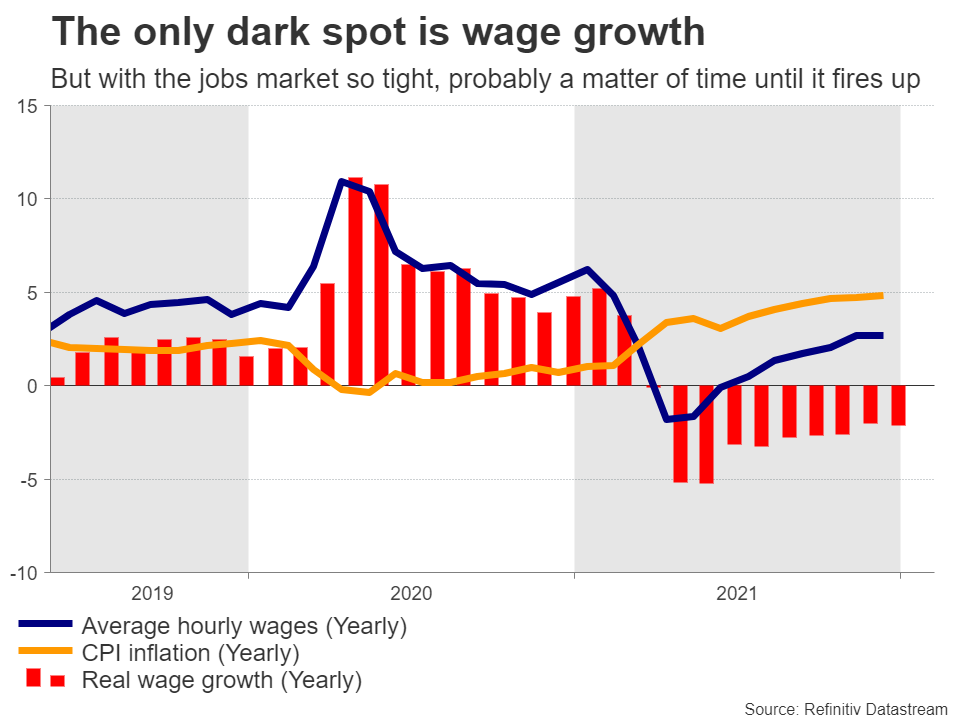
That said, the economy’s fundamentals are robust. The only ‘dark spot’ is wage growth, which remains relatively slow, but given how strong the labor market is, it is probably only a matter of time until it fires up. Additionally, oil prices are very elevated, which is good news for Canada’s massive oil industry and overall economic growth.
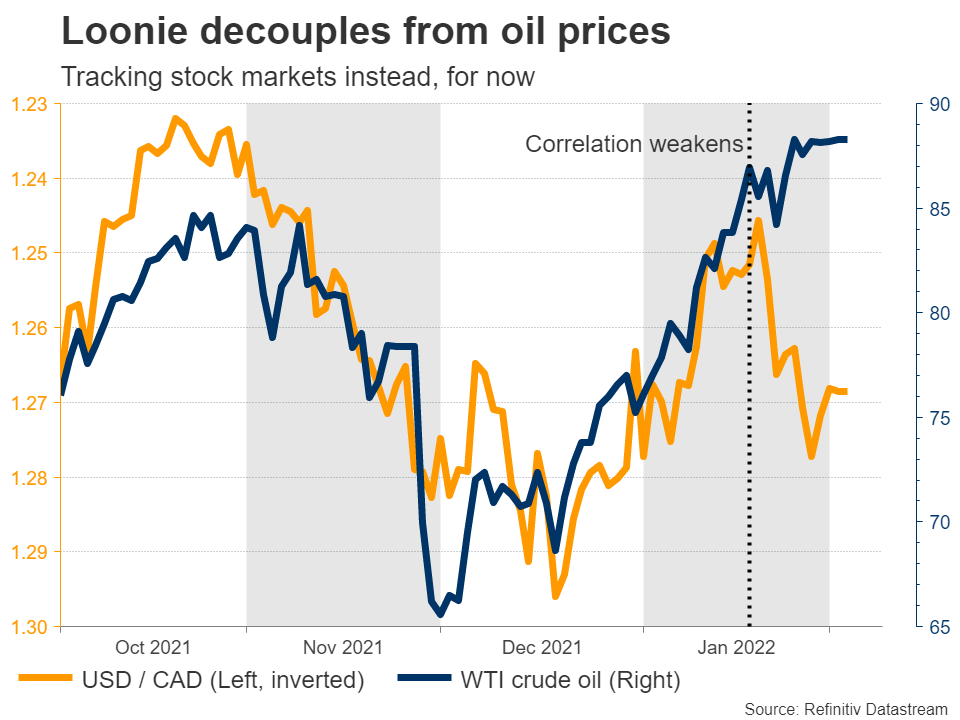
Adding everything up, the outlook for the loonie remains constructive. While the currency could remain in the hands of risk appetite for now as fears over central bank tightening hit equity markets, over time, it could realign itself with the strong underlying economy and energy prices.
Geopolitical tensions are another variable to consider, but luckily for the bulls, an escalation in Ukraine might not hurt the loonie as much as other risky assets thanks to the potential bullish impact on oil prices. Instead, the real risk for the loonie would be a deal between America and Iran that boosts global oil supply.
Stocks Slide Amid Weak Earnings and More Tightening
European stock markets are coming under pressure on Thursday, with the moves being exacerbated by the realisation that rate hikes may come earlier and faster than thought.
Equity markets were already under a little pressure today, as earnings from Meta and Spotify brought investors back down to earth with a bang. Results from Microsoft, Apple and Alphabet had been far more encouraging and it seemed that the worst could be over for big tech. Today's sell-off suggests we're not out of the woods yet.
The spotlight was always going to be on the BoE and ECB today to see whether more aggressive tightening was going to be warranted to get to grips with inflation. The BoE had already started raising rates and indicated more will come this year while the ECB has repeatedly pushed back.
With the ECB appearing to have become the latest to buckle and abandon its commitment to its previously held transitory beliefs, yields are spiking and that's weighing heavily on stock markets in the region. The question now is how far expectations will go as they may have a lot of catching up to do.
Mixed messages from the BoE
The Bank of England appeared to tick all the boxes but not in a particularly helpful manner on Thursday. The central bank raised interest rates by 0.25%, in line with expectations, while four of the nine MPC members - a very large minority - preferred a 0.5% hike and Governor Bailey later indicated that market expectations were too aggressive. So an outcome that kind of appeals to everyone but satisfies no one.
On top of that, the Bank announced that it will start reducing the size of the balance sheet through non-reinvestment of maturing assets and active sales of corporate bonds. Gilts will only be considered for active selling once the bank rate hits 1%, which markets still believe will happen much earlier than the BoE is trying to suggest.
Clearly, there are wide-ranging opinions on the MPC which is contributing to what appears to be a gulf between the BoE and markets rate expectations this year. Recent history has been on the side of the latter which is pricing in another rate hike at each of the next two meetings. There was plenty of volatility in the pound since the initial announcement, as you can imagine, with the currency starting to settle a little higher.
ECB buckles under inflationary pressure
The ECB avoided doing anything radical today but not-so-subtle tweaks in the statement and Lagarde's responses in the press conference made clear that the central bank no longer thinks a rate hike is unlikely this year. It was always unlikely that we were going to see a dramatic shift in the absence of new economic projections but it's clear after today that we will see something along those lines next month.
Once again, it seems that the market is ahead of the curve and the central bank is chasing behind. And based on current market rates, the ECB will have some serious catching up to do. This may change, if as many expect inflation peaks over the next few months and we see evidence of pressures easing, which will allow central banks to proceed as they wish. But recent history hasn't favoured listening to what policymakers are saying so perhaps we should strap ourselves in for a turbulent year and a lot more tightening.
The euro is performing very well on the day, on the back of Lagarde's press conference, and the clear message that rate increases this year are no longer off the table. With three or four 10 basis point hikes now heavily priced in by the end of the year, the currency could remain in favour as we adjust to something we haven't experienced in a decade; interest rate hikes in the eurozone.
Oil softens but major correction unlikely
Oil prices are softening a little again today, as they continue to struggle around the $90 level. This comes even as OPEC+ refused to be pressured into raising output faster in March - or perhaps be forced to do something they're unable to do right now. The group stood by previous commitments on Wednesday which leaves us to wonder just how much they will actually manage to deliver this time.
The steady approach didn't generate any fresh optimism for crude, despite rumours beforehand that we could see a larger increase in March, amid political pressure. Instead, we seem to be seeing a little profit-taking. I don't think this makes $100 oil any less likely, or that we'll see any significant correction, but we may see it lose some momentum in the near term and even pull back a little.
Gold suffers as more tightening is priced in
Gold appears to have fallen back into consolidation and is even a little lower today after paring some of last weeks losses in the early part of the week. Central banks upping their game is not favourable for the yellow metal and we are now seeing that across the board, from the Fed maybe raising interest rates five times, to the BoE perhaps doing similar and even the ECB joining to a much lesser degree. All are coming around to the market view that inflation is here for a while and it needs addressing.
The yellow metal has slipped back below $1,800 on more hawkish expectations for the BoE and ECB, despite the moves weakening the dollar. It's almost 1% lower on the day and appears to be struggling after breaking that psychological support level. The next test below is $1,780, with a break of this potentially seeing attention shift further back to $1,760, around the late 2021 lows.
Bitcoin slips again in risk-off markets
Bitcoin is also not faring well in the monetary tightening environment although it's the impact it's having on broader risk appetite that's probably the most damaging aspect of that. It's around 1% lower on the day, having pulled further back from $40,000 on Wednesday, where it was briefly threatening to break back above earlier this week. We could see it consolidate in this region in the near term, with a significant break of $30,000 potentially triggering another aggressive move lower.