

Sample Category Title
EUR/USD Daily Outlook
Daily Pivots: (S1) 1.1309; (P) 1.1335; (R1) 1.1368; More...
Intraday bias in EUR/USD remains neutral for the moment. Price action from 1.1185 are seen as corrective move. Break of 1.1284 will argue that larger down trend from 1.2348 is ready to resume. Intraday bias will be back on the downside for retesting 1.1185 low first. Also, in case of another rise, upside should be limited by 38.2% retracement of 1.2265 to 1.1185 at 1.1598 eventually.
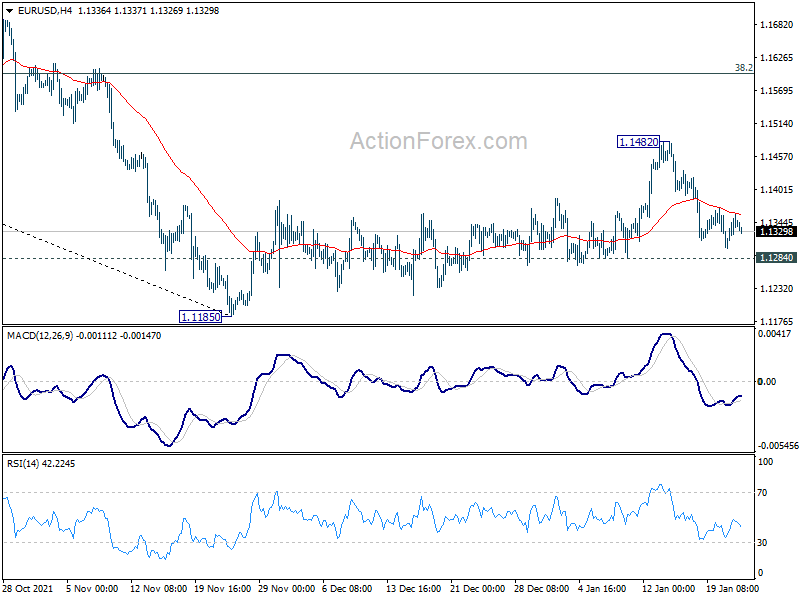
In the bigger picture, there are various ways of interpreting the fall from 1.2348 (2021 high). It could be a correction to rise from 1.0635 (2020 low), the fourth leg of a sideway pattern from 1.0339 (2017 low), or resuming long term down trend. In any case, outlook will now stay bearish as long as 1.1703 support turned resistance holds. Sustained break of 61.8% retracement of 1.0635 to 1.2348 at 1.1289 would pave the way back to 1.0635.
GBP/USD Daily Outlook
Daily Pivots: (S1) 1.3532; (P) 1.3567; (R1) 1.3589; More...
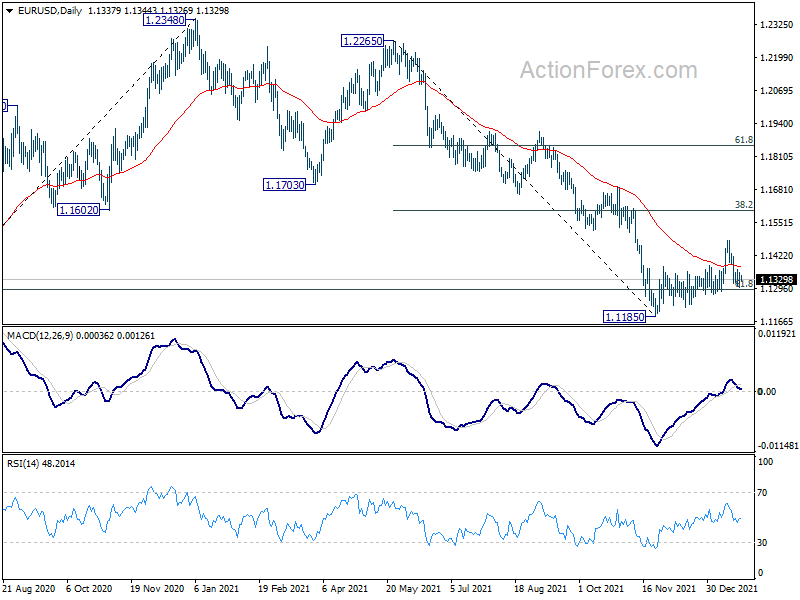
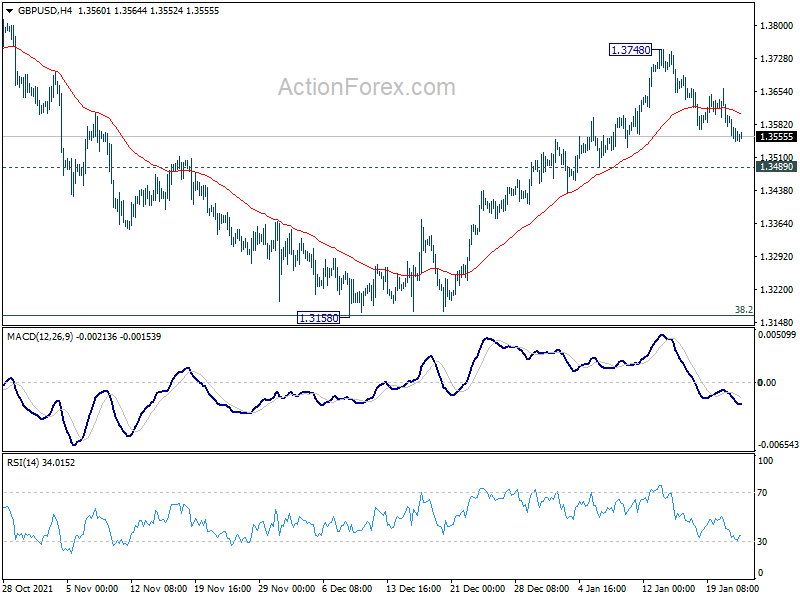
Intraday bias in GBP/USD remains neutral and outlook is unchanged. Pull back from 1.3478 should be contained by 1.3489 support to bring another rally. As noted before, corrective fall from 1.4282 should have completed with three waves down to 1.3158, after hitting 1.3164 medium term fibonacci level. Above 1.3748 will target 1.3833 first. Sustained break of 1.3833 will pave the way back to retest 1.4248 high. However, break of 1.3489 will dampen this bullish view and turn bias back to the downside for 1.3158 support again.
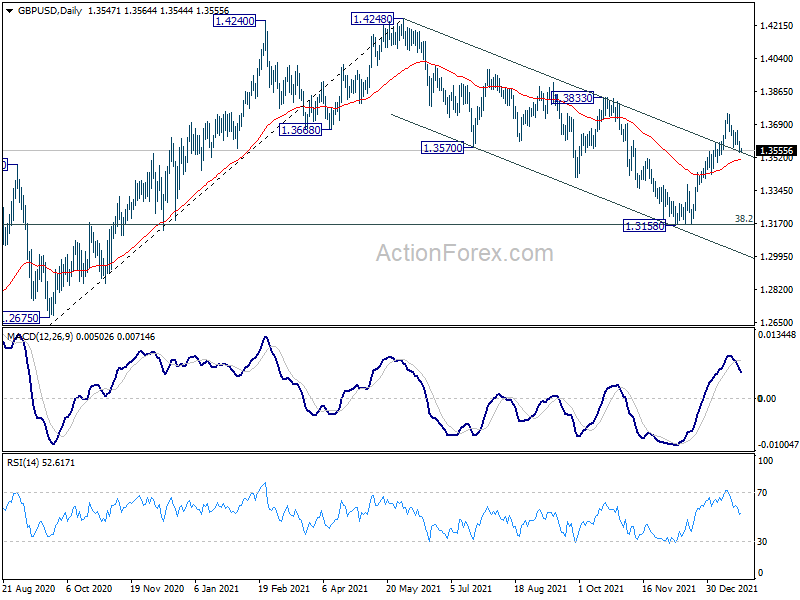
In the bigger picture, strong support was seen from 38.2% retracement of 1.1409 to 1.4248 at 1.3164. The development suggests that up trend from 1.1409 (2020 low) is still in progress. On resumption, next target will be 38.2% retracement of 2.1161 to 1.1409 at 1.5134. Nevertheless sustained break of 1.3164 will argue that whole rise from 1.1409 has completed and bring deeper fall to 61.8% retracement at 1.2493.
USD/CHF Daily Outlook
Daily Pivots: (S1) 0.9095; (P) 0.9134; (R1) 0.9161; More....
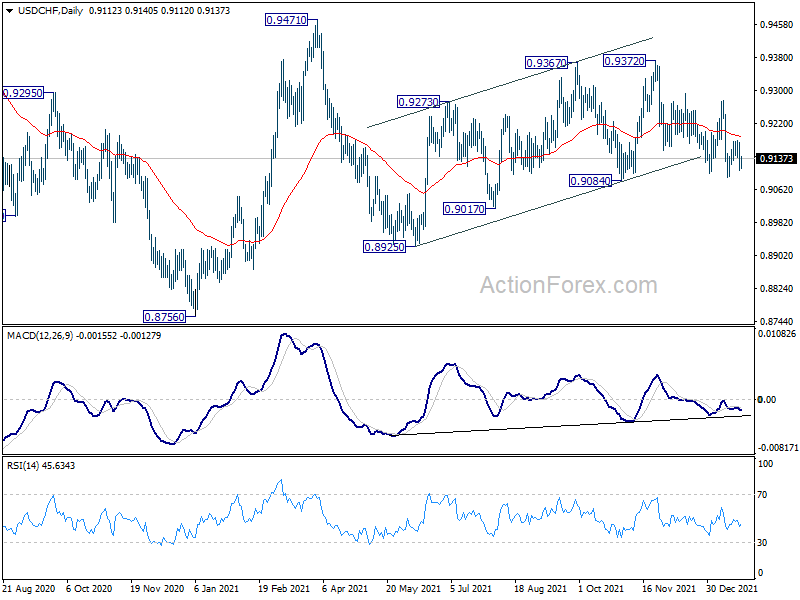
Intraday bias in USD/CHF remains neutral as range trading continues. On the downside, firm break of 0.9084 support will argue that choppy rise from 0.8925 has completed. Fall from 0.9471 might be ready to resuming. Further decline would be seen back to 0.8925 support first. On the upside, above 0.9276 will target 0.9372 resistance instead.
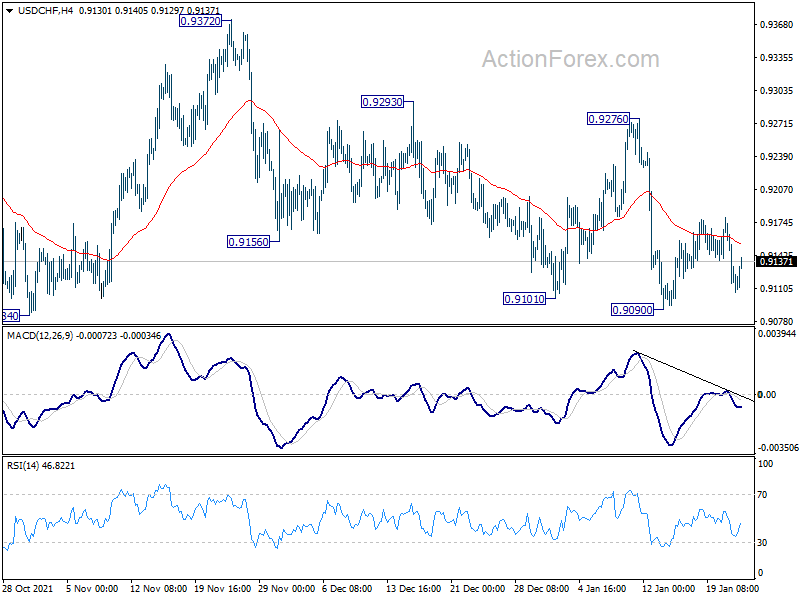
In the bigger picture, the corrective structure of the rebound from 0.8925 argues that fall from 0.9471 is not complete yet. It could either be the second leg of pattern from 0.8756 (2021 low), or resuming larger down trend from 1.0237 (2018 high). We'd pay attention to the downside momentum and assess the odds later. But for now, medium term outlook will be neutral at best as long as 0.9471 resistance holds.
EUR/USD Starts Fresh Decline, Can Bulls Protect 1.1300?
Key Highlights
- EUR/USD started a fresh decline below the 1.1380 support.
- It traded below a bullish trend line with support near 1.1370 on the 4-hours chart.
- GBP/USD extended decline below the 1.3620 support zone.
- The Euro Zone Manufacturing PMI could decline from 58 to 57.5 in Jan 2022 (Preliminary).
EUR/USD Technical Analysis
The Euro failed to continue higher above 1.1480 against the US Dollar. EUR/USD started a fresh decline below the 1.1400 and 1.1380 support levels.
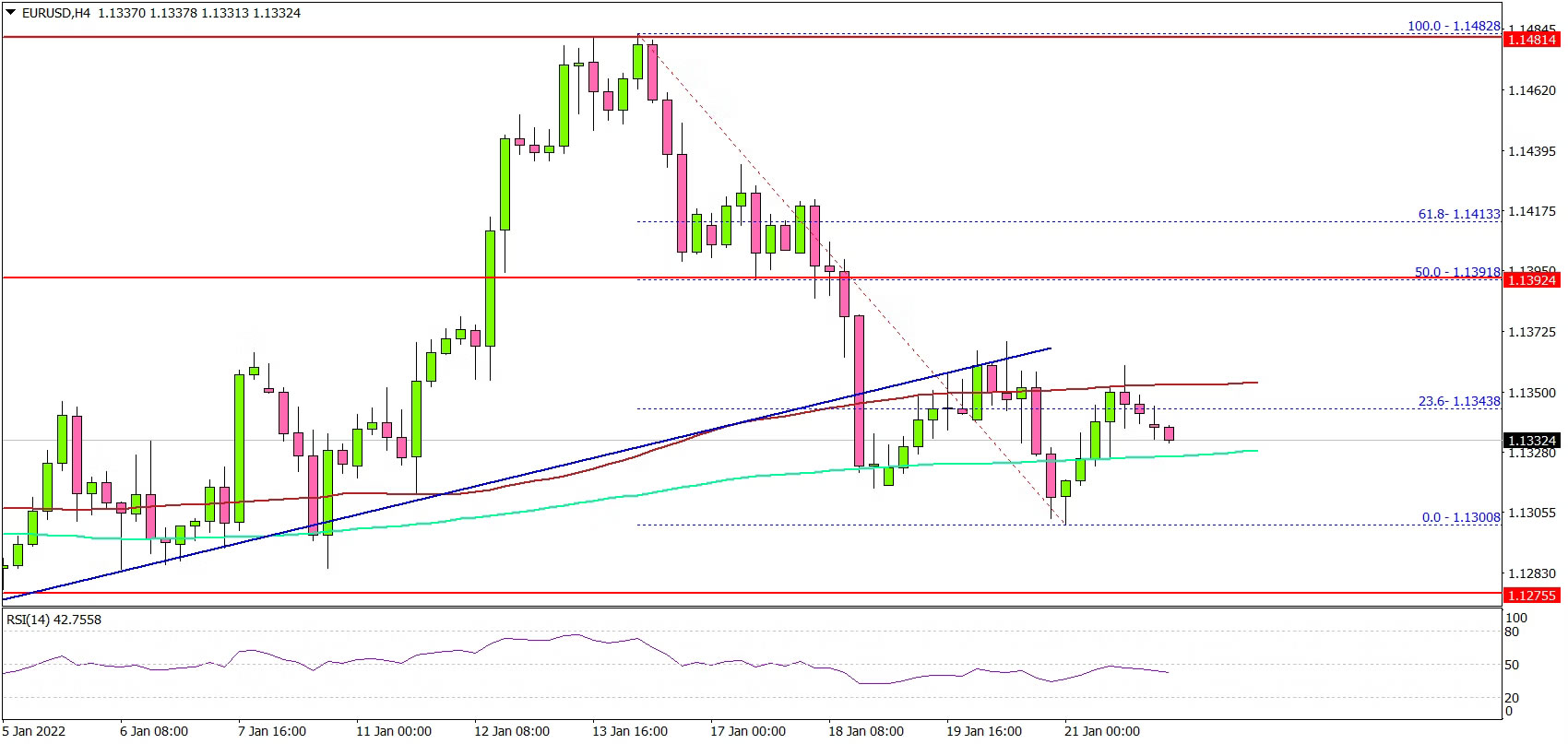
Looking at the 4-hours chart, the pair settled below the 1.1400 level and the 100 simple moving average (red, 4-hours). Besides, there was a break below a bullish trend line with support near 1.1370.
The pair even traded below the 1.1350 support and the 200 simple moving average (green, 4-hours). It traded as low as 1.1300 and currently consolidating losses. On the upside, the pair is facing resistance near 1.1370 and 1.1380 levels.
The next major resistance is near the 1.1400 level. It is near the 50% Fib retracement level of the downward move from the 1.1482 swing high to 1.1300 low.
If there is a fresh close above 1.1400, the pair could rise above 1.1450. If not, there is a risk of more downsides below the 1.1300 level. The next major support sits near the 1.1250 level.
Looking at GBP/USD, the pair gained bearish momentum after there was a clear move below the 1.3700 and 1.3650 levels.
Economic Releases
- Germany’s Manufacturing PMI for Jan 2022 (Preliminary) - Forecast 57.0, versus 57.4 previous.
- Germany’s Services PMI for Jan 2022 (Preliminary) - Forecast 48.0, versus 48.7 previous.
- Euro Zone Manufacturing PMI for Jan 2022 (Preliminary) – Forecast 57.5, versus 58.0 previous.
- Euro Zone Services PMI for Jan 2022 (Preliminary) – Forecast 52.2, versus 53.1 previous.
- UK Manufacturing PMI for Jan 2022 (Preliminary) – Forecast 57.9, versus 57.9 previous.
- UK Services PMI for Jan 2022 (Preliminary) – Forecast 55.0, versus 53.6 previous.
- US Manufacturing PMI for Jan 2022 (Preliminary) – Forecast 56.8, versus 57.7 previous.
- US Services PMI for Jan 2022 (Preliminary) – Forecast 55.0, versus 57.6 previous.
USD/JPY Daily Outlook
Daily Pivots: (S1) 113.49; (P) 113.82; (R1) 114.04; More...
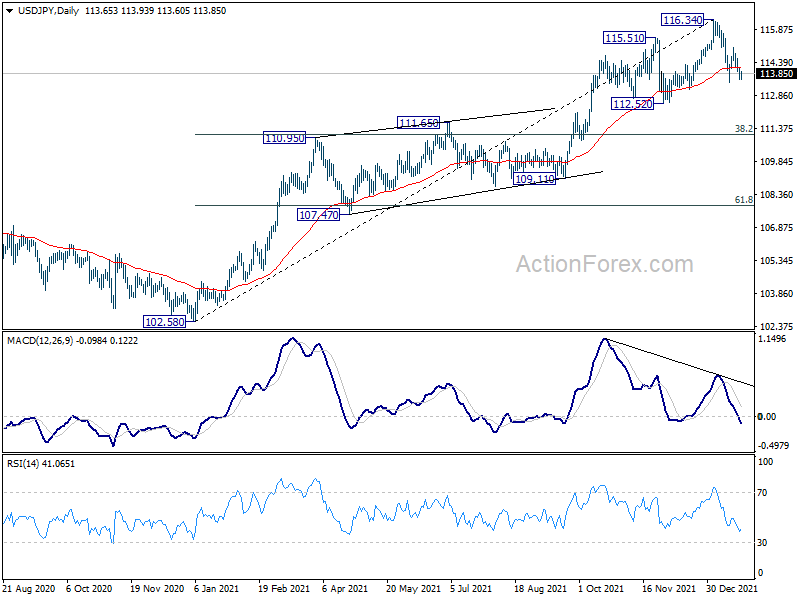
Intraday bias in USD/JPY remains mildly on the downside at this point. Considering bearish divergence condition in in daily MACD, it's probably already in correction to whole up trend from 102.58. Break of 113.47 will target 112.52 support first, and then 38.2% retracement of 102.58 to 116.34 at 111.08. For now, risk will stay on the downside as long as 115.05 resistance holds, in case of recovery.
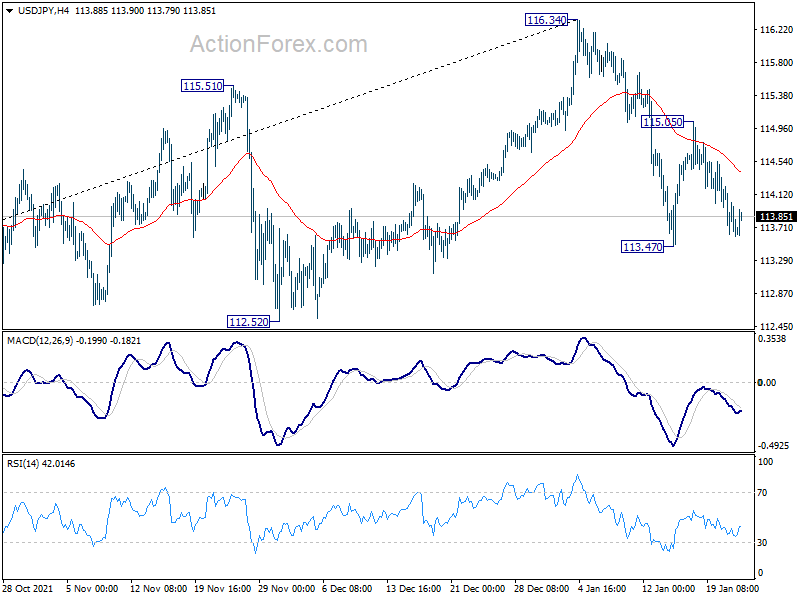
In the bigger picture, no change in the view that rise from 102.58 is the third leg of the up trend from 101.18 (2020 low). Such rally should target a test on 118.65 (2016 high). Sustained break there will pave the way to 120.85 (2015 high) and raise the chance of long term up trend resumption. This will remain the favored case as long as 55 week EMA (now at 110.91) holds.
Dollar Mixed Awaiting Fed Guidance, Markets Steady in Asia
The forex markets are pretty steady in Asian session even though others trade with a slight risk-off tone. Major pairs and crosses are stuck inside Friday's range for now. But volatility is guaranteed ahead, with Fed and BoC featured, as well as a large batch of important economic data. As for today, main focuses will be on PMIs from Eurozone and UK, indicating the states activities and inflation.
Technically, Dollar is rather mixed for now. EUR/USD didn't break through 1.1284 support to indicate completion of rebound from 1.1185. USD/JPY is holding above 113.47 temporary low, without resuming the fall from 116.34. USD/CHF is also holding above 0.9090 support, without resuming the fall from 0.9372. These pairs could probably need more guidance from Fed.
In Asia, at the time of writing, Nikkei is down -0.55%. Hong Kong HSI is down -1.07%. China Shanghai SSE is up 0.07%. Singapore Strait Times is down -0.16%. Japan 10-year JGB yield is up 0.0002 at 0.137.
Japan PMI manufacturing ticked up to 54.6, services tumbled to 46.6
Japan PMI Manufacturing ticked up from 54.3 to 54.6 in January, below expectation of 55.0. PMI Services dropped sharply from 52.1 to 46.6. PMI Composite also dropped from 52.5 to 48.8.
Usamah Bhatti, Economist at IHS Markit, said: "Flash PMI data indicated that activity at Japanese private sector businesses dipped into contraction territory for the first time in four months at the start of 2022. The pace of decline was modest, and led by the sharpest fall in services activity since August, while manufacturers commented on a slight quickening in output growth."
Australia PMI composite dropped to 45.3, slipped from strong recovery to contraction
Australia PMI Manufacturing dropped from 57.7 to 55.3 in January. PMI Services tumbled sharply from 55.1 to 45.0. PMI Composite also dropped from 54.9 to 45.3, first contraction follow three months of growth. All are at their 5-month low.
Jingyi Pan, Economics Associate Director at IHS Markit, said: "The Australian economy had slipped from a state of strong recovery in end-2021 to being affected by the surge in COVID-19 infections at the start of 2022... Supply issues meanwhile remained prevalent... This had led to input price inflation worsening Employment levels were unchanged."
ECB Rehn: Economic data to remain good despite Omicron
ECB Governing Council member Olli Rehn said over the weekend, "personally, I expect the economic data to remain relatively good despite being affected by the Omicron variant." He added that rate hikes in 2023 would be a logical step if there are no new economic shocks.
He added upward pressure on inflation will subside over the course of the year. Inflation is expected to hover around ECB's target of 2% in the next two years.
FOMC and BoC might set the stages for rate hikes
FOMC and BoC meetings are two major focuses this week. No policy change is expected for Fed yet, and there will not be new economic projections. The main focus is on whether, or how, Fed would make use of the statement and Chair Jerome Powell's press conference to lay down the ground work for rate hike in March.
BoC had indicated in December that interest rate will stay at effective lower bound until economic slack is absorbed, "sometime in the middle quarters of 2022". Hence, there is no policy change expected. The focus is on whether BoC would adjust the forward guidance to indicate that rate hike has become more imminent.
The economic calendar is also ultra-busy. Special focuses will be GDP data from US and Eurozone. On activities, a wave of PMI data will be released from Australia, Japan, Eurozone, UK and US. On sentiment, Germany Ifo will catch most attention. On inflation, Australia and New Zealand will release CPI while US will release PCE price indexes.
Here are some highlights for the week:
- Monday: Australia PMIs; Japan PMI Manufacturing; Eurozone PMIs; UK PMIs; US PMIs.
- Tuesday: Australia CPI, NAB business confidence; UK public sector net borrowing, CBI industrial order expectations; Germany Ifo business climate; US house price index, consumer confidence.
- Wednesday: New Zealand trade balance; Japan corporate service prices, BoJ summary of opinions; Swiss Credit Suisse economic expectations; US trade balance, wholesale inventories, new home sales, FOMC rate decision; BoC rate decision.
- Thursday: New Zealand CPI, Australia import prices; Swiss trade balance; Germany Gfk consumer climate; UK CBI realized sales; US GDP, durable goods orders, jobless claims, pending home sales.
- Friday: Japan Tokyo CPI; Australia PPI; France GDP, consumer spending; Germany import prices, GDP; Swiss KOF economic barometer; US personal income and spending, PCE inflation, employment cost index.
USD/JPY Daily Outlook
Daily Pivots: (S1) 113.49; (P) 113.82; (R1) 114.04; More...
Intraday bias in USD/JPY remains mildly on the downside at this point. Considering bearish divergence condition in in daily MACD, it's probably already in correction to whole up trend from 102.58. Break of 113.47 will target 112.52 support first, and then 38.2% retracement of 102.58 to 116.34 at 111.08. For now, risk will stay on the downside as long as 115.05 resistance holds, in case of recovery.
In the bigger picture, no change in the view that rise from 102.58 is the third leg of the up trend from 101.18 (2020 low). Such rally should target a test on 118.65 (2016 high). Sustained break there will pave the way to 120.85 (2015 high) and raise the chance of long term up trend resumption. This will remain the favored case as long as 55 week EMA (now at 110.91) holds.
Economic Indicators Update
| GMT | Ccy | Events | Actual | Forecast | Previous | Revised |
|---|---|---|---|---|---|---|
| 22:00 | AUD | Manufacturing PMI Jan P | 55.3 | 57.7 | ||
| 22:00 | AUD | Services PMI Jan P | 45.0 | 55.1 | ||
| 00:30 | JPY | Manufacturing PMI Jan P | 54.6 | 55 | 54.3 | |
| 08:15 | EUR | France Manufacturing PMI Jan P | 55.5 | 55.6 | ||
| 08:15 | EUR | France Services PMI Jan P | 55.3 | 57 | ||
| 08:30 | EUR | Germany Manufacturing PMI Jan P | 57 | 57.4 | ||
| 08:30 | EUR | Germany Services PMI Jan P | 48 | 48.7 | ||
| 09:00 | EUR | Eurozone Manufacturing PMI Jan P | 57.5 | 58 | ||
| 09:00 | EUR | Eurozone Services PMI Jan P | 52.2 | 53.1 | ||
| 09:30 | GBP | Manufacturing PMI Jan P | 57.9 | 57.9 | ||
| 09:30 | GBP | Services PMI Jan P | 55 | 53.6 | ||
| 14:45 | USD | Manufacturing PMI Jan P | 56.8 | 57.7 | ||
| 14:45 | USD | Services PMI Jan P | 55 | 57.6 |
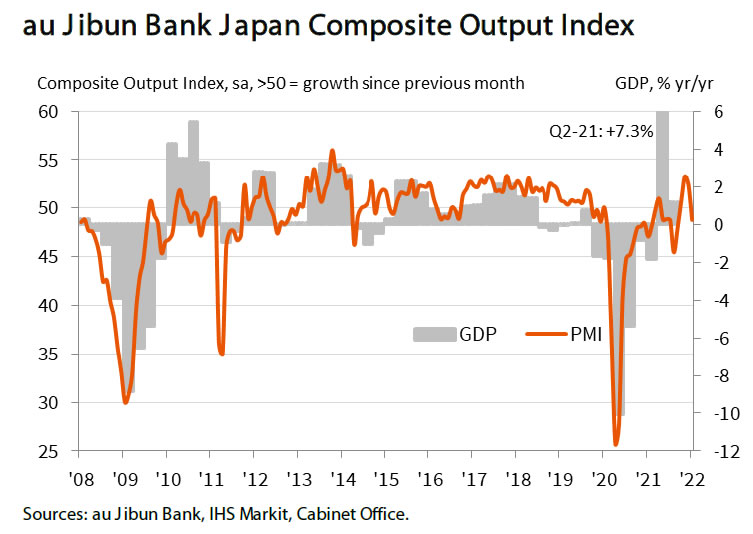
Japan PMI manufacturing ticked up to 54.6, services tumbled to 46.6
Japan PMI Manufacturing ticked up from 54.3 to 54.6 in January, below expectation of 55.0. PMI Services dropped sharply from 52.1 to 46.6. PMI Composite also dropped from 52.5 to 48.8.
Usamah Bhatti, Economist at IHS Markit, said: "Flash PMI data indicated that activity at Japanese private sector businesses dipped into contraction territory for the first time in four months at the start of 2022. The pace of decline was modest, and led by the sharpest fall in services activity since August, while manufacturers commented on a slight quickening in output growth."
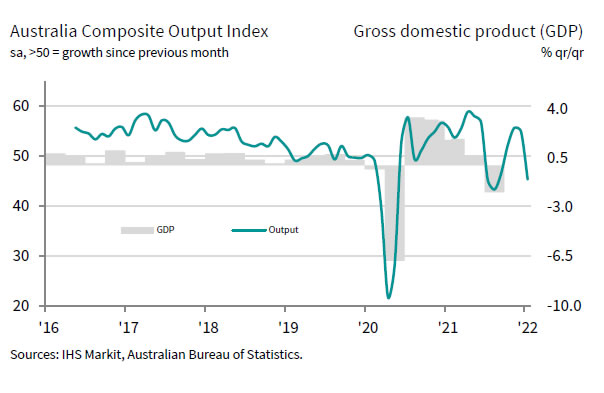
Australia PMI composite dropped to 45.3, slipped from strong recovery to contraction
Australia PMI Manufacturing dropped from 57.7 to 55.3 in January. PMI Services tumbled sharply from 55.1 to 45.0. PMI Composite also dropped from 54.9 to 45.3, first contraction follow three months of growth. All are at their 5-month low.
Jingyi Pan, Economics Associate Director at IHS Markit, said: "The Australian economy had slipped from a state of strong recovery in end-2021 to being affected by the surge in COVID-19 infections at the start of 2022... Supply issues meanwhile remained prevalent... This had led to input price inflation worsening Employment levels were unchanged."
ECB Rehn: Economic data to remain good despite Omicron
ECB Governing Council member Olli Rehn said over the weekend, "personally, I expect the economic data to remain relatively good despite being affected by the Omicron variant." He added that rate hikes in 2023 would be a logical step if there are no new economic shocks.
He added upward pressure on inflation will subside over the course of the year. Inflation is expected to hover around ECB's target of 2% in the next two years.
Bitcoin Weekend Plunge: 50% off Record Highs
Cryptocurrency traders have been suffering a slow painful death after the Fed ran out of excuses in tackling inflation. In just a few months, Wall Street had to reprice a much more aggressive Fed tightening strategy that made Bitcoin go from having a simple correction, to entering bear market territory, and now has fallen over 50% from its record highs.
Many crypto traders were anticipating one last plunge before jumping back in, but the regulatory environment got a lot cloudier now that the White House may soon unveil some national security challenges posed by cryptocurrencies and the Fed’s paper on central bank digital currencies didn’t answer any questions on if we will see a digital dollar or how they could work with stablecoins.
The majority of retail and institutional traders that got started in crypto in 2021 are now in the red and their patience may not be as long lasting as traders who are used to Bitcoin’s extreme volatility during major de-risking events. Bitcoin should have support ahead of the $30,000 level, but if that breaks it could be a freefall to $22,500.