

Sample Category Title
EUR/JPY Weekly Outlook
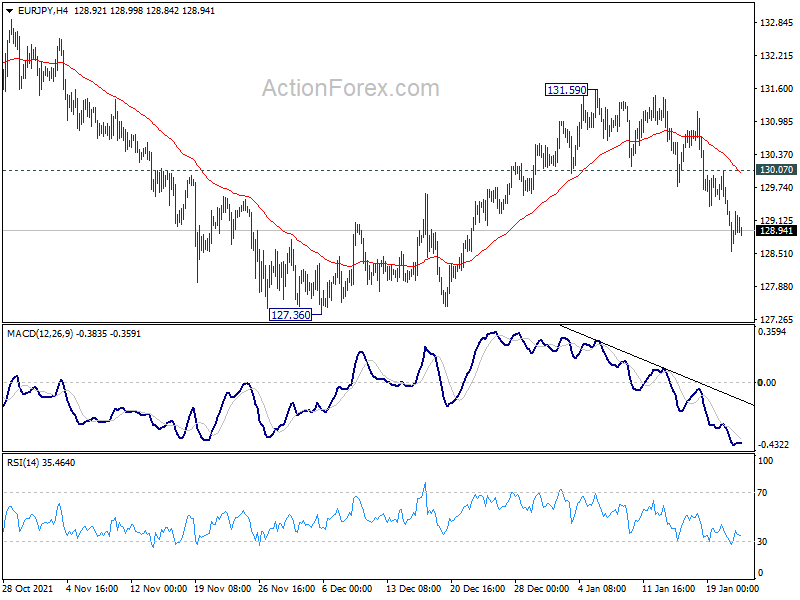
EUR/JPY's decline last week suggests that rebound from 127.36 has completed at 131.59. More importantly, the consolidation pattern from1 34.11 is extend with another falling leg. Initial bias stays on the downside for 127.36 and possibly further to 126.58 fibonacci level. On the upside, above 130.07 minor resistance will turn intraday bias neutral first. But risk will stay on the downside for now as long as 131.59 resistance holds.
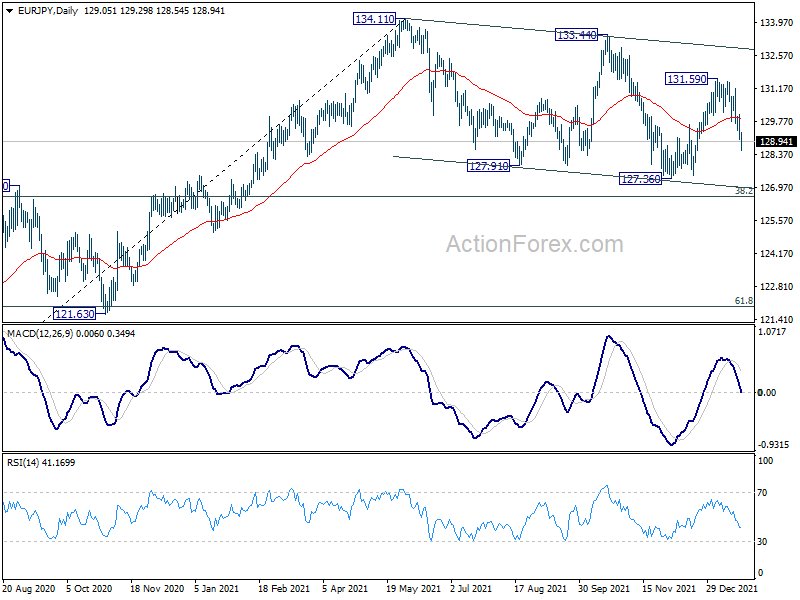
In the bigger picture, price actions from 134.11 are currently seen as a consolidation pattern only. As long as 38.2% retracement of 114.42 (2020 low) to 134.11 at 126.58 holds, up trend from 114.42 is still in favor to continue. Break of 134.11 will target long term resistance at 137.49 (2018 high). However, sustained break of 126.58 will raise the chance of medium term bearish reversal. In this case, deeper decline would be seen to 61.8% retracement at 121.94, and possibly below.
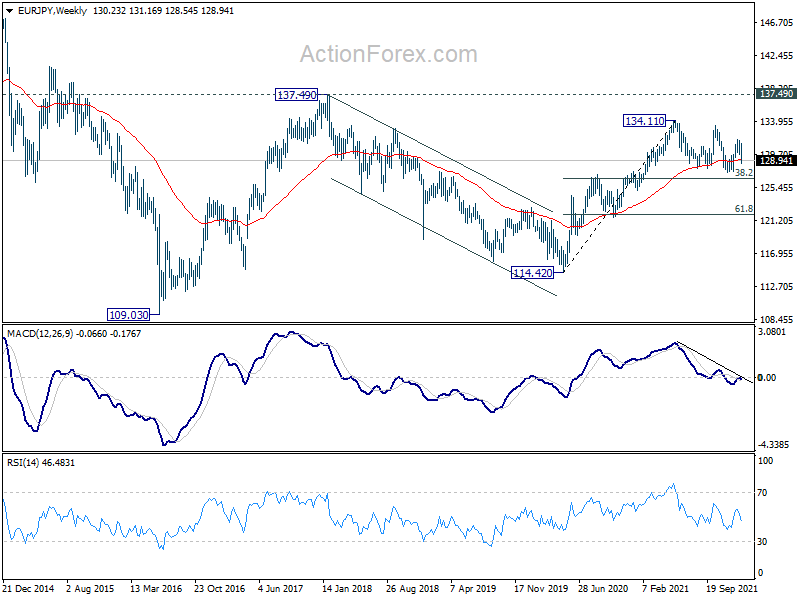
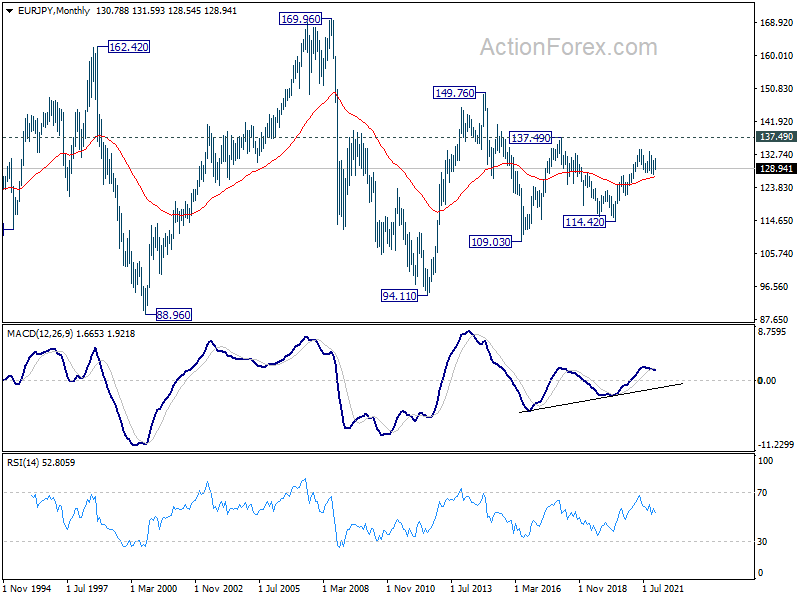
In the long term picture, EUR/JPY is staying in long term sideway pattern, established since 2000. Long term outlook will remain neutral until breakout from the range of 109.03/137.49.
GBP/JPY Weekly Outlook
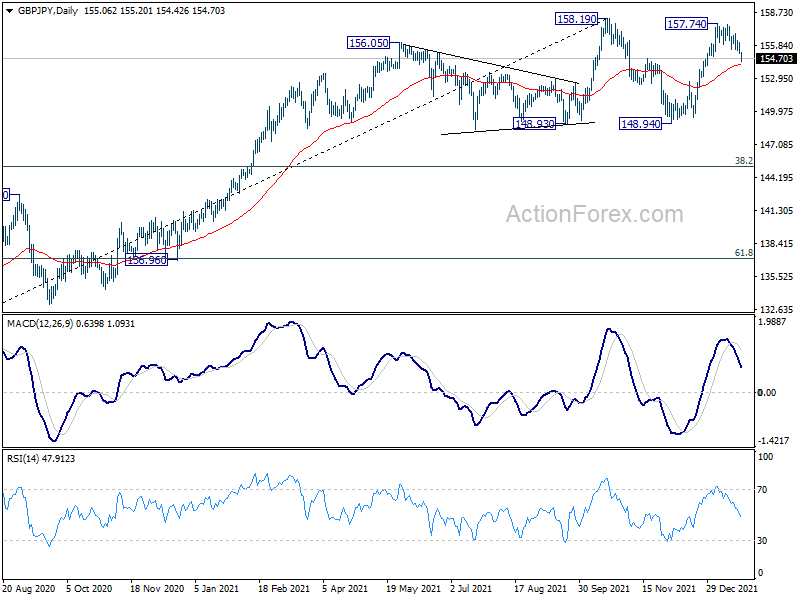
GBP/JPY's sharp decline last week suggests that rise from 148.94 has completed at 157.74, ahead of 158.19 high. Fall from 157.74 is seen as the third leg of the consolidative pattern from 158.19. Initial bias stays on the downside this week. Sustained break of 55 day EMA (now at 154.13) will target 148.94 support next. For now, risk will stay on the downside as long as 157.74 resistance holds, in case of recovery.
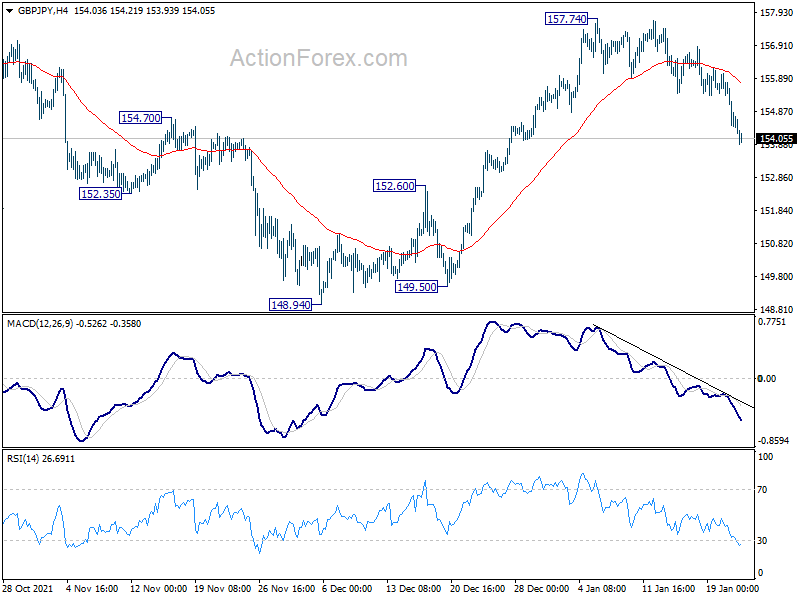
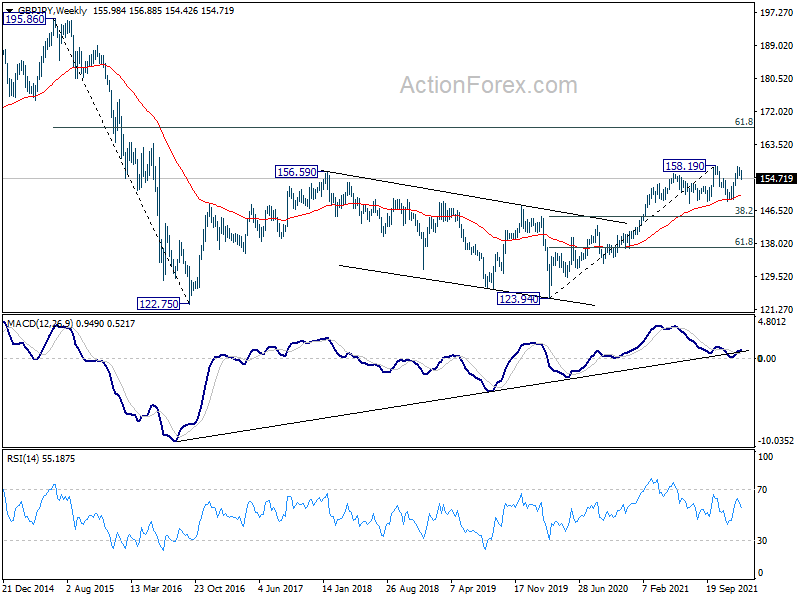
In the bigger picture, price actions from 158.19 are currently seen as developing into a consolidation pattern to up trend from 123.94 (2020 low). Downside should be contained by 123.94 to 158.19 at 145.10 to bring rebound. Firm break of 158.19 will resume the up trend to long term fibonacci level at 167.93. However, sustained break of 145.10 will raise the chance of trend reversal and target 61.8% retracement at 137.02.
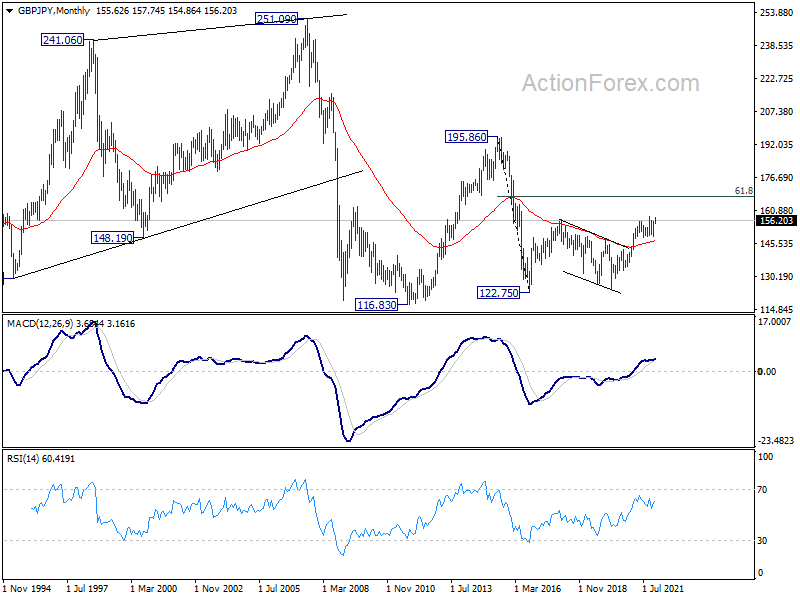
In the longer term picture, as long as 55 month EMA (now at 147.03) holds, we'd still favor more rally to 61.8% retracement of 195.86 to 122.75 at 167.93. But sustained trading below 55 month EMA will at least neutralize medium term bullishness and re-open the chance of revisiting 122.75 low (2016 low).
EUR/CHF Weekly Outlook
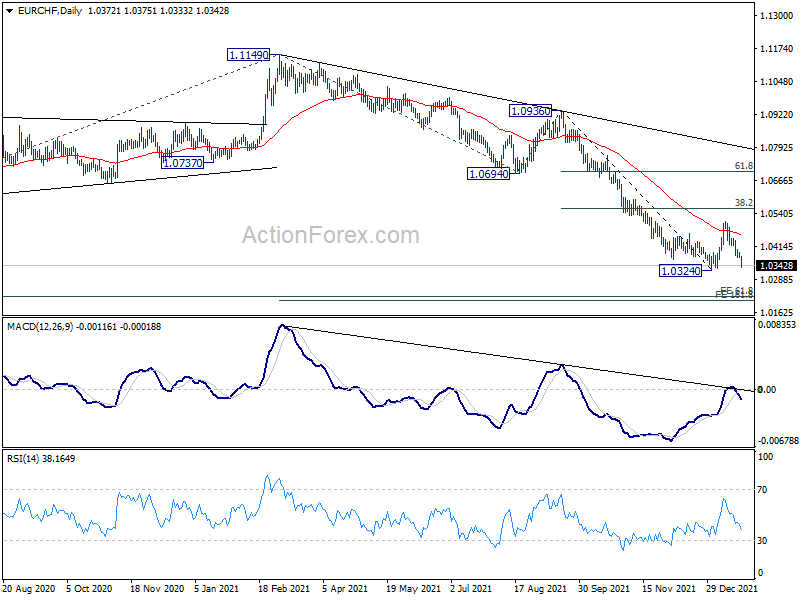
EUR/CHF's fall last week suggests that corrective rebound from 1.0324 has completed at 1.0510 already. Initial bias remains on the downside this week for 1.0324 first. Firm break there will resume larger down trend from 1.1149 to 161.8% projection of 1.1149 to 1.0694 from 1.0936 at 1.0200 next. On the upside, above 1.0401 minor resistance will extend the corrective pattern with another rise leg. But upside should be limited by 38.2% retracement of 1.0936 to 1.0324 at 1.0558.
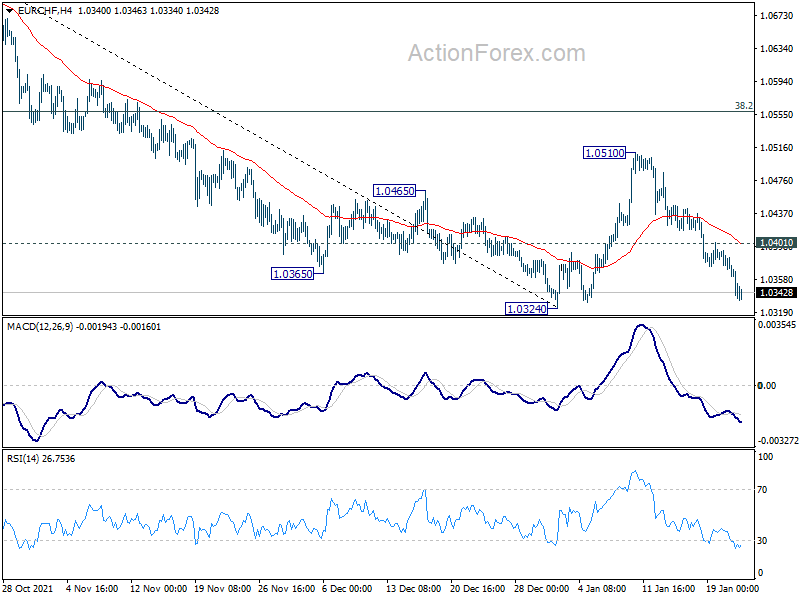
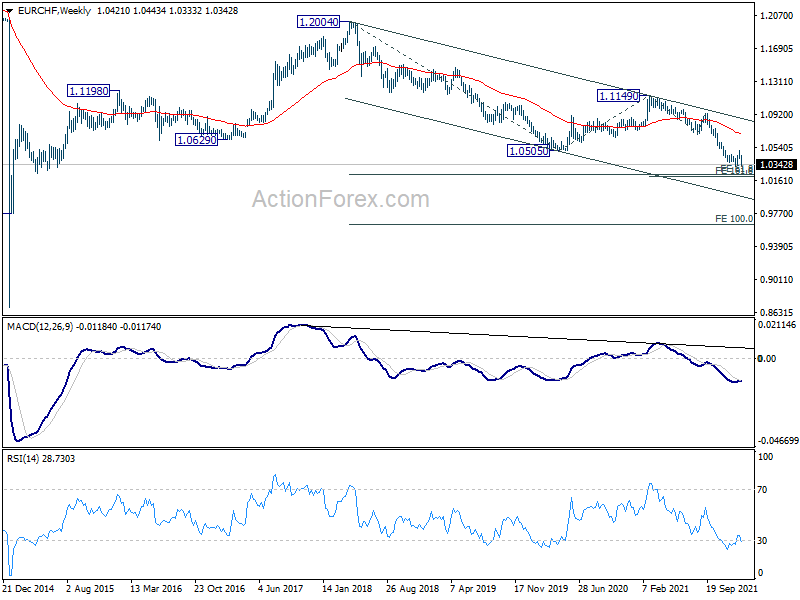
In the bigger picture, long term down trend from 1.2004 (2018 high) is still in progress. Next target is 61.8% projection of 1.2004 to 1.0505 to 1.1149 at 1.0223. On the upside, firm break of 1.0505 support turned resistance is needed to be the first sign of medium term bottoming. Otherwise, outlook will remain bearish even in case of rebound.
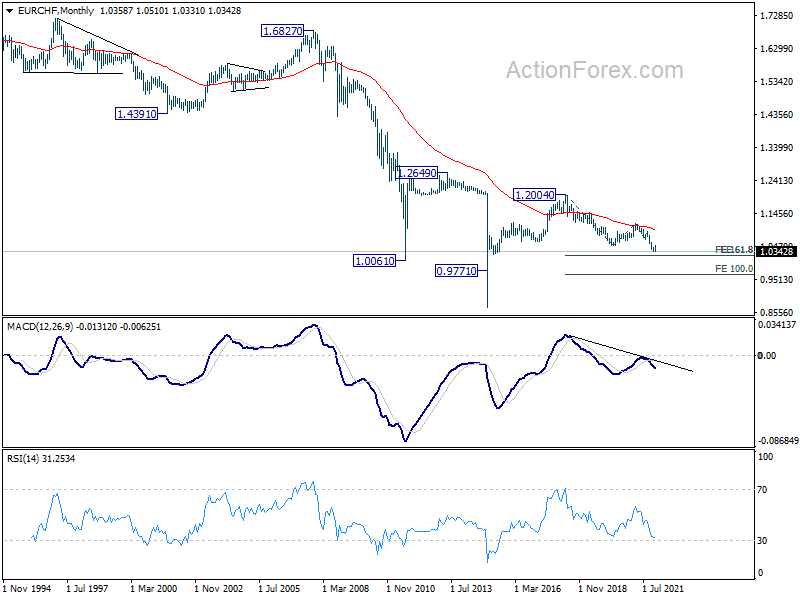
In the long term picture, prior rejection by 55 month EMA (now at 1.0967) maintains long term bearishness. Down trend from 1.2004 is now in progress for 61.8% projection of 1.2004 to 1.0505 to 1.1149 at 1.0223. Firm break there will target 100% projection at 0.9650.
Yen and Franc in Spotlights Again as Earnings Shook Markets
It's not Omicron nor Fed rate hike, but earnings. Bullish investors appeared to have finally gave up after disappointing Netflix report last week. NASDAQ led other major indexes sharply lower, and dragged down cryptocurrencies too. Given that Apple and Tesla will come next, there is risk of even more downside pushes in sentiments.
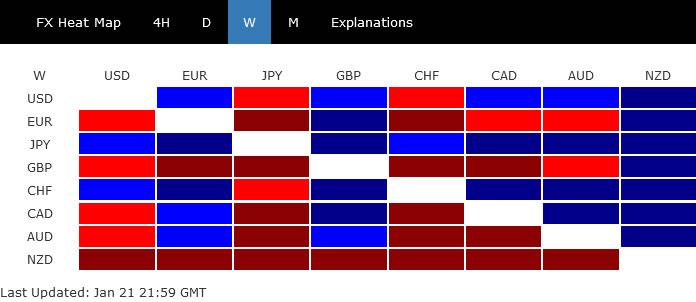
In the currency markets, Yen and Swiss Franc ended as the strongest ones while Dollar was a distant third. New Zealand Dollar was the worst performing, facing additional pressure from selloff against Aussie. Sterling was the second worst followed closely by Euro. Canadian Dollar was actually very resilient, as support from extended rally in oil prices, but starts to look vulnerable too.
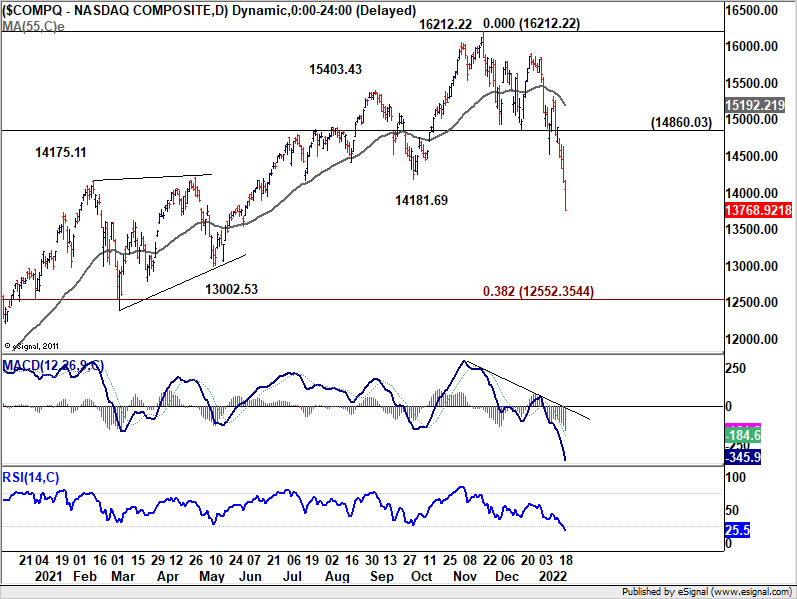
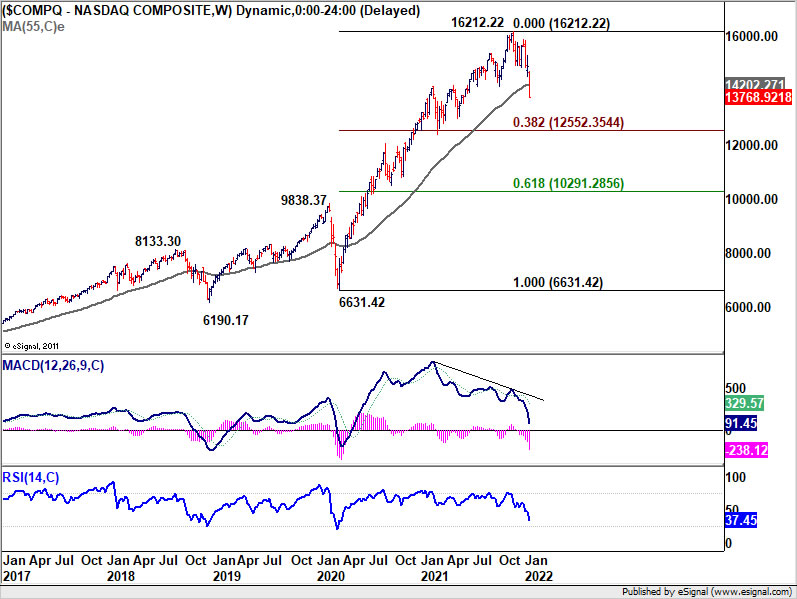
NASDAQ in medium term correction, to target 12.5k
The free fall in NASDAQ was a surprise, even more so the strong break of 14100 cluster support level. The break of 55 week EMA on the back of bearish divergence condition in weekly MACD is a rather bearish development. NASDAQ could now be in correction to the whole up trend from 6631.42 (2020 low).
With that in mind, any rebound attempt should be limited by 14860.03 support turned resistance. Fall from 16212.22 should target 38.2% retracement of 6631.42 to 16212.22 at 12552.35 before making a bottom.
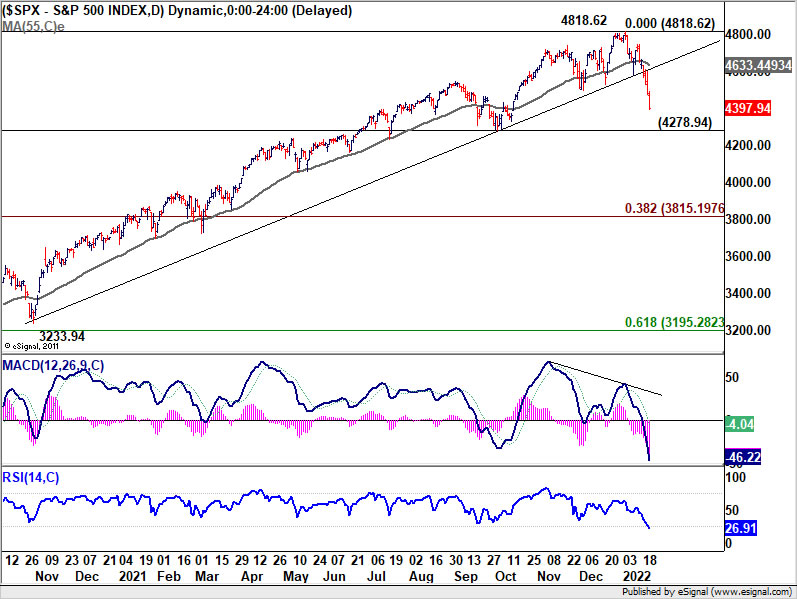
S&P 500 in medium term correction too?
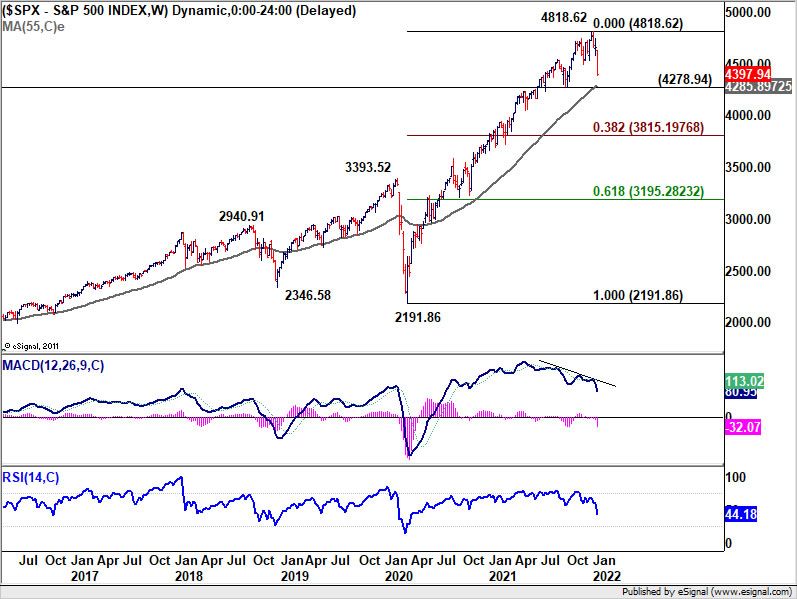
S&P 500's break of trend line support and the move away from 55 day EMA is also rather bearish for S&P 500. The index will now have to defend structural support at 4278.94, which is close to 55 week EMA (now at 4285.89).
Sustained break there will align the outlook with NASDAQ, and indicate that SPX is also in correction to the up trend from 2191.86 (2020 low). In that case, SPX would target 38.2% retracement of 2919.86 to 4818.62 at 3815.19.
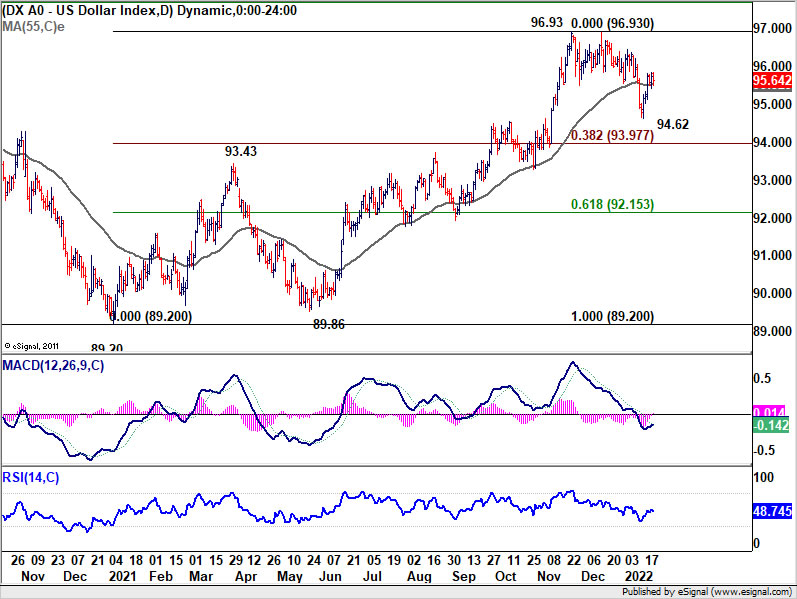
DXY recovered ahead of 93.97 fibonacci level
Dollar index extended the recovery from 94.62 and closed above 55 day EMA, indicating some stabilization. There is no change in the view that price actions from 96.93 are merely correcting the up trend from 89.20. That is, in case of another fall, strong support is expected from 38.2% retracement of 89.20 to 96.93 at 93.97 to contain downside.
However, sustained break of 93.97 will argue the trend might have reversed and deeper fall could be seen to 61.8% retracement at 92.15 and possibly below.
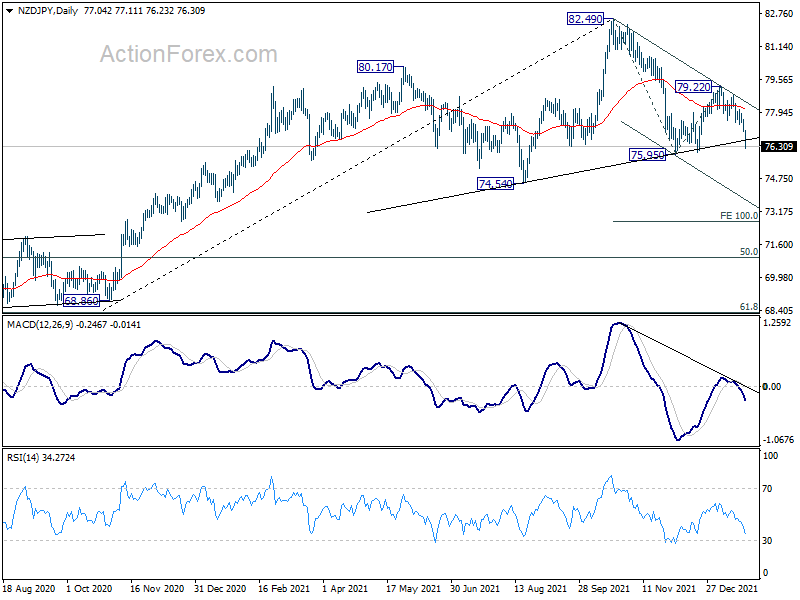
NZD/JPY to complete head and shoulder top pattern
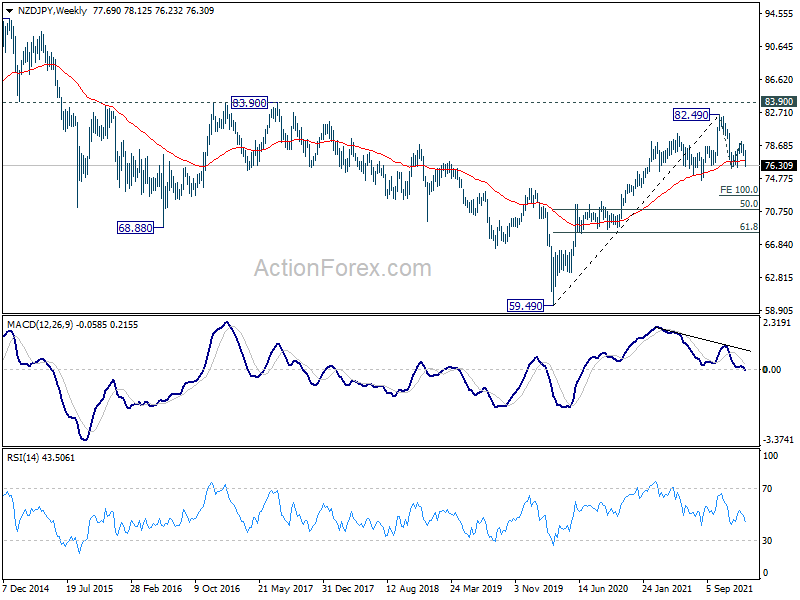
In the currency market, NZD/JPY was the top mover last week, losing -1.90%. The development now confirms that rebound from 75.95 has completed at 79.22. More importantly, fall from 82.49 is ready to resume. Immediate focus is on 75.95 support.
Sustained break of 75.59 will also complete a head and should top pattern (ls: 80.17, h: 82.49, rs: 79.22). In this case, NZD/JPY should fall through 74.54 support to 100% projection of 82.49 to 75.95 from 79.22 at 72.68. Reaction from there will decide when such decline is a correction to the up trend from 59.49. Or, it's already reversing the trend.
GBP/CHF to extend the correction from 1.3070 with another leg.
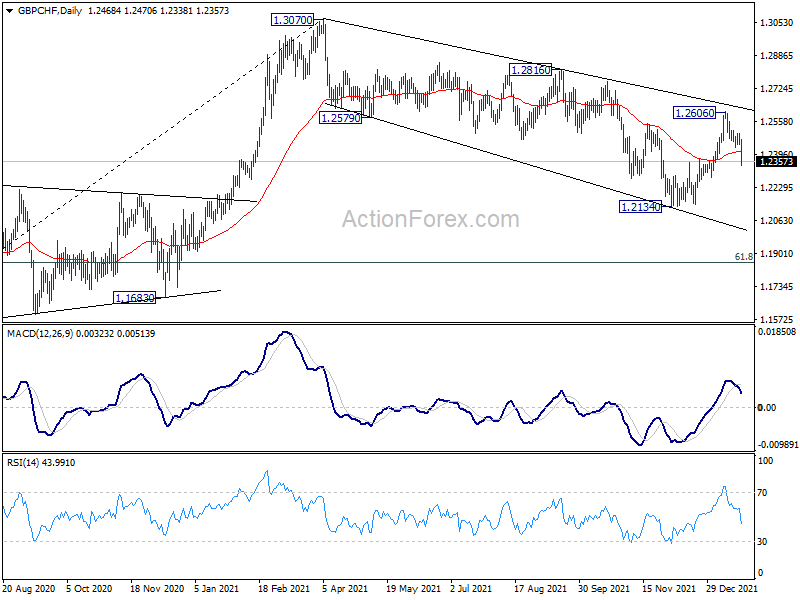
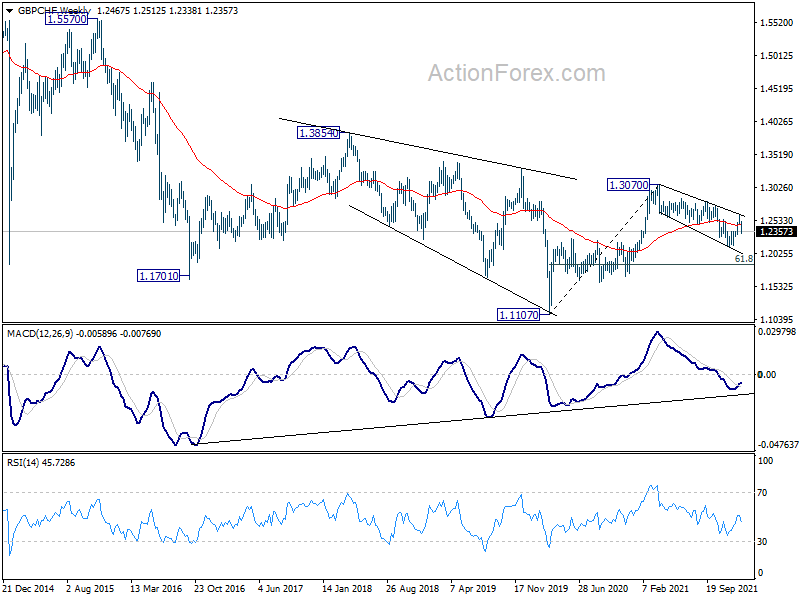
GBP/CHF was also one of the bigger movers, losing -1.12%. The development suggests that rise from 1.2134 has completed at 1.2606 already, after rejection by medium term falling trendline. The pattern from 1.3070 is probably now in its fifth leg. Further decline should be seen through 1.2134 low.
Larger outlook is not too bearish though, as the structure of the fall from 1.3070 is still corrective looking. It's more likely a correction to the up trend from 1.1107 then not. Nevertheless, GBP/CHF could try to reach 61.8% projection of 1.1107 to 1.3070 at 1.1857 before forming a bottom.
Bitcoin extends down trend, to bottom above 29261
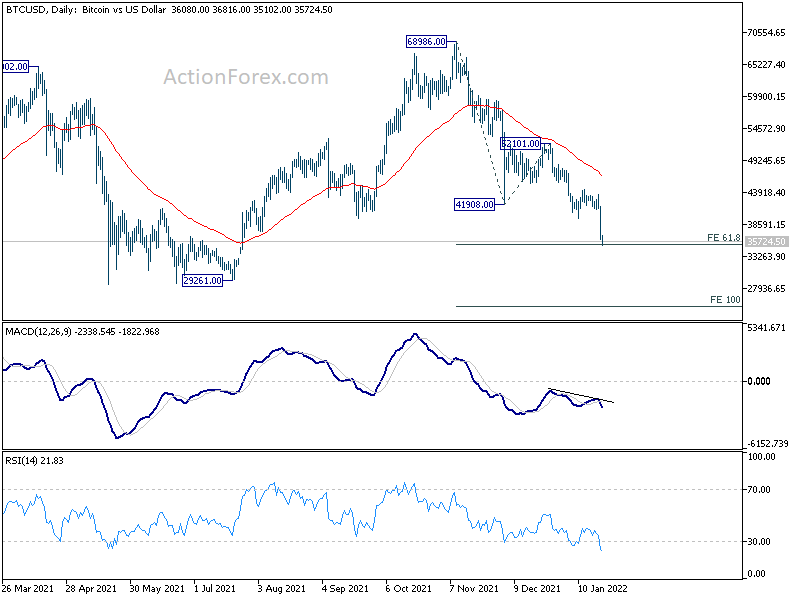
Bitcoin's down trend resumed last week but powering through 40k handle, and hit as low as 35102. 61.8% projection of 68986 to 41908 from 52101 at 35366. was already met, but there is not clear sign of bottoming yet. Overall, decline from 68986 is still viewed as as part of a long term range pattern between 29261 and 68986 only. Hence, momentum to start to diminish below 35366, and a bottom should be formed above 29261 low.
Nevertheless, break of 41908 support turned resistance is needed to be the first sign of bottoming, or risk will stay heavily on the downside even in case of recovery. In an unlikely more bearish scenario, bitcoin could extend the down trend to 100% projection at 25023 if it couldn't defend 30k handle.
USD/CAD Weekly Outlook
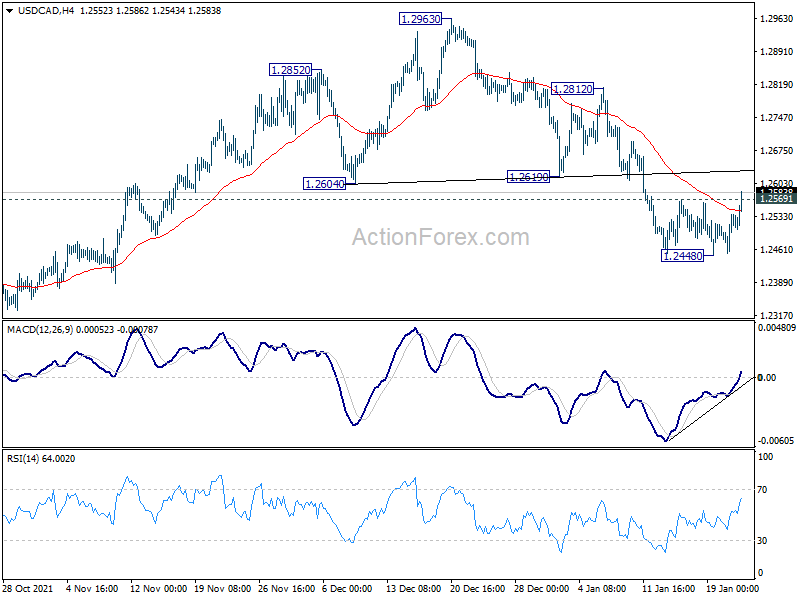
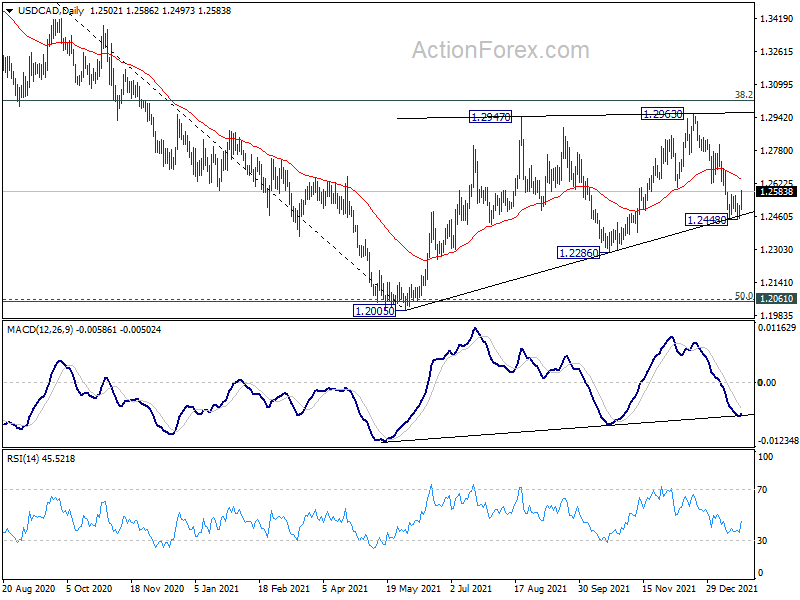
USD/CAD's late rebound and break of 1.2569 minor resistance last week suggests short term bottoming at 1.2448, after touching trend line support. Initial bias is back on the upside for 1.2619 support turned resistance first. Firm break there will argue that whole pull back from 1.2963 has completed and bring stronger rally through 1.2812 to retest 1.2964. Nevertheless, rejection by 1.2619, followed by break of 1.2448, will retain near term bearishness for deeper decline to 1.2286 support next.
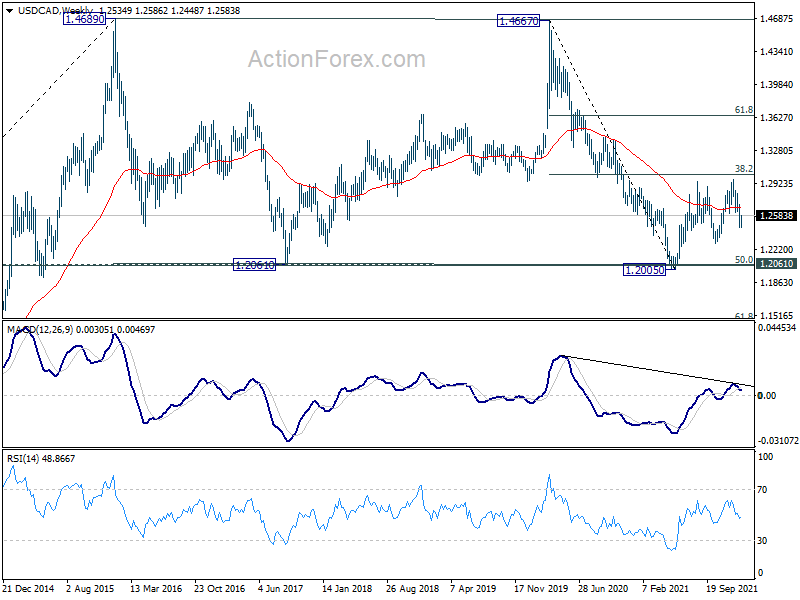
In the bigger picture, focus stays on 38.2% retracement of 1.4667 (2020 high) to 1.2005 (2021 low) at 1.3022. Sustained break there should confirm that the down trend from 1.4667 has completed after defending 1.2061 long term cluster support. Further rise would then be seen towards 61.8% retracement at 1.3650. However, rejection by 1.3022 will maintain medium term bearishness. Break of 1.2005 will resume the down trend form 1.4667 and that carries larger bearish implications too.
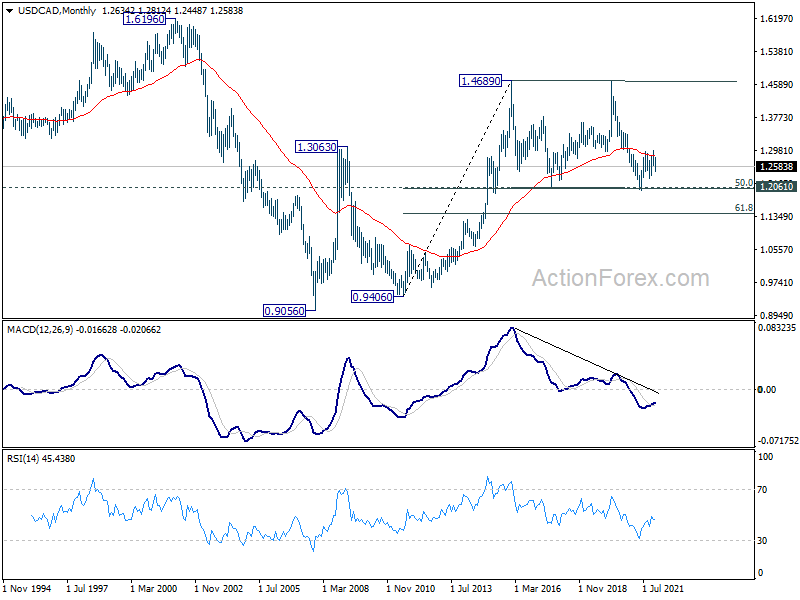
In the longer term picture, we're viewing price actions from 1.4689 as a consolidation pattern. Thus, up trend from 0.9506 (2007 low) is still expected to resume at a later stage. This will remain the favored case as long as 1.2061 support holds, which is close to 50% retracement of 0.9406 to 1.4689 at 1.2048. However, firm break of 1.2061 support will argue that USD/CAD has already started a long term down trend. Next target is 61.8% retracement of 0.9406 to 1.4689 at 1.1424.
Summary 1/24 – 1/28
Monday, Jan 24, 2022
[php_everywhere instance="1"]
Tuesday, Jan 25, 2022
[php_everywhere instance="2"]
Wednesday, Jan 26, 2022
[php_everywhere instance="3"]
Thursday, Jan 27, 2022
[php_everywhere instance="4"]
Friday, Jan 28, 2022
[php_everywhere instance="5"]
Weekly Economic & Financial Commentary: No Rate Hikes Yet, but Next Week’s FOMC Meeting Should Set the Table
Summary
United States: The Housing Market Closes Out a Strong Year
- The state of the housing market was the predominant theme in what was otherwise a quiet week for economic data. Mounting inflation concerns and ongoing supply chain disruptions weighed on homebuilder confidence in January, yet home construction continues to run at a robust pace. The overall shortfall of housing inventories constrained buying activity in December and pulled existing median home prices higher.
- Next week: Q4 Real GDP (Thu.), Durable Goods Orders (Thu.), Personal Income & Spending (Fri.)
International: China Growth Outperforms in Q4-2021 While U.K. Retail Sales Disappoint
- While the economy still slowed from the prior quarter, China's economy grew 8.1% in 2021, one of the fastest annual growth rates in years. Data indicate that, month-over-month, U.K. retail sales contracted 3.7%. These data are disappointing no matter how we slice them, but can be possibly explained by households doing holiday shopping early amid concerns of shortages and delivery delays.
- Next week: Eurozone PMIs (Mon.), Bank of Canada Rate (Wed.), Central Bank of Chile Rate (Wed.)
Interest Rate Watch: No Rate Hikes Yet, but Next Week's FOMC Meeting Should Set the Table
- All eyes are on the Federal Reserve next week as monetary policymakers conduct the first of the eight planned FOMC meetings for 2022. Interest rates have jumped since the FOMC last met on Dec. 15. The 10-year Treasury yield has risen 29 bps since then, while the two-year Treasury yield has seen a similar move.
Topic of the Week: A Record Gain in Holiday Sales that Most Retailers Would Like to Forget
- Holiday sales showed a record increase in 2021, but the holiday shopping season was not without its challenges. Higher prices took some joy out of last year's gain, and December's decline in sales confirmed consumers finished their holiday shopping early amid supply chain concerns.
The Weekly Bottom Line: To Hike or Not to Hike (in January)
U.S. Highlights
- Early signs of the pandemic’s toll on economic activity were evident in softer-than-expected home sales and a deceleration in regional manufacturing surveys.
- The current soft patch will likely prove temporary, and the broader economic trend is still one of robust growth.
- With strong demand showing increasing resilience to new pandemic waves, the Fed will remain on course to raise the federal funds rate.
Canadian Highlights
- After being starved for data last week, we were treated to a buffet this week. The housing market remained hot, while inflation hit 4.8% y/y, the highest reading since 1991.
- With inflation persistently above 2%, the Bank of Canada Business Outlook Survey and Canadian Survey of Consumer Expectations reported that medium-term inflation expectations are rising for businesses and consumers alike.
- The central bank is mindful of the risks to inflation. It may abandon its forward guidance of keeping the overnight rate at the effective lower bound until the middle quarters of 2022, and hike next week.
U.S. - Momentum Slows Amid Pandemic Wave
This week’s data releases showed some slowing in U.S. economic momentum through the winter months. In line with last week’s reported pullback in retail sales, existing home sales took a tumble in December. The soft patch looks to have continued at the start of the year, with both the Empire State and Philadelphia Fed manufacturing surveys weakening to multi-month lows in January.
Fortunately, it wasn’t all bad news as housing starts exceeded expectations, hitting their highest level in nine months in December. The virus-induced demand slowdown is likely to prove temporary, and the supply side of the economy is still playing catch up. The Federal Reserve is likely to signal as much at its meeting next week, setting the stage for policy rate liftoff at its following meeting in March.
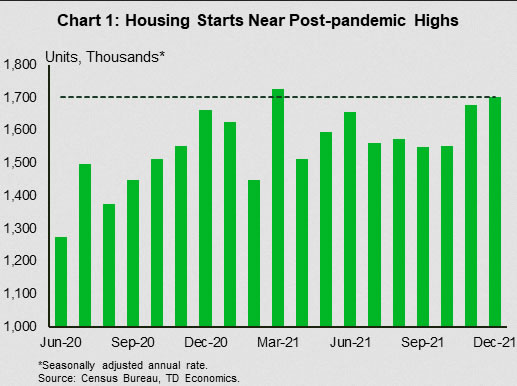
First up, the good news. Wednesday’s release of December’s housing starts data showed homebuilders are adding supply to a market in dire need of it (Chart 1). Starts rose to 1.7 million units (annualized) in December, a 1.7% increase over the prior month. The gain built on upward revisions of 49k units in the prior two months. The improvement was entirely in the multifamily segment, which posted a 51k unit increase (+10.6% m/m), while the single-family segment pulled back 27k units (-2.6% m/m). As starts perked up, so did permitting activity. Permits were up 9.1% for the month, rising to 1.9 million – the highest reading since July 2020. As with starts, this was mostly a multi-family story as permitting in the segment rose 21.9%, dwarfing the 2.0% lift in the single-family segment.
Homebuyers, on the other hand, showed some hesitancy in December. Existing home sales fell 4.6%, undershooting the market consensus for a 0.5% pull back. Surging Covid cases and a lack of inventory explain the setback. At the current pace of sales there exists only 1.8 months’ supply of homes – half the 3.9 months’ average in the three years before the pandemic.
This is an extraordinarily tight housing market, and with demand still strong it’s no surprise that the median transacted price again registered double-digit year-over-year gains – accelerating to 15.8% from 14% in November. The sharp rise in prices has worsened affordability. Higher interest rates will exacerbate this challenge and are likely to slow demand growth over the next year. The silver lining is that higher prices and higher carrying costs should lead to more supply in both the existing and new market, helping to rebalance the market.
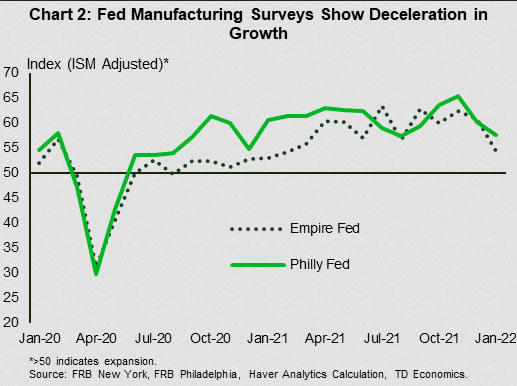
Finally, softening economic conditions were reflected in the Empire State and Philadelphia Fed Manufacturing surveys in January. On an ISM adjusted basis, both pulled back for the month registering 54.4 and 57.6, respectively. While readings above 50 imply the expansion continued in January, the Empire state index is now at its lowest level since January of last year, while its counterpart out of Philadelphia is now at its lowest level since August.
That said, this week’s data reflect a temporary blip in the path of the recovery. The Fed will remain focused on the broader trends – strong growth and persistent shortages – as they start the rate hiking cycle in the coming months.
Canada - To Hike or Not to Hike (in January)
After being starved for data last week, we were treated to a buffet this week. There were updates on the housing market, retail sales, and perhaps most importantly, inflation. In addition, the Bank of Canada (BoC) released the Business Outlook Survey (BOS) and the Canadian Survey of Consumer Expectations (CSCE).
First, on the residential front, December data showed that Canadian housing markets remained hot at the end of last year. Existing home sales rose 0.2% to 54.4k units, the highest level of activity since May 2021, while home prices rose 1.5% as housing inventory fell to its lowest level on record in December. Excess exuberance appears to have taken hold in some residential markets. Buyers have purchased homes in the belief that price growth will continue unabated. This poses a growing vulnerability in the economy, and is one that the BoC is closely monitoring.
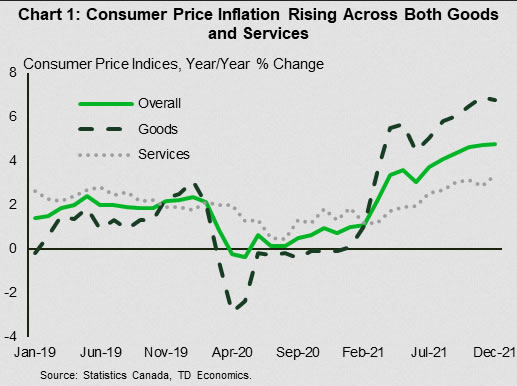
The central bank is also keeping a watchful eye on bubbling consumer price pressures. December data released this week had inflation at 4.8% in year-over-year terms, the highest reading since 1991. Goods prices have driven the increase, but services prices have also picked up recently as price pressures broaden across the economy (Chart 1).
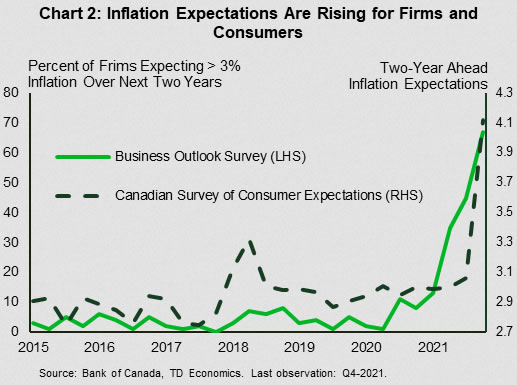
With inflation firmly above 2% through most of 2021, there are indications that inflation expectations are rising for businesses and consumers alike. The 2021Q4 BOS found that two-thirds of firms expect inflation to be above 3% over the next two years (Chart 2). Similarly, the CSCE reported a significant increase in inflation expectations among consumers. This survey also found that consumers were more concerned about inflation than they were prior to the pandemic due to a loss in purchasing power.
Indeed, wage growth has not kept up with inflation, despite labour shortages across a number of industries. This may change in short order, however. The majority of firms surveyed in the BOS said they planned for larger wage increases to attract and retain workers. Some are even planning to catch up on pay raises that were shelved earlier in the pandemic. If businesses follow through on these promises, we could enter a wage-price spiral, meaning inflation could remain elevated for some time.
The Bank of Canada is mindful of the risks to inflation. In October, the Bank became decidedly hawkish. It ended quantitative easing, and adjusted forward guidance, committing to keep the overnight rate at 0.25% until the middle quarters of 2022. The Bank re-affirmed this view in December. However, with longer term inflation expectations threatening to become un-anchored, the Bank may be tempted to abandon its forward guidance and hike next week. If it does, it risks diminishing the power of this tool. Instead, the Bank may use January to set the stage for lift off in March. Regardless of the decision next week, its clear that we will soon be saying au revoir to rock-bottom interest rates.
Bank of Canada to Make Highly-Anticipated Rate Decision
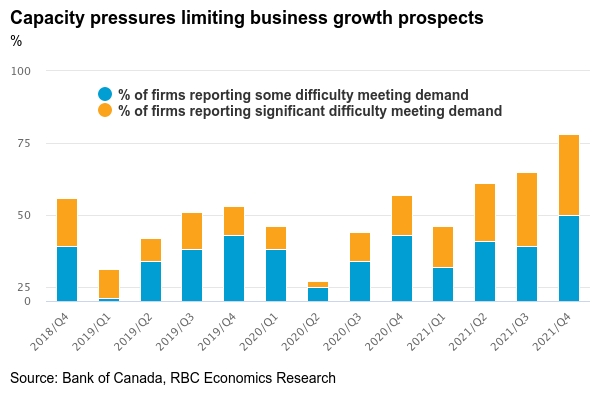
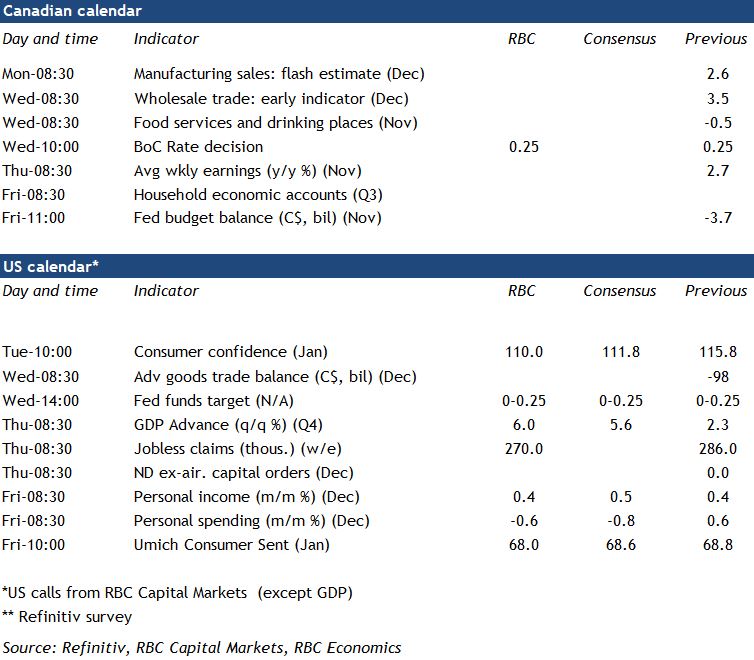
All eyes will be on the Bank of Canada rate decision next week as pressure builds for policymakers to hike rates sooner than previously indicated. We expect the bank to hold off on a change next week, but in a very close call. Clearly, the conditions are in place to support higher rates. Inflation trends have evolved largely in line with the BoC’s forecasts from the October Monetary Policy Report (4.8% vs actual 4.7% for Q4). But that still represents consumer price growth substantially above the 2% target rate. And our own tracking shows not all of that pressure can be explained away by pandemic-related distortions. Households still appear to have ample purchasing power, with government support programs once again putting a floor under incomes during the latest round of pandemic restrictions. And the Bank’s quarterly Business Outlook Survey showed business capacity pressures and labour shortages intensifying significantly—along with expected inflation and wage growth—ahead of the surge in Omicron cases in recent weeks.
Macroeconomic disruptions from the new virus variant are expected to be significant but temporary, with some regions, including Ontario, already planning to roll back restrictions that were re-imposed in early January. Beyond those near-term virus risks, the BoC is clearly running out of reasons to keep interest rates at emergency low levels. Rates will rise soon, even if the bank only uses next week’s announcement to foreshadow them (as we expect) rather than hiking immediately.
Week ahead data watch:
The December 'flash' estimate of Canadian manufacturing sales is expected to show another increase, building on a larger 2.6% gain in November. Manufacturing hours worked ticked up 0.4% and finished auto production rose another 4% (seasonally adjusted) by our count.
Canada’s alternative labour report (SEPH) will likely yet again highlight elevated vacancies, particularly in the hardest hit food and accommodation sector.
No major surprises are expected from next week’s US FOMC meeting. We look for the Fed to raise rates soon, but a change is not expected at the January meeting.
Week Ahead – Fed and Earnings in Focus
Investors in need of a lift
Earnings season is off to a rocky start and not only are investors not comforted by what they’re seeing, but it’s also contributing to the unease in the markets. The next week will be huge after an awful start to the year that’s brought inflation and interest rate anxiety, earnings disappointment, and increased geopolitical risk.
The Federal Reserve will have an opportunity to ease the growing concerns in the markets that four rate hikes and balance sheet reduction won’t be enough to get inflation under control. The last week has seen plenty of speculation around the possibility of the first 50 basis point increase in more than 20 years and up to seven hikes next year which isn’t helping to calm the nerves.
The Nasdaq has been hit hard by the combination of higher yields and risk aversion which will make the big tech earnings next week all the more important. Netflix got things off to a disappointing start and paid the price. Can the other big tech names turn things around?
US
This is building up to be a huge week on Wall Street after investors have been rattled by a rough start to earnings season and now face a critical FOMC meeting that should pave the way for a March liftoff. The main event is the Fed policy meeting and press conference, but a close second will be the next round of earnings. The Fed is worried about inflation and will be delivering a series of interest rate hikes in the first half of the year. This week’s meeting is all about preparing markets for how they will normalize policy this year with rate hikes and balance sheet reduction.
With the Nasdaq falling into correction territory, stock traders will look to see if Microsoft, Intel, and Apple earnings can help form a bottom. Investors are growing cautious over the outlook as margin pressures continue to get hit over surging wage and transportation costs.
Geopolitics is also becoming a key focal point for investors, with US and Russian talks over Ukraine potentially having a huge impact on energy prices. US policy over North Korea may become more aggressive as the country seems poised to resume nuclear missile tests.
EU
Plenty of economic data to come from the euro area next week which will no doubt draw a lot of attention, starting with the flash PMIs on Monday.
With markets once again getting ahead of the curve and pricing in a small rate hike in October, despite President Christine Lagarde pushing back against it, there will be a lot of focus on the releases and what they tell us about inflation.
Italian lawmakers will start voting next week for the country’s next President, with Prime Minister Mario Draghi the favorite.
UK
A relatively quiet week as far as the UK is concerned. From a data standpoint, the week basically starts and finishes on Monday with the flash PMIs. With four rate hikes priced in this year, the focus remains on the inflation outlook and whether more may be needed.
Of course, the political arena is far more in the headlines right now. Boris Johnson is hanging on by a thread as we await the outcome from Sue Gray’s investigation into Downing Street parties during lockdown. Pressure has become almost unbearable on the Prime Minister but he came out fighting during PMQ’s and if Gray returns a favorable report, he could well live to see another day.
Russia
A quiet week on the economic side, with industrial output on Tuesday and PPI on Wednesday the only notable releases.
As far as Russia is concerned, the focus is on the geopolitics and whether the country is, as the US warns, about to invade Ukraine. The market impact could be very negative in that case and the currency is already coming under some pressure, despite higher oil prices, as the odds increase.
South Africa
Inflation rose faster than expected last month, reaching 5.9%, up from 5.5% in November, which is right at the upper end of the central bank target range of 3-6%. The jump has made a second consecutive 25 basis point hike very likely which will take the repo rate to 4%.
Turkey
A rare moment of refrain from the CBRT this week saw the repo rate remain at 14%. That brought an end to a run of four consecutive rate cuts that saw the repo rate slashed by 5% and inflation soar to 36%.
The move left the lira quite stable for another week after an extraordinarily volatile couple of months. Governor Sahap Kavcioglu’s briefing on the quarterly inflation report on Thursday will be all the more interesting after the decision to hold rates.
The CBRT said this week that a comprehensive review of the policy framework is being conducted and the lira will be prioritized. Perhaps we’ll learn more about what that means next week and whether more volatility is coming.
China
China Industrial Profits for December, which will be released on Thursday, is a key gauge of the strength of the business sector. The consensus stands at 10%, up from the November gain of 9.0%.
China has responded to recent Covid-19 outbreaks by enacting a zero-tolerance policy. There are more than 20 million people are in lockdown, but the economy has held up.
India
The Indian state of Maharashtra announced that it will reopen schools this week. Although the state had the highest number of Omicron cases in the country, new cases have fallen sharply. This raises hopes that Omicron has peaked and the economy can reopen. India has been devastated by Covid, recording almost 500,000 deaths from the pandemic.
No major data next week but traders continue to look for clues around a possible rate hike in February in response to rising global yields and higher oil prices.
Bank Holiday on Wednesday.
Australia
Australia releases CPI for Q4 on Tuesday. The consensus stands at 0.8% QoQ, unchanged from the third quarter. Price rises have been driven by an increase in energy, food, and new home construction costs. The energy component may ease in the coming months and wage growth remains weak, which means that inflationary pressures should be contained.
PMIs will be released early in the week which could dictate early trading.
Australia Day bank holiday on Wednesday.
New Zealand
New Zealand will publish CPI for Q4 on Thursday. Higher energy continues to fuel an upswing in inflation, with the headline reading expected to rise above 5.0% YoY. On a quarterly basis, CPI is expected to have climbed 0.8%, after a sharp rise of 2.2% in Q3. Gasoline and food costs are the primary drivers of inflation.
Japan
After decades of deflation, Japan is seeing a rise in inflationary pressures. On Tuesday, we’ll get a look at BoJ Core CPI, the central bank’s preferred inflation indicator. This will be followed on Thursday by Tokyo Core CPI for January. The consensus is a 0.2% gain, down from 0.5% prior.
Inflation has been boosted by rising energy and food costs, which will likely continue to boost inflation. At the same time, the Omicron wave is a downside risk.
Economic Calendar
Monday, Jan. 24
- Evergrande next dollar bond interest payments are due
- German Chancellor Scholz discusses Covid pandemic strategy
- Lawmaker ballot starts for Italy’s presidency
- COP27 climate summit
- European Union foreign ministers meet in Brussels
- European Commission VP Sefcovic and UK Foreign Secretary Truss meet for Brexit talks
Economic Data/Events
- Australia CPI
- Singapore CPI
- Eurozone PMI
- Germany PMI
- UK PMI
- Australia PMI
- Japan Bank PMI
- Taiwan industrial production, money supply
- South Korea retail sales, department store sales
- Switzerland sight deposits
Tuesday, Jan. 25
- US FOMC begins a two-day meeting
- IMF launches the World Economic Outlook update
Economic Data/Events
- Germany IFO business climate
- Mexico international reserves
- New Zealand performance services index
- Australia consumer confidence, CPI
- Hungary Rate decision
- US Conference Board consumer confidence
- UK public finances, public sector net borrowing
- Japan department store sales
- Vietnam industrial production, retail sales, trade, CPI
- Turkey real sector confidence
- Spain PPI
Wednesday, Jan. 26
Economic Data/Events
- FOMC Rate Decision: The Fed may stop bond purchases and set up a March liftoff
- US new home sales, wholesale inventories
- BOC Rate decisions: May raise rates 25 bps to 0.50%
- Poland GDP
- China industrial profits
- New Zealand trade, credit card spending
- Philippines agricultural output
- Japan PPI services, leading index
- Thailand capacity utilization, manufacturing production index
- Singapore industrial production
- Poland unemployment
- Russia CPI, PPI
- Switzerland Credit Suisse survey expectations
- Spain mortgages
- EIA Crude Oil Inventory Report
Thursday, Jan. 27
Economic Data/Events
- US Q4 Advance GDP Annualized Q/Q: 5.8%e v 2.3% prior
- US initial jobless claims, durable goods
- European Central Bank’s Edward Scicluna speaks at a European Savings and Retail Banking Group event
- Norway’s sovereign wealth fund releases key figures for 2021
- Turkish central bank releases its quarterly inflation report
- Hungary Rate Decision: Expected to raise interest rates by 30 basis points to 2.70%
- Hong Kong Trade
- Mexico Trade
- Switzerland Trade
- New Zealand CPI
- Spain Unemployment
- Singapore Unemployment
- South Africa rate decision: Expected to raise rates by 25 basis points to 4.00%
- South Africa PPI
- China industrial profits
- Japan machine tool orders
- Australia Westpac leading index, Bloomberg economic survey, import-export price index
- Russia gold and foreign reserves
- Germany consumer confidence
Friday, Jan. 28
Economic Data/Events
- US consumer income, University of Michigan consumer sentiment
- German GDP
- France GDP
- Sweden GDP
- Eurozone economic confidence, consumer confidence
- Singapore Unemployment
- Sweden Unemployment
- Norway Unemployment
- France PPI
- Australia PPI
- New Zealand consumer confidence
- Japan CPI: Japan (Tokyo)
- Thailand forward contracts, foreign reserves
- Turkey economic confidence
- South Africa monthly budget balance
- Italy economic, manufacturing, and consumer confidence
Sovereign Rating Updates
- Hungary (Fitch)
- Ireland (Fitch)
- Finland (Moody’s)
- Austria (DBRS)
Eurozone PMIs: Another Dose of Bad News?
The latest PMI business surveys for the euro area will hit the markets early on Monday, starting with the French numbers at 08:15 GMT. Forecasts suggest the Eurozone economy lost further steam thanks to Omicron restrictions. Overall, economic growth remains sluggish and contrary to market expectations, the European Central Bank doesn’t seem ready to raise rates this year, leaving the euro vulnerable.
New year, same old blues
The euro area recovery has been rather disappointing. Economic growth remains stuck on slow gear with covid restrictions making a comeback in several countries recently. The labor market is not impressive either as the unemployment rate is still elevated at 7.2%.
On the other hand, inflation has fired up dramatically. Consumer prices are rising at the fastest clip in decades, sparking speculation that the ECB will be forced to raise interest rates soon. Money markets are currently pricing in 15 basis points of rate increases for this year. However, that seems unrealistic.
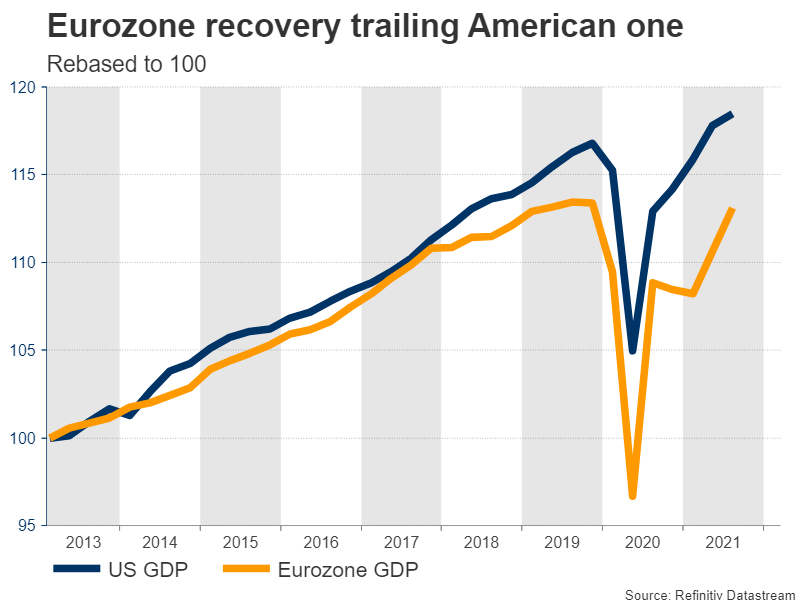
The primary difference between the ECB and the Fed is wage growth. Whereas American wages have picked up amid a labor market that’s approaching full employment, the same hasn’t happened in Europe. This means that there is little ‘organic’ inflation, so price pressures could cool once supply chains come back online and energy prices stabilize.
ECB President Lagarde argued the same point this week, when she said ‘the cycle of economic recovery in the US is ahead of that in Europe, so we have every reason not to act as quickly and ruthlessly as one might imagine with the Fed’.
More bad news
The upcoming business surveys are expected to confirm this narrative. Both the manufacturing and services indices are forecast to decline a little further in January, which would signal that economic growth is slowing as measures to combat Omicron begin to bite.
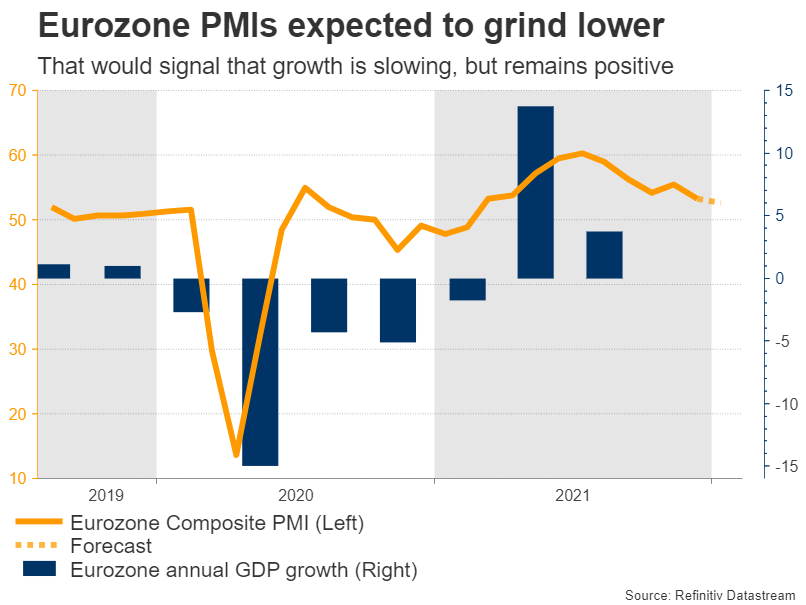
On the bright side, such numbers would imply that growth at least remains positive, so the economy probably absorbed the latest round of restrictions with less damage than previous waves.
Euro seems vulnerable
In the FX market, the initial reaction in the euro will depend on any surprises in the PMI figures relative to the forecasts. Taking a technical look at euro/dollar, a disappointment could see the pair head lower to test the 1.1270 zone again. On the upside, preliminary resistance may be found around 1.1370.
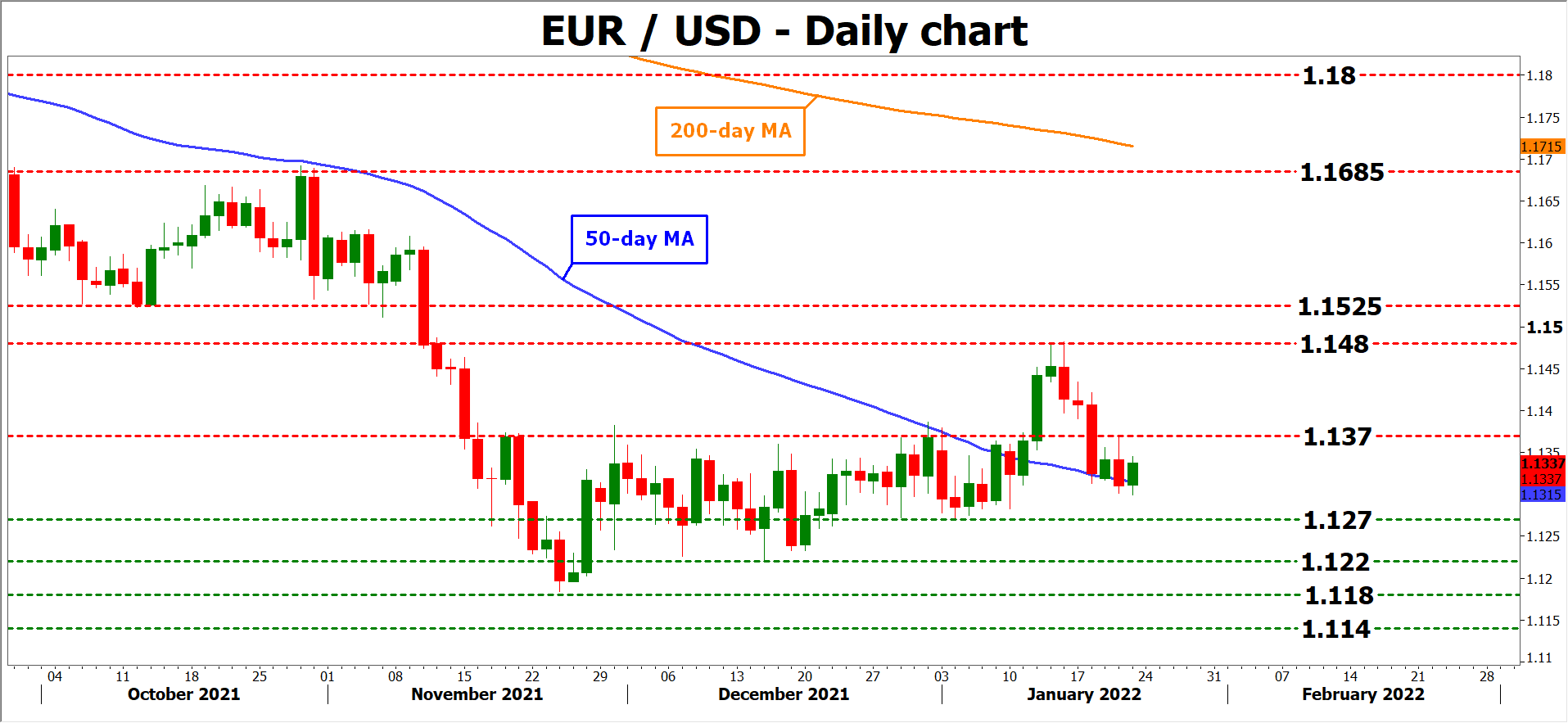
In the bigger picture, the next few months could be tough for the euro. The obvious risk is the ECB disappointing market expectations. The European economy simply doesn’t look strong enough to sustain higher rates and subdued wage growth implies that inflation could cool by itself moving forward.
Another headache for the ECB is how the bond market might react to higher rates. The European bond market has become accustomed to extraordinary levels of stimulus, so pulling that back would risk a sharp spike in yields, especially for economies with high debt levels like Italy. Such a spike could dampen the entire recovery, so the ECB cannot hit the brakes too hard.
Political risk is also back on the radar. The French presidential election in April is approaching and President Macron will have to face off against challengers who are skeptical of further EU integration.
All this suggests that the risks surrounding euro/dollar remain tilted to the downside for now. But it could be a different story in the second half of the year. If the European labor market eventually gets rolling and that also coincides with ‘peak inflation’ in the US, it may be enough to turn the tide for the pair. Buckle up, it could be a stormy year.