Sample Category Title
Week Ahead – Fed, BoC to Sing from Same Hawkish Hymn Sheet; Data Flurry on the Way
A jam-packed week for central banks and economic releases is coming up as the inflation story continues to grip the markets. With the price data pointing up and bond yields fired up, investors are expecting nothing but hawkish talk from the Federal Reserve and the Bank of Canada. The latter could even go one step further and put words into action. In Europe, though, all eyes will be on the flash PMI readings where Omicron likely weighed on economic activity in January. Down under, CPI figures for both Australia and New Zealand should direct some of the rate hike buzz towards the aussie and kiwi.
BoC rate hike: no point in waiting
The Bank of Canada will be the first major central bank to hold its first policy meeting of 2022 on Wednesday and it’s looking like it will be an exciting one. Rate hike bets have been intensifying all week and a 25-basis-point increase is now about 85% priced in. Expectations of a move as soon as the January meeting were reinforced by the latest CPI data that showed annual inflation hit a 30-year high of 4.8% in December.
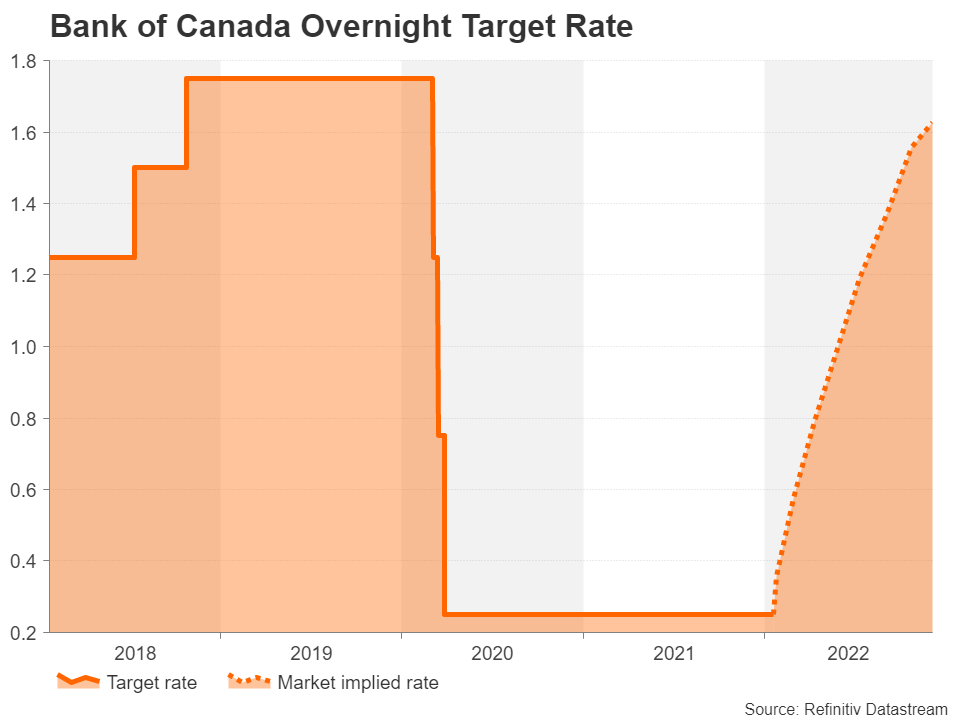
At the last meeting, the BoC had reiterated its view that the first rate rise is unlikely to come before April. But now that inflation is clearly surging and perhaps more importantly, the Fed is now leading the hawkish camp and the BoC is no longer the lone wolf, there’s less of a danger that an earlier-than-projected rate hike would be seen as a misstep.
The problem for the Canadian dollar, however, is that a non-telegraphed rate increase might not provide much of a boost when it’s already been anticipated by most investors. If the BoC does indeed raise interest rates on Wednesday, it would need to back it up with some very hawkish forecasts to sustain the loonie’s rebound.
Fed meeting, GDP data and much more on the dollar’s roster
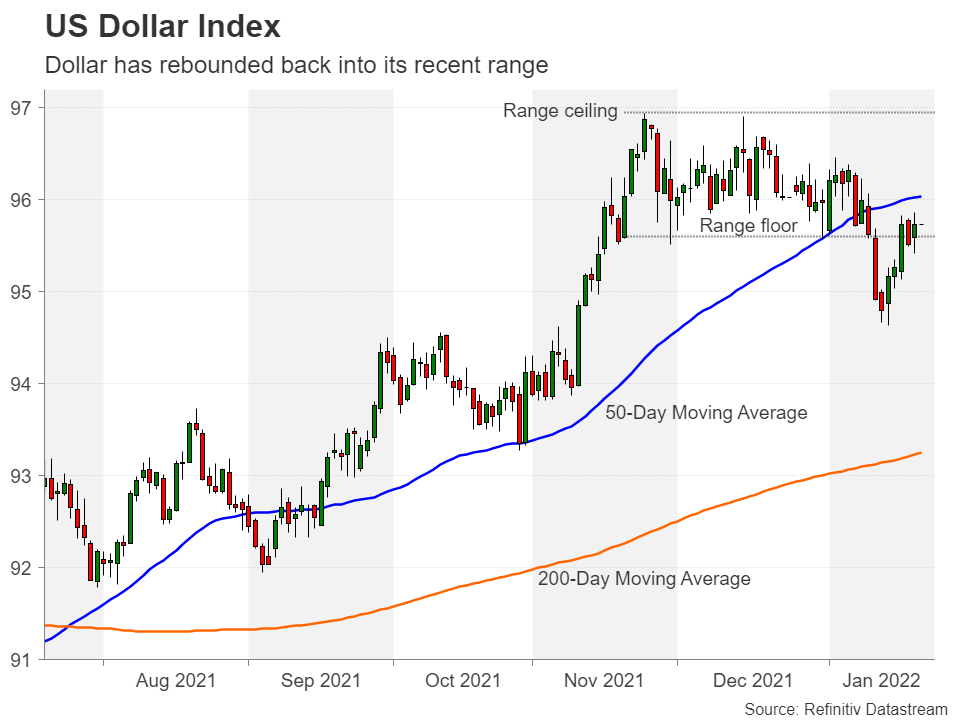
The US dollar has been rangebound since late November and after a short-lived bearish breakout, it’s back to being neutral again against a basket of currencies. However, it’s hard to see the greenback maintaining this posture in the coming week when apart from the all-important FOMC meeting, there’s a raft of data due on the health of the US economy.
The flash PMI figures for January by IHS Markit will start the week on Monday. The S&P CoreLogic Case-Shiller 20-city home price index is out on Tuesday along with the closely watched consumer confidence index. New home and pending home sales for December are released on Wednesday and Thursday, respectively. Durable goods orders are scheduled for Thursday too.
But the real focus will be on the fourth quarter GDP estimates on Thursday and on Friday’s personal income and outlays report containing the core PCE price index and the latest consumption numbers.
US GDP growth probably accelerated to an annualized 5.8% rate in the fourth quarter from 2.3% before, which would support the argument that the American economy is well and truly out of the woods and does not need any additional stimulus.
However, growth likely slowed towards the end of the quarter with personal consumption expected to have risen by just 0.1% month-on-month in December. Personal income is anticipated to have maintained the 0.4% m/m pace, while the core PCE price index is forecast to have inched higher by 0.1 percentage points to 4.8% year-on-year.
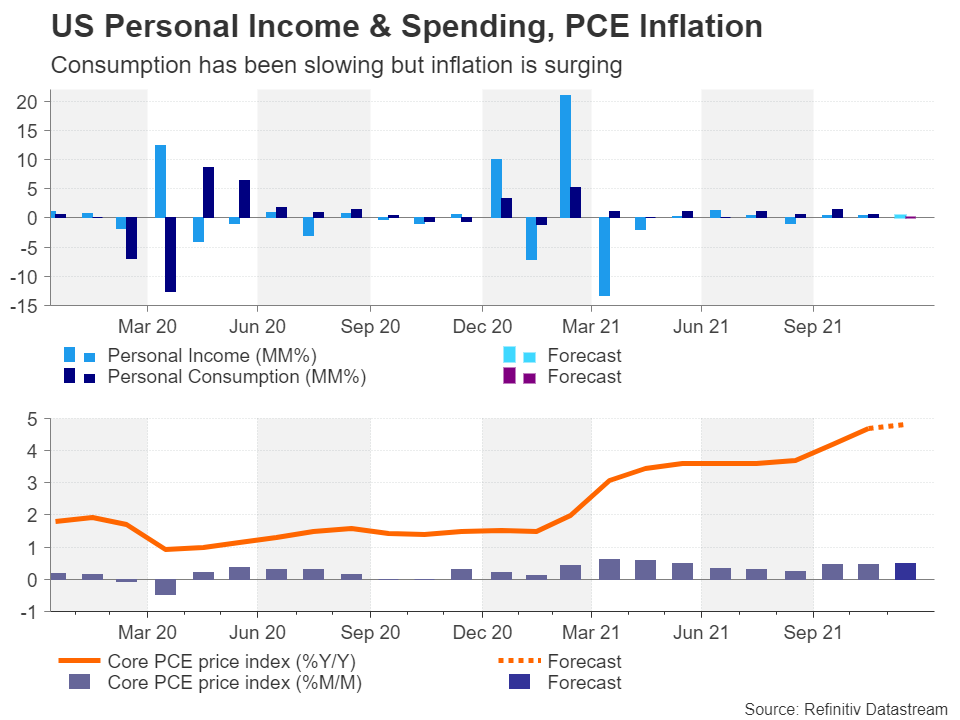
If the Fed’s favourite inflation metric meets expectations, showing signs of moderating, that could weigh on Treasury yields, which are currently taking a breather from the recent surge. However, next week’s data will have to play second fiddle to the Fed’s policy meeting.
No change in policy is expected from the Federal Open Market Committee on Wednesday but if policymakers want to get an early start on rate hikes, they will need to signal their intentions for March at the January meeting.
The other item at the top of investors’ agenda is the balance sheet runoff. It’s probably too soon for the Fed to go into too much detail about this but no doubt Chair Jerome Powell will be asked about it in his press conference and any revelations on the timing and speed are bound to spark a big response in the bond market, which in turn could roil FX and equity markets.
Will Eurozone PMIs add to euro’s woes?
The euro enjoyed some rare upside action last week but the bulls were unable to hold out for too long and the $1.14 handle proved unsustainable. Monday’s flash PMI prints will be important as they are often a reliable indicator for GDP growth in the euro area. Both the manufacturing and services PMIs are forecast to have edged lower in January amid a combination of tighter restrictions and heightened public caution due to the Omicron outbreak over the Christmas and New Year period. The overall composite PMI is expected to have fallen from 53.3 to 52.6 in January.
Such a drop would represent only a modest deceleration in growth and is unlikely to ring any alarm bells for the European Central Bank, which meets in the first week of February. The euro might even gain some ground if there’s a small positive surprise and the Fed isn’t quite as hawkish as feared.
Also of interest will be Germany’s Ifo business climate gauge (Tuesday) and the Eurozone’s economic sentiment indicator (Friday).
Is Boris about to quit?
Over in the UK, the PMI numbers will be the highlight of the week too, at least on the data front. A political storm is currently brewing in Westminster, though the markets have so far taken little notice of it. Pressure is growing on Prime Minister Boris Johnson to resign following a series of scandals, the latest one of which is ‘Partygate’. Downing Street staff allegedly held parties during the lockdowns of 2020 and 2021, one of which was attended by Johnson.
Most likely, the prime minister is safe for the time being. But should he resign, the markets would probably be comfortable with any of the current hotly tipped contenders to replace him.
A more pressing matter for the pound is what the Bank of England will do at its next meeting. Recent data out of the UK have been mostly strong, including the last CPI report. It’s possible Monday’s flash PMIs will buck the trend but that shouldn’t deter the BoE from lifting rates for a second time since the pandemic in February.
Nevertheless, some volatility shouldn’t be discounted for cable over the next few days, whether it’s sparked by Partygate or the Fed.
Antipodeans on CPI alert
The Australian dollar got a significant boost in the past week from a much stronger-than-expected set of jobs numbers. With the fourth quarter CPI readings due on Tuesday, the aussie could enjoy a further lift if Australia’s inflation rate climbs higher as expected. The Reserve Bank of Australia convenes on February 1 and may decide to end its asset purchase programme early if there’s reason to worry about spiralling inflationary pressures. Ahead of the CPI report, the flash PMIs will be watched on Monday for more evidence that Omicron had only minimal impact on the Australian economy.
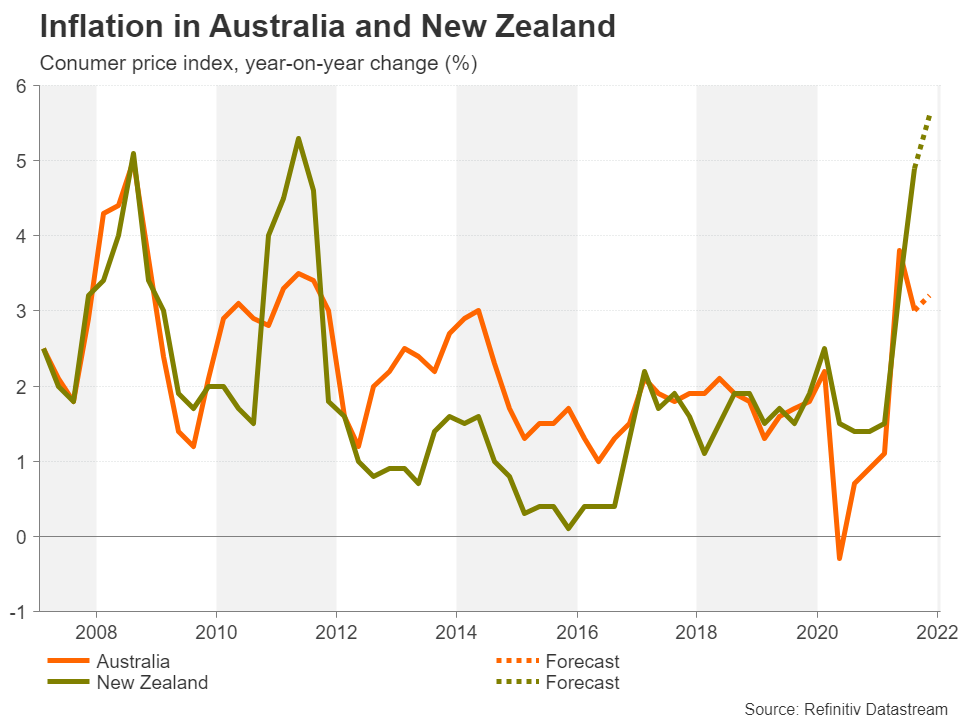
In neighbouring New Zealand, inflation will also be front and centre. The country’s quarterly CPI prints are out on Thursday and there could be another spike in headline inflation, which had jumped to 4.9% y/y in Q3.
The Reserve Bank of New Zealand doesn’t meet until February 23. But with a quarter-percentage point rate hike already fully priced in for each of the RBNZ’s meetings this year, the only thing that can be a game-changer for the struggling New Zealand dollar is if the figures are strong enough to open the door for half-point increases.
Weekly Focus – All Eyes on Fed
Risk sentiment remained on the back foot this week, with market focus centring on a continued rise in global yields. US 10Y Treasury yields closed in on 1.9% - up 35bp since the start of the year - reflecting expectations for faster monetary tightening in the US. Markets are now pricing in four Fed rate hikes of 25bp this year, with a good probability that we will see more than two rate hikes in H1 22 or alternatively a 50bp hike. In our view the first year of the US money market curve is now fairly priced, especially as we expect the Fed to reduce the balance sheet (QT) in Q3 this year, but with upside risk of more Fed hikes in 2023 (read more in Yield Outlook: Market rates and yields set to continue rising, 19 January). Notably, yields are moving higher with stable to lower inflation expectations (break-evens), resulting in a sharp move higher in real rates, which was an important driver for the sour risk appetite. We have increased our 12M forecast for 10Y US Treasury yields to 2.25% and lowered our 12M EUR/USD forecast to 1.08.
The rise in US yields also spilled over into other markets, with 10Y German Bund yields turning positive for the first time since May 2019. Brent oil prices touched USD 89/bbl in light of improving demand expectations and equity markets remained volatile amid a lacklustre start to the Q4 earnings season. Rays of light came from China, where the central bank cut its key policy rates by 10bp, easing liquidity conditions further to support the economy during a year where stability is high on the agenda. German ZEW expectations also showed a welcome rebound in January, as investors still see Omicron as a temporary headwind to the global recovery. Meanwhile, US manufacturing seems to have started 2022 on a weak footing, with regional business surveys pointing to a noticeable drop in orders and shipments amid Omicron disruptions, with still high price pressures. Despite rumours about a hawkish twist, Bank of Japan kept a steady hand with no signs of discussions of a rate hike before the 2% inflation target is reached. ECB President Lagarde again rejected calls for faster policy tightening despite continued high inflation pressures, reiterating that cyclical conditions were weaker in the euro area than in the US.
A busy agenda awaits next week, with the highlight being the FOMC meeting on Wednesday. We expect Fed to keep policy rates unchanged, but reinforce signals for a March hike. We have changed our Fed call, now expecting four 25bp rate hikes this year and QT starting in September, with risks skewed towards more hikes and earlier QT (read more in Fed Research - Preview: End of money printing brrrrr - (at least) four 25bp rate hikes this year and QT in September, 18 January). On the macro front, flash PMIs for January in the euro area, UK and US will also draw attention, especially to gauge whether manufacturing is slowing and price pressures are easing. US GDP figures should still signal that the recovery continued at the end of 2021, but we will watch out how households reacted a new COVID-19 wave and rising prices in the December consumption data. Russia-Ukraine tensions also remain an important tail risk to watch for markets, as a decision about military intervention/sanctions will probably have to come sooner rather than later. Italy's presidential election kicks off on Monday, with a clear risk of political uncertainty returning over the longevity of Italy's unity government, if current Prime Minister Mario Draghi is elected as President.
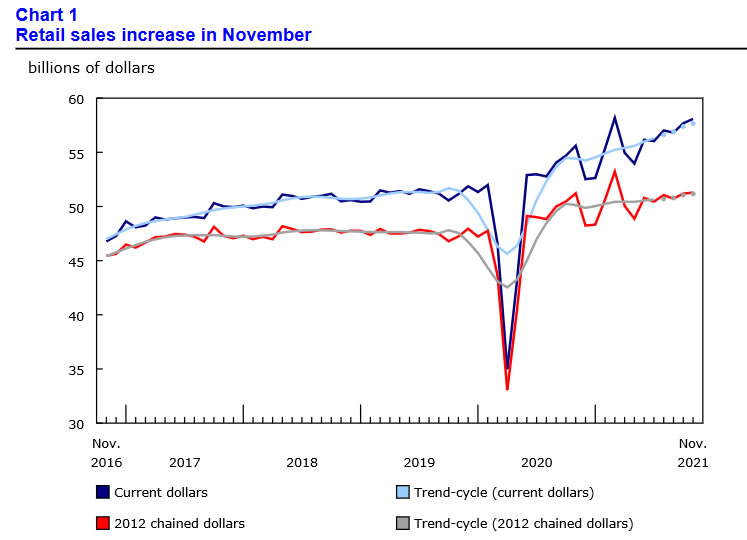
Canada: Retail Sales Rise in November, Boosted by Higher Prices and Improved Gasoline Sales
Following a solid increase in October, retail sales continued to rise in November gaining 0.7% on the month. Looking ahead, the picture appears less bright, with Statistics Canada's flash estimate projecting a 2.1% decline in December.
Higher prices continued to inflate retail sales growth in nominal terms. Stripping away the effect of prices, the volume of sales was up just 0.2% on the month.
Sales of motor vehicle & parts edged lower on the month (-0.3), but receipts at gasoline stations edged higher in both nominal (+4.9%) and volume terms (+3.5%).
Core sales, which exclude autos and gasoline, rose by 0.5% month-on-month.
- Core sales were supported by higher sales at building materials, garden equipment and supplies dealers (+3.0%) and at food & beverage stores (+1.0%). Clothing and accessories stores also fared well (+3.0%).
- On the other hand, sales declined at furniture and home furnishings retailers (-1.2%) and at electronics and appliance stores (-1.1%). Sales of electronics and appliances have been weak for the last eight months, and are now 16.7% below their year ago level.
- Online sales edged 3.5% lower in November. The share of e-commerce sales relative to total retail sales was 6.9%, down 0.4 percentage points from a year ago.
On a regional basis, sales were up in seven provinces. Quebec led the way with retail sales rising by 1.2%. Sales were also higher in Ontario (+0.5%) and British Columbia (+0.8%).
Key Implications
Retail sales ended 2021 on softer footing. Sales were nearly flat in real terms in November, with an outright decline projected for December. Global supply-chain bottlenecks could have prompted consumers to shop early, shifting activity to October. Additionally, severe floods in British Columbia and the Atlantic provinces affected business operations and caused shipment disruptions in and out of those provinces.
With inflation hitting a multi-decade high in December, it's no surprise that rising prices were evident in today's report. While nominal retail sales were 4.4% higher than a year ago, volumes were just 0.1% above their November 2020 level.
Looking ahead, the picture for retail spending is mixed. Capacity limits, staff absenteeism and health concerns may weigh on in-store sales at the start of the year. Supply-chain bottlenecks are also likely to intensify once again, leading to delayed shipments, higher prices, and less choice for consumers. That being said, retailers, particularly the ones with online operations, could also see a boost to their sales as consumers redirect their spending from services to goods, similar to previous episodes of lockdowns.
Sunset Market Commentary
Markets
European stock markets can’t escape the rot today. Main indices lose up to 2% and more. The EuroStoxx 50 trades below first support at 4231. A sustained break paves the way to the low 4000-zone. It will be a key session for US indices as well. They open around 0.5% weaker. The S&P yesterday closed below the neck line of a triple top formation at 4495. A sustained break lower gives more downward potential towards the October low of 4279 with the final target of the technical formation even at 4172. The threat in the Nasdaq is even larger. The tech index is already officially in correction mode given the 10%+ decline from the November top. The Nasdaq yesterday closed below the neckline of a huge double top formation (14175) which serves as resistance in H1 2021. A move lower suggests more downward potential towards 12552 (38% retracement since March 2020) and even the low 12 000 area (final target double top). The dominant reason for this year’s risk correction is obviously the surge in real rates because of the accelerated global push towards (central bank) policy normalization. Q4 earnings also start showing an impact of higher inflation via rising wage costs. Later this year, the impact from higher inflation and tighter monetary policies risks backfiring via more sluggish growth momentum.
The more pronounced risk correction took over from the rising yields as being the dominant factor for other action on the market place. Core bonds are against better bid from a safe haven perspective even if oil prices remain upwardly oriented. US yields drop by 3.1 bps to 5.2 bps on a daily basis with the belly of the curve outperforming the wings. The German yield curve bull flattens with yields shedding 4.3 bps (2-yr) to 6.2 bps (30-yr). 10-yr yield spread changes vs Germany widen by 3 bps for Italy and 4 bps for Greece. The Japanese yen and single currency are again G4-outperformers in the risk off climate. USD/JPY loses the 114 handle with EUR/USD trading again more comfortable in the mildly upward sloping trend channel around 1.1350. Sterling is today’s underperformer. Losses for UK Gilts are in line with the ones in Germany, but the risk-off climate and this morning’s horrible December UK retail sales clearly spooked some GBP-investors. We think that the February BoE rate hike still stands. The dismal retail sales probably are an omen for worse to come. The UK cost-of-living crisis risks intensifying in Q2 with planned tax hikes and the lifting of the gas price ceiling. EUR/GBP is short squeezed higher from 0.8317 to 0.8369. Smaller and less liquid currencies like the CEE ones all pay the price for risk aversion today. CHF is the only one that outperforms EUR and even JPY. EUR/CHF nears the sell-off low at 1.0326. News Headlines
US federal agencies are being instructed to up the minimum wage for government employees to $15 per hour, American news website Axios reports, based on a statement by the Office of Personnel Management today. Last year, the Biden administration also issued an executive order that raised wages of federal contract workers to $15 an hour. While the new OPM guidance only affects an estimated 70 000 federal employees, it carries important symbolic meaning in an environment where rising wages are becoming an ever bigger issue in the much larger private sector. Data from FactSet showed that up until January 14, 60% of the S&P 500 companies in their earnings calls said labour inflation and shortages either had a negative impact on bottom lines or are expected to have one in the future.
Belgian consumer confidence slightly rose at the start of the new year. The headline indicator for the first time since October posted an increase, from -4 to -2. The improvement came thanks to better economic expectations (-16 to -12) and less worries over the unemployment (from 12 to 6; a decline of the indicator is a positive). A less optimistic view on the financial situation (from 0 to -3) as well on the ability to save (from 12 to 10) over the next 12 months served as counterweights. This may reflect growing concern over inflation.
EUR/USD Mid-Day Outlook
Daily Pivots: (S1) 1.1286; (P) 1.1327; (R1) 1.1352; More...
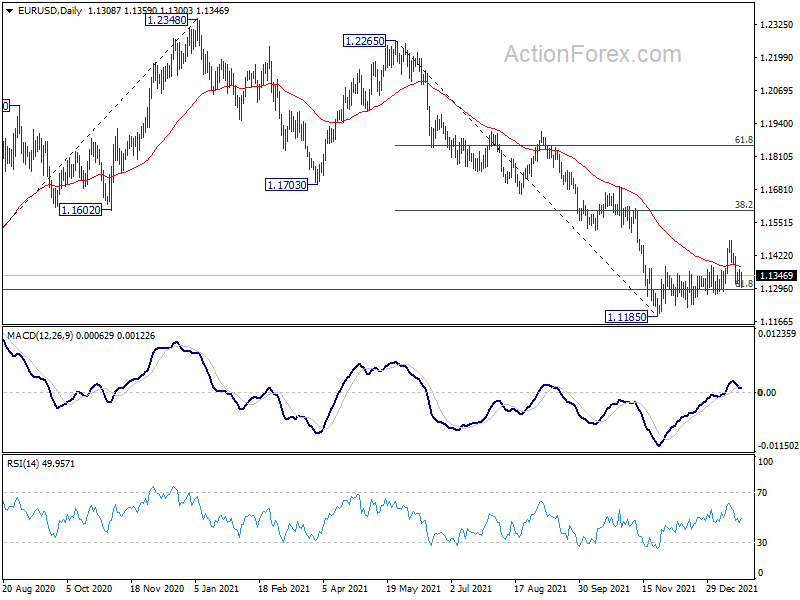
Intraday bias in EUR/USD remains neutral first. As noted before, rebound from 1.1185 is seen as corrective move. Break of 1.1284 will argue that larger down trend from 1.2348 is ready to resume. Intraday bias will be back on the downside for retesting 1.1185 low first. Also, in case of another rise, upside should be limited by 38.2% retracement of 1.2265 to 1.1185 at 1.1598 eventually.
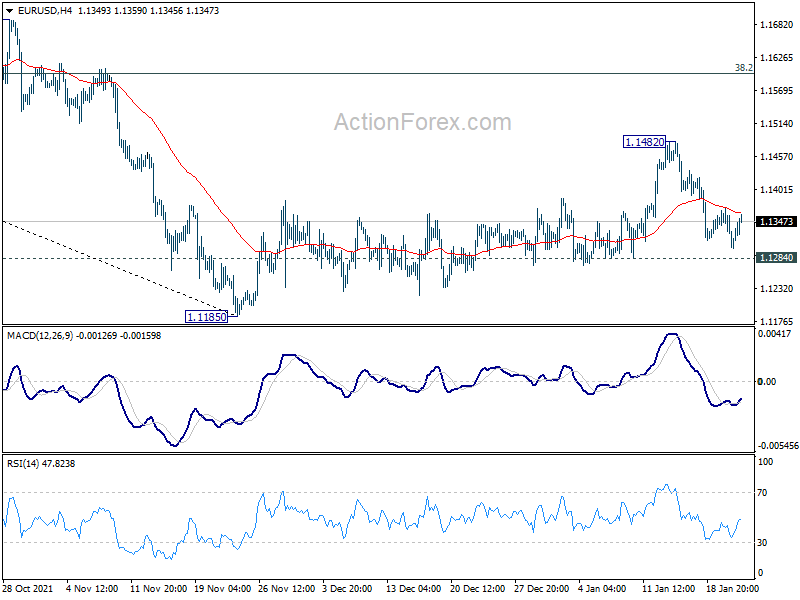
In the bigger picture, there are various ways of interpreting the fall from 1.2348 (2021 high). It could be a correction to rise from 1.0635 (2020 low), the fourth leg of a sideway pattern from 1.0339 (2017 low), or resuming long term down trend. In any case, outlook will now stay bearish as long as 1.1703 support turned resistance holds. Sustained break of 61.8% retracement of 1.0635 to 1.2348 at 1.1289 would pave the way back to 1.0635.
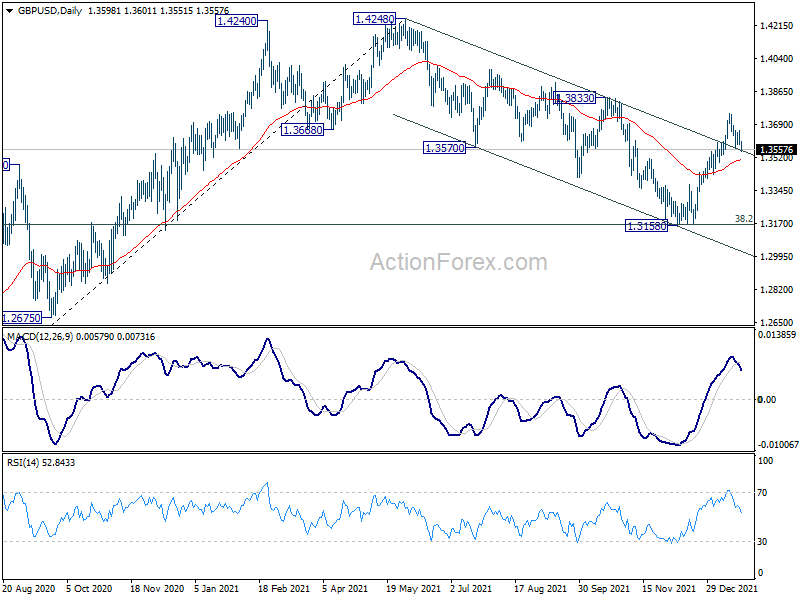
GBP/USD Mid-Day Outlook
Daily Pivots: (S1) 1.3569; (P) 1.3616; (R1) 1.3644; More...
Intraday bias in GBP/USD remains neutral and outlook is unchanged. While deeper fall cannot be ruled out, downside of retreat should be contained by 1.3489 support to bring another rally. As noted before, corrective fall from 1.4282 should have completed with three waves down to 1.3158, after hitting 1.3164 medium term fibonacci level. Above 1.3748 will target 1.3833 first. Sustained break of 1.3833 will pave the way back to retest 1.4248 high.
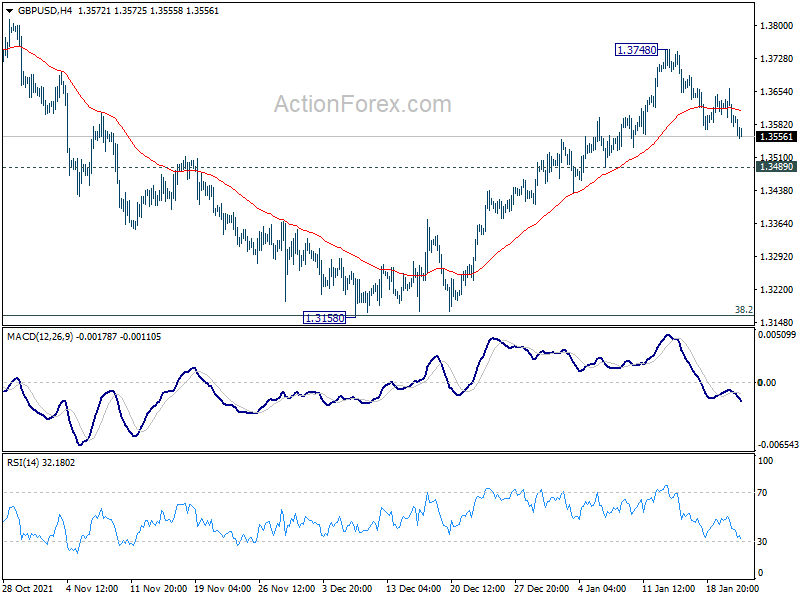
In the bigger picture, strong support was seen from 38.2% retracement of 1.1409 to 1.4248 at 1.3164. The development suggests that up trend from 1.1409 (2020 low) is still in progress. On resumption, next target will be 38.2% retracement of 2.1161 to 1.1409 at 1.5134. Nevertheless sustained break of 1.3164 will argue that whole rise from 1.1409 has completed and bring deeper fall to 61.8% retracement at 1.2493.
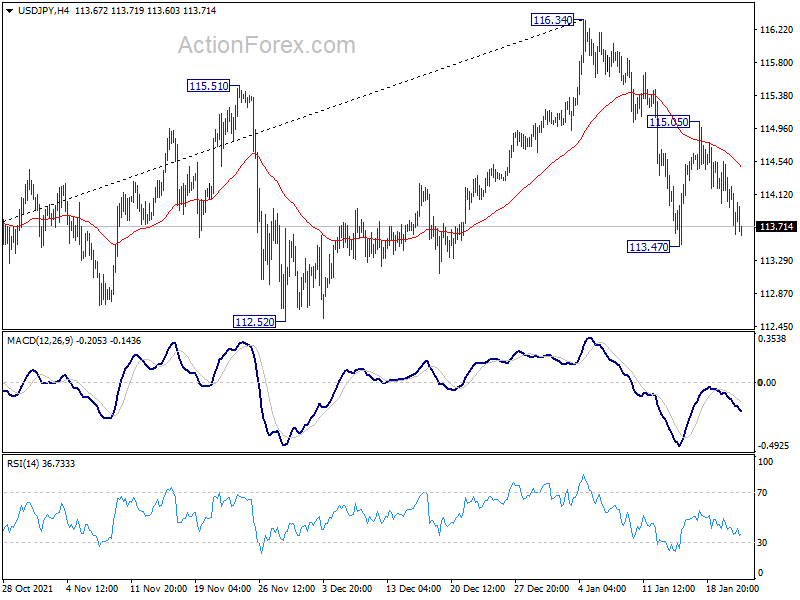
USD/JPY Mid-Day Outlook
Daily Pivots: (S1) 113.89; (P) 114.22; (R1) 114.47; More...
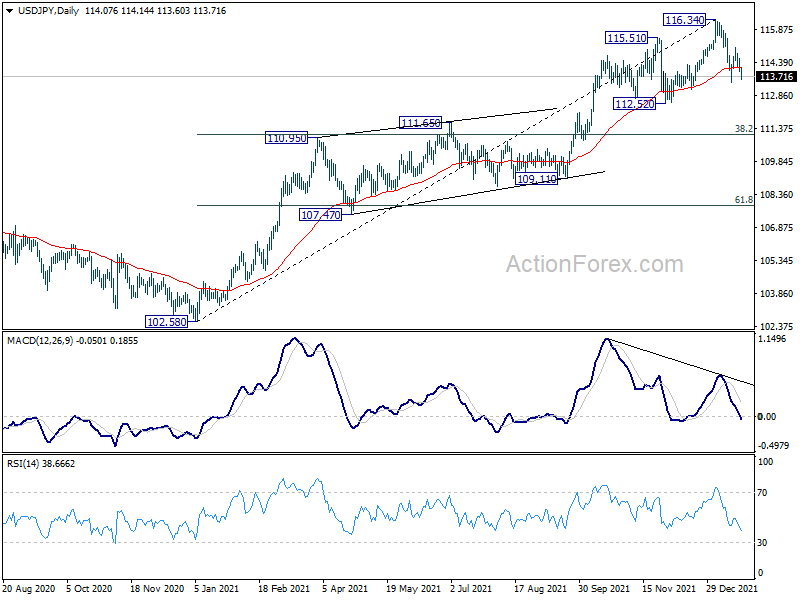
Intraday bias in USD/JPY stays on the downside for 113.47. Break will resume the fall from 112.52 structural support. Considering bearish divergence condition in in daily MACD, further break of 112.52 will confirm that it's already in correction to the up trend from 102.58. Deeper decline would be seen to 38.2% retracement of 102.58 to 116.34 at 111.08. For now, risk will stay on the downside as long as 115.05 resistance holds, in case of recovery.
In the bigger picture, no change in the view that rise from 102.58 is the third leg of the up trend from 101.18 (2020 low). Such rally should target a test on 118.65 (2016 high). Sustained break there will pave the way to 120.85 (2015 high) and raise the chance of long term up trend resumption. However, firm break of 112.52 support will dampen this bullish case and we'll assess the outlook based on subsequent price actions later.
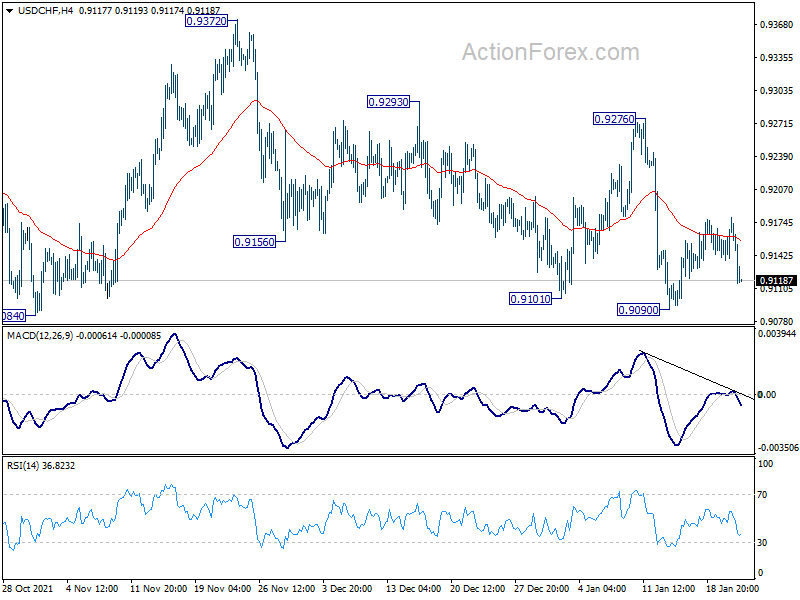
USD/CHF Mid-Day Outlook
Daily Pivots: (S1) 0.9148; (P) 0.9164; (R1) 0.9190; More....
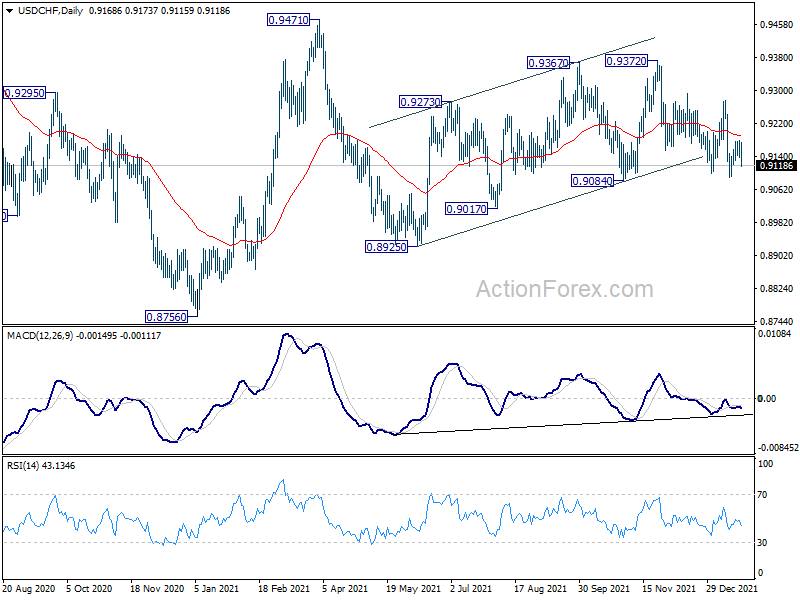
USD/CHF drops notably today but stays above 0.9090 support. Intraday bias remains neutral first. On the downside, firm break of 0.9084 support will argue that choppy rise from 0.8925 has completed. Fall from 0.9471 might be ready to resuming. Further decline would be seen back to 0.8925 support first. On the upside, above 0.9276 will target 0.9372 resistance instead.
In the bigger picture, the corrective structure of the rebound from 0.8925 argues that fall from 0.9471 is not complete yet. It could either be the second leg of pattern from 0.8756 (2021 low), or resuming larger down trend from 1.0237 (2018 high). We'd pay attention to the downside momentum and assess the odds later. But for now, medium term outlook will be neutral at best as long as 0.9471 resistance holds.
Markets to End With a Pessimistic Tone, Swiss Fran and Yen Firm
The markets are set to end the week with a pessimistic tone. Major European index are trading in deep red while US futures point to a weak open. In the currency markets, Swiss Franc is the strongest one for today, followed by Euro and then Yen. Aussie and Kiwi are the worst ones, but Sterling is not too far away after poor retail sales. Loonie is mixed after retail sales missed, still supported by resilient oil prices.
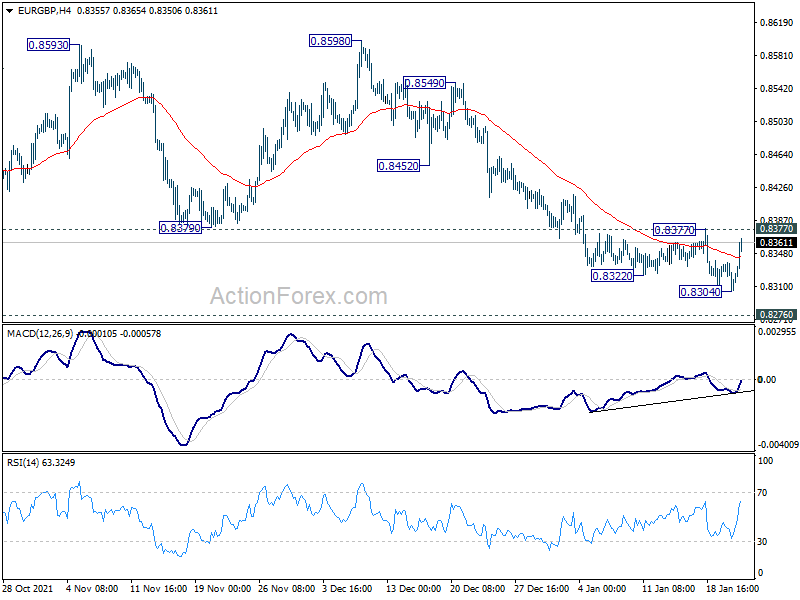
Technically, Euro appears to be recovering except versus Swiss Franc. A focus will be on 0.8377 resistance in EUR/GBP. Break there will indicate short term bottoming ahead of 0.8276 long term support. If that happens, the subsequent rebound could be strong and quick. That might help EUR/USD defend 1.1284 near term support too.
In Europe, at the time of writing, FTSE is down -1.29%. DAX is down -2.19%. CAC is down -1.93%. Germany 10-year yield is down -0.045 at -0.069. Earlier in Asia, Nikkei dropped -0.90%. Hong Kong HSI rose 0.05%. China Shanghai SSE dropped -0.91%. Singapore Strait Times closed flat. Japan 10-year JGB yield dropped -0.008 to 0.137.
Canada retail sales rose 0.7% mom in Nov, to drop -2.1% mom in Dec
Canada retail sales rose 0.7% mom to CAD 58.1B in November, below expectation of 1.0% mom. The increase was led by higher sales at gasoline stations (+4.9%), building material and garden equipment and supplies dealers (+3.0%) and food and beverage stores (+1.0%). Sales increased in 6 of 11 subsectors, representing 63.8% of retail trade. Core retail sales—which exclude gasoline stations and motor vehicle and parts dealers—increased 0.5%. According to advance estimate, sales decreased -2.1% mom in December.
Also released, new housing price index rose 0.2% mom in December, below expectation of 1.2% mom.
UK retail sales dropped -3.7% mom in Dec, well below expectations
UK retail sales dropped sharply by -3.7% mom in December, much worse than expectation of -0.6% mom decline. Overall retail sales volume was still 2.6% higher than their pre-coronavirus February 2020 levels. For the year, sales volume dropped -0.9% yoy, below expectation of 4.2% yoy. Between 2020 and 2021, volume of retail sales rose by 5.1%, which is the strongest since 2004.
Japan CPI core unchanged at 0.5% yoy in Dec
Japan CPI core (all item ex-food) was unchanged at 0.5% yoy in December, below expectation of 0.6% yoy. But that's still the second increase in a row, and the fastest pace in nearly two years. All item CPI accelerated from 0.6% yoy to 0.8% yoy. All item ex-food, ex-energy CPI dropped from -0.6% yoy to -0.7% yoy.
In the minutes of December BoJ meeting, a board member said, "we're seeing signs of change in the price-setting behavior of Japanese firms, which had been said to be cautious about raising prices for fear of seeing sales volume fall,."
Another member noted, "it's unlikely Japan will see wages rise as sharply as in the United States. But there's a significant chance both economic growth and inflation could overshoot expectations,"
Earlier this week, BoJ raised 2022 and 2023 core CPI projection. But it also indicated there is no rush to change the ultra-loose monetary policy.
New Zealand BusinessNZ PMI rose to 53.7, return to growth
New Zealand BusinessNZ Performance of Manufacturing Index rose from 51.2 to 53.7 in December. Looking at some details, Production rose from 53.0 to 56.3. Employment rose from 48.5 to 52.0. New orders rose from 55.4 to 57.5. Finished stocks rose from 48.7 to 52.0. Deliveries rose from 43.9 to 50.0.
BNZ Senior Economist, Doug Steel stated that "in the final quarter of 2021 the PMI averaged 53.2, indicating a return to positive manufacturing GDP growth after a sharp negative in the prior quarter."
USD/CHF Mid-Day Outlook
Daily Pivots: (S1) 0.9148; (P) 0.9164; (R1) 0.9190; More....
USD/CHF drops notably today but stays above 0.9090 support. Intraday bias remains neutral first. On the downside, firm break of 0.9084 support will argue that choppy rise from 0.8925 has completed. Fall from 0.9471 might be ready to resuming. Further decline would be seen back to 0.8925 support first. On the upside, above 0.9276 will target 0.9372 resistance instead.
In the bigger picture, the corrective structure of the rebound from 0.8925 argues that fall from 0.9471 is not complete yet. It could either be the second leg of pattern from 0.8756 (2021 low), or resuming larger down trend from 1.0237 (2018 high). We'd pay attention to the downside momentum and assess the odds later. But for now, medium term outlook will be neutral at best as long as 0.9471 resistance holds.
Economic Indicators Update
| GMT | Ccy | Events | Actual | Forecast | Previous | Revised |
|---|---|---|---|---|---|---|
| 21:30 | NZD | Business NZ PMI Dec | 53.7 | 50.6 | 51.2 | |
| 23:30 | JPY | National CPI Core Y/Y Dec | 0.50% | 0.60% | 0.50% | |
| 23:50 | JPY | BoJ Minutes | ||||
| 00:01 | GBP | GfK Consumer Confidence Jan | -19 | -15 | ||
| 07:00 | GBP | Retail Sales M/M Dec | -3.70% | -0.60% | 1.40% | 1.00% |
| 07:00 | GBP | Retail Sales Y/Y Dec | -0.90% | 4.20% | 4.70% | 4.30% |
| 07:00 | GBP | Retail Sales ex-Fuel M/M Dec | -3.60% | -0.50% | 1.10% | 0.70% |
| 07:00 | GBP | Retail Sales ex-Fuel Y/Y Dec | -3.00% | 1.10% | 2.70% | 2.20% |
| 13:30 | CAD | New Housing Price Index M/M Dec | 0.20% | 1.20% | 0.80% | |
| 13:30 | CAD | Retail Sales M/M Nov | 0.70% | 1.00% | 1.60% | |
| 13:30 | CAD | Retail Sales ex Autos M/M Nov | 1.10% | 1.50% | 1.30% | |
| 15:00 | EUR | Eurozone Consumer Confidence Jan P | -9 | -8 |
Canada retail sales rose 0.7% mom in Nov, to drop -2.1% mom in Dec
Canada retail sales rose 0.7% mom to CAD 58.1B in November, below expectation of 1.0% mom. The increase was led by higher sales at gasoline stations (+4.9%), building material and garden equipment and supplies dealers (+3.0%) and food and beverage stores (+1.0%).
Sales increased in 6 of 11 subsectors, representing 63.8% of retail trade. Core retail sales—which exclude gasoline stations and motor vehicle and parts dealers—increased 0.5%.
According to advance estimate, sales decreased -2.1% mom in December.