

Sample Category Title
USDCAD Eyes Critical Resistance Border
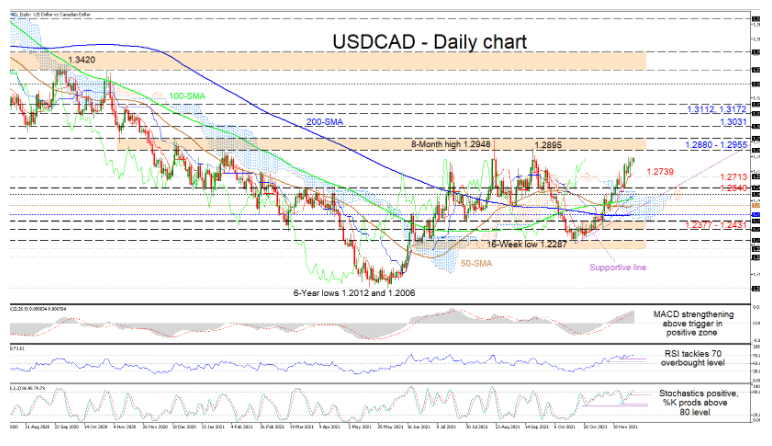
USDCAD is extending a one-and-a-half-month ascent above the Ichimoku cloud and towards the resistance ceiling of 1.2880-1.2955, which started to take shape around the later part of December 2020. The simple moving averages (SMAs) are currently not sponsoring a definitive trend in the pair.
The climbing Ichimoku lines are indicating a predominant bullish drive, while the short-term oscillators are conveying an upside preference in the pair. The MACD, some distance above zero, is improving above its red trigger line, while the stochastic oscillator’s %K line has climbed into overbought territory. The RSI is sustaining a bullish bearing but presently is flirting with the 70 threshold.
Maintaining its current trajectory, the price could initially combat the reinforced 1.2880-1.2955 resistance barrier. Should this critical boundary fail to limit additional gains from unfolding, buyers could then tackle the 1.3031 border before navigating towards the mid-November 2020 highs of 1.3112 and 1.3172 respectively.
Otherwise, if sellers resurface and steer the price beneath yesterday’s low of 1.2777, prompt support could arise around the red Tenkan-sen line at 1.2739 and the adjacent 1.2713 low. Retracing further, the pair may meet the 1.2640 obstacle before facing a tough zone of support between the 1.2600 handle and the 50-day SMA at 1.2530. In the event the price manages to dive past this key zone, overlapped by a potential diagonal support pulled from the eight-week low of 1.2287, sellers may then challenge the 200-day SMA at 1.2470 before pursuing the 1.2377-1.2431 support band.
Summarizing, USDCAD is currently sustaining a bullish tone and a thrust beyond the crucial 1.2880-1.2955 resistance boundary could boost the bullish bias in the longer-term picture. Otherwise, credence will be given to the formation of a medium-term trading range between the 1.2251-1.2308 floor and 1.2880-1.2955 ceiling.
GBPJPY Sets A Foothold But Bears Still Around
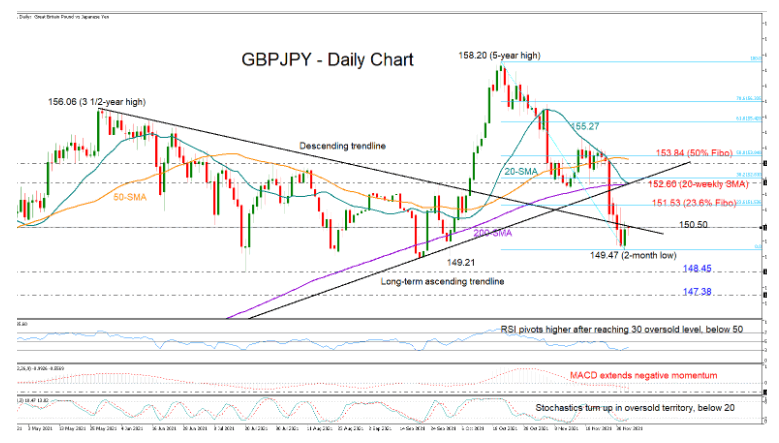
GBPJPY is capped by the descending line at 150.50, which has been hindering market actions since mid-May, questioning the oversold signals coming from the RSI and the Stochastics.
Even though the aforementioned indicators seem to have set up a foothold within the oversold territory, the bulls will need to successfully overcome the 150.50 bar in order to deviate above the two-month low of 149.47 and advance towards the 23.6% Fibonacci level of the latest downleg at 151.53. Then, a decisive close above the 152.60 barrier, where the 20- and 50-day simple moving averages (SMAs) are currently intersecting the broken long-term ascending trendline, could be a bigger achievement and an incentive to reach the 50-day SMA and the 50% Fibonacci of 153.84.
Alternatively, a downside reversal cannot be ruled out given the persisting negative momentum in the MACD. Therefore, if the 150.50 resistance stands firm, the price could drift lower to encounter its recent low of 149.47 before tumbling towards July’s support of 148.45. If the latter fails to cease selling pressures, the next stop could be around 147.40 taken from February’s limits.
Looking at the big picture, the decline below 156.00 has re-shaped the market structure from bullish to neutral. A drop below 148.38 could further worsen this outlook.
In brief, GBPJPY seems to be creating a base for its next upside reversal, though only a clear move above the 150.50 barrier could activate new buying orders.
Investors Eye NFP, Canadian Job Data
Solid US job numbers expected
With the Omicron Covid variant and the Jerome Powell grabbing this week’s headlines, US nonfarm payrolls has become an afterthought for the markets. I cannot recall a week when anticipation ahead of NFP was so subdued and the release received such scant coverage. Still, let’s not forget that NFP is perhaps the most important economic release on the calendar, and it should be treated as a market-mover for the US dollar.
The US economy is projected to have created 543 thousand jobs in November, after a reading of 531 thousand in October. Besides NFP, the markets expect an improvement in wage growth and the unemployment rate. Wages are forecast to rise from 4.9% to 5.0%, while unemployment is projected to dip to 4.5%, down from 4.6%. If nonfarm employment rolls come in at 500k+ and wages and unemployment are within expectations, the US dollar should hold its own and perhaps move higher.
North of the border, Canada is expected to add 35 thousand jobs in November, similar to the 31 thousand in October. This would be a modest gain, and unless the consensus is way off the mark, any movement in the Canadian dollar will likely be a result of the US job data.
USD/CAD has been in a strong bullish trend, and earlier this week hit 1.2837, its highest level since late September. The Canadian dollar had a disastrous month in November. USD/CAD rose 3.22%, making it the worst month for the Canadian dollar since March 2020, when Covid-19 first appeared and sent the Canadian dollar tumbling.
Fed Chair Jerome Powell surprised the markets with a hawkish performance on the Hill, raising expectations that the Fed will speed up the unwinding of its bond purchase program. This means that a rate hike could come earlier than previously expected, which is bullish for USD/CAD.
USD/CAD Technical
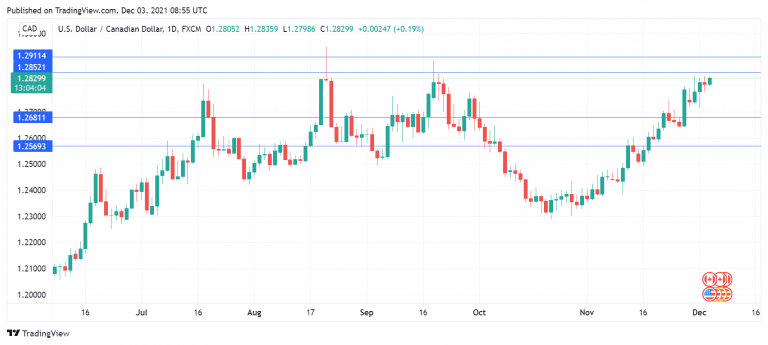
- There is support at 1.2681. Below, there is support at 1.2569
- USD/CAD continues to put pressure on resistance at 1.2852, a line which has held since September. This is followed by resistance 1.2911
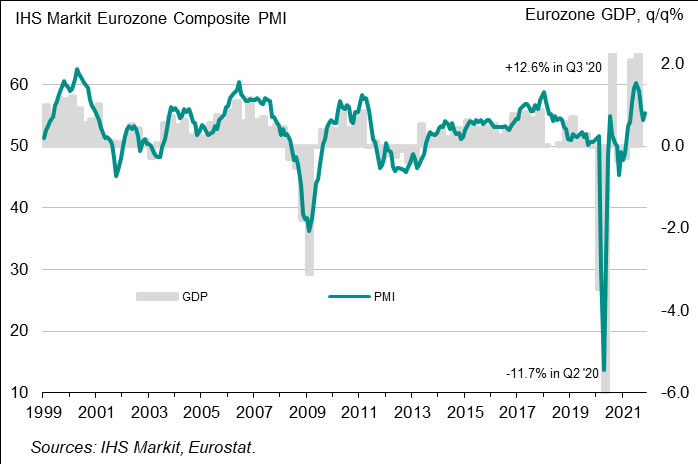
Eurozone PMI composite finalized at 55.4, downside growth risk, upside inflation risk
Eurozone PMI Services was finalized at 55.9 in November, up from October;s 54.6. PMI Composite was finalized at 55.4, up from October's 54.2. Looking at some member states, Ireland PMI composite dropped to 7-month low at 59.3. Spain rose to 3-month high at 58.3. Italy rose to 3-month high at 57.6. France rose to 4-month high at 56.1. Germany rose to 2-month high at 52.2.
Chris Williamson, Chief Business Economist at IHS Markit said:
"An improvement in the rate of economic growth signalled by the eurozone PMI looks likely to be short-lived. Not only did demand growth weaken, but firms' expectations of future growth also sank lower as worries about the pandemic intensified again. With the data collected prior to news of the Omicron variant, sentiment about near-term prospects will inevitably have been knocked even further....
"..While growth risks have shifted to the downside, risks to the inflation outlook seem tiled to the upside if virus case numbers continue to rise and new restrictions are introduced. Supply chains will be further hit, staff availability will deteriorate and spending could shift from services to goods again, further exacerbating the imbalance of supply and demand."
Oil Rallies Despite OPEC+, Gold Dips
OPEC+ surprises, with conditions
Oil markets rallied last night despite OPEC+ surprising the markets and the author by deciding to continue their pre-planned 400,000 bpd production increases this month. OPEC+ has left a huge poison pill in their statement, retaining the right to convene an immediate meeting and to change their mind if omicron continues to send oil prices lower. That has made it dangerous to be short at these levels and the net effect was to lift prices higher, after the market sold immediately on the headline, before reading the small print.
Overnight, Brent crude finished 2.25% higher at USD 70.50 a barrel, while WTI rallied 2.25% to USD 67.35. In Asia, both contracts have continued to rally, rising 0.50% to USD 70.85 and USD 69.70 a barrel. Unless we get a major omicron escalation, I will stick my neck out and say that this week’s lows for Brent and WTI likely represent the lows for the medium-term. The relative strength indexes (RSIs) are still oversold meaning both contracts remain vulnerable to a further short-squeeze.
The overnight lows for Brent at USD 65.80 and for WTI at USD 62.50 a barrel form short and medium-term support, and it is unlikely the market will want to test OPEC+’s mettle at this stage. The grouping having shown itself to be relatively immune to pressure from the US President amongst others. That said, virus concerns continue to linger, meaning Brent crude will struggle to recapture USD 75.00 a barrel, and WTI USD 70.00 a barrel in the nearer term.
Gold’s standing 8-count continues
With virus nerves subsiding and the Fed-taper stronger US dollar story reasserting itself, gold continued to take a standing 8-count, remaining near its weekly lows. Gold fell 0.77% to USD 1768.25 an ounce overnight, before weekend risk hedging buyers in Asia lifted it back to USD 1772.50 this morning.
Gold is flirting with its last major support level at USD 1770.00 an ounce, and failure tonight sets up a possible wave of stop-loss sellers and a retest of USD 1720.00, possibly as early as next week. Gold’s inability to rally with skyrocketing risk aversion, a weaker US dollar or weaker US yields remains deeply concerning.
Gold has resistance between USD 1791.00 and USD 1792.00 an ounce, where the 50, 100 and 200-day moving averages are clustered. Behind that is USD 1800.00 and then USD 1815.00 an ounce.
The US Dollar Rallies
US dollar edges higher as Omicron concerns ease
With omicron nerves easing overnight the US dollar reasserted itself, rallying modestly versus major currencies and holding steady in the EM space. The dollar index finished 0.10% higher at 96.12, edging higher to 96.17 in Asia. Notably, both the Australian and New Zealand dollars, key risk-sentiment barometers fell once again to 2021 lows, hinting that caution remains the key mantra in currency markets still.
EUR/USD has slid back below 1.1300 to 1.1295 and an upbeat US Non-Farm Payrolls tonight will set up a test of 1.1200 again next week. In a similar vein, GBP/USD has moved back through 1.3300 to 1.3390, with a retest of 1.3200 possible. USD/JPY rose as yen haven buying subsided overnight, climbing to 113.20 this morning. If indeed we are at “peak-omicron,” then this week’s low of 112.50 is likely to be the low for the pair for the foreseeable future.
The EM space was relatively sedate overnight, but the US dollar has resumed advances once again versus Asia FX today with USD/KRW, USD/IDR and USD/MYR up around 0.20%. A firm Non-Farm Payrolls number tonight will increase the pressure of the Asian currencies, whose monetary policies, buy and large, are not aligned with a Federal Reserve set to increase the pace of its taper.
I expect currency markets to remain subdued into the US tier-1 data. As usual this week, the caveat is omicron. If another negative headline were to hit the wires today, we will likely see US Dollar selling with the yen and Swiss franc as the main beneficiaries.
Germany PMI services finalized at 52.7, eke out further modest growth
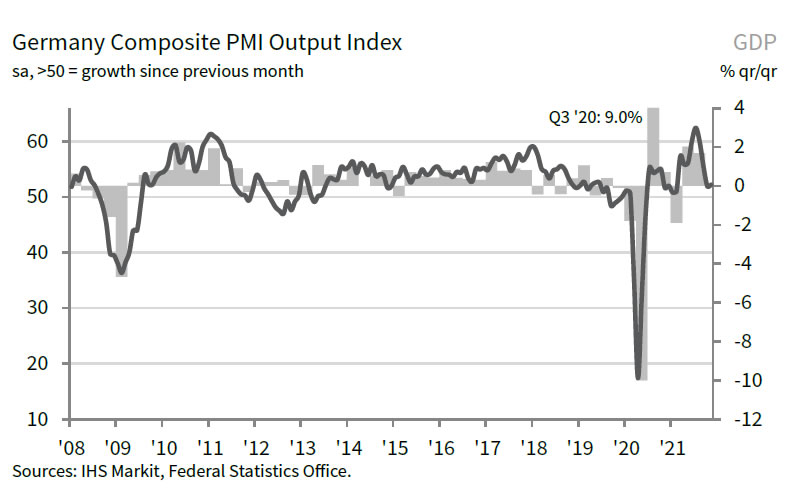
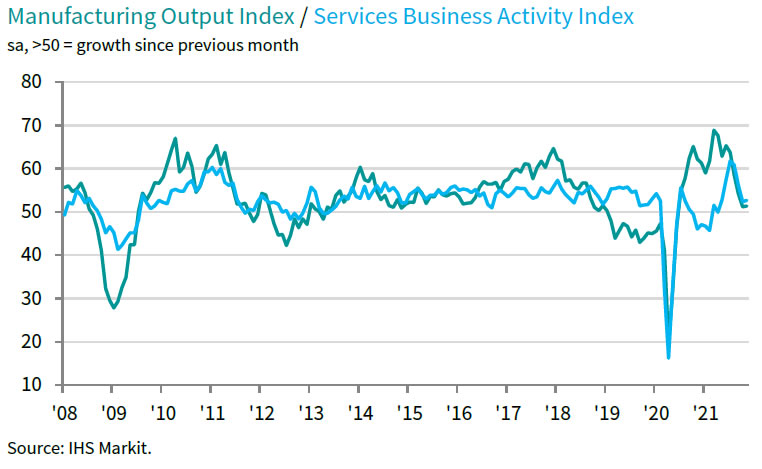
Germany PMI Services was finalized to 52.7 in November, up from October's 52.4. PMI Composite was finalized at 52.2, up slightly from October's 52.0. Markit said new business fell as fourth COVID wave took hold. Firms' expectation slipped to 12-month low. Rate of input cost and output price accelerated to new highs.
Phil Smith, Economics Associate Director at IHS Markit:
"Germany's service sector was able to eke out further modest growth in November, but the survey's forward-looking indicators gave reason for concern. Inflows of new work and business confidence were already in decline in November thanks to the fourth wave of coronavirus, and now the Omicron variant brings added uncertainty and a risk of tighter virus containment measures.
"Given what we've seen in the survey data so far and the potential new risks posed by the Omicron variant, the economy is, at best, set for a notable slowdown in growth in the final quarter.
"The survey data showed a further intensification of inflationary pressures in November driven by a surge in energy costs, with service providers joining manufacturers in recording an unprecedented rise in prices. This was despite signs of inflation already easing across consumer-facing sectors.
"Another strong round of hiring across the service sector in November maintained the labour market's solid pace of recovery. However, with recruitment tending to lag movements in activity and underlying demand, we can reasonably expect the pace of job creation to slow in line with weaker economic growth and lower business confidence."
US 500 Heads Towards Daily Support
The S&P 500 continues on its way down as investors jump ship amid the omicron scare.
The latest rebound has been capped by 4650, a sign that the bears are in control of short-term price action. A combination of pessimism and lack of buying interest means that the index is stuck in a bearish spiral.
An oversold RSI may cause a limited rebound as intraday sellers cover their positions. 4450 at the origin of a previous bullish breakout would be the next target. 4360 is the second line of defense that sits in a daily demand zone.

France PMI services finalized at 57.4, keeping the economy afloat
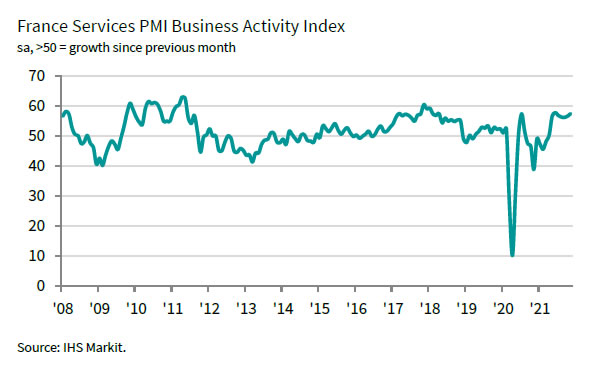
France PMI Services was finalized at 57.4 in November, up from 56.6 in October, signalling the strongest growth since June. Markit said strong jobs growth sustained as business activity continued to grow. Firms reported still-strong demand pressures. output prices rose at fastest rate since June 2011. PMI Composite was finalized at 56.1, up from October's 54.7.
Joe Hayes, Senior Economist at IHS Markit:
"November presented another positive month for France's service sector, with growth accelerating to a five-month high amid still-strong hiring activity and improving demand conditions.
"To be clear though, the service sector is what is keeping the economy afloat at the moment as France's manufacturing sector is struggling with massive supply-related constraints.
"This puts the wider economy in a precarious position, because as we've seen on other parts of Europe, the fate of the service sector is still a function of the trajectory of COVID-19 cases. Policymakers in France have so far talked down the potential for the most stringent of restrictions being implemented, which bodes well for economic activity through the next couple of quarters, but as we've seen before, this can change rapidly.
"That said, if France manages the current wave of infections, this should allow robust growth in the service sector to continue."
EUR/USD Attempts Bullish Reversal
The euro recoups losses as traders reposition ahead of today’s nonfarm payrolls.
A bullish RSI divergence indicates a slowdown in the bearish push. The pair has found support near June 2020’s lows around 1.1190. Then successive breaks above 1.1270 and 1.1370 have prompted short interests to bail, paving the way for a potential reversal.
1.1460 next to the 30-day moving average would be the target and its breach may turn sentiment around. 1.1240 is a key support to keep the rebound relevant.
