Sample Category Title
Week Ahead – US Inflation to Fire Up Again, Watch Out Fed
Riskier assets have been under pressure ever since Omicron entered the equation, fearful that central banks cannot ride to the rescue this time because inflation is so hot already. This puts even more emphasis on the next edition of US inflation, which could accelerate towards 7% in yearly terms. The Bank of Canada and Reserve Bank of Australia will also hold policy meetings.
Fed hits panic button
The Fed chief dropped a bombshell on financial markets this week by signaling that his central bank will consider accelerating the pace at which it withdraws liquidity from the system. He downplayed the Omicron variant and stressed repeatedly that inflation risks have intensified.
With inflation high and rising, the jobs market healing quickly, and consumption booming, the Fed is clearly preparing to step on the brakes to prevent the economy from overheating. Powell suggested it might be appropriate to end asset purchases “a few months” earlier, essentially opening the door for raising interest rates sooner.
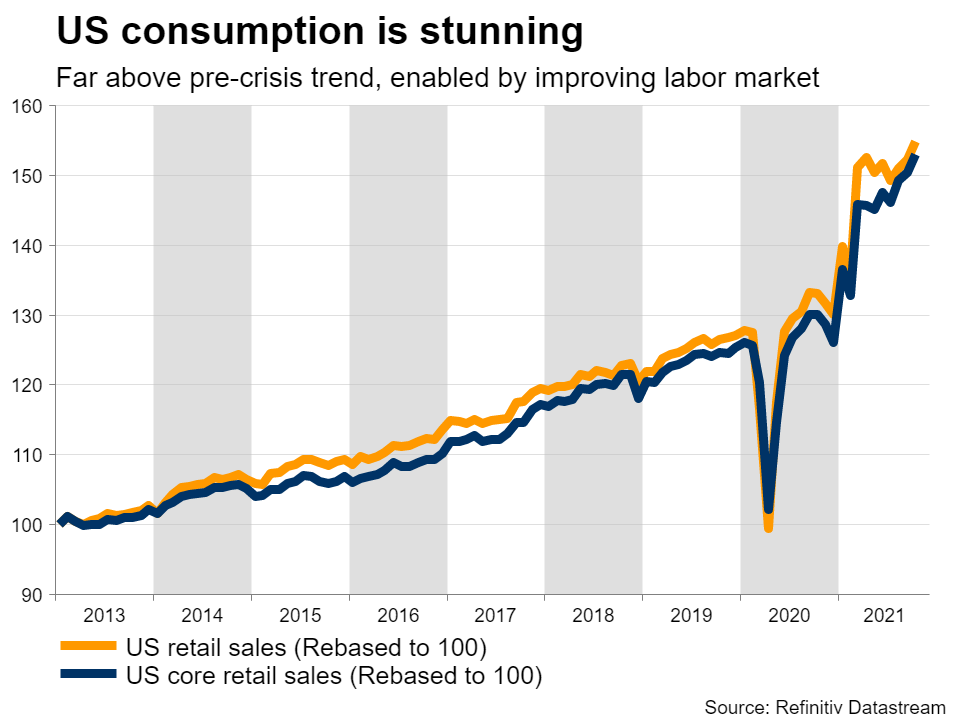
Now the question is whether the Fed will announce this at the next meeting in mid-December, and if so, how much faster it will dial back asset purchases. As such, the upcoming inflation report on Wednesday will be absolutely crucial.
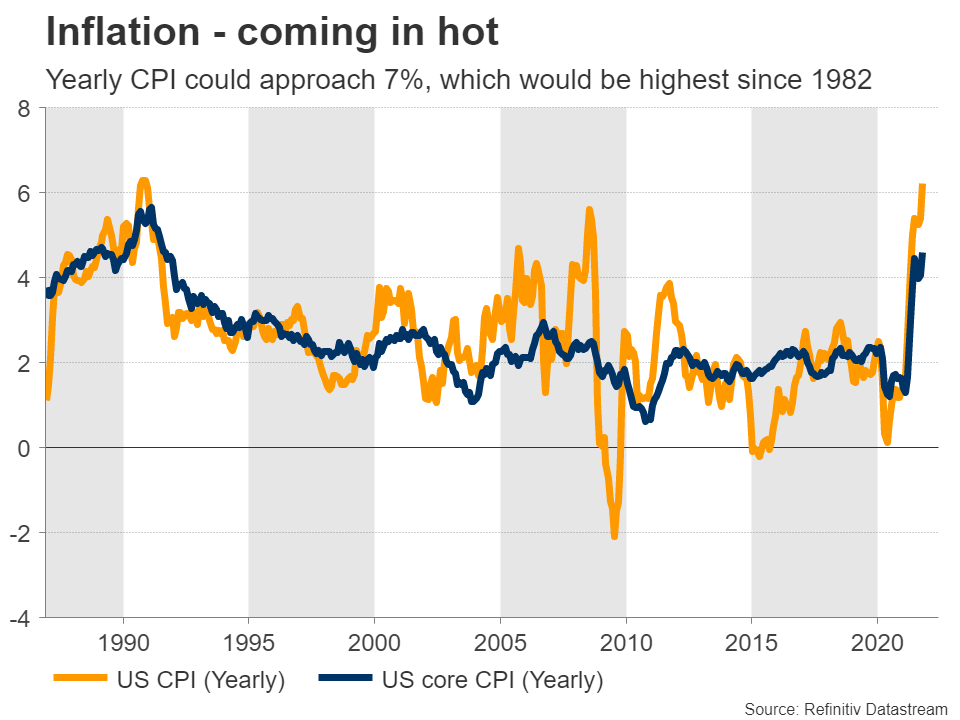
Official forecasts are not available yet, but the latest Markit PMI surveys for November showed that US companies raised their selling prices at a pace that “matched October’s series record high”. The monthly CPI rose by 0.9% in October, so if we assume a similar gain in November, that would push the yearly CPI rate towards 7% from 6.2% currently.
That could seal the deal for an acceleration of tapering at the next FOMC meeting. Besides Chairman Powell, several other Fed officials have already said they are open to such an action, including Vice Chairman Clarida, Board Governors Waller and Quarles, and regional Fed presidents Daly, Mester, Bullard, and Bostic.
As for the dollar, the outlook remains positive and a faster conclusion of asset purchases might reignite the uptrend. Markets are currently pricing in two Fed rate increases for next year and even odds for a third one, so there is scope for market pricing to turn more hawkish. In contrast, the euro continues to grapple with covid restrictions that could hamstring economic growth.
RBA meets as aussie tanks
The Reserve Bank of Australia will wrap up its policy meeting on Tuesday. No policy changes are expected, so the reaction in the aussie will likely depend on any signals about future moves. There has been both good and bad news since the RBA last met.
On the bright side, the lockdowns didn’t hit economic growth as much as feared in Q3, consumption was strong in October, and the latest PMI business surveys were encouraging. However, the labor market got struck by lightning in October, with the unemployment rate jumping substantially and a considerable amount of jobs being lost.
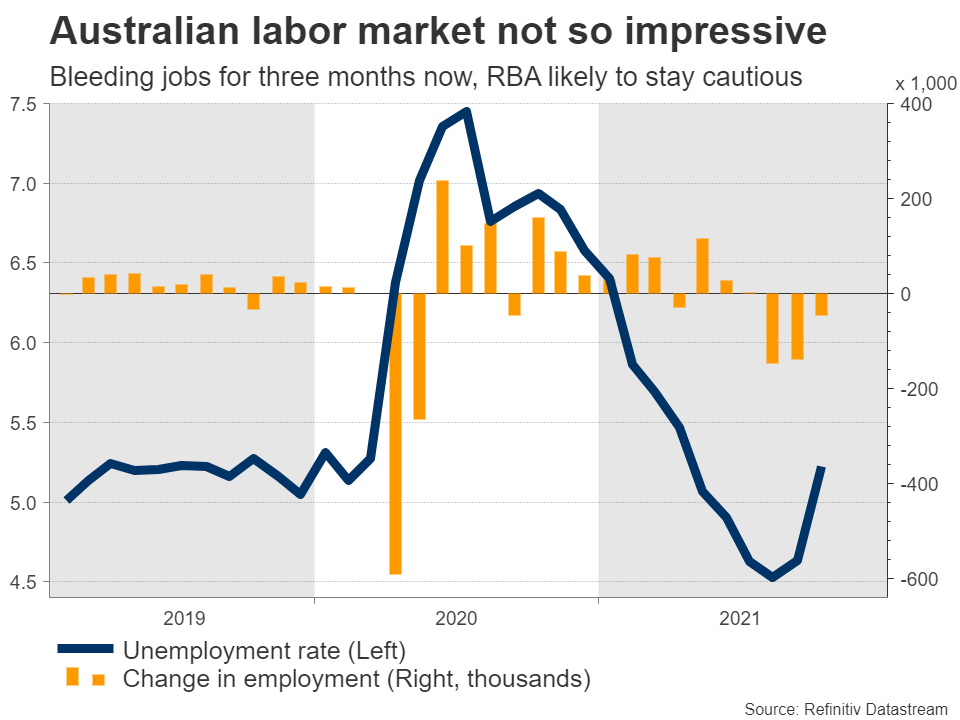
Combined with the slowdown in China, which matters tremendously for Australia given their close trading relationship, the RBA is likely to remain cautious. Money markets continue to price in three rate increases for next year, whereas the central bank insists it will deliver none. A repetition of that guidance could deal another blow to the battered aussie. In the bigger picture, the currency is at the mercy of expectations for global growth and iron ore prices.
Bank of Canada: Let the good times roll
It’s a completely different story in Canada, where the economy is booming. Inflation is scorching hot, the jobs market has almost recovered fully, businesses are feeling optimistic, and the housing market is on fire. The only dark spot is the recent plunge in oil prices, but that follows a very strong rally, so it shouldn’t be very worrisome.
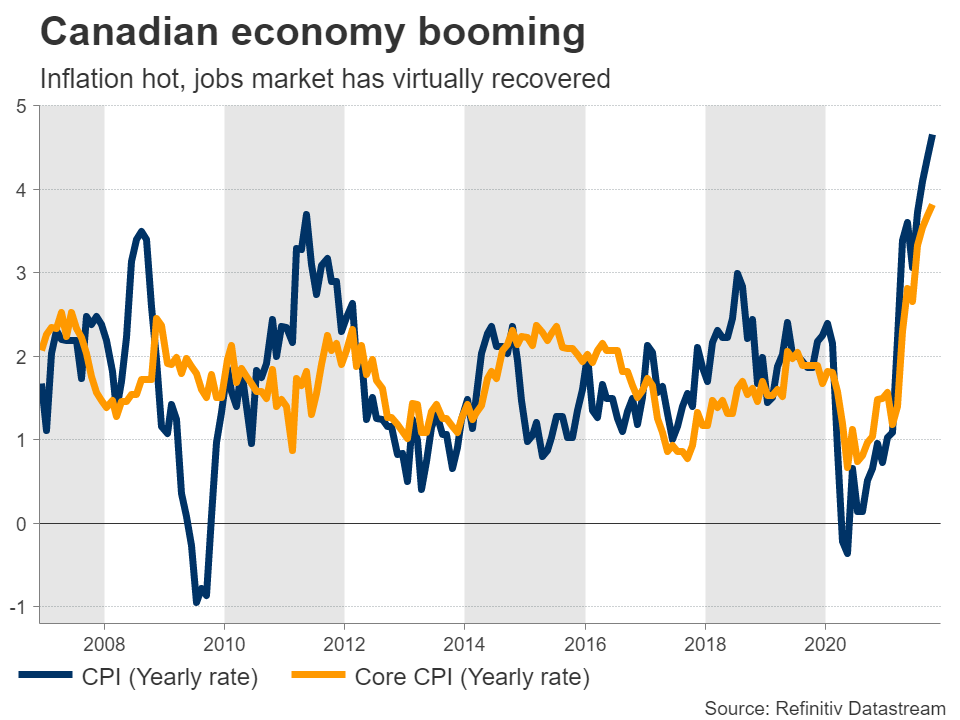
The Bank of Canada took markets by storm at its latest meeting, ending its asset purchase program early and signaling that rate increases are on the menu around the middle of next year. That initially propelled the loonie much higher, before the retreat in oil prices clipped the currency’s wings.
This meeting is unlikely to change much for the loonie. Markets are currently pricing in five rate increases for next year, which seems fair given the strength of the economy. The Omicron variant complicates things, but unless economic data take a hit or new restrictions are announced, it is unlikely to stop the central bank.
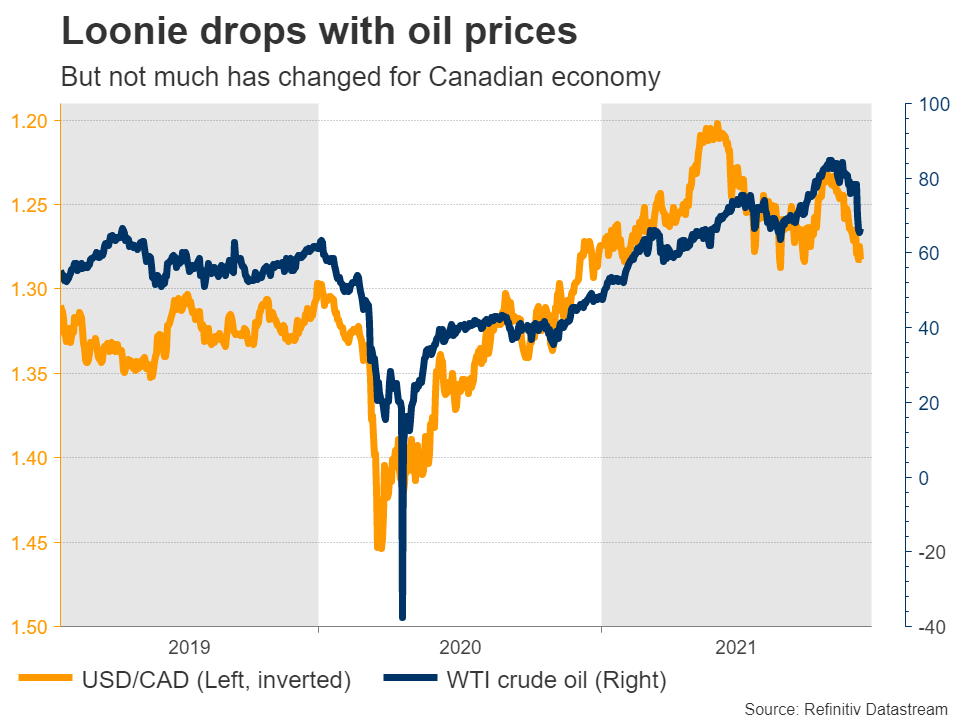
In other words, it is difficult to be pessimistic on the Canadian dollar. It has taken a sharp hit this past month, but that really boils down to external factors. Eventually, it could realign with the healthy fundamentals of the Canadian economy, especially if oil prices stabilize.
UK monthly GDP coming up
The British pound has also suffered ever since Omicron appeared, most likely because of its strong correlation with global risk sentiment. Some signals that the Bank of England is not in a hurry to raise interest rates after all haven’t helped either.
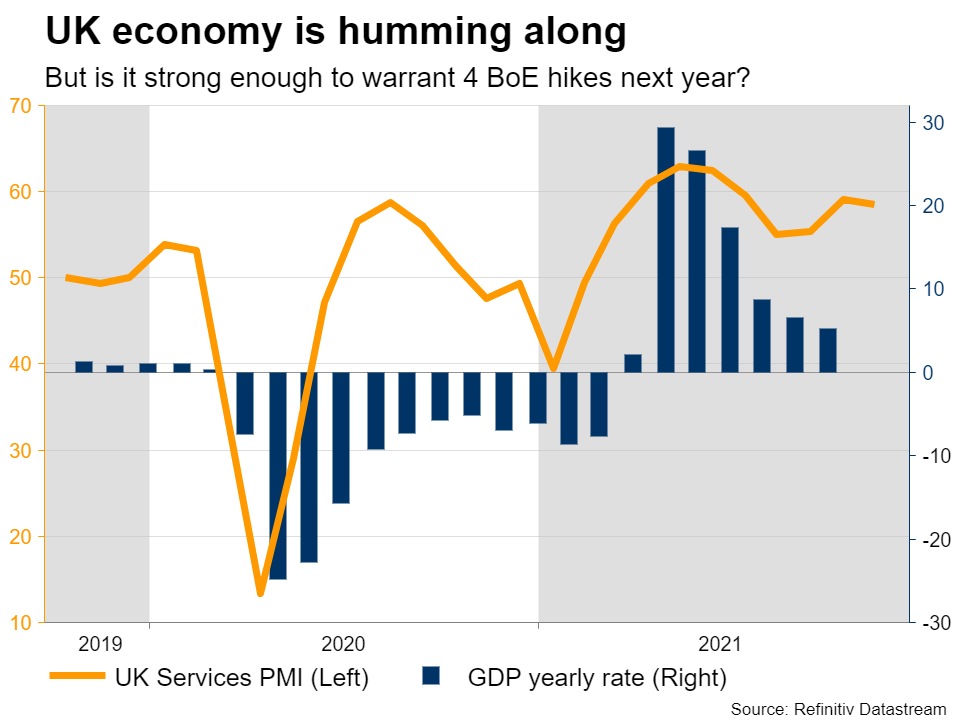
Monthly economic growth data for October will be released on Friday and could be crucial as traders try to decide whether the current market pricing for four rate increases next year is realistic or not.
Finally, Chinese trade numbers will hit the markets on Tuesday ahead of the inflation report on Thursday.
Weekly Focus – Omicron and a Hawkish Fed Challenge Markets
Volatility picked up in markets this week as the Fed's Jerome Powell took a hawkish twist and the new Covid variant Omicron added new uncertainty to the growth as well as inflation outlook. The stock market VIX volatility 'fear gauge' increased to the highest level in 10 months and German 10-year yields dropped to -0.35%, the lowest level in two months. EUR/USD bounced higher to above 1.13 despite hawkish Fed comments but it probably reflects a temporary correction as investors are quite long the USD. The common factor in markets also seem to be a squaring of positions heading into year-end to protect positions in the midst of rising uncertainty. Oil prices has dropped sharply to just below USD70 per barrel on concerns over less travelling over the winter amid new covid waves and restrictions. It's a drop of more than USD15 per barrel in a little more than a month.
Fed chairman Jerome Powell this week signalled a faster move to the exit with a statement that it is time to "retire" the word transitory when talking about inflation and said that the Fed can consider ending QE bond buying "a few months" earlier. It's a clear signal that the Fed is set to increase the pace of tapering asset purchases when they meet in two weeks (15 December). It also paves the way for earlier take-off on rate hikes and we now look for three hikes in 2022 in June, September and December. This is in line with market pricing. We expect another four hikes in 2023, which is 1½ more than the market expects.
The new covid variant Omicron with origin in South Africa added new challenges from the pandemic. The variant has more than 30 mutations, which could leave vaccines less effective and early indications suggest it is more contagious. However, the knowledge is highly uncertain and we need to wait a few weeks to assess it. Europe continues to be the epi-centre and new infections continue to rise. Germany is the latest country to impose new restrictions, see Politico. We expect covid to be a challenge over the winter with some form of restrictions in most European countries. On a positive note, there are tentative signs that bottle necks are easing slightly as freight rates have come down and ships waiting in line outside the port of Los Angeles is down to 17 from 40 just a few weeks ago.
On the data front the euro area delivered the biggest surprise as inflation jumped higher in November to 4.9% y/y from 4.1% y/y (consensus 4.5% y/y). While it was mainly driven by energy prices, core inflation also moved up to 2.6% y/y from 2.3% y/y. However, in contrast to the US, wage growth is still quite subdued and the ECB can afford to be more patient than the Fed. Not least in light of the recent drop in commodity prices. Global activity data did not add much new information. Chinese PMI was still soft and while the US ISM manufacturing was better than expected the US PMI manufacturing was revised lower and painted a picture of weaker momentum.
Over the coming week the main focus will be on news regarding the Omicron variant and US CPI for November. Consensus is for a rise in US core CPI of 0.5% m/m, so another high print is built into expectations. In Europe, we get the German ZEW, which could see a new setback due to covid waves. No changes are expected at the Reserve Bank of Australia meeting and we look for a still dovish narrative from the central bank. At the Polish central bank meeting markets price a 50bp hike adding to a 75bp hike in November.
Sunset Market Commentary
Markets
Markets were clearly counting down to US payrolls. Unfortunately, the November edition was a “on the one hand, on the other hand” and didn’t bring much inspiration to traders. Employment rose with 210k, the smallest increase this year and well below the 550k consensus, even if you take into account the 82k upward revision for the two previous months. Job growth in leisure and hospitality eased considerably to 23k compared to the 242k average for 2021 (Jan-Oct) so far. Professional & business services (90k) were the biggest contributor in the services sector last month while retail shed 20k jobs. The goods-producing sector added 60k jobs with construction and manufacturing equally responsible for the increase. There was some good news too though. People came from the sidelines to the labour market, resulting in a rise of the participation rate to 61.8%. Employees might be drawn by further increasing wages (0.3% m/m to be up 4.8% y/y). The unemployment rate dropped more than expected from 4.6% to 4.2%, a new post-pandemic low. This is at odds with the fairly low job growth but bare in mind both come from different sources (BLS vs. household survey). In fact, the household survey showed a whopping 1136k job increase! The disappointing headline figure prompted a knee-jerk move in core bond yields and the dollar. Lingering uncertainty about omicron and what it may mean for the recovery going forward probably added to the move. All reversed quickly though. Today’s labour market report may be not as strong as hoped for but it won’t bring the Fed off track in quickening the pace of tapering next month which brings forward the timing a first rate hike. US bond yields now trade higher than before the release with changes varying from 0.8 bps (10y) to 3.3 bps (2y). German yields add about 1 bp across the curve in directionless trading. EUR/USD trades stable near the 1.13 big figure with the improving risk environment hanging in the balance with USD short-term interest rate support.
The Bank of England’s most prominent hawk took a dovish turn. Saunders said the omicron strain is the crucial issue for the December policy meeting, adding that there could be “particular advantages in waiting to see more evidence on its possible effects on public health outcomes and hence on the economy”. The latest string of UK economic data (labour market, CPI, retail sales …) made the start of the BoE tightening cycle in December all but certain. But since news about omicron got out last Friday, markets started paring back bets and continued to do so after Saunders’ speech. They now see a 50% chance of a 10 bps hike in December. There is more conviction on a first, full (25 bps) hike in February. Losses for the pound were limited. EUR/GBP is changing hands around 0.852.News Headlines
Turkish November inflation accelerated by 3.51% M/M to 21.31% Y/Y (up from 19.89% in October). Core inflation intensified from 16.82% to 17.62%. Both printed higher than expected. Upward pressures in producer prices were even more impressive, with PPI rising 9.99% M/M and 54.62% Y/Y (from 46.31%). The sharp rise probably mirrors higher import prices due to the weak lira. Higher inflation further deepens the negative real policy rate after the CBRT cut it to 15.00% from 19.00% since September. The lira weakened to EUR/TRY 15.69 after the publication of the release before the CBTR again intervened to address ‘unhealthy price formations‘. Any relief for the lira was modest and short-lived. EUR/TRY currently again trades near 15.55.
Canadian net employment grew 153.7k in November compared to 31.2k in October and market expectations for a rise around 37k. Both full time (79.9k) and part time (73.8) employment rose. Job creation was mainly driven by strong hiring in the services sector. The unemployment rate nosedived from 6.7% to 6.0%. The participation rate stabilized at 65.3%. The Canadian dollar recently suffered from the overall uncertainty and the oil price decline. The loonie today rebounded with USD/CAD declining from 1.282 to 1.274. Further improvement in the labour market reinforces the case for the BoC to start an interest rate lift-off next year. The BoC indicated a possible start in the second or third quarter. Markets discount a first hike already at the end of Q1.
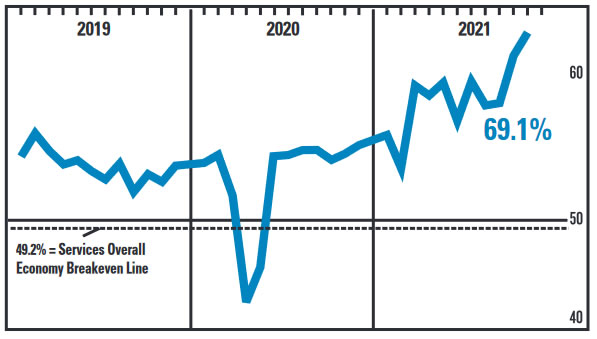
US ISM services jumped to 69.1, corresponds to 6.9% annualized growth in GDP
US ISM Services rose from 66.7 to 69.1 in November, above expectation of 65.5. Business activity/production rose from 69.8 to 74.6. New orders was unchanged at 69.7. Employment rose from 51.6 to 56.5. Prices dropped from 82.9 to 82.3. Employment rose from 51.6 to 56.5.
ISM said: "The past relationship between the Services PMI and the overall economy indicates that the Services PMI for November (69.1 percent) corresponds to a 6.9-percent increase in real gross domestic product (GDP) on an annualized basis."
US Labour Market Recovery Inched Forward in November
- Payroll employment added 210k jobs in November, disappointing expectations
- Unemployment rate ticked lower to 4.2%, closer to rate pre-pandemic
- Inadequate labour supply adding pressure to wage growth
Payroll employment rose by 210k in November in the US, disappointing consensus expectations for another half a million gain to build on a 470k average pace of increase over the prior 3 months. Hiring momentum among close-contact service industries stalled in November ahead of the holidays, despite a still large shortfall in jobs versus pre-pandemic levels. Leisure and hospitality posted a small gain (+23k) and retail saw an outright decline (-20k). Notable gains instead were seen in professional and business services (+90k) and transportation and warehousing (+50k), the latter remains one of the only few industries to have recouped all of the pandemic losses.
From the separately released household survey, the unemployment rate fell lower to 4.2% and the labour force participation rate ticked up to 61.8% but was still much lower than the +63% rate pre-pandemic. Indeed, insufficient inflow into the labour force, coupled with sky-high job openings has put significant upward pressure on wage growth in recent months. And that’s particularly true among a few services industries where labour shortages have been more acute. Average hourly earnings were 5% higher in November comparing to the beginning of this year for all private industries, but 13.7% higher for leisure and hospitality and 8.9% higher for transportation and warehousing.
Despite a 2.4 million shortfall in the size of the labour force relative to pre-pandemic, it is still difficult to see a large amount of ‘hidden’ unemployment. The gap between the benchmark unemployment rate (U3) and broader measure of labour force utilization like the U6 – which includes workers who want a job but aren’t counted as ‘unemployed’ because they were not actively looking for work – has declined to levels closer to pre-pandemic already. That implies many of those who have left the labour force simply do not wish to come back. A large part of that can be tied to aging demographics and early retirement. Health-related concerns have likely played a role as well. On that front, the “Omicron” variant that has been rattling equity and commodity markets could risk exacerbating the existing supply crunch, and remains a risk to the near-term growth outlook. But barring much more significant disruptions than are currently expected from the new variant, we expect the Fed to start hiking rates in Q3 2022.
Canadian Employment Surged Higher in November
- Employment jumped much stronger-than-expected 154k in November
- Unemployment rate fell to 6.0% - close to pre-pandemic levels
- Labour shortages to grow more acute, absent significant disruptions from the Omicron variant
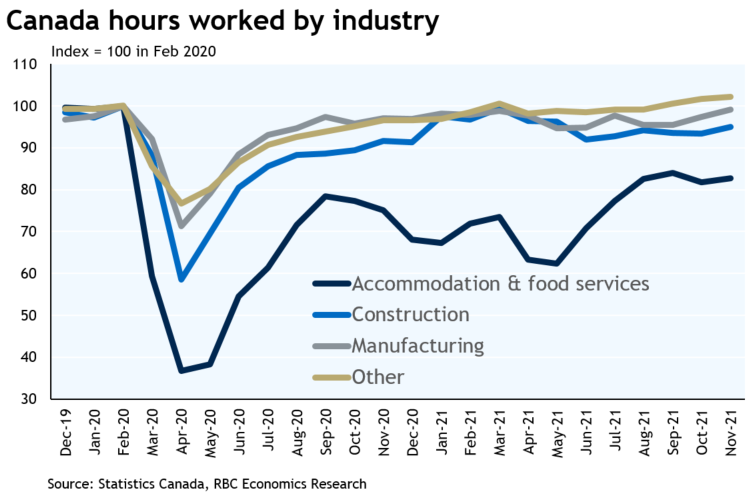
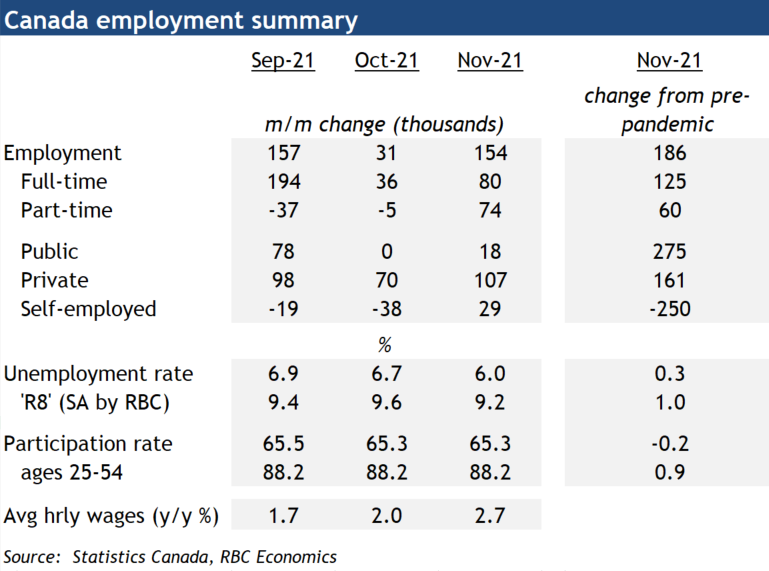
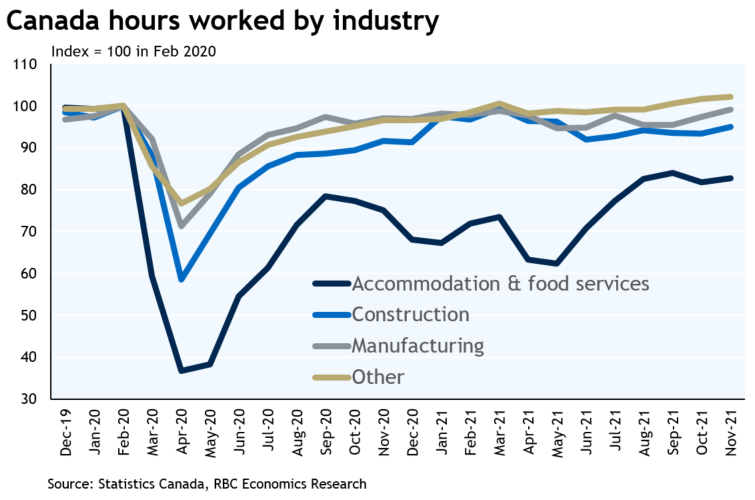
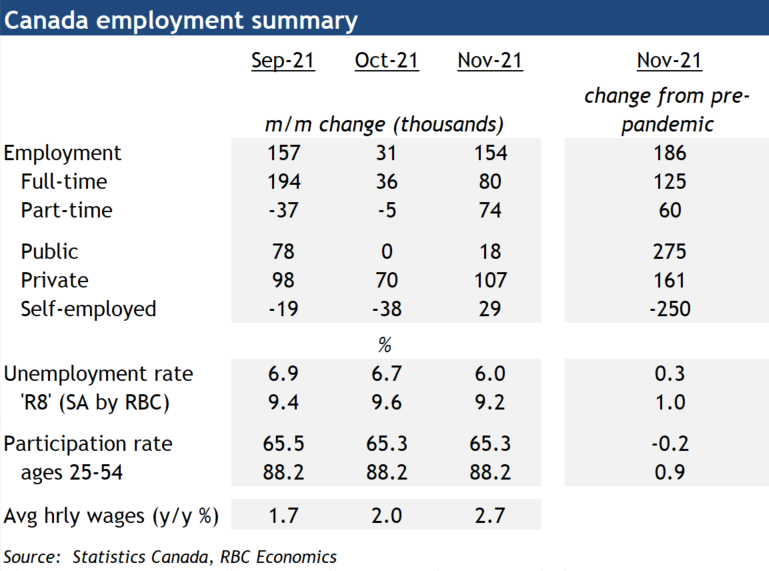
The Canadian labour market recovery took a larger-than-expected step forward in November with a 154k jump in employment, bringing the total to 186k above pre-shock February 2020 levels. The unemployment rate plunged 0.7 ppts to 6.0% - still above pre-pandemic lows but much closer to the kind of rate historically consistent with a healthy labour market. Hours worked jumped another 0.7% to get back to pre-pandemic levels.
The November employment surge was despite still exceptionally low level of workers in the high contact service sectors. Employment in accommodation & food services edged up 5k from October but is still more than 200k below pre-shock levels. Travel and hospitality spending has been rebounding, but with the unemployment rate now substantially lower, it is increasingly clear that there are not enough remaining unemployed workers out there to re-fill all of those jobs any time soon.
The Omicron variant is a reminder that the pandemic is not over. And global supply chain disruptions and rising input costs remain acute challenges for businesses. But even as/if those challenges fade in the year ahead, labour shortages are only expected to intensify. Lack of labour supply means increased hiring demand is expected to show up more in above-trend wage than employment gains going forward. To-date, wage growth has been relatively modest. Hourly earnings were up 2.7% year-over-year in November, and Statistics Canada reported a 2-year increase of 5.2% adjusting for shifting employment composition - but gains were stronger among new hires and in some industries, including accommodation & food services (+8.5% versus 2 years ago) suggesting that wage growth is beginning to creep higher.
Market Volatility and Dollar Stabilize
Dollar calm after disappointing November US jobs report; ISM services PMI up next
Despite comments from Fed Chair Powell regarding omicron variant risks to inflation and employment, and how this could ultimately slow the progress in the labour market and reinforce supply disruptions, the markets seem to have brushed off these underlying market threats for now, with US stock futures and the forex arena adopting a softer market mood even after today’s key US employment data.
A faster taper narrative seems to be gaining more Fed official fans and a Q3 lift off and a booster hike in Q4 remain fully priced in.
The dollar remains ahead in the forex arena, despite the disappointing employment report today. In November, 550k jobs were expected to be created, however, the non-farm employment report came in lower than half of October’s added amount of 531k, with average hourly earnings ticking slightly lower. That said, the unemployment rate fell to 4.2% from 4.6% in October and beat the forecast of 4.5%, signalling that the labour sector remains robust despite the jobs created.
Softer jobless claims last week are signalling that the employment sector is creeping closer and closer to full employment, which could aid wage figures. Moreover, the annual average hourly earnings for November came in line with October’s numbers, and this could cause a sparkle in the Fed’s eye, given it puts weight on strong wage growth, while hours worked in the week also improved.
This may give credence to a more hawkish approach from the Fed towards tapering and boost odds of 2022 Q2 lift off, which is a positive for the dollar.
The continued expansion in the US economy for the third month in a row, signalled by the October ISM manufacturing PMI is another positive driver.
The US will deliver final services PMI at 14:45 GMT and ISM services PMI and factory orders at 15:00 GMT. Stronger figures could underpin the dollar, given the NFP results failed to.
The dollar index is holding just above the 96.00 level.
On another note, European services PMI suggest economic expansion, even though some areas missed forecasts slightly. Furthermore, ECB President Lagarde toned down odds for a hike in 2022.
The euro is trading a tad over the $1.1300 vicinity and the pound remains lethargic below the $1.3300 mark, both on uncertainty related to the omicron variant and the risks it poses to economic activity.
Loonie fails to capitalise on rally in oil but powers up on employment results
The black liquid’s downward risks appear to be minor now after the omicron coronavirus variant shock, which resulted in a $10 drop. Even OPECs decision to proceed with supplying markets with 400k barrels per day has not caused WTI oil futures price to fall further. On the contrary, WTI is currently trading around the $68.00 per barrel mark, having recouped the dip towards the $63.00 level. WTI may continue to rise should omicron related uncertainty remain subdued and until a change in inventory figures takes shape moving into the winter period, which could ultimately result in OPEC tweaking their strategy in the new year.
Canadian employment today hit the numbers out of the park. The country added 153.7k jobs in November, dwarfing October’s creation of a mere 31.2k, while the unemployment rate also fell sharply to a 6.0%, beating the expectation of 6.6% and that of October at 6.7%.
The heavily correlated Canadian dollar had not moved along with the pickup in oil prices and seemed to be exhibiting some weakness, however today’s employment data has given the loonie a boost. As a result, the USDCAD pair plunged around 90 pips to C$1.2745.
While the BoC has kept its rate hike expectations unchanged, changes in oil prices linked to uncertainty around the omicron variant could warrant some caution from the central bank. However, with today’s employment figures, the Canadian economy appears to be robust as ever.
Later, the US treasury’s current report is due.
USD/JPY Mid-Day Outlook
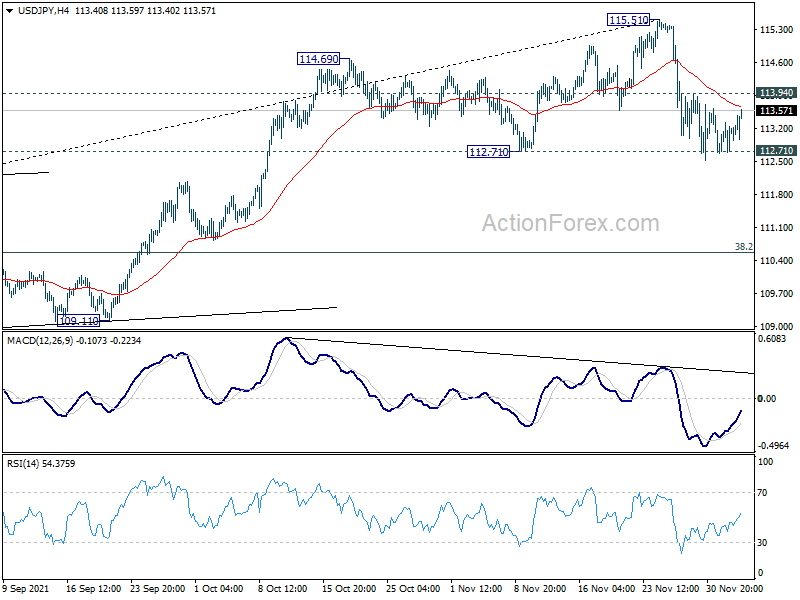
Daily Pivots: (S1) 112.82; (P) 113.08; (R1) 113.44; More...
Intraday bias in USD/JPY stays neutral at this point. On the upside, break of 113.94 minor resistance will turn bias back to the upside for retesting 115.51 high instead. On the downside, sustained break of 112.71 structural support will argue that fall from 115.51 is already correcting whole rise from 102.58. Deeper decline would then be seen to 38.2% retracement of 102.58 to 115.51 at 110.57.
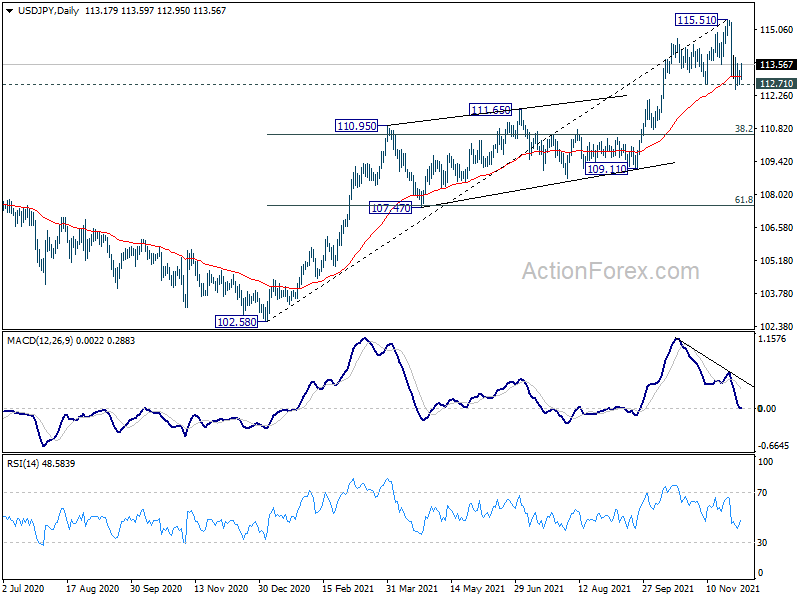
In the bigger picture, no change in the view that rise from 102.58 is the third leg of the up trend from 101.18 (2020 low). Such rally should target a test on 118.65 (2016 high) on resumption. However, firm break of 109.11 structural support will argue that the trend might have reversed and bring deeper fall to 107.47 support and possibly below.
USD/CHF Mid-Day Outlook
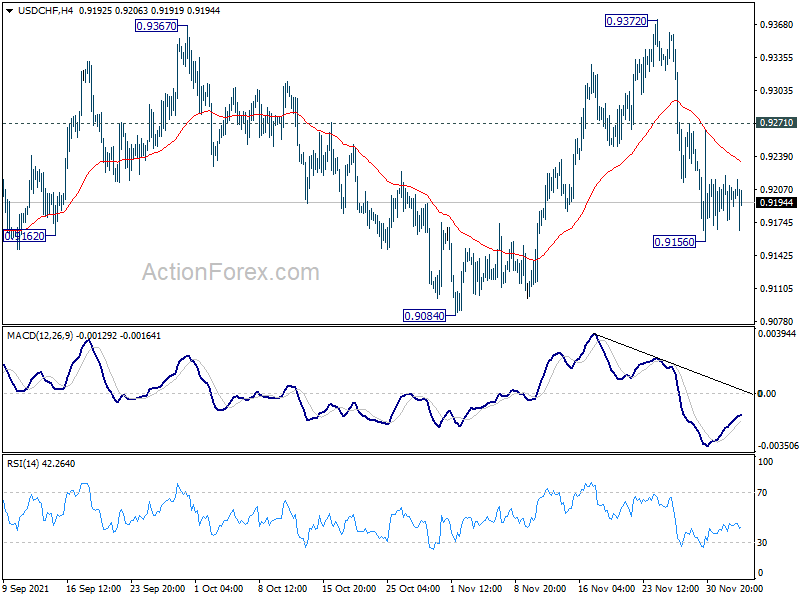
Daily Pivots: (S1) 0.9181; (P) 0.9201; (R1) 0.9225; More....
Outlook in USD/CHF remains unchanged and intraday bias stays neutral first. With 0.9271 resistance intact, further decline is expected. Break of 0.9156 will resume the decline from 0.9372 to 0.9084 support. Firm break there will argue that choppy rise from 0.8925 has completed, and fall from 0.9471 is resuming. Deeper decline would be seen through 0.8925. Nevertheless, break of 0.9271 will turn bias back to the upside for retesting 0.9372.
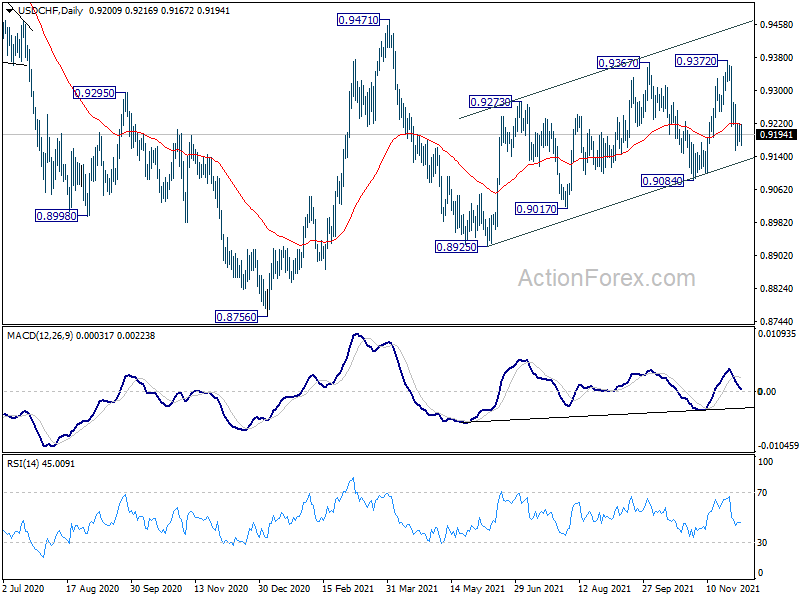
In the bigger picture, the corrective structure of the rebound from 0.8925 argues that fall from 0.9471 is not complete yet. It could either be the second leg of pattern from 0.8756 (2021 low), or resuming larger down trend from 1.0237 (2018 high). We'd pay attention to the downside momentum and assess the odds later. But for now, medium term outlook will be neutral at best as long as 0.9471 resistance holds.
GBP/USD Mid-Day Outlook
Daily Pivots: (S1) 1.3270; (P) 1.3302; (R1) 1.3332; More...
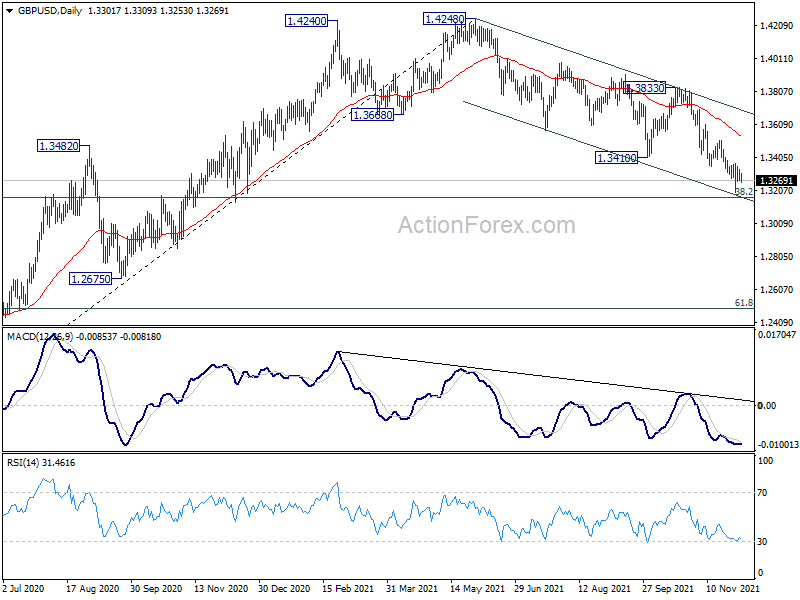
Intraday bias in GBP/USD remains neutral for the moment. Further fall could be seen, but we'd look for some support from 1.3164 fibonacci level to bring rebound. On the upside, break of 1.3369 minor resistance will suggest short term bottoming, and turn bias back to the upside for 1.3512 resistance first. However, sustained break of 1.3164 will carry larger bearish implication.
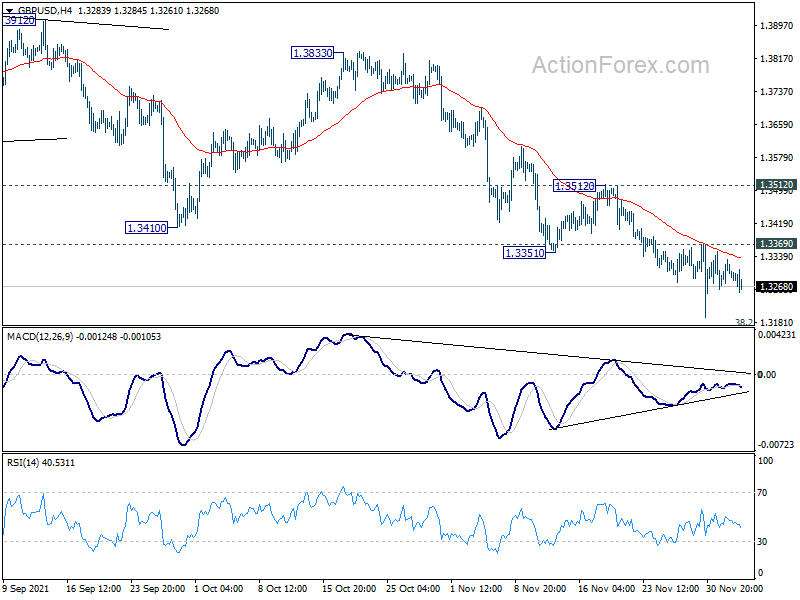
In the bigger picture, the structure of the fall from 1.4248 suggests that it's a correction to the up trend from 1.1409 (2020 low) only. While deeper fall cannot be ruled out yet, downside should be contained by 38.2% retracement of 1.1409 to 1.4248 at 1.3164, at least on first attempt, to bring rebound. On the upside, break of 1.3833 resistance will argue that the correction has completed and bring retest of 1.4248 high. However, sustained trading below 1.3164 will revive some medium term bearishness and target 61.8% retracement at 1.2493.