

Sample Category Title
USD/JPY Daily Outlook
Daily Pivots: (S1) 112.40; (P) 113.00; (R1) 113.45; More...
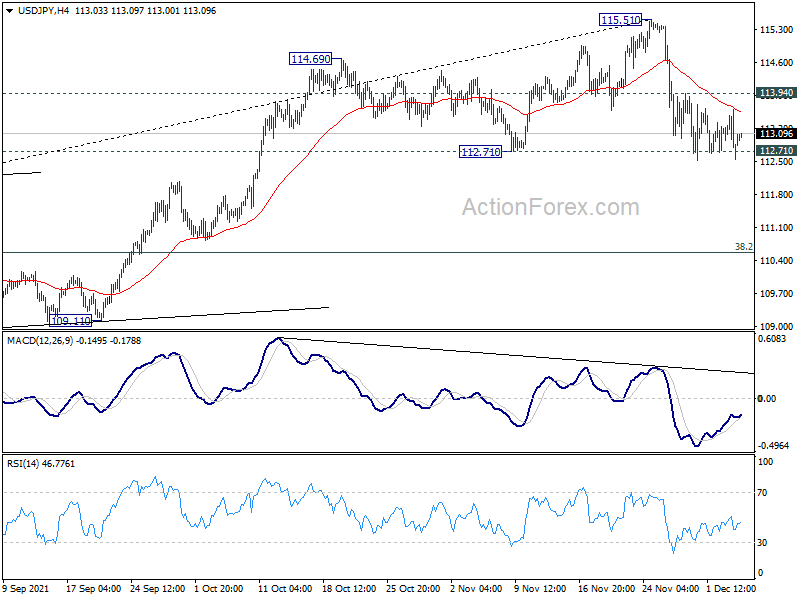
Intraday bias in USD/JPY remains neutral with focus on 112.71 support. On the downside, sustained break of 112.71 will argue that it's already correcting whole rise from 102.58. Deeper fall would be seen to 38.2% retracement of 102.58 to 115.51 at 110.57. On the upside, break of 113.94 minor resistance will turn bias back to the upside for retesting 115.51 high instead.
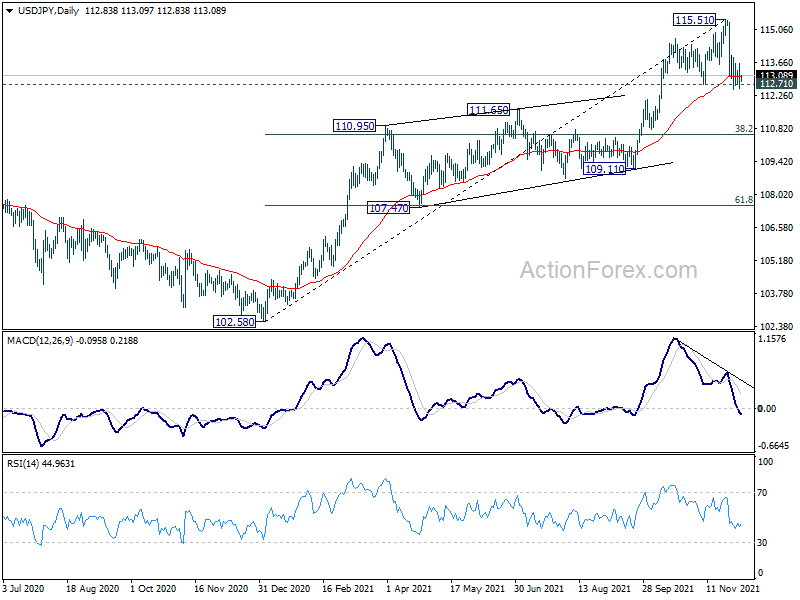
In the bigger picture, no change in the view that rise from 102.58 is the third leg of the up trend from 101.18 (2020 low). Such rally should target a test on 118.65 (2016 high) on resumption. However, firm break of 109.11 structural support will argue that the trend might have reversed and bring deeper fall to 107.47 support and possibly below.
USD/CAD Daily Outlook
Daily Pivots: (S1) 1.2778; (P) 1.2816; (R1) 1.2888; More...
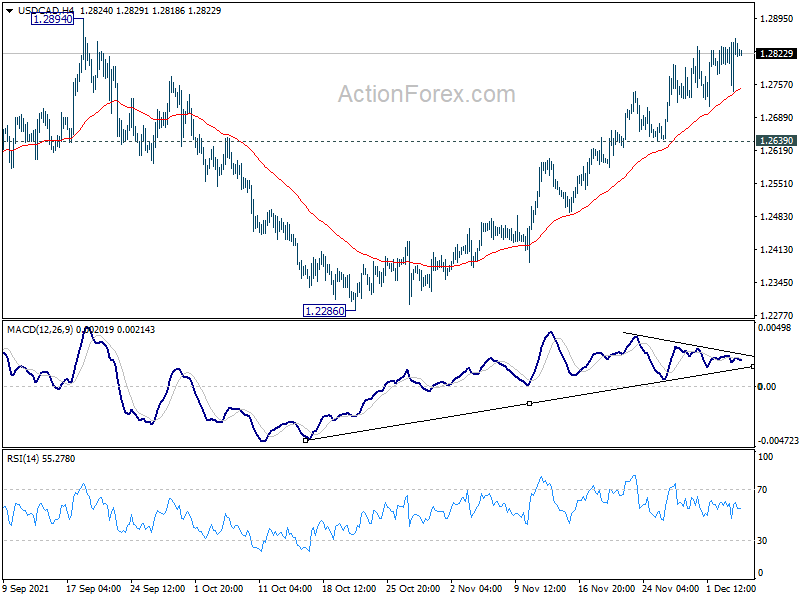
No change in USD/CAD's outlook as rise form 1.2286 is in progress despite some loss of upside momentum. Further rally would be seen to 1.2894/2947 resistance zone. Break there will target 1.3022 long term fibonacci level next. On the downside, break of 1.2639 will indicate short term topping, and turn bias back to the downside for 55 day EMA (now at 1.2591).
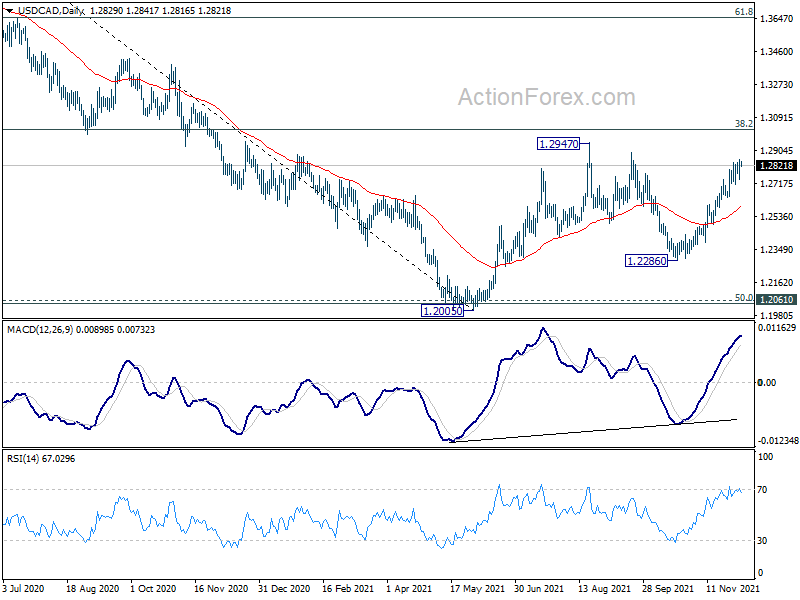
In the bigger picture, medium term outlook is neutral for now. The pair drew support from 1.2061 cluster and rebounded. Yet, upside was limited below 38.2% retracement of 1.4667 to 1.2005 at 1.3022. On the upside, firm break of 1.3022 should affirm the case of medium term bullish reversal. However, break of 1.2286 will turn focus back to 1.2005 low again.
AUD/USD Daily Report
Daily Pivots: (S1) 0.6962; (P) 0.7031; (R1) 0.7068; More...
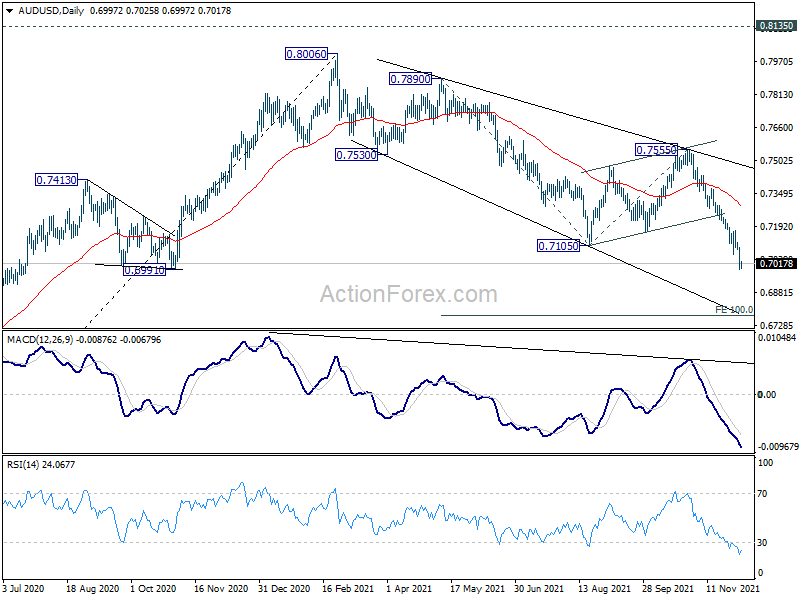
Intraday bias in AUD/USD remains on the downside with focus on 0.6991 key structural support. Sustained break there will carry larger bearish implication. Next target is 100% projection of 0.7890 to 0.7105 from 0.7555 at 0.6770. On the upside, break of 0.7172 resistance will indicate short term bottoming and bring stronger rebound.
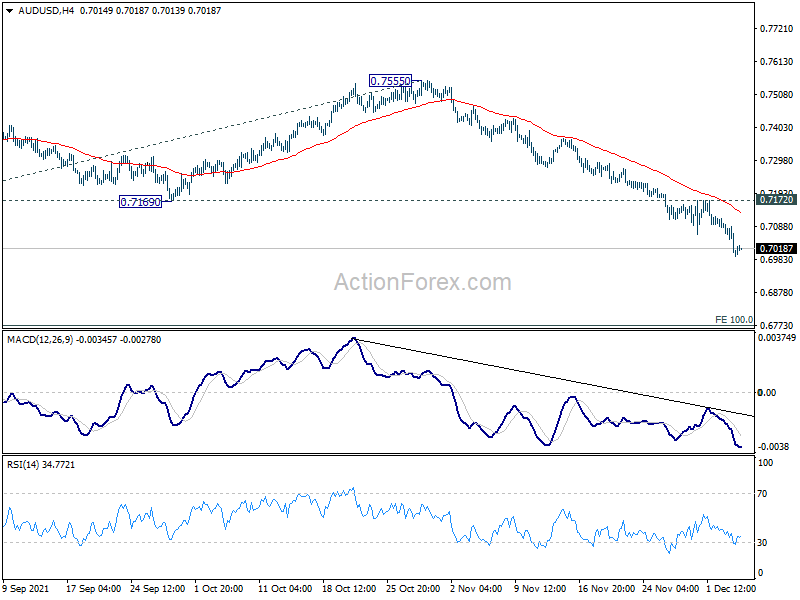
In the bigger picture, sustained break of 0.6991 cluster support will argue that the who up trend from 0.5506 might be finished at 0.8006, after rejection by 0.8135 long term resistance. Deeper decline would then be seen back to 61.8% retracement of 0.5506 to 0.8006 at 0.6461). For now, medium term outlook will stay bearish as long as 0.7555 resistance holds, in case of rebound.
Markets in Consolidation as Focus Turns to RBA, BoC and US CPI
The markets are relatively quiet in Asian session today. Major Asian indexes are mixed despite steep selloff last Friday. Currencies are bounded inside tight range, with Swiss Franc and Yen consolidation some of recent gains. Aussie and other commodity currencies also recover mildly. Gold and oil prices are also staying in tight range. Nonetheless, big selloff was seen in cryptocurrencies during the weekend.
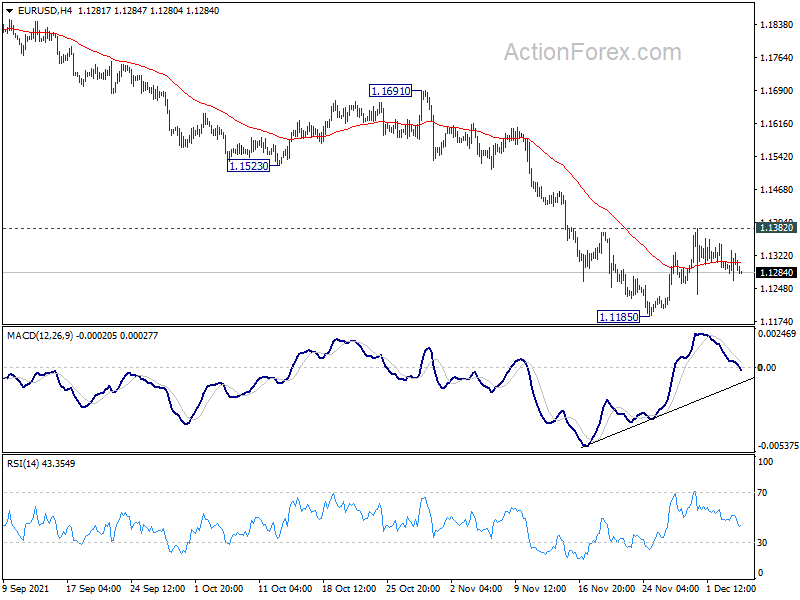
Technically, we're still paying attention to EUR/USD. For now downside breakout through 1.1185 support is in favor. But considering bullish convergence condition in 4 hour MACD, break of 1.1382 resistance should confirm short term bottoming and bring stronger rebound. In that case, we might see USD/CHF breaking through 0.9156 minor support to confirm weakness in Dollar.
In Asia, Nikkei closed down -0.26%. Hong Kong HSI is down -1.23%. China Shanghai SSE is up 0.13%. Singapore Strait Times is up 0.88%. Japan10-year JGB yield is down -0.0122 at 0.045.
CBI downgrades UK growth forecasts to 6.9% in 2021 and 5.1% in 2022
The Confederation of British Industry downgraded UK GDP growth forecast for 2021 from 8.2% to 6.9%. For 2022, GDP growth forecast was also lowered from 6.1% to 5.1%. Inflation is projected to peak at 5.2% in the coming April while unemployment rate would fall to 3.8% by the end of 2023.
"The challenge for January 1st is now very clear for the UK economy. Significant headwinds and rising costs of living threaten the extent of recovery and prospects for economic success. These hurdles for firms will provide a major test for the government – can they foster sustainable UK investment and growth?" said Tony Danker, CBI director-general.
"The UK's New Year resolution must be to give firms the confidence to go for growth. We should be raising our sights on the economy's potential and seizing the moment."
Bitcoin in ugly weekend selloff, downside risks remain
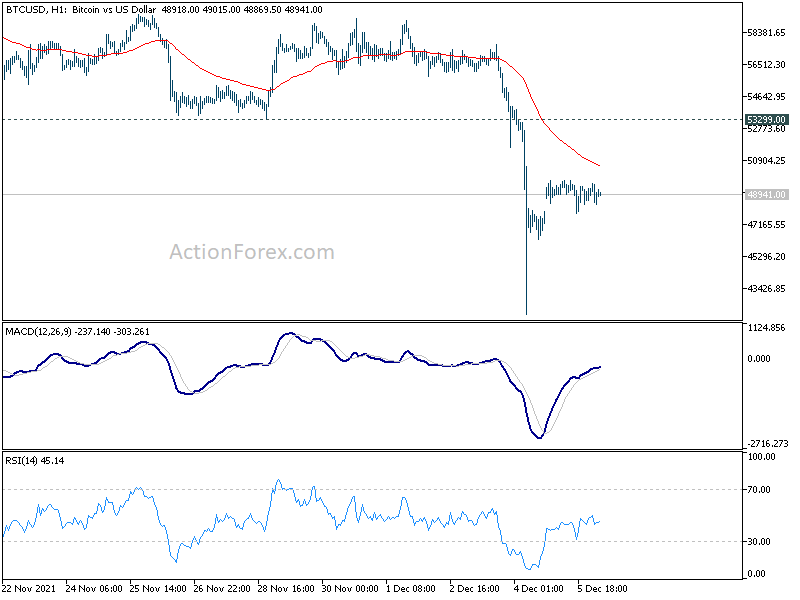
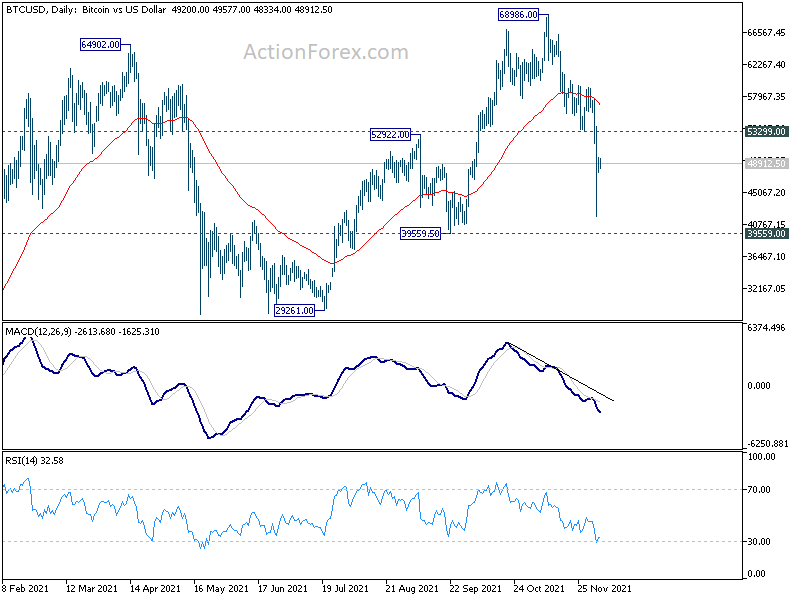
Cryptocurrencies suffered an ugly selloff over the weekend, as Bitcoin dived to as low as 41908, and then recovered and settled in range around 48k/49k. The move was exaggerated by low liquidity and cascading selling and liquidations. But it's also part of the overall risk-off moves late last week.
Technically, downside risks will remain in Bitcoin as long as 53299 support turned resistance holds. But we're not expecting a break of 40k handle for now, which is close to 39559. However, firm break of 39559 could trigger even steeper selling to 30k handle, which is close to 29261.
RBA and BoC to stand pat, US CPI a major mover
Two central banks will meet this week. RBA is expected to keep monetary policy unchanged, with cash rate target at 0.10% and asset purchases at AUD 4B per week. RBA is unlikely to drop any hint on what to do after finishing the current asset purchase commitment in mid-February, given the uncertainty over Omicron. So, the meeting will probably be a non-event.
After ending the quantitative easing program back in October, BoC is generally expected to keep interest rate unchanged at effective lower bound of 0.25% first. It's also likely to maintain the forward guidance that rate hike won't happen until "sometime in the middle quarters of 2022". While the economy is strong and inflation is hot, BoC will wait-and-see more information on Omicron first.
On the data front, US CPI will be major market mover this week. Before there, Eurozone Sentix, German ZEW, China trade balance and UK GDP will also be closely watched.
- Monday: Germany factory orders; Italy retail sales; Eurozone Sentix investor confidence; UK PMI construction.
- Tuesday: Australia AiG services, house price index, RBA rate decision; Japan average cash earnings, household spending; China trade balance; Swiss unemployment rate, foreign currency reserves; Germany industrial production, ZEW economic sentiment; France trade balance; Eurozone GDP revision; Canada trade balance, Ivey PMI; US trade balance, non-farm productivity.
- Wednesday; Japan GDP final, current account; BoC rate decision.
- Thursday: New Zealand manufacturing sales; Japan BSI manufacturing; China CPI, PPI; Swiss SECO economic forecasts; Germany trade balance; US jobless claims.
- Friday: New Zealand BusinessNZ manufacturing; Japan PPI; Germany CPI final; UK GDP, production, goods trade balance; Italy industrial production; US CPI, U of Michigan sentiment.
AUD/USD Daily Report
Daily Pivots: (S1) 0.6962; (P) 0.7031; (R1) 0.7068; More...
Intraday bias in AUD/USD remains on the downside with focus on 0.6991 key structural support. Sustained break there will carry larger bearish implication. Next target is 100% projection of 0.7890 to 0.7105 from 0.7555 at 0.6770. On the upside, break of 0.7172 resistance will indicate short term bottoming and bring stronger rebound.
In the bigger picture, sustained break of 0.6991 cluster support will argue that the who up trend from 0.5506 might be finished at 0.8006, after rejection by 0.8135 long term resistance. Deeper decline would then be seen back to 61.8% retracement of 0.5506 to 0.8006 at 0.6461). For now, medium term outlook will stay bearish as long as 0.7555 resistance holds, in case of rebound.
Economic Indicators Update
| GMT | Ccy | Events | Actual | Forecast | Previous | Revised |
|---|---|---|---|---|---|---|
| 00:00 | AUD | TD Securities Inflation M/M Nov | 0.30% | 0.20% | ||
| 07:00 | EUR | Germany Factory Orders M/M Oct | -0.20% | 1.30% | ||
| 09:00 | EUR | Italy Retail Sales M/M Oct | 0.40% | 0.80% | ||
| 09:30 | EUR | Eurozone Sentix Investor Confidence Dec | 15.9 | 18.3 | ||
| 09:30 | GBP | Construction PMI Nov | 52 | 54.6 |
Market Morning Briefing: Pound Has Bounced Slightly From 1.32
STOCKS
Crucial supports seen below current levels. All holding for now but we need to see if the indices can go into a sideways range before a sharp break out is seen in the medium term. The ranges are intact for Nifty at 17800-16800, for Dax between 15050-15500, for Nikkei between 28250-27500 and for Dow and Shanghai within 35500-34000 and 3625-3500/3550 respectively. Sensex too can be ranged for now within 58000-57000. Respective breaks on either side of the mentioned ranges are needed for cues on further direction from here. Till then we wait and watch.
Dow (34580.08, -59.71, -0.17%) has risen slightly but holds above support near 34000. The view remains bullish to see a rise towards 35000/35500 while above 34000. Broad range of 35500-34000 to hold for the next couple of weeks.
DAX (15169.98, -93.13, -0.61%) has declined well while below immediate trend resistance near 15500. The index can trade sideways between 15100/15050-15500 region before breaking higher to head towards 15700/800 on the upside.
Nikkei (27866.81, -162.76, -0.58%) fell sharply from 28081 but overall trades above support at 27500. The index has immediate resistance at 28250/200 which if holds can send the index back to 27500 or lower; else a rise above 28250 is needed to sustain to move up towards 28750 or higher in the medium term.
Shanghai (3619.11, +11.68, +0.32%) finally moved up above 3600, made a high of 3626.13 before coming down from there. The index has immediate resistance at 3625 which seems to be holding for now. While below 3625, we can see a dip towards 3600 just now.
Nifty (17196.70, -204.95, +1.18%) came down sharply on Friday after testing a high of 17489.80. The index has failed to stay above 17200. While below 17200 the chances of a fall towards 17000/16800 remain intact. On the upside immediate resistance is now seen at 17600 and higher at 17750/800. While these mentioned resistances hold, it would be difficult for Nifty to become strongly bullish. A broad range of 17800-16800 may hold for the next few weeks.
Sensex (57696.46, -764.83, -1.31%) has fallen below 58000 again. While below 58000 the view is bearish to see a dip towards 57000.
COMMODITIES
Brent and WTI have risen slightly but can move more in the coming sessions before a decline is again seen. Gold needs to sustain above 1780 to head higher to 1810; else a fall back to 1770/60 cannot be negated. Silver is within 22-24/24.50. Copper has support at 4.0 and 4.20 which if hold can produce a bounce towards 4.40/45 in the near term.
Brent (71.42) is holding above 65/66 and WTI (67.78) is holding above 61. A rise to 74 and 71 respectively looks likely for the near term. Any rise seen now can be corrective and short lived with another down-leg in place to be seen over the next 2-weeks.
Gold (1787.80) has risen back above 1780. Immediate resistance is seen near 1890 a break above which is needed for Gold to rise back again towards 1810. Else a fall back towards 1770/60 cannot be ruled out.
Silver (22.56) has important support at 22 and while that holds, a rise to 23-24 is likely in the medium term. A broad range of 22-24/24.50 may hold for now.
Copper (4.2965) can rise while above immediate support near 4.20/25 and head towards 4.40/45. Failure to hold above 4.20 can drag it down to lower support at 4.00.
FOREX
Dollar Index may move higher within the 95.50-97 range while Euro can fall towards 1.12-1.1142 in the next few sessions. Dollar Yen too may remain within 112.50-114 region while EURJPY can fall towards 127.50-127 while below 128. Pound is bearish while below 1.33. USDINR has immediate resistance at 75.20/25 which if breaks can take the spot higher towards 75.50/75 before any reversal is seen from there.
Dollar Index (96.268) is holding above 96. Immediate range of 95.50-97 may hold for the next few sessions.
Euro (1.1291) seems to be falling while below 1.13. An eventual test of immediate resistance zone near 1.12-1.1142 looks possible.
EURJPY (127.57) has broken below 130 to sustain and as warned, an eventual fall to 127 is possible soon. Any break below 127 thereafter can drag it lower towards 125 in the medium term. Watch price action within 127-128.
Aussie (0.7018) has paused near 0.69 and if it sees a bounce, we may expect a rise to 0.71 on the upside. Failure to bounce from here can take it down to 0.69.
Pound (1.3236) has bounced slightly from 1.32 and can rise towards 1.3350-1.34 on a break above 1.3267-1.3284 in the near term. For now 1.32 seems to be holding well and may lead to an immediate rise to 1.3284 or slightly higher to 1.33. Thereafter we need to see if the pound breaks higher or faces stiff rejection.
Dollar-Yen (112.96) has fallen from 113.61 seen on Friday. The pair has not been able to sustain higher but trades within a sideways range of 114-112.50 for the past few sessions. A break on either side will pave way for the next movement. Till then we may expect the sideways range to continue.
USDCNY (6.3690) tested 6.3770 on Friday before falling again from there. Overall view is bearish while below 6.40/39. A break below 6.36 will drag it lower towards 6.35 on the downside in the medium term.
{USDINR (75.1675) closed higher on Friday, moving towards the upper resistance at 75.20/25. If a break above this is seen today, it would open up chances of a further rise towards 75.50/75 (possibly the last leg of upmove within the rise seen from 74.00) on the upside before a reversal is seen from there. A break above 75.20/25 will need a close watch today.
INTEREST RATES
The US Treasury yields continue to fall at the far-end (10Yr and 30Yr). The 10Yr has key support at 1.35% which will have to hold to avoid a deeper fall to 1.2%. The 30Yr looks weaker than the 10Yr to fall further from here. The German yields continue to fall in line with our expectation and are keeping our bearish view intact. The 10Yr and 5Yr GoI have risen on Friday and have room to move up further to test their resistances and then reverse lower again.
The US 2Yr (0.61%) remains stable, the 5Yr (1.17%) has dipped slightly while the 10 Yr (1.38%) and the 30Yr (1.70%) have declined sharply. The 10Yr has a key support at 1.35%. A strong bounce above 1.4% from here is needed to avoid a break below 1.35% and see a further fall to 1.2%. The 30Yr looks weaker to test 1.6% on the downside although there is some support at 1.7%.
The German 2Yr (-0.76%) and 5Yr (-0.64%) yields remain stable while the 10Yr (-0.39%) and 30Yr (-0.11%) have declined further. Our bearish view of seeing a fall to -0.45% / -0.5% on the 10Yr and -0.1% / -0.2% on the 30Yr remains intact.
The Indian 10Yr (6.3693%) and the 5Yr (5.7014%) have moved up on Friday. The 10Yr can test the range resistance at 6.38% and is likely to reverse lower to keep the 6.3%-6.38% range intact. The 5Yr can test 5.72%-5.74% while it sustains above 5.7%. Thereafter it can come down again 5.68% and lower.
EUR/USD Faces An Uphill Task Near 1.1400
Key Highlights
- EUR/USD started an upside correction above 1.1300.
- A key bullish trend line is forming with support near 1.1270 on the 4-hours chart.
- GBP/USD failed to surpass 1.3350 and started a fresh decline.
- Crude oil price is consolidating losses below $70.00.
EUR/USD Technical Analysis
The Euro started an upside correction from the 1.1186 low against the US Dollar. EUR/USD corrected above the 1.1300 level, but it is facing a lot of hurdles.
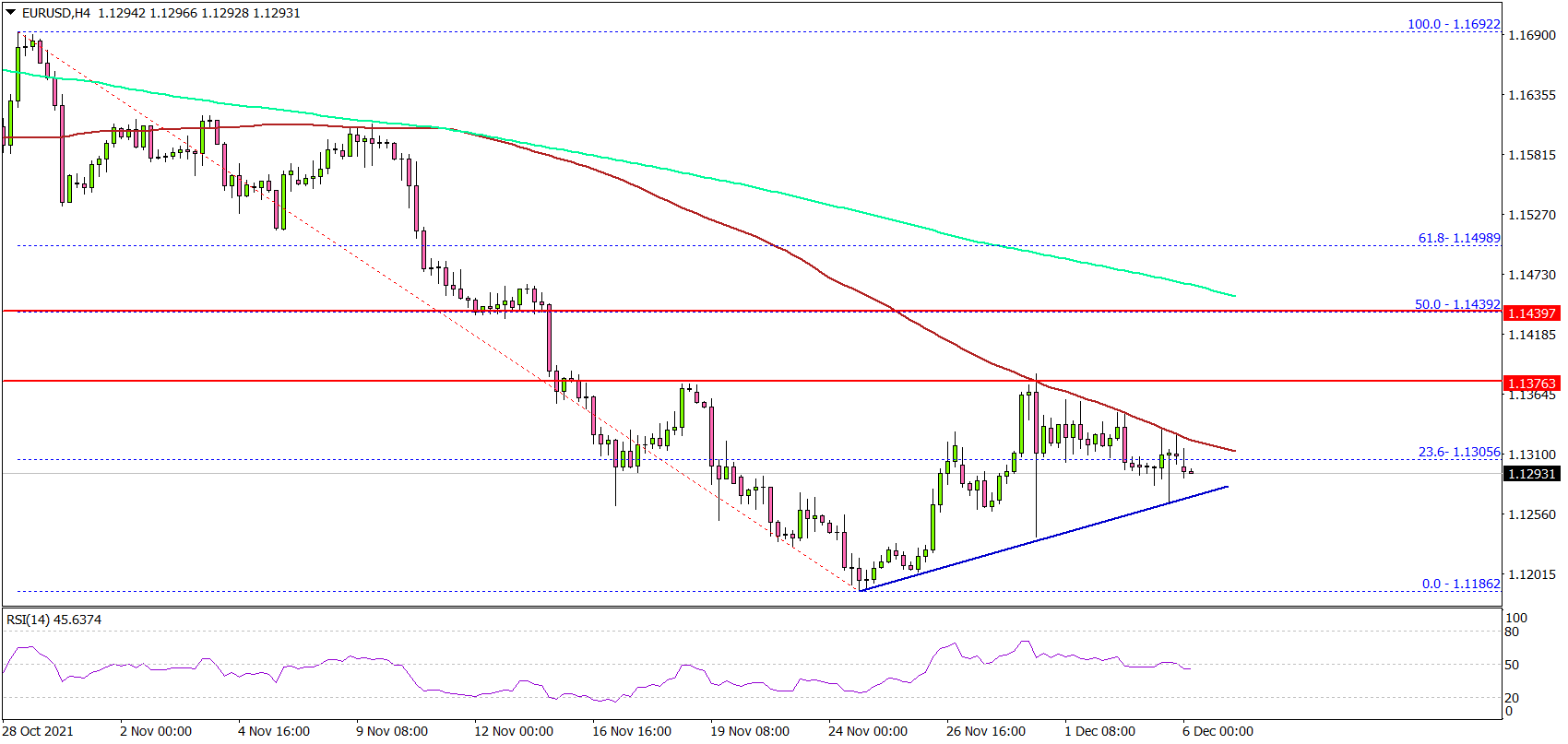
Looking at the 4-hours chart, the pair failed on many occasions near the 100 simple moving average (red, 4-hours), and it stayed below the 200 simple moving average (green, 4-hours).
There was a minor upward move above the 23.6% Fib retracement level of the downward move from the 1.1692 swing high to 1.1186 low. On the upside, an initial resistance is near the 1.1350 level.
The next major resistance is near 1.1400 or the 50% Fib retracement level of the downward move from the 1.1692 swing high to 1.1186 low. A clear break above the 1.1350 and 1.1400 levels could start a steady increase.
If not, there could be more losses below the 1.1250 and 1.1240 support levels. In the stated case, the pair may possibly decline towards the 1.1150 level.
Looking at GBP/USD, the pair struggled to gain strength above the 1.3350 level and started a fresh decline. It might continue to move down below 1.3250.
Economic Releases
- German Factory Orders for Oct 2021 (MoM) – Forecast -0.5%, versus +1.3% previous.
- UK's Construction PMI for Nov 2021 – Forecast 52.0, versus 54.6 previous.
Bitcoin in ugly weekend selloff, downside risks remain
Cryptocurrencies suffered an ugly selloff over the weekend, as Bitcoin dived to as low as 41908, and then recovered and settled in range around 48k/49k. The move was exaggerated by low liquidity and cascading selling and liquidations. But it's also part of the overall risk-off moves late last week.
Technically, downside risks will remain in Bitcoin as long as 53299 support turned resistance holds. But we're not expecting a break of 40k handle for now, which is close to 39559. However, firm break of 39559 could trigger even steeper selling to 30k handle, which is close to 29261.
CBI downgrades UK growth forecasts to 6.9% in 2021 and 5.1% in 2022
The Confederation of British Industry downgraded UK GDP growth forecast for 2021 from 8.2% to 6.9%. For 2022, GDP growth forecast was also lowered from 6.1% to 5.1%. Inflation is projected to peak at 5.2% in the coming April while unemployment rate would fall to 3.8% by the end of 2023.
"The challenge for January 1st is now very clear for the UK economy. Significant headwinds and rising costs of living threaten the extent of recovery and prospects for economic success. These hurdles for firms will provide a major test for the government – can they foster sustainable UK investment and growth?" said Tony Danker, CBI director-general.
"The UK's New Year resolution must be to give firms the confidence to go for growth. We should be raising our sights on the economy's potential and seizing the moment."
Forex and Cryptocurrency Forecast
EUR/USD: Employment and Inflation Decide Everything
Markets are now ruled by two factors: fear of the new COVID strain and monetary tightening by central banks. It is not yet very clear how dangerous the Omicron strain is and how it will affect the economy. Therefore, the main focus is shifting towards central banks and, first of all, the US Federal Reserve. Thus, 19 Reuters experts have named the difference in interest rates as the main market driver, while 15 have pointed to Omicron.
Fed Chairman Jerome Powell's speech in the US Senate on November 30 had a bombshell effect on the markets. And all because analysts and commentators saw a harsh hawkish attitude in his words. As a result, stock indices, Dow Jones, S&P500, Nasdaq, flew further down, while the DXY dollar index rushed up.
The dollar played back 147 points against the euro in less than an hour, lowering the EUR/USD pair from 1.1382 to 1.1235. However, then the markets calmed down as quickly and, in anticipation of data from the US labor market, the pair went up.
Inflation and employment: these two indicators are defining in the current policy of central banks.
The ECB continues to insist that the increase in inflation is temporary, so it makes no sense to take measures to contain it now. Although some people believe that the Bank's Governor Christine Lagarde's speech on December 02 hinted at an imminent tightening of monetary policy, however, nothing was said about specific steps. Although it would be possible to tackle this problem already. The data on producer prices released last week look frightening: their growth rates accelerated from 16.1% to 21.9% (against the forecast of 18.3%). These figures indicate that inflation in the Eurozone, which has already reached 4.9%, will not stop there and will continue to grow. As for the European labor market, the progress here is more than modest: unemployment fell by only 0.1%, from 7.4% to 7.3%.
Statistics from the US labor market look much better. The number of initial applications for unemployment benefits rose less than expected: to 222 thousand against the forecast of 245 thousand, and the four-week moving average of the indicator fell to the lows of March 2020. At the same time, the number of people receiving benefits for the first time since the beginning of the pandemic fell below 2 million, to 1,956 thousand.
But the number of new jobs created outside the US agricultural sector (NFP) was only 210 thousand, which is significantly less than both the forecast (550 thousand) and the previous value (546 thousand). However, this fall does not look so dramatic against the background of the country's labor shortage. Suffice it to say that, due to a shortage of personnel, the number of laid-off people in the United States dropped to a 28-year low.
The unexpectedly low NFP data is unlikely to have a strong impact on the Fed's decisions. There are many reasons to believe that the Federal Reserve may accelerate the pace of curtailing the monetary stimulus (QE) program at its meeting on December 14-15. Cleveland Fed President Loretta Mester and her colleagues Mary Daley of San Francisco and Rafael Bostic of Atlanta actively support the idea of accelerating this process. And Randal Quarles, outgoing vice chairman of the Fed, considers such fiscal and monetary incentives harmful to the economy. In his opinion, they have inflated demand so much that it has exceeded the pre-pandemic level, and the high inflation is no longer temporary, but permanent.
Fed Chairman Jerome Powell and US Treasury Secretary Janet Yellen also believe that the time has come to drop the word "temporary". This means that the inflation forecast will be revised upwards, and the schedule for raising interest rates will become more intense.
Most likely, the difference in monetary policy between the Fed and the ECB will continue to put pressure on the EUR/USD pair, pushing it further down. 50% of experts agree with this forecast, while 35% of analysts have taken the opposite position. The remaining 15% vote for the sideways trend.
The trend indicators on D1 have a predominantly red color, these are 65%. But there is confusion and disparity among the oscillators: 40% of them point to the south, 35% to the north and another 25% have taken a neutral position.
Resistance levels are located in the zones and at levels 1.1380, 1.1435-1.1465 and 1525. The nearest support level is 1.1260, then 1.1235, 1.1185-1.1200, then 1.1075-1.1100.
As for the events of the coming week, it should be noted that the data on GDP of the Eurozone for the Q3 will be issued. Increased volatility can be expected on Friday, December 10, when the German and US CPIs, as well as the University of Michigan Consumer Confidence Index will become known. This indicator is an indicator of the US consumers' confidence in economic growth and assesses their willingness to spend money.
GBP/USD: Back on the Bear Trail?
The behavior of the GBP/USD pair last week was similar to that of EUR/USD. It reacted similarly to Jerome Powell's speech in the Senate and to data from the US labor market, and as a result it ended the five-day week at 1.3225.
Concerns about Brexit remain the main factor of pressure on the pound. Irish Foreign Minister Simon Coveney said on December 03 that there are still significant differences between the EU and the UK on the application of the Northern Ireland Protocol. The politician added that there was no breakthrough in the negotiations, and that these differences are unlikely to be overcome before the end of this year.
The GBP/USD pair failed to gain a foothold above the 1.3300 horizon. According to analysts at Singapore's United Overseas Bank (UOB), the British currency may continue to decline in December, although it will be difficult for it to overcome strong support at 1.3195 (November 30 low). If successful, the pair will open the way to support at 1.3135. For the bulls, task No.1 is to overcome the key resistance in the 1.3300 zone. And if the Bank of England does raise the interest rate on December 16, this will not be a problem. Subsequent resistances are located at levels 1.3360, 1.3410, 1.3475, 1.3515, 1.3570, 1.3610, 1.3735, 1.3835.
30% of analysts hope for the pair's growth in the near future, 45% expect it to fall further, and 25% have taken a neutral position. But the indicators on D1 definitely support the bears. 100% of trend indicators point to the south. The same could be said about oscillators, but 15% of them give signals that the pair is oversold.
USD/JPY: Yen Won't Retreat
The USD/JPY pair went beyond the trading range 113.40-114.40 at the end of November, and, as most experts expected (55%), continued to move south, reaching the local bottom at the level of 112.52 and having updated the seven-week low. This was followed by a trend reversal, several unsuccessful attempts to return the pair to the 113.40-114.40 channel and a finish at 112.80.
The yen is supported as a safe haven currency by investor fears regarding the spread of the Omicron coronavirus strain. However, now that the initial wave of panic has passed, this advantage over the dollar is gradually fading away.
It should also be borne in mind that Japan is in a difficult position because the country's debt to GDP ratio is too high. And according to a number of experts, it is necessary to adopt a new package of monetary stimuli, which will put additional pressure on the yen, in order to increase the pace of economic recovery.
Until that happens, UOB analysts believe the pair may retest the 1.1250 support, but the chances of breaking below are slim. If it does manage to do so, it will face the next obstacle in the 111.85-112.00 area. According to experts at Credit Suisse, the pair needs to rise above the 113.70-114.00 zone to implement the bullish scenario, and then overcome the resistance at 114.80. This will be a good start for a move to the five-year high of 115.52, which was recorded on November 24.
Most of the experts (55%) are currently on the side of the bulls, 25% side with the bears and 20% expect a sideways movement of the pair. 90% of the oscillators are still facing south, but a quarter of them are in the oversold zone, the remaining 10% have turned north. The ratio is 65% to 35% among trend indicators in favor of the reds.
The resistance levels are 113.40, 113.70, 114.00, 114.40, 114.70, 115.00 and 115.50, the long-term target of the bulls is the December 2016 high of 118.65. The nearest support level is 112.50, then 112.00 and 111.65.
As for macro-economic statistics, data on GDP of Japan for Q3 will be released on Wednesday December 08. This indicator is expected to move from a decline (minus 0.8% in Q2) to a modest growth of 0.4%.
CRYPTOCURRENCIES: Overnight Crash in the Thin Market
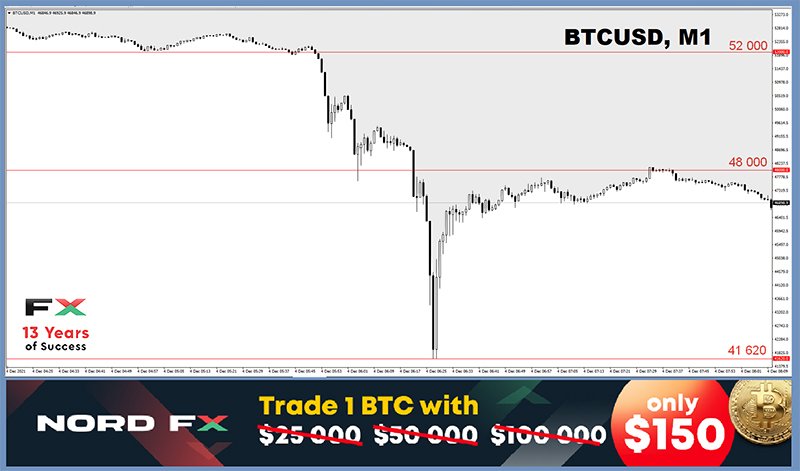
There were no significant changes on the crypto front throughout the working week. Bitcoin and ethereum, along with stock indices and investor risk appetites, even went up at the beginning of the week. But it was only a temporary respite. The cryptocurrency market went down during the night from Friday to Saturday, dipping by about 20%. The BTC/USD pair returned to levels ten weeks ago, falling to $41,620, while ETH/USD fell to $3,510. And this despite the fact that ethereum tried to renew its all-time high just three days before that, rising to the height of $4.771.
The true reasons for what happened are not yet clear at the time of writing the review, but it all looks like someone's speculative combination on a thin night market, when major investors are asleep ahead of the weekend days. This version is also supported by the fact that the quotes of the main cryptocurrencies jumped up within a few minutes after the fall. Bitcoin went up 15%, rising to $48,000. It is possible that it was those who were behind this drop that who replenished their stocks of coins very quickly at a "discount" price. Although, this is only a guess.
The President of El Salvador managed to take advantage of the drawdown of the flagship cryptocurrency. Nayib Bukele acquired another 150 BTC, increasing his wallet to 1,370 coins. True, at the same time he complained that he slept through the moment of the collapse for only 7 minutes, so he had to pay about $48,000 per coin.
At the time of this writing, on the afternoon of December 4, the total crypto market capitalization is at $2.2 trillion, and the Crypto Fear & Greed Index has shifted from the neutral center of the scale to the Extreme Fear zone, to 25 points mark (47 weeks ago).
According to Nigel Green, CEO of the consulting company deVere Group, investors should buy this cryptocurrency right now, as its rate will double in a year. "Panic is the right time to buy BTC," Green said.
Mark Yusko, CEO of Morgan Creek Capital Management, who believes that investors should not be fooled by the daily fluctuations in the price of bitcoin, agrees with him. According to the financier, it's not that bitcoin is getting better over fiat currencies. They are getting worse than bitcoin. "There is a global race to the bottom," says Martin Yusko. Therefore, BTC is an ideal savings asset in a world where governments are in a race to devalue their currency.
Much the same thought was expressed by Anthony Scaramucci, founder of SkyBridge Capital and former director of communications in the Donald Trump administration. "If you believe in long-term fundamentals like we do, then now is the time to buy. The volatility of bitcoin and other cryptocurrencies is knocking people out of the game. It also flushes out some of the leverage, which, in my opinion, creates a springboard for a good Q1," the financier explained, adding that not only fundamental factors, but also the monetary policy of the US Federal Reserve, indicate further growth in cryptocurrency quotes.
Time will tell whether these optimistic influencers are right or wrong. For example, cryptanalyst and trader Benjamin Cowen has recently argued that the value of bitcoin will not fall below $50,000. But it did. At the same time, we cannot but mention another negative signal for investors: option traders are betting on bitcoin's decline for six months for the first time since May. The price ratio for weekly, monthly and three-month contracts also shifted to the "bears" earlier this month.
And in conclusion of the review, a traditional and not very serious rubric of crypto-life hacks. We will tell you how some are trying to make money on cryptocurrencies. But at the same time, we strongly advise you NOT to follow their example.
Police in the Spanish city of Tarragona arrested a 33-year-old man and a woman who installed hidden miners on computers... in stores. The criminals infected at least 16 devices in electronics stores Mediamarkt and El Corte Ingles department stores. According to available information, the woman distracted employees and asked for help to start the laptop, which she allegedly bought in their store. Meanwhile, her companion was installing the Nicehash miner and the Anydesk program for remote access to computers on display sample laptops.
The new laptops running at full capacity have raised suspicion among consultants. Mediamarkt's CCTV cameras filmed the accomplices visiting the store three times, and the police were able to identify them from the video.
It is probably appropriate to cite here one more figure concerning the criminal mining of cryptocurrencies. According to the Cybersecurity Action Team experts, 86% of the hacked accounts on the Google Cloud platform were subsequently used for mining, and the software required for this was loaded on average 22 seconds after the hack.
In many cases, attackers gained access to accounts due to poor protection on the part of the users themselves. Therefore, dear readers, be as vigilant as possible.
Eco Data 12/6/21
[php_everywhere instance="1"]