

Sample Category Title
EUR/AUD Weekly Outlook
After some initial struggles, EUR/AUD's rally accelerated to as high as 1.1618 last week. Initial bias remains on the upside this week for further rally. With 161.8% projection of 1.5354 to 1.5743 from 1.5446 at 1.6075 taken out, next target is 1.6434 high. On the downside, below 1.5968 minor support will turn intraday bias neutral first.
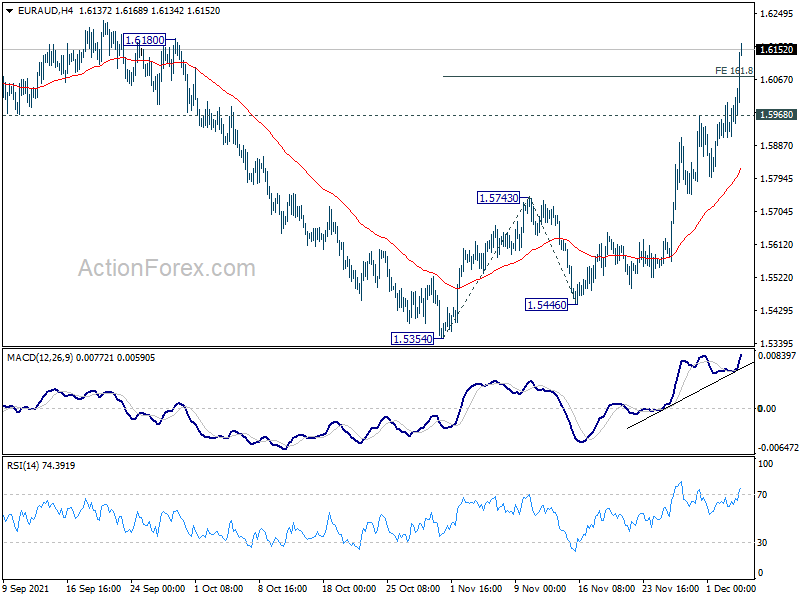
In the bigger picture, medium term outlook is neutral for the moment. Rise from 1.5354 is seen as the third leg of the corrective pattern from 1.5250 low first. Further rise could be seen through 1.6434 towards 38.2% retracement of 1.9799 to 1.5250 at 1.6988. On the downside, however, sustained trading below 55 day EMA (now at 1.5747) will turn focus back to 1.5250 low instead.
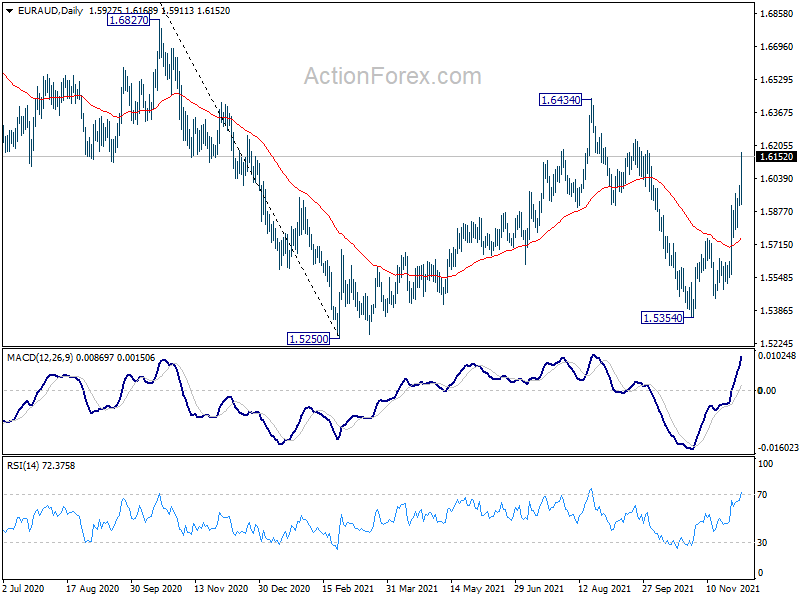
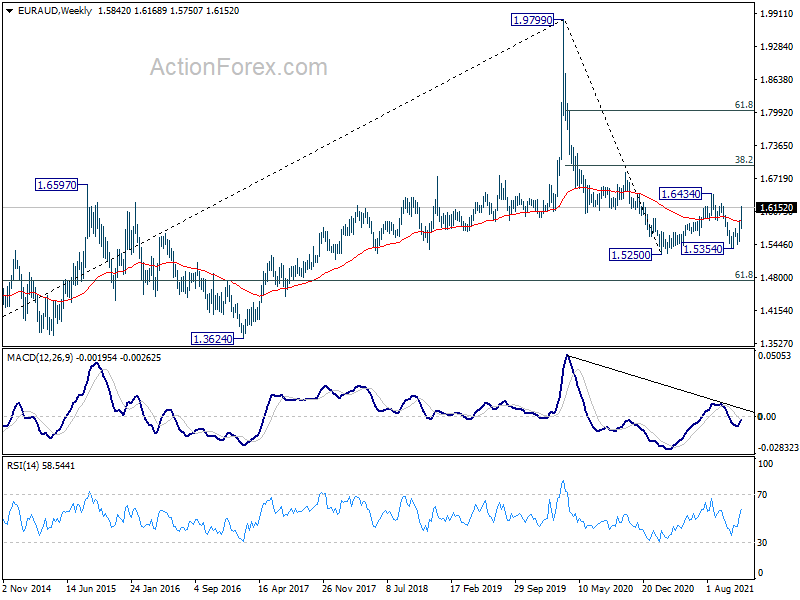
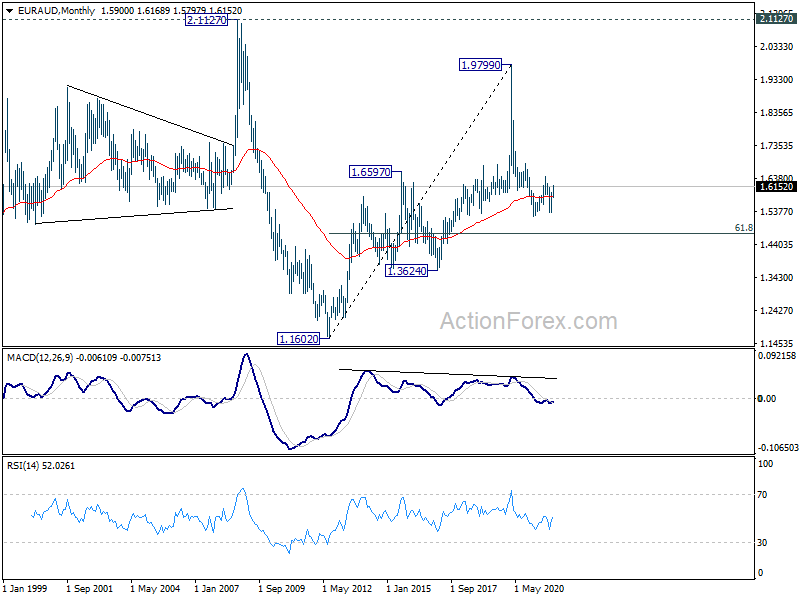
In the longer term picture, fall from 1.9799 (2020 high) is seen as a long term down trend. Further decline will remain in favor as long as 38.2% retracement of 1.9799 to 1.5250 at 1.6988 holds. Break of 1.5250 will target 61.8 retracement of 1.1602 (2012 low) to 1.9799 at 1.4733
EUR/CHF Weekly Outlook
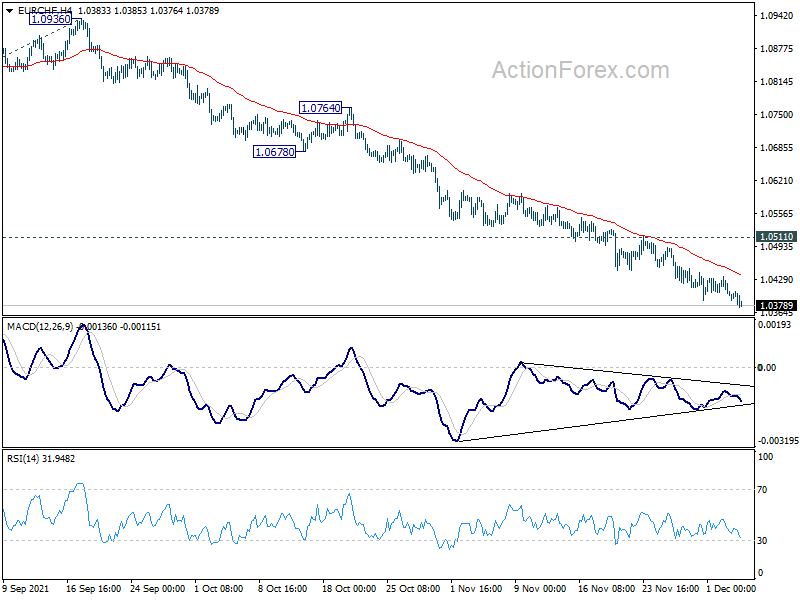
EUR/CHF's down trend extended last week and hit as low as 1.3074. Initial bias remains on the downside this week. Current fall from 1.1149 would target 161.8% projection of 1.1149 to 1.0694 from 1.0936 at 1.0200 next. On the upside, break of 1.0511 resistance is needed to indicate short term bottoming. Otherwise, outlook will stay bearish in case of recovery.
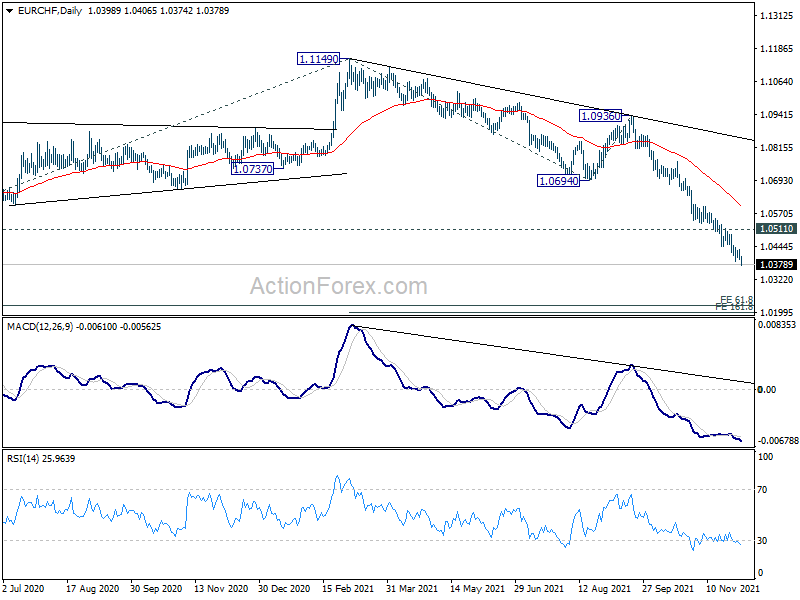
In the bigger picture, long term down trend from 1.2004 (2018 high) is now extending. Next target is 61.8% projection of 1.2004 to 1.0505 to 1.1149 at 1.0223. On the upside, break of 1.0694 support turned resistance is needed to be the first sign of medium term bottoming. Otherwise, outlook will remain bearish even in case of rebound.
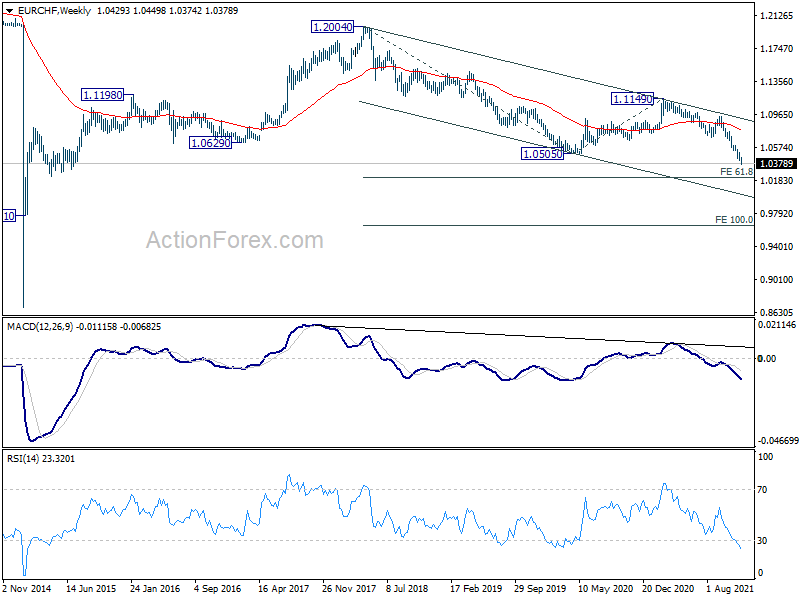
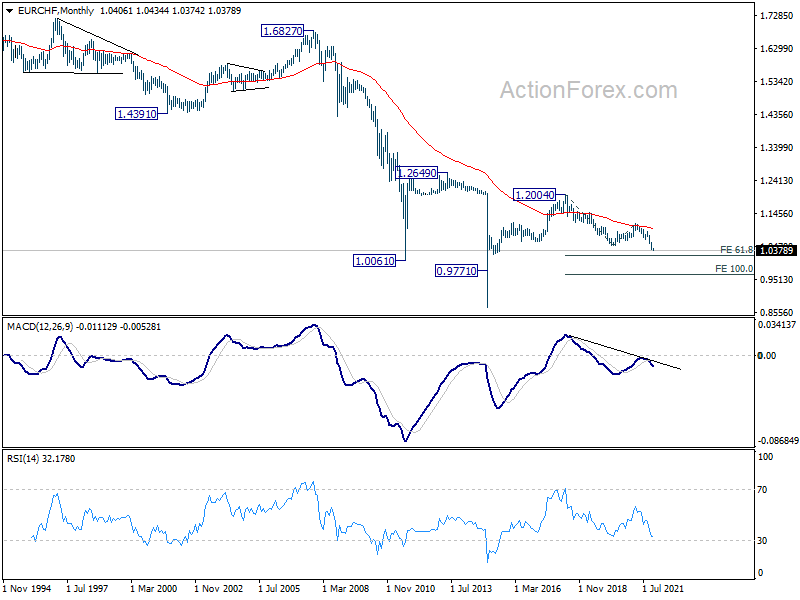
In the long term picture, rejection by 55 month EMA (now at 1.1015) maintains long term bearishness. Down trend from 1.2004 is now in progress for 61.8% projection of 1.2004 to 1.0505 to 1.1149 at 1.0223. Firm break there will target 100% projection at 0.9650.
Swiss Franc and Yen Surged after Fed Powell Stirred Up Omicron-Nervous Markets
Just as the world is concerned and confused with the newly discovered Omicron, Fed Chair Jerome Powell stirred up the markets further, by talking up faster tapering. The biggest reactions were found in US treasury yields on strong safe-haven flows. Major stocks indexes also turned sharply lower, solidifying the case of medium term correction.
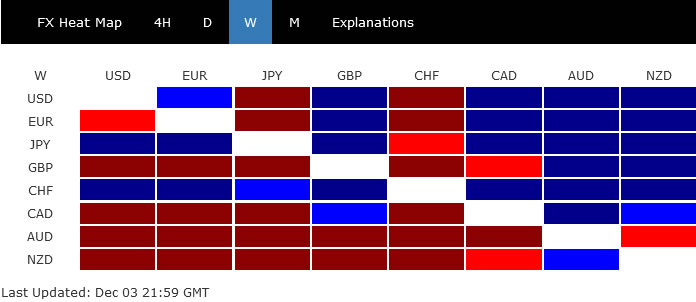
In the currency markets, Swiss Franc and Yen ended as the biggest winners followed by Dollar. Australian Dollar was the worst, followed by New Zealand Dollar and then Sterling. Current developments suggest that for the near term, there will be more downside in stocks and more so in yield. Yen and Swiss Franc would likely to outshone the others.
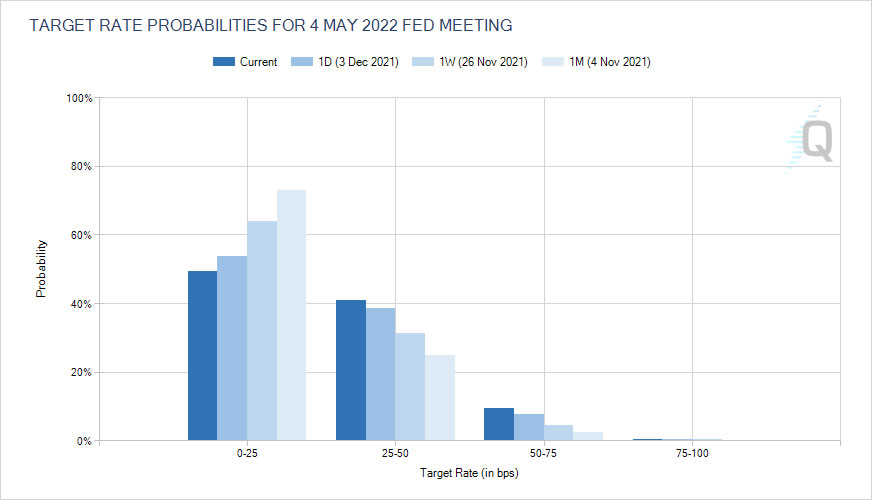
Market pricing in over 50% chance of Fed hike in May
Fed Chair Jerome Powell surprised the markets by delivering a much more hawkish than expected testimony last week. He acknowledged that inflation pressures "have spread much more broadly" and that "the threat of persistently higher inflation has grown". More importantly, he added that FOMC is "going to have a conversation at our next meeting about accelerating the taper and ending our asset purchases a few months early". His comments were then echoed by a chorus of Fedspeaks.
Omicron is clearly a source of huge uncertainty. If would probably take a few more weeks before clearly know how infectious it is, and how fatal it is, and how effective the current vaccines are against it. On the economic side, it seems that markets are seeing Omicron as an inflationary factor, rather than disinflationary, prolonging supply chain disruptions. That could be in-line with Fed policymakers' thoughts too.
Anyways, as indicate by Fed fund futures, markets are pricing in slightly more than 50% chance of a Fed hike or more at the May 4 2022 meeting. That's notably higher than just 27% a month ago.
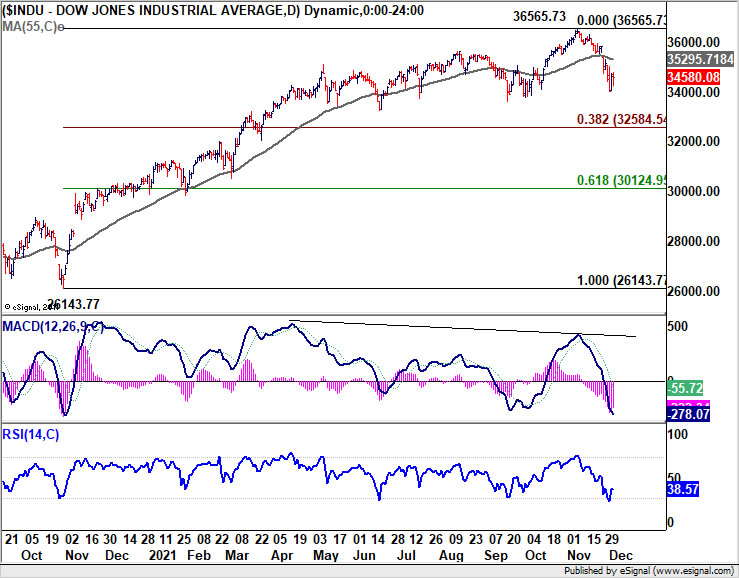
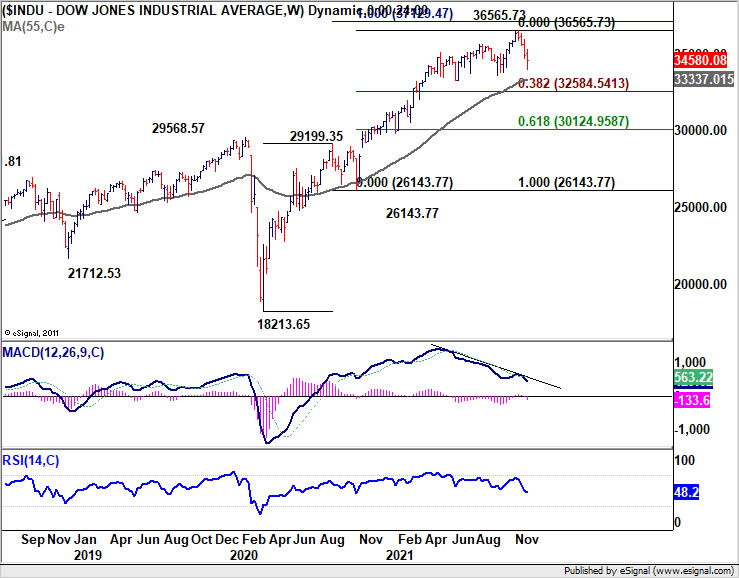
DOW and NASDAQ extending medium term correction
While US stocks tumbled sharply last week, the development isn't that disastrous for now. Major indexes are merely in rather common medium term scale corrections. DOW is seen as correcting the rise from 26143 to 36565. Such correction would target 38.2% retracement of 26143 to 36565 at 32584 before completion, unless it can rebound back above 55 day EMA (now at 35295) quickly.
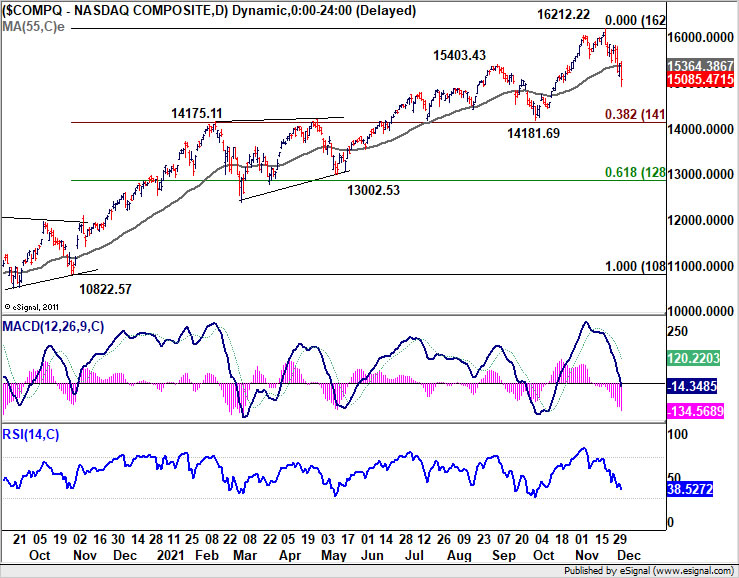
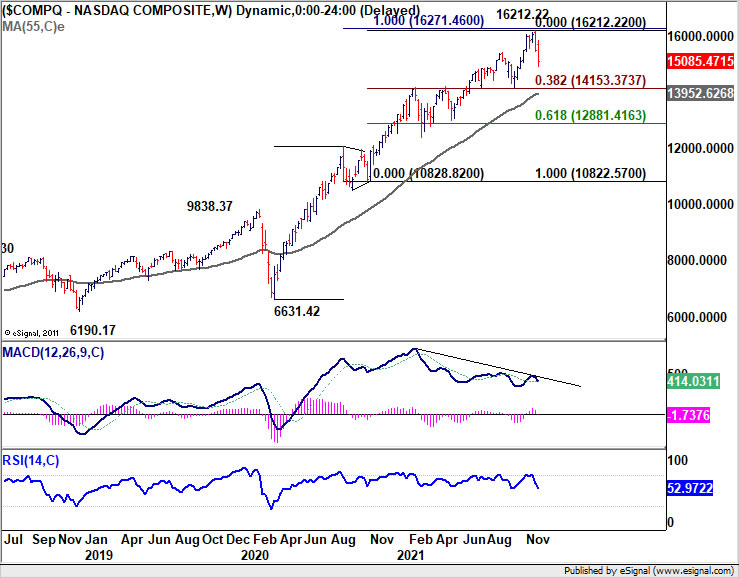
Similarly, NASDAQ should now be corrective the rise from 10822 to 16212. Deeper fall should be seen to 38.2% retracement of 10822 to 16212 at 14153. Additional support with be provided by 14175 and 14181 to contain downside to complete the correction.
However, it should be noted that sustained break of these two fibonacci levels will a a strong warning of some more bearish developments.
Steep falls in US yields suggest flight-to-safety sentiment
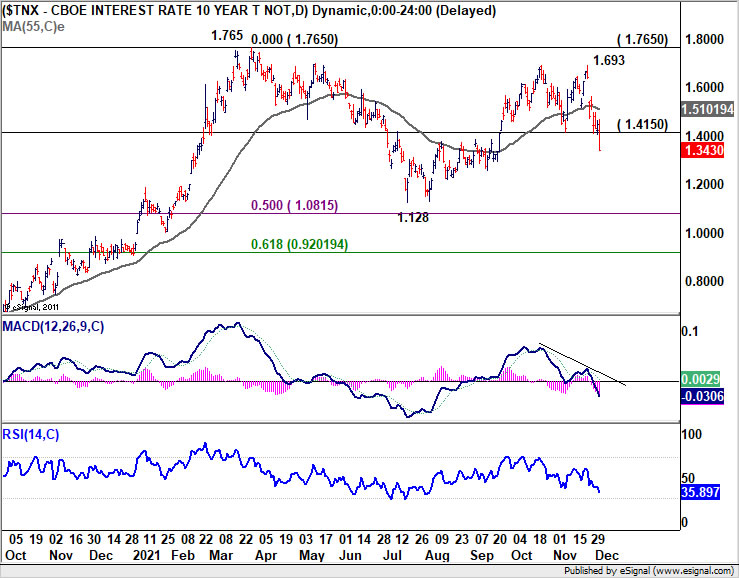
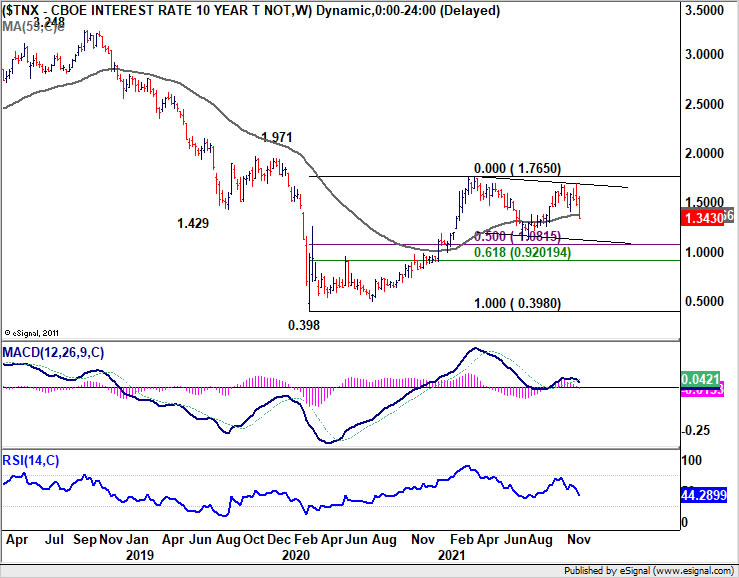
US treasury yields in the long end tumbled sharply last week, indicate clear flight-to-safety sentiment. As yields would likely continue southwards, that will also take Yen pairs together.
To our surprise, 10-year yield tumbled through 1.415 near term support very decisively. The development confirmed completion of rebound from 1.128 at 1.1693. Corrective pattern from 1.765 is now in its third leg which could extend to 1.128, or even to 50% retracement of 0.398 to 1.765 at 1.081 before bottoming.
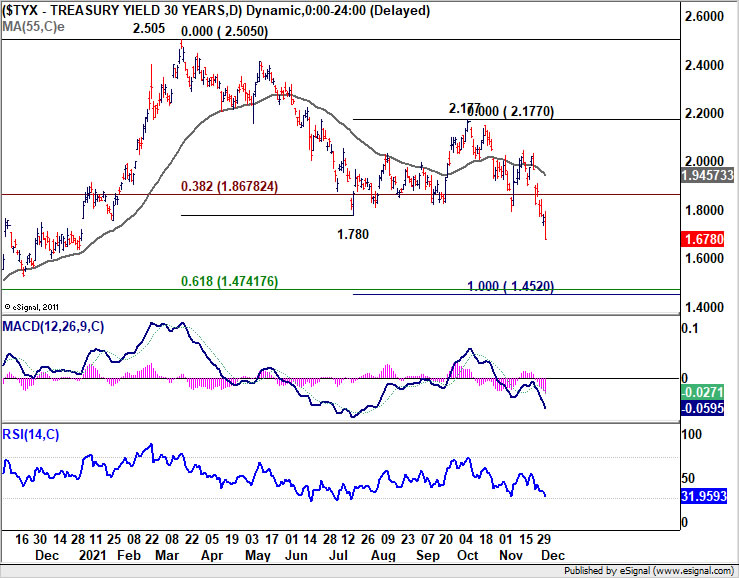
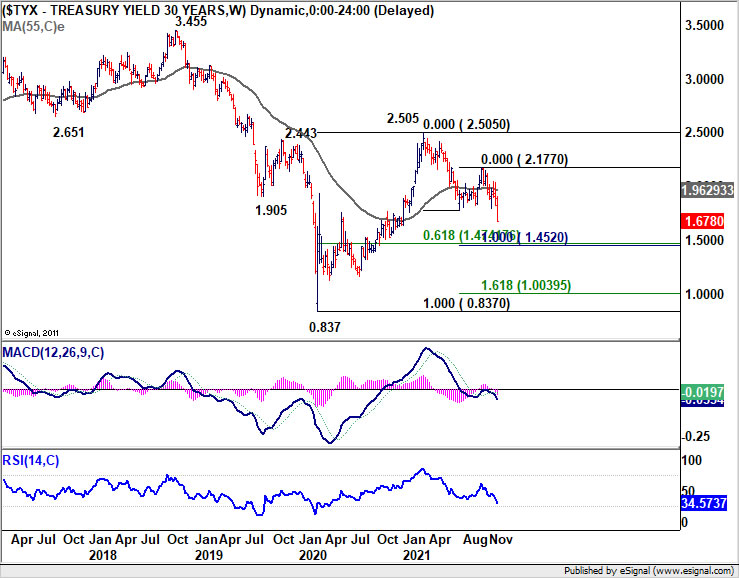
30-year yield even broke through 1.1780 support with power to close at 1.678, resuming the whole decline from 2.5050. TYX might now target 100% projection of 2.505 to 1.780 from 2.177 at 1.452, which is close to 61.8% retracement of 0.837 to 2.505 at 1.474, before bottoming.
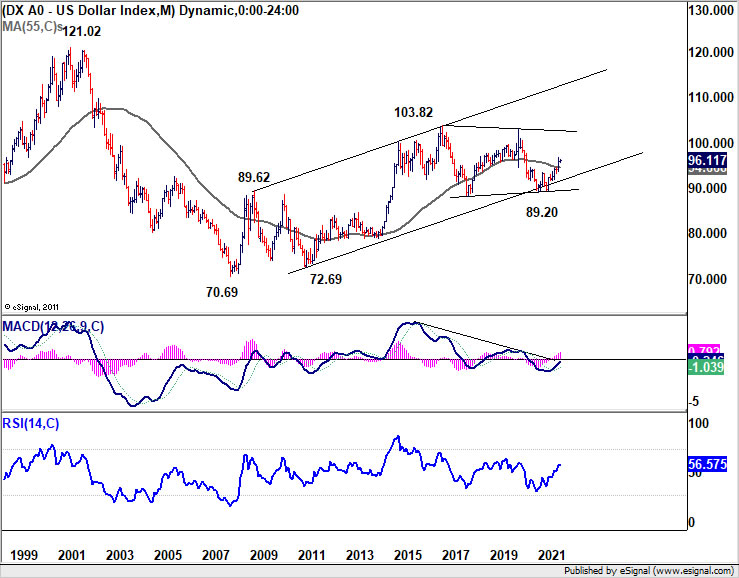
Dollar index still holding above 95.51 support as consolidations continued
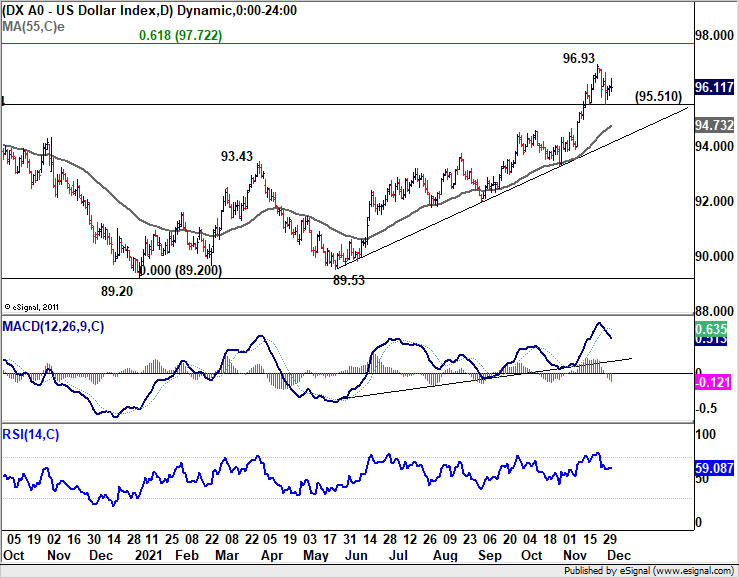
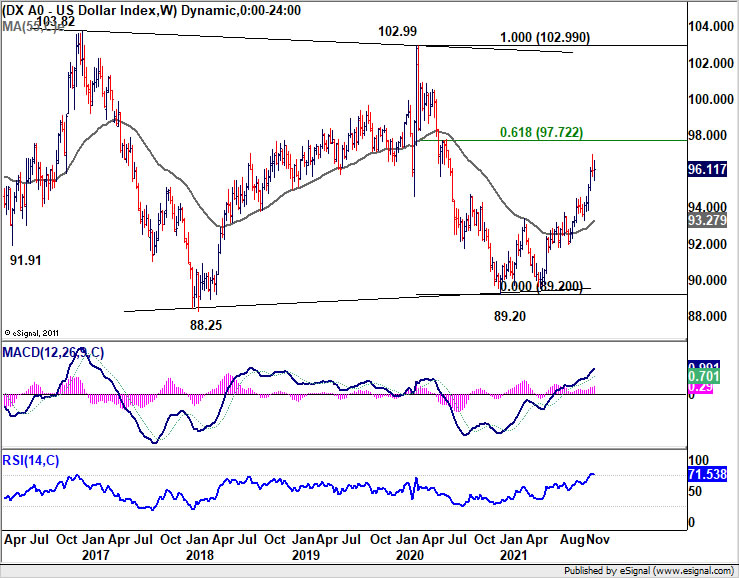
Dollar index extended the consolidation from 96.94 last week but holds above 95.51 support. The development still supports the view that it's in a near term consolidation pattern only, and recent up trend would resume sooner rather then later, to 61.8% retracement of 102.99 to 89.20 at 97.72.
However, downside risk is growing. Firm break of 95.51 will bring deeper pull back to 55 day EMA (now at 94.73), or even further to 55 week EMA (now at 93.27) before bottoming.
Still, long term outlook remains bullish as we're seeing corrective pattern from 103.82 (2016 high) as completed with three waves to 89.20 after hitting channel support. Hence, the pull back from 96.94 should be relatively "shallow" from medium term perspective.
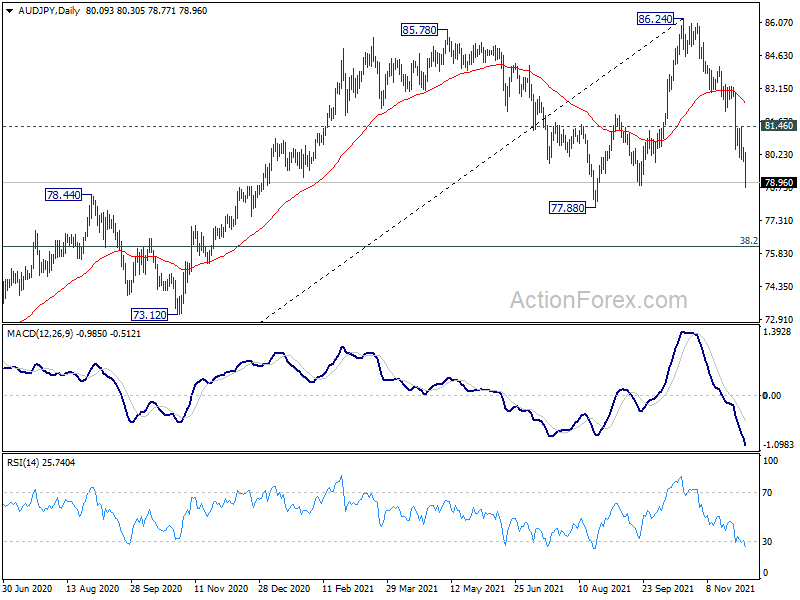
AUD/JPY accelerated lower as medium term correction took shape
AUD/JPY was among the biggest losers last week together with AUD/CHF. The downside acceleration from 86.24 affirms the case that it's already correcting whole up trend from 59.85 (2020 low). Deeper decline is expected as long as 81.46 resistance holds, to 38.2% retracement of 59.85 to 86.24 at 71.65.
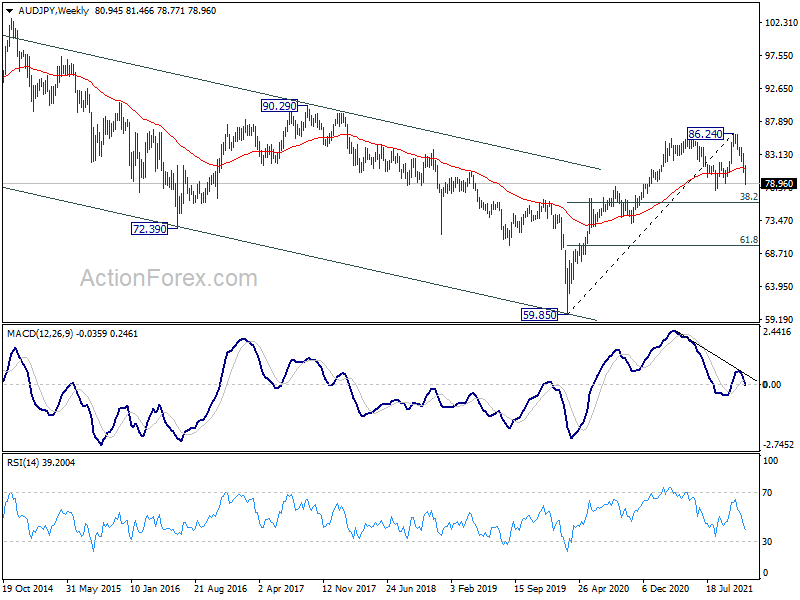
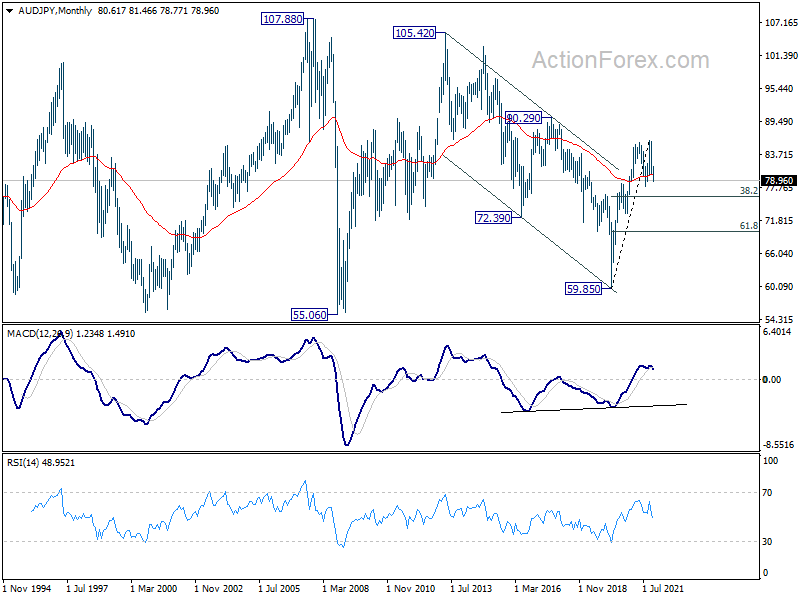
While the decline from 86.24 may extend even for the medium term, the long term outlook isn't too bearish for now. We'd holding on to the view that fall from 105.42 (2013 low) is a three wave corrective move that has completed at 59.85. Rise from 59.85 should be a long term rise in the same degree. Hence, the zone between 73.12 support and 61.8% retracement of 59.85 to 86.24 at 69.93 would be the place for accumulation for long term positions.
GBP/CHF broke 1.2259 key support as a BoE hawk turned cautious
Sterling took a dive after a known BoE hawk took a turn to a more cautious stance. He noted in a speech that "policy is not on auto pilot". He added. "The pace, and scale, of any monetary policy changes will depend on economic developments and the outlook". "In particular, at the December meeting, a key consideration for me will be the possible economic effects of the new Omicron Covid variant, and the potential costs and benefits of waiting to see more data on this before – if necessary – adjusting policy," he said.
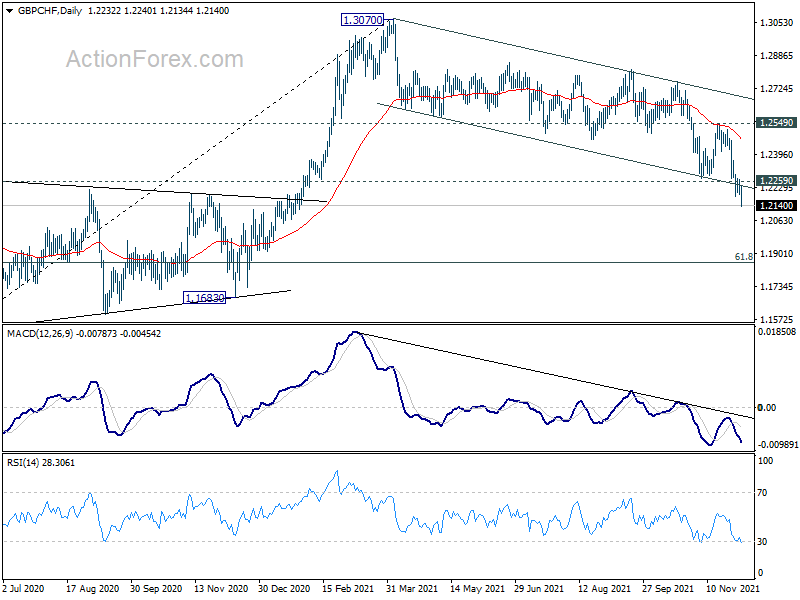
GBP/CHF finally took out 1.2259 key resistance turned support last week, with some downside acceleration too. The development now suggests that whole rise from 1.1107 (2020 low) has completed with three waves up to 1.3070. Near term outlook will remain bearish as long as 1.2549 resistance holds, for 61.8% retracement of 1.1107 to 1.3070 at 1.1857
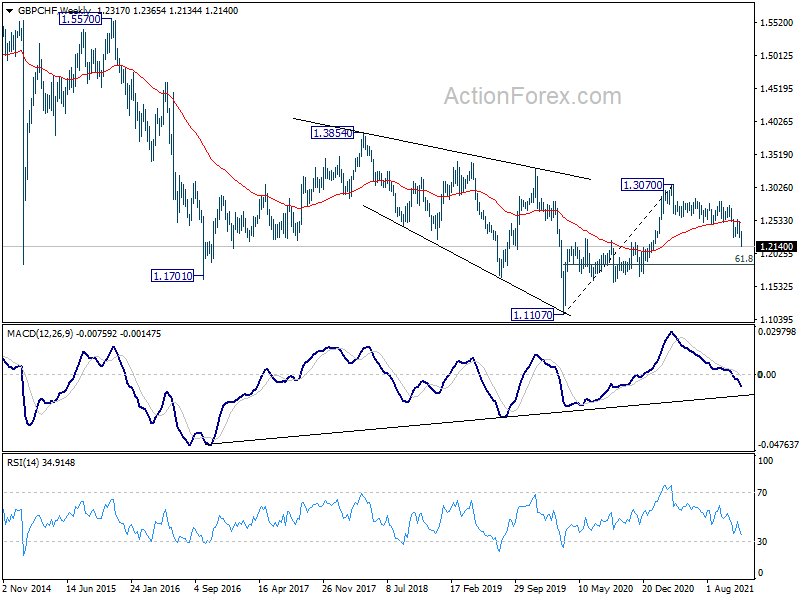
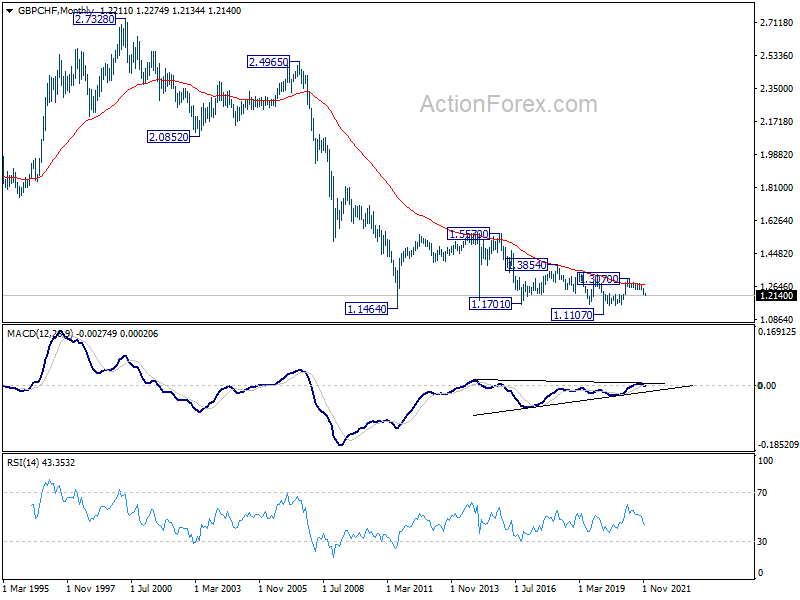
Also, it should be noted that GBP/CHF was rejected by falling 55 month EMA, keeping the long term outlook bearish. That is, a break of 1.1107 low to resume whole down trend from 2.7328 (2000 high) is plausible.
EUR/CHF Weekly Outlook
EUR/CHF's down trend extended last week and hit as low as 1.3074. Initial bias remains on the downside this week. Current fall from 1.1149 would target 161.8% projection of 1.1149 to 1.0694 from 1.0936 at 1.0200 next. On the upside, break of 1.0511 resistance is needed to indicate short term bottoming. Otherwise, outlook will stay bearish in case of recovery.
In the bigger picture, long term down trend from 1.2004 (2018 high) is now extending. Next target is 61.8% projection of 1.2004 to 1.0505 to 1.1149 at 1.0223. On the upside, break of 1.0694 support turned resistance is needed to be the first sign of medium term bottoming. Otherwise, outlook will remain bearish even in case of rebound.
In the long term picture, rejection by 55 month EMA (now at 1.1015) maintains long term bearishness. Down trend from 1.2004 is now in progress for 61.8% projection of 1.2004 to 1.0505 to 1.1149 at 1.0223. Firm break there will target 100% projection at 0.9650.
Summary 12/6 – 12/10
Monday, Dec 6, 2021
[php_everywhere instance="1"]
Tuesday, Dec 7, 2021
[php_everywhere instance="2"]
Wednesday, Dec 8, 2021
[php_everywhere instance="3"]
Thursday, Dec 9, 2021
[php_everywhere instance="4"]
Friday, Dec 10, 2021
[php_everywhere instance="5"]
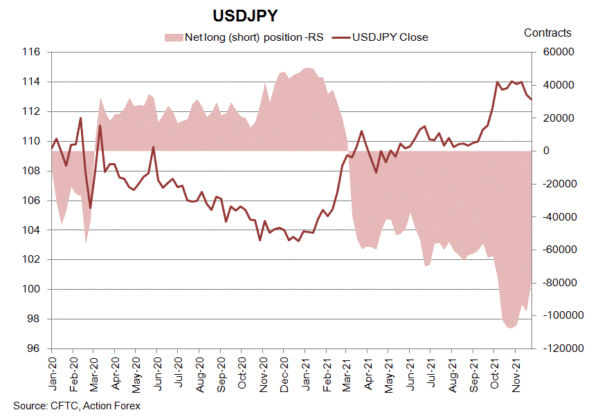
CFTC Commitments of Traders – JPY’s Net Short Trimmed Sharply on Safe Haven Demand
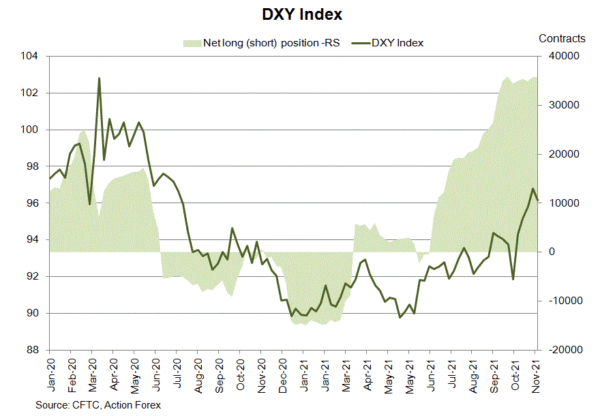
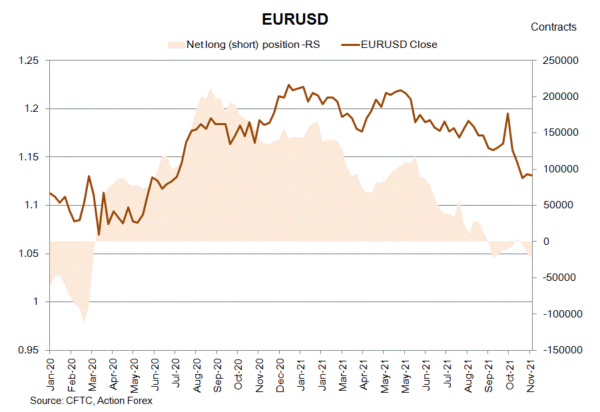
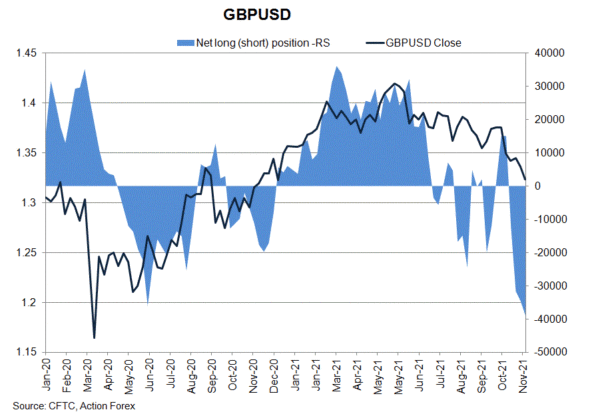
As suggested in the CFTC Commitments of Traders report in the week ended November 30, NET LENGTH of USD index futures added +104 contracts to 35 879. Bets on both sides fell further. Concerning European currencies, NET SHORT of EUR futures gained +6 788 contracts to 23 240 while that of GBP futures increased +4 320 contracts to 38 899.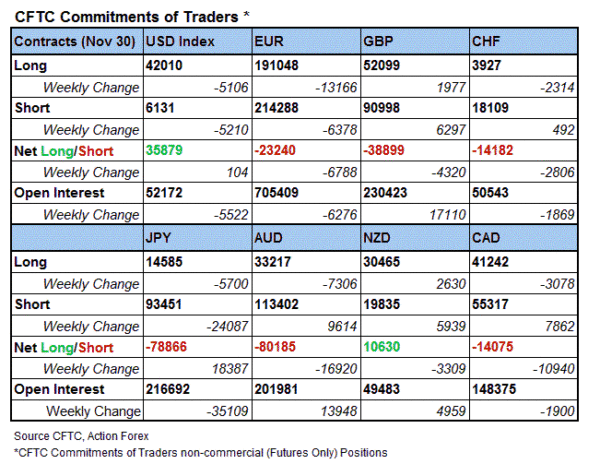
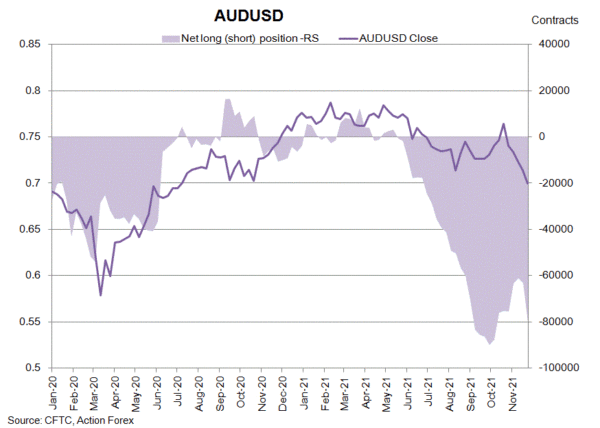
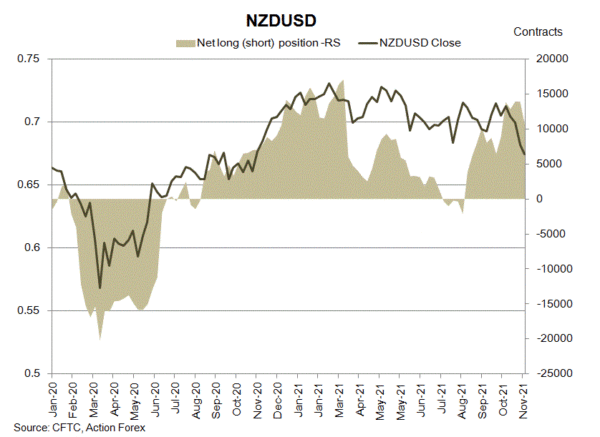
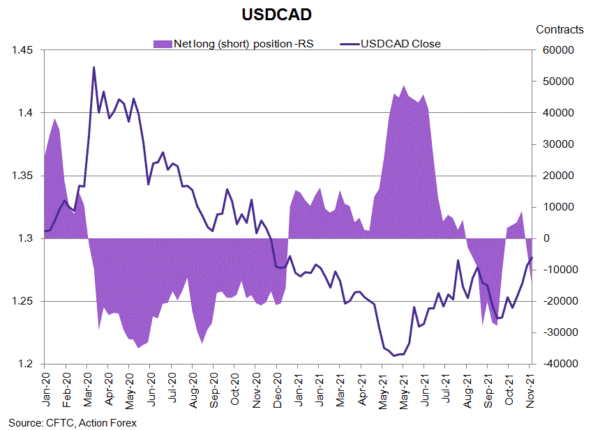
 On safe-haven currencies, NET SHORT of CHF futures gained +2 806 contracts to 14 182 while that of JPY futures slumped -18 387 contracts to 78 866. Concerning commodity currencies, NET SHORT of AUD futures jumped +16 920 contracts to 80 185. NET LENGTH for NZD futures dropped -3 309 contracts to 10 630 during the week. NET SHORT of CAD futures rallied +10 940 contracts to 14 075.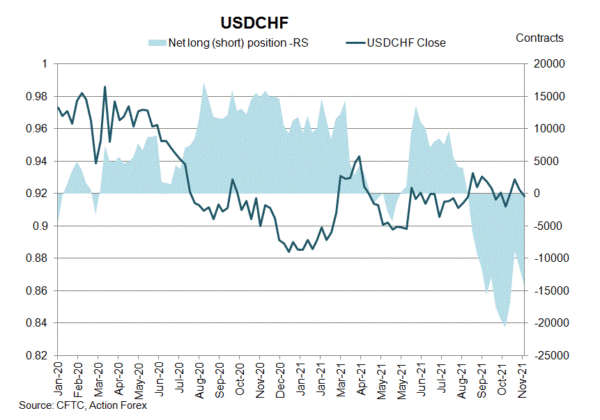
Weekly Economic & Financial Commentary: Powell Hints at Earlier Taper, but Payroll Miss & Omicron Variant Loom Large
Summary
United States: Powell Hints at Earlier Taper, but Payroll Miss & Omicron Variant Loom Large
- This week was bustling with economic news as tensions mounted surrounding the breakout of the Omicron variant. The changes in tone in Powell's comments during his testimony before Congress have economists and markets on high alert for the December 15 FOMC meeting. Meanwhile, payrolls rose less than half of the consensus estimates, although participation rose and the unemployment rate fell to 4.2%. ISM surveys pointed to strength in manufacturing and services production, while consumer confidence dipped slightly and construction spending moderated.
- Next week: Trade Balance (Tues), JOLTS (Wed), CPI (Fri)
International: Eurozone November CPI & Canada Q3 GDP Come in Hot
- The Eurozone's November CPI grew at a record pace of 4.9% year-over-year, while Canada's Q3 GDP bounced back, rising 5.4% quarter-over-quarter (annualized). In China, the November manufacturing and services PMIs both came in slightly stronger than expectations, but the outlook remains uncertain amid COVID-related restrictions and a slowdown in the real estate sector.
- Next week: Reserve Bank of India (Tues), Brazilian Central Bank (Wed), Bank of Canada (Wed)
Interest Rate Watch: Is the Fed Turning Hawkish?
- Federal Reserve Chairman Jerome Powell got the attention of market participants this week, acknowledging that "it now appears that factors pushing inflation upward will linger well into next year." The Fed Chairman also said that the Federal Open Market Committee (FOMC) may consider speeding up the pace of "tapering" of its asset purchases.
Credit Market Insights: A Recovery to Pre-Pandemic Levels in Household Credit
- Credit card application rates have now risen to their pre-pandemic levels, indicating that consumers are returning to, or even exceeding, their level of household spending from before the pandemic.
Topic of the Week: Congress Faces a Jam-Packed December Schedule
- On Thursday, Congress reached an eleventh-hour agreement on a continuing resolution (CR) that would once again avert a government shutdown for a few months. The CR agreed to this week is just the tip of the iceberg for Congress this December.
CFTC Commitments of Traders – Traders Remained Bearish over Commodity Prices amidst Omicron Uncertainty
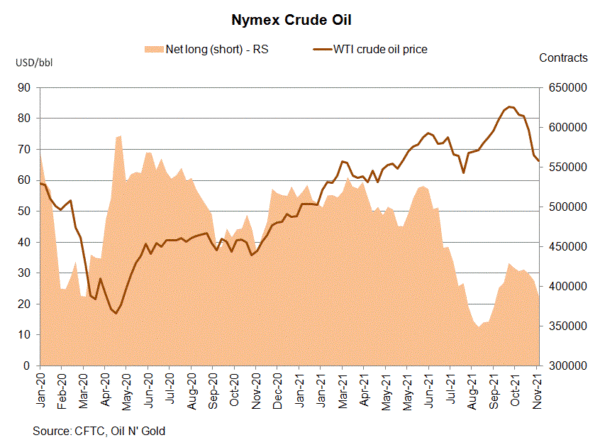
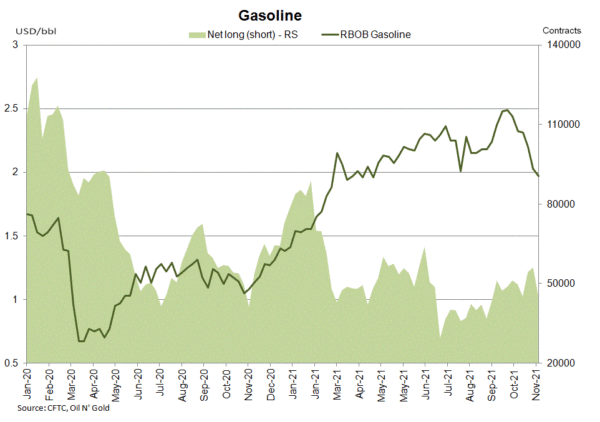
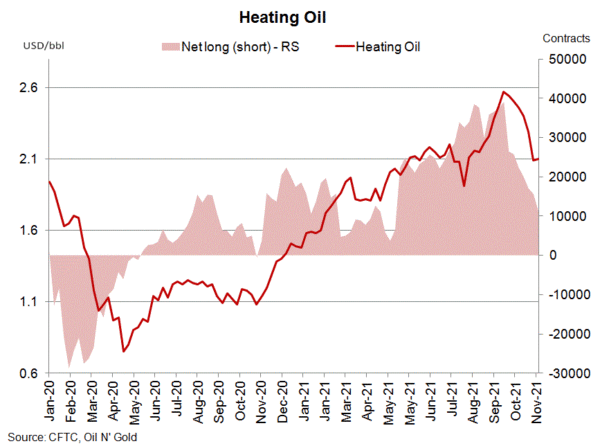
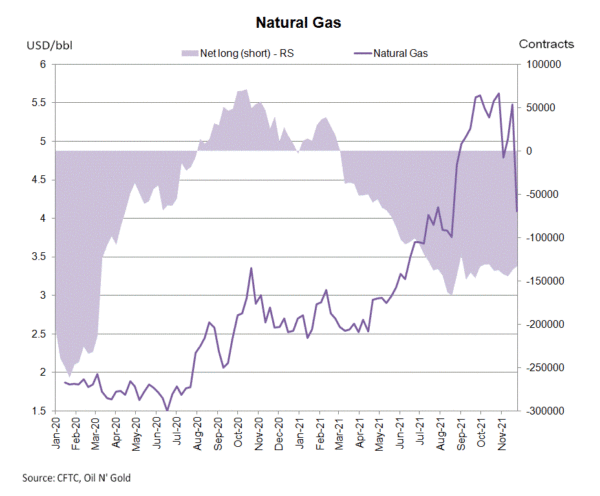
According to the CFTC Commitments of Traders report for the week ended November 30, NET LENGTH of crude oil futures slumped -20 423 contracts to 387 234. Speculative longs added +1 276 contracts while shorts soared +21 699 contracts. For refined oil products, NET LENGTH for heating oil declined -4 406 contracts to 11 225, while that for gasoline plummeted -10 380 contracts to 45 614. NET SHORT of natural gas futures dropped -4 577 contracts to 132 678 during the week.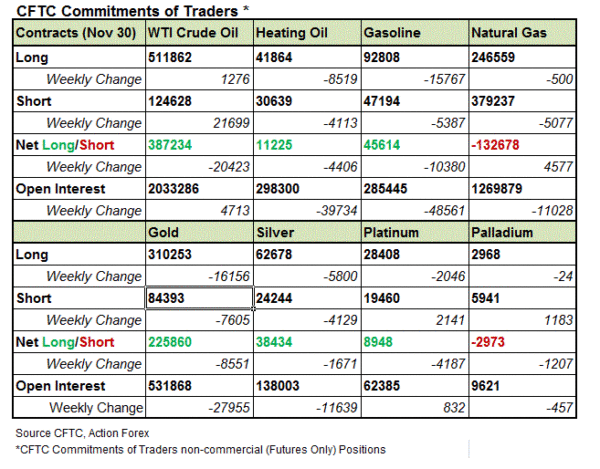
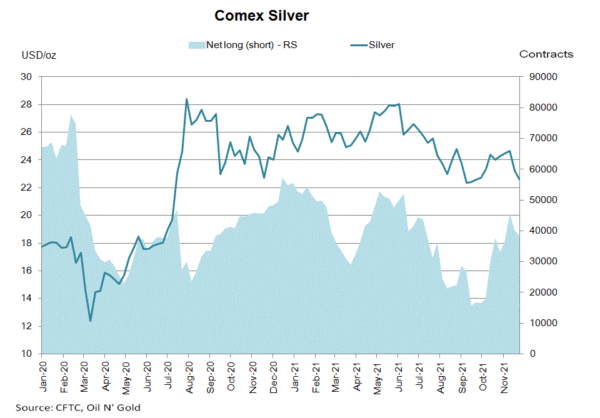
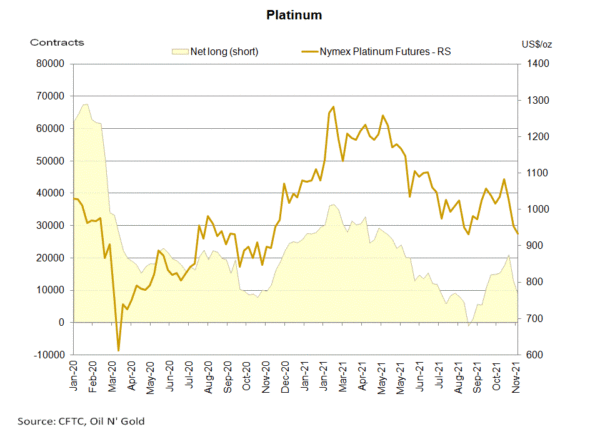
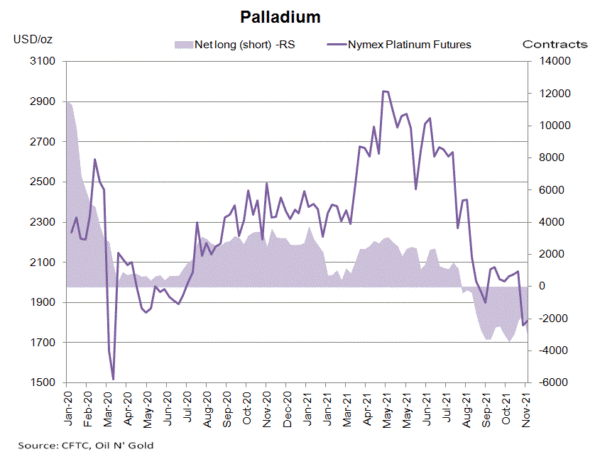
 Gold futures’ NET LENGTH sank -8 551 contracts to 225 860. Silver futures’ NET LENGTH slipped -1 671 contracts to 38 434. For PGMs, NET LENGTH of Nymex platinum futures dropped -4 187 contracts to 8 948, while NET SHORT for palladium futures added +1 207 contracts to 2 973.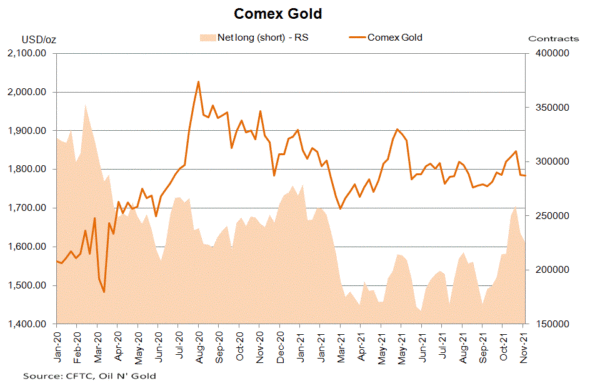
The Weekly Bottom Line: Supply Issues Easing, But Omicron Looms
U.S. Highlights
- The ISM manufacturing index showed signs of easing supply chain conditions. Supplier delivery times shortened while production, employment and new orders indexes all increased.
- This week’s payrolls report left something to be desired, but a pop in household employment and a rise in the labor force participation rate are welcome signs of a recovery in labor supply.
- While the first glimmers of abating supply side issues have emerged, the Omicron variant threatens to undo the progress.
Canadian Highlights
- Financial markets were volatile this week amid uncertainty about the impact of the Omicron variant. Equity markets ended the week lower and oil prices remained under pressure.
- The GDP and employment data released this week were upbeat. Following a slump in Q2, GDP rebounded smartly in the third quarter, advancing by 5.4% annualized. The job market delivered some additional pre-holiday cheer, with employment rising by 154k in November.
- The new Omicron variant has raised uncertainty, but with the labour market recovery nearly complete, there could be more hawkishness in store in next week’s Bank of Canada statement.
U.S. - Supply Issues Easing, but Omicron Looms
Volatility was the name of the game this week as markets whipsawed on news of the Omicron variant’s identification in the U.S., and Chairman Powell’s more hawkish stance. Inflation remains front and center as Chairman Powell retired the term “transitory” when describing recent price gains. That said, November’s data offered signs that supply chains challenges have begun to ease, offering some promise of inflation relief.
This week’s release of November’s ISM manufacturing survey gave one such signal. The report showed growth accelerating as the expansion carried on for its 18th consecutive month. The details provided further reasons for optimism. The supplier delivery times subindex remained extremely high (you have to look back to the late 1970’s to find a comparable lead time prior to the pandemic), but it pulled back for the first time in three months (Chart 1). Alone, this move doesn’t mean much, but the production, employment, and new orders indexes also all moved higher in November. An environment where production, orders, and employment growth are increasing while supplier delivery times are narrowing is a signal that some of the bottlenecks we’ve been seeing are beginning to clear.
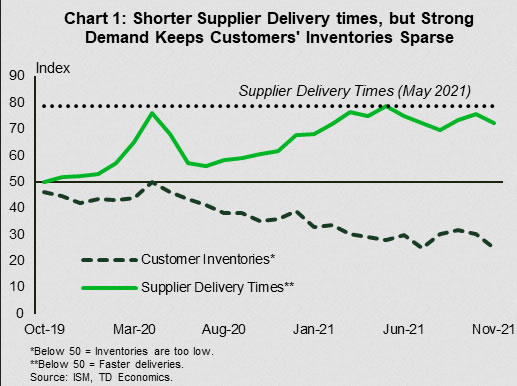
Alas, not all of the news was good. Customer inventories continue to languish at low levels and the index pulled back on the month. This is likely a reflection of continued strong demand that has left producers trying to keep up. Indeed, this month’s vehicle sales report was a reflection of those tight conditions, as monthly sales disappointed, falling to 12.9 million units (at a seasonally adjusted annualized rate). Automotive production ticked up in October, but remains well below underlying demand, which is likely closer to 1.45 million per month. This means inventories will remain scarce for the time being.
At the same time, this week’s payrolls report showed a slowing in the pace of job growth. Markets had expected north of 500k jobs to be added to payrolls, so the 210k realized in November missed the mark.
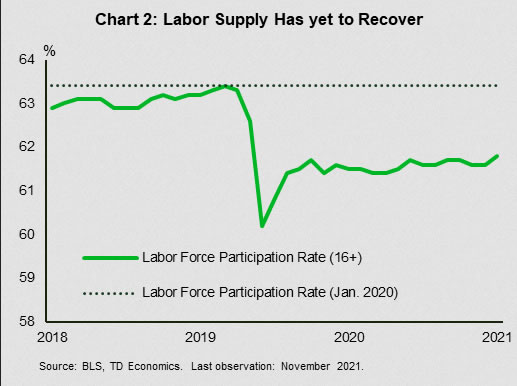
Despite the disappointing print in the payrolls report there were several reassuring details in the household survey. Household employment increased by 1.1 million people, taking the employment to population ratio up to 59.2%, and continuing its steady improvement. An additional million people working is a good sign, but the increase in the labor force participation rate is another welcome sign for the supply side of the economy (Chart 2). To alleviate reported labor shortages the number of Americans active in the labor market has to increase, and nearly 600 thousand added their names to the hat in November.
This year has been characterized by ample demand and a virus-induced supply shock that has pushed inflation to multi-decade highs. November’s data started showing us signs that the supply side of the economy has begun to recover. The data are reassuring for now, but the emergence of the Omicron variant could derail the fragile improvements that have been made. Even without lockdowns in the U.S., restrictions in less vaccinated nations, or worker fears of infection, could pinch the supply of inputs and labor, pushing prices higher.
Canada - Job Market Takes a Big Step Forward
Financial markets remained volatile this week amid uncertainty about the impact of the Omicron variant. New data seem to suggest that Omicron is more infectious and three times more likely to cause reinfections, but it is unclear if it causes more severe illness or is more likely to evade the vaccines. Given the rapidly evolving situation, equity markets seesawed throughout the week, with the TSX 1.9% lower relative to last Friday (as of writing). Omicron worries also kept a lid on oil prices, with WTI trading below $70/barrel throughout the week. Crude prices were further pressured by the OPEC+ decision to boost oil output by 400,000 barrels a day in January.
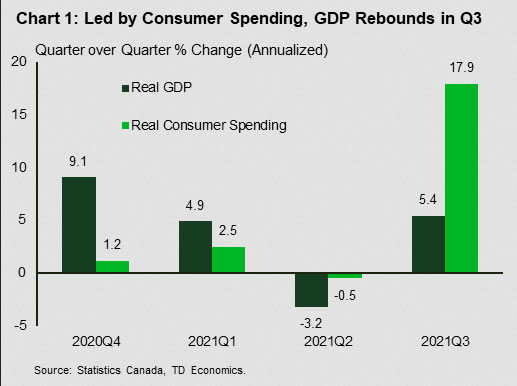
Luckily, the GDP and employment data released this week were upbeat, offering respite from the Omicron-induced drama. Following a slump in Q2, made worse by the negative revisions (-3.2% versus -1.1% previously), GDP rebounded smartly in the third quarter, advancing by 5.4% annualized (Chart 1). This left output just 1.4% shy of its pre-pandemic level. Growth was fueled by consumer spending, which rose 18% (annualized) as provinces lifted restrictions. Demand was especially strong in areas hardest hit by the restrictions, with consumers rushing to spend more on services (such as travel and dining out) and semi-durable goods (such as clothing).
Growth would have been even stronger if not for global supply chain woes, which contributed to declines in durable goods spending (due to lower car sales) and business investment. Residential investment also pulled back as new construction and renovations dropped Chart two shows the Canadian employment and participation rate for Canadians between ages of 15 to 64. The chart highlights the recovery progress in the Canadian labour market over the last two years. In particular, the employment in November of 2021 has surpassed its pre-pandemic February 2020 level by 1%. The participation rate among this age group was 80 basis points higher than in February of 2020.
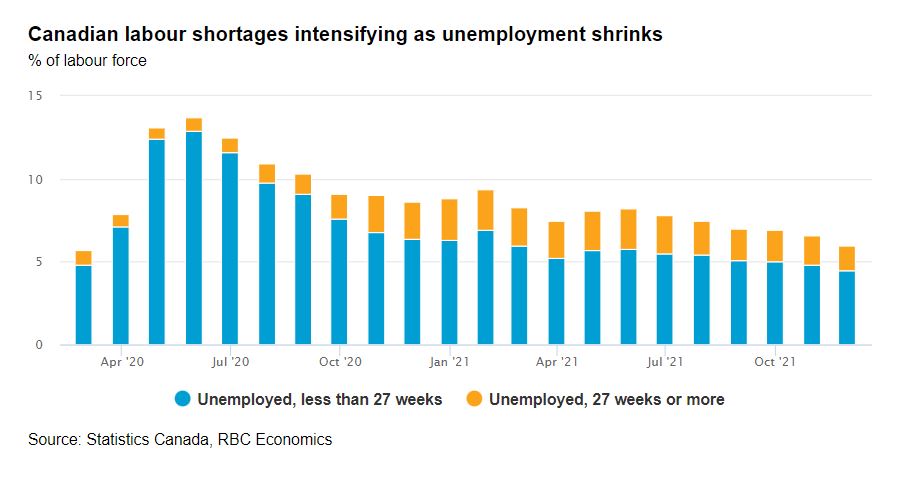
The job market also delivered some pre-holiday cheer this week (Chart 2). The labour market took a big step forward, with employment rising by 154k in November. The gains were about evenly split between full-time and part-time positions, and were led by the service sector industries, which added 127k new jobs. The rise left employment 1% above its pre-pandemic level and pushed the unemployment rate down 0.7 percentage points to 6.0%, with a noticeable drop in the number of long-term unemployed. The good news didn't end there. Total hours worked increased 0.7%, returning to its pre-pandemic February 2020 level for the first time.
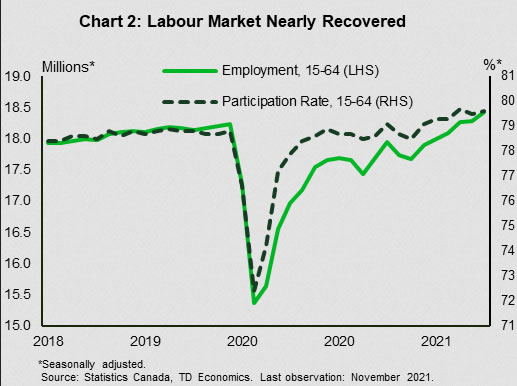
November's jobs report will be impossible for the Bank of Canada to ignore. Throughout the pandemic, the Bank emphasized it would keep the overnight rate low until the labour market recovery was complete. We’re nearly there – the unemployment rate is almost back to where it was in February 2020. Given tighter labour market conditions, stronger price pressures, and hot housing market activity, we can't discount the possibility the Bank will hike rates as early as January. Uncertainty with respect to the new Omicron variant is elevated, but barring any significant negative developments, there could be more hawkishness in store in next week's Bank of Canada statement.
Forward Guidance: Bank of Canada and Omicron Risks in the Spotlight Next Week
Virus concerns and inflation will loom over the final scheduled Bank of Canada policy decision of 2021. So far, economic data has been tracking close to the central bank’s expectations. The 5.4% (annualized) increase in Q3 GDP was almost bang-on with the 5.5% forecast in its October policy update. And though inflation is still running well above the central bank’s target, it’s broadly in line with the 4.8% Q4 CPI increase expected as of the October MPR. But labour markets have continued to improve with a much stronger than expected 154,000 jobs added in November, and at 6%, the unemployment rate is falling back closer to pre-pandemic levels.
The emergence of the Omicron variant has rattled financial markets and is a reminder that the pandemic is still not over. Inflation has also moved higher, labour markets look increasingly tight, and wage pressures are building. Demand and purchasing-power are not expected to be an issue with the household pandemic savings stockpile ballooning to nearly $300 billion as of Q3. Businesses are largely identifying labour shortages and higher input costs as more significant concerns than any shortfall in orders. The BoC might still be able to point to pockets of weakness in labour markets—long-run unemployment is still elevated, for example. But arguments to keep policy interest rates at emergency low levels are getting thin. The BoC is expected to reiterate that, barring significant further disruptions from the new virus variant, the economy is on track to fully recover by mid-2022, and that interest rate hikes will be warranted at that point. We expect the first rate hike next year to come in April.
Week ahead data watch:
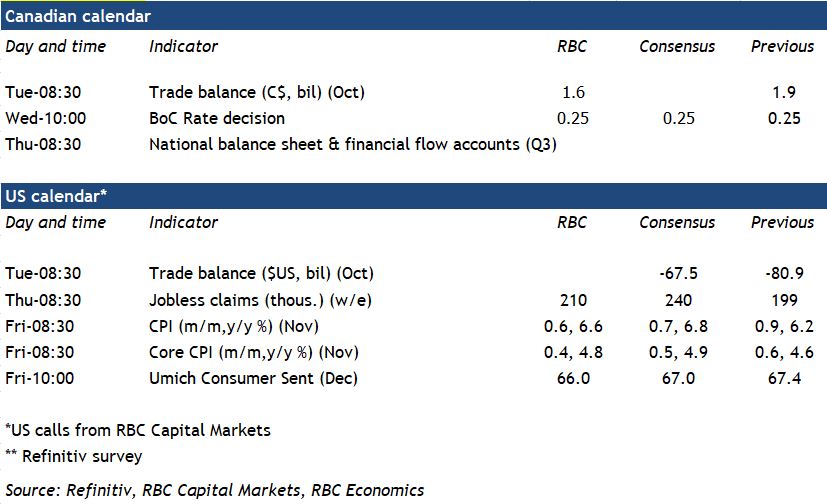
- US headline CPI inflation is primed to rise to 6.6% from a year ago in November. We expect that higher fuel prices and stronger used autos prices will put upward pressures on the monthly reading.
- Canadian household net worth likely rose further in Q3 with rising asset values offsetting increases in mortgage debt and consumer credit. Debt service ratios and the closely-watched household debt-to-income ratio are expected to tick higher but to remain well below pre-pandemic levels.
- We expect the Canadian merchandise trade surplus to narrow to $1.6B in October. A resumption of auto production after widespread shutdowns in September due to chip shortages should boost both exports and imports, while agricultural exports are expected to fall due to low crop yields in western Canada.
Week Ahead – Volatility to Remain
Omicron and central banks to dominate
The past week has been dominated by Omicron news as we all try to piece together the limited information we have and determine what it all means for the coming months. So much is still unknown and so the volatility and seesaw action we’ve seen this week may continue until we get a better idea of the threat posed by the new variant.
The RBA and BoC both hold meetings next week and will likely be armed with little more information than OPEC+ had on Thursday, which makes the job of providing reliable guidance extremely challenging. Even the Fed, ECB and BoE the week after will find life difficult and two of them were expected to announce tightening measures prior to the news of the Omicron variant.
And this is at a time when central banks have an incredibly tough job on their hands. They’re already being forced to tighten monetary policy before they would like to and may soon have to make much tougher choices if the Omicron news isn’t good.
US
The US economy is adding jobs at a slower pace as employers are starting to have success luring people back to the labor force. If wages continue to rise, that will be the key for companies to reach their hiring targets.
The November employment report showed US employers added 210,000 jobs, a miss of the 550,000 consensus estimate and well below the upwardly revised prior reading of 546,000 jobs. A headline miss with the nonfarm payroll report may be mostly attributed to seasonal factors. The underlying components make this a solid labor market report as people are coming back to the labor force, with the participation rate improving from 61.6% to 61.8%.
Wage pressures may be slowing as average hourly earnings dipped in November from 0.4% to 0.3%, but some of that could be attributed to the weakness in lower-paying hospitality jobs.
The Fed may view this as a positive employment report as minority unemployment improved significantly and the participation rate is now only 1.5 percentage points lower than in February 2020. Fed rate hike expectations are settling around two rate hikes next year. The headline jobs miss takes away momentum from accelerated tapering but allows them to increase the taper pace by $5-10billion.
EU
A relatively quiet week ahead for the euro area, with much of the headline data being revisions and ZEW figures the only notable releases. The focus is on the ECB the week after, although that will be heavily influenced by the scientific data on the new Omicron strain which will determine how the next six months will look.
UK
Much like in Europe, the UK next week sees a number of low-level economic data releases, with GDP numbers on Friday the only outlier. Meanwhile, Deputy Governor of the Bank of England, Ben Broadbent, will appear on Monday. The BoE meeting the week after is still a live one although the odds of a rate hike have slipped significantly as a result of the Omicron variant.
Russia
Russian data next week is a little thin, with CPI on Wednesday the only release.
The focus will remain on the buildup of forces on the border, with tensions rising in recent weeks and a resolution not looking close. Talks between Biden and Putin could take place in the coming weeks although no date has been set.
South Africa
Omicron cases are rising rapidly, with the rate of transmission believed to be faster than that of Delta. Early evidence appears to suggest that symptoms are mild although the sample size is small and contains a lot of younger people that reportedly make up a large number of the countries unvaccinated. Time will tell whether that trend continues.
On the economy, we have a few notable releases next week including GDP data for the third quarter on Tuesday.
Turkey
Coming off the back of another eventful week that’s seen the Finance Minister – a vocal opponent of recent rate cuts – replaced and multiple unsuccessful FX interventions by the CBRT, there should be plenty to look forward to. Currency markets are far from stable, with the lira hitting fresh lows at the end of the week and remaining under severe pressure. Next week offers unemployment data on Friday, although this will naturally fall well down the pecking order below the rants of President Erdogan and the actions of the central bank. More volatility in the FX markets and intervention to stabilise them appear likely.
China
China releases its trade balance, CPI, and PPI inflation data this week. Of the three, the market focus will be on exports and PPI for evidence of slowing growth and/or rising inflationary pressures.
Data aside, it is China’s property sector that poses the most risk in the coming week. Both Kaisa and Evergrande face final payment deadlines and in the case of Kaisa, an official default is increasingly likely. Hong Kong equities are particularly vulnerable in this case, and will likely continue to face delisting nerves in the US from dual-listed Chinese giants.
India
A firm Non-Farm Payrolls number would have turned up the heat on emerging market currencies in the week ahead as monetary policy remains out of sync with the US. The Reserve Bank of India can alleviate some of that stress in the future by finally indicating that tighter monetary policy is on the way in 2022, even if it does not move at its policy meeting on Wednesday. India releases manufacturing, industrial production, and inflation data on Friday. A high inflation print will elevate the return of stagflationary pressures if the RBI is dovish mid-week, leaving the currency and equities vulnerable.
Australia
The Australian dollar is wallowing at 2021 lows as Fed taper nerves and omicron concerns sap risk sentiment of which the AUD is a major barometer.
The Reserve Bank of Australia has its policy meeting on Tuesday with its ultra-dovish mantra suffering credibility issues. No change in tone from the statement will deepen pressure on the currency, although local equities will continue chasing their tails in line with Wall Street volatility.
New Zealand
The NZD/USD, a risk sentiment barometer for global markets like AUD/USD, is also testing 2021 lows and remains vulnerable to stronger US data increasing Fed-taper nerves, as well as risk aversion flows via NZD/JPY on omicron.
Friday’s Business PMI could negatively impact the currency if it is higher than forecast, increasing the noise that the RBNZ is falling further behind New Zealand’s rapidly escalating inflation problem.
New Zealand’s government has eased Covid-19 restrictions in Auckland and brought in a new system of freedoms/restrictions across the country. A large spike in delta cases (the prevailing variant) could negatively impact the currency and stock market.
Japan
The Japanese Yen has rallied 250 points this week versus the US Dollar on omicron haven flows, also recording impressive gains via the Yen crosses. Yen’s rally is entirely based on omicron, and an easing of those tensions and firmer US data could see USD/JPY’s rally resume.
Japanese equities continue to show a high correlation to Nasdaq moves and we expect volatile, but directionless trading to continue as the Nasdaq and Nikkei bounce around on omicron headlines. No significant data.
Key Economic Events
Saturday, Dec. 4
- China central bank Governor Yi Gang and Guo Shuqing, chairman of the country’s financial regulator speak at the International Finance Forum in Guangzhou.
- France’s Republican party is expected to announce its presidential candidate
- Germany’s Social Democrats (SPD) to announce its ministry posts and votes on the deal for the incoming coalition government.
Economic Data/Events
- Thailand consumer confidence
Sunday, Dec. 5
Economic Data/Events
- World Petroleum Congress starts in Houston.
- Germany’s Free Democrats (FDP) vote to approve the incoming government’s coalition deal.
Monday, Dec. 6
- Russia President Vladimir Putin visits New Delhi
- BOE’s Broadbent speaks at Leeds University about the outlook for growth and monetary policy.
- Sweden’s Riksbank publishes the minutes of its Nov. 24 meeting.
- Turkish President Recep Erdogan travels to Qatar for a regular bi-lateral visit
Economic Data/Events
- Germany factory orders, construction PMIs
- Greece GDP
- New Zealand construction work value, ANZ commodity prices
- Australia inflation gauge, ANZ job advertisements
- Italy retail sales
- Turkey effective exchange rate
- UK construction PMIs
Tuesday, Dec. 7
- Greek PM Mitsotakis visits Russia to meet President Putin.
Economic Data/Events
- US Trade
- China Trade
- Eurozone GDP: Eurozone
- South Africa GDP
- Sweden GDP
- Australia rate decision: Expected to keep cash rate target at 0.10%
- Australian consumer confidence, house price index
- South Korea BoP
- Taiwan CPI
- Japan cash earnings, household spending, leading index
- Philippines CPI, unemployed
- Singapore foreign reserves
- China foreign reserves
- Australia foreign reserves
- Switzerland foreign reserves
- Germany ZEW survey expectations, industrial production
- Mexico international reserves
- South Africa gross and net reserves
- Turkey cash budget balance
Wednesday, Dec. 8
- Olaf Scholz becomes German chancellor.
- ECB President Lagarde speaks at the Fifth ESRB annual conference.
Economic Data/Events
- Canada Rate decision: Expected to keep Interest Rate unchanged at 0.25%
- Poland Rate decision: Expected to raise rates by 50 basis points to 1.75%
- India Rate decision: Expected to keep Repurchase Rate unchanged at 4.00%
- Russia CPI
- Hungary CPI
- Japan bank lending, BoP, GDP, bankruptcies
- South Africa retail sales, SACCI business confidence
- Bank of France industry sentiment indicator
- EIA crude oil inventory report
Thursday, Dec. 9
- Fed’s Kashkari speaks
- Reserve Bank of Australia Governor Philip Lowe speaks at Payments Summit 2021.
Economic Data/Events
- US wholesale inventories, initial jobless claims
- Hungary Rate decision: The central bank is expected to deliver another 20bps rate hike.
- Germany Trade
- Hungary Trade
- China CPI, PPI, money supply, new yuan loans, aggregate financing
- Japan money stock, machine tool orders
- Thailand foreign reserves, forward contracts
- Mexico CPI
- New Zealand ANZ heavy traffic index, manufacturing activity
- South Africa manufacturing production, current account, mining, gold, and platinum production
- Turkey non-resident bond holdings, foreigner net stock invest
- Russia gold and FX reserves
- UK RICS house price balance
- Norway GDP
Friday, Dec. 10
Economic Data/Events
- US Nov CPI M/M: 0.7%e v 0.9% prior; Y/Y: 6.7%e v 6.2% prior, University of Michigan Consumer Sentiment: 68.0e v 67.4 prior
- G-7 foreign ministers meet in Liverpool, UK
- Germany CPI
- UK GDP, BOE inflation attitudes survey, Industrial Production
- India Industrial production
- Mexico Industrial Production
- New Zealand card spending, manufacturing index, home sales
- Japan PPI
- China FDI
- Russia trade, money supply
- Turkey unemployment, expected inflation for next 12 months
Sovereign Rating Updates
- Czech Republic (Fitch)
- Spain(Fitch)
- United Kingdom (Fitch)
- Austria(Moody’s)
- Netherlands (Moody’s)