Sample Category Title
Asian Markets Mixed
Weaker omicron hopes lessen Friday fallout on Asian equities
Asian equities are having a mixed day today after US index futures rallied this morning in hopes that omicron is a milder variant. That came after another torrid Wall Street session, where mixed signals from US employment data led to higher Fed tapering nerves mixed in with negative omicron sentiment. On Friday, the S&P 500 fell by 0.84%, the Nasdaq slumped by 1.92% and the Dow Jones outperformed, falling just 0.19%. A faster Fed taper and early rate hikes clearly benefit value versus growth at the moment, with the US yield curve flattening once again.
An abrupt reversal has occurred on initial reports that omicron is a weaker variant. Dow Jones futures have jumped by 0.65% today, while S&P 500 futures are 0.50% higher, with Nasdaq futures lagging, rising just 0.15%. It seems that positive omicron news will be expressed further by value outperforming growth against the background of a more hawkish FOMC.
That has taken the edge of Asian markets as well with the Nikkei 225 falling just 0.45% today, led by a 9.0% slump by Softbank. South Korea’s Kospi, by contrast, is 0.10% higher. Mainland China is outperforming after comments from officials and press over the weekend raised expectations of an imminent RRR cut and more lending. China’s “national team’ may also be around, “smoothing” markets. That sees the Shanghai Composite rising by 0.65% today, with the CSI 300 climbing 0.35%.
Hong Kong markets are enduring a torrid session with China big-tech stocks being hammered once again on delisting and crackdown nerves. Evergrande’s day of truth sees it trading 10% lower as well. The Hang Seng is down by 1.20%.
Regionally, Singapore is 0.80% higher, whiles Kuala Lumpur has fallen by 0.45% and Jakarta has risen by 0.55%. Taipei is 0.30% lower, with Manila rising by 1.20% and Bangkok falling 0.45%. Australian markets have also edged lower, the ASX 200 easing by 0.15%, and the All Ordinaries moving 0.30% lower.
Hong Kong aside, the positive omicron headlines, have encouraged Asian buy-the-dippers back into the market today, albeit unevenly. European markets are likely to seize on the omicron-is-weaker hopes as well and I expect Europe and the UK to open quite positively this afternoon. As ever, market direction and sentiment remains fragile. Although markets are desperate to grasp at any straws of hope on the virus front, we are one headline away from the straw being taken from our grasp and direction changing abruptly.
Equities Perk Up As Omicron Panic Eases, Fed Liftoff In Focus
- Positive start for US and European stock futures, Asia mixed as mood brightens
- But still plenty of caution amid Omicron unknowns and central bank policy shifts
- Busy week lined up - US CPI the highlight; dollar edges higher
Is the Omicron scare over?
After a gruesome two weeks, US equities may be at a turning point as markets digest the growing expectation that the Fed will remove stimulus at a faster pace and amid encouraging signs that the Omicron variant is not as perilous as first feared. Stocks globally got stuck in a selling frenzy after Fed chief, Jerome Powell, indicated he was on board with the idea of accelerated tapering, with the emergence of the Omicron variant and subsequent imposition of travel restrictions further pummelling stocks.
However, whilst the panic over the new Covid strain may now have been overdone, the bond market reaction to the latest virus scare has only underscored the diverging outlook on short- and long-term interest rates. Investors still think the Fed is likely to end its bond purchases much sooner, probably in March, and raise rates in May. The odds for an even earlier liftoff, possibly in March, are also quite high.
Long-term Treasuries defy hawkish Fed
Yet, long-term rates have slid quite sharply over the past two weeks, with the 10-year Treasury yield hitting a more than two-month low of 1.335% on Friday. This has been the silver lining for stocks with bloated valuations that are the most sensitive to increases in long-term borrowing costs as the assumption is that early action on rates will avert the need for steeper hikes in the future.
The biggest risks now are that markets become too complacent again about the virus threat should fears about the Omicron outbreak recede further, or if the Fed turns too hawkish and sets itself on autopilot for a Spring liftoff in spite of the heightened Covid risks.
For the moment, however, this could be another buy the dip opportunity, with S&P 500 futures gaining 0.7% in early European trade and the FTSE 100 and Xetra DAX up a similar amount shortly after their open.
Dollar marches on after strong ISM; China worries persist
In Asia, however, the mood improved only marginally as concerns about China’s economic growth prospects continued to weigh. Evergrande’s never-ending woes and authorities’ ongoing regulatory onslaught on the tech sector are clouding the outlook for the region. Reports that China’s central bank could soon cut the reserve requirement ratio again did little to lift sentiment as investors doubted whether the modest loosening of monetary policy would be enough to kickstart the world’s second largest economy.
In contrast, US economic growth remains robust. Although Friday’s payrolls numbers for November were quite disappointing, the ISM non-manufacturing PMI for the same period hit an all-time high. The employment component also rose while the prices paid index stayed elevated, putting the spotlight on the next CPI report due this Friday.
With the Fed subtly ditching its transitory narrative on inflation, a rate hike in March or May is looking more and more likely and this is helping the US dollar extend last week’s gains even as risk appetite recovers slightly today.
Aussie and loonie climb ahead of central bank decisions
Elsewhere, the euro was struggling, slipping back below $1.13 after the ECB’s Lagarde on Friday reinforced her dovish stance, though the pound managed to recoup some of its losses.
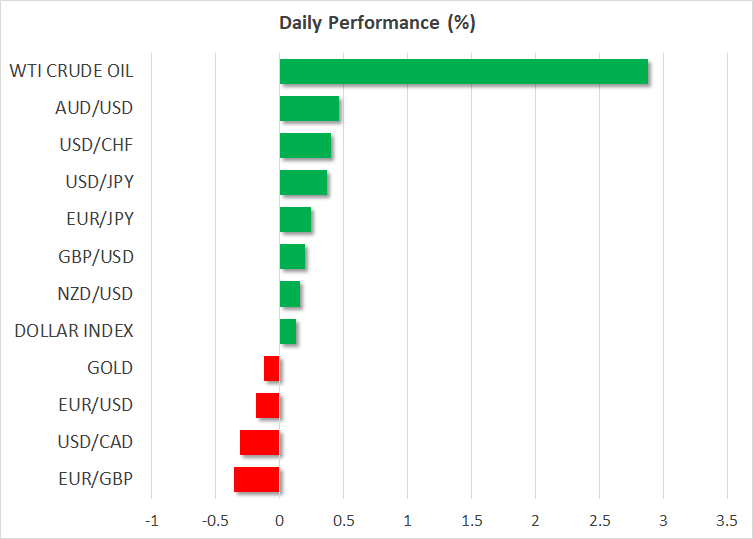
The safe-haven Japanese yen fell across the board and the Swiss franc was another big loser on Monday, while the riskier commodity-linked currencies shined.
The Australian dollar outperformed its peers, boosted by domestic data showing there was a jump in November jobs advertisements – a sign that the labour market is recovering strongly as virus restrictions are eased.
The Canadian dollar was not far behind, firming to around C$1.28 to the greenback after Friday’s massive rise in employment.
Both the Reserve Bank of Australia and Bank of Canada meet this week, on Tuesday and Wednesday, respectively. The RBA meeting likely poses some downside risks for the aussie as the Omicron outbreak gives policymakers an excuse to push back on early rate hike expectations. But the loonie is at risk of a hawkish surprise as the BoC bring forward its rate hike timeline.
UK 100 Attempts To Rebound
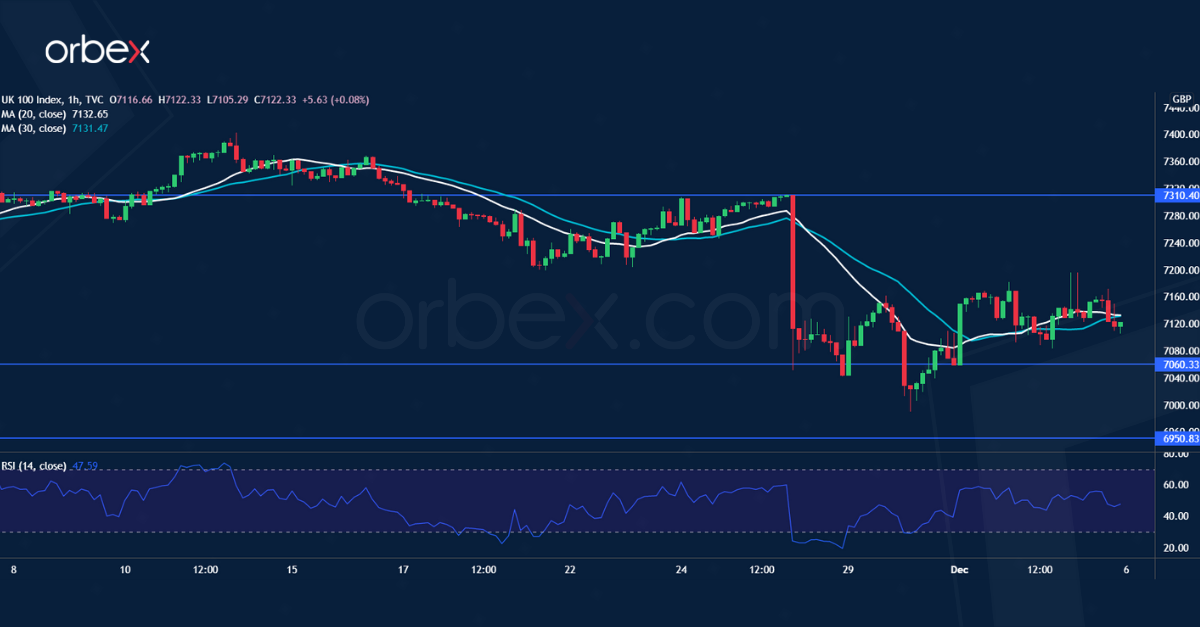
The FTSE 100 recouped some losses bolstered by a weaker US jobs report. The index saw buying interest over the psychological level of 7000 which sits in the daily demand zone.
The RSI’s double-dip in the oversold area has attracted a ‘buying-the-dips’ crowd in this congestion area. A close above the immediate resistance at 7150 is an encouraging sign of a bullish attempt.
7310 is a major hurdle ahead, its breach could short circuit the correction. 7060 is the closest support in case of weakness in the rebound.
CAD/JPY Breaks Higher
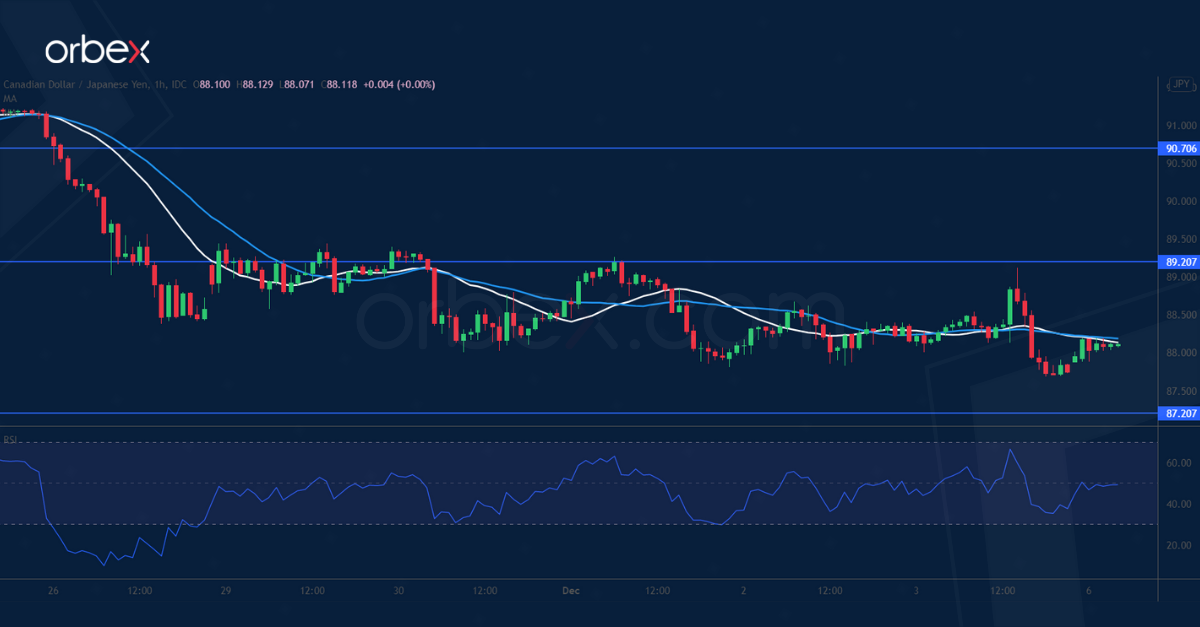
The Canadian dollar surged after November’s unemployment rate fell to 6%. A bearish MA cross on the daily chart still indicates a pessimistic mood.
An oversold RSI on the hourly chart caused a limited bounce as short-term traders took profit. Sellers are eager to fade rebounds with the latest being at 89.20, 87.20 at the base of the October rally would be the next support.
A deeper correction may send the loonie to 85.90. The bulls will need to lift said resistance before they could initiate a reversal.
USD/CHF Struggles To Bounce
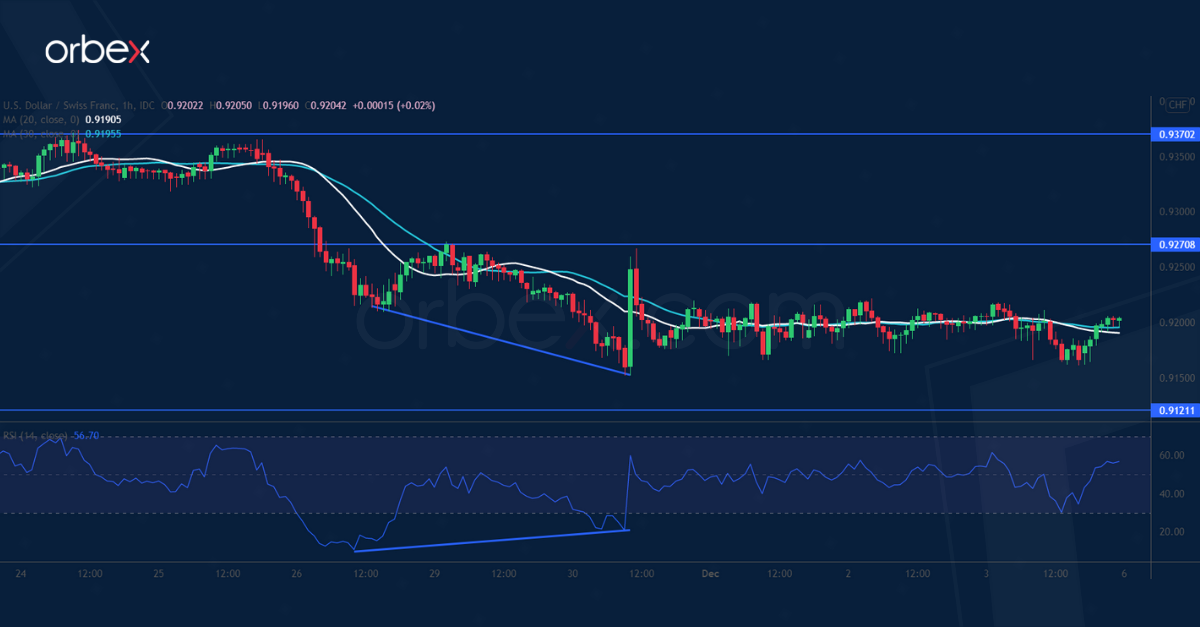
The US dollar softened after November’s nonfarm payrolls missed the mark.
The pair has met stiff selling pressure at 0.9270, a former support that had turned into a resistance. The bullish RSI divergence suggests a slowdown in the sell-off though there is no confirmation yet for a sustainable bounce.
0.9120 is a key demand area on the daily timeframe and a bearish breakout would invalidate the November rebound. Buyers may switch sides as sentiment further deteriorates, exacerbating volatility to the downside.
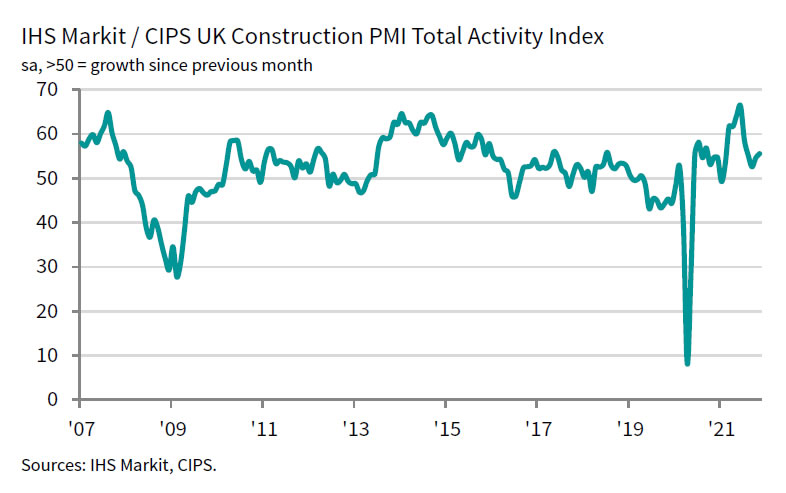
UK PMI construction rose to 55.5 in Nov, faster growth and softer inflation
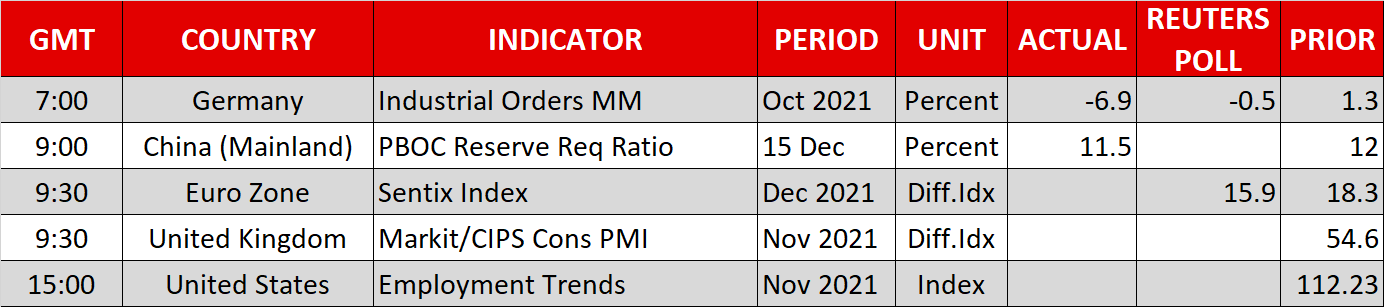
UK PMI Construction rose from 54.6 to 55.5 in November, above expectation of 52.0. Markit noted recovery was led by robust and accelerated rise in commercial work. Numbers of firms reporting suppliers delays continued to ease. In put costs inflation dipped to seven-month low.
Tim Moore, Director at IHS Markit: "November data highlighted a welcome combination of faster output growth and softer price inflation across the UK construction sector.... Input price inflation remains extremely strong by any measure, but it has started to trend downwards after hitting multi-decade peaks this summer... Port congestion and severe shortages of haulage capacity were again the most commonly cited reasons for longer lead times for construction products and materials."
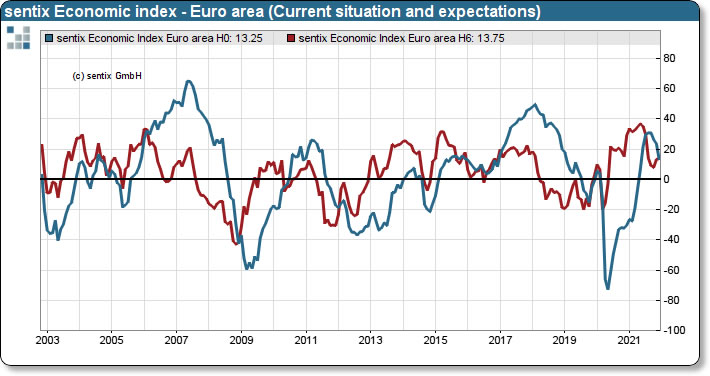
Eurozone Sentix investor confidence dropped to 13.5, risks are increasing
Eurozone Sentix Investor Confidence dropped from 18.3 to 13.5 in December, missed expectation of 15.9. That's also the lowest level since April. Current Situation Index dropped for the third straight month from 23.5 to 13.3, lowest since May. Expectation Index, on the other hand, improved slightly from 13.3 to 13.8.
Sentix said that hopes of an end to the economic slowdown "have been abruptly dampened" by the latest Sentix data. Lockdown measures in Germany and Austria are "putting a considerable damper on current economic activity".
It added: "Our basic scenario of a 'mid-cycle slowdown', i.e. a consolidation in the middle of a cycle, does not have to be abandoned yet. But the risks are increasing! It is also interesting that our thematic analysis reveals an increasingly negative influence of central bank policy. While a continued expansionary monetary policy is likely to fuel inflation in particular, a shift to a restrictive course would obviously be burdened by liquidity constraints. The ECB thus seems to be definitively 'behind the curve'. The risks for markets and the economy are increasing.
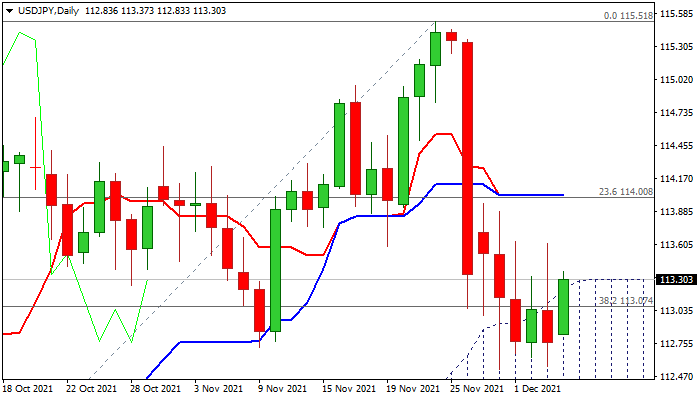
USD/JPY Outlook: Fresh Strength Needs Close Above Daily Cloud To Lessen Downside Risk
The pair traction and probes above daily cloud after being congested in past three days.
Rising and thickening daily cloud underpins the action which needs close above cloud top (113.29) to strengthen near-term structure generate initial signal of formation of a higher base at 112.50 zone.
The signal will be confirmed on rise and close above 114.02 (50% retracement of 115.51/112.53 pullback / converged daily Tenkan / Kijun-sen).
Mixed daily MA’s and strengthening negative momentum require caution, as the pair may remain within current congestion on failure to break above daily cloud that would keep the downside vulnerable, but slight positive alignment can be expected on close above broken Fibo support at 113.07 (38.2% of 109.11/115.51) after the pair registered three consecutive daily closes below this level.
Res: 113.67, 114.02, 114.37, 114.69.
Sup: 113.07, 112.83, 112.53, 112.31.
Mild Symptoms
US equity index futures are performing another omicron U-turn this morning, limiting the fallout in Asian markets of another fairly gruesome Wall Street session on Friday. The driver of the whip-saw return of serve omicron headline tennis comes from South Africa, where an article from the South African Medical Research Council, suggests that omicron symptoms were milder than previous incarnations, with hospitalised patients mostly having comorbidities. Of course, the sample size is small, but markets never let “the data” these days get in the way of narrative. Omicron variant milder = U-turn = buy everything.
Asia, having suffered so greatly in the delta wave, is understandably more cautious and now is also coming to grips with the reality of the Federal Reserve taper as well as China’s “shared prosperity,” property sector and tech-saga travails. It is no surprise that regional investors have refused to join in North America’s virus ping pong price action unless you are a retail FOMO-gnome inhabitant of Japan’s Nikkei, and South Korea’s Kospi.
US NFP underperforms
Last Friday’s US Non-Farm Payrolls was dismal, adding just 210,000 jobs with a modest upward revision of 82,000 jobs to the October data. The soft data turned into a nil-all draw for markets though as the household employment data suggested 1.1 million jobs had been added, sending the unemployment rate plunging from 4.60% to 4.20%. There are still 10 million open jobs in America and the National Federation of Independent Business survey shows small businesses are crying out for workers. The participation rate remains a dire 61.80%, even as ISM Non-Manufacturing PMI and Business Activity, Employment sub-indexes outperformed.
The truth about employment clearly lies somewhere between the two headline numbers with the household survey likely more prone to exaggeration. Nevertheless, it seems clear that either the workforce has shrunk dramatically through early retirements for example, or Americans are so much wealthier, thanks to the Federal Reserve pimping up asset prices, that they feel no need to immediately return? In this respect, the Fed may have accidentally shot itself in the foot. Such is life in economics, cause, and effect.
Net-net, the overall data impact on Friday didn’t change the narrative surrounding a fast Fed taper and markets have now priced in two rate hikes by late 2022. Apart from allowing markets to fret over omicron into the end of the week, faster tapering and rate hikes impacted tasty valuations of tech stocks, but also lifted the US dollar. The US bond market continues to behave interestingly though, with the curve flattening instead of steepening, as bond markets price in faster, but lower terminal rates from the FOMC, and remaining comfortable that the Fed has medium/long-term inflation under control.
Things are going to get very interesting if that narrative changes and its first challenge could come this Friday if US CPI prints at 7.0%+ YoY. Secondly, if more omicron outlooks hit the street this week suggesting it is more contagious but less aggressive, you can reasonably assume we have seen the lows in USD/JPY and USD/CHF and oil, but I suspect technology will still struggle at the expense of the denizens of the Dow Jones and Russel 2000. ASEAN will probably be the winner as well versus North Asia.
Of course, China issues have not disappeared and despite reassuring words from various state organs regarding China company US listing over the weekend, nerves surrounding China big-tech will continue. The property sector faces another reckoning this week as well after Evergrande announced on Friday it had received a USD 260 million repayment demand, and that it could not guarantee it would be able to meet liabilities going forward. That led to the Guangdong local government “sending in a team” to help manage operations. Evergrande and Kaisa face offshore payment deadlines today and tomorrow as well. There is still plenty of juice in this story into the year-end, with Hong Kong markets probably the more vulnerable. What has likely changed is that the odds of a RRR cut by the PBOC have ramped up.
The data calendar is mostly second-tier this week in Asia except for the Reserve Bank of Australia and India’s latest policy decisions. Directional moves will be dominated by omicron, Evergrande/Kaisa and Friday’s US CPI data, ahead of a central bank policy decision frenzy around the world next week.
Today’s ANZ Job Advertisements, which rose by 7.40% MoM in November, is unlikely to sway the RBA from its ultra-cautious, release the doves, course. The policy statement will be the more interesting, with markets searching for signs of wavering of that course from the RBA. They are likely to be disappointed with omicron community infections in Australia leaving the central bank’s finger glued to the W for Wimp button. The RBI’s policy decision will be more interesting. Rates will remain unchanged, but with stagflation, I mean inflation, moving higher recently, the RBI may signal a rate hike or two are coming. That will be another headwind for local equities, although the rupee may gain some support, assuming the RBI doesn’t provoke a stampede of international fast money out of local equities.
Oil is on the move today as well, with Saudi Arabia raising January prices to Asian and US customers by USD 0.60 a barrel over the weekend, although it cut official selling prices (OSPs) to European customers. Technically, that will make other grades of oil from other producers around the world more appealing to Asian buyers, but Brent crude and WTI are up by 2.0% today anyway. Given that OPEC+ is proceeding with its planned 400,000 bpd increase this month, it appears that Saudi Arabia is taking a punt that omicron is a virus in a teacup. Saudi Arabia’s confidence, along with the South African omicron article over the weekend, is a boost to markets looking for good news in any corner they can find it.
The section where Jeff talks about bitcoin
Finally, one “asset class” that didn’t enjoy any good news was the crypto space. Fresh from Singapore banning a local crypto exchange for promoting a coin illegally associated with a South Korean boy band, yep, cryptos are a maturing market with more institutional participants, bitcoin and ether slumped by around 20% on Saturday, before recovering over half of those losses. I am at a loss to why this happened, but I’ll take a wild guess. Cryptos trade in little islands of liquidity on centralised exchanges; there is not one venue aggregating liquidity. A large leveraged position or two had margin calls on Saturday, and the resulting selling triggered a perfect storm amongst other long positions in a low liquidity time period in isolated liquidity venues. Arbitrageurs would have had a field day. The automated “market makers” did what they do in any other asset class when the going gets tough, disappeared. (insert flash crash/asset class here)
Because cryptos are a rapidly maturing mainstream asset class, I applied an appropriately scientific approach to the problem. I did a voodoo dance threw chicken entrails into the air. When the chicken entrails landed, otherwise known as technical analysis, it actually suggests Saturday’s sell-off was in fact bullish. Bitcoin’s plummet to USD 42,000.00 was very near to the 61.80% Fibonacci retracement of the January to November rally. The 200-day moving average at USD 46,400.00 also held on a closing basis. I’m not going to say the coast is clear until bitcoin reclaims USD 53,000.00, though. It does look like bitcoin is vulnerable to more downside liquidity events, so approach my voodoo dancing chicken entrails outlook with caution.
I look forward to my email inbox filling up tonight with strange people calling me an idiot and saying they all bought Bitcoin at USD 1.0. I will receive none from people saying I bought it at USD 67,000.00 and I wish I’d listened to you, Jeff. For me, I eagerly await the gigantic “institutional players” appearance to “stabilise markets.” Bueller? Bueller? Ferris Bueller?
Could The RBA Put The Brakes On Aussie’s Sell-Off?
The Reserve Bank of Australia (RBA) will meet on Tuesday in what could turn into an intense debate for policymakers as the new covid omicron variant has emerged to add to the unknowns of the pandemic just a month after Australian zero-covid measures were called off. Expectations are for the central bank to stand pat on policy, keeping its bond tapering guidance steady, but aussie bulls will still be on guard for any surprising hawkish twists. The policy announcement is due at 03:30 GMT.
Australian inflation still within limits
Major central banks have been defending their transitory inflation narrative for months, stubbornly reiterating that high price pressures will prove to be a one-off factor soon or later. But the Fed chief, Jerome Powell, dropped a bombshell last Tuesday, admitting that inflation has been more persistent than initially anticipated and the word “transitory” should be retired. Perhaps, the Fed chairman attempted to explain that the word “transitory” refers to whether inflation could leave permanent scars and does not imply a “short-lived phenomenon”. In any case, the Fed will probably come with a different definition this month for inflation, which will probably recognize the risky upside inflation pressures and set a more hawkish tone to its guidance.
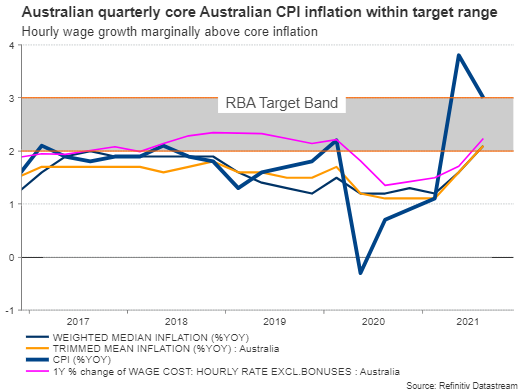
The question that arises at this point is whether other central banks will follow suit. The RBA is first in the queue to announce its policy decision this month but unlike its New Zealand counterpart, who has already hiked its interest rates twice, it is not facing significant deviations from its inflation mandate. The headline CPI fell back to 3.0% y/y in Q3, remaining above the 2.5% midpoint but within the RBA's 2-3% range target. The core measures, which exclude volatile energy and food prices, came even lower at around 2.1%, providing little incentive for higher borrowing costs.
RBA to stand pat on policy; hawkish twists in focus
Of course, house prices have been booming, but the RBA is still exclusively focused on how the pace of wage growth is developing. Particularly, the central bank has clearly telegraphed that interest rates will not rise until the unemployment rate drops to 4.0% and wage growth accelerates above 3.0% which is not expected to happen in the next two years according to its latest projections.
The emergence of the new covid omicron variant, whose effects are still unknown, could be used as an excuse to keep the above rate guidance steady this week. As initially planned, additional bond tapering actions will also be examined during February's gathering following the termination of the yield curve control program. However, with the lasting pandemic risks threatening to further intensify supply jitters, which could consequently fuel more inflation in the coming months, and the economy facing a softer-than-expected damage from the summer lockdown, policymakers may find it challenging to not sound more hawkish.
It is uncertain how severe the omicron variant will be and whether it will bypass vaccines, but currently the broad view is that demand and supply imbalances will keep feeding inflation and that may add more pressure to the RBA to shift to the hawkish side, especially if the Fed finally sets a roadmap to higher interest rates, increasing the spread between Australian and US bond yields.
AUD/USD
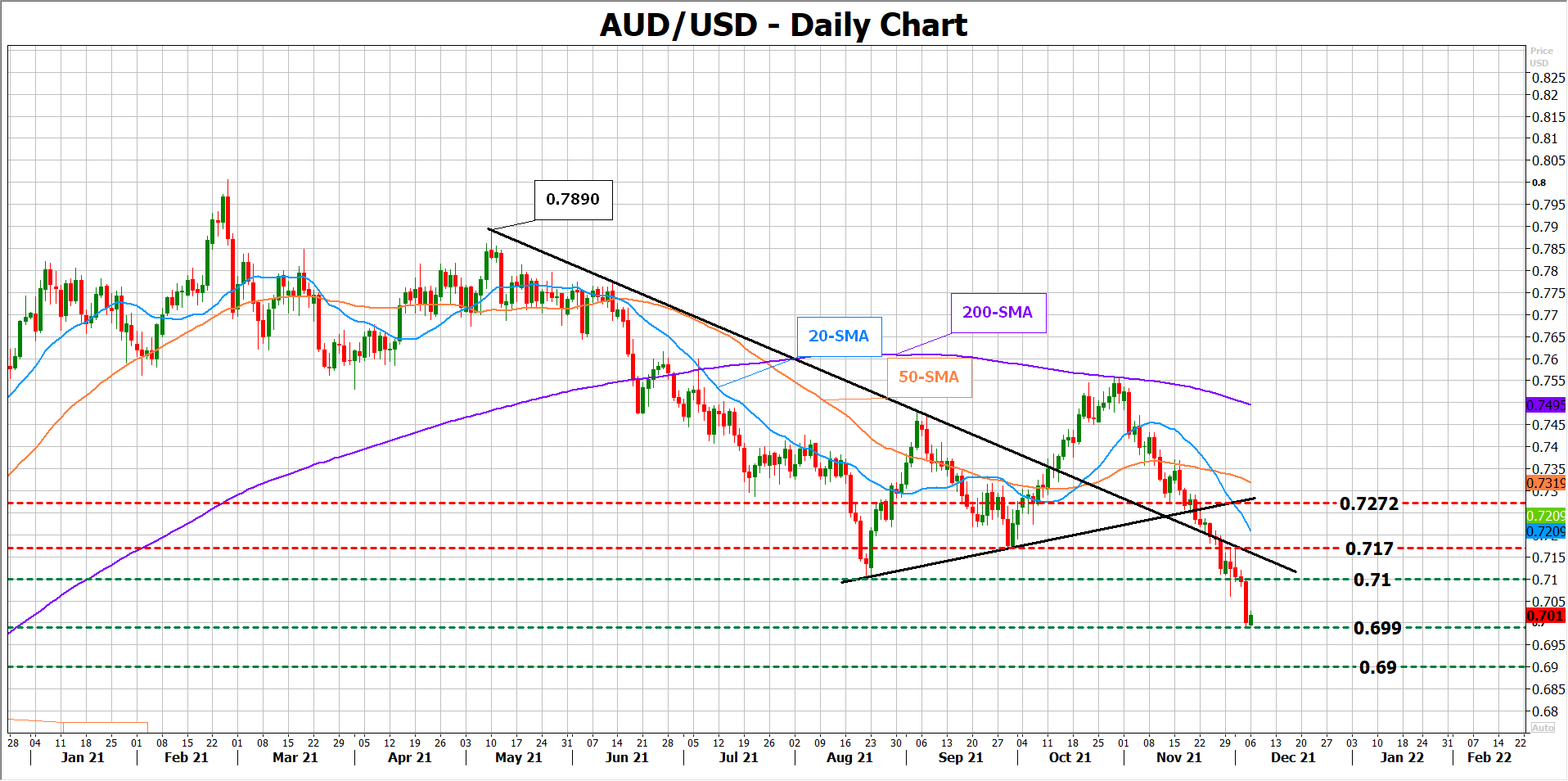
Investors are well ahead of the central bank at the moment, pricing three rate hikes and even a fourth one for next year, around the same period the Fed rate hike expectations are also placed. If the RBA surprises markets by slashing its bond purchases before February or even setting an end date to its bond buying program next year, the aussie could change course to the upside in speculation that Australian interest rates may pivot sooner than expected and could even compete with the US ones. In this case, aussie/dollar could drift higher to test the former support of 0.7100, while not far above, the 0.7169 barrier may also come on the radar if buying forces intensify.
Well, the RBA tends to occasionally deliver surprising policy announcements, therefore, the above scenario or at least some hawkish twists cannot be ruled out on Tuesday.
Otherwise, if the RBA plays it safe, citing the growing uncertainty around the pandemic and relying on upcoming data releases to examine any policy adjustments, aussie/dollar could breach the 0.6990 floor from November 2020 and slide towards the 0.6900 psychological level.