Sample Category Title
AUD/USD Mid-Day Report
Daily Pivots: (S1) 0.6962; (P) 0.7031; (R1) 0.7068; More...
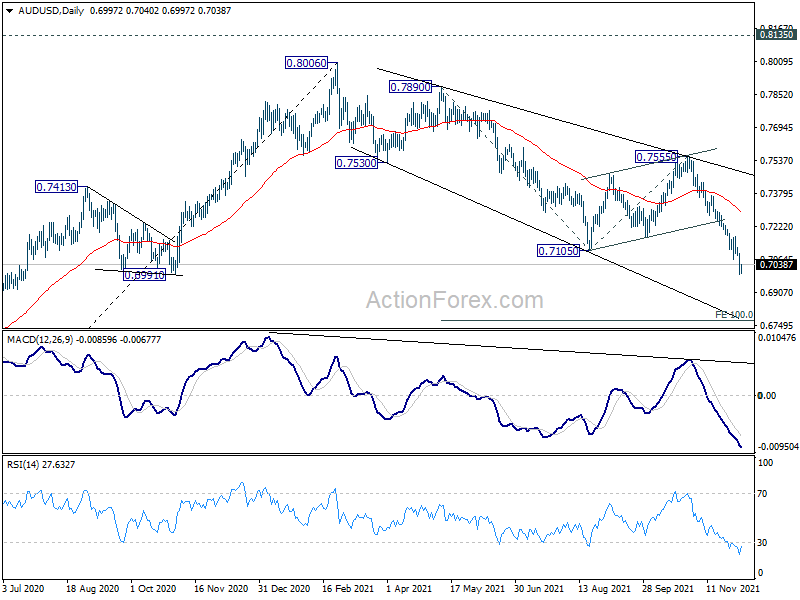
AUD/USD recovers mildly today but outlook remains unchanged. Intraday bias stays on the downside with focus on 0.6991 key structural support. Sustained break there will carry larger bearish implication. Next target is 100% projection of 0.7890 to 0.7105 from 0.7555 at 0.6770. On the upside, break of 0.7172 resistance will indicate short term bottoming and bring stronger rebound.
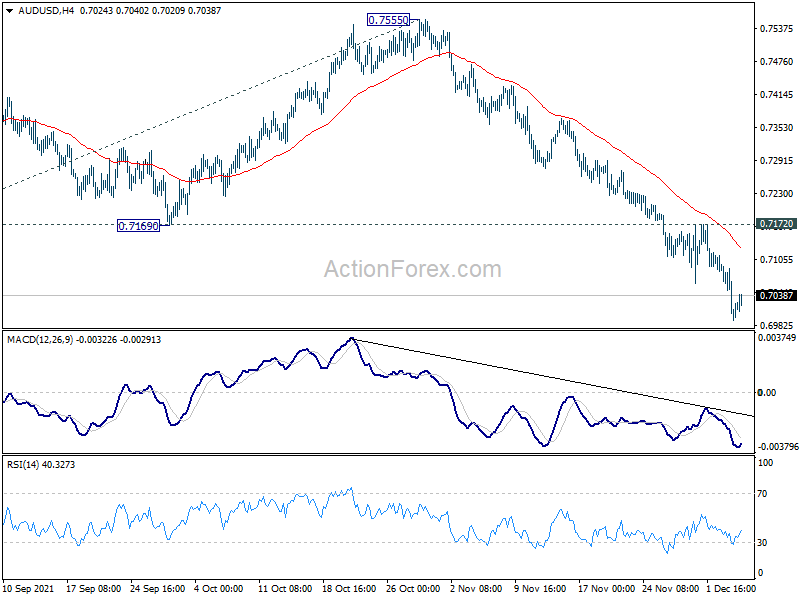
In the bigger picture, sustained break of 0.6991 cluster support will argue that the who up trend from 0.5506 might be finished at 0.8006, after rejection by 0.8135 long term resistance. Deeper decline would then be seen back to 61.8% retracement of 0.5506 to 0.8006 at 0.6461). For now, medium term outlook will stay bearish as long as 0.7555 resistance holds, in case of rebound.
Aussie Recovering Slightly in Range-bound Markets, Yen Softens
Major currencies remain largely in range against each other in quiet trading today. Australian Dollar continues to lead other commodity currencies to recover. But Aussie's recovery could be short-lived if RBA delivers some unexpected dovish surprise in the coming Asian session. Meanwhile, Swiss Franc is turning notably weaker, followed by Yen and then Euro and Dollar.
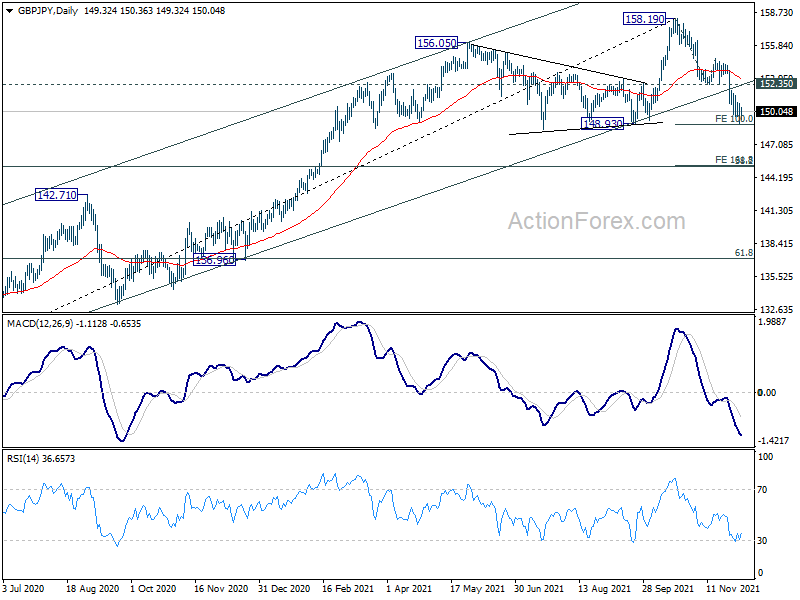
Technically, US benchmark yields and stocks are set for a rebound in early trading. We'll see how that would drive the next move in Yen crosses. In particular, GBP/JPY has lose some downside momentum just ahead of 148.93 keys support level. Rise from current level, followed by break of 152.35 resistance would turn near term bias back to the upside. However, sustained break of 148.93 will pave the way to next cluster level at 145.25.
In Europe, at the time of writing, FTSE is up 0.93%. DAX is up 0.50%. CAC is up 0.84%. Germany 10-year yield is up 0.011 at -0.377. Earlier in Asia, Nikkei dropped -0.36%. Hong Kong HSI dropped -1.76%. China Shanghai SSE dropped -0.50%. Singapore Strait Times rose 0.46%. Japan 10-year JGB yield dropped -0.0158 to 0.041.
BoE Broadbent: Transitory never meant inflation effects gone in even 12 months
BoE Deputy Governor Ben Broadbent reiterated in a speech that "it takes time for policy to work". "A change in interest rates has its peak impact on inflation only after a significant delay – probably eighteen months or more".
When global central bankers used the word "transitory" in describing current surge in inflation, "they do not mean (and never meant) that these effects will be gone in one, two or even twelve months".
"The relevant question is whether the global factors currently pushing up on goods prices are still there by the time a policy decision taken today could have any significant effect of its own," he added.
"What is their prospective contribution to inflation in eighteen, twenty-four months and beyond? This is the horizon that matters for policy and against which the word 'transitory' should be measured."
UK PMI construction rose to 55.5 in Nov, faster growth and softer inflation
UK PMI Construction rose from 54.6 to 55.5 in November, above expectation of 52.0. Markit noted recovery was led by robust and accelerated rise in commercial work. Numbers of firms reporting suppliers delays continued to ease. In put costs inflation dipped to seven-month low.
Tim Moore, Director at IHS Markit: "November data highlighted a welcome combination of faster output growth and softer price inflation across the UK construction sector.... Input price inflation remains extremely strong by any measure, but it has started to trend downwards after hitting multi-decade peaks this summer... Port congestion and severe shortages of haulage capacity were again the most commonly cited reasons for longer lead times for construction products and materials."
CBI downgrades UK growth forecasts to 6.9% in 2021 and 5.1% in 2022
The Confederation of British Industry downgraded UK GDP growth forecast for 2021 from 8.2% to 6.9%. For 2022, GDP growth forecast was also lowered from 6.1% to 5.1%. Inflation is projected to peak at 5.2% in the coming April while unemployment rate would fall to 3.8% by the end of 2023.
"The challenge for January 1st is now very clear for the UK economy. Significant headwinds and rising costs of living threaten the extent of recovery and prospects for economic success. These hurdles for firms will provide a major test for the government – can they foster sustainable UK investment and growth?" said Tony Danker, CBI director-general.
"The UK's New Year resolution must be to give firms the confidence to go for growth. We should be raising our sights on the economy's potential and seizing the moment."
Eurozone Sentix investor confidence dropped to 13.5, risks are increasing
Eurozone Sentix Investor Confidence dropped from 18.3 to 13.5 in December, missed expectation of 15.9. That's also the lowest level since April. Current Situation Index dropped for the third straight month from 23.5 to 13.3, lowest since May. Expectation Index, on the other hand, improved slightly from 13.3 to 13.8.
Sentix said that hopes of an end to the economic slowdown "have been abruptly dampened" by the latest Sentix data. Lockdown measures in Germany and Austria are "putting a considerable damper on current economic activity".
It added: "Our basic scenario of a 'mid-cycle slowdown', i.e. a consolidation in the middle of a cycle, does not have to be abandoned yet. But the risks are increasing! It is also interesting that our thematic analysis reveals an increasingly negative influence of central bank policy. While a continued expansionary monetary policy is likely to fuel inflation in particular, a shift to a restrictive course would obviously be burdened by liquidity constraints. The ECB thus seems to be definitively 'behind the curve'. The risks for markets and the economy are increasing.
Germany factor orders dropped -6.9% mom in Oct, as foreign orders tumbled
Germany factory orders dropped sharply by -6.9% mom in October, much worse than expectation of -0.2% mom decline. Not including major orders, a 1.8% decrease in new orders in manufacturing was recorded.
Looking at some details, domestic orders rose 3.4% mom. Foreign orders dropped -13.1%. New orders from Eurozone dropped -3.2% mom. The fall in new orders from other countries amounted to 18.1% in the current month (last month +15.7%), influenced by the absence of major orders in the sector of manufacture of machinery and equipment.
Compared with October 2020, new orders were also down -1.0% mom yoy. That;s the first decreased since September 2020. New orders in the period January to October 2021 as a whole increased by 20.8% on the same period a year earlier. Comparing with pre-pandemic February 2020, new orders were 1.7% higher.
AUD/USD Mid-Day Report
Daily Pivots: (S1) 0.6962; (P) 0.7031; (R1) 0.7068; More...
AUD/USD recovers mildly today but outlook remains unchanged. Intraday bias stays on the downside with focus on 0.6991 key structural support. Sustained break there will carry larger bearish implication. Next target is 100% projection of 0.7890 to 0.7105 from 0.7555 at 0.6770. On the upside, break of 0.7172 resistance will indicate short term bottoming and bring stronger rebound.
In the bigger picture, sustained break of 0.6991 cluster support will argue that the who up trend from 0.5506 might be finished at 0.8006, after rejection by 0.8135 long term resistance. Deeper decline would then be seen back to 61.8% retracement of 0.5506 to 0.8006 at 0.6461). For now, medium term outlook will stay bearish as long as 0.7555 resistance holds, in case of rebound.
Economic Indicators Update
| GMT | Ccy | Events | Actual | Forecast | Previous | Revised |
|---|---|---|---|---|---|---|
| 0:00 | AUD | TD Securities Inflation M/M Nov | 0.30% | 0.20% | ||
| 7:00 | EUR | Germany Factory Orders M/M Oct | -6.90% | -0.20% | 1.30% | 1.80% |
| 9:00 | EUR | Italy Retail Sales M/M Oct | 0.10% | 0.40% | 0.80% | |
| 9:30 | EUR | Eurozone Sentix Investor Confidence Dec | 13.5 | 15.9 | 18.3 | |
| 9:30 | GBP | Construction PMI Nov | 55.5 | 52 | 54.6 |
BoE Broadbent: Transitory never meant inflation effects gone in even 12 months
BoE Deputy Governor Ben Broadbent reiterated in a speech that "it takes time for policy to work". "A change in interest rates has its peak impact on inflation only after a significant delay – probably eighteen months or more".
When global central bankers used the word "transitory" in describing current surge in inflation, "they do not mean (and never meant) that these effects will be gone in one, two or even twelve months".
"The relevant question is whether the global factors currently pushing up on goods prices are still there by the time a policy decision taken today could have any significant effect of its own," he added.
"What is their prospective contribution to inflation in eighteen, twenty-four months and beyond? This is the horizon that matters for policy and against which the word 'transitory' should be measured."
PBOC Cut RRR; More Easing is Expected to Boost Recovery
The PBOC announced to cut the reserve requirement ratio (RRR) by -50 bps, effective December 15. Yet, the reduction will not apply to financial institutions with existing RRR of 5%. Releasing about RMB 2 trillion in long-term liquidity, the amount is not significant but sent a signal that more stimulus would follow to boost the economic recovery. Moreover, the policy divergence could lead to renminbi's weakness against US dollar.
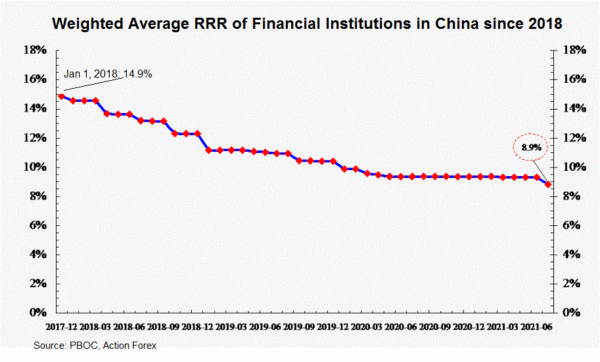
Hinted by Premier Li Keqiang last Friday, China’s central bank formally announced to lower the RRR by -50 bps. Since some of the funds released will be used to repay matured medium-term lending facility loans, the liquidity injection to the market would be about RMB 2 trillion, resembles an average month’s new renminbi loan.
The reduction would leave the weighted average RRR for financial institutions at 8.4%. Lower interest rates after the move might be positive news for the real estate sector. However, banks would likely be very cautious when lending to the debt-ridden sector. The default of Evergrande and some other developers indicate that more debt to support the sectors could lead to a vicious spiral which would result in the collapse of the entire sector, and China’s economy. Banks might choose to fund state-backed infrastructure or mortgage, instead.
It was noted in the policy statement that the cut is a “regular monetary policy action” and that the PBOC would “continue with a normal monetary policy, maintaining the stability, consistency and sustainability of policy, and won’t flood the economy with stimulus”. We expect more easing on the way. Since the RRR reduction this time does not target small and medium-sized enterprises, it is expected that the government or the central bank would announce stimulus measures directed to SMEs.
While the central bank attempted to downplay the possibility of a renewed monetary easing cycle, further RRR cut and even rate cut are getting more likely. This is in contrast with the Fed's stance of QE tapering, followed by rate hike. The policy divergence could lead to weakness in renminbi against the greenback.
Dollar Moves Higher On Fed Taper Talk
The US dollar maintains its Fed tapering boost
The US dollar shrugged of a confused US employment data picture on Friday as markets put omicron to one side and priced in that a faster Fed taper from the FOMC remains on track to be announced next week. Markets have also priced in faster rate hikes as well, supporting the US dollar even as the US yield curve flattens. The dollar index held steady at 96.15 on Friday, rising 12 points to 96.27 in Asia.
The rise in the dollar index has been driven by a reversal out of the haven Japanese yen and Swiss franc today as omicron worries subside for now. USD/JPY and USD/CHF have risen 0.16% and 0.28% to 113.00 and 0.9205 respectively. If the initial reports from South Africa turn out to be correct globally, markets have seen the lows in both pairs for some time.
Those currencies most associated with risk sentiment are finding very little respite though, namely the commonwealths and Euro. Instead of omicron, sentiment concerns have been replaced with a faster Fed taper and more rapid US interest rate hikes. EUR/USD and GBP/USD have edged lower to 1.1290 and 1.3235 today and remain a sell on any 50 to 100 point rally. AUD/USD has risen 0.30% to 0.7020 on firm ANZ jobs data, but NZD/USD remains stuck around 0.6760. Both remain vulnerable to deeper sell-offs this week and in the case of AUD/USD, it has formed a very negative head-and-shoulders technical pattern targeting a multi-week move to near 0.6000.
The PBOC set a weaker Yuan fixing today but USD/CNY has still eased 0.10% to 6.3685. Other Asian currencies are also enjoying a modest omicron respite, with MYR, KRW, PHP, SGD, and THB between 0.15% and 0.25% higher this morning. The longevity of the rally is entirely dependent on omicron headlines, as it is elsewhere. But being more sensitive as a region to US monetary policy, I believe gains will be limited at best by Asian currencies this week as Fed taper nerves ratchet higher. A higher than expected US CPI on Friday likely sees another wave of selling sweeping Asian FX as well as the euro and commonwealths.
China Cuts RRR As Property Market Remains In Focus
Notes/Observations
- German Oct Factory Orders handily miss expectations.
- China PBoC cuts its Overall RRR by 50bps as Chinese property sector remained in focus.
Asia
- Japan PM Kishida stated that would maintain a cautious stance on coronavirus policy and would not hesitate to provide funding to tackle coronavirus crisis.
- Property Developer Sunshine 100 [2608.HK] announced default on senior notes due in 2021.
- China property developer Evergrande [3333.HK] said to be continuing talks with offshore bondholders on Dec 7th, ahead of next payment deadline. Filed plans that it to actively engage with offshore creditors on a restructuring plan in a sign that its $300B of overseas and local liabilities have become unsustainable.
Coronavirus
- Study said to note that Omicron was possibly more infectious because it shares genetic code with common cold coronavirus.
Europe
- UK PM Johnson said to have ordered his team to de-escalate tensions with France opening the way to a new Anglo-French treaty after elections next year.
- Chancellor of the Exchequer Sunak (Fin Min) said to be preparing a 2% cut to income tax or to slash VAT rates before the next election.
- IMF Chief Georgieva stated that was likely to see some downgrades for forecasts for global growth; Had been concerned that recovery has been losing momentum even before Omicron emergence.
- Moody's affirmed Turkey B2 rating; Maintains negative outlook.
- Fitch raised Italy sovereign rating one notch to BBB from BBB-; Outlook Stable.
- Fitch affirmed Russia sovereign rating at BBB; outlook Stable.
Americas
- Goldman Sachs analyst cut 2022 US GDP growth forecast from 4.2% to 3.8%; updated outlook to incorporate omicron virus variant.
Energy
- Saudi Arabia raised oil prices for all crude grades for buyers from US and Asia.
- OPEC Sec Gen Barkindo stated that OPEC would continue with its supply adjustments to attain stability in the oil market.
Speakers/Fixed income/FX/Commodities/Erratum
Equities
- Indices [Stoxx600 +0.64% at 465.72, FTSE +0.85% at 7,182.91, DAX +0.58% at 15,256.75, CAC-40 +0.68% at 6,811.28, IBEX-35 +1.02% at 8,325.73, FTSE MIB +1.04% at 26,207.00, SMI +0.84% at 12,277.65, S&P 500 Futures +0.50%].
- Market Focal Points/Key Themes: European indices open generally higher and advanced into the green as the session progressed; sectors leading to the upside include consumer discretionary and materials; while among the laggard sectors are industrials and technology; Finland closed for holiday; EssilorLuxottica completes takeover of GrandVision; Saint-Gobain to acquire GCP; Intertrust to be acquired by CSC; earnings expected during the upcoming US session include SAIC.
Equities
- Consumer discretionary: Intertrust [INTER.NL] +7% (to be acquired).
- Financials: Deutsche Bank [DBK.DE] +3% (analyst upgrade), Amigo Holdings [AMGO.UK] -18% (scheme of arrangement).
- Healthcare: Bavarian Nordic [BAVA.DK] -4% (vaccine trial results; outlook cut).
- Industrials: Clarkson [CKN.UK] +4% (trading update), SSAB [SSABA.SE] -8% (lost order).
Speakers
- China PBoC cut the Reserve requirement ratio (RRR) by 50bps; effective Dec 15th Reiterated stance to maintain prudent monetary policy and keep liquidity reasonably ample. To step up cross cyclical adjustments. RRR cut to release CNY1.2T liquidity into banking system and Banking sector to use part of RRR funds to repay MLF.
- China Politburo noted that macro policies to be stable and effective in 2022; reiterated to continue to implement proactive fiscal policy and prudent monetary policy. Monetary policy to be more flexible and appropriate and to elevate core competitiveness of manufacturing.
- Sweden Central Bank (Riksbank) Nov Minutes noted that policy needed to give continued support to economy. Members supported the decision to retain the repo rate unchanged a 0.00% (zero) and to purchase bonds during the first quarter to compensate for principal payments. Some members advocated that purchases be tapered further in 2022 . PIF forecast seen falling back to fairly low level in 2022.
- UK PM Johnson stated that it did not see need to change guidance on omicron. Denied government acted too late in bringing back pre-departure tests amid spread of Omicron.
- Incoming German Health Min Lauterbach stated that pandemic to last longer than what many people believe.
- Russia govt spokesperson Peskov stated that President Putin and US President Biden call was scheduled at 10:00EST (15:00GMT) on Tuesday, Dec 7th. Call to review progress in relations since the Jun summit held in Geneva. Putin wanted Ukraine tensions, NATO and security guarantees in focus during call.
- China CASS researcher Xie Fuzhan said to see 2022 GDP growth around 8.0% and saw CPI higher compared to 2021 level.
Currencies/Fixed Income
- USD was steady despite last week’s soft payroll report. Dealers noted that Fed policymakers continued to signal a faster withdrawal of asset purchases at the upcoming mid-December meeting despite the emergence of the Omicron coronavirus variant.
Economic data
- (DE) Germany Oct Factory Orders M/M: -6.9% v -0.3%e; Y/Y: -1.0% v +5.5%e.
- (CZ) Czech Q3 Average Real Monthly Wage Y/Y: 1.5% v 1.4%e.
- (CZ) Czech Oct Retail Sales Y/Y: +0.3% v -1.1%e; Retail Sales (ex-auto) Y/Y: 5.6% v 4.7%e.
- (AT) Austria Nov Wholesale Price Index M/M: 1.0% v 2.6% prior; Y/Y: 16.6% v 15.8% prior.
- (TW) Taiwan Nov Foreign Reserves: $547.3B v $546.7B prior.
- (DE) Germany Nov Construction PMI: 47.9 v 47.7 prior.
- (SE) Sweden Q3 Current Account Balance (SEK): 63.0B v 85.7B prior.
- (IT) Italy Oct Retail Sales M/M: 0.1% v 0.3%e; Y/Y: 3.7% v 4.0%e.
- (CH) Swiss weekly Total Sight Deposits (CHF): 720.3B v 719.4B prior; Domestic Sight Deposits: 645.7B v 646.9B prior.
- (UK) Nov New Car Registrations Y/Y: +1.7% v -24.6% prior.
- (UK) Nov Construction PMI: 55.5 v 54.2e (10th month of expansion).
- (EU) Euro Zone Dec Sentix Investor Confidence: 13.5 v 12.5e.
- (GR) Greece Q3 GDP Q/Q: 2.7% v 0.9%e; Y/Y: 13.4% v 16.2% prior; GDP NSA (unadj): Y/Y: 13.7% v 16.4% prior.
Fixed income Issuance
- (LT) Latvia to sell Jan 2030 sustainable notes; guidance seen low 30bps area to mid-swaps.
Looking ahead
- (UR) Ukraine Nov Official Reserve Assets: No est v $29.7B prior.
- 05:25 (EU) Daily ECB Liquidity Stats.
- 05:30 (DE) Germany to sell combined €6.0B in 6-month and 12-month BuBills.
- 05:30 (NL) Netherlands Debt Agency (DSTA) to sell €2.0-4.0B in 3-month and 6-month bills.
- 06:00 (SE) Sweden Central bank (Riksbank) Skingsley.
- 06:00 (IL) Israel to sell bonds.
- 06:25 (BR) Brazil Central Bank Weekly Economists Survey.
- 06:30 (UK) BOE's Broadbent.
- 06:30 (TR) Turkey Nov Real Effective Exchange Rate (REER): No est v 60.37 prior.
- 06:45 (US) Daily Libor Fixing.
- -07:00 (TR) Turkey to sell Floating Bonds.
- 07:00 (IN) India announces details of upcoming bond sale (held on Fridays).
- 07:00 (MX) Mexico Nov Consumer Confidence: No est v 43.6 prior.
- 07:00 (MX) Mexico Nov Vehicle Production: No est v 257.8K prior; Vehicle Exports: No est v 224.5K prior.
- 07:00 (CL) Chile Oct Nominal Wage M/M: No est v 0.4% prior; Y/Y: No est v 5.7% prior.
- 08:00 (BR) Brazil Nov Vehicle Production: No est v 177.9K prior; Vehicle Sales: No est v 162.4K prior; Vehicle Exports: No est v 29.8K prior.
- 08:00 (UK) Daily Baltic Dry Bulk Index.
- 09:00 (FR) France Debt Agency (AFT) to sell €3.8-5.0B in 3-month, 6-month and 12-month bills.
- 09:45 (UK) BOE to buy £1.47B in APF Gilt purchase operation (3-7 years).
- 17:30 (AU) Australia ANZ Roy Morgan Weekly Consumer Confidence Index: No est v 106.0 prior.
- 18:00 (KR) South Korea Oct Current Account Balance: No est v $10.0B prior; Balance of Goods (BOP): No est v $9.5B prior.
- 18:30 (JP) Japan Oct Labor Cash Earnings Y/Y: 0.4%e v 0.2% prior; Real Cash Earnings Y/Y: -0.5%e v -0.6% prior.
- 18:30 (JP) Japan Oct Household Spending Y/Y: -0.6%e v -1.9% prior.
- 19:01 (UK) Nov BRC Sales Like-For-Like Y/Y: No est v -0.2% prior.
- 19:30 (AU) Australia Q3 House Price Index Q/Q: 5.0%e v 6.7% prior; Y/Y: 21.7%e v 16.8% prior.
- 20:00 (PH) Philippines Oct Unemployment Rate: No est v 8.9% prior.
- 20:00 (PH) Philippines Nov CPI Y/Y: 4.0%e v 4.6% prior.
- 22:00 (ID) Indonesia Nov Foreign Reserves: No est v $145.5B prior.
- 22:30 (AU) RBA Interest Rate Decision: Expected to leave Cash Rate Target unchanged at 0.10%.
- 22:30 (HK) Hong Kong to sell 3-month and 6-month Bills.
The Analytical Overview Of The Main Currency Pairs
The EUR/USD currency pair
Technical indicators of the currency pair:
Prev Open: 1.1298
Prev Close: 1.1305
% chg. over the last day: +0.06%
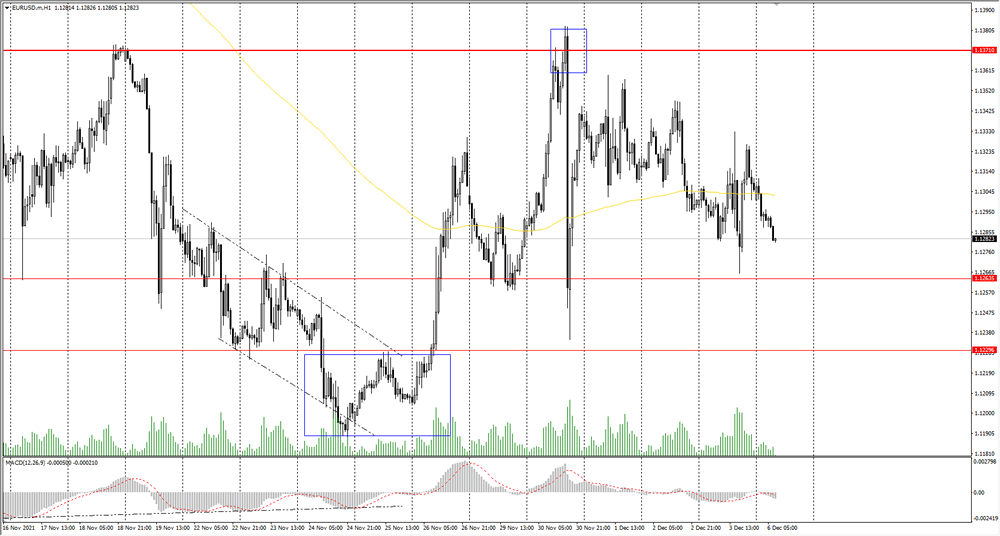
On Friday, ECB head Christine Lagarde said that the ECB will end its PEPP program in March 2022, and it is highly unlikely that the ECB will raise interest rates in 2022. However, inflation expectations in the Eurozone continue to rise, and unemployment in the Eurozone is much higher than in the United States, indicating a weak labor market recovery.
Trading recommendations
Support levels: 1.1263, 1.1230, 1.1168
Resistance levels: 1.1371, 1.1436, 1.1535, 1.1613, 1.1667, 1.1717
From the technical point of view, the EUR/USD on the hour time frame is still bearish. The price is currently trading in a corridor. The MACD indicator has become inactive. Under such market conditions, traders should consider sell positions from the priority change level of 1.1371. Buy trades should be considered only from the support levels of the higher time frame, given the buyers’ initiative, but only with short targets.
Alternative scenario: if the price breaks out through the 1.1371 resistance level and fixes above, the mid-term uptrend will likely resume.
The GBP/USD currency pair
Technical indicators of the currency pair:
Prev Open: 1.3296
Prev Close: 1.3220
% chg. over the last day: -0.58%
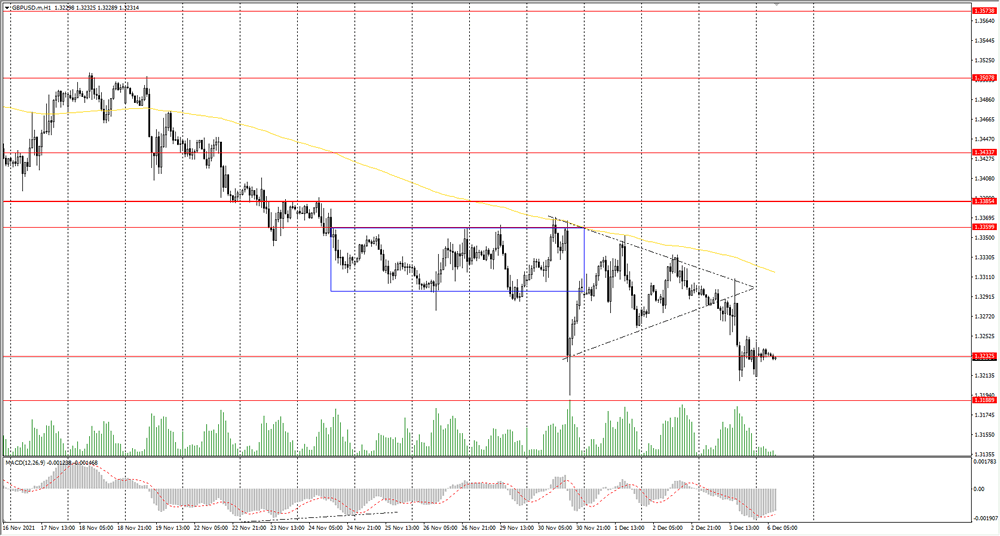
The UK will publish October GDP data this week ahead of the Bank of England's December meeting. Recent UK economic data showed that the Bank of England may start to raise interest rates at the December meeting, but due to new uncertainty related to the Omicron strain, policymakers may decide to wait until early 2022. For that reason, investors are now bearish on the GBP.
Trading recommendations
Support levels: 1.3232
Resistance levels: 1.3360, 1.3434, 1.3507, 1.3575, 1.3685, 1.3748
On the hourly time frame, the trend on GBP/USD is bearish. A narrowing of liquidity in the form of a "triangle" pattern was in sales direction. The MACD indicator became negative, but it is still signaling divergence on several time frames. Under such market conditions, traders should consider sell positions from the resistance levels around the moving average. Buy trades should be considered on the support levels of higher time frames, given the buyers' initiative.
Alternative scenario: if the price breaks out through the 1.3385 resistance level and consolidates above, the bullish scenario will likely resume.
News feed for 2021.12.03:
- UK Construction PMI (m/m) at 11:30 (GMT+2).
The USD/JPY currency pair
Technical indicators of the currency pair:
Prev Open: 113.13
Prev Close: 112.79
% chg. over the last day: -0.30%
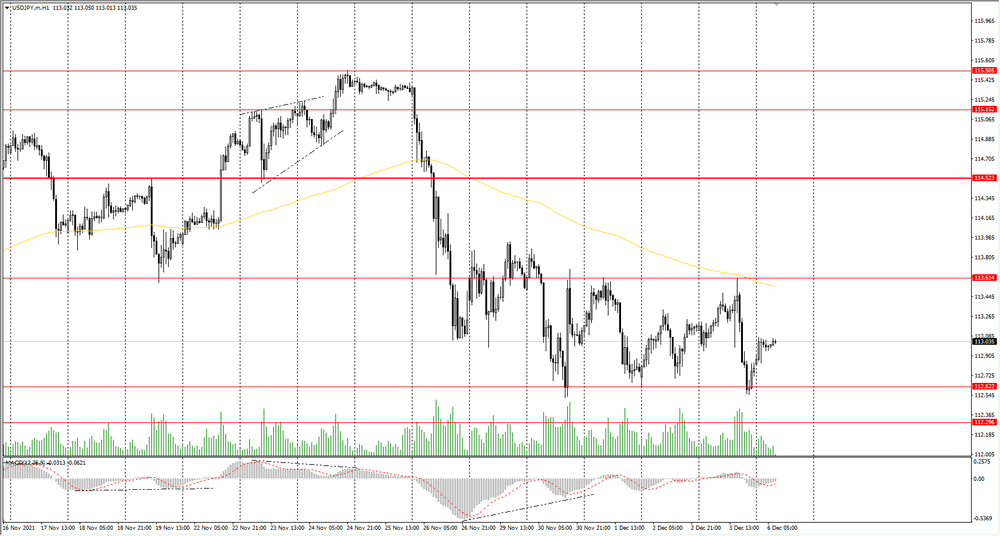
The Japanese yen continues to strengthen as a safe haven currency since markets are still in high uncertainty due to the spread of the Omicron strain. This has led to renewed restrictions in various countries and heightened fears over possible more decisive action by the Federal Reserve to curb inflation. But analysts are confident that the USD/JPY quotes will continue to rise once tensions ease.
Trading recommendations
Support levels: 112.62, 112.30
Resistance levels: 113.61, 114.48, 115.15, 115.50
The global trend on the USD/JPY currency pair is bearish. Currently, the price is trading in the corridor with the 112.62-113.61 range. Under such market conditions, it is best for traders to look for sell positions from the resistance levels around the moving average or from the upper border of the corridor, but with additional confirmation. Buy positions should be considered from the lower border of the corridor, but with additional confirmation in the form of a buyers' initiative.
Alternative scenario: if the price rises above 114.52, the uptrend will likely resume.
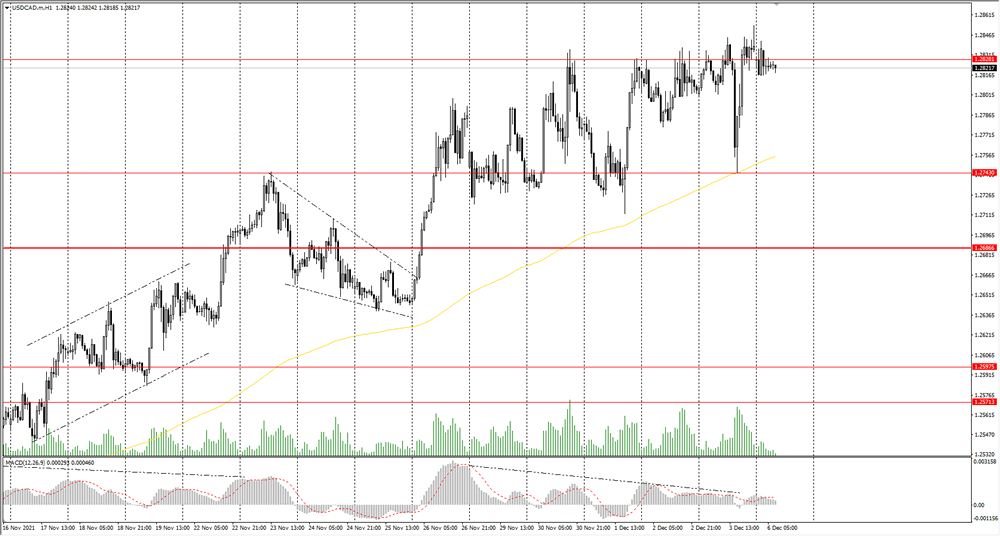
The USD/CAD currency pair
Technical indicators of the currency pair:
Prev Open: 1.2802
Prev Close: 1.2838
% chg. over the last day: +0.28%
Analysts are bullish on the Canadian dollar (bearish on the USD/CAD) despite the uncertainty surrounding the Omicron COVID-19 strain, expecting oil prices to recover and the Bank of Canada to raise interest rates sooner than the US Federal Reserve. A Reuters forecast with 32 strategists shows the Canadian dollar will rise by 2.4% to 1.25 per US dollar in three months.
Trading recommendations
Support levels: 1.2743, 1.2646, 1.2598, 1.2571, 1.2483, 1.2416, 1.2388
Resistance levels: 1.2828
From a technical point of view, the USD/CAD currency trend is bullish. The price is trading flat in the corridor with a range of 1.2743-1.2828. But there is a pressure of buyers to the upper border. The MACD indicator is in the positive zone, but there are signs of divergence. Under such market conditions, it is better to look for buy trades from the lower border of the flat corridor or after a true breakout. Given the sellers ' initiative, sell deals should be considered from the resistance levels of the higher time frames.
Alternative scenario: if the price breaks down through the 1.2687 support level and fixes below, the downtrend will likely resume.
International Monetary Fund Asks Fed To Acelerate QE Cuts
Last week on Friday, investors' attention was focused on US nonfarm payrolls data. The labor market statistics were disappointing. The US economy added only 210,000 jobs in November (against 533,000 expected), while the unemployment rate decreased from 4.6% to 4.2%. Also, last week, Fed Chairman Jerome Powell said that the central bank will probably discuss reducing its stimulus program more quickly at its meeting later this month. A lot will depend on US inflation data due, which will be published later this week. Analysts are predicting a rise in inflation to 6.7% in annual terms. The acceleration of inflation may strengthen expectations of a faster reduction of QE by the Fed. The US stock market fell again on Friday. By the close of the stock market, Dow Jones Index (US30) decreased by 0.17% (-4.14% for the week), S&P500 (US500) decreased by 0.84% (-2.27% for the week), and NASDAQ Technology Index (US100) lost 1.92% (-4.14% for the week) and became the fall leader among the major US indices. Stocks sold off due to the twin uncertainties over the Omicron strain and the prospect of a faster reduction in the Federal Reserve's stimulus program.
The International Monetary Fund warned Friday that it would likely lower its global economic growth estimates because of a new variant of the coronavirus. The number of countries reporting cases of Omicron continues to grow. However, scientists are still unsure whether it is more contagious than other variants, how serious the disease is, and what level of protection existing vaccines provide. The emergence of Omicron has already hit financial markets and undermined the global economic recovery.
Also, the International Monetary Fund has asked the Federal Reserve to tighten monetary policy with a faster pace because of rising inflation risks.
According to Bank of America's weekly report, falling equity markets, rising volatility, and the prospect of higher rates are classic signs of a market top. Volatility indicators also signal caution. Despite the volatility indicators in the US and Europe rebounding from the 2021 highs earlier last week, they remain well above average.
European stock indices also closed Friday in the red area. British FTSE 100 (UK100) decreased by 0.097% on Friday (+1.11% for the week), French CAC 40 (FR40) decreased by 0.44% (-0.32% for the week), German DAX (DE40) decreased by 0.61% (-1.13% for the week) and Spanish IBEX 35 (ES35) lost 0.71% and became the leader of the fall for the week with -2.56%. Germany will publish inflation data this week. As inflation in the region is rising, there are more and more calls for the ECB to tighten its monetary policy. However, the ECB has always been famous for its conservatism. That's why analysts are confident that it is not worth waiting for the ECB to change its policy before spring 2022 even if inflation in the region continues to rise. The UK will release October GDP data this week ahead of the Bank of England's December meeting. Recent UK economic data showed that the Bank of England may start to raise interest rates, but due to new uncertainty surrounding the Omicron strain, policymakers may decide to wait until early 2022 at the December meeting.
Oil prices increased more than $1 a barrel on Monday after Saudi Arabia, the largest exporter, raised the price of its crude oil sold to Asia and the United States, and because US and Iranian negotiations over a renewed nuclear deal appear to have stalled. The analyst expects oil prices to rise to $75 a barrel.
Asian markets traded in positive territory on Friday. Japan's Nikkei 225 (JP225) gained 1.00% (-1.44% for the week), Hong Kong's Hang Seng (HK50) increased by 0.093% (-0.60% for the week), and Australia's S&P/ASX 200 (AU200) added 0.22% (+0.37% for the week). The Japanese yen continues to strengthen as a safe haven currency as uncertainty in the markets is still high due to the spread of the Omicron option, which has led to renewed restrictions in various countries and increased fears over possible stronger action from the Federal Reserve to curb inflation.
In the commodities market, lumber futures (+18%), cocoa (+2.92%), WTI crude (+2.58%), and Brent crude (+2.39%) showed the biggest gains by the end of the week. Futures on natural gas (-6.92%), sugar (-2.89%), and orange juice (-2.22%) showed the biggest drop.
Main market quotes:
- S&P 500 (F) (US500) 4,538.43 −38.67 (−0.84%)
- Dow Jones (US30) 34,580.08 −59.71 (−0.17%)
- DAX (DE40) 15,169.98 −93.13 (−0.61%)
- FTSE 100 (UK100) 7,122.32 −6.89 (−0.097%)
- USD Index 96.15 +0.01 (+0.01%)
Important events for today:
- UK Construction PMI (m/m) at 11:30 (GMT+2).
US Futures Rally After A Turbulent Week
US and European stocks are set to bounce from last week's selloff as investors assess the Omicron Covid variant and the Federal Reserve's next move. Early clinical data from South Africa suggest that the new variant may cause less severe symptoms than previous variants. If this proves to be accurate, investors may find it an opportunity to buy the latest dip.
Investors are, in fact, more confused with the latest ambiguous US employment data, which showed nonfarm payrolls recording an increase of 210,000 in November, their lowest of the year, following an upwardly revised 546,000 reading in the previous month. However, the unemployment rate fell by 0.4% to 4.2% despite the labor force participation rate increasing to 61.8%, its highest level since the beginning of the pandemic. In short, one survey shows a significant slowing in job growth, and another indicates accelerating employment gains. It cannot be more confusing.
Another economic report released on Friday showed the services sector in the US is booming like never before. The ISM non-manufacturing index recorded a new all-time high of 69.1, surpassing the previous record set in October. This is where investors interested in forward-looking indicators need to look. If the Omicron variant does not disrupt this trend, the US economy is clearly in a strong position and no longer needs extremely easy monetary policy.
November's consumer price index (CPI) due on Friday is the last significant piece of data before the Federal Reserve meets next week on 14 December. Fed Chair Jerome Powell already indicated that he no longer viewed inflation as 'transitory' in his testimony before the Senate last week. So, another strong inflation print will likely justify winding down asset purchases more quickly, and investors' focus will then shift to the pace of interest rates hikes.
Bond markets are already pricing in two to three rate rises in 2022. As a result, the short end of the US Treasury yield curve has been pushed higher in anticipation of tighter monetary policy. Meanwhile, the longer end of the curve has been dragged lower, implying lower growth and less inflation risk over the longer run. Hence, the yield curve has flattened the most since the beginning of the year.
A flatter yield curve is not necessarily a recession signal as long as it doesn't invert. And given the few alternatives for investors to park their money, equities will remain attractive. However, it's time to be very selective and well-diversified. Most unprofitable growth firms are already in a bear market, and so are speculative assets like cryptocurrencies. Healthy balance sheets, high-profit margins, and strong pricing power are the criteria you need in today's portfolio. It doesn't matter if the companies are in growth or value sectors.
Gold Consolidates As Merged MAs Curb Advances
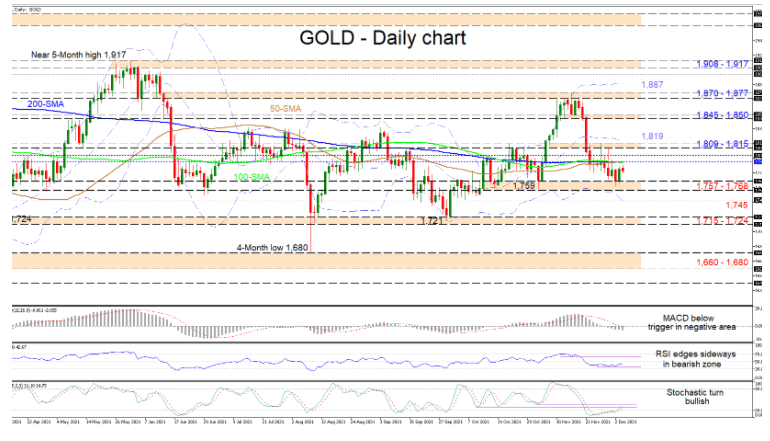
Gold is currently edging sideways not too far below the 1,800 mark after managing to find its feet around the 1,757-1,768 support base, following the latest plunge in the commodity from the 1,877 high. The flattened simple moving averages (SMAs) have joined together and are sponsoring a clear price trend.
The short-term oscillators are suggesting mixed messages in directional momentum. The MACD, is slightly underneath the zero level and below its red trigger line, while the positively charged stochastic oscillator is promoting positive price action in the commodity. The RSI is aiming a tad lower in the bearish territory, indicating that the commodity’s scale may be tilting slightly negative.
In the negative scenario, limitations could originate from the key 1,757-1,768 support zone. Breaching this barrier, sellers may aim for the lower Bollinger band, currently lying at the 1,745 low before seeking out the 1,715-1,724 critical foundation. If selling interest endures, the price could then dive for the 1,660-1,680 boundary that has managed to hold as an upside defence, which took shape over the April until June 2020 period.
If upside forces increase, initial tough resistance could transpire from the converged SMAs at 1,792 and the 1,800 handle overhead. The neighbouring resistance band of 1,809-1,815 and the mid-Bollinger band at 1,819 could hinder further developments in the price towards the 1,845-1,850 obstacle. From here, should upside impetus surpass the 1,870-1,877 border and upper Bollinger band at 1,887, the bulls may seek out the 1,900 hurdle and the zone of the near 5-month high of 1,917.
Summarizing, gold is currently stuck in a horizontal trajectory between the 1,757-1,768 lower limit and the 1,792-1,800 upper limit. That said, surpassing the mid-Bollinger band at 1,819 could bolster bullish forces, while a dip below the lower Bollinger band at 1,745 could feed negative pressures.