

Sample Category Title
Yen Crosses Rebounding as Sentiments Turned Positive
Overtone in the markets turned positive with the strong rebound in US stocks overnight, while Asia indexes follow higher. Australian Dollar is recovering broadly after RBA stood pat and gave nothing new to the markets. On the other hand, Yen is trading broadly lower for now, followed by Dollar and then Euro. It seems that investors are putting Omicron risks, and even the prospect of earlier Fed hike behind.
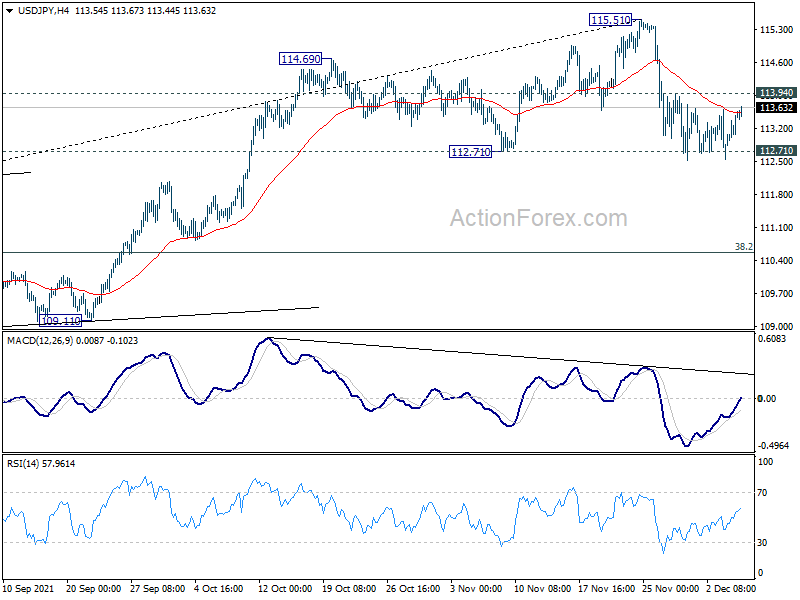
Technically, our attention will be on Yen crosses. 113.94 minor resistance in USD/JPY is the first level to watch. Break there will suggest that pull back from 115.51 has completed after defending 112.71 support and bring retest of 115.51 high. Also, break of 128.77 minor resistance in EUR/JPY and 152.35 resistance in GBP/JPY would affirm selling momentum in Yen for the near term.
In Asia, at the time of writing, Nikkei is up 1.98%. Hong Kong HSI is up 1.46%. China Shanghai SSE is up 0.12%. Singapore Strait Times is up 0.24%. Japan 10-year JGB yield is up 0.0177 at 0.059. Overnight, DOW rose 1.87%. S&P 500 rose 1.17%. NASDAQ rose 0.93%. 10-year yield rose 0.091 to 1.434.
RBA keeps cash rate at 0.1%, asset purchase as 4B a week
RBA left monetary policy unchanged as widely expected. The cash rate target is held at 0.10%. It reiterated that "the Board will not increase the cash rate until actual inflation is sustainably within the 2 to 3 per cent target range."
Asset purchases will continue at AUD 4B a week until at least mid-February 2022. The decision on the program in February will be guided by the same three considerations used from the outset: "the actions of other central banks; how the Australian bond market is functioning; and, most importantly, the actual and expected progress towards the goals of full employment and inflation consistent with the target."
Australia AiG services rose to 49.6, underachieving relative to expectations
Australia AiG Performance of Services rose 2.0 pts to 49.6 in November. Sales dropped -1.6 to 53.6. Employment dropped -0.6 to 56.2. New orders rose 8.6 to 47.4. Supplier deliveries rose 0.9 to 40.4. Input prices dropped -8.3 to 65.3. Selling prices dropped -3.5 to 58.2.
Ai Group Chief Executive, Innes Willox, said: "The Australian services sector was broadly stable in November, underachieving relative to expectations of a more convincing recovery after the COVID-19 downturn in recent months."
Also released, house price index rose 5.0% qoq in Q3, slightly below expectation of 5.1% qoq.
RBNZ Hawkesby: A higher currency helps us achieve objectives more quickly
RBNZ Assistant Governor Christian Hawkesby said today that the central bank would take "considered steps" in raising interest rate. He added, "we have more confidence around the fact that the labour market is tight and that's going to build inflation pressures."
Regarding the government's plan to reopen borders from January, Hawkesby said "One risk we are conscious of in the very short term is that even when the borders reopen, that actually becomes easier for more Kiwis to leave the country than it does for foreigners to come in... So there is a potential that the labour market gets tighter before it gets looser".
Also, "at the moment a higher currency in the short term will actually help us achieve our objectives more quickly because a strong currency will feed through a lower tradeables inflation and feed through to lower inflation, and we are managing inflation from the top side."
Separately, outgoing Deputy Governor Geoff Bascand said inflation is "definitely got some persistence to it for the next 12 months". He added, we'll see the CPI moving along at 4 percent over the next year, but we think it will moderate over time, some of those things that have driven it up won't last forever."
Bascand also said, "we will keep reducing stimulus and do our part to stop inflation from getting momentum into it."
China exports rose 22% yoy in Nov, imports rose 31.7% yoy
In November in USD term, China exports rose 22.0% yoy, above expectation of 17.2% yoy. Imports rose 31.7% yoy, versus expectation of 19.5% yoy. Trade surplus narrowed to USD 71.7B, down from USD 84.5B, below expectation of USD 82.2B.
In CNY term, exports rose 16.6% yoy, below expectation of 17.2% yoy. Imports rose 26.0% yoy, above expectation of 9.4% yoy. Trade surplus narrowed to CNY 461B, down from CNY 546B, below expectation of CNY 575B.
From Japan, labor cash earnings rose 0.2% yoy in October, below expectation of 0.4% yoy. Household spending dropped -0.6% yoy, matched expectations.
Looking ahead
Swiss unemployment rate and foreign currency reserves, Germany industrial production and ZEW economic sentiment, France trade balance, and Eurozone GDP will be released in European session.
Later in the day, US will release trade balance and non-farm productivity. Canada will release trade balance and Ivey PMI.
GBP/JPY Daily Outlook
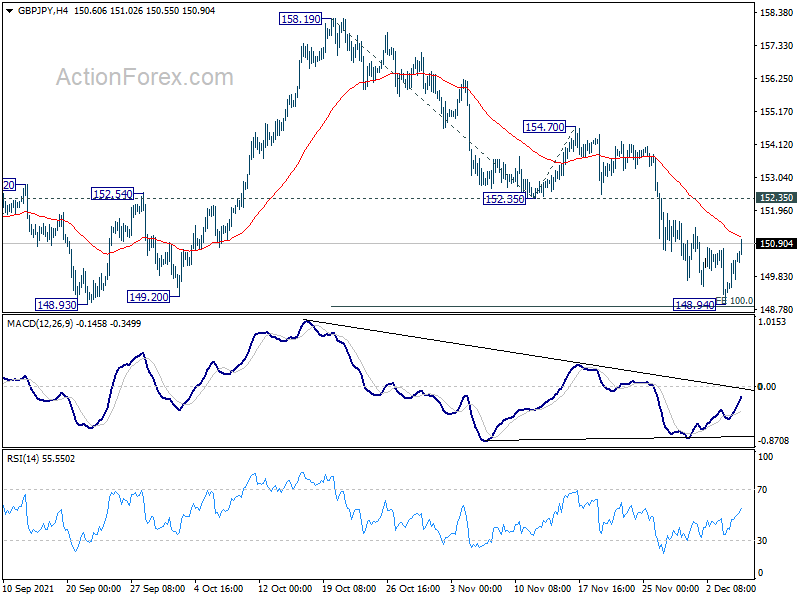
Daily Pivots: (S1) 149.62; (P) 150.12; (R1) 151.05; More...
Intraday bias in GBP/JPY is turned neutral with current recovery. A temporary low is formed at 148.94, just ahead of 100% projection of 158.19 to 152.35 from 154.70 at 148.86, which is close to 148.93 key structural support. On the upside, break of 152.35 support turned resistance will argue that the pull back from 158.19 is complete. Intraday bias will be turned back to the upside for retesting 158.19 high. However, on the downside, decisive break there will carry larger bearish implication and target 161.8% projection at 145.25 next.
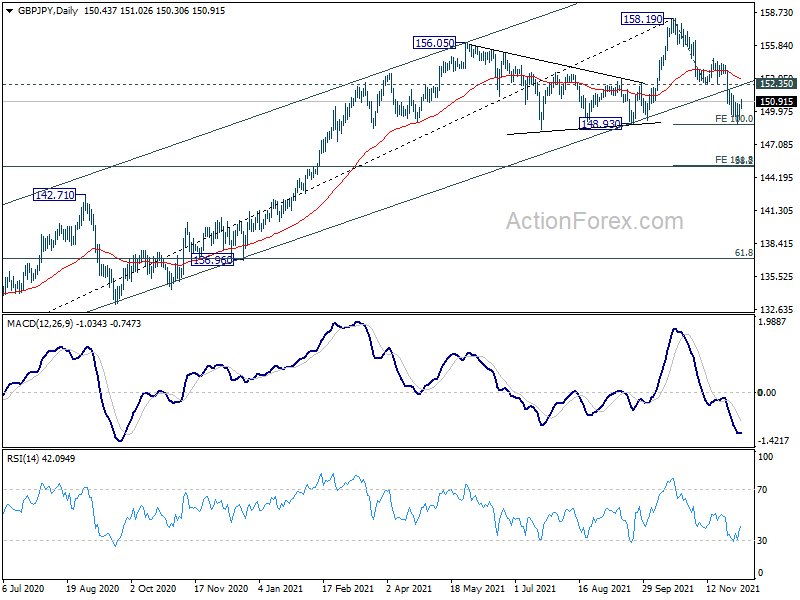
In the bigger picture, the break of medium term channel support, and bearish divergence condition in week MACD are raising the chance of medium term topping at 158.19. Firm break of 148.93 support will argue that GBP/JPY is at least correcting the whole rise from 123.94 (2020 low). In this case, deeper fall would be seen to 38.2% retracement of 123.94 to 158.19 at 145.10. Nevertheless, strong rebound from 148.93 will retain medium term bullishness for another rise through 158.19 at a later stage.
Economic Indicators Update
| GMT | Ccy | Events | Actual | Forecast | Previous | Revised |
|---|---|---|---|---|---|---|
| 21:30 | AUD | AiG Performance of Services Index Nov | 49.6 | 47.6 | ||
| 23:30 | JPY | Labor Cash Earnings Y/Y Oct | 0.20% | 0.40% | 0.20% | |
| 23:30 | JPY | Household Spending Y/Y Oct | -0.60% | -0.60% | -1.90% | |
| 00:01 | GBP | BRC Like-For-Like Retail Sales Y/Y Nov | 1.80% | 0.30% | -0.20% | |
| 00:30 | AUD | House Price Index Q/Q Q3 | 5.00% | 5.10% | 6.70% | |
| 02:00 | CNY | Trade Balance (USD) Nov | 71.7B | 82.2B | 84.5B | |
| 02:00 | CNY | Exports Y/Y Nov | 22.00% | 17.20% | 27.10% | |
| 02:00 | CNY | Imports Y/Y Nov | 31.70% | 19.50% | 20.60% | |
| 02:00 | CNY | Trade Balance (CNY) Nov | 461B | 575B | 546B | |
| 02:00 | CNY | Exports (CNY) Y/Y Nov | 16.60% | 17.20% | 20.30% | |
| 02:00 | CNY | Imports (CNY) Y/Y Nov | 26.00% | 9.40% | 14.50% | |
| 03:30 | AUD | RBA Interest Rate Decision | 0.10% | 0.10% | 0.10% | |
| 05:00 | JPY | Leading Economic Index Oct P | 100.2 | 100.9 | ||
| 06:45 | CHF | Unemployment Rate Nov | 2.60% | 2.70% | ||
| 07:00 | EUR | Germany Industrial Production M/M Oct | 0.80% | -1.10% | ||
| 07:45 | EUR | France Trade Balance (EUR) Oct | -6.2B | -6.8B | ||
| 08:00 | CHF | Foreign Currency Reserves (CHF) Nov | 923B | |||
| 10:00 | EUR | Eurozone GDP Q/Q Q3 | 2.20% | 2.20% | ||
| 10:00 | EUR | Eurozone Employment Change Q/Q Q3 F | 0.90% | 0.90% | ||
| 10:00 | EUR | Germany ZEW Economic Sentiment Dec | 25.3 | 31.7 | ||
| 10:00 | EUR | Germany ZEW Current Situation Dec | 5 | 12.5 | ||
| 10:00 | EUR | Eurozone ZEW Economic Sentiment Dec | 23.5 | 25.9 | ||
| 13:30 | USD | Trade Balance (USD) Oct | -66.9B | -80.9B | ||
| 13:30 | USD | Nonfarm Productivity Q3 | -4.90% | -5.00% | ||
| 13:30 | USD | Unit Labor Costs Q3 | 8.40% | 8.30% | ||
| 13:30 | CAD | Trade Balance (CAD) Oct | 1.6B | 1.9B | ||
| 15:00 | CAD | Ivey PMI Nov | 60.2 | 59.3 |
China exports rose 22% yoy in Nov, imports rose 31.7% yoy
In November in USD term, China exports rose 22.0% yoy, above expectation of 17.2% yoy. Imports rose 31.7% yoy, versus expectation of 19.5% yoy. Trade surplus narrowed to USD 71.7B, down from USD 84.5B, below expectation of USD 82.2B.
In CNY term, exports rose 16.6% yoy, below expectation of 17.2% yoy. Imports rose 26.0% yoy, above expectation of 9.4% yoy. Trade surplus narrowed to CNY 461B, down from CNY 546B, below expectation of CNY 575B.
RBNZ Hawkesby: A higher currency helps us achieve objectives more quickly
RBNZ Assistant Governor Christian Hawkesby said today that the central bank would take "considered steps" in raising interest rate. He added, "we have more confidence around the fact that the labour market is tight and that's going to build inflation pressures."
Regarding the government's plan to reopen borders from January, Hawkesby said "One risk we are conscious of in the very short term is that even when the borders reopen, that actually becomes easier for more Kiwis to leave the country than it does for foreigners to come in... So there is a potential that the labour market gets tighter before it gets looser".
Also, "at the moment a higher currency in the short term will actually help us achieve our objectives more quickly because a strong currency will feed through a lower tradeables inflation and feed through to lower inflation, and we are managing inflation from the top side."
Separately, outgoing Deputy Governor Geoff Bascand said inflation is "definitely got some persistence to it for the next 12 months". He added, we'll see the CPI moving along at 4 percent over the next year, but we think it will moderate over time, some of those things that have driven it up won't last forever."
Bascand also said, "we will keep reducing stimulus and do our part to stop inflation from getting momentum into it."
Australia AiG services rose to 49.6, underachieving relative to expectations
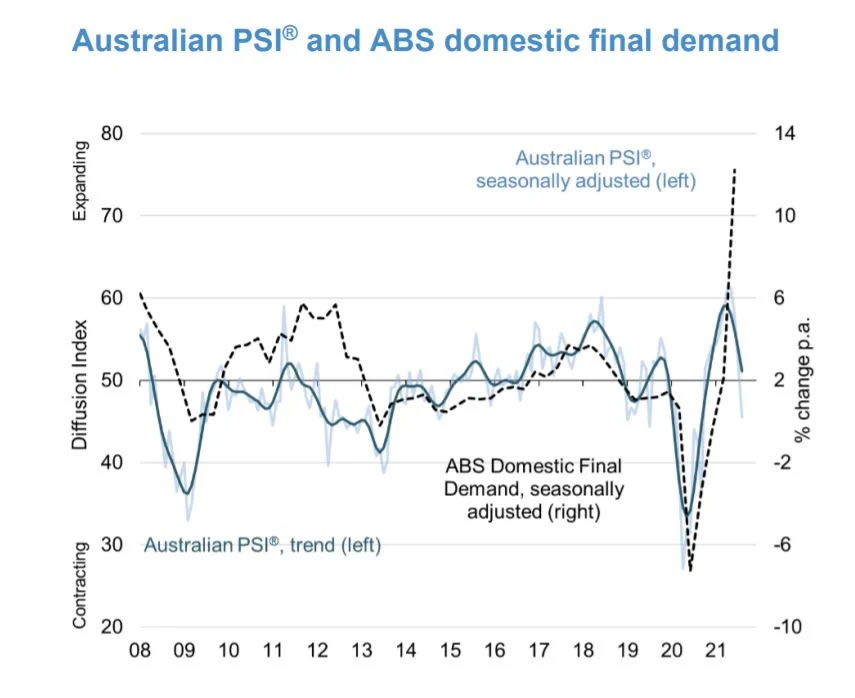
Australia AiG Performance of Services rose 2.0 pts to 49.6 in November. Sales dropped -1.6 to 53.6. Employment dropped -0.6 to 56.2. New orders rose 8.6 to 47.4. Supplier deliveries rose 0.9 to 40.4. Input prices dropped -8.3 to 65.3. Selling prices dropped -3.5 to 58.2.
Ai Group Chief Executive, Innes Willox, said: "The Australian services sector was broadly stable in November, underachieving relative to expectations of a more convincing recovery after the COVID-19 downturn in recent months."
RBA keeps cash rate at 0.1%, asset purchase as 4B a week
RBA left monetary policy unchanged as widely expected. The cash rate target is held at 0.10%. It reiterated that "the Board will not increase the cash rate until actual inflation is sustainably within the 2 to 3 per cent target range."
Asset purchases will continue at AUD 4B a week until at least mid-February 2022. The decision on the program in February will be guided by the same three considerations used from the outset: "the actions of other central banks; how the Australian bond market is functioning; and, most importantly, the actual and expected progress towards the goals of full employment and inflation consistent with the target."
(RBA) Statement by Philip Lowe, Governor: Monetary Policy Decision
At its meeting today, the Board decided to:
- maintain the cash rate target at 10 basis points and the interest rate on Exchange Settlement balances at zero per cent
- continue to purchase government securities at the rate of $4 billion a week until at least mid February 2022.
The Australian economy is recovering from the setback caused by the Delta outbreak. High rates of vaccination and substantial policy support are underpinning this recovery. Household consumption is rebounding strongly and the outlook for business investment has improved. The emergence of the Omicron strain is a new source of uncertainty, but it is not expected to derail the recovery. The economy is expected to return to its pre-Delta path in the first half of 2022.
Leading indicators point to a strong recovery in the labour market. Job advertisements are at an historically high level and there are reports of firms finding it difficult to hire workers. Wages growth has picked up but, at the aggregate level, has only returned to the relatively low rates prevailing before the pandemic. A further pick-up in wages growth is expected as the labour market tightens. This pick-up is expected to be only gradual, although there is uncertainty about the behaviour of wages as the unemployment rate declines to historically low levels.
Inflation has increased, but, in underlying terms, is still low, at 2.1 per cent. The headline CPI inflation rate is 3 per cent and is being affected by higher petrol prices, higher prices for newly constructed homes and the disruptions in global supply chains. A further, but only gradual, pick-up in underlying inflation is expected. The central forecast is for underlying inflation to reach 2½ per cent over 2023.
Housing prices have risen strongly over the past year, although the rate of increase has eased over recent months. Housing credit increased by 6.7 per cent over the past year, but, more recently, the value of housing loan commitments has declined from high levels. With interest rates at historically low levels, it is important that lending standards are maintained and that borrowers have adequate buffers.
Globally, bond yields have declined over the past month due to concerns about the Omicron variant. The Australian dollar exchange rate has depreciated and is around its lows of the past year. Financial conditions in Australia remain highly accommodative, with most lending rates around record lows.
At its February meeting, the Board will consider the bond purchase program. By mid February, the RBA will hold a total of $350 billion of bonds issued by the Australian Government and the states and territories, with these holdings providing significant support to the economy. In reaching its decision in February, the Board will be guided by the same three considerations that it has used from the outset of the program: the actions of other central banks; how the Australian bond market is functioning; and, most importantly, the actual and expected progress towards the goals of full employment and inflation consistent with the target.
The Board is committed to maintaining highly supportive monetary conditions to achieve its objectives of a return to full employment in Australia and inflation consistent with the target. While inflation has picked up, it remains low in underlying terms. Inflation pressures are also less than they are in many other countries, not least because of the only modest wages growth in Australia. The Board will not increase the cash rate until actual inflation is sustainably within the 2 to 3 per cent target range. This will require the labour market to be tight enough to generate wages growth that is materially higher than it is currently. This is likely to take some time and the Board is prepared to be patient.
Eco Data 12/7/21
[php_everywhere instance="1"]
US 500 Index Attempts to Push Higher
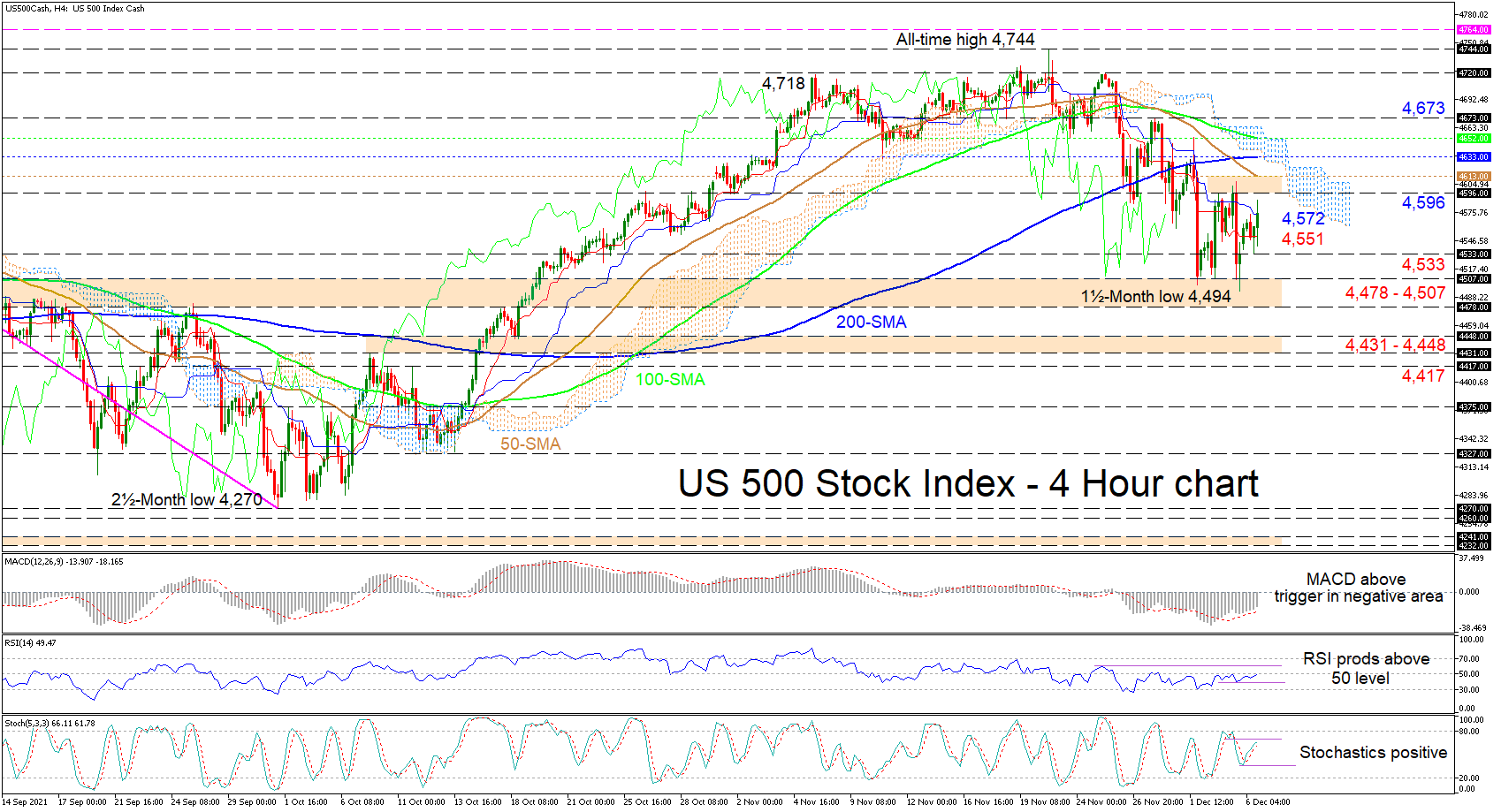
The US 500 stock index (Cash) is trying to recoup previously lost ground from the decline off the 4,720 level until the one-and-a-half month low of 4,494. The bearish 50- and 100-period simple moving averages (SMAs) are endorsing the pullback, and a downward crossover of the 200-period SMA by the approaching 100-period SMA could boost the negative trajectory.
That said, the Ichimoku lines are suggesting downward forces are taking a breather, while the short-term oscillators are signalling that buyers may be gaining the upper hand. The MACD is above its red trigger line, implying that negative momentum is waning. The RSI has nudged above the 50 threshold and is hinting that upside impetus is growing. The positively charged stochastic oscillator is promoting additional gains in the index.
To the upside, buyers face an initial resistance band from the 4,596 level until the 50-period SMA at 4,613 ahead of the Ichimoku cloud. Should the bulls overstep the cloud, a zone of resistance between the 200-period SMA at 4,633 and the 100-period SMA at 4,652 may impede additional advances from testing the 4,673 high.
If sellers retake control, downside friction could arise at the red Tenkan-sen line at 4,551 and the 4,533 low, before the bears challenge the 4,478-4,507 support border. In the event selling pressures increase and drive the price beneath this obstacle, the support boundary of 4,431-4,448 could come into focus prior to the 4,417 barrier.
Summarizing, the US 500 index is currently exhibiting a neutral-to-bearish tone below the 4,596-4,613 resistance barrier.
AUDUSD Meets Key Support, But Trendline Breakout Still Required
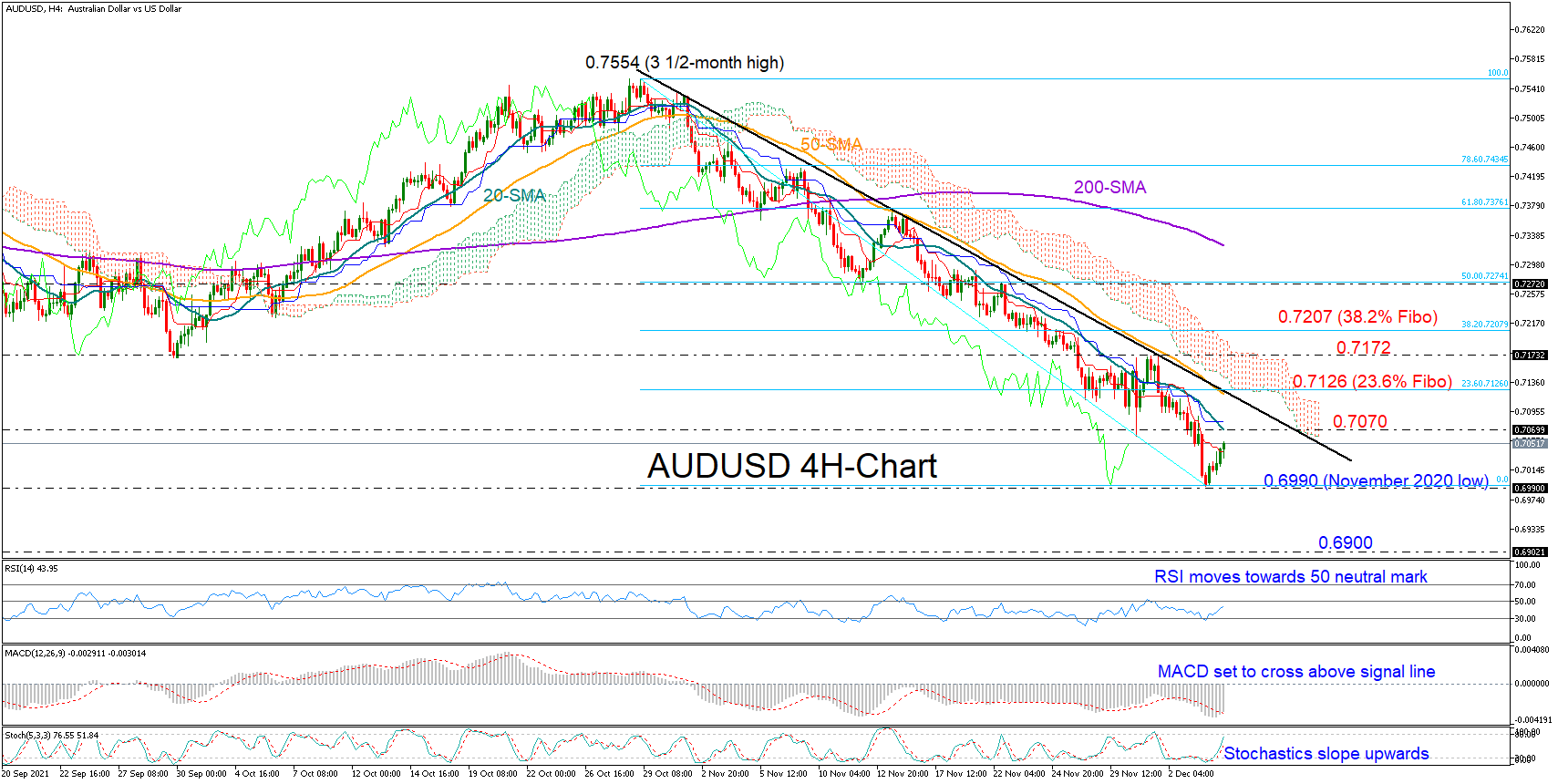
AUDUSD is still in a clear downtrend in the four-hour chart despite the latest reflection near the November 2020 low of 0.6990, with the falling simple moving averages (SMAs) endorsing the bearish trajectory in the market.
That said, the positive momentum in the RSI and the Stochastics, and the recovery in the MACD, which is set to cross back above its red signal line, are pointing to additional bullish actions in the coming sessions. If that is the case, a decisive close above the 0.7070 barrier and the 20-period SMA could boost the price towards the crucial resistance trendline at 0.7126, where the 50-period SMA and the 23.6% Fibonacci retracement of the 0.7554 – 0.6990 down leg are also positioned. Breaking that wall, the bulls may speed up to the swing high of 0.7172, while not far above, the 38.2% Fibonacci of 0.7207 could immediately apply downside pressures if buying forces persist.
In the event sellers drive the price below 0.6990, the pair could mark a new lower low around the 0.6900 psychological mark. Lower, the bears may attempt to breach the 0.6830 – 0.6800 floor last seen in the second half of 2020.
Summarizing, AUDUSD is expected to pare some of its previous losses in the short-term, although the negative trend in the market may remain intact. A sustainable move above 0.7120 would eliminate downside risks.
In fundamentals, the Reserve Bank of Australia is meeting on Tuesday at 03:30 GMT to review its policy settings.
Bank of Canada Meets as Omicron Hits Loonie
Not much is expected from the Bank of Canada when it concludes its meeting at 15:00 GMT Wednesday. The domestic economy is absolutely booming, setting the stage for several rate increases next year. However, most of that is already priced in and uncertainty around Omicron could keep policymakers sidelined for now. As such, the Canadian dollar will be driven mostly by oil prices, although eventually, it could shine as carry trades come back in fashion.
Firing on all cylinders
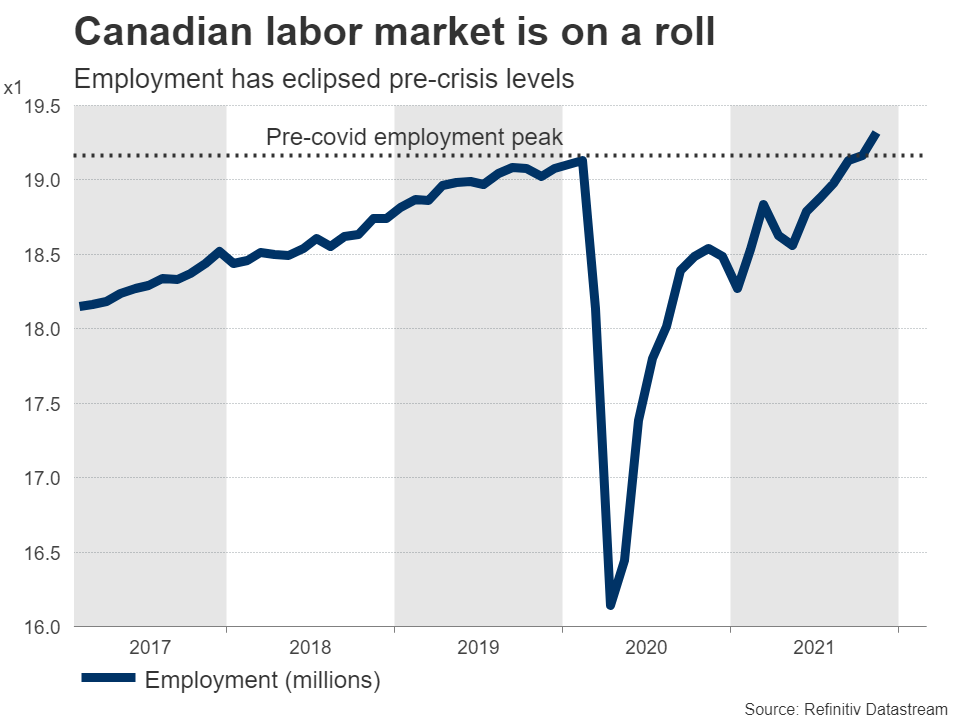
The Canadian economy has staged an incredible recovery. Growth has come back online, inflation is high and rising, the housing market is roaring, and consumption has been solid. The best part is that the labor market has recovered completely, with employment now standing far above its pre-crisis levels.
In light of all this, the Bank of Canada has started to take its foot off the gas. It ended its asset purchase program at the latest meeting and signaled that it could raise interest rates as early as April next year. Money markets are currently pricing in five rate hikes for 2022, which is quite realistic considering the economy’s strength.
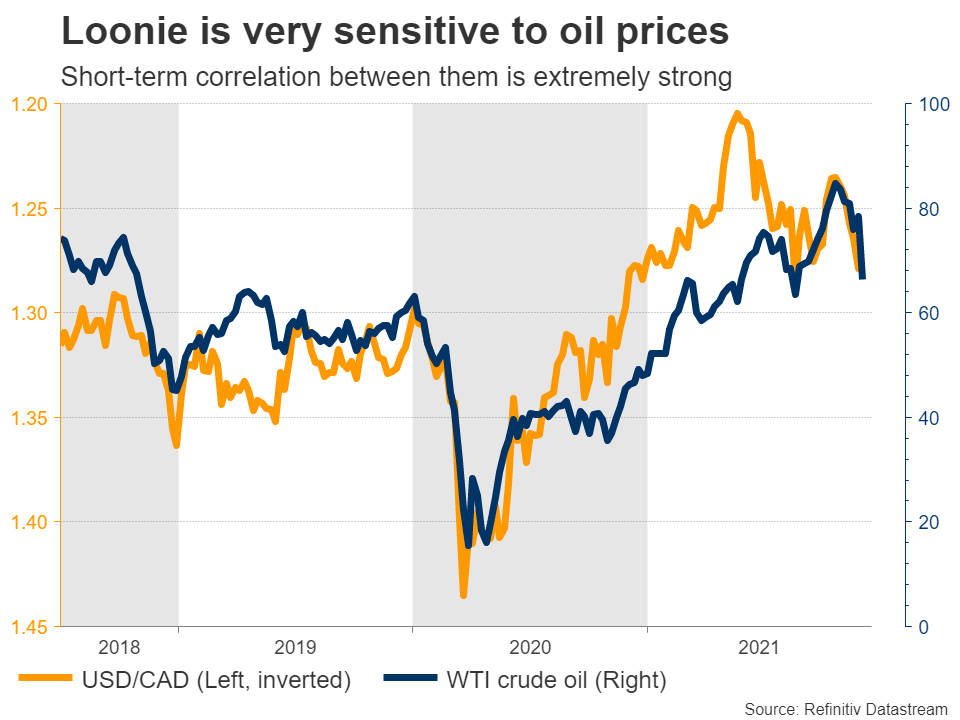
And yet the Canadian dollar has taken a beating this past month. Most of that boils down to the sharp correction in oil prices after the Omicron variant entered the equation. The 30- and 60-day rolling correlation between the loonie and oil prices currently stands at 0.9, which means the two assets have moved in the same direction 90% of the time lately. Of course, Canada is a major exporter of oil.
Neutral meeting?
Turning to the upcoming meeting, the central bank is unlikely to move the needle. Incoming data since it last met have been encouraging, but at the same time, Omicron fears could keep policymakers a little cautious given the risks to global growth.
This is one of the smaller meetings without any updated economic forecasts or a press conference, so the market reaction will depend mostly on the tone of the statement. That said, any reaction could be relatively small as there isn’t much scope for drastic changes in guidance.
Oil and carry trades
With the Bank of Canada's future rate increases ‘fully priced in', the loonie’s fortunes will likely depend mostly on how oil prices perform. In turn, that will depend on the narrative around Omicron and what OPEC does in the coming months.
For simplicity's sake, let’s assume that oil prices remain relatively stable. In this case, the outlook for the Canadian dollar seems bright. The fundamentals of the economy are exceptionally strong, and with the central bank likely to be a global leader in raising rates during this cycle, the loonie could become an attractive destination for ‘carry trades’.
A carry trade is when an investor borrows in a low-yielding currency to invest in a higher-yielding one, and profits from the difference. Therefore, the loonie could outperform the likes of the Japanese yen and the Swiss franc once the Omicron panic settles down, as neither the Bank of Japan nor the Swiss National Bank is expected to raise rates over the coming years. The euro also falls in this category, albeit to a lesser extent.
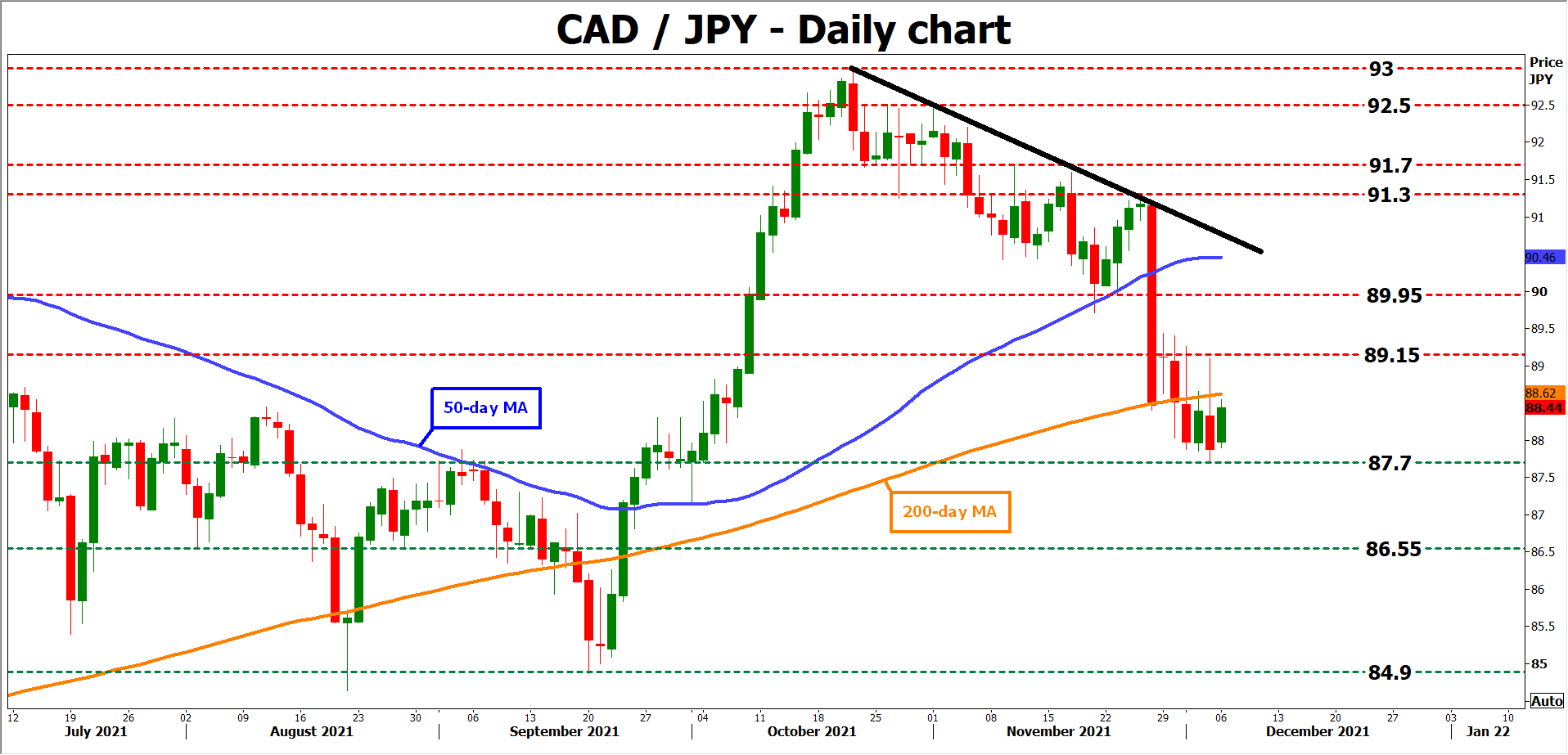
Taking a technical look at loonie/yen, if the bulls manage to close above the restrictive 200-day moving average currently at 88.60, that could open the door for another test of 89.15. Even higher, the focus would shift towards the 89.95 region.
On the downside, should the BoC strike a cautious tone or Omicron fears intensify, preliminary support to declines could be found around 87.70. If the bears pierce below that, the next defensive barrier may be near 86.55, a zone that is more visible on the four-hour chart.