Sample Category Title
Sunset Market Commentary
Markets
Core bonds only return part of Friday’s massive gains in today’s unexciting opening session. Main moves so far occurred during Asian dealings with markets drifting during the European session. Empty eco calendars on both sides of the Atlantic obviously couldn’t color trading. The risk climate is more beneficial following a flagged RRR cut by the PBOC (see below) and as the Chief Medical Adviser to US President Biden (Fauci) said that early reports on the omicron variant of the coronavirus suggested that it could be less dangerous than the ruling delta variant. Main European equity indices gain over 1%. German yields are rising up to 1.5 bps across the curve. The German 10-yr yield remains below the critical -0.35% mark, lost last week. Italian BTP’s outperform in the peripheral space with the spreads vs Germany narrowing by 3 bps. The move comes as rating agency Fitch upgraded the country’s rating from BBB- to BBB (stable outlook), citing higher-than-expected growth in 2021 (6.2%), before Italy reaches its pre-Covid GDP level in Q1 2022. GDP forecasts for 2022 and 2023 are respectively 4.3% and 2.3%. High vaccination rates, high levels of private sector savings and EU recovery fund money all contribute to growth. The rating by Fitch is now in line with the one at S&P (positive outlook though) while Moody’s is the only one to retain the lowest available investment grade rating (Baa3 with stable outlook). US yields add 1.9 bps (2-yr) to 3.3 bps (7-yr) across the curve with the belly slightly underperforming against the wings. The US 10-yr yield remains below 1.41%. Damage for US T’s could have been bigger in the run-up to the Treasury’s mid-month refinancing operation which starts tomorrow with a 3-yr Note sale, but includes more tricky 10-yr Note and 30-yr Bond auctions on Wednesday and on Thursday. EUR/USD switched sides again around the 1.13 big figure, spending most of the day in an extremely narrow range of 1.1280-1.1310. EUR/GBP turned south in the better risk environment, currently changing hands around 0.8520 from a 0.854+ open. BoE’s Broadbent said that he remains out on backing a rate hike next week with the omicron virus providing additional economic uncertainty. He did mention upside inflation risks coming from rising wages with the labour market being tighter than key figures show and as the end of furlough schemes hasn’t loosened the jobs context. JPY (USD/JPY > 113) and CHF (EUR/CHF > 1.04) are today’s main underperformers in FX space.
News Headlines
The People’s Bank of China today announced to reduce the Reserve Requirement Ratio (RRR) for banks by 50 bps, starting on December 15. The action will reduce the amount of cash that banks will have to put aside by about 1.2tn yuan (+/- $188bn). However, part of this amount will be used to repay loans under an expiring medium term loan facility. It was the second cut in the RRR this year after a reduction in July. The move was flagged recently by Prime Minister Li Keqiang as he indicated that authorities would take action to support smaller companies. According to the PBOC, the weighted average RRR will be at 8.4%. The RRR cut comes as Chinese authorities try to cope with a slowdown in growth and with the fall-out from a (liquidity) crisis in some parts of the real estate market. In this respect, comments from a meeting of the Polity Bureau reported that the government will ‘support the commercial housing market to better meet buyer’s reasonable housing needs’. The government also was said to facilitate a healthy development of the property market, which might be an indication that authorities could become less strict on the sector after recent turbulence. The yuan eased slightly this morning with USD/CNY trading near 6.3775.
Czech retail sales printed stronger than expected in October. Sales in constant prices rose 0.3% Y/Y. The core figure excluding motor vehicles even rose 5.6% Y/Y from 3.7% Y/Y. Food and beverages declined slightly (-2.7% Y/Y), but sales of automotive fuels (13.4%Y/Y ) and other (non-food) good (10.0% Y/Y) accelerated. Sale and repair of motor vehicles declined 11.8% Y/Y. This solid retail sales report comes as the CNB is pondering the pace of further rate hikes as inflation is still accelerating while at the same time corona developments might hamper growth short term. EUR/CZK today trades little changed near 25.43.
RBA Preview – Keeping Powder Dry on Mixed Data and Omicron Uncertainty
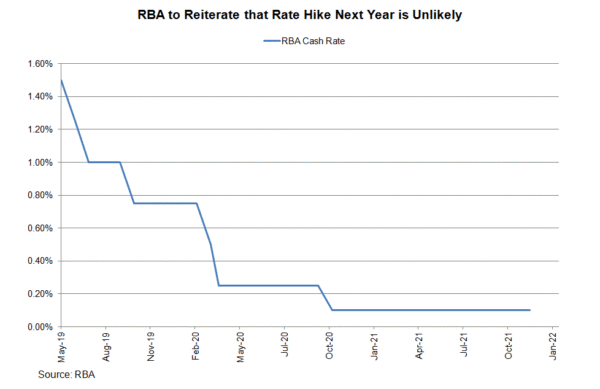
The RBA is widely expected to leave the cash rate unchanged at 0.1%. Given the mixed economic data flow since the last meeting, the uncertainty of the Omicron variant and the scheduled discussion about asset purchases in February, policymakers would stand pat at the upcoming meeting. They would also reinstate that a rate hike next year is unlikely.
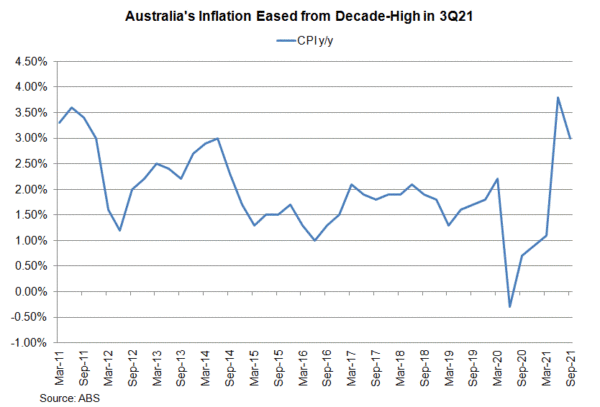
The economic data flow has been mixed since the last week. GDP contracted -1.9% q/q in 3Q21, after growing +0.7% in the prior quarter. This, however, exceeded consensus of -2.7% contraction. From a year ago, GDP expanded +3.9%. While much weaker than +9.6% growth recorded in the second quarter, the reading came in better than consensus of +3%. Inflation stabilized with headline CPI easing to +3% y/y in 3Q21 from a decade-high +3.8% a quarter ago. While the trimmed mean inflation rate, soared +2.1% y/y in 3Q21, from +1.6% in the prior quarter, it has largely stated within RBA’s inflation target range.
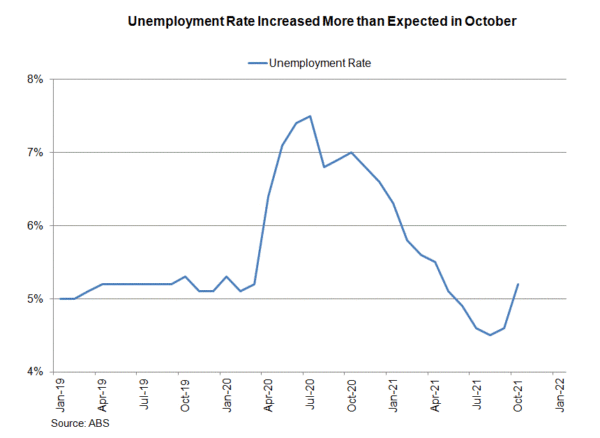
 On the job market, the unemployment rate surprisingly rose +0.6 ppt to 5.2% in October, worse than consensus of 4.8%. The number of fulltime jobs sank -40.4K during the month. The participation rate increased to 64.7% from September’s 64.5%. This came in slightly lower than consensus of 64.8%.
We expect the mixed data and increasingly uncertain outlook brought about by the Omicron variant would support the RBA’s stance to keep the monetary policy on hold. Moreover, the central bank last month noted that a decision on the weekly pace of the bond purchase program will be made at the February meeting. Policymakers should find it more appropriate to leave things as they are and reiterate the forward guidance that conditions for rate liftoff are not expected to be met before "the end of 2023".
Risk Sentiment Rebounds on Omicron Relief; RBA Policy Decision Looms
Omicron concerns ease after volatile week
While the omicron variant keeps spreading rapidly around the globe, headlines that its symptoms are not as severe as previously feared, provided a breather to global markets on Monday after a bumpy week.
Of course, it is too early to draw final conclusions, and the Covid news will probably keep everyone on their toes for longer amid fears stricter lockdown measures could roll in again ahead of the holiday season. Yet, the less risks the omicron variant poses to economies, the larger the odds are for monetary tightening moving at a faster pace next year as inflation continues to spiral in several economies.
US nonfarm payrolls could not power the dollar index above the 97.00 level last week, but Powell’s recent surprising inflation warnings suggested the Fed may prioritize its price target over its employment goal in the coming months. Hence, the dollar bulls may have another opportunity to rally when November’s CPI figures come out on Friday, consequently reducing the fortunes for euro/dollar, which is still stuck below the 20-day simple moving average at 1.1330 for the fifth consecutive day.
BoE Deputy governor downplays rate increases
On the other hand, the pound held onto a slight advance, rotating back towards the $1.3300 number despite the BoE Deputy governor showing his discomfort at higher interest rates. Particularly, Ben Broadbent argued that inflation may exceed 5.0% in April, but subsequently price pressures could fade before potential rate hikes produce any effects.
Commodity currencies pare losses; RBA to stand pat on policy
The commodity currencies were in the green zone as well during the time of writing, with the loonie recouping some lost ground against the greenback thanks to the more-than 3.0% bounce in oil prices.
The Bank of Canada’s policy meeting could be the next challenge for the currency on Wednesday, but prior to that, the focus will be on the Reserve Bank of Australia (RBA), which is scheduled to announce its own policy decision on Tuesday at 03:30 GMT. Expectations are for the central bank to keep its guidance steady, leaving any bond tapering decisions for February as initially planned, and downplaying investors’ sharp pricing of four rate hikes in 2022. On the one hand, the uncertainty around the new omicron variant and the growth slowdown in China, where the PBOC delivered a 50 bp RRR cut today, are currently discouraging any tightening announcements. On the other hand, global risks are pointing to higher inflation in the coming months and with the economy facing a smaller-than-expected damage from its summer lockdowns, some hawkish twists cannot be ruled out.
Should the RBA stress the need for faster monetary tightening, aussie/dollar could extend today’s positive momentum up to the 0.7100 resistance.
Stock indices return to positive territory
Turning to stock markets, the Covid relief is currently putting some footing under major indices after a volatile week, with the pan-European STOXX 600 drifting northwards mainly on the back of energy and utility stocks. The Dow Jones and the S&P 500 are also set to open in positive territory, whereas the Nasdaq 100 could see a moderate pullback at the start of the US open according to US futures.
Euro Yawns after Soft German Data
The euro has started the week quietly and is trading just below the 1.13 level.
German Factory Orders slide
It wasn’t a great way to start the week, as German Factory Orders contacted in October. News orders fell by -6.9% m/m and -1.0% y/y, respectively. The weak numbers are a result of health restrictions in Germany, which has been hit by a fourth wave of Covid and is seeing a sharp uptick in the number of Covid cases. Investors shrugged at the weak data, as Germany’s manufacturing sector is in decent shape. The November Manufacturing PMI came in at 57.4, which points to significant expansion. Still, if the pandemic worsens and the government responds with more severe restrictions, manufacturing could lose steam.
Eurozone inflation is running at a 4.9% clip, but some investors have expressed concern that ECB President Christine Lagarde has been too sanguine about the jump in inflation. Lagarde has said that inflation is under control and a result of temporary factors such as high energy prices, but many market participants are sceptical of her stance. Some ECB members have stated that inflation may not ease as quickly as expected. This view was reiterated last week by Luis de Guindos, vice-president of the ECB. There is growing pressure on the ECB to reduce its monetary stimulus, but the upcoming meeting may be a sleeper, with Lagarde signalling that there won’t be any major changes at next week’s policy meeting.
In the US, non-farm payrolls was very disappointing, with a reading of 210 thousand new jobs. This was nowhere near the consensus of 534 thousand. The soft reading was cushioned by a sharp drop in the unemployment rate, which fell from 4.6% to 4.2%. This was a result of a household employment report which showed some 1.1 million jobs at been created. If you’re confused about the conflicting data, no worries – the expert are as well. These two employment reports often diverge sharply, and the true state of the labor market lies somewhere in the middle.
EUR/USD Technical
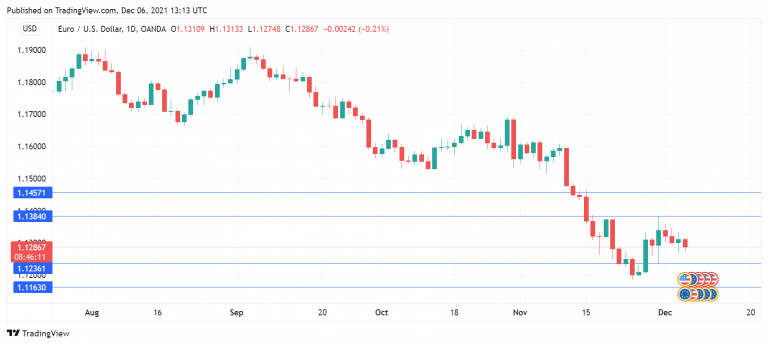
- EUR/USD has support at 1.1236 and 1.1163
- The next resistance lines are 1.1383 and 1.1457
EUR/USD Elliott Wave Analysis: Be Aware of More Weakness
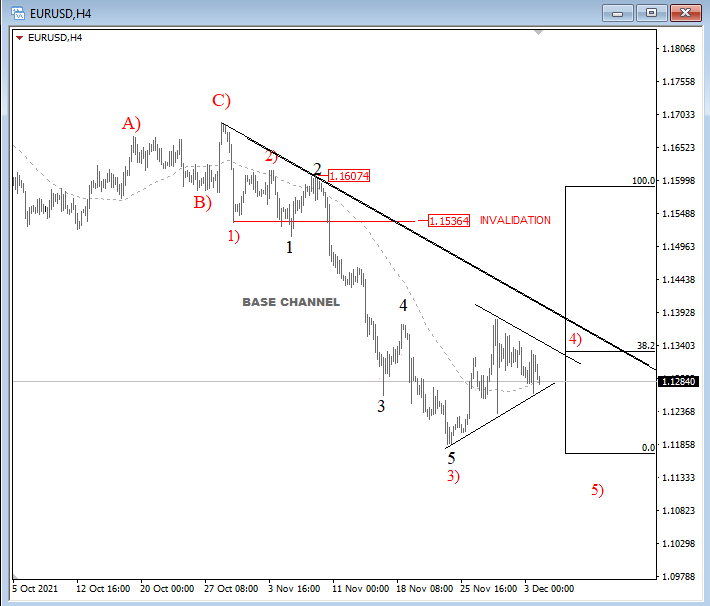
EURUSD is trying to stabilize after a recent sharp sell-off from 1.1600 that we see as an extended wave 3) that belongs to the ongoing bearish impulse which may resume after a current rally.
We see the current price rally as wave 4) that already stopped at the 1.1370 resistance zone, near 38.2%, so we should be aware of more weakness this week, while an upper trendline holds.
EUR/USD 4h Elliott Wave analysis
US Dollar is Rising Again
EUR/USD is back to falling on Monday; it is currently trading at 1.1280.
Last Friday’s statistics on the US labour market for November were rather mixed. However, the ISM and PMI data may help the market to recapture the positive tendency.
The Unemployment Rate in the US dropped from 4.6% in October to 4.2% in November. At the same time, the Average Hourly Earnings added only 0.3% m/m, less than expected. The Non-Farm Employment Change was really disappointing and showed 210K after being 546K the month before and against the expected reading of 553K.
The numbers are very mixed: the labour market may have slowed down the job creation process, but only the December data will show whether it is accidental or regular.
These mixed signals from the labour market are quite unlikely to prevent the US Fed from deciding in favour of a more active QE program closure during its meeting scheduled for 15 December.
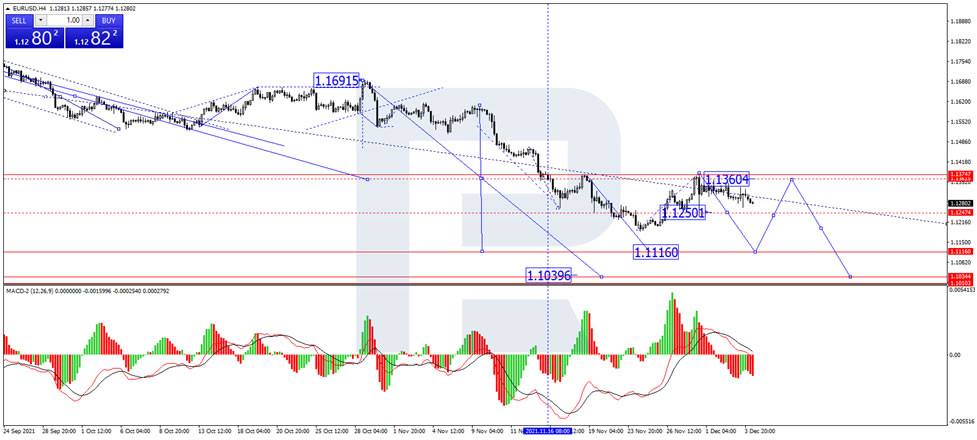
In the H4 chart, EUR/USD is trading downwards to reach 1.1247 and may later consolidate there. If later the price breaks the range to the downside, the market may resume falling towards 1.1116. After that, the instrument may start a new correction to return to 1.1247 and then resume falling with the target at 1.1110. From the technical point of view, this scenario is confirmed by MACD Oscillator: its signal line is moving to break 0 and may later continue falling towards new lows.
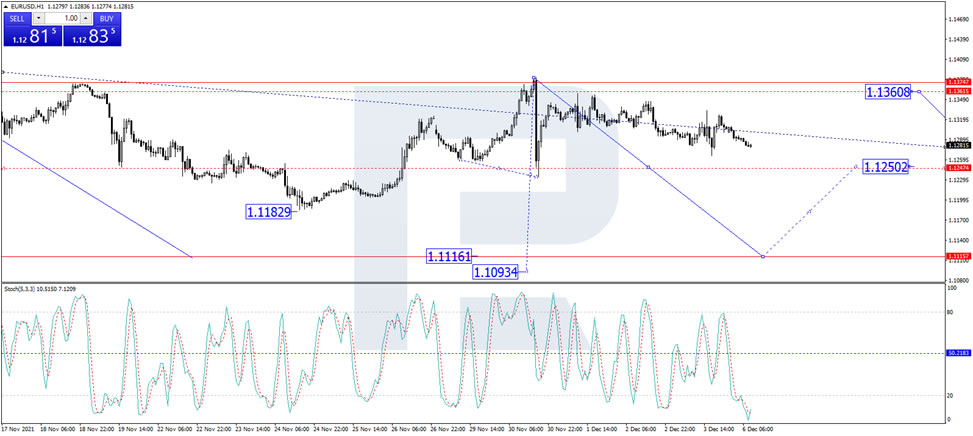
As we can see in the H1 chart, EUR/USD is forming the third descending wave; it has already completed the first wave at 1.1266 along with the correction towards 1.1326. At the moment, the asset is falling to reach 1.1250 and may later form a new consolidation range as a downside continuation pattern. If the price breaks the range to the downside, the market may resume falling with the short-term target at 1.1140 and then form one more descending structure to reach 1.1111. From the technical point of view, this idea is confirmed by the Stochastic Oscillator: its signal line is moving below 20, thus implying a furth
EUR/USD Mid-Day Outlook
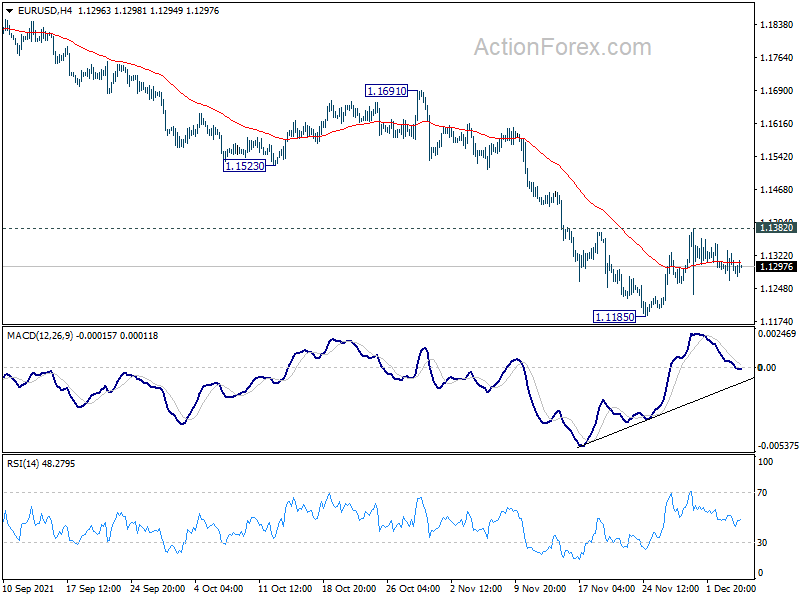
Daily Pivots: (S1) 1.1274; (P) 1.1303; (R1) 1.1340; More...
Range trading continues in EUR/USD and intraday bias remains neutral at this point. On the upside, firm break of 1.1382 resistance should confirm short term bottoming at 1.1186. Intraday bias will be turned back to the upside for 55 day EMA (now at 1.1487). On the downside, break of 1.1185 will resume larger fall from 1.2348.
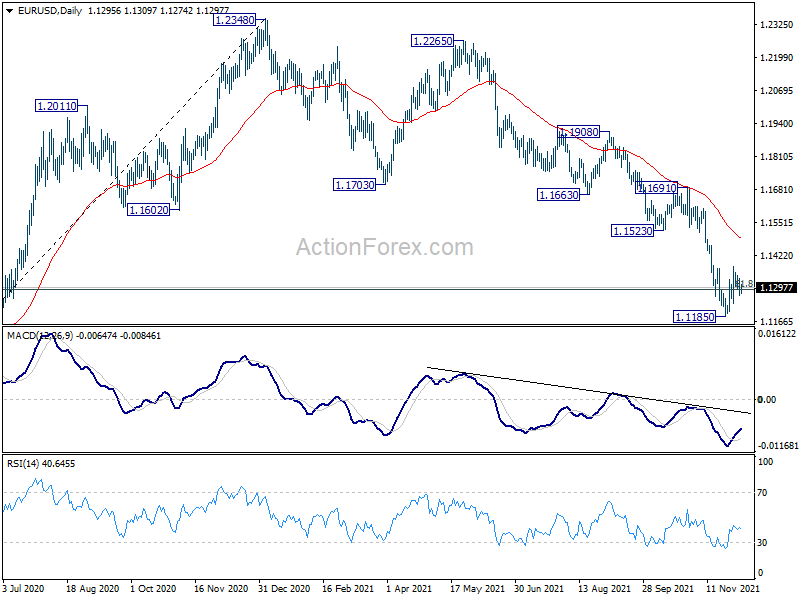
In the bigger picture, there are various ways of interpreting the fall from 1.2348 (2021 high). It could be a correction to rise from 1.0635 (2020 low), the fourth leg of a sideway pattern from 1.0339 (2017 low), or resuming long term down trend. In any case, outlook will now stay bearish as long as 1.1703 support turned resistance holds. Sustained break of 61.8% retracement of 1.0635 to 1.2348 at 1.1289 would pave the way back to 1.0635.
GBP/USD Mid-Day Outlook
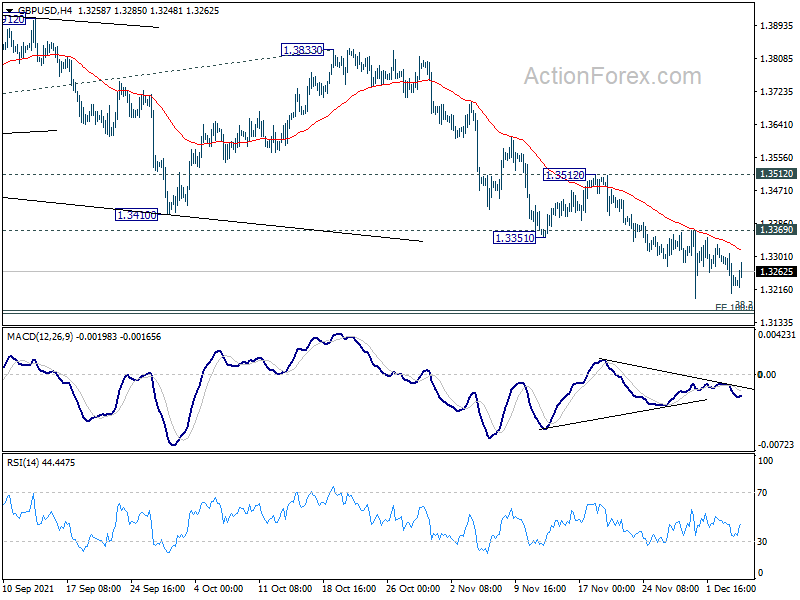
Daily Pivots: (S1) 1.3191; (P) 1.3250; (R1) 1.3292; More...
Intraday bias in GBP/USD remains neutral with focus on 1.3164 medium term fibonacci level. Sustained break there will carry larger bearish implication, and target 161.8% projection of 1.4248 to 1.3570 from 1.3833 at 1.2736. Nevertheless, break of 1.3369 minor resistance will turn bias back to the upside for 1.3512 resistance first.
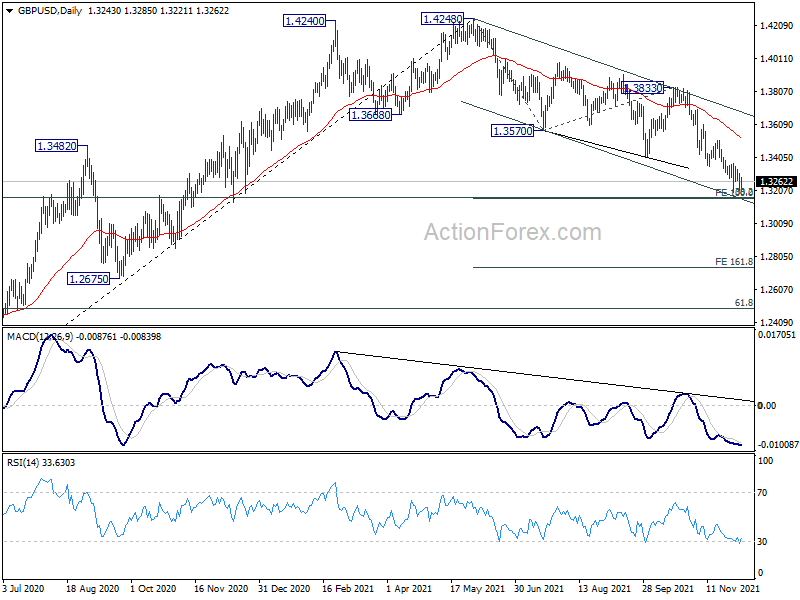
In the bigger picture, immediate focus is now on 38.2% retracement of 1.1409 to 1.4248 at 1.3164. Sustained break there will argue that whole rise from 1.1409 has completed at 1.4248, ahead rejection by 1.4376 long term resistance. That will revive some medium term bearishness and and target 61.8% retracement at 1.2493.
USD/CHF Mid-Day Outlook
Daily Pivots: (S1) 0.9158; (P) 0.9188; (R1) 0.9210; More....
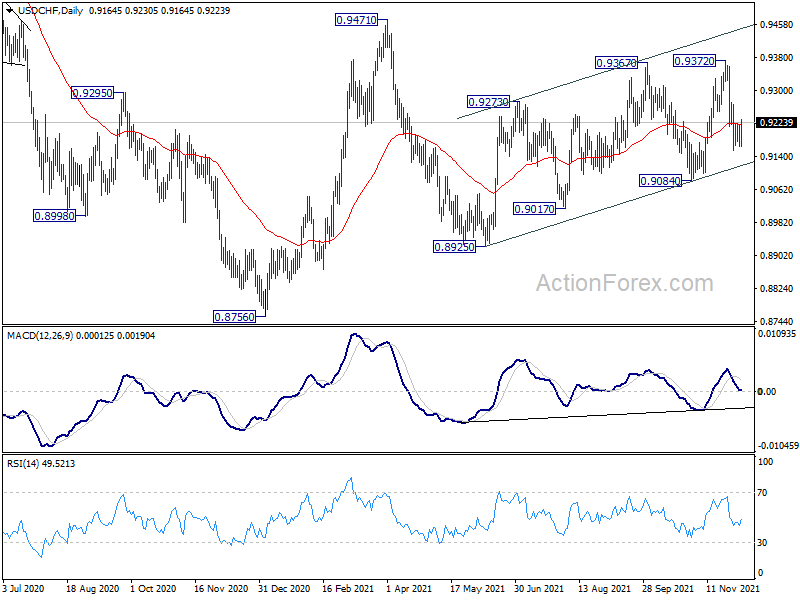
No change in USD/CHF's outlook and intraday bias remains neutral for the moment. On the downside, below 0.9156 will target 0.9084 support. Firm break there should confirm that choppy rise from 0.8925 has completed, and suggests that fall from 0.9471 is resuming. Deeper decline would be seen through 0.8925. Nevertheless, break of 0.9271 will turn bias back to the upside for retesting 0.9372.
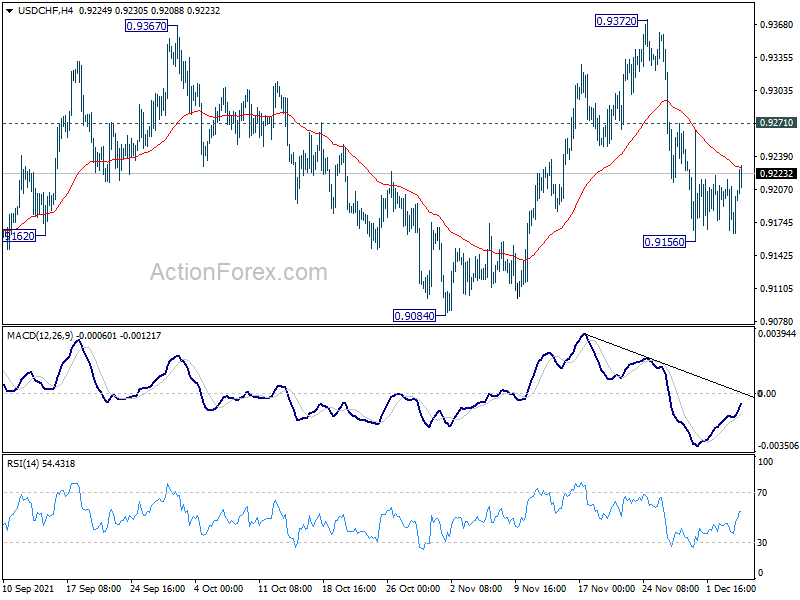
In the bigger picture, the corrective structure of the rebound from 0.8925 argues that fall from 0.9471 is not complete yet. It could either be the second leg of pattern from 0.8756 (2021 low), or resuming larger down trend from 1.0237 (2018 high). We'd pay attention to the downside momentum and assess the odds later. But for now, medium term outlook will be neutral at best as long as 0.9471 resistance holds.
USD/JPY Mid-Day Outlook
Daily Pivots: (S1) 112.40; (P) 113.00; (R1) 113.45; More...
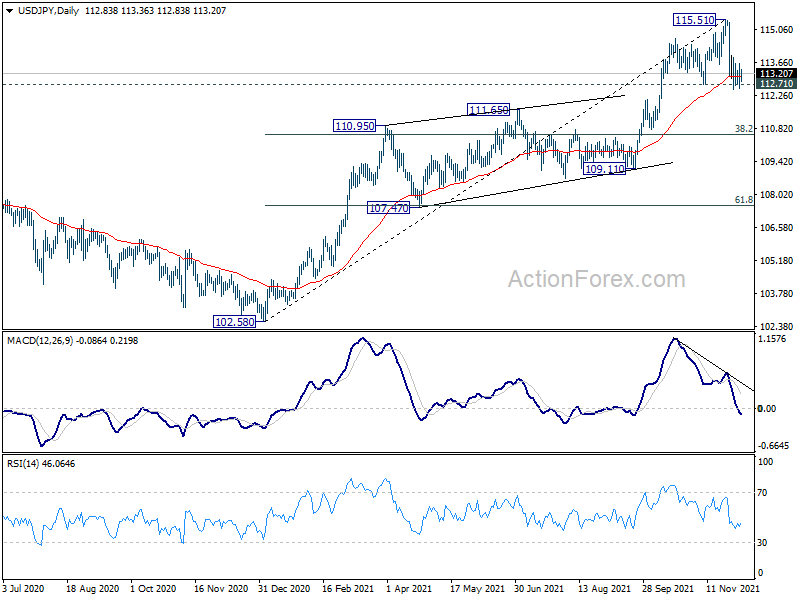
No change in USD/JPY's outlook and intraday bias stays neutral with focus on 112.71 support. On the downside, sustained break of 112.71 will argue that it's already correcting whole rise from 102.58. Deeper fall would be seen to 38.2% retracement of 102.58 to 115.51 at 110.57. On the upside, break of 113.94 minor resistance will turn bias back to the upside for retesting 115.51 high instead.
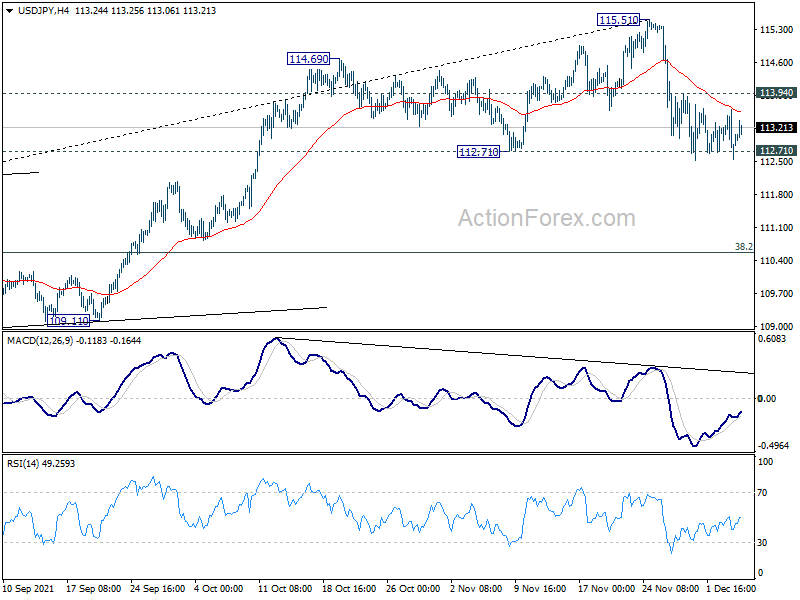
In the bigger picture, no change in the view that rise from 102.58 is the third leg of the up trend from 101.18 (2020 low). Such rally should target a test on 118.65 (2016 high) on resumption. However, firm break of 109.11 structural support will argue that the trend might have reversed and bring deeper fall to 107.47 support and possibly below.