Sample Category Title
Risk Improves, As Omicron Fears Fade
Market movers today
- The German ZEW index may resume a declining trend after last month's small rebound, a development seen in the similar Euro sentix indicator yesterday. New headwinds from Covid, weakness in China and declining real wages currently weigh on the German economy.
- German industrial production could also surprise to the downside following a very weak reading on factory orders yesterday, which dropped 6.9% m/m and 1.0% y/y.
- In the afternoon, we get US trade balance as well as unit labour cost.
- In Sweden we get a lot of data during the morning: industrial production and orders, household consumption and GDP indicator. Norway releases Regional Survey and industrial production.
The 60 second overview
China: Yesterday, PBoC cut the RRR rate by 50bp for banks. It was widely expected it would come after a statement from premier Li Keqiang on Friday. We do not expect a lot of further easing from here, as China is also easing fiscal policy moderately (more infrastructure projects). Both China' exports and imports grew faster than expected in November, as foreign demand remains strong. China's exports are likely to stay strong over the winter if US goods demand stays high amid new outbreaks.
Increasing tensions with Russia The US and Europe are considering targeting Russia's banks if president Vladimir Putin invades Ukraine. One possibility is to make it difficult for the banks to convert roubles for dollars and euros.
RBA: In Australia, RBA kept monetary policy unchanged but added that omicron is not expected to derail the recovery. This is a view we share, not just for Australia but globally, although new outbreaks over the winter may slow growth.
Equities: Strong start of the week for developed markets equities as a narrative of a less deadly covid-19 variant (omicron) is building. Recovery yesterday took place in some of the hard-hit sectors such as consumer service. Also, the stimulus in China contributes to increasing risk appetite. Vol came lower though VIX still at 27 and small cap outperformed large. Growth and momentum stocks still struggling as with value outperforming for its fourth consecutive day. In US Dow +1.9%, S&P 500 +1.2%, Nasdaq +0.9%, Russell 2000 +2.1%. Optimism continues to build in China this morning with Japanese and Chinese H-shares sharply higher. Both European and US futures are pointing to a green opening in cash markets.
FI: For most of the European trading session, it was mostly a waiting game. No significant data releases or headlines yesterday drove markets as we are all waiting for the central bank showdown next week, with specifically the Fed and the ECB meetings. The little volatility benefitted the periphery, led by Italy that also saw one notch upgrade from Fitch on Friday, leaving the BTPs-Bund spread tighter by 3bp.
FX: NOK, AUD and CAD rose vis-à-vis CHF and JPY yesterday where risk sentiment recovered further. EUR/USD slipped back below 1.13; EUR/SEK and EUR/NOK both fell back below 10:30 level.
Credit: The positive sentiment in credit extended into yesterday with iTraxx Xover tightening almost 4bp (taking it to 280bp) and Main 1bp (to 57bp). HY bonds tightened 1bp and IG 0.5bp.
Nordic macro
Sweden: A busy day on the Swedish agenda. We receive a bunch of October macro data, which will give us a first glance at Q4 developments. The releases include Production Value Index, household consumption and Statistics Sweden GDP indicator, which will summarize the first month of Q4 in GDP terms. According to hours worked and the trade balance, the Swedish economy has probably had a decent start to the quarter.
Additionally, SNDO releases data on the November borrowing requirement, where expectations are for a SEK14.6bn surplus. As the October figure surprised to the upside, the risks are probably tilted to the downside (smaller surplus) this time around.
Norway: Norges Bank's regional survey has long been the central bank's preferred leading indicator. We expect the survey to show a slowdown in growth as the bulk of the reopening effect is behind us. The latest wave of infections may also have pushed up uncertainty again, at least in parts of the service sector. However, we will be more interested in the results for capacity utilization, labour shortages and wage expectations (for 2022) as these could signal an upside risk to inflation in the medium term.
EUR/CHF Daily Outlook
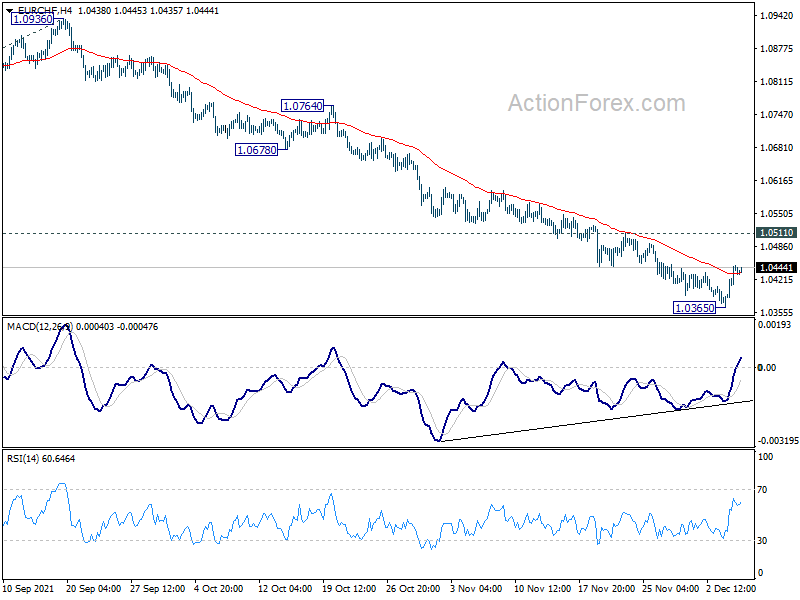
Daily Pivots: (S1) 1.0395; (P) 1.0423; (R1) 1.0471; More....
Intraday bias in EUR/CHF is turned neutral with current recovery. Further fall is still expected as long as 1.0511 resistance holds. On the downside, break of 1.0365 will resume larger down trend to 161.8% projection of 1.1149 to 1.0694 from 1.0936 at 1.0200 next. Nevertheless, firm break of 1.0511 will confirm short term bottoming, and bring stronger rebound to 55 day EMA (now at 1.0584) and possibly above.
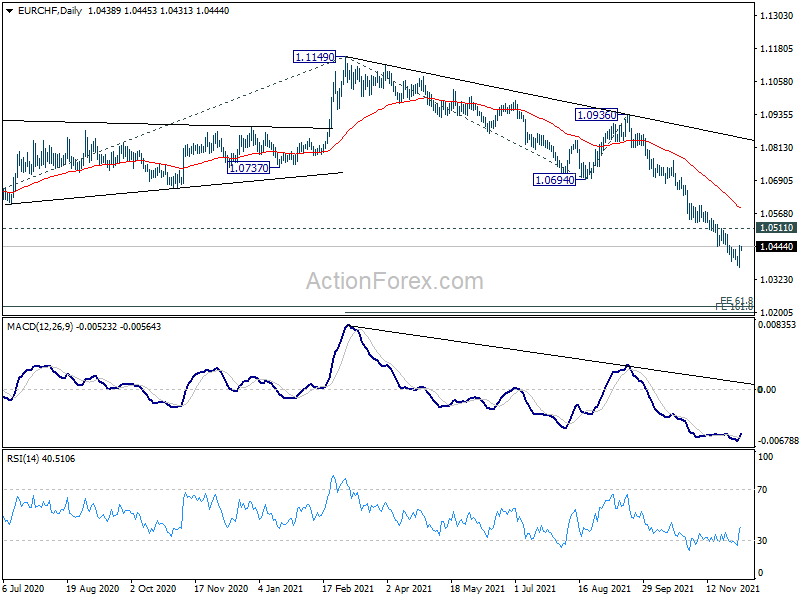
In the bigger picture, long term down trend from 1.2004 (2018 high) is now extending. Next target is 61.8% projection of 1.2004 to 1.0505 to 1.1149 at 1.0223. On the upside, break of 1.0694 support turned resistance is needed to be the first sign of medium term bottoming. Otherwise, outlook will remain bearish even in case of rebound.
EUR/JPY Daily Outlook
Daily Pivots: (S1) 127.70; (P) 127.90; (R1) 128.27; More....
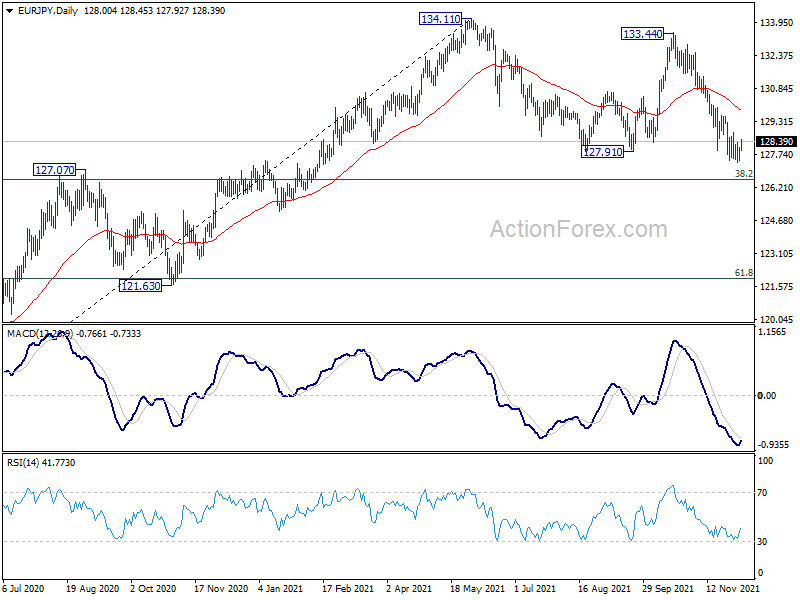
Intraday bias in EUR/JPY is turned neutral with current recovery. On the upside, break of 128.77 will indicate short term bottoming and bring stronger rebound to 55 day EMA (now at 129.87). On the downside, below 127.36 will target 126.58 medium term fibonacci level. We'd look for some support from there to bring rebound. But sustained break of 126.58 will carry larger bearish implications.
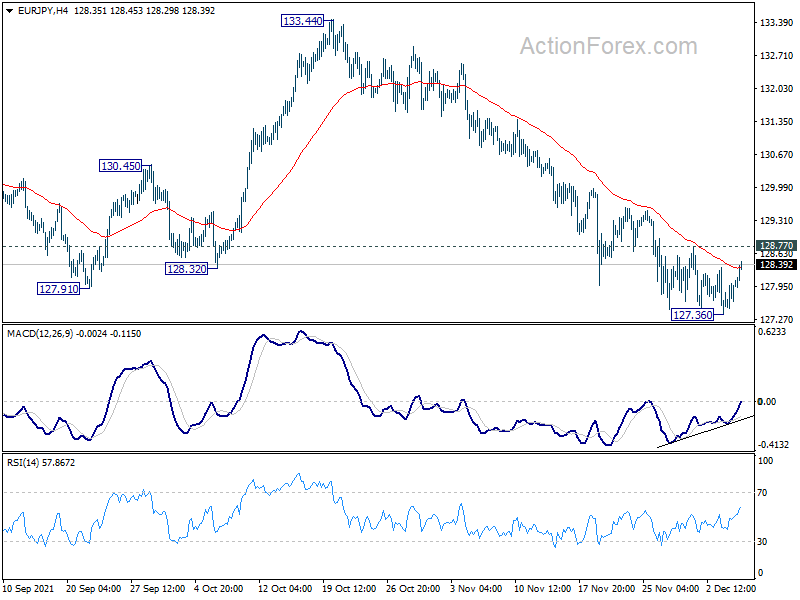
In the bigger picture, as long as 38.2% retracement of 114.42 (2020 low) to 134.11 at 126.58 holds, up trend from 114.42 is still in favor to continue. Break of 134.11 will target long term resistance at 137.49 (2018 high). However, sustained break of 126.58 will raise the chance of medium term bearish reversal. In this case, deeper decline would be seen to 61.8% retracement at 121.94, and possibly below.
RBA Board Holds Policy Steady – Brings Forward Timing of Returning to Pre-Delta Growth Path
As expected, the RBA Board held its policy settings steady. The Governor confirmed a review of the bond purchase program at the February Board meeting. He did bring forward his estimate of when the economy will return to the pre-Delta growth path from the second half of 2022 to the first half. That accords with Westpac’s view although we are forecasting GDP growth in 2022 of 6.4% compared to the Bank’s current forecast of 5.5%.
As expected, the Reserve Bank Board decided to retain the current policy settings at its December Board meeting.
The overnight cash rate was held at 0.1%; the Exchange Settlement rate stayed at zero while the Bank will continue to purchase securities at the rate of $4 billion a week until at least mid February 2022.
Given the recent firming market sentiment that the FOMC is likely to announce an acceleration of its taper plans at its meeting next week there was some speculation that the Board might announce plans to scale back the taper in February.
That seemed highly unlikely to us given the Governor’s firm commitment in November that the tapering decision is scheduled for February. After the controversy over the Yield Curve Control policy the Board would want to be seen to be mixing its signals.
The Governor confirmed that the decision in February would be based on three criteria the actions of other central banks; how the Australian bond market would be functioning; and expected progress towards the full employment and inflation goals. In effect the decision will be impacted by the economic forecasts, which are set to be reviewed before the February Board meeting.
We expect the Bank will strike a “middle ground” position on its bond purchases by scaling back purchases from $4 billion to $2 billion per week. The program would be phased out by the May Board meeting.
The Bank will not have changed its forecasts for the December meeting with the pick-up in wages growth “expected to be gradual” while “a further, but only gradual, pick up in underlying inflation is expected.”
The key sentences on inflation are identical to the November Statement.
On the other hand, there is more “colour” around the wages discussion “Job advertisements are at an historically high level and there are reports of firms finding it difficult to hire workers.”
The Bank will need to change its growth forecasts at least for 2021 following the September quarter GDP report. We assess that the Bank expected that the economy contracted by 2.5% whereas the contraction was “only” 1.9%. With the smaller than expected contraction and, presumably, no offsetting reduction in the speed of the recovery the economy would be expected to return to its pre delta path somewhat earlier.
The economy had previously been assessed to return to its pre- Delta by the second half of 2022 whereas in today’s Statement the Governor notes “The economy is expected to return to its pre- Delta path in the first half of 2022”.
On December 3 Westpac released its revised growth forecasts following the National Accounts. We expect GDP growth of 6.4% in 2022 compared to the RBA’s current forecast of 5.5%
We expect GDP to be 6.6% higher in December 2022 than in June 2021 compared to the 5.5% we forecast pre-Delta.
We expect GDP to be 4.4% higher in June 2022 than in June 2021 whereas pre-Delta we expected an increase of 4.2%.
Consequently, the RBA’s views on the economy returning to the pre-Delta path by the first half of 2022 accord with our own views.
It also seems reasonable that the RBA will lift its growth forecast for 2022 although probably not all the way to our 6.4%.
Relative to November the Governor sounds somewhat more encouraged that the housing market may be losing a little steam. In November “Housing prices are continuing to rise in most markets and housing credit growth has picked up “in December “the rate of increase has eased over recent months … the value of housing loan commitments has declined from high levels.”
Finally, the concluding paragraphs setting out the policy outlook are entirely consistent with the messages in previous Statements.
Conclusion
February has recently been a month for some bold action by the Governor. In addition to the usual Board meeting where a new set of forecasts are reviewed, he gives a speech to the National Press Club titled The Year Ahead and the February Statement on Monetary Policy is released at the end of the week.
For example, in 2021 he surprised many market participants by adopting a second $100 billion bond purchase program.
His rhetoric on wages and inflation (currently “gradual”) will be impacted by the forecasts which in turn will have the benefit of another CPI report and two employment reports, in particular.
Therefore, there is a possibility that he will strengthen his rhetoric on the inflation and wages outlook beyond just scaling back the bond purchase program.
We expect that he will need more time before he signals a retreat from the very dovish stance we have seen this year.
We remain comfortable with the view we have held since June 18 that the first-rate hike will be at the February Board meeting in 2023.
Equities Trade Generally Higher After US Gains, HK And CN Markets Trade Mixed After PBOC’s Easing
General trend
- Speculation has now moved to China’s loan prime rates (LPRs) following RRR cut.
- China’s Nov trade surplus missed ests amid higher imports.
- RBA seemingly downplayed omicron.
- US equity FUTs have remained higher; Intel rises during afterhours trading on Mobileye news.
- Travel stocks trade generally higher.
- Hang Seng has remained higher; TECH index rises after prior losses; HK property developers continue to announce stock offerings [Shimao Property, Logan Property].
- Shanghai Composite traded slightly higher after the easing by the PBOC, the index later pared gains; Property index rises 2%, Financials also gain.
- Nikkei 225 has extended its advance.
- S&P ASX 200 also continued to move higher; Energy and Consumer Discretionary indices outperformed.
- Reserve Bank of India (RBI) is due to hold policy meeting on Wed (Dec 8th).
- Companies due to report during the NY morning include AutoZone, Conn’s, Designer Brands.
Headlines/Economic data
Australia/New Zealand
- ASX 200 opened +0.2%.
- (AU) RESERVE BANK OF AUSTRALIA (RBA) LEAVES CASH RATE TARGET UNCHANGED AT 0.10%; AS EXPECTED; Omicron strain is a new source of uncertainty, but it is not expected to derail the recovery.
- (AU) AUSTRALIA Q3 HOUSE PRICE INDEX Q/Q: 5.0% V 5.0%E; Y/Y: 21.7% V 16.8% PRIOR.
- (NZ) Reserve Bank of New Zealand (RBNZ) annual Stress test results: Major stress event could make it difficult for banks to meet higher capital requirements, but show strengthening bank resilience from last year.
Japan
- Nikkei 225 opened +0.8%.
- (JP) Japan Oct Labor Cash Earnings Y/Y: 0.2% v 0.4%e; Real Cash Earnings Y/Y: -0.7% v -0.5% prior.
- (JP) Japan Nov FX Reserves $1.41T v $1.40T prior.
- 7201.JP COO Gupta: Will follow customer demand when deciding which regions to roll out electric vehicles, we are on a good path with profits and electrification - press.
- (JP) Japan Fin Min Suzuki: FY25 primary balance target should be upheld, no need to consider a different target at this juncture – press.
- (JP) Japan MoF sells ¥900B v ¥900B indicated in 0.7% 30-year JGBs, Avg Yield: 0.6730% v 0.6830% prior, bid-to-cover: 3.21x v 3.45x prior.
Korea
- Kospi opened 0.0%.
- (KR) South Korea to front load more than 70% of budget in H1 of 2022 - Yonhap.
- (KR) South Korea Oct Current Account (BOP): $5.6B v $10.0B prior (18th consecutive surplus); Balance of Goods (BOP): $7.0B v $9.5B prior.
- 005930.KR To replace CEOs and business division heads; Appoints CFO, To merge mobile and consumer electronic divisions.
China/Hong Kong
- Hang Seng opened +1.5%; Shanghai Composite opened +0.6%.
- (CN) CHINA NOV TRADE BALANCE (CNY-DENOMINATED): 460.7B V 575.0BE.
- (CN) CHINA NOV TRADE BALANCE $71.7B V $82.1BE; Trade Balance with US: $37.0B v $40.7B prior.
- (CN) CHINA PBOC CUTS OVERALL RESERVE REQUIREMENT RATIO (RRR) BY 50BPS; effective Dec 15th ; cut to release CNY1.2T liquidity into banking system (late session yesterday).
- (CN) China PBOC to cut relending rate by 25bps to support SME and rural sector, effective Dec 7th - China Securities Times.
- (CN) Shanghai Securities News: Property prices in China expected to remain 'steady' in 2022.
- Kaisa Group, 1638.HK Said to have failed to deliver apartments and pay wages in Guangzhou - China Press.
- (CN) China PBOC sets Yuan reference rate: 6.3738 v 6.3702 prior.
- (CN) China PBOC Open Market Operation (OMO): Sells CNY10B in 7-day reverse repos v CNY10B prior; Net drain CNY90B v Net drain CNY90B prior.
- (HK) Hong Kong Chief Exec Lam: Travel between Hong Kong and China to begin with business groups.
- (CN) China Govt Think Tank: Expects China GDP at 5.3% in 2022.
North America
- INTC Confirms Intent to Take Mobileye Public; Will retain majority stake after IPO.
- (US) Senate Minority Leader McConnell (R-KY): Will probably end up supporting reappointing Jerome Powell as Fed Chair.
- TSLA CEO Musk: Company does not need federal tax credits; Cybertruck will move volume production to 2023.
Europe
- (RU) US President Biden is considering options for potential Russia Invasion of Ukraine, including cutting Russia off of SWIFT payment system and restrictions on Russian bond trading.
- (UK) Nov BRC Sales LFL Y/Y: +1.8% v -0.2% prior.
- (HU) Hungary Central Bank Dep Gov Virag: Inflation will peak above ~7.0% in Nov, but decline will be slow starting in H2 2022; Will not hike rates weekly, but when needed. Central bank to act with sufficient force.
Levels as of 00:15ET
- Hang Seng +1.8%; Shanghai Composite -0.1%; Kospi +0.5%; Nikkei225 +2.2%; ASX 200 +1.0%.
- Equity Futures: S&P500 +0.3%; Nasdaq100 +0.3%, Dax +0.4%; FTSE100 0.0%.
- EUR 1.1293-1.1276; JPY 113.68-113.40; AUD 0.7075-0.7039; NZD 0.6762-0.6737.
- Commodity Futures: Gold -0.1% at $1,777/oz; Crude Oil +1.0% at $70.20/brl; Copper -0.4% at $4.32/lb.
Is The Bottom In?
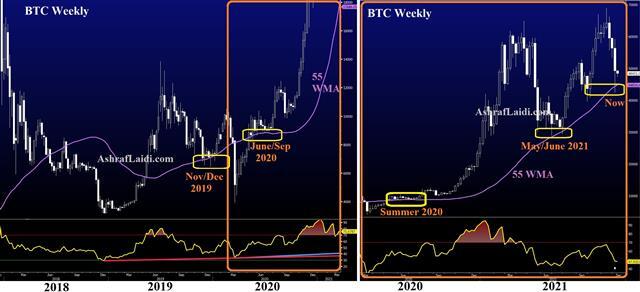
Prepare to hear/read this question at least 5x this week and the next.."Is the Bottom In? Bitcoin respected the 55-WEEK MA as did the Dow Jones Industrials Index held above its 200-DAY MA and the S&P500 bounced off its trendline support from the late Sep low. What about gold's trendline support at 1760..or the horizontal support on the 10-year yield at 1.38% -- in line with the 100-DMA. Figuring our all of these levels make us appear astute and especially clever when they're all in synch. But the challenge lies with the repetitive manner these levels will likely have to be tested, just as we saw in the SPX bottom of late Sep/early Oct. Back then, the index re-tested its 100-DMA at least 4x before mounting a 450-pt ascent in a mere 7 weeks. All of the aforementioned markets are sure to retest their recent sometime this week (US CPI report due Friday) and most likely next week when the Fed, BoE and ECB all decide on QE and interest rates. One thing we learned during the lows of late Sep/early Oct is to look beyond wicks and focus on the cash close. Whether you're bullish or bearish make sure to exercise extra caution ahead of next week --considered one of the most important weeks of the year. Earlier today we told the WhatsApp Broadcast Group we were long the DOW30 based on the VVIX/VIX technicals.
Elliott Wave View: Rally In DAX Expected To Fail
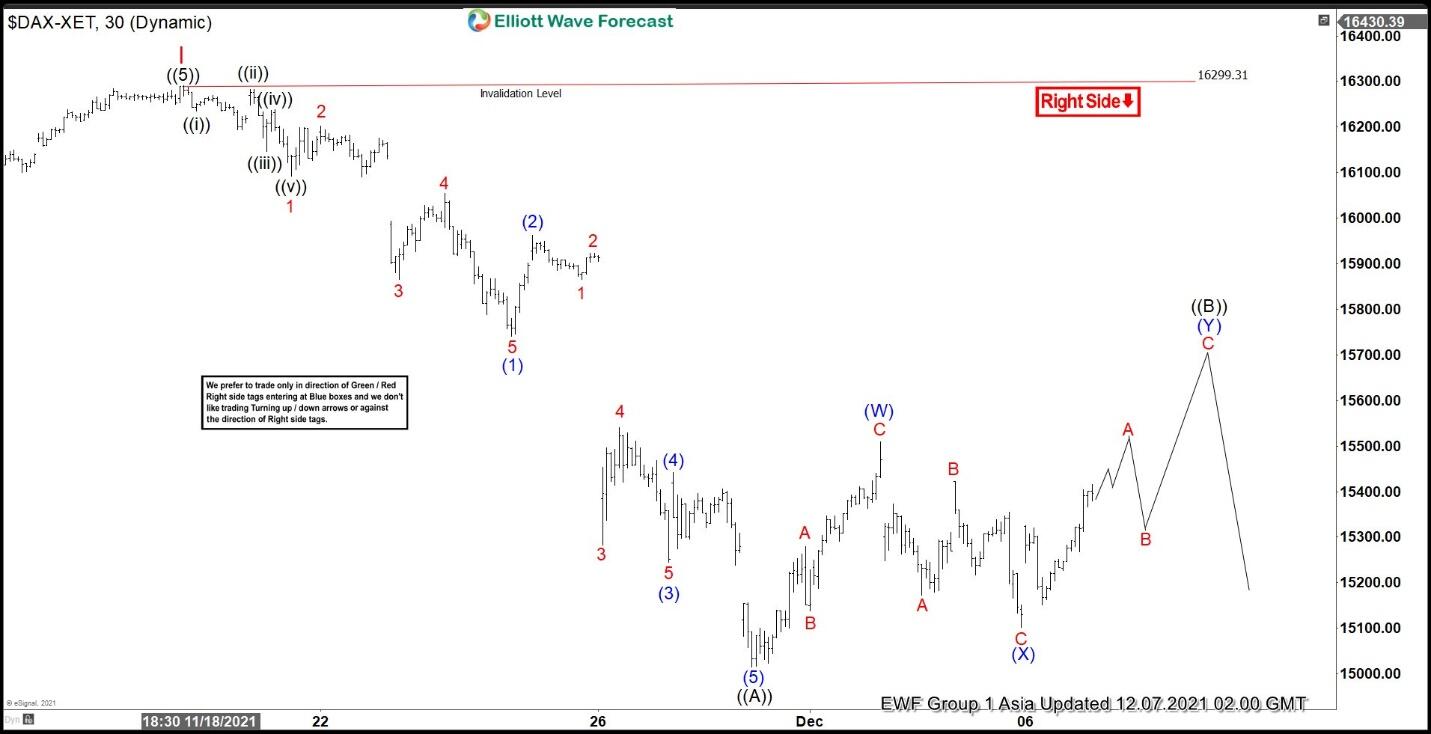
Rally in DAX to 16299.31 ended cycle degree wave I. This completed the rally which started from March 16, 2020 low. The Index is currently in wave II to correct cycle from March 2020 low in larger degree pullback wave II. 30 minutes Elliott Wave chart below suggests the internal subdivision of wave II as a zigzag structure. Down from wave I, wave (1) ended at 15740.6 and rally in wave (2) ended at 15962.54. Index then resumes lower in wave (3) towards 15245.35, and rally in wave (4) ended at 15441.91. Final elg lower wave (5) ended at 15016.66 and this completed wave ((A)).
Rally in wave ((B)) is in progress to correct cycle from November 18, 2021 peak. The internal subdivision of wave ((B)) unfolded as a double zigzag structure. Up from wave ((A)), wave (W) ended at 15509.46 and dips in wave (X) ended at 15101.71. Final leg higher wave (Y) is in progress as another zigzag. Potential target for wave (Y) is 100% -161.8% Fibonacci extension from November 30, 2021 low which comes at 15601 – 15906 area. Index should then resume lower from this area or pullback in 3 waves at least. Near term, as far as pivot at 16299.31 stays intact, expect rally to fail in 3, 7, 11 swing for more downside.
DAX 30 Minutes Elliott Wave Chart
GBP/USD Remains At Risk Of More Losses Below 1.3200
Key Highlights
- GBP/USD is struggling to recover above the 1.3350 resistance.
- A major bearish trend line is forming with resistance near 1.3280 on the 4-hours chart.
- EUR/USD could resume losses if there is a clear break below 1.1250.
- Gold price is showing a few bearish signs below $1,800.
GBP/USD Technical Analysis
The British pound attempted a recovery wave above 1.3350 against the US Dollar. However, GBP/USD struggled to gain pace and started a fresh decline below 1.3300.
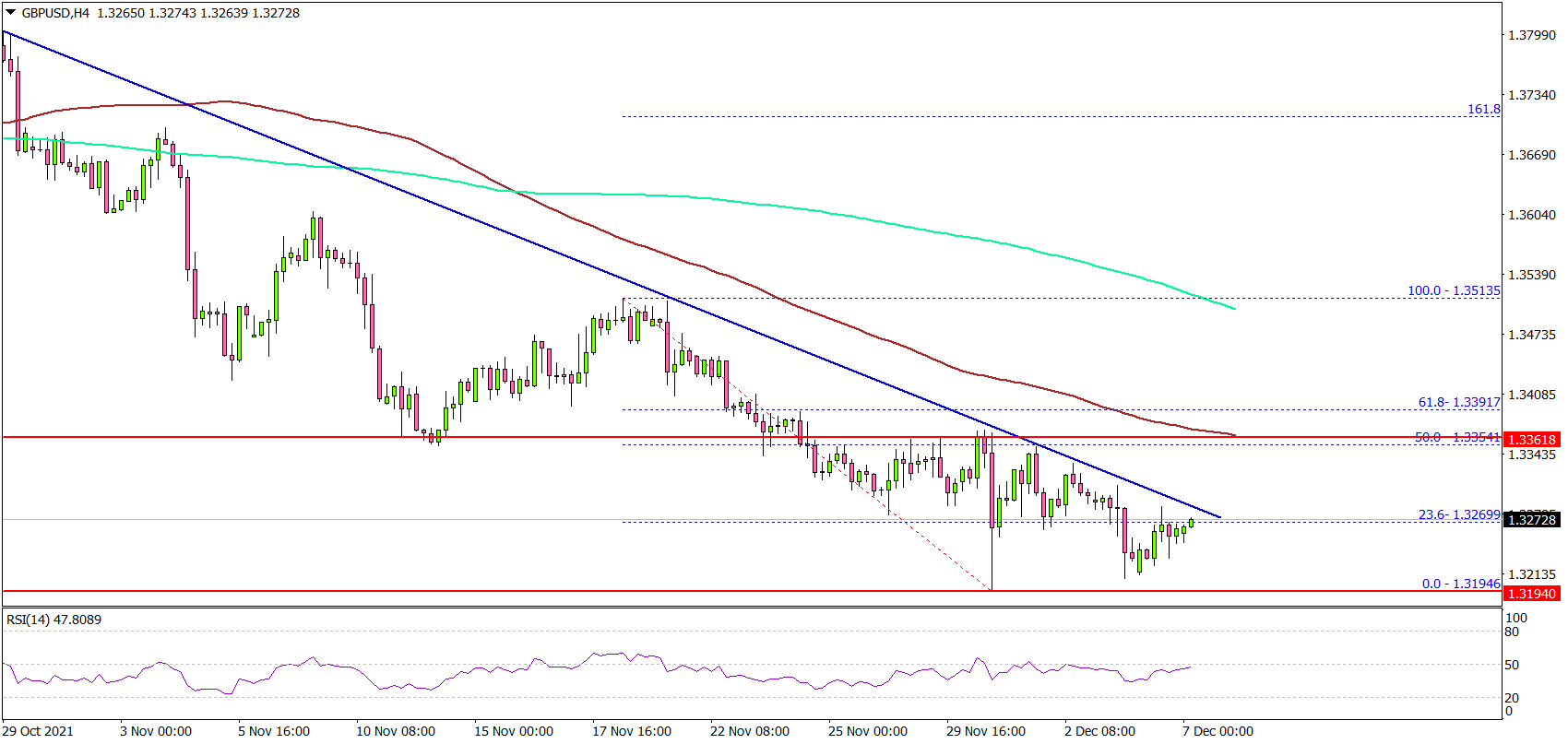
Looking at the 4-hours chart, the pair resumed its decline below 1.3300. The pair settled well below 1.3350, the 100 simple moving average (red, 4-hours), and the 200 simple moving average (green, 4-hours).
On the upside, the pair is facing resistance near 1.3270. There is also a major bearish trend line forming with resistance near 1.3280. The trend line is close to the 23.6% Fib retracement level of the downward move from the 1.3513 swing high to 1.3194 low.
The next major resistance is near 1.3350 or the 50% Fib retracement level of the downward move from the 1.3513 swing high to 1.3194 low.
A clear break above the 1.3300 and 1.3350 levels could start a steady increase. If not, there could be more losses below the 1.3200 and 1.3180 support levels. In the stated case, the pair may possibly decline towards the 1.3050 level.
Looking at EUR/USD, the pair is struggling to recover above 1.1350 and it seems like there could be more losses below the 1.1250 support.
Economic Releases
- Euro Zone Gross Domestic Product for Q3 2021 (QoQ) - Forecast 2.2%, versus 2.2% previous.
- Euro Zone Gross Domestic Product for Q3 2021 (YoY) - Forecast 3.7%, versus 3.7% previous.
- German ZEW Business Economic Sentiment Index for Dec 2021 – Forecast 25.3, versus 31.7 previous.
Market Morning Briefing: Dollar-Yen Has Risen Within The 114-112.50 Region
STOCKS
Dow, Dax, Nikkei and Shanghai have risen but could face resistances on the upside before declining from there. Failure to decline from respective resistances can give some upside momentum for the medium term. Nifty and Sensex plunged yesterday and although there is some rom on the downside, we would wait to see if the Indian markets can bounce in line with the strength seen in other indices globally.
Dow (35227.03, +646.95, +1.87%%) has risen sharply. Immediate resistance can be seen at 35500 which can hold for now and send index down towards 34000 again. A strong break above 35500 if seen, can take the index up towards 36000 and indicate bullishness. Till then a broad range of 35500-34000 may hold.
DAX (15380.79, +210.81, +1.39%) has moved up but while below 15500 we can see some more consolidation between 15500 and 15050. The index has room to rise towards 15750-15800 on a break above 15500.
Nikkei (28282.01, +354.64,+1.27%) has risen today. The index is just below the immediate resistance at 28250 which if holds can bring down the index to 27500 else can open up scope for a rise towards 29250.
Shanghai (3590.73, +1.42, +0.032%) has dipped below 3600 as mentioned previously as resistance near 3625 iss holding for now. The view is bearish to see a fall towards 3550/3500 in the coming sessions before we see a test of 3600/3625 again.
Nifty (16912.25, -284.45, -1.65%) plunged yesterday and closed below the crucial support level of 17000. While below 17000, the view is bearish to see a dip towards 16800 before bouncing back. Any break below 16800 can drag the index down towards 16600/400.
Sensex (56747.14, -949.32, -1.65%) has fallen sharply yesterday. The view is bearish to see a test of 56000-55500 on the downside.
COMMODITIES
Brent and WTI have risen well and need to break above interim resistances to head further up. The rise is expected to be a corrective one which can be short lived. Gold is bearish while below 1790. Silver and Copper are likely to continue range trade within 22-24 and 4.25-4.45/50 respectively.
Brent (73.34) and WTI (69.93) have risen today. While above 73, Brent can rise to 75-77 before declining from there again. Needs to rise above 70 to test 73 on the upside before sharply falling back from there.
Gold (1779.60) has earlier support turned resistance near 1790 and while that holds, Gold can fall towards 1760 or even lower in the near term.
Silver (22.30) has dipped and can test support near 22. While above 22, a range of 22-24 may hold.
Copper (4.3050) trades stable near current levels. We continue to look for a range of 4.25-4.45/50 for the near term.
FOREX
Some recovery is seen in most currency pairs. Aussie, Pound, EURJPY have bounced from yesterday’s lows and may see some corrective bounce for the next few sessions before deciding whether to continue the upmove or resume its fall. Dollar Index, Euro and USDCNY continue to remain ranged within 97-95.50, 1.1142/1.12-1.14 and 6.38-6.3663 respectively. USDINR can test 75.50 which if holds can produce a fall to 75.20. Failure to fall from 75.50 can lead to an eventual rise to 75.75.
Dollar Index (96.23) is holding below 96.50 for now and has scope to fall towards 95.50. As mentioned yesterday, we would keep a close watch on the broad range of 95.50-97; a break on either side thereafter can determine the next course of movement.
Euro (1.1290) may trade within 1.14-1.12/1.1142 for the near term. A break below 1.1142 will be needed for the Euro to become more bearish.
EURJPY (128.17) has risen back to above 128 and needs to sustain the rise to head towards 129-129.50 soon. Failure to break above 128.50 can again bring it down towards 127.50. Immediate support is now seen at 127.50 while there enough room on the upside.
Aussie (0.7048) tested 0.6990 but has bounced back well from there. If the bounce sustains, it can bounce higher towards 0.71. Failure to hold above 0.699 for long can again take Aussie lower towards 0.6950-0.6900 soon.
Pound (1.3277) has bounced well and holds above 1.32. A further rise to 1.3350 is possible in the next few sessions. View is bullish while above 1.32.
Dollar-Yen (113.47) has risen within the 114-112.50 region. Unless the range breaks on either side, we may expect it to hold for a few more sessions.
USDCNY (6.3711) is fluctuating below 6.38 but at the same time finds difficult to break below 6.3663 over the past 3-sessions. We may continue to look for the range of 6.38-6.3663 to hold but a break below 6.3663 can soon be possible leading to a fall towards 6.36/35 on the downside. Overall view remains bearish while below 6.40/38.
{USDINR (75.4250) rose sharply yesterday breaking above the initial resistance at 75.20/25. We now look at the next important resistance near 75.50 which if holds can produce a corrective dip to 75.20 before rising higher to 75.75, the upper crucial resistance that we have been looking at. We expect a reversal to be seen from 75.75 in the medium term.
INTEREST RATES
The US Treasury yields have risen back sharply at the far-end. The supports mentioned yesterday on the 10Yr and 30Yr have held as expected and the deeper fall mentioned yesterday could get delayed. While this bounce sustains, a further rise is possible from here before a reversal is seen again. The German yields keep the bearish view intact and can fall further from here. The 10Yr and 5Yr GoI have come-off from near-their resistances and can dip within their respective ranges in the coming days.
The US 2Yr (0.63%), 5Yr (1.21%), 10 Yr (1.44%) and the 30Yr (1.77%) have bounced-back especially sharply at the far-end. The support at 1.35% on the 10Yr and 1.7% on the 30Yr mentioned yesterday has held well. While the 10Yr sustains above 1.4%, a further rise to 1.5%-1.55% is possible in the coming days. The 30Yr on the other hand will have room to test 1.85% from where a reversal is possible again.
The German 2Yr (-0.74%), 5Yr (-0.64%), 10Yr (-0.39%) and 30Yr (-0.10%) yields remain lower and stable. The outlook is bearish. The yields can fall to -0.45% / -0.5% (10Yr) and -0.1% / -0.2% (30Yr) in the coming days.
The Indian 10Yr (6.3594%) and the 5Yr (5.6896%) have come-off from their highs of 6.3751% and 5.7133% respectively. The resistances at 6.38% (10Yr) and 5.72%-5.74% (5Yr) are holding well as expected. While below 6.38%, the 10Yr can dip to 6.32%-6.3%. The 5Yr on the other hand can test 5.64%-5.63% on a break below 5.68%.
GBP/JPY Daily Outlook
Daily Pivots: (S1) 149.62; (P) 150.12; (R1) 151.05; More...
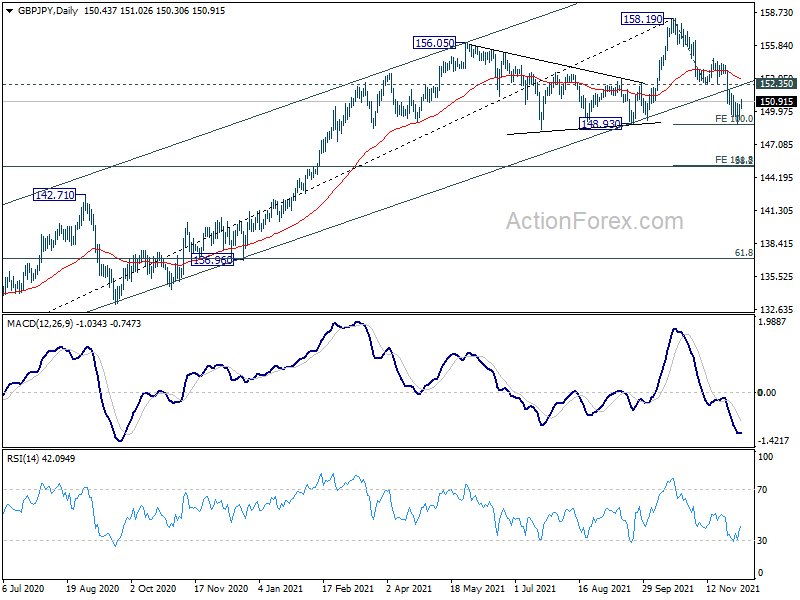
Intraday bias in GBP/JPY is turned neutral with current recovery. A temporary low is formed at 148.94, just ahead of 100% projection of 158.19 to 152.35 from 154.70 at 148.86, which is close to 148.93 key structural support. On the upside, break of 152.35 support turned resistance will argue that the pull back from 158.19 is complete. Intraday bias will be turned back to the upside for retesting 158.19 high. However, on the downside, decisive break there will carry larger bearish implication and target 161.8% projection at 145.25 next.
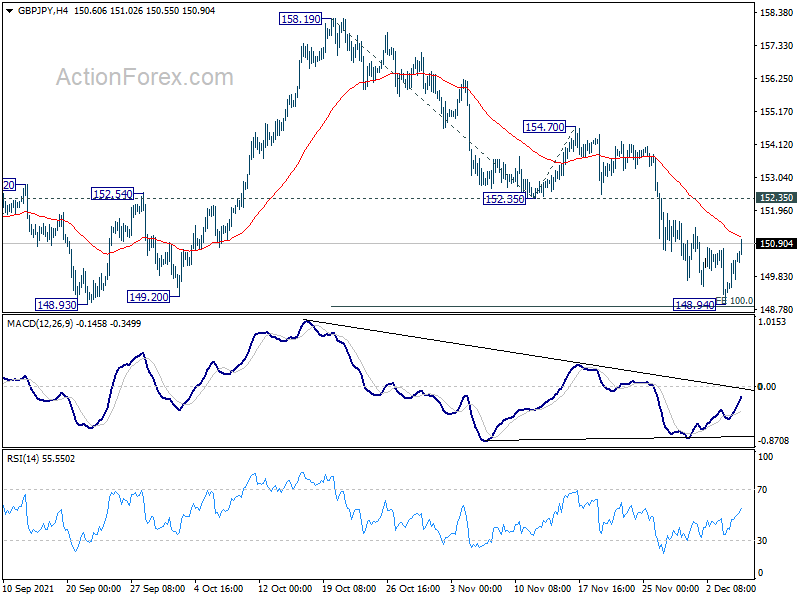
In the bigger picture, the break of medium term channel support, and bearish divergence condition in week MACD are raising the chance of medium term topping at 158.19. Firm break of 148.93 support will argue that GBP/JPY is at least correcting the whole rise from 123.94 (2020 low). In this case, deeper fall would be seen to 38.2% retracement of 123.94 to 158.19 at 145.10. Nevertheless, strong rebound from 148.93 will retain medium term bullishness for another rise through 158.19 at a later stage.