Sample Category Title
EUR/GBP Weekly Outlook
EUR/GBP rebounded strongly last week and the development suggests short term bottoming at 0.8401. Initial bias stays on the upside this week for 0.8656 resistance. Firm break there will argue that whole down trend from 0.9499 has completed. Stronger rise would be seen to 38.2% retracement of 0.9499 to 0.8401 at 0.8820. On the downside, break of 0.8459 minor support will bring retest of 0.8401 low instead.
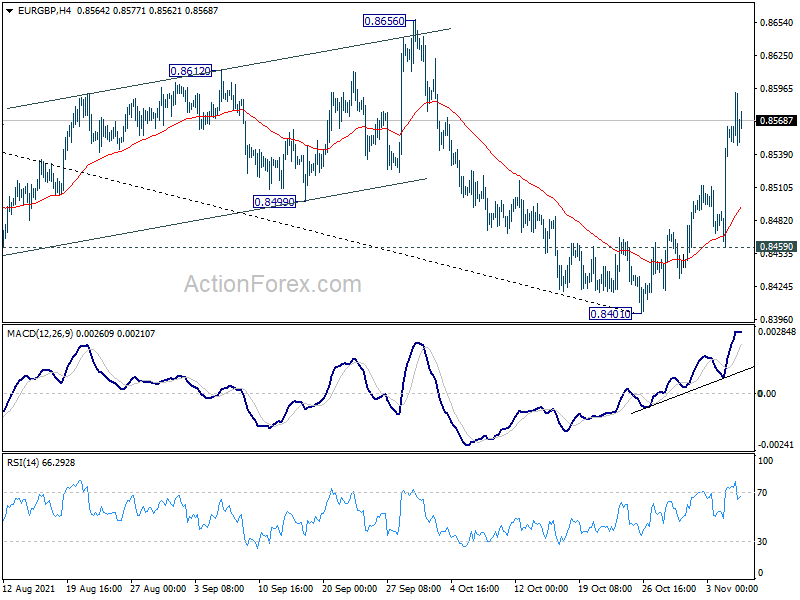
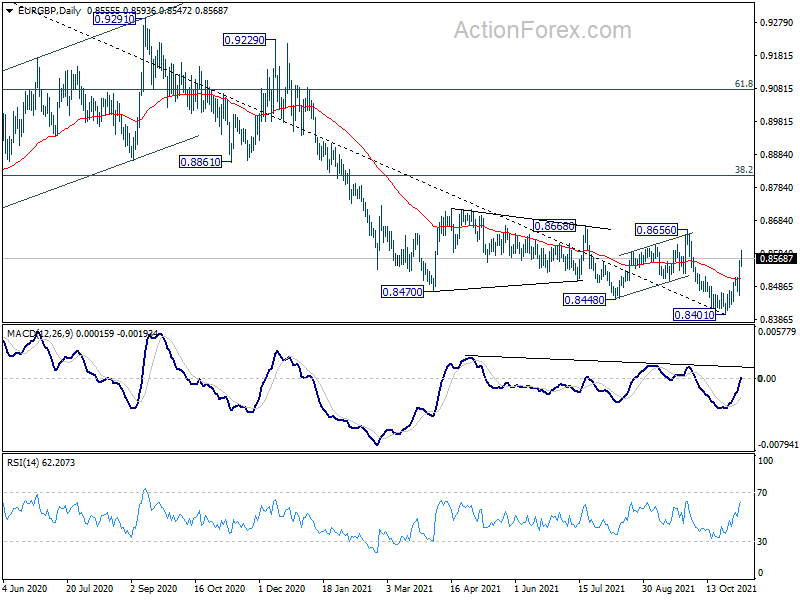
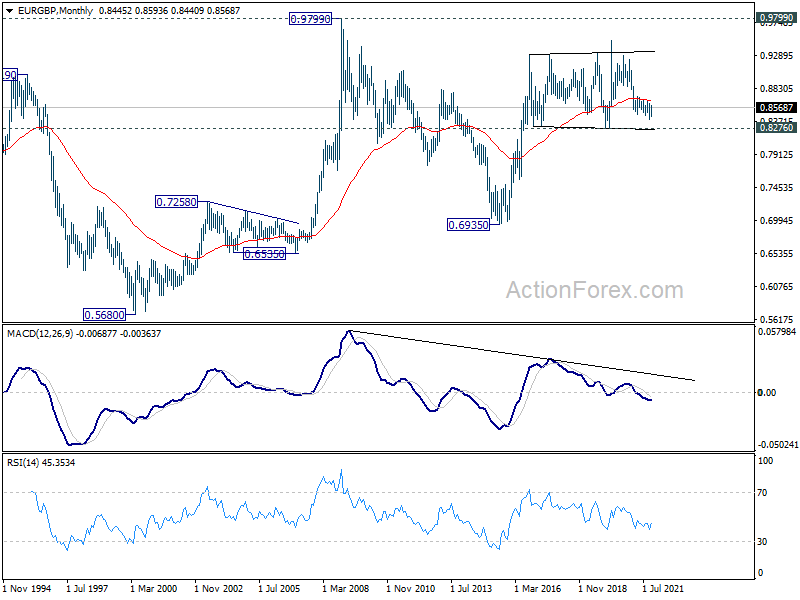
In the bigger picture, price actions from 0.9499 (2020 high) are still seen as developing into a corrective pattern. Deeper fall could be seen as long as 0.8656 resistance holds, towards long term support at 0.8276. However, firm break of 0.8656 resistance would argue that a medium term bottom was already formed. Stronger rise would be seen to 0.8861 support turned resistance to confirm completion of the corrective pattern.
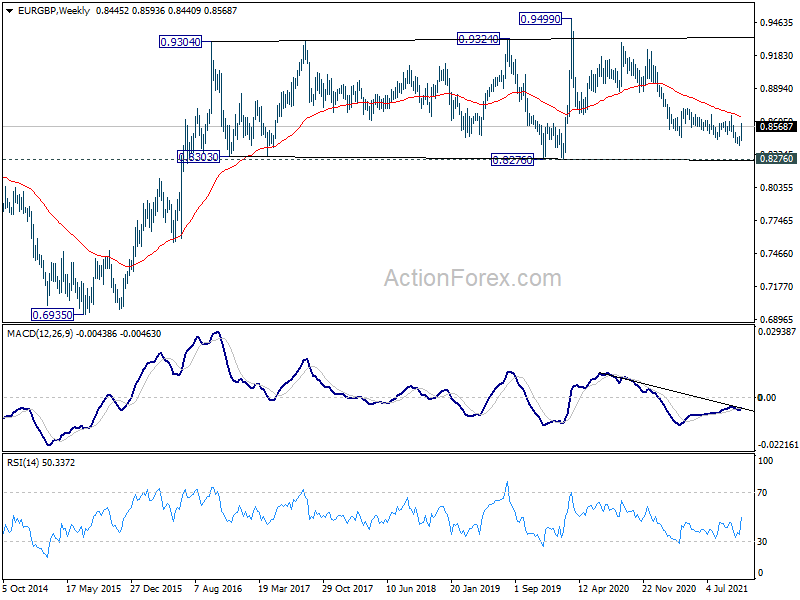
In the long term picture, outlook will stay bullish as long as 0.8276 support holds. Break of 0.9499 is in favor at a later stage, to resume the up trend from 0.6935 (2015 low).
EUR/AUD Weekly Outlook
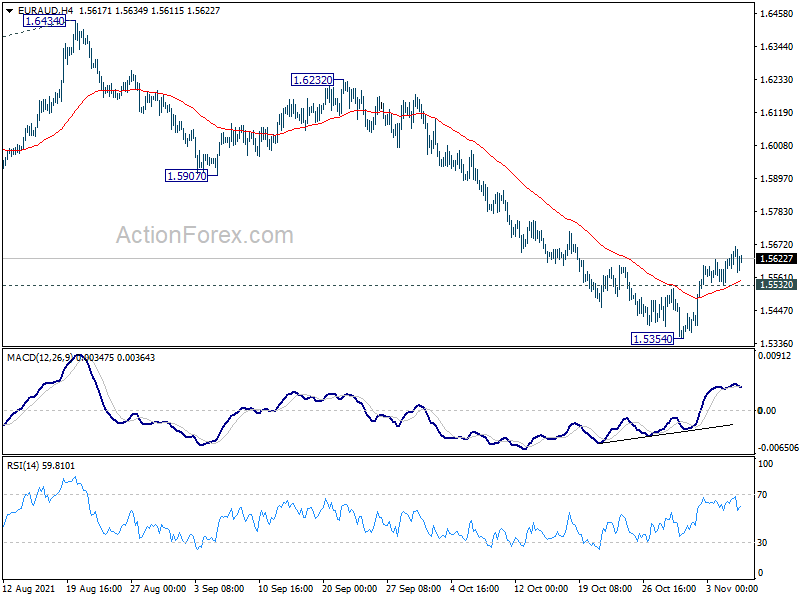
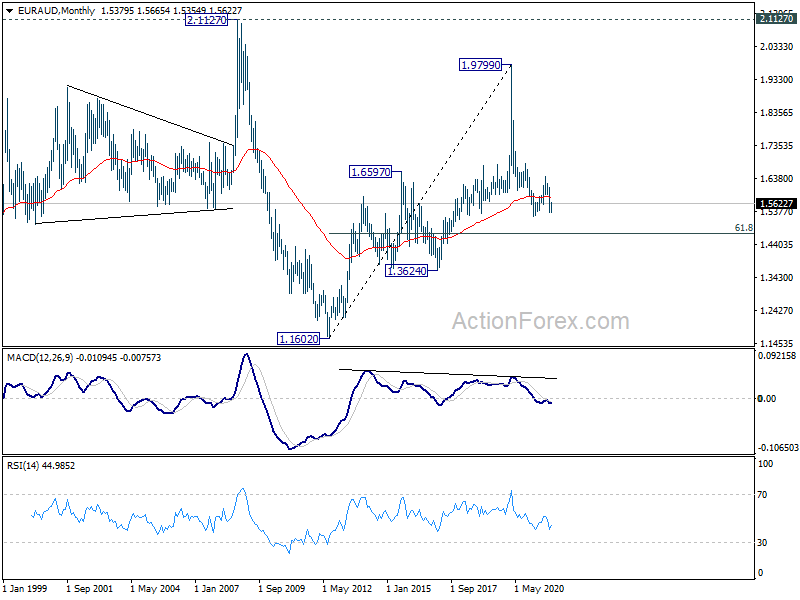
EUR/AUD recovered last week after forming a short term bottom at 1.5354. Further rise could be seen this week to 55 day EMA (now at 1.5775). Sustained break there will argue that whole fall from 1.6434 has completed and bring stronger rally. On the downside, however, below 1.5532 minor support turn turn bias back to the downside for 1.5354. Break there will target a test on 1.5250 low.
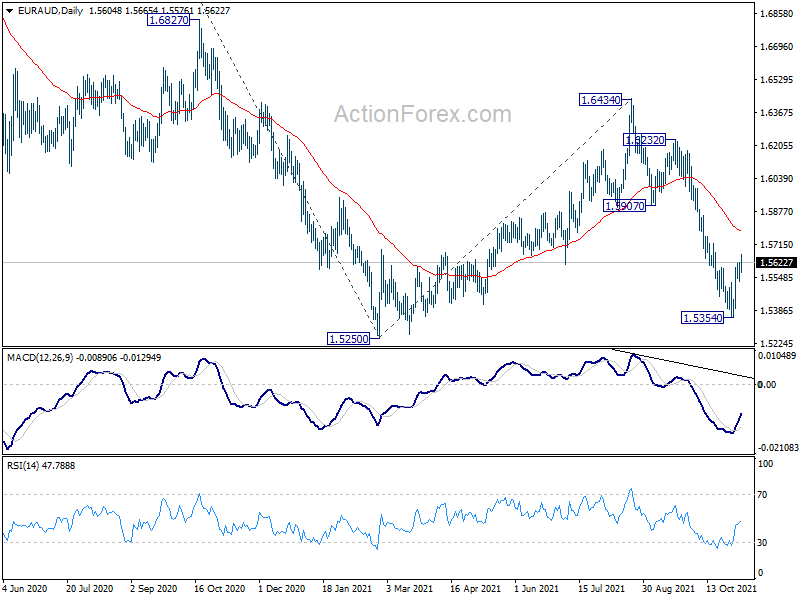
In the bigger picture, the down trend from 1.9799 (2020 high) is in progress. Firm break of 1.5250 low will confirm resumption and target 61.8% retracement of 1.1602 (2012 low) to 1.9799 at 1.4733. Sustained break there could bring more downside acceleration to 61.8% projection of 1.9799 to 1.5250 from 1.6434 at 1.3623. In any case, break of 1.6434 resistance is needed to signal medium term bottoming, or outlook will stay bearish.
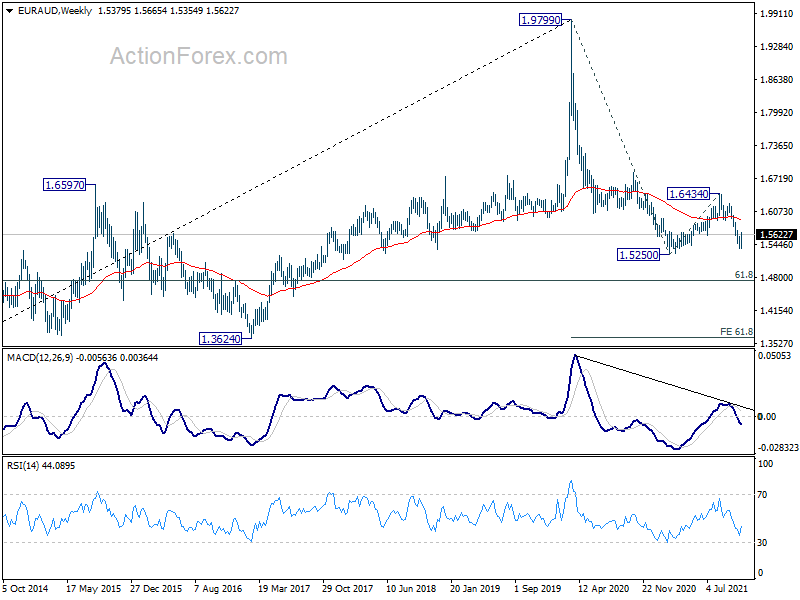
In the longer term picture, fall from 1.9799 (2020 high) is seen as a long term down trend. Sustained break of 61.8 retracement of 1.1602 to 1.9799 at 1.4733 will extend the decline to 1.3624 long term support and possibly below.
EUR/CHF Weekly Outlook
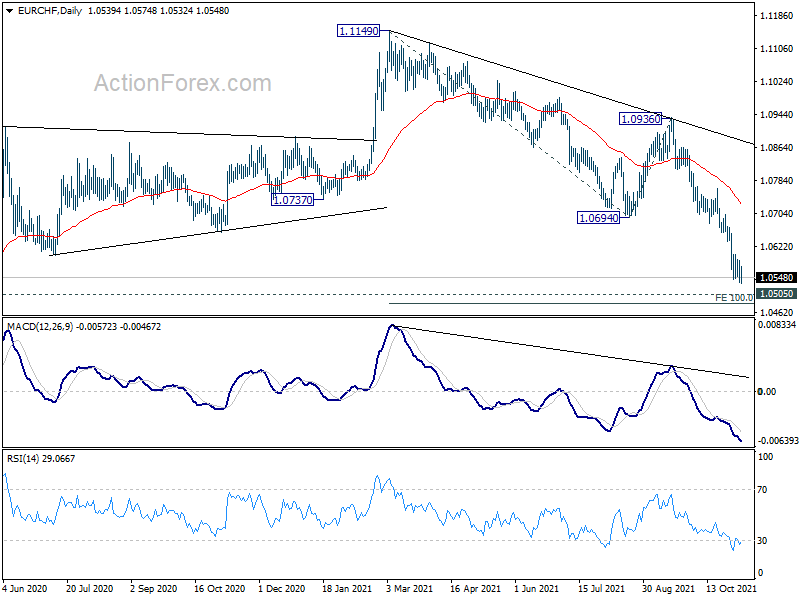
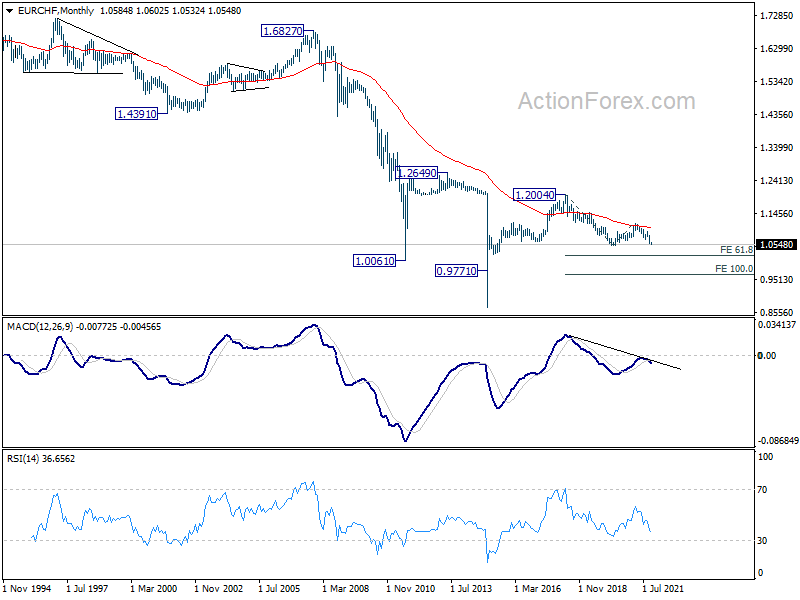
EUR/CHF dropped further to 1.0532 last week. Downside momentum diminished slightly but there is no sign of bottoming yet. Further fall is expected this week as long as 1.0602 resistance holds. Current down trend from 1.1159 would target 100% projection of 1.1149 to 1.0694 from 1.0936 at 1.0481. On the upside, however, break of 1.0602 will turn bias to the upside for stronger rebound back towards 1.0678 support turned resistance.
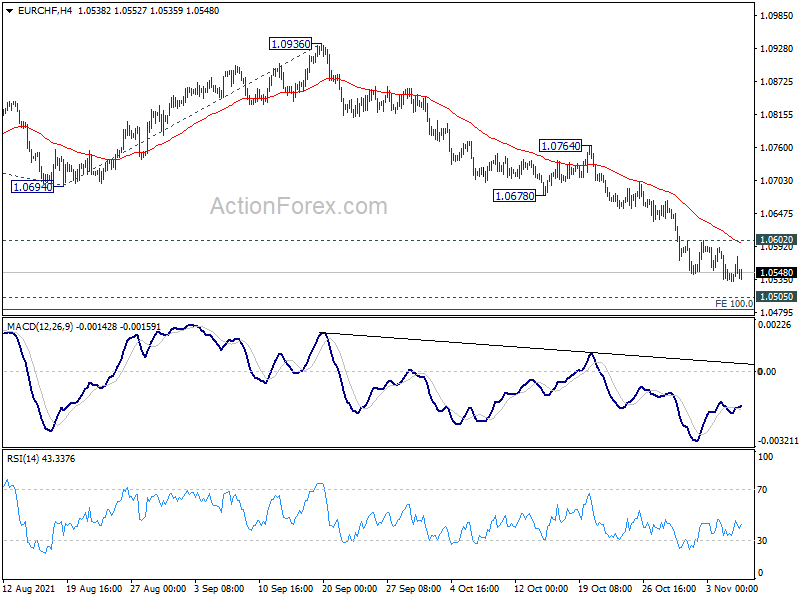
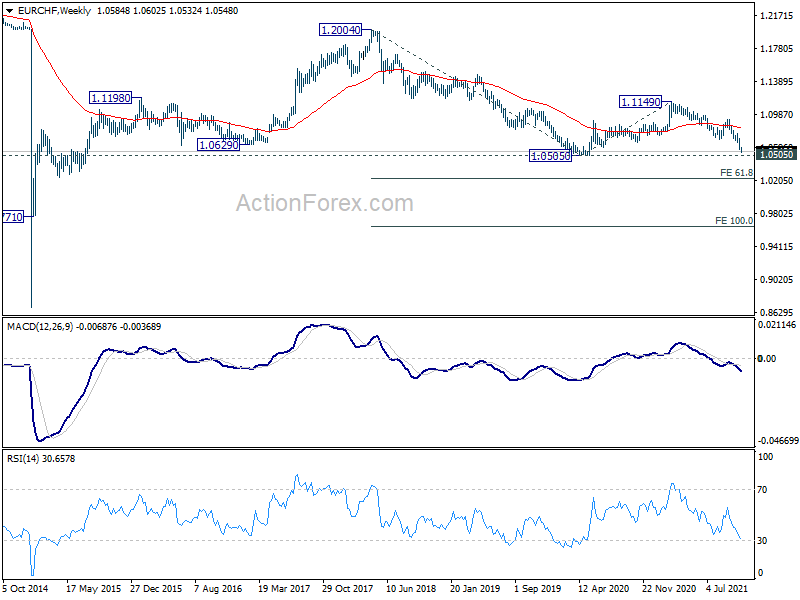
In the bigger picture, current downside momentum argues that fall from 1.1149 is probably resuming the down trend from 1.2004 (2018 high). Next focus is 1.0505 (2020 low). Decisive break there will confirm this bearish case and target 61.8% projection of 1.2004 to 1.0505 to 1.1149 at 1.0223 next. Strong support from 1.0505 will bring rebound first. But outlook will stay bearish as long as 1.0936 resistance holds.
In the long term picture, rejection by 55 month EMA (now at 1.1015) maintains long term bearishness. Break of 1.0505 low will resume the down trend from 1.2004 to 61.8% projection of 1.2004 to 1.0505 to 1.1149 at 1.0223. Firm break there will target 100% projection at 0.9650.
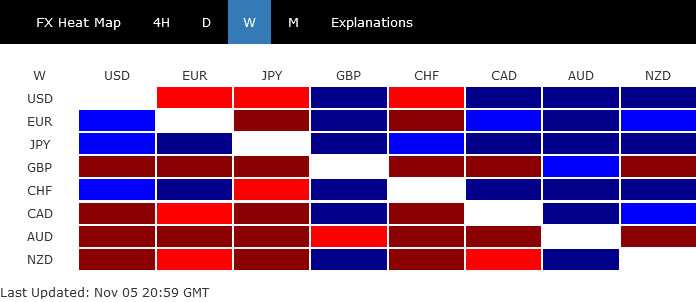
Yen and Franc Followed Bonds Higher, Ignored Record Running Stocks
The developments last week were a bit confounding, as both stocks and bonds rallied notably. Yen and Swiss Franc followed the path of falling yields and rose as the biggest winner of the week.
Dollar was not much helped by Fed's tapering and solid job data. Australia Dollar ignored broad risk-on sentiment, and ended as the worst performer after RBA hinted that it's in no rush for rate hike. Sterling was the second worst after BoE disappointed those who expected an imminent hike.
The path ahead could depend on how far stocks would go, and how deep yields would fall, and the balance of the impacts on the currency markets. That would also very much depend on the upcoming inflation data from the US.
Major benchmark yields tumbled
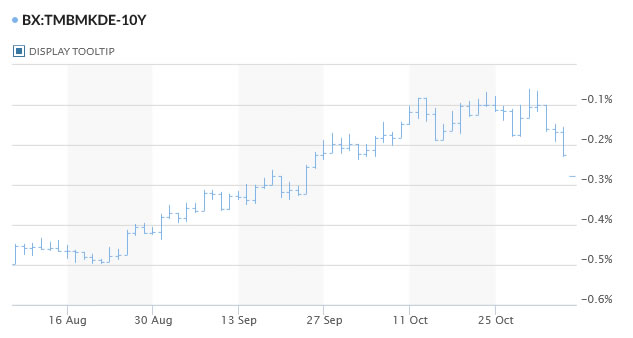
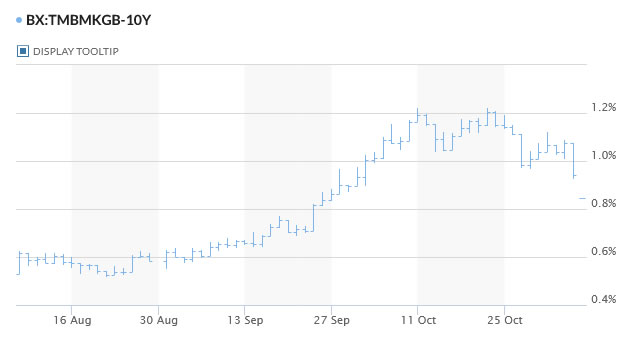
Major benchmark treasury yields tumbled sharply, reversing most of October's gains. The moves came after central banks pushed back on market expectations on rate hikes. Even BoE refrained from raising interest rate despite recent rhetorics. Fed also still sounded patient after delivering tapering plan.
Germany 10-year bund yield closed at -0.278, comparing to October's high at -0.060.
UK 10-year gilt yield closed at 0.847, comparing to October's high at 1.222.
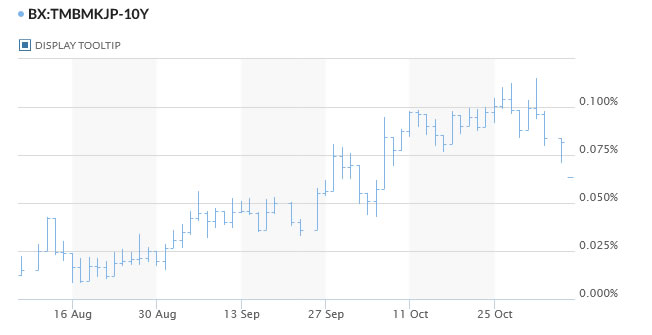
Japan 10-year JGB yield also dropped to close at 0.064, after hitting as high as 0.115 earlier this month.
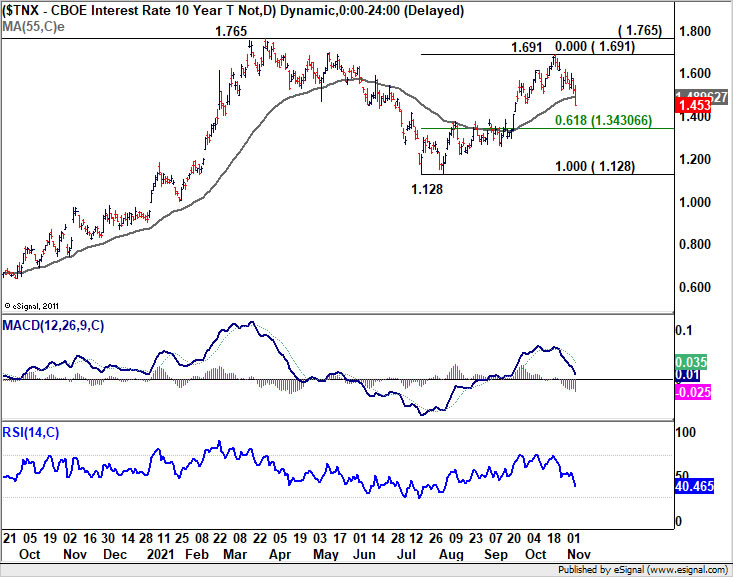
In the US, 10 year yield broke through 55 day EMA to close at 1.453. The development confirmed short term topping at 1.691. The consolidation pattern from 1.765 should be in the third leg and deeper decline could be seen in TNX to 61.8% retracement of 1.128 to 1.691 at 1.343, and possibly below. But we're not expecting a break of 1.128 key support.
Major stock indexes surged to new records
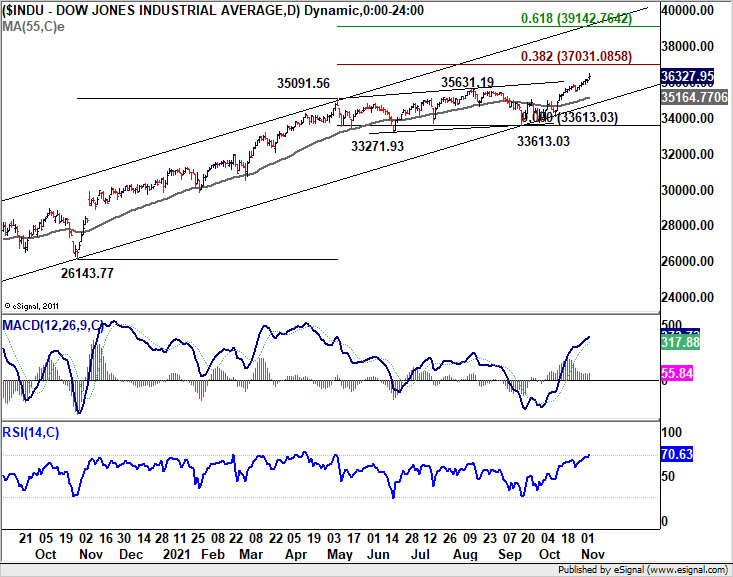
On the other hand, major stock indexes in US and Europe surged to new record highs last week, including DOW, S&P 500, NASDAQ, DAX and CAC 40.
DOW extended record runs to close at 36327.95. For now, as long as last week's low at 35797.97 holds, further rally should be seen to 38.2% projection of 26143.77 to 35091.56 from 33613.03 at 37031.08. Firm break there would push DOW further to 61.8% projection at 39142.76, which is close to 40k handle, in the early months of next year.
Dollar index struggled to extend rally again
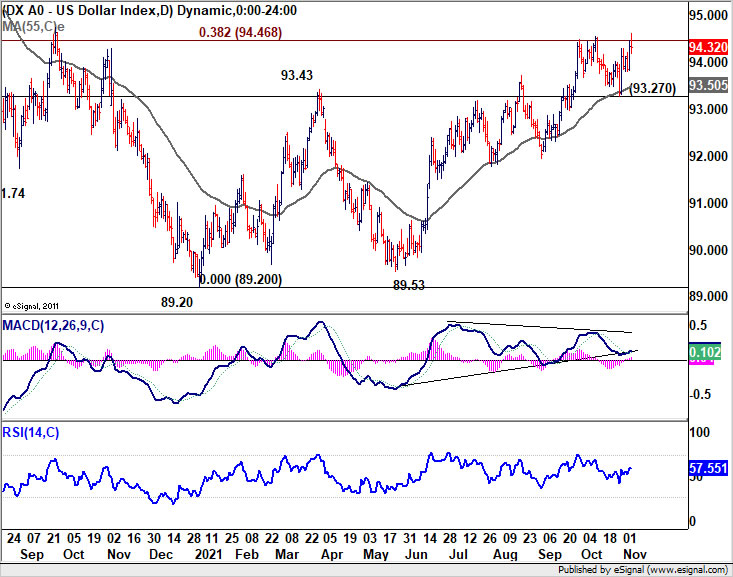
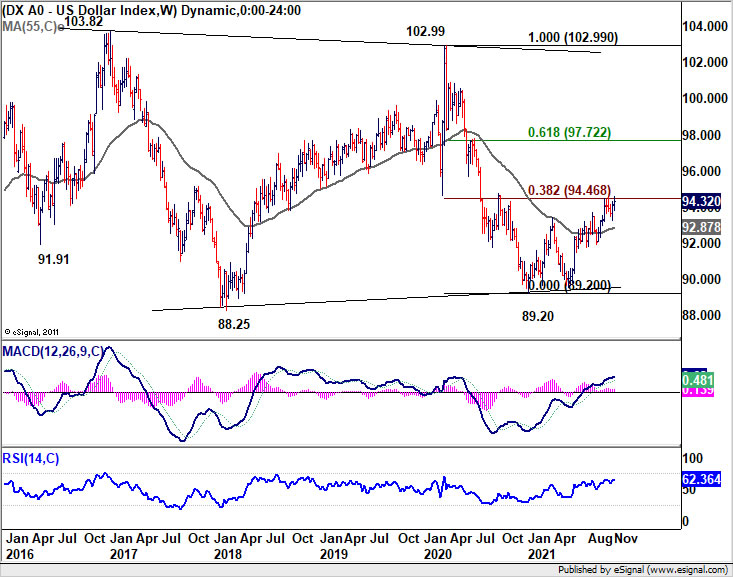
In spite of Fed's tapering and a set of solid non-farm payroll data, Dollar struggled to extend gain, capped by risk-on sentiment and falling yields. Even EUR/USD's break of 1.1523 low was half-hearted. Dollar index also failed to sustain above 94.46 fibonacci level again.
For now, near term outlook will stay bullish as long as 93.27 support holds. Sustained trading above 38.2% retracement of 102.99 to 89.20 at 94.46 should confirm medium term bullish reversal, and target 61.8% retracement at 97.72 next. However, break of 93.27 support will confirm rejection by 94.46, which retains medium term bearishness. Deeper fall would then be seen back towards 89.20.
AUD/JPY extended near term correction
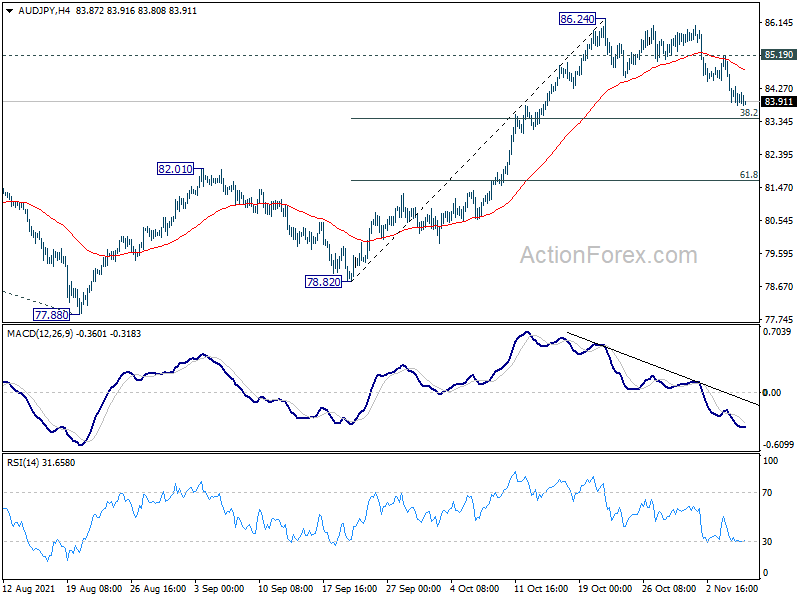
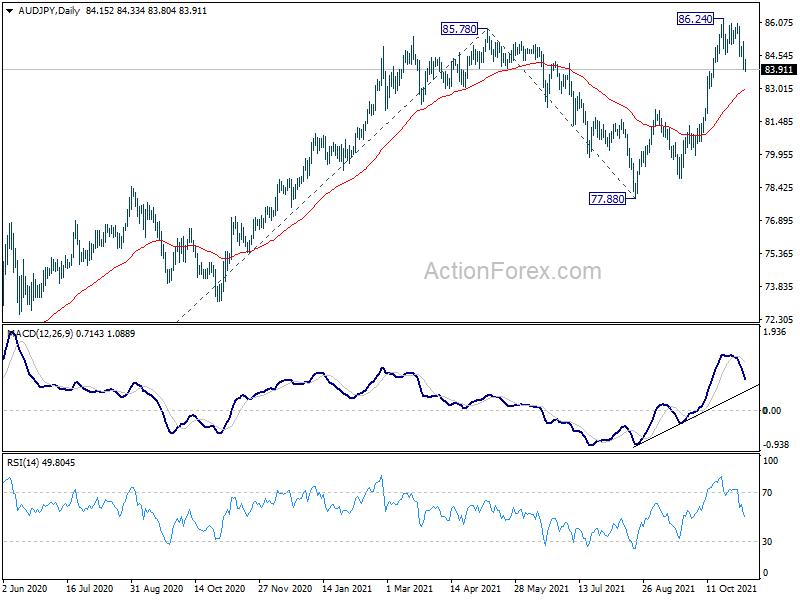
AUD/JPY was the biggest mover last week, extending the decline from 86.24 lower to close at 83.91. For now, such decline is still seen as a corrective move only. While further fall cannot be ruled out, we'd look for strong support from 38.2% retracement of 78.82 to 86.24 at 83.40 to contain downside and bring rebound.
Break of 85.19 will bring retest of 86.24 and then resumption of medium term up trend. That could come when the decline in treasury yield slows, or when Yen crosses recouple with risk-on sentiment. However, firm break of 83.50 will bring deeper fall towards 82.01 resistance turned support, and signal a broader change in overall sentiments.
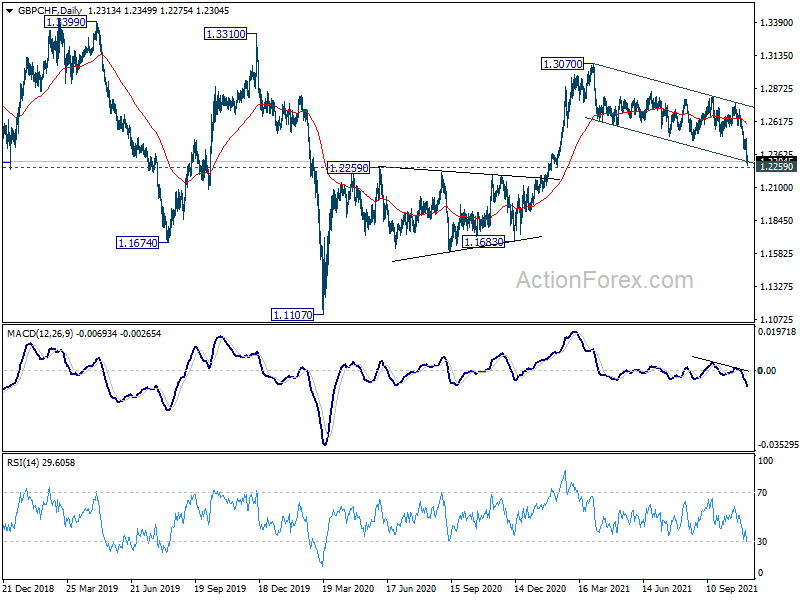
GBP/CHF eyes 1.2259 key support after steep fall
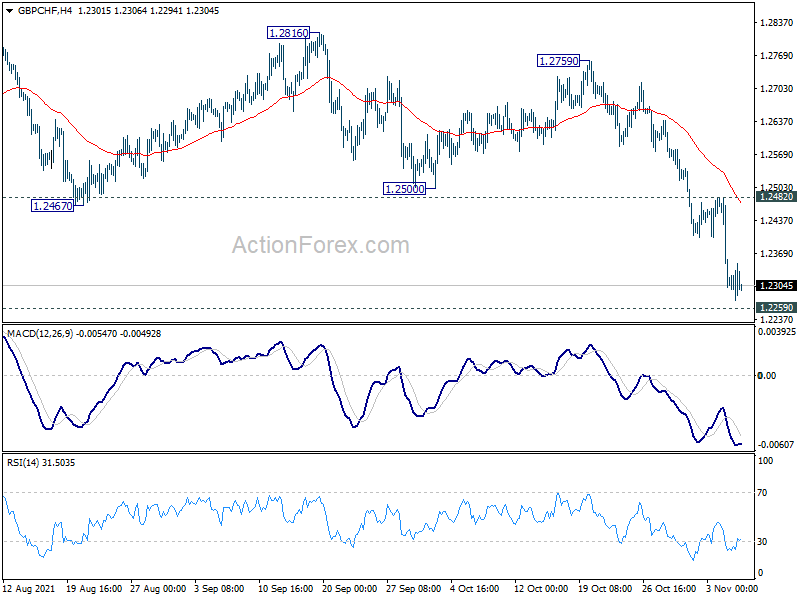
GBP/CHF was also one of the top movers, diving after BoE missed the rate hike expectation that it set the markets up. The downside acceleration is mixing the outlook a bit, and focus is immediately on 1.2259 key resistance turned support.
Strong rebound from 1.2259, followed by break of 1.2482 resistance should defend the case that fall from 1.3070 is merely a corrective move. Rise from 1.1107 low should still be in progress for resumption at a later stage.
However, sustained break of 1.2259 would argue that the medium term trend has reversed. There could even be some downside acceleration to follow to 1.1683 support next.
EUR/CHF Weekly Outlook
EUR/CHF dropped further to 1.0532 last week. Downside momentum diminished slightly but there is no sign of bottoming yet. Further fall is expected this week as long as 1.0602 resistance holds. Current down trend from 1.1159 would target 100% projection of 1.1149 to 1.0694 from 1.0936 at 1.0481. On the upside, however, break of 1.0602 will turn bias to the upside for stronger rebound back towards 1.0678 support turned resistance.
In the bigger picture, current downside momentum argues that fall from 1.1149 is probably resuming the down trend from 1.2004 (2018 high). Next focus is 1.0505 (2020 low). Decisive break there will confirm this bearish case and target 61.8% projection of 1.2004 to 1.0505 to 1.1149 at 1.0223 next. Strong support from 1.0505 will bring rebound first. But outlook will stay bearish as long as 1.0936 resistance holds.
In the long term picture, rejection by 55 month EMA (now at 1.1015) maintains long term bearishness. Break of 1.0505 low will resume the down trend from 1.2004 to 61.8% projection of 1.2004 to 1.0505 to 1.1149 at 1.0223. Firm break there will target 100% projection at 0.9650.
Summary 11/8 – 11/12
Monday, Nov 8, 2021
[php_everywhere instance="1"]
Tuesday, Nov 9, 2021
[php_everywhere instance="2"]
Wednesday, Nov 10, 2021
[php_everywhere instance="3"]
Thursday, Nov 11, 2021
[php_everywhere instance="4"]
Friday, Nov 12, 2021
[php_everywhere instance="5"]
Weekly Economic & Financial Commentary: When Will the Shortages End?
Summary
United States: When Will the Shortages End?
- Data released this week continue to paint the severity of supply chain bottlenecks. The ISM manufacturing index slipped to 60.8 in October, and the U.S. trade deficit widened to a record $80.9 billion. That said, October's employment report hinted that the labor market's supply headwinds may be beginning to ease. Nonfarm employment rose a better-than-expected 531K.
- Next week: CPI (Wed), Monthly Budget Statement (Wed), JOLTS (Fri)
International: BoE's Unreliable Boyfriend & China's Soft October PMIs
- Bank of England policymakers sent shock waves through the monetary policy community this week by pushing back on market expectations and not raising policy rates. Meanwhile, China's economy has been decelerating. Manufacturing and non-manufacturing PMIs softened in October, and energy shortages, continued COVID disruptions and supply chain disruptions suggest Q4 economic performance is off to a rough start and could remain under pressure.
- Next week: Brazil Inflation (Wed), Central Bank of Mexico (Thurs), Japan Q3 GDP (Sun)
Interest Rate Watch: Tip Toeing Through the Taper
- The Federal Open Market Committee (FOMC) announced that beginning this month it will reduce its monthly purchases of Treasury securities and MBS by $10 billion and $5 billion, respectively. If this pace of reduction is maintained, it will be completely finished purchasing assets in June. The FOMC continues to stress its belief that inflationary impulses are largely "transitory".
Credit Market Insights: Commercial & Multifamily Borrowing Is on the Mend
- The Mortgage Bankers Association's (MBA) third quarter report on commercial and multifamily loan originations showed the index grew a whopping 119% over this time last year. While the housing market has been on a tear since the start of the pandemic, commercial real estate (CRE) weakened last year as office space and close-together apartment living were less than ideal given social distancing measures.
Topic of the Week: Sitting, Waiting, Wishing
- The global supply chain is severely out of whack. This isn’t new, but indications of wait times are lengthening and the knock-on effects across the entire supply chain continue to be extreme.
The Weekly Bottom Line: Supply Chain Strain is the Name of the Game
U.S. Highlights
- As widely expected, the Federal Reserve kept interest rate unchanged this week while announcing a reduction in its asset purchase program. The Fed will reduce securities purchases by 15 billion per month starting in November.
- The labor market recovery gained speed with 531k jobs added in October. The unemployment rate edged down by 0.2 percentage points and labor force participation rate remained unchanged.
- Supply chain bottlenecks continue to stymie growth, slowing the pace of expansion in manufacturing and limiting vehicle production. Despite challenges, service sectors continue to fire on all cylinders.
Canadian Highlights
- After rising briskly last week, Canadian bond yields eased off toward the end of this week. The Bank of England disappointed expectations for a rate increase, leading to rally in global bond markets.
- Data from regional real estate boards this week showed that both home sales and prices strengthened in major cities in October. The inventory of homes on the market – already at low levels – fell further in the month.
- This week’s jobs report showed that the labour market continued to climb in October, adding 31k new jobs. The pace of hiring was slower than the outsized gain in September, but still signaled improvement.
U.S. - Supply Chain Strain is the Name of the Game
With inflation running above 5% and proving more persistent than Fed officials had expected, the Federal Open Market Committee’s (FOMC) announcement this week was highly anticipated. Unsurprisingly, the FOMC decided to leave the target range for the fed funds rate unchanged at 0-0.25%, noting that there are still improvements to be made in the labor market. The committee also delivered on widely held expectations that they would begin to taper their asset purchase program. The Fed will begin reducing the pace of its securities purchases by $15 billion per month, signaling that the tapering process will be completed by mid-2022. This should give the central bank greater flexibility to respond should inflation pressures become more pronounced.
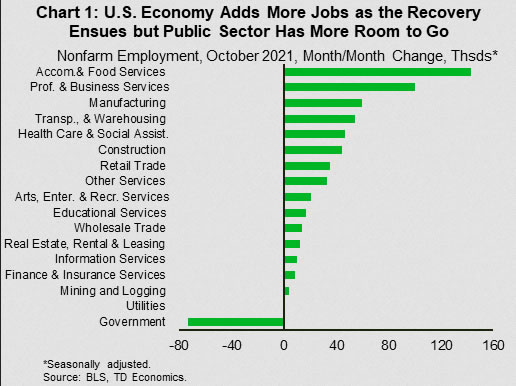
Some of the Fed’s concern about the labor market may be alleviated by the job report this week that showed a net 531k positions added to payrolls and the unemployment rate down 0.2 percentage points to 4.6% in October. This comes on top of a combined 235k upward revision to the job numbers for August and September. Job gains were relatively broad-based with the notable exception of employment in the public sector (Chart 1).
Another punch of good news for the U.S. economy – the ISM services index suggests that the service sector is running on all cylinders. The index rose to 66.7 in October (from 61.9 in September) – the highest level on record. The business activity sub-index rose by 7.5 points to 69.8 and new orders by 6.2 points to 69.7 – both record highs. The new export orders sub-index also moved higher to 62.3 - a 2.8 point increase.
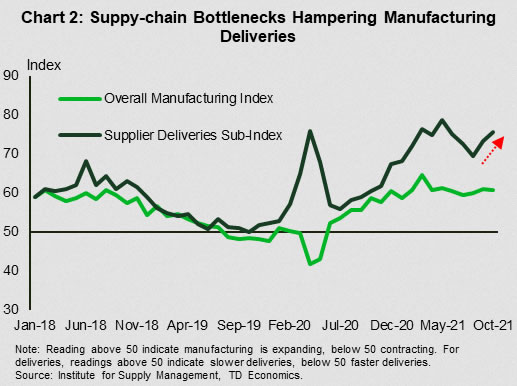
While services are driving ahead, expansion in the manufacturing sector cooled in October. The ISM manufacturing index declined marginally to 60.8 from 61.1 in September. All sub-indexes signaled expansion, with the highest among them the supplier-deliveries index (Chart 2). Usually, a high reading is an indication of robust manufacturing activity, however the sub-index is currently spiking for all the wrong reasons – supply-chain bottlenecks and labor shortages – issues which are hampering manufacturing output.
Turning to vehicle sales, another sector of the U.S. economy that has been stymied by supply shortages, there was an uptick in sales in October, after five consecutive months of decline. Vehicle sales rose 6.5% in the month to 13 million units. Supply bottleneck issues have weighed heavily on auto production, resulting in tight inventories. As a result, new vehicle prices are up a whopping 20% relative to year-ago levels.
Further evidence that U.S. domestic demand is ahead of much of the rest of the world, the U.S. trade deficit widened again in September, reaching a record level for the third consecutive month. The widening deficit was driven by a 3% decrease in exports and a 0.6% increase in imports.
With ongoing evidence of demand resiliency, the Fed is likely to continue to signal the gradual withdrawal of policy support. The first hike in the federal funds rate is likely to follow shortly after the end of asset purchases, with at least one more to come before the end of 2022.
Canada - Job Market Recovery Continues In October
Central banks have pivoted to a more hawkish tone in recent months, preparing markets for a reduction in the extraordinary monetary policy support they have provided since the start of the pandemic. Last week, the Bank of Canada announced an end to its QE program and pulled forward expectations of the first rate hike. This week, the Fed and the Bank of England were on the docket.
As widely expected, the Fed announced it will start tapering its asset purchases, however, the Bank of England disappointed expectations for a rate increase, leading to rally in global bond markets on Thursday. As a result, after rising briskly last week, Canadian bond yields eased off toward the end of this week. Still, 5-year yield remains more than 50 points higher than it was in mid-September.
An increase in bond yields has led fixed mortgage rates higher, however, activity in the Canadian housing market has yet to reflect that. Data from several regional real estate boards this week showed that both home sales and prices strengthened in October. Price gains continue to be supported by demand-supply imbalances, as the inventory of homes on the market – already at low levels – fell further in the month, while demand remained strong. Even as the housing market appears be reaccelerating, a double whammy on affordability stemming from higher prices and borrowing costs is expected to cool demand in the coming year.
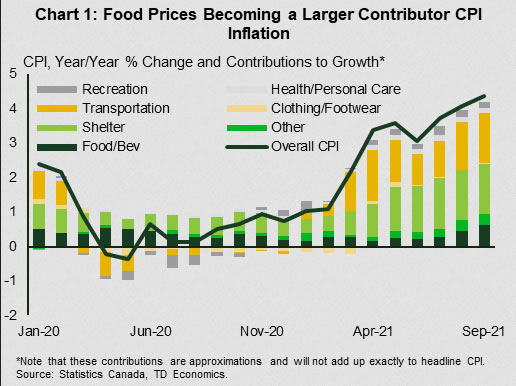
The housing market is not the only one dealing with supply-demand imbalances. As we discuss in this week's report on food prices, food manufacturers have been feeling the squeeze, prompting them to raise prices. Unsupportive weather has hit crop production and inventories globally, as well as in Western Canada, and agricultural input costs, such as energy, transportation and fertilizer are rising. While shelter and transportation are still the main culprits behind hot inflation figures, retail food prices have become a bigger contributor (Chart 1). The above-mentioned headwinds suggest that retail food prices could remain elevated for some time.
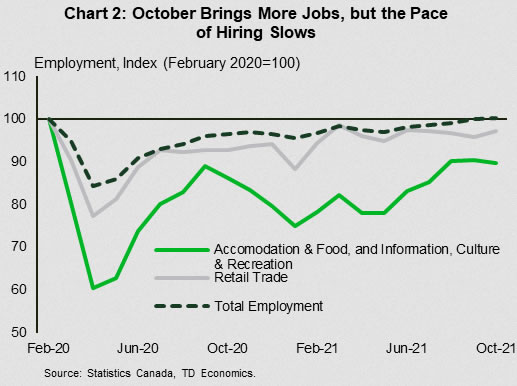
While some of the supply-side factors stirring inflation higher should begin to dissipate, others – such as significant excess savings by households and potentially higher wages – represent an upside risk (report). This week's jobs report showed that the labour market continued to climb in October, adding 31k new jobs (Chart 2). The unemployment rate fell 0.2 points to 6.7%, while total hours worked rose by a robust 1%. The pace of hiring was slower than the outsized gain in September, but still signaled improvement. As long as economic recovery continues, the Bank of Canada will look to begin normalizing interest rates sooner rather than later, mitigating the risk of falling behind the inflation curve as well to financial stability from overheated asset markets.
Forward Guidance: US Inflation to Hold the Spotlight Next Week
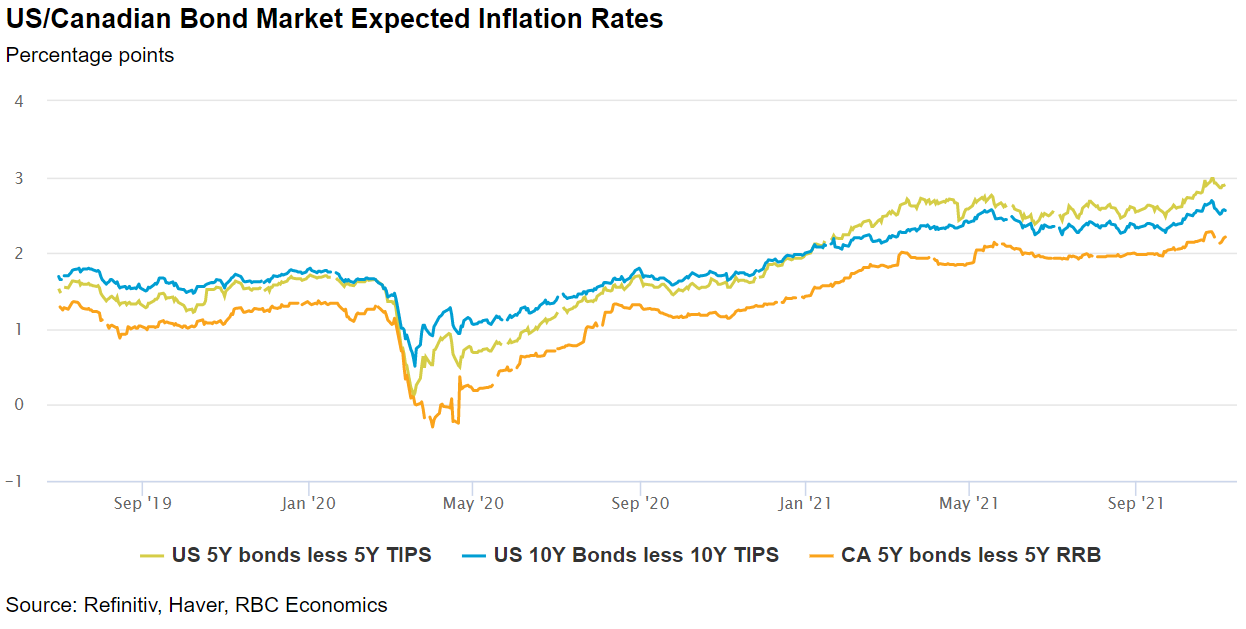
All eyes will be on US inflation figures next week during a quiet period for Canadian data releases. US CPI growth is expected to remain elevated—up almost 6% relative to October 2020—as growth in consumer prices continue to be affected by very low year-ago prices. Nearly half of the increase in the CPI relative to pre-COVID levels is being driven by a small number of components such as used cars and energy, both of which likely moved higher again in October. The more pressing concern in both the U.S and Canada is that price pressures are broadening as demand recovers and production is limited by global supply chain disruptions and labour shortages.
Shelter costs have been a larger CPI driver in Canada, with exceptionally tight resale markets pushing up realtor/broker fees and prices. They continued to rise in October with early market reports pointing to a reacceleration in home price growth. The Bank of Canada acknowledged more persistent price pressures and expects inflation to average 4.8% in Q4 before easing to average 3.4% next year. At its November meeting, the Fed said the rise in inflation is “expected to be transitory” and that vaccines and easing supply constraints should support continued job gains and a reduction in inflation. The Bank of Canada (with its single mandate focus on inflation) reiterated at its recent meeting that policymakers are watching inflation expectations and labour cost growth closely for signs that recent inflation pressures could be more persistent than they currently expect.
Week ahead data watch:
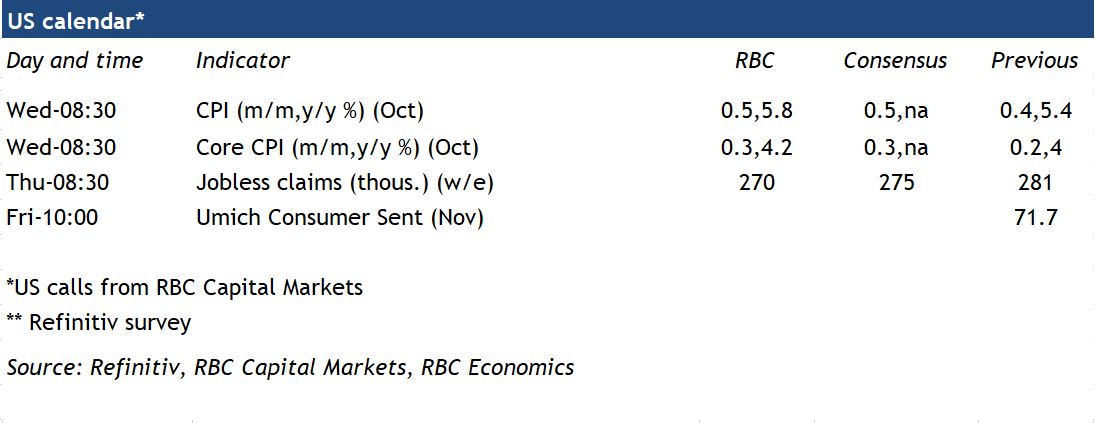
- We expect US Inflation remained elevated, growing by 0.5% in October from September, and up 5.8% year-over-year. Distortions to supply side factors such as port congestion, input and labour shortages will continue to put on floor on price growth. Looking beyond the pandemic base effects, the more important focus will be on the evolution of monthly price gains.
Week Ahead – All About Inflation Now
After an impressive nonfarm payroll report and a successful avoidance of a Fed ‘taper tantrum’, the focus shifts to inflation. Everything from earnings season, the regional Fed surveys, and the ISM reports suggest that global supply chain pressures remain intense, and that inflation will remain elevated. The October inflation report is expected to show pricing pressures run to the hottest levels since 1990.
Given the broad-based inflation signs hitting both sides of the Atlantic, traders will look to see if the upcoming global inflation reports are able to unwind the surge in Treasuries and move forward expectations for the Fed to raise rates.
For the US, the upcoming week is filled with Fed speak, a couple of key Treasury auctions (3-year and 10-year), PPI and CPI reports, and consumer sentiment. In Asia, the focus will fall on Chinese trade, credit, and inflation data. In Europe, traders will eye the German ZEW survey, Russian GDP, UK GDP and Eurozone industrial production data.
Country
US
After an impressive nonfarm payroll report that included strong revisions to the prior two months, the US labor market recovery got its groove back. It was a busy week that contained a dovish Fed taper announcement that triggered a major reset with Fed rate-hike expectations, Democrats inched closer to delivering on President Biden’s agenda, the US added 531,000 jobs in October, and promising data with Pfizer’s COVID pill.
Wall Street will now fixate over the upcoming inflation report that could show the fastest increase since 1990. Surging energy costs, persistent supply chain issues, and rising labor costs could have both the PPI and CPI reports run hotter-than-expected.
The majority of next week’s Fed speak will be before the inflation report but will still be closely watched. On Monday, Fed’s Clarida speaks about the prospects for monetary policy, Fed Chair Powell will make opening remarks at the Fed Diversity Conference, Fed’s Harker speaks to the Economic Club of New York, Fed’s Bowman talks about the housing market, and Fed’s Evan’s talks about the economy. On Tuesday, we will hear again from Powell, Fed’s Bullard, Fed’s Daly and Fed’s Kashkari. On Friday Fed’s Williams speaks.
EU
Next week has little to offer from the EU. We’re in wait and see mode ahead of the December ECB meeting, at which point we may have a better idea of what will replace PEPP in March, if anything.
The only standout events come on Tuesday as we get the ZEW economic sentiment readings and hear from ECB President Christine Lagarde. Investors weren’t buying the “inflation is transitory” message last week. Maybe she’ll have more luck on Tuesday.
UK
After this week’s BoE meeting, it’s clear the MPC is uncertain on the path for inflation and interest rates and is hesitant to pull the trigger. Yet it knows it has backed itself into a corner and must now deliver in the coming months. Governor Bailey speaks on Tuesday and may be able to clear up some confusion.
Thursday then offers a selection of data including monthly and quarterly GDP readings.
Russia
GDP data on Wednesday is the only release of note next week. The CBR has previously made clear that another large rate hike will likely be warranted before the end of the year in order to combat high inflation which is expected to reach almost double the central bank’s target.
South Africa
Finance Minister Enoch Godongwana will deliver the medium-term budget statement on Tuesday. No other notable data due next week.
Turkey
A couple of pieces of data due next week including unemployment and industrial production.
Inflation rose closer to 20% last month which will further fuel concerns about the policy direction of the central bank, under pressure from President Erdogan. The lira continues to suffer despite enjoying some rare reprieve over the last couple of weeks. It didn’t last long and could be headed for fresh record lows and a move above 10 to the dollar, a massive psychological blow.
China
China releases Inflation data on Wednesday but in the immediate term markets will be on tenterhooks over the coming weekend. A unit of Evergrande is due to make offshore coupon payments of just over $82.0 million Saturday. Property developer Kaisa’s shares were suspended on Friday in Hong Kong after it warned of liquidity issues and put circa $12 billion of developments on the sales block. Mainland and Hong Kong equities ended the week on a sour note as fears rose of deepening woes in the property sector. If Evergrande misses payment this weekend, and enters a 30-day grace period again, China and Hong Kong equities are likely to move sharply lower on Monday.
Elsewhere, the China regulator has apparently asked some banks (mostly regional) to not increase wealth management assets from present levels. The shared prosperity interventions by China’s government appear to be moving into a new phase and are another potential headwind this week. These developments are overshadowing the Communist Party Central Committee meeting starting Monday, and new policy measures could emerge mid-week.
India
Holidays have shortened the trading week in India where a buoyant IPO market continues to suck in foreign inflows, keeping the INR firm. Much will depend on the US Non-Farm Payrolls where a high number could have the Fed tightening story back front and centre, and weigh on INR and other Asian currencies. India markets also stand to benefit from lower oil prices although Northern India still faces challenging energy conditions.
No significant data until Friday with the release of Manufacturing and Industrial Production, and Inflation. The former should confirm India is emerging from Covid slowdown. Inflation will be closely watched thanks to India’s stagflationary monetary conditions. A fall in inflation to near 4.0% should be enough to boost India equities into the end of next week.
Australia & New Zealand
The dovish hawkish unchanged RBA decision will continue to dominate Australian equities next week as local markets mark local bond yields lower in response to no signs of change in RBA guidance. Overall, price action in equity markets, and AUD, continues to be dominated by investor sentiment in the US. That said, another tumble in iron ore this week could weigh on both.
Australian employment data on Thursday will cause intra-day volatility, but even if the data is poor, markets will likely look through it to the domestic and international border reopening story and the expected consumer rebound.
NZ Business PMI is the only notable data point this week. The currency will be dominated by investor sentiment swings in international markets. Locally, markets remain laser-focused on RBNZ and how much it will hike later this month.
Japan
Japan has no significant data this week. Local equities are alternating between following investor sentiment in New York, or wringing hands over the contents of the new government’s forthcoming stimulus package. Much of the recent rally in the Nikkei can be attributed to the stimulus hopes, and if the details disappoint, that will weigh on the Nikkei. It is likely to be a story for later in November though.
USD/JPY continues to range between 113.50 and 114.50, with its daily movements almost entirely correlated to the US/Japan interest rate differentials. Readers should watch the ebb and flow of those for direction, or have a good book to read while waiting.
Markets
Oil
Now that the OPEC+ is over with and COP26 is winding down, energy traders are in wait-and-see mode to see what will be the response from the Biden administration. It seems very likely the US will tap the strategic petroleum reserve and possibly unveil other actions. The oil market deficit remains firmly in place but many traders are hesitant to scale back in until the US makes an announcement about an SPR release.
Gold
Both Fed and BOE rate-hike bets are getting pushed back and that has been great news for bullion. Global bond yields have been tumbling quickly and that has revitalized the trade in gold. Even as the US labor market gets back on track and stocks continue to make fresh records, gold is seeing steady support. The Fed might be making a policy mistake and that is supporting gold prices. Investors will closely follow the next round of Fed speak to see if policymakers’ confidence with the transitory narrative is waning.
Bitcoin
Bitcoin continues to consolidate as retail investors primarily focus on altcoins and institutional traders can’t pass up on the volatility in the bond and stock market. Bitcoin continues to attract new investors and that should support the current consolidation pattern.
New York City Mayor-elect Eric Adams said, “NYC is going to be the center of the cryptocurrency industry and other fast-growing, innovative industries.” Cryptocurrency traders will wait to see if anything of substance happens in New York.
Key Economic Events
Saturday, Nov. 6
- Berkshire Hathaway earnings.
Economic Data/Events:
- Singapore foreign reserves
Sunday, Nov. 7
Economic Data/Events:
- China Oct Trade Balance: $64.0Be v $66.8B prior, forex reserves: $3.201Te v $3.201T prior
Monday, Nov. 8
- The U.S will lift restrictions for vaccinated travelers.
- China’s Communist Party’s decision-making Central Committee 4-day event begins
- ECB Chief Economist Lane speaks at ECB conference on money markets at an event hosted by The Hutchins Center on Fiscal & Monetary Policy at Brookings (along with Fed Vice Chair Clarida and former Fed chief Bernanke).
- Eurogroup ministers meet in Brussels to discuss macro-economic developments and inflation.
Economic Data/Events:
- Japan leading index, coincident index
- South Africa gross and net reserves
- Sweden house prices
- Switzerland unemployment
Tuesday, Nov. 9
- Virtual Conference on Diversity and Inclusion in Economics, Finance, and Central Banking speakers include Fed Chair Powell, BOE Governor Bailey, BOC Gov Macklem and ECB Executive Board member Schnabel.
- Fed’s Daly speaks at NABE Tech Economics Conference.
- US WASDE report on agricultural supply and demand.
- EU finance ministers meet in Brussels.
- ECB Executive Board members Panetta and Rehn, Bank of Russia Governor Nabiullina, People’s Bank of China Governor Yi Gang participate in a policy panel at the 30th anniversary conference of the Bank of Finland Institute for Emerging Economies.
- ECB Forum on Banking Supervision two-day event featuring ECB President Lagarde, Executive Board member Elderson.
- ECB Governing Council member Knot, Fed’s Bullard speak at a UBS conference.
- Norges Bank releases financial stability report.
Economic Data/Events:
- US Oct PPI Final Demand M/M: 0.6%e v 0.5% prior
- Australia consumer confidence, NAB business confidence
- China aggregate financing, money supply, new yuan loans
- France trade
- Germany trade, ZEW survey expectations
- Japan labor cash earnings, bank lending, BoP, bankruptcies
- Russia GDP
- New Zealand ANC Truckometer, card spending
- Mexico international reserves, CPI
Wednesday, Nov. 10
Economic Data/Events:
- US Oct CPI M/M: 0.6%e v 0.4% prior; Y/Y: 5.8%e v 5.4% prior wholesale inventories, initial jobless claims
- Australia weekly payroll, Westpac consumer confidence
- Germany CPI
- Denmark CPI
- Norway CPI
- Italy industrial production
- Riksbank financial stability report
- Japan M2 money stock, machine tool orders
- China Oct PPI Y/Y: 12.3%e v 10.7% prior, CPI Y/Y: 1.3%e v 0.7% prior, FDI
- New Zealand home sales
- Thailand rate decision
- France industrial sentiment
- Turkey Unemployment
- EIA Crude Oil Inventory Report
Thursday, Nov. 11
- US bond market is closed in observance of Veterans Day.
- European Commission publishes its updated economic forecasts.
- EU trade ministers meet in Brussels to discuss World Trade Organization reforms.
- South African Finance Minister Godongwana delivers his first budget.
Economic Data/Events:
- UK industrial production, GDP
- Australia unemployment, consumer inflation expectations
- Japan PPI
- Mexico central bank (Banxico) Rate Decision: Expected to raise overnight raise 25bps to 5.00%
- Mexico industrial production
- New Zealand food prices, ANZ business confidence
- Russia Trade
- South Africa manufacturing production, mining production, gold and platinum production
- Turkey current account
- Sweden unemployment
Friday, Nov. 12
- Shanghai exchange weekly commodities inventory.
- Final day of the UN COP26 Conference in Glasgow.
- ECB’s Lane participates DG ECFIN’s workshop: “The future of the EU fiscal governance framework.”
- BOE policy maker Jonathan Haskel delivers speech at the IARIW-ESCoE Conference “Measuring Intangible Assets and their Contributions to Growth.”
Economic Data/Events:
- US Nov Prelim University of Michigan consumer sentiment: 72.5e v 71.7 prior
- Eurozone Industrial production
- Turkey Industrial production
- India Industrial production
- Norway GDP
- Thailand foreign reserves, forward contracts
- New Zealand manufacturing PMI
- India CPI
Sovereign Rating Updates:
- Portugal (Fitch)
- Netherlands (S&P)
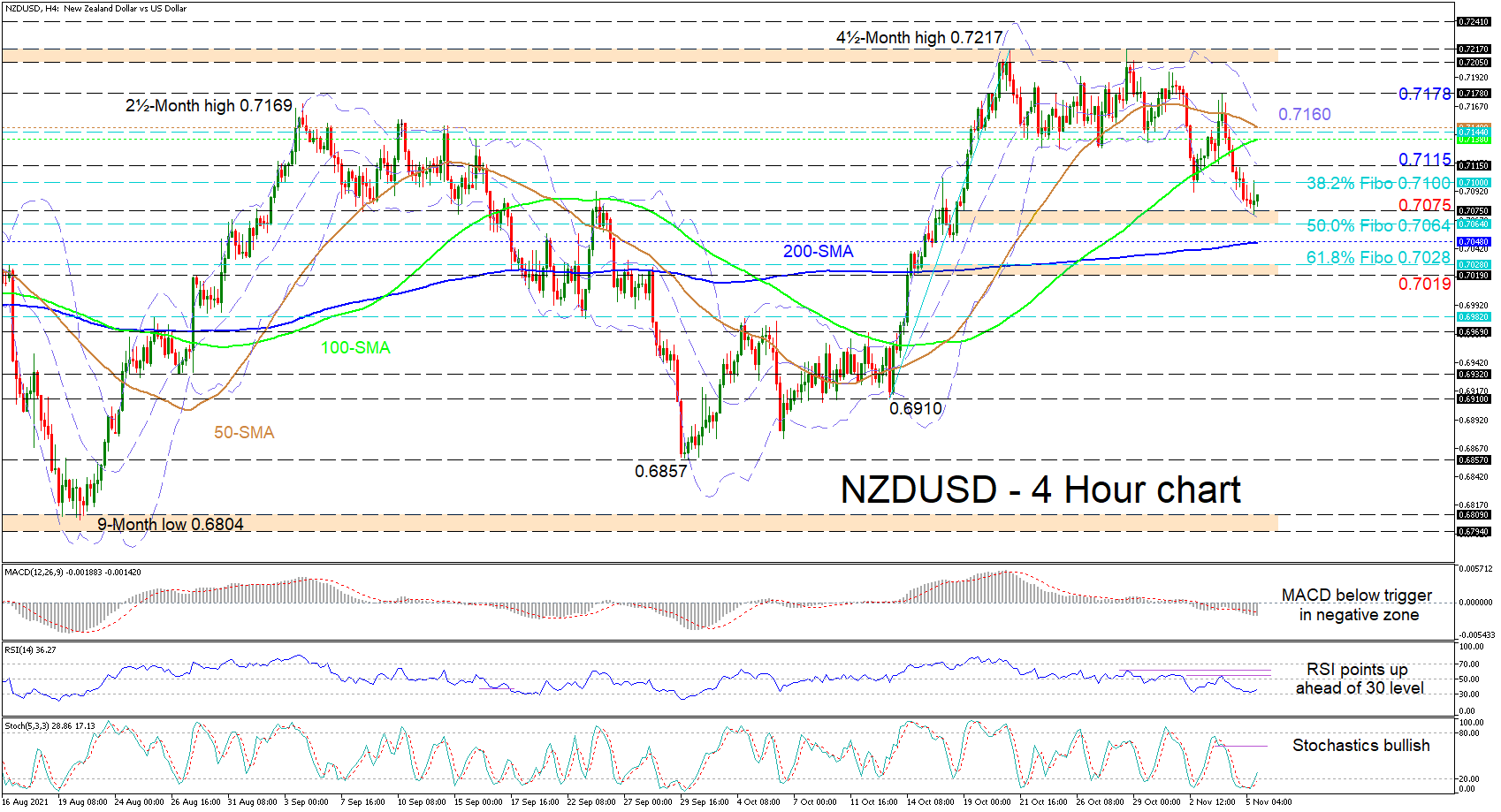
NZDUSD May Find its Feet ahead of 50.0% Fibonacci
NZDUSD has surrendered just about 50.0% of its latest rally from 0.6910 until 0.7217 but the negative drive seems to have somewhat softened. The falling 50-period simple moving average (SMA) appears to be heading for a bearish crossover of the 100-period SMA and this could signal the negative trend is gaining strength.
However, the short-term oscillators are indicating a slight pick up in positive momentum. The MACD, in the negative region, is flattening beneath its red trigger line. On the contrary, the RSI is improving from the 30 oversold level, while the stochastic oscillator has turned bullish. They are both reflecting that selling interest is fading.
Gaining traction off the lower Bollinger band within the support section of 0.7064-0.7075, buyers may meet initial resistance at the 0.7100 handle, that being the 38.2% Fibonacci retracement of the up leg from 0.6910 until 0.7217 and the mid-Bollinger band at 0.7115. Overstepping the mid-Bollinger band, upside impetus could struggle at the zone between the 100- and 50-period SMAs at 0.7138 and 0.7148 respectively. However, should buying interest conquer this tough border, the bulls will then need to push past the upper Bollinger band at 0.7160 to challenge the 0.7178 high.
If sellers retake the reins, the first barrier to deny the downside acceleration is the nearby support border of 0.7064-0.7075. If the bears overwhelm that, the 200-period SMA at 0.7048 may be next to make a stand. A deeper drop from here could then meet the support band formed between the 61.8% Fibo of 0.7028 and the 0.7019 low.
Summarizing, NZDUSD is exhibiting a bearish tone despite buyers recently gaining some strength. A price dive below the 200-period SMA at 0.7048 could reinforce negative pressures, while a climb above 0.7178 high is necessary to refuel buyers’ confidence.