Sample Category Title
Asia Ignores Overnight US Equity Rally
Asian markets in cautious mode
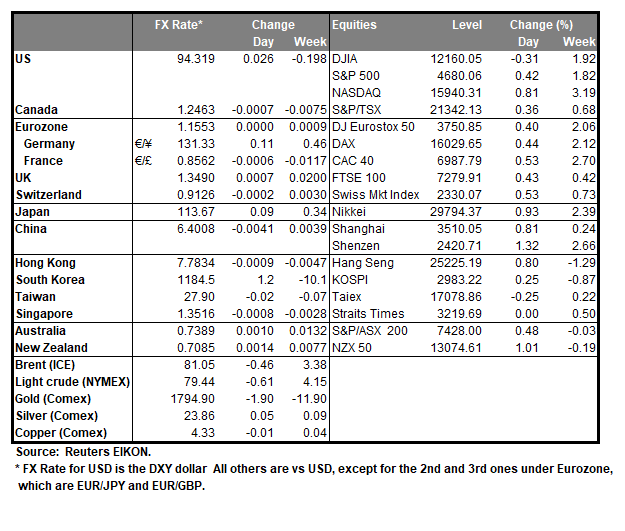
A wave of caution is sweeping the North Asia heavyweights today, and as usual, it seems to have spurred a rotation into ASEAN markets further south. That has seen Japan, South Korea and China ignoring yet another rally on Wall Street overnight. With markets moving into lower-for-longer mode, the rate-sensitive Nasdaq and S&P 500 outperformed, while the Dow Jones suffered. The S&P 500 finished 0.42% higher, with the Nasdaq jumping 0.81%, while the Dow Jones lagged, rising just 0.09%. Futures on all three are steady in Asia.
In Japan, nerves around the makeup of the fiscal stimulus package have spurred profit-taking. The Nikkei 225 has fallen 0.75%, with South Korea’s Kospi down 0.55%. In China, the Shanghai Composite has fallen on wealth management concerns, edging 0.25% lower. The CSI 300, by contrast, has risen by 0.20%. China property nerves are front and centre in Hong Kong, with the Hang Seng retreating by 0.95%. Tech-centric Taipei has increased by 0.25%.
Singapore has climbed by 0.60% in regional markets on strong bank earnings, with Kuala Lumpur edging 0.20% lower as oil prices remain pressured. Bangkok and Jakarta are flat, while Manila has leapt 1.65% higher after benign inflation numbers and a dollop of IPO-mania. Australian markets are also in the green, helped along by a dovish RBA this week and another overnight rally on Wall Street. The ASX 200 and All Ordinaries are 0.50% higher.
Europe’s data calendar lacks tier-1 releases today and will likely open higher on the back of a strong Wall Street finish. Three Bank of England speakers today will bring some volatility to UK equities after yesterday’s surprise policy decision. Overall, I expect activity to be muted this afternoon in Asia and Europe as the market awaits this evening US jobs print.
Market’s Attention On October’s US Employment Report
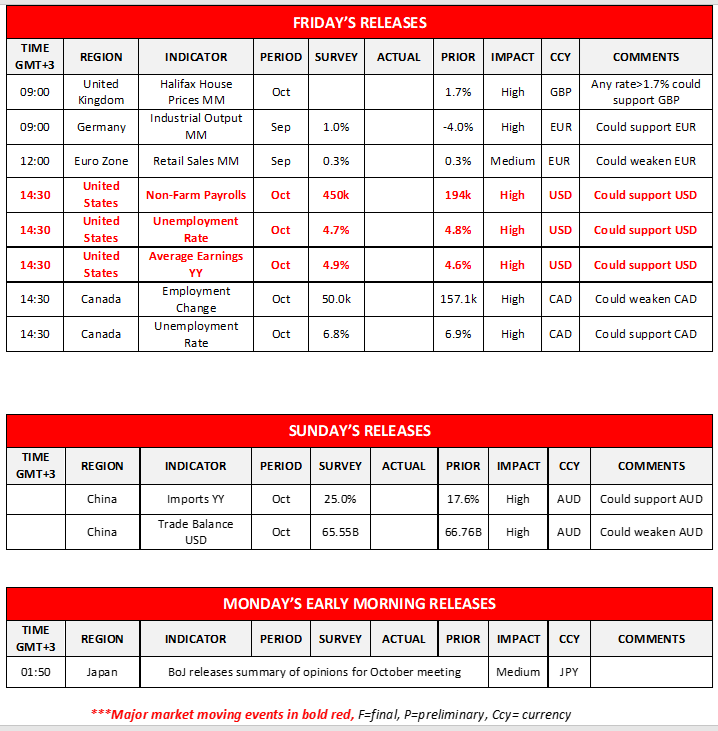
The USD gained against a number of its counterparts yesterday ahead of the release of the US Employment report for October later today. It should be noted that in an encouraging sign, the weekly initial jobless claims figure dropped more than expected implying a tightening of the US employment market also on the last week of the month. From the US employment report's key indicators, the Non-Farm Payrolls is expected to rise substantially and reach 450k if compared to September's disappointing 194k, while the unemployment rate is expected to tick down and the average earnings growth rate to accelerate year on year. Overall, should the actual rates and figures meet their respective forecasts or show an even wider tightening of the US Employment market we may see the USD getting some support as it could boost the confidence of the Fed. On the other hand, should the rates and figures miss their targets we may see the greenback retreating as it did at the release of the September report last month.
The USD index was on the rise yesterday breaking the 94.10 (S1) resistance line, now turned to support. Given that the index has started to mark higher highs and higher lows we see the bullish tendencies, yet we note that today's employment report release could alter the index's direction. Should USD buyers continue to dominate the scene we may see the index rising, breaking the 94.60 (R1) resistance line and take aim for the 95.10 (R2) level. Should the market decide to sell the greenback we may see the index dropping once again below the 94.10 (S1) support line and take aim for the 93.70 (S2) level.
CAD traders eye employment data and oil prices
The CAD continued to retreat against the USD yesterday and reached its lowest point since the 13th of October, as the Loonie's value was undermined by dropping oil prices. WTI's price action erased any gains made earlier in the day and continued to be in red territory for a third consecutive day. It should be noted that OPEC's decision to rebuff US calls for higher production levels and continue to produce what was agreed may make oil bears think twice before advancing further. Nevertheless, we tend to maintain the view that should oil prices continue to drop we may see CAD bears remaining present. Today CAD traders could focus on the release of the Canada's employment data for October due out at the same time as the US employment report. The unemployment rate is expected to drop which could be a positive for the CAD, yet also the employment change figure is to drop which could moderate any gains for the CAD or even encourage the bears, if the actual rates and figures meet their respective forecasts.
USD/CAD was on the rise yesterday breaking the 1.2425 (S1) resistance line, now turned to support. We tend to maintain a bullish outlook for the pair yet the employment data for the US and CAD for October which are due out today could alter the pair's direction. Please note that the RSI indicator below our chart is just below the reading of 70, implying an advantage for the bulls. Should the bulls actually continue to push the pair higher, we may see USD/CAD breaking the 1.2500 (R1) resistance line and aim for the 1.2580 (R2) level. On the flip side should the bears take over, we may see the pair breaking the 1.2425 (S1) support line and aim for the 1.2330 (S2) level.
Today's events and expectations
Today in the European session, we note the release of UK's Halifax House prices for October, Germany's industrial output for September and Eurozone's retail sales growth rate for the same month. In the American session we note the release of the US employment report for October as well as the Canadian employment data for the same month. On Sunday we would also note the release of China's trade data for October, while on Monday BoJ is to release the summary of opinions for October's meeting.
USD Index H4 Chart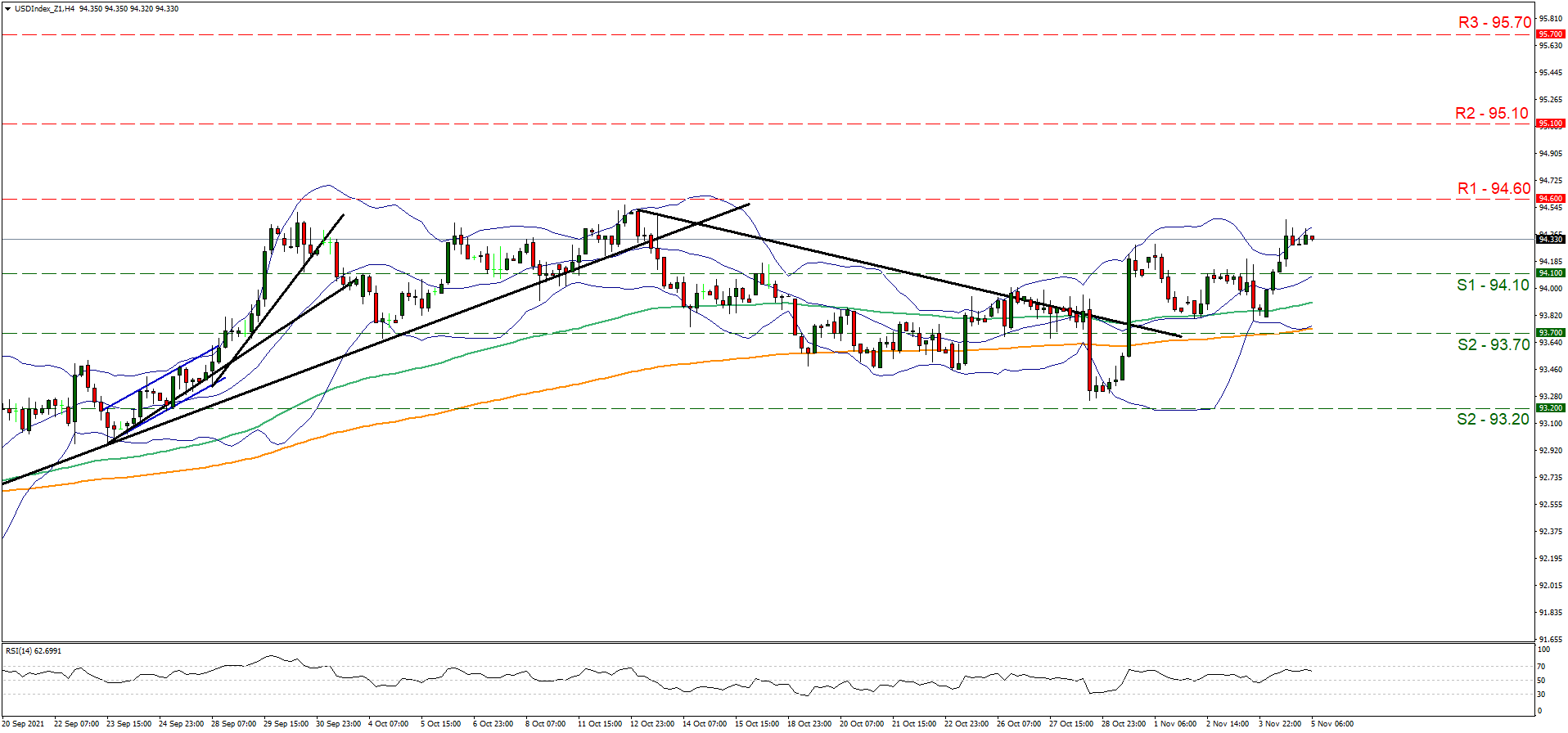
Support: 94.10 (S1), 93.70 (S2), 93.20 (S3)
Resistance: 94.60 (R1), 95.10 (R2), 95.70 (R3)
USD/CAD H4 Chart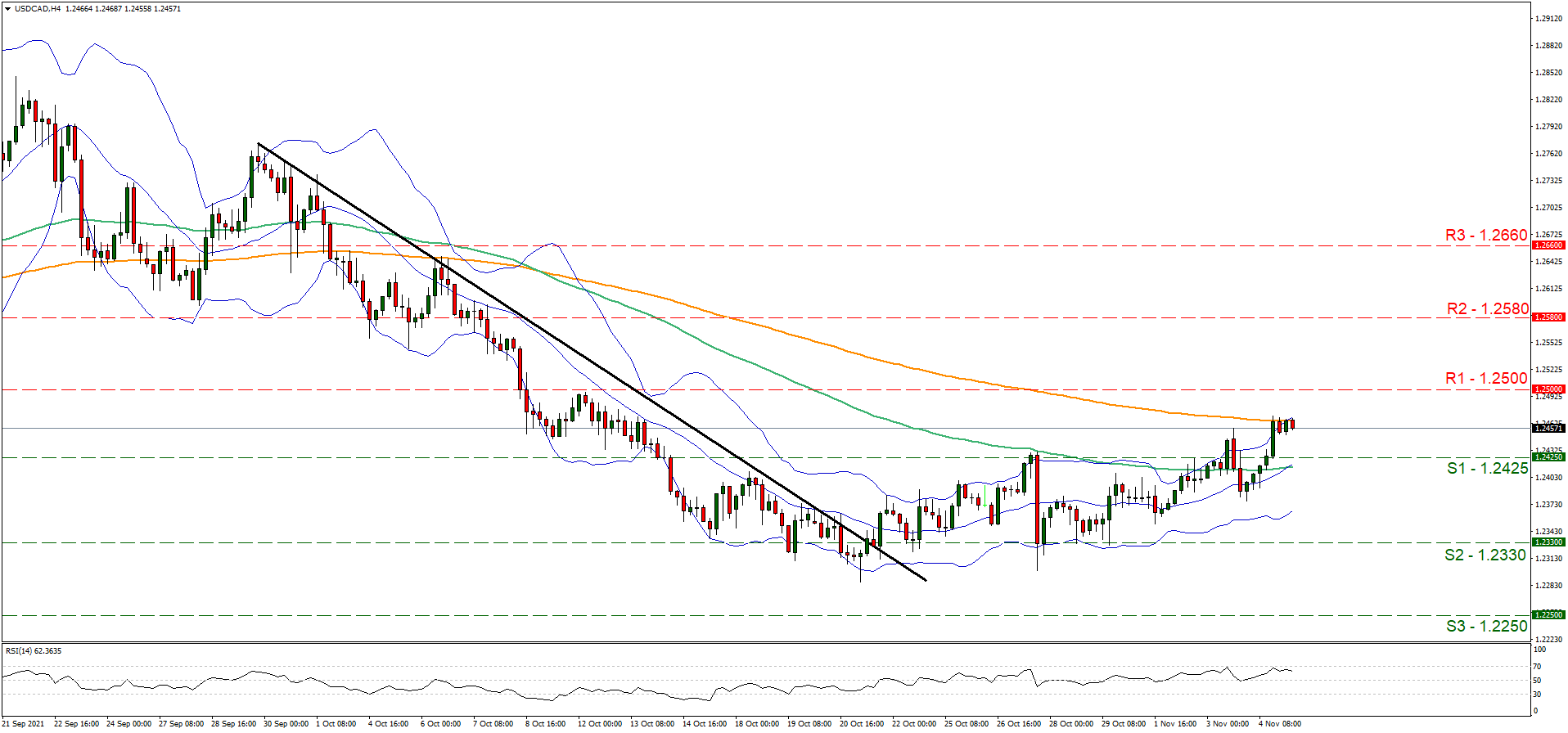 Support: 1.2425 (S1), 1.2330 (S2), 1.2250 (S3)
Resistance: 1.2500 (R1), 1.2580 (R2), 1.2660 (R3)
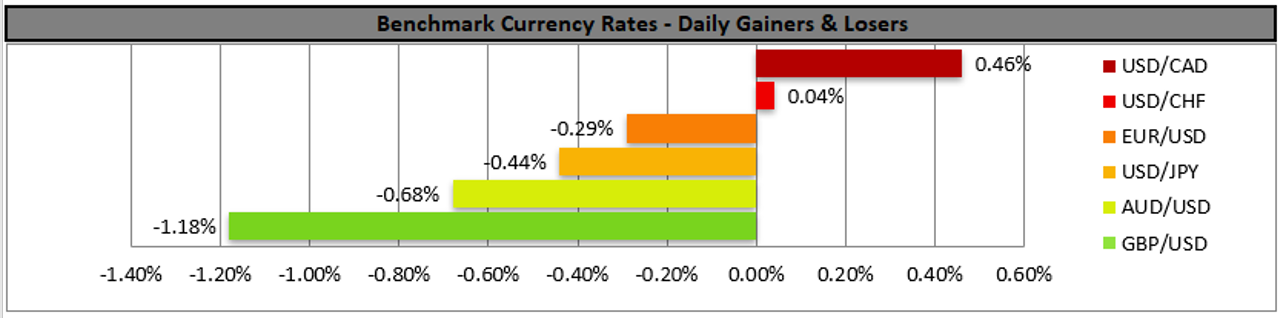
GBPUSD Rocked As BoE Alters Decision To Hike Rate
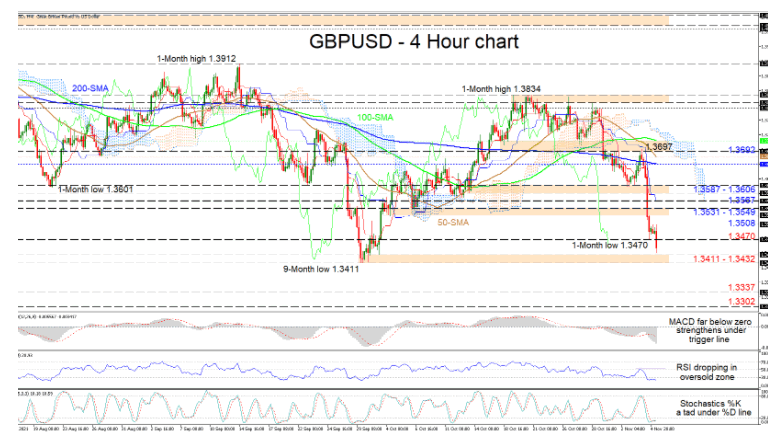
GBPUSD plummeted to a one-month low of 1.3470 yesterday, after the Bank of England’s Monetary Policy Committee (MPC) voted to continue with its existing programme of UK government bond purchases, and to keep the bank rate unchanged at 0.1%. The pair is now extending its drop past the 1.3470 low and the road to recovery for the pound is looking to be a bumpy one. The longer-term simple moving averages (SMAs) are directing lower, while the diving 50-period SMA is endorsing the growing downtrend and could boost it with a bearish crossover of the 200-period SMA.
The Ichimoku lines are indicating that bearish forces are powering up again, while the short-term oscillators are showing a preference to the downside. The MACD, below the zero threshold, is plunging further beneath its red trigger line, while the RSI is steering deeper into the oversold territory. The stochastic lines are entangled below the 20 level and are not signalling clear directional impetus yet.
If the price retains its current trajectory, prompt downside constraints could arise from the nearby 1.3411-1.3432 support section, formed by the lows around the end of September and the beginning of October. If sellers continue to dominate, they may then navigate the pair lower, turning their focus towards the 1.3337 barrier before aiming for the 1.3302 trough, achieved in December 2020.
Alternatively, if buying interest intensifies significantly, upside friction could commence from the 1.3470 mark (previous support-now-resistance) and the 1.3508 high prior to the bulls testing the 1.3531-1.3549 boundary. Recouping more ground, the price may hit the 1.3567 barrier before tackling the resistance region of 1.3587-1.3606. Recapturing the area above this could bolster upside momentum steering the price towards the zone existing between the 200- and 50-period SMAs at 1.3659 and 1.3679 respectively. Another leg higher could encourage buyers to challenge the 1.3692-1.3718 resistance border, reinforced by the Ichimoku cloud.
Summarizing, GBPUSD is exhibiting a sturdy negative bias below the 1.3500 mark. That said, for a positive tone to materialize, the price would need to return above the 1.3697 high.
Revenge Of The Wimps
Last night it was the turn of the Bank of Federal Reserve Bank of England, Japan, Europe and Australia, I mean the Bank of England, to give markets another hawkishly dovish policy decision. Despite telegraphing future rate hikes pre-meeting, the BOE bottled it on the day, preferring to wait-and-see the effects of employment from the end of the Government’s furlough scheme. The BOE did signal hikes were still on the way to their credit, probably starting in December, as did the Norges Bank yesterday. Possums in the headlights and central banks have been muttered a lot by me this week.
Sterling slides after BoE non-move
There was no doubt long sterling and short UK rates was a crowded trade. And markets reacted appropriately afterwards, GBP/USD collapsing 1.30% overnight and UK yields falling. Having all but promised markets a rate hike next month, assuming UK employment holds up, the BOE will have some serious credibility issues on its hands if it doesn’t. As I have said before, zero per cent rates bother me not; it is QE that has to go, having rapidly reached its use-by date. QE makes those who can afford to belong assets richer, while those who are young and having their future wealth stolen, those on low or fixed salaries, those who rent, are made poorer. The double kidney punch is that “transient” inflation will further erode their spending power. QE-ing into an inflationary environment is economic stupidity that is saving up serious societal problems for the future.
The Bank of England decision sparked a rally in European and US bond markets, and the street swivelled back to lower for longer. I suspect that has as much to do with market positioning than lower for longer, though, as the US dollar continued to power higher overnight. From my perspective, that is a warning that the drop in US yields may only be temporary. Gold was a significant beneficiary of lower yields, rising 1.25% overnight. But again, the higher US dollar warns gold’s day in the sun may only be temporary.
How temporary, will likely be decided by tonight’s US Non-Farm Payrolls data. Market expectations are hovering around 450,000 jobs added, with another fall in Initial Jobless Claims overnight suggesting that the job market is finally moving. A print north of 500K likely stirs the inflation, taper, and hiking noise again, and could see that rally in bonds overnight evaporate along with gold. Conversely, another disappointing number sub-350K is likely to have the opposite effect and will see the US dollar given an end-of-week slapping.
In Asia today, Japanese Household Spending rebounded by 5.0% MoM for September, thanks to a low base in August due to Covid restrictions. The YOY number was still negative, and markets seem more on comments on the news tickers by Japanese officials regarding the makeup of the forthcoming stimulus package. Philippines Inflation rose by 4.60% YoY in October, but thankfully, eased to just 0.20% MoM. That will be a relief to the central bank, whose policy settings are far below inflation but still leaves the country among the more vulnerable in ASEAN to a Fed taper-tantrum, should it occur before the end of the year. Indonesian GDP disappointed, rising only 1.55% QoQ Q3. Still, with life here back to normal in Jakarta (including traffic and flooding) and firm commodity prices, the Q4 data should show an accelerating trend helped by a long-awaited consumer spending rebound.
China nerves appear to be rising into the week’s end. Property developer, Kaisa had its shares in Hong Kong suspended today. Units of Evergrande have an offshore bond payment deadline tomorrow. And Caixin is running a story that the regulators have instructed some banks to hold wealth management assets at present levels. China’s shared prosperity intervention never went away; they just took a holiday. All I can say, is buyer beware with the Central Committee meeting also running from the 8th to 11th next week. That has put Asian markets in a cautious frame of mind today, waiting for the US non-Farm Payrolls tonight and developments in China as well.
GBP/USD Outlook: Cable Continues To Travel South After BoE Disappointed Expectations For Rate Hike
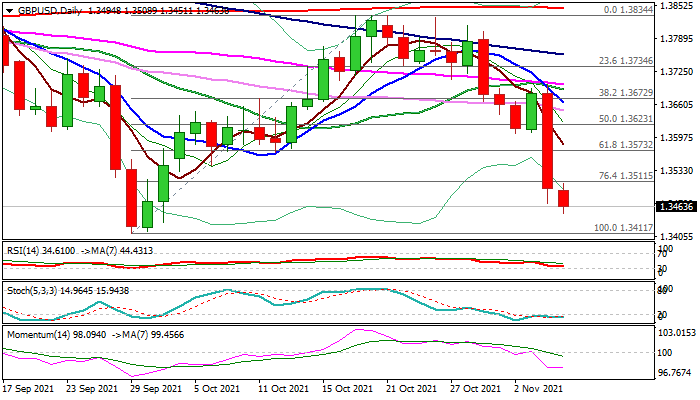
Cable remains firmly in red and extends weakness below the 1.3500 mark, following a massive fall on Thursday (down 1.35%, the biggest one-day drop since 18 Mar 2020), sparked by BoE disappointment.
The Bank of England kept rates unchanged on Thursday although many expected the British central bank to be the first among major world central banks to start hiking after the pandemic, pricing in a 0.15% rise in November’s policy meeting.
The decision strongly soured the sentiment, sending the pound to a five-week low that significantly weakened the near-term structure.
Fresh bears eye key support at 1.3411 (2021 low, posted on Sep 29) to fully retrace 1.3411/1.3834 recovery leg and signal continuation of the larger downtrend from 1.4249 (2021 high).
Break of 1.3411 pivots could extend bears towards 1.3164/56 (Fibo 38.2% of 1.1409/1.4249, Mar2020/Jun2021 rally/ base of thick weekly cloud) that would unmask psychological 1.30 support.
Thursday’s massive bearish candle weighs heavily, as bearish momentum continues to strengthen on the daily chart, but oversold conditions suggest bears may face headwinds on approach to 1.3411, however, firm bearish signals from the weekly chart suggest that bears remain in play and corrective upticks would offer better selling opportunities.
Immediate resistance lays at 1.3511 (session high / broken Fibo 76.4% of 1.3411/1.3834), followed by a more significant 1.3570 zones (former higher base / broken Fibo 61.8%) which should cap the upticks and keep bears intact.
Res: 1.3511, 1.3543, 1.3570, 1.3605.
Sup: 1.3433, 1.3411, 1.3312, 1.3280.
EUR/USD Pair Is Currently Correcting Losses From The 1.1530 Low
The Euro started a fresh decline from well above 1.1600 against the US Dollar. The EUR/USD pair traded below the 1.1580 support to move into a bearish zone.
The pair even settled below the 1.1580 level and the 50 hourly simple moving average. A low is formed near 1.1530 and is currently correcting losses. It is back above 1.1550. There was a break above a key bearish trend line with resistance near 1.1550 on the hourly chart.
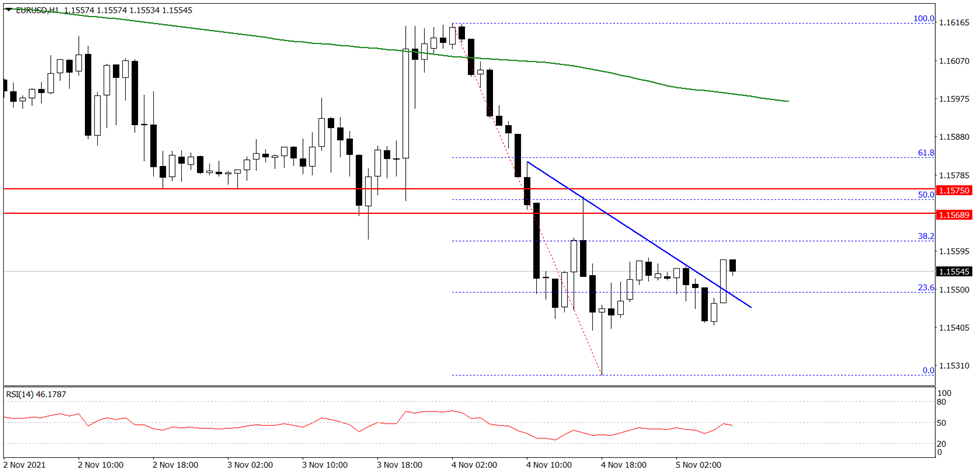
An immediate resistance near the 1.1600 level. A break above the 1.1580 and 1.1600 resistance levels could lead the pair towards the 1.1620 zone.
On the downside, an initial support is near 1.1550 on FXOpen. The key support is near 1.1520, below which there is a risk of a fresh decline. The next major support is near the 1.1480 level.
USD/CAD Trades Sideways
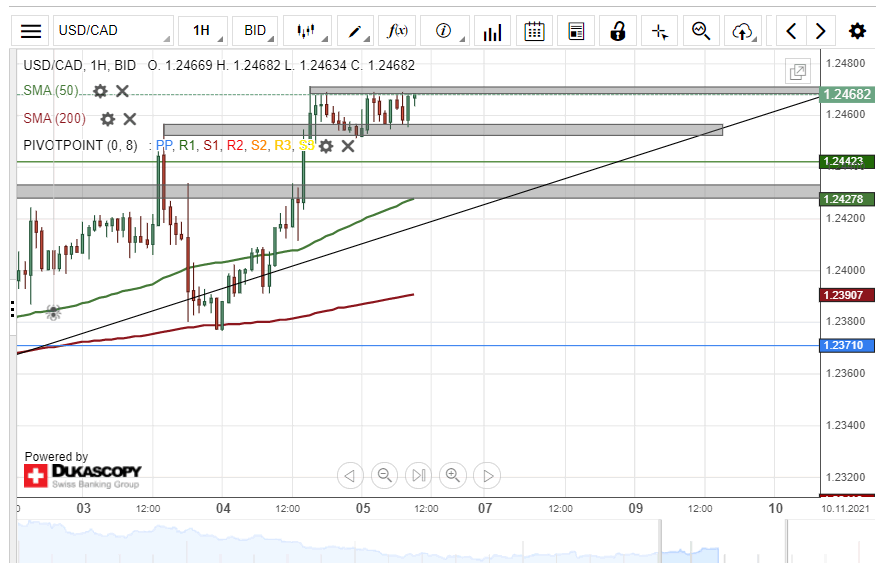
The USD/CAD reached the resistance of the 1.2452/1.2457 zone and passed it on Thursday. However, since the event, the rate has been trading sideways. Namely, the pair appears to be squeezed in between the support of the mentioned 1.2452/1.2457 zone and the resistance of the 1.2470/1.2472 levels.
A breaking of the 1.2470/1.2472 resistance zone could reach for the 1.2500 mark. Note that the 1.2500 level is surrounded by the October 8 and 10 high and low level zone at 1.2497/1.2507. In addition, the weekly R2 simple pivot point is located at 1.2502.
Meanwhile, a decline below the 1.2452/1.2457 zone's support, could result in a decline. A decline would look for support first in the weekly R1 simple pivot point at 1.2442. Below the pivot point, the 1.2428/1.2434 zone and the 50-hour simple moving average might provide support.
GBP/JPY Pierces Support Levels
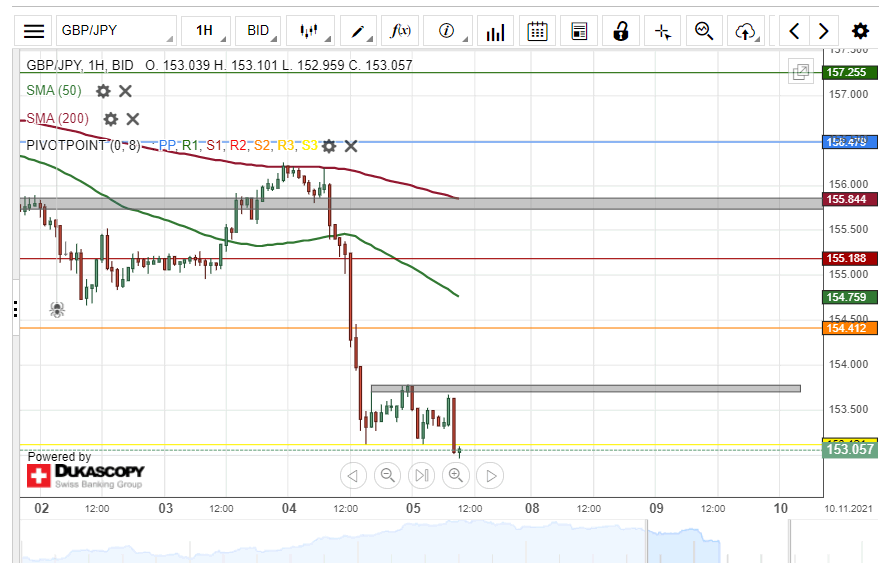
On Friday morning, the GBP/JPY passed the support of the weekly S3 simple pivot point at 153.10 and touched the 153.00 mark.
In the case that the rate extends the decline, it would have no technical support. Namely, the 152.50 and 152.00 levels could act as support. These levels provided resistance during the pair's early October surge.
On the other hand, a recovery of the rate could find resistance in the weekly S3 simple pivot point first. Afterwards, the 153.65/153.77 zone might keep the rate down, as it did since mid-Thursday.
AUD/USD Continues To Decline
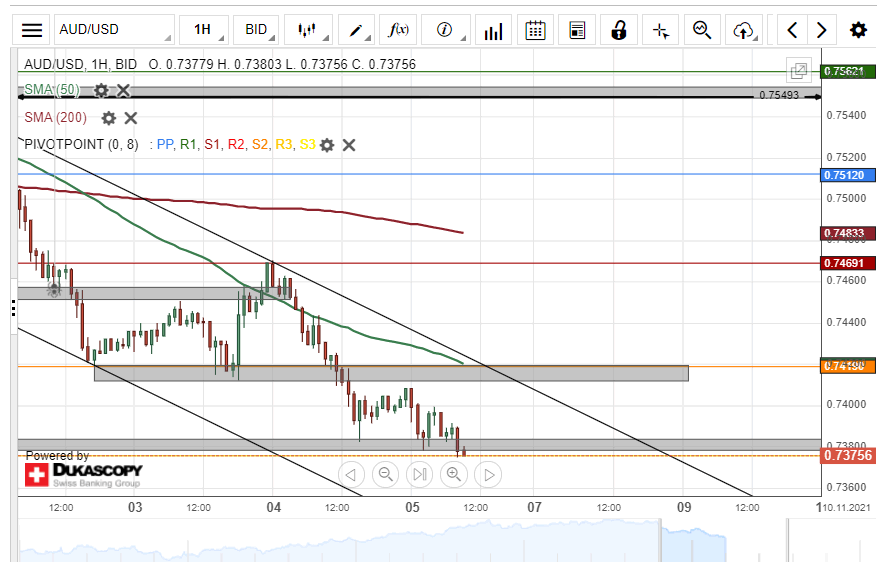
The AUD/USD passed the support of the weekly S2 simple pivot point at 0.7419 and the 0.7412/0.7420 zone. This event resulted in a decline to the October 12 high and October 18 low level zone and the weekly S3 simple pivot point at 0.7376/0.7384, as described in the first scenario on Thursday.
If the pair declines below the mentioned support levels, it would have almost no technical support. The only exception is a recently added channel down pattern's lower trend line. In addition, note that round exchange rate levels like the 0.7350 and 0.7300 could act as support.
On the other hand, a recovery of the pair from the support zone might aim at the resistance of the weekly S2 simple pivot point and the 0.7412/0.7420 zone. Note that the zone was reached by the 50-hour simple moving average on Friday morning.
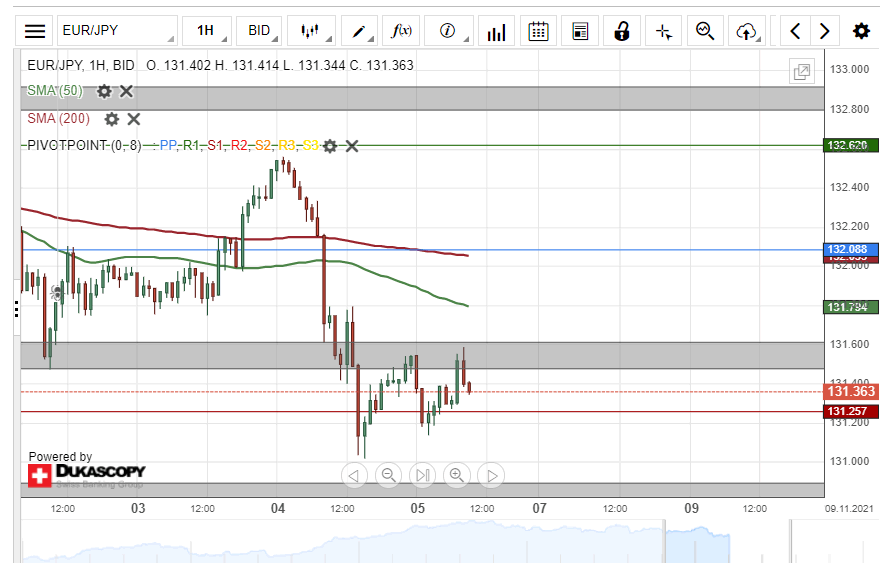
EUR/JPY Almost Reaches 131.00 Level
The decline of the EUR/JPY passed the support zone that is located at 131.48/131.62. The rate continued to decline until it reached the 131.02 level. Due to that reason it is assumed that the 131.00 mark might act as resistance.
Meanwhile, on Friday morning, the currency exchange rate was testing the resistance of the previously passed 131.48/131.62 zone. The near term future was dependent on whether or not the zone forces the pair into another decline.
In the case that the currency pair passes the 131.48/131.62 zone, it could find resistance in the 50-hour SMA near 131.80. Above the 50-hour SMA, the 200-hour SMA and the weekly simple pivot point might act as resistance levels near 132.05.
On the other hand, a potential decline of the EUR/JPY might look for support in the weekly S1 simple pivot point at 131.26. Afterwards, the 131.00 mark might once again provide support. Below the 131.00 level, note the mid-October low level zone at 130.90/130.75. In addittion, the weekly S2 simple pivot point is located at 130.73.