Sample Category Title
Weekly Focus – Central Banks Push Brakes on Rate Hike Speculation
The past week shed some light into central banks' thinking amid growing stagflation fears around the world, and the general message was at least somewhat to the dovish side. At the same time, market's inflation fears appear to have moderated slightly, with 5y5y inflation expectation rates falling below 1.9% in Europe and 2.5% in the US, providing support to the transitory camp of the inflation discussion.
Fed announced the widely expected tapering of their asset purchase program, with the pace of USD15bn per month from mid-November, indicating an end to the purchases by next June. While we got no updated projections from the interim meeting, Powell sounded generally dovish, trying to slightly push against the markets aggressive pricing, yet still acknowledging the increased upside risks to inflation. We see the taper as a beginning of a hiking cycle, and look for two Fed hikes next year, read our more in-depth take in Fed Research - Review: Tapering marks the beginning of a tightening cycle, 3 November.
US macro data also surprised to the upside with payrolls growth of 531,000 in October and upwards revisions to previous months. However, employment is still 4.2m below pre-COVID levels. US ISM Services reached an all-time high at 66.7 (from 61.9). While supplier's delivery times continued to increase for both the Manufacturing and Services PMIs, especially Services index was also supported by strong growth in business activity and new orders.
Against markets' hawkish pricing, Bank of England refrained from hiking rates this week, although it still signals that rate hikes will come at a later stage. Inflation is seen peaking at 5% next April, but labor market developments will be key to follow for gauging the upcoming hiking pace, we look for a 15bp hike in February, followed by two more 25bp hikes in 2022, read more in UK Research - Bank of England Review: Unchanged but hikes are coming, 4 November.
Reserve Bank of Australia also maintained a dovish view, and while the April 2024 yield cap was ended, RBA only pointed towards the first hike in 2023. On the contrary, central banks in Eastern Europe continued their aggressive hiking, with the National Bank of Poland first hiking by 75bp and Czech National Bank following with 125bp. Norges Bank's interim meeting was among the less eventful ones this week, read more in the scandi section below.
The upcoming week is light in terms of data releases, with focus also on the central bank speeches following this week's meetings. US CPI for October will be released on Wednesday, with market looking for signs of increasing pass-through of high raw material, component and labor costs into consumer prices. In the Euro Area, German ZEW will give us the first glimpse on the November growth momentum, while the EU commission will release their new forecasts on Thursday, including the latest draft budget projections.
For China, the October trade data released on Sunday is expected to display continued high trade surplus supported by robust exports and weakening imports amid the domestic slowdown. The high surplus is likely a key factor supporting CNY despite the recent uncertainties. Inflation data will also be released on Wednesday, with focus on the PPI currently at the highest levels in 26 years, and where we look for a further rise to 12.3%.
Sunset Market Commentary
Markets
Day one after the big deception from the Bank of England confirms that upward yield momentum is seriously dented in the short run. Unreliable boyfriend Bailey lured investors by repeating that rates will still need to rise in coming months to keep inflation to target, but his comments didn’t meet with any market response. The upcoming two UK labour market reports will be decisive on the timing of a first rate hike (this year still or with the February monetary policy report). The Fed and US markets find themselves in a more or less similar situation (eyeing labour market); the only difference being that net asset purchases in the US still need to end (June 2022), before discounting rate hikes. The (bond) market reaction after today’s US payrolls was telling. The US economy added 531k jobs in October, beating 450k consensus. The September figure received an 118k upward revision. The unemployment rate fell from 4.8% to 4.6% against a stabilizing participation rate (61.6%). Average hourly earnings rose as expected by 0.4% M/M and 4.9% Y/Y. US Treasuries spiked lower immediately after the release, but rapidly retraced their steps. Once bitten, twice shy. The time/momentum isn’t ripe for better data to spoil bond market momentum after this week’s debacle. On the contrary, core bonds extended intraday gains after the release. US Treasuries do underperform against German Bunds and UK Gilts. The US yield curve bull flattens in a daily respective with yields losing up to 4.6 bps (30-yr). The German yield curve shifts in similar fashion with losses ranging between -1.6 bps (2-yr) and -7.2 bps (30-yr). UK yield lose 7.2 bps (2-yr) to 10.9 bps (30-yr). Lower real yields are the main culprit behind the recent setback in yields. The Japanese yen on the FX markets fails to undo some of the losses occurred during the September/October rate rally. USD/JPY treads water near 113.66. Current market settings suggest a better JPY performance. The greenback primes against EUR and GBP. The dollar did benefit (slightly) from the payrolls. EUR/USD set a minor new YTD low at 1.1514 with EUR/USD 1.1495/93 still being high profile support. The post-BoE rebound of EUR/GBP surprisingly sputtered just ahead of the 0.86 big handle with the pair changing hands near opening levels (0.8550). Stock markets continue to profit from yield dynamics with new all-time highs in the US and the EuroStoxx 50 testing the post-pandemic high at 5048.
News Headlines
Hungarian and Czech data painted a mixed picture. Industrial production in Hungary in September declined 0.3% M/M; the fourth monthly decline in a row. This caused production to print 1.7% lower compared to the same period last year. According to the Hungarian statistical office, the decline was due to supply chain issues in the automotive and the electronics manufacturing sectors. At the same time, Hungarian September retail sales were stronger than expected at 5.8% Y/Y from 4.1% in August. The Hungarian Finance Minister earlier this week warned that this year’s growth might be slower than the 7% estimate penciled in until now. Czech retail sales slowed more than expected in September, easing to 0.6% M/M and 3.6% Y/Y (down from 5.1% Y/Y August). Both central banks currently are engaged in a hiking cycle in order to arrest runaway inflation. The Czech national bank yesterday raised the policy rate sharply from 1.50% to 2.75%. On monetary policy tools, CNB governor Rusnok today said that the Bank board did not discuss using foreign exchange reserves as another tool to tighten monetary policy.
Canadian payrolls growth was – contrary to the US - less buoyant that expected in September. The Canadian Economy added 31.2k job gains mainly in the retail and wholesale trade (+80.5 k). Many other sectors saw a small setback in employment. The unemployment rate declined more than expected to 6.7% from 6.9%, but this was due to a decline in the participation rate (65.3% from 65.5%). The hourly wage growth rate for permanent workers improved from 1.7% Y/Y to 2.1% Y/Y. However, this level isn’t enough to change the assessment of the Bank of Canada on when to raise its policy rate. The BoC last week guided that the policy rate might be raised in the ‘middle quarters of 2022’. USD/CAD is trading little changed in the 1.2465 area.
Week Ahead – Another US inflation shock?
It is a relatively calm week without any central bank meetings and just a handful of data points. The only event that could spark fireworks is the latest edition of US inflation, which will probably fire up further. If price pressures continue to broaden out into different sectors too, this could set off another cascade of worries around faster Fed rate increases and reignite the dollar’s rally.
Not so transitory
Will inflation fade away by itself? This question has tormented markets and central banks recently. It definitely seemed transitory early on. Enormous government spending, paralyzed supply chains, soaring shipping costs, energy prices going ballistic - all these factors can push inflation much higher, but their impact wears off after a while.
‘As long as inflation expectations aren’t rising, it’s all transitory’. This was the thinking among central bankers. Well, inflation expectations have finally stormed higher. Derivatives investors are now betting this shock will last much longer, so they are hedging their inflation exposure.
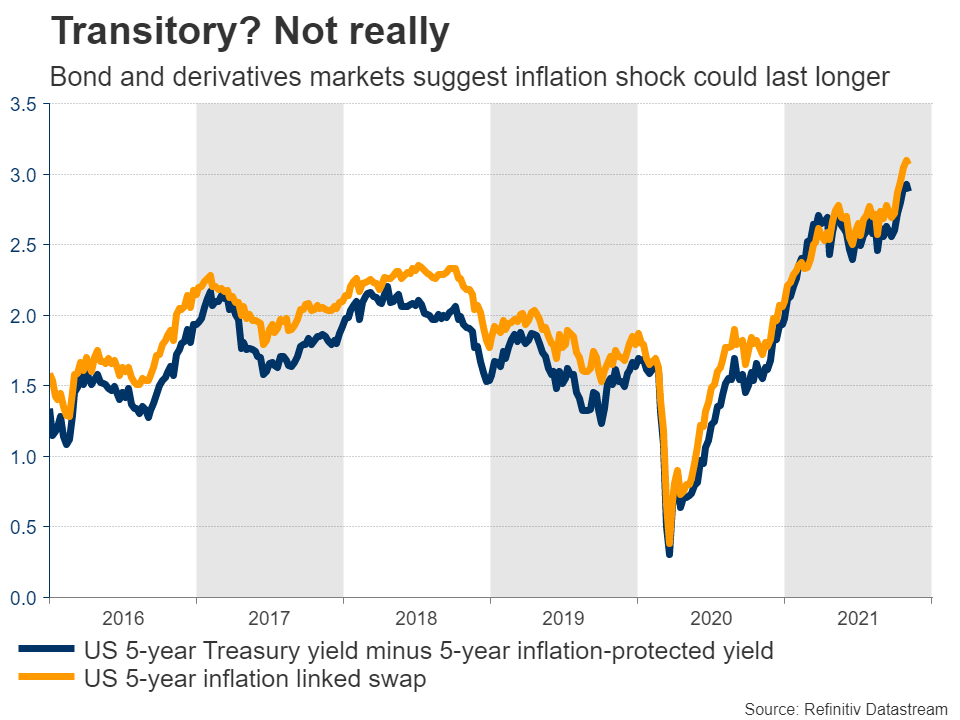
But it’s not just supply problems anymore. Wage growth is accelerating, rents have started playing catch-up with soaring house prices, and Congress is about to bring more spending to the party. This is precisely why the upcoming US inflation report on Wednesday will be so crucial. It will reveal whether inflationary pressures continue to broaden out.
Forecasts suggest the yearly CPI rate will jump to 5.9% in October, from 5.4% previously. But considering the signals from various business surveys, the risks surrounding this forecast may even be tilted to the upside. The Markit PMIs showed companies raising their selling prices ‘at the fastest rate on record’, while the price indices in both the ISM surveys jumped sharply too.
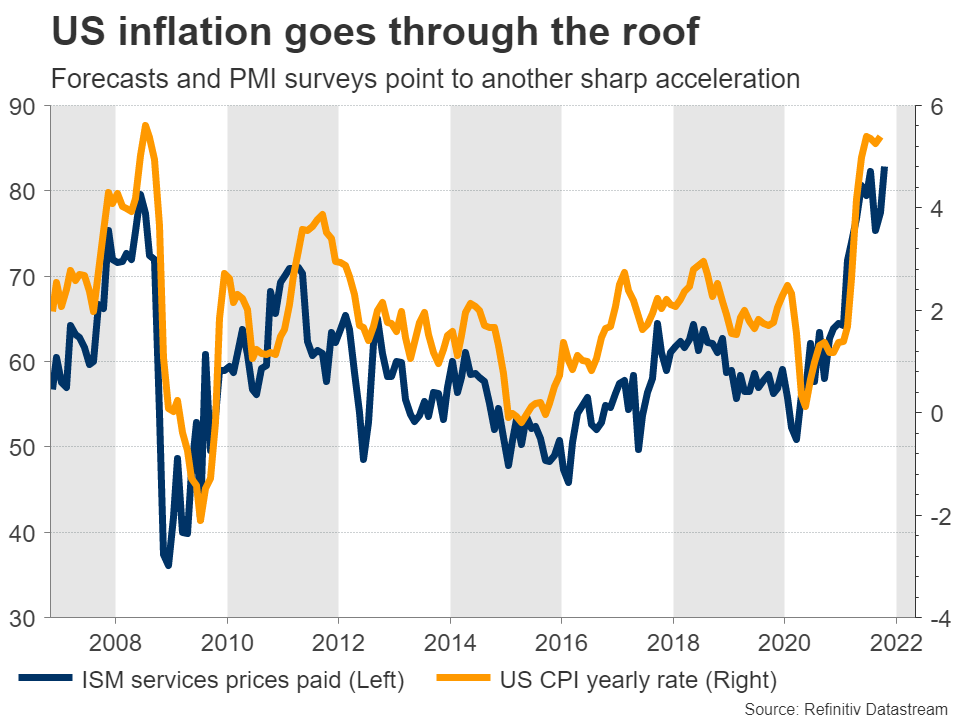
Money markets are now pricing in two Fed rate increases for next year, in September and December. Asset purchases will end in June assuming the Fed maintains the current tapering pace. The risk is that markets could bring this entire timeline forward if inflation keeps rising. Tapering could be accelerated so that it ends in May, allowing scope for three rate hikes in June/July, September, and December.
This spells upside risks for the dollar, especially against the currencies whose central banks could disappoint market expectations for aggressive rate hikes. Those are mainly the Australian dollar and British pound, although the euro falls in this category too. None of these economies are firing on all cylinders, so the current market pricing for three rate increases by the Reserve Bank of Australia next year and almost four hikes from the Bank of England seems unrealistic.
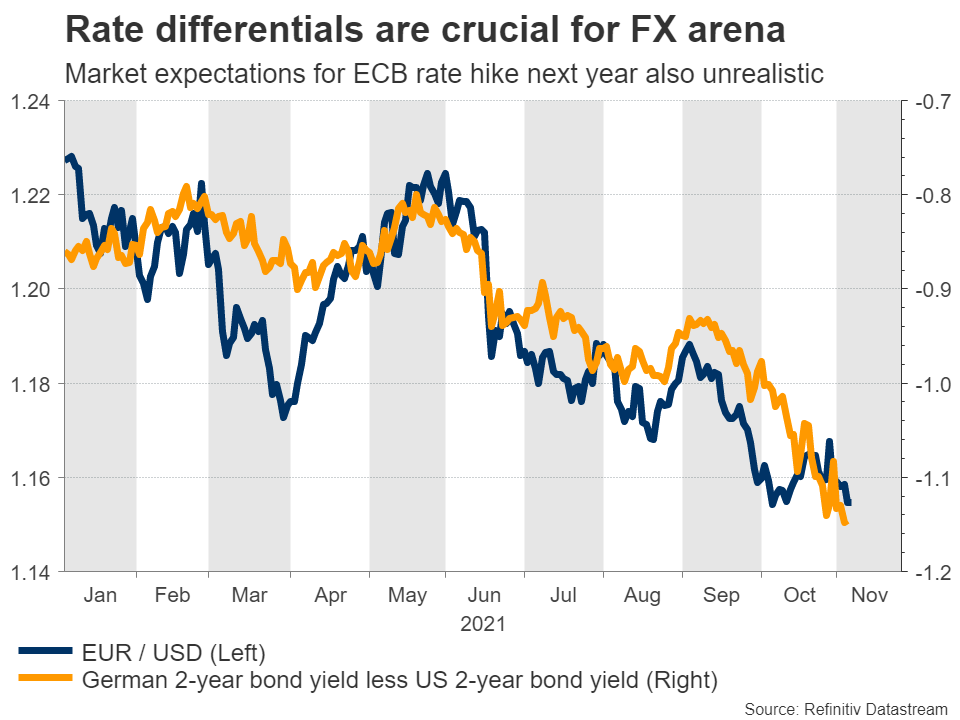
In contrast, the two central banks that could match or exceed the Fed in raising rates are the Bank of Canada and the Reserve Bank of New Zealand. The Canadian economy in particular is absolutely booming, so pairs like aussie/loonie or pound/loonie seem vulnerable moving forward - assuming oil prices hold up.
Australian jobs report eyed
Speaking of Australia, the central bank did its best to push back against market pricing this week. Governor Lowe made it clear that rates won’t rise until 2023 at the earliest and that investors overreacted to the latest spike in inflation. But even after all that, markets continue to expect three hikes for next year.
Now to be clear, the Australian economy is not that strong. Sure, it remained resilient during the latest lockdown, but the labor market and consumption still took some damage. Meanwhile, iron ore prices are dropping like a rock and China is slowing down, which is a massive risk for the Australian economy that relies on China to absorb its exports.
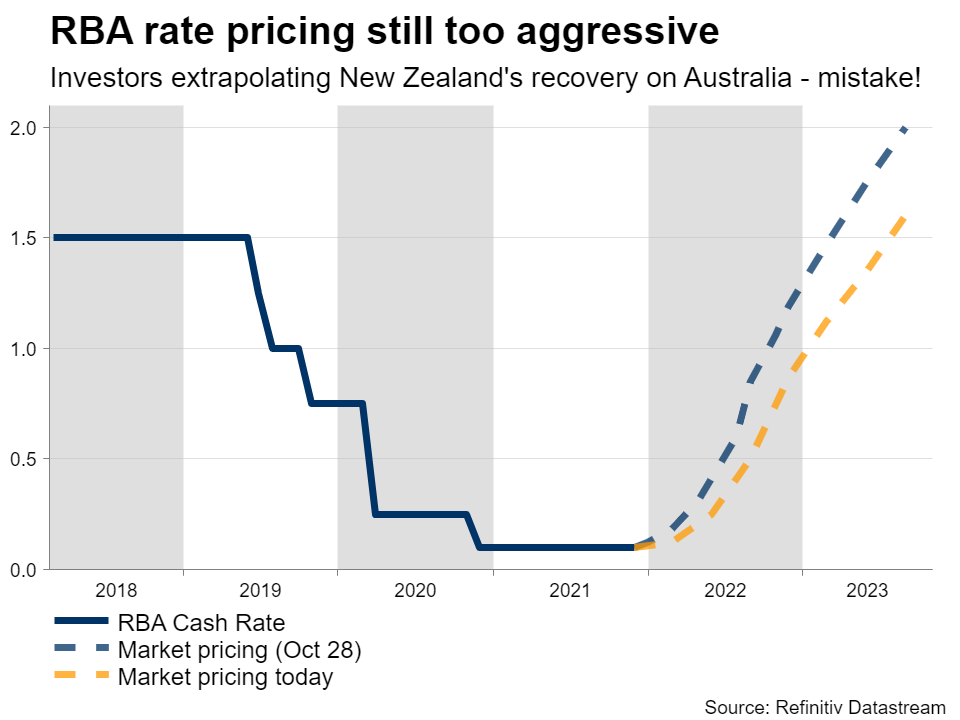
It seems investors are using New Zealand’s powerful recovery as the model for how Australia will perform going forward. The two economies share similar characteristics and usually move in lockstep. This time though, it could be a mistake.
We will get some more clues on Thursday, when Australia’s jobs data for October are released. It will probably be a strong report thanks to the reopening of the economy, but is that enough to justify three rate hikes for next year? There’s plenty of scope for disappointment when markets are so hawkish.
Chinese and British data on the radar
The other events that could impact the Australian dollar and riskier assets like stocks are China’s upcoming trade numbers over the weekend and the inflation stats on Wednesday. The focus will probably fall on producer prices, which are expected to have accelerated to 12% in October from 10.7% previously on a yearly basis.
This metric will be crucial in settling the raging inflation debate. If Chinese factories keep exporting inflation abroad at an accelerating pace, it’s another factor arguing for persistent inflationary pressures.
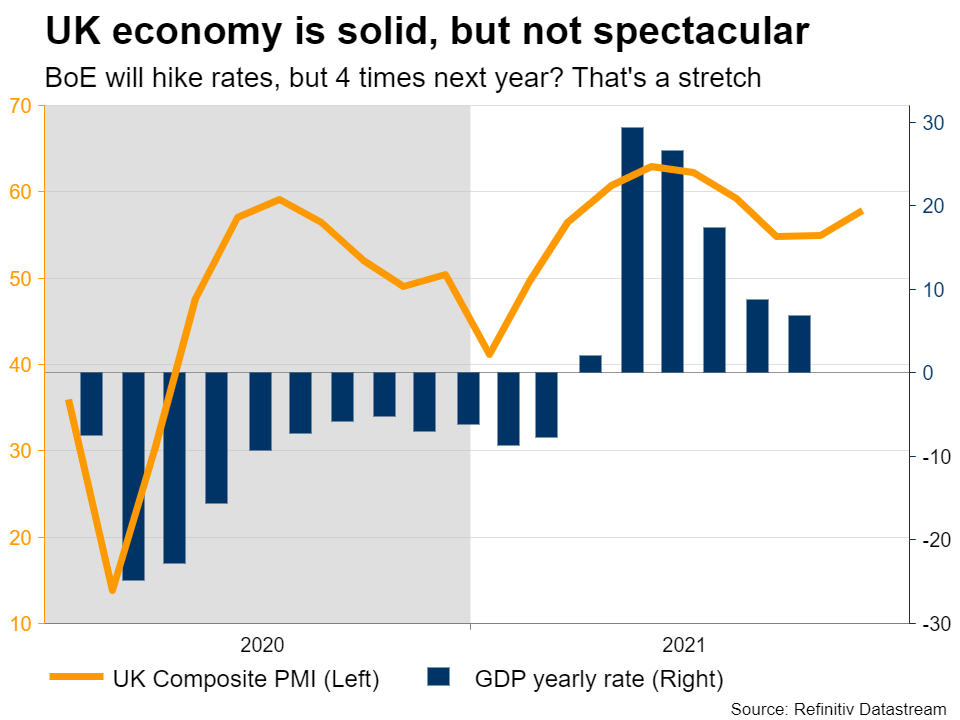
And finally in the United Kingdom, the GDP stats for September and the entire third quarter will hit the markets on Thursday. The Bank of England took markets by storm this week after it held its fire on raising interest rates, sinking the pound. That said, investors remain confident this was only a delay, pricing in aggressive rate hikes over the next year.
As such, the risks surrounding the pound remain tilted to the downside. The UK economy is not overheating to the point where it needs dramatically higher rates. The BoE simply wants to keep inflation expectations in check, something it can achieve with far less tightening than what’s currently priced in.
US 30 Index Breaches 176.4% Fibo on Upbeat NFP Payroll
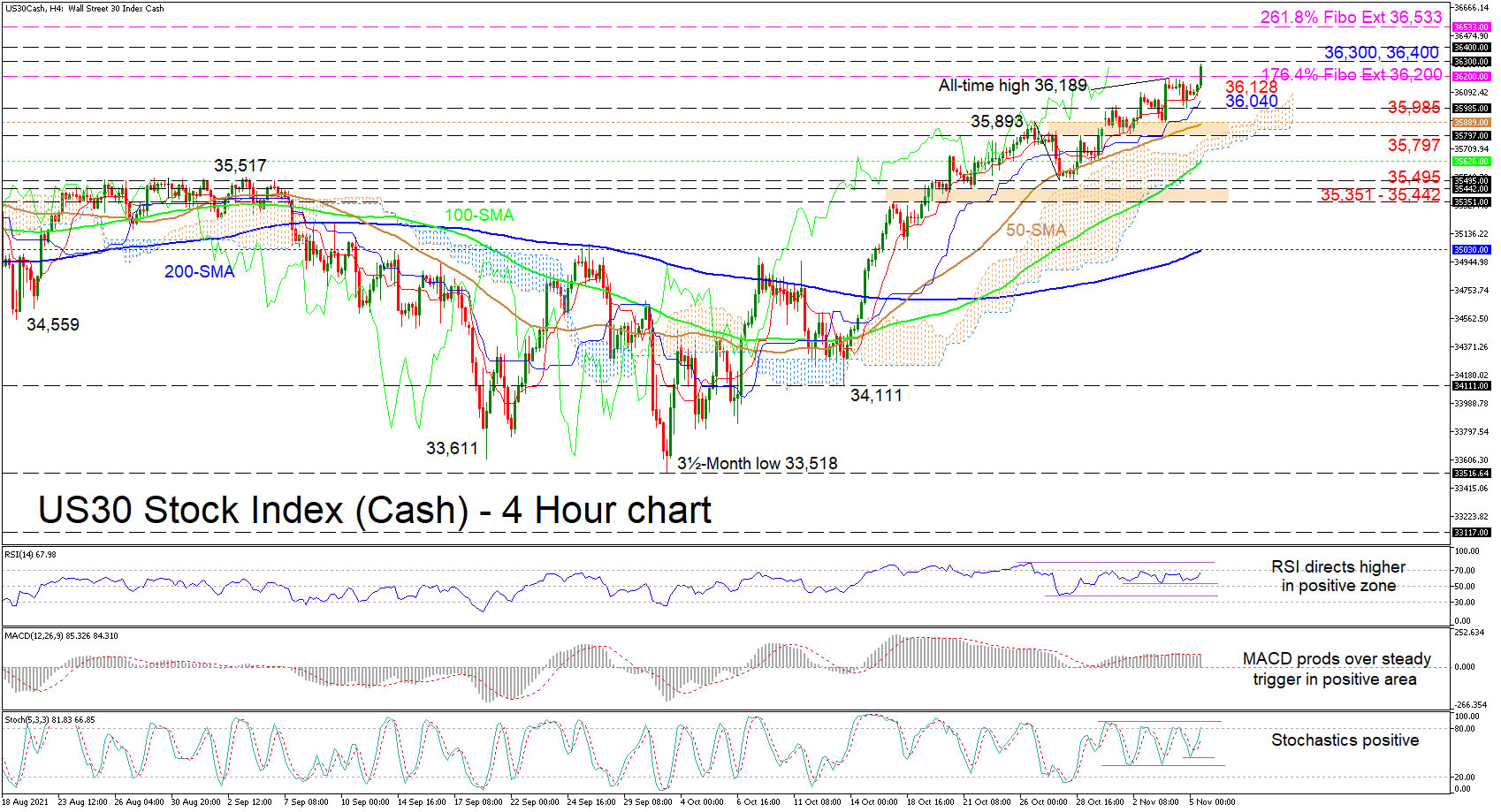
The US 30 stock index (Cash) has pushed past the 36,200 level, that being the 176.4% Fibonacci extension of the down leg of 35,893 until 35,495, which had capped recent advances, keeping the all-time high at 36,189. The index has now regained buoyancy after a minor pullback and is now heading for the resistance of 36,300. The advancing simple moving averages (SMAs) are endorsing the uptrend in the index.
Moreover, the bullish Ichimoku lines are confirming that positive forces are bolstering, while the short-term oscillators are looking skewed to the upside. The MACD, in the positive region, has nudged over its red trigger line, while the RSI is rising towards the 70 level. The positively charged stochastic oscillator is also promoting bullish moves in the pair.
If buyers stay in charge, preliminary resistance could transpire from the 36,300 and 36,400 respective barriers. Overstepping these obstacles, the bulls may then pilot the price to challenge the 261.8% Fibo extension of 35,533.
However, if upside momentum starts to wane, the price of the index could encounter some support from the Ichimoku lines at 36,128 and 36,040 prior to the 35,945 nearby low. Losing some more ground, the price may then meet a support zone from the 50-period SMA at 35,889 until the 35,797 obstacle, which overlaps with the Ichimoku cloud. From here, a deeper retracement could find footing on the approaching 100-period SMA at 35,626, otherwise the price may dive to test the 35,495 trough and the adjacent support border of 35,351-35,442.
Summarizing, the US 30 index is pushing into uncharted waters again and should remain bullish if the price persists above the SMAs and the trough at 35,495. That said, a price dip below the 35,985 low could signal that sellers are fighting back.
US: Hiring Picked Up the Pace in October
Hiring picked up in October, with payrolls gaining 531k jobs. That came on top of a large upward revision to September's tally, which is now a solid 312k gain. In total, hiring in August and September was revised up by 235k jobs. Nonfarm employment remains 4.2 million jobs, or 2.8%, below its pre-pandemic level.
The unemployment rate fell 0.2 percentage points to 4.6%, a tick lower than market expectations. Household survey employment, which is typically more volatile on a month-to-month basis than payrolls, rose 359k jobs, while the labor force participation rate was unchanged at 61.6%.
Job gains were broad based across the private sector, led by leisure and hospitality (+164k), professional and business services (+100k), manufacturing (+60k) and transportation and warehousing (+54k). Leisure and hospitality remains the hardest hit sector, with employment still 8.2% below pre-pandemic levels and accounting for one third of the total nonfarm job deficit. In contrast, employment in transportation and warehousing is 149k above its pre-pandemic level, supported by gains in warehousing and storage and couriers and messengers.
Elsewhere job gains were also seen in construction (+44k), health care (+37k), retail trade (+35k) other services (+33k), finance (+21k) and wholesale trade (+14k).
Once again, education jobs fell at the local (-43k) and state (-22k) level, as pandemic related staffing fluctuations have distorted the normal seasonal patterns.
Average hourly earnings were up 4.9% from a year ago in October, as a healthy demand for workers is driving wages higher across sectors.
Key Implications
Well that is more like it. The U.S. job market shook off its malaise in October as the impacts from Delta fade. Job gains were widespread and the unemployment rate continued to tick down.
The persistent gray cloud over the labor market recovery has been the slow improvement in labor force participation, and there was no progress on that front in October despite more kids in real school and the end of pandemic unemployment supports. We still expect participation to improve going forward as higher wages help to lure more people back to the job market.
Canada: Employment Continues to Climb in October
The Canadian labour market added 31k positions in October, slightly below the median consensus call for a gain of 42k jobs. This took employment 0.2% above its pre-pandemic (February 2020) level. Full-time (+36k) employment advanced, while part-time (-5k) employment dropped in October.
The labour force declined in October, decreasing by 25k. As a result of this and the increase in employment, the unemployment rate fell 0.2 ppts to 6.7% in October.
By industry, the services sector (+38k) saw all of the increase in employment. Within the sector, there were strong gains in retail trade (+72k), other services (+21k), and information, culture and recreation (+15k). This was partly offset by losses in accommodation and food services (-27k), business building and other support services (-23k) and professional, scientific and technical services (-22k).
Goods producing employment edged lower in October (-6.2k). Employment saw almost zero growth in the construction industry (+4k) as building activity continued to cool. Meanwhile, the manufacturing sector saw an 8k decline in employment.
By province, employment rose notably in Ontario (+37k) and New Brunswick (+3k), while there were decreases in Saskatchewan (-7k) and Manitoba (-3k).
Lastly, total hours worked were up 1.0% in October, which left hours 0.6% below its pre-pandemic level.
Key Implications
The Canadian labour market continued to climb in October, albeit at a slower pace than what we saw in September. Robust demand conditions fueled strong hiring activity during the month, especially in industries that benefitted from less stringent public health restrictions such as retail trade, and information, culture and recreation services. Surprisingly, employment in accommodation and food services declined for the second straight month despite having an elevated number of vacancies. It appears renewed restrictions in Alberta was partly responsible for the decline.
Looking ahead, with COVID cases on the decline, and some provinces continuing to ease restrictions (i.e. Ontario), employment should continue to advance, driven by industries with strong labour demand. That said, supply shortages that are hindering production in goods-producing industries, could hinder hiring activity in this area of the economy.
Canada's labour market picture is likely to be impacted by the expiry of fiscal support programs. The Canada Recovery Benefit as well as wage and rent subsidies for businesses ended on October 23. We will be watching the November employment report closely for evidence of how this may have impacted labor force engagement.
USD/JPY Mid-Day Outlook
Daily Pivots: (S1) 113.42; (P) 113.85; (R1) 114.19; More...
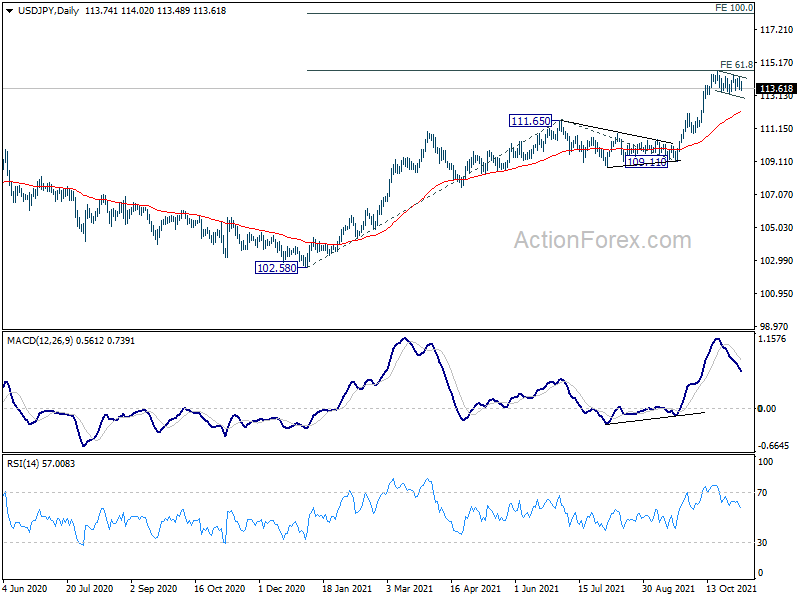
Intraday bias in USD/JPY stays neutral first. On the upside, firm break of 114.69 will resume the larger up trend to 100% projection of 102.58 to 111.65 from 109.11 at 118.18 next. Break of 113.24 will bring deeper pull back, but downside should be contained above 112.07 resistance turned support to bring rebound.
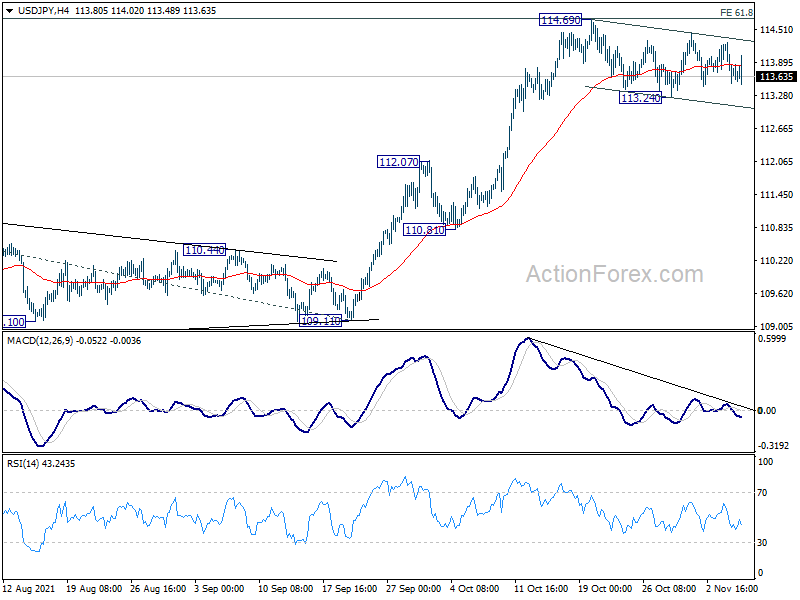
In the bigger picture, corrective decline from 118.65 (2016 high) should have completed at 101.18 already. Rise from the 102.58 is seen as the third leg of the up trend from 101.18. Next target is 114.54 resistance and then 118.65 high. This will now be the preferred case as long as 109.11 support hold, even in case of deep pull back.
USD/CHF Mid-Day Outlook
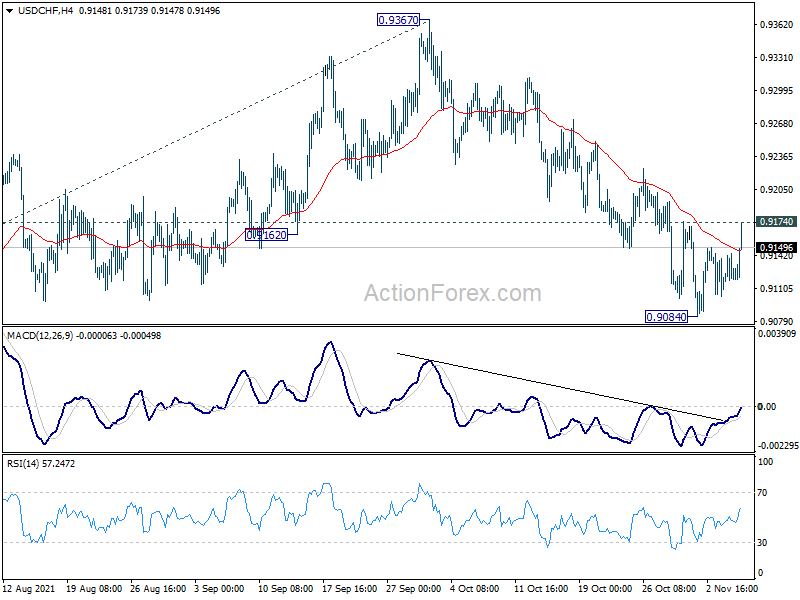
Daily Pivots: (S1) 0.9110; (P) 0.9127; (R1) 0.9143; More....
Intraday bias stays neutral for the moment. Further fall is expected with 0.9174 resistance intact. Break of 0.9084 will resume the fall from 0.9367 to 0.9017 support first and then 0.8925. On the upside, however, break of 0.9174 resistance will indicate short term bottoming and turn bias back to the upside for stronger rebound instead.
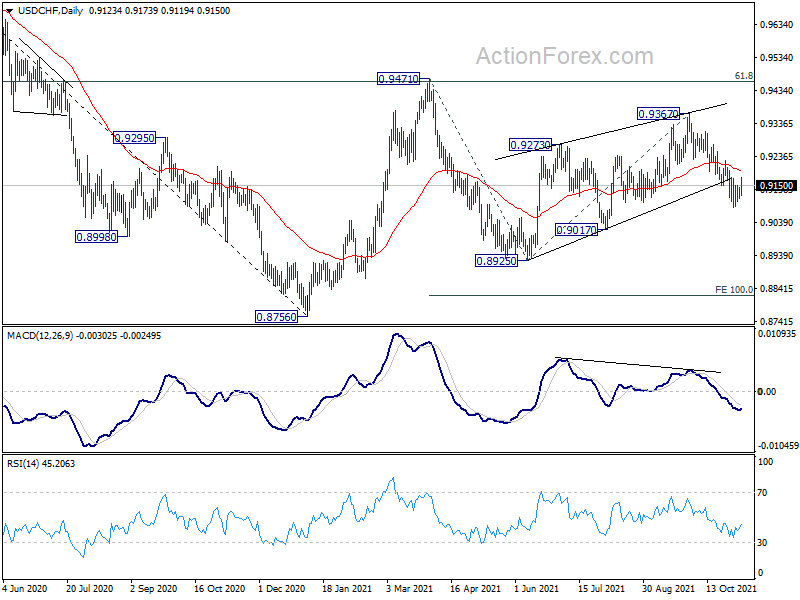
In the bigger picture, the corrective structure of the rebound from 0.8925 argues that fall from 0.9471 is not complete yet. It could either be the second leg of pattern from 0.8756 (2021 low), or resuming larger down trend from 1.0237 (2018 high). We'd pay attention to the downside momentum and assess the odds later. But for now, medium term outlook will be neutral at best as long as 0.9471 resistance holds.
GBP/USD Mid-Day Outlook
Daily Pivots: (S1) 1.3414; (P) 1.3556; (R1) 1.3641; More...
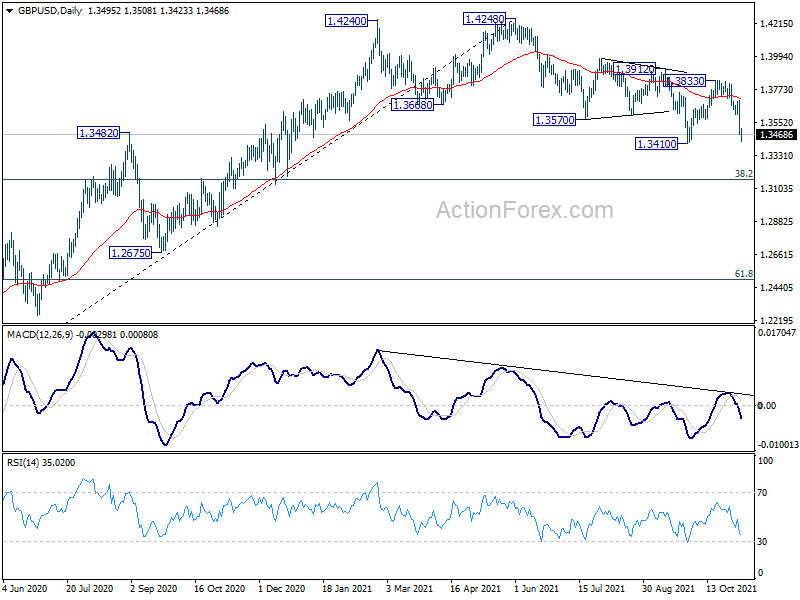
No change in GBP/USD's outlook and intraday bias stays on the downside for retesting 1.3410 low first. Firm break there will resume larger fall from 1.4280 to 1.3164 medium term fibonacci level. On the upside, above 1.3604 minor resistance will mix up the near term outlook and turn intraday bias neutral first.
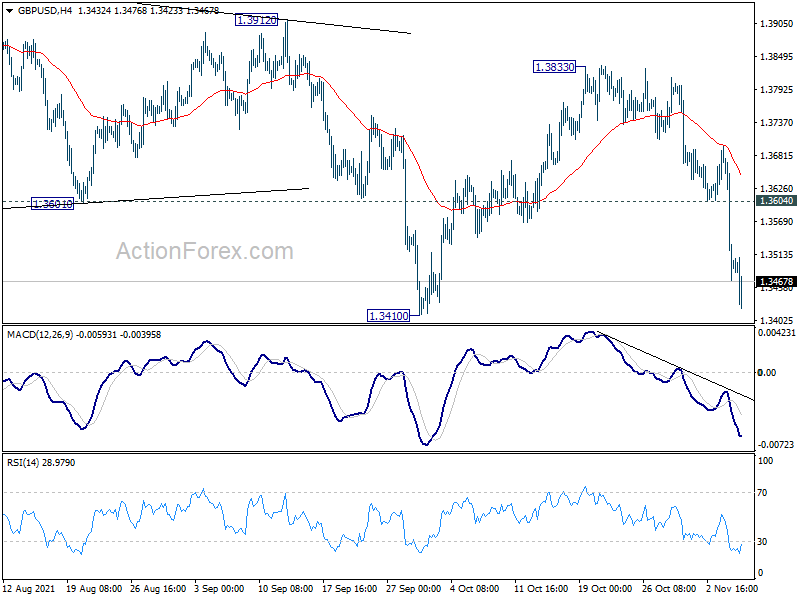
In the bigger picture, the structure of the fall from 1.4248 suggests that it's a correction to the up trend from 1.1409 (2020 low) only. While deeper fall cannot be ruled out yet, downside should be contained by 38.2% retracement of 1.1409 to 1.4248 at 1.3164, at least on first attempt, to bring rebound. On the upside, firm break of 1.4376 key resistance (2018 high) will add to the case of long term bullish reversal. However, sustained trading below 1.3164 will revive some medium term bearishness and target 61.8% retracement at 1.2493.
EUR/USD Mid-Day Outlook
Daily Pivots: (S1) 1.1517; (P) 1.1567; (R1) 1.1605; More...
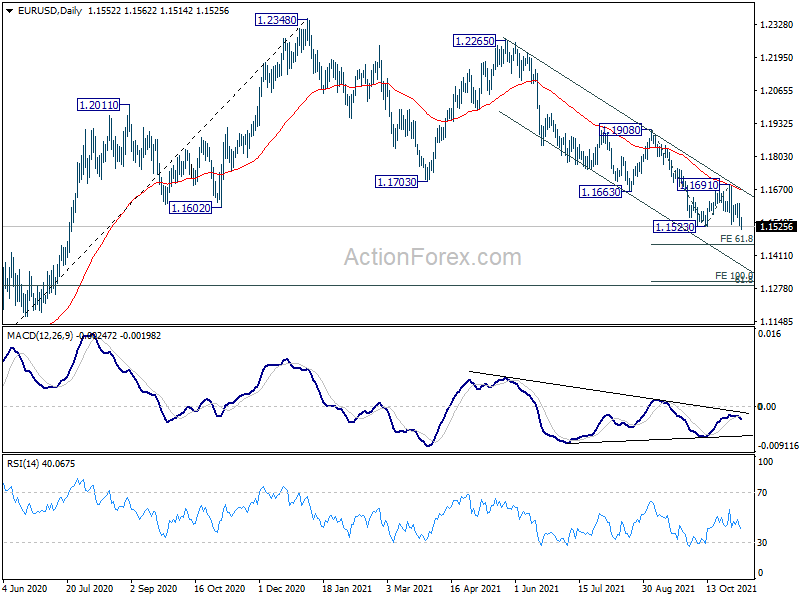
EUR/USD's break of 1.1523 suggests resumption of fall from 1.2265, and that from 1.2348 too. Intraday bias is back on the downside for 61.8% projection of 1.1908 to 1.1523 from 1.1691 at 1.1453. Break will pave the way to 100% projection at 1.1306. On the upside, though, above 1.1615 minor resistance will delay the bearish case and turn bias neutral first.
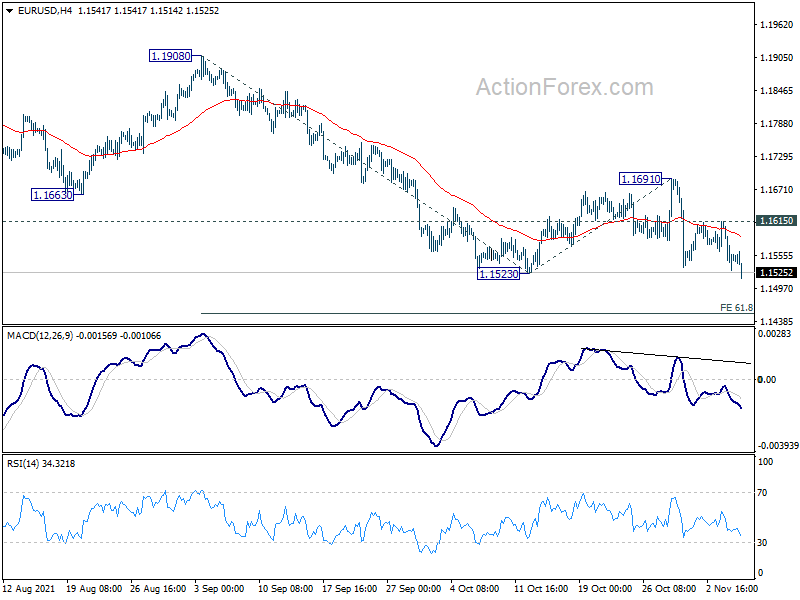
In the bigger picture, price actions from 1.2348 should at least be a correction to rise from 1.0635 (2020 low). As long as 1.1908 resistance holds, deeper fall would be seen to 61.8% retracement of 1.0635 to 1.2348 at 1.1289. Nevertheless break of 1.1908 resistance will revive medium term bullishness and turn focus back to 1.2348 high.