Sample Category Title
USD/CHF Daily Outlook
Daily Pivots: (S1) 0.9110; (P) 0.9127; (R1) 0.9143; More....
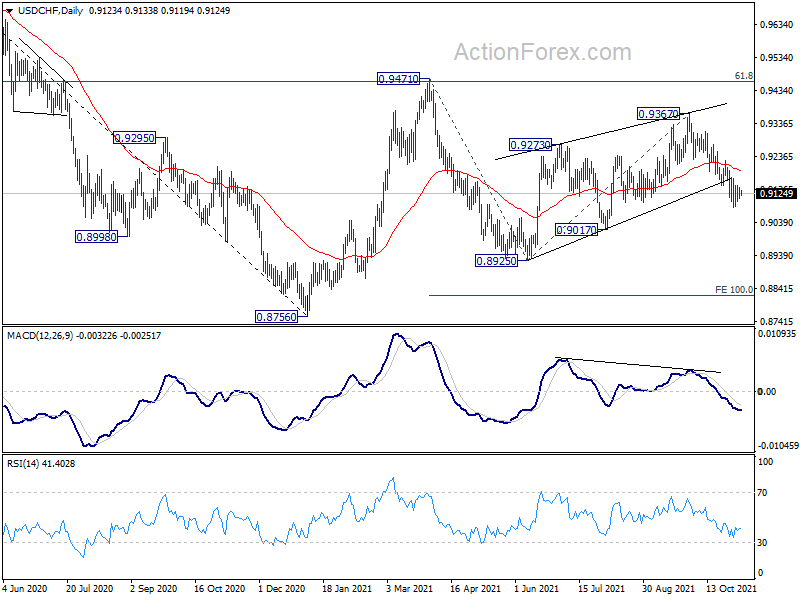
Intraday bias in USD/CHF is neutral for consolidation above 0.9084 temporary low. Further fall is expected with 0.9174 resistance intact. Break of 0.9084 will resume the fall from 0.9367 to 0.9017 support first and then 0.8925. On the upside, however, break of 0.9174 resistance will indicate short term bottoming and turn bias back to the upside for stronger rebound instead.
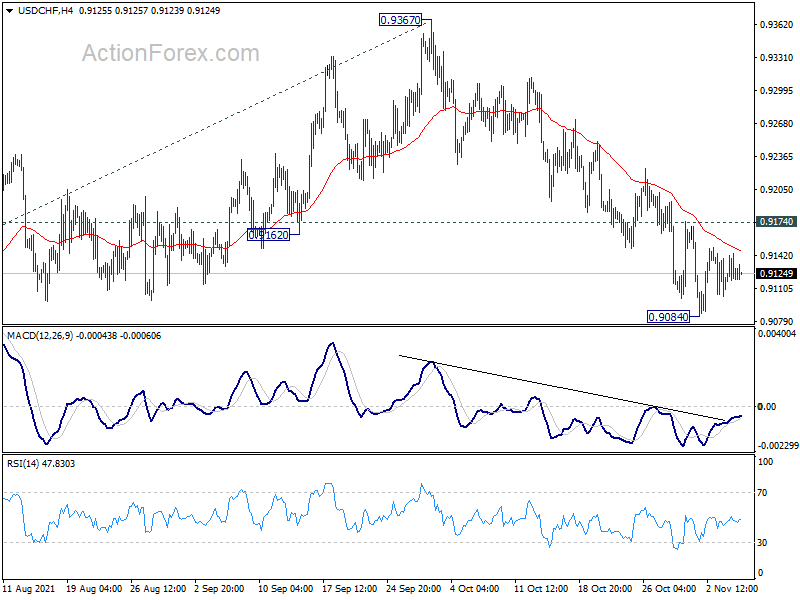
In the bigger picture, the corrective structure of the rebound from 0.8925 argues that fall from 0.9471 is not complete yet. It could either be the second leg of pattern from 0.8756 (2021 low), or resuming larger down trend from 1.0237 (2018 high). We'd pay attention to the downside momentum and assess the odds later. But for now, medium term outlook will be neutral at best as long as 0.9471 resistance holds.
Asian Indices Trade Mixed Ahead Of US Jobs Report
General trend
- South Korea bond yields drop ahead of later today bond repurchase operation.
- Japanese cos. due to report earnings include Honda, JFE Holdings, Kobe Steel, Asics, Inpex, Olympus.
- Companies due to report earnings during the NY morning include American Axle, DraftKings, Elanco Animal Health, Fluor Corp, Canada Goose, Goodyear, Johnson Controls, Magna International, Revlon, Tenneco.
- China Oct Trade Balance due on Nov 7th (Sunday, Shanghai time).
Headlines/Economic data
Australia/New Zealand
- ASX opened flat.
- (AU) Reserve Bank of Australia (RBA) Statement on Monetary Policy (SOMP): Committed to keeping highly supportive monetary conditions; Forecasts for cash rate broadly in line with recent market pricing.
- (AU) Australia sells A$1.0B v A$1.0B indicated in 3.25% Apr 2025 bonds, avg yield 1.0468%, bid to cover 3.25x.
Japan
- Nikkei 225 opened +0.2%.
- Softbank [9984.JP]: Said to be under pressure from investors to 'prop up' share price with a share buyback [Q2 earnings are due on Mon, Nov 8th] - FT.
- (JP) Japan expected to issue ¥100K (~$879) cash handout to people under the age of 18 - Japanese press.
- (JP) Japan Govt said to be including SPACs in its 'new capitalism' plan.
- (JP) Japan Sept Household Spending M/M: +5.0% v +2.8%e; Y/Y: -1.9% v -3.5%e.
- (JP) Japan Fin Min Suzuki: Kishida told us to look for tax breaks to pay for hikes; Will firmly pursue FY25 primary balance goal (in line).
- (JP) Japan Econ Min Yamagiwa: Declines to comment on size or content of stimulus package.
Korea
- Kospi opened +0.7%.
- (KR) South Korea Sept Current Account (BOP): $10.0B v $7.5B prior (17th consecutive surplus); Balance of Goods (BOP): $9.5B v $5.6B prior.
- (KR) South Korea Vice Fin Min: To repurchase KRW2.0T in 5-10 year bonds on Nov 5th; Will preemptively act to stabilize local bond markets [comments from Nov 4th].
China/Hong Kong
- Shanghai Opened -0.2%; Hang Seng opened -1.1%.
- (CN) China PBOC sets Yuan reference rate: 6.3980 v 6.3943 prior.
- (CN) China PBOC Open Market Operation (OMO): Injects CNY100B in 7-day reverse repos v CNY50B prior; Net Drain CNY100B v Net drain CNY150B prior.
- (CN) China State Planner (NDRC): Coal Inventory at power plants are at a normal level again.
- (CN) PBOC expected to keep market liquidity ample - China Press.
- (CN) China has told certain smaller banks to limit wealth products - Chinese press.
- (CN) Follow Up: China MOF issues mandate related to planned issuance of EUR denominated bonds.
- (CN) China Tax Bureau: 9M Tax and Fee reductions amounts at CNY910.1B.
- Kaisa Group [1638.HK]: Company and units Halted after Wealth Management Product misses payments.
- (CN) China Press: PBOC Vice Gov Chen: has urged China to prevent systemic financial risks when further opening up the sector.
- Shanghai Shimao [600823.CN]: CNY bonds due 2022 halted after price decline.
North America
- (US) Initial Jobless Claims: 269K V 275KE (new post-pandemic low); CONTINUING CLAIMS: 2.11M V 2.15ME.
- (US) Weekly EIA Natural Gas Inventories: +63 BCF VS. +64 BCF TO +68 BCF Indicated range.
- (AR) Argentina Central Bank tells financial firms not to raise US dollar reserves, congressional elections are due to occur on Nov 14th (Sun) - financial press.
- (US) Senate proposed bill aimed at cutting US Dependence on foreign pharmaceuticals - Press.
- (US) White House has asked senators to meet with Fed Chair Powell - Axios.
- (US) House Democrats propose increasing SALT deduction cap to $80K (up from $10K).
- (US) House said to not hold any votes on Economic spending packages today, will vote tomorrow (Nov 5) - Press.
Europe
- (UK) BOE Gov Bailey: Not our job to steer markets on rates, I am not surprised to see correction in markets; Market rate pricing was puzzling, pricing for rate hikes was overdone - Media interview.
- (EU) ECB’s Schnabel (Germany): We take people's concerns over high inflation very seriously; Conditions for a rate hike are unlikely to be met next year.
- OPEC+ JMMC reportedly supports no change to OPEC policy - Energy Intel's Bakr.
Other
- (ID) Indonesia Q3 GDP Q/Q: 1.6% v 1.9%e; Y/Y: 3.5% v 3.9%e.
- (PH) Philippines Oct CPI Y/Y: 4.6% v 4.9%e.
- (SG) Singapore Sept Retail Sales M/M: 6.0% v 0.9%e; Y/Y: 6.6% v 2.0%e.
Levels as of 01:20 ET
- Nikkei 225, -0.6%, ASX 200 +0.4% , Hang Seng -1%; Shanghai Composite -0.4%; Kospi -0.7%.
- Equity S&P500 Futures: flat; Nasdaq100 +0.1%, Dax flat; FTSE100 -0.1%.
- EUR 1.1557-1.1541 ; JPY 113.86-113.55 ; AUD 0.7410-0.7378 ;NZD 0.7110-0.7080.
- Gold flat at $1,796/oz; Crude Oil +0.9% at $79.50/brl; Copper -0.1% at $4.3165/lb.
USD/JPY Daily Outlook
Daily Pivots: (S1) 113.42; (P) 113.85; (R1) 114.19; More...
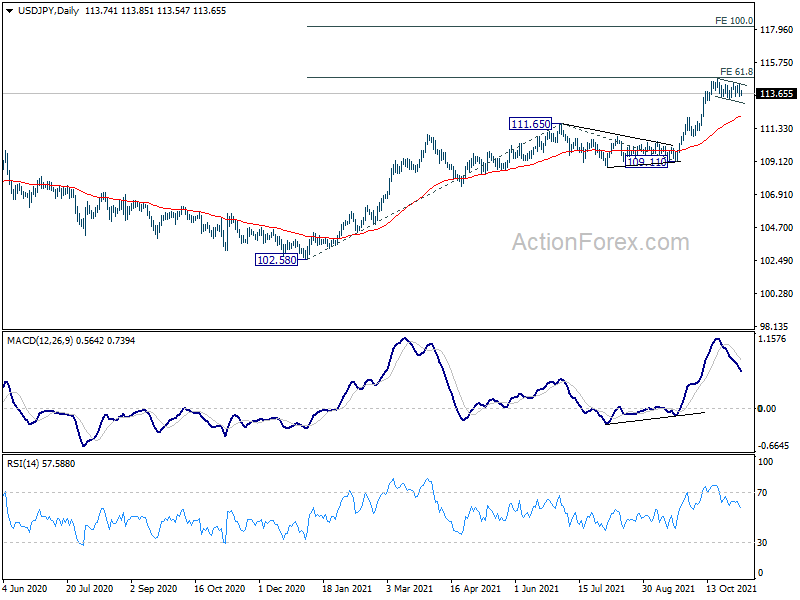
Intraday bias in USD/JPY remains neutral and consolidation from 114.69 could continue. On the upside, firm break of 114.69 will resume the larger up trend to 100% projection of 102.58 to 111.65 from 109.11 at 118.18 next. Break of 113.24 will bring deeper pull back, but downside should be contained above 112.07 resistance turned support to bring rebound.
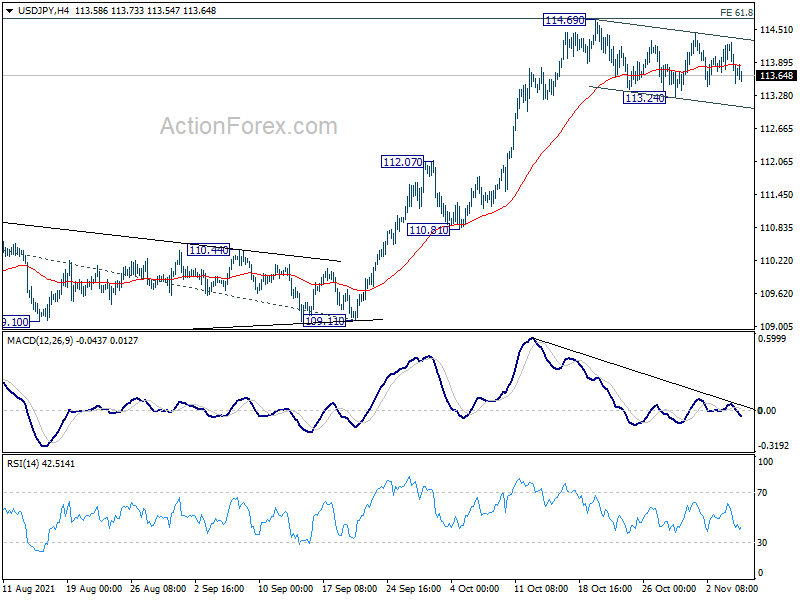
In the bigger picture, corrective decline from 118.65 (2016 high) should have completed at 101.18 already. Rise from the 102.58 is seen as the third leg of the up trend from 101.18. Next target is 114.54 resistance and then 118.65 high. This will now be the preferred case as long as 109.11 support hold, even in case of deep pull back.
Yen and Franc Strong on Falling Global Yields, Dollar Looks into NFP
Yen and Swiss Franc are currently the strongest ones for the week and remain generally firm. Falling global benchmark treasury yields seem to be supporting both "safe-haven" currencies. Germany 10-year bund yield is back below -0.22, UK 10-year gilt yield is below 0.95 while Japan 10-year JGB yield is back at 0.07. Aussie is worst performing one for the week, followed by Sterling, as selloff continued after their respective central bank meeting. Dollar is firm but needs guidance from non-farm payroll report for taking up a more committed direction.
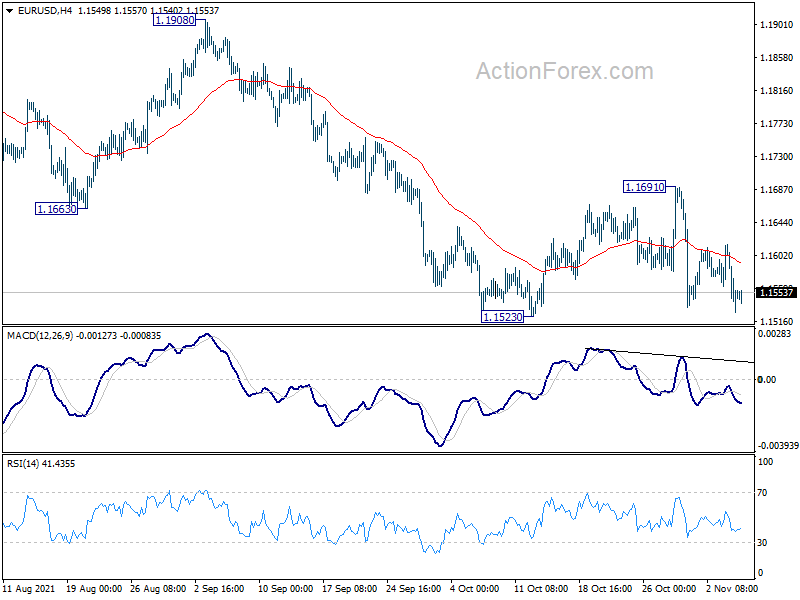
Technically, we'd pay special attention to EUR/USD and USD/JPY today. EUR/USD is now stuck in range of 1.1523/1691. USD/JPY is also bounded inside 113.24/114.69. For now, upside breakout in Dollar is in favor in both pairs. But we'll have to see if NFP supports that.
In Asia, at the time of writing, Nikkei is down -0.70%. Hong Kong HSI is down -0.99%. China Shanghai SSE is down -0.32%. Singapore Strait Times is up 0.56%. Japan 10-year JGB yield is down -0.012 at 0.070. Overnight, DOW dropped -0.09%. S&P 500 rose 0.42%. NASDAQ rose 0.81%. 10-year yield dropped -0.0055 to 1.524.
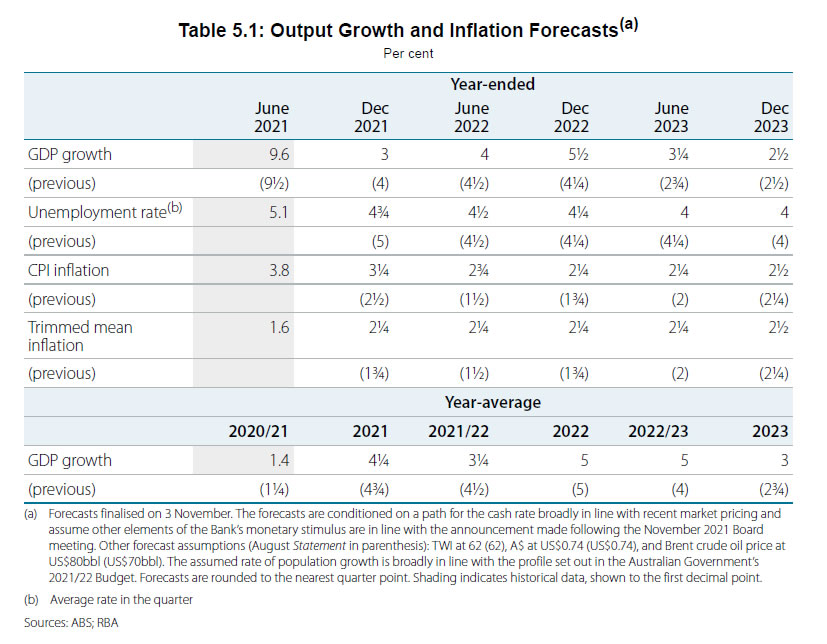
RBA SoMP: Inflation forecasts upgraded across horizon
As seen in RBA's Statement on Monetary Policy, 2021 year-average GDP growth forecasts was downgraded from 4.75% to 4.25%. 2022 GDP year-average GDP growth forecast was left unchanged at 5%. 2023 year-average growth forecast was upgraded from 2.75% to 3%.
Headline CPI inflation forecasts were raised across the horizon, with 2021 year-end increased from 2.5% to 3.25%, 2022 year-end increased from 1.75% to 2.25%, 2023 year-end increased from 2.25% to 2.5%. Trimmed mean inflation forecasts were also raised, with 2021 year-end increased from 1.75% to 2.25%, 2022 year-end from 1.75% to 2.25%, 2023 year-end from 2.25% to 2.5%.
2021 year-end unemployment rate forecast was lowered from 5% to 4.75%. 2022 year-end and 2023 year-end unemployment rate forecast was left unchanged at 4.25% and 4% respectively.
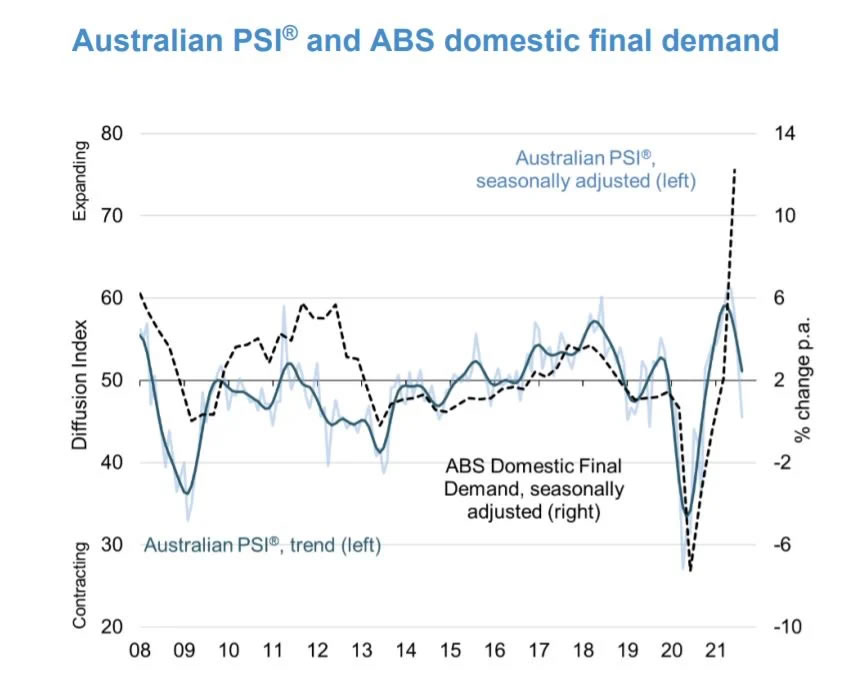
Australia AiG services rose to 47.6 in Oct, third month in contraction
Australia AiG Performance of Services rose 1.9 pts to 47.6 in October, marking a third month in contraction. Sales rose 13.8 to 55.2. Employment rose 4.8 to 56.8. New orders dropped -1.0 to 38.8. supplier deliveries dropped -7.5 to 39.5. Finished stocks dropped -13.7 to 39.8. Capacity utilization dropped -1.7 to 74.5. Input prices rose 9.1 to 73.6. Selling prices rose 7.8 to 61.7. Average wages rose 9.1 to 68.3.
Ai Group Chief Executive, Innes Willox, said: "The Australian services sector reported mixed fortunes in October... Across the services sector, sales and employment were higher in October while new orders were discouragingly low. A more robust recovery was inhibited by lingering activity restrictions, barriers to interstate movement and the same disruptions to the supply of inputs that are being felt in other parts of the economy... Services companies reported further strong rises in input prices and wages with selling prices also rising although not by enough to prevent additional pressure on margins."
Dollar index awaits NFP to guide range breakout
US non-farm payroll employment is again a major focus. Markets are expecting 425k job growth in October. Unemployment rate is expected to tick down by 0.1% to 4.7%. Average hourly earnings are expected to grow 0.4% mom.
Looking at related data, ISM manufacturing employment rose from 50.2 to 52.0. But ISM services employment dropped from 53.0 to 51.6. ADP private jobs grew 571k, rose slightly from prior month's 523k. Four-week moving average of initial jobless claims continued to trend down, notably, from 344k to 285k.
All in all, today's NFP will likely be a solid one, affirming Fed's tapering plan. The main question ahead is whether wage growth would continue in a strong trend, the pushes up inflation, and force Fed for an earlier hike. Strong wage growth could push Dollar index out of the near term range.
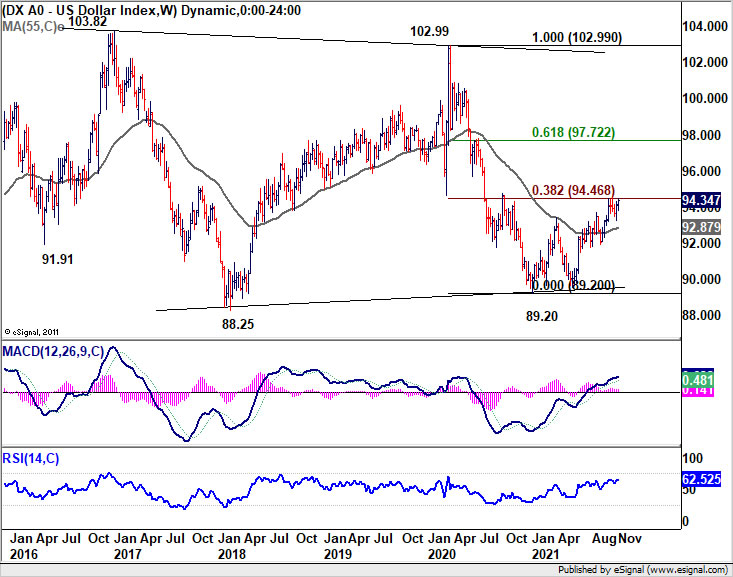
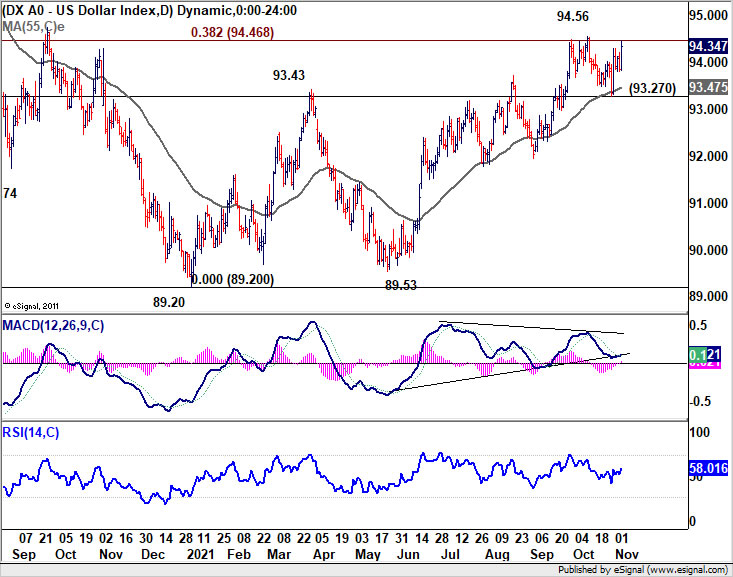
Dollar index is sitting in range below 94.56 short term top. The support from 55 day EMA is a bullish sign. Yet, it will have to break through key long term fibonacci resistance at 94.46 (38.2% retracement of 102.99 to 89.20) decisively to confirm medium term bullishness. In the case, we'd probably seen upside acceleration ahead to 61.8% retracement at 97.72. However, break of 93.27 support will suggest rejection by 94.46, and turn near term outlook bearish for deeper pull back.
Elsewhere
Japan overall household spending dropped -1.9% yoy in September, versus expectation of -3.9% yoy.
Germany industrial production, France industrial output, Italy retail sales, Eurozone retail sales and Swiss foreign currency reserves will be released in European session.
Later in the day, US will release non-farm payrolls and Canada will also release job data and Ivey PMI.
USD/JPY Daily Outlook
Daily Pivots: (S1) 113.42; (P) 113.85; (R1) 114.19; More...
Intraday bias in USD/JPY remains neutral and consolidation from 114.69 could continue. On the upside, firm break of 114.69 will resume the larger up trend to 100% projection of 102.58 to 111.65 from 109.11 at 118.18 next. Break of 113.24 will bring deeper pull back, but downside should be contained above 112.07 resistance turned support to bring rebound.
In the bigger picture, corrective decline from 118.65 (2016 high) should have completed at 101.18 already. Rise from the 102.58 is seen as the third leg of the up trend from 101.18. Next target is 114.54 resistance and then 118.65 high. This will now be the preferred case as long as 109.11 support hold, even in case of deep pull back.
Economic Indicators Update
| GMT | Ccy | Events | Actual | Forecast | Previous | Revised |
|---|---|---|---|---|---|---|
| 21:30 | AUD | AiG Performance of Services Index Oct | 47.6 | 45.7 | ||
| 23:30 | JPY | Overall Household Spending Y/Y Sep | -1.90% | -3.90% | -3.00% | |
| 0:30 | AUD | RBA Monetary Policy Statement | ||||
| 7:00 | EUR | Germany Industrial Production M/M Sep | 1.10% | -4.00% | ||
| 7:45 | EUR | France Industrial Output M/M Sep | 0.40% | 1.00% | ||
| 8:00 | CHF | Foreign Currency Reserves (CHF) Oct | 939B | |||
| 9:00 | EUR | Italy Retail Sales M/M Sep | 0.70% | 0.40% | ||
| 10:00 | EUR | Eurozone Retail Sales M/M Sep | 0.20% | 0.30% | ||
| 12:30 | USD | Nonfarm Payrolls Oct | 425K | 194K | ||
| 12:30 | USD | Unemployment Rate Oct | 4.70% | 4.80% | ||
| 12:30 | USD | Average Hourly Earnings M/M Oct | 0.40% | 0.60% | ||
| 12:30 | CAD | Net Change in Employment Oct | 19.3K | 157.1K | ||
| 12:30 | CAD | Unemployment Rate Oct | 6.90% | 6.90% | ||
| 14:00 | CAD | Ivey PMI Oct | 71.2 | 70.4 |
Dollar index awaits NFP to guide range breakout
US non-farm payroll employment is again a major focus. Markets are expecting 425k job growth in October. Unemployment rate is expected to tick down by 0.1% to 4.7%. Average hourly earnings are expected to grow 0.4% mom.
Looking at related data, ISM manufacturing employment rose from 50.2 to 52.0. But ISM services employment dropped from 53.0 to 51.6. ADP private jobs grew 571k, rose slightly from prior month's 523k. Four-week moving average of initial jobless claims continued to trend down, notably, from 344k to 285k.
All in all, today's NFP will likely be a solid one, affirming Fed's tapering plan. The main question ahead is whether wage growth would continue in a strong trend, the pushes up inflation, and force Fed for an earlier hike. Strong wage growth could push Dollar index out of the near term range.
Dollar index is now sitting in range below 94.56 short term top. The support from 55 day EMA is a bullish sign. Yet, it will have to break through key long term fibonacci resistance at 94.46 (38.2% retracement of 102.99 to 89.20) decisively to confirm medium term bullishness. In the case, we'd probably seen upside acceleration ahead to 61.8% retracement at 97.72. However, break of 93.27 support will suggest rejection by 94.46, and turn near term outlook bearish for deeper pull back.
RBA SoMP: Inflation forecasts upgraded across horizon
As seen in RBA's Statement on Monetary Policy, 2021 year-average GDP growth forecasts was downgraded from 4.75% to 4.25%. 2022 GDP year-average GDP growth forecast was left unchanged at 5%. 2023 year-average growth forecast was upgraded from 2.75% to 3%.
Headline CPI inflation forecasts were raised across the horizon, with 2021 year-end increased from 2.5% to 3.25%, 2022 year-end increased from 1.75% to 2.25%, 2023 year-end increased from 2.25% to 2.5%. Trimmed mean inflation forecasts were also raised, with 2021 year-end increased from 1.75% to 2.25%, 2022 year-end from 1.75% to 2.25%, 2023 year-end from 2.25% to 2.5%.
2021 year-end unemployment rate forecast was lowered from 5% to 4.75%. 2022 year-end and 2023 year-end unemployment rate forecast was left unchanged at 4.25% and 4% respectively.
Australia AiG services rose to 47.6 in Oct, third month in contraction
Australia AiG Performance of Services rose 1.9 pts to 47.6 in October, marking a third month in contraction. Sales rose 13.8 to 55.2. Employment rose 4.8 to 56.8. New orders dropped -1.0 to 38.8. supplier deliveries dropped -7.5 to 39.5. Finished stocks dropped -13.7 to 39.8. Capacity utilization dropped -1.7 to 74.5. Input prices rose 9.1 to 73.6. Selling prices rose 7.8 to 61.7. Average wages rose 9.1 to 68.3.
Ai Group Chief Executive, Innes Willox, said: "The Australian services sector reported mixed fortunes in October... Across the services sector, sales and employment were higher in October while new orders were discouragingly low. A more robust recovery was inhibited by lingering activity restrictions, barriers to interstate movement and the same disruptions to the supply of inputs that are being felt in other parts of the economy... Services companies reported further strong rises in input prices and wages with selling prices also rising although not by enough to prevent additional pressure on margins."
GBP/JPY – Slides As BoE Disappoints
How much further will it fall?
The pound plunged on Thursday after the Bank of England left interest rates unchanged and gave the impression future hikes won’t be as aggressive as markets had anticipated.
For weeks, the pound has performed well and traders priced in one hike this year and at least a few next. But it seems they may have to reconsider and that started today.

The pound has slipped against the yen, breaking below the descending channel that it had traded within the last couple of weeks as it pared previous gains.
The acceleration of the decline is potentially a signal that this is more than a correction in a broader uptrend. The test of this will be whether it breaks key support around 152.50-153.50, where the 50 and 61.8 fib levels combine with the 55/89-day SMA band and prior resistance.
A rotation off here could be a bullish signal in the longer term, while a move below may suggest traders got carried away in the run-up to today’s meeting.
That doesn’t mean we’ll settle back in the June-early October ranges as the BoE still looks likely to raise rates at least a few times. But it may be a while before we’re scaling the highs of a few weeks ago, again.
Cliff Notes: Central Banks Remain Committed to Reactive Policy Decision Making
Key insights from the week that was.
As we anticipated, at their November meeting the RBA decided to end Yield Curve Control and remove specific date guidance on the likely timing of the first rate hike. The Bank’s revised forecasts now point to a potential first increase in the cash rate in 2023, assuming the economy performs as expected.
As detailed by Chief Economist Bill Evans, the RBA’s forecasts for growth and inflation in 2022 have been revised up; though the unemployment rate forecasts are unchanged, and the Bank remains circumspect on the prospects for wages growth, at least in 2022. Westpac are more optimistic on growth and the labour market through 2022 and consequently continue to anticipate the first RBA hike in February 2023, to be followed by additional hikes in the June and December quarters of 2023 and another two hikes in 2024 to 1.25%. Note, the RBA’s November Statement on Monetary Policy has just been released, providing full detail on the RBA’s updated forecasts and their view of the risks to the outlook. Westpac Economics’ coverage of the SoMP will be contained in our Weekly this afternoon, available on Westpac IQ.
Following a strong Q3 labour force survey, our New Zealand economics team now forecast a much more aggressive policy response by the RBNZ, with the cash rate now expected to reach 3.0% by mid-2023. This view is justified by 2.0% employment growth in the quarter, 4.2% over the past year, which has left the unemployment rate at a record low of 3.4%. Importantly, Statistics NZ estimate the lockdown bias in the unemployment rate at just 0.2%, implying a ‘true’ estimate of unemployment of 3.6% -- still well below expectations and historic. While wages growth wasn’t as strong as Westpac expected, the 0.8% gain for the Labour Cost Index was still ahead of RBNZ expectations and robust. Pressure will clearly remain on wages given inflation concerns and the historically tight state of the labour market.
Further afield, data this week has been robust, but largely secondary in nature. The focus of the market has instead been on central banks, with the US Federal Reserve’s and the Bank of England’s policy committees meeting.
Showing their confidence in the economy, the US FOMC decided to start their taper immediately with a $15bn reduction in purchases in November and to lay out an unconditional schedule of further reductions to stabilise the size of their balance sheet by June 2022. However, the Committee and Chair Powell both stressed there would be no immediate follow-on for policy post the taper.
To justify rate hikes, maximum employment and inflation above 2.0%yr both have to be realised and expected to persist into the medium-term. The Committee’s forecasts and Chair Powell’s commentary both point to maximum employment being possible by end-2022, justifying our call for a December 2022 first hike. But it would take another round of inflation pressures, this time demand led, along with maximum employment to warrant an earlier move. Currently there is no clear evidence of such an outturn building.
It is also important to recognise that the FOMC wish to remain reactive not only for the first hike but the entire hiking cycle that follows. This should allow GDP growth to settle at or above trend at the end of the forecast period and warrants the possibility of additional rate hikes remaining priced into rate markets for the foreseeable future.
Turning finally to the Bank of England, though their decision to keep policy on hold in November was regarded by the market as a dovish move, it was evident in their communications that they plan “over coming months to increase Bank Rate in order to return CPI inflation sustainably to the 2% target”, “provided the incoming data, particularly on the labour market, are broadly in line with the central projections in the November Monetary Policy Report”. However, only a few rate hikes are likely over the coming year.
In the November MPR, the Bank also noted that “observing the market-implied path for Bank Rate… CPI inflation is projected to be below the 2% target at the end of the forecast period, and would probably fall a little further beyond that point, given the margin of spare capacity that is expected to emerge”. At the time of the meeting, a Bank Rate of 1.0% was priced by the market by end-2022, 75bps above its current level. From these comments and the market’s response to the decision, we can take that, while the Bank of England may act ahead of the US FOMC and other central banks, they are also likely to stop sooner.
Elliott Wave View: EURUSD Should Continue Lower
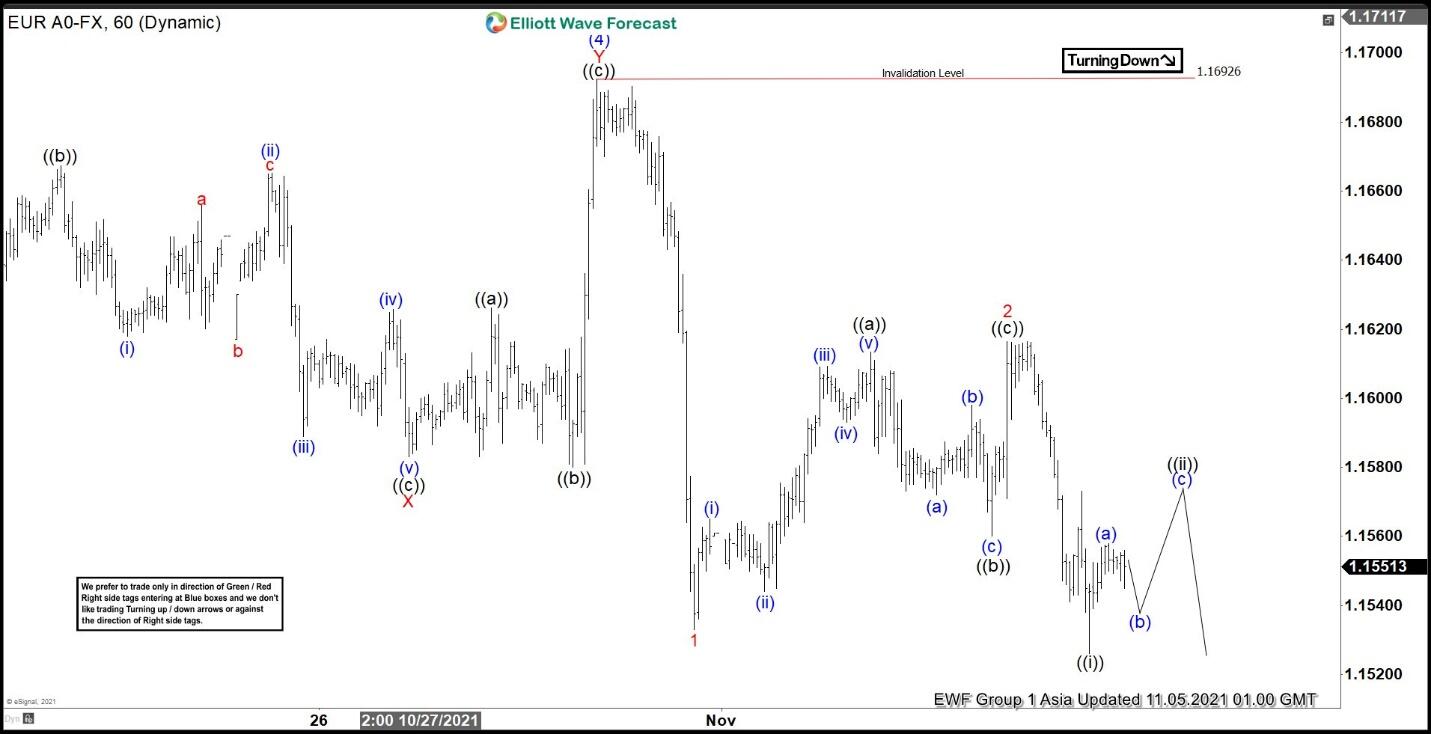
Short-term Elliott wave view in EURUSD suggests the decline from May 25, 2021 peak is unfolding as a 5 waves impulse Elliott Wave structure. Down from May 25, wave (1) ended at 1.1664 and rally in wave (2) ended at 1.1909. Pair then extends lower in wave (3) towards 1.1522 and bounce in wave (4) ended at 1.1692. Internal of wave (4) subdivided into a double three structure. Up from wave (3), wave W ended at 1.1669, wave X ended at 1.1583, and wave Y ended at 1.1692.
Wave (5) is currently in progress lower. Internal of wave (5) unfolded as an impulse in lesser degree. Down from wave (4), wave 1 ended at 1.1533 and bounce in wave 2 ended at 1.16164. Internal of wave 2 unfolded as a zigzag structure where wave ((a)) ended at 1.1613, wave ((b)) ended at 1.156, and wave ((c)) ended at 1.16164. Pair has resumed lower in wave 3. Down from wave 2, wave ((i)) ended at 1.1526. Near term, while wave ((ii)) rally fails below 1.16164, and more importantly below 1.1692, expect pair to extend lower. Potential target lower is 100% – 161.8% Fibonacci extension of wave 1 at 1.1359 – 1.145.
EURUSD 60 Minutes Elliott Wave Chart